26 March 2006

The Harry Potter Problem.

Some mundane programming issues have really cool names. One of them is the Harry Potter problem.

In his latest post, Greg talks about the "Customers who bought this also bought" feature, internally known at Amazon at the time as the 'similarities' feature. One of the early problems with 'similarities' was the 'Harry Potter' problem.

See, everyone and their dog bought Harry Potter:

"This kind of similarity is not very useful. If I'm looking at the book "The Psychology of Computer Programming", telling me that customers are also interested in Harry Potter is not helpful. Recommending "Peopleware" and "The Mythical Man Month", that is pretty helpful."


This is in the same vein as another of my favorites, the "Bud Vase Feature."

Senators Then And Now.

One of the more off color arguments for U.S. Senator Kerry in his race for the Presidency in 2004, was that as a sailor in the U.S. Navy he had killed a lot guys, which in truth, he had.

But, in the Roman Empire, Julius Caesar, at age twenty-four, in 69 BC, is reputed to have organized his own private military expedition to kill hundreds of pirates who had kidnapped him.

Of course, we have had a Presidential candidate who did something similar in recent times. His name: Ross Perot, who organized an expedition to free his employees who had been held hostage in the Middle East.

Apparently, this kind of action is no longer a political plus. Neither man, won their election.

Hat Tip to Stygius.

Secret Order Based On Secret Evidence Appealled

An attorney for an accused terrorist plotter in New York is appealling an order in pre-trial proceedings in the criminal trial to disclose the basis of a decision made based upon evidence and argument not made available to the defendant or his attorney, in a writ of mandamus. Previous coverage of the matter is found here.

Don't Let The Door Hit You On The Way Out.

"Don't Let The door Hit You On The Way Out.", is how a 6th Circuit Court of Appeals judge sums up current U.S. Immigration policy as implemented in our woefully inadequate administrative court system. In the case before it, an immigration judge was acting in a manner that seemed wholely disconnected from the case, and the immigrant's lawyer was screwing up keeping out valuable evidence. Also, notably, the Court of Appeals took judicial notice of Wikipedia as an authority of the state of affairs in Mauritania.

Farewell Colorado Luis.

I join the blogosphere in bidding a fond farewell to Colorado Luis's blog. Luis has been a valueable guide for me in blogging and the views expressed on his blog have consistently been original and on target. We can only hope that his next endeavors will be equally successful.

The Humvee Problem


The Humvee was the American successor to the jeep. It entered service in 1985, as one of the last major military systems purchased in the Cold War, and was used first in the First Gulf War under the administration of the elder George Bush, then in Kosovo and Bosnia and Somalia during the Clinton administration, and is now being widely used in the Iraq War and in Afghanistan during the administration of George W. Bush. The military has tens of thousands of them, if not hundreds of thousands of them, and there are about a dozen different variants of them.

When the Humvee was first designed, the main focus was on its off road capabilities. There is probably no four wheeled vehicle that rivals it in this respect. Its low center of gravity, wide frame, four wheel drive and other features allow it to climb steep hills (60% grade), drive with a right side much higher than its left (40% grade), or visa versa, and its undercarriage is designed to give it exceptionally high clearance (16 inches) of rocks and tree stumps and debris that may be in its way, and ford shallow streams (30 inches in a standard configuration). In short, it is designed to be able to carry modest loads of cargo and troops anywhere tracked military vehicles, like tanks and Bradley fighting vehicles, could while getting fuel economy at about 12 mpg, which isn't great, but is far better than a tank, 0.5 mpg, or a Bradley, at about 1.5 mpg. (A Stryker gets about 6 mpg.)

The downside of the Humvee is that, despite being a military vehicle, it was basically designed to be a non-combatant, providing mobility for forced behind the front lines in a European conflict with the Soviet Union. As one commentator puts it, "'just getting around and doing work, particularly in quieter areas' is a role concept that becomes deeply questionable for a military vehicle." Civilian vehicles without extreme off roads capabilities can do that in areas that are genuinely behind the front lines, like military bases away from combat zones, for less money with greater performance. But, a vehicle that isn't even armored enough to stop shrapnel and ordinary firearm rounds, and has no design features to protect its occupants from land mines is ill suited for use in a combat zone, even when the opposition has already been stripped of heavy weapons like aircraft, tanks and heavy artillery.

This is particularly a concern as the roles of the Humvee have expanded because the military has a great many of them. While it was well designed to serve as a behind the front lines cargo/troop carrier, or shelter carrier, and is reasonably useful as a field ambulance, its design its less suited to its roles as a patrol vehicle and automatic weapons platform, which implies a vehicle likely to get into firefights, as an anti-tank missile carrier, and hence very near enemy tanks, or as a light howitzer carrier, and hence operating close to the battlefield and possibly facing return fire. In the conflicts where it has been used militarily, its role as a automatic weapons platform on patrol duty in urban or hostile territories, for which it wasn't designed, has been particularly in demand, and while there has been relatively little occasion for Humvees to be used in the extreme off road environments for which it was designed.

Another problem with the Humvee is its size. While two or three of them can fit on a C-130 intratheater transport plane, they can not be carried on a V-22, or internally by any American military helicopter, and are difficult for all but the largest of American military helicopters to carry externally. This means that troops delivered by helicopter have to walk or use some other vehicle once they are dropped off.

These are the problems that are driving the choice of successors to the Humvee. Vehicles can be designed to better address these problems, and it will probably take three different kinds of vehicles to address the problems that have arisen with it.

Armor can provide protection against enemy gunfire in firefights, and many existing Humvees have been armored to address this issue. But, the Humvee wasn't designed to carry the kind of weight that armor creates, so armored Humvees face suspension problems and other maintenance difficulties. Improvised armor is often not terribly good at protecting occupants. And, even relatively ample, factory designed armor isn't sufficient to make a Humvee impervious to heavier weapons like anti-tank rounds and rocket propelled grenades (RPGs).

The M1117 "Guardian" Armored Security Vehicle, which costs about $700,000 each, compared to $100,000-$200,000 for a Humvee, in contrast, was designed from the ground up to act as a heavy automatic weapons platform that protects its occupants from enemy fire, and the U.S. military has about 1,000 on order from the New Orleans firm that makes them, but being in New Orleans, production is not what might be hope for in the short run.

The key to protecting occupants from land mines (such as the improvised explosive devices or IEDs found in Iraq) appears to be to have the bottom of the vehicle formed in a V shape that directs blast energy away from the vehicle, and to make that part of the vehicle out of explosion resistant material. Vehicles designed with this goal in mind have been purchased by military forces in significant numbers in South Africa, Australia, Germany and Britain, but Canadian and American militaries are just starting to purchase small numbers of them, such as the Cougar, the Buffalo, and the RG-31 Nyala for troops specifically tasked with destroying land mines and doing road work. But, the widespread adoption of V-shaped hull vehicles for ordinary patrolling troops who might encounter land mines hasn't yet taken place.

More vehicles to address both the armor and land mine issues are on the drawing boards, with the Georgia Tech designed "Ultra AP", a Ford F-350 pickup truck derivative, garnering the most press.

The size problem can't be addressed in the same vehicle as the armor and land mine problems. A vehicle small enough to fit on a V-22 or C-47 helicopter, can't also be bullet proof and mine resistant using today's technology. But, dune buggy like ITVs are being investigated by the Marines to fill this gap.

Finally, there is an increasing movement in the military to simply use commercial off the shelf technology, like every day pickup trucks and vans, for truly safe areas, like military bases outside hostile territory, for the kind of utility roles for which the Humvee was designed, where extreme off road conditions aren't likely to arise.

This doesn't mean that there isn't a role for the Humvee going forward. It does what it was designed to do, which is carry cargo and troops over very rough terrain in areas where enemy land mines and gunfire are unlikely to be encountered, very well. But, while the military of the 1980s and 1990s thought that it needed 55,000+ vehicles to fill this niche, and fewer than a couple thousand designed for the anti-land mine, urban firefight role, and only a few dozen for special forces capable of easily being transported by helicopter or V-22, in hindsight, this has proven to be a miscalculation. It turns out that tens of thousands of armored patrol vehicles land mine resistance are necessary, that perhaps only a couple of thousand vehicles with extreme off road non-combatant capabilities are needed (and even they could use some designed add on armor capability), that two to four thousand helicopter or V-22 transportable vehicles are needed, and that there is no need for vehicles in safe areas to have an expensive military design at all.

New vehicles, of course, cost money. But, lightly armored ground vehicles for the Army are still remarkably cheap compared to the budgets of the Navy and Air Force for equipment. For example, for the cost of one proposed DD(X) destroyer, one can buy 4,000 Guardian ASV patrol vehicles, or 6,800 RG-31 Nyala land mine resistant vehicles. One can buy three or four commercial diesel pickup trucks for the cost of one unarmored humvee, and they also cost less to maintain and fuel.

Also, while I have called this failure to purchase light armored and land mine resistant vehicles in the 1980s "a miscalculation", this is really being generous towards Army planners. The U.S. military made a conscious calculation in the wake of the Vietnam war to build a military force that was not designed for fighting light counterinsurgency like the one it had just lost in the hope that politicians would be discouraged from sending the U.S. military to fight those kinds of conflicts in the future.

Instead, it built a force more or less exclusively designed for large, set piece, conventional battles in Europe against a Soviet foe. The mainstay M1 Abrahms tank, for instance, didn't have any significant number of units designed with such basic features for asymmetric combat, as a metal shield from which a machine gunner could fire in safety, until the Iraq War, is too heavy to be easily transported, and is not well suited for close quarters combat. The Humvee was designed without any meaningful armor or land mine protection. While the Swift Boats that John Kerry became a hero commanding in Vietnam were a key component of the "brown water" Navy at the time, the U.S. Navy built up after the Vietnam War was almost exclusively a "blue water" Navy that largely removed operations in coastal waters and support of ground troops on the coast from the kind of missions it prepared to fight. The Navy has removed its ground attack oriented A-6 from its carrier fleet, in favor of more air to air combat oriented fighter aircraft, and has decommissioned its big gunned battleships that could be used for ground bombardment. The Air Force has shunned the idea of developing successors to the Vietnam era A-10 and AC-130 aircraft which were designed to support ground troops, and has repeatedly tried to scuttle those that remain.

This is likely to change. While military planners are always busy fighting "the last war", Iraq has profoundly changed that vision that those planners have in mind. The Army, late in the game, is starting to see that its "Future Combat System" a high tech answer to the problems of the Cold War, may be the right solution to the wrong problem, and to see counter-insurgency as a more central mission. Military ship building is starting to focus on high speed military transports like the USS Swift, and the coastal conflict oriented littoral combat ship, while production of the proposed DD(X) destroyer buy has been repeatedly cut. The Air Force's purchases of the air to air combat oriented F-22 fighter was greatly reduced from the original plans to buy 700+ of them, to current plans to buy just 180 or so, with purchases complete in 2008.

At some points, the new thinking in defense of old programs has reached the ridiculous. For a while, the Air Force was floating the idea of using the F-22 to deal with land mines. The Navy's retooled Ohio class ballistic missile submarines have been sold as a way to deploy Navy SEALs. Both capabilities may exist, but the Air Force simply isn't going to end up using many quarter of a billion dollar stealth aircraft to destroy $250 IEDs, when the same thing can be done with $500,000 specialized trucks, and a multi-billion dollar, 18,750 ton submarine, carrying a 60 ton, $446 million submarine landing craft is a ponderous and expensive way to deploy a dozen or so Navy SEALs when a 60 ton version of a USS Swift type catamaran, could do the job just as well for $6 million.

But, while budgetary politics encourages everyone in the procurement process to hang on to existing programs when possible, it is the vision that military planners have of the nature of future threats that drives new programs and influences which programs must be cut in budgetary lean times. The growing consensus that the next war will look more like Iraq and less like WWIII with the Soviet Union (with apologies to those who call the Cold War WWIII, and call current spat of unconventional and counterinsurgent campaigns WWIV), will change what the military seeks to do going forward.

23 March 2006

Laboratory Scale Frame Dragging Experiment.

General relativity predicts an effect known as frame dragging, also known as gravitomagnetism. Just as electrical charges in motion can create magnetic fields, moving masses, in theory, under general relativity, can create gravitational fields analogous to electromagnetic fields where the primary gravitational effect is similar to an electrical field.

But, gravitomagnetic fields are generally predicted to be so faint that they can only be detected with supersophisticated equipment a carefully chosen locations in space. But, now some experimenters claims to have discovered the same kinds of frame dragging phenomena in a relatively ordinary physics laboratory, using relatively common place superconductors.

This would allow precise general relativity experiments to be conducted for tens or hundreds of thousands of dollars, instead of tens or hundreds of millions of dollars. Previously, while a small number of existing general relativity tests, like Gravity Probe B, can be conducted on a truly experimental basis at an immense cost that makes them hard to reproduce experimentally, and special relativity is comparatively easy to test in a laboratory, most general relativity research has been conducted with telescopes on an observational basis, which makes precision difficult to secure because so many of the masses and distances involved themselves have considerable experimental uncertainty associated with them. The results described in the pre-print linked above will probably be the subject of replication attempts that will prove or disprove the experimental results claimed within a few years, or less.

How could this effect be observed at this scale? The theory that motivated this experiment is that gravity is carried by a long hypothesized particle called a graviton, and that in this highly controlled environment, that graviton gains mass, thus greatly amplifying the frame dragging effect.

While general relativity has long been observed and confirmed at large scales, small scale gravity tests have proven difficult to conduct and the mechanism by which gravity operates at a distance has been largely confined to theory without any empirical basis. The main camps in the debate have been those who have preferred to model gravity with a carrier particle, much like other forces, and those who have advanced theories of quantum gravity which are fundamentally geometric in nature, proposing that time-space itself in quantitized. This experiment is one of the strongest indicators to date that gravity does have a quantum carrier particle, and it suggests avenues for further investigation of that hypothesis.

Some in the blogosphere have described this experiment as a radical disproof of Einstein's Theory of General Relativity, because the effect that is observed is much larger than one would conventionally expect to see. But, their mechanism of graviton mass gain, a theoretically well developed concept, bridges the gap between mainstream quantum theory and mainstream general relativity in a manner that really doesn't disprove well established theories in either realm.

22 March 2006

Federal Tax Form Simplification

The Tax Form Status Quo

There are three main federal tax forms for individuals in the United States. They are: the 1040EZ, the 1040A, and the 1040. About 50 million out of 130 million people file on 1040EZ or 1040A, while the remainding 80 million must file on the regular form 1040.

Roughly speaking, you must file a 1040 if:
* You have $100,000 or more of income
* You itemizes your deductions (including most home owners)
* You have a health care savings account
* You pay a penalty for early withdrawal
* You have moving expenses
* You have certain business expenses of performing artists and certain government employees
* You have household employees
* You have tips upon which their employer didn't pay FICA taxes
* You have any foreign income
* You pay or receive alimony
* You have any income from self-employment, rental properties, a trust or estate, or a closely held business (other than a C corporation), or
* You have non-mutual fund capital gains.

You can file a 1040EZ if:
* You have no dependents
* Are under age 65 and not blind
* Have under $100,000 of income
* Have no adjustments to income.
* Don't itemize
* Have no tax credits other than the earned income tax credit, and have no advanced earned income tax credit receipts and
* Have income only from wages, salaries, W-2 tips, taxable scholarships and grants, unemployment compensation, Alaska Permanent Fund dividends, interest up to $1,500 a year, and non-taxable combat pay.

You can file a 1040A if you could file a 1040EZ except for the fact that you had:
* Ordinary dividends and capital gains distributions
* Pension, annuity or IRA distributions
* Taxable social security and railraod retirement benefits
* Dependents
* Age over 65 or blind
* Adjustments to income for educator expenses, IRAs, student loan interest, or tuition deduction, or
* The child tax credit, the education tax credits, the EIC (including advanced EIC payments), the child and dependent care expense tax credits, the elderly or disabled tax credit, the adoption tax credit, or the retirement savings tax credit.

The Problem

There is a great deal to be said for allowing people to fill out a tax form that is no more complex than necessary. But, the current system makes people with relatively simple tax situations fill out the dreaded 1040, rather than a 1040A or 1040EZ, or will out the 1040A when a slightly modified 1040EZ could have done the job. The problem is primarily that a number of tax benefits and types of income common to people who would otherwise complete a 1040A or 1040EZ aren't available on those forms.

The Solution.

A few slight tweaks in who can use each form, with accompanying modifications of the forms and instructions, could allow tens of millions of people to use simpler tax forms, greatly reducing the complexity they have to face each year at tax time. What are they?

The following items should be added to Form 1040EZ:

* Income from alimony received (since many otherwise 1040EZ qualified people receive it).
* The special standard deduction for people who are blind (since many blind people would otherwise qualify for the 1040EZ, while few over age 65 would qualify since most forms of retirement income aren't included on the form; this adds two check boxs, a paragraph of instructions and four numbers to choose from, instead of two on the standard deduction and exemption line).
* Adjustments to income for student loan interest (almost all childless college graduates pay student loans), alimony paid (many wage earners without dependents pay this), health care savings accounts (many employed people have these), moving expenses (many people without dependents have these expenses), and penalties for early withdrawal (which often accompany interest income and are shown on Form 1099-INT). Schedules for HSAs and moving expenses would be included with the instructions to the 1040EZ instead of as separate forms.
* Advanced earned income tax credit payments. (These can be copied off a W-2).

The following items should be added to Form 1040A:

* Itemized deductions (many people file form 1040 only for this, and it doesn't make the Form 1040A much more complicated, since non-itemizers can skip the schedule).
* Taxable tax refund income (goes hand in hand with itemized deductions).
* Alimony paid and received (so common these days).
* Tips not reported to the employer (why should waiters have to file a 1040?).
* Household employment taxes (many wage earners have regular baby sitters who receive substantial payments subject to employment taxes).
* Adjustments to income for health care savings accounts, moving expenses, penalties for early withdrawal, and certain business expenses of reservists, performing artists and fee based government officials, all of which are commonly taken by middle income wage earners.
* Schedules for itemized deductions, tips not reported to the employer, household employment taxes, HSAs, moving expenses and special business expenses would be included with the instructions to the 1040A.

Thus, in this regime, you would have to file on Form 1040 only if:
* You have $100,000 or more of income
* You have any foreign income
* You have any income from self-employment, rental properties, a trust or estate, or a closely held business (other than a C corporation), or
* You have non-mutual fund capital gains (including alternative minimum taxes on incentive stock option grants).

With these adjustments, something like 30-40 million people who now file Form 1040 could file on either 1040EZ or 1040A, and at least several million people who now file on 1040A could now file on 1040EZ. Perhaps one in three tax paying households could file on an simpler tax form, without any substantive change in the tax law at all.

It would add about nine lines to the 1040EZ, and it would add about eleven lines and one schedule to the 1040A. But, much of the apparent added complexity on the forms is only apparent, because taxpayers already had to consider many of the matters raised by the additional lines in the course of deciding which form they needed to use.

The Sad Decline of General Motors Continues.

General Motors wants to cut about a quarter of its hourly work force in the United States by 2008 and is offering workers a buyout plan to make it happen.

Beware Foreign Asset Protection Trusts

If you put your fortune in foreign accounts or trusts, beyond the reach of U.S. Court, and the court doesn't believe that you don't have access to those funds, you could end up spending ten years to life in jail for contempt of court, as a certain Mr. Chadwick did.

This excerpt from a decision of panel of the U.S. Court of Appeals for the Third Circuit which included now Justice Alito, in 2002, sets forth the pertinent facts that let to the original jailing of Mr. Chadwick on non-punitive contempt of court charges:

In November 1992, Mrs. Barbara Chadwick filed for divorce in the Delaware County (Pennsylvania) Court of Common Pleas. During an equitable distribution conference in February 1993, Mr. Chadwick informed the state court and Mrs. Chadwick that he had unilaterally transferred $2,502,000.00 of the marital estate to satisfy an alleged debt to Maison Blanche, Ltd., a Gibraltar partnership.

It was later discovered that (1) one of the principals of Maison Blanche had returned $869,106.00 from Gibraltar to an American bank account in Mr. Chadwick's name and that these funds had then been used to purchase three insurance annuity contracts; (2) $995,726.41 had been transferred to a Union Bank account in Switzerland in Mr. Chadwick's name; and (3) $550,000.00 in stock certificates that the petitioner claimed he had transferred to an unknown barrister in England to forward to Maison Blanche had never been received. The state court then entered a freeze order on the marital assets on April 29, 1994.

In May 1994, Mr. Chadwick redeemed the annuity contracts and deposited the funds in a Panamanian bank. After a hearing on July 22, 1994, the court determined that Mr. Chadwick's transfer of the money was an attempt to defraud Mrs. Chadwick and the court. At that time, the court ordered petitioner to return the $2,502,000.00 to an account under the jurisdiction of the court, to pay $75,000.00 for Mrs. Chadwick's attorney's fees and costs, to surrender his passport, and to remain within the jurisdiction. Mr. Chadwick refused to comply, and Mrs. Chadwick thereafter filed a petition to have him held in civil contempt. Mr. Chadwick failed to appear at any of the three contempt hearings, but his attorney was present. The court found Mr. Chadwick in contempt of the July 22, 1994, order and issued a bench warrant for his arrest.

After learning of the bench warrant, Mr. Chadwick fled the jurisdiction but was arrested and detained on April 5, 1995. The state court determined that Mr. Chadwick had the present ability to comply with the terms of the July 22, 1994, order and set bail at $3,000,000. Mr. Chadwick could have been released from custody either by posting bail or by complying with the July 22, 1994, order. To date, he has done neither.


After ten years in custody, he is right where he started.

He was jailed in 1995 for allegedly hiding $2.5 million in overseas banks during a bitter divorce. Since then, a series of judges have told him he could go free once he tells the court what happened to the money, but Chadwick hasn't budged, the judges said.

Chadwick, a former corporate lawyer, maintains he lost the money in an overseas investment. Experts say it would now be worth more than $8 million.

In the latest ruling in the meandering case, a three-judge Delaware County panel concluded that the most recent court-ordered financial probe did little to resolve questions about the money. Chadwick, while claiming cooperation, did not give investigators full power to follow the money trail overseas, the judges said.

"Defendant Chadwick's lack of cooperation undermined the entire investigation, invalidating any conclusions or recommendations," the judges wrote in their ruling last month.


I have seen the contempt power abused in divorce cases where the contempt defendant doesn't have the ability to pay the amount he is compelled to pay and is cooperating. If the amount at stake were smaller, I might be inclined to believe that he really didn't have any further ability to cooperate in finding the money he hid, or to recover it. But, people will go to great lengths to hold onto $2.5 million, and so I'm inclined to think that deferrence to the court findings here is in order.

Moreover, even if the court was wrong, and he has no ability to recover the $2.5 million, it is hard to say that Mr. Chadwick has been morally wronged yet, even though it would be a legal wrong. Ten years in jail is far from being a cruel or unusual punishment for intentionally defauding your ex-wife of $2.5 million, even if is more than would be authorized for a punitive contempt punishment in the case. There is someone who is serving a life sentence right now for stealing some golf clubs in California. This case hardly shocks the conscience by comparison.

Mr. Chadwick, who is 68 years old, faces a real likelihood of dying in jail, and the funds will probably never be recovered. He asked for it, and he got it.

Judges hate foreign asset protection techniques, and even if you are technically correct that you shouldn't be subject to contempt of court sanctions that keep you in jail for a very long time in an effort to force you to comply with a court order to deliver the funds, this doesn't mean that the judges will believe you. Foreign asset protection is a high risk venture that one pursues only at one's own peril.

Low Profile Democratic Candidates.

There are actually two candidates running for the Democratic ticket in the Colorado Attorney General's race against Republican John Suthers. One is Fern O'Brien, who is the party's favorite, and the other is Robert Leland Johnson (one of the oldest members of the bar at attorney registration number 564), who apparently runs a solo practice and hasn't issued a press release announcing his candidacy.

Another candidate whom I had never heard of, but is apparently seeking the Democratic nomination for Governor in Colorado, other than Bill Ritter, is Samuel Bridges (unless he is really Rutt Bridges, but I don't believe that he is the same person).

And, in addition to much better known Colorado State Treasurer candidate, Cary Kennedy, a fellow by the name of John Turner appears to be running for that office on the Democratic party ticket.

Realistically, none of these lesser known candidates have a prayer of being elected, and have only a very dim chance of even making it onto the ballot at all, as one of the key aspects of getting elected is being well known, and it is late in the game for no one to have even heard of you, when ballot qualification deadlines are only a couple of months away.

IRS Audit Statistics

Audit rates are based on periodic comprehensive examinations of large samples of taxpayers of each type to determine which examinations are most likely to produce additional IRS revenues. The latest numbers show the returns most likely to fail to report all taxes due with the return. Some returns like partnerships, S corporations, gift taxes and fiduciary income tax returns, are low primarily because they are usually information returns upon which no taxes are due.

The percentage of returns audited in 2005 by type, illustrates who is most and least likely to get their tax due amounts wrong (TPI stands for total positive income):

C Corporations with assets $10,000,000 and over----------20.02%
Estate tax (usually estates $2,000,000 in value or more)--8.20%
Sole proprietorships under $25,000 in gross receipts------3.68%
Sole proprietorships $100,000+ of gross receipts----------3.65%
Sole proprietorships $25,000 to $100,000 gross receipts---2.21%
Individual Returns Under $25,000 TPI (not 1040A)----------1.48%
Individual Returns $100,000+ TPI--------------------------1.19%
Farms with $100,000+ Gross Receipts-----------------------1.01%
Gift Tax Returns------------------------------------------0.81%
C Corporations under $10,000,000 in assets----------------0.79%
Individual Returns $25,000 to $49,999 TPI-----------------0.60%
Individual Returns $50,000 to $99,999 TPI-----------------0.57%
Individual Returns under $25,000 on Form 1040A------------0.52%
Farms with under $100,000 gross receipts------------------0.48%
Partnerships----------------------------------------------0.33%
S Corporations--------------------------------------------0.30%
Fiduciary (Estate and Trust Income)-----------------------0.18%

There were 1,215,308 individual income tax returns were audited during fiscal year 2005, out of 130.6 million returns. Of those, 521,872 (42.9%) were selected on the basis of an earned income tax credit (EITC) claim, which accounts for the high audit rate of returns with under $25,000 of total positive income.

About 20% of the audits were conducted in person, while about 80% were conducted by mail. Automatic computerized calculation corrections that don't change any of the factual basis for a return, but change the tax due, don't count as audits in the statistics above.

More information is available at the IRS website in the 2005 Data Book (Pub 55B, March 2006).

Bottom Line: The earned income tax credit is too complicated for a great many taxpayers resulting in a plethora of minor IRS hassles. And, otherwise, big business, the wealthy and the self-employed account for most tax mischief.

Election Deadlines

Via Colorado Pols:

• March 27: First day to begin circulating candidate petitions for Primary Election.

• April 1-20: County Assemblies (click for Democrat or Republican)

• Mid-May: Congressional District Assemblies.

• May 20: State Assembly (both parties).

• May 25: Last day to file candidate petitions for Primary Election.

• July 10: Last day to register to vote for the primary election.

• July 28: Last day to apply for an absentee ballot for the primary election if the ballot is to be mailed.

• July 29: Early voting begins for the primary election.

• Aug. 4: Last day for early voting; last day to apply for an absentee ballot for the primary election if the ballot is not to be mailed.

• Aug. 8: Primary Election Day.

• Oct. 10: Last day to register to vote for the General Election.

• Oct. 23: Early voting begins

• Oct. 27: Last day to apply for an absentee ballot for the General Election if mailed.

• Nov. 3: Last day to apply for an absentee ballot for the General Election if not mailed.

• Nov. 3: Last day for early voting.

• Nov. 7: Election Day.


The Democratic Party County Assembly in Denver, which I plan to attend as a delegate, is on April 8.

In the initiative process:

The deadline for 2006 proposals is April 21, 2006, and May 26, 2006 is the last day to finish the pre-petition circulation initiative process. You need 67,829 signatures to get on the ballot, which must be turned in by August 7, 2006 at 3:00 p.m.


And, there is a special election planned for May, 2006 for the Xcel Energy franchise in Denver. More background here. Negotiations on the agreement were in progress at least as long ago as July of 2005. I presume that there is a deadline to give notice of an election like this, but am not familiar with those rules without looking them up and have contacted my friendly neighborhood election commissioner for more information.

UPDATED: The scoop from Denver Election Commissioner Sandy Adams is as follows:

There probably will be a 3rd election in 2006 for the Xcel franchise, but WHEN will be determined by City council and Xcel. The Election Commission will administer it. You might want to check with CC to see when they think that election will be. The Commission would like to see it happen at the same time as the Aug primary or the November 2006 election to avoid a special election.

A War Crime In Iraq

Not all soldiers deserve our support. (Emphasis added in excerpt below).

The military says about 12 Marines are under investigation for possible war crimes by the Naval Criminal Investigative Service following the Nov. 19 insurgent attack in Haditha, 140 miles northwest of Baghdad. . . .

[A] videotape two months ago taken by a Haditha journalism student that shows the dead still in their nightclothes. . . .

Rsayef and another resident, former city councilman Imad Jawad Hamza, who spoke with hospital officials and residents, said the first house to be stormed was that of Abdul-Hamid Hassan Ali, which was near the scene of the bombing.

Ali, 76, whose left leg was amputated years ago because of diabetes, died after being shot in the stomach and chest. His wife, Khamisa, 66, was shot in the back. Ali's son, Jahid, 43, was hit in the head and chest. Son Walid, 37, was burned to death after a grenade was thrown into his room, and a third son, 28-year-old Rashid, died after he was shot in the head and chest, Rsayef and Hamza said.

Also among the dead were son Walid's wife, Asma, 32, who was shot in the head, and their son Abdullah, 4, who was shot in the chest, Rsayef and Hamza said.

Walid's 8-year-old daughter, Iman, and his 6-year-old son, Abdul-Rahman, were wounded and U.S. troops took them to Baghdad for treatment. The only person who escaped unharmed was Walid's 5-month-old daughter, Asia. . . .

Rsayef said those killed in the second house were his brother Younis, 43, who was shot in the stomach and chest, the brother's wife Aida, 40, who was shot in the neck and chest while still in bed where she was recuperating from bladder surgery. Their 8-year-old son Mohammed bled to death after being shot in the right arm, Rsayef said.

Also killed were Younis's daughters, Nour, 14, who was shot in the head; Seba, 10, who was hit in the chest; Zeinab, 5, shot in the chest and stomach; and Aisha, 3, who was shot in the chest. Hoda Yassin, a visiting relative, was also killed, Rsayef and Hamza said.

The only survivor from Younis's family was his 15-year-old daughter Safa, who pretended she was dead. . . .

Dr. Walid al-Hadithi, chief physician at Haditha General Hospital, said that about midnight the day of the attack, two U.S. Humvees arrived at the hospital — one carrying the bodies of men and the other those of women and children.

"They (the Marines) told me the women and children were shot in their homes, and they added that the men were saboteurs," al-Hadithi said. He said he was given a total of 24 bodies. "All had bullet wounds."


What did the military report:

A U.S. military statement in November described it as an ambush on a joint U.S.-Iraqi patrol that left 15 civilians, eight insurgents and a U.S. Marine dead in the bombing and a subsequent firefight. The statement said the 15 civilians were killed by the blast [an IED that destroyed a U.S. Humvee].


IEDs don't inflict bullet wounds on people asleep in their homes.

To Do List: Give To Ned Lamont

I don't make donations to political candidates on the spur of the moment. I have a limited budget, consider where my meager funds would make the most difference this campaign season, and then write the checks. I've written only a couple in my life to out of state candidates. This year, I'll write another. The check will be to the primary campaign of Ned Lamont who is opposing Joe Lieberman in the Connecticut Democratic primary.

Why? Because, as explained by a long time local supportere Joe Lieberman, a member of my own political party, as done a great deal of damage to the party (far more than on my shitlist local Senator Ken Salazar, despite Lieberman's overall more liberal career voting record).

Lieberman, who cannot countenance violent videogames, has occasionally sounded like an apologist for real-life torture.


Democrats have a right to expect better from a Democratic Senator from blue Connecticut (Kerry got 54.3% of the vote in 2004 in CT compared to 47% in CO; only the District of the Columbia and five states Northeast of it were more pro-Kerry).

There is a place for bipartisanship in Washington. Bipartisanship means looking for solutions that are not controversial on partisan grounds that can bring about positive change. For example, while gun control is hot button political issue, aggressively punishing those who use guns in crimes (at least, where the gun has a meaningful nexus with the crime) is not. Partisans focus on the former, bipartisans try to find common ground dealing with the later approach.

Joe Lieberman doesn't engage in that kind of bipartisanship. His brand of politics is closer to partisan schizophrenia, favoring one party's divisive party line in a partisan way some of the time, and the other party's divisive party line in a partisan way at other times. There is nothing wrong with occassionally taking a strong stand on a divisive issue. This is what we pay politicians to do. But, neither I, nor the Democratic party generally, has an obligation to support those who eat their own. We don't need Democrats who say things like:

It's time for Democrats who distrust President Bush to acknowledge that he will be the commander in chief for three more critical years and that in matters of war we undermine the president's credibility at our nation's peril.


Save shrill, ignorant efforts to shut down legitimate criticism in the name of patriotism for members of that other party. I scarcely know Ned Lamont, but I'm confident that he won't harm the Democratic party in the way that Joe Lieberman has hurt it.

U.S. Torture Policy Saga Continues.

The Bush Administration has backed away from its "we don't torture people, but we'll accept confessions obtained with torture policy" (pushed strongly by Dick Cheney's chief of staff David Addington and Pentagon General Counsel William J. Haynes II) which it adopted in July for proceedings at Guantanamo Bay, as court review of the administration's policy looms and in light, perhaps of the unenforceable part of the Detainee Treatment Act of 2005 passed by Congress in December, in which Congress bans torture by the administration more definitively than it had previously.

The Bush administration will bar statements made under torture from its Guantanamo Bay military courts, reversing a White House decision in July that could have allowed such evidence to convict suspected terrorists held at the U.S. naval base in Cuba.

The new rule, expected to be issued this week, comes before Supreme Court arguments next Tuesday over the legality of the special courts, known as military commissions, which President Bush authorized after the Sept. 11, 2001, terrorist attacks to prosecute non-U.S. citizens for war crimes.


Despite the fact that the regulation has been approved, its text remains secret at this time and has not been disclosed to defense counsel. In particular, it is not clear how detainees will be permitted to prove that they were tortured or how narrow a defintion will be applied to the term "torture". The administration has denied that this has ever happened despite strong evidence to the contrary. It appears that the change in the rules about torture evidence may have been motivated by concerns about:

the United Nations Convention Against Torture and Other Cruel, Inhuman or Degrading Treatment or Punishment. The treaty, which the U.S. ratified in 1994, requires member countries to exclude statements taken under torture from "any proceeding."


This treaty has been raised in the Hamdan case by detainees arguing that the ever changing rules applied to their cases are illegal. Oral arguments in the Hamdan case will be held in the U.S. Supreme Court on March 28, 2006 and audiotapes will be promptly released to the public. The Detainee Treatment Act of 2005 has shifted the focus of the Hamdan case to whether it may proceed at all, in light of the act, and away from the merits of the case.

Separate litigation on the Detainee Treatment Act of 2005 is also pending in the U.S. Court of Appeals for the District of Columbia, which held oral arguments on the matter earlier today. Lawyers for detainees argued in that setting that the law is unconstitutional because it amounts to a suspension of the writ of habeas corpus in the absence of a rebellion or invasion, because it deprives all court of jurisdiction to hear such petitions.

Vacancies In Colorado: A Case Study

Democrat Deanna Hanna formally ended her State Senate term with a resignation on Tuesday, after controversy arose over the nature of her requests for campaign contributions. She wasn't precisely forced out. She did not have an ethics committee explusion recommendation hanging over her head and the odds are good that if an ethics committee investigation initiated by fellow Democratic State Senator Ken Gordon had gone that far, that a lesser sanction would have been recommended. The recall petition that had been in the works to oust her would have required well over ten thousand signatures, in a relatively short period of time, from registered voters in her state senate district, and there is a decent chance that petitioners would have failed to gather the requisite numbers of signatures, or that voters would not have decided to recall her. Absent a successful recall or explusion, she wouldn't even have been up for election in 2006.

Instead, the decision to resign was a political one. She left her office to avoid creating a campaign issue for Republicans in their campaigns against her colleagues in 2006, defusing the argument that Democrats have all the lack of ethical accountability that Republicans have been accused (often by the Bush Administration's Justice Department backed by solid evidence or other professional prosecutors, Tom Delay comes to mind), is shared by Democrats.

But, this decision was made easier by an important feature of Colorado politics that makes decisions like those made by Deanna Hanna issues of public perception and personal career fortunes, rather than opportunities to change the balance of power.

In Colorado, State House and State Senate vacancies are filled by vacancy committees comprises of officials of the departing legislator's own political party. I've served on two (one which appointed State Senator Jennifer Veiga, and another which appointed State Representative Anne McGihon, both of whom have since gone on to win elections in their respective districts without primary opposition). In the usual case, they consist of the precinct committee people in the District (a post to which I was elected for another two year term last night), although special rules apply in multi-county districts. Once a vacancy committee fills a post, the appointee serves only until the next general election in an even numbered year, even if, as in the case of Deanna Hanna's post, there normally would not have been an election for another two years.

This rule provides stability, and separates partisan issues from personal ones, in much the way that the Vice Presidency does at the national level. The political incentive for liberal to impeach President Bush, for example, is dramatically reduced by the sure knowledge that Vice President Dick Cheney would become President if such an impeachment were a success.

In this case, Democrat Betty Boyd, a state representative from Lakewood (within Deanna Hanna's district) was chosen in an unopposed Democratic party vacancy committee decision to fill Deanna Hanna's seat, and will take office Friday, leaving a mere two day vacancy in the post, during which the Senate is unlikely to conduct any serious business.

Another vacancy committee convened yesterday prior to the election of new precinct committeepeople in the precinct caucuses, chose (contrary to the rumors from Colorado Pols that another candidate was a lock), Democrat Andy Kerr, a school administrator with a background working with the Colorado Education Association when he was a teacher, to fill Betty Boyd's seat. In a matter of days, after a brief vacancy in the House, he too will restore the pre-Hanna resignation balance to the State House. In the meantime:

[Democratic House Majority Leader Alice] Madden is likely to keep controversial bills off the House floor until Boyd's replacement is sworn in Friday, she said.


Kerr was chosen, in significant part, because vacancy committee members felt that he, while being a solid Democrat, would also be a strongest candidate in the November election. He will be the candidate in that race, if he ends up being the Democratic party candidate after the caucus and primary processes are completed (which is likely because of the overlap between the caucus process the qualifies people for the general election ballot and the vacancy committee membership), in the relatively competitive Lakewood District that is House District 26. In 2004, incumbent Boyd received 16,606 votes (56% of the votes cast for the office), the Republican challenger Mike Smith received 12,424 votes, and Libertarian Doug Anderson received 799 votes. A race without an full fledged incumbent in House District 26 can be expected to be more competitive.

A vacancy in the Governor's post, similarly, is filled by a Lieutenant Governor of the same party who now is chosen by the Gubinatorial candidate him or herself before facing the voters. Unfortunately, Colorado has not yet adopted a similar system for the positions of Attorney General, Secretary of State or State Treasurer, where the Governor appoints a replacement who may be from a different political party than the incumbent, as was the case when Democratic Attorney General Ken Salazar was replaced by Republican Attorney General John Suthers.

If the federal models of a by-election or immediately gubinatorial appointment of a successor to Deanna Hanna, or even a simple rule that the post would remain vacant until the next election, had applied, the controversy would almost certainly have played out differently. Democratic party members would have urged Hanna to stay on to protect Democrat's one vote majority in the State Senate, and Hanna and all others Democrtas would have felt pressure to try to vehemently deny any wrong doing, rather than concluding that even an appearance of impropriety was enough to make resignation the right thing to do.

21 March 2006

Off To Caucus

I am off, in just a little while, to my local Democratic Party caucus. I previewed the issues, not many, previously.

Why Is The Defense Budget Expensive?

The author of the Defense Tech blog has a front page story in Popular Mechanics. Bottom line: The administration may talk the talk on the War on Terrorism and war in Iraq, but it is spending its defense dollars to a great extent to prepare for a war with China.

Inventing Iraq


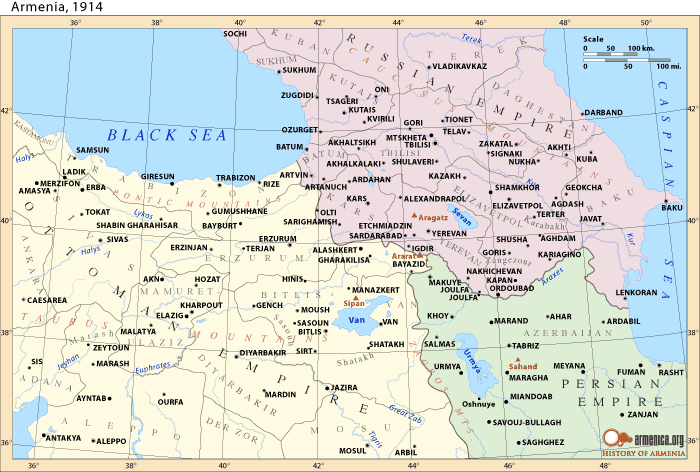
Historical map of Ottoman provinces of Musul, Baghdad and Basra.


Ottoman provinces of Diyarbekir and Musul in 1914, four years before Iraq was formed.

Iraq didn't exist in 1917. It was invented in 1918 by a British woman by the name of Gertrude Bell on tracing paper and in letters to the government in London.

[British Oriental Secretary] Gertrude Bell . . . in 1918 drew the borders of his country from three disparate provinces of the former Ottoman empire . . . .

Bell sketched the boundaries of Iraq on tracing paper after careful consultation with Iraqi tribes, consideration of Britain's need for oil and her own idiosyncratic geopolitical beliefs.

"The truth is I'm becoming a Sunni myself; you know where you are with them, they are staunch and they are guided, according to their lights, by reason; whereas with the Shi'ahs, however well intentioned they may be, at any moment some ignorant fanatic of an alim may tell them that by the order of God and himself they are to think differently," she wrote home.

She and her allies gave the monarchy to the minority Sunnis, denied independence to the Kurds in order to keep northern oil fields for Britain and withheld from the Shiite majority the democracy of which she thought them incapable.

"The object of every government here has always been to keep the Shi'ah divines from taking charge of public affairs," Bell wrote.

She confided in her father her greater hopes. "You are never to repeat -- because officially I may not hold these opinions -- that from the very beginning I've felt certain that if ever we succeed in setting up an orderly Arab independent Kingdom here we shall drive both the French and the Zionists into the Mediterranean. Of course they will all want to come in with us. And it will happen.'' . . . .

The names and families have held through the decades. Bell's Baghdad landlord was from the Chalabi family, the key minister in the Iraq government was Jafar, and Britain's nemesis in Iraq was a scowling young Shiite cleric named Sadr.

"The vilain [sic] of the piece is Saiyid Muhammad Sadr, the son of old Saiyid Hasan Sadr," she wrote home. ". . . Saiyid Muhammad was the man who first received us, a tall black bearded alim with a sinister expression. At the time you and I paid our call, Saiyid Muhammad was little more than the son of Saiyid Hasan, but a month later he leapt into an evil prominence as the chief agitator in the disturbances. He has still a certain amount of influence and it's a hand to hand conflict between us and him. He is in a black rage and I feel as if we were struggling against the powers of evil in the dark. You never know what Shi'ahs are up to." . . . .

Bell's camp ensured that Britain and its military would have say over Iraq's government and oil for decades to come. London installed a foreign Sunni sheik, Faisal, as Iraq's king in a rigged plebiscite with a Hussein-style, 96 percent yes vote.

To suppress Shiite and Sunni tribal revolts that followed, Britain pioneered air assaults on villages and the use of artillery shells filled with poison gas.

Though Iraq was given formal independence in 1932, the monarchy ensured British dominance until 1958, when mobs tore the young King Faisal II limb from limb. . . .

She killed herself in 1926, taking an overdose of sleeping pills in her bed on a hot summer night in Baghdad.


There is a constant temptation to assume that the present is the way that life has always been and always will be. Of course, the present is not eternal. In most of the world, political boundaries are recent and arbitrary. Iraq is no exception. It is 88 years old as a country. The people didn't vote to form it. But for the British use of military force every bit as brutal as that Saddam Hussein committed, it would not have held together (this is not to say that contemporary Ottomans were better -- the Armenian genocide was raging to the North of Iraq in what is now Turkey as Bell was forging Iraq). The inclusions of these Ottoman provinces in a single unit was ad hoc and designed for the advantage of the British, not Iraqis. The people of Iraq, indeed, spent four decades under a foreign installed monarchy before they managed to find their own dicators.

Before Gertrude Bell established the country of Iraq, the principal Ottoman political subdivision (with the year each was formed) that went into Iraq were Baghdad (1535), Basra (1546) and Mosul (1535), as well as part of Diyarbekir (1515), the rest of which went to Turkey, and a chunk of whatever province contained much of Iraq's thinly populated Southwestern desert, most of which is in Iraq's Anbar province now.

Now, the American led Iraq War has established a new regime in Iraq, and set off a regionally distinct, factional, civil war in Iraq. Remnants of Ottoman Diyarbekir and Mosul, which are still parts of Iraq, might become an autonomous Kurdistan; central Iraq might become an autonomous region of Baghdad; and that the South might become an autonomous Basra. This, or something along those lines, might quell much of the violence in Iraq now. (Daniel Schorr, who is National Public Radio's in house voice of conventional wisdom on foreign affairs is beginning to come to the same conclusion, seeing division rather than unification as the trend of our era, and the disintegration of Iraq as perhaps inevitable in the face of sectarian violence.)


Iraqi election results.

The United States fought a civil war from 1861 to 1865 to maintain its territorial integrity. But, the nation it sought to hold together was the product of the democratic agreement of its constituent parts, and one can fairly question the legitimacy of the generally democratic basis asking for Southern succession because a significant share of the population, black slaves, were excluded from the process. The case for holding Iraq together is far weaker.