28 March 2019

Shared Environment Matters For IQ And Anti-Social Behavior In Young People

More personality traits and mental health conditions have significant genetic components (statistically) but almost no variability attributable to shared environment. The main exceptions are IQ (32%) and anti-social behavior (31%) in children, which show significant shared environment effects, although shared environment effects are much less pronounced as people get older (4-5%).

Thus, parents can influence childhood intelligence and rates of anti-social behavior, but not personality or the manifestation of mental health conditions. Parental influence declines in adults over time, however, as people gravitate in the direction of their genetics.
Shared Versus Nonshared Environmental Influences  
Whereas the dominant theoretical and empirical traditions within developmental psychology have emphasized the influence of shared rather than nonshared environmental factors, behavioral genetic research is consistent in showing that environmental influences on most psychological traits are of the nonshared rather than the shared variety (Plomin & Daniels 1987).  
For personality characteristics, the MZT correlation has consistently exceeded the corresponding DZT correlation by more than a factor of two. This observation, first noted by Loehlin & Nichols (1976) but replicated in diverse cultures with thousands of twin pairs (Loehlin 1992), implies a shared environmental component of zero. Alternatively, the consistently high ratio of MZT to DZT correlation could reflect genetic nonadditivity, or greater environmental sharing among MZT as compared with DZT twins. It is thus significant that findings from studies of reared together twins have been replicated using alternative research designs. For example, MZTs are not markedly more similar in personality than MZAs. In the four published studies comparing the similarity of MZA and MZT twins on the two most fundamental dimensions of personality, extraversion and neuroticism, the weighted average MZA correlation is .39 for both factors (summarized by Loehlin 1992). The comparable MZT averages are .56 for extraversion and .46 for neuroticism. Secondly, the correlation for nonbiologically related but reared together sibling pairs (i.e. adoptive siblings) provides a direct estimate of the effect of common rearing; in three adoption studies of adults (summarized by Loehlin 1992), the weighted average adoptive sibling correlation was −.07 for extraversion and .09 for neuroticism, while in a single adoption study of adolescents, the adoptive sibling correlation was −.04 for a measure of extraversion and .00 for a measure of neuroticism (McGue et al 1996).  
The minimal effect of common rearing appears to hold not only for personality factors but also for most major forms of psychopathology. Adoption studies of, for example, schizophrenia (Gottesman 1991) and alcoholism (McGue 1995) indicate that risk to the biological offspring of an affected parent is independent of whether the offspring is reared by the affected parent, while twin studies of most behavioral disorders reveal a greater than 2:1 ratio of MZT to DZT concordance (see above). 
There are, however, two noteworthy exceptions to the general finding of little shared environmental influence on behavioral characteristics: cognitive ability and juvenile delinquency. From a compilation of familial IQ correlations (Bouchard & McGue 1981), the following observations all support the existence of substantial shared environmental influences on general cognitive ability: (a) the average MZT IQ correlation (.86) is less than double the corresponding average DZT correlation (.60); (b) the average MZA correlation (.72) is moderately lower than the average MZT correlation; and (c) the average adoptive sibling correlation (.32) is substantial. Taken together, these observations suggest that from 20% to 30% of the variance in IQ is associated with shared environmental effects (Chipuer et al 1990).  
The overwhelming majority of the twin and adoptive sibling correlations for IQ are based on preadult samples, for which the effect of shared environmental factors may be maximal. As noted above, when twin IQ correlations are categorized according to the age of the twin sample (McGue et al 1993), the ratio of MZT to DZT correlation is found to increase with age such that in adult samples the average MZT correlation (.83) exceeds the average DZT correlation (.39) by more than a factor of two, suggesting no shared environmental influence at this life stage. Moreover, the average adoptive sibling IQ correlation equals .32 in studies of children or adolescents (summarized in Bouchard 1997a), but, as already noted, only .04 in studies of adults. The adoptive sibling correlation decreased with age in each of the three of these studies that involved longitudinal assessment of IQ. Shared environmental influences on IQ, although substantial in childhood, appear to decrease markedly in adulthood.  
The pooled concordance rates for male juvenile delinquency are high and similar for MZT (91%) and DZT (73%), suggesting a substantial influence of shared environmental factors (Gottesman & Goldsmith 1994). Similarly, twin correlations for delinquency assessed quantitatively (e.g. as number of delinquent acts) rather than categorically find evidence for strong shared environmental effects (Rowe 1994, Silberg et al 1996). Like IQ, the influence of shared environmental factors on adolescent antisocial behavior may diminish in adulthood. In a sample of more than 3000 US veteran twin pairs, Lyons and colleagues (1995) reported that the heritability of antisocial behavior increased from .07 in adolescence to .43 in adulthood, while the proportion of variance associated with shared environmental effects decreased from .31 in adolescence to .05 in adulthood. The matter is not fully resolved, however, as a subsequent investigation of more than 2500 Australian twins (Slutske et al 14 McGUE & BOUCHARD 1997) reported significant heritability (.71) and no shared environmental effect for retrospectively assessed adolescent conduct disorder.
From Matt McGue and Thomas J. Bouchard, Jr , "Genetics And Environmental Influences On Human Behavior Differences", 21 Annu. Rev. Neurosci. 1–24 (1998) (emphasis added).

A 2004 follow up review of the data by Bouchard is a major reference point for the issue. It results were as follows:
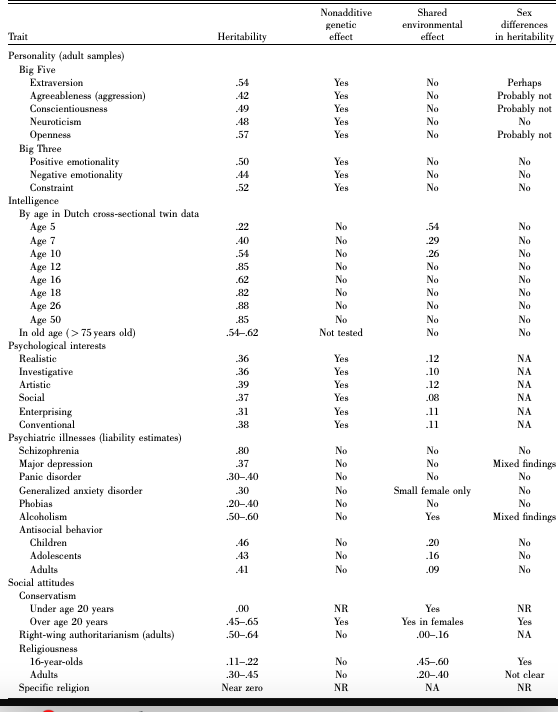

This shows modest (ca. 8-12%) impacts on psychological interests (consistent also with the study below), a shared environmental impact on alcoholism, the same age dependent impact on IQ and anti-social behavior (9% of which endures to adulthood), as well as an age dependent shared environmental impact on religiousness.

It found a shared environmental impact on conservatism  (with no genetic impact in children, but a great deal in adults) and some weak shared environmental impact on right wing authoritarianism in adults (which also shows strong genetic impact in adults).

Gender effects are small and uncertain except for a definite presence in religiousness, conservatism, and possibly extraversion, major depression and alcoholism.

A 2006 study by Michael F. Streger, et al., similarly examined 24 other personality traits and found possible shared environment influences in just two of them, and they were weak.
[C]orrelations among MZ twins are generally large, with some exceptions, whereas correlations among DZ twins are generally small to medium. These results would lead us to expect substantial genetic effects, and this is what we observe when we fit ACE models. Two scales exhibited weak evidence of shared environmental effects: open-mindedness, c^2 =.10 (95% confidence interval [CI]: .00, .49), and love of learning, c^2 =.18 (95% CI: .00, .56). Because there was so little evidence of shared environmental influences, we tested AE models for each of the scales. . . . the estimates of additive genetic factors (A), ranging between .14 (14% genetic influence) and .59 (59%), with a median estimate of .42 (42%), indicate a level of genetic influence similar to that observed for other psychological traits (Bouchard, 2004). Lower bounds of 95% confidence intervals were greater than zero for 21 character strengths. There is also substantial evidence of non-shared environmental influence (E) on variability in character strengths, with estimates ranging between .41 (41%) and .86 (86%; median= .58, or 58%).
Both of the shared environmental effects seen are for traits that could fairly be characterized as psychological interests, consistent with prior research. 

Issue 300 Motives

Issue 300 in Denver, called the right to survive, would end the use of many tactics currently used by Denver law enforcement to address the "nuisance" created by homeless camps and other conduct driven by homelessness in the City, especially by repealing the controversial Camping Ordinance. The official summary of the measure states:

I wrote most of the material below in response to a Facebook post severely criticizing the opponents of Issue 300, condemning them, among other things as Trumpists (I have made editorial changes not indicated and added new paragraph breaks which you can't easily make in Facebook comments):
I wouldn't be as quick to to demonize [the opponents of Issue 300].  
I definitely agree that many people who are opposed to 300 are afraid of the homeless (and more particularly afraid of the subset of the homeless who used to be known as "vagrants" as opposed to other populations that are technically homeless like couch surfing single moms), and especially the homeless who are struggling with drug addiction and alcoholism.  
This doesn't come from nowhere. Usually it comes from frightening personal encounters in which they find needles or human feces strewn on their property or in a park, or are on the receiving end of rude comments or gestures, or are faced with an aggressive panhandling request. And, nobody thinks that leaving dirty needles around, pooping in public, or being rude and aggressive are appropriate behaviors.  
The anti-300 folks don't want to undermine anything that tries to reduce this unpleasantness.  
The pro-300 people don't like the status quo either but think that an incarceration and criminal justice based solution does more harm than good, and pushes for alternative solutions (some of which are really harm reduction strategies rather than true solutions) like supervised injection sites, more public toilets, housing first, wider access to drug and alcohol treatment, etc.  
The kind of lack of knowledge of what policy responses (to what is universally acknowledged to be a problem) work is different and much less blameworthy than the kind of lack of knowledge of what is obvious or can be learned with brief inspection that we usually call ignorance.  
The selfish focus on eliminating a problem in so far as it affects the person making the decision personally, in lieu of the more empathetic approach that really thinks hard about how a "solution" to the bad conditions that the homeless are in will affect the homeless themselves, is driven a lot by fear and by insecurity. You fear what you have a harder time avoiding and escaping or addressing personally more than you do situations you can easily leave or that you can easily fix. Empathy is, to some extent, a form of privilege.
While I completely agree with you that drug addiction and alcoholism are more similar to non-problematic substance use than most people realize, and is less voluntary than most people realize, these are not at all obvious realities, and almost everyone involved (including the people who have drug addictions or are alcoholic) agrees that drug addiction and alcoholism (which definitely are an important contributor to the situation of many people who are vagrant), are problems even though they aren't (as many people who don't understand this well believe them to be), problems that are easily solved by just deciding to do so.  
In general, the idea behind 300, which is that the best shouldn't be the enemy of the good (or that there are gray areas between a totally free ability to choose one's own actions and a complete lack of ability to control one's own actions), is a very challenging idea for lots of people who are generally people of good will to get their arms around.

26 March 2019

U.S. Military Officers Have Declining IQ And Increased Physical Fitness; Enlisted Ranks Getting Smarter

This is one of the most troubling bits of news about the U.S. military that I've heard for a long time.

U.S. military officer IQ is has declined significantly since both 1980 and 2004, although IQ in the senior non-commissioned officer ranks is apparently up, and office physical fitness is at an all time high.
[T]he intelligence of new Marine Corps officers has declined steadily since 1980. Two-thirds of the new officers commissioned in 2014 would be in the bottom one-third of the class of 1980; 41 percent of new officers in 2014 would not have qualified to be officers by the standards held at the time of World War II. Similarly, at the top of the distribution, there are fewer of the very intelligent officers who will eventually become senior leaders. . . . 
In 1980, 18.6 percent of 18- to 24-year-olds were in college. Today, that number is close to 30 percent. The dramatic rise in college attendance has increased the pool of people eligible to become officers in the military (possession of a bachelor’s degree being one of the chief requirements to be commissioned as an officer in all branches), but it also means that possession of a college degree is a less significant indicator of intelligence now than it once was. Marine Corps officers have reflected this trend, declining in average intelligence along with the population of college graduates
For example, the average Scholastic Aptitude Test (SAT) score of a Navy Reserve Officer Training Corps graduate in 2014 was the same as that of a new Marine officer. In the Army, the test scores of previously enlisted officer candidates have been declining since at least the mid-1990s. . . .

In 2014, the average SAT score of incoming Marine officers was 1198, compared to an average of 1010 for college-bound high school seniors. [94th v. 74th percentile]. 
The decline in average intelligence manifests itself not just in the middle of the distribution, but also at the top. Figure 2 shows the distribution of intelligence scores for 1980 and 2014. Note how not only the average has declined, but also the number of officers who are achieving the highest scores.
In 1980, there were 14 Marine officers entering who scored above 155 (on a test with a maximum score of 160). In 2004, the year of incoming officers who are now recently promoted majors, there were only two lieutenants who scored above 155. In 2014, there were none.
This and the material below are from:

Matthew F. Cancian, "Officers Are Less Intelligent: What Does It Mean", 81 Joint Forces Quarterly (2nd Quarter, April 2016) (March 29, 2016).

There is objective evidence that this matters a lot: 
[T]he link between intelligence and enlisted job performance; studies show that more intelligent enlistees are more proficient at technical skills, make more lethal riflemen, and are more law abiding. The most holistic studies are found in the congressionally mandated Job Performance Measurement project, a series of broad, multimillion-dollar studies assessing how accurately intelligence tests could predict on-the-job success for enlisted members in the military. The Army’s “Project A” was conducted in the 1980s as an extension of this effort. The results are unambiguous: intelligence testing provides an excellent way to predict the job performance of enlistees. . . .

The link between intelligence and performance in officers, while less thoroughly studied than the link in enlisted, is still clear. In World War II, there was no requirement that an officer have a college education, but possessing a 4-year degree allowed one to be commissioned without taking the GCT. Without a college degree, enlistees in the Army who scored above 110 on the GCT were considered for Officer Candidate School (OCS), which was used to train and screen potential officers (the minimum score for Marine officer candidates was 120). The GCT score was found to be highly correlated with success there. In fact, it was so important that it was administered to all officers again at the beginning of infantry school to ensure that they were competent enough to be suitable combat leaders. Additionally, there was much debate about whether 110 was a sufficient minimum score, as most of the failures at Army OCS were by candidates who scored between 110 and 115. 

Scores on the GCT have been found to be highly indicative of performance at The Basic School (TBS), the 6-month-long initial training for Marine officers. New officers at TBS are graded on a mix of military skills (such as running an obstacle course or orienteering), leadership evaluations (made by staff members and peers), and academics (technical knowledge). The GCT score was found to have a 0.75 correlation with academic grade at TBS and a 0.65 correlation with total grade there. This means that GCT scores have a 0.6 correlation with nonacademic events. It is likely, therefore, that not only does the GCT correlate strongly with academic ability, but that it also correlates to leadership grade at TBS. No pen and paper test can exactly predict leadership; these results, however, indicate that there is a relationship between GCT scores and the leadership potential of young officers. . . .
Some might argue that junior officers only need leadership and physical fitness. If so, we already have a cadre who fit that bill: our staff noncommissioned officers (SNCOs). Why not have them lead our platoons, companies, and battalions? While many might dismiss this idea outright, in the long view of history, it has been done before by successful armies. Take the Roman Legions, for instance, whose centurions rose through the ranks to lead all units up to the cohorts (battalion equivalents). Thus, centurions, proven enlisted leaders, held responsibility equivalent to that of a lieutenant colonel. A small group of educated aristocrats was needed only for the highest ranks. That functioned very well—2,000 years ago. While the nature of warfare has not changed, its practice certainly has. 
The complex nature of contemporary warfare puts great intellectual demands on our mid- and upper-level leaders. The Roman Legions did not employ artillery, tanks, communications, or any number of technical branches that we have today. Consider the job of the contemporary infantry platoon commander, the least technical, most leadership-intensive position. In a conventional war, he must be a physically fit leader, but he must also know how to program a radio, accurately locate targets for airstrikes and artillery, and calculate geometries of fire, among many other intellectual demands. In an unconventional conflict, we also ask him to be a cultural expert, government builder, and humanitarian aid planner. This requires a high degree of intelligence. While contemporary enlistees are on average the brightest they have ever been, there is a wide variance in their quality that makes the “Roman solution” ill advised today. 
Physical fitness does not have the correlation to military performance that general intelligence does. In an initial statement to the Marine Corps Times regarding this new data, Marine Corps Recruiting Command repeated a common rebuttal to these findings: new Marine officers are the most physically fit that they have ever been, achieving an average physical fitness test score of 279. Our military leaders, however, need to be more than just tough. While physical fitness is probably well correlated to success in some military skills events, such as the endurance course, it does not have the strong correlation to total TBS grade that intelligence does (0.65). There are numerous studies correlating intelligence to success in the military; there are none doing the same for physical fitness. 
Finally, most members of the military would argue that having distance between commissioned officers and the enlisted is necessary for military effectiveness; the decline of officer intelligence and the rise in enlisted intelligence has blurred these lines. Given that the intelligence of entering enlisted has risen over time, and that more intelligent enlisted tend to be promoted, it is not unreasonable to guess that right now the average intelligence of SNCOs is close to that of our junior officers. If officers are much like the troops they command, why have an officer corps at all? Raising average officer intelligence is necessary to maintain the utility and credibility of the officer corps.
For the last point on NCO IQ, the article cites to:

Lauren R. Malone and Adam M. Clemens, The Impacts of Budget Cuts on Recruit Quality and the United States Marine Corps: Executive Summary (Alexandria, VA: Center for Naval Analyses, September 2013).
In the current fiscal environment, all government agencies including those beyond the Department of Defense (DOD) are being asked to take budget cuts and to consider how to reallocate resources to yield efficiencies. Within DOD, the United States Marine Corps (USMC) is evaluating how the effects of resource cuts may vary depending on where they occur. Marine Corps Recruiting Command (MCRC) is perhaps more at risk than other USMC commands because of its ongoing success: MCRC is surpassing historical norms in terms of recruit quality. Although some of this success is certainly attributable to the lack of civilian employment opportunities in the currently weak economic environment, it raises questions as to whether MCRC could meet its mission with fewer resources. If MCRC s resources are cut via a decrease in its advertising budget (currently $80 million), its recruiting operations budget (currently $97 million), and/or its recruiter end strength (currently 3,760) what would be the implications for both MCRC and the USMC? CNA was tasked with helping MCRC answer this question. Even in difficult recruiting environments when resources, recruiter end strength, the civilian unemployment rate, and/or military propensity are low the services tend to meet their overall recruiting missions. This is because these are missions for which recruiters (and their commanding officers) are personally responsible and, thus, that greatly affect their careers and continued professional development. Recruiters are personally incentivized to meet their missions, regardless of how hard they might have to work to make this happen. As a result, there is little variation over time in the gap between accessions and missions, and we cannot identify a systematic relationship between resource cuts and the mission-accession gap. In most cases, this gap simply does not exist, as illustrated in figure 1.
Full text here.
Our study focused on how the quality of new accessions varies over time. Average quality depends on both the recruiting environment (the overall quality of the eligible and propensed population) and the accession mission (for a given recruiting environment, increased missions will decrease overall quality since the “stock” of high-quality (HQ) people does not change). We define HQ recruits as those who have traditional high school diplomas and score in the upper 50 percentiles of the Armed Forces Qualification Test (AFQT). Lower quality (LQ) recruits are those who do not meet both of these qualifications. There is also a “lower bound” below which quality cannot fall: the Commandant of the Marine Corps’ (CMC’s) recruit quality standards. Although, as previously noted, it is unlikely that we will observe dips in recruit quality below these cutoffs, there will still be variation in quality above the benchmarks. This is where quality is a more useful indicator of the effect of recruiting cuts; accessions will generally not exceed the mission, whereas recruit quality can exceed the CMC’s benchmarks. 
The percentage of HQ enlisted accessions is currently higher than ever, largely a result of the weak economy and increased recruiting resources. In FY12, 99.9 percent of recruits had a traditional high school diploma and 74.8 percent scored 50 or above on the AFQT. Thus, there is room for quality to fall from its current levels and still satisfy the CMC’s recruit quality standards of 95 percent high school diploma graduates and 63 percent in the upper 50 percentiles of the AFQT.2 
Because numerous studies have proved that resources and recruit quality move together, we take that relationship as given and evaluate both the immediate and longer term effects of accessing LQ enlisted recruits. 
What are the implications of a lower quality accession cohort? 
Because youth with more education and higher aptitude have more attractive options outside the military—and, thus, are more difficult to recruit—a lessened recruiting capacity (via budget or recruiter cuts) implies that these will be some of the recruits forgone, resulting in lower average recruit quality. 
As we demonstrate, at any percentage of HQ accessions, there are possible trade-offs: increasing the HQ percentage further (by increasing the percentage with traditional high school diplomas or improving the AFQT distribution) always implies higher recruiting costs (in a given recruiting environment), lower attrition, and higher readiness. Conversely, decreasing the HQ share implies lower recruiting costs, higher attrition, and reduced readiness. What is important for the USMC to determine is the relative cost of these outcomes, and whether the savings from decreasing the HQ share (perhaps by different amounts) is sufficient to compensate for the resulting, undesirable effects. 
Our analyses reveal that HQ recruits provide a greater return on investment than their LQ counterparts. We find direct effects of recruit quality on important USMC outcomes. For example, HQ recruits are less likely to attrite, from both bootcamp and their first terms, yielding savings for the USMC because attrition is costly. In addition, HQ recruits are less likely to receive Non-Judicial Punishments (NJPs) or be demoted—processes that entail significant administrative costs and potential morale effects for other Marines. So, despite the higher recruiting expense, replacing an LQ recruit with an HQ recruit is likely a cost-saving endeavor for the enterprise. 
HQ recruits also are more likely to contribute to a more able USMC. They are more likely to be rifle experts by the end of the first term and to promote faster. They receive higher Proficiency and Conduct marks but have slightly lower physical fitness test (PFT) scores at the end of the first term and are less likely to reenlist among the population of recommended and eligible Marines (perhaps because of better outside job opportunities). Table 1 summarizes both the direction and magnitude of these effects.

20 March 2019

Denver Citizen Initiatives In 2019

Five citizen initiatives were proposed for the May 7, 2019 City and County of Denver ballot. 

One appears to have been withdrawn (Denver Airport Minimum Wage Initiative). One appears to lack sufficient signatures (Denver Internet Initiative). This seems to leave three issues, only two of which matter:


* Psilocybin Initiative (make enforcement of "magic mushroom" drug violations against persons at least 21 years old Denver's lowest law enforcement priority).

Let Denver Vote Initiative (require a popular vote for Denver to support an Olympics bid). This is virtually a moot point, as we have been passed over already for the Olympics in 2030 in favor of Utah.

The Timeline

  • April 15: Ballots begin mailing to active voters
  • April 15: 22-day residency deadline
  • April 15: Drop-boxes open across the City
  • April 29: Vote Centers open
  • May 7: Election Day
    • Vote Centers open 7am - 7pm
    • Ballots must be received by 7pm
  • June 4: Run-Off Election (single member district candidate races only).
    • Vote Centers open 7am - 7pm
    • Ballots must be received by 7pm 

This Week's SCOTUS Rulings

* A cert grant regarding a suit against Google that relied on a subsequently overturned Court of Appeals decision was remanded. Cert was granted on the issue of whether a charitable gift that gave nothing to class members and resulted in an attorneys' fee award was proper in a suit over Google's failure to make statutorily required disclosures. But, the remand was on the issue of whether the class had standing to sue for Google's violation of the statute. The case the lower court relied upon for that proposition was reversed by SCOTUS on the grounds that not all violations of statutes sufficient to give rise to an Article III standing eligible injury. Frank v. Gaos, No. 17-961.

The case reveals, once again, the hostility of the Supreme Court to class action lawsuits. 

* SCOTUS holds that a law firm carrying out only non-judicial foreclosures in Colorado is not a debt collector for purposes of the fair debt collection act except for three narrow provisions related to non-judicial foreclosures. Obduskeyv. McCarthy & Holthus LLP, No. 17-1307.

This is contrary to the working understanding that firms that regularly engage in debt collection are debt collectors even if a substantial part of their work includes non-judicial foreclosures. The analysis is weak in too easily conceding that this law firm that does non-judicial foreclosures is not also more broadly a debt collector without more global analysis of the scope of the law firm's practice, and in its lack of analysis regarding the claim that a non-judicial foreclosure in Colorado which calls for a short court hearing, is truly non-judicial. This ruling comes on the heels of a SCOTUS ruling that a collection agency which buys a third-party's defaulted debt and then collects it on its own is also not within the scope of the Fair Debt Collection Practices Act. There is a parallel Colorado Act with the Colorado General Assembly could amend to address this issue.

* Product liability suits involving ships are subject to admiralty law, rather than state law in product liability lawsuits. At issue is whether the manufacturer is liable for failure to warn of a dangerous product used for its intended use under admiralty law when the dangerous part of the product is intended to be added by the consumer after purchase, rather than included in what is delivered by the manufacturer. In this case, it is asbestos that must be added by the consumer (the U.S. Navy) after delivery. SCOTUS holds that in these circumstances, there is a duty to warn. Air & Liquid Systems Corp. v. DeVries, No. 17-1104.

Since admiralty is a matter of federal common law, the Supreme Court has great discretion in how it resolves these cases (which honestly, don't come up very often).

* SCOTUS holds that an Indian tribe importing gasoline over public highways that cross Washington State via a company the is tribal owned to stores on a reservation is not subject to Washington State fuel taxes based upon the relevant treaty. Justice Gorsuch joined the four liberal justices in making this ruling. Washington State Dept. of Licensing v. Cougar Den, Inc., No. 16-1498.

The core issues appears to have been whether a treaty right to use public highways including a treaty right to transport goods across those highways to a reservation without subjecting the goods to taxation.

* U.S. immigration laws provide that if an immigrant is allegedly deportable due to a criminal conviction and falls into one of four categories, and is picked up directly from jail by immigration officials and placed in immigration custody that the immigrant must be detained indefinitely until a hearing is held. The immigrants in question would have been subject to this rule if they were immediately turned over to immigration officials, but were instead released and then apprehended by immigration officials. The statute that governs immigrants detained by immigration officials who are not turned over directly by jails or prisons to immigration custody entitles them to a pre-trial release hearing. SCOTUS holds that despite the plain language of the statute that the immigrants in question are not eligible for pre-trial release hearings and must be indefinitely detained until a hearing is held on the deportation merits. (A mootness issue related to the fact that some parties received relief or were deported before the case made it to SCOTUS and before a class was certified is dispensed with under the notion of an issue that would defy review for mootness if that rule was strictly applied.) Nielsen v. Preap, No. 16-1363.

This is a big deal, in part, because the speedy trial requirements of the 6th Amendment do not apply to deportation hearings which are chronically very, very behind schedule, which makes any kind of indefinite detention pending a deportation hearing problematic.  Kavanaugh concurs in an opinion noting the narrowness of the decision which does not, for example, address the legality of indefinite pre-trial detention in immigration proceedings in general (which was addressed in three prior SCOTUS cases). Thomas and Gorsuch concur to take the extreme position that immigration detention is not subject to judicial review. The four liberal justices dissent arguing that the distinction between immigrants immediately turned over and those who are detained later is meaningful and intended, because those detained later may have set down ties for years in the U.S. that make the harm of denying a hearing much greater than that of someone going directly from criminal incarceration to immigration detention.

14 March 2019

Rule 12 Not Popular With Judges

Colorado Rule of Civil Procedure 12(b) provides that rather than filing an answer to a complaint in a civil action, which delineates which facts alleged are admitted or denied and setting the parameters of the subsequent litigation, that a defendant can file a "motion to dismiss" arguing either that the court lacks jurisdiction (or something closely related to it) over the case, or that the allegations in the Complaint, even if taken as true, don't entitle the person filing the Complaint to relief.

A Denver District Court judge today (in a case to which I was not a party) commented as an aside in a hearing, that the effect of this rule is to delay proceedings until the motion to dismissed is fully briefed and ruled upon, and that most of the time, in his experience, these motions are filed to delay the proceedings rather than out of bona fide belief that an entitlement to legal relief on some grounds has not been set forth (assuming that the facts alleged are true). He also indicated that this view is widely shared among Colorado judges.

In federal practice, the equivalent rule does not have such a strong delaying effect on other aspects of the case such as disclosure and discovery practice, as it does in state court practice in Colorado.

Selected Heritability Estimates


Via Razib Khan's Twitter feed.

09 March 2019

Rules Of Evidence Ideas

Sworn Testimony

* Dispense with formal oaths and affirmations in court cases and just make it a crime to lie to a court or in a court proceeding (both live presentations and statements made in writing to a court).

Hearsay Not Involving Expert Testimony

* Adopt in addition to existing hearsay exceptions the British hearsay exception: "Hearsay is admissible if the declarant is present and available to testify at trial, or if the declarant is unavailable to testify as a witness." Thus, it becomes primarily a "best evidence" rule rather than a rule to exclude evidence.

Expert Testimony

* Eliminate Rule of Evidence 702 (qualification of expert witnesses) and revise Rule of Evidence 701 (what opinion a lay person may testify regarding) and instead allow anyone to testify as an expert witness can now, subject to prior disclosure of proposed expert testimony as now. The trier of fact would use credibility rather than admission to sort out expert testimony. Colorado already has a narrow exception to Rule 702 of this nature allowing owners of property to testify as to its value without expert qualifications.

* Dispense with the requirements that any claim that would otherwise require expert testimony (e.g. re standard of care in an attorney malpractice case or attorney fee reasonableness) be supported by expert testimony when the matter involves legal expertise and the judge is a lawyer. In a jury trial, a standard of case can be articulated by the judge as a jury instruction. In a bench trial, argument of parties and counsel and the judge's own experience can substitute for expert testimony.

* Allow expert witness reports to be admitted as evidence (in criminal cases, subject to a defendant's right to insist on live testimony).

* In Colorado Rule of Civil Procedure 16.1 cases, disallow depositions of appraisers who have provided appraisal reports.

Limitation On Pre-Trial Disclosure Of Evidence As Grounds To Exclude Evidence

Do not exclude evidence in a trial or hearing based upon failure to disclose it prior to the trial or hearing if: (1) the evidence was obtained from the party seeking to exclude it, (2) the evidence is otherwise something that the objecting party was necessarily aware of (e.g. video and audio and writings of the objecting party, or photographs or video of something that the objecting party has seen.), or (3) the evidence was disclosed in discovery or pre-trial disclosures.

Follow Up Evidence

In bench trials involving pro se parties, a party should be permitted to submit supplemental evidence that was referred to as existing at trial, within two weeks after trial, even if it was not ready to submit to the court at the time, or not disclosed prior to trial. Additional argument regarding this evidence may be made orally (by pro se parties upon request) or in writing (by attorney represented parties).

Extreme Times Call For Extreme Measures

I am not opposed to children serving as soldiers in all circumstances.
Freddie Oversteegen was born in Haarlem, near Amsterdam on September 6, 1925 and raised by her communist mother. 
She was just 14 when she joined the Dutch resistance, the Daily Mail reports. 
Together with her older sister Truus and their friend Hannie Schaft, she blew up bridges and railway tracks with dynamite, smuggled Jewish children out of concentration camps and executed as many Nazis as she could, using a firearm hidden in the basket of her bike. 
The trio had a routine: first approach the Nazi men in bars, and, having successfully seduced them, ask if they wanted to 'go for a stroll' in the forest, where, as Freddie herself put it, they would be 'liquidated'.
Via the NZ Herald.

She died at age 92. She was a badass grandma.

07 March 2019

United Health Loses Class Action For Denying Mental Health Claims

These practices, by a former health insurance company of mine destroys lives. Usually class action lawsuits like this are settled, rather than resolved on the merits, in this case following a 10 day bench trial.
LOS ANGELES, March 05, 2019 (GLOBE NEWSWIRE) -- 
In a landmark mental health ruling, a federal court held today that health insurance giant United Behavioral Health (UBH), which serves over 60 million members and is owned by UnitedHealth Group, used flawed internal guidelines to unlawfully deny mental health and substance use treatment for its insureds across the United States. The historic class action was filed by Psych-Appeal, Inc. and Zuckerman Spaeder LLP, and litigated in the U.S. District Court for the Northern District of California. 
The federal court found that, to promote its own bottom line, UBH denied claims based on internally developed medical necessity criteria that were far more restrictive than generally accepted standards for behavioral health care. Specifically, the court found that UBH’s criteria were skewed to cover “acute” treatment, which is short-term or crisis-focused, and disregarded chronic or complex mental health conditions that often require ongoing care. 
The court was particularly troubled by UBH’s lack of coverage criteria for children and adolescents, estimated to number in the thousands in the certified classes.

In its decision, the court also held that UBH misled regulators about its guidelines being consistent with the American Society of Addiction Medicine (ASAM) criteria, which insurers must use in Connecticut, Illinois and Rhode Island. Additionally, the court found that UBH failed to apply Texas-mandated substance use criteria for at least a portion of the class period. 
While the Paul Wellstone and Pete Domenici Mental Health Parity and Addiction Equity Act of 2008 requires parity for mental health and substance use benefits, insurers are permitted to evaluate claims for medical necessity. However, by using flawed medical necessity criteria, insurers can circumvent parity in favor of financial considerations and prevent patients from receiving the type and amount of care they actually require. 
In his decision, Chief Magistrate Judge Joseph Spero concluded that “the record is replete with evidence that UBH’s Guidelines were viewed as an important tool for meeting utilization management targets, ‘mitigating’ the impact of the 2008 Parity Act, and keeping ‘benex’ [benefit expense] down.” 
The court’s ruling stems from two consolidated class-action lawsuits, Wit et al. v. United Behavioral Health and Alexander et al. v. United Behavioral Health, brought under the Employee Retirement Income Security Act of 1974 (ERISA) in 2014, certified in 2016 and tried in October 2017. The ruling affects UBH insureds who were denied outpatient, intensive outpatient and residential treatment from 2011 to 2017. 
Only ERISA participants and beneficiaries are class members in this lawsuit, requiring non-ERISA insureds, such as government employees, who were denied coverage under the same flawed guidelines to rely on regulators to hold UBH accountable.
From an AP press release. Docket here. The public version of the ruling was redacted for patient privacy reasons.

The Court found on the issue of liability (not damages) that:
UBH has breached its fiduciary duty by violating its duty of loyalty, its duty of due care, and its duty to comply with plan terms by adopting Guidelines that are unreasonable and do not reflect generally accepted standards of care. . . . UBH’s Guidelines were unreasonable and an abuse of discretion because they were more restrictive than generally accepted standards of care.
UBH’s experts. . . . had serious credibility problems. The Court found that with respect to a significant portion of their testimony each of them was evasive – and even deceptive – in their answers when confronted with contrary evidence. . . .
Mr. Niewenhous’s testimony . . . that the Guidelines were developed solely to reflect generally accepted standards of care was not credible. As discussed further below, internal UBH communications involving Mr. Niewenhous make it crystal clear that the primary focus of the Guideline development process, in which Mr. Niewenhous played a critical role, was the implementation of a “utilization management” model that keeps benefit expenses down by placing a heavy emphasis on crisis stabilization and an insufficient emphasis on the effective treatment of co-occurring and chronic conditions.
. . . 

Dr. Alam’s testimony on the subject of whether the Guidelines cover certain lower levels of residential treatment set forth in the ASAM Criteria, and his testimony about Mr. Shulman’s conclusions on this subject, was evasive and at times untruthful. His testimony at trial also revealed that he had misrepresented material facts in his expert report when he stated that UBH contracts with “few, if any” providers of lower-intensity residential treatment, namely, at the 3.3 and 3.5 levels under ASAM; at trial, in contrast, he conceded that UBH does contract with such providers. Dr. Alam also repeatedly offered interpretations of the Guidelines that were inconsistent with their plain meaning and dismissed changes to the Guidelines proposed by Mr. Shulman as “just changing words.” . . .
[T]he testimony of some UBH witnesses that Peer Reviewers can deviate from the Guidelines based on their clinical judgment was not credible.
Damages will be decided later. The case was filed May 21, 2014.

06 March 2019

Airships May Not Be Gone For Good

From here.

One particularly attractive aspect of airships, like airplanes, is that it isn't necessary to have infrastructure in place anywhere but the landing pads, and even those don't have to be very sophisticated.

Airships can serve Alaska while leaving it roadless. It can serve islands as easily as mainland destinations. Because they aren't noisy, landing pads can be closer to urban centers, reducing the length of the final leg of a delivery trip.

The prices in the chart may be overoptimistic, but that's O.K. Even at 20 cents per ton-mile (i.e. 2-4 times the estimated cost) and 85 mile per hour instead of 100 miles per hour, they are competitive with trucks. Even at 65 miles per hour, airships have an edge over trucks because they can fly in straight lines rather than using indirect roadways. And, they aren't delayed by traffic, and accidents, and road and bridge work. The cost savings of airships have a lot to do with having 2-12 times the freight for similar sized crews - and really, it is much easier to put an airship on cruise control than a semi-truck.

Payloads of 100 to 500 tons per airship are estimated. By comparison, a standard semi-truck in the U.S. or one freight car on a freight train, carries 20-40 tons (incidentally, at the low end, about the same amount of cargo as a C-130 military transport plane). A container ship typically carries on the order of 25,000 tons.

Airships, traveling at five times the speed of a freight ship over water, also provide a nice middle ground between very expensive and low volume airplane based cargo delivery, and very slow and inexpensive maritime freight. This has obvious military and civilian applications for medium value cargo that is time sensitive but heavy and expensive for airplane based cargo delivery.

And, the cost of building and maintaining roads and bridges is profoundly greater than the cost of building and maintaining cargo airship landing pads. An airship's altitude is easily higher than any building or tower on the ground, but lower than any kind of aircraft other than helicopters.

The linked analysis suggests that even a 5-15% market share would make cargo airships a 0.5 to 1.5 trillion dollar a year industry. 

01 March 2019

Cash Flow Accounting

One of the major complications of tax law and accounting pertains to ways in which tax law and accounting rules differ from cash flow. A cash flow based system could simplify the law and eliminate many loopholes.

How would it work?

Loans

* Loan proceeds would be income.
* Principal payments on loans would be an expense to the person paying and income to the person receiving them.

Capital Expenses

* The purchase of a capital asset would be an expense.
* There would be no deductions for depreciation, amortization.
* The proceeds from the sale of a capital asset would be income without reduction for basis.
* There would be no distinction between ordinary income and capital gains.

Sale of Goods

* The sale of inventory would be a gain, without a reduction for cost of goods sold, when paid for.
* Purchases of inventory would be an expense.
* There would be no deductions for bad debt.

Entities

* Dividends and distributions paid would be deductible as an expense by a corporation, and income to the person receiving them.
* There would be no pass through taxation (except single person LLCs and grantor trusts that are simply disregarded for tax purposes).

Exclusions

It might make sense to still exclude insurance proceeds, gifts and inheritances from income with donative transfers taxed in a separate regime that is easier to administer.

28 February 2019

Finding A Mate Is Hard. Why?

Do lots of people suck at dating because historically arranged marriage was the norm?
"A considerable proportion of the population in post-industrial societies experiences substantial difficulties in the domain of mating. The current research attempted to estimate the prevalence rate of poor mating performance and to identify some of its predictors. Two independent studies, which employed a total of 1,358 Greek-speaking men and women, found that about 40% of the participants experienced poor performance in either starting or keeping an intimate relationship, or in both areas.
It has been proposed that one reason behind the high prevalence of poor mating performance is the mismatch between ancestral and modern conditions (Apostolou, 2015a). More specifically, selection forces have adjusted the adaptations involved in mating to function optimally in a specific environment. When the environment changes, selection forces will adjust these adaptations to work optimally in the new setting (Lynch, 2010; Nielsen & Slatkin, 2013). Nevertheless, this process takes several generations, and in the meantime, there would be many individuals who have adaptations that are not well adapted to the demands of the novel environment, a problem known as evolutionary mismatch (Crawford, 1998; Li, van Vugt, & Colarelli, 2018; Maner & Kenrick, 2010). How many people are affected depends on how drastic and how recent the change in the domain of mating has been. If the change has been small, it is expected that most adaptations would interact with the novel environment reasonably well, so few people would be affected. On the other hand, if the change in the environment has been substantial, several adaptions may not be able to interact effectively with the very different environment, resulting in many people experiencing poor mating performance. 
More specifically, anthropological evidence from contemporary preindustrial societies, along with historical evidence from ancestral preindustrial societies, suggests that the contemporary environment associated with mating is very different from the ancestral environment. In more detail, anthropological evidence indicates that in a preindustrial context, mate choice is typically regulated and individuals are not free to choose their mates, who are chosen by their parents (Apostolou, 2007, 2010). Evidence from a sample of 190 contemporary foraging societies indicated that the most frequent mode of long-term mating in about 70% of cases was arranged marriage, while free courtship marriage was a practice in about 4% of the societies (Apostolou, 2007). Evidence from contemporary preindustrial societies that are based on subsistence agriculture indicated that free courtship marriage was practised in 7% of societies for women and 23% of societies for men, while arranged marriage was the most frequent form of marriage for both sexes (Apostolou, 2010).
From here (emphasis added).

The paper is:
A considerable proportion of the population in post-industrial societies experiences substantial difficulties in the domain of mating. The current research attempted to estimate the prevalence rate of poor ma. .ting performance and to identify some of its predictors. Two independent studies, which employed a total of 1,358 Greek-speaking men and women, found that about 40% of the participants experienced poor performance in either starting or keeping an intimate relationship, or in both areas. Furthermore, emotional intelligence, Dark Triad traits, jealousy, and attachment style were found to be significant predictors of mating performance. In particular, higher emotional intelligence and narcissism were associated with higher performance in mating, while higher psychopathy, jealousy and an avoidant attachment style were associated with lower mating performance.
Menelaos Apostolou, et al., "Mating Performance: Exploring Emotional Intelligence, the Dark Triad, Jealousy and Attachment Effects" 10 J. of Relationship Research e1 (January 11, 2019). https://doi.org/10.1017/jrr.2018.22

It would be interesting to compare relationship aptitude in places where free courtship marriage is more v. less recent and what circumstances may have favored free courtship marriage in places where it was an earlier outlier.

My intuition is that this doesn't actually matter and that spouse choice styles are driven more by economics than long run cultural legacies. In particular, I think that it is likely that the historic success of arranged marriage and marriage stability in general was driven by economic realities leading to mutual dependence upon a spouse driven by technology that has changed which made it not very hard for even not very well matched couples to stay together and function. While, in contrast, today, technology has created a world where there is much weaker economic glue binding couples together, so only the most compatible couples can manage to weather differences and issues pulling them apart. Thus, free courtship marriage, a more accurate way of determining compatibility is needed to increase the odds of producing couples capable of sticking together in the absence of the historical levels of economic pressures serving as relationship glue.

The shift away from arrange marriage is quite recent. I have relatives I've met in previous generations who had arranged marriages and so has my wife.

Also, there is a continuum between an arranged marriage to someone that a prospective spouse has never met or even actively dislikes with little notice and no meaningful opportunity to say no, to active parental support and guidance in courtship, to strong parental capacity to disapprove of a child's potential mate, to spouse selection with no parental involvement at all. And, when there is parental involvement there is a continuum between involvement intended to achieve the parent's objectives and involvement in which a parent is trying to optimize a child's well being in a society where the competence of people at making the best decision for themselves is doubted.

There are also possibilities off this continuum, for example, where a woman has no say, e.g. since she is abducted or a POW or a slave or community or religious leaders decide, but there is no parental or family involvement in the choice.

27 February 2019

Combined Tax Rates In 2019 For Certain Colorado Taxpayers

What were the combined federal and state, corporate and individual income tax rates in Colorado for the investment income of high income taxpayers who are married filing jointly in 2019?

Corporations

The current C corporation tax rate in Colorado which is always a flat rate, is 21% federal and 4.65% state. This is 25.65% combined. (Prior to 2018, most C corporation income in Colorado was taxed at a combined 39.65% rate. The new rate is particularly helpful for marijuana firms that can't take most overhead deductions due to IRC § 280E.)

The Obamacare net investment income tax not apply to C corporations. 

C Corporations do not pay a reduced rate for capital gains or qualified dividends (but do have a dividends received deduction omitted from this summary which depends upon what percentage of the shares of the dividend paying company are owned by the taxpayer corporation).

Capital gains and qualified dividends for married filing jointly taxpayers

The current tax rates on long term capital gains and qualified dividends at the federal level are 0%, 15% and 20% plus 4.65% of state income tax. 

Capital gains and qualified dividends 10% and 12% bracket capital gains are taxed at 0% at the federal level and 4.65% under the Colorado state income tax for a combined tax rate of 4.65% (up to $78,950 of income if a taxpayer is married and filing jointly). However, Colorado taxpayers pay a 15 percent federal income tax rate and 4.65% state rate on those capital gains if their income exceeds $78,950 up to $488,850 for married filing jointly taxpayers in 2019. 

But, capital gain and dividend taxes are also subject to an Obamacare net investment income tax of 3.8% above a certain level. The net investment income tax of modified adjusted gross income thresholds for 2019 of $250,000 if you're married and filing jointly. This amount isn't indexed for inflation. Modified adjusted gross income isn't exactly comparable to taxable income which applies to the other tax brackets, since it is not reduced by below the line tax deductions, but that adjustment is ignored in this analysis. The actually cutoff will usually be $225,600 or less for married taxpayers filing jointly and I will use that cutoff here, even though it could be lower for itemizers.

The combined federal and state income tax rates on capital gains and qualified dividends for married taxpayers filing jointly are:
28.45% ($488,851 plus)
23.45% ($225,601-$488,850), 
19.65% ($78,951-$225,600), and 
4.65% ($0-$78,950).

Ordinary investment income for married filing jointly taxpayers

The current tax rates on ordinary income such as interest, unqualified dividends and short term capital gains (i.e. under one year) are 10 percent, 12 percent, 22 percent, 24 percent, 32 percent, 35 percent, and 37 percent. In addition there is 4.65% state income tax on all such income and the 3.8% Obamacare net investment income tax over $250,000 of modified adjusted gross income. 

The individual level ordinary investment income tax rates for married filing jointly taxpayers are: 
45.45% ($612,351 plus), 
43.45% ($408,201-$612,350), 
40.45% ($321,451-$408,200), 
32.45% ($225,601-$321,450); 
28.65% ($168,401-$225,600); 
26.65% ($78,851-$168,400), 
16.45%  ($19,401-$78,950), and
14.45%  ($0 -$19,400).

Combined corporate and shareholder level taxes on corporate profits realized as dividends or capital gains at the shareholder level

The combined income tax rates on corporate profits distributed as qualified dividends or long term capital gains to married taxpayers filing jointly are: 
46.802575% ($488,851 plus). 
43.085075% ($225,601-$488,850). 
40.259775% ($78,951-$225,600), and 
29.107275% ($0-$78,950).

The combined rates on profits distributed as non-qualified dividends or short term capital gains are: 
59.442075% ($612,351 plus); 
57.955075% ($408,201-$612,350); 
55.724575% ($321,451-$408,200), 
49.776575% ($225,601-$321,450), 
46.951275% ($168,401-$225,600),  
45.464275%($78,951-$168,400),
37.880575% ($19,401-$78,950), and
36.393575% ($0-$19,400).

The combined corporate and shareholder level taxes on corporate profits realized as dividends or capital gains at the shareholder level doesn't tell the whole story, however, because if profits are not distributed to C-corporation shareholders, the shareholder level tax can be deferred given the corporation the ability to continue to earn income on profits that would have been taxed at both levels if distributed as dividends and then reinvested. So, the effective tax rate of companies that defer shareholder realization of gain is overstated by the rates above, even if the shareholder eventually realizes the gain.

Footnote re earned income and Social Security/Medicare taxation

In addition to income taxes there are FICA or self-employment taxes on earned income. This is not payable on investment income. FICA is owed on wage and salary income at 7.65% employer and 7.65% employee up to $132,900 per employee in 2019, and 1.45% employer and 1.45% employee on wage and salary income in excess of that amount.

A similar tax, in lieu of FICA, called the self-employment tax, is imposed on active self-employment income in lieu of FICA, with some very subtle differences in how it is calculated (it is 15.3% of 92.35% of self-employment income up to $22,018 per self-employed person, plus 2.9% of the appropriate share of the remaining self-employment income, with income reduced in an above the line deduction for income tax purposes of self-employment taxes paid).

The active business profits allocated to an active partner in a partnership or an active member of an LLC is subject to self-employment taxation but not FICA. 

The share of profits of a shareholder in an S-corporation is not subject to self-employment taxation or FICA, but the IRS can deem some S-corporation profits to be salary instead if the salary of a shareholder of an S-corporation who actively works in the business is artificially too low. 

Dividends from a C-corporation are also not subject to self-employment taxation or FICA. Since amounts paid as dividends of a C-corporation are also not subject to self-employment taxation or FICA, and the IRS rarely adjusts the salary of an active C-corporation owner for being too low, owning a C-corporation and working without pay in it in exchange for dividends which aren't subject  to self-employment taxation or FICA, can have a similar tax effect to working as a sole proprietor if the shareholder gets income from long term capital gains or qualified dividends. Comparisons are complicated by the fact that there are far fewer deductions from self-employment income than from income tax income (e.g. there are no deductions for health insurance, for traditional IRA contributions, or for the Standard Deduction for self-employment taxes).

A lot of tax planning is driven by these (and other) subtle distinctions between entity forms and the character given to different kinds of compensation.

Tax Reforms

The best alternatives to the status quo to simplify the system and make it more sound and less prone to manipulation and more fair and rational related to the points discussed in this post would be to:

* Allow C corporations to deduct dividends (as currently defined for tax purposes) paid from income for corporate income tax purposes.
* Eliminate the dividends received deduction for C corporations and the accumulated income tax and the personal holding company taxes.
* Subject S-corporation profits and C-corporation dividends paid too active shareholders to self-employment taxation.
* Deduct self-employed health insurance payments from self-employment income.
* Increase the flat federal income tax rate on C corporations to 40%.
* Tax long term capital gains and qualified dividends and other capital gains at the same tax rate as ordinary income, and end depreciation recapture rules.
* Repeal IRC § 280E.
* Repeal the earned income credit and replace it with a refundable income tax credit dollar for dollar for self-employment taxes paid and FICA taxes paid by individuals, and an income tax credit dollar for dollar to employers against FICA taxes that they pay.
* Replace the 10 percent, 12 percent, 22 percent, 24 percent tax rates with a 25% tax rate.
* Replace the 32 percent, 35 percent, and 37 percent rates with a 40% tax rate.
* Repeal the Obamacare net investment income tax.

26 February 2019

The Politics Of Occupations

Mostly unsurprising, but with the virtue of being based on non-anecdotal data.


24 February 2019

Quote of the Day

In Finnish we have a word called "Kalsarikänni" which directly translates to underwear drunk. More specifically, being home alone getting wasted wearing just your underwear. Best word.
From the comments to this YouTube video. Confirmation here and here.

21 February 2019

Could Corporate Finance Manage Without Securities Laws?

In the late nineteenth century Britain had almost no mandatory shareholder protections, but had very developed financial markets. We argue that private contracting between shareholders and corporations meant that the absence of statutory protections was immaterial. Using approximately 500 articles of association from before 1900, we code the protections offered to shareholders in these private contracts. We find that firms voluntarily offered shareholders many of the protections that were subsequently included in statutory corporate law. We also find that companies offering better protection to shareholders had less concentrated ownership.
From here via Marginal Revolution.

I would also observe, however, that while private corporations were a fairly new and unregulated area in Britain in the 19th century, that Britain did have a very substantial body of private law and, in particular, commercial law, by the time that private corporations started to emerge. Corporations emerging in a context in which there was a large and well established class of urban merchants who were used to being regulated legally by a strong state that had very predictable approaches to resolving business disputes with long pedigrees of case law and economic practice behind them. It also had a substantial community of lawyers with business oriented practices who had a good understanding of what protections were important to have for shareholders in corporations, and a large class of sophisticated and experienced investors who were cognizant of the details enough to insist on corporate governance document provisions necessary to adequately protect their investments.

In contrast, in many countries that are economically developing or that have "Third World" economies, the country itself has only been independent of colonial rule since 1960 or later, there have been multiple post-independence regimes interrupted by successions of coups or civil wars or insurgencies, the country's boundaries often don't coincide with the geographic distribution of people who share of a common ethnic or national identity, the current regime is quite weak, and neither the leading economic actors nor the common people are accustomed to operating in a Western style elected government which implements its policies via a substantial bureaucratic structure and pervasive regulation of all facets of life by the courts.

It is one thing to have a laissez faire approach to high level business regulation, when at the local level, there are courts and sheriffs and police and local governments that enforce contract and property rights, sanction people who don't respect the rights of others, keep water and sewer systems operating smoothly, keep local roads in good repair, confirm that construction activity adheres to safety standards both in terms of what is built and worker safety, funds schools that provide universal education and a literate public, and so on. And, where, corruption in local government administration is not pervasive.

It is another thing to try to manage without formal business regulation without such a sound foundation and the norms reflected in securities laws and corporate law are already widely shared by the people who are affected by them. In Albania, for example, one of the very early problems it faced economically when it converted from Soviet style communism in its purest autarkic form to a market economy, was that its securities laws were inadequate to address the needs of the many newly privatized enterprises. Russia also faced serious problems in its privatization process that have caused it to develop a corrupt crony capitalist system run by oligarchs.

The study itself should also be taken with a grain of salt. Consider this comment to the Marginal Revolution post linked above:
clockwork_prior February 19, 2019 at 8:39 am

Always look at the generally carefully chosen dates for such studies, as that way, they avoid discussing things like this - 'Railway Mania was an instance of speculative frenzy in the United Kingdom of Great Britain and Ireland in the 1840s. It followed a common pattern: as the price of railway shares increased, more and more money was poured in by speculators until the inevitable collapse. It reached its zenith in 1846, when no fewer than 272 Acts of Parliament were passed, setting up new railway companies, with the proposed routes totalling 9,500 miles (15,300 km) of new railway. Around a third of the railways authorised were never built – the companies either collapsed due to poor financial planning, were bought out by larger competitors before they could build their line, or turned out to be fraudulent enterprises to channel investors' money into other businesses.' https://en.wikipedia.org/wiki/Railway_Mania 
Bubbles come and go, but that fraudulent diversion just might have made a certain impression on both law makers and investors in the UK. Along with laying a lot of rail, of course.
Similarly:
Donald Pretari February 19, 2019 at 12:43 pm

We have financial oversight to protect the interests of average citizens, not to protect James Grant or George Selgin. Do you really expect the average citizen to be able to monitor banks, when experts can't agree about MMT? You need to keep up with current events. The recent crisis involved massive fraud and deception on the part of financial and investment concerns. Read "The Chickenshit Club: Why the Justice Department Fails to Prosecute Executives" by Jesse Eisinger. And don't mention other countries unless you allow mention of them when it doesn't suit your purposes. I actually find comparing our country today and 18th Century Britain disturbing, although I agree its historically interesting. In any case, expecting banks and investment services to be trusted nowadays is not likely, nor should it be.
Along the same lines that I have suggested, see also this comment to the Marginal Revolution post (emphasis added):
jack February 19, 2019 at 8:58 am  
Britain still has almost no statutory shareholder protections and no governmental regulator like the SEC. Its companies law is is way less bureaucratic than the US's with far less lawyer involvement. It does have perhaps the best commercial courts in the world with judges not juries deciding commercial cases and cost shifting. It also has a culture that values probity -- perhaps more than the US.
Indeed, even the word "probity" is so uncommon in the U.S. that I feel the need to provide this definition of it (the featured one in a Google search):
pro·bi·ty
/ˈprōbədē/
noun 
FORMAL
the quality of having strong moral principles; honesty and decency.
"financial probity" 
synonyms: integrity, honesty, uprightness, decency, morality, rectitude, goodness, virtue, right-mindedness, trustworthiness, truthfulness, honor, honorableness, justice, fairness, equity . . .
Britain does have a "Financial Conduct Authority" (the FCA) whose role is somewhat analogous to the SEC and state securities regulators in the U.S., but it regulates with a lighter hand.