19 February 2025

The Ukraine War After Almost Three Years

An Overview Three Years Later

In three years of war, Ukraine and Russia have both had immense casualties (as have the North Korean soldiers deployed with Russian forces), and have lost immense amounts of military equipment.

Ukraine is able to obtain replacements for its military equipment losses from the U.S. and Europe. Russia has a very limited capacity to replace its military equipment and is able to buy additional military equipment primarily only from North Korea (whose equipment is of poor quality) and Iran (which has primarily supplied it with military drones).

Estimates of what military equipment resources Russia and Ukraine, respectively, have to use right now are hard to come by (previous posts at this blog have tried to estimate this for Russia). Russia has so far been able to largely replace its casualties with new recruits and conscripts, but the expertise of the huge swath of its officer corps and experienced career soldier veterans which it has lost are much harder to replace than warm bodies with minimal military training.

But it is fair to say that Russia's resources to fight conventional ground warfare have been greatly reduced by the Ukraine War, while NATO countries have simultaneously increased their capacity to wage war with Russia in response to the Ukraine War (and NATO has also expanded to add new members as a result). And, this ignores the extent to which Russian military secrets about its tactics and readiness have made it easier for its opponents to figure out how best to counter its military and has allowed them to more realistically assess how its forces on paper translate into actual military capabilities.

Russia has lost more troops and military equipment than many countries in the world have at all. Russia inherited the Soviet Navy, but at a fraction of the USSR's population, struggles to maintain and operate it.

Russia's economy more generally is also starting to struggle, as 57% of its sovereign wealth fund has been used up, its fiscal deficit has increased thirteen-fold, its cutting pay for soldiers, its inflation rate has leapt to 24% (with key food items like butter and potatoes surging 30% and 56%, year to year, respectively), consumer loans are almost impossible to get (95% of applications are rejected) and business loans are much harder to get because interest rates are being artificially capped at 21%, 700,000 to 900,000 economically mobile Russians have moved abroad since the war started, this and diversion of people from the work force to the military, and mass deportations of foreigners in response to terrorist attacks, have created shortages of workers, and sanctions have slowly but effectively taken a toll on it. Russia's fossil fuel sales have taken a hit as well.

For the most part, the Trump Administration has been intent upon pulling the rug out from under Ukraine and doing what Russia wants, but in one surprising deviation from that policy, it has floated the idea of providing Ukraine with nuclear weapons.

Russia continues to make some territorial gains, but is going so slowly and at an immense cost in soldiers, equipment, and money.

So far, Russia has used the excuse of the war to crack down on internal dissent and shut off foreign influences. It has been largely successful in doing so, apart from one mutiny by Russia's mercenaries which was quickly abandoned.

Military Casualties in the Ukraine War

"In a rare public estimate, President Volodymyr Zelensky told US news outlet NBC over the weekend that more than 46,000 Ukrainian soldiers have been killed and some 380,000 wounded. But independent Ukrainian war correspondent Yuri Butusov said in December 2024 that his army sources estimated some 70,000 dead and 35,000 missing. Several Western media, citing European and US sources, have reported numbers that hugely vary -- with estimates ranging from 50,000 to 100,000 Ukrainians killed in combat."

From France24

"The Russian army has lost almost 250,000 soldiers in the war against Ukraine, President Volodymyr Zelensky said on Feb. 15 during his speech at the Munich Security Conference. . . . In addition, a total of over 610,000 Russian troops have been wounded since Feb. 24, 2022, according to the president. . . . 
Up to 12,000 North Korean troops were deployed to Kursk Oblast last fall to support Russian forces in countering a Ukrainian incursion launched in early August 2024. Zelensky previously said that North Korean troops fighting for Russia against Ukraine have suffered 4,000 casualties, two-thirds of whom have been killed. The heavy losses of the North Korean army may be related to its lack of combat experience and the tactic of human waves attacks with a limited amount of equipment[.]"

From the Kyiv Independent.  

Russian Military Equipment Losses

Ukrainian Commander-in-Chief General Oleksandr Syrskyi reported in early February 2025 that Russia has lost (presumably damaged or destroyed) almost 10,000 tanks since the start of the full-scale invasion in February 2022. Data from the Ukrainian General Staff indicates that Ukrainian forces destroyed or damaged 3,689 tanks, 8,956 infantry fighting vehicles (IFVs), 13,050 artillery systems, and 407 air defense systems in 2024 alone. The British International Institute for Strategic Studies (IISS) recently estimated that Ukrainian forces destroyed 1,400 Russian main battle tanks and over 3,700 Russian IFVs and armored personnel carriers (APCs) in 2024. (IISS's numbers likely differ from those from the Ukrainian General Staff as IISS data likely only accounts for destroyed vehicles.) Dutch open-source project Oryx, which uses photo or video evidence to verify Russian equipment losses, confirmed that Russia has lost at least 3,740 tanks, 5,459 IFVs, 615 APCs, 446 towed artillery systems, and 880 self-propelled artillery systems since February 2022 as of the time of this writing.

From an Institute for the Study of War report, dated February 19, 2025.  

Replacing Russian casualties and resupplying Russian military equipment

Russia is replacing its military casualties at a roughly one to one rate with new green recruits, and North Korean forces have barely made a dent in that issue. 

Russia's efforts to replenish its military equipment are in even worse shape, and are forcing it to dig deep into Soviet boneyards for inferior older models that are hard to refurbish and will be exhausted in a year or two. Russia is burning through artillery and tank shells as fast as it can make them. 

North Korea is supplying Russia with military equipment, but its products are inferior. Iran is mostly limiting itself to selling Russia drones. China is refusing to sell Russia military equipment.

Russia's current reported monthly recruitment rate is either just equal to or just below the quantity needed to replace Russia's monthly casualty rate one-to-one. Former US Defense Secretary Lloyd Austin reported in October 2024 that Russian forces were suffering roughly 1,200 casualties per day. UK Defense Secretary John Healey stated in November 2024 that Russian forces suffered an average daily casualty rate of 1,345 troops per day in October 2024. Russia's casualty rate increased in late 2024 as Russian forces made gradual, creeping advances in eastern Ukraine. The Ukrainian Ministry of Defense (MoD) reported that December 2024 saw a record-high Russian loss rate with 48,670 casualties, even though Russian advances slowed in December 2024 compared to September through November 2024. Syrskyi reported in January 2025 that Russian forces suffered more than 434,000 casualties in 2024. Similarly high casualty rates have continued into 2025, with Russia reportedly suffering 48,240 casualties in January 2025. Russian Security Council Deputy Chairperson Dmitry Medvedev claimed in late December 2024 that 440,000 recruits signed military service contracts with the Russian MoD in 2024 — about 36,600 new recruits per month. . . . The roughly 12,000 North Korean troops in Kursk Oblast would offset nine to 12 days of theater-wide Russian losses at current rates.
        . . . 

Russia's defense industrial base (DIB) cannot produce new armored vehicles and artillery systems at rates that can offset Russia's current tempo of losses in the medium- to long-term. Russia is reportedly able to produce about 200 IFVs per year — far below even the more conservative figures for Russia's IFV losses in 2024. Russia is reportedly able to produce about 50 artillery gun barrels per year but is unable to quickly scale up this production as Russia currently only has two factories that are equipped with the specialized machines used to produce gun barrels. Russia has one factory producing new tanks — Uralvagonzavod in Nizhny Tagil. Estimates vary widely for the factory's production rates, ranging from about 20 tanks per month to just 60 to 90 per year. Uralvagonzavod can also reportedly refurbish about eight tanks per month, while three other repair plants can reportedly refurbish about 17 tanks per month each. Đ•ven Uralvagonzavod's higher new production estimates plus Russia's reported refurbishment rates leave the Russian DIB unable to replace Russia's continued high tank losses.

Russia has maintained its offensives by tapping its Soviet-era stocks of armored vehicles and artillery systems to compensate for these high loss rates, but this resource is finite and approaching a point of diminishing availability. IISS assessed that Russia refurbished and built over 1,500 tanks and 2,800 IFVs and APCs in 2024 — suggesting that Russia produced enough vehicles to replace all of IISS's estimated tank losses and three quarters of IISS's assessed Russian armored vehicle losses in 2024. Other open-source assessments of Russian military depots using satellite imagery find that Russia retains 47 percent of its pre-war tank reserves, 52 percent of its pre-war IFV reserves, and 45 percent of its pre-war APC reserves in storage as of December 2, 2024. Some analysts forecast that Russia will run out of its Soviet-era equipment stockpiles by the end of 2025 or in 2026. IISS also notably assessed that Russia may be suffering from a shortage of spare parts to refurbish tanks and armored vehicles. Significant portions of Russia’s Soviet-era tanks and armored vehicles remaining in long-term stores are likely the remains of cannibalized or unsalvageable hulls in deteriorated condition that cannot be used to offset the high equipment losses Russian could face in 2025 and beyond.

Russian forces have reportedly been using fewer armored vehicles in assaults in the most active areas of the frontline in recent months, likely in part due to heavy losses and the need to conserve these vehicles as Soviet stocks dwindle. ISW began observing indications in November and December 2024 that Russian forces were using fewer armored vehicles in Donetsk Oblast, particularly in areas where Russian forces had previously relied heavily on mechanized assaults to make significant tactical advances. Ukrainian military officials have reported in recent months that Russian forces are fielding fewer armored vehicles in the Pokrovsk and Kurakhove directions — the two operational directions with the highest intensity of fighting and where Russia has the densest concentrations of its forces — in favor of highly attritional, infantry-led assaults. IISS noted in February 2025 that Russia has adapted some of its tactics to address ongoing equipment shortages and is increasingly relying on infantry-led assaults to advance along the frontline.

Russia's DIB may not be able to produce or procure enough artillery ammunition to support the current rate of Russian offensive operations in the medium- to long-term. Russia cannot produce sufficient shells to meet its current operational needs despite the fact that Russia has increased its artillery production since the start of its full-scale invasion. CNN reported in March 2024 that NATO intelligence estimated that the Russian DIB was producing about 250,000 artillery shells per month. The Royal United Services Institute's (RUSI) and Open Source Center reported in October 2024 that Russian forces' rate of fire since June 2022 has been "fairly consistent" between 7,000 and 16,000 rounds per day, with an average of about 10,000 per day or about 300,000 per month — just over Russia's average production rate. Russia’s previous 5:1 artillery advantage ratio over Ukraine has been reduced to 1.5:1 as of December 2024 and will likely continue to decrease provided current trends continue.

Russia has had to lean on allies and partners to satisfy Russia’s materiel requirements. Up to 60 percent of the artillery and mortar shells that Russian forces have been firing as of December 2024 have reportedly come from North Korea, which reportedly sent Russia as many as nine million shells — indicating that the Russian DIB was unable to sustain the required level of supplies on its own. It remains unclear if North Korean and other foreign provisions will be able to compensate for the Russian DIB's inadequacies indefinitely. North Korea reportedly increased its domestic production of 152mm shells in 2024, but the North Korean shells that Russian forces are currently firing are reportedly of a low quality, with about half of them proving to be duds.

Iran has supplied Russia with weapons, particularly Shahed drones, as Russian-Iranian relations have intensified since Russia's full-scale invasion. However, it is unclear if Iran would be willing or able to significantly increase its materiel supplies to Russia. The January 2025 Russia-Iran Comprehensive Strategic Partnership Agreement lacked a mutual defense clause, and Iranian officials noted at the time that the agreement is "not a military alliance" and differs from Russia's agreements with North Korea and Belarus — suggesting that Iran is unwilling to participate in Russia's war in Ukraine at a higher level on par with North Korea or Belarus. Iran also lacks the stockpiles or defense industrial capacity to provide Russia with much needed tanks, IFVs, APCs, artillery systems, or ammunition.

The People's Republic of China (PRC) has larger materiel stocks and could provide Russia with vehicles, artillery systems, and ammunition, but has so far refused to engage in such direct support. The PRC will likely continue to refuse to do so out of fear of triggering economic sanctions or decoupling from the West.

From an Institute for the Study of War report, dated February 19, 2025. 
18 February 2025

DNA Evidence Probably Identifies Jack The Ripper

More than a dozen suspects who could have been Jack the Ripper, one of the earliest well known serial killers, have been seriously considered. 
A police investigation into a series of eleven brutal murders committed in Whitechapel and Spitalfields between 1888 and 1891 was unable to connect all the killings conclusively to the murders of 1888. Five victims—Mary Ann Nichols, Annie Chapman, Elizabeth Stride, Catherine Eddowes, and Mary Jane Kelly—are known as the "canonical five" and their murders between 31 August and 9 November 1888 are often considered the most likely to be linked. The murders were never solved.
Several other murders, less definitively connected to this spree than the "canonical five" also occurred in the vicinity before the man who is now clearly the prime suspect was committed to an insane asylum.

But, DNA evidence has tipped the balance and arguably cracked this cold case case and linked the killings to one of the top suspects.
A Polish barber by the name of Aaron Kosminski was a suspect at the time of the five murders in Whitechapel, east London, in 1888. . . . A bloodstained shawl said to have been found on the body of one of the victims – which was purchased at auction in 2007 by author and Ripper researcher Russell Edwards – was recently found to have the DNA of both the victim and Kosminski. In October, the Daily Mail revealed that Mr Edwards had uncovered new evidence of Kosminski’s links to the highly secretive Freemasons which may have motivated his sadistic killings and shielded him from law enforcement, ensuring he was locked away in an asylum, where he eventually died. . . . Aaron Kosminski was a Polish immigrant who worked as a barber upon moving to London. He was only a young man when he embarked on his killing spree – 23 years old to be exact. To uncover the killer’s identity, Kosminski’s oldest brother’s great-great-granddaughter actually helped Edwards. She provided a DNA sample that was able to be matched with that of the shawl. . . . When the original inquest was held on October 4, 1888, a verdict of ‘wilful murder’ was returned. But police were still hunting for the serial killer at the time.
From here.

While the DNA match isn't ironclad, it apparently relied on mtDNA which isn't as useful at definitively fingering a suspect as autosomal DNA, it also corroborates other evidence against him which was stronger than the evidence against of any of the other leading suspects, even without DNA evidence. He was formally diagnosed at the asylum with paranoid schizophrenia. 
On 12 July 1890, Kosminski was placed in Mile End Old Town workhouse due to his worsening mental illness, with his brother Woolf certifying the entry, and was released three days later. On 4 February 1891, he was returned to the workhouse, possibly by the police, and on 7 February, he was transferred to Colney Hatch Lunatic Asylum. A witness to the certification of his entry, recorded as Jacob Cohen, gave some basic background information and stated that Kosminski had threatened his sister with a knife. It is unclear whether this meant Kosminski's sister or Cohen's. Kosminski remained at the Colney Hatch Lunatic Asylum for the next three years until he was admitted on 19 April 1894 to Leavesden Asylum. Case notes indicate that Kosminski had been ill since at least 1885. His insanity took the form of auditory hallucinations, a paranoid fear of being fed by other people that drove him to pick up and eat food dropped as litter, and a refusal to wash or bathe. 
The cause of his insanity was recorded as "self-abuse", which is thought to be a euphemism for masturbation. His poor diet seems to have kept him in an emaciated state for years; his low weight was recorded in the asylum case notes. By February 1919, he weighed just 96 pounds (44 kg). He died the following month, aged 53.

While the evidence that Kosminski was Jack the Ripper might not meet modern standards of proof beyond a reasonable doubt, in a case that is 130 years old occurring at the dawn of modern policing, there is enough evidence that is is very likely that he was the Ripper, and he is far more likely to have been the killer than any of the other leading suspects.

14 February 2025

Quote Of The Day

If the physical task which lay before the American people had advanced but a short way toward completion, little more change could be seen in the economical conditions of American life. 
The man who in the year 1800 ventured to hope for a new era in the coming century, could lay his hand on no statistics that silenced doubt. The machinery of production showed no radical difference from that familiar to ages long past. The Saxon farmer of the eighth century enjoyed most of the comforts known to Saxon farmers in the eighteenth. The eorls and ceorls of Offa and Ecgbert could not read or write, and did not receive a weekly newspaper with such information as newspapers in that age could supply; yet neither their houses, their clothing, their food and drink, their agricultural tools and methods, their stock, nor their habits were so greatly altered or improved by time that they would have found much difficulty in accommodating their lives to that of their descendants in the eighteenth century. 
In this respect America was backward. Fifty or a hundred miles inland more than half the houses were log-cabins, which might or might not enjoy the luxury of a glass window.
- Henry Adams, "History of the United States During the Administrations of Thomas Jefferson: The First Administration of Thomas Jefferson, Part I, Chapter 1" (1889).

13 February 2025

Turning Civilian Ships Into Warships (And New Chinese Long Range Bombers)

In the modern era, where conventional warfare is expected to be conducted mostly at long range with missiles and drones, the aircraft and ships that deliver those missiles and drones to the theater of conflict aren't themselves terribly important. And, some of them that are purpose built military vehicles, such as the B-52 bomber, and the littoral combat ship, are only marginally more capable than commercial transport aircraft and ships respectively.

In the case of ships, the missile launchers, radar systems, drone launcher and support systems, and even guns that distinguish a warship from a merchant ship, can all be put in shipping containers and are pretty much ready to go. And, increasingly, since many advocates for a stronger navy are fixated on quantity rather than quality, putting these militarizing shipping containers on large numbers of merchant ships can quickly increase the quantity of missiles that the navy can deliver.

Surface combatant warships are inherently vulnerable, but at least securing most of their offensive capabilities at low cost with small crews mitigates the cost in money, and in crews placed in harm's way, of existing destroyers and frigates in the U.S. Navy.

Certainly, these ships would have some limitations. They don't have integrated advanced air defenses. They aren't well suited to littoral warfare where small missile boats and short range naval drones and ground based anti-ship missiles can easily place them in harm's way. They don't have torpedoes or naval guns or anti-submarine warfare or mine countermeasures. But, they do perform the most critical mission for "near peer conflicts" of providing platforms for the delivery of anti-ship and land attack long range missiles (and even anti-ballistic missile air defenses) and long range reconnaissance drones, from stations deep in the blue seas of international waters.

On the other hand, given their narrow mission, it isn't at all obvious why it doesn't make more sense to hand the task of delivering long range anti-ship and land attack missiles over to long range aircraft that can spend a bare minimum of time "in theater" exposed to enemy missiles and aircraft, with a minimum number of crew in harm's way, and remove low and vulnerable naval ships from this mission all together. Long range aircraft can also be rapidly shifted from one theater of action to another across the globe, in a matter of days, in the event of simultaneous regional wars, while ships take weeks to make that transition. This is essentially the U.S. Air Force's argument for a large B-21 fleet.

Really the only blue sea navy mission that can't be dealt with this way is the task of locating opposition submarines, which can be delegated to small drones with a purely reconnaissance mission directed from a small number of motherships, with the actual strike mission being something that could be carried out, for example, by P-8 maritime patrol aircraft (or a wide variety of other air platforms). 

The days when noisy diesel submarines just below the surface have to be attacked with torpedos from destroyers should be left back in the days of World War II. And, there simply aren't all that many military submarines in the world, fewer still are in the fleets of potential adversary nations (predominantly North Korea, China, Russia, and Iran), and only China and Russia have significant military submarine capabilities that extend far from their coasts. Russia's navy, moreover, is in a low state of readiness as Russia's military diverts available resources to fight the Ukraine War. So, rather than thinking in the abstract, it is essential to realize that the number of blue sea military submarines deployed at any one time, which come from just two military forces and are split between multiple theaters of potential conflict, is small. And, while they are hard to find, they are comparatively easy to destroy once located, as they have far fewer active defenses than surface warships against anti-submarine missiles.

In the past half decade, innovators have heeded calls to increase the Navy’s ship count by putting containerized missiles on merchant ships. They have improved the weapons, drones, and sensors to the point the Navy is experimenting with mounting them on container ships. Even so, U.S. politicians, military leaders, and analysts continue to overemphasize the number of destroyers, cruisers, frigates, etc., the Navy needs. But the Navy has acknowledged it cannot meet its goal of 380-plus ships any time soon: In October 2024, Deputy Chief of Naval Operations for Warfighting Requirements and Capabilities Vice Admiral James Pitts noted that, if the budget is kept at the projected level, that number would be unobtainable.

Even were the Navy to get the desired 380-ship fleet, there would not be sufficient forward-deployed ships to win a missile fight within range of the antiship missiles of the People’s Liberation Army (PLA). Yet staying out of range of Chinese missiles would render the surface fleet largely irrelevant and leave allies to fight without U.S. naval support. If war comes, China will almost certainly fire first, leaving U.S. forces to absorb the opening volley and hoping to remain effective enough to reply. As has been well documented elsewhere, carrier-based aviation’s limited range and land-based aircraft’s vulnerabilities mean strike fighters probably would not be much help. Finally, the Navy has too few missiles to fill the magazines of the ships it has. There are many reasons for this, but a significant factor is that the Navy’s budget and expenditures continue to emphasize expensive platforms and missiles rather than affordable ones.

In short, the need for and potential capability of the missile merchant concept and new weapons have each increased dramatically in the past six years. The clear solution is to put more ships to sea with better missiles and drones. It is time to get on with it. 
Different (Better) Weapons

The number of ships is the wrong metric. Far more important is how many weapons the Navy can bring to bear in a great power confrontation. Retired Navy Captain Wayne Hughes highlighted a fundamental truth about modern naval combat: “Navies are in a new tactical era characterized by missile warfare.” Recent events suggest attack drones should be added to the calculations.

Multiple nations and even private companies are exploring the potential of this idea and have developed complete packages of containerized systems that include a variety of missiles, drones, guns, radars, towed-array sonars, and command-and-control suites. Russia has been selling the Club-K antiship missile in 20-foot equivalent (TEU) containers for more than a decade. Since then Israel, Iran, China, the United States, the Netherlands, Denmark, and numerous other nations have developed containerized missile systems. This year, the Royal Netherlands Navy began arming its auxiliaries with containerized missiles. Israel’s tests of containerized weapons in 2020 is instructive:
No modifications to the ship would be required once the weapon system is on board. In addition to offensive missiles, cargo ships could be equipped with canisterized and/or concealed anti-ship missiles and guns, as well as air- and missile-defense interceptors and sensors—making them asymmetric, concealable warships.
Containerized weapons and support equipment are multi-modal. They can be used from container ships or the decks of warships or even moved ashore. Containers can be handled by commercial equipment present in any major port, including those throughout the first and second island chains. Marine littoral regiments and Army multidomain task forces are already exercising with land-based antiship cruise missiles (ASCMs) in the Pacific. The next logical step would be to move from the specialized launchers and vehicles those services are using now to standard shipping containers and commercial trucks to make the systems interchangeable and multimodal.

Unfortunately, China’s large merchant marine fleet and tens of thousands of fishing vessels could provide the PLA Navy (PLAN) with effectively unlimited launch platforms. This makes it all the more important that the United States and regional partners cooperate. Japan, Taiwan, South Korea, Singapore, and Australia are already fielding land-based ASCMs that could easily be adapted for containerized systems. Such efforts would reinforce U.S. efforts to protect friends and partners in the East and South China Seas and beyond. 
Improved Attack and Surveillance Systems
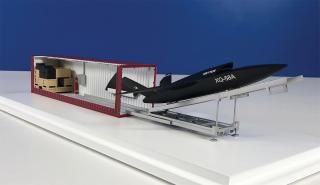
A model of a containerized Kratos XQ-58 unmanned aerial vehicle. Kratos

The range and capability of air and sea drones have increased massively in recent years. For example, conservationists have been using autonomous drones with visual and infrared sensors and very long range—up to 1,100 miles for the Flexrotor—to monitor illegal, unreported, and unregulated fishing as well as wildlife poaching.

Israel has been operating the Harpy unmanned aerial vehicle (UAV) for more than a decade. The vertical-takeoff-and-landing Harpy can autonomously navigate up to 600 miles to hunt in the visual, infrared, and electromagnetic spectrums. 
The U.S. Air Force, Navy, and Marine Corps are experimenting with the Kratos Valkyrie UAV. It has a range of 3,000 miles, a payload of 600 pounds, and a cruise speed of .72 Mach, and it is designed to be “runway independent.” Kratos has developed a version with a launcher that can fit in a standard shipping container.

Numerous countries are developing long-range autonomous surface attack boats. Ukraine’s Magura V has demonstrated lethal capability and essentially driven the Russian Navy from the Black Sea. Saronic Technologies, a U.S. firm, is building autonomous, swarming boats with a 1,000-mile range and a 1,000-pound payload. These craft are small enough that several can be loaded in a TEU container. They can be launched from a ship at sea, aircraft, and the beach. 
Inexpensive Platforms

By combining such new weapons and delivery systems with widely available and relatively inexpensive commercial ships, the Navy could create a class of “missile merchants” that would possess deep magazines, long range, and onboard intelligence, surveillance, and reconnaissance (ISR), thus addressing the number and range issues. Further, it would be easy to upgrade the capabilities of these ships. As the Navy develops newer, longer-range missiles, drones, and sensors, it could swap out the containers.

Ship costs could vary from a low of $10 million for a small container ship to $40 million for a 40,000 deadweight-ton (DWT) container ship. With missile, drone, command-and-control, life-support, and maintenance containers, such a ship could be converted into a warship with long-range precision weapons faster than designing and building a new warship. A package with 40 missiles would cost around $100 million—about $2 million for each Naval Strike Missile and $20 million for command, maintenance, and living modules and any minor ship modifications required. Most modern container ships are double hulled, making them capable of absorbing more damage than Navy surface ships such as littoral combat ships. In addition, empty containers could be filled with foam, dirt, or other energy-absorbing materials as inexpensive armor. As an added benefit, container ships generally require less maintenance than surface warships and are at sea much more frequently.

For a net acquisition cost of $130 to $145 million each, the Navy could purchase 40 or so missile merchants for about one-quarter the combined cost of a Gerald R. Ford–class aircraft carrier and its air wing—while adding 1,600 high-end missiles to the fleet.

Better still, this concept could reinforce the significant progress the Pentagon is making in seeking nontraditional defense firms to produce low-cost cruise missiles. In mid-2024, just 11 weeks after its founding, startup defense company Ares began flight testing a cheap cruise missile. It “is targeting a $300,000 unit cost for its missiles,” compared with the $3 million Long-Range Antiship Missile.

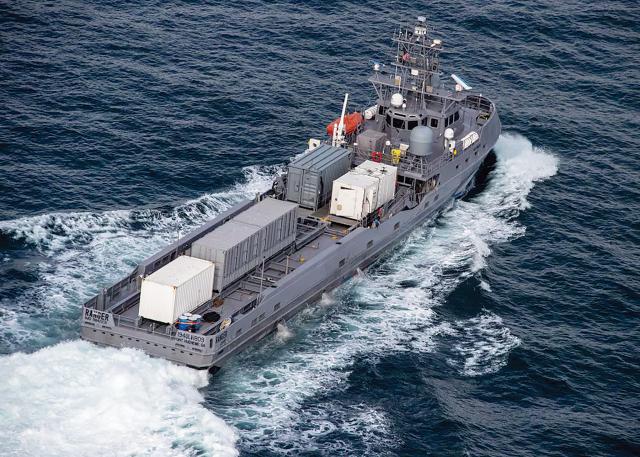
The Navy has test fired containerized SM-6 Standard Missiles from the large unmanned surface vessel Ranger. U.S. Navy (Tyler Fraser)

Smaller, cheaper ASCMs like these would mean the Navy could greatly increase the fleet’s magazine depth, fill the vertical launch systems cells of its current fleet, and potentially put hundreds of missiles on board missile merchants.

Beyond reduced up-front costs, real savings also would occur in manpower. Based on peacetime manning plus additional personnel for combat systems operation, missile merchants would require about 45 sailors. In other words: Four could be manned for the expected crew size of the future Constellation (FFG-62). Containerized launch-control modules could be assigned to Navy Reserve units that could routinely train on them during drill weekends. Those units’ annual training then could consist of operating the modules on board proof-of-concept ships—or even leased ships, if necessary. Such training could help identify the optimal mix of regulars, reservists, and merchant mariners. Wargaming and simulation also would help determine the optimal missile, attack drone, and ISR drone loadout per ship.

It would be essential that the Navy resist any bureaucratic impulse to require these ships to be retrofitted to meet Naval Sea Systems Command general specifications. Doing so would dramatically increase the cost and complexity.

A positive second-order effect of acquiring missile merchants could be to provide command opportunities for younger officers, restoring the long and successful Navy tradition of putting young officers in command. A missile merchant would be an ideal first command for a lieutenant commander. 
Getting Under Way
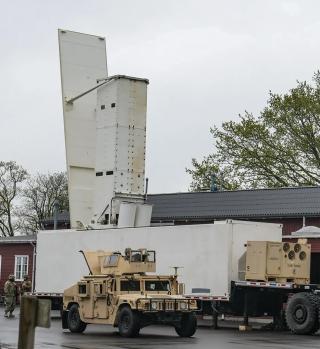
A Navy containerized missile launcher during an exercise in Bornholm, Denmark, in May 2024. U.S. Navy photo (James S. Hong)

The Navy could begin the developmental process by purchasing existing containerized weapon systems and buying or leasing two container ships—a large ship of 30,000 to 40,000 DWTs with a 2,500-container capacity and a smaller ship of perhaps 6,000 DWTs with a 150–250 container capacity. This would allow initial experiments with different operating concepts.

Some questions the Navy might consider include: Can these platforms provide deep magazines for destroyers operating outside the range of most Chinese weapons? Can commercially available, long-range drones establish ISR and communication networks to allow the ships to provide their own targeting information? Can larger drones such as the XQ-58A operate from these platforms and recover ashore at a Marine Corps expeditionary base for reuse?

Communication systems would be an integral part of the containerized weapon packages on board missile ships. The recent adoption of Starlink/Starshield by various navies and commercial fleets is demonstrating that any ship can have high bandwidth, gaining rapid access to national assets and intensive commercial satellite surveillance of the planet. With sustained communications, the embarked weapons’ long ranges would allow massed fires from dispersed platforms—supporting the Navy’s distributed maritime operations concept. But degraded or even denied communications would not render the missiles useless. Inexpensive vertical-launch-and-recovery drones such as the Flexrotor or V-Bat would give the ships organic surveillance assets, allowing them to locate and engage targets even when communication links to higher headquarters are severely degraded. With clear commander’s intent and containerized sensors, the ships would stay in the fight, increasing the uncertainty China would face if it were to initiate a conflict.

The Navy should work with innovative companies to develop rapid mobilization and production processes. It should even consider something like the Civil Reserve Aircraft Fleet, which subsidizes commercial aircraft purchases on the condition that, in times of war, those aircraft could be mobilized by the Department of Defense. A Civil Reserve Industrial Base to subsidize advanced manufacturing could provide surge capacity in a future crisis while investing in innovation immediately.

As concepts are refined, the Navy could buy as many as eight merchant ships for the price of one frigate to develop tactics and integrate these missile merchants into fleet fires. As a bonus, in peacetime, these ships could supplement Military Sealift Command, moving matĂ©riel into and around operational theaters. 
Ready and Waiting
Russia has been selling the Club-K container missile system for more than a decade. Shutterstock

One certain effect of any war between the United States and China would be a rapid and dramatic reduction in maritime trade for the duration. With proper testing and development ahead of time, the Navy could be well positioned to replace significant combat losses with idle container ships and arm them with containerized weapons and sensors. They would be able to provide rapid reinforcements—but only if the Navy starts working with manufacturers now while training Naval Reserve crews to man the mobilized ships.

Advanced Chinese antiaccess systems will limit how far forward the fleet can deploy until China’s fleet and missile arsenal are degraded. Pushing carrier strike groups too far forward could place too much blood and treasure in harm’s way without contributing to the fight. Carriers would play a vital role in winning the midocean fight for dominance but are too valuable to risk in the opening stages.

In contrast, missile merchants would be low-value platforms of the type historically put at risk in great power conflict—consider the picket ships that screened the U.S. fleet during the Battle of Okinawa. In any naval fight some ships will have to be risked but, unlike those picket ships, missile merchants would pack a considerable offensive punch while being much tougher and needing smaller crews. And, given that electromagnetic sensors could have a hard time distinguishing them from what commercial ship traffic remains at sea, they might be more likely to persist forward.

Converted merchant ships could be durable and inexpensive weapon “trucks.” Given modern containers’ interchangeability, this type of missile ship could become the most easily replaced and upgraded system in a fight.

From here.

In other, not entirely unrelated news, China has finally put into service long range, nuclear armed capable strategic bombers that can refuel in the air:

China’s military has begun deploying significant numbers of upgraded strategic nuclear bombers that are bolstering Beijing’s triad of weapons, including land-based missiles and nuclear missile submarines, according to U.S. defense officials.

The new strategic bomber is an H-6N that was recently converted to a nuclear delivery system from less-capable bombers. . . .

What sets the H-6N apart from earlier variants is that it’s the first bomber in the Chinese warplane inventory that can be refueled while in flight. “This is important because if you want to have a strategic strike capability, you have to have strategic range associated with that, and [the H-6N] is designed specifically to deliver a nuclear payload,” the official said.

The Chinese nuclear bomber force is being built along lines similar to those used by the Soviet and now Russian nuclear bomber force, the official said. The number of deployed H-6Ns is unknown as the Chinese government does not disclose the size of its nuclear forces. The Arms Control Association estimates there are about 20 H-6Ns. Other assessments from 2023 state that the total number of H-6 bombers of all variants is around 150, with a projected expansion to around 250 bombers by 2035.

The H-6N has a range of 3,728 miles and can be armed with an air-launched ballistic missile with a range of 1,864 miles for a combined nuclear strike range of 5,592 miles.

China did not use the new H-6N variant during a provocative aerial incursion near Alaska last summer. Two H-6K maritime bombers along with two Russian Tu-95 Bear nuclear-capable bombers conducted an operation in international airspace July 24, penetrating the Alaska air defense identification zone and prompting the deployment of U.S. F-35 and F-16 jets and Canadian CF-18 fighters to intercept them. It was the first time Chinese and Russian bombers operated together and highlights the potential for nuclear war fighting cooperation under the 2022 “no limits” agreement. “Both the Chinese and Russian bombers involved in the patrol were nuclear-capable, a signal that corresponds with the rapid expansion of China’s nuclear forces and persistent Russian nuclear saber-rattling,” the Center for Strategic and International Studies said in a report on the joint bomber patrol.

Both H-6 variants are based on the Soviet Tu-16 heavy bomber, dubbed the “Badger” by NATO and first flown in 1952. Analysts say the Chinese probably flew H-6Ks rather than the newer H-6N near Alaska to avoid showing off the strategic bomber to U.S. intelligence assets. . . .

The Pentagon’s annual report on the Chinese military, published in December, said the PLA enhanced the effectiveness of the H-6 despite its age. Both variants can fire long range cruise precision missiles capable of hitting ships near Chinese coasts from airfields in China, while the H-6K can carry six supersonic long-range YJ-12 anti-ship cruise missiles.

“The H-6N features a modified fuselage, enabling it to carry an air-launched ballistic missile externally that may be nuclear-capable,” the report said. . . .  A new H-20 stealth strategic bomber is on the drawing board, the report said.

07 February 2025

Enforcing Noblesse Oblige

La noblesse oblige literally "nobility obliges") is a French expression that means that nobility extends beyond mere entitlement, requiring people who hold such status to fulfill social responsibilities; the term retains the same meaning in English. For example, a primary obligation of a nobleman could include generosity towards those around him. As those who lived on the nobles' land had obligations to the nobility, the nobility had obligations to their people, including protection at the least.

- Wikipedia, Noblesse Oblige.

The American system of representative democracy is profoundly anti-elitist. In its ideal form, which it somewhat approximates, all adults can vote for candidates who are not meaningfully screened for qualifications to do the jobs for which they are elected.

Most other parts of our society don't work that way. 

Typically, when a business or government needs an employee, or an individual or firm or government wants to hire a contractor to do something, the business or person seeking a contractor tries to do so on a meritocratic basis consistent with what they can afford. For many kinds of tasks, a government license awarded on the basis of a meritocratic examination process that can be revoked for various kinds of professional or personal misconduct is required to even be considered for doing that task.

Most of the time, competence and qualifications are considered to some extent in the process of electing representatives to oversee the government on behalf of the voting public by the voters who are given the authority to elect them. But that isn't hard wired into the system (although some more specialized state and local elected offices like sheriffs and surveyors and judges and prosecutors sometimes do have some minimal professional qualifications that are required of candidates).

Unlike elected officials, civil service employees of governments are appointed on a formally meritocratic basis with only minimal political input by supervising officers for the prospective employees who are well-informed about the candidates' qualifications and are generally highly trained and qualified themselves.

Why do we have a system that allows ill-informed voters, no matter how uneducated they may be, choose people to run the system from among a group of minimally screened candidates with no obligation, even an unenforceable and theoretical one, to choose from among those candidates on a meritocratic basis?

The political theory behind a system with minimal screening of candidates and a very broad franchise is that the desire to win elections gives politicians an incentive to care about the best interests of the people who are entitled to vote, rather than caring only about their own personal interests and desires.

The ill-treatment that American society affords to people who can't vote at some or all levels of our political system, like children, non-citizens, prison inmates, institutionalized mentally ill people, people in places like the District of Columbia and Puerto Rico, and people who live outside the territory of the governmental body whose voters select those elected officials, supports the conclusion that including someone in the franchise tends to produce political outcomes that benefit people who can vote. 

Likewise, policies that meet the interests and desires of people who vote more consistently, like older people, educated people, and Evangelical Christians, are more frequently translated into government policy than the interests and desires of people who vote less often, like younger people and less educated people, even when they have a right to vote.

The American political system has made a calculated choice that having politicians who care about the needs and desires of as many people as can legitimately be permitted to vote is so important that it is worth the risk that in the cases where these voters will make bad choices, especially when they are ill-informed and are not very good decision makers about anything.

The political theory, in other words, is that a franchise that is as broad as possible with minimally screened candidates will enforce noblesse oblige upon the class of politicians who are elected in this system, and that having politicians who are incentivized to display noblesse oblige in their decision making is worth the price that society pays in choosing less qualified leaders because a greater share of the decision makers are ill-informed and bad at making decisions than they would be if the franchise was narrower. The political system of American representative democracy enshrines equality in order to create no incentives to make as few people as possible strangers of the law.

It is a political theory that leans heavily on formal political institutions to cause this to happen rather than alternative means.

Not every political system in history as relied upon this strategy.

Confucianism, in contrast, focuses on securing noblesse oblige by instilling a political culture infused in it.

In Confucianism, almost every important interact in life in characterized as being unequal and hierarchical. Subordinates have a duty to obey and defer to their superiors. Superiors have a duty to look out for the bests interests of their subordinates in a spirit of reciprocity and fiduciary-like duty. Confucianism calls for people to be promoted to higher positions of authority on the basis of merit, which is viewed as a balanced mix of competence and good character in the sense of upholding confucian values.

Modern cultures with strong Confucian values display pros and cons. They tend to be well ordered, to be law abiding, to have people who are good at self-organization and cooperation in times of need, and to have relatively few people who are just cast away and neglected. But these are prone to abuse of authority and bullying by people higher up in the hierarchy, tend to ignore positive or urgent input from people low in the hierarchy, tend to force subordinates to sacrifice their own well-being and desires for the demands of their superiors, and are reliant on the people at the top to be innovative because those at the bottom are not permitted to innovate. Confucianism, focused as it is on a system rooted in good men, rather than good laws, also tends to be vulnerable to corruption and not very focused on the consistent rule of law.

Of course, different modern Confucian influenced societies address the "natural" shortcomings of Confucianism in different ways. 

Japan has done a relatively good job at curbing the selfishness of people like senior executives in positions of power, and has begun to temper Confucian values with respect for personal self-actualization as it has become a more affluent society with the luxury of doing so. 

South Korea has been less successful at curbing excesses and abuses by superiors, and has likewise been somewhat less successful at fulfilling the obligation to look out for subordinates. But it has also been better, on balance, at allowing self-actualization in lieu of subordination of one's own desires to the will of those superior in the hierarchy.

China has done a poor job indeed of curbing kleptocracy by those in power, but has done a good job at having the older generation cede power to the younger generation, in a manner that has fostered a class of relatively young, powerful, innovative change makers that have kept its society from becoming too static and tradition bound. But China has done a particularly poor job of respecting individual self-actualization, or listening to the voices of subordinates with valuable input that could be offered in decision-making. China has also suffered mightily from corruption and is deeply immersed in a social and intellectual climate of dishonesty and censorship of the truth.

Feudalism, the political culture that produced the concept of noblesse oblige in the West was similar, but unlike Confucianism, awarded positions of authority based primarily on the hereditary principal, rather than based upon meritocratic selection. Also, feudalism tied the sense that superiors should look out for the well-being of their subordinates to the pride, ego, and greed associated with ownership. In a feudal context, you basically owned your subordinates, and your sense of noblesse oblige was related to your desire to have your property be the best that it can be for your own person benefit since this would make you rich in the process.

Saudi Arabian style monarchies, while hardly meritocratic or democratic, have at least tamed the hereditary principle, by having large, polygamous royal families in which the current ruler can choose the most qualified person within this large royal family to be their successor. This mitigates the risk that a hereditary successor will be profoundly incompetent or immoral, and creates an incentive for its many princes to distinguish themselves in competence and loyalty in connection with the competition to be a successor to the reigning monarch or at least a member of the reigning monarch's inner circle.

Saudi Arabian monarchies do show outstanding noblesse oblige in terms of using their wealth to benefit the actual citizens of their kingdoms, but like most absolute monarchies, are also highly repressive and authoritarian, and treat people who are not their permanent subjects and property as disposable and care for their well-being only to the extent that it is transactionally necessary.

Returning to the question of the American political system, the question is really how we can secure noblesse oblige on a broad based basis, without sacrificing competence, rule of law, and freedom from corruption motivated by partisanship, to the extent that the MAGA movement does today. 

While there is a place to recognize political motives rooted in a desire to satisfy a broad grass roots of society rather than only its elites, not all choices which we have vested politicians with making are equally valid. There may not be one right choice, but there are many choices which are objectively worse across the value systems that are intersubjectively shared by broad swaths of our society. And, a system that makes objectively bad choices because swaths ignorant people in the grass roots don't understand that these are bad choices is broken.

Furthermore, the American political system has slipped away from securing noblesse oblige on a broad based basis from its political leaders, because its electoral and legislative processes and procedures have created incentives to further the well-being and desires of minimal winning coalitions while neglecting or actively harming those outside the winning coalition. 

Also, deep rooted flaws in the design of the American political system that arose because the Founders who designed it didn't have the benefit of the lessons of two and a half centuries of global democratic government's successes and failures, prevent the American political system from accurately translating the needs and desires of its people as a whole into appropriate action. It is a political system that is too gridlocked to promptly change to reflect new knowledge and needs, and is too biased towards rural white Christian interests and the interests of the ultra-rich, and against urban, non-Christian and non-white people's interests, and people who are not ultra-rich.

The inability of our gridlocked political system to address urgent needs and desires, especially those of the working class has been toxic for the American political culture. It has undermined faith in the belief that politicians can be in good faith about wanting change. It has washed away concern about the good character or competence of its political leaders. It has fueled the search for scapegoats to lash out against like immigration and free trade and non-Christians and LGBT people and women's rights and racial minorities. It has encouraged thoughtless and radical anti-government attitudes, conspiracy theories, anti-science ideologies, and distrust of intellectual elites.

Working class needs and desires have been neglected, in part, because they don't vote as consistently as more educated and affluent people do, and, in part, because the economy is changing but political gridlock has preventing timely and competent responses to these changes. This is led to the conventional wisdom that political changes have not occurred because bipartisan political elites are conspiring against them, even though this is more untrue than not and the primary reason that the current political system has not addressed their needs is that  the current system makes it too hard for well-intentioned political elites to secure effective change.

Returning to the question of the American economic system, there, the question is mostly, how we can cause the people at the top of economic hierarchies to display more noblesse oblige to their subordinates and to the larger society at a time when they have gone too far in milking the system for their own personal benefit at the expense of the rest of society. American economic elites generally are very competent, and are certainly much less corrupt the American political elites. But they also have far too weak incentives to refrain from causing externalities or exploiting subordinates and third-parties for their own personal benefit. The American political system's job is, in substantial part, to reign in the excesses of American economic elites, and the American political system has done a fairly shoddy job of doing so, in part, because the system in designed in such a way that this kind of regulation of American economic elites is too difficult to secure in a system that takes an unreasonably wide consensus to act.

Political Identity And The Total Fertility Rate In The U.S.

It is remarkable how closely state by state total fertility rates (roughly speaking, how a point in time estimate of how many children women in the state have per lifetime) track the partisan leanings of those states.

There are a handful of departures (West Virginia and Wyoming with coal based economies are lower than expected for their partisan leaning, and so are Montana and New Hampshire), but overall, it tracks quite closely.

Total fertility rate, in turn, tends to closely track economic development, education, and religiosity, which are probably the true drivers of political identity.

04 February 2025

The Shooting In Washington Park

The Shooting

The description of the events in this section is compiled mostly from multiple news reports at the Denver Post (including this one), the Denver Gazette, and three TV news channel websites (7 News including this one, 9 News, and Fox 31 News).

My previous post on middle class crime, was motivated by, and a prelude to, this post about the February 2, 2025 shooting in Washington Park, in Denver, Colorado, about three blocks from my home, that took place around 2:30-2:40 p.m. on a sunny warm day in broad daylight, just minutes after my wife decided to take another route home from the Washington Park Recreation Center than she had been planning to take. 

The shooting took place roughly Downing and Kentucky streets near a major west entrance to the park (it may have taken place a block further south at Downing and Tennessee, there are conflicting reports and there is a park bench there that could have been the one central to this story).

Twenty-eight year old Ryan Martin Egelston is suspected of having gotten into an argument with another man over a park bench at this location. 

As a Denver Post story explains:

Egelston got into a fight with another man in the park around 2 p.m. Sunday after the man asked if he could share a park bench with Egelston, according to an arrest affidavit released by the Denver Police Department.

Witnesses told investigators that Egelston spat on the man, pushed him in the chest and punched him in the lower back, according to the affidavit.

The man was walking away with his bike when Egelston allegedly pulled out a gun and shot at him. Egelston didn’t hit the man, but police said the bullet punctured one of the bike’s tires.

About 90 seconds later, Egelston shot at a second, unrelated victim from behind, striking him near the jaw, according to the affidavit. Witnesses told the Denver Post on Sunday that the bullet entered the man’s neck and went out his face.

“At no point did the second victim and (Egelston) appear to have any sort of disagreement or altercation prior to the shooting,” Denver police officials said in the arrest affidavit.

Chaos erupted in the crowed park in response. A medical doctor who was in the park nearby provided first aid to the man who was shot until an ambulance arrived and took him to a hospital. The man who was shot is expected to survive despite these serious injuries.

UPDATE: February 14, 2025:

A silver lining to the fateful day was the presence of Lakshmi Karra, Denver Health family medicine doctor, who was also at the park. She rushed to help Ben without hesitating. "I noticed that there was what looked like a gunshot wound on his neck," she said. "I took his picnic blanket out of his bag and I held pressure on his wound." Karra called 911 after which the Denver Health Paramedics rushed Ben to the hospital.

From 9 News.  

Egelston was muttering and cursing to himself and displayed his handgun to two women nearby telling them not to photograph him. He then tried to flee in his red Hyundai sedan.  

The 7 News story adds some details from the arrest affdavit and criminal case:
Moments after the second shooting, Egelston was seen walking southbound on S. Downing St. from E. Kentucky Ave. before he got inside a red Hyundai Sudan with Colorado license plate CIS-K97.

Denver Police officers who responded to the scene chased the vehicle with their sirens blaring before they rammed the car at E. Kentucky Ave. just west of S. Downing St. “due to the active threat to the public and in an attempt to limit a high-speed chase,” according to the affidavit.

At least two Denver police patrol cars surrounded the vehicle and took Engelson into custody. A black Glock handgun was then recovered from the passenger seat of the vehicle, according to investigators.

Egelston was taken to Denver Police Department headquarters where he was interviewed by police about two hours later following the shootings, though it’s not clear why Egelston got into an argument with the first victim and why he reportedly shot the two men, as the affidavit obtained by Denver7 Monday is heavily redacted.

The suspect is currently being held for investigation of attempted first-degree murder on a $1 million cash-only bond.

He was also carrying a concealed weapon in a Denver park, which is itself illegal.

UPDATE (February 10, 2024) from the Denver Post:

Ryan Martin Egelston has been charged with four counts of first-degree attempted murder, one count of assault and one count of vehicular eluding, all felonies, according to court records. He is also charged with six sentence-enhancing charges related to violent crimes and weapons.

Egelston told police he didn’t intend to shoot anyone, that he thought the two victims were involved in psyops and he was previously hospitalized for mental health concerns.

A GoFundMe has been established for the shooting victim Ben Varga, who is 23 years old, by his family. As I write this, it has raised $34,935 towards a $40,000 goal from 530 donors. Varga was taken to Denver Health, a level one trauma center. The GoFundMe page explains that:

On February 2nd, 2025, our friend, brother, and son, Ben Varga, was the victim of a shooting in Wash Park, Denver. Ben was shot from behind while waiting to meet up with friends. The bullet traveled through the back of his neck and straight through his jaw and chin. We are incredibly grateful that he survived. In what can only be described as a miracle, the bullet narrowly missed critical structures like his trachea and spine, preventing even more devastating consequences. The visible impact on his face is minimal, given that the bullet traveled in a way that left his facial structure largely intact on the surface. Since the incident, Ben has been in the Surgical Intensive Care Unit (SICU) at Denver Health, undergoing multiple surgeries and receiving round-the-clock care. His recovery will be long, but we remain hopeful. . . . 
Ben, a lifelong Coloradan, has always had a deep love for his home state and the community around him. He graduated from CU Boulder's Leeds School of Business last May, is a dedicated Buffs fan, and recently moved to downtown Denver to start a new job. Ben is also a big fan of all Colorado sports, including the Broncos, Avalanche, and Nuggets. When he's not cheering for local teams, he loves skiing, playing pickleball, trying new restaurants, and traveling the world. As a triplet, he shares a special bond with his brother, sister, and family. His love extends deeply to his friends and his dogs, Tatum and Bernie.

Ben's picture appears on his "recovery" blog

About Shooting Suspect Ryan Egelston

The suspect in this case is not much of a fit to stereotypes about random shootings in big cities.

Egelston attended the University of Dayton, in Ohio, from 2015-2019 where he got decent enough grades, after graduating from Buffalo Grove High School in Buffalo Grove, Illinois (a Chicago suburb) on schedule, starting in August of 2011. He was born sometime in 1996. While he was in college, in the summer of 2018, he was an intern with Respire Ministries, helping to teach English to Haitian immigrants (probably the ones made famous in the 2024 Presidential race).

After he graduated with a bachelor's degree in accounting and finance he became a CPA for the Big Four accounting firm of Deloitte, which he rose to the position of senior auditor over a period of two years and four months. He moved to Denver in 2021 to work as a senior associate for a financial consulting firm involving "interim financial assistance primarily to Fortune 1000 companies during critical times of need" performing accounting, auditing and compliance functions for a year until November of 2022, and was admitted as a licensed CPA in Colorado by reciprocity.

Before moving to Denver and until shortly after he moved to Denver, he was a treasurer and trustee on the board of the mother church, called "Destiny Church" and an "inherited church" called "Risen Church" and was a youth ministry leader at Destiny Church that served more than 100 members. At these meetings he "casted vision." He also worked in their addiction ministries.

Then, his ordinary and highly successful career path shifted. He took what he described as a "gap year" and "career break" for nineteen months, until May of 2024, during which he "authored over 4 unpublished books and numerous business consulting articles and thought leadership." Over the last nine months he has been working remotely providing accounting and finance consulting services for "One10" which I suspect, but don't know, is the entity in which he engaged in self-employment.

He describes himself as revivalist preacher and a Revelations 11 witness, maintained a blog until September of 2023, and made a dozen or two TikTok posts. The blog posts were pretty out there from the perspective of the uninitiated. For example, his September 25, 2023 blog post (the last one on his site) he said: 

Moore’s Law is the prophetic fulfillment of Daniel 12:4, which is prophecy on the end time’s that detail that knowledge shall increase stating, “Many shall run to and fro, and knowledge shall increase.”

The pictures and videos on his website and TikTok posts depict a clean cut, fit, white young man, who is almost frenetic with impatient energy.


The "about me" section on his webpage says (fancy formatting in the original not fully preserved):
Passionate About Revival, Writing Books, Teaching the Word of God,
Empowerment, Leadership Development,
Business Development/Consulting Services, and Public Speaking
I am a small business owner who is 'sold out' with a deep passion to preach and teach the Word of God with all my chips on the table, and I offer speaking arrangements where I hope to be the spiritual thermostat for you, your business, or your church! When not speaking or writing books, I love to consult with companies and would love the opportunity to help take your business to the next level and be a sounding board of wisdom in your room, a voice of reason, a voice that you can trust that will come in looking out for your best intentions with the utmost excellence. Business is my passion, people are my concentration, and the Word of God is what I belt out and yearn to live out with the very actions of my life. I choose to live 'under the Word,' apply it in every area of my life, and yearn to see an on-fire and burning church ready with oil for the return of Christ.

Currently, I am writing books believing God to impact thousands of people in whatever manner possible and dream of speaking all around the world. I am deeply passionate about client service and love adding value in the consulting sphere solving complex problems and being the sounding board for decision makers like you! Moreover, I'd love to come speak at your church or organization and inspire and build up one anothers' faith, usher in a spirit of revival, and preach LIGHTS out. If you think I'd be a great fit to speak, please do not hesitate to reach out!

A Reddit thread provides some more insights about him. One comment states:

Went to college with this guy. He became super religious after moving to Colorado and started going a little nutty. We always knew he was a little off, this is taking it to the next level.

Another comment in the thread states:

I'm almost certain I saw this dude tweaking around 1st and Emerson like two weeks ago. Same red hyundai parked in the alley, same build/look. He was trying to get into the abandoned homes on that block. I remember it now because the dude looked really wound up and had something he kept pocketing/holding. i got the fuck away ASAP. It confirms my initial suspicions that it was a gun. freaky shit.

A third comment in the thread states: 

OMG this dude came through the gas station one night and was having some kind of schizophrenic episode. He did the gesture of a rifle in his arms and I asked him if he was doing alright. He like snapped out of it said he’s going great and then went back to his episode.

Analysis

Looking at all of the facts and circumstances, including his own statement to police, I have to concur with the final Reddit comment quoted above that this shooting is probably a result of Ryan Egelston developing schizophrenia symptoms (or if not that, some other form of psychosis).

His life apparently started to go off track sometime between late 2021 when he left his job at Deloitte and November of 2022 when he left the position that he took in Denver after only a year to take a "gap year." He would have been 25-26 years old at the time, which is a very typical time for men with schizophrenia and other forms of psychosis (whose brains develop at a somewhat later age than women) to have their symptoms reach a point where they become unmanageable. These symptoms probably presented themselves at a more manageable level, perhaps even at such a slight level that one could doubt that they were real, several years earlier.

Inability to function in a highly structured conventional business setting like an accounting firm, paranoia and overreaction to unaggressive conduct from others, claims to see "visions", and making seemingly bizarre connections between ideas that other would see as unrelated, are all classic symptoms of schizophrenia.

He probably didn't self-diagnose his situation as a mental health issue (although his claim that he was previously hospitalized suggests otherwise), and his religious peers probably didn't either, as it seemed to be consistent with his self-image as a religious prophet or witness. 

His behavior as reported at Reddit and his lack of work history according to LinkedIn, also suggests that he may have been nearing the end of his rope financially, after being on the top of the world financially briefly after college as an accountant at a big national accounting firm, and then apparently exhausting his savings. This may have further fueled his paranoia and desperation.

From the perspective of criminal law, his behavior seems to belie the state of mind (typically associated with severe schizophrenia) that is necessary for him to present an insanity defense to his charges, although his lawyers, once hired or appointed, will probably have no choice but to present this defense in the criminal prosecution arising from this incident. The statement he made to police after the shooting might support this defense.

If he is not found to be incompetent and involuntarily committed as a threat to himself and others, he will probably plea bargain down from attempted murder to aggregated assault and received a fairly lengthy prison sentence in connection with that charge.

As a result of the quick response of the police to the incident, the numerous witnesses, and the ample physical evidence, a defense strategy claiming that he wasn't the shooter, or that he had a legal justification for the shooting, such as self-defense, would almost surely be futile. 

It is also plausible that an investigation will link him to other crimes for which he may face additional charges for which an insanity defense is not available (such as burglary, or carrying a concealed weapon in a Denver city park).