The President is considering a call for an income tax overhaul next year. One of the objectives is tax simplification. This is possible, without significantly changing overall tax revenues, without greatly rearranging the distribution of taxes due for low income taxpayers, and with a far more rational marginal tax rate structure for working class taxpayers than the current regime.
In this post, I'll lay out thirty key elements of a core tax simplification package, without much background or detailed proofs that these results are achieved.
End all net federal income and FICA taxes on the first $20,000 of income per married couple and $10,000 of income per single person.
1. Increase the standard deduction to $20,000 to married couples filing jointly, and $10,000 for married couples filing separately and single taxpayers.
2. End the special standard deductions for the elderly and the blind. End the phase out of itemized deductions.
3. Create a income tax credit for individuals equal to the amount of FICA taxes owed on the first $20,000 of wages (and to the extent not fully used for wages, of self-employment taxes owed on self-employment income) earned by a married couple filing jointly, and the first $10,000 of wages (and to the extent not fully used of self-employment income) of married copules filing separately and single taxpayers. Allow the FICA tax credit as a credit against both ordinary income tax and alternative minimum tax liabilities. Do not phase this out
Pay stubs and W-2s would reflect the FICA tax paid and the FICA tax income tax credit applied against it, and withholding tables would be adjusted to reflect cases where a married couple filing jointly has only one employed individual or a worker has multiple jobs.
4. The only penalty for failure to report income that would not have been subject to income or FICA taxes or self-employment taxes after the standard deduction and this tax credit would be a failure to receive credit for those earnings in the calculation of Social Security benefits.
5. Employers would get an income tax credit equal to the amount of employer FICA taxes paid on the first $10,000 of wages per employee per year, with withholding tax tables adjusted accordingly. All this credit against both ordinary income tax and alternative minimum tax liabilities. Do not phase this out.
Replace the benefits related to having children in head of household filing status, the per child tax credit, personal exemptions and the earned income tax credit, with a single, simpler per child tax credit.
6. Establish a fully refundable $3,000 per child tax credit.
In the case of married couples filing separately, or children with two parents who are not married to each other, each parent would get a $1,500 per child tax credit unless otherwise agreed in writing or otherwise allocated in a court order. Allow this per child tax credit against both ordinary income tax and alternative minimum tax liabilities. Do not phase this out. Do not require proof of financial support or parenting activities; any parent with parental rights is eligible for it until a written agreement or a state court order allocates it otherwise.
7. End the head of household filing status, personal exemptions, the phase out of personal exemptions, the existing per child tax credit, and the existing earned income tax credit.
Adjust marginal tax rates to produce similar revenues from individuals with similar income to the current regime
8. Replace the 10% and 15% marginal income tax rates with a 20% income tax rate up to the point where the 25% marginal income tax rate starts.
Simplify selected itemized deductions
9. End the percentage of AGI cap on medical expenses including health insurance expenses, and allow the medical expense deduction against self-employment taxes as well as income taxes. This result can already be achieved under current law in a variety of ways with various forms of tax planning.
10. End the deduction for state sales taxes.
11. End the second home mortgage interest deduction.
12. Limit the mortgage interest deduction loan amount for new loans to the greater of the existiing amount of mortgage interest deduction loan eligible debt, or the purchase price of the residence plus the amount of any capital improvements financed with a construction loan, rather than the fair market value of the residence. This would make it impossible to take out home equity loans borrow against paper increases in housing values, an incentive that contributed significantly to the financial crisis.
13. Make the private mortgage insurance deduction permanent.
Simplify the taxation of Social Security benefits
14. Include half of Social Security benefits received in income in lieu of existing formulas. This reflects the fact that half of Social Security taxes were collected before tax and half were collected after tax, paralleling the tax treatment of other retirement benefits. Existing means tested social security benefit inclusion would be repealed.
Simplify retirement contribution taxation
15. Limit the income that can be considered for all employer based, qualified defined contribution and defined benefit retirement plans (such as 401(k) plans, defined benefit pension plans, cash balance plans, profit sharing plans, SEP and Simple IRAs) to the Social Security wage base and impose a uniform cap on contributions for all plans of an employer to 15% of FICA wages paid.
16. Cap IRA, Roth IRA and Keogh plan contributions at 15% of wages earned from employers without a retirement plan of any kind plus 15% of self-employment income.
17. End the retirement savings contributions credit.
Simplify selected business expense deductions.
18. Disallow a deduction for any business meals for employers or clients, and for business entertainment for employers or clients. But, do not include these meals and entertainment in the income of the person receiving them.
Food and entertainment are personal benefits to whoever receive them that in a transaction cost free world would be taxed as compensation income to the person who benefits. Disallowing a deduction for these expenses instead imposes a tax in lieu of a tax on the person who benefits on the person who pays for them, a rough justice solution that results in similar levels of taxation. This expense item invariably eats up a disproportionate share of IRS audit resources and compliance costs for taxpayers.
19. Allow self-employed individuals who have no other office, own or rent a home, and have a permanent designated office in their home, a standard deduction of $5,000 or the amount of their business profit, for the year, whichever is less, for a home office. Someone who takes a home office deduction may not deduct expenses for rent, mortgage interest, utilities, or a landline phone that is not dedicated exclusive to the business. Home office expenses can be itemized in lieu of the home office deduction under existing rules.
20. Make simplified business use of a cell phone tax deduction rules permanent.
21. Replace the child and dependent care expense credit with an above the line deduction covering a comparable amount of such expenses.
22. Consolidate the educator expense deduction, the deduction for business expenses of reservists, performing artis and fee based government officials, the moving expense deduction, the student loan interest deduction, and the itemized deduction for employee business expenses into a single above the line deduction for employee business expenses in excess of $200 per year on a return for a single person or married filing separately return, and in excess of $400 per year on a return for a married couple filing jointly. Allow expenses required to maintain a license as a lawyer, doctor, engineer or other profession on this line for employed individuals and as a business expense for self-employed individuals.
23. End the deduction for tuition and fees, instead using education tax credits as the way to provide tax incentives for tuition and fee payments.
24. End the domestic production activities deduction (Section 199).
Equity Based Compensation
25. Compensation in the form of an ownership interests in a company in exchange for services, including carried interests in private equity funds, should have a zero basis and be taxed only when sold, without regard to its marketability, and then treated as ordinary earned income subject to self-employment taxation when sold. In publicly held companies, individuals owning stock received in exchange for services may elect to make a deemed sale of the stock and repurchase of the shares for the cash earned at any time.
26. Compensation in the form of stock options in a company in exchange for services should be not be taxed when the option is exercised. At that point the stock should be treated as compensation in the form of an ownership interest in the company in exchange for services, except that it would have a basis equal to the exercise price of the option, rather than zero. Incentive stock option rules under current law and the AMT would be repealed for options issued after the effective date.
27. End the penalty tax on straight compensation in excess of $1,000,000 per year.
Adjust The Self-Employment Income Tax Base
28. Include tips earned in self-employment income rather than in wage and salary income. Thus, employers would not be required to withhold taxes for, or account for tips, other than to issue 1099s to employees for tips paid to the employer and then paid in turn to employees, rather than paid directly to employees.
29. Include K-1 income from all S corporations and partnerships in which the taxpayer is active in the business as self-employment income (except to the extent that it is unearned income).
30. Include royalties from creative works that one has authored in self-employment income.
10 December 2010
Battery Technology Update
An electric car is comparable to, or superior, in almost every way but one to a conventional gasoline or diesel powered vehicle with an internal combustion engine. Their flaw is their limited range. They are mechanically simplier. They have no emissions other than those associated with generating electricity in the power grid at a central power plant which can be upgraded to be greener. The infrastructure necessary to put charging stations in places where they are needed in not particularly expensive. They perform essentially the same as a conventional vehicle. Tney are quiet. The electricity necessary to power one is much cheaper per mile than a comparable gasoline or electric vehicle. They reduce the need for imports of petroleum that account of half of all U.S. imports, drive the trade deficit and weaken the U.S. hand in geopolitical circles.
Electric cars have just one serious problem. Their batteries have a range much shorter than a conventional gasoline or electric powered vehicle and they take much longer to recharge than it doesto recharge a conventional vehicle. Also, batteries are expensive and cost a considerable amount to replace, which ust be done every five to ten years. The future of the electric car (and a host of other portable electric technologies from laptop computers to cell phones to electric law mowers and power tools rely on state of the art battery technologyl
There is room for optimism on this front. New fuel cell technologies may reduce their cost by replacing platinum with gold (also here).
Progress is being made towards making lithium batteries that store ten times as much energy as the current versions. This would allow an electric car to have the same range as an conventional cars with half as many batteries, greatly reducing the cost of the car.
Electric buses four times as efficient as existing buses are also in the works. Electric propulsion fo vehicles is a technology that scales from motorcycles to large trains and everything in between, very well.
Electric cars have just one serious problem. Their batteries have a range much shorter than a conventional gasoline or electric powered vehicle and they take much longer to recharge than it doesto recharge a conventional vehicle. Also, batteries are expensive and cost a considerable amount to replace, which ust be done every five to ten years. The future of the electric car (and a host of other portable electric technologies from laptop computers to cell phones to electric law mowers and power tools rely on state of the art battery technologyl
There is room for optimism on this front. New fuel cell technologies may reduce their cost by replacing platinum with gold (also here).
Progress is being made towards making lithium batteries that store ten times as much energy as the current versions. This would allow an electric car to have the same range as an conventional cars with half as many batteries, greatly reducing the cost of the car.
Electric buses four times as efficient as existing buses are also in the works. Electric propulsion fo vehicles is a technology that scales from motorcycles to large trains and everything in between, very well.
09 December 2010
The Republican Line On The Economy
I don't agree with Mike Rosen's policy prescriptions for our nation's economy and even his factual assertions are wrong, but his column today is a succinct summary of the Republican party line on the matter from an advocate for the position rather than a straw man argument that I have created myself, so I'm noting it for future reference. I quote some highlights from the narrative below to convey the gist of the message:
He closes by identifying his position with those of the Revolutionary War Americans.
Shorter version: Stop spending money to help poor people, stop taxing rich people, and pay civil servants less.
What's wrong with this analysis?
1. The federal deficit is mostly due to unfunded increases in defense spending and tax cuts, with rising health care costs as a secondary cost. Other welfare state spending has not increased and the American welfare state is one of the most miserly in the developed world.
2. The biggest culprits in state budget deficits are cyclical drops in revenue caused by an unprecedentedly deep recession and rising prison spending. Colorado is very close to the bottom nationally in its spending on P-12 education, higher education and other social programs. Medicaid doctors are getting paid far less than market rates. Both the state and federal government are underfunding our roads and bridges. We do not have a $1 billion shortfall in Colorado because Colorado is overspending on social services. We have a $1 billion shortfall because we have no rainy day fund (as TABOR basically insisted), and because we made permanent tax cuts during a temporary economic boom that inflated tax revenues.
3. The empirical evidence makes its unequivocally clear that low tax rates and tax cuts do not spur economic development. While correlation is not causation, you can't have causation without correlation and there is no correlation between low taxes or tax cuts and economic growth, indeed, to the extent that there is a relationship, higher taxes are associated empirically with stronger economic growth. The truth of the matter is that not buying enough government services is bad for the economy too. Goods and services aren't worthless to the economy just because the government writes the check, and the people who get government spending inject it into the economy again faster than the rich who get tax cuts.
4. The payroll cost of government pensions in Colorado is very close to the cost of Social Security (which they replace) and a typical private sector 401(k) plan. The benefits are generous compared to typical private sector retirement plans and Social Security combined, but only because the state treasurer has managed PERA funds better than the private sector alternative. More generally, the benefits at government jobs aren't nearly as sweet as Republicans would have you believe. The health insurance deal, for example, is typically about the same.
5. Government, in general, pays top executives and the senior managers who work for them far less than comparable private businesses do. Michael Bennet did not leave his job as a corporate lawyer to become Superintendent of the Denver Public Schools because the pay for the job was so good. The guy who is in charge of running the entire immigrations and customs enforcement office for the United States makes about the same amount of money as a typical owner of a single McDonald's franchise store, or a junior associate attorney at a Wall Street law firm. Midlevel government workers earn salaries similar to those of midlevel private sector workers. Workers at the bottom in government come out a bit better than their private sector counterparts in job security and compensation, but also perform consistently with quality work, and the differential isn't what is breaking the nation's government sector budgets.
But, Rosen has given you the GOP line, such as it is.
[T]he heart of the problem [of state budget shortfalls] is the unsustainable level of government spending and indebtedness driven by a cornucopia of entitlement, health care and welfare programs, along with overly generous government employee payrolls and lavish pension plans that have dwarfed growth in private-sector compensation in recent years. Our federal government is also upside down financially, only with more zeroes at the end of the numbers. . . .
Overseas governments are in a similar pickle, and their citizens are doing something about it: They're revolting (double entendre intended). In France, labor unions and students have staged protests and general strikes, outraged over the government's perfectly reasonable proposal to raise the retirement age from 60 to 62. . . .[Western European countries] nations spend a much smaller share of their gross domestic product on defense than we do, and they're still going broke. This is about the inevitable collapse of the democratic socialist welfare state. In the name of "social justice," compassion knows no economic bounds. Well, the bounds are there whether or not democratic socialists know or care about them. In the prophetic words of Margaret Thatcher, "The problem with socialism is that eventually you run out of other people's money."
Our current spending levels exceed our practical tax capacity. No nation can tax itself rich. It can only produce itself rich. Excessive tax rates are the enemy of production and a barrier to the creation of societal wealth. You can soak the rich . . . and you still won't come up with nearly enough revenue to close this runaway spending gap. . . . The economic solution is obvious: Government must spend less — much less — on all kinds of things at the federal and state levels.
He closes by identifying his position with those of the Revolutionary War Americans.
Shorter version: Stop spending money to help poor people, stop taxing rich people, and pay civil servants less.
What's wrong with this analysis?
1. The federal deficit is mostly due to unfunded increases in defense spending and tax cuts, with rising health care costs as a secondary cost. Other welfare state spending has not increased and the American welfare state is one of the most miserly in the developed world.
2. The biggest culprits in state budget deficits are cyclical drops in revenue caused by an unprecedentedly deep recession and rising prison spending. Colorado is very close to the bottom nationally in its spending on P-12 education, higher education and other social programs. Medicaid doctors are getting paid far less than market rates. Both the state and federal government are underfunding our roads and bridges. We do not have a $1 billion shortfall in Colorado because Colorado is overspending on social services. We have a $1 billion shortfall because we have no rainy day fund (as TABOR basically insisted), and because we made permanent tax cuts during a temporary economic boom that inflated tax revenues.
3. The empirical evidence makes its unequivocally clear that low tax rates and tax cuts do not spur economic development. While correlation is not causation, you can't have causation without correlation and there is no correlation between low taxes or tax cuts and economic growth, indeed, to the extent that there is a relationship, higher taxes are associated empirically with stronger economic growth. The truth of the matter is that not buying enough government services is bad for the economy too. Goods and services aren't worthless to the economy just because the government writes the check, and the people who get government spending inject it into the economy again faster than the rich who get tax cuts.
4. The payroll cost of government pensions in Colorado is very close to the cost of Social Security (which they replace) and a typical private sector 401(k) plan. The benefits are generous compared to typical private sector retirement plans and Social Security combined, but only because the state treasurer has managed PERA funds better than the private sector alternative. More generally, the benefits at government jobs aren't nearly as sweet as Republicans would have you believe. The health insurance deal, for example, is typically about the same.
5. Government, in general, pays top executives and the senior managers who work for them far less than comparable private businesses do. Michael Bennet did not leave his job as a corporate lawyer to become Superintendent of the Denver Public Schools because the pay for the job was so good. The guy who is in charge of running the entire immigrations and customs enforcement office for the United States makes about the same amount of money as a typical owner of a single McDonald's franchise store, or a junior associate attorney at a Wall Street law firm. Midlevel government workers earn salaries similar to those of midlevel private sector workers. Workers at the bottom in government come out a bit better than their private sector counterparts in job security and compensation, but also perform consistently with quality work, and the differential isn't what is breaking the nation's government sector budgets.
But, Rosen has given you the GOP line, such as it is.
08 December 2010
Asprin Even More Wonderful
Asprin has long been known to be a treatment for headaches and minor pain. More recently, low dose asprin regimes have been found to dramatically reduce cardiovascular disease (e.g. stroke, heart attack) risk if risks to the stomach and elevated risks when the regime ends are monitored. Now, the same asprin regime that dramatically reduces cardio-vascular disease risk has also been found to dramatically reduce risks associated with a wide array of cancers.
This is even more amazing when one considers that this is the opposite of what one would expect knowing only that the asprin was effective in reducing cardiovascular disease. Cardiovascular diseases are major killers late in life, at essentially the same part of the life cycle where cancer is the other biggest cause of death. Naiively, one would expect that people who were at a greatly reduced risk of death from heart attacks and strokes would be more likely as a result to die instead from the other biggest killer for people in that age range, which is cancer. In other words, you'd think that people who otherwise would have died of a stroke would have lived long enough to die of cancer instead.
But, this isn't what happened. Asprin dramatically reduces incidence of both of the biggest categories of diseases that killed middle aged and older people. And, you can buy it over the counter for peanuts, while you have to pay large sums of money for brand name drugs that don't deliver results nearly as impressive.
According to the study author, "the “sensible time” to start taking aspirin “would be before the risk of cancer starts to rise, at about 45.” He says prophylactic aspirin is “worth thinking about” for people with a family history of early cancers."
The studies involved 25,000 people over 20 years, and produced very intense effects. The mechanism appears to be a connection between chronic inflamation which is reduced by asprin and cancer risk, but honestly, it doesn't really matter if the actually mechanism is that asprin attracts cancer cell eating aliens who abduct you at night and remove it without you knowing about it. What matters is that a cheap, simple preventative measure is incredibly effective at reducing many of the main causes of death in older adults.
Deaths from esophageal cancer were reduced by 60% in the aspirin-takers (who took the drug for at least five years), compared with the placebo group. Lung cancer deaths were reduced by 30%, colorectal cancer deaths were cut by 40% and prostate cancer deaths were lowered by 10%, compared with the patients who got placebo. What’s more, the longer people took aspirin, the greater their reduction in cancer risk. . . . those cancer reduction numbers represent a more profound effect than the one aspirin has on heart disease and stroke, which are the main reasons lots of people now take a low-dose aspirin regimen.
This is even more amazing when one considers that this is the opposite of what one would expect knowing only that the asprin was effective in reducing cardiovascular disease. Cardiovascular diseases are major killers late in life, at essentially the same part of the life cycle where cancer is the other biggest cause of death. Naiively, one would expect that people who were at a greatly reduced risk of death from heart attacks and strokes would be more likely as a result to die instead from the other biggest killer for people in that age range, which is cancer. In other words, you'd think that people who otherwise would have died of a stroke would have lived long enough to die of cancer instead.
But, this isn't what happened. Asprin dramatically reduces incidence of both of the biggest categories of diseases that killed middle aged and older people. And, you can buy it over the counter for peanuts, while you have to pay large sums of money for brand name drugs that don't deliver results nearly as impressive.
According to the study author, "the “sensible time” to start taking aspirin “would be before the risk of cancer starts to rise, at about 45.” He says prophylactic aspirin is “worth thinking about” for people with a family history of early cancers."
The studies involved 25,000 people over 20 years, and produced very intense effects. The mechanism appears to be a connection between chronic inflamation which is reduced by asprin and cancer risk, but honestly, it doesn't really matter if the actually mechanism is that asprin attracts cancer cell eating aliens who abduct you at night and remove it without you knowing about it. What matters is that a cheap, simple preventative measure is incredibly effective at reducing many of the main causes of death in older adults.
Denver Bike Program Ends First Season
Denver launched its B-Cycle program, a system of bike rentals kiosks, this year, in cooperation with the non-profit Denver Bike Sharing, and its first season is now over as it shuts down until March.
This season it had 500 bikes and about 50 kiosks, mostly in the vicinity of downtown Denver, Cherry Creek and the University of Denver, with some points in between. "In the seven months since it launched April 22, Denver B-cycle hit nearly 103,000 rides, selling 1,784 annual memberships and more than 32,900 short-term memberships." Short term memberships were $5 to $30 depending on length, annual memberships were $65. Rental rates, in addition to the membership costs, ranged from free to $8.80 per hour, depending on the length of use (longer rentals cost more). Next season's plans include a simpler fee structure, adjustment of kiosk locations to reflect the demand levels in different locations, and improvements to the touch screen interface of the kiosks.
Notably, no Denver taxes go towards the programs, although Denver does maintain at taxpayer expense, a bike path system in the city and has made city property available for kiosks to be set up upon. The program is funded with user fees (my back of napkin math suggests that those fees are more than $300,000, perhaps quite a bit more), donations and a $210,000 grant.
This season it had 500 bikes and about 50 kiosks, mostly in the vicinity of downtown Denver, Cherry Creek and the University of Denver, with some points in between. "In the seven months since it launched April 22, Denver B-cycle hit nearly 103,000 rides, selling 1,784 annual memberships and more than 32,900 short-term memberships." Short term memberships were $5 to $30 depending on length, annual memberships were $65. Rental rates, in addition to the membership costs, ranged from free to $8.80 per hour, depending on the length of use (longer rentals cost more). Next season's plans include a simpler fee structure, adjustment of kiosk locations to reflect the demand levels in different locations, and improvements to the touch screen interface of the kiosks.
Notably, no Denver taxes go towards the programs, although Denver does maintain at taxpayer expense, a bike path system in the city and has made city property available for kiosks to be set up upon. The program is funded with user fees (my back of napkin math suggests that those fees are more than $300,000, perhaps quite a bit more), donations and a $210,000 grant.
Half of Unemployed Have Exhausted Reg Benefits
The Great Recession is once again earning its name.
The median duration of unemployment right now is about 26 weeks, which is the maximum period of unemployment benefits when they are not extended.
Many people who have been receiving extended unemployment benefits (the maximum length is 60 to 99 weeks depending upon your state), are seeing those benefits run out. The proposed deal in Congress simply keeps the maximum duration of unemployment benefits from reverting to 26 weeks over the next thirteen months, it does not extend the limits already in place. More than six million people have been unemployed for more than twenty-six weeks, a rate more than double its previous peak in 1983.
In the period from 1965 to 2008, that median duration of unemployment had never topped 13 weeks.
The number of people who are working part-time for economic reasons has also shot up to record highs and is currently at about 9 million. The highest point it was at in the last 40 years (and surely much longer) was 7 million.
It is the deepest, in terms of percentage decline in jobs since the Great Depression.
Some states are currently being hit worse than others. Nevada's unemployment rate of 14% is the highest in the country. It is followed by Michigan at 13%, and California and Florida at about 12%. North Dakota with a 4% unemployment rate is best off.
Colorado is right in the middle of the pack with an unemployment rate of about 8.5% but, Colorado is one of about eight states, however, that is very close to the highest unemployment rate that the state has seen since 1976. Unlike states in the Rust Belt and Appalachia, Colorado isn't familiar with this serious an economic downturn.
Denver's housing market, however, is the strongest of the twenty Case-Shiller urban markets other than Dallas (and isn't far behind it) having suffered only a 10.6% decine from the peak. The bottom of the heap Las Vegas real estate market, in contrast, is down 57.6% from the peak. The strong Denver housing market is reflects in its low vacancy rates for rentals. "The small-property vacancy rate in the seven-county metro area dropped to 2.9 percent in the third quarter, the lowest rate in that period since record-keeping began in 2001." This is down from 4.6% a year ago and has been fueled in part by a decline in the average rent to $1,041 from $1,060 a year ago. Douglas County has bucked the trend with an increase in small property vacancy rates from 5.2% to 5.7%.
The only recession in which the workforce was declining for a similar in length of time was the 2001 tech bust. But, that tech bust involved only a 2% decline in employment, making it one of the more mild post-Great Depression downturns, while the Great Recession has involved a 6% decline in jobs. The 2001 tech bust lasted 47 months from it start to the point where the number of jobs in the economy had returned to pre-recession levels.
The Great Recession will almost certainly be longer - it has already lasted 35 months and no one seriously expects that all jobs lost will be replaced at the 5.7% over the next twelve months it needs to be back where it was when the Great Recession. The number of jobs in the economy has not grown at all in the last six months. The fact that job recoveries have been slow in the last two recessions (1990 and 2001) as well as the current recession, which started in 2007, compared to prior post-Great Depression recessions where jobs were lost and then restored much more quickly, suggests that something has changed in the process by which the U.S. economy creates jobs.
Few Commercial Banks Have Failed Given The Depth of the Downturn
Unlike the Great Depression, commercial bank failures, while high, aren't at record highs.
This year there have been 149 FDIC insured bank failures so far, this is more than last year, and there will probably be a few more before the year end. But, recently as 1992, a year when the economy was in far worse shape (GDP fell a quarter as deeply, 1.5% in that recession that began in 1990, and GDP had retuned to where it started 30 months later, while this time around GDP is still down 5.4% after 35 months and has been below the low point of the 1990 recession for 25 months), there were 189 bank failures.
Also, most of the banks that are failing are tiny. The failed banks this time around also make up only a tiny percentage of all FDIC insured banks as a percentage of insured assets, and none are anything close to being total losses.
Bank failures are a lagging indicator. The 1992 bank failure peak was two years after that recession started in 1990. The financial crisis started in 2007, but bank failures didn't start to pile up in atypically high numbers until 2009. But, the number of bank failures in 2011 is unlikely to be a lot higher than it was in 2009 and 2010.
While the FDIC is not obligated to protect depositors with more than the FDIC insurance limit amount in their accounts, I'm not aware of a single instance where a depositor has lost anything in a bank failure. Swift deals to sell bank deposits to other banks have held depositors harmless and made the blow to the FDIC's insurance premium funded reserves modest. Shareholders of failed banks have been wiped out, of course, as have some long term investors, but bank customers (except those awaiting loan approvals that didn't get their loans due to the failure of a bank, most of whom were able to get loans elsewhere with some delay) haven't been hurt.
The median duration of unemployment right now is about 26 weeks, which is the maximum period of unemployment benefits when they are not extended.
Many people who have been receiving extended unemployment benefits (the maximum length is 60 to 99 weeks depending upon your state), are seeing those benefits run out. The proposed deal in Congress simply keeps the maximum duration of unemployment benefits from reverting to 26 weeks over the next thirteen months, it does not extend the limits already in place. More than six million people have been unemployed for more than twenty-six weeks, a rate more than double its previous peak in 1983.

In the period from 1965 to 2008, that median duration of unemployment had never topped 13 weeks.
The number of people who are working part-time for economic reasons has also shot up to record highs and is currently at about 9 million. The highest point it was at in the last 40 years (and surely much longer) was 7 million.
It is the deepest, in terms of percentage decline in jobs since the Great Depression.

Some states are currently being hit worse than others. Nevada's unemployment rate of 14% is the highest in the country. It is followed by Michigan at 13%, and California and Florida at about 12%. North Dakota with a 4% unemployment rate is best off.

Colorado is right in the middle of the pack with an unemployment rate of about 8.5% but, Colorado is one of about eight states, however, that is very close to the highest unemployment rate that the state has seen since 1976. Unlike states in the Rust Belt and Appalachia, Colorado isn't familiar with this serious an economic downturn.
Denver's housing market, however, is the strongest of the twenty Case-Shiller urban markets other than Dallas (and isn't far behind it) having suffered only a 10.6% decine from the peak. The bottom of the heap Las Vegas real estate market, in contrast, is down 57.6% from the peak. The strong Denver housing market is reflects in its low vacancy rates for rentals. "The small-property vacancy rate in the seven-county metro area dropped to 2.9 percent in the third quarter, the lowest rate in that period since record-keeping began in 2001." This is down from 4.6% a year ago and has been fueled in part by a decline in the average rent to $1,041 from $1,060 a year ago. Douglas County has bucked the trend with an increase in small property vacancy rates from 5.2% to 5.7%.

The only recession in which the workforce was declining for a similar in length of time was the 2001 tech bust. But, that tech bust involved only a 2% decline in employment, making it one of the more mild post-Great Depression downturns, while the Great Recession has involved a 6% decline in jobs. The 2001 tech bust lasted 47 months from it start to the point where the number of jobs in the economy had returned to pre-recession levels.
The Great Recession will almost certainly be longer - it has already lasted 35 months and no one seriously expects that all jobs lost will be replaced at the 5.7% over the next twelve months it needs to be back where it was when the Great Recession. The number of jobs in the economy has not grown at all in the last six months. The fact that job recoveries have been slow in the last two recessions (1990 and 2001) as well as the current recession, which started in 2007, compared to prior post-Great Depression recessions where jobs were lost and then restored much more quickly, suggests that something has changed in the process by which the U.S. economy creates jobs.
Few Commercial Banks Have Failed Given The Depth of the Downturn
Unlike the Great Depression, commercial bank failures, while high, aren't at record highs.
This year there have been 149 FDIC insured bank failures so far, this is more than last year, and there will probably be a few more before the year end. But, recently as 1992, a year when the economy was in far worse shape (GDP fell a quarter as deeply, 1.5% in that recession that began in 1990, and GDP had retuned to where it started 30 months later, while this time around GDP is still down 5.4% after 35 months and has been below the low point of the 1990 recession for 25 months), there were 189 bank failures.
Also, most of the banks that are failing are tiny. The failed banks this time around also make up only a tiny percentage of all FDIC insured banks as a percentage of insured assets, and none are anything close to being total losses.
Bank failures are a lagging indicator. The 1992 bank failure peak was two years after that recession started in 1990. The financial crisis started in 2007, but bank failures didn't start to pile up in atypically high numbers until 2009. But, the number of bank failures in 2011 is unlikely to be a lot higher than it was in 2009 and 2010.
While the FDIC is not obligated to protect depositors with more than the FDIC insurance limit amount in their accounts, I'm not aware of a single instance where a depositor has lost anything in a bank failure. Swift deals to sell bank deposits to other banks have held depositors harmless and made the blow to the FDIC's insurance premium funded reserves modest. Shareholders of failed banks have been wiped out, of course, as have some long term investors, but bank customers (except those awaiting loan approvals that didn't get their loans due to the failure of a bank, most of whom were able to get loans elsewhere with some delay) haven't been hurt.
07 December 2010
Pearl Harbor Remembered
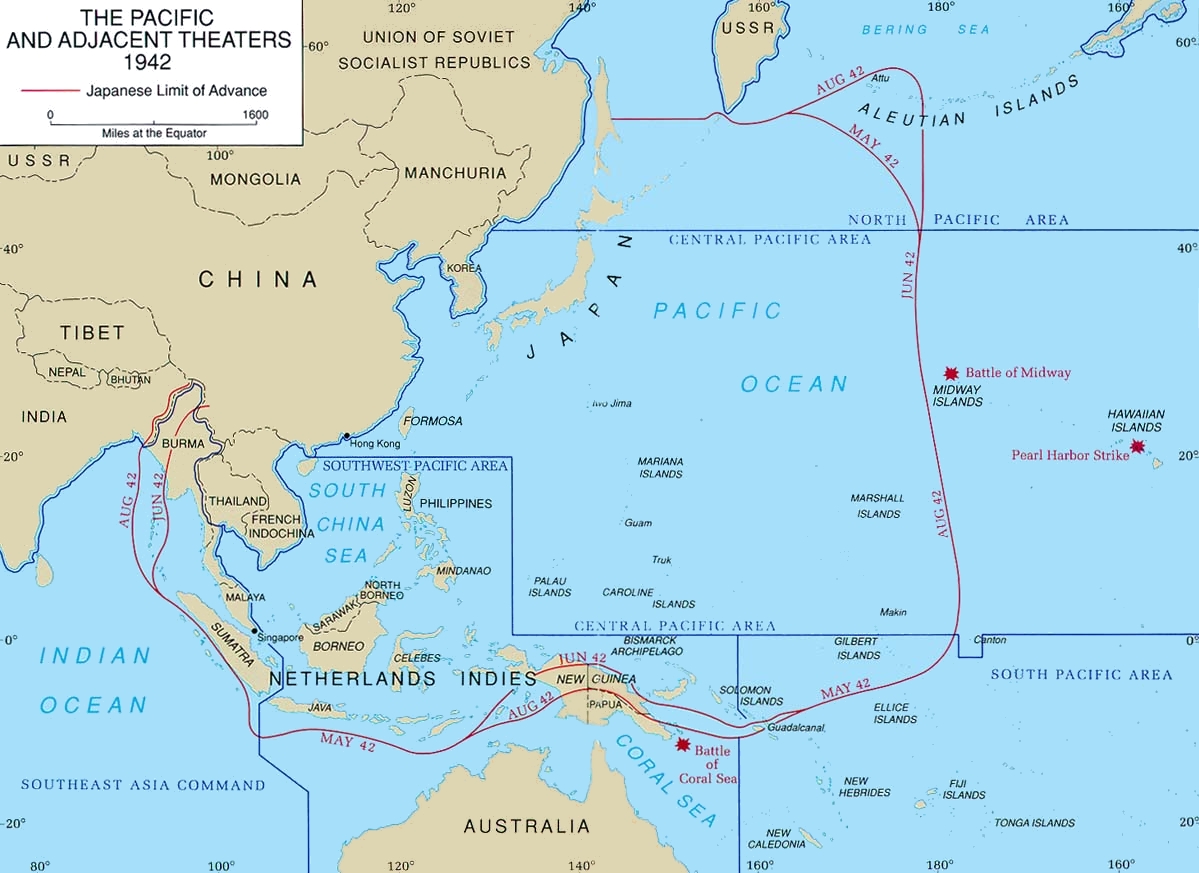
The Pacific Theater in 1942, shortly after the U.S. joins World War II in the Pacific via Wikipedia.
Today, December 7, in 1941, Japan launched a surprise attack on Pearl Harbor, Hawaii. It was event that changed history profoundly by bringing the United States, which had refrained from being an active combatant for the first two years of the war, into World War II. Wikipedia sums up the events and their significance:
The attack was intended as a preventive action in order to keep the U.S. Pacific Fleet from influencing the war that the Empire of Japan was planning in Southeast Asia, against Britain and the Netherlands, as well as the U.S. in the Philippines. The base was attacked by Japanese aircraft (a total of 353, in two waves) launched from six aircraft carriers.
Four U.S. Navy battleships were sunk (two of which were raised and returned to service later in the war) and all of the four other battleships present were damaged. The Japanese also sank or damaged three cruisers, three destroyers, an anti-aircraft training ship and one minelayer. 188 U.S. aircraft were destroyed, 2,402 personnel were killed and 1,282 were wounded. The power station, shipyard, maintenance, and fuel and torpedo storage facilities, as well as the submarine piers and headquarters building (also home of the intelligence section) were not attacked. Japanese losses were light, with 29 aircraft and five midget submarines lost, and 65 servicemen killed or wounded. One Japanese sailor was captured.
The attack came as a profound shock to the American people and led directly to the United States entry into World War II in both the Pacific and European theaters. The following day (December 8) the United States declared war on Japan. Domestic support for isolationism, which had been strong, disappeared. Clandestine support of Britain (for example the Neutrality Patrol) was replaced by active alliance and full participation in the European Theater. Subsequent operations by the U.S. prompted Germany to declare war on the U.S. on December 11, which was reciprocated by the U.S. the same day.
Japan also launched "a surprise attack on the Clark Air Base in Pampanga, Philippines on December 8, 1941, just ten hours after the attack on Pearl Harbor. Aerial bombardment was followed by landings of ground troops on Luzon." At the time, the Commonwealth of the Philippines had a legal relationship to the United States similar to that relationship that Puerto Rico has with the United States today, was home to a recently reinforced U.S. military presence, under the command of General Douglas MacArthur, and was at that time scheduled to leave the foreign policy shadow of the United States and achieve full independence in 1945.
The attacks were a tactical coup of Japan.
The Pacific Fleet, which had recently been relocated to Hawaii, was decimated, but all of the U.S. aircraft carriers (which were afloat away from the Hawaii at the time) and many smaller ships based there, survived and the fllet was soon rebuilt and actively engaged Japanese forces.
The Philippine and United States troops were forced to retreat to the Bataan Penisula, conceded the capital Manilla's status as an "open city" in January to prevent its destruction, and Major General Edward P. King, Jr. (against the orders MacArthur, his commander) surrendered four months later, on April 9, 1942 after which the prisoners of war endured the infamous Bataan Death March to their prison camp that killed at least 10,000 Filippinos and 1,200 Americans, out of the roughly 67,000 Filipinos, 1,000 Chinese Filipinos, and 11,796 American prisoners who surrended (perhaps 10,000 prisoners escaped). A Japanese occupation goverment ruled much of the Philippines over the next thirty-nine months in the face of a vigorous insurgency that eventually regained control of three-quarters of the province in the Philippines, and U.S. troops had landed and were fighting a bloody conventional war with Japanese troops for a little more than a year before the Japanese surrender on September 2, 1945.
Despite their tactical successes, the attacks were a strategic disaster for both Japan and the Axis Powers generally. As a result of these attacks, the U.S., Britain, Australia and other Allies to formally declare war on Japan, and in January, the United States, Britain, Soviet Union, China, and 22 smaller or exiled governments issued the Declaration by United Nations, which affirmed the Atlantic Charter. Despite the U.N. Declaration, however, the Soviet Union did, honor a neutrality agreement with Japan.
The Japanese high command's key mistake that prompted the attack was is mistaken belief that it was certain that any attack on the British Southeast Asian colonies, an attack crucial to its war plan, would bring the U.S. into the war. Since it thought U.S. entry into the war was inevitable, it sought to crush U.S. forces in the Pacific. In fact, had Japan refrained from attacking U.S. possessions like Hawaii (not yet a state) and the Philippines, it might have postponed U.S. military involvement in the World War II significantly and might even have prevented U.S. intervention in the Pacific entirely.
On October 8, 1940, Admiral James O. Richardson, commander of the Pacific Fleet, provoked a confrontation with President Roosevelt, repeating his earlier messages to Chief of Naval Operations Admiral Harold R. Stark and to Secretary of the Navy Frank Knox—that Pearl Harbor was the wrong place for his ships. Roosevelt replied that having the fleet in Hawaii was a "restraining influence" on Japan.
Richardson asked the president if the United States was going to war. In Richardson's account the president responded: "At least as early as October 8, 1940, President Roosevelt believed that affairs had reached such a state that the United States would be come involved in a war with Japan. ... 'that if the Japanese attacked Thailand, or the Kra Peninsula, or the Dutch East Indies we would not enter the war, that if they even attacked the Philippines he doubted whether we would enter the enter, but that they (the Japanese) could not always avoid making mistakes and that as the war continued and that area of operations expanded sooner of later they would make a mistake and we would enter the war.' ... "
U.S. involvement in World War II, of course, was a central factor in the defeat of the Axis Powers, both Japan and Germany, less than four years later, with Japan enduring the destruction of Hiroshima and Nagasaki by nuclear bombs and surrending to the United States, marking the only times in the history of the world that nuclear weapons have been detonated other than in weapons tests.
A Comic
A stunningly well done webcomic set in the days leading up to that attack from the perspective of an ordinary American girl and an ordinary Japanese boy, called Dreamless, is worth a read.
Tenative Estate Tax Deal Reached
President Obama and Congressional Republicans have reached a deal to extend the Bush tax cuts and all tax cuts passed since then, for all, even those making more than $1,000,000 a year, for two years, and to extend unemployment benefits for thirteen months. Congressional Democrats have not yet consented to the deal, and some will almost certainly vote against it, but it is likely that support from Blue Dogs and from other Democrats who don't want to oppose the President will lead to passage of the proposal.
As a tax lawyer who deals most often with estate taxes, the implications for me are practical.
The deal on estate taxes is to set the estate tax exclusion at death, per person, to $5,000,000 (from which are subtracted significant life time gifts) and to set the estate tax rate at 35%. This change is not permanent. Like the other parts of this deal, it will be in force for two years (2011 and 2012).
If no deal had been reached, the exclusion would have fallen to $1,000,000 and the estate tax rate would have been a progressive one, starting at 37%, with a top normal rate of 55%, and with a bubble rate of 60% to recapture the benefits of lower rates in large estates. There was no estate tax (although there was a gift tax) in 2010, and in 2009 the estate tax exclusion at death was $3,500,000 and the estate tax rate was 45%. It appears that efforts to retroactively apply the estate tax to decedents who died in 2010 has been abandoned. Before this deal was reached, the President and Congressional Democrats had pushed to freeze the estate tax at 2009 exemptions and tax rates.
The tax is roughly equivalent to an income tax equal to the top personal income tax rate for heirs of large estates.
New releases haven't clearly stated the fact, but it appears that the step up in basis of capital gains at death will be reinstated after lapsing in 2010, so heirs will not have to pay the 15% capital gains tax on unappreciated capital gains that would be due if the appreciated assets had been sold at some point.
Some important aspects of the deal on estate taxes remain unclear.
First, it isn't clear if the gift tax exclusion, which had been capped at $1,000,000 as the estate tax exclusion grew, will be again unified with the gift tax. The gift tax was kept low because it was temporary and would create an incentive to make lifetime gifts larger than those that could be made at death if the estate tax exclusion was reduced as a hedge against future legislative changes in the gift and estate taxes.
Second, it isn't clear if an election to allow decedents to get a step up in basis for 2010 while being subject to estate taxes, either as they were in 2009 or as they are proposed to be in 2011, which has been discussed, will become law. Currently, while there is no estate tax in 2010, heirs of large estates (the step up in basis still applies to small estates), take appreciated assets subject to the condition that accrued capital gains on those assets will be taxed when the assets are ultimately sold (the same rule that applies to gifts of appreciated assets.
Third, there was serious discussion of a proposal to allow a surviving spouse to inherit any unused part of a decedent's estate tax exemption so that it could be used at the second death.
This would make unnecessary the trusts, sometimes called "credit shelter" or "family trusts" set up at the first death in a marriage couple, and related estate equalization planning, necessary under current law since the estate tax was overhauled in the 1970s in order to make full use of the estate tax exemptions. While these trusts do have some non-tax benefits, most are included in wills or revocable trust terms primary as a result of estate tax considerations.
For most families today that need to do estate tax planning, putting these trusts in place and equalizing the estates are the main elements of planning that are required. Other estate tax planning approaches are largely limited to large estates.
In practical terms, the proposal would mean that, for tax purposes, simple wills and powers of attorney would be adequate for any individual with an anticipated date of death fair market value of his estate (including the face value of life insurance and the fair market value of trust in which he or she has a retained interest) of less than $5,000,000, and for any married copule with an anticipated date off death fair market value of their combined estate (again including the face value of life insuracne and the fair market value of trusts with retained interests) of less than $10,000,000.
The caveat to this, however, is that the proposal is not permanent, and anyone who has a reasonable possibility of living through 2011 and 2012 still needs to plan for the possiblity that the estate tax exclusion will revert to $1,000,000 with higher rates as it is a little more than three weeks away from doing today with the proposed deal still not yet made law. So, until this change is made permanent, a "Plan A and Plan B" formula in a will or trust will still be the prudent approach, and families with net worths of more than $1,000,000 and less than $10,000,000 will still need to plan to control their exposure to estate taxes.
As a tax lawyer who deals most often with estate taxes, the implications for me are practical.
The deal on estate taxes is to set the estate tax exclusion at death, per person, to $5,000,000 (from which are subtracted significant life time gifts) and to set the estate tax rate at 35%. This change is not permanent. Like the other parts of this deal, it will be in force for two years (2011 and 2012).
If no deal had been reached, the exclusion would have fallen to $1,000,000 and the estate tax rate would have been a progressive one, starting at 37%, with a top normal rate of 55%, and with a bubble rate of 60% to recapture the benefits of lower rates in large estates. There was no estate tax (although there was a gift tax) in 2010, and in 2009 the estate tax exclusion at death was $3,500,000 and the estate tax rate was 45%. It appears that efforts to retroactively apply the estate tax to decedents who died in 2010 has been abandoned. Before this deal was reached, the President and Congressional Democrats had pushed to freeze the estate tax at 2009 exemptions and tax rates.
The tax is roughly equivalent to an income tax equal to the top personal income tax rate for heirs of large estates.
New releases haven't clearly stated the fact, but it appears that the step up in basis of capital gains at death will be reinstated after lapsing in 2010, so heirs will not have to pay the 15% capital gains tax on unappreciated capital gains that would be due if the appreciated assets had been sold at some point.
Some important aspects of the deal on estate taxes remain unclear.
First, it isn't clear if the gift tax exclusion, which had been capped at $1,000,000 as the estate tax exclusion grew, will be again unified with the gift tax. The gift tax was kept low because it was temporary and would create an incentive to make lifetime gifts larger than those that could be made at death if the estate tax exclusion was reduced as a hedge against future legislative changes in the gift and estate taxes.
Second, it isn't clear if an election to allow decedents to get a step up in basis for 2010 while being subject to estate taxes, either as they were in 2009 or as they are proposed to be in 2011, which has been discussed, will become law. Currently, while there is no estate tax in 2010, heirs of large estates (the step up in basis still applies to small estates), take appreciated assets subject to the condition that accrued capital gains on those assets will be taxed when the assets are ultimately sold (the same rule that applies to gifts of appreciated assets.
Third, there was serious discussion of a proposal to allow a surviving spouse to inherit any unused part of a decedent's estate tax exemption so that it could be used at the second death.
This would make unnecessary the trusts, sometimes called "credit shelter" or "family trusts" set up at the first death in a marriage couple, and related estate equalization planning, necessary under current law since the estate tax was overhauled in the 1970s in order to make full use of the estate tax exemptions. While these trusts do have some non-tax benefits, most are included in wills or revocable trust terms primary as a result of estate tax considerations.
For most families today that need to do estate tax planning, putting these trusts in place and equalizing the estates are the main elements of planning that are required. Other estate tax planning approaches are largely limited to large estates.
In practical terms, the proposal would mean that, for tax purposes, simple wills and powers of attorney would be adequate for any individual with an anticipated date of death fair market value of his estate (including the face value of life insurance and the fair market value of trust in which he or she has a retained interest) of less than $5,000,000, and for any married copule with an anticipated date off death fair market value of their combined estate (again including the face value of life insuracne and the fair market value of trusts with retained interests) of less than $10,000,000.
The caveat to this, however, is that the proposal is not permanent, and anyone who has a reasonable possibility of living through 2011 and 2012 still needs to plan for the possiblity that the estate tax exclusion will revert to $1,000,000 with higher rates as it is a little more than three weeks away from doing today with the proposed deal still not yet made law. So, until this change is made permanent, a "Plan A and Plan B" formula in a will or trust will still be the prudent approach, and families with net worths of more than $1,000,000 and less than $10,000,000 will still need to plan to control their exposure to estate taxes.
Denver's SD 32 Vacancy Election
Colorado State Senator Chris Romer, a Democrat who is two years into a four year term as State Senator for Senate District 32, part of Denver's state senate delegation (and son of Colorado's former Democratic Governor), has resigned to run to replace Mayor Hickenlooper as Mayor of the City and County of Denver in May, in advance of the 2011 legislative session which perfectly overlaps with Mayoral campaign season.
State Senate District 32 includes Denver neighborhoods Cheeseman Park, Congress Park, Country Club, Washington Park, the University of Denver, Overland Park, Mar Lee, Harveys Park, Bear Creek and Bear Valley. The eastern part of the district includes Denver's best known middle class to affluent urban residential neighborhoods, where predominantly white social liberals, environmentalist, and white collar public employee union members make up the core of the Democratic party base. Cheeseman Park is also close to the invisible "center" of Denver's gay community. The central part of the district is working class with a substantial Hispanic component, where economic justice and issues related to fair treatment of the Latino community are key to local Democrats. The far Southwestern part of the District is suburban and lower middle class to middle class and was long a favored destination for police and firefighters who wanted to live a suburban lifestyle, but were required by city residency requirements to live in the city, support for public employees unions and law enforcement is important to the Democratic base here.
Overall, Senate District 32 is a safe Democratic seat. Anyone half way competent Democrat in the general election in this District would prevail, but this could all change after redistricting, which will remake the district for 2012. The fact that the district will be redrawn and that the incumbent in 2012 will be a mere vacancy committee appointee also makes a primary or caucus process challenge in 2012 likely for whoever prevails in the vacancy committee election.
In Colorado, state legislative vacancies are filled by political party vacancy committees. This is has 149 members, consisting mostly of precinct committee people in Senate District 32, but also of any other Democratic party officials and members of the Democratic party who hold partisan elected office in the District (the county chair can also designate someone from within the district to cast a vote if the county chair doesn't resident in the district). The vacancy committee meets and votes on December 13, 2010 for an individual who will serve for the remaining two years of Romer's term.
Basically, delegates show up to the appointed meeting place (usually a school auditorium or union hall or church), where their credential are verified, there is a brief welcome, each candidate gives a speech, and delegates vote. In advance of the vacancy committee meeting there is a mad dash for candidates to contact and lobby everyone in the small body of voters on the committee, and candidates typically have signs and supporters at the event itself. In this race there are five announced candidates at this point:
Owen Perkins, Secretary Denver Democrats, journalist & former teacher.
Irene Aguilar, MD and advocate for the developmentally disabled.
Beth McCann, State Representative & former Manager of Safety.
Jeff Hart, Retired federal auditor for Office of Management and Budget & EPA.
Matt Royster, Environmentalist.
The favorite in the race is Beth McCann, as she is the only sitting elected official running and has a long history of involvement in Denver Democratic party politics.
Owen Perkins, the current County Party Secretary, who defeated Dan Willis in a hard fought race in which Perkins campaigned tirelessly for the post, is well known to the party insiders who will be voting and has been exemplary in his party post, is the next most likely to win support of the vacancy committee.
Aguilar, Hart and Royster all have some shot at winning, simply because anything can happen on any given day, particularly when the voters get to hear speeches from all candidates immediately before voting. But, none of the three have the history of serving in senior party or elected positions in the party, so they have a much bigger job ahead of them in establishing support from a group of people who may already feel some loyalty to one of the other two candidates. Still, at face value, I know nothing to suggest that any one of them aren't highly competent people who would perform their duties capably.
State Senate District 32 includes Denver neighborhoods Cheeseman Park, Congress Park, Country Club, Washington Park, the University of Denver, Overland Park, Mar Lee, Harveys Park, Bear Creek and Bear Valley. The eastern part of the district includes Denver's best known middle class to affluent urban residential neighborhoods, where predominantly white social liberals, environmentalist, and white collar public employee union members make up the core of the Democratic party base. Cheeseman Park is also close to the invisible "center" of Denver's gay community. The central part of the district is working class with a substantial Hispanic component, where economic justice and issues related to fair treatment of the Latino community are key to local Democrats. The far Southwestern part of the District is suburban and lower middle class to middle class and was long a favored destination for police and firefighters who wanted to live a suburban lifestyle, but were required by city residency requirements to live in the city, support for public employees unions and law enforcement is important to the Democratic base here.
Overall, Senate District 32 is a safe Democratic seat. Anyone half way competent Democrat in the general election in this District would prevail, but this could all change after redistricting, which will remake the district for 2012. The fact that the district will be redrawn and that the incumbent in 2012 will be a mere vacancy committee appointee also makes a primary or caucus process challenge in 2012 likely for whoever prevails in the vacancy committee election.
In Colorado, state legislative vacancies are filled by political party vacancy committees. This is has 149 members, consisting mostly of precinct committee people in Senate District 32, but also of any other Democratic party officials and members of the Democratic party who hold partisan elected office in the District (the county chair can also designate someone from within the district to cast a vote if the county chair doesn't resident in the district). The vacancy committee meets and votes on December 13, 2010 for an individual who will serve for the remaining two years of Romer's term.
Basically, delegates show up to the appointed meeting place (usually a school auditorium or union hall or church), where their credential are verified, there is a brief welcome, each candidate gives a speech, and delegates vote. In advance of the vacancy committee meeting there is a mad dash for candidates to contact and lobby everyone in the small body of voters on the committee, and candidates typically have signs and supporters at the event itself. In this race there are five announced candidates at this point:
Owen Perkins, Secretary Denver Democrats, journalist & former teacher.
Irene Aguilar, MD and advocate for the developmentally disabled.
Beth McCann, State Representative & former Manager of Safety.
Jeff Hart, Retired federal auditor for Office of Management and Budget & EPA.
Matt Royster, Environmentalist.
The favorite in the race is Beth McCann, as she is the only sitting elected official running and has a long history of involvement in Denver Democratic party politics.
Owen Perkins, the current County Party Secretary, who defeated Dan Willis in a hard fought race in which Perkins campaigned tirelessly for the post, is well known to the party insiders who will be voting and has been exemplary in his party post, is the next most likely to win support of the vacancy committee.
Aguilar, Hart and Royster all have some shot at winning, simply because anything can happen on any given day, particularly when the voters get to hear speeches from all candidates immediately before voting. But, none of the three have the history of serving in senior party or elected positions in the party, so they have a much bigger job ahead of them in establishing support from a group of people who may already feel some loyalty to one of the other two candidates. Still, at face value, I know nothing to suggest that any one of them aren't highly competent people who would perform their duties capably.
06 December 2010
Musings On Poverty And Government
One of the main activities of government is to address poverty.
Sometimes, this is obvious and direct. Significant government spending goes towards means tested programs to help the poor like TANF, WIC, Food Stamps, school nutrition programs, housing assistance, and Medicaid.
Sometimes, this involves categorical programs, like Social Security and Medicare, that were enacted because large shares of the elderly and disabled prior to their enactment were desperately poor. Without those programs, far more would be in poverty today. Similarly, the biggest anti-poverty program for working aged families is public education.
Sometimes, this is less direct, but intimately related to financial distress. A very large share of all thefts, burglaries and robberies are committed by the poor for economic gain. So too is a very large share of all vice offenses: drug dealing, prostitution, illegal gambling and so on. A significant share of violent crimes, such as most gang related violent crime, are in the furtherance of other criminal activities that are economically motivated. And, there is a significant correlation between domestic violence and economic distress. These crimes require society to have large police forces, drive the size of the court system that is required and require substantial investments in prisons. The crimes themselves, of course, also harm the victims of the society and drive large systemic costs associated with preventing crimes. For example, a significant share of property and casualty insurance premiums arise from property crime claims. Criminal justice also deprives society of the useful labor of the people being punished.
As I noted in a previous post, a large share of child abuse and neglect cases are intimately associated with poverty. The prosecution of these cases, both criminally and to terminate parental rights, is a societal costs, as is the cost of caring for foster children. And, the serious harms that children suffer when they are abused and neglected, often as a result of the poverty of their parents, in turn harms their future prospects, denying society as a whole the benefit of the full potential of these children.
A very large share of all civil litigation involves simple debt collection actions, seeking money judgments or the repossession of property for loan payments or rent payments or taxes that are in default. A small portion of those cases involve bona fide disputes over what is owed, but most involve a simple inability to pay the amounts due when they were due. Most involve not exhorbitant spending, but a decline in ability to pay that took place after the contract in question was entered into by the parties. The predominant form of federal court litigation, personal bankruptcy filings, is also quintessentially one that arises out of financial distress.
Financial distress is also an important cause of divorce which is much more common among the less affluent than the more affluent, and of non-marital disputes over child support. Unemployment benefit litigation (and social security disability litigation) are both driven by financial distress, as is the need for the unemployment benefit program at all.
Mental illness is common at all socio-economic levels, but only among those who lack some college education does it routinely go untreated and contribute to serious criminal activity.
Poverty is expensive for the public, and the poor contribute very little to the size of the economy as a whole. The Marxist view that the rich derive their wealth from the exploitation of the poor is mostly wrong. The rich derive their wealth from a stable society and the gainfully employed members of the working and middle classes. The rich are forced to contribute some of their wealth to the care of the poor because they want a stable society where they can do business. Poverty is a drain on the profits of the rich from which they do not benefit.
In a society where every household had able bodied people with jobs sufficient to meet the basic needs of everyone in the household, everyone set aside savings for retirement and college educations for their children, everyone could afford adequate health care, and every student could obtain and repay loans for educational costs that their families couldn't afford, there would still be a need for a government, but it would be much smaller.
There would always be people who steal or vandalize property for fun or out of impulse or spite. There would always be people who are financially comfortable but engage in white collar crimes to be wealthier. There will always be instances for financially secure families have instances of domestic violence, and child abuse or neglect. There will always be instances of violent actions having nothing to do with illegal economic activity or economically motivated property crimes. Economic justice will not prevent bar fights, or psychopathic serial killings. But, we could have fewer police, fewer prosecutors, fewer criminal court judges, fewer jails and prisons, few child protective services officers, and fewer foster families, probably by something on the order of a factor of ten or twenty.
Means tested welfare programs would dramatically shrink in scale and cost. Some categorical programs like the Social Security retirement program and public tuition assistance for higher education, might be unnecessary. The need for these kinds of assistance might even become so small that private charity, from a more affluent community, could meet these needs adequately.
There will likewise always be bona fide disputes over commercial and consumer agreements, people who borrowed more than they could afford even when they were financially stable, accidents where fault is ambiguous, marriages that irretrievably broken, and unmarried parents who must resolve custody disputes. We would still need most of our government institutions, but they would be far smaller and less costly. Again, the civil side of the court docket might be a factor of ten or twenty smaller than it is today.
There are likewise roles for government that have nothing to do with poverty - providing for the national defense, building and maintaining roads, delivering water and sewage services, operating parks, creating and managing a currency, regulating pollution, and so on, that wouldn't change much.
But, government would be dramatically less expensive, the courts would be dramatically less busy, more families would be stable, and far few people would be victims of crime and abuse and neglect if it weren't for the legions of people who are poor. It would, indeed, look much closer to some sort of libertarian view of the state. But, that isn't the world that we live in today.
Why are people poor? Mostly because capitalism is working as advertised, not because it is flawed. The poor are poor primarily because they can't find good jobs. They can't find good jobs because the economy is ruthlessly efficient in hiring only the people it needs to do the economic work that people who are able to pay can afford to have done for them. Sometimes they are unemployed because the economy, at the going market price for the kind of labor they do, doesn't need what they know how to do at the moment. This doesn't happen randomly, although quite a bit of it is random. Some people have educations, skills and abilities that the economy needs consistently. Some people don't. Those who don't consistently have trouble finding gainful employment, find employment that doesn't pay well when they do, and as a result they and their families are poor.
American poverty is not mostly a result of poor incentives, although our tax and social welfare system do place a mighty burden on those who would seek to make themselves a little better off with higher earnings, as benefit reductions and tax credit phaseouts deprive them of most of their marginal labor on the path to emerge from poverty to the middle class.
But, no other developed economy in the world has such a powerful economic incentive to make a middle class wage, and imposes such harsh consequences for failing to do so. The poor are not poor mostly because they lack an economic incentive to be better off, they are poor because they have less of what it takes to be employable and don't have family members that have those traits.
Government has a sovereign responsibility to establish a system in which all of the essential needs of all of its citizens are met. To the extent that this can be fulfilled by the employment market and self-employed individuals, and through family obligations, so much the better.
But, the reality is that there will also be people whose ability to contribute economically will be insufficient to meet their essential needs. Some people, for example, those who severe mental or physical disabilities, for example, will never be able to provide for themselves and not everyone with these conditions will always have family with the means to provide for them.
What isn't happening now and should be happening to a much greater extent, is what is happening in Denver with homelessness. Denver has acknowledged that it has homeless people who cannot currently provide for themselves and for whom it is responsible. Then, it has looked squarely at that responsibility, asked itself how it can discharge its responsibility to this group of people in a less costly way than its prior piecemeal approach, and determined that providing for people's basic needs for shelter and other assistance is cheaper than the cost of dealing with the consequences of having a population whose basic needs aren't met and face one crisis after another.
This, writ large, is where I think we need to go as a larger society in dealing with poverty. We need to look at the aggregate costs to government of dealing with poverty and economic insecurity in an expansive way and to define the population who needs help in preventing poverty and economic insecurity. Then, we need to look at less expensive, prevention oriented approaches to meeting those needs that are less stingy because they recognize that not meeting those needs will be more expensive overall. For example, while it makes sense to not require landlords to bear the economic cost of tenants who can't pay rent, it makes little sense to have one arm of the government toss people and their possessions into the street, without regard to dealing with the homelessness problem that is created at that moment, but will only be addressed by government months or years later.
This is essentially the difference between American style capitalism and the European welfare state. Both have a population who have low incomes prior to government intervention that have been stagnant for decades due to a revolution in the economy that makes less skilled work less valuable relative to more skilled work. But, the social welfare states have decided that adjusting tax and benefit program policies to prevent an underclass from arising is a more cost effective and societally worthwhile approach, while the American system has made these concessions only kicking and screaming when poverty seems overwhelming or tight state budgets compel a new approach.
Generous unemployment benefits, for example, lift large numbers of people who might need a variety of kinds of assistance in the face of hard economic times, into self-sufficiency apart from this one benefit, and prevent a variety of other costly social ills.
It isn't entirely clear why other countries have dealt better with the question of poverty than the United States, although the much larger share of the population that votes in those countries, and much better job that their political systems do of translating the popular will into political power may be an important factor.
Sometimes, this is obvious and direct. Significant government spending goes towards means tested programs to help the poor like TANF, WIC, Food Stamps, school nutrition programs, housing assistance, and Medicaid.
Sometimes, this involves categorical programs, like Social Security and Medicare, that were enacted because large shares of the elderly and disabled prior to their enactment were desperately poor. Without those programs, far more would be in poverty today. Similarly, the biggest anti-poverty program for working aged families is public education.
Sometimes, this is less direct, but intimately related to financial distress. A very large share of all thefts, burglaries and robberies are committed by the poor for economic gain. So too is a very large share of all vice offenses: drug dealing, prostitution, illegal gambling and so on. A significant share of violent crimes, such as most gang related violent crime, are in the furtherance of other criminal activities that are economically motivated. And, there is a significant correlation between domestic violence and economic distress. These crimes require society to have large police forces, drive the size of the court system that is required and require substantial investments in prisons. The crimes themselves, of course, also harm the victims of the society and drive large systemic costs associated with preventing crimes. For example, a significant share of property and casualty insurance premiums arise from property crime claims. Criminal justice also deprives society of the useful labor of the people being punished.
As I noted in a previous post, a large share of child abuse and neglect cases are intimately associated with poverty. The prosecution of these cases, both criminally and to terminate parental rights, is a societal costs, as is the cost of caring for foster children. And, the serious harms that children suffer when they are abused and neglected, often as a result of the poverty of their parents, in turn harms their future prospects, denying society as a whole the benefit of the full potential of these children.
A very large share of all civil litigation involves simple debt collection actions, seeking money judgments or the repossession of property for loan payments or rent payments or taxes that are in default. A small portion of those cases involve bona fide disputes over what is owed, but most involve a simple inability to pay the amounts due when they were due. Most involve not exhorbitant spending, but a decline in ability to pay that took place after the contract in question was entered into by the parties. The predominant form of federal court litigation, personal bankruptcy filings, is also quintessentially one that arises out of financial distress.
Financial distress is also an important cause of divorce which is much more common among the less affluent than the more affluent, and of non-marital disputes over child support. Unemployment benefit litigation (and social security disability litigation) are both driven by financial distress, as is the need for the unemployment benefit program at all.
Mental illness is common at all socio-economic levels, but only among those who lack some college education does it routinely go untreated and contribute to serious criminal activity.
Poverty is expensive for the public, and the poor contribute very little to the size of the economy as a whole. The Marxist view that the rich derive their wealth from the exploitation of the poor is mostly wrong. The rich derive their wealth from a stable society and the gainfully employed members of the working and middle classes. The rich are forced to contribute some of their wealth to the care of the poor because they want a stable society where they can do business. Poverty is a drain on the profits of the rich from which they do not benefit.
In a society where every household had able bodied people with jobs sufficient to meet the basic needs of everyone in the household, everyone set aside savings for retirement and college educations for their children, everyone could afford adequate health care, and every student could obtain and repay loans for educational costs that their families couldn't afford, there would still be a need for a government, but it would be much smaller.
There would always be people who steal or vandalize property for fun or out of impulse or spite. There would always be people who are financially comfortable but engage in white collar crimes to be wealthier. There will always be instances for financially secure families have instances of domestic violence, and child abuse or neglect. There will always be instances of violent actions having nothing to do with illegal economic activity or economically motivated property crimes. Economic justice will not prevent bar fights, or psychopathic serial killings. But, we could have fewer police, fewer prosecutors, fewer criminal court judges, fewer jails and prisons, few child protective services officers, and fewer foster families, probably by something on the order of a factor of ten or twenty.
Means tested welfare programs would dramatically shrink in scale and cost. Some categorical programs like the Social Security retirement program and public tuition assistance for higher education, might be unnecessary. The need for these kinds of assistance might even become so small that private charity, from a more affluent community, could meet these needs adequately.
There will likewise always be bona fide disputes over commercial and consumer agreements, people who borrowed more than they could afford even when they were financially stable, accidents where fault is ambiguous, marriages that irretrievably broken, and unmarried parents who must resolve custody disputes. We would still need most of our government institutions, but they would be far smaller and less costly. Again, the civil side of the court docket might be a factor of ten or twenty smaller than it is today.
There are likewise roles for government that have nothing to do with poverty - providing for the national defense, building and maintaining roads, delivering water and sewage services, operating parks, creating and managing a currency, regulating pollution, and so on, that wouldn't change much.
But, government would be dramatically less expensive, the courts would be dramatically less busy, more families would be stable, and far few people would be victims of crime and abuse and neglect if it weren't for the legions of people who are poor. It would, indeed, look much closer to some sort of libertarian view of the state. But, that isn't the world that we live in today.
Why are people poor? Mostly because capitalism is working as advertised, not because it is flawed. The poor are poor primarily because they can't find good jobs. They can't find good jobs because the economy is ruthlessly efficient in hiring only the people it needs to do the economic work that people who are able to pay can afford to have done for them. Sometimes they are unemployed because the economy, at the going market price for the kind of labor they do, doesn't need what they know how to do at the moment. This doesn't happen randomly, although quite a bit of it is random. Some people have educations, skills and abilities that the economy needs consistently. Some people don't. Those who don't consistently have trouble finding gainful employment, find employment that doesn't pay well when they do, and as a result they and their families are poor.
American poverty is not mostly a result of poor incentives, although our tax and social welfare system do place a mighty burden on those who would seek to make themselves a little better off with higher earnings, as benefit reductions and tax credit phaseouts deprive them of most of their marginal labor on the path to emerge from poverty to the middle class.
But, no other developed economy in the world has such a powerful economic incentive to make a middle class wage, and imposes such harsh consequences for failing to do so. The poor are not poor mostly because they lack an economic incentive to be better off, they are poor because they have less of what it takes to be employable and don't have family members that have those traits.
Government has a sovereign responsibility to establish a system in which all of the essential needs of all of its citizens are met. To the extent that this can be fulfilled by the employment market and self-employed individuals, and through family obligations, so much the better.
But, the reality is that there will also be people whose ability to contribute economically will be insufficient to meet their essential needs. Some people, for example, those who severe mental or physical disabilities, for example, will never be able to provide for themselves and not everyone with these conditions will always have family with the means to provide for them.
What isn't happening now and should be happening to a much greater extent, is what is happening in Denver with homelessness. Denver has acknowledged that it has homeless people who cannot currently provide for themselves and for whom it is responsible. Then, it has looked squarely at that responsibility, asked itself how it can discharge its responsibility to this group of people in a less costly way than its prior piecemeal approach, and determined that providing for people's basic needs for shelter and other assistance is cheaper than the cost of dealing with the consequences of having a population whose basic needs aren't met and face one crisis after another.
This, writ large, is where I think we need to go as a larger society in dealing with poverty. We need to look at the aggregate costs to government of dealing with poverty and economic insecurity in an expansive way and to define the population who needs help in preventing poverty and economic insecurity. Then, we need to look at less expensive, prevention oriented approaches to meeting those needs that are less stingy because they recognize that not meeting those needs will be more expensive overall. For example, while it makes sense to not require landlords to bear the economic cost of tenants who can't pay rent, it makes little sense to have one arm of the government toss people and their possessions into the street, without regard to dealing with the homelessness problem that is created at that moment, but will only be addressed by government months or years later.
This is essentially the difference between American style capitalism and the European welfare state. Both have a population who have low incomes prior to government intervention that have been stagnant for decades due to a revolution in the economy that makes less skilled work less valuable relative to more skilled work. But, the social welfare states have decided that adjusting tax and benefit program policies to prevent an underclass from arising is a more cost effective and societally worthwhile approach, while the American system has made these concessions only kicking and screaming when poverty seems overwhelming or tight state budgets compel a new approach.
Generous unemployment benefits, for example, lift large numbers of people who might need a variety of kinds of assistance in the face of hard economic times, into self-sufficiency apart from this one benefit, and prevent a variety of other costly social ills.
It isn't entirely clear why other countries have dealt better with the question of poverty than the United States, although the much larger share of the population that votes in those countries, and much better job that their political systems do of translating the popular will into political power may be an important factor.
Corrupt Denver Parking Enforcers Charged
In a follow up to a previous post on the topic, two Denver parking enforcement officials who faked a ticket to get retribution against someone who parked a car in Denver and was rude when given a ticket have been charged with forgery and conspiracy respectively.
The felony charges carry sentences of up to eighteen months for conspiracy and up to three years for imprisonment for forgery, in each case before good time (although first offenders convicted of minor felonies are frequently places on probation rather than required to serve prison terms), plus mandatory parole periods of one and two years respectively, plus fines up $1,000 to $100,000 each, court costs and restitution. This is far more serious than the brief suspension and lack of any discipline metted out to the men by their supervisors in the Department of Public Works.
The felony charges carry sentences of up to eighteen months for conspiracy and up to three years for imprisonment for forgery, in each case before good time (although first offenders convicted of minor felonies are frequently places on probation rather than required to serve prison terms), plus mandatory parole periods of one and two years respectively, plus fines up $1,000 to $100,000 each, court costs and restitution. This is far more serious than the brief suspension and lack of any discipline metted out to the men by their supervisors in the Department of Public Works.
Sun Valley Considered
Tina Griego at the Denver Post is doing a three part series on Denver's Sun Valley neighborhood, that started on Sunday, continues today, and will conclude tomorrow.
The Poorest Neighborhood in Colorado
The vast majority of residents are Latino or African-American - 59 out of 950 people living in the public housing project called Sun Valley Homes project are Anglo. Another non-profit run transitional housing apartment building called Decatur Place has 245 residents. Of the twenty-seven single family homes in the neighborhood, five are vacant and ten are rentals.
A significant subset of the residents of Sun Valley are refugees from places like Ethiopia, Somalia and Sudan. Many are disabled. Most residents stay fewer than four years and move on. Fewer than 10% of residents live in something other than subsidized housing. A large share of residents don't have cars, access to transit will continue to be iffy until a light rail stop opens near the neighborhood in 2013, and there are few shops within walking distance of the neighborhood surrounded by industrial uses. Sun Valley is isolated and largely forgotten as the last of the old style public housing complexes. Sun Valley is consistently at the top of the crime rate charts by neighborhood for Denver, although crime has declined here as it has in the rest of the city.
It is residents have a dismal existence by many measures, and yet there is a one to two year waiting list to live there. There may be no other neighborhood in the state with such concentrated poverty, but surely, there are many people in Colorado who are just as poor who live in worse conditions.
There are a host of programs for poor single mothers in Sun Valley, there is an elementary school that serves the neighborhood with a principal who is committed to recognize that in these kids, poor academic performance frequently flows from a childhood full of domestic violence, neighborhood violence, traumatic police intervention, and lack of money, rather than learning disabilities.
Griego reports that the houses themselves are nicer than one would expect for the poorest neighborhood in the state, and that the neighborhood is oddly quiet for one so full of residents who are financially distressed and one in which there is so much turnover. Yet, this is clearly a NIMBY land use and always has been in the more than thirty years that it has operated as it does now, and the nearly ninety years that it has been home to some sort of public housing. In this residential neighborhood, the industrial users complain about the residential neighborhoods, instead of the other way around.
Where Are The Fathers?
The two low income housing complexes have at least 328 absent fathers (really more, since some single mothers there have children from more than one father). The story offers only one anecdotal glimpse of what happened to all those fathers who aren't there:
Would having fathers there help? Maybe. But, many of these mothers seem to have left relationships with men who abused them, or are incarcerated, or had their parental rights terminated for neglect or abuse, or have substance abuse problems, or are unemployed themselves. Nationally, domestic violence is a major factor in homelessness and poverty for women and children (also here).
It is hard to tell how many of these mothers are single because the fathers of their children were worthless or trouble, and how many are single because of incentives created by the social services system and the indifference of boyfriend who could have supported them. Most fathers seem uninvolved and seem to be providing little support.
Yet, there isn't a visible community of destitute young fathers out there, aside from our jails and prisons, where young men who are fathers to children in public housing projects survive on government support alone.
The city's rapidly shrinking community of street sleeping vagrants (more politely called the chronically homeless), don't seem to overlap much with the group of men and boys who are the fathers of these children.
Some of the modest amount of research that has been done on these fathers is summarized here:
These mothers are all committed to raising their children as well as they can manage, and if they just walked away, as the fathers did, would likely face serious criminal charges. Many of the fathers may have had trouble with the law, but one gets the impression that few are incarcerated for child neglect.
One is left to wonder if the situation might be signficantly better if there were more financial support in the system for couple with kids that stayed together, and more counseling support to help them do so. How many families fall into crime, domestic violence and child abuse and neglect primarily because they can't make ends meet financially and deal with that situation poorly?
Poverty is the root cause of a huge share of all child neglect:
Certainly, in lots of cases in Sun Valley, an ideal of a two parent married couple heading up a family that wouldn't have been workable in any case. But, could an approach that supported financially stressed couples more strongly still help a lot more families better in the long run if it were adopted?
For example, "Analysing divorce during the three recessions between 1970 and 1982, Donald J. Hernandez, Chief of Marriage and Family Statistics at the US Bureau of the Census, estimates that recession accounted for about 50% of the increase in divorced or separated mother-only families between 1968 and 1988."
Financial stress is also one factor in the frequency of domestic violence (also here and here).
The Path To The Projects
We also don't get much of a view of what life was like for residents before arriving in the projects. But, one gets the impression that few non-refugee residents of Sun Valley arrived their from middle class roots. Instead, one sees young mothers without the fathers of their children there to support them, who ended up in that situation because they themselves grew up poor, received inadequate parental support, and didn't see other options for themselves.
Middle class kids have more hope, which makes them less tempted by iffy relationships and more prone to resort to the day after pill or abortions if they do they pregnant. And, middle class kids who get pregnant, are less likely to be deserted by boyfriends when they keep their babies, and are more likely to receive family support when their boyfriends do depart.
Residents are not just poor, they are persistently poor. To end up in Sun Valley you need to be homeless and very poor for years. Sun Valley is the modern day poor house. It isn't a prison. But, like a prison, it is isolated from the rest of the community and crime ridden. Residents get only what they need to survive. Those who thrive, leave.
This doesn't mean that the residents of Sun Valley are doing anything morally wrong. They are getting a very raw deal from our system, when what they have done is gotten pregnant, gotten dumped by their boyfriends, and kept their babies, which is what conservatives are constantly saying that they have a moral imperative to do. They are under great pressure to earn a living sufficient to support themselves and their children, despite having little education and few skills.
It makes all sorts of sense for single mothers who can find good paying employment to pay for day care and work a job for money. It isn't at all obvious that society is better off when single mothers who aren't high school graduates and don't have job skills work at a job for money, so that someone else can get paid almost as much as they make in order to take care of their children.
These are single mothers who mostly could have handled simply being mothers, perhaps with part-time jobs, in a married couple where a husband worked or with a widow's pension, very well. Their lives would have been unremarkable working class lives. But, because their boyfriends have betrayed them, they are under the intense stress of providing everything themselves and caring for their children.
Yes, there is public housing that limits rent to 30% of often meager incomes, and there are food stamps and WIC and free school breakfasts and lunches, and there is Medicaid, and there is an earned income tax credit. But, those benefits dissolve rapidly as their incomes rise, with combined marginal rates that would make Republicans utter apoplectic if applied to well heeled investors, making poverty even more of a trap.
Our society is remarkably harsh to young women with children who have been put in a very bad situation through decisions that aren't very blameworthy. Their main sin is the ultimate one in our society; not having enough money.
The Poorest Neighborhood in Colorado
Sun Valley is a pocket of at least 1,300 people, nearly all of whom live in public housing. This is not just a poor neighborhood. It is, by far, the state's poorest. . . . The median annual household income in the projects is about $8,000, less than 20 percent of Denver's. In Decatur Place, the average annual family income is just $4,400. . . .
More than half of Sun Valley residents are 18 and younger, and most are toddlers and elementary school kids. No other neighborhood in the city comes close to this ratio of child to adult. Of the 324 households in Sun Valley Homes, 43 are headed by two parents. Almost 85 percent of the rest are headed by single women. In Decatur Place, 89 of the 96 single parents are women. Two years ago, nearly seven of 10 births in the neighborhood were to single moms, compared with 28 percent citywide. . . . They are children of young mothers. About 15 percent of those births were to teen moms, 50 percent higher than the city as a whole. They are children of parents who do not finish school. Census data from 2000 — old, but consistent — showed nearly 57 percent of residents 25 and older have less than a 12th-grade education, compared with 21 percent.
The vast majority of residents are Latino or African-American - 59 out of 950 people living in the public housing project called Sun Valley Homes project are Anglo. Another non-profit run transitional housing apartment building called Decatur Place has 245 residents. Of the twenty-seven single family homes in the neighborhood, five are vacant and ten are rentals.
A significant subset of the residents of Sun Valley are refugees from places like Ethiopia, Somalia and Sudan. Many are disabled. Most residents stay fewer than four years and move on. Fewer than 10% of residents live in something other than subsidized housing. A large share of residents don't have cars, access to transit will continue to be iffy until a light rail stop opens near the neighborhood in 2013, and there are few shops within walking distance of the neighborhood surrounded by industrial uses. Sun Valley is isolated and largely forgotten as the last of the old style public housing complexes. Sun Valley is consistently at the top of the crime rate charts by neighborhood for Denver, although crime has declined here as it has in the rest of the city.
It is residents have a dismal existence by many measures, and yet there is a one to two year waiting list to live there. There may be no other neighborhood in the state with such concentrated poverty, but surely, there are many people in Colorado who are just as poor who live in worse conditions.
There are a host of programs for poor single mothers in Sun Valley, there is an elementary school that serves the neighborhood with a principal who is committed to recognize that in these kids, poor academic performance frequently flows from a childhood full of domestic violence, neighborhood violence, traumatic police intervention, and lack of money, rather than learning disabilities.
Griego reports that the houses themselves are nicer than one would expect for the poorest neighborhood in the state, and that the neighborhood is oddly quiet for one so full of residents who are financially distressed and one in which there is so much turnover. Yet, this is clearly a NIMBY land use and always has been in the more than thirty years that it has operated as it does now, and the nearly ninety years that it has been home to some sort of public housing. In this residential neighborhood, the industrial users complain about the residential neighborhoods, instead of the other way around.
Where Are The Fathers?
The two low income housing complexes have at least 328 absent fathers (really more, since some single mothers there have children from more than one father). The story offers only one anecdotal glimpse of what happened to all those fathers who aren't there:
A 27-year-old named Jolena Casias moved in to Sun Valley Homes two years ago. She'd been in transitional housing before that, a shelter before that, with relatives before that, in foster care before that.
Her mom, she says with a shrug, "was never interested in being a mom." Jolena has four kids, three by a man who started having sex with her when she was 14. He was 22. She dropped out of school and later earned her GED and a certificate to be a medical clerical worker.
"I wanted kids," she tells me during her lunch break. She's working full time for minimum wage at a home-health agency. "I didn't feel anyone would love me, and they would love me.
Would having fathers there help? Maybe. But, many of these mothers seem to have left relationships with men who abused them, or are incarcerated, or had their parental rights terminated for neglect or abuse, or have substance abuse problems, or are unemployed themselves. Nationally, domestic violence is a major factor in homelessness and poverty for women and children (also here).
It is hard to tell how many of these mothers are single because the fathers of their children were worthless or trouble, and how many are single because of incentives created by the social services system and the indifference of boyfriend who could have supported them. Most fathers seem uninvolved and seem to be providing little support.
Yet, there isn't a visible community of destitute young fathers out there, aside from our jails and prisons, where young men who are fathers to children in public housing projects survive on government support alone.
The city's rapidly shrinking community of street sleeping vagrants (more politely called the chronically homeless), don't seem to overlap much with the group of men and boys who are the fathers of these children.
Some of the modest amount of research that has been done on these fathers is summarized here:
"Characteristics of families using Title IV-D services in 1995" by Matthew Lyon [is] one of the few reports that looked at the income of non-resident fathers: 1% had $0 income; 10% had an income of $1-$5,000; 18% had an income of $5,000-$10,000; 15% had an income of $10,001-$15,000; 10% had an income of $15,001-$20,000; 7% had an income of $20,001-$25,000; 8% had an income of $25,001-$30,000 and 30.5% had an income above $30,000. . . .
A Wisconsin study of absent fathers with showed that about 33% did not have a high diploma, 47% were high school graduates, and 20% had more education than a high school diploma. . . .
"non-residential fathers with higher income are more likely to pay than those with low income. Only 26% of non-resident fathers whose personal income was in the lowest quartile paid child support. In contrast, nearly 70% of non-resident fathers in the highest quartile paid such support. Among the fathers who paid child support, those with higher income paid more than low-income dads, $4,660 versus $2,264."
The strongest predictor of paying child support was the number of weeks a non-resident father works. Those who worked between 40 and 51 weeks were 7 percentage points less likely to pay child support than those who worked 52 weeks. Non-resident fathers who did not work at all were 33 percentage points less likely to pay child support.
A 10% increase in weekly earnings ($42/week) was estimated to boost annual child support payments by $104. Similarly, a 10% increase in non-labor income ($130) and in household income ($1,561) was associated with a respective rise in child support payments of $8.90 and $23.42.
Single African-American men with stable employment are twice as likely to marry the mother of the children they conceive out of wedlock (Testa and Krogh, 1995).
A study of 289 single teen-mother families on public assistance in Wisconsin found the father's work experience to be the strongest predictor of his remaining involved in the child's life (Danzinger and Radin, 1990).
A 1996 study showed that unmarried parents who are employed are significantly more likely to acknowledge paternity on a voluntary basis (Pearson and Thoennes, 1996).
Several studies find that most parents who are not paying child support regularly attribute non-payment to economic factors and unstable employment patterns (Pearson, et al., 1996; Haskins, 1985; Braver, et al., 1993).
The report Estimating How Much of California’s Child Support Arrears Are Collectable Using Statewide Databases (Sorensen and Zibman, 2001) found:
"Of those with no recent income, 23% do not live in California. Moreover, 5% are incarcerated and 16% are poor enough to qualify for Medical. Only 16% had incomes in the prior years and only 7% had assets. . . .
"U.S. Department of Health and Human Services reports that about 50% of fathers of TANF children have never been married and 50% are divorced."
These mothers are all committed to raising their children as well as they can manage, and if they just walked away, as the fathers did, would likely face serious criminal charges. Many of the fathers may have had trouble with the law, but one gets the impression that few are incarcerated for child neglect.
One is left to wonder if the situation might be signficantly better if there were more financial support in the system for couple with kids that stayed together, and more counseling support to help them do so. How many families fall into crime, domestic violence and child abuse and neglect primarily because they can't make ends meet financially and deal with that situation poorly?
Poverty is the root cause of a huge share of all child neglect:
Poverty and unemployment show strong associations with child maltreatment, particularly neglect. The NIS-3 study, for example, found that children from families with annual incomes below $15,000 in 1993 were more than 22 times more likely to be harmed by child abuse and neglect as compared to children from families with annual incomes above $30,000.
It is important to underscore that most poor people do not maltreat their children. However, poverty—particularly when interacting with other risk factors such as depression, substance abuse, and social isolation—can increase the likelihood of maltreatment. In 1999, 85 percent of States identified poverty and substance abuse as the top two problems challenging families reported to child protective service (CPS) agencies.
Certainly, in lots of cases in Sun Valley, an ideal of a two parent married couple heading up a family that wouldn't have been workable in any case. But, could an approach that supported financially stressed couples more strongly still help a lot more families better in the long run if it were adopted?
For example, "Analysing divorce during the three recessions between 1970 and 1982, Donald J. Hernandez, Chief of Marriage and Family Statistics at the US Bureau of the Census, estimates that recession accounted for about 50% of the increase in divorced or separated mother-only families between 1968 and 1988."
Financial stress is also one factor in the frequency of domestic violence (also here and here).
The Path To The Projects
We also don't get much of a view of what life was like for residents before arriving in the projects. But, one gets the impression that few non-refugee residents of Sun Valley arrived their from middle class roots. Instead, one sees young mothers without the fathers of their children there to support them, who ended up in that situation because they themselves grew up poor, received inadequate parental support, and didn't see other options for themselves.
Middle class kids have more hope, which makes them less tempted by iffy relationships and more prone to resort to the day after pill or abortions if they do they pregnant. And, middle class kids who get pregnant, are less likely to be deserted by boyfriends when they keep their babies, and are more likely to receive family support when their boyfriends do depart.
Residents are not just poor, they are persistently poor. To end up in Sun Valley you need to be homeless and very poor for years. Sun Valley is the modern day poor house. It isn't a prison. But, like a prison, it is isolated from the rest of the community and crime ridden. Residents get only what they need to survive. Those who thrive, leave.
This doesn't mean that the residents of Sun Valley are doing anything morally wrong. They are getting a very raw deal from our system, when what they have done is gotten pregnant, gotten dumped by their boyfriends, and kept their babies, which is what conservatives are constantly saying that they have a moral imperative to do. They are under great pressure to earn a living sufficient to support themselves and their children, despite having little education and few skills.
It makes all sorts of sense for single mothers who can find good paying employment to pay for day care and work a job for money. It isn't at all obvious that society is better off when single mothers who aren't high school graduates and don't have job skills work at a job for money, so that someone else can get paid almost as much as they make in order to take care of their children.
These are single mothers who mostly could have handled simply being mothers, perhaps with part-time jobs, in a married couple where a husband worked or with a widow's pension, very well. Their lives would have been unremarkable working class lives. But, because their boyfriends have betrayed them, they are under the intense stress of providing everything themselves and caring for their children.
Yes, there is public housing that limits rent to 30% of often meager incomes, and there are food stamps and WIC and free school breakfasts and lunches, and there is Medicaid, and there is an earned income tax credit. But, those benefits dissolve rapidly as their incomes rise, with combined marginal rates that would make Republicans utter apoplectic if applied to well heeled investors, making poverty even more of a trap.
Our society is remarkably harsh to young women with children who have been put in a very bad situation through decisions that aren't very blameworthy. Their main sin is the ultimate one in our society; not having enough money.
02 December 2010
Lots of Dark Matter Actually Just Dim
There Is Lots Of Matter That Is Hard To See
The rate at which galaxies spin in space is not a good fit for what the laws of physics would predict if the only matter in those galaxies was observable stars combined with unobservable ordinary matter in proportions similar to those seen in the Milky Way.
It turns out that you can estimate the total mass of a galaxy by its rate of spin (and via graviational lensing effects), and that stars of a particular brightness have a quite predictable mass because the size of a star is the dominant factor in high brightly it burns, and stars are actually quite simple phenomena that are easy to model from first principles using the laws of physics. So, it is easy, albeit tedious, to count up the number of stars you see in a galaxy with a good telescope, categorize them into weight classes, add up the total, adjust it for the percentage of matter in the Milky Way (for which the most accurate observations are possible, because it is so much closer) that wouldn't be observable from the distance that we are viewing a distant galaxy from, and then compare that total estimate of ordinary matter in the galaxy observed to the mass implied using an independent approach, from the rotation rate and gravitational lensing. Using those methods, astronomers have determiend that "dark matter constitutes 80% of the matter in the universe, while ordinary matter makes up only 20%."
The methods used to make that estimate should be pretty accurate when it comes to estimating the total amount of mass in the universe, because rotation curves and gravitational lensing allow for indirect observation of lots of mass that might otherwise be undetectable. But, since the dark matter figure is derived from the total less the estimated mass of ordinary matter, if we underestimated the amount of ordinary matter in the universe, then our estimate of the amount of dark matter in the universe will be too high.
Old Estimates We Based On Woefully Inaccurate Data For Ellipical Galaxies
The trouble is that the amount of hard to observe ordinary matter in the Milky Way, a spiral galaxy, turns out to be a poor estimate of the amount of hard to observe matter is elliptical galaxies, which "account for one-third of the stellar mass in the universe." In elliptical galaxies, small stars, called red dwarfs, which are hard to observe and about a third the size of the sun, are far more common than they are in the Milky Way.
How far off were estimates of the number of stars in the universe based on the Milky Way? A lot. New careful observations of eight nearby elliptical galaxies reveal that there are three times as many stars in the universe as we used to think that there were in the universe. Red dwarfs are about ten times as common in elliptical galaxis as they are in spiral galaxies like ours.
Implications For Cosmology
It isn't entirely clear to me from the report that I have read if the implication is that there is considerably more ordinary matter in the universe relative to dark matter than had been previously presumed, or if instead, this simply means that the amount of ordinary matter is the same and that the share of it that comes from small stars relative to the share that comes from large stars was grossly incorrect.
Either way, this has a profound effect on cosmology models.
If the amount of dark matter in the universe has been greatly overestimated, then dark matter candidates like massive neutrinos and interstellar hydrogen-helium gas that were insufficient to explain a very meaningful share of dark matter we thought we had, may start to look more attractive, and the target mass for any undiscovered king of particles that produces dark matter effects may be smaller than previously anticipated, which reduces the power of laboratory experiments that should be necessary to detect these particles. The authors of the paper imply, but don't definitively state that this is the case.
If the implication is simply that the proportion of stars of different types was wrong, then "the early history of the cosmos may need a rewrite, perhaps doubling previous estimates of the total mass of stars in many of the universe’s first, massive galaxies. If so, those early galaxies would have forged stars at a much more prodigious rate." This could have a great impact on concepts regarding how the universe arose like "inflation" that help explain the disconnect between a naiive model in which the rate of the expansion of the universe from the Big Bang is constant and the larger actual size of the universe that we observe. It could also cause a rethink of the distributions of mass in the very early universe. Some physicists looking at other data in the cosmic background radiation that is observed are already starting to do some of this rethinking based on observations that could suggest that the universe experiences cycles of expansion and collapse over and over again, rather than representing a beginning of space-time itself. This may also be the case.
Why Care?
Data that help us understand the nature of dark matter and the early history of the cosmos are discoveries with implications that have implications beyond the realm of astronomy. Theoretical physicists use information from astronomers that tell us what we know about dark matter and the history of the cosmos to distinguish between theories about fundamental physical laws that go beyond the Standard Model of Particle Physics and General Relativity that could be true, and those that are ruled out by empirical evidence. For example, if your theory predicts that there would be an undiscovered form of dark matter particle in the universe that should account for 90% of all of the matter in the universe, then you know that your theory is wrong. Similarly, if your theory predicts that it would have taken ten billion years for the first stars to emerge from the Big Bang, you again know that your theory is wrong.
This sounds mushy. The number of theories a person can create is seemingly infinite, and slicing off a smaller chunk of an infinite number of theories to consider doesn't leave you much better off than you were when you started. And, to some extent that's true. There is even a term in string theory for all the different possible versions of that very specific kind of theory that could exist, call "string vacua." But, it is less mushy than it seems, because those aren't the only constraints on theory building.
In any theory, you must first propose rules that are consistent with all laws of physics which are observable in laboratories and at scales involving the solar system or smaller areas. A century of quantum physics experiments, detailed observations from outer space in the solar system, and the like, have made those boundaries quite confining.
For example, if you have a theory that predicts that there are no charge-parity symmetry violations in the universe, or that quantum tunnelling effects don't occur, or that neutrinos don't have mass, or that any of 37 observed particles in the Standard Model doesn't exist or has properties different beyond the margin of error from the charges, masses, coupling constants and weak force interaction matrixes that are observed in real life, then you know that your theory is wrong.
Essentially, the only places there is room to tweak what we know from the laboratory is with gravitation-like or space-time structure effects that are too faint to be observed at sub-galactic distances (for example, by adding a new term to an existing equation with only modest impact), and with new particles that require too much energy to create, are too empheral, or are too weakly interacting with other particles at laboratory scales (where gravity is effectively impossible to measure) to be detected in experiments to date. In other words, one pretty much has to come up with a theory that is equivalent to the Standard Model and general relativity with some extra tweaks that are observable only in highly specific circumstances and you don't lead to impossible inconsistencies. For example, hypothesized dark matter particles called WIMPs, if the exist, should have a mass of about 8 GeV +/- 1 GeV, given that data to date and the models of how they should act, which should be observable at the Large Hadron Collider within the next decade if they exist.
We also know, to a considerable extent, where the discrepencies between what we observe, mostly in astronomy observations from which we infer dark matter and dark energy effects, and what our current theories applied naiively, look like. In other words, we know to a great extent how the tweaks should change the existing theories.
As a result, from a practical perspective, theories need to be variations on one of less than a dozen or so variations out there, most of which can be lumped into half a dozen or so kinds of variations on string theory each of which has been described in theoretical terms with some specificity, or half a dozen or so non-string theory approaches.
In any case, since the cosmology work done in the last few decades relied heavily on efforts to develop mathematical models of the Big Bang that would produce a universe that looks like ours, and the target of a universe that looks like ours turns out to have been significantly flawed based on the new observations of the number of red dwarfs that are present in elliptical galaxies, the cosmological models that produce the best fit to the old data are surely materially wrong, and some other models that had appeared to be ruled out by the data may now look more attractive.
Also, since the physical laws that apply to the dynamics of the universe are better understood the closer you get to conditions like the ones that exist today, most of the differences between the theories involve what happens in the very earliest stage of the Big Bang, where it is hardest to determine the laws of physics in laboratory conditions or by viewing similar situations today in telescopes. For a given distribution of matter a few hundred thousand years after the Big Bang (it happened about 14 billion years ago, give or take half a billion years), all of the models will predict that the universe evolved from their in almost the same way, apart from modest differences involving the way in which they model "dark energy," a concept that is largely observable only in the rate at which the universe is expanding. But, slight tweaks in initial conditions or the laws of particle physics in extremely high energy situations can greatly alter how the models play out in ways that are not ruled out empirically unless the end result after a fourteen billion year simulation looks much different from the real universe in some important effect not attributable simply to random chance aspects of the model.
Better understood fundamental laws of physics, if we could find them, might tell us something we wouldn't have otherwise known about how to build things or make things work, exploiting physical laws or particles that we hadn't previously known existed, or could simply make existing engineering calculations more accurate in cases where measurement error obscures results that could be obtained if you could use mathematical equations to calculate a result from first principles with fewer, more accurately known empircally determined constants (e.g. the speed of light, the strength of the electrical force, the weight of a particular kind of quark). The current theories are very accurate in many situations, but reach results based on dozens of empirically measured relationships, when the intuition of almost every scientist and educated layman who has looked at the issue is that a large number of these can be derivated by means as yet unknown, by a much smaller number of empirically measured physical constants (perhaps half a dozen or less) related by formulas that are not yet known despite several decades of trying by hundreds, if not thousands, of the smartest people in the world working together on the problem.
UPDATED based on comments by Karl on December 6, 2010.
The rate at which galaxies spin in space is not a good fit for what the laws of physics would predict if the only matter in those galaxies was observable stars combined with unobservable ordinary matter in proportions similar to those seen in the Milky Way.
It turns out that you can estimate the total mass of a galaxy by its rate of spin (and via graviational lensing effects), and that stars of a particular brightness have a quite predictable mass because the size of a star is the dominant factor in high brightly it burns, and stars are actually quite simple phenomena that are easy to model from first principles using the laws of physics. So, it is easy, albeit tedious, to count up the number of stars you see in a galaxy with a good telescope, categorize them into weight classes, add up the total, adjust it for the percentage of matter in the Milky Way (for which the most accurate observations are possible, because it is so much closer) that wouldn't be observable from the distance that we are viewing a distant galaxy from, and then compare that total estimate of ordinary matter in the galaxy observed to the mass implied using an independent approach, from the rotation rate and gravitational lensing. Using those methods, astronomers have determiend that "dark matter constitutes 80% of the matter in the universe, while ordinary matter makes up only 20%."
The methods used to make that estimate should be pretty accurate when it comes to estimating the total amount of mass in the universe, because rotation curves and gravitational lensing allow for indirect observation of lots of mass that might otherwise be undetectable. But, since the dark matter figure is derived from the total less the estimated mass of ordinary matter, if we underestimated the amount of ordinary matter in the universe, then our estimate of the amount of dark matter in the universe will be too high.
Old Estimates We Based On Woefully Inaccurate Data For Ellipical Galaxies
The trouble is that the amount of hard to observe ordinary matter in the Milky Way, a spiral galaxy, turns out to be a poor estimate of the amount of hard to observe matter is elliptical galaxies, which "account for one-third of the stellar mass in the universe." In elliptical galaxies, small stars, called red dwarfs, which are hard to observe and about a third the size of the sun, are far more common than they are in the Milky Way.
How far off were estimates of the number of stars in the universe based on the Milky Way? A lot. New careful observations of eight nearby elliptical galaxies reveal that there are three times as many stars in the universe as we used to think that there were in the universe. Red dwarfs are about ten times as common in elliptical galaxis as they are in spiral galaxies like ours.
Implications For Cosmology
It isn't entirely clear to me from the report that I have read if the implication is that there is considerably more ordinary matter in the universe relative to dark matter than had been previously presumed, or if instead, this simply means that the amount of ordinary matter is the same and that the share of it that comes from small stars relative to the share that comes from large stars was grossly incorrect.
Either way, this has a profound effect on cosmology models.
If the amount of dark matter in the universe has been greatly overestimated, then dark matter candidates like massive neutrinos and interstellar hydrogen-helium gas that were insufficient to explain a very meaningful share of dark matter we thought we had, may start to look more attractive, and the target mass for any undiscovered king of particles that produces dark matter effects may be smaller than previously anticipated, which reduces the power of laboratory experiments that should be necessary to detect these particles. The authors of the paper imply, but don't definitively state that this is the case.
If the implication is simply that the proportion of stars of different types was wrong, then "the early history of the cosmos may need a rewrite, perhaps doubling previous estimates of the total mass of stars in many of the universe’s first, massive galaxies. If so, those early galaxies would have forged stars at a much more prodigious rate." This could have a great impact on concepts regarding how the universe arose like "inflation" that help explain the disconnect between a naiive model in which the rate of the expansion of the universe from the Big Bang is constant and the larger actual size of the universe that we observe. It could also cause a rethink of the distributions of mass in the very early universe. Some physicists looking at other data in the cosmic background radiation that is observed are already starting to do some of this rethinking based on observations that could suggest that the universe experiences cycles of expansion and collapse over and over again, rather than representing a beginning of space-time itself. This may also be the case.
Why Care?
Data that help us understand the nature of dark matter and the early history of the cosmos are discoveries with implications that have implications beyond the realm of astronomy. Theoretical physicists use information from astronomers that tell us what we know about dark matter and the history of the cosmos to distinguish between theories about fundamental physical laws that go beyond the Standard Model of Particle Physics and General Relativity that could be true, and those that are ruled out by empirical evidence. For example, if your theory predicts that there would be an undiscovered form of dark matter particle in the universe that should account for 90% of all of the matter in the universe, then you know that your theory is wrong. Similarly, if your theory predicts that it would have taken ten billion years for the first stars to emerge from the Big Bang, you again know that your theory is wrong.
This sounds mushy. The number of theories a person can create is seemingly infinite, and slicing off a smaller chunk of an infinite number of theories to consider doesn't leave you much better off than you were when you started. And, to some extent that's true. There is even a term in string theory for all the different possible versions of that very specific kind of theory that could exist, call "string vacua." But, it is less mushy than it seems, because those aren't the only constraints on theory building.
In any theory, you must first propose rules that are consistent with all laws of physics which are observable in laboratories and at scales involving the solar system or smaller areas. A century of quantum physics experiments, detailed observations from outer space in the solar system, and the like, have made those boundaries quite confining.
For example, if you have a theory that predicts that there are no charge-parity symmetry violations in the universe, or that quantum tunnelling effects don't occur, or that neutrinos don't have mass, or that any of 37 observed particles in the Standard Model doesn't exist or has properties different beyond the margin of error from the charges, masses, coupling constants and weak force interaction matrixes that are observed in real life, then you know that your theory is wrong.
Essentially, the only places there is room to tweak what we know from the laboratory is with gravitation-like or space-time structure effects that are too faint to be observed at sub-galactic distances (for example, by adding a new term to an existing equation with only modest impact), and with new particles that require too much energy to create, are too empheral, or are too weakly interacting with other particles at laboratory scales (where gravity is effectively impossible to measure) to be detected in experiments to date. In other words, one pretty much has to come up with a theory that is equivalent to the Standard Model and general relativity with some extra tweaks that are observable only in highly specific circumstances and you don't lead to impossible inconsistencies. For example, hypothesized dark matter particles called WIMPs, if the exist, should have a mass of about 8 GeV +/- 1 GeV, given that data to date and the models of how they should act, which should be observable at the Large Hadron Collider within the next decade if they exist.
We also know, to a considerable extent, where the discrepencies between what we observe, mostly in astronomy observations from which we infer dark matter and dark energy effects, and what our current theories applied naiively, look like. In other words, we know to a great extent how the tweaks should change the existing theories.
As a result, from a practical perspective, theories need to be variations on one of less than a dozen or so variations out there, most of which can be lumped into half a dozen or so kinds of variations on string theory each of which has been described in theoretical terms with some specificity, or half a dozen or so non-string theory approaches.
In any case, since the cosmology work done in the last few decades relied heavily on efforts to develop mathematical models of the Big Bang that would produce a universe that looks like ours, and the target of a universe that looks like ours turns out to have been significantly flawed based on the new observations of the number of red dwarfs that are present in elliptical galaxies, the cosmological models that produce the best fit to the old data are surely materially wrong, and some other models that had appeared to be ruled out by the data may now look more attractive.
Also, since the physical laws that apply to the dynamics of the universe are better understood the closer you get to conditions like the ones that exist today, most of the differences between the theories involve what happens in the very earliest stage of the Big Bang, where it is hardest to determine the laws of physics in laboratory conditions or by viewing similar situations today in telescopes. For a given distribution of matter a few hundred thousand years after the Big Bang (it happened about 14 billion years ago, give or take half a billion years), all of the models will predict that the universe evolved from their in almost the same way, apart from modest differences involving the way in which they model "dark energy," a concept that is largely observable only in the rate at which the universe is expanding. But, slight tweaks in initial conditions or the laws of particle physics in extremely high energy situations can greatly alter how the models play out in ways that are not ruled out empirically unless the end result after a fourteen billion year simulation looks much different from the real universe in some important effect not attributable simply to random chance aspects of the model.
Better understood fundamental laws of physics, if we could find them, might tell us something we wouldn't have otherwise known about how to build things or make things work, exploiting physical laws or particles that we hadn't previously known existed, or could simply make existing engineering calculations more accurate in cases where measurement error obscures results that could be obtained if you could use mathematical equations to calculate a result from first principles with fewer, more accurately known empircally determined constants (e.g. the speed of light, the strength of the electrical force, the weight of a particular kind of quark). The current theories are very accurate in many situations, but reach results based on dozens of empirically measured relationships, when the intuition of almost every scientist and educated layman who has looked at the issue is that a large number of these can be derivated by means as yet unknown, by a much smaller number of empirically measured physical constants (perhaps half a dozen or less) related by formulas that are not yet known despite several decades of trying by hundreds, if not thousands, of the smartest people in the world working together on the problem.
UPDATED based on comments by Karl on December 6, 2010.
What Is Modern About Modern Humans?
What did modern humans do that Neanderthals didn't that allowed modern humans to become a dominant species on the planet, while Neanderthals filled an economic niche not much different from other top predators like Siberian tigers (each of which had a very similar population density)?
Matt Ridley makes the case that one of the most important things that modern humans did and Neaderthals didn't was to trade good with each other. Neanderthal tools, even ca. 30,000 years ago, were made with local materials (and no non-hominins engage in cross group trade of goods). Homo Erectus also didn't engage in trade. He even casts doubt on the extent to which there was even specialization of labor and trade between men and women in the same Neanderthal tribes, something present in even the earliest hunter-gatherer societies of modern humans where, to oversimplify, men tend to hunt, while women tend to gather. Modern humans in the same era (i.e. 30,000 years ago), in contrast, engaged in considerable trade between groups, securing materials for their tools from distance places. He notes that trade is at least ten times as old as farming.
He also notes that the discontinuation of trade causes not just slow economic growth, but a decline in technology and a decline in standard of living. The example that he uses is that of the four thousand people who were isolated in Tasmania when sea levels rose. In contrast, he notes that this didn't happen in Tierra del Feugo, where a population was isolated on an island due to rising sea levels, but trade continued since the strait was navigable.
There are other famous historical examples that he doesn't cite (because they are less dramatic and more complex) that are also commonly offered in support of this proposition. China's civilization, which had been the most technologically advanced in the world at the time, stagnated when it dramatically reduced its trade with the outside world via the Haijin laws adopted in 1371 at the start of the the Ming Dynasty. The Smoot-Hawley Tariff Act of 1930, which reduced foreign trade by more than 50% is widely believed to have made the Great Depression more severe. Communist Albania and North Korea are 20th century examples of countries that declined markedly when they closed themselves to most international trade.
Why does isolation lead to stagnation? Because the exchange of ideas and specialization of labor, empirically, turn out to be critical to the good functioning and advance of civilization as we know it, economic prosperity and technological advance.
As Ridley puts it, self-reliance is another name for poverty. Trade, exchange and specialization are at the heart of what makes our society prosperous and technologically advanced. Closing yourself or your society to the outside world is a well proven way to create economic stagnation and technological decline.
In his view, the ideas of comparative advantage (which is the well established principle in economics that a society that is better at every task and one that is worse at every task can still mutually benefit from trade with each other if one society is better at a task relative to other things it can do than the other), and the importance of trade as opposed to individual effort in economic advances and technology, also imply that concepts like a country's average IQ or the number of geniuses it has aren't that important. Since no one knows everything needed to make modern civilization function, the fact that it may take a few more people to store the same amount of knowledge than it would in a society where people were smarter isn't that important. Instead, what matters is how functional the society as a whole is in a collective sense.
Matt Ridley makes the case that one of the most important things that modern humans did and Neaderthals didn't was to trade good with each other. Neanderthal tools, even ca. 30,000 years ago, were made with local materials (and no non-hominins engage in cross group trade of goods). Homo Erectus also didn't engage in trade. He even casts doubt on the extent to which there was even specialization of labor and trade between men and women in the same Neanderthal tribes, something present in even the earliest hunter-gatherer societies of modern humans where, to oversimplify, men tend to hunt, while women tend to gather. Modern humans in the same era (i.e. 30,000 years ago), in contrast, engaged in considerable trade between groups, securing materials for their tools from distance places. He notes that trade is at least ten times as old as farming.
He also notes that the discontinuation of trade causes not just slow economic growth, but a decline in technology and a decline in standard of living. The example that he uses is that of the four thousand people who were isolated in Tasmania when sea levels rose. In contrast, he notes that this didn't happen in Tierra del Feugo, where a population was isolated on an island due to rising sea levels, but trade continued since the strait was navigable.
There are other famous historical examples that he doesn't cite (because they are less dramatic and more complex) that are also commonly offered in support of this proposition. China's civilization, which had been the most technologically advanced in the world at the time, stagnated when it dramatically reduced its trade with the outside world via the Haijin laws adopted in 1371 at the start of the the Ming Dynasty. The Smoot-Hawley Tariff Act of 1930, which reduced foreign trade by more than 50% is widely believed to have made the Great Depression more severe. Communist Albania and North Korea are 20th century examples of countries that declined markedly when they closed themselves to most international trade.
Why does isolation lead to stagnation? Because the exchange of ideas and specialization of labor, empirically, turn out to be critical to the good functioning and advance of civilization as we know it, economic prosperity and technological advance.
As Ridley puts it, self-reliance is another name for poverty. Trade, exchange and specialization are at the heart of what makes our society prosperous and technologically advanced. Closing yourself or your society to the outside world is a well proven way to create economic stagnation and technological decline.
In his view, the ideas of comparative advantage (which is the well established principle in economics that a society that is better at every task and one that is worse at every task can still mutually benefit from trade with each other if one society is better at a task relative to other things it can do than the other), and the importance of trade as opposed to individual effort in economic advances and technology, also imply that concepts like a country's average IQ or the number of geniuses it has aren't that important. Since no one knows everything needed to make modern civilization function, the fact that it may take a few more people to store the same amount of knowledge than it would in a society where people were smarter isn't that important. Instead, what matters is how functional the society as a whole is in a collective sense.
01 December 2010
The Origins of a Breast Cancer Gene
The BRCA1 mutation . . . was originally described as a founder mutation in the Ashkenazi Jewish population. However, this mutation is also present at appreciable frequency in several European countries, which raises intriguing questions about the origins of the mutation.
We genotyped 245 carrier families from 14 different population groups (Russian, Latvian, Ukrainian, Czech, Slovak, Polish, Danish, Dutch, French, German, Italian, Greek, Brazilian and Ashkenazi Jewish) . . . and confirmed that all mutation carriers share a common haplotype from a single founder individual. . . .
[T]he mutation arose some 1800 years ago [200 CE] in either Scandinavia or what is now northern Russia and subsequently spread to the various populations we genotyped during the following centuries, including the Ashkenazi Jewish population. Age estimates and the molecular evolution profile of the most common linked haplotype in the carrier populations studied further suggest that [the mutation] likely entered the Ashkenazi Jewish gene pool in Poland approximately 400–500 years ago [1500 CE - 1600 CE].
From here.
Licensed Professions and Businesses In Colorado
What professions does Colorado regulate?
Most professional and business regulation at the state level involves three industries: (1) health and psychological well being, (2) finance, insurance and real estate, and (3) the construction industry. There are, of course, a few professions that don't fit any of these categories. The professions and businesses regulated by the Department of Regulatory Agencies are below.
Health and Psychological Well Being
Professionals:
Nurses (CNA, LPN, RN) 67,615
Barbers/Cosmetologists 45,743
Nurse Aides 31,803
Physicians/Physicians Assistants 22,737
Emergency Medical Technicians 15,986 (Department of Public Health)
Dentists/Dental Hygienists 8,952
Massage Therapists 7,528
Pharmacists 7,385
Physical Therapists 5,537
Social Workers 4,421
Veterinarians 3,998
Addiction Counselors 3,080
Unlicensed Psychotherapists 2,706*
Chiropractors 2,655
Respiratory Therapists 2,630
Psychologists 2,462
Occupational Therapists 2,160
Optometrists 1,144
Acupuncturists 1,046
Athletic Trainers 700 (projected)
Marriage and Family Therapists 651
Audiologists/Hearing Aid Providers 552
Nursing Home Administrators 448
Podiatrists 198
Midwives 54 (direct entry midwives only, nurse-practitioners classified with nurses)
* ironically one really does need a license to be an "unlicensed psychotherapist" and unlicensed psychotherapists in Colorado even have a professional association.
Businesses:
Barber/Cosmetology Shops and Salons 4,427
Pharmacy Businesses 2,247
Health Facilities (Department of Public Health)
Hospitals (Department of Public Health)
Medical Marijuana (Department of Revenue and Department of Public Health)
Ground Ambulances (Department of Public Health)
Air Ambulances 19 (Department of Public Health)
Life Care Institutions 11
Finance, Insurance and Real Estate
Professionals:
Stockbrokers 154,580
Insurance Agents 108,927
Real Estate (Agents, Appraisers, Brokers & Sales) 53,251
Accountants 16,497
Investment Advisor Representatives 9,163
Mortgage Brokers 8,729
Businesses:
Insurance Agencies 10,108
Securities Brokerage Firms 2,403
Insurance Companies (e.g. Life, Health, Property & Casualty, Title, HMOs) 1,464
Accounting Firms 1,204
Investment Advisory Firms 705
Purchasing Groups (Insurance) 431
Banks 107
Preneed Contract Sellers (Funeral) 72
Credit Unions 52
Money Transmitters 40
Government Entity Self-Insurance Pools 9
Trust Companies 7
Saving and Loan Associations 4
Construction Industry
Professionals:
Architects/Engineers/Land Surveyors 29,738
Plumbers 22,737
Electricians 19,308
Landscape Architects 681
Other Professions and Businesses
Professionals:
Professional Counselors 4,424
Boxers 1,194
Outfitters, Hunting and Fishing Guides 738
Bail Bonding Agents 497
Athlete Agents 2
Businesses:
Tramways 365
Funeral Homes and Crematories 349 (projected)
Non-DORA Regulation
There are other professional and business licenses regulated at the state level by agencies other than DORA. Some of the more notable are:
Attorneys (Judiciary),
State Judges (Judiciary),
Notaries Public (Secretary of State),
Debt Collection Agencies (Attorney General),
Payday Lenders (Attorney General),
P-12 teachers in public schools (Department of Education),
Public school administrators (Department of Education),
Charter schools (local school districts and Department of Education),
Private schools (Department of Education),
Home Schooling parents (Department of Education),
Car dealers and sellers (Department of Revenue),
Powersports dealers (Department of Revenue),
Manufactured home sales (Department of Local Affairs),
Retail sales establishments (Department of Revenue),
Restaurants (Department of Public Health),
Nursery businesses (Agriculture),
Pesticide applicators (Agriculture),
Kennels (Agriculture),
Sale of farm products (Agriculture),
Feedlots (Agriculture),
Zoos (Department of Natural Resources),
River outfitters (Department of Natural Resources),
Parks and Exhibitors (Department of Natural Resources),
Water treatment plant operators (Department of Public Health),
Firms related to air pollution, water pollution and hazardous waste (Department of Public Health),
Mines (Department of Revenue and Department of Natural Resources)
Fossil Fuel distributors (Department of Revenue)
Establishments that serve or sell alcohol (Department of Revenue),
Tobacco vendors (Department of Revenue),
Racing (Department of Revenue),
Bingo and Lotteries (Secretary of State),
Casinos (Department of Revenue),
Public utilities (including taxi cabs) (PUC and Attorney General),
Commercial vehicle drivers 130,000+ (Department of Revenue),
Lobbyists (General Assembly),
Political campaigns (Secretary of State),
Charities (Attorney-General and Secretary of State), and
Law enforcement officers (Attorney General).
A variety of businesses and professions are regulated at the local level. Some of the more notable include a variety of building trades (such as general contractors), real estate development (via building permits, zoning regulation, etc.), and street vendors.
Likewise there are many businesses and professions that are licensed at the federal level.
Most professional and business regulation at the state level involves three industries: (1) health and psychological well being, (2) finance, insurance and real estate, and (3) the construction industry. There are, of course, a few professions that don't fit any of these categories. The professions and businesses regulated by the Department of Regulatory Agencies are below.
Health and Psychological Well Being
Professionals:
Nurses (CNA, LPN, RN) 67,615
Barbers/Cosmetologists 45,743
Nurse Aides 31,803
Physicians/Physicians Assistants 22,737
Emergency Medical Technicians 15,986 (Department of Public Health)
Dentists/Dental Hygienists 8,952
Massage Therapists 7,528
Pharmacists 7,385
Physical Therapists 5,537
Social Workers 4,421
Veterinarians 3,998
Addiction Counselors 3,080
Unlicensed Psychotherapists 2,706*
Chiropractors 2,655
Respiratory Therapists 2,630
Psychologists 2,462
Occupational Therapists 2,160
Optometrists 1,144
Acupuncturists 1,046
Athletic Trainers 700 (projected)
Marriage and Family Therapists 651
Audiologists/Hearing Aid Providers 552
Nursing Home Administrators 448
Podiatrists 198
Midwives 54 (direct entry midwives only, nurse-practitioners classified with nurses)
* ironically one really does need a license to be an "unlicensed psychotherapist" and unlicensed psychotherapists in Colorado even have a professional association.
Businesses:
Barber/Cosmetology Shops and Salons 4,427
Pharmacy Businesses 2,247
Health Facilities (Department of Public Health)
Hospitals (Department of Public Health)
Medical Marijuana (Department of Revenue and Department of Public Health)
Ground Ambulances (Department of Public Health)
Air Ambulances 19 (Department of Public Health)
Life Care Institutions 11
Finance, Insurance and Real Estate
Professionals:
Stockbrokers 154,580
Insurance Agents 108,927
Real Estate (Agents, Appraisers, Brokers & Sales) 53,251
Accountants 16,497
Investment Advisor Representatives 9,163
Mortgage Brokers 8,729
Businesses:
Insurance Agencies 10,108
Securities Brokerage Firms 2,403
Insurance Companies (e.g. Life, Health, Property & Casualty, Title, HMOs) 1,464
Accounting Firms 1,204
Investment Advisory Firms 705
Purchasing Groups (Insurance) 431
Banks 107
Preneed Contract Sellers (Funeral) 72
Credit Unions 52
Money Transmitters 40
Government Entity Self-Insurance Pools 9
Trust Companies 7
Saving and Loan Associations 4
Construction Industry
Professionals:
Architects/Engineers/Land Surveyors 29,738
Plumbers 22,737
Electricians 19,308
Landscape Architects 681
Other Professions and Businesses
Professionals:
Professional Counselors 4,424
Boxers 1,194
Outfitters, Hunting and Fishing Guides 738
Bail Bonding Agents 497
Athlete Agents 2
Businesses:
Tramways 365
Funeral Homes and Crematories 349 (projected)
Non-DORA Regulation
There are other professional and business licenses regulated at the state level by agencies other than DORA. Some of the more notable are:
Attorneys (Judiciary),
State Judges (Judiciary),
Notaries Public (Secretary of State),
Debt Collection Agencies (Attorney General),
Payday Lenders (Attorney General),
P-12 teachers in public schools (Department of Education),
Public school administrators (Department of Education),
Charter schools (local school districts and Department of Education),
Private schools (Department of Education),
Home Schooling parents (Department of Education),
Car dealers and sellers (Department of Revenue),
Powersports dealers (Department of Revenue),
Manufactured home sales (Department of Local Affairs),
Retail sales establishments (Department of Revenue),
Restaurants (Department of Public Health),
Nursery businesses (Agriculture),
Pesticide applicators (Agriculture),
Kennels (Agriculture),
Sale of farm products (Agriculture),
Feedlots (Agriculture),
Zoos (Department of Natural Resources),
River outfitters (Department of Natural Resources),
Parks and Exhibitors (Department of Natural Resources),
Water treatment plant operators (Department of Public Health),
Firms related to air pollution, water pollution and hazardous waste (Department of Public Health),
Mines (Department of Revenue and Department of Natural Resources)
Fossil Fuel distributors (Department of Revenue)
Establishments that serve or sell alcohol (Department of Revenue),
Tobacco vendors (Department of Revenue),
Racing (Department of Revenue),
Bingo and Lotteries (Secretary of State),
Casinos (Department of Revenue),
Public utilities (including taxi cabs) (PUC and Attorney General),
Commercial vehicle drivers 130,000+ (Department of Revenue),
Lobbyists (General Assembly),
Political campaigns (Secretary of State),
Charities (Attorney-General and Secretary of State), and
Law enforcement officers (Attorney General).
A variety of businesses and professions are regulated at the local level. Some of the more notable include a variety of building trades (such as general contractors), real estate development (via building permits, zoning regulation, etc.), and street vendors.
Likewise there are many businesses and professions that are licensed at the federal level.
Subscribe to:
Posts (Atom)