20 September 2022

The Majoritarian Risk

The problem isn't new. There still isn't a perfect or even excellent solution for it.
Looking at democracy in the way in which it is commonly conceived, as the rule of the numerical majority, it is surely possible that the ruling power may be under the dominion of sectional or class interests, pointing to conduct different from that which would be dictated by impartial regard for the interest of all. 
Suppose the majority to be whites, the minority negroes, or vice versa: is it likely that the majority would allow equal justice to the minority? Suppose the majority Catholics, the minority Protestants, or the reverse; will there not be the same danger? Or let the majority be English, the minority Irish, or the contrary: is there not a great probability of similar evil? 
In all countries there is a majority of poor, a minority who, in contradistinction, may be called rich. Between these two classes, on many questions, there is complete opposition of apparent interest.
John Staurt Mill from Considerations on Representative Government (1861).

Monarchy Benefits Overstated

Ed West at the Wrong Side Of History blog makes a case for monarchy based upon the alleged stability of monarchies relative to republics. For example, in 2015, monarchies had less political unrest in the Middle East and North Africa than non-monarchies.

The article make not even a passing reference to correlation vs. causation. It's a little worse than "apples and oranges" when you're comparing Arab republics and Arab monarchies without reference to the postcolonial or sectarian factors that led to those differences. 

The problem with this is selection bias. Almost all countries used to have monarchs. Only the stable ones still do. “Arab republics” are just toppled Arab monarchies.

Similarly, US News ranks of countries by quality of life: Canada, Denmark, Sweden, Norway, Switzerland, Australia, Netherlands, Finland, Germany, New Zealand: 7 of them are monarchies, and 3 of those are members of the British Commonwealth. Another desirable place to live, Japan, is also a monarchy. 

But, in all of these countries the monarchs are figure-heads. They could replace their monarchs with elected heads of state like Germany or France and not much would change. We're not in the 18th century arguing whether actual monarchs rule better than republics. Basically every functioning "monarchy" in a developed country is actually a republic in substance.

I won't entirely discount the possibility that both true monarchies and symbolic constitutional monarchies do have some benefits, but selection bias and the failure to distinguish between the two kinds of monarchies pushes an analysis that overstates their benefits.

Cause, Effect, And Unions

One recurring theme is that people correctly observe that a policy or arrangement persists and works, but the conventional wisdom widely misinterprets the reason that this policy or arrangement persists and works, instead attributing a plausible, but incorrect cause for it.

When a misidentified cause is used merely to justify something that works, albeit for a different reason, this is harmless. But, when one wants to make policy reforms, a misidentification of why something happens leads to reforms that don't fix a problem. 

One of the ubiquitous arguments made by Democrats is that the working class well-being and the size of the middle class that we associate with the 1950s, in which single income families with a working class or middle class income could afford to own a home, could afford a car, could afford to have a stay at home spouse with many children, and had reasonable forty-hour work weeks was due to unions. Likewise, Democrats very frequently attribute the fall of the American family from this state of grace to union busting and legislation that weakened unionization.

While this isn't entirely wrong, for the most part, it gets cause and effect wrong.

Instead, the strong economic demand for less skilled and moderately skilled labor gave these workers economic power which they then utilized unions to accomplish (although the breakdown in meritocracy also created a corps of potential union leaders who weren't coopted by management to make this approach viable).

But, the decline of the private sector union in the U.S., which coincided with the stagnating economic state of working class America and secondarily with a shrinking middle class, likewise is fundamentally driven by declining economic power for less skilled and moderately skilled labor, which made unions less effective at delivering results. Some of this was due to the mechanization and computerization of work that made individual workers more efficient but demanded more from them in terms of skills sets. Some of this was due to off shoring of work to cheaper labor markets. And, the effect of meritocracy at coopting people who might otherwise have become union leaders was a secondary and parallel factor.

One way to see that this is the case is to observe that pro-union, and anti-union legislative changed are lagging indicators, not leading indicators. Pro-union legislation gets enacted only after unions are already getting strong without the benefit of protective legislation. Anti-union legislation gets enacted only when unions and the sector of workers they represent are already getting weaker before they are deprived of protective legislation.

The recent upsurge in unionization, for example, with more than 200 Starbucks locations being unionized in the last year or so, flows from the fact that the going market price for barista skill level labor in the labor market surged in the late pandemic. Wages rose first, and unions followed to better utilize greater market power, and not the reverse.

This matters in the current political environment because one of the most serious causes of political polarization, the anomie that drives Trumpism and right wing political violence and the decline of right wing respect for rule of law, and the demise of working class marriage in the United States, is the stagnant compensation and economic insecurity of working class men accompanied by the improved economic and educational prospects of women, and by the perceived improved economic prospects of minority working class men relative to white working class men relative to the pre-civil rights status quo due to anti-discrimination laws.

Strong protections for private sector unions won't solve this problem, because unionization is an intermediate means to an end facilitated the economic power in the labor market, and not the actual direct cause of working class men's economic woes.

Instead, some other solution for this problem is required.

19 September 2022

Quote Of The Day

There's nothing you could tell me
that could change how I feel about you,
because I'm kind of dumb.
- Bee and Puppycat

16 September 2022

Will Wyoming Become A One Party State?

In Wyoming, out of 60 state representatives, Democrats hold 6 seats, and out of 30 state senators, Democrats hold 2 seats. But, they aren't actually realistically at risk of losing major party status because they will almost surely get at least 10% of the voter for at least one statewide office in November.
The Wyoming Democratic Party is at risk of losing major party status if Democrats in the state don’t register and vote in the general election. The Wyoming Secretary of State’s Office reported that out of the more than 182,000 votes cast in the primary election overall, only 4.5% were for Democratic candidates. Republican candidates received 94.4% of the vote, and nonpartisan votes cast were at 1.1%.

The lopsided numbers were the result of many Democrats “crossing over” and voting Republican to support incumbent U.S. Rep. Liz Cheney, who has taken a strong stance against former President Donald Trump and serves as vice chair of the congressional committee investigating the Jan. 6, 2021, attack on the U.S. Capitol. . . .  
Cheney lost to challenger Harriet Hageman by 63,709 votes. Democrats need to meet the 10% threshold of total votes cast for any one of the statewide offices — U.S. House of Representatives, governor or secretary of state – in the general election, or else they will be considered a minor political party.

Under state statute, a minor political party is a political organization that receives not less than 2% or more than 10% of the total votes cast in the same office elections.

If they received less than 2%, a representative from the Wyoming Secretary of State’s Election Division said the Democratic Party would need to petition to gain access as a provisional party. Minor and provisional political parties must nominate through a convention, meaning only the Republican Party would be allowed to nominate candidates by primary election, if Democrats lost major party status. Laramie County Democratic Party Communications Director Lindsey Hanlon said it also impacts participation in debates. (Hanlon is also a member of the Wyoming Tribune Eagle’s editorial board.)

15 September 2022

Why Are People Leaving Christianity?

Christianity is dying because it is fundamentally a flawed product. Notably, “Over the last 15 years, White evangelical Protestant decline has actually been markedly steeper than the White non-evangelical Protestant decline.”

[P]eople are leaving Christian churches because, among other things, they don’t believe in the churches’ teachings, they are hostile to organized religion writ large and/or they do not find spiritual solace there. Jones says, “One reason younger people are disaffiliating is the hardening of partisanship within churches and conservative political stances are significantly out of step with younger Americans on a range of issues: same-sex marriage, abortion, contraception, climate change, immigration, etc.” He continues, “The culture war battle, particularly with the Trumpian/MAGA edge, simply doesn’t resonate with the bulk of a generation that grew up with Roe as settled law of the land and a much more diverse group of friends who were not just straight, White and Christian.”

In short, the irrational panic evident in MAGA circles and the creeping openness to authoritarian theocracy appear to be a reaction to a new reality: Christians (especially White evangelical Christians) do not dominate the United States demographically, economically, socially or politically as they once did. That’s what has freaked out members of the right — from the Jan. 6 insurrectionists to Alito.

14 September 2022

The Latest Religious Affiliation Trends In The U.S.

Pew Research reports: 
The Center estimates that in 2020, about 64% of Americans, including children, were Christian. People who are religiously unaffiliated, sometimes called religious “nones,” accounted for 30% of the U.S. population. Adherents of all other religions – including Jews, Muslims, Hindus and Buddhists – totaled about 6%. 
Depending on whether religious switching continues at recent rates, speeds up or stops entirely, the projections show Christians of all ages shrinking from 64% to between a little more than half (54%) and just above one-third (35%) of all Americans by 2070. 
Over that same period, “nones” would rise from the current 30% to somewhere between 34% and 52% of the U.S. population. . . .
As recently as the early 1990s, about 90% of U.S. adults identified as Christians. In 2007 the share was at 78%. Today, that number is down to 64%. Since 2007, the share of adults who identify as religious “nones” has grown from 16% to 29%.
A mid-range estimate is 50% Christian, 5% other religions, and 45% "none" by 2070, which would be a 50% increase in the proportion of "nones" and a 12% decrease in the proportion of Christians. This might even involve a net decline in the absolute number Christians because population growth in the United States is leveling off in the same time frame.

Changes in religious affiliation tend to follow an S-shaped logistic curve, with rates of change highest when the proportions are each category are most similar, and lowest when all but one of the main categories is very small (e.g. single digit percentages), so a mid-range estimate based upon current rates of change in religious affiliation is more likely to be an underestimate than an overestimate.

Put another way, the 2070 midrange estimate is likely to actually arrive well before 2070.

13 September 2022

Ukraine Makes Gains In War

A little progress in Ukraine. Also, it is notable, generally, how little either side has gained or lost after the first month of the six and a half month old war.
Also, a Twitter thread makes a convincing case that the Russian Army in Ukraine is ill-trained, ill-equipped, ill-managed, ill-motivated, is suffering from severe losses, and has dismal morale. This bodes poorly for the Russian military going forward in this war.

12 September 2022

A U.S. Private Firearm Ownership And Use Survey

With respect to data on defensive use in the survey results below, I note two main caveats. (And, survey data with well quantifiable systemic error can still be very useful.)

First, there is good evidence that the claimed 302,000 or so instances each year in which shots are fired in defensive uses of firearms is grossly overstated (especially in questions about whether it has ever been done) based upon other data that is "harder" than  survey data, although no shots fired cases are harder to corroborate. 

The number of justified civilian homicides each year 0.1%-0.5% of that number in a typical year, the number of people shot but not killed by civilians in self-defense each year is less than ten times that number, and the case that there are 285,000 warning shot or missed self-defense shots fired each year is extremely implausible given the ratio of warning and missed shots to shots causing injuries and deaths in civilian self-defense circumstances where good data on all of them (e.g. in neighborhoods with automated gunfire locators) is available. Defensive use of firearms in public and in the workplace, for example, is more easily corroborated and doesn't line up with magnitude of the survey responses.

Also, lots of uses of firearms characterized as "defensive uses" of firearms, when analyzed by people familiar with the applicable laws, are in fact illegal. Many constitute illegal menacing, or unjustified uses of deadly force. 

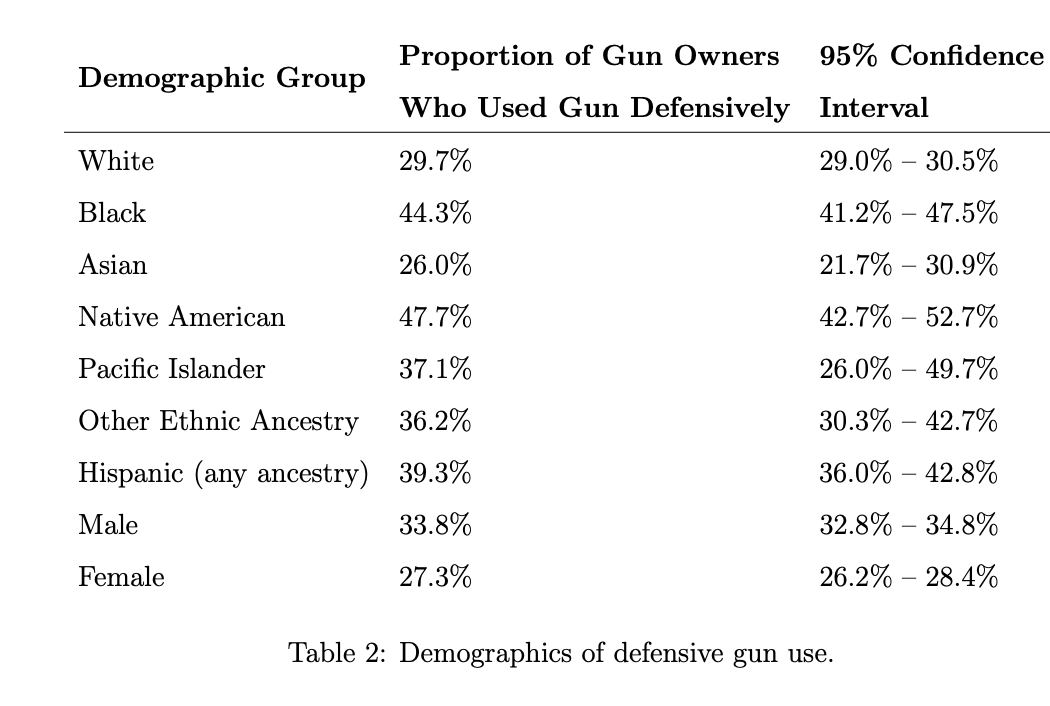
Notably "telling someone you have a gun" is counted as a large share of defense uses of firearms:


It ought to be possible to compare sales data to large magazine, assault rifle, handgun, rifle, and shotgun data to determine how accurate the survey results are in those domains.

The geographic ownership rates by state from the 2021 survey are as follows:


Of course, while statistical sample size sourced uncertainty is easy to estimate, sample selection bias is an issue in every kind of survey data and has gotten worse in recent years. Given the direction of the sample selection bias in election polling (even adjusting for representative samples), it could very well mean that the the bias is towards underestimates rather than overestimates, however. Centiment is not an "A-list" survey operation, especially for such a large survey, but that doesn't inherently mean very much a well done survey is useful no matter who does it.

Both bold and italic emphasis below is mine.
This report summarizes the findings of a national survey of firearms ownership and use conducted between February 17th and March 23rd, 2021 by the professional survey firm Centiment. This survey, which is part of a larger book project, aims to provide the most comprehensive assessment of firearms ownership and use patterns in America to date. This online survey was administered to a representative sample of approximately fifty-four thousand U.S. residents aged 18 and over, and it identified 16,708 gun owners who were, in turn, asked in-depth questions about their ownership and their use of firearms, including defensive uses of firearms.

Consistent with other recent survey research, the survey finds an overall rate of adult firearm ownership of 31.9%, suggesting that in excess of 81.4 million Americans aged 18 and over own firearms. The survey further finds that approximately a third of gun owners (31.1%) have used a firearm to defend themselves or their property, often on more than one occasion, and it estimates that guns are used defensively by firearms owners in approximately 1.67 million incidents per year. 
Handguns are the most common firearm employed for self-defense (used in 65.9% of defensive incidents), and in most defensive incidents (81.9%) no shot was fired. Approximately a quarter (25.2%) of defensive incidents occurred within the gun owner's home, and approximately half (53.9%) occurred outside their home, but on their property. About one out of ten (9.1%) defensive gun uses occurred in public, and about one out of thirty (3.2%) occurred at work.

A majority of gun owners (56.2%) indicate that they carry a handgun for self-defense in at least some circumstances, and about 35% of gun owners report carrying a handgun with some frequency. We estimate that approximately 20.7 million gun owners (26.3%) carry a handgun in public under a ``concealed carry'' regime; and 34.9% of gun owners report that there have been instances in which they had wanted to carry a handgun for self-defense, but local rules did not allow them to carry.

The average gun owner owns about 5 firearms, and handguns are the most common type of firearm owned. 48.0% of gun owners -- about 39 million individuals -- have owned magazines that hold over 10 rounds (up to 542 million such magazines in total), and 30.2% of gun owners -- about 24.6 million individuals -- have owned an AR-15 or similarly styled rifle (up to 44 million such rifles in total). 
Demographically, gun owners are diverse. 42.2% are female and 57.8% are male. Approximately 25.4% of Blacks own firearms, 28.3% of Hispanics own firearms, 19.4% of Asians own firearms, and 34.3% of Whites own firearms. 
In total, Americans own over 415 million firearms, consisting of approximately 171 million handguns, 146 million rifles, and 98 million shotguns.
William English, "2021 National Firearms Survey: Updated Analysis Including Types of Firearms Owned" SSRN (May 18, 2022).

This paper just includes the basically raw results of this particular survey without examining historical trends or comparing it to non-survey data.

Firearm ownership rates (ignoring multiple guns owned by a single person) have historically been lower in urban areas than rural areas and have gradually fallen over time as the population grows more urban and as hunting has grown less popular as a result.

Hat tip to Tom Bridgeland who provided the link to the paper in the comments.

09 September 2022

Highlights From A Book About Chinese History

A recounting of excerpts and observations from Yasheng Huang, The Rise and Fall of the East: Examination, Autocracy, Stability, and Technology in Chinese History and Today (2022):
Keju [the civil service exam system] had a deep penetration both cross-sectionally in society and across time in history. It was all encompassing, laying claims to time, efforts and cognitive investments of a significant swath of Chinese population. It was incubatory of values, norms, and cognitions, therefore impacting ideology and epistemology of Chinese minds. It was a state institution designed to augment the power and the capabilities of the state. Directly, the state monopolized the very best human capital; indirectly, the state deprived society access to talent and preempted organized religion, commerce, and intelligentsia. The Chinese state in history and today is an imprinted version of this Keju system.
* Chinese state is strong because it reigns without a society. . . .

* the exam system expanded in the 17th century, to support a larger and growing Chinese state. . . .
* Chinese bureaucrats in the provinces tend to be generalists and the ministerial officials tend to be specialists. . . .

* “A state without society is a vertically integrated organization…Keju’s powerful platform effect crowded and stymied alternative mobility channels…the Keju was an anti-mobility mobility channel.”

* “In the 1890s, China’s population literacy was only 18 percent, way below 95 percent of England and the Netherlands.”

* Exam competition takes up so much of individual mind space. Furthermore the competition atomizes society and makes it harder to form the kinds of collective movements that might lead to democracy. 
. . .

* “Throughout Chinese history very few emperors were toppled by their generals or senior functionaries, a sharp contrast with the Roman Empire.”

From here

Does Behavioral Science Work?

This paper overstates its case somewhat, but there is some truth to its claims.
How accurately can behavioral scientists predict behavior?

To answer this question, we analyzed data from five studies in which 640 professional behavioral scientists predicted the results of one or more behavioral science experiments. We compared the behavioral scientists’ predictions to random chance, linear models, and simple heuristics like “behavioral interventions have no effect” and “all published psychology research is false.”

We find that behavioral scientists are consistently no better than - and often worse than - these simple heuristics and models. Behavioral scientists’ predictions are not only noisy but also biased. 
They systematically overestimate how well behavioral science “works”: overestimating the effectiveness of behavioral interventions, the impact of psychological phenomena like time discounting, and the replicability of published psychology research.
Dillon Bowen, "Simple models predict behavior at least as well as behavioral scientists" arXiv:2208.01167 (August 3, 2002) (pdf link).

Has China's Overdue Deep Recession Finally Arrived?

China is about due for a major recession after years of uninterrupted growth (which I have predicted). A new Wall Street Journal article's headline suggests that it may finally be appearing. But, it will take more and better data to know.

China’s Property Market Has Slid Into Severe Depression, Real-Estate Giant Says 
Country Garden, which for years ranked as China’s top real-estate developer, reports 96% drop in first-half profit

From the Wall Street Journal (to which I don't have access to the body text). 

There was also a definite COVID related contraction in the Chinese economy in 2020.

08 September 2022

The U.S. Navy Still Has Problems

The U.S. Navy continues to ignore elephants in the room regarding its deep military vulnerabilities. Also, mostly as a result of weak management of the service, the U.S. Navy does a poor job of running the assets it has as a "tight ship" (as evidenced by major screw ups outside of wartime situations) and does a poor job of procuring new major military systems. 

[I]n war games and mock attacks from 1966 to 2006 — a forty year span — submarines and surface warships from the Soviet Union and Russia, China, Chile, Holland, Australia, and Canada theoretically destroyed the carriers Saratoga, Independence, John F. Kennedy, Franklin D. Roosevelt, Eisenhower, Forrestal, Constellation, Carl Vinson, Theodore Roosevelt, Kitty Hawk and Abraham Lincoln. Nor is this ancient history. More recent articles . . . refer to the continuing problem of the Navy’s inability to protect its high-cost core assets. . . .  aircraft carriers are becoming vulnerable to China’s anti-ship ballistic missiles and other systems. Part of the problem is also the Navy’s poor anti-submarine systems (ASW) systems. This all must be given much more serious attention by anyone who thinks everything’s just fine.

But the problems the Navy has today go way beyond the utility of its carriers. Leadership has come under increasing scrutiny. . . .  recent Navy disasters such as the tragedies involving the McCain, Fitzgerald, and the Bonhomme Richard amphibious vessel, which was destroyed in port last year by fire, bear many of his criticisms out. . . . the service [is]. . . “cumbersome, vastly overmanned, stolidly managed, with massive institutional inertia and hobbled by internal and external politics.” . . . [with] “monstrous levels of inefficiency in many respects”[.] . . . According to a 2021 survey of current and retired Navy officers: “Concern within the Navy runs so high that, when asked whether incidents such as the two destroyer collisions in the Pacific (McCain and Fitzgerald), the surrender of a small craft to the IRGC (Iranian Republican Guard Corps) in the Arabian Gulf, the burning of the Bonhomme Richard, and other incidents were part of a broader cultural or leadership problem in the Navy, 94% of interviewees responded ‘yes.’” . . .
The problems plaguing the Zumwalt-class destroyer and Littoral Combat Ship (LCS) programs, for example, represent moral as well as material failures. . . .
it is difficult to see this organization continue to blunder and make mistakes that go uncorrected decade after decade. 

From here.

The losses of the Russian Navy's Black Sea fleet in the Ukraine War were due to vulnerabilities to anti-ship missiles to which U.S. warships are also highly vulnerable.

In addition to anti-ship missiles and hypersonic missiles deployed from land, aircraft, surface combatants and submarines, U.S. surface warships are vulnerable to submarine launched torpedoes, sea mines, and swarm attacks by small boats and drones.

Almost all U.S. Navy destroyers and frigates have naval guns that are basically unguided shell lobbing howitzers with a range too short to be useful in supporting grounds forces in coastal areas, or in combat against missile armed enemy warships, although they might be effective against the kind of militarized civilian pirate and smuggler opponents generally reserved for coast guard vessels. Naval guns are also ineffectual against submarines, drones, and enemy aircraft.

The U.S. Navy and the Marine Corps devote immense resources to maintaining a non-permissive amphibious assault capability that hasn't been utilized in a militarily important way since the Korean War in the 1950s. Long range missiles, aircraft carrying guided bombs and missiles, and paratroopers, have largely made that mission obsolete.

The U.S. Navy devotes immense resources to blue sea warships capable of striking other warships with anti-ship missiles, even though submarines and warplanes are just as effective or more at doing so, at a comparable or lower cost, and are far less vulnerable to enemy attacks than U.S. Navy surface combatants in that mission.

Similarly, submarines and warplanes just as effective or more than surface combatants at launching missiles at land targets, at a comparable  or lower cost, and are far less vulnerable to enemy attacks than U.S. Navy surface combatants in that mission.

Even anti-submarine warfare is an area where patrol aircraft like the P-8 together with submarines, both of which are comparable in cost or less expensive than, and far less vulnerable than U.S. surface combatant aircraft in this mission.

The U.S. Navy has a long neglected sea lift function, that has avoided disaster mostly because no one has seriously tried to take it on militarily. These sea lift resources, as demonstrated in the 1980s and 1990s, is mostly too slow, and has too little capacity, to get ground forces to the battle in the time frames that matter in modern warfare. And, many of the sea lift ships it has are just civilian freighters with U.S. Navy logos painted on their sides with no significant military capacity of their own. Also, the heavy tanks that were once at the core of what used to need to be sea lifted are increasingly of less importance in ground combat.

U.S. Navy surface combatants have crews that are two or three times as large as they would need to be with modern automation technologies and many of their functions can be performed just as well by unmanned surface and submarine drones.

Basically, going to war in a U.S. Navy surface combatant is like going into a battle on land in an armored RV, that is slow, vulnerable, has a small tooth to tail ratio, and puts large numbers of sailors at unnecessary risk.

Yet, the U.S. Navy is extremely expensive. Its budget alone, setting aside the Marine Corps within the Navy, the Army, and Air Force, is still larger than the budget of the entire military of any other country in the world. 

The U.S. Navy is far larger than any other naval force that could conceivably be an opponent of the U.S. Navy in the foreseeable future, even without considering allied support that is likely to be present in any foreseeable conflict. And, it isn't particularly efficient in utilizing the resources that it has, with only about a third of its warships deployed at any one time.

Despite the fact that Russia is one of the main blue sea navy adversaries of the U.S., military lobbyists rarely even bother to portray it as a serious threat for the U.S. Navy to counter any longer. Its allies in Europe and East Asia who are closer to Russia are more than capable of handling that threat themselves. Naval threats from Iran and North Korea, two of the most formidable potential naval opponents of the United State Navy also barely get a mention in debates on funding the U.S. Navy.

Almost all contemporary policy and lobbying arguments for maintain the current high levels of U.S. Navy funding focus on the ability of the U.S. to defend Taiwan from an amphibious invasion from the People's Republic of China, a single potential conflict, about which Taiwan itself vacillates about fighting at times. But the U.S. Navy, with its World War II era derived force structure, which it doubled down on in Ronald Reagan's Navy buildup, isn't even particularly optimized for that mission.

In sum, U.S. spending on the U.S. Navy, and especially its fleet of surface combatants, is probably the single best place for the U.S. to cut its grossly excessive defense budget, without undue harm to U.S. national security.

The U.S. does require a navy appropriate to its needs as a global military power. But it needs to stop throwing good money after bad to address hypothetical adversaries that don't exist. And, the U.S. military needs to far more seriously consider the extent to which ground and air based forces would be better alternatives for carrying out many of the missions to which the U.S. Navy has been assigned.

The Queen Is Dead

Queen Elizabeth II died today at her summer home in Scotland at age 96. She served as Queen for 70 years, the second longest reign of any monarch in the entire world in all of history, after Louis XIV of France, the longest-reigning monarch, with a 72-year and 110-day reign from 1643 until 1715.

The man formerly known as Prince Charles, age 73, is now the King of the United Kingdom (and also of Canada, New Zealand, Australia and a few other places). It is customary for his to decide for himself what his name will be as King at his coronation (but see below). His second wife Camilla's title (whom he married in 2005, after his first wife and mother of all of his children, the late Princess Diana, divorced him prior to her death, and then died in 1996) is now Queen Consort.

Prince William, age 40, the adult eldest son of Prince Charles (and a much more popular figure than his father), is now the Crown Prince. The person next in line to the throne is Prince George, the nine year old eldest child of Prince William.

Since the United Kingdom is a constitutional monarchy in which the monarch plays a primarily symbolic role, such as formally declaring the United Kingdom's new Prime Minister to be head of government in Scotland earlier this month, there are basically no practical governmental policy implications for this development in the short term.

Charles Stross (a science fiction author and anti-monarchist in the U.K.) has some comments at his blog:

Operation Unicorn is in effect (contingency plans for the monarch dying in Scotland). Charles is now King: coronation will follow within the next year, his name as monarch isn't announced yet.
UPDATE:

A few hours after the death of Queen Elizabeth, the new King of England announced that his regnal name will be King Charles III.

Secessionism

Secessionism is primarily driven by political identity according to a new study using a very large global dataset. 

It also sheds light on why the U.S., which has significant secessionist leanings that caused the U.S. Civil War but remain alive and well today, and deep seated racial divides, has a weak welfare state and an anti-government spending bent.

This said, there is the question of who seeks to secede from whom. If there is a division in political identity, either group could seek to secede. Conventional wisdom is that the more affluent side seeks to secede, which holds true in the cases of Spain and Italy, but not in the U.K. (both before and after the formation of the Republic of Ireland) or the U.S.
This paper analyzes whether the propensity to secede by subnational regions responds mostly to differences in income per capita or to distinct identities. We explore this question in a quantitative political economy model where people's willingness to finance a public good depends on their income and identity. 
Using high-resolution economic and linguistic data for the entire globe, we predict the propensity to secede of 3,003 subnational regions in 173 countries. We validate the model-based predictions with data on secessionist movements, state fragility, regional autonomy, and conflict, as well as with an application to the dissolution of the Soviet Union. Counterfactual analysis strongly suggests that identity trumps income in determining a region's propensity to secede. Removing identity differences reduces the average support for secession from 7.5% to 0.6% of the population.
Klaus Desmet, Ignacio Ortuño-Ortín & Ömer Özak, "Is Secessionism Mostly About Income or Identity? A Global Analysis of 3,003 Subnational Regions" NBER Working Paper 30428 (September 2022).

07 September 2022

Quote Of The Day

Three Rings for the Elven-kings under the sky,
Seven for the Dwarf-lords in their halls of stone,
Nine for Mortal Men, doomed to die,
Six for J-Lo.

From here

06 September 2022

The Ukraine War Half A Year Later

A little more than six months in, the war in Ukraine is not going well for Russia, despite the fact that it has a much larger population, a much larger economy, and a much larger military than Ukraine.

Two main factors determine who wins wars. Technology and the allies of the respective sides. Russia has neither. 

Allies

Russia has the support of the regime in Belarus and a few other former Soviet Republics, Syria, Iran, and perhaps North Korea. The support or submission from the leadership in Belarus was undermined by sabotage of Russian supply lines to Ukraine from internal dissenters, and its assistance was undermined by the fierce resistance Russia faced along the Belorussian border where there are few ethnic Russians living to support them as they have had in other territories that they have occupied. 

Both India and China standing neutral enough to not directly oppose it and to purchase its sanctioned oil at a favorable price, and Mexico neutral since this is a distant war in which it has no dog and because it no military capacity (by design) to fight a foreign war. This neutrality would probably collapse is Russia used nuclear weapons in this conflict.

Almost the entire balance of the world, including NATO, Turkey, and much of the rest of the world is arrayed against Russia and back Ukraine. Rather than getting NATO to back off, Russia has caused it to expand and pull together against the imminent threat that it poses, while its members spend more on their defense budgets out of fear of a Russian attack.

Almost all of the other countries in Europe except Belarus and a few small former Soviet countries, from the United Kingdom and the United States, to former Soviet Republics like Lithuania, to former Warsaw Pact members like Poland, are openly supplying Ukrainian forces with arms and military intelligence. Even countries that refused to joint NATO, like Ireland, are openly welcoming Ukrainian refugees. Even perennially neutral Switzerland has joined in enforcing economic sanctions against Russia. Turkey has stridently insisted that Russia retreat not just from its newly conquered territory but from the territory in one in a fait accompli in Crimea and ethnically Russian areas on the Russian border with Ukraine.

Sanctions and Natural Gas Supplies

The Financial Times reports that:

Russia’s gas supplies to Europe via the Nord Stream 1 pipeline will not resume in full until the “collective west” lifts sanctions against Moscow over its invasion of Ukraine, the Kremlin has said.

Germany leaned early on in the conflict towards a muted response out of an awareness of its reliance of Russian fossil fuel imports (although Italy and Poland were both more resolute despite their comparable dependency on Russian natural gas). But Russia has taken away any incentive that Germany, Poland, Italy, or other countries reliant upon its natural gas would have to consider Russia's desired after pulling the trigger of its threat with an ultimatum that fossil fuel reliant countries on the fence couldn't meet if they wanted to do so.

So, Germany, Italy, and other countries that have been dependent upon Russian natural gas are now forced to find alternatives even if it would have been politically painful to do so if Russia had merely continued to insist on being paid in rubles rather than Euros, rather than on the entire Western alliance lifting its economic sanctions. Even if the war ends and sanctions are lifted, returning to dependency on Russian national gas in the long run will now be something these countries will make extreme efforts to avoid for national security reasons.

Indeed, but making the lifting of those sanction an ultimatum, it validates the imposition of those sanctions in the first place by suggesting that those sanctions are important to it, which will encourage the West to keep those sanctions in force. The timing of this development is a Russian own goal, because in the West doubt had been developing over whether the sanctions were really working.

Russia is forcing Western Europe to wean itself from reliance on Russian natural gas. When the war is over, much of the demand for Russian natural gas, a commodity that can be sold in great volume only to Western Europe due to the logistics of transporting natural gas, if it fails to satisfy Western European demand for it this winter, will no longer exist, permanently denting its income from its most important export.

Likewise, while the brain drain that the Ukraine war has triggered as Russia's brightest minds and best businessmen have left the country isn't very visible in the short run, this will permanently impair Russia's economy in the medium to long term. And, most of the world's multinational businesses, having disinvested due to political risk in Russia, will not return until long after formal economic sanctions against Russia are lifted.

In sum, Russia has put itself in the slow lane of economic development for the foreseeable future even long after the war is over.

And, while Russia has already made a concession to allow some Ukrainian grain and cooking oil exports across the Black Sea, the war is still an impairment to food supplies many places in the world which won't make Russia friends among countries facing inflation, hardship and famine as a result, that might otherwise have been inclined to be neutral in the Ukraine war.

Conventional Military Technology and Resupply

In part, from its Western allies, Ukraine has developed far more high technical arms than it could build itself with supplies that can be replenished.

Armed with modern Western guided missiles, from Scandinavian anti-ship missiles, to U.S. HIMARS and loitering munitions, to modern guided anti-tank missiles of several kinds from many of its allies, with U.S. satellite and spy plane intelligence, and with advanced intelligence drones, as well as cast off artillery batteries and armored military vehicles from its allies, Ukraine also has the technological edge.

Russia has mostly exhausted its supplies of guided munitions. Its Black Sea fleet has suffered serious defeats, losing ships, based, and supplies to support those ships and has been forced to stay far from the fight for fear of being struck down by anti-ship missiles and denying it the ability to move troops to flank Ukrainian forces by sea. Russia's tanks, armored personnel carriers, and artillery batteries have been destroyed in great numbers. It has had tens of thousand of casualties, extending up to proportionate numbers of generals and high ranking military officers lost. It has lost some drones and some helicopters. Its ammunition and fuel dumps have been pummeled. Bridges across the Dneiper River have been destroyed making it impossible for its forces to advance further West into Ukraine without turning the forces seeking to cross into sitting ducks for concentrated artillery fire.

None of this heavy Russian military equipment and none of its senior personnel losses are easily replaced. It doesn't have enough of a self-sufficient manufacturing base to do so quickly, and China isn't selling it replacement arms. Also, until Russia's military equipment is replaced, Russia will return to the Soviet era dilemma of balancing guns and butter while it devotes an above average share of its economic capacity to replacing these lost assets unless Russia contents itself with disarming on a scale similar to Germany and Japan after World War II.

Most remarkably of all, Russia's air force, which on paper is vastly superior and easily relocated from all other fronts and bases in Russia to the Ukraine conflict, has not been able to maintain air superiority and has not been able to fly main sorties against Ukraine's far smaller air force made up mostly of jet fighters of the same design, many of which were lost in the first few days of the war. Some of this is attributable to Ukraine's domestic and more recently Western supplied anti-aircraft missiles that make it dangerous for Russia warplanes to fly over Ukraine. Some of this, presumably, is due to shortages of warplanes in good enough repair for combat with enough pilots sufficiently well trained to fly them in a war zone. The shortage of hard to replace guided weapons for these warplanes also greatly diminishes their effectiveness.

As a result, Russia now has far less conventional war fighting capacity in Europe than it did when the conflict started, and the quality of its forces has been revealed to be hollow in a way unappreciated when the Ukraine War began.

The catastrophic failure of Russian military systems in head to head fights against Western supplied more advance Ukrainian missiles will also, in the medium to long term, seriously stunt the inclination of foreign countries to purchase its military exports which is another of its major sources of foreign currency.

The Muted Nuclear Threat

Russia still has nuclear weapons, but its failure to use them, a failure to use even tactical nuclear weapons that it, unlike the West, still has in its arsenal, so far makes the threat that they will be used going forward less credible. Russia also knows that a resort to nuclear weapons could trigger a direct nuclear retaliation from the West in what has so far been merely a proxy war for Ukraine's many allies in the mutual assured destruction balance that persisted throughout the Cold War.

Ukraine has crossed lines that many initially believed early on in the conflict might trigger nuclear war, like striking hard in Crimea, sinking its flagship in the Black Sea, and carrying out assassinations and terrorist style attacks deep in Russia. Western assistance to Ukrainian forces has grown more open, and Western forces have harried Russian naval forces in the Mediterranean, the North Atlantic, the Irish Sea, and the Baltic Sea.

Short of an open Ukrainian military scale assault on a major Russian city with large civilian casualties, or major direct Western military intervention beyond a Ukrainian proxy fight on the territory of Ukraine itself, it is hard to see what would trigger a nuclear strike from Russia now.

Also, nuclear weapons, even comparatively small tactical nuclear weapons (which Russia claims to still have and the West has largely dismantled) are fundamentally ill-suited to subjugating conquered peoples and holding territory. They are good for sinking large naval ships or penetrating bunkers or destroying large military bases. But, they kill everything in the vicinity making them inappropriate for trying to rule territory without killing everyone in it. And, a campaign to massacre whole swaths of Ukraine with nuclear weapons in order to replace them with Russian colonists (in a move somewhat similar to the genocidal tactics employed in Ukraine in the early days of the Soviet Union before World War II) would place Russia at grave risk of mass nuclear retaliation in Russia's own territory.

Instead, Russia has tried to play games by threatening to damage Ukraine's nuclear power plants in a move that be an environmental disaster for all of Europe and might provoke decisive more direct military action against it from the West.

Political Considerations

Mostly, Russia has managed to suppress war related dissent with ruthless totalitarian measures, and has managed to blunt the appearance of distress from economic sanctions with homegrown replacements to post-Cold War Western businesses. But, with its natural gas card spent, Russia has very little that it can do to sanction its enemies economically because its exports are narrow and are not diverse.

Putin started this war with very little internal consultation, or involvement of his allies other than the leaders of Belarus. His grip on power is strong, so he didn't need it to start this war. But, without having secured their buy in in advance, Putin has left Russia with a lot of very powerful people who wouldn't lose face if the war's end was a disaster, many of whom have experienced serious personal economic setbacks as a result of this decision by Putin that they weren't involved in making.

There is no indication at this point that there is any strong elite or grass roots movement to end the war or depose Putin. But even if Putin ends this war, or can bring it back to the simmer that it was in from 2014 to 2022 with something like the status quo level of territorial gains, he will have depleted much of his political capital and his regime will be in a place where a lot of the powerful people in the country feel like they are owed favors after having been put out by the war and its consequences.

An outright catastrophic defeat of Russia in this war that forced it to surrender not just its territorial gains from the last six months but the territory it sized in 2014 with some Russian military personnel tried for war crimes by Western and Ukrainian powers, could crush the Russian national psyche to a degree not previously seen since its defeated withdrawal from Afghanistan or worse.

Putin and Ukraine both have reasons to turn to diplomacy before a complete rollback of Russia's 2014 gains are achieved.

This would leave Putin a fig leaf of accomplishment, even if it is a meager one, looking at the larger war started in 2014 as a whole, when a complete and total defeat with many further casualties and military resource losses, might be the only thing that could undermine enough to cost him his hold on power in Russia.

Allowing Russia to retain, for example, Crimea with or without its 2014 holdings in Eastern Ukraine, also breaks for good the political deadlock that Ukraine was in on the brink of Russia's 2014 aggression when there was a razor thin divided between pro-Western political parties that were strongest in the West, and pro-Russian political parties that were strongest in the areas Russia took in 2014 and held without serious Ukrainian contest for the eight years that followed. Russia's invasion of Ukraine has probably tipped marginal voters permanently against Russia anyway, but keeping representatives from these strongholds out of Ukraine's parliament would leave no hope that pro-Russian political forces could ever regain power in Ukraine.

The End Game

What does the end game look like in the Ukraine War?

An end to the Ukraine War due to regime change doesn't look likely on either side of the conflict.

Because Ukraine's allies give it more capacity to resupply itself militarily than Russia, and a marginal edge in military effectiveness, we have reached the point where a war of attrition favors Ukraine over Russia.

The longer the war goes on, the more Russia falls to a lower percentage of its pre-February 2022 military capacity and the more territory that it holds in Ukraine it will lose. The pace at which Russia is faltering is now gradual, rather than the huge losses it experienced early on in Northern and Western Ukraine, or the back and forth ebb and flow of territorial gains that netted in its favor in the early months of the conflict. But Russia also doesn't seem to be making any gains.

Russia also seems like it is at a disadvantage in terms of economic attrition as the war persists due to sanctions that have cumulative negative effects upon it.

Almost all of the territory of Ukraine that Russia doesn't currently hold, and quite possibly some of the territory of Ukraine over which it currently has de facto control, would be as a practical matter, impossible for Russia to hold in any fruitful way. The people who live in the parts of Russia that it doesn't hold have a majority Ukrainian identity (often far more than a majority), have been organized and armed as a militia with military grade weapons, and have had their cause of resisting Russia unequivocally affirmed by an unquestionably legitimate government of their country.

Fresh and credible reports of war crimes committed by Russian forces so far in the Ukraine War have effectively poisoned the well. As a result of these war crimes it is unlikely that the Ukrainian people would ever submit to Russian occupation, even if they were terrified of retaliation. The distrust these Russia's war crimes and dishonorable tactics in invading notwithstanding fresh treaties to the contrary would leave any Russian occupying force facing a never ending, Western supported insurgency for at least several decades if it tried to rule the Ukrainian people for a sustained period in territory of Ukraine that it doesn't hold now.

In general, the insurgent's job of preventing the regime that claims de facto military control of territory is easier than the occupier's job of trying to maintain order and rule in a functional government without the widespread resignation or consent of the the people they are ruling.

For example, lots of Ukraine is farmland. It's the breadbasket of Europe. But a year of diligently, carefully, painstakingly raising a crop of wheat over hundreds of hectares can be easily destroyed in a single night with a low risk, low technology act of vandalism. Alternatively, a patriotic Ukrainian farmer can simply refrain from planting a crop during a period of Russian occupation.

An insurgent can destroy rail lines and bridges, can destroy gasoline and diesel storage facilities, can sabotage a grain elevator storing a harvested crop, can slash the tires of occupation government vehicles and throw rocks through the windows of government offices in the dark of night, can organize a mass movement to not pay taxes or to falsify tax returns, and so on. A bunch of young men with assault rifles who don't speak the local language and don't know the territory, many of them conscripts, would be hard pressed to run a modern country like Ukraine fruitfully over the resistance of its people.

The Russians might be able to occupy and control a few enclaves that it depopulates of Ukrainians and replaces with colonists who are brave to the point of being foolhardy in a few selection places like part of the port of Odessa, but no amount of heavy military weapons could effectively subjugate the populations of most of Ukraine at this point, even if they might have been able to pull it off if they had toppled the Ukrainian national government at the outset.

Russia may cling to maintaining a land bridge to Crimea from its territory, and to holding onto some of its 2014 territorial gains in Eastern Ukraine, including lots of territory that was majority ethnic Russia before 2014 and is now even more so as ethnic Ukrainians have fled, where Ukraine might find it challenging to retain de facto political control anyway in the face of insurgencies led by ethnic Russians in areas Russia has claimed.

But to hold any pre-2014  territory of Ukraine without facing ongoing war by reaching a mutual agreement formalized in some sort of treaty, will have to make concessions to match every gain it makes. This time around Russia can not simply resort to a fait accompli status quo with local populations that have fully submitted to them and gained at least a patina of legitimacy.

Russia might need to agree to demilitarize these territories and maybe even adjacent territory across the Russian border, to dismantle its Black Sea fleet, to dismantle its tactical nuclear weapons, to surrender select accused war criminals in its Army, to pay some sort of reparations and/or to otherwise surrender economic claims it asserts now that are associated with Ukraine and/or its allies. 

Alternately, we might see a frozen cease fire along some line of control without a true treaty ending the war, like the period from 2014 to 2022 in Ukraine, akin to what we have seen between North Korea and South Korea since active hostilities in the Korean War ended, or the status of the West Bank and Gaza in Israel, or like the perpetual competing claims to territory that we've seen between the People's Republic of China and Taiwan, or like the disputed status of the Western Sahara region controlled by Morocco. A resolution like this one would end fighting, while keeping stubborn tensions unsupported by the realities on the ground for many decades to come is also possible. Such a standoff might continue, at least, until Putin is dead.

Or, Russia could simply give up and unilaterally withdraw, having determined that it has nothing further to gain from further efforts to prosecute the war that it started, and having also concluded that it can't secure a treaty it can live with by mutual agreement. Many counterinsurgency operations ultimately end that way.

Crime Reduction Research

An interesting analysis takes on the question of how to reduce crime.

It starts by establishing that crime is bad, not just due to direct harm, but due to indirect harms like changing how people behave to avoid it. I won't belabor that point.

It then lays out some key facts:

The distribution of criminal behaviour is highly skewed, with a very small proportion of the population accounting for a significant share of total crime. Incapacitation of this group through imprisonment results in a significant reduction in societal exposure to criminal activity.

(i) A study of the Swedish population born between 1958 and 1980 found that 3.9% of the cohort was convicted of a violent crime. A group of persistent offenders accounting for 1% of the total population accounted for 63.2% of all convictions. These offenders were relatively likely to commit offences early, use drugs, and display personality disorders.

(ii) A paper comparing convictions from a UK longitudinal study and a US dataset of self-reported delinquency found that in both cases, criminal behaviour was well described by a power law.

(iii) Some 70% of custodial sentences in England and Wales are handed out to offenders with at least seven previous convictions or cautions; 50% to those with at least 15.

(iv) Roughly 73% of 2016 US federal offenders had previous convictions. Among this group, the average number of convictions was ~6. Around 39.5% of these offenders had prior violent offences.

Offenders often possess characteristics which require greater support both in prison and in general society, and which may make standard models of rational choice a poor fit for their decision-making processes.

[Multiple studies show that people convicted of crimes have "high discount rates" which is to say that they disproportionately care about the short term and short change the long consequences.] . . . .

(iv) Some 53,109 adults in British prisons were being treated for alcohol or drug abuse issues in 2017-18, out of a total prison population of around 82,000.

(vi) The National Institute on Drug Abuse states that ”85% of the [US] prison population has an active substance use disorder or were incarcerated for a crime involving drugs or drug use”

(vi) The UK does not have up-to-date figures on mental health in prisons, but the Institute of Psychiatry estimated over half of prisoners have common mental disorders - PTSD, anxiety, or depression - while another 15% have specialist mental health needs, and 2% acute and serious problems.

(vii) The APA estimates that “at least half of prisoners have some mental health concerns”, and 10-25% of US prisoners serious mental illnesses such as schizophrenia.

The deterrence effect of jail time appears to be relatively weak, in part due to these commonalities. . . . 

(ii) . . .  the majority of any deterrent effect results from the initial period of punishment.

(iii) . . . when . . . the economic return to non-criminal activity . . . is low value the return to crime may be disproportionately high.

(iv) . . . it is not clear whether classical rational behaviour is a good approximation to the behaviour of individuals suffering from mental illness or substance abuse issues.

(v) These suspicions are born out by David Roodman’s excellent analysis of deterrence, which notes that punishments designed under the presumption that increases in the certainty of punishment better dissuades criminal behaviour than the threat of greater sanction did not produce the desired effects.

(vi) Roodman also notes that US studies on increased severity have shown little in the way of strong deterrence effects.

(vii) The existence of significant procedural delays in trials and sentencing may exacerbate this, pushing the eventual punishment further into the discounting window.

Conversely, the deterrence effect of visible policing is relatively high

(i) A study using variation caused by the terror alert level set by the Department of Homeland Security found that crime levels decrease significantly when police presence is increased.

(ii) An Argentine study using variation in policing following terror attacks found a strong deterrent effect of observable police in the immediate vicinity.

(iii) Evidence from the United Kingdom shows that victim-reported crime drops with higher numbers of police, while police recorded crime may increase - indicating a deterrent effect alongside improved reporting.

(iv) Variation in police spending in sync with electoral cycles shows that increases in police force numbers have a strong effect on violent crime.

(v) A review of the literature on hotspot policing found that focusing police attention on high crime areas caused an appreciable decrease in crime, with some evidence that high visibility patrols were more effective than normal patterns of behaviour.

Local interventions can also reduce crime by altering the physical environment
. . .  
(ii) An analysis of the impact of street lighting on crime in the UK found that targeted interventions tended to reduce crime, and also made residents less fearful, potentially reducing costly behavioural alteration. . . . A broader review backs this conclusion, finding that street lighting significantly reduces crime.
(iv) A 2009 review of the literature on the installation of CCTV cameras found that it resulted in a small but significant decrease in criminal activity, particularly in car parks. . . . A similar review conducted in 2019 replicated these findings, with the additional note that active monitoring resulted in a larger reduction than passive systems. . . . One study suggests that the bulk of the benefit is deterrence of automobile theft.

The incapacitation effect of imprisonment is relatively strong

(i) Almost by definition, an individual in prison is highly unlikely to commit a crime against a member of the general public.

(ii) Set against this, they are also more likely to commit crimes within prison. Greater monitoring of behaviour must be set against the lack of possibility for effective further punishment (longer sentences may not act as sufficient deterrent), and an environment which is likely to be criminogenic (see below).

(iii) The cost of crime within prison is likely to be lower to society than the cost of crime without; it is not committed against random members of the population, results in less defensive expenditure or avoidance behaviour, and is focused on a smaller group of individuals in an environment designed to reduce criminal activity.

(iv) Roodman’s review of incarceration notes that multiple studies find strong evidence that incapacitation works to prevent crime. This should be expected.

Certain currently common forms of sentencing are likely to increase reoffending

(i) Turning again to Roodman’s review, there is a fairly solid bed of evidence that US prisons are criminogenic. This is not sufficient to outweigh the benefits of incapacitating serious offenders, but is cause for reappraisal for marginal offenders.

(ii) Harsher prison conditions are associated with greater recidivism. This is unsurprising, as brutalising conditions are unlikely to provide effective conditions for self-improvement. . . . A study of Italian jails shows that worse prison conditions does not reduce future criminal activity, instead driving increases in future criminal behaviour. . . . A study of US jails produced a similar conclusion, with a suggestion that harsher conditions increased crime post-release. . . .
(v) A UK Ministry of Justice report concluded that short-duration sentences if anything increased reoffending relative to court orders.

(vi) Norwegian prisons consistently display low rates of recidivism, and are marked by their civilised treatment of prisoners.

The analysis has conclusions, but I'll draw them myself from this data.

1. Identify the individuals at highest risk of committing serious or repeat crimes and support them so they they don't. This is a fairly modest share of the total population: mostly males who are high school dropouts, have substance abuse problems, have criminal records or juvenile justice records, have particular mental health disorders that put them at high risk, and have with poor non-criminal economic prospects. Substance abuse is generally higher risk than mental health disorders generally (although psychopathy manifests young and is a very high risk factor). 

Gang membership, while hard to establish legally in a civil liberties respecting manner, is also an extremely high risk factor. As of 2017:

According to the DOC, there are now more than 8,000 gang-affiliated inmates and parolees in Colorado divided between at least 135 gangs. That means that roughly one out of every four people in the state prison system is labeled as being in a gang. And there are now more gang members in prison than there are total DOC employees.

Incidentally, killing or incarcerating gang kingpins is absolutely the worst thing you can do if organized crime is a serious problem. (See also here).

As I've previously noted at this blog: "Just as crime gravitates to certain neighborhoods, it also clusters in families: According to one criminologist’s analysis of the National Longitudinal Study of Adolescent Health, 5 percent of families account for more than 50 percent of all arrests."

Less than a quarter of Colorado prison inmates graduated from high school in the ordinary course (as opposed to getting a GED) (compared to about 85%+ of the general population), and just 1% have earned any college degree (compared to about 43% of the general population). Substance abuse is a problem for 79% of inmates. Just 6% of Colorado inmates both have a high school diploma (as opposed to a GED) and don't have a moderate to severe substance abuse problem, and some of the inmates in that 6% have moderate to severe mental health problems.

"As of 2010, 3 percent of the total US population and 15 percent of the African-American male population have served time in prison. People with felony convictions more broadly account for 8 percent of the overall population and 33 percent of the African-American male population." (From Science Daily. The paper is: Sarah K. S. Shannon, Christopher Uggen, Jason Schnittker, Melissa Thompson, Sara Wakefield, Michael Massoglia. "The Growth, Scope, and Spatial Distribution of People With Felony Records in the United States, 1948–2010." Demography (2017). DOI: 10.1007/s13524-017-0611-1).

Traumatic brain injury (TBI) is extremely common in the most difficult inmates. 96% of inmates in a high risk unit of the Denver jail have a history of traumatic brain injury. By comparison, 67%-80% of all jail and prison inmates, nationally, have a history of traumatic brain injury, and 6%-8.5% of the general population has suffered from a traumatic brain injury. In the Denver high risk jail unit, 100% had a prior criminal history, more than 90% had a history of mental illness and more than 90% had a history of substance abuse. More than 77% of the inmates in the high risk unit had all four risk factors. A study reviewing TBI incidence in Australian prisons from 2006 found an 82% TBI incidence rate. Another county jail study from 2003 found an 87% lifetime incidence of TBI. A 1995 study examined the way the substance abuse can exacerbate TBI issues.

2. Incarcerate offenders with high recidivism risk until they no longer have a high recidivism risk. A small percentage of people are convicted of crimes and a small percentage of people who are convicted of crimes commit most of those crimes. Detain the worst and try to avoid criminalizing low risk offenders further with the criminalizing effects of poorly managed prisons.

3. Take the effort to make prison conditions less brutal both to reduce recidivism and to reduce crime within prisons.

4. Longer sentences don't discourage people not currently in prison from committing crimes, and even certainty in sentencing doesn't do that, because criminals don't care about the long run and aren't rational actors.

5. Visible police presence in crime hotspots can work.

6. Good street lighting reduces crime.

7. Actively monitored CCTV in parking lots reduces car theft.

The analysis fails to note, but it is nonetheless true, that strict gun control over large geographic areas is very effective at reducing homicide, suicide, and accidental deaths from firearms.

For example, “shall-issue concealed carry permitting laws were significantly associated with 6.5% higher total homicide rates, 8.6% higher firearm-related homicide rates, and 10.6% higher handgun-specific homicide rates compared with may-issue states.”

The analysis emphasizes the fact that violent crime causes more harm than non-violent crime. But, it misses some key points about prevention of crime, especially, but not only, non-violent crime:

1. Requiring a personal identification number (PIN) to use a credit card greatly reduces credit card fraud. See, e.g., this 2012 study (e.g. U.K. credit card fraud fell 63% when this was done).

2. Tracking technology is now cheap and used well, it can greatly reduce car and bicycle and laptop and phone theft, not just through deterrence and by recovering stolen items, but by catching thieves before they can reoffend.

3. Monitoring markets for stolen goods (including electronic markets) effectively is a good way to catch thieves and to make theft less cost effective.

4. Using forensic technology usually reserved for murders and serious assaults and rapes in burglary cases can greatly reduce burglaries because most burglaries are committed by repeat offenders so if you catch on burglar you prevent many offenses and recover a lot of stolen property.

5. Require small telecoms to adopt anti-spoofing calls used to make fraud calls.

6. Randomly including trackers in a modest percentage of delivered packages in problem areas, and using this information together with security camera data to catch porch pirates can reduce larceny.

7. More effectively blacklisting fraudsters can reduce fraud.

8. We could establish an agency that can identify patterns and networks of fraud activity in social media, and take effective action based upon it.

9. We should legalize one party consent to recording telephone communications to make it easier to catch offenders.

10. Legalizing vice (i.e. drugs, prostitution, and gambling) can greatly reduce crime by making organized crime that maintains black markets unprofitable, and by building trust between police enforcing crimes that have victims and citizens. For example, legalizing prostitution materially reduces sexual assault and drug crime rates.

Legalizing vice (e.g. federally legalizing marijuana) also reduces the amount of cash circulating which can drive robbery, burglary and theft.

11. Allowing adult entertainment businesses in a neighborhood reduces the incidence of rapes in that neighborhood.

11. After a fairly modest number of years after release from prison (about five) without committing a new offense, the risk of committing a new offense approaches barely below background levels.

12. Ignoring juvenile records deprives sentencing authorities of key information because the earlier and more severe your juvenile offenses are, the most likely you are to commit serious future offenses. Juvenile delinquency records are a major risk factor for adult crime. The notion that young offenses are most prone to rehabilitation is mostly false. People do age out of being high crime risks, but only in middle age.

13. The risk of substance abuse, and of schizophrenia and bipolar disorders, is highly hereditary.

14. The risk of poor academic performance leading to behavioral problems in school are highly predictable from early childhood, as is a capacity to defer gratification which is a major risk factor for crime.

15. A large share of crimes are economically motivated, or are violent crimes that are incident to economically motivated crimes. Even quite modest non-criminal economic opportunities for people with criminal records and people at high risk for committing crimes can significantly disfavor crime.

16. Abating lead pollution prevented a lot of crime and should continue. More generally, a 2017 California study of the link between air pollution exposure and delinquency shows a statistically significant link between pollution exposure and delinquency. A related study shows the impacts on air pollution exposure on cognitive development.

Finally, a footnote on race, public safety, and crime:

rates of homicides, gun killings and illicit-drug fatalities [ed. combined] are highest in counties where nine in 10 residents are white and where President Trump won in the 2016 election.

Such counties are not limited to one geographical region. They include Boone County, W.V.; Washington County, Utah; Baxter County, Ark.; and Brown County, Ohio.

Correspondingly, the white Americans who are safest from such deaths are those who live in racially diverse areas such as Los Angeles, New York and Chicago, where two-thirds of residents are nonwhite, where millions of immigrants live, and where voters favored Hillary Clinton in 2016. Nonwhites also are safer in these areas overall, though rates vary by location.  

White Americans are nearly eight times more likely to die from illicit-drug overdoses than murder, the CDC statistics show, a proportion that undoubtedly reflects the heroin and opiate epidemic. But according to FBI data for 2015, when whites are murdered anywhere in the country, the murderer is five times more likely to be white than nonwhite. (This ratio counts only murder cases in which information about the offender is known by law enforcement.)

Overall, white Americans who live in predominantly white and Trump-voting counties are 50% more likely to die from murder, gun violence and drug overdoses [ed. combined] than whites who live in the most diverse and Democratic-voting counties. The more white and Republican a county is, the greater the risk for white Americans.
and a footnote on immigration:
immigration is consistently linked to decreases in violent (e.g., murder) and property (e.g., burglary) crime 
Robert Adelman, et al., "Urban crime rates and the changing face of immigration: Evidence across four decades" 15(1) Journal of Ethnicity in Criminal Justice (November 21, 2016).

Deporting immigrants who are arrested for crimes, surprisingly, has no discernible impact on the crime rate.

And, a footnote on religion and homicide and suicide:
The current study assessed the relationship between national religious affiliation and lethal violence by simultaneously examining homicide and suicide rates. The information on homicide and suicide rates for 124 countries came from the World Health Organization (WHO). Regression results suggested no significant difference in lethal violence between predominantly Catholic and Protestant countries, although Islamic countries revealed significantly lower homicide, suicide, and overall lethal violence rates than non-Islamic countries. Countries with a high level of religious heterogeneity are subject to an increased suicide rate.