Showing posts with label Science. Show all posts

22 August 2025

Why Do Distance Runners Have More Precancerous Colon Growths?

Are Marathons and Extreme Running Linked to Colon Cancer? A small, preliminary study found that marathoners were much more likely to have precancerous growths. Experts aren’t sure why.

From the New York Times. 

My initial take is that marathoners and extreme runners aren't dying of cardiovascular diseases or pulmonary disease (including lung cancer), but eventually have to die of something, and that something is often colon cancer.

Another non-causal explanation could be that marathoners and extreme runners are more health conscious, and hence more likely to get their colonoscopies done, causing their colon cancers to be noted statistically, while less health conscious people skip their colonoscopies (an entirely understandable sentiment) and so if they have precancerous growths at the same age, they go undetected and aren't noted statistically.

In the same vein, almost no one discovers that they have precancerous pancreatic cancer growth, or even pancreatic cancer itself, because it is usually asymptomatic until it is very advanced.

Or, it could just be a statistical fluke, which is something that is common in small studies and is further influenced by a bias towards only publishing results showing a potential positive or negative disease correlation (which creates a "look elsewhere effect"  that reduces the statistical significance of the studies that are published since only locally statistically significant outlier results get published). The look elsewhere effect is widely recognized but can be hard to quantify.

It could be more than that. It is certainly plausible that a more stressed body might be more prone to cancer, and long distance running does indeed stress your gastrointestinal system. This is especially plausible if the true effect size is modest. Indeed, the confounds noted above could turn a small effect size into a seemingly much larger one.

But it also might be just be entirely due to some of the non-intuitive aspects of how epidemiology and health statistics work. 

19 August 2025

The Idea To Action Pipeline

My education and life training was typical of a lot of people who grew up in upper middle class families and lots of upwardly mobile people who used education and skill training and socialization in the course of securing those things. There are maybe a hundred million people in the United States, a country of about 340 million people, who have been raised or trained to have the kind of mindset that I have.

As younger children, a key focus from my parents (and the parents and teachers of most people like me) was on making good choices, and that's also something that was an important part of what my wife and I, and most of our peers viewed as good parenting.

As I got older, and advanced in my education and socialization all of the way into college, I was raised and taught (formally and informally) to identify problems, to analyze them in evidence and experience informed ways, to be familiar with lots of proven problem solving strategies, to devise appropriate solutions to problem that would work, and to know how to evaluate what is likely to work and test proposed solutions to see if they work as expected (and to revised the solutions if they don't).

Even in law school, the curriculum, while it taught us to nuts and bolts of what the law says, was very oriented towards identifying legal rules and official policies that were good, or were flawed, partially so we could use this knowledge in our adult lives and careers to push for better policies, and partially so that when we encountered flawed rules that we couldn't change we could understand what we were up against, why the rules were a problem, and with this information could devise the best strategies for dealing with them.

We learned to be on the lookout for good ideas that other people had, from other countries and places within our own country, from history, from different cultures, from people with a good track record for innovation, from sources that specialize in identifying good ideas. In the areas of science, and technology and medicine, back before the Internet, we subscribed to Popular Science and Science News. In the area of style and food and architecture when we moved to the West, there was Sunset magazine. These days, for example, I regularly check in on the Boing Boing websites, and read the latest academic scholarship from free sources like the arXiv and bioRxiv and SSRN preprint websites, NBER, the Legal Theory blog, and the various law professors blogs.

It is a way of thinking and conceptual tool kit shared with modest variation, by a large swath of people trained to make up our classes of mangers, professional, and makers. It's an approach used by scientists, engineers, inventors, transactional lawyers, mediators, business executives, entrepreneurs, policy makers, and innovators.

One of the textbooks used in my first college level political science classes, at Miami University of Ohio, was called "Power and Choice". And, the training, upbringing, and inclinations that I developed and that a huge swath of people developed, was focused on the choice side of this formula.

One of the reasons that I blog, and a major theme of my life, and the lives of lots and lots of people, although I probably have the luxury and means to do so more than most people, is to float constructive ideas for how we as a society can make better choices and find better solutions. Sometimes they are proposed government policies or laws. Sometimes they are better way to fund or finance something. Sometimes they are new technologies to could be used in a new way. 

Sometimes they are concrete approaches to concrete problems like better ways to landscape our home in a city in what is almost a high desert, or a better kind of appliance, or coming up with a better way to keep track of what pills I've taken or need to take, or a better way to keep track of what we need to buy at the store and what we already have in a way that we can actually find it, or how to manage household plants, or a more efficient way to pay bills.

Many of these ideas are solutions to problems that somebody else has. How to make better military procurement choices. What tools we could make available for first responders and disaster responses. How to tax publicly held companies and multinational business in a better way. How to deliver better health care results for our society as a whole, while doing so in a more affordable way. How to cut red tape in big bureaucracies.

Collectively, most of us have much less familiarity, less training, and less comfort and familiarity with the power side of the "power and choice" formula, even many of those of us who are truly exceptional and extraordinary at the choice part.

A lot of us are attracted to politics because we care about and have a good skill set for making policy, but are adrift when it comes to securing the power necessary to putting those policies in place. A lot of the scientists who see most clearly what paths to new scientific discoveries would be most fruitful and which are most likely to be dead ends are stymied at how to generate momentum and funding for those ideas in the scientific community. Lots of us are aware of businesses that would be good to invest in, or would be good to short, but don't have the financial wealth or the influence with people who have access to money to do anything about this knowledge. Lots of us are aware of innovative technological solutions that could bring about a lot of constructive change, but don't know where to begin to go about getting those solutions adopted more widely.

People like me, and there are perhaps a hundred million of us in the United States, have lots of good ideas, but feel hopeless or frustrated when it comes to turning these ideas into action.

And, it isn't just that we are stupid or missing the obvious. The idea to action pipeline is hard for most people to locate, is clogged up, and is full of seemingly unnecessary twists and turns that make it less effective. Acquiring the power to make even a seemingly obvious on brainer innovation that is itself minor seems to take absolutely epic amounts of time, money, connections, and effort that seems grossly disproportionate to the swift moment it takes to recognize that an idea is good and should be put into action.

It is no secret that I am no fan of Elon Musk, who is the richest man in the world. And, Mr. Musk is not a particular genius when it comes to coming up with ideas of his own. The technological innovations behind Telsa, SpaceX, the social media platform formerly known as Twitter, the Hyper loop, and his other projects were all the work of someone else. His ability to identify good ideas is slightly above average, but it isn't particular exceptional. Frederick W. Smith, who founded FedEx, is cut from the same cloth. He had identified one particular, not really profoundly innovative idea that could be implemented with technology that wasn't cutting edge but was still pretty new at the time he came up with it.

But, I have to grudgingly acknowledge that what Musk and Smith both excelled at (and may even continue to excel at) is securing the resources and momentum necessary to turn moderately good, although fairly obvious ideas that no one had implemented (as is so often the case) into action that allowed the ideas that were mostly children of other people to actually come into wide use.

In the case of Musk, being an heir to an emerald mine fortune helped a lot. Smith also grew up as the son of a wealthy, moderately successful business owner, attended the top local private schools, and went to Yale in some of the last years when doing so was more about money and connections than academic merit.

But turning ideas into action can be a lot more challenging for the rest of us, partially because we don't have nearly as much training in how to do this as we do in how to come up with good ideas (i.e. because we are much better at making good choices than exercising power), and in part, because the idea to action pipeline at the moment is mediocre and has deteriorated over time is a society that is starting to stagnate (something that Economist Tyler Cohen wrote a book about).

This is true even for people like me who have a solid nuts and bolts understanding of things like how capital is raised for businesses in the modern U.S. economy, how the political process works, and the inner workings of academia, while spending decades working side by side by quite successful political figures and business people and academics (albeit not necessarily the peak "A-list" individuals in their respective fields).

Yes, it is possible to innovate and turn good ideas into action, even if, in my humble opinion it is too hard to do so. And, it is true that innovation shouldn't be too easy or free of gatekeepers. There are also a lot of really bad ideas out there that, when implemented, do immense harm. The more easily ideas get turned into action, the more important it is that the ideas that receive the thumbs up are good ones.

For examples in the 20th century of bad ideas being adopted too quickly and causing immense harm, ask the people of the early Soviet Union, Maoist China, revolutionary Cambodia, or North Korea. Ask the members of cults like the one organized by Jim Jones. 

Ask the people who thought it was a great idea to cover beautiful hardwood floors with cheap vinyl who convinced tens of millions of American homeowners to do so. Further back, ask the people who thought that putting the ill-drafted Second Amendment into the United States constitution was a good idea.

More recently, look at the policy initiative of RFK, Jr., or the actions taken by Elon Musk's DOGE, or the "Liberation Day" tariffs in the second Trump Administration.

On the other hand, lots of opposition to new ideas is mindlessly stubborn, ignorant, corrupt, or mendacious.

Sitting in my living room under the ceiling fan on a hot, dry summer day in August, after returning to work at home after a morning in my office doing a lot of work that actually generates money, I don't have a solution for how to improve the idea to action pipeline. But, surely, even identifying this as a crucial and pervasive problem in our society is progress in and of itself and can lay a foundation for future progress.

31 March 2025

Life After Death


Belief in life after death is an interesting choice to compare religiosity. 

It is a belief shared by all of the widely adhered to religions in the region without being strictly tied to any one of them, and also captures residual metaphysical beliefs in contrast to metaphysical naturalism among people who are nominally non-religious and may have a problem with particular denominational or institutional religious structures but not with a somewhat religious worldview at a broad level.

The percentage of people believe in life after death considerably exceeds the percentage of people who regularly attend religious services or pray regularly. But it is below 50% in most of the historically predominantly Christian countries  of Europe, and just barely above 50% in several of the remaining ones in the face of a long term trend towards declining belief in an afterlife. Most of Europe is majority secular, or very nearly so. In the homelands of most of my ancestors, belief in an afterlife is less than 40%.

Related from a May 12, 2016 post:
* For the first time in Norwegian history, there are more atheists and agnostics than believers in God. 
* For the first time in British history, there are now more atheists and agnostics than believers in God. And church attendance rates in the UK are at an all-time low, with less than 2% of British men and women attending church on any given Sunday. 
* A recent survey found that 0% of Icelanders believe that God created the Earth. That’s correct: 0%. And whereas 20 years ago, 90% of Icelanders claimed to be religious, today less than 50% claim to be.
* Nearly 70% of the Dutch are not affiliated with any religion, and approximately 700 Protestant churches and over 1,000 Catholic churches are expected to close within the next few years throughout the Netherlands, due to low attendance.
* According to a recent Eurobarometer Poll, 19% of Spaniards, 24% of Danes, 26% of Slovenians, 27% of Germans and Belgians, 34% of Swedes, and 40% of the French, claim to not believe in “any sort of spirit, God, or life-force.” 
The Data

Belgium, Moldova, Ireland and Kosovo are omitted, presumably for a lack of statistically significant amounts of data. Vatican City is almost omitted but one presumes that this belief is near 100% among its couple thousand permanent residents.

Poland, Bosnia, and Turkey are the only countries on the map over 60%. 

The lowest rates are in Bulgaria (25%) and Albania (22.7%), presumably as legacies of communism in places where religious institutions didn't play a large role in their emergence as non-communist states, and where the juxtaposition of these states against their Muslim neighbors, made an emphasis on state imposed atheism more salient.

In Turkey this is due to an overwhelmingly Muslim population. In Bosnia, the 51% of the population that is Muslim brings up the average. Predominantly Muslim Kosovo is probably higher than the 65.9% of Bosnia, but due to its long membership of nominally secular communist Yugoslavia and a somewhat larger non-Muslim minority, is probably less than teh 91.8% of Turkey. 

Poland is predominantly Catholic and the only predominantly Christian country on the map over 60%. This makes sense as Catholicism played an important and recent role in its departure from its former Communist regime, less than half a century ago.

Below Poland, but above 50% are Iceland, Lithuania, Romania, Croatia, Switzerland, Austria, and Macedonia, with a mix of Protestants, Catholics, and Eastern Orthodox adherents and a range of economic development and historical ties to the Western and Eastern economic blocks of the Cold War. And, more generally, there doesn't seem to be a strong Protestant, Catholic, or Eastern Orthodox skew to the likelihood of believing in life after death among Europeans in predominantly Christian countries. 

Belgium probably splits the difference between France (41.2%) and the Netherlands (34%) and is probably under 40%. 

Moldova probably splits the difference between Romania and Ukraine, which are also former Eastern block countries that were historically Eastern Orthodox, and is probably close to Romania than Ukraine and may be a bit over 50%.

I don't have a great intuition regarding where Ireland falls. It is probably under 60%, but probably higher than the U.K. (41.7%), as it is one of the more religious observant Christian countries in Europe, and Catholicism played a major role in sustaining Irish culture in the face of centuries of English rule in 1921 (now more than a century ago). It is probably in the high 40s or low 50s, percentage-wise.

Muslim v. Christian Approaches To Heresy

The very high rates in belief in life after death among Muslims is notable in light of a big difference in how Christianity and Islam have historically approached heresy at the individual level.

Christianity conceptualized heresy as an internal and subjective matter - not believing in the doctrinal truths of the established church.

Islam, in contrast, has focused on insisting that people outwardly comply with religious edicts concerning prayer, fasting, etc., without trying to punish or even really condemn people who are outwardly compliant with its demands even though subjectively, deep down, they have doubts or even outright don't believe in Islamic doctrines.

Yet, modern Islam has much higher rates of belief in the afterlife than modern European Christianity does, where the median rate of belief in the afterlife is probably half what it is among Muslims, if not a little lower.

Paces On The Path To Secular Humanism

Another possibility is that predominantly Islamic countries are simply on the same path towards secular humanism induced by modern scientific thinking and modern societal conditions as predominantly Christian countries, but are just less far along that path.

Many of the Islam driven doctrines and practices that are striking to us today in historically Christian countries, were once present in Christianity.

Witchcraft

Saudi Arabia is executing people for witchcraft now. Christians in Europe and North America were doing this into the 18th century. 

The last known execution for witchcraft in Europe was that of Anna Göldi in 1782 in Glarus, Switzerland, while in the British Isles, Janet Horne was the last person executed for witchcraft in 1727. The last known witchcraft trial in North America was held in Virginia in 1730, where a woman named Mary was convicted of using witchcraft to find lost items and sentenced to be whipped 39 times. There are still witchcraft persecutions (and lots of focus on fighting demons and exorcisms) among African Christians and animists.

Witchcraft prosecutions died, in part, because nobody believed that witchcraft was real any more.

Charging Interest

Islam prohibits the charging of interest now (although work around doctrines exist in Islamic finance to allow the equivalent of simple interest but not compound interest).

Interest was condemned not only in the Hebrew Bible, but also in the New Testament, in writings of the fathers of the Roman Catholic church during the Roman Empire, and by Luther and Calvin at least as late as the 16th century, although usury came to be redefined in Western Christianity as a bar only unfairly high interest rates and not charging interest at all, and became a minor issue for Christian clergy, with the established or formerly established Christian churches now relying on interest on their endowments to operate.

The gap in the focus on barring the charging of interest in the period between the Roman era and the Reformation, moreover, was as much due to the lack of banking activity entirely during the Middle Ages in Christendom, where feudalism prevailed, as it was due to a change in Christian religious doctrine in that time period, per se

Modesty

The Islamic world is known today for its greater expectations of modesty in how women dress, and its less equal treatment of women than in the modern Western world. But this too was recently a part of the Christian world, often with religious justification.

Certainly, there is a range of how this manifests within the Islamic world. Saudi Arabia and Afghanistan under the Taliban impose absurdly strict modestly standards. American Muslims and Muslims in Southeast Asia, in contrast, are still more strict than modern Americans and Western Europeans, but are far less extreme than Saudi Arabians.

European and American styles of dress for women were common in Afghanistan and Iran in the 1970s, but this shift was rolled back in Islamic revolutions.

Still, Victorian England, and most predominantly Christian countries in that era, were similar in standards of female modesty to many Islamic countries today. In the early 19th century, women were still wearing swim wear that looked suspiciously similar to "burkinis" in Europe and the U.S. Women were still getting arrested and held in contempt of court for wearing pants in the United States, in the early 1900s. 

Not wearing a skirt or dress to school, even at the collegiate level, was something that women got in trouble for doing up to the early 1960s in the U.S., and skirts are still part of mandatory school uniforms for girls in Japan, much of Asia, and some places in the British Commonwealth.

Marriage

Polygamy and cousin marriage ended much sooner in countries that became Christian than it did in the Islamic world where it is still common in much of the Middle East, West Asia, South Asia, and Africa, although polygamy is banned in both Turkey and Tunisia as a matter of secular law and is quite rare in most Islamic countries. And, cousin marriage is not common in much of the Islamic world.

Polygamy has been very rare, outside the early Mormons in the 19th century and some small splinter Mormon sects after that, in places that have been predominantly Christian at the time, although tolerance for mistresses and concubines who are not Christian wives, instead of, or in addition to, Christian wives, has varied in European and Latin American history, and to a lesser extent until the early 19th century especially in places where slavery was permitted in North America and the Caribbean. Polygamy was at least as common as it is in modern polygamist countries in the Mediterranean world and Europe in the pagan era, and remains common today among animists in Africa.

In one exception to the trend, divorce has been allowed in Islam from the outset, while it was banned entirely until the 16th century, and was virtually non-existent in most Christian countries until the 19th century (with divorces generally only available from the legislature). Complete divorce bans for Christians existed in Ireland and Italy until a quite late date, and this is still the case in the Philippines.

Women's Rights

Mary Wollstonecraft was famously battling for women's rights in the U.K. and Europe in the 18th century. The Married Women's Property Acts that formally gave married women many private law rights and ended coverture law that absorbed women's private law personalities into their husbands were mostly passed in the 19th and early 20th centuries.

This is close to where women's rights in private law are today in many Islamic countries. Shi'ite Islamic communities have tended to be afford women greater rights than Sunni Islamic countries, although this may be more a matter of coincidence and local cultures and conditions than it is a matter of the doctrines of the religious sects, both of which vastly predate widespread democratic government.

Political Rights

The United States, at its independence in 1776, was one of the earliest and largest Republics since the fall of the Roman Republic to the Roman Empire (although the Swiss, Iceland, and some city states had it earlier). 

Constitutional monarchies afforded considerable democratic rights to a fairly narrow franchise of middle aged property owning white men in the U.K., but the British monarch had real power into the 19th century as the franchise was expanded by fits and starts there.

The French Revolution in 1789 was another early experiment in democratic government without a monarch, but this revolution was not stable with some form on monarchy persisting intermittently until 1870.

Most European and Latin American constitutional monarchies and republics arose in the late 19th century. The modal year at which European colonies with mostly non-European residents gained their independence in Africa and Asia was 1960, in most cases with Western style Republican government followed not many years after by military coups and dictatorships and multiple false starts before stable democratic government was established.

Much of the Islamic world was subject to European colonial rule for a long time. But outright strong monarchies now persist predominantly in the oil rich states of the Islamic world, mostly in the Middle East and North Africa. Morocco and Jordan are fairly close to where the British constitutional monarchy was at the time of the American Revolution. Pakistan, Bangladesh, Egypt, Turkey, and Indonesia have shed their monarchs for a while, but still struggle to make those republics stable multi-party democracies. The Middle East, generally, is still playing out the final acts of the fall of the Ottoman Empire which was formally dissolved with country lines redrawn after World War I, at a time when most of Europe and Latin America has republics. But World War II hit the reset button on democratic government in almost all of continental Europe, leading to the organization of new democratic regimes with the demise of most of them under fascism during World War II.

Eastern Europe and much of Africa and some of Latin America has Soviet style communist regimes until the fall end of the Cold War around 1989, and in some cases beyond, with holdouts like Cuba and Venezuela, and the post-communist era in these countries have only sometimes yielded multi-party democratic republics, and those that did persist still often have a political culture marked by authoritarian tendencies.

Women's Right To Vote

In the U.S. women's right to vote came late. The 19th Amendment, guaranteeing women's right to vote at the national level was adopted only in 1920. Unmarried women who owned property in New Jersey could and did cast ballots between 1776 and 1807. Beginning in 1869, women in Western territories won the right to vote. And in the decade leading up to the 19th Amendment’s passage, 23 states granted women full or partial voting rights through a series of successful campaigns.

The U.S. was neither first nor last in the women's right to vote. New Zealand was the first country to allow a wide cross-section of women to vote in national elections in 1893, followed by Australia in 1902, Finland in 1906, Norway in 1913, and Denmark (including Iceland) in 1915. Many European countries followed in 1917 and 1918. But women in Switzerland obtained the right to vote at federal level in 1971, and at local cantonal level between 1959 and 1972, except for Appenzell in 1989/1990.

Women has the right to vote in national elections in Afghanistan's constitutional monarchy, a predominantly Islamic country then and now, from 1919 to 1929.

Relative to the time that Islamic countries have become democratic republics, in the places where they have, women have gained the right to vote, if anything, sooner than they did in predominantly Christian countries, often from the outset.

20 February 2025

Thirty-One Flavors Of Fiction That Could Be Attempted

1. The usual medical drama features a brilliant but somehow personally flawed or anti-social physician. It would be interesting to imagine one that is, instead, about an admittedly mediocre or dull physician, just barely qualified medically to do their job, and perhaps a little corrupt as well, so not truly righteous, who nonetheless basically moral and makes a positive difference by falling back on the medical basics and by recognizing and addressing the non-medical concerns of this physician's patients.

2. If one wanted to do a "hard science" story about aliens, how could one do it without faster-than-light travel? Suppose that somehow someone in our solar system with an advanced space based radio telescope intercepted transmissions from another advanced civilization without faster-than-light travel many light years away. Suppose further that these transmissions were sufficiently rich to figure out their language(s) and to follow the story playing out amongst the aliens. This would leave the author free reign to develop a very different (and yet in some essentials, similar) culture and world. The aliens' stories, in turn would impact the solar system based observers despite the fact that it doesn't directly impact them and they can't really meaningfully interact with the aliens. Perhaps, for example, our solar system observers might witness transmissions from the fall of their civilization and gain insights from it that would guide them in trying to prevent humans from making the same mistakes. The solar system observers might also glean technological advances that could be utilized by us.

3. There are several places in the solar system: the atmosphere of Venus, and the gas clouds of Jupiter and Saturn, for example, where the most habitable regions would be for life that was perpetually aloft rather than on the surface of some rocky or icy planet. A hard science fiction story of first contact with an intelligent species that is part of a larger aeolian ecosystem in one or more of these places could be promising.

4. There have been a number of science fiction stories about human scientists deliberately nudging other species along to become sentient species on a par with our own. One of the most promising, but least explored, of these possibilities, is the possibility of sentient octopi, who are already quite intelligent and have the physical traits necessary to be tool users but whose intelligence is as different from our own as almost any other on Earth. The main problem that prevents them from realizing this potential is that they have a great many young who receive no parental care once they are born and are eaten in large quantities by all manner of other creatures in the sea. A story taking place near the end of this process as we begin to share the world with another fully sentient species that we helped to create could be fascinating.

5. A hard science fiction story exploring the consequences in the not so distant future, of widespread biohacking and genetic engineering for longevity and other traits.

6. A hard scientific Jurassic Park style de-extinction drama, but involving mostly Pleistocene mammal species (which are much more feasible), rather than dinosaurs, and a less tragic ending.

7. A story exploring the co-existing of various archaic hominins and modern humans that we know happened several times in human history, perhaps a "Clan of the Cave Bear" type story, but with Denisovans and hobbits making first contact with modern humans.

8. A century or two in the future, climate change driven by fossil fuels will have run its course, fossil fuels themselves will have ceased to play a significant economic role even if it persists in some niches, Africa will have undergone economic development and experienced the demographic transition seen everyplace else that has experienced economic development, the global population will have fallen significantly from a peak of perhaps 9-10 billion people, Islam will have transformed from a current state that is a bit like Victorian Christian civilization to something more like modern Christianity, Christianity will have become a minority religion in most places outside of Africa in the face of secularization, and science will have advanced to the point where we know the laws of physics at the most fundamental levels without the various unsolved problems and open questions we have today. All this plausibly prophecy for the future needs is the right kind of story to unveil this world, and to identify the new central conflicts that have emerged in it, perhaps a heroes journey, or a journey of exploration, or a flight from some peril.

9. What would the world look like in the future if the so called "Axis of Evil" ends up winning, perhaps with the complicity of a MAGA America? What would the regression of global civilization look like in that new dark age? I would expect a future in that scenario that is dystopian but not apocalyptic, in which some small resistance or movement tries to get return humanity to a path of progress, and our hero joins that movement. 

10. We know that there was once a farming civilization, thousands of years ago at a suitable moment in climate history, in what is now the Amazon jungle. At some point, the climate changes, the civilization collapsed, and the jungle came to be in its current state. Imagine a story, or perhaps a series of stories or short stories, all set in this civilization trying to imagine it as fully and accurately as possible.

11. The Younger Dryas climate event profoundly impacted much of the world about three thousand years before farming and herding was invented, at a moment when the Clovis culture was thriving in North America, and when proto-farming and megalithic ritual centers were starting to develop in Anatolia. In North America, this climate event tipped the balance provided by the ecological pressure of human hunters, to result in a mass megafauna extinction. In Anatolia, this climate event delayed the development of agriculture by about three thousand years. There would be plenty of room for the stories of people who lived just before, during, and after the Younger Dryas event.

12. The modern collection of military conflicts that I call the Sahel War in Africa is a climate driven conflict that is epic and primal, giving rise to genocidal wars between Muslims in the north, whose ancestors were traditionally herders, and Christians and animists in the south, whose ancestors were traditionally farmers, as the slowly expanding Sahara desert creeps southward, pushing herders into the farmers' territory as their own land become uninhabitable. There are many stories that could be written in the context of this ongoing conflict from both sides, or perhaps in the context of a young couple with a herder and farmer from opposite sides of the conflict.

13. The ancestors of the Chadic people of Africa made an epic journey from the place we now call Moldova to Lake Chad at the peak of the Green Sahara period. A story, perhaps a multi-generational one, of their journey and of the society they build upon arriving at Lake Chad, would be a worthy one.

14. Another epic, possibly multi-generational journey worth describing in fiction based upon pre-history would be that of the Austronesian mariners who settled Madagascar via East Africa, and also brought the banana to Africa.

15. Swahili civilization arose when Arabic speaking maritime traders entered into marriages with high status local women along their trade routes along the eastern coast of Africa. The ethnogenesis of this civilization could provide a great backdrop for all manner of stories.

16. It would be interesting to read stories set in the early days of the Islamic empire, concretely filling in the blanks with best available hunches, on what fueled its explosive expansion in a matter of decades and the experience of the first wave of people converting to Islam that made this attractive to them. 

17. It would also be interesting to set a story in the medieval period at urban centers in the Islamic empire where an Islamic renaissance of intellectual progress and cultural flowering was underway. The story of how the lives of women who got divorced in this time period, which was something that happened and was not uncommon at the time (long before divorce was possible in Christendom), in a historically authentic way, could provide at least one important unifying thread to the overall narrative.

18. Some horrible regional war in the medium term future forces a large group of refugees into exile, and they settle in some near Arctic or Antarctic region that global warming has made marginally habitable, or in someplace like Texas that has become increasingly uninhabitable causing most people to move away, in a story of pioneering colonization on a last frontier on Earth.

19. A murder mystery, a few decades in the future, some sprawling megacity in the developing world or third-world city, perhaps in a more backward part of India developing on the late side, or Southeast Asia, or Africa.

20. Some political faction in a gridlocked political system, resorts to assassinations to achieve its political goals, authorities try to thwart them with mixed success.

21. A story recounting the rise of a new religion, along the lines of the 2010 series "Caprica" (a Battlestar galactic prequel), or the 2024 series "Dune Prophecy", that is a better fit in its metaphysics and in the social issues that it addresses, than the Abrahamic faiths that are predominant today.

22. A city killing sized asteroid is headed towards Earth and scientists have greatly narrowed down where it will strike, but political leaders and the rich have declined to mobilize a planetary defense effort. So, instead, the race is on to relocate as many people as possible from the predicted impact area far enough away that they can survive, before it strikes at the appointed time.

23. A retelling of the Bible narrative and some of its extra-canonical books from the perspective of Satan, an angel cast out of heaven because he bucked YHWH's tyrannical rule.

24. A very personal story of the author of some piece of a major work of legendary history and what drives this author to mix elements of historical fact with mythical fiction, perhaps the Iliad, perhaps the Bible, perhaps some other Bronze Age mythology.

25. The Second Amendment is repealed and slowly but surely the population of the United States is disarmed in a series of conflicts with reluctant gun nuts that ultimately end decisively against them. Tyranny does not follow.

26. Vice has been legalized, but only in designated areas that were formerly industrial or in the middle of nowhere. Our protagonist is a public official charged with helping people who have started to drown in this and need treatment, and identifying abuses that need to be ended.

27. A woman from a strict and wealthy Muslim family de-converts while she is a foreign student in the U.S. where she is chased by extended family members and the Islamic government of her home country, in an effort to subject her to a honor killing. With the help of allies she meets along the way, she tries to stay alive and make a life for herself.

28. A short story of a woman who is charged with sorcery in Saudi Arabia and ultimately executed for it, ideally based as much as possible on one or more true stories.

29. All of the women and a couple of the men in the senior class of a high school, with varied well developed individual characters, in an isolated rural hot springs resort town, inspired by a science fiction story that a few of them read, form a polyamorous pod and have and raise children in it.

30. Oil runs out or becomes worthless, in much the way that coal is starting to, or already has, in North America of Europe. The economies of oil states start to collapse. Our protagonist is a member of the Saudi Arabian royal family as the monarchy must choose a path to either constitutional monarchy or being replaced entirely in the face of dramatically declining economic prospects, particularly when it is discovered that the sovereign wealth fund of the country has been embezzled on a massive scale and invested in failed nepotism and politics driven investments.

31. A relict colony of archaic hominins are discovered deep in an Indonesian jungle and scientists make contact with them and study them. They find that they are more human than they expected them to be, while still clearly not being modern humans.

Note also that science fiction, and really all speculative fiction, really involves all other genres of fiction, but in disguise.

09 September 2024

Conservatives Make Poor Elites

Although EHC [elite human capital] types can make a lot of mistakes, it’s inevitable that they will rule and it’s mostly a good thing that they do. I think a society where most elites could stomach someone like Trump would have so much corruption that it would head towards collapse. This is why conservatives cannot build scientific institutions, and only a very small number of credible journalistic outlets. Right-wingers are discriminated against in academia and the media, but they mostly aren’t in these professions because they select out of them, since they lack intellectual curiosity and a concern for truth. If it doesn’t make them money or flatter their ego in a very simplistic way — in contrast to the more complicated and morally substantive ways in which liberals improve their own self-esteem — conservatives are not interested.

Conservatives complain about liberals “virtue signalling,” but one way to avoid that is to not care about virtue at all. And only by forsaking any ideals higher than “destroy the enemy” can a movement fall in line behind someone like Donald Trump. As already mentioned, I think that markets are counterintuitive to people, and Western civilization has done a good job of giving the entrepreneur his due. That said, EHC is a necessary part of any functioning civilization, and I see my job as helping to make it liberal rather than leftist. A truly conservative EHC class is something close to an oxymoron, since the first things smart people do when they begin to use reason are reject religion in public life and expand their moral circle.

01 May 2024

The Road Christianity Could Have Taken


Christianity has steadily become a morally evil force in the United States. This was not an inevitable result, although, perhaps it was a likely one.

Mainline Protestants and Catholics could have tried to nip in the bud the current trend in the bud, denouncing the prosperity gospel, the resort to Old Testament thinking, and the general atmosphere of hate in Christianity. There were seeds of that. In Catholicism there was liberation theology and the social gospel, and as a global faith with a leader in Italy, it has always been a bit more cosmopolitan than American Protestantism, even if it has had no qualms about blending church and state. These trends also made real progress in elite seminary training for mainline Protestants, but the living faith of the people in the pews didn't transform in the same way.

These movements within American Christianity didn't bear fruit. Promising steps in the 1960s and 1970s in that direction fizzled out without fanfare. The path suggested by the Chicago Folk Service faded away, while the path imitating secular arena rock thrived.

One of the big barriers to this path is that Christianity is fundamentally at odds with the metaphysical naturalism that is the correct description of our world. In a scientific worldview, there is no room for miracles, for divine intervention, for prayers that make a difference, for faith healing, for demonic temptation and corruption.

The people who have left Christianity are not a random sampling of Christians. They are disproportionately people who share that scientific worldview, and it so happens that a scientific worldview and more humane moral instincts tend to coincide. This is why a more moral Christianity was always going to be a less likely outcome.

Of course, in the United States, where there is great freedom of religion, it is also the case that heresy can't have legal force. The First Amendment to the U.S. Constitution means that there is no such thing as a heretical sect in the United States. It is an open marketplace of ideas, and the sects that appeal to the darker sides of human nature thrived in that competition.

18 March 2024

Historical Causation And The Deep Future

Unless there is strong evidence to the contrary, it is safe to assume that the chain of causation for historical events is:

Climate change and new technology ==> New economic realities ==> Changing cultural norms ==> Changing politics, changing religious views, new laws, and new wars.

While individuals aren't irrelevant in history and drive the particulars of how it plays out, the Marxist concept of economic determinism is more right than it is wrong. If particular people at particular times in history had acted differently, an Arian Christianity or the cult of Mithras or Rabbinic Judaism or Zoroastrianism might have become dominant in Europe, instead of the version of Christian Orthodoxy orchestrated by Emperor Constantine, of the world we live in. If certain battles and events had come out differently, England might have been French speaking, and Ireland might predominantly speak a Celtic language. The United States might have been a constitutional monarchy under George Washington's dynasty, and the Confederate States of America might still exist today. But the technological, economic, and cultural character of those alternate histories would have been similar no matter how they got there.

Climate and technology drive change in everything else until they stop changing so much and the chain of causation plays out until it reaches a stable equilibrium, where it will then remain more or less indefinitely, until climate and technology chain gain.

Epochal periods in history, from the Out of Africa migration, to the migration of humans beyond India to Southeast Asia, East Asia, and Australia, to the human replacement of Neanderthals in Europe, to the migration of humans to the Americas, to the Neolithic Revolutions across the globe, to Indo-European expansion and the fall of the Harappans and the fall of the Minoans and the fall of an Egyptian dynasty, to the rise and fall of sedentary farming civilizations in the Amazon basin, to Bronze Age collapse and the fall of empires like the Hittite Empire, to the rise and fall of the Roman Empire, to the demise of the Anasazi, to the Black Plague in the Middle Ages, to the Dust Bowl of the Great Depression in the U.S., are all attributable to a great extent to climate events.

Technology fills in the gaps that climate doesn't explain. The domestication of a sufficient package of plants and animals in the Neolithic Revolutions. Stone working and astronomy and calendars for megalithic civilizations. Metallurgy and writing in the Copper and Bronze Ages. Domestication of the horse and the invention of a practical wheel in addition to metallurgy, for Indo-European expansion. Maritime navigation techniques and ship building for the Austronesian expansion, for Phoenician and Punic exploration and trade, for the Viking Expansion, and with European colonial expansion and the Columbian Exchange. Ironworking metallurgy and mathematics for the Iron Age. Road building, plumbing, and aqueduct building for the Roman Empire. Reinvention of art and science and mathematics in the Renaissance. The printing press and practical military use of gunpowder in the Reformation and early modern era. Then windmills and dikes in places like the Netherlands and England. Then coal driven steam engines in the Industrial Revolution. Then electricity, hydroelectric power, trains, steamships, and telecommunications. Then petroleum driven vehicles and antibiotics and vaccines. Then nuclear power and weapons and quantum physics and general relativity. Then computers and space travel and satellites and robots and automation and genetic engineering.

We continue to produce new technologies and have much more to discovery. We've reached a point where our own technologies have brought about rapid climate change.

But our technological development has grown systematic and our scientific understanding grows ever more complete. The remaining frontiers of physics, astronomy, and cosmology probably have few technological applications. Deriving the principles of chemistry from fundamental physics is something that has already been outlined and is close to being possible to do rigorously. We understand chemistry well enough that increasingly it is becoming a matter of artistry and craftsmanship rather than a question of the limits of our scientific understanding of it. Biochemistry is the hardest part of that and we are seeing a torrent of progress there. From biochemistry and parallel study of ecology and meteorology we are coming to master biology and the medical biotechnology that flows from that knowledge.

Maybe we'll have another century or two of significant scientific advancement and technological breakthroughs. Maybe we'll proceed two steps forward and one step back with an apocalypse or two along the way and progress will be delayed for a century or two. But science and technology are ratchets. It doesn't take many seeds for it to revive itself after even a very severe setback.

Call me an optimist, but I see a future where humanity has come to a full scientific understanding of the physical world at all scales, and has developed technologies that more or less fully exploit this scientific understanding, as a more likely one than any other possible future for humanity. 

With the room for technological innovation muted and our home planet's climate susceptible to our precise and intentional manipulation, we will soon after, probably before the year 2500 CE,  settle into a stable equilibrium that will last for thousands of years, not unlike our many tens of thousands of years as hunter-gatherers, the thousands of years of the early Neolithic era, or the millennium long periods of the Copper Age, Bronze Age, Iron Age-Classic era, and the Middle Ages, respectively.

The world of 4500 CE will look more like the world of 2500 CE than the world of 2024 looks like the world of 1824.

23 January 2024

Metric Meters And Seconds

The speed of light is, by the current definition of the meter, 299,792,458 m/s. The second, in turn, is currently defined in terms of the rate of radioactive decay of a certain isotope of an unstable atom. Specifically:
The second [...] is defined by taking the fixed numerical value of the caesium frequency, ΔνCs, the unperturbed ground-state hyperfine transition frequency of the caesium 133 atom, to be 9192631770 when expressed in the unit Hz, which is equal to s−1.

The second was originally based upon 60 seconds per minute, 60 minutes per hour, 24 hours per day on Earth. The new definitions, however, are independent of the properties of planet Earth.

Meanwhile

The metre was originally defined in 1791 by the French National Assembly as one ten-millionth of the distance from the equator to the North Pole along a great circle, so the Earth's polar circumference is approximately 40000 km. . . . today Earth's polar circumference measures 40007.863 km, a change of 0.022% from the original value of exactly 40000 km, which also includes improvements in the accuracy of measuring the circumference.

If the original definition of the meter from 1791 had been carried through to the currently accurately measured distance from the North Pole to the Equator, then the speed of light would have been: 299,858,412.340 76 m/s, about 0.05% less than the nice round number of 300,000,000 m/s.

It would have be nice if the definition of the meter could have been changed to make the speed of light 300,000,000 m/s (which would be a meter that is is 0.0691806666667% longer than the current definition), or better yet, 100,000,000 new meters/s which would be 33333.3333 old mm per per new meter (about 13.12 Imperial inches). But the speed of light wasn't possible to measure until the length of the meter had been established to high precision, and the slight adjustments to precision metric measurements weren't deemed worth the numerological convenience by the time that the speed of light started to be used to define the meter.

A 300,000,000 m/s speed of light would slightly increase the size of the kilogram (by a fraction of a gram) which was originally based upon the mass of 1000 cubic centimeters of water at room temperature at sea level air pressure.

It would also slightly tweak the electromagnetic units that were originally based upon interactions that are a function of the meter.

Incidentally, the Imperial system of length measurement is defined in terms of the metric system, with one Imperial inch equal to exactly 25.4 mm, and all other Imperial length measurements flowing from that definition.

05 December 2023

How Helpful Is Psychotherapy?

The empirical evidence for the benefits of psychotherapy is very mixed, with the studies showing the greatest benefits from this mental health treatment plagued by small sample sizes and poor study designs.


An effect size of zero in the chart above implies no benefit, a negative effect is harmful, and a positive effect improves mental health outcomes. Standard error which has zero at the top rather than the bottom in the chart, is largely a function of sample size.

The data tends to show that psychotherapy usually, although not always, provides some benefit, but that the benefit shown in large, accurate studies is quite small, and that studies showing large benefits are basically flukes.

The data aren't high enough in quality to distinguish different approaches to psychotherapy from each other.

09 April 2023

How Fast Can The Ice Sheets Melt?

If ice sheets melt faster than expected, then global sea levels should rise faster than expected. 

Ice sheets can retreat up to 600 meters a day during periods of climate warming, 20 times faster than the highest rate of retreat previously measured. An international team of researchers used high-resolution imagery of the seafloor to reveal just how quickly a former ice sheet that extended from Norway retreated at the end of the last Ice Age, about 20,000 years ago.

From Science Daily citing Christine L. Batchelor, et al., "Rapid, buoyancy-driven ice-sheet retreat of hundreds of metres per day." Nature (2023); DOI: 10.1038/s41586-023-05876-1

26 September 2022

Maternal Mortality Rates In History

Modern maternal mortality in England is now about 98% lower than it was prior to 1935. 

In the pre-industrial era, maternal mortality in child birth was about 0.4%-0.5% per pregnancy, with a lifetime risk of dying in childbirth on the order of 4% (given eight births per lifetime in the early pre-modern era, implying about twelve pregnancies given a typical rate of miscarriages). 

Maternal mortality actually rose in the 1800s and early 1900s during to medical assistance that did more harm than good. It only significantly improved after 1935.
The history of maternal deaths in England from the earliest records in the 1700s to 1935, concentrating on the influence of medical practice, is recounted. The rate lay between 4 and 5 per 1000 until 1935, with the advent of sulfa antibiotics to prevent puerperal infections. 
The practice of midwifery by men began in the early 17th century in Britain, but attendance at normal labors by medical practitioners, that is, surgeon-apothecaries, did not become common, and then only in urban areas, until 1730. The use of forceps became widely known about that time, and lying-in hospitals were begun. Obstetrics was held in contempt by professionally educated and registered physicians and apothecaries, however, because of the immodesty and messiness of the work and the long hours involved. Estimates of maternal mortality, from the 1st recorded unselected series, in the late 18th century range from 5-29/1000. Some of the high figures are from specialists in obstetrics, who treated complicated cases. From these data the maternal death rate was estimated at about 25/1000 among unassisted women. Some institutions achieved results better than the national average in the 1920s, suggesting that by the end of the 18th century, a fairly good understanding of childbirth had been reached. At that time the overall forceps rate was conservative, less than 1% compared to 15% now. Use of the perforator, hook and crochet, and manual dilatation of the cervix had been abandoned. 
In the 19th century, lying-in hospitals became more common and their death rates were higher, probably due to less conservative methods, up to as high as 85/1000, until the advent of antisepsis in 1880. Nevertheless, hospital births were the minority, amounting to 15% in 1927, 54% in 1946, 87% in 1970, 98.8% in 1980. Sepsis, due to casual use of sterile technique, remained the cause of half the total deaths until 1937. 
It is difficult to assess the contribution of toxemia or obstructed labor in maternal deaths. Rickets was a common cause of obstructed labor, and there are recorded epidemics of both. Similarly, abortion-related deaths are even more difficult to estimate, because of poor reporting. In evaluating the undiminished maternal death rate before 1935, the author believes that maternal survival is remarkably resistant to the ill effects of socioeconomic deprivation, but is very sensitive to the good and bad effects of medical intervention. Hence, there is evidence that the rural and poor in some cases had better results that those given the best medical assistance, especially with regard to puerperal sepsis. The midwifery laws of 1902 provided for training of midwives, and slowly corrected quality of care, as well as hostility between midwives and physicians. The current maternal death rate is about 0.1/1000.
I Loudon, "Deaths in childbed from the eighteenth century to 1935" 30(1) Med Hist 1-41 (January 1986) doi: 10.1017/s0025727300045014.

12 September 2022

A U.S. Private Firearm Ownership And Use Survey

With respect to data on defensive use in the survey results below, I note two main caveats. (And, survey data with well quantifiable systemic error can still be very useful.)

First, there is good evidence that the claimed 302,000 or so instances each year in which shots are fired in defensive uses of firearms is grossly overstated (especially in questions about whether it has ever been done) based upon other data that is "harder" than  survey data, although no shots fired cases are harder to corroborate. 

The number of justified civilian homicides each year 0.1%-0.5% of that number in a typical year, the number of people shot but not killed by civilians in self-defense each year is less than ten times that number, and the case that there are 285,000 warning shot or missed self-defense shots fired each year is extremely implausible given the ratio of warning and missed shots to shots causing injuries and deaths in civilian self-defense circumstances where good data on all of them (e.g. in neighborhoods with automated gunfire locators) is available. Defensive use of firearms in public and in the workplace, for example, is more easily corroborated and doesn't line up with magnitude of the survey responses.

Also, lots of uses of firearms characterized as "defensive uses" of firearms, when analyzed by people familiar with the applicable laws, are in fact illegal. Many constitute illegal menacing, or unjustified uses of deadly force. 

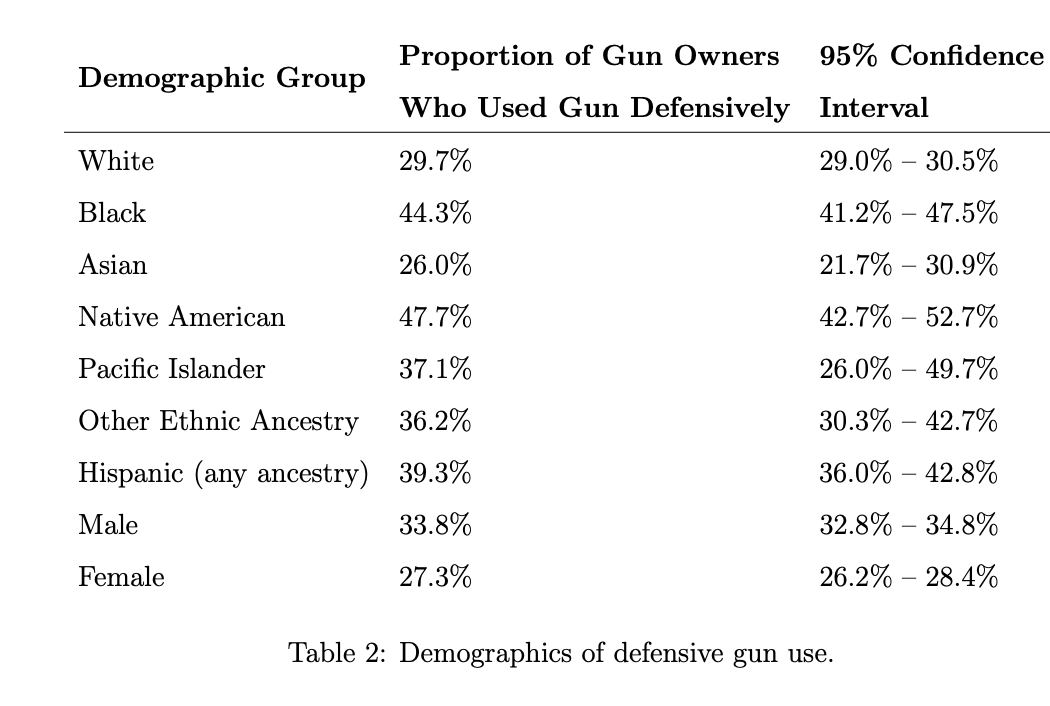
Notably "telling someone you have a gun" is counted as a large share of defense uses of firearms:


It ought to be possible to compare sales data to large magazine, assault rifle, handgun, rifle, and shotgun data to determine how accurate the survey results are in those domains.

The geographic ownership rates by state from the 2021 survey are as follows:


Of course, while statistical sample size sourced uncertainty is easy to estimate, sample selection bias is an issue in every kind of survey data and has gotten worse in recent years. Given the direction of the sample selection bias in election polling (even adjusting for representative samples), it could very well mean that the the bias is towards underestimates rather than overestimates, however. Centiment is not an "A-list" survey operation, especially for such a large survey, but that doesn't inherently mean very much a well done survey is useful no matter who does it.

Both bold and italic emphasis below is mine.
This report summarizes the findings of a national survey of firearms ownership and use conducted between February 17th and March 23rd, 2021 by the professional survey firm Centiment. This survey, which is part of a larger book project, aims to provide the most comprehensive assessment of firearms ownership and use patterns in America to date. This online survey was administered to a representative sample of approximately fifty-four thousand U.S. residents aged 18 and over, and it identified 16,708 gun owners who were, in turn, asked in-depth questions about their ownership and their use of firearms, including defensive uses of firearms.

Consistent with other recent survey research, the survey finds an overall rate of adult firearm ownership of 31.9%, suggesting that in excess of 81.4 million Americans aged 18 and over own firearms. The survey further finds that approximately a third of gun owners (31.1%) have used a firearm to defend themselves or their property, often on more than one occasion, and it estimates that guns are used defensively by firearms owners in approximately 1.67 million incidents per year. 
Handguns are the most common firearm employed for self-defense (used in 65.9% of defensive incidents), and in most defensive incidents (81.9%) no shot was fired. Approximately a quarter (25.2%) of defensive incidents occurred within the gun owner's home, and approximately half (53.9%) occurred outside their home, but on their property. About one out of ten (9.1%) defensive gun uses occurred in public, and about one out of thirty (3.2%) occurred at work.

A majority of gun owners (56.2%) indicate that they carry a handgun for self-defense in at least some circumstances, and about 35% of gun owners report carrying a handgun with some frequency. We estimate that approximately 20.7 million gun owners (26.3%) carry a handgun in public under a ``concealed carry'' regime; and 34.9% of gun owners report that there have been instances in which they had wanted to carry a handgun for self-defense, but local rules did not allow them to carry.

The average gun owner owns about 5 firearms, and handguns are the most common type of firearm owned. 48.0% of gun owners -- about 39 million individuals -- have owned magazines that hold over 10 rounds (up to 542 million such magazines in total), and 30.2% of gun owners -- about 24.6 million individuals -- have owned an AR-15 or similarly styled rifle (up to 44 million such rifles in total). 
Demographically, gun owners are diverse. 42.2% are female and 57.8% are male. Approximately 25.4% of Blacks own firearms, 28.3% of Hispanics own firearms, 19.4% of Asians own firearms, and 34.3% of Whites own firearms. 
In total, Americans own over 415 million firearms, consisting of approximately 171 million handguns, 146 million rifles, and 98 million shotguns.
William English, "2021 National Firearms Survey: Updated Analysis Including Types of Firearms Owned" SSRN (May 18, 2022).

This paper just includes the basically raw results of this particular survey without examining historical trends or comparing it to non-survey data.

Firearm ownership rates (ignoring multiple guns owned by a single person) have historically been lower in urban areas than rural areas and have gradually fallen over time as the population grows more urban and as hunting has grown less popular as a result.

Hat tip to Tom Bridgeland who provided the link to the paper in the comments.

09 September 2022

Does Behavioral Science Work?

This paper overstates its case somewhat, but there is some truth to its claims.
How accurately can behavioral scientists predict behavior?

To answer this question, we analyzed data from five studies in which 640 professional behavioral scientists predicted the results of one or more behavioral science experiments. We compared the behavioral scientists’ predictions to random chance, linear models, and simple heuristics like “behavioral interventions have no effect” and “all published psychology research is false.”

We find that behavioral scientists are consistently no better than - and often worse than - these simple heuristics and models. Behavioral scientists’ predictions are not only noisy but also biased. 
They systematically overestimate how well behavioral science “works”: overestimating the effectiveness of behavioral interventions, the impact of psychological phenomena like time discounting, and the replicability of published psychology research.
Dillon Bowen, "Simple models predict behavior at least as well as behavioral scientists" arXiv:2208.01167 (August 3, 2002) (pdf link).

18 May 2022

Globed Together People

The anime series "Kabaneri of the Iron Fortress" (which features zombies that can merge their bodies into a single much more powerful entity) greatly overestimates the volume of a large number of bodies globed together in a single clump.

02 March 2022

Fight Or Flight

The journal Science notes that Ukrainian scientists are deciding whether to become resistance fighters against the Russian invasion, or to flee the country as refugees, giving this event a very human and practical dimension.
On 24 February, as Russian troops poured across the border in an unprovoked invasion of Ukraine, Sergei Mosyakin, director of the Institute of Botany in Kyiv, set out with a few key staff to secure the institute and its National Herbarium, which holds more than 2 million specimens representing the wealth of Ukraine’s floral and fungal diversity. 
Several kilometers to the south, Fedor Danevich and six colleagues at the Institute for Nuclear Research had joined an online workshop for a multinational physics project in South Korea. The Zoom call included Russian physicists. “One said that he is sorry for the war,” Danevich recalls. The other Russians kept silent. 
. . .

As Russian forces bombarded and sought to encircle Kyiv, Mosyakin and some fellow botanists hunkered down at home, whereas others took refuge with relatives in the countryside. 
Danevich says he and his wife intended to stay in Kyiv, but their son persuaded them to seek shelter in Budapest, Hungary. As Science went to press, the family had made it as far as Romania.

Condemnation of the invasion has rained down on Russia from many quarters, and a rising chorus is calling on the West to sever ties with Russian scientists. “I’m sitting now with my 86-year-old mother, who is a prominent biochemist, listening to the sounds of battle some 20 kilometers to the west, and waiting for the next bombardment,” says Maksym Strikha, a physicist and former top official in Ukraine’s science ministry. “Could you imagine asking a Polish physicist, surrounded and bombed in Warsaw in September 1939, whether it would be fair to maintain scientific diplomacy with scientists in Nazi Germany?” 
. . .

In Europe, a number of institutions have offered refuge to Ukrainian scientists, some of whom have joined an exodus of more than 500,000 people from the besieged country. 
The Polish Young Academy, part of the Polish Academy of Sciences (PAN), has lined up scores of institutes and universities willing to host refugee scientists. “We want to find them jobs in their expertise,” says Jacek Kolanowski of PAN’s Institute of Bioorganic chemistry. So far, they’ve secured positions for a psychologist in Warsaw, a cancer researcher in Lublin, and a law professor in PoznaĹ„.  
In Germany, the Alexander von Humboldt Foundation’s Philipp Schwartz-Initiative, which helps find succor for scholars at risk, has invited Ukrainian scientists to apply for funding with German partners. “Our lab in Berlin will support researchers who had to flee Ukraine,” tweeted Matthias Rillig, an ecologist at the Free University of Berlin.

Many Ukrainian scientists have vowed to stay and defend their homeland. “Virtually the entire population has taken up arms,” says Oleg Krishtal, a neurophysiologist with the Bogomoletz Institute of Physiology, who is sticking it out in Kyiv. 
Mosyakin says that although he is a mixture of at least four nationalities, “I am a Ukrainian, period.” And most Ukrainians he knows “are not afraid to die for their native land.”