Showing posts with label Alternative History. Show all posts

05 October 2025

An Alternative History Story Idea

 This could have been pretty cool.

Around the turn of the 20th century, inexpensive meat, a product of American prosperity that had long been available to even the poorest immigrants, was suddenly in short supply. Louisiana Representative Robert F. Broussard thought he had a solution: embrace hippopotamus ranching. He even outlined the details in his “American Hippo Bill.” 
What did his plan have to do with the water hyacinth and what became of the proposed solution?

Full story at the Smithsonian Magazine.

01 June 2025

Some Fantasy Maps


 Venus with as much water as Earth.

Los Angeles and Orange County if the ice sheets all melted.

Ancient India


Adam's Bridge Between India and Sri Lanka Before 1480.


An alternative map of Europe shows post-World War II without Germany. It was never realized, however, plans existed to eradicate Germany from Europe, like Theodore N. Kaufman, who was an advocate of the territorial dismemberment of Germany and the sterilization of the Germans. His book "Germany Must Perish!" was published in 1941.


Alternative Europe in the 1960s if the Axis would've won the Second World War


The state boundary of the states of the United States of America when measured at natural geographical points


The Moon compared to North America.


The Last Glacial Maximum


These maps represents what North America looked like 75-77 million years ago compared to its present shape (the black lines mark the outline of the continent as we know it today). At that time, Canada's Atlantic provinces were part of a large landmass known as Appalachia, while the west coast had not yet been integrated into the continent. All this is a consequence of the movement of tectonic plates. During the Cretaceous Period, the two main landmasses were Laramidia and Appalachia, separated by the Western Interior Sea. The existence of these regions has been confirmed by fossil analysis, which shows distinct species in each. The separation of the continents is explained by tectonic activity, and marine sediments confirm the presence of the sea that divided the two landmasses. Geological maps are created by combining fossil remains, analysis of geological formations, and simulations that allow us to reconstruct the tectonic movements and arrangement of the continents at that time.


Antarctica without its ice.


If the Mediterranean and Black Seas were in North America.


A mish mash map.


Map of Doggerland at its near maximum extent c. 10,000 years Before Present (~8,000 BCE) (top left) and its subsequent disintegration by 7,000 BP (~5,000 BCE)

27 April 2025

More Random Thoughts

* What if the Younger Dryas extra-terrestrial impact didn't happen? 

Pleistocene megafauna might have survived. The Clovis culture would have lasted longer. Native American cultures in North America might have been more patriarchal. Göbekli Tepe might not have been built at all, or might have been very different. The Neolithic Revolution might have arrived 4,000 years earlier. The genetics of European hunter-gatherers might have been more diverse.

* There is more than one scenario by which brain evolution could be next level. 

One is exemplified by the Cylons of Battlestar Galactica who have essentially the three main layers of the human brain plus a new one on top of that - dolphins come close to that. Another is exemplified by octopi who have a completely different brain structure with is decentralized with many sub-brains throughout their bodies. Yet another would be the cyborg approach (perhaps exemplified by Ghost in the Machine) where brains would be part human and part computer (perhaps the most likely as it has already been done at a very limited level).

* “Eternity is two people and a ham." - Irma Rombauer in The Joy of Cooking. But the price is right. You can get so much red meat for so little money when there are holiday ham sales.

* I visited the Colorado History Museum today and saw, among other things, the 90s exhibit. It is actually fairly stunning how little fashion, music, and movies have changed in the last 35 years, even though technology has changed dramatically. There was a much smaller generation gap between me and my children, culturally, than there was between me and my parents (or my wife and her parents).

* I still don't really understand why the dust bowl of the 1930s happened, or what the risk of it recurring is.

* My son is in Mexico City with his (serious, long term) girlfriend. He is almost exactly the same age that I was when I went there on my honeymoon.

* The U.S. Navy has been quietly developing unmanned surface and undersea ships that are just about ready for "prime time" as important components of our overall naval fleet. Here are some recent examples:

For example, the Australian Eureka unmanned or minimally manned ship has a 1,150 mile range, a 44 ton payload, can travel at 50 knots (60 mph a.k.a. 100 km/hr), and can launch Tomahawk cruise missiles and anti-ship Naval Strike Missiles (NSM). But is fairly small at 36 meters in length.


The Lionfish UUV (i.e. drone submarine) is about to enter service.
Lionfish is designed to address critical undersea warfare needs, including mine countermeasures, intelligence, surveillance, and reconnaissance (ISR), anti-submarine warfare, and electronic warfare.

The REMUS UUV family delivers critical advantages across modern naval operations and the autonomous systems have been proven to operate independently or in conjunction with crewed platforms — such as Virginia-class nuclear submarines — to extend mission range, reduce detection risk, and limit personnel exposure.


The U.S. Navy has a 100 foot long, 100 ton, unmanned surface vessel (USV) in the works (confusingly the same article seems to describe it as a 180 foot, 240 ton USV). It would have a range of thousands of miles.
The vessel is envisaged to be multi-role, capable of transporting logistics payloads, conducting ISR (intelligence, surveillance, reconnaissance) missions, or supporting naval munitions delivery without human oversight.


* My wife is currently watching White Lotus. One of the striking parts of the show is how aptly it captures the ways that men and women completely misunderstand each other because they have very different communications styles. To oversimplify, men are much more direct. Men rely far less on implied meanings and expecting people to "take a hint" than women. Women, in turn, overthink what men say, trying to look for hidden meanings in what men say that aren't there. Women, meanwhile, underestimate how much men can be hurt when they take what women say literally, when what women really mean is different, and is supposed to be implied from context. It also puts the lie to the notion that women are better communicators. Both are men and women are bad at communicating with members of the opposite sex. This mirrors differences in national communications styles. Germans, for example, are much more direct than Americans, while the Japanese, for example, have a much more indirect communication systle.

08 April 2025

An Imaginary Passover 2025

This weekend is the Jewish holiday of Passover, which is based upon an event described in Chapters 11 and 12 of the book of Exodus in the Torah in which God kills all first born males, human and animal, in Egypt on an appointed night, except in homes where the lintel is marked with a lamb's blood as the members of the Jewish community were instructed by their leaders to do.

Benchmarking the date of this event in the Biblical story in a manner consistent with the appearance of the Philistines in the Levant (which historically happened around 1200 BCE at the time of the Bronze Age collapse), this story would be taking place something like 3200 to 3300 years ago.

Imagine the impossible scenario that another miracle is called for now, in the United States, to smite the wicked and protect those who are less wicked. Suppose that this time around, on Passover evening starting after sundown on April 12, all 77.3 million people who voted for Trump, who are still living, died, a bit more than 20% of the population of the United States, so an event of similar magnitude.

Image how that would change the world. Almost all of the Republican elected officials and judges would die. Children would be almost completely spared. Some states, like West Virginia, Wyoming, and Utah would take particularly hard hits, as would most rural areas and small towns outside New England and Hawaii and college towns. Very few people would be left in predominantly white Evangelical Christian churches and Mormon temples the next morning. Predominantly white Protestant churches and Catholic parishes would likewise take strong hits. Jews celebrating Passover and predominantly black churches would barely notice a difference. The old, men, and people without college educations would be disproportionately hit, as would blue collar small business owners and farmers. The impact in big cities would be quite modest. The U.S. military office corps would be very hard hit, and the enlisted ranks would experience a milder impact. The LGBTQ community would be almost all spared. Schools, colleges, and universities would have only modest impacts. Non-religious people and non-Christians generally would see a quite modest toll. Many billionaires would be no more.

There would still be a crunch. Prompt arrangements would have to be made for many children left without parents. Figuring out how to keep farms running would be particularly challenging. But it would probably set the country back only a few years as the people who were passed over returned to the path of decency and responsibility and competence.

The hostile stance of the U.S. towards the rest of the world would promptly fade away. Those remaining wouldn't have a single set of political views, but the crazy and mean spirited elements would be gone.

The victims wouldn't all be horrible, horrible people, but they would be much more personally culpable than the victims of the Biblical Passover, who just had the bad luck to be non-Jewish subjects to the Pharaoh, and were often innocent children or animals. 

13 August 2024

Four Alternative History Memes


Imagine if the ancient Egyptians had developed steam power!  
Instead of relying solely on manpower and simple machines to build their iconic monuments, they could have harnessed the power of steam engines thousands of years before the industrial revolution. Pharaohs might have used steam-powered boats to travel up and down the Nile, transforming trade and transportation. Massive stone blocks for pyramids and temples could have been moved with ease using steam-driven cranes and pulleys. 
This technological leap could have altered the course of history, potentially leading to an ancient industrial age in the heart of Egypt. Would the Great Library of Alexandria have become a hub for early engineering and scientific advancement? 
Would the Mediterranean world have seen an unprecedented explosion of innovation? 
What do you think the world would look like today if ancient Egyptians had tapped into the power of steam?

Observation: The steam part wasn't the real key point of the steam age. The steam age is just a pretty name for the coal age. I'm not sure that Egypt had good access to coal resources.


Imagine a world where Carthage defeated Rome in the Punic Wars. Instead of the Roman Empire shaping the Western world, the Carthaginian Empire would have dominated the Mediterranean. Latin might have been a minor dialect, while Punic became the lingua franca of Europe and North Africa. The famous Roman roads could have been Carthaginian trade routes, bustling with merchants from across the known world. Christianity might never have taken root, as Carthage was a stronghold of polytheistic beliefs. Instead of Roman architecture, we could see Carthaginian designs influencing our cities, with grand temples dedicated to Baal and Tanit. 
How different would our history be if the victors of the Punic Wars were not the Romans? 
What other cultural and technological advancements might have emerged under Carthaginian rule?

Observation: It isn't at all obvious that the Carthaginians had the same engineering, organizational, and conquest proclivities as the Romans. 

Imagine a world where ancient Chinese explorers reached the Americas before Columbus. Around 1421, fleets of massive Chinese junks, led by Admiral Zheng He, could have set sail across the Pacific, landing on the West Coast of what is now the United States. What if these early Chinese settlers established thriving colonies along the Californian coast? 
Cities like San Francisco and Los Angeles might have been founded centuries earlier, rich with Chinese architecture, culture, and technology. Trade routes could have emerged, connecting Asia directly with the Americas. The exchange of goods, ideas, and innovations would have reshaped both continents. Imagine Chinese influence on indigenous cultures and the blending of traditions that might have occurred. Would the European Age of Exploration have taken a different path? 
The Spanish, Portuguese, and later British explorers might have encountered powerful Chinese settlements, altering their strategies and alliances in the New World. Consider the global power dynamics. With a strong Chinese presence in the Americas, the geopolitical landscape of the 16th and 17th centuries would look drastically different. The balance of power between East and West might have shifted in unexpected ways. 
What other changes do you think could have happened if China had colonized the Americas?

Observation: The indigenous peoples of the Americas would probably still have suffered mass death killing 90%+ of them from Old World diseases. 

Imagine a world where the Ottoman Empire embraced the Industrial Revolution in the 19th century. Factories would have sprung up in Istanbul, with steam engines transforming the landscape. The Bosporus Strait might have been lined with bustling ports, filled with ships transporting goods across Europe and Asia. With an industrial base, the Ottomans could have developed a powerful railway network, connecting distant provinces from the Balkans to the Arabian Peninsula. This might have led to quicker movement of troops and resources, potentially altering the outcomes of conflicts in the region. Urban centers like Cairo, Baghdad, and Damascus might have transformed into major industrial hubs, attracting workers and fostering innovations. The cultural and scientific advancements could have been significant, possibly influencing global technology and trade. Think about how different the Middle East and Europe could have been if the Ottomans had harnessed the power of industry. 
What do you think would have been the biggest changes?

Observation: The early Islamic empire was a center of advanced medicine, science, and business technologies (like checking accounts). The Ottoman Empire had been in a state of deep decay and decline for many centuries before it actually fell in the early 1900s.

28 June 2024

Sharing A Country


The Temptation Of Secession 

There are days when I wonder if secession, which was a moral imperative to stop in order to end slavery during the U.S. Civil War, wouldn't make sense now when slavery is no longer an issue.

The Republican Party and Democratic Party are more deeply divided from each other than any post-Civil War division in the U.S., although gridlock in the federal government has masked these divides a little. The Americans in Red States live in different cultures and realities from Americans in Blue States. Republican are why we "can't have nice things" in the United States politically.

Unity Prevents Military Conflict

National unity brings quiet, unappreciated benefits as well. The mainland of the North American continent is divided between just three countries whose vast inequalities in power have arguably contributed to lasting peace.

Since the U.S. Constitution was adopted, the War of 1812, the Indian Wars, and the U.S. Civil War have been the only significant military conflicts fought on the territory claimed by the United States on the mainland.

The U.S. has been involved in armed conflicts around the world very frequently in its history, from Tripoli and the Barbary pirates, to many conflicts in Central America and Latin America under the Monroe Doctrine (continuing through Grenada, Panama, and peace keeping in Haiti), to more recent military engagements in Europe in World Wars I and II, to the Pacific in World War II, in Korea, in Vietnam, Cambodia and Laos, and in the Middle East and its vicinity as far as Somalia and Afghanistan. Indeed, national unity is one of the reason that the U.S. has had the military resources available for expeditionary military action all over the world.

Critically, after the U.S. Civil War in 1865 more than 159 years ago (and Reconstruction that followed) and the final stages of the Indian Wars in the late 1800s, there has been almost no fighting which has taken place in the continental U.S.

There have been only two episodes since the U.S. Constitution wad adopted in 1789 of foreign invasions that reached U.S. soil: the War of 1812 and Pearl Harbor in Hawaii in 1941, which was 82 and a half years ago. And, the invaders in each of those cases: Britain in the War of 1812, and Japan in World War II, are now close U.S. allies.

If what is now the United States in the mainland of North America had been balkanized, at a minimum, each of the balkanized states would have had to have devoted considerable military resources to defend themselves from each other. In all likelihood, they would have fought some major conventional wars against each other in the mainland of North America.

For example, in World War II, of the Lincoln had not forced the Confederacy to rejoin the Union in the U.S. Civil War, the Confederacy might have sided with the Axis powers, while the Union might have sided with the Allies, leading to far more military conflict on the North American mainland and near the Atlantic Coast of North America.

Unity Secures Human Rights

National unity has also thwarted or resulted in remedies for the worst human rights abuses of the American South and other backwards places in the U.S.

The North has forced the South to protect the civil rights of African Americans, has forced the Southwest to protect the civil rights of Hispanics, and has forced Red States to protect the rights of women, children, and of Native Americans and immigrants, more than states in these regions would have otherwise.

How Does Migration Tip The Political Balance?

These questions aren't just "top down" matters to mandate from on hight. The way that the political divisions in the U.S. play out are profoundly influenced by choices made and lobbying from businesses, especially big ones, by civil society organizations, and by the internal migration and political activism decisions of individual people and families.

On one hand, if blue state people migrate to a red state, they can change the politics of that red state, shifting it to be first purple and then blue. 

Multi-state and multi-national businesses can also lobby against policies that make it untenable for them to continue to operate in a red state.

On the other hand, migration can further the political divisions between states. If conservatives migrate from blue states to red states, and liberals migrate from red states to blue states, this can solidify red state-blue state political divisions. 

Many businesses can, if they don't like red state or blue state policies respectively, move elsewhere. For example, many tech companies are moving away from Austin or choosing not to expand to Texas, because of bad red state politics and laws.

Migration from blue states to red states has tipped Virginia, North Carolina, Georgia, Texas, Arizona, Nevada, and Colorado to the left. Migration of liberals to big cities in other states, especially from the rust belt and farm communities, has tipped Missouri, Pennsylvania, Ohio, Michigan, Wisconsin, and Iowa to the right. 

Migration of retirees to Florida and Arizona has been a mild right leaning political influence since retirees are more conservative than the general public, but balanced by the fact that retirees still aren't assimilated members of Southern culture or the culture of the rural Old West.

There has been a lot of net migration from northern states to the South and Southwest, especially out of the Midwest and Great Plains, and to a letter extent out of the Northeast, although even then, the migrants to the South and Southwest are largely sticking to big cities that are culturally bluer than other place in those mostly red states. This trend may be running its course, however, as "natural" disasters and global warming and increasingly bad conservative policies in these states make them unattractive.

It isn't clear which trends will predominate in the longer run.

Florida seems to have crossed a tipping point from being almost a northern state in the South, to being crazy conservative. Virginia and North Carolina are being pulled by D.C. related suburbanites in Virginia, and tech oriented development in both states, from being firmly red states to purple states. The shift left in Georgia has been driven by professionals and managers moving to Atlanta which is a regional economic hub.

Ohio is vastly more conservative and economically depressed than it was when I grew up there, and there have been shifts to the right all across the rust belt.

Beyond Geography

The U.S. Civil War failed to end once and for all the underlying political and cultural divisions that remain dominant in U.S. politics today, even though it did effectively end slavery itself and largely took succession off the table as a political tactic.

The trouble is that as the meme quoting General Grant above predicts, is that the current first order political, moral, and cultural division in the United States only sometimes breaks neatly along state lines.

Red states still have "enlightened" enclaves, like Austin in Texas. Blue states like New York and Colorado still have large swaths of conservative, mostly rural areas. 

Secession isn't an easy solution to a divide that runs along urban-rural lines as much as it does along state lines, even if it was an available political tactic. And, honestly, while the U.S. Constitution doesn't specifically provide for the possibility, I don't seriously doubt that Congress and states seeking to secede could by mutual agreement authorize a "divorce" that would let some states secede.

One of the reasons that there is an urban-rural political divide is that highly skilled and educated workers receive much higher economic premiums for their abilities in big cities than they do in small towns and rural areas, making the higher cost of living in urbanized areas worth the price. 

In contrast, less skilled workers without college degrees receive much smaller economic premiums in big cities over small town and rural areas. But they still have to contend with the same higher cost of living that the highly skilled and educated workers in big cities do.

Of course, the mere fact of living in a place with higher population density and greater diversity also seems to influence people's political views causally. 

Every U.S. state of consequence needs big cities to function, however, and this leaves many even very red states with comparatively liberal urban centers.

Generational Shifts And The Long Run Culture War

Juxtaposed against the regional shifts are the generational shifts. Across the U.S., younger voters are much more liberal on most social issues, and are less religious, than older voters. 

The left has been pretty much consistently winning in the culture wars since the Civil Rights movement. Absent political tactics that can thwart the political will of the people in a conservative direction, the U.S. will eventually, almost by default, drift to the left over time.

Joe Biden, a long time drug warrior, is taking the lead in decriminalizing cannabis at the federal level.  Many red states have legalized either medical marijuana or both medical and recreational marijuana.

Mass incarceration is easing in red states as well as blue states.

The original segregationists (Biden himself started his career on opposition to public school desegregation plans in Delaware), no longer advocate for de jure segregation or bans on interracial marriage, although they now oppose affirmative action and DEI programs that exist to counteract and remedy racism. In the 1960s, in contrast, even Martin Luther King, Jr. was reluctant to press for interracial marriage.

About 85% of Democrats and 75% of independents, and large shares of young people even if they identify as Evangelical Christians, support same sex marriage, even though less than half of Republicans do (down from a narrow majority a few years ago), although conservatives are vigorously trying to make transgender people into scapegoats and are fighting a rear guard action to keep gays in the closet. Not all that many years earlier, even liberal Democrats were afraid to push for more than half-measures like domestic partnerships and civil unions.

The percentage of Republicans who have no religion is higher than the percentage of Democrats who did not that many years ago (white Protestant Christians are now increasingly scarce in the Democratic party coalition). The overall ranks of the non-religious have surged.

Of course, the U.S. Supreme Court's Dobbs decision was a huge setback for reproductive rights and have left us with a country deeply divided on abortion, which pregnant women are moving with their feet to overcome. But grass roots voters in state initiatives are pushing back on that, for example, protecting abortion rights in Kansas, and legislators in Arizona backtracked from the reinstitution of a very strict archaic abortion law that Roe v. Wade had invalidated.

Likewise, the U.S. Supreme Court starting with its Heller decision has taken steps backward on policies to end gun violence with gun control.

Of course, generational political divides can't be addressed with secession.

Sharing A Country

Federalism is one way to find compromises in countries with geographically based political division. But federalism doesn't provide a very good solution to balancing the needs and desires of big cities v. rural areas and small towns, or those of older and younger generations.

How do people who are so starkly divided in their view of the facts of reality, their norms, their culture, and the policies that they prefer balance their competing needs in a way that is tolerable for all involved?

Our federal institutions encourage politically segregating migration as a solution, but we don't have great power sharing alternatives. 

In theory, one could devolve law making further by vesting more power in more local governments, as the Swiss do, and less in state governments. But this isn't a great solution in the case of many laws because the underlying reality involves huge intrastate and interstate ties with everyone having to share a single national or statewide context for the most part. 

Also, while Swiss do well enough with three dozen cantons with authority similar to that of U.S. states in a country the size of a typical U.S. state, that overcomes small scale divides with compromises, carving the U.S. into several hundred states with state-class authority doesn't seem like a viable solution.

The difficulties involved with the necessity that people share a country and the states that they are in across political divides when we have few institutions to support that is part of the reason why the current political situation is so volatile. 

01 May 2024

The Road Christianity Could Have Taken


Christianity has steadily become a morally evil force in the United States. This was not an inevitable result, although, perhaps it was a likely one.

Mainline Protestants and Catholics could have tried to nip in the bud the current trend in the bud, denouncing the prosperity gospel, the resort to Old Testament thinking, and the general atmosphere of hate in Christianity. There were seeds of that. In Catholicism there was liberation theology and the social gospel, and as a global faith with a leader in Italy, it has always been a bit more cosmopolitan than American Protestantism, even if it has had no qualms about blending church and state. These trends also made real progress in elite seminary training for mainline Protestants, but the living faith of the people in the pews didn't transform in the same way.

These movements within American Christianity didn't bear fruit. Promising steps in the 1960s and 1970s in that direction fizzled out without fanfare. The path suggested by the Chicago Folk Service faded away, while the path imitating secular arena rock thrived.

One of the big barriers to this path is that Christianity is fundamentally at odds with the metaphysical naturalism that is the correct description of our world. In a scientific worldview, there is no room for miracles, for divine intervention, for prayers that make a difference, for faith healing, for demonic temptation and corruption.

The people who have left Christianity are not a random sampling of Christians. They are disproportionately people who share that scientific worldview, and it so happens that a scientific worldview and more humane moral instincts tend to coincide. This is why a more moral Christianity was always going to be a less likely outcome.

Of course, in the United States, where there is great freedom of religion, it is also the case that heresy can't have legal force. The First Amendment to the U.S. Constitution means that there is no such thing as a heretical sect in the United States. It is an open marketplace of ideas, and the sects that appeal to the darker sides of human nature thrived in that competition.

18 March 2024

Historical Causation And The Deep Future

Unless there is strong evidence to the contrary, it is safe to assume that the chain of causation for historical events is:

Climate change and new technology ==> New economic realities ==> Changing cultural norms ==> Changing politics, changing religious views, new laws, and new wars.

While individuals aren't irrelevant in history and drive the particulars of how it plays out, the Marxist concept of economic determinism is more right than it is wrong. If particular people at particular times in history had acted differently, an Arian Christianity or the cult of Mithras or Rabbinic Judaism or Zoroastrianism might have become dominant in Europe, instead of the version of Christian Orthodoxy orchestrated by Emperor Constantine, of the world we live in. If certain battles and events had come out differently, England might have been French speaking, and Ireland might predominantly speak a Celtic language. The United States might have been a constitutional monarchy under George Washington's dynasty, and the Confederate States of America might still exist today. But the technological, economic, and cultural character of those alternate histories would have been similar no matter how they got there.

Climate and technology drive change in everything else until they stop changing so much and the chain of causation plays out until it reaches a stable equilibrium, where it will then remain more or less indefinitely, until climate and technology chain gain.

Epochal periods in history, from the Out of Africa migration, to the migration of humans beyond India to Southeast Asia, East Asia, and Australia, to the human replacement of Neanderthals in Europe, to the migration of humans to the Americas, to the Neolithic Revolutions across the globe, to Indo-European expansion and the fall of the Harappans and the fall of the Minoans and the fall of an Egyptian dynasty, to the rise and fall of sedentary farming civilizations in the Amazon basin, to Bronze Age collapse and the fall of empires like the Hittite Empire, to the rise and fall of the Roman Empire, to the demise of the Anasazi, to the Black Plague in the Middle Ages, to the Dust Bowl of the Great Depression in the U.S., are all attributable to a great extent to climate events.

Technology fills in the gaps that climate doesn't explain. The domestication of a sufficient package of plants and animals in the Neolithic Revolutions. Stone working and astronomy and calendars for megalithic civilizations. Metallurgy and writing in the Copper and Bronze Ages. Domestication of the horse and the invention of a practical wheel in addition to metallurgy, for Indo-European expansion. Maritime navigation techniques and ship building for the Austronesian expansion, for Phoenician and Punic exploration and trade, for the Viking Expansion, and with European colonial expansion and the Columbian Exchange. Ironworking metallurgy and mathematics for the Iron Age. Road building, plumbing, and aqueduct building for the Roman Empire. Reinvention of art and science and mathematics in the Renaissance. The printing press and practical military use of gunpowder in the Reformation and early modern era. Then windmills and dikes in places like the Netherlands and England. Then coal driven steam engines in the Industrial Revolution. Then electricity, hydroelectric power, trains, steamships, and telecommunications. Then petroleum driven vehicles and antibiotics and vaccines. Then nuclear power and weapons and quantum physics and general relativity. Then computers and space travel and satellites and robots and automation and genetic engineering.

We continue to produce new technologies and have much more to discovery. We've reached a point where our own technologies have brought about rapid climate change.

But our technological development has grown systematic and our scientific understanding grows ever more complete. The remaining frontiers of physics, astronomy, and cosmology probably have few technological applications. Deriving the principles of chemistry from fundamental physics is something that has already been outlined and is close to being possible to do rigorously. We understand chemistry well enough that increasingly it is becoming a matter of artistry and craftsmanship rather than a question of the limits of our scientific understanding of it. Biochemistry is the hardest part of that and we are seeing a torrent of progress there. From biochemistry and parallel study of ecology and meteorology we are coming to master biology and the medical biotechnology that flows from that knowledge.

Maybe we'll have another century or two of significant scientific advancement and technological breakthroughs. Maybe we'll proceed two steps forward and one step back with an apocalypse or two along the way and progress will be delayed for a century or two. But science and technology are ratchets. It doesn't take many seeds for it to revive itself after even a very severe setback.

Call me an optimist, but I see a future where humanity has come to a full scientific understanding of the physical world at all scales, and has developed technologies that more or less fully exploit this scientific understanding, as a more likely one than any other possible future for humanity. 

With the room for technological innovation muted and our home planet's climate susceptible to our precise and intentional manipulation, we will soon after, probably before the year 2500 CE,  settle into a stable equilibrium that will last for thousands of years, not unlike our many tens of thousands of years as hunter-gatherers, the thousands of years of the early Neolithic era, or the millennium long periods of the Copper Age, Bronze Age, Iron Age-Classic era, and the Middle Ages, respectively.

The world of 4500 CE will look more like the world of 2500 CE than the world of 2024 looks like the world of 1824.

23 January 2024

Metric Meters And Seconds

The speed of light is, by the current definition of the meter, 299,792,458 m/s. The second, in turn, is currently defined in terms of the rate of radioactive decay of a certain isotope of an unstable atom. Specifically:
The second [...] is defined by taking the fixed numerical value of the caesium frequency, ΔνCs, the unperturbed ground-state hyperfine transition frequency of the caesium 133 atom, to be 9192631770 when expressed in the unit Hz, which is equal to s−1.

The second was originally based upon 60 seconds per minute, 60 minutes per hour, 24 hours per day on Earth. The new definitions, however, are independent of the properties of planet Earth.

Meanwhile

The metre was originally defined in 1791 by the French National Assembly as one ten-millionth of the distance from the equator to the North Pole along a great circle, so the Earth's polar circumference is approximately 40000 km. . . . today Earth's polar circumference measures 40007.863 km, a change of 0.022% from the original value of exactly 40000 km, which also includes improvements in the accuracy of measuring the circumference.

If the original definition of the meter from 1791 had been carried through to the currently accurately measured distance from the North Pole to the Equator, then the speed of light would have been: 299,858,412.340 76 m/s, about 0.05% less than the nice round number of 300,000,000 m/s.

It would have be nice if the definition of the meter could have been changed to make the speed of light 300,000,000 m/s (which would be a meter that is is 0.0691806666667% longer than the current definition), or better yet, 100,000,000 new meters/s which would be 33333.3333 old mm per per new meter (about 13.12 Imperial inches). But the speed of light wasn't possible to measure until the length of the meter had been established to high precision, and the slight adjustments to precision metric measurements weren't deemed worth the numerological convenience by the time that the speed of light started to be used to define the meter.

A 300,000,000 m/s speed of light would slightly increase the size of the kilogram (by a fraction of a gram) which was originally based upon the mass of 1000 cubic centimeters of water at room temperature at sea level air pressure.

It would also slightly tweak the electromagnetic units that were originally based upon interactions that are a function of the meter.

Incidentally, the Imperial system of length measurement is defined in terms of the metric system, with one Imperial inch equal to exactly 25.4 mm, and all other Imperial length measurements flowing from that definition.

30 September 2023

Reconstruction Revisited

One of the sources of many modern political woes in the United States is that Reconstruction after the U.S. Civil War ended before the South was reconstructed.

This could have, and probably should have, been handled differently. Some things that we should have done instead:

* Execute all of the Confederate regime's elected officials, senior political appointees ("officers" of the regime's government), judges, military officers and spies for treason.

* Execute all pro-slavery clergy.

* Permanently remove the right to vote of every Confederate government official, every every Confederate solider who was a volunteer, and everyone who had ever owned a slave as an adult. Make it a crime for any of these persons to bear arms.

* Seize all real property and all other significant property (including all firearms and military equipment) of the families of everyone executed due to these Reconstruction mandates, everyone whose right to vote was lost, everyone who served voluntarily in the Confederate military and died, and every slave owner. Use this seized property for reparations to the freed slaves and exiled Native American tribes. Reparations for former slaves would be in a concept something alone the lines of "40 acres and a mule" affording freed slaves the resources necessary to survive as subsistence freeholder farmers.

* Seize all property of pro-slavery churches and pro-slavery or pro-confederacy political or civic organization. Use this seized property as part of the funding for integrated, universal, free public educational institutions and libraries.

* Convert all states that seceded to unorganized federal territories eligible for readmission to the United States as states only when they we sufficiently reconstructed. These would be under military rule for a decade or two in any given place before territorial self-rule subject to Congressional direction and a federally appointed territorial governor would be permitted.

In this kind of scenario, the South might have actually reconstructed itself.

23 July 2023

Alternate Food History

A great many useful domesticated food plants come from a small number of source wild types that have been bioengineered through selective breeding and hybridization to produce the variety we see today. Many of the wild types involved in this process actually have a quite narrow geographic range in nature.

This post is a reminder to myself to follow up further to consider what other species of plants might have had similar domestication histories if these wild type plants had not been available.

One historical example is the alternate set of domesticates, now largely unknown to the general public, that developed in what is now the Southeast United States before it came into contact with the Meso-American domesticate package of maize, beans, and squash.

The family Rosaceae includes herbs, shrubs, and trees. Most species are deciduous, but some are evergreen. They have a worldwide range but are most diverse in the Northern Hemisphere.

Many economically important products come from the Rosaceae, including various edible fruits, such as apples, pears, quinces, apricots, plums, cherries, peaches, raspberries, blackberries, loquats, strawberries, rose hips, hawthorns, and almonds. The family also includes popular ornamental trees and shrubs, such as roses, meadowsweets, rowans, firethorns, and photinias.
From Wikipedia.
Brassica oleracea is a plant species from family Brassicaceae that includes many common cultivars used as vegetables, such as cabbage, broccoli, cauliflower, kale, Brussels sprouts, collard greens, Savoy cabbage, kohlrabi, and gai lan.

Its uncultivated form, wild cabbage, native to coastal southern and western Europe, is a hardy plant with high tolerance for salt and lime. However, its intolerance of competition from other plants typically restricts its natural occurrence to limestone sea cliffs, like the chalk cliffs on both sides of the English Channel.

From Wikipedia

Citrus plants are native to subtropical and tropical regions of Asia, Island Southeast Asia, Near Oceania, and northeastern Australia. Domestication of citrus species involved much hybridization and introgression, leaving much uncertainty about when and where domestication first happened.  
A genomic, phylogenic, and biogeographical analysis by Wu et al. (2018) has shown that the center of origin of the genus Citrus is likely the southeast foothills of the Himalayas, in a region stretching from eastern Assam, northern Myanmar, to western Yunnan. . . .
Ancestral species:
Citrus maxima – Pomelo
Citrus medica – Citron
Citrus reticulata – Mandarin orange
Citrus hystrix – Kaffir lime
Citrus cavaleriei – Ichang papeda
Citrus japonica – Kumquat

Important hybrids:
Citrus × aurantiifolia – Key lime
Citrus × aurantium – Bitter orange
Citrus × latifolia – Persian lime
Citrus × limon – Lemon
Citrus × limonia – Rangpur
Citrus × paradisi – Grapefruit
Citrus × sinensis – Sweet orange
Citrus × tangerina – Tangerine

See also below for other species and hybrids. 

From Wikipedia

29 March 2023

What If The Sea Level Rose 100 Meters?


The sea level is not likely to rise by the 100 meters shown in the map above ever. This is probably more than the maximal amount it could rise is all of the ice caps on the planet melted (which is about 58 meters and would take centuries, or even thousands of years, to happen). If all of the ice caps melted, it would look like this:

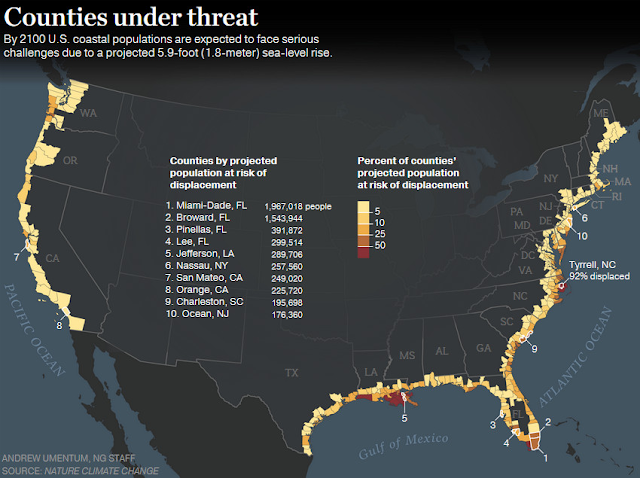
But global warming is likely to cause sea levels to rise somewhat (perhaps two to three meters by the year 2100), and it is also likely to cause storms and peak flooding coinciding with high tides to become worse. In that case it would look like this:

The counties in the U.S. affected by 2100 (with only a two meter sea level rise) would be:


Even when places are not actually underwater all of the time, places that are less than 100 meters above sea level are still facing an elevated risk of natural disasters like serious storms (including but not limited to hurricanes and tornados) and floods for the foreseeable future. And, the places that will be hardest hit are easy to identify as places at an elevated risk, due to their low elevation.

What is likely to happen?

According to the U.S. National Oceanic and Atmospheric Administration (as of 2022):
Sea level along the U.S. coastline is projected to rise, on average, 10 - 12 inches (0.25 - 0.30 meters) in the next 30 years (2020 - 2050), which will be as much as the rise measured over the last 100 years (1920 - 2020). Sea level rise will vary regionally along U.S. coasts because of changes in both land and ocean height.

Sea level rise will create a profound shift in coastal flooding over the next 30 years by causing tide and storm surge heights to increase and reach further inland. By 2050, “moderate” (typically damaging) flooding is expected to occur, on average, more than 10 times as often as it does today, and can be intensified by local factors.

Current and future emissions matter. About 2 feet (0.6 meters) of sea level rise along the U.S. coastline is increasingly likely between 2020 and 2100 because of emissions to date. Failing to curb future emissions could cause an additional 1.5 - 5 feet (0.5 - 1.5 meters) of rise for a total of 3.5 - 7 feet (1.1 - 2.1 meters) by the end of this century.

UPDATE with Bonus content: 


The images below are basically impossible but worth of considering for fantasy and science fiction worlds.

At 200 meters of sea level right, the Northeast Corridor and the greater Mississippi Valley are inundated and California and Oregon have impressive inland seas:


At 400 meters of sea level rise, the Eastern U.S. has been reduced to an island chain and Washington and Oregon share a major, far inland sea:


This is what it looks like when the Las Vegas strip has oceanfront beaches nearby and the Appalachian mountain chain starts to resemble New Zealand or the Philippines:


It would look like this when beachfront property was available not far from Denver - all of the Eastern U.S. and most of the land in the Pacific states is underwater at this point: