22 August 2022

The Courts of India Explained

Comparative law is useful to someone seeking to reform their own legal system because it shows both proof of concept and relatedly can quash a "parade of horribles" analysis.

The case of the court system of India is particularly notable because it involves a legal system in a big, complicated, multi-cultural, federal county.

Of course, very few people would argue that the court system of India is superior to that of the United States. 

For example, it has far too few judges for its case loads, resulting in a very slow pace of legal action (for reasons that aren't entirely clear given the civil service appointment system, although low compensation and poor working conditions may be important factors), and also has a populace that often can't afford to use it in the intended manner with competent legal counsel due to a lack of financial means.

The Indian court backlog numbers in the millions. The legal maxim justice delayed is justice denied is honored only in the breach. On average about 20% of approved judicial positions are vacant. The annual backlog increase is less than 2%. If the vacancies were filled, the backlog would decline. Minor infractions make up nearly half of pending cases.

In 2015, some 400 vacancies were reported in the 24 high courts. The Supreme Court backlog is around 65,000 cases. Some 30 million cases await resolution in various courts. The budget allocation is a 0.2 per cent of gross domestic product. The judge-population ratio is 10.5 to one million, about 20% of the recommended 50 to one million.

The government is the largest single litigant, adding cases to the docket, losing most, and then appealing to the next court. The Law Commission found that most such appeals were pointless.

Jagdev claimed that the Judiciary does not attract the best legal talent in part because of disparity in compensation. In recent years scandals have besmirched the judiciary's reputation. The sub-ordinate judiciary works in appalling conditions.

On 12 January 2012, the Supreme Court said that confidence in the judiciary was decreasing, posing a threat to the country. It acknowledged the problems of vacancies in trial courts, unwillingness of lawyers to become judges, and the failure of the apex judiciary in filling vacant HC posts. One proposal is that access to justice must be made a constitutional right requiring the executive to provide the necessary infrastructure for protecting that right. The Court also wanted the Government of India to detail the work being done by the National Mission for Justice Delivery and Legal Reforms.

Undertrials outnumber convicts in the prison population. Ordinary citizens have been imprisioned for espionage for overstaying their visa or straying across international borders, languishing in prison for years due to the slow redressal process.

To reduce pendency, 'Fast-track courts', 'Evening courts/Morning courts' were set up and met with mixed success. Mobile courts were set up to bring 'justice at the doorsteps' of litigants of judge-poor rural areas.

Lok Adalats is an informal, alternative mechanism that has been a success in tackling backlogs, especially in pre-litigation matters, settling cases before they enter the courts.

According to a report released by Centre for Public Policy Research and British Deputy High Commission "a total of 16,884 commercial disputes [are] pending in High Courts with original jurisdiction. Of these Madras High court tops with 5,865. With the number of commercial disputes growing rapidly, facilitating a seamless dispute resolution system through alternate means has become crucial."

Economists Boehm and Oberfeld calculated that the backlog costs the Indian economy several percentage points of GDP.

Also, while India's courts are arguably less politicized than U.S. courts, they are also more prone to instances of judicial corruption.

But, it is nonetheless interesting to see how it handles the issues of judicial appointments in a far less political manner (really modeled on the British system).

Some of the other notable quirks of India's court system are highlighted in the discussion below, such as the lack of a strict correspondence between what are basically state supreme courts and state boundaries, the national effect of precedents in intermediate appellate courts, its village court system based on traditional or customary law (found in many other non-European countries), its special corruption court, some of its other specialized tribunals which don't have direct parallels in U.S. law (for human rights, company law, consumer disputes, and anti-trust cases), and the limited inquisitorial features of its criminal courts (e.g. the power to call witnesses or obtain evidence sua sponte).

Also notably, India completely abolished the institution of the jury trial in 1959, even in serious criminal cases and in extremely limited classes of civil cases where jury trials have been retained in England.

I leave for another day the significant differences that exist (fairly few) in other areas of civil and criminal procedure.

Court structure and hierarchy

12. What is the general court structure and hierarchy?

The Indian judicial system is a single integrated system. The Constitution of India divides the Indian judiciary into superior judiciary (the Supreme Court and the High Courts) and the subordinate judiciary (the lower courts under the control of the High Courts). 
The Supreme Court of India is the apex court of the country and sits in New Delhi. It is presided by the Chief Justice of India. There are twenty-four High Courts in the country. Each state has one High Court, although some High Courts have jurisdiction over multiple states and Union Territories. For example, the Guwahati High Court exercises jurisdiction over the states of Assam, Nagaland, Mizoram and Arunachal Pradesh, all of which are situated close to each other in the north-eastern part of India. 
For administrative convenience, states are further sub-divided into districts, each of which has its own District Court. Barring a few states, the original jurisdiction for both civil and criminal cases vests with the District Court. The judicial system also consists of tribunals and commissions which are established under, and to deal with, specific statutes.

13. To what extent are lower courts bound by the decisions of higher courts?

The judicial pronouncements by the Supreme Court of India are binding precedents on all courts, judicial authorities and tribunals in India. Similarly, High Court decisions are binding on all subordinate courts, authorities and tribunals in India, unless there is a contrary decision from another High Court. If there is a contrary decision from a different High Court, the decision from the court with the larger judge bench usually prevails. District Court decisions are not binding on any other court.

14. Are there specialist courts for certain legal areas?

Under the Indian judicial system, certain traditional courts have been specifically tasked to deal with certain areas of law. District Courts usually have courts formed under specific statues, such as: 
* Family courts to deal with issues relating to marriage, inheritance, guardianship of minors and maintenance. 
* The Special Court of Central Bureau of Investigation to deal with cases of corruption and bribery. 
* Some High Courts and District Courts, which house commercial courts which deal only with commercial matters of specified value, including matters relating to arbitration. 
With the socialist aim of making legal remedies accessible and affordable to all, the Indian judicial system has constituted Lok Adalats and Gram Panchayats at the village level. These bodies apply traditional or customary laws and primarily work towards settling local disputes by using alternative dispute resolution mechanisms.

15. Are other quasi-legal authorities commonly used?

Apart from the courts, the Indian judicial system comprises tribunals, commissions and quasi-judicial authorities that derive their authority from specific statutes. These bodies include the: 
* Central Administrative Tribunal, which adjudicates disputes that relate to the recruitment and conditions of service of public servants.
* National and State Human Rights Commissions for the protection of human rights. 
* National Company Law Tribunal and National Company Law Appellate Tribunal, which adjudicate issues relating to company law, including insolvency and bankruptcy matters. 
* Consumer disputes forums at national, state and district level to deal with consumer disputes. 
* Competition Commission of India to promote and protect market competition. 
* Ombudsman for banking, Insurance, Income tax and electricity matters. 
* Income Tax Appellate Tribunal, Central Excise and Service Tax Appellate Tribunal and Sales Tax Appellate Tribunal to hear tax and excise matters. 
Most quasi-judicial bodies oversee administrative actions and impose restrictions on administrative agencies.

16. Does the constitution provide for an independent judiciary?

There are several provisions under the Constitution of India that ensure an independent judiciary. For example: 
The judges of the Supreme Court and the High Courts have secured tenure and cannot be removed from office (unless there is proven misconduct or incapacity)
The Constitution empowers the Supreme Court and the High Courts to punish any person for its contempt. 
Appointments and transfers of judges of the Supreme Court and the High Courts is made through a collegium system. The collegium comprises the Chief Justice of India and a forum of four of the most senior judges of the Supreme Court. Remarkably, this system is not expressly found in the Constitution and was created by the Supreme Court while deciding a matter in 1998. Facets of an independent judiciary are found even in the subordinate judiciary, where matters relating to removal and disciplinary actions fall under the control of the High Courts.

17. How are members of the judiciary typically appointed?

Appointment 
Appointment of judges up to the highest level in the subordinate judiciary are either made by the state Public Service Commissions or the High Courts. These appointments are usually made on the basis of performance in dedicated examinations (that is, the Lower Judicial Services Examination or Higher Judicial Services Examination). Judges from the subordinate judiciary are regularly promoted and some are even appointed as High Courts or Supreme Court judges. 
The appointment procedure in the superior judiciary is slightly different as the appointments are not made through judicial service examinations. High Court judges are appointed either through promoting judges from the subordinate judiciary or by direct elevation of advocates. Supreme Court judges are appointed either through promotion or direct elevation of judges from the High Courts. Supreme Court and High Courts judges are appointed through a collegium system, comprising the Chief Justice of India and a forum of the four most senior judges of the Supreme Court. 
Qualifications 
For a person to be eligible to sit the Lower Judicial Services Examination, he or she: 
* Must be a citizen of India. 
* Must be graduate in law.  
* Should have been enrolled or qualified to be enrolled as an advocate. 
The age limit for candidates varies from state to state and is usually between 21 to 35 years. 
For the Higher Judicial Services Examination, a candidate must: 
* Be a graduate in law 
* Have the prescribed minimum experience as an advocate (usually seven years) or as a judge. 
For a person to be eligible for an appointment as a High Court judge, he or she must: 
* Be an Indian citizen. 
* Be under the age of 62 years. 
* Have either held a judicial office in India for ten years or practised as an advocate of High Court(s) for ten years. 
For a person to be eligible for an appointment as a Supreme Court judge, he or she must: 
* Be an Indian citizen. 
* Be under the age of 65 years.
Have been a: 
* judge of a High Court for at least five years; 
* an advocate of a High Court for at least ten years; or 
* a distinguished jurist in the opinion of the President of India.

Litigation (civil and criminal)

18. Do the courts use an adversarial, non-adversarial or other system?

The Indian legal system is mainly adversarial. However, in certain aspects it is hybrid of adversarial and inquisitorial functions. Particularly the criminal justice system is not strictly adversarial, as some provisions in the criminal code require the judge to perform inquisitorial functions. For example, the judge will undertake active fact-finding exercises, such as: 
* Directing further investigation. 
* Assisting in the framing of charges. 
* Calling any person as witness and procuring evidence.

From here

Wikipedia further discusses the courts at each level as shown below. Particularly notable is that in the model of the English Court of Chancery, "Revenue Courts" have jurisdiction over many aspects of real property law that are handled by ordinary civil courts in U.S. law. India's courts also follow the British practice of having higher courts which are courts of first instance in serious civil matters in addition to being predominantly appellate courts.

Supreme Court

The Supreme Court is the highest court established by the Constitution. The Constitution states that the Supreme Court is a federal court, guardian of the Constitution, and the highest court of appeal. Articles 124 to 147 of the Constitution lay down the court's composition and jurisdiction. 
Primarily, it is an appellate court that takes up appeals against judgments of the High Courts of the states and territories. It also takes writ petitions in cases of serious human rights violations or any petition filed under Article 32, which is the right to a constitutional remedy, or if a serious case involves needs immediate resolution.

The Supreme Court comprises the Chief Justice and 33 judges.

It first sat on 26 January 1950, the day India's constitution came into force, and thereafter delivered more than 24,000 reported judgements.

Proceedings are conducted in English only. The Supreme Court Rules of 1966 were framed under Article 145 of the Constitution, which exists to regulate its practices and procedures. Article 145 was amended and is governed by the Supreme Court Rules of 2013. 
High courts

27 High Courts operate at the state level. Article 141 of the Constitution mandates that they are bound by the judgements and orders of the Supreme Court of India by precedence. These courts have jurisdiction over a state, a union territory or a group of states and union territories. High courts were instituted as constitutional courts under Part VI, Chapter V, Article 214 of the Constitution.

The High Courts are the principal civil courts of original jurisdiction in the state (along with the subordinate District Courts). However, High Courts civil and criminal jurisdiction applies only if subordinate courts are not authorized to try matters for lack of pecuniary or territorial jurisdiction. High Courts may enjoy original jurisdiction in certain matters if so designated in a state or federal law. For example, company law cases are instituted only in a high court.

The primary work of most High Courts consists of deciding appeals from lower courts, and writs in terms of Article 226 of the Constitution. Writ jurisdiction is also an original jurisdiction of High Courts. The precise territorial jurisdiction of each High Court varies by province.

Judges in these courts are appointed by the President after consultation with the Chief Justice of India, Chief Justice of the High Court, and the state governor. The number of judges in a court is decided by dividing the average institution of main cases during the last five years by the national average, or the average rate of disposal of main cases per judge per year in that High Court, whichever is higher.

The Calcutta High Court is the country's oldest, established on 2 July 1862, while the Allahabad High Court is the largest, hosting 160 judges.

High Courts that handle large numbers of cases have permanent benches (or a branch of the court). For litigants of remote regions, 'circuit benches' work on those days when judges visit. 
District / Subordinate courts

The District Courts of India are established by state governments for every district or group of districts, taking into account the number of cases and population distribution. These courts are under administrative control of the state's High Court. Decisions are subject to the appeal to the High Court.

The district court is presided over by one District Judge appointed by the Governor with the consultation of High Court. Additional District Judges and Assistant District Judges may be appointee depending on the workload. The Additional District Judge has equivalent jurisdiction as the District Judge. The District Judge is called a "Metropolitan session judge", when he is presiding over a district court in a city which is designated a "Metropolitan area" by the state government.

The district court has appellate jurisdiction over subordinate courts on all matters. Subordinate courts, on the civil side (in ascending order) are Junior Civil Judge Court, Principal Junior Civil Judge Court, Senior Civil Judge Court (also called sub-court). Subordinate courts, on the criminal side (in ascending order) are, Second Class Judicial Magistrate Court, First Class Judicial Magistrate Court, Chief Judicial Magistrate Court. In Family Courts deal with matrimonial disputes.

Family Court and Mahila Court matters are handled by the Principal Judge. The Judges appointed to this post are from the pool of District Judges. In Maharashtra, Andhra Pradesh and some other states, judges are appointed from the pool of retired judicial officer either directly or through exam. 
Executive and Revenue Court

Below the judicial hierarchy sits the executive hierarchy. Cr.P.C. empowers the Executive Court to deal with petty offences, but the power does not imply that they hold judicial power. Section 3 of CrPC clearly splits matter to be handled by both magistrates. Section 20 of CrPC empowers the State Government to appoint Executive Magistrates (EM) in every metropolitan area and in every district. It has the authority to appoint one Executive Magistrate as the District Magistrate and to appoint any EM as the ADM. Such a magistrate has the same power as enjoyed by the District Magistrate (DM).

If the office of a DM is left vacant then any officer who temporarily succeeds to the executive administration of the district exercises the same power as enjoyed by the DM. The State Government is empowered to give charge of a sub-division to the EM, who is called Sub-divisional Magistrate. The EM role generally maintain law and order under section 107–110, 133, 144, 145, and 147 of the CrPC., cancelling or granting licenses, handling land acquisition matters, or any other matter raised by state government.

Section 21 empowers state government to appoint special Executive Magistrates (Sp. EM). Under Section 20(5) of Crpc, the Commissioner of Police (CP) can be appointed as EM, but only when the district is declared by state government as a Commissionerate. The DG(P) holds the rank of CP but can't exercise power of EM (special) until his designation changes into CP. The appeal of executive court lies in the court of Session Judge or Additional Session Judge of the district or to the High Court. 
Order Executive Court
3 Other Executive Magistrate

To deal with the land revenue matters, each state established a Revenue Court. These courts adjudicate matters related to: 
land revenue
tenancy (ownership - in a loose sense)
property boundaries
succession
land transfers
partition of holdings
removal of encroachments, eviction of trespassers, and in some states, declaratory suits.

The Revenue Court is a quasi-judicial body and holds only limited power to deal with specific civil matters. As per Section 5(2) of Civil Procedure Code; Revenue Courts have jurisdiction to deal with suits related to rent, revenue or profits of land used for agricultural purposes, but does not include civil court matters. Therefore, certain matters of the Revenue Courts are barred from jurisdiction of Civil Courts as specified under the code. The Court of Additional Commissioner and above are appellate courts. However, it is a state controlled organization. 
Generally the officers of the rank of Collector and above are from the pool of the Indian Administrative Service, while lower positions can be from either IAS or SAS and inferior to that are from the State Administrative Services. 
Order Revenue [ed. appointing civil service system omitted] 
1 Board of Revenue 
2 Principal Revenue Commissioner 
4 Additional Commissioner 
5 Commissioner Land Record
6 Additional Commissioner Land Record
8 Addl. Collector
9 Chief Revenue Officer
10 Sub Divisional Officer
11 Assistant Collectors
12 Settlement Officer 
13 Assistant Settlement Officer
14 Record Officer
15 Ass. Record Officer
17 Additional Tahsildars
18 Naib Tahsildars

Village courts / Panchayat / Rural Court

Village courts, Lok Adalat (people's court) or Nyaya panchayat (justice of the villages), offer alternative dispute resolution. They were recognized through the 1888 Madras Village Court Act, then developed (after 1935) in various provinces and (after independence) Indian states. The model from Gujarat State (with a judge and two assessors) was used from the 1970s onwards. In 1984 the Law Commission recommended to create Panchayats in rural areas with laymen ("having educational attainments"). The 2008 Gram Nyayalayas Act had foreseen 5,000 mobile courts in the country for judging petty civil (property cases) and criminal (up to 2 years of prison) cases. However, the Act was not enforced, with only 151 functional Gram Nyayalayas in the country (as of May 2012) against a target of 5000. The major reasons were include financial constraints, reluctance of lawyers, police and other government officials.

The Mahila Court (open access) is mentioned above only in passing but is an interesting Indian innovation: 

The ‘women's court’ (mahila adalat or mahila mandal) is a fairly recent but increasingly prevalent phenomenon in contemporary India. A particular kind of alternative dispute-resolution forum specifically designed to address women's marital and related family problems, it aims to provide a safe and unthreatening environment wherein women can air their grievances, work out satisfactory settlements with husbands and in-laws, or find ways to escape their difficult situations altogether. It encourages women to resolve domestic disputes informally, rather than by resort to the state's judicatory institutions. Most women's courts are run by women's NGOs, often with financial support from foreign donor agencies or, in some cases, from governmental or semi-governmental agencies such as State Women's Commissions or Legal Aid Societies.

This paper discusses the structure and workings of some of these women's courts, based on two decades of ethnographic observations and interviews in such venues as well as on the work of other scholars who have studied similar bodies more intensively than I. It highlights some of the unique features of these ‘courts,’ shows why they are the forum of choice for so many poor women, and asks how effective they are in delivering justice to those who come to them for help.

19 August 2022

Births Outside Of Marriage

There is great variation in the percentage of births which are to married mothers by country. I don't have great theories to explain the overall trends.

From here.

Per the CDC data from 2018 for U.S. states:

Quote Of The Day

Whales often mate in threes, so while one male is having intercourse with the female whale, the other male whale will swim and have its penis rise out of the water while patiently waiting for his turn for intercourse.

From here

18 August 2022

A Mid-Term Election Forecast

It is still early in the mid-term Congressional election calendar, and 538 has data and survey driven election forecasts for the midterm Congressional elections. 

The Senate race predictions are favorable to Democrats who currently hold the 50-50 Senate with the support of a Democratic Vice President ruling with them in tie votes, compared to a "normal" midterm election where the party of the President usually loses ground, in substantial part because Republicans have fields some weak candidates in competitive races. The most likely outcomes are a continued 50-50 split or 51-49 seat Democratic majority in the Senate.


But, the current forecast is that the Democrats are more likely than not to lose their 221-214 majority (218 seats are needed for a majority, so Democrats can lose 3 seats and retain their majority) in the U.S. House of Representatives. The most likely result would be about a 229-206 seat Republican majority, flipping about 15 seats "currently held" by Democrats (although since the maps are post-redistricting maps with some states losing seats and other states gaining them, the "currently held" language shouldn't be taken literally).

Democrats have been improving their predicted outcome since the U.S. Supreme Court overruled Roe v. Wade, but it isn't clear whether those gains will last long enough and be strong enough to tip the balance in November.

538 also has Governor's race forecasts (Kansas is the only toss-up race):

A New D.C. Think Tank Advancing Technological Progress And High-Skilled Immigration

As the Republican party grows to be Trumpist, the smart and principled people who were in that orbit of the old GOP coalition, from libertarians, to big business advocates, to neoconservatives, to neoliberals, are heading in new directions. Meanwhile the mass migration of affluent college educated people into the Democratic coalition has also shaped the factions within it which are asserting themselves. 

A new think tank in D.C. is representative of this trend.

I’m a fan of all kinds of immigration — I think they all strengthen our country. But I pay special attention to high-skilled immigration, for a number of reasons — because it’s strategically important, because it gives our economy an especially big boost, and because convincing skilled immigrants to come is not always easy.

In the last year or so, the Institute for Progress — a new think tank in D.C. championing policies to speed up technological progress — has been pushing hard to increase skilled immigration. So I asked IFP cofounder Alec Stapp and Senior Immigration Fellow Jeremy Neufeld to write a guest post laying out the case for focusing on skilled immigration, and what specific steps they’re looking at.
From the preface of a guest post at the Noapinion blog of Noah Smith entitled "The case for high-skilled immigration reform (and how to make it happen)."

The substance of the article is notable too, and I excerpt some highlights from it below.

The foundation sees encouraging "brain drain" from elsewhere as critical to American prosperity.
Immigration is America’s superpower. According to research by William Kerr at Harvard, between 2000 and 2010, America received more migrating inventors than every other country combined.

However, for decades, our broken immigration system has stacked obstacles in front of immigrants, succeeding in spite of itself thanks to the overwhelming desire of global talent to move here. But this pattern of migration that has served the U.S. so well is starting to change. Facing ever-growing wait times for green cards in the United States, talented immigrants are increasingly looking abroad for opportunities. According to a survey released last year by Boston Consulting Group, for the first time Canada has replaced the U.S. as the most desirable location for migrants moving for work. . . .

For a given level of immigration, scientists, engineers, inventors, and entrepreneurs deliver the largest benefits. Despite making up just 14% of the population, immigrants are responsible for 30% of U.S. patents and 38% of U.S. Nobel Prizes in science. A team of Stanford economists recently estimated that nearly three quarters of all U.S. innovation since 1976 can be attributed to high-skilled immigration. . . .  Recent analysis by the National Foundation for American Policy found that 55% of billion-dollar startups in the U.S. were started by immigrants. Somewhat ironically, the U.S. is actually the home of the most valuable company cofounded by someone born in “South Africa (Tesla), Russia (Alphabet), Ireland (Stripe), Taiwan (Nvidia), Kenya (Cognizant), Lebanon (Moderna), or Bulgaria (Robinhood),” as Byrne Hobart recently pointed out. . . .

One recent paper looked at competitors in the International Math Olympiad competition and followed them throughout their careers. This study found that “migrants to the U.S. are up to six times more productive than migrants to other countries — even after accounting for talent during one’s teenage years.” Further, immigrants help bring technologies from the frontier to developing countries.

And immigrants aren’t just economic contributors. Lawmakers in Washington increasingly recognize that skilled immigration can be a powerful lever against a belligerent China. Today, defense-related industries disproportionately turn to international talent to find workers with advanced STEM degrees. And there is nothing new about the idea that attracting the best and brightest can be a major strategic asset — it has been a major benefit to U.S. security from the Civil War through WWII, the Cold War, and beyond. . . .

The article then examines how to achieve this goal politically, arguing that high-skilled immigration has greater bipartisan support and gives rise to less political backlash than low-skilled immigration (much of which is extended family based in U.S. law):

In a paper analyzing U.S. election data, Anna Maria Mayda and coauthors show that high-skilled immigration does not carry a political cost (in fact it appears to be a political asset), but low-skilled immigration does. Research by Martin Ruhs shows that greater high-skilled immigration is correlated with a country being more open to immigrants.
Countries like Canada and Australia, though smaller than the U.S. in absolute size, have a much higher foreign born share of their population. They’ve been able to do this, in part, by using some version of a “point system” or other selection mechanisms that tilt immigration toward highly educated or skilled workers. In the U.S., only 36% of immigrants have a college degree, while in Canada and Australia, the shares are 65% and 63% respectively.

We can also look to the U.K. as a case study. Prior to Brexit, E.U. citizens were able to live, work, and study in the U.K. and negative public sentiment toward immigration rose with the annual rate of immigration. But after the Brexit referendum, once the public felt they were in control of their borders, negative sentiment toward immigration plummeted while immigration rates remained high, according to recent analysis by the Financial Times. And after free movement ended post-Brexit, the U.K. government expanded opportunities for high-skilled workers, launching its Global Talent visa and the High Potential Individual visa.

. . .

A majority of Americans (66%) say they would prefer to either increase the rate of immigration or keep it the same, according to Gallup. A minority — 31% — want to decrease it. But here’s the catch: Voters who oppose immigration care about the issue much more deeply than voters who support immigration. And their willingness to vote on this issue in Republican primaries is why many Republican politicians campaign on immigration restriction. Polls also show that voters “trust” Republicans more than Democrats on immigration (37% to 27% in one recent poll), which is why Democrats’ electoral chances suffer when the salience of this issue goes up in the media (e.g., when there’s video on cable news of migrants at the Southern border).

Fortunately, voters are more positive about high-skilled immigration. According to Pew, 78% of voters support high-skilled immigration, including 63% of those who said the country should allow fewer or no immigrants. . . .

The article then gets down to the brass tacks of specific ways that legislation and executive action could increase high-skilled immigration with incrementalist changes to existing immigration laws and related executive orders, as opposed to comprehensive immigration reform which has repeatedly stalled in Congress: 

The America COMPETES Act, which included a provision for a green card cap exemption for immigrants with advanced STEM degrees, passed the House of Representatives in February with nearly every Democrat voting in favor of the bill.

Republicans seem to be interested too. Senator Todd Young said earlier this year that “in terms of skills-based immigration reform, I think it’s essential to maintaining our national competitiveness.“ His comments have been echoed by other members of his caucus such as Senators Cassidy, Cornyn, Braun, and Lankford. Even Senator Chuck Grassley, a longtime immigration skeptic, has said this is an issue on which he has “changed [his] mind completely.” 
Source: CSIS

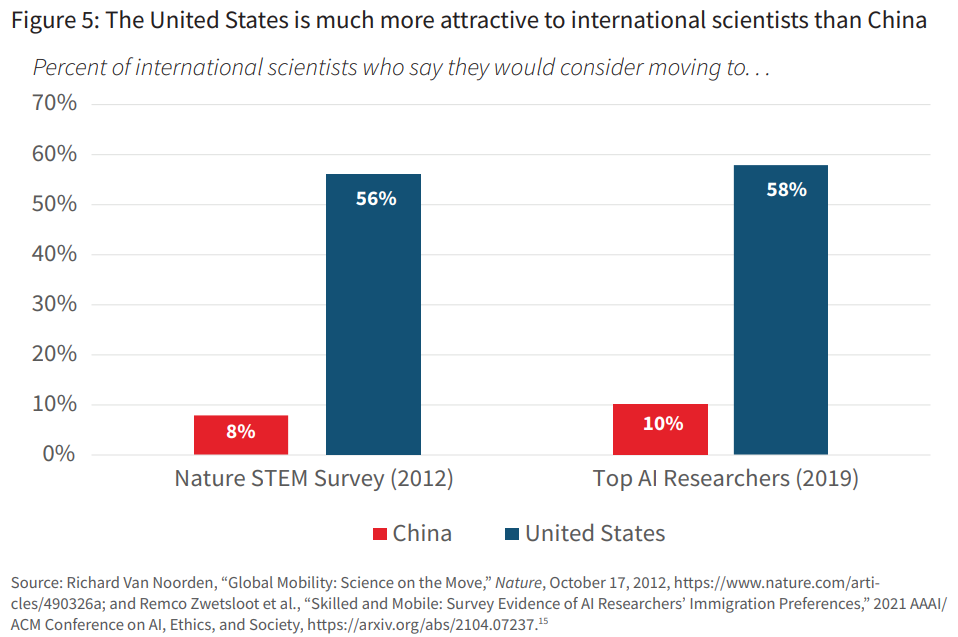
With the return of Great Power politics, policymakers understand that high-skilled immigration is how we can beat China and Russia. Less than 0.1% of China’s population is foreign born. On surveys, potential migrants do not say they want to move to China. And since Russia’s invasion of Ukraine, the tech talent pipeline is flowing out of Russia, not into it. . . .

There’s much for Congress to do, from allowing international students “dual intent” to make it easier for them to stay after graduation, to providing the necessary resources to USCIS to process visas efficiently and bring their system into the digital age.

The most essential action Congress should take is to lift the overly restrictive caps that are holding back green cards from highly qualified and promising talent. Employment-based green card caps are the key bottleneck for high-skilled immigration that only Congress can fix.

This bottleneck imposes major limitations on U.S. potential in two ways. 
First, it makes the U.S. a less attractive destination for potential immigrants, especially as compared to other countries like Canada and the UK which have taken active steps to attract talent with faster, more flexible options for permanent residency. 
Second, they force the immigrants who still want to come here through poorly designed and restrictive temporary visa programs that limit their opportunities while they wait for a green card. Many students who lose the H-1B lottery elect for more schooling they don’t really want since they are barred from employment. And many people stay at “safe” companies rather than take risks with startups. . . .

the executive branch also has significant power to improve high-skilled immigration. In January, the White House announced four initiatives to help the U.S. attract and retain STEM talent from around the world. It was an excellent first step, but large opportunities remain.

The O-1 visa for extraordinary ability is an uncapped category established by Congress, where the specific criteria for what counts as “extraordinary ability” is left to the executive. It does not require an employer-sponsor and gives recipients much more freedom to work, change jobs, or start new companies than other visas. An ambitious administration could use the discretion left by Congress to turn the O-1 into a visa program to rival the H-1B among the most talented people looking to come to the U.S. The administration should consider making it easier for startup founders to use the O-1, and broadening eligibility for people working in critical fields such as artificial intelligence.

The J visa for exchange visitors is another uncapped category ripe for additional executive reform. The Bureau of Educational and Cultural Affairs is empowered to determine valid exchange categories. The current list could be expanded to promote intellectual exchange in both academia and the private sector. Further, the executive branch could adjust the requirement that exchange visitors return home for two years after the end of their program. This requirement doesn't apply to visitors from countries that have decided to waive it, and the U.S. benefits when such visitors decide to stay. The executive branch could retain more exchange visitors if a government body with an interest in securing STEM talent in the American workforce (such as the National Science Foundation or the Department of Defense) established objective eligibility criteria for J-1 holders to apply for an Interested Government Agency Waiver.

The H-1B is the biggest high-skilled program in the United States, and it too has significant problems that could be addressed by executive action. This year, employers filed nearly 500,000 petitions for 85,000 H-1B visas. Instead of allocating these scarce visas to the most valuable talent, USCIS runs a lottery in which world class experts have essentially the same chance of winning as entry-level IT workers. The lottery was established by USCIS, not Congress, and replacing this system has bipartisan support — the Trump administration attempted to replace it by executive order and it featured in a Biden campaign promise. While Trump’s attempt was ultimately struck down by the courts, it was for procedural reasons (it was an action taken by an unlawfully sitting DHS Secretary) and not on the merits of the proposal.

17 August 2022

Major Tax Provisions Of The Inflation Reduction Act That Just Became Law

The newly enacted Inflation Reduction Act has many tax provisions, including a lot of new environmental tax credits not discussed in detail below. Here are some of the highlights: 

The updated draft legislation of the Inflation Reduction Act would include the following major changes, effective beginning after December 31, 2022, unless otherwise noted:

Extends the limitation on pass-through business losses enacted in the 2017 Tax Cuts and Jobs Act (TCJA) for two years through 2028.

Extends the expanded health insurance Premium Tax Credits provided in the American Rescue Plan Act (ARPA), including allowing higher-income households to qualify for the credits and boosting the subsidy for lower-income households, through the end of 2025 
Imposes a 15 percent minimum tax on corporate book income for corporations with profits over $1 billion, effective for tax years beginning after December 31, 2022. 
Creates a 1 percent excise tax on the value of stock repurchases during the taxable year, net of new issuances of stock, effective for repurchases after December 31, 2022. Excluded from the tax are stock contributed to retirement accounts, pensions, and employee-stock ownership plans (ESOPs). 
Modifies, extends, and creates a variety of tax credits for green energy and other efforts primarily through 2031 or 2033. 
Raises the Superfund tax on crude oil and imported petroleum to 16.4 cents per barrel (indexed to inflation) and increases other taxes and fees on the fossil fuel sector. 
Expands IRS enforcement funding by about $80 billion over 10 years. 
Imposes a 95 percent excise tax penalty on drug manufacturers to lower drug prices. 
Increases the research & development tax credit amount that can be claimed against payroll taxes for small businesses by $250,000.

Via the Tax Foundation

The source is credible enough in describing the changes in the tax law, but is not credible in its assessment of the economic impact of the legislation.

16 August 2022

Optimal Tax Policy

Matt Yglesias has made a mediocre post on optimal taxation. I'll try to hit some points that do a better job.

1. Taxes should not distort economic decisions that would have been made in their absence unless we are distorting those economic decisions on purpose in furtherance of intended policy goals. For example, the tax system: 

* should not prefer debt over equity financing (e.g. dividends and interest on loans should result in comparable combined taxation), 

* should not prefer subordinated debt over insurance mechanisms for protecting investors from risk (e.g. mortgage insurance as well as second mortgage interest should have similar tax treatment for home owners),

* should not prefer renting over owning (e.g. there should be a rent deduction comparable to the deduction for mortgage interest and property taxes)

* should not prefer tangible capital or financial capital over human capital (e.g. education expenses should be deductible), and

* should not prefer income from property over income from labor (e.g. capital gains and qualified dividends and "carried interests" should not received favorable tax treatment).

2. Intentional distortions of economic decisions to mitigate negative externalities with taxes should involve tax burdens comparable in magnitude to the harm caused by the externality. These taxes should also, ideally, be earmarked to mitigate the externalities caused. For example:

* Vehicle taxes should approximate the wear and tear on infrastructure that the vehicle creates (a per mile odometer tax adjusted for vehicle weight and owed when a car is registered may make sense).

*  Carbon taxes should approximate the harms caused by fossil fuel pollution.

3. Intentional distortions of economic decisions to encourage conduct with positive externalities with tax subsidies should involve subsidies comparable to the benefit the positive externality generates. These subsidies should be treat as expenditures in the budget process. Tax subsidies should be used only when direct spending is significantly less efficient and should regularly be reviewed for efficiency in generating the desired benefit. There are lots of dubious tax expenditures in the Internal Revenue Code that should be scrapped.

4. Taxes should be linked to means of determination that are transaction driven and hard to dispute, to the extent feasible, rather than based upon theoretical values.

* Cash flow based taxation for businesses (with what are now capital expenditures being deductible, loan proceeds being income, principal payments on loans being an expense, and no depreciation, amortization or depletion deductions) would be preferable to the current system of capital investments and loan proceeds that are not taxable and depreciation, amortization, and depletion deductions that are expenses without cash outlays. This eliminates the need to track capital gains tax basis and maintain depreciation and amortization schedules.

* C-corporation, trust and estate style taxation of distributions to beneficial owners when actually made is preferable in taxation of entity income to passthrough taxation. Pass through taxation should be limited to income allocable to unlimited liability owners of a company (treating a limited partnership as a partnership between a general partnership and a corporation made up of the limited partners).

* Taxes requiring property valuation should be disfavored in cases where there is not a well established market price for the thing valued, but can be attractive when a market price is easily established from many current and comparable transactions.

5. Taxes should be hard to defer with a preference for paying now rather than later. Indefinite tax deferral has a comparable economic impact to non-payment of taxes. For example:

* The deferral of gain in like-kind exchanges of investment real estate pursuant to IRC § 1031 should be eliminated.

* Multiple year carry forwards or carry backs of losses should be disfavored.

* A corporate entity level tax (or immediate passthrough taxation) is necessary to prevent taxation of income earned at the entity level from being indefinitely deferred.

6. Taxes should be paid to the geographic governmental subdivisions closest to where the underlying economic activity that gives rise to what is taxed occurs. In the case of intangible income, this should usually be the place the the transactions generating it occur and not the places where it is received. In a related point, taxes should be designed to address the fact that there are multiple levels of taxation in a federal system and that we have an open economy that includes interstate and international business. For example:

* Intellectual property royalties and sales taxes from the sale of intangible serviecs like streaming software should be subject to taxation when sales generating the royalties take place, or where the goods or services are delivered if this is not as "hot" and subject to manipulation.

* Retirement income should be taxed by the jurisdiction where the retirement funds were earned.

7. Taxation of non-profits should minimize the interactions between the tax collection system and non-profits. But this should not open up loopholes that undermine the taxation of the for profit tax sector. For example:

* Charitable deductions should be eliminated for income tax purposes, so that tax officials are not tracking who contributes charitably to whom and whether the charity is worthy. This is already the case for the tens of millions of taxpayers who do not itemized their deductions (especially homeowners in states with low taxes and renters).

* The 501(c)(3) tax exemption should remain but investment income and payrolls should continue to be subject to taxation. This would protect non-profits from most kinds of audits intrusions.

* The exclusion of charitable gifts from gift and estate taxation should be retained since the gift and estate taxes are taxes in lieu of income taxation on the person receiving it and non-profits are not taxable on the income that they receive.

* The minister's housing exemption should be repealed.

* Sales tax exemptions particular to non-profits should be repealed. This way vendors don't have to treat non-profits differently from other customers.

*  Property tax exemptions for non-profits owning ordinary taxable property should be repealed although special valuation rules or taxes in lieu of property taxes may need to be established for property that has a very thin market in which the transactions that do take place are often not at arms-length like churches.

* The exclusion from income for municipal bond income should be repealed.

8. The overall tax system should not be regressive. It should be flat or progressive. High rates of marginal taxation of lower incomes should be avoided, and for this purpose, the phase out of means tested benefits should be considered. In a related point, taxes should not tend to push someone from not being in poverty to being in poverty. For example:

* Integrating a universal basis income into the tax system can avoid the complication of phase outs of means tested benefits.

9. The taxes used to pay for public spending should be commensurate with the characteristics of the tax. For example, these characteristics include the geographic equity, business cycle patterns, changes with economic growth, and magnitude of what they pay for, to the extent feasible.

10. Taxes should be imposed in a manner sensitive to tax related transaction costs so that the transaction costs are not unreasonable relative to the revenue generated by taxes. One important subset of transaction costs is tax planning for the purposes of reducing taxation in ways not in furtherance of intentional policy goals. Loopholes are undesirable in part because they encourage wasteful tax planning.

* One of the big offenders here is the Medicaid Cost Recovery System which is basically the poor man's estate tax, impose an immense planning and economic burden on the assets of people who die after having received state subsidized, means tested nursing home care.

11. Aggregate taxation levels from all types of taxes should be sufficient to pay for all long term average public spending, both on goods and services that are more desirable to purchase governmentally than privately and also on transfer payments as necessary for reasonable equity in society without eliminating incentives to earn income or be profitable in activities that are socially desirable on a net basis. We shouldn't run annual deficits in ordinary times but should use debts to buffer the economy in bad times, and should set aside rainy day funds in good times. 

On balance, in the U.S. we err on the side of underinvesting in public spending, resulting in less efficient private sector attempts to address the same issues that could be addressed with public funding, which means higher taxes to pay for that and to reduce the long term average annual budget deficit (not the national debt itself) would be a good thing.

12. Taxes should be designed and administered in a manner that keeps the "tax gap" between taxes imposed and taxes collected small. For example:

* Third-party information reporting should be established in areas where the tax gap is large.

* Excessively complex provisions like the "earned income tax credit" should be redesigned or eliminated to reduce the vast number of audits it creates. The Obamacare tax credit is similarly absurdly complex.

Criticism of Proposals From Matt Yglesias

1.  Yglesias is a proponent of a "Land Value Tax", which purports to be good because the supply of land is fixed so it is hard to evade and investments in its can't increase or decrease the supply of land. But, a Land Value Tax doesn't tax land, which is fixed in supply, it taxes "Land Value" which is not fixed in supply. Land value, in reality, is indirectly a product of the buildings built in the neighborhood of the land being valued. But it does puts arguably counterfactual theoretical analysis (since few sales actually involve land alone) between market comparable values and the quantity being taxed. 

It also arguably puts too much pressure on the owners of vacant land to develop it despite the fact that it doesn't generate any revenue, or in the alternative leads to tax sales, because the development value of vacant land doesn't generate income and hence doesn't generate an ability to pay this tax.

A better way to think about property taxes is as a tax in lieu of an income tax on the fair market rental value of use property that isn't taxed in an income tax since income taxes usually don't tax imputed income from property ownership. 

In this analysis, it isn't obvious that it makes sense to impose property taxes on real property that is a factor of production (like agricultural land) as opposed to use property, any more than it does to impose sales taxes on both the full amount of wholesale sales and the full amount of retail sales, effectively giving rise to double taxation.

Any kind of property tax or Land Value Tax is also a troublesome way to finance a good or service like public education that needs to be delivered to people statewide or nationwide, partially though local taxes, since there is so much variation in tax base of real estate in different areas. Only a couple of very low population rural states have statewide property taxes.

2. Yglesias makes a half-hearted case in support of consumption taxes while also favoring strongly progressive consumption taxation and arguing the the source of income should matter. His proposal looks a bit like a value added tax or sales tax analysis. But, mechanically, it is difficult to make that kind of consumption tax progressive or even flat, and the alternative to a VAT or sales tax is usually an exemption for income from property (sometimes in the form of a generalized IRA with no contribution or withdrawal limits whose gains aren't taxed until withdrawn, effectively deferring income taxation but not eliminating it).

Essentially all consumption taxes are regressive and are especially regressive with respect to the very rich, in whose case even basically consumptive purchases are easy to reclassify as investments. He admits himself that:

The economic case that consumption taxes increase economic growth in the case of real world consumption tax proposals are also based upon pretty feeble macroeconomic analysis that isn't rigorously and unequivocally supported empirically.

He and I agree that a carbon tax or greenhouse gas emissions tax makes sense, even if the right dollar amount per ton is not something that can be scientifically determined down to the last dollar (Biden is proposing $51 a ton, he points to studies that suggest something more like $258 per ton.) The best is the enemy of the good and I'd be glad to see anything done.

He thinks that:

With respect to alcohol taxes, the current amounts are so small that they barely justify the costs of collection and vastly higher alcohol taxes would have a pretty regressive effect (although less than one might expect because really poor people don't drink much alcohol).

With respect to Marijuana taxes, he's smoking something, because marijuana is already extremely heavily taxed at the federal, state, and local levels, for example, due to IRC § 280E.

With respect to sweeteners, the studies that have been done to date are a mixed bag and we don't really understand the causes of obesity well enough to be making tax policy based upon it. And, there is a basic cost-benefit issue since even a high sweetener tax would still generate not that much revenue for high collection costs.

He may have had better proposals in the gated portion of his post, but if so, he didn't put anything in his introductory discussion to suggest that they were coming.

Quote Of The Day

I don’t think Stop the Steal is about ballots at all. I don’t believe a lot of people really think that the votes weren’t counted correctly in 2020. They believe that urban people, metropolitan people—disproportionately young and minorities, to be sure, but frankly liberal whites—are an illegitimate brew that’s changing America in unrecognizable ways and taking it away from them. Stop the Steal is a way of saying that. Stop the Steal is a metaphor. And remember, they declared voting fraud before the election.

12 August 2022

How Large A Part Does Agriculture Play In Colorado's Economy?

Colorado, a major beef and wheat producer, has an agricultural economy worth about $47 billion. The Colorado Fruit and Vegetable Growers Association said produce, grown on more than 90,000 acres statewide, contributes nearly $485 million to the economy, which doesn’t include the benefits as the products move through the distribution system. 

From the Denver Post


As of 2021, the Gross Domestic Product of Colorado is $421 billion (with a labor force of 2,819,800 workers), so the agricultural economy's share of Colorado's overall economic production is about 11% (using about 15% of Colorado's labor force).

Wheat, corn, sorghum, and proso millet were the largest agricultural products by acres farmed. Hay ($1 billon), corn ($850 million), and wheat ($460 million) were the largest farmed products by value sold. Colorado is also a significant beef producer with 659,000 cows in 2021. Colorado was the fourth largest marijuana producer in 2021 by sales at $460 million. . . . 
Colorado's agriculture supports a $47 billion dollar economy with more than 426,000 employees and $1.7 billion in exports.  
Farming and ranching takes 32 million acres of Colorado land. Colorado's agriculture consumes 88% of the state's water or 4.7 million acre feet. The northeast of the state has the most agricultural business.

The total number of jobs and economic contribution in this count, however, includes "food industry" workers such as grocery store employees and workers in factories that process food. 

The statistics on water use don't break it out between cattle operations, other livestock operations, and horticulture. I know that cattle operations use a disproportionately large share of Colorado's agricultural land. I suspect that cattle operations make up a big share of the dollar contributions and of the water use relative to the dollar contributions as well, but I don't know that for fact.

There are 38,900 farms and ranches in Colorado.

Fruits and vegetables make up a little more than 1% of the total agricultural economy in Colorado, and about 0.12% of the total Colorado economy. Fruits and vegetables are grown on about 0.3% of Colorado's agricultural land. 

Fruit and vegetable growers contribute about the same amount to Colorado's economy as marijuana growing does. About half of the marijuana grown in Colorado is produced in the City and County of Denver in about 100 acres of indoor marijuana grows.

See also the following sources relied upon by Wikipedia and quoted here:

11 August 2022

Maybe It's An Evil Scheme

Premise:

Sane middle class people from the north and the west have been surging into Southern and Southwestern cities, shifting the political scene to the left, as they already did in Colorado, Nevada and Virginia.

You are a GOP strategist and you can see the same trend threatening to flip states like North Carolina, Georgia, Florida, and Texas.

Question:

How do you stop this migration keeping your state conservative and to reduce competition for jobs for your low skilled, undereducated constituents?

Answer:

You do everything you can with the conservative majorities that you still have (before you lose those majorities) to make your state as undesirable a place for educated or skilled, liberal or moderate leaning economic migrants to move to. You do this by adopting far right policies and making your state a bad place to live or do business.

You also oppose any policies that could bring a culture of prosperity to the state that could shift it to the left, by favoring policies that keep your constituents poor, sick, uneducated, and insecure.

You use these policies to bait liberals and big businesses into boycotting your state and into making personal decisions not to move there despite economic incentives to do so.

Result:

Your political party and ideology remains in power longer than they would if only demographics and economics were involved.

10 August 2022

Nuclear Power Related Deaths Analyzed

Nuclear power related deaths are a matter of renewed interest because a new nuclear reactor design for a modular mini-reactor was recently approved in the U.S. for the first time that a new nuclear reactor design has been approved in decades.

Like renewables, nuclear power is much better for public safety and the environment than fossil fuels. Among them, costs and operational considerations (nuclear power is desirable because it provides reliable baseline electrical power), and not safety, should be the main consideration. 

Disposing of high level nuclear waste is far more of a political issue and far less of a technical issue than it is perceived to be. Nuclear fuel reprocessing is also an important way to mitigate this concern that is grossly underused in the United States.

Nuclear power is more expensive than natural gas, which has far fewer safety and environmental externalities than coal or oil or biofuels do. But, considering the environmental and safety externalities of natural gas, nuclear power should still be considered a competitive alternative to natural gas (and, in Europe, reliance on Russian natural gas supplies poses national security issues).

Oil has been largely phased out of electricity generation outside Hawaii and Alaska, both of which are prime candidates for conversion to new electrical power sources. Coal is by far the worst way to generate electrical power and is indeed being phased out in the developed world.

The other main way to wean the world of fossil fuels in addition to converting power plants from coal to other fuels in most places and from oil to other fuels in Alaska and Hawaii, is to convert to electric vehicles, especially as the electrical power grid becomes greener. This process is now well underway. 


Nuclear Power Related Deaths

There have been 20 deaths outside the Soviet Union from nuclear power incidents since 1958 (and not more than about 267 for all time outside the Soviet Union).

All of the other nuclear power related deaths are from very early in the industry (two in 1957, one of which was Soviet), and from poor Soviet nuclear power safety standards. There have been about 4,310 nuclear power related deaths from incidents in the Soviet Union (predominantly long term exposure deaths from the 1986 Chernobyl disaster).

There have only been three nuclear power incidents with death counts from a single incident of more than ten: 

(1) The Chernobyl disaster in 1986 in Ukraine during the Soviet era, resulting in about 78 direct deaths and a WHO estimated 4,000 long term exposure related deaths. This was 36 years ago. Fossil fuels kill more people in Europe from pollution every year.

2) The Kyshtym disaster in the Soviet Union causing 50-9000 excess deaths over 32 years, with the most credible estimate of about 200 in 1957. This was sixty-five years ago and just three years after the first commercial nuclear power plant started operations in the Soviet Union. 

(3) The Windscale fire in 1957 in the UK killed 100-240 people. this was one year after the first commercial nuclear power plant started operations in the U.K. 

All other nuclear power incidents for all time have killed about 60 people (33 of which were Soviet, mostly military nuclear submarine related and 27 elsewhere). 

Keep in mind that the nuclear power industry is very young compared to most of the alternatives:
The first time that heat from a nuclear reactor was used to generate electricity was on December 20, 1951 at the Experimental Breeder Reactor I, feeding four light bulbs.

On June 27, 1954, the world's first nuclear power station to generate electricity for a power grid, the Obninsk Nuclear Power Plant, commenced operations in Obninsk, in the Soviet Union. The world's first full scale power station, Calder Hall in the United Kingdom, opened on October 17, 1956. The world's first full scale power station solely devoted to electricity production—Calder Hall was also meant to produce plutonium — the Shippingport Atomic Power Station in Pennsylvania, United States—was connected to the grid on December 18, 1957.
In the first two disasters (Chernobyl and Kyshtym), the number of deaths is hotly disputed. This mostly due to disputes in how to statistically estimate excess deaths from radiation released in these incidents, mostly from cancer, many decades later (rather like difficulties in estimating deaths from fossil fuel air pollution only several orders of magnitude or more lower).

The non-human plants and animals of greater Chernobyl, have thrived because they are free of humans and that was more harmful to them than the fallout from the disaster in 1986.

In addition, about 62 people have died for all time from excess medical cancer radiation therapy exposures which has saved many thousands if not millions of lives.

Those statistics come from here.

Other Deaths

Deaths in the solar power industry appear to come mostly from construction industry style accidents, similar to those for roofers, and possibly also from the mining and disposal of potentially toxic materials used to make solar panels.

Nuclear compares favorably to renewables in safety, in part, because it generates so much power with so little fuel and so few materials.

There are fossil fuel deaths from air pollution, extraction industry related injuries, injuries related to transporting fossil fuels, toxins and radioactive waste from coal and from oil and gas operations and oil spills, and explosions now and then (e.g. from gas leaks and oil spills).

09 August 2022

Corporate Taxes, Immigration, And Economic Growth In Ireland

Ireland's corporate taxes are soaring and so its economy is also surging. Recent loose immigration rules have no doubt contributed - half of the foreign born population of Ireland arrived in the last five years providing it with a surge of fit immigrants whose talents power economic growth.

But, it isn't clear how much its role has a tax haven for multinational companies seeking to shelter income from international taxes by putting "hot assets" like intellectual property upon which royalties are due distorts the GDP growth cited in this story. Ireland's government itself essentially keeps two sets of books to address this distortion for internal policy-making purposes, because the tax sheltered assets make Ireland look more affluent than it actually is even though it isn't doing horribly. But, the increased corporate tax revenues are less subject to manipulation.
The republic is enjoying a €8bn corporate tax windfall after bumper pandemic-enhanced revenues from tech and pharmaceutical companies. The tax take from companies attracted by Ireland’s 12.5 per cent corporate rate has soared since 2015 and leapt a further 30 per cent last year compared with 2020.

Ireland’s economy expanded by 6.3 per cent over the second quarter, against an EU average of just 0.6 per cent. So great was the impact from multinationals that Ireland’s numbers distorted EU figures, despite the nation of 5.1mn making up less than 3 per cent of the region’s economy.

From Marginal Revolution

The comments to the Marginal Revenue article quoting the Financial Times article note that in Ireland:

Half of corporate tax receipts of €15.3bn last year came from just 10 companies — among them Apple, Google, Intel, Meta, Amazon and Pfizer.