04 June 2013
Ignorance On Partisan Issues Is Mostly Feigned
People asked factual questions about political issues show far less partisan bias when they get a reward for getting the right answers than they do when their misstatements of fact have no consequences, even when those with the incentive to get the answers right have no additional access to information when answering the questions.
Appreciations
* The acid test of whether pop musicians are really talented is how they perform acoustically in a single live take like the 93.3 FM garage sessions. This morning I heard one of those sessions by vocalist Amy Lee and song writer and guitarist Ben Moody of the band Evanescence (before they parted ways) performing a stripped down version of "Bring Me To Life" with nothing but her singing without backup singers, and him playing acoustic guitar with no other instrumentation. It was one of the most exquisite and haunting performances I've ever heard from anyone in any genre. I'm not sure that there is a vocal diva alive today who can match Amy Lee on a good day.
* Poem of the day:
* Poem of the day:
What does a snipe look like?From here.
To be honest, they're the trickiest bird to spot.
They don't fly very well but they tend to hide a lot.
A kinda cross between a pigeon and an owl,
it's a strange bird, one that deserves to be called fowl.
A rooster with a comb, like antlers on a moose;
Many experts would say, it looks like a wild goose.
How do you catch a snipe?
Pillowcases are nice; a garbage bag 'l do.
My brother got lucky; he hit one with his shoe.
I made a super cage out of a cardboard box;
baby snipes are the easiest ones to outfox.
It takes at least two guys; one has to tie the rope
the first one hangs on; if it's real dark, you just hope.
How long does it take to catch a snipe?
You start to hear sounds - like so much gobblety-gook.
Then comes this dumb sensation that you are the schnook.
It could take forever, but usually with youth
you quit hunting after someone relays the truth.
03 June 2013
Crazy SC Man Burns Down Own House Because He Thought It Had Witches
The Item (Sumter, S.C.) reports on the story, and on the fact that the man (Richard Clark) “was deemed not guilty by reason of insanity by 3rd Circuit Judge R. Ferrell Cothran.” State mental health authorities had concluded the man was insane, and the prosecutor agreed that “Clark burned the house down because he believed witches were in the home.”From here.
Apparently, if there really had been witches in the house, burning it down would have been justifiable in South Carolina.
Japan Big Businesses Manage Employees Like U.S. Government Agencies
Basically, banishment rooms are departments where [large Japanese] companies transfer surplus employees and give them menial or useless tasks or even nothing to do until they become depressed or disheartened enough to quit on their own, thus not getting full benefits, unlike if they were actually let go.From here.
I know from first hand accounts that U.S. government agencies, particularly in the District of Columbia and its vicinity, does the same thing.
In both cases, security of employee tenure, by virtue of civil service laws in the U.S., and by strong social and business norms to some extent in Japan, making firing employees very difficult leading to human resources management policies like these. In smaller entities, the cost of carrying a bad employee is to high proportionately to allow for the use of such costly and wasteful alternatives.
Bad Rule Still Good Law
In the case of Hillman v. Maretta decided today by the U.S. Supreme Court, the Court followed a long line of cases holding the generally applicable state laws in the area of probate, property and divorce are pre-empted by federal laws governing particular assets that are incomplete and ill considered.
This particular case involved FEGLI(federal employee group life insurance) policies. Under the law of the State of Virginia, and of many other states, a divorce implicitly repeals a beneficiary designation in any kind of asset in favor of the ex-spouse unless reaffirmed after the divorce and prior to death. The federal law has no such provision, largely due to oversight, although one provision of the FEGLI law that was enacted in response to a U.S. Supreme Court decision on the subject allows a divorce court to award FEGLI benefits to an ex-spouse if the decree so states and the order is filed with the federal government after the divorce and before the death. (Federal law has, as a matter of federal common law, implicitly read in a "slayer statute" with respect to FEGLI benefits expressly provided for in almost every state, but not expressly provided for in the federal law.)
The U.S. Supreme Court in prior cases held that the FEGLI statute pre-empts the generally applicable state law on inheritance in the case of divorce, and in this case held that a statute in Virginia (which is home to a great many federal employees because of its proximity to the Capitol), that tried to make an end run around this pre-emption by creating a tort lawsuit against an ex-spouse in the amount of FEGLI benefits that go to her (or him) as a result of federal pre-emption of state law in favor of the heirs is also pre-empted. It isn't too surprising that such a brazen attempt to circumvent federal pre-emption would be held invalid, although one could have hoped that resort to the maxim that artificial solutions are acceptable when they solve artificial problems might have won the day.
Similar conundrums arise in a great many ERISA cases, where a similar broad pre-emption of generally applicable state private law has been held to exist despite the fact that ERISA itself offers no meaningful replacement.
The result in almost all of these pre-emption cases is unjust - state legal systems have primary responsibility for these areas of law and do a better job.
Also, considering that Congress has no express power to regulate marriage, divorce, inheritance, or property rights and private law in general, apart from the interaction with their express powers to regulate other things (in these cases mostly interstate commerce and the compensation of federal employees), the existing precedents are a tone deaf way to handle regulation of these matters. There is no meaningful federal interest, other than mere administrative convenience which is almost always overstated (and in fact leads to the opposite in practice, overall), in excluding these assets from generally applicable state law.
(Another deep problem in a lot of these cases is the issue of whether the law of domicile that applies to probate assets, rather than the law selected by a contract of adhesion or the law of the asset holding institution should apply to non-probate transfers which isn't completely unrelated, but since state laws in general are better drafted than incomplete federal law treatments of the relevant issues, there is often little injustice associated with choosing the law of one state rather than another. Still, contractual choices of law made by parties with no real interest in the outcome other than overstated administrative convenience are also problematic in terms of "natural law" style justice in these cases.)
Congress is aware of the issues, as is the executive branch, but because these private law issues have no strong constituency, they rarely become a priority for Congress. Congress isn't particularly good at quality legislative drafting in private law areas that are outside its core expertise.
These are all cases where the crabbed reading of federal law contradicts any fair reading of a "natural law" result or a sensible federal common law precedent. But, the federal courts have been loathe to fashion federal common law in any non-constitutional context where it is not absolutely necessary and prefers not to call it that when it does.
These cases are a perfect example of the problems with a doctrine of legal positivism, i.e. the notion that law consists merely of enacted statutes and cases that is entirely created by authoritative legal bodies and does not exist apart from them and does not have a "natural law" component. It is particularly ironic that this arises in the case of federal law where "natural law" is expressly recognized as existing in the U.S. Constitution itself.
These cases also illustrate the benefits of federal allocations of responsibility for private law in countries like Canada and Germany that allocate more private law responsibility to the national government with state court administration handled locally.
This particular case involved FEGLI(federal employee group life insurance) policies. Under the law of the State of Virginia, and of many other states, a divorce implicitly repeals a beneficiary designation in any kind of asset in favor of the ex-spouse unless reaffirmed after the divorce and prior to death. The federal law has no such provision, largely due to oversight, although one provision of the FEGLI law that was enacted in response to a U.S. Supreme Court decision on the subject allows a divorce court to award FEGLI benefits to an ex-spouse if the decree so states and the order is filed with the federal government after the divorce and before the death. (Federal law has, as a matter of federal common law, implicitly read in a "slayer statute" with respect to FEGLI benefits expressly provided for in almost every state, but not expressly provided for in the federal law.)
The U.S. Supreme Court in prior cases held that the FEGLI statute pre-empts the generally applicable state law on inheritance in the case of divorce, and in this case held that a statute in Virginia (which is home to a great many federal employees because of its proximity to the Capitol), that tried to make an end run around this pre-emption by creating a tort lawsuit against an ex-spouse in the amount of FEGLI benefits that go to her (or him) as a result of federal pre-emption of state law in favor of the heirs is also pre-empted. It isn't too surprising that such a brazen attempt to circumvent federal pre-emption would be held invalid, although one could have hoped that resort to the maxim that artificial solutions are acceptable when they solve artificial problems might have won the day.
Similar conundrums arise in a great many ERISA cases, where a similar broad pre-emption of generally applicable state private law has been held to exist despite the fact that ERISA itself offers no meaningful replacement.
The result in almost all of these pre-emption cases is unjust - state legal systems have primary responsibility for these areas of law and do a better job.
Also, considering that Congress has no express power to regulate marriage, divorce, inheritance, or property rights and private law in general, apart from the interaction with their express powers to regulate other things (in these cases mostly interstate commerce and the compensation of federal employees), the existing precedents are a tone deaf way to handle regulation of these matters. There is no meaningful federal interest, other than mere administrative convenience which is almost always overstated (and in fact leads to the opposite in practice, overall), in excluding these assets from generally applicable state law.
(Another deep problem in a lot of these cases is the issue of whether the law of domicile that applies to probate assets, rather than the law selected by a contract of adhesion or the law of the asset holding institution should apply to non-probate transfers which isn't completely unrelated, but since state laws in general are better drafted than incomplete federal law treatments of the relevant issues, there is often little injustice associated with choosing the law of one state rather than another. Still, contractual choices of law made by parties with no real interest in the outcome other than overstated administrative convenience are also problematic in terms of "natural law" style justice in these cases.)
Congress is aware of the issues, as is the executive branch, but because these private law issues have no strong constituency, they rarely become a priority for Congress. Congress isn't particularly good at quality legislative drafting in private law areas that are outside its core expertise.
These are all cases where the crabbed reading of federal law contradicts any fair reading of a "natural law" result or a sensible federal common law precedent. But, the federal courts have been loathe to fashion federal common law in any non-constitutional context where it is not absolutely necessary and prefers not to call it that when it does.
These cases are a perfect example of the problems with a doctrine of legal positivism, i.e. the notion that law consists merely of enacted statutes and cases that is entirely created by authoritative legal bodies and does not exist apart from them and does not have a "natural law" component. It is particularly ironic that this arises in the case of federal law where "natural law" is expressly recognized as existing in the U.S. Constitution itself.
These cases also illustrate the benefits of federal allocations of responsibility for private law in countries like Canada and Germany that allocate more private law responsibility to the national government with state court administration handled locally.
31 May 2013
World still demon haunted.
I think it is a sad day for America. They have fought & fought against this & just like everyone else they caved. Why would they even want to be apart of something that stands against everything they believe in? It is just another way for satan to get a toehold & take away the rights of God fearing Christians. Now the Boy Scouts no longer stand for the things they were originally founded on just like our sad country. It's past time to pray people & pray hard.
- Facebook comment poster Misti Witt of Oxford, Colorado, on May 23, 2013 at 9:48 p.m. regarding a decision of the Boy Scouts of America to allow gay scouts (but not gay leaders) to participate in scouting.
I won't dignify the substance of this comment with a full response (although I did post one this Facebook page). Suffice it to say that I disagree. But, the style of the response is really far more interesting.
Most Americans believe in God. Many Americans attend a church, at least irregularly. But, very few actually interpret events they encounter in life through the lens of cosmic struggles in the here and now between Satan and "God fearing Christians."
People in my world, even the pious religious believers in God who regularly attend religious services, just don't practice their religion in that way. People in my world, regardless of their religious beliefs, don't have that kind of worldview and don't have that way of responding to it. It was a bit of a shock to see that apparently, even in the 21st century on the Internet, there are people who still do see the world in that way.
Most of my most religious extended family members almost all express their beliefs within the context of one of the several Lutheran denominations, or Roman Catholicism, or some subdivision of the Anglican Church. Even the few who are part of immigrant churches or who are affiliated with Evangelical denominations rarely invoke "Satan" as an active force in current events in the world.
I don't think that individuals who see the world the way that Ms. Witt do are very common. In particular, I don't even think that individuals who see the world this way make up the bulk of people who are opposed to gay rights. But, I acknowledge that my perception of this may biased by my own set of acquaintances and mental filters and information browsing habits.
28 May 2013
Ideal Body-Mass Index In One Image (With Nuance)

The chart shows that:
(1) ideal BMI increases with age from about 18 at age 20 to about 26 at age 70. For someone my age, the ideal BMI is about 23;
(2) low BMI increasingly becomes a problem starting about age 50 and becomes worse with time;
(3) significant marginal health risks from higher BMI start to kink at a BMI of about 37 at age twenty but drop to about 30-32 by age 70.
Putting together points (2) and (3) the BMI window around ideal BMI that doesn't have much mortality cost gets smaller and smaller from both ends, and the penalties for being the wrong weight are greater, as you get older.
As far as communicating that point goes, I'm not sure that one can do much better than the chart above.
Wash Park Prophet on Angels
I have recently added an article to Wikipedia on the subject of the Elioud, who are children of the angel-human hybrid Nephalim in certain non-canonical religious texts such as the First Book of Enoch and the Book of Jubilees that were widely used by the Jewish Essenes sect around the time that early Christianity arose.
It is the ninth new article that I have contributed to Wikipedia, one of which was a biography of a living physicist that was deleted on the ground that he lacked sufficient notability.
It is the ninth new article that I have contributed to Wikipedia, one of which was a biography of a living physicist that was deleted on the ground that he lacked sufficient notability.
24 May 2013
Yes, Not Fixing Bridges Really Does Have Consequences

The Interstate Highway 5 Bridge in Washington State did this yesterday. Early reports suggest that fortunately, no one died, although several cars with people in them were plunged into the water.
Choking Your Boss So Badly It Leaves Marks Never A Good Idea
Peter Boyles, a well-known and sometimes-controversial radio host in Denver for 630 KHOW, will be off the air Friday after a heated physical exchange with one of his producers, multiple sources connected to the station confirm to 9NEWS.
Employees observed red marks on producer Greg Hollenback's neck within the minutes of the argument, which happened during Thursday morning's broadcast of the Peter Boyles Show.From here.
On the upside, we don't necessarily expect the same level of temperance from talk radio hosts as we do from a Wisconsin Supreme Court justice who not so long ago engaged in similar conduct with a fellow justice. But, still, we are talking seasoned, middle aged or older, chair jockeys in either case, not twenty-something hockey players, and we really ought to be able to expect better behavior in both cases. There are some kinds of conduct that are just not O.K. and are far beyond the pale. This fits that description.
20 May 2013
Colorado Sheriff's Second Amendment Lawsuit Dubious
The Suit
Fifty-four Colorado Sheriff's and various conservative and libertarian advocacy organizations and gun vendors and individuals, under the leadership of the Independence Institute, have joined a federal lawsuit seeking to have laws mandating universal background checks and limiting magazine size unconstitutional under the Second Amendment with this Complaint filed earlier this week.
Governor Hickenlooper is sued in his official capacity in an action seeking exclusively injunctive relief, in order to overcome the Eleventh Amendment prohibition on suing state governments for money damages in federal court. One complication politically comes from the fact that John Suthers, Colorado's attorney general charged with defending Governor Hickenlooper (who also signed the bill) in this action is a Republican who probably has great sympathy with the Plaintiffs' argument and a history of backing conservative advocacy litigation in the name of the State of Colorado himself.
The choice of a federal forum seems to be primarily rooted in the fact that the alternative (Denver District Court and ultimately the Colorado Supreme Court) are less likely to agree with them on the merits than the federal courts. The Plaintiffs might be lucky enough to pull conservative judges at the trial court and appellate levels, but are less likely to prevail on this score in the state courts. Also, a win in a federal appellate court would impact more states than a win in the Colorado Supreme Court.
The fifty-five page Complaint contains copious legal argument and analysis of caselaw, which is not normally appropriate for inclusion in such a document, because its P.R. function is as important as its legal sufficiency (and putting forth a legal argument even if it is a losing one protects the people filing it from sanctions for groundless and frivilous conduct).
The Arguments On The Merits
Universal Background Checks
Background check laws have previously been upheld against constitutional challenges and those rulings did not place particular importance on the fact that the law had loopholes for gun shows and the like. It receives only slight attention in the Complaint.
Simply put, it is hard to argue for a back door way to transfer guns to people who aren't allowed to own guns shielded only by innocence and willful refusal to obtain a background check, as a matter of constitutional right.
This argument is probably dismissed by the court early on and largely forgotten. Indeed, including this law in the lawsuit probably hurts the Second Amendment cause in the long run by establishing a precedent that can be used to limit the right in many other situations.
Sheriff Standing
It also seems likely that not all of the Plaintiffs, and in particular the Sheriffs, may lack standing to sue in federal court, at least once the background check issues is dispensed with in the case.
The argument that background checks are unconstitutional is central to the standing of the Sheriffs, since this is the source of most of the non-discretionary enforcement costs associated with the lawsuit and those enforcement costs seem to be the basis for their argument that they have standing to sue. The interstate fiscal federalism consideration that a new state law imposes financial burdens on county governments that enforce those laws is not normally a matter within the province of the federal courts. But, this seems to be the basis for the Sheriffs inclusion in the suit (their inclusion, of course, is to provide law enforcement political cover to a suit that facilities the conduct of mass murderers).
The argument that they have no duty to enforce a law that they believe to be unconstitutional, while true as far as it goes, is also problematic. Their remedy is generally not to seek a court ruling, and certainly not to seek a preliminary injunction against enforcement; it is to prioritize other cases. Only non-discretionary enforcement duties create a situation where court intervention is necessary.
I wouldn't be surprised if some of the "new law" that emerges from this lawsuit is a new doctrine restricting advocacy lawsuits like this one by Sheriffs and other local government officials.
The Ban On Large Magazines
The Plaintiffs magazine size argument has both a general Second Amendment argument that large magazine guns are included in the Second Amendment's protections and a couple of weaker arguments to support it.
* The Push For The "Common and Popular" Standard
The strongest argument against a limit on large magazines is that the Heller right is based on a right to armed self-defense and oneself and one's home, but the exact scope of that right in terms of what weapontry is appropriate for that purpose is not well developed. Some plausible standards for which arms are covered by the right could include large magazines.
The Plaintiffs are pushing a "common and popular" standard for including a firearm type within the scope of the Second Amendment's protections, as opposed to some sort of "necessary for self-defense of onself, one's home and one's family" standard, under which fifteen round magazines are something that a reasonable legislature in its wisdom balancing the interests at stake could find to be unnecessary.
A "common and popular" standard create a high bar for a law like Colorado's and would push every case to a battle of experts at trial. One would always have to argue over "how common is common" and "how popular is popular" as a matter of constitutional law. Even the facts themselves, if known precisely, would not provide clear cut guidanc on these questions.
The fact that no one has successfully challenged the highly regulated state of automatic weapons under federal law, however, doesn't bode well for this challenge which is based upon the same considerations but to a lesser degree in any version of a "necessity" for self-defense argument. The option of owning multiple loaded firearms undercuts an argument that the magazine size limit is unconstitutional because large magazines are "necessary" for the purposes that the Second Amendment protects.
In the face of a necessity standard, one would have to make the additional argument that the Second Amendment requires the law to permit less expensive means of bearing arms when more expensive options that accomplish the same ends are available. Arguing for an expense sensitive standard is not one that I would want to be force to make to a Court. But, the multiple firearm work around for the magazine limit also weakens that utility of the ban in preventing harm as part of a balancing test if some standard other than necessity determines the outer bounds of the Second Amendment's protections.
There are two other kinds of weaker arguments that are made with respect to the large magazine ban.
* The Americans With Disabilities Act Argument
One is based on the Americans With Disabilities Act claim that argues that people with disabilities need large magazines because they can't reload quickly, which seems dubious. A scenario that puts together a disabled person, acting in self-defense and exhausting a fourteen round magazine without thrwarting the criminals involved starts to seem like a very far fetched reason for finding a generally applicable ban on magazine size to facially invalid as applied to all citizens of Colorado. Of course, the easy alternative for this tiny class of persons: to own more than one loaded gun.
Quite frankly, this scenario just seems so far fetched, at least in a facial challenge to the constitutionality of the law itself. I can't even think of a movie in the orgy of violence that the cinema presents in action and horror movies that presents this kind of situation. It is hard to see it convincing the judges.
This seems like the sort of argument that might sound good in a libertarian gun nut bubble but seems like a bit creepy and paranoid to those who are not.
* The Vagueness Argument
Another is based on a vagueness challenges to certain language in the law.
This might have some legs as to the "designed to be readily convertable" language of the prohibition that might make it to an evidentiary hearing, although that is still a hard case on vagueness grounds and is more easily resolved with a court determined interpretation of that language that reads it narrowly.
The suit's broader vagueness attack, however, seems to be grasping at straws - "continous possession" for example, seems no more vague here than in other contexts where similar language has been held not to be vague.
Arguments Not Offered
I'll note that there are arguments other than those arising under the Second Amendment and ADA that might be plausible (e.g. the dormant commerce clause), but are not made here, presumably because the agenda of the Plaintiffs appears to be to make Second Amendment law, rather than simply to prevail on some other grounds.
Of course, since this was enacted by a state government, arguments based on the limited scope of Congressional authority that have been marshalled to fight gun control laws are not available.
Fifty-four Colorado Sheriff's and various conservative and libertarian advocacy organizations and gun vendors and individuals, under the leadership of the Independence Institute, have joined a federal lawsuit seeking to have laws mandating universal background checks and limiting magazine size unconstitutional under the Second Amendment with this Complaint filed earlier this week.
Governor Hickenlooper is sued in his official capacity in an action seeking exclusively injunctive relief, in order to overcome the Eleventh Amendment prohibition on suing state governments for money damages in federal court. One complication politically comes from the fact that John Suthers, Colorado's attorney general charged with defending Governor Hickenlooper (who also signed the bill) in this action is a Republican who probably has great sympathy with the Plaintiffs' argument and a history of backing conservative advocacy litigation in the name of the State of Colorado himself.
The choice of a federal forum seems to be primarily rooted in the fact that the alternative (Denver District Court and ultimately the Colorado Supreme Court) are less likely to agree with them on the merits than the federal courts. The Plaintiffs might be lucky enough to pull conservative judges at the trial court and appellate levels, but are less likely to prevail on this score in the state courts. Also, a win in a federal appellate court would impact more states than a win in the Colorado Supreme Court.
The fifty-five page Complaint contains copious legal argument and analysis of caselaw, which is not normally appropriate for inclusion in such a document, because its P.R. function is as important as its legal sufficiency (and putting forth a legal argument even if it is a losing one protects the people filing it from sanctions for groundless and frivilous conduct).
The Arguments On The Merits
Universal Background Checks
Background check laws have previously been upheld against constitutional challenges and those rulings did not place particular importance on the fact that the law had loopholes for gun shows and the like. It receives only slight attention in the Complaint.
Simply put, it is hard to argue for a back door way to transfer guns to people who aren't allowed to own guns shielded only by innocence and willful refusal to obtain a background check, as a matter of constitutional right.
This argument is probably dismissed by the court early on and largely forgotten. Indeed, including this law in the lawsuit probably hurts the Second Amendment cause in the long run by establishing a precedent that can be used to limit the right in many other situations.
Sheriff Standing
It also seems likely that not all of the Plaintiffs, and in particular the Sheriffs, may lack standing to sue in federal court, at least once the background check issues is dispensed with in the case.
The argument that background checks are unconstitutional is central to the standing of the Sheriffs, since this is the source of most of the non-discretionary enforcement costs associated with the lawsuit and those enforcement costs seem to be the basis for their argument that they have standing to sue. The interstate fiscal federalism consideration that a new state law imposes financial burdens on county governments that enforce those laws is not normally a matter within the province of the federal courts. But, this seems to be the basis for the Sheriffs inclusion in the suit (their inclusion, of course, is to provide law enforcement political cover to a suit that facilities the conduct of mass murderers).
The argument that they have no duty to enforce a law that they believe to be unconstitutional, while true as far as it goes, is also problematic. Their remedy is generally not to seek a court ruling, and certainly not to seek a preliminary injunction against enforcement; it is to prioritize other cases. Only non-discretionary enforcement duties create a situation where court intervention is necessary.
I wouldn't be surprised if some of the "new law" that emerges from this lawsuit is a new doctrine restricting advocacy lawsuits like this one by Sheriffs and other local government officials.
The Ban On Large Magazines
The Plaintiffs magazine size argument has both a general Second Amendment argument that large magazine guns are included in the Second Amendment's protections and a couple of weaker arguments to support it.
* The Push For The "Common and Popular" Standard
The strongest argument against a limit on large magazines is that the Heller right is based on a right to armed self-defense and oneself and one's home, but the exact scope of that right in terms of what weapontry is appropriate for that purpose is not well developed. Some plausible standards for which arms are covered by the right could include large magazines.
The Plaintiffs are pushing a "common and popular" standard for including a firearm type within the scope of the Second Amendment's protections, as opposed to some sort of "necessary for self-defense of onself, one's home and one's family" standard, under which fifteen round magazines are something that a reasonable legislature in its wisdom balancing the interests at stake could find to be unnecessary.
A "common and popular" standard create a high bar for a law like Colorado's and would push every case to a battle of experts at trial. One would always have to argue over "how common is common" and "how popular is popular" as a matter of constitutional law. Even the facts themselves, if known precisely, would not provide clear cut guidanc on these questions.
The fact that no one has successfully challenged the highly regulated state of automatic weapons under federal law, however, doesn't bode well for this challenge which is based upon the same considerations but to a lesser degree in any version of a "necessity" for self-defense argument. The option of owning multiple loaded firearms undercuts an argument that the magazine size limit is unconstitutional because large magazines are "necessary" for the purposes that the Second Amendment protects.
In the face of a necessity standard, one would have to make the additional argument that the Second Amendment requires the law to permit less expensive means of bearing arms when more expensive options that accomplish the same ends are available. Arguing for an expense sensitive standard is not one that I would want to be force to make to a Court. But, the multiple firearm work around for the magazine limit also weakens that utility of the ban in preventing harm as part of a balancing test if some standard other than necessity determines the outer bounds of the Second Amendment's protections.
There are two other kinds of weaker arguments that are made with respect to the large magazine ban.
* The Americans With Disabilities Act Argument
One is based on the Americans With Disabilities Act claim that argues that people with disabilities need large magazines because they can't reload quickly, which seems dubious. A scenario that puts together a disabled person, acting in self-defense and exhausting a fourteen round magazine without thrwarting the criminals involved starts to seem like a very far fetched reason for finding a generally applicable ban on magazine size to facially invalid as applied to all citizens of Colorado. Of course, the easy alternative for this tiny class of persons: to own more than one loaded gun.
Quite frankly, this scenario just seems so far fetched, at least in a facial challenge to the constitutionality of the law itself. I can't even think of a movie in the orgy of violence that the cinema presents in action and horror movies that presents this kind of situation. It is hard to see it convincing the judges.
This seems like the sort of argument that might sound good in a libertarian gun nut bubble but seems like a bit creepy and paranoid to those who are not.
* The Vagueness Argument
Another is based on a vagueness challenges to certain language in the law.
This might have some legs as to the "designed to be readily convertable" language of the prohibition that might make it to an evidentiary hearing, although that is still a hard case on vagueness grounds and is more easily resolved with a court determined interpretation of that language that reads it narrowly.
The suit's broader vagueness attack, however, seems to be grasping at straws - "continous possession" for example, seems no more vague here than in other contexts where similar language has been held not to be vague.
Arguments Not Offered
I'll note that there are arguments other than those arising under the Second Amendment and ADA that might be plausible (e.g. the dormant commerce clause), but are not made here, presumably because the agenda of the Plaintiffs appears to be to make Second Amendment law, rather than simply to prevail on some other grounds.
Of course, since this was enacted by a state government, arguments based on the limited scope of Congressional authority that have been marshalled to fight gun control laws are not available.
Blasphemy Law In Canada
Jeremy Patrick (University of Southern Queensland School of Law) has posted The Curious Persistence of Blasphemy: Canada and Beyond on SSRN. Here is the abstract:
The purpose of this dissertation is to examine the history and future of the crime of blasphemy. In the introduction, several key questions are examined:(1) What is blasphemy? (2) Why do people blaspheme? and (3) What are the real or perceived harms of blasphemy?
Subsequently, Part I examines the history of blasphemy and blasphemy-like laws in six jurisdictions around the globe: England, Ireland, Australia, Pakistan, the United Nations, and the United States. The jurisdictions chosen illuminate the fact that blasphemy is a complex concept which can be regulated in a wide variety of ways. These six provide an excellent picture of the varied and diverse ways the concept of blasphemy has operated and an understanding as to why it remains relevant today.
Part II of this dissertation turns away from a global, comparative examination of blasphemy and instead provides a comprehensive, in-depth study of a single jurisdiction: Canada. This sustained history of blasphemy in Canada, the first ever published, allows for a valuable snapshot of the evolution of the crime into its modern form.
From here.Part III synthesizes the research and analysis in Parts I and II to answer the fundamental questions: what is the future of the crime of blasphemy in Canada and beyond?
The article explains that:
In Canada, most lawyers and laypersons alike would be astonished to hear that the country still has a law prohibiting blasphemy on the books. Originally prosecuted as a common law crime, the offense was first statutorily prohibited in 1892 and is currently contained in Section 296 of the Criminal Code:19
(1) Every one who publishes a blasphemous libel is guilty of an indictable offence and liable to imprisonment for a term not exceeding two years.
(2) It is a question of fact whether or not any matter that is published is a blasphemous libel.
(3) No person shall be convicted of an offence under this section for expressing in good faith and in decent language, or attempting to establish by argument used in good faith and conveyed in decent language, an opinion on a religious subject.
19 R.S.C. 1985, c. C-46 [Criminal Code].
Although this prohibition is now of dubious constitutionality given the Canadian Charter of Rights and Freedoms several prosecutions for blasphemous libel can be found in Canada’s law reports, and dozens more are hidden in newspaper archives and courthouse files. Indeed, the offense has survived the normal processes responsible for “weeding out” obsolete legislation: critical public attention, repeal bills launched by reformists, law commissions, Criminal Code revision committees, and more. The survival of a criminal ban on blasphemy cannot therefore be attributed wholly to an inattentive legislature.The Canadian Charter of Rights and Freedoms (aka "CONSTITUTION ACT, 1982, c. 11 (U.K.), Schedule B" provides in the pertinent parts:
PART I
CANADIAN CHARTER OF RIGHTS AND FREEDOMS
Whereas Canada is founded upon principles that recognize the supremacy of God and the rule of law:
Guarantee of Rights and Freedoms
1. The Canadian Charter of Rights and Freedoms guarantees the rights and freedoms set out in it subject only to such reasonable limits prescribed by law as can be demonstrably justified in a free and democratic society.
Fundamental freedoms
2. Everyone has the following fundamental freedoms:Section 33 of the Canadian Charter of Rights and Freedoms, commonly known as the "notwithtstanding clause" allows the Canadian parliament to suspend certain parts of the Canadian Charter of Rights and Freedoms including the one containing Canada's freedom of religion, if it does so expressly and intentionally. But, it has not, in fact, been invoked in the case of Canada's blasphemy laws.
(a) freedom of conscience and religion;
(b) freedom of thought, belief, opinion and expression, including freedom of the press and other media of communication;
(c) freedom of peaceful assembly; and
(d) freedom of association. . .
24. (1) Anyone whose rights or freedoms, as guaranteed by this Charter, have been infringed or denied may apply to a court of competent jurisdiction to obtain such remedy as the court considers appropriate and just in the circumstances.
(2) Where, in proceedings under subsection (1), a court concludes that evidence was obtained in a manner that infringed or denied any rights or freedoms guaranteed by this Charter, the evidence shall be excluded if it is established that, having regard to all the circumstances, the admission of it in the proceedings would bring the administration of justice into disrepute. . . .
33. (1) Parliament or the legislature of a province may expressly declare in an Act of Parliament or of the legislature, as the case may be, that the Act or a provision thereof shall operate notwithstanding a provision included in section 2 or sections 7 to 15 of this Charter.
(2) An Act or a provision of an Act in respect of which a declaration made under this section is in effect shall have such operation as it would have but for the provision of this Charter referred to in the declaration.
(3) A declaration made under subsection (1) shall cease to have effect five years after it comes into force or on such earlier date as may be specified in the declaration.
(4) Parliament or the legislature of a province may re-enact a declaration made under subsection (1).
(5) Subsection (3) applies in respect of a re-enactment made under subsection (4).
Of course, unlike the American constitution and bill of rights, the Canadian constitution expressly recognizes the "supremacy of God" in its preamble and in Section 1 recognizes that the rights it grants are not absolute. And, Canada's statute itself may comply by permitting sincere and "polite" blasphemy. But, this statute is certainly an odd bird and the analysis in the linked article is worth a read.
Ephemera on Monday
* The national animal of Scotland is the Unicorn. It is much easier to come by the state pets of Colorado, which are shelter cats and dogs. The Dumb Friends League which I frequently pass by when out and about around town has cats for $10.
* In June, I am moving to a rowhouse in Stapleton (a Denver, Colorado neighborhood) that looks like this (less the "A" pointer):
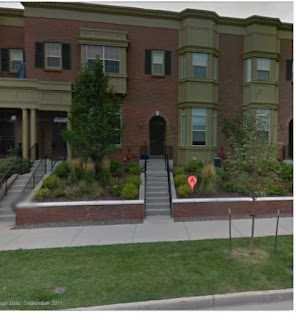
In addition to its street appeal, it also has the virtue of not being one of the handful of residential units in the metro areas at ground zero in the flood plain if the Cherry Creek dam ever busts. This is not inconceivable as corners were cut in its construction, so it was not built to specification. My current apartment and Denver Health are two of the most vulnerable structures if that ever happens.
* 255 Civil Union licenses had been issued in Denver since the law authorizing the marriage in all but name for state law purposes law was passed on May 1 through May 15. In the same time period Denver issued 245 marriage licenses. Since Colorado's law took effect, Minnesota and France have joined the ranks of jurisdictions with same sex marriage.
* In June, I am moving to a rowhouse in Stapleton (a Denver, Colorado neighborhood) that looks like this (less the "A" pointer):

In addition to its street appeal, it also has the virtue of not being one of the handful of residential units in the metro areas at ground zero in the flood plain if the Cherry Creek dam ever busts. This is not inconceivable as corners were cut in its construction, so it was not built to specification. My current apartment and Denver Health are two of the most vulnerable structures if that ever happens.
* 255 Civil Union licenses had been issued in Denver since the law authorizing the marriage in all but name for state law purposes law was passed on May 1 through May 15. In the same time period Denver issued 245 marriage licenses. Since Colorado's law took effect, Minnesota and France have joined the ranks of jurisdictions with same sex marriage.
17 May 2013
Partisan Elected Election Officials Still A Bad Idea
In Colorado, statewide election administration is vested in Secretary of State Scott Gessler, a Republican elected to the office in 2008. Now, he is considering running for Governor in 2014.
Thus, in the hypothetical race of incumbent Governor Hickenlooper, a Democrat, v. Scott Gessler, a Republican, in 2014, the winner will be officially determined by the certification of Scott Gessler, acting with the counsel of the incumbent Republican Secretary of State.
No appearance of impropriety there, no siree!
Then again, suppose Scott Gessler, to avoid an appearance of impropriety, resigns. This creates its own problem. Because, if he resigned, his replacement would be appointed by the other candidate in the same race, Governor Hickenlooper.
Thus, in the hypothetical race of incumbent Governor Hickenlooper, a Democrat, v. Scott Gessler, a Republican, in 2014, the winner will be officially determined by the certification of Scott Gessler, acting with the counsel of the incumbent Republican Secretary of State.
No appearance of impropriety there, no siree!
Then again, suppose Scott Gessler, to avoid an appearance of impropriety, resigns. This creates its own problem. Because, if he resigned, his replacement would be appointed by the other candidate in the same race, Governor Hickenlooper.
16 May 2013
Homeless Alcoholic Men Suffer Many Head Injuries
Men who are heavy drinkers and homeless for long periods of time have 400 times the number of head injuries as the general population, according to a new study . . . These men have 170 times as many severe head injuries as the general population and 300 times as many injuries that cause bleeding in the brain.
The study also looked at head injuries in the general homeless population and among people who are vulnerably housed, meaning they live in crowded, unsafe or unaffordable housing or are in danger of becoming homeless. Both these groups had about 23 times the number of head injuries as the general population, but rates much lower than the chronically homeless. . . .
In the general population in Canada, about 12 in every 10,000 men have a head injury that might involve a brain injury each year. Among the chronically homeless the number is 4,800 every year. Among men who are in low income housing each year, 370 in every 10,000 have such a head injury.From here.
Thus, about 48% of homeless alcoholic men have a head injury in any given year while only 0.12% of people in the general population experience this kind of injury.
The brief press release did not discuss the source of these head injuries.
13 May 2013
How Different Is Polygamy?
Key parts of the institution of polygamous marriage are far less distant from the mainstream American practice than it was sixty years ago in the 1950s, although others, commonly coinciding with polygamy in practice, despite not being part of its definition, were more common then.
In particular, the rise of non-marital parenting and serial monogamy has created an environment where it is far less unusual for a man to have children with multiple woman who are simultaneous alive and simutaneously have meaningful coparenting relationships with him, just live multiple polygamous wives. We owe some of that legacy to Republican Ronald Regan whose ushing in of "no fault" divorce to California during his tenure as Governor jump started this trend.
Some De Facto Emancipated Kids Thrive
Joel Milgram, a professor emeritus of developmental psychology with a specialization in adolescent psychology, who is the father of a close friend of mine, co-authorized back in 1997 a research paper that was described in news reports with psychologist Nancy Britton, that provided ethnographic accounts of teens who lived independently while staying in school and taking care of themselves.
This kind of situation, of a teen just striking out without formal court involvement, is one that gets a lot of attention in American popular fiction (e.g. one of the lead characters in the early 2000s television show "Roswell" who moves out from the home of a drunk and abusive foster father and a character in the ABC Family television series, "The Lying Game" that commenced in 2011 (the Sara Shepard book upon which the television series is based is quite different)), and even more in manga and anime where it is a common trope and almost a cliche, for example, in the case of the heroine in the hit series "Fruits Basket" by Natsuki Takaya (1999-2006). In a variant on the theme, sometimes a teen lives with another family with no formal arrangement in place, for example, as in the Colorado classic "Plainsong" by Kent Haruf (1999). The trope isn't a new one, for example, it was at the center of "The Boxcar Children" series of Gertrude Chandler Warner that debuted in 1924, and describes the life of the title character in Mark Twain's "Adventures of Huckleberry Finn" (1884).
Part of the popularity of these situations is the simple fictional fact that it is easier to write a plausible tale of youthful adventure without parents on hand to get in the way. It provides a way to explore univeral teen yearnings for autonomy.
It also has a certain personal familiarity for me, as I spent my junior year in high school as an exchange student, living (as intended) with a series of host families, but also living more autonomously and independently than most American young adults for that year. As a lawyer I have dealt with this situations a small number of times first hand, representing someone involved in the arrangement or its aftermath each time. For example, in one case I handled, I represented a non-custodial parent of a child who lived alone with parental consent to avoid being uprooted by a move to a new town that would disrupt a stable high school situation for the child's senior year.
Milgram's study calls these teens "unemancipated teenagers", but in Colorado law, which just as in its recognition of common law marriage, and common law name changes, believes in the notion that actions speak louder than words, "emancipation" is a factual reality that exists or does not, with legal consequences, rather than a set of privileges and responsibilities which one receives from a court. In Colorado, rather than going to a court asking for permission to be emancipated, a teen is emancipated by virtue of the fact of living on their own and running their own lives without parental involvement and generally, a court merely acknowledges and treats the situation.*
Because it doesn't fit neatly into a box and is in a gray area between legality and illegality (even the law is sometimes contradictory on the legal status of these teens and it differs from state to state), there aren't good Census records on how often this happens and there isn't much good scholarship on how these teens manage.
In the case of foster children, our current system dumps them into this status and reality, whether they like it or not, when they turn eighteen. Yet, while it would have seemed borderline deviant for foster kids to live an empancipated life a couple of years earlier, at eighteen, emancipation is suddenly imposed on them, in many cases leading to a rocky start to adult life.
But, there are teens who make the leap and live on their own, and those kids sometimes do manage to get by, and sometimes even thrive. Most of these kids find a cheap place to live, get part-time work, stay in school and keep their grades up. The lives that they make for themselves can be better than the situations they are leaving. Milgram's report on twenty-two kids in this situation in three cities largely parallels my own experience providing legal counsel to people who find themselves with a connection to these situations.
The kids often live in the shadows, hiding these situations from school authorities, who can put them in an unwelcome foster care situation or return them to a parental household they don't want, if they can't explain why they have no one to sign a parental permission slip or fill out school registration forms for the year. Large governmental bureaucracies do not mix comfortably with the actual legal rules for which actions are enough to give rise to a change in status without formal paperwork.
More teens in high school who have family or foster home situations that aren't working well might do well in this alternative with the appropriate economic support, greater legitimacy with school and social service officials, and a mentor whom they could turn to without risking their autonomy. While one likes to hope that parents or legal guardians or foster parents are doing something of value for their teens, sometimes the reality is that they are just proving to be a hinderance or are actively worsening the situation of the teens in their care.
* For child support purposes, a child is automatically emancipated at age nineteen, when a child marries, when a child enters into active military duty, unless the child is "otherwise emancipated" (i.e. de facto self-sufficient and autonomous), with additional exceptions related to written stipulations between the parties, mental or physical disabilities, or completion of high school. See Section 14-10-115, Colorado Revised Statutes. Tax laws and a variety of other laws have different, not always consistent definitions. For example, Colorado currently has a law stating that it will not recognize the common law marriage of a person under the age of eighteen, even if it is recognized in another state, only licensed marriages, which often required parental consent or court approval are recognized by Colorado in the case of minors.
Statistics indicate that teenagers who live away from their parents without any adult supervision are high-risk to become high school drop-outs. Joel Milgram, a University of Cincinnati professor of education has found that a small number of teenagers and parents choose to live apart yet maintain themselves in high school. The teenagers fell into three categories, those who left on their own, those who were kicked out, and those who agreed to live alone with their parent's consent.
Milgram's research is the focus of a chapter in a forthcoming book. "One of the redeeming qualities for all of the kids in this research was that they all were determined to finish high school. Ironically, though most of them had negative feelings about their parents, they admitted to learning the value of education from their parents," he said.
According to Milgram, a developmental child psychologist who has done extensive research into the cognitive, social, and emotional development of children, there are children of various socio-economic backgrounds who have graduated from high school and improved their situations on their own, without adult supervision. Most of the adolescents lived in relative poverty, with the exception of those subsidized by their parents, and represent a small percentage of kids who were relatively successful.
This kind of situation, of a teen just striking out without formal court involvement, is one that gets a lot of attention in American popular fiction (e.g. one of the lead characters in the early 2000s television show "Roswell" who moves out from the home of a drunk and abusive foster father and a character in the ABC Family television series, "The Lying Game" that commenced in 2011 (the Sara Shepard book upon which the television series is based is quite different)), and even more in manga and anime where it is a common trope and almost a cliche, for example, in the case of the heroine in the hit series "Fruits Basket" by Natsuki Takaya (1999-2006). In a variant on the theme, sometimes a teen lives with another family with no formal arrangement in place, for example, as in the Colorado classic "Plainsong" by Kent Haruf (1999). The trope isn't a new one, for example, it was at the center of "The Boxcar Children" series of Gertrude Chandler Warner that debuted in 1924, and describes the life of the title character in Mark Twain's "Adventures of Huckleberry Finn" (1884).
Part of the popularity of these situations is the simple fictional fact that it is easier to write a plausible tale of youthful adventure without parents on hand to get in the way. It provides a way to explore univeral teen yearnings for autonomy.
It also has a certain personal familiarity for me, as I spent my junior year in high school as an exchange student, living (as intended) with a series of host families, but also living more autonomously and independently than most American young adults for that year. As a lawyer I have dealt with this situations a small number of times first hand, representing someone involved in the arrangement or its aftermath each time. For example, in one case I handled, I represented a non-custodial parent of a child who lived alone with parental consent to avoid being uprooted by a move to a new town that would disrupt a stable high school situation for the child's senior year.
Milgram's study calls these teens "unemancipated teenagers", but in Colorado law, which just as in its recognition of common law marriage, and common law name changes, believes in the notion that actions speak louder than words, "emancipation" is a factual reality that exists or does not, with legal consequences, rather than a set of privileges and responsibilities which one receives from a court. In Colorado, rather than going to a court asking for permission to be emancipated, a teen is emancipated by virtue of the fact of living on their own and running their own lives without parental involvement and generally, a court merely acknowledges and treats the situation.*
Because it doesn't fit neatly into a box and is in a gray area between legality and illegality (even the law is sometimes contradictory on the legal status of these teens and it differs from state to state), there aren't good Census records on how often this happens and there isn't much good scholarship on how these teens manage.
In the case of foster children, our current system dumps them into this status and reality, whether they like it or not, when they turn eighteen. Yet, while it would have seemed borderline deviant for foster kids to live an empancipated life a couple of years earlier, at eighteen, emancipation is suddenly imposed on them, in many cases leading to a rocky start to adult life.
But, there are teens who make the leap and live on their own, and those kids sometimes do manage to get by, and sometimes even thrive. Most of these kids find a cheap place to live, get part-time work, stay in school and keep their grades up. The lives that they make for themselves can be better than the situations they are leaving. Milgram's report on twenty-two kids in this situation in three cities largely parallels my own experience providing legal counsel to people who find themselves with a connection to these situations.
The kids often live in the shadows, hiding these situations from school authorities, who can put them in an unwelcome foster care situation or return them to a parental household they don't want, if they can't explain why they have no one to sign a parental permission slip or fill out school registration forms for the year. Large governmental bureaucracies do not mix comfortably with the actual legal rules for which actions are enough to give rise to a change in status without formal paperwork.
More teens in high school who have family or foster home situations that aren't working well might do well in this alternative with the appropriate economic support, greater legitimacy with school and social service officials, and a mentor whom they could turn to without risking their autonomy. While one likes to hope that parents or legal guardians or foster parents are doing something of value for their teens, sometimes the reality is that they are just proving to be a hinderance or are actively worsening the situation of the teens in their care.
* For child support purposes, a child is automatically emancipated at age nineteen, when a child marries, when a child enters into active military duty, unless the child is "otherwise emancipated" (i.e. de facto self-sufficient and autonomous), with additional exceptions related to written stipulations between the parties, mental or physical disabilities, or completion of high school. See Section 14-10-115, Colorado Revised Statutes. Tax laws and a variety of other laws have different, not always consistent definitions. For example, Colorado currently has a law stating that it will not recognize the common law marriage of a person under the age of eighteen, even if it is recognized in another state, only licensed marriages, which often required parental consent or court approval are recognized by Colorado in the case of minors.
12 May 2013
Quote of the Day
The universe has yet to take my wishes under consideration.- Jessica Spotswood in her novel "Born Wicked" (2012) at 12.
The Bible Is Mostly Immoral
God is a being of terrific character...cruel, vindictive, capricious and unjust.
- Thomas Jefferson
If Jews really followed the Torah, and Christians really held up the Bible as their moral guide, the world would be a terrifying place indeed. Thankfully, mostly, today neither Jews nor Christians act like they did in the Bible. But, the scriptures that these faiths hold as foundational have little to recommend themselves from a moral perspective, and this casts doubt on the moral legitimacy of these faiths themselves.
The YHWH of the Hebrew Bible and his people acting under his guidance are positively wicked. He commands the Jews to slaughter all of the adults and boys in whole communities and to rape and enslave their virgins, or at least to take similarly genocidal steps in order to grab land for their own selfish gain (e.g. the Girgashites, Amorites, Canaanites, Perizzites, Hivites, Jebusites, Amalekites and Midianites, see, e.g., Deuteronomy 2; Joshua Ch. 8 and 10; Numbers 21 and 31; Judges 4:16; 1 Samuel 27:8-9). He kills the first born children of an entire nation and visits this nation with plague after plague (the Egyptians) because the Pharoh was stubborn as a consequence of the mind control that YHWH placed him under. The greatest philosopher-poet king ruling in his divine right (Solomon) arranges the death of a woman's husband on the front lines of a war so that he can have her for himself. His commandment to murder witches has caused thousands of innocent women to be tortured, to suffer, to die over thousands of years (Exodus 22:18). More people yet have been unjustly stoned on account of his commandments (Deuteronomy 22:22; Leviticus 20:10). The Bible calls for the death penalty for such offenses as "eating leavened bread during the Feast of Unleavened Bread, a male engaging in sexual activity with a woman who is menstruating, teaching people about another religion, blasphemy, to working on Saturday, etc." Men offer up their daughters to be raped (Lot) and their sons (Isaac) to be presented as sacrifices in his name. Entire families are destroyed for one member's minor sins. The Torah provides that virgins who are raped must marry their rapists who must pay a minor compensatory fine to their fathers (Deuteronomy 22:28-29). When he loses his temper, God smites whole villages (Sodom and Gomorrah, Genesis 19) and even almost the whole world (Noah's flood, Genesis 6-9). He toys with even his most loyal and faithful servants for wager and jest (Job). The first Jew (Abraham) is married to his half-sister yet offers up his wife as bride to a king to blackmail him and has second class children by his maid as well - this is neither the first, nor the last questionable pairing of the Hebrew Bible. Esther's answer to a genocidal plot against the Jews is not reconciliation, but counter-genocide.
These are not tangential or minor parts of the narrative. These are central elements of it and the worst parts of repeated emphatically, over and over again in new circumstances. Few societies in all of history have so meticulously assembled a legendary history of themselves acting like maniacal vile monsters.
The fundamentalist Christian defense is not exactly impressive: "one fundamental principle is overlooked by the atheists: God as the Creator of life has the right to take it." I suppose, by that logic, we should go back to the old Roman law principle that fathers have an absolute right to kill their children without justification too. (More critiques here).
The lives of modern Muslims are probably closer to that of the Biblical Jews than the lives of modern Rabbinic Jews, and Islam, like Biblical Judiasm, provides a set of commandments about how to live life that only makes sense in a society of iron age herders, if it ever even made sense for them. Much of modern Islamic fundamentalism is as much as anything a case of the moderating doctrines of the extra scriptural tradition losing its force as more and more moderately literate Muslims are capable of reading the Quaran themselves, and doing so without this intepretative gloss from religious authorities over the centuries to contain its "hard passages."
The Christianity that Saint Paul created, that is ancestral, at least to the European Christianity and Orthodox Christian faiths is hardly better. His conception of sex and marriage is twisted and wrong. Celibacy is a disorder, not something to aspire to, and that someone with such a jaded view of marriage should tell those in marriages how to relate to each other is absurd. He called on slaves to embrace their slavery. His notion of resurrection is almost surely a gross distortion of what the Jesus movement taught and it appears to be him that made ritual cannibalism a central rite of Christianity. Would it be so shocking to consider that maybe the authorities threw him in jail again and again and again because he actually did deserve it?
The Jesus of the Gospels is one of the more attractive figures in the Bible, but hardly above reproach. He and his disciples were charlatan exorcists and faith healers and magicians first, and humane philosophers second. People came to them greedy for their magic above all. The distaste Jesus urged his follows to adopt for material wealth and family loyalties would be ruinous for the entire society if people actually followed it. His focus on the next world was at best counterproductive. And, a god who thinks that manipulating events to bring about his own son's painful unjust execution followed by a long weekend in Hell should in some way be relevant to the afterlife of billions of people is just more perverse crazy talk.
There are few important figures in the Bible who are not either felons or war criminals.
The New Testament emphasis on the forgiveness that urban people need to function, rather than the vengeance mentality of a herder society is a positive shift, but is only a half measure.
None of the "People of the Book" as Islam calls them have a scriptural code that could function at all today without a thick blanket of religious doctrine to mute or ignore their rough edges.
If God were real, he would be a evil force in the world that Lucifer was right to try to bring down (this reading is mostly rooted in Genesis 6:4-6; Isaiah 14:12-18 and Revelations 12:7-9 as elaborated on by Dante, John Milton, and other writers in the Christian mystical tradition). The fact that God is not real, however, does not absolve the teachings made in his name of their fundamental immorality.
As people of the twenty-first century, surely we can do better in our search for moral guidance in life than the parade of positively vicious and wrong advice and examples set forth in the Bible. The Bible's "wisdom" does not deserve respect or reverence from any modern man or woman or child. It may have made sense for people in the Iron Age Eastern Mediterrean. It does not make sense for a post-industrial global society.
The moderate web collective "Religous Tolerance.org" based on Ontario, Canada offers a more scholarly take than the fundamentalist straw man version set forth here which states in part:
Almost everywhere else in our essays dealing with Christianity, we compare conservative and liberal Christian points of view. This essay is different. Here, we compare various events in the Bible with current secular and religious standards of morality. This section lists many events in the Bible that are immoral by today's secular standards, including: genocide, murder of people for their religious beliefs, mass murder of innocent children, transferring guilt and punishment from the guilty to the innocent, executing some hookers by burning them alive, etc. They are sometimes called "hard passages" because they seem to portray God as behaving in a way that would be considered highly immoral by most people today.
Some of the early Christian groups, including many in the Gnostic tradition were so offended by what they viewed as profoundly immoral actions by Yahweh that they rejected the entire Hebrew Scriptures (Old Testament) or even lowered the status of Yahweh to that of a demiurge -- an inferior deity.
The purpose and intent of this section is to show there are some profoundly violent, immoral and unethical passages in the Bible when it is compared to today's secular and religious ethical systems. These passages are casting Christianity and Judaism a bad light. They are causing many potential Christians and Jews to reject the Bible, and may be contributing to the legitimization of violence throughout the culture.
Solving this problem is difficult.
| Most religious liberals have long asserted that the
Bible was written by humans who were influenced by their tribal culture,
regional violence, and lack of scientific knowledge. Most liberals accept that
the passages did not reflect the will of God at the time and are not the will of
God today. | |
| However, most conservative Christian and Jewish leaders take a very strong stand that the entire Bible reflects the will of God. If they were to teach that some biblical passages violate the will of God then their followers' faith in the validity of the rest of the Bible might dissipate. |
Included below is a link to a companion essay which discusses why it is important to change the interpretation of those passages in religious holy books that are violent and unjust by today's standards.The companion essay argues not just that these passages be reinterpreted, but that they be edited out of the scriptures in which they are found in the tradition of the Jefferson Bible that is currently on display in Denver. I personally have a very hard time believing that censorship is the answer.
If you have a strong ideological precommitment to saving Judaism and Christianity as morally legitimate enterprises that should guide us going forward in the modern world, you urgently need to find a way to gloss over the "hard passages" and tame your religion.
But, if you come to the matter without preconceptions, the answer is easy. These religious are so rotten at the core that it makes far more sense to simply start over from scratch and abandon them to the wastebins of history, than to try to build an elaborate work around of doctrine to deny what the written word has preserved.
It is partially for this reason that the ranks of the non-religious are surging despite the fact that millions of people are employed full time for pay to evangelize and to sustain the faithful, while virtually no one is employed to try to cause people to abandon their faith and the non-religious movement is terribly disorganized. The force of ideas is on their side.
Do We Need Anxiety Enhancing Drugs?
It is widely acknowledged in psychiatry that there is such a thing as generalized anxiety disorder - the condition of being constantly to anxious for the circumstances. There are a number of drugs to treat it.
Studies of unipolar depression likewise point to one common chain of causation being sustained over anxiety, which, if it lasts too long, caused the anxiety/stress system to shut down entirely leading to depression.
But, surely, if many people have a tendency to overreact and become too anxious, other people must have the problem that they aren't anxious enough, that they are calm when they should be agitated with anxiety and driven to take action. Anxiety, like fear and pain, exists for a reason. It has an important purpose. Not having enough can surely sometimes be just as harmful or moreso than having too much. Surely, inappropriate calm a.k.a. indifference, can be a problem as well.
Why then, are there no pro-anxiety or anxiety amplifying or enhancing drugs out there for them? Are people who have insufficient anxiety simply not diagnosed because the DSM-IV doesn't acknowledge the problem, or because people who have it and are disabled as a result are misdiagnosed?
Studies of unipolar depression likewise point to one common chain of causation being sustained over anxiety, which, if it lasts too long, caused the anxiety/stress system to shut down entirely leading to depression.
But, surely, if many people have a tendency to overreact and become too anxious, other people must have the problem that they aren't anxious enough, that they are calm when they should be agitated with anxiety and driven to take action. Anxiety, like fear and pain, exists for a reason. It has an important purpose. Not having enough can surely sometimes be just as harmful or moreso than having too much. Surely, inappropriate calm a.k.a. indifference, can be a problem as well.
Why then, are there no pro-anxiety or anxiety amplifying or enhancing drugs out there for them? Are people who have insufficient anxiety simply not diagnosed because the DSM-IV doesn't acknowledge the problem, or because people who have it and are disabled as a result are misdiagnosed?
Subscribe to:
Posts (Atom)