The U.S. Senate race in Colorado between Mark Udall and Cory Gardner is the closest in the country and could swing control of the U.S. Senate.
The latest ad I heard on the radio (this morning) was sponsored by Women for Cory Gardner or something like that.
It argued that choice of issues other than abortion (which Gardner wants to restrict in any manner possible, whether or not it is constitutional) and contraception (which Gardner has repeatedly supported "Personhood" measures to restrict despite a sudden about face arguing that oral contraception should be an over the counter drug, in part so it isn't provided via taxpayer subsidies for health insurance) was important to women.
The ad claimed that Udall wanted to take away at least three other kinds of choice for women in very non-specific language that was at best misleading and in most cases false.
1. Udall wants to take away your choice of a doctor. FALSE.
Presumably this is a reference to his support for Obamacare.
Despite the fact that Obamacare is not a single payer system, does not reduce choice of doctor in any way for people who have health insurance, and expands one's choice of doctors for the large number of people who couldn't previously afford health insurance.
Obamacare also greatly increases reproductive health and mental health options for large numbers of people who already had insurance, particularly in the individual and small business plan market.
2. Udall wants to limit choices about how to protect your family. MISLEADING.
Presumably this is a reference to Udall's support for mild gun control measures.
If you are a woman who is also a felon, this is true. If you think you need magazines with more than ten bullets to defend your family, this is also true.
In particular, Udall has not sought any new limitations on purchases of the ordinary handguns, rifles and shotguns usually used by families for self-defense, and has actually supported legislation to make it easier to carry firearms in checked luggage on Amtrak trips. He has also supported legislation to limit tort liability for gun manufacturers when their products are used illegally or tortuously, as opposed to simply being defective.
If you are more concerned about making it easier for criminals to use their guns against you and your family, particularly criminals and impulsive men on the verge of having restraining orders entered against them, than about you having a military grade arsenal at your home, like most women, this isn't a big deal.
Notable facts: Criminals kill about 100 people with guns for every criminal killed by a law abiding person person with a gun. Criminal commit a similar ratio of non-deadly crimes with guns for every non-deadly crime prevented with guns.
3. Udall wants to limit your energy choices. FALSE.
Presumably this is a reference to Udall's support for various forms of regulation of fossil fuel extraction and combustion, and support for renewable energy measures. At the level of ordinary voters, this simply isn't true, although he has supported some new regulation of air pollution and oil and gas production (an area OSHA and the EPA admit that they do not satisfactorily regulate) that impact utilities over whom consumers never had any choice or control in the first place.
Most Colorado voters have historically had one and only one choice when it comes to electricity and natural gas, because these are regulated monopolies. In the Denver metropolitan area, you used to buy your electricity and natural gas from Xcel energy, the monopoly provider. Gasoline and diesel fuel and propane, in contrast, have always been provided in highly competitive markets that Udall has done nothing to restrict.
Udall's support for renewable energy measures, however, such as alternative fuel vehicle credits and solar energy credits, have given people an alternative to gasoline and diesel in the transportation fuel market, and have given people an alternative choice to Xcel (or in conjunction with Xcel) for electrical and water heating energy. Similar credits have also opened up additional conservation options, which is a choice to consume less money on energy.
30 October 2014
Everything In Australia Can Kill You
Australia has far more deadly animals and climate conditions than just about anyplace else in the world, at least on a per capita basis.
These include four kinds of deadly snakes, two kinds of deadly jellyfish, disease carrying flying foxes, deadly ticks, spiders and centipedes, poisonous fish, octopuses, and fresh water amoebas, sharks, crocodiles, large flightless birds, hail, and extreme heat. And, those of just the highlights.
The toxic and deadly fauna can largely be chalked up to extreme Red Queen type evolutionary competition in a hot, arid environment, and a relatively brief period of high density human habitation to exterminate smaller threats.
The people in Australia, on the other hand, are generally quite nice, even though they have funny accents and judges who wear wigs.
28 October 2014
Colorado Renames State Standardized Tests Again
In yet another puzzling and useless development pretending to be education reform, Colorado has renamed its state standardized tests again for the third time since my kids entered the public education system in the state. First, we had the CSAPs. Then, they were called the TCAPs. Now, they are called the CMAS.
In principle, the CMAS will not be graded on a curve to the same extent as the prior renditions. But, since the tests are used to evaluate schools rather than having any role in educating kids, it really doesn't matter how they are graded.
Here's a prediction for you: the relative performance of kids, income groups, ethnic groups, schools and school within school programs on these tests will be almost exactly the same as they were when the tests were called the TCAPs and the CSAPs. In physics, we call this a gauge symmetry. In education, we call this shifting deck chairs on the Titanic.
The assessments are called the Colorado Measures of Academic Success, or CMAS for short. These statewide tests replace the former statewide exams known as the Colorado Student Assessment Program (CSAP) and the Transitional Colorado Assessment Program (TCAP).The CMAS will serve the same purpose as the TCAPs and CSAPs, but will have a different set of four levels of grades with different cutoffs to achieve each of the four ratings, to keep us on our toes and to prevent us from making apples to apples comparisons for long time periods.
In principle, the CMAS will not be graded on a curve to the same extent as the prior renditions. But, since the tests are used to evaluate schools rather than having any role in educating kids, it really doesn't matter how they are graded.
Here's a prediction for you: the relative performance of kids, income groups, ethnic groups, schools and school within school programs on these tests will be almost exactly the same as they were when the tests were called the TCAPs and the CSAPs. In physics, we call this a gauge symmetry. In education, we call this shifting deck chairs on the Titanic.
Quote of the Day
"Sorry," I say, "I'll be right back and we'll go," leaving Ben to explain our plans and knowing that at this moment, he could say we were off to a heroin-smuggling operation in Mexico and that my father, dazzled and disarmed, would probably only ask if I needed any cash for tacos.- Kat Rosenfield, in her novel "Inland"(2014).
27 October 2014
Rural New York State Is Much More Liberal Than Alabama
Lawyers, Guns and Money dramatically demonstrates how much more liberal New York State outside of New York City is than Alabama. For example:
If we look at the presidential level, a more useful metric in this context, we can see that upstate New York is overwhelmingly Democratic. In 2012, Obama lost three of New York’s 27 congressional districts: NY-22 [central New York] by .4%, NY-23 [Ithica and parts of the Finger Lakes] by 1.2%, and finally one solid Romney win in NY-27 [suburban Buffalo.] In Alabama, conversely, Romney’s percentages in the 6 of 7 districts he won were 62, 63, 62, 74, 64, and 74.
How Fast Can Gender Norms About Appearance Change?
Today, once of the most visually disturbing and alienating feature of Islam is the extent to which the religion places limitations on how women can dress. But, not so long ago, even the center of the American film industry wasn't that different when it came to using the force of law to impose dress standards on women (although this women's protest was ultimately upheld on appeal):
The direct contempt of court power under which Miss Hulick was incarcerated is essentially unchanged today from the way it was in 1938.
In 1938, L.A. woman defied a judge's order and wore slacks in court, earning her a five-day jail sentence
Kindergarten teacher Helen Hulick made Los Angeles court history — and struck a blow for women's fashion — in 1938. Hulick arrived in downtown L.A. court to testify against two burglary suspects. But the courtroom drama immediately shifted to the slacks she was wearing.
Judge Arthur S. Guerin rescheduled her testimony and ordered her to wear a dress next time. Hulick was quoted in the Nov. 10, 1938, Los Angeles Times saying:
You tell the judge I will stand on my rights. If he orders me to change into a dress I won't do it. I like slacks. They're comfortable.
She returned to court five days later — in slacks — infuriating the judge. The Times reported: In a scathing denunciation of slacks — which he prosaically termed pants — as courtroom attire for women, Guerin yesterday again forbade Helen Hulick, 28, kindergarten teacher, to testify as a witness while dressed in a green and orange leisure attire.
The last time you were in this court dressed as you are now and reclining on your neck on the back of your chair, you drew more attention from spectators, prisoners and court attaches than the legal business at hand. You were requested to return in garb acceptable to courtroom procedure.
Today you come back dressed in pants and openly defying the court and its duties to conduct judicial proceedings in an orderly manner. It's time a decision was reached on this matter and on the power the court has to maintain what it considers orderly conduct.
The court hereby orders and directs you to return tomorrow in accepted dress. If you insist on wearing slacks again you will be prevented from testifying because that would hinder the administration of justice. But be prepared to be punished according to law for contempt of court.
Slack-shrouded Miss Hulick was accompanied by Attorney William Katz, who carried four heavy volumes of citations relative to his client's right to appear in court in whatever dress she chose. She said:
Listen. I've worn slacks since I was 15. I don't own a dress except a formal. If he wants me to appear in a formal gown that's okay with me. I'll come back in slacks and if he puts me in jail I hope it will help to free women forever of anti-slackism.
The next day, Hulick showed up in slacks. Judge Guerin held her in contempt. She was given a five-day sentence and sent to jail. "After being divested of her favorite garment by a jail matron and attired in a prison denim dress, Miss Hulick was released on her own recognizance after her attorney … obtained a writ of habeas corpus and declared he would carry the matter to the Appellate Court," The Times reported. Hundreds sent letters of protest to the courthouse. Guerin's contempt citation was overturned by the Appellate Division during a habeas corpus hearing. Hulick was free to wear slacks to court. A couple of months later, Hulick came back to court. Her point made, this time she wore a dress.On comment on this retrospective article at the Los Angeles Times noted that:
When I moved to western Michigan in 1973, women attorneys were not allowed to wear slacks, even tailored pant suits, in some judges courtrooms.Now, of course, in the era of "Orange is the New Black" women in jail or prison are rarely allowed to wear dresses or skirts even if they want to do so. And, about one in three women incarcerated in the world are incarcerated in the U.S. prison system, despite the fact that the U.S. has only about 5% of the world's population.
The direct contempt of court power under which Miss Hulick was incarcerated is essentially unchanged today from the way it was in 1938.
Dogs Are For Soup
While it is unfortunate that it took NRA support, I applaud the defeat of a Pennsylvania bill that allows the criminal prosecution of anyone who “[breeds,] keeps, sells, offers for sale or transfers a dog or cat for the purpose of human consumption." I also favor keeping slaughter houses for horse meat legal.
Eating dogs, cats and horses is a matter of taste, not a crime. Many perfectly law abiding people in other parts of the world eat these animals, and animals are not people, no matter how much we might wish to imagine otherwise. Given a choice, I will almost always side with the People Eating Tasty Animals version of PETA and not the often extremist People for the Ethical Treatment of Animals that wants us to call fish "sea kittens."
Now, this is not to say that I don't believe that cruelty to animals shouldn't be subject to a criminal sanction. Torturing animals for cruelty's sake, rather than merely killing them for utilitarian purposes, is a characteristic trait of a psychopath and is often used as a means of intentionally inflicting distress upon, or threatening people. But causing a swift death to an animal for food, or for advancing a clearly identified research objective in medical science is not cruelty.
26 October 2014
The 10 Worst Diet Foods
There are certain foods that diets love to include that have an impact on taste similar to including rat droppings or cat piss in your food:
1. Flax seed Guaranteed to make anything delightful into a chore to eat.
2. Tempeh A nausea inducing meat substitute.
3. Capers and olives Little nuggets of yuck.
4. Turmeric drinks After one sip, you'll never want another. Rust and water would have about the same color, but would be more tasty.
5. Protein powder Looks and tastes like chalk, and isn't much more satisfying either.
6. Ricotta cheese A gooey texture and almost rotting taste and smell that my wife thinks is dessert-like.
7. Turkey burgers and bacon Turkey has its virtues; a Thanksgiving helping of slices turkey with gravy can be excellent. But, turkey is not a good substitute for either ground beef or bacon.
8. Eggplant Purple is a color that belongs on your sweater, not in your grocery basket. Diets love to substitute eggplant for meat or cheese, a role that it just cannot live up to. Honestly, there really isn't any role in a human diet that eggplant can live up to. It is best reserved for pig slop on a farm.
9. Quinoa Imagine bird seed infused with pureed mold and you'll be fairly close to reproducing this diet recipe favorite.
10. Mashed Cauliflower As a minor salad component, cauliflower has its place. As a form of imitation mashed potatoes, it is a form of torture.
24 October 2014
Hottest October 24 on Record Today In Denver
The old record high of 80 degrees for October 24 in Denver was set in 2011. This year, this record was broken at 12:30 p.m. when temperatures reached 81 degrees and could easily reach 83 degrees before the day is out.
22 October 2014
Quote of the Day
You can't choose your destiny, you can only fulfill it or fail it.- The Tomorrow People, Season 1, Episode 7 (2013-2014 remake by the the CW Network).
21 October 2014
Two Week Left Until Election Is Over
Voting is in full swing here in the swing state of Colorado and in two weeks, we will have a verdict from the state's voters.
17 October 2014
Vote Yes on Denver Ballot Issue 2A
Vote Now!
I filled out my mail in ballot today, and will drop it off at a 24 hour drop box (all of which have been open since October 15, 2014 in Denver), today or tomorrow.
If you vote by mail in Colorado, you should have your ballot for the 2014 general election by now. If you don't, take action to make sure that you can vote. Due to recent legislative changes, it is easier than every to vote, and the register to vote close to the election, than ever before in Colorado.
Previous Posts In This Series
In previous posts, I've discussed Colorado's four state ballot issues:
* Amendment 67 (personhood - vote no);
* Amendment 68 (horsetrack casino gambling - vote yes);
* Proposition 104 (restrictions on collective bargaining with school boards - vote no); and
* Proposition 105 (labeling genetically modified food - vote no).
I have also written about Colorado's judicial retention elections in 2014.
I've also discussed the importance of electing Democrats this year in Colorado. Once again, Colorado is a critical swing state in both the U.S. Senate and U.S. House races, in addition to having a very close Governor's race underway.
In particular, the performance of incumbent Colorado state treasurer Walker Stapleton has been dismal. (Incumbent Republican Secretary of State Scott Gessler's performance has also been dismal, but he isn't running for re-election.)
Referred Measure 2A
Denver's Preschool Program, which was improved in 2006, provides access to high quality preschool for all Denver 4 year olds and is financed with a 0.12% sales tax (12 cents per 100 dollars). The program will end in 2016 if not reauthorized. Referred measure 2A will reauthorize the program and increase the sale tax amount to 0.15% (15 cents per 100 dollars) from 0.12%.
Also on the ballot is the City and County of Denver, Colorado is local referred measure 2A. This ballot measure reauthorizes and expands Denver's Preschool Program.
Why Should You Vote Yes on Referred Measure 2A in Denver?
One of Mayor Hickenlooper's initiatives in Denver, before he became Colorado's Governor, was to subsidize preschool education, which is much more costly than K-12 education which is supported by state and school district tax dollars.
Preschool programs are more effective, by far, improving the lifetime academic performance of low income, black and Hispanic children relative to their middle class and affluent peers, than any other form of education spending. 2013 and 2014 Denver Preschool Program students did better than their peers who didn't attend a DPP program on their third-grade reading TCAP tests.
Participation in a preschool program also significantly reduces the likelihood that a child will be abused or neglected. And, a parent's ability to put a child in preschool at an affordable price greatly increases the economic well being of low income and middle class families, both because it reduces the amount of money that must be devoted to child care, and because it makes it possible for a parent to obtain at least part-time employment where it would otherwise have been very difficult.
Denver's economic well being is well served by having all children (or at least as many as possible) whose parents want to be able to place them in preschool programs do so. The preschool program in Denver has generally been a great success. This is an investment in children that is well worth it.
The United States has a social welfare system and economy that produces epic rates of poverty for children, while almost no senior citizens, and a far smaller proportion of adults are destitute. Poverty rates are particularly high for children of preschool age. So, preschool subsidies are also justified in terms of relative demographic justice.
Vote Yes on Denver Referred Measure 2A. This funds a preschool program that works and provides exceptionally great rewards compared to other public spending programs.
Vote For Betsy Markey For Colorado State Treasurer And Toss Incumbent Walker Stapleton
Besty Markey is the Democrat and a former state representative, who is running to replace incumbent Republican state treasurer Walker Stapleton in Colorado.
Why should you vote for for Besty Markey and against Walker Stapleton?
Mostly because in his first four years, Walker Stapleton has done a lousy job as state treasurer.
State treasurer is one of the least partisan elected positions in the state. It calls for competence, diligence and honesty in managing state funds, while offering very little policy discretion. It doesn't tip any partisan balances in the legislative or executive branches.
If you are going to cross party lines in your voting on any office, and instead focus merely on the candidate, this is the office where this can make sense. And, whether you are a Republican, an unaffiliated voter, a Libertarian, or a Democrat, getting incumbent Walker Stapleton out of this job that he has utterly failed in, and replacing him with someone else, is an easy choice.
In practice, the only way to do that is to vote for Democrat Betsy Markey. She is competent enough, and given the incumbent's performance over the last four years, the choice is an easy one.
1. Walker Stapleton devotes very little time to this full time public office.
He shows up to work about 10 days a month. He is gone from the office for weeks at a time. When he does show up to work, sometimes it is after three p.m. and for short days.
He rarely shows up for PERA meetings, on whose board he serves ex officio, and when he does attend, often leaves early. Here's his PERA meeting attendance track record:
2. He has done a poor job carrying out his responsibilities to serve on the board of PERA, the public employees retirement system for Colorado.
He is on the record saying that:
3. He has secured only a dismal 1% annual rate of return on Colorado's investments, during a recovery and financial market boom.
By comparison, the PERA board which manages the state's retirement assets, has had a long run (and recent) rate of return in excess of 8%. His Democratic predecessor, Cary Kennedy, who served from 2007-2010 during the Financial Crisis and went on to become Denver's very competent CFO, in contrast, outperformed market benchmarks during this very difficult fiscal climate.
In his 2010 primary campaign, he said that the State of Colorado should invest its financial assets heavily in gold, which if he had done so, would have led to massive losses on the state's investments. This has a lot to do with the fact that Stapleton is a life long realtor, a career to which he still devotes most of his time and efforts, with essentially no experience in finance or accounting.
4. He games Colorado's property tax system.
Walker Stapleton games Colorado's property tax system by pretending to be a gentleman farmer to secure huge property tax breaks for property that can't fairly be described as farming.
This isn't illegal, but it doesn't inspire confidence in someone whose primary responsibility should be to look out of Colorado's fiscal solvency. Simply put, it doesn't reflect well on his character.
5. He was arrested for DUI in a hit and run incident in San Francisco in 1999 after hitting two pedestrians, and acknowledged that he was an alcoholic at the time.
He pleaded no contest to the DUI charge in exchange for having the more serious hit and run felony dropped. He was sentenced to three years probation, twice a week AA meetings, and community service, in addition to restitution, fines and costs.
It could be that Walker Stapleton is managing his alcoholism better now than he was then. But, this was no youthful indiscretion, hurt people and property, and he demonstrated irresponsibility when life tested him.
There are worse things in life to be than a recovering alcoholic. But, why have a recovering alcoholic in a highly responsible statewide political office when we could have someone who isn't in alcoholic in that post.
6. He is an heir to the KKK wing of the Republican party.
Walker Stapleton is the great-grandson of Denver's Mayor Benjamin Stapleton (from 1921-1931 and 1935-1947) and as Democratic State Auditor from 1933-1935, after which Denver's former airport and current redeveloped neighborhood is named. This was back when the Democrats were the party of Southern Conservatives and the GOP was still the party of northern liberals in the tradition of Abraham Lincoln.
Mayor Stapleton's key to getting elected was support from the Ku Klux Klan:
Admittedly, Walker Stapleton is not responsible for things that he great-grandfather did before he was born (and in fairness, his great-grandfather's detestable racism and anti-Semitism didn't prevent him from accomplishing a lot as state auditor and Mayor of Denver). But, it is hardly a proud legacy either, and is certainly not a legacy that Walker Stapleton is running away from himself.
Why should you vote for for Besty Markey and against Walker Stapleton?
Mostly because in his first four years, Walker Stapleton has done a lousy job as state treasurer.
State treasurer is one of the least partisan elected positions in the state. It calls for competence, diligence and honesty in managing state funds, while offering very little policy discretion. It doesn't tip any partisan balances in the legislative or executive branches.
If you are going to cross party lines in your voting on any office, and instead focus merely on the candidate, this is the office where this can make sense. And, whether you are a Republican, an unaffiliated voter, a Libertarian, or a Democrat, getting incumbent Walker Stapleton out of this job that he has utterly failed in, and replacing him with someone else, is an easy choice.
In practice, the only way to do that is to vote for Democrat Betsy Markey. She is competent enough, and given the incumbent's performance over the last four years, the choice is an easy one.
1. Walker Stapleton devotes very little time to this full time public office.
He shows up to work about 10 days a month. He is gone from the office for weeks at a time. When he does show up to work, sometimes it is after three p.m. and for short days.
He rarely shows up for PERA meetings, on whose board he serves ex officio, and when he does attend, often leaves early. Here's his PERA meeting attendance track record:
2012: There were 10 PERA meetings. Stapleton attended 3, but left early at 2 of those.
2013: There were 7 PERA meetings. Stapleton attended 2, but left both early. *NOTE: From the September 20, 2013 PERA Board Meeting Minutes: “Mr. Stapleton requested the removal of his absence from the June 25, 2013 Board meeting minutes, as his designee Brett Johnson was present.”
2014 (through June): There have been 5 PERA Board meetings. Minutes are not available for the June 24 meeting. Of the other 4 meetings, he has fully attended 1 and left early at another 2 meetings.These meetings are not just some extracurricular fund activity for Mr. Stapleton. They are a core responsibility of his full time job that the people of Colorado elected him to do. He shouldn't have any higher priorities than his duty to the people of the State of Colorado as a statewide elected official.
2. He has done a poor job carrying out his responsibilities to serve on the board of PERA, the public employees retirement system for Colorado.
He is on the record saying that:
It's time, unfortunately, that everyone that benefits from PERA sufferers.His has spent much of his term in contentious litigation with the rest of the PERA Board, which he lost.
3. He has secured only a dismal 1% annual rate of return on Colorado's investments, during a recovery and financial market boom.
By comparison, the PERA board which manages the state's retirement assets, has had a long run (and recent) rate of return in excess of 8%. His Democratic predecessor, Cary Kennedy, who served from 2007-2010 during the Financial Crisis and went on to become Denver's very competent CFO, in contrast, outperformed market benchmarks during this very difficult fiscal climate.
In his 2010 primary campaign, he said that the State of Colorado should invest its financial assets heavily in gold, which if he had done so, would have led to massive losses on the state's investments. This has a lot to do with the fact that Stapleton is a life long realtor, a career to which he still devotes most of his time and efforts, with essentially no experience in finance or accounting.
4. He games Colorado's property tax system.
Walker Stapleton games Colorado's property tax system by pretending to be a gentleman farmer to secure huge property tax breaks for property that can't fairly be described as farming.
This isn't illegal, but it doesn't inspire confidence in someone whose primary responsibility should be to look out of Colorado's fiscal solvency. Simply put, it doesn't reflect well on his character.
5. He was arrested for DUI in a hit and run incident in San Francisco in 1999 after hitting two pedestrians, and acknowledged that he was an alcoholic at the time.
He pleaded no contest to the DUI charge in exchange for having the more serious hit and run felony dropped. He was sentenced to three years probation, twice a week AA meetings, and community service, in addition to restitution, fines and costs.
It could be that Walker Stapleton is managing his alcoholism better now than he was then. But, this was no youthful indiscretion, hurt people and property, and he demonstrated irresponsibility when life tested him.
There are worse things in life to be than a recovering alcoholic. But, why have a recovering alcoholic in a highly responsible statewide political office when we could have someone who isn't in alcoholic in that post.
6. He is an heir to the KKK wing of the Republican party.
Walker Stapleton is the great-grandson of Denver's Mayor Benjamin Stapleton (from 1921-1931 and 1935-1947) and as Democratic State Auditor from 1933-1935, after which Denver's former airport and current redeveloped neighborhood is named. This was back when the Democrats were the party of Southern Conservatives and the GOP was still the party of northern liberals in the tradition of Abraham Lincoln.
Mayor Stapleton's key to getting elected was support from the Ku Klux Klan:
Stapleton was the Klan candidate for mayor of Denver in 1923 and won the election with Klan support. When Stapleton declared his candidacy for mayor in March 1923, he was Klan member number 1,128 and a close friend of the Colorado Klan Grand Dragon, John Galen Locke.After realignment, when conservative Southern Democrats were replaced by Republicans, and liberal northerners joined the Democratic party, most of the political heirs of the KKK wing of the Democratic party became Republicans.
Admittedly, Walker Stapleton is not responsible for things that he great-grandfather did before he was born (and in fairness, his great-grandfather's detestable racism and anti-Semitism didn't prevent him from accomplishing a lot as state auditor and Mayor of Denver). But, it is hardly a proud legacy either, and is certainly not a legacy that Walker Stapleton is running away from himself.
Simple Graphs and Formulas Are Persuasive
Published this week in Public Understanding of Science, the Cornell Food and Brand Lab study found trivial graphs or formulas accompanying medical information can lead consumers to believe products are more effective. "Your faith in science may actually make you more likely to trust information that appears scientific but really doesn't tell you much," said lead author Aner Tal, post-doctoral researcher at the Cornell Food and Brand Lab. "Anything that looks scientific can make information you read a lot more convincing."
The study showed that when a graph -- with no new information -- was added to the description of a medication, 96.6 percent of people believed that the medicines were effective in reducing illness verses 67.7 percent of people who were shown the product information without the graph. . . ."In fact, the more people believed in science, the more they were convinced by the graphs."From here citing A. Tal, B. Wansink, "Blinded with science: Trivial graphs and formulas increase ad persuasiveness and belief in product efficacy." (Public Understanding of Science 2014) (emphasis added).
Let charitably, but to the same effect, the vast majority of people are at least somewhat innumerate, but most people can easily grasp simple graphs and formulas.
16 October 2014
Truth Stranger Than Fiction In Alaska National Guard Scandal
Wonkette's recounting of a sexual harassment, rape and credit card fraud scandal in the Alaska National Guard's recruiting office that implicates the Governor, who is now running for re-election, and numerous senior National Guard officials, reads like a John Irving novel. It is both wacky and tragic, and is filled with characters so bizarre, it shouldn't be possible for them to exist in the real world.
Consider, for example, a Deputy Chief of Staff of the Alaska National Guard, who was a former pornography company manager and co-founder of an end times religious sect. During his tour in Iraq, he served as the military advisor to the Mongolian Army.
The Republican Governor promoted him to his current high ranking post at the same time that a confidential report recommended him for a bad conduct discharge (a military equivalent of serious misdemeanor conviction), for his role in facilitating $200,000 of credit card fraud in the recruiting office he supervised which was also notorious for its rampant pattern of sexual harassment and rape by a core of several recruiters under his command.
But, investigative reporting from the Anchorage Press, a newspaper with documents and sources to back up its allegations, corroborates the story.
We Are Uplifting Racoons
In the Uplift Universe of science fiction writer David Brin, humans deliberately upgrade the intelligence of chimpanzees and bottle nosed dolphins making them into sentient species equal in ability to humans.
In real life, humans are inadvertently placing selective pressures on urban raccoons that is creating a highly intelligence and capable subspecies of this scavenger species. They are smarter than previous generations of their kind and smarter than their rural counterparts. Alternately, their rapid adaptation could be a cultural or epigenetic adaptation.
In real life, humans are inadvertently placing selective pressures on urban raccoons that is creating a highly intelligence and capable subspecies of this scavenger species. They are smarter than previous generations of their kind and smarter than their rural counterparts. Alternately, their rapid adaptation could be a cultural or epigenetic adaptation.
14 October 2014
Denver Loses Another Excessive Force Case
A federal jury awarded the surviving family members of Marvin Booker, a homeless African-American preacher who died in the Denver jail, $4.65 million of combined economic, non-economic and punitive damages, plus their lawyers reasonable attorneys' fees and costs which are likely to exceed $1 million.
The City stipulated to liability for all non-punitive damages awarded, to avoid the introduction of similar incidents involving the city at trial, but that procedural trick made no difference in the end.
The City has not determined how the punitive damage awards against individual jail guards will be handled, or whether it will appeal the ruling.
The jury found that Denver jail guards violated Mr. Booker's civil rights by unconstitutionally using excessive force to subdue him in a videotaped incident.
The City has spent many millions of dollars on settlements and jury verdicts in excessive force cases involving its police and sheriff's departments, several involving multiple millions of dollars, and many more cases are in the pipeline. A judge in a recent civil rights case related to harm to a prisoner in the jail concluded that Denver's attorneys' and internal affairs investigators were engaging in litigation misconduct and called for a federal investigation.
Heads have rolled in the Denver jail's management, and numerous reforms have been proposed. But, the problem of improper conduct by Denver's police and jail guards remains an unresolved and long standing issue.
The U.S. Constitution does not allow state governments to be sued in federal courts, but municipalities may be sued in federal courts for civil rights violations, so long as the "qualified immunity" defense which makes money damages available for civil rights violations only in cases involving intentional violations of clearly established constitutional rights by particular named individuals acting under color of law. If the City had not conceded liability for compensatory damages, the Plaintiffs would have had to show that the City had a policy or practice in place that caused the civil rights violation by its guards to take place.
13 October 2014
Popular Opinion And Marriage
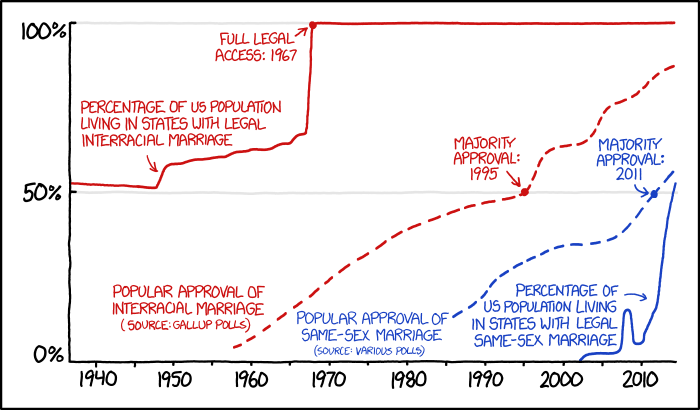
Via xkcd.
Majority approval of gay marriage in public opinion preceded majority legalization of gay marriage.
Majority approval of interracial marriage followed Loving v. Virginia in 1967 by about three decades.
When Should Lying Be Legal?
Via Legal Theory Blog: Ariel Porat and Omri Yadlin (Tel Aviv University and Tel Aviv University - Buchmann Faculty of Law) have posted Valuable Lies on SSRN. Here is the abstract:
1. Lies by law enforcement (but not prosecuting attorneys) in interrogating criminal suspects. See Oregon v. Mathiason, 429 U.S. 492 (1977) (confession obtained through false statement that fingerprint evidence linked suspect to crime) and Michigan v. Mosley, 423 U.S. 96 (1975) (confession obtained through false statement that co-defendant had confessed). See also Moran v. Burbine, 475 U.S. 412 (1986) (allowing confession to be admitted despite lie of police to attorney obtained by a suspect's sister to represent the sister to the effect that the suspect was not being questioned when he was being questioned, after suspect waived Miranda rights not knowing that attorney was available).
2. Lies in connection with a covert intelligence or undercover law enforcement operation to targets of the operation, and in general, to sustain an officially sanctioned "cover identity" such as those in witness protection programs. See, e.g., Hoffa v. United States, 385 U.S. 293 (1966) (undercover agent in non-custodial environment) and Illinois v. Perkins, 496 U.S. 292 (1990) (undercover agent in jail).
3 Lies in the course of political debates and campaigns about policy issues.
4. Lies about receiving military honors (in some circumstances) despite the Stolen Valor Act.
5. Lies about your "bottom line" in negotiations.
6. Lies that are not relied upon by the person hearing them.
7. Lies about immaterial matters.
8. Lies that do not lead to economic harm and don't violate other criminal statutes.
9. Lies told in order to secure sex ("rape by deception" or "rape by fraud") (but some lies to secure a marriage about matters that are deemed to be material as a matter of law, may give rise to an action to annul a marriage).
Categories 1 and 2, as well as a doctor's lies, are true cases of alleged superseding justification.
Categories 3 and 4 are motivated by First Amendment concerns and about courts acting as arbiters of what is true, although I personally feel that 4 was wrongly decided as the usual First Amendment concerns about who decides what is true aren't applicable in any meaningful way.
Categories 5, 6, 7 and 8 are basically variations of the "no harm, no foul" rule together with a codification of what can and cannot be reasonably relied upon. These are derived from the common law of fraud and misrepresentation.
Category 9 is also troublesome. On one hand, there are often serious issues of proof, questions about what is material, and longstanding judicial distaste for interjecting itself into the dialog that leads to sex. On the other hand, there are many cases where those concerns do not clearly apply. There is also in category 5 a skepticism over how many lies as opposed to what amount to broken promises (express or implied, even if in the form of representation of fact) lead to sex.
In general, I don't favor broadening the scope of lies that are not sanctionable, except in "self-help" situations such as the lie about one's religious affiliation made to avoid unlawful discrimination, which in some sense is a generalization of the lack of legal sanction for lies about immaterial matters. Indeed, there is a good argument that some of the above categories of authorized lies should be narrowed.
The lie in the abstract example about mineral potential is deeply problematic, because a whole framework of commercial practice and due diligence burdens is predicated on the inability to make material misstatements of fact about such matters, which is as much as rule of the road as it is anything else. It would be deeply disruptive to commercial practice to change this rule.
Doctors have a very utilitiarian and paternalistic set of ethics and frequently feel that they have the right to lie for the greater good in all sorts of circumstances where it would never be tolerated from lawyers.
A more common a problem than the vaccination issue, which actually is very rarely the case, is the circumstance where prognosis information is withheld from terminally ill people or expressed in an unduly optimistic way, on the theory that a belief in a better prognosis will make it a better outcome more likely through a sort of placebo effect (with the placebo effect itself being the classic physician lie for the patient's well being).
Law enforcement officers and doctors, already conditioned to believe that it is ethically permissible to lie under some circumstances are also particularly prone to also lie for the impermissible purposes of covering up their own mistakes and the mistakes of their peers.
Another area where there is a distinction between non-disclosure and false affirmative disclosure that is, I would argue, morally relevant, is between anonymous or clearly pseudonymous writing in which there is clear non-disclosure of authorship, and sock puppetry, in which there is affirmative deception concerning authorship.
Should a Muslim employee who falsely stated in his job interview that he is Christian in order to avoid discrimination be fired for his dishonesty? Should a buyer of a tract of land who conducted an expensive investigation before contracting that revealed a high likelihood of mineral deposits be subject to liability for fraud because he told the seller he knew nothing about the land's mineral potential before purchase? Is a doctor violating her legal duties toward her patient if she convinces him to get vaccinated on the pretext that it is in his best interest when it is instead in the public interest? In all of these cases, and many others, parties are allowed not to disclose material information to an interested party but not to lie about the same information.
This article makes the argument that in many contexts, where non-disclosure is permitted lies should also be tolerated, for otherwise the social goals sought by allowing non-disclosure are frustrated. With this as its starting point, the article develops a theory of valuable lies, discussing the conditions under which lies should be permitted. It analyzes the main impediments to allowing lies, the most important of which being the risk that permitting lies would impair truth-tellers' ability to reliably convey truthful information. The article applies the theory to various fields, including contract law, tort law, medical malpractice, criminal law and procedure, and constitutional law. It concludes by proposing changes to the law that will allow telling valuable lies in well-defined categories of cases.There are a number of circumstances where the law authorizes, or at least does not punish, lying:
1. Lies by law enforcement (but not prosecuting attorneys) in interrogating criminal suspects. See Oregon v. Mathiason, 429 U.S. 492 (1977) (confession obtained through false statement that fingerprint evidence linked suspect to crime) and Michigan v. Mosley, 423 U.S. 96 (1975) (confession obtained through false statement that co-defendant had confessed). See also Moran v. Burbine, 475 U.S. 412 (1986) (allowing confession to be admitted despite lie of police to attorney obtained by a suspect's sister to represent the sister to the effect that the suspect was not being questioned when he was being questioned, after suspect waived Miranda rights not knowing that attorney was available).
2. Lies in connection with a covert intelligence or undercover law enforcement operation to targets of the operation, and in general, to sustain an officially sanctioned "cover identity" such as those in witness protection programs. See, e.g., Hoffa v. United States, 385 U.S. 293 (1966) (undercover agent in non-custodial environment) and Illinois v. Perkins, 496 U.S. 292 (1990) (undercover agent in jail).
3 Lies in the course of political debates and campaigns about policy issues.
4. Lies about receiving military honors (in some circumstances) despite the Stolen Valor Act.
5. Lies about your "bottom line" in negotiations.
6. Lies that are not relied upon by the person hearing them.
7. Lies about immaterial matters.
8. Lies that do not lead to economic harm and don't violate other criminal statutes.
9. Lies told in order to secure sex ("rape by deception" or "rape by fraud") (but some lies to secure a marriage about matters that are deemed to be material as a matter of law, may give rise to an action to annul a marriage).
Categories 1 and 2, as well as a doctor's lies, are true cases of alleged superseding justification.
Categories 3 and 4 are motivated by First Amendment concerns and about courts acting as arbiters of what is true, although I personally feel that 4 was wrongly decided as the usual First Amendment concerns about who decides what is true aren't applicable in any meaningful way.
Categories 5, 6, 7 and 8 are basically variations of the "no harm, no foul" rule together with a codification of what can and cannot be reasonably relied upon. These are derived from the common law of fraud and misrepresentation.
Category 9 is also troublesome. On one hand, there are often serious issues of proof, questions about what is material, and longstanding judicial distaste for interjecting itself into the dialog that leads to sex. On the other hand, there are many cases where those concerns do not clearly apply. There is also in category 5 a skepticism over how many lies as opposed to what amount to broken promises (express or implied, even if in the form of representation of fact) lead to sex.
In general, I don't favor broadening the scope of lies that are not sanctionable, except in "self-help" situations such as the lie about one's religious affiliation made to avoid unlawful discrimination, which in some sense is a generalization of the lack of legal sanction for lies about immaterial matters. Indeed, there is a good argument that some of the above categories of authorized lies should be narrowed.
The lie in the abstract example about mineral potential is deeply problematic, because a whole framework of commercial practice and due diligence burdens is predicated on the inability to make material misstatements of fact about such matters, which is as much as rule of the road as it is anything else. It would be deeply disruptive to commercial practice to change this rule.
Doctors have a very utilitiarian and paternalistic set of ethics and frequently feel that they have the right to lie for the greater good in all sorts of circumstances where it would never be tolerated from lawyers.
A more common a problem than the vaccination issue, which actually is very rarely the case, is the circumstance where prognosis information is withheld from terminally ill people or expressed in an unduly optimistic way, on the theory that a belief in a better prognosis will make it a better outcome more likely through a sort of placebo effect (with the placebo effect itself being the classic physician lie for the patient's well being).
Law enforcement officers and doctors, already conditioned to believe that it is ethically permissible to lie under some circumstances are also particularly prone to also lie for the impermissible purposes of covering up their own mistakes and the mistakes of their peers.
Another area where there is a distinction between non-disclosure and false affirmative disclosure that is, I would argue, morally relevant, is between anonymous or clearly pseudonymous writing in which there is clear non-disclosure of authorship, and sock puppetry, in which there is affirmative deception concerning authorship.
Energy Problems Solved
In an apparent violation of the law of matter and energy conservation, my car's fuel gauge appears to be be indicating that I have more gas in the tank the further I drive. Then again, maybe it is a case of elves who appear when I'm not looking and fill up the tank.
I figure if we siphon off my gas tank every couple of days, we could shut down an oil well or two.
Then again, it could be that the folks at Midas on Colorado Boulevard at Alameda in Denver who worked on the fuel system on my car more than once in the last year could of damages the fuel gauge while they were working on it.
But, really, which seems more likely? Incompetence at a nationally branded car repair facility, or elves refilling my tank?
Surely, it must be the elves.
The practical issue is whether I go back and try to get the company that previously screwed up to acknowledge it made mistakes and should repair the new problem free of charge, which they are unlikely to do and might lead to more mistakes, or do I simply call it a sunk cost and go to a different shop?
Subscribe to:
Posts (Atom)