07 May 2020

New Colorado General Election Polling

The Presidential Race

The latest Presidential poll in Colorado was Biden 55% and Trump 36%.

The U.S. Senate Race

In the U.S. Senate race, the poll was John Hickenlooper 54% and Cory Gardiner 36% (an 18 percentage point lead for Hickenlooper). 

The poll pointed did not ask about Andrew Romanoff and ask about the upcoming Hickenlooper and Romanoff Democratic Primary for U.S. Senate in a pretty overt effort to boost Hickenlooper, whom the national party has already taken the side of, over Romanoff, even though both men have a very good chance against Gardiner in the general election. 

Methodology

The poll was by Keating Research, OnSight Public Affairs and Mike Melanson – Democratic firms and a former Hickenlooper campaign staffer – polled 600 Coloradans in an online survey between May 1 and 3, with a margin of error of ±4%. Cross tabs.

06 May 2020

Tropes

One of my favorite websites is having a short story contest in which reader votes play an important part in who wins. 

There will be 20 winners and there are at least 700 entries. Two of the winners get $15,000 each, are included in a published anthology, and have an animated short made based on their story. Six more winners get $5,000 each and are also included in the anthology. The remaining twelve winners get $3,000 each and are included in the anthology. In all, there are $96,000 of prizes to be awarded and the recognition puts the winners on their way to a career of story telling.

Reader voting isn't random, however. As elusive and seemingly subjective as it may seem, "quality" as Robert Pirsig described it in his signature novels, "Zen and the Art of Motorcycle Maintenance" and "Lila", is still something real, even if it may be intersubjective, rather than objective. And, it is much easier to recognize it, than to create it.

The best stories tread a fine line. 

On one hand, they can't be stale and cliched. It has to be fresh, with some elements that are novel or unexpected. Also, the execution and delivery have to.be good from a technical mastery perspective. 

On the other hand, a story has to tread close enough to established tropes that the audience has some sense of where the story is likely to go and finds some elements of the story comfortably familiar. To say that there are true "universals" may go to far, but there are characters, settings, situations, and plot devices that are proven winners if done well, and a story teller's job is to assemble a good mix of them in a competent manner the works.

Yet, a story teller doesn't have to adhere to any particular stylistic convention (even within genre writing there is room to develop a distinctive take on the genre or a sub-genre), the style just needs to be distinctive. The creative arts reward someone who has an identifiable style and trademark, not a jack of all trades who is competent is a wide variety of styles and genres. Maybe, if you are very, very accomplished, you can branch into two or three different styles that have overlapping aspects to them.

05 May 2020

U.S. Navy Awards Next Generation Frigate Contract

fincantieri, ffgx

An artist's conception of the FFG(X). 

In an atypical move, the U.S. Navy has commissioned a next generation frigate based upon a European design that entered service in 2012, scorning U.S. based proposals. 

At 6,000 tons, the next generation U.S. Navy frigate (not yet assigned a name for the class) will be about midway in size between the previous and now decommissioned Oliver Hazard Perry class frigate (4000 tons), and the Arleigh Burke class destroyers (up to 9,700 tons) which are the main stay of U.S. Navy surface combatants. It will have a crew of about 145 sailors (compared to 329 for an Arleigh Burke class destroyer). The diesel-electric propulsion system has a blue sea ship range (11,000 kilometers) and its top speed (50 km per hour) and cruising speed (29 km per hour) are comparable to existing U.S. surface combatants. It will be marginally slower than the Arleigh Burke class destroyers, but have a somewhat longer range.

The ship would be more modern, less expensive, and come on line quickly (i.e. in six years) with only modest development costs or technology risk. But it does not represent any breathtaking innovations or capabilities relative to existing U.S. and NATO warships. 


The French design carries 40 guides missiles customized for anti-air (16), surface to surface (16), and anti-submarine (8) missions, a 3" naval gun, two torpedo tubes, two or three 20mm grenade canons, defensive anti-torpedo, decoy ordinance and electromagnetic jamming systems, and a small, armed helicopter. The French design also has advanced air, surface and submarine sensors. The U.S. version would carry a comparable complement of weapons and sensors and aircraft from designs used on other U.S. warships. 


The most notable difference in capabilities between the FFG(X) and the Arleigh Burke destroyer appears to be that the frigate will have about half as many missiles as the destroyer, although I am not aware of any situation in which an Arleigh Burke destroyer has ever needed to fire anywhere close to half of its missiles before having an opportunity to resupply.


The anticipated total cost of this new warship (including development costs amortized over the total purchase) is about $795 million U.S. dollars for the first frigate and $525 million for each of the next nine ships in the class (compared to about $1,843 million per new Arleigh Burke class destroyer with a design that entered service in 1991).


UPDATE May 6, 2020:
According to Assistant Secretary of the Navy for Research, Development and Acquisition James Geurts, the first hull will cost $1.281 billion, which includes the design money for both the ship and for the work needed at the shipyard to set up a production line. It also includes all the government-furnished equipment, including things such as Raytheon’s AN/SPY-6-derivative radar and Lockheed Martin’s Aegis Combat System. 
Of that $1.281 billion, $795 million will go to the shipyard. The next hulls in the buy should cost significantly less. The Navy is aiming for a price tag of $800 million in 2018 dollars, with the threshold at $950 million. But Geurts thinks he can beat both numbers. An independent cost estimate found the follow-on hulls should cost about $781 million if all 20 are built. 
“The study shows this ship as selected and the program as designed delivering underneath our objective cost per platform,” Geurts said on a May 30 phone call with reporters. 
2) The timeline. Detailed design of the future frigate, known as FFG(X), starts right away, Geurts said, and construction will begin no later than April 2022. The first ship should be delivered in 2026 and should be operational by 2030, with final operational capability declared by 2032, Geurts said. 
The contract should be wrapped up — all 10 hulls — by 2035. The intention is to buy 20 hulls, though it’s unclear whether Marinette will build all 20 or if the Navy will identify a second source.
From here.
END UPDATE
* The U.S. Navy has selected a Franco-Italian frigate design as the basis for its next generation guided missile frigate, FFG(X). 
* The ship will be European in basic design but with U.S. made weapons and sensors. 
* The Navy will buy an initial 10 ships with up to 40 or more purchased over the next two decades. 
The U.S. Navy officially selected Italian shipbuilder Fincantieri to produce the service’s first guided-missile frigates in more than 30 years. The service awarded the company $795 million to begin construction on the first of at least ten frigates, with the lead ship entering service in 2026. The new, unnamed ship will fill a hole in the U.S. Navy’s fleet structure for an armed, small surface combatant capable of tackling both low- and high-end missions. 
Fincantieri beat out three other companies, including Austal USA, a partnership of General Dynamics Bath Iron Works and Spain’s Navantia, and Huntington Ingalls Industries, to win the FFG(X) (fast frigate, guided, “experimental”) contract. The winning ship design is based on the FREMM class of European missile frigates, with variants of the design already in service with the Italian, French, Moroccan, and Egyptian navies. . . . 
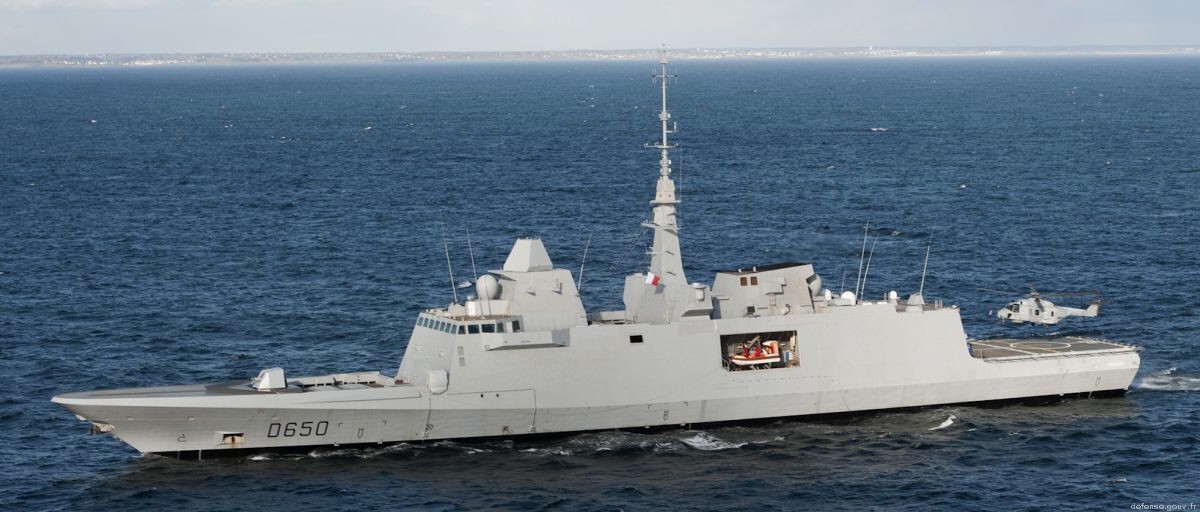
aquitaine fremm class fregate europeenne multi-missions frigate french navy marine nationale 18x

An Aquitaine class FREMM in French service from the link below.
Fincantieri’s frigate is based on the FREMM “Fregata europea multi-missione” design operated by France and Italy, with exports to Egypt and Morocco. FREMM weighs 50 percent more than the Perry-class frigates, tipping the scales at 6,000 tons. The ships use a hybrid electric drive system that gives them a top speed of 30+ knots and a range of 6,800 miles. As multi-mission ships, the FREMM ships carry anti-air, anti-ship, and anti-submarine weapons, though some are optimized for anti-submarine missions. French FREMM frigates carry MdCN land attack cruise missiles and launched them against Syria’s chemical weapons stockpiles in April 2018.

Although a foreign design, the American FREMM will be thoroughly Americanized, with U.S.-made sensors and weapons installed throughout the hull. The new Enterprise Air Surveillance Radar (EASR), developed by Raytheon for the new USS Enterprise aircraft carrier, will be the primary air sensor. The EASR will be coupled with the Aegis Combat System, a computer system that allows surface ships to detect, track, and engage a variety of surface and air threats, from high-flying ballistic missiles to low-flying cruise missiles.
From Popular Mechanics.

Does It Make Sense?

The U.S. military's sense of itself, and what it devotes a huge amount of its resources to doing, has only a dim connection to what it actually does. 

The U.S. Navy, to a great extent, is operating on a replacement cycle for a structure put in place in World War II and never really seriously rethought since then. As I noted in a June 11, 2018 post:
Notwithstanding the fact that D-Day was an Army operation, the Marines see massive amphibious assaults in the image of D-Day as core to their mission and acquire ships, amphibious armored vehicles, landing craft, helicopters, STOVL fighter aircraft and more to carry out that mission. Never mind that the last time that a large scale amphibious assault was important to the outcome of an armed conflict for the U.S. military was more than sixty years ago during the Korean War. And, neither has anyone else.
In World War II, the U.S. Navy fought a lot of battles in which one blue sea warship tried to sink another blue sea warship. You can count on your fingers the number of times that has happened since then with any military force in the world. But, the U.S. still has a fleet of blue sea warships designed to dominate and vastly outnumber of handful of blue sea navies in the world that still exist. Never mind that aircraft and submarines and cruise missiles and long range missiles and sea mines are almost always better at sinking warships than other warships, which are to a great extent sitting ducks that have avoided catastrophe mostly because no one has wanted to be so definitively at war with the nuclear armed United States. The Navy, like the Air Force, has not given as much attention as it should to sealift, sea basing and coastal firepower support for coastal ground troops.
Another important role of the U.S. Navy is anti-piracy, smuggling interdiction, for which billion dollar destroyers, are expensive overkill, but littoral combat ships may not be very effective.
The Navy, of course, isn't the only Department of Defense bureaucracy at fault, as I also noted in the same post:
The Air Force's elite ranks are disproportionately made up of fighter pilots who trained to engage in air to air combat, and so those are the missions it focuses on preparing the Air Force to carry out, whether that is really what we need to carry out the foreseeable missions the military might be called upon to carry out. Never mind that the U.S. military has had only about two instances of air to air combat in the last twenty years. Other missions have atrophied. The Air Force has again and again tried to shirk its responsibility to provide close air support to ground troops. The Air Force has underinvested in transport aircraft and failed to coordinate with other services to make sure that the planes that carry troops and weapons systems are optimized to the needs to the troops and weapons systems that they carry and likewise ground troops have insufficiently tailored their resources to the aircraft available to carry them.
Wikipedia sums up the post-World War II history of naval warfare as follows:
World War II had seen the United States become the world's dominant sea power. Throughout the rest of the 20th century, the United States Navy maintained a tonnage greater than that of the next 17 largest navies combined. 
The aftermath of World War Two saw naval gunnery supplanted by ship to ship missiles as the primary weapon of surface combatants. Two major naval battles have taken place since World War II.  

In the 1982 Falklands War between Argentina and the United Kingdom, a Royal Navy task force of approximately 100 ships was dispatched over 7000 miles from the British mainland to the South Atlantic. The British were outnumbered in theatre airpower with only 36 Harriers from their two aircraft carriers and a few helicopters, compared with at least 200 aircraft of the Fuerza Aérea Argentina, although London dispatched Vulcan bombers in a display of long-distance strategic capacity. Most of the land-based aircraft of the Royal Air Force were not available due to the distance from air bases. This reliance on aircraft at sea showed the importance of the aircraft carrier. The Falklands War showed the vulnerability of modern ships to sea-skimming missiles like the Exocet. One hit from an Exocet sank HMS Sheffield, a modern anti-air warfare destroyer. Over half of Argentine deaths in the war occurred when the nuclear submarine Conqueror torpedoed and sank the light cruiser ARA General Belgrano with the loss of 323 lives. Important lessons about ship design, damage control and ship construction materials were learnt from the conflict.  
The Indo-Pakistani Naval War of 1971 was the first major naval war post World War II. It saw the dispatch of an Indian aircraft carrier group, heavy utilisation of missile boats in naval operations, total naval blockade of Pakistan by the Indian Navy and the near total annihilation of almost half of Pakistan's Navy. By the end of the war, the damage inflicted by the Indian Navy and Air Forces on Pakistan's Navy stood at two destroyers, one submarine, one minesweeper, three patrol vessels, seven gunboats, eighteen cargo, supply and communication vessels, large-scale damage inflicted on the naval base and docks located in the major port city of Karachi. Three merchant navy ships; Anwar Baksh, Pasni and Madhumathi; and ten smaller vessels were captured. Around 1,900 personnel were lost, while 1,413 servicemen (mostly officers) were captured by Indian forces in Dhaka. The Indian Navy lost 18 officers and 194 sailors and a frigate, while another frigate was badly damaged and a Breguet Alizé naval aircraft was shot down by the Pakistan Air Force. 
At the present time, large naval wars are seldom-seen affairs, since nations with substantial navies rarely fight each other; most wars are civil wars or some form of asymmetrical warfare, fought on land, sometimes with the involvement of military aircraft. 
The main function of the modern navy is to exploit its control of the seaways to project power ashore. Power projection has been the primary naval feature of most late-century conflicts including the Korean War, Suez Crisis, Vietnam War, Konfrontasi, Gulf War, Kosovo War, the War on Terrorism in Afghanistan, and the Iraq War.  
A major exception to this trend was the Sri Lankan Civil War, which saw a large number of surface engagements between the belligerents involving fast attack craft and other littoral warfare units.
There have been some small skirmishes in addition to these involving warships in the Persian Gulf, and with pirates near Somalia and in Island Southeast Asia. But, the last time a submarine sunk a full sized warship, a warship sunk a submarine, or two full sized warships engaged each other in anger, anywhere in the world, was 38 years ago, and the conflict before that was 49 years ago.

The United States hasn't engaged in the kind of blue sea naval warfare against a naval near peer, i.e. the kind of conflict that its navy is designed around, since World War II ended 75 years ago. 

One could imagine a conflict with Iran in the Persian Gulf, with North Korea or China near the coast of East Asia, or with Russia in variety of places in the Northern hemisphere. But, after that, it is increasingly difficult to imagine a military conflict involving real naval warfare.

WWI Helmets Better Than Current Ones At Preventing Concussions


Helmet b was most effective against concussions. 
The modern helmet is d and e is a bare head.

Surprisingly, modern helmets for soldiers are worse at preventing concussions than World War I helmets, a design problem with modern helmets that, in theory, should be pretty easy to fix.
Since World War I, helmets have been used to protect the head in warfare, designed primarily for protection against artillery shrapnel. More recently, helmet requirements have included ballistic and blunt trauma protection, but neurotrauma from primary blast has never been a key concern in helmet design. Only in recent years has the threat of direct blast wave impingement on the head–separate from penetrating trauma–been appreciated. 
This study compares the blast protective effect of historical (World War I) and current combat helmets, against each other and ‘no helmet’ or bare head, for realistic shock wave impingement on the helmet crown. Helmets included World War I variants from the United Kingdom/United States (Brodie), France (Adrian), Germany (Stahlhelm), and a current United States combat variant (Advanced Combat Helmet). Helmets were mounted on a dummy head and neck and aligned along the crown of the head with a cylindrical shock tube to simulate an overhead blast. Primary blast waves of different magnitudes were generated based on estimated blast conditions from historical shells. Peak reflected overpressure at the open end of the blast tube was compared to peak overpressure measured at several head locations. 
All helmets provided significant pressure attenuation compared to the no helmet case. The modern variant did not provide more pressure attenuation than the historical helmets, and some historical helmets performed better at certain measurement locations. The study demonstrates that both historical and current helmets have some primary blast protective capabilities, and that simple design features may improve these capabilities for future helmet systems.

The conclusion states:
All tested helmets provided significant protection against primary blast brain injury compared to a bare head scenario. . . . 
While the helmets also provided protection against eardrum rupture based on current eardrum injury risk assessments, the resulting pressures were still injurious even with the helmets with extended brims. 
Major improvements made in helmet technology to increase ballistic protection do not provide the same increase in blast protection. At certain measurement locations, some historical helmets provided more blast attenuation than the modern helmet even though the modern helmets based on modern fiber composites are far more protective from typical ballistic threats. Specifically, the French 1915 Adrian helmet produced a lower peak pressure at the crown of the head compared to the Advanced Combat Helmet and the other historical helmets. These results show that there is considerable overlap in materials that have good qualities for ballistic and blast protection, but the protection mechanisms are different. Protection against primary blast focuses largely on impedance mismatches that reduce the amplitude of the transmitted waves to the head. The introduction of steel helmets during World War I reduced the toll of both blast and ballistics injuries at the front. 
In the future, helmet protection against primary blast might be improved by material choice, multiple material layers with different acoustic impedance, or the geometry of the helmet.

04 May 2020

The 2020 Presidential Race Six Months Out

Donald Trump has incumbency going for him going into the general election, as well as a deeply divided Democratic electorate that has only lukewarm support for former Vice President Joe Biden, the Democrats' presumptive nominee. 

But, Trump who as recently as February had a strong economy in his favor, now has the worst economy since the Great Depression. While facing a crisis can help a Presidency and briefly gave Trump a boost, his utter mishandling of the coronavirus pandemic thus far seems to be doing him no favors going into the general election. 

He is doing so poorly that he could easily take the Republican majority in the U.S. Senate down with him (the subject of other posts) and there seems to be no real likelihood that the Republicans will retake the U.S. House.

In national polling, Biden leads Trump by 5.3 percentage points.

Cook's Political Report summarizes the Electoral College Outlook as follows:


The current polling in all states not solidly Democratic or solidly Republican per Cook's Political Report is as follows (with 2016 results in parenthesis, followed by the swing in percentage points):

Minnesota (10) . . . . . . . . Biden + 12* (Clinton + 1.5) D+10.5
Colorado (9) . . . . . . . . . . Biden + 10** (Clinton + 4.9) D+5.1
Maine (2) . . . . . . . . . . . . . Biden + 10 (Clinton + 2.9) D+7.1
Virginia (13) . . . . . . . . . . Biden + 7.3 (Clinton + 5.4) D+1.9
Pennsylvania (20) . . . . . . Biden + 6.5 (Trump + 0.7) D+7.2
Michigan (16) . . . . . . . . Biden + 5.5 (Trump + 0.3) D+ 5.8
New Hampshire (4) . . . . Biden + 4.6 (Clinton + 0.3) D+4.3
Arizona (11). . . . . . . . . . Biden + 4.4 (Trump + 3.3) D+7.7
Nevada (6) . . . . . . . . . . .  Biden + 4.0*** (Clinton + 2.4) D+1.6
Ohio (18) . . . . . . . .  . . . .  Biden + 4.0 (Trump + 8.1) D+12.1
Florida (29) . . . . . . . . . . Biden + 3.2 (Trump + 1.2) D+4.4
Wisconsin (10) . . . . . . . . Biden + 2.7 (Trump + 0.7) D+3.2
North Carolina (15) . . . . Trump + 0.3 (Trump + 3.7) D+3.4
Texas (38) . . . . . . . . . . . . Trump + 1.4 (Trump + 9.0) D+7.6
Iowa (6) . . . . . . . . . . . . . . Trump + 4.6 (Trump + 9.5) D+4.9
Georgia (16) . . . . . . . . . . Trump + 7.5 (Trump + 5.1) R+2.4

* Last polling from October 2019.
** Last polling from August 2019.
*** Last polling from January 2020.

Biden's lead exceeds the margin of error in the polling in Florida and all states where he has a stronger lead. But, not in Wisconsin, where the margin of error exceed Biden's lead. Trump's lead is less than the margin of error in North Carolina and Texas.

If Trump's relative support in current polling stays the same, he needs to win all of the solidly Republican states, Georgia, Iowa, Texas, North Carolina, Wisconsin, Florida, Ohio, and Arizona. He also needs to win either Nevada, or both Maine's Second Congressional District and Nebraska's Second Congressional District to win the Presidential election in the electoral college.

This would be a 4.5 percentage point swing from the current polling against Biden from current polling (which exceeds the polling margin of error) six months from today, if all polling was perfectly correlated, and on that assumption, this swing would correspond to a Biden lead of 0.8 percentage points in national polling.

The status quo is that Biden wins the Electoral College 352-186 (assuming that Trump wins both Maine's Second Congressional District and Nebraska's Second Congressional District).

A 1.5 percentage point swing from the current polling against Trump would probably swing Nebraska's Second Congressional District to Biden in addition to North Carolina and Texas, giving rise to a landslide Biden win in the Electoral College of 406-132. 

Clinton fell short of Trump by less than one percentage point in the polls in three key states (Pennsylvania, Michigan and Wisconsin), and by just 1.2 percentage points in Florida. Trump won the 2016 election by a nose.

Of sixteen states that are even remotely in play in 2020, Georgia is the only one that has swung in Trump's direction, rather than away from him. Trump support in Ohio has fallen by more than 12 percentage points, where the incumbent Republican Governor has clashed with Trump on his handling of the COVID crisis.

The swing away from Trump is consistent with the fact that his favorability rating was last positive on January 26, 2017 (when it was positive by 0.1 percentage points), six days after he took office. By January 29, 2017 and every day thereafter in his Presidency, Trump has had negative approval ratings. On December 15, 2017, at his low point, his disapproval rating was 21 percentage points in excess of his approval rating. Currently polling disapproves of him rather than approves by 6.5 percentage points, just a little bit more than the amount by which he trails Biden in the polls.

The only measure by which Biden in not the clear front runner going into the November 3, 2020 general election against Trump is the betting odds which favor Trump by 8.8 percentage points.

Biden certainly has the ability to snatch defeat from the jaws of victory in the campaign and has a history of being absolutely miserable on the campaign trail. But, this election is primarily a referendum on Trump's performance in his first four years in office. So, if Biden can simply keep his mouth shut and refrain from making any unforced errors, there is a very good chance that Trump can be limited to a single term in office and that the United States can start to rebuild itself from the mess that Trump has left behind.

03 May 2020

Up And Running

When my old laptop received a terminal diagnosis, after starting to crash once or twice a day without warning, I ordered a new one. It arrived, and three days later, I've finally managed to get all of my main applications in place and the lion's share of my files transferred over. There may be a few straggler files, or a password or two that needs to be put in place, but basically, I'm up and running again.

28 April 2020

When Does COVID Kill?

DISCLAIMER: I am not a doctor or an epidemiologist. I am someone with a mathematics background who likes to analyze large data sets. I'm making a conjecture based upon what I've read about COVID-19 and this post is meant to be thought provoking, especially for those who have a better capacity to evaluate the data properly, and not as a definitively conclusion that should be acted upon. I am engaged in hypothesis generation, not in empirical proof of a hypothesis at this point.

Are COVID deaths primarily due to the interaction of select pre-existing conditions and a COVID infection?

COVID death risk is very strongly influenced by age. But, the association is made partially because it is easiest to analyze statistically.

Another way of conceptualizing the data, and I don’t know how much this has been formally analyzed, is that the true relationship could be between select pre-existing conditions and morbidity and morality risk, with age serving as proxy for the likelihood of having one or more of the risk enhancing pre-existing conditions.

Hints For A Pre-Existing Condition Theory Among The Young

In this frame, it makes a lot more sense that the young, who are normally viewed as having weaker overall immune systems than those in the prime of life, are so little affected. It also is a good fit when you dig down to who in particular among the young dies or suffers serious impairment.

For example, among the young who have died in Colorado are premature infants already in ICU, the child with severe epilepsy only responsive to CBD after whom the strain of marijuana known as Charlotte’s Web is named, a girl a couple of years behind my son in high school who was in a wheel chair and had respiratory issues, etc.

Anecdotal and small sample studies seem to show that mortality is heavily concentrated among those with a short list of pre-existing conditions (ca. 70%-90%+). It also isn’t unreasonable to suspect that many or most of those who die without any of the pre-existing conditions on the short list also have pre-existing conditions that are less common in the general population (and hence don’t make up a huge share of the total), or have pre-existing conditions that are undiagnosed, or not recognized as relevant.

Those conditions are most rare in the 5-14 age group, which has none of the congenital conditions that kill within the first five years of life (especially the first year or two), but are at an age before anything else with a genetic cause crops up. This is because this is an age group that faced strong continuing selection from infectious diseases or other causes, prior to vaccination and antibiotics, even in non-epidemic periods. Those who die in that age range overwhelmingly die without reproducing first, unlike those who die in their 30s or later, so genetic conditions that increase mortality in that age range are subject to especially strong selective pressure.

Hints For A Pre-Existing Condition Theory Among The Elderly

It is also worth noting that deaths among the elderly, despite age itself being statistically a huge risk factor, are heavily concentrated among those in nursing homes and assisted living facilities, i.e. among those who almost by definition have some impairments or serious pre-existing conditions already. Admittedly, some of the risk is from high density institutional living in what are predominantly pretty non-medically and sloppily run facilities that do not enough to prevent infections from spreading. But, the percentage of the dead in these institutions seems to be running at 35%-70% (in Colorado where I live it is 63%), but they are a much smaller share of the total elderly population. They make up about 5% of the elderly population, which in turn makes up about 15% of the total population, so about 0.75% of the total population accounts for about 35% to 70% of the dead. 

The mortality rate of the roughly 14% of the population that is over age 65 but is not in a nursing home is much, much lower. So, it is’t just the elderly who are dying, it is the elderly who have pre-existing conditions, often serious ones. Pre-existing conditions are much more common in the elderly, whose bodies are breaking down due to old age on multiple fronts. But, these conditions are not universal or uniformly distributed by any means.

How frail are people in nursing homes? 

One way to quantify that is by looking at death rates for nursing home residents pre-COVID.
In a study of elderly Americans who moved to a nursing home for their final months or years of life, 65 percent died there within one year, according to an investigation by researchers at the San Francisco VA Medical Center and the University of California, San Francisco. 
In the study, which appears in the online Early View section of the “Journal of the American Geriatrics Society,” the researchers found that length of stay before death in a nursing home was associated with differences in gender, net worth, and marital status. 
Men had shorter lengths of stay before death than women, residents with higher net worth had shorter lengths of stay than those with lower net worth, and residents who were married or otherwise partnered had shorter lengths of stay before death than those who were single, says lead author Anne Kelly, MSW, a social worker at SFVAMC. 
“It’s a matter of resources. People with more access to care and resources were able to stay in the community for longer before moving to a nursing home than those with less access,” explains Kelly. “One reason that men had shorter stays before death than women might be that women tend to outlive men, and so by the time a woman moves to a nursing home her partner is more likely to have died, whereas men are more likely to have a spouse or partner to care for them at home through the end of life.” . . .  
“One quarter of all deaths in the United States occur in nursing homes, and that figure is expected to rise to 40 percent by the year 2020,” says Smith. . . .  
Smith describes the average and median length of stay before death as “surprisingly brief.” The implication, he says, is that “we need to engage nursing home residents in planning conversations about end-of-life care and treatment preferences very soon after they are admitted. We have only a brief amount of time to address their concerns before they become seriously ill.” 
For the study, the authors analyzed data on 1,817 nursing home residents who died between 1992 and 2006. The residents were participants in the Health and Retirement Study, an ongoing nationally representative longitudinal study of health, retirement, and aging sponsored by the National Institute on Aging. 
The average age of participants when they moved to a nursing home was about 83. The average length of stay before death was 13.7 months, while the median was five months. Fifty-three percent of nursing home residents in the study died within six months. 
Men died after a median stay of three months, while women died after a median stay of eight months. 
From Steve Tokar, "Social Support is Key to Nursing Home Length of Stay Before Death", Patient Care (August 24, 2010) (emphasis added).

The mortality differences based on sex in COVID deaths (about 60% are men) also mirrors the sex differences in survival durations for nursing home residents.

The good news is that the proportionate impact of COVID on lost years of life may be much more modest than it is in the raw number of deaths. Lots of people who are dying of COVID had short life expectancies, in a large share of cases, median life expectancies of less than a year. Many people who die of COVID would have died of something else in the near future if they hadn't died of it.

Does This Help Explain The Geography Of COVID Outbreaks?

Western Europe and North America have been much harder hit by COVID than most of the rest of the world, especially when considering deaths per million people, a measure that is insensitive to testing rates and the extent to which testing is targeted well.

The pre-existing condition theory might help to explain this pattern.

First, the "age pyramid" in most of the rest of the world is much more bottom heavy. Most other countries have more young people and fewer older people, proportionately.

Second, many countries outside Western Europe and North America don't warehouse their sickest of the sick in nursing home-like facilities with the very least healthy of old and disabled in them. This reduces transmission and infection rates among the very vulnerable.

Third, it is also probably a reality in most of the world that most people unwell enough that they would be admitted to nursing homes in Western Europe and North America, instead die at home a few months to a year or so on average than they would have with the comparatively intensive paramedical attention that they receive in a nursing home. So, the group of people with an odds ratio of death from COVID on the order of 50 to 100 times that of the general population makes up a much, much smaller share of the total population in places outside Northern Europe, like India, Indonesia, and Africa.

Could very high exposure rates explain deaths among the quite small percentage of deaths among healthy younger people?

There are cases of seemingly healthy people dying of COVID with no apparent pre-existing conditions. But, the other common thread there in many of those cases seems to be extremely high levels of exposure. For example, ER doctors and COVID ward nurses, and public transit workers in areas with very high infection rates, seem to make up many of these cases.

27 April 2020

Change, Some For The Better In Saudi Arabia

Crown Prince Mohammed bin Salman has made some reforms that restrict practices that are widely recognized as putting Saudi Arabia among the "uncivilized" countries of the world (he has also relaxed some restrictions on women's rights and expanded democracy at the local government level while retaining an absolute monarchy nationally). But, he's also taken actions that belong in a modern version of the television series "Game of Thrones."

Even with the reforms, Saudi Arabia will still have one of the highest rates of capital and corporal punishment in the world, still criminalizes conduct that is legal in most of the world, and remains one of the most totalitarian countries in the world. But, steps in the right direction are still welcome ones.

It remains to be seen if his policies, reforms and tactics, will be, on balance, positive or negative ones.
"Saudi Arabia's King Salman has ordered an end to the death penalty for crimes committed by minors, according to a statement Sunday by a top official. The decision comes on the heels of another ordering judges to end the practice of flogging, replacing it with jail time, fines or community service and bringing one of the kingdom’s most controversial forms of public punishment to a close. 
King Salman's son and heir, Crown Prince Mohammed bin Salman, is seen as the force behind the kingdom’s loosening of restrictions and its pivot away from ultraconservative interpretations of Islamic law known as Wahhabism, which many in the country still closely adhere to. 
The crown prince has sought to modernize the country, attract foreign investment and revamp Saudi Arabia’s reputation globally. He's also overseen a parallel crackdown on liberals, women's rights activists, writers, moderate clerics and reformers. The 2018 killing of Saudi writer Jamal Khashoggi in Turkey by agents who worked for the crown prince drew sharp criticism internationally. 
The latest royal decree by King Salman could spare the death penalty for at least six men from the country’s minority Shiite community who allegedly committed crimes while under the age of 18, including Ali al-Nimr, who had participated in anti-government protests. Such activity carries terrorism-related charges in the kingdom for disturbing order and disobeying the ruler. In a document seen by The Associated Press, the royal decree orders prosecutors to review cases and drop punishments for those who've already served the maximum 10 years. However, the decree states that terrorism-related cases of minors will be tried differently. . . . 
He said “more reforms will be coming,” and that the two decisions “reflect how Saudi Arabia is forging ahead in its realization of critical human rights reforms even amid the hardship imposed by the COVID-19 pandemic." The decree expands on a previous order by King Salman issued in late 2018, which set a maximum 10-year prison term for minors in certain cases, except for crimes punishable by death. Now the 10-year maximum applies to all crimes by minors, with the possible exception of terrorism-related crimes. . . . 
Saudi Arabia's Supreme Court recently issued a directive to end flogging as a form of punishment sometime in April, according to another document seen by The Associated Press. The public spectacle of whipping a handcuffed prisoner for often non-violent crimes had drawn some comparisons to the types of punishment carried out by extremist groups like the Islamic State. . . . The Supreme Court document said the decision was in line with the kingdom's reforms and developments in the realm of human rights as directed by King Salman and overseen by the crown prince. .. . 
While some crimes, such as murder, may carry fixed punishments under Saudi Arabia’s interpretation of Islamic law, or Shariah, many other offenses are considered “tazir," meaning neither the crime nor the punishment is defined in Islam. Discretionary judgments for “tazir” crimes, such as flogging, have led to arbitrary rulings with contentious outcomes. Muslim countries generally do not practice public flogging. “This is a good step but we are still waiting to see if existing lashing sentences will be reversed and expunged,” al-Ahmed said."
From ABC News. 

23 April 2020

Family History, European History, Heredity And My Weight

As part of my weight loss program with Noom.com I also purchased a weight loss focused genetic test, took it and sent it off. I got a notice that my sample was received today by Orig3n, their commercial consumer grade DNA testing affiliate. I've already had DNA testing done by 23andMe and already known my family history with respect to most of the relevant issues, and family history is really still more powerful than DNA testing for discerning hereditary influences on complex traits.

I'll compare what I know from family history and a previous genetic test to the latest appraisal.

What do I know before receiving those results?

Myself

When I graduated from high school, I had a body mass index of 23.4 right in the middle of the "normal weight" range of 18.5 to 24.9. I wasn't particularly mindful of my diet, although I had lots of home cooked family meals, but I was moderately active. 

I was on the town's reaction center's summer swim team from late elementary school until through junior high school, and was on the high school swim team in the summer of my senior year. I also played soccer for many years in elementary school. In terms of athletic performance, I was dismally bad (as in pretty much the worst on every team I participated in for both swimming and soccer), but I was a good sport and tried my best. I was Cub Scout and then a Boy Scout (ultimately earning the Eagle Scout rank my senior year in high school), with the activities and outdoor hiking, camping and boating that this implied, and was involved in every theater production at high school and many of the community theater productions. I also biked around town for transportation and as a paper boy until I could drive late in my sophomore year of high school and in in senior year in high school (I was a foreign student in New Zealand during my junior year in high school and also fairly active then).

Once I was on my own, in college and then in law school, and then as a young lawyer, I was far more sedentary, although I walked to get places around campus, and ate with abandon when I had unlimited food available at the dining halls for all three years of undergrad and my first year at law school, and wasn't a weight conscious cook for myself. I put on a lot of weight in school, and then gradually added more over time.


The DNA test I took previously noted a couple of weight related genetic risk factors noting that my "genes predispose you to weigh about 4% more than average" (based upon a risk score derived from 760 different genetic markers) and that "people of European descent with genetics like yours have an estimated 32% chance of developing type 2 diabetes at some point between the ages of 49 (your current age) and 80." My expected weight for my gender, height, and age implies a BMI of 27.8 (in the overweight, but not obese range). 

Something on the order of 46.4% of American men my age in the United States from the general population are obese (defined as BMI 30.0 or more) without regard to genetics (estimating the cross tabs, adjusting for race as well would bring it down to about 46.1%), so the median is almost surely "overweight" (BMI 25.0 to 29.9) rather than being in the "normal range". About 11.5% of Americans my age in the United States from the general population are severely obese (defined as BMI 40.0 or more), as I was for several months in late 2017 and early 2018, although severe obesity is significantly less common (about a third less) in men than women (so the rate of severe obesity for men my age is probably closer to 10%), even thought men are more likely than women to be obese at all.

Also according to the DNA test that I took previously, my "weight is likely to be similar on diets high or low in saturated fat with the same number of total calories." I am correctly predicted to be lactose tolerant, and so far as I know, all of my genetic relatives are lactose tolerant.

Indeed, I was diagnosed with Type II diabetes in the spring of 2018 although I have since returned to non-diabetic status following a bit more than sixty pounds of weight loss on what amounts to basically a paleo diet, with a low to moderate amount of low impact exercise. I gained about twenty of those pounds back in the fall of 2019 and winter of 2020, which is why I returned to a diet program again. But, I've since shed almost all of the weight that I gained back during the lockdown in March and April of 2020. I've also done, as predicted, about equally well on my previous diet, which was high in saturated fat, and my current one, which is low in saturated fat.

My father's side

My paternal grandfather, Gale, was not at all heavy, although he was a hands on farmer engaged in manual labor most of his life, primarily growing typical Northwest Ohio crops like corn on a cash crop basis in addition to having a garden for personal consumption, with animals limited to a working horse for some of the time my father and uncle were growing up, and a small number of food animals for personal consumption. He was primarily or completely Northern German in origins with his patrilineal ancestor migrating to the U.S. in 1847 (he was born in 1901) and the moving not too long after that to Ohio. His origins were with leather workers and were more urban than my mother's family, even though he ended up being a farmer in the U.S.

My paternal grandmother, Mildred (born in 1904), was on the heavy side. She has significant Irish ancestry (50%, I  think), probably from after the Irish Potato famine. So, she may have experienced selective pressure to accumulate weight to survive famine, although I know less about her background.

Neither my father nor my uncle were heavy and both had desk jobs. My father was a professor, my uncle was a treasurer for the local school district and the family's church, among other book keeping/accounting professions, although he was not a CPA. 

My uncle Lowell was slim as was his wife and his four children, although some of that may be because he and one of his daughters had Type I diabetes which caused their family to be very mindful of their diets and very careful about the added sugars in the American diets that were helping to make the rest of the nation obese. At least a couple of Lowell's children were far superior to either my brother or myself athletically. One of Lowell's children had children, and her children are also not heavy (and neither is her husband).

Both my father and his brother died of pancreatic cancer, although there is circumstantial evidence to suggest that any common cause for this had an environmental, rather than a hereditary cause.

So, phenotypically, my father and his brother don't seem to have inherited any dominant tendency towards obesity, although it is plausible that they had something recessive, or at least, phenotypically invisible genotype that might incline someone to obesity.

My brother, who is considerably taller than I am, has almost always been less heavy than me, although certainly not slim as an adult, despite the fact that he works out quite diligently (e.g. biking a considerable distance to work most days) to help him resist becoming too heavy.

My previous DNA test revealed that my father was basically a Northern European mutt. He had British/Irish ancestry more or less in line with, but a little low to reflect his Irish ancestry through Mildred (he was about 20% British/Irish with some broadly Northern European ancestry probably also traceable to Mildred's Irish parent) with a locus correctly in Ireland. My father's remaining ancestry from France and Germany in Northern Europe, and broadly Northern European ancestry with small percentages of Scandinavian and Southern European descent (less than 5% combined). 

The service's effort to localize the French-German ancestry was not very accurate, predicting, predicting Switzerland as most likely, although its second choice, the region of Hesse, Germany, wasn't too far off from my father's ancestors actual German homeland. But, given that Northern Europe has far less genetic substructure than Finland (which is very distinctive from the rest of Germany and has lots of sharp internal substructure) this isn't that serious of fault from the test's perspective.

My mother's side

My mom was not extremely heavy, but was at least overweight and probably low stage obese, and struggled with diet after diet all her life and had blood sugar deficit issues. 

Her mother, one of her sisters and two brothers were on the heavy side, as are many of my cousins on that side (her other sister, Kay, contracted M.S. in college which atypically influenced her weight). At least one of my first cousins on my mother's side who is heavy also has sleep apnea. Many of my more distant American Swede Finn relatives are also on the heavy side.

My mom's father had an extremely active lifestyle as a lumberjack and subsistence farmer that might have counteracted a tendency to be heavy. 

Both of my mothers parents were descended exclusively from Swedish speaking Finnish people from roughly the same part of Finland about midway up the Baltic Sea coast in the late 1800s. My great grandfather, if I recall correctly, was a first generation immigrant who came to the U.S. and promptly arrived in the Upper Peninsula of Michigan at the age of fifteen or so, the first in his family to do so, although multiple siblings came after him. He was motivated by economic distress in Finland.

Finland has suffered at least two famines that killed 33%+ of the population each in the last 325 years and often had lean times due to cold temperatures and limited growing seasons. Also, my ancestors in Finland were poor peasants who probably did a lot of manual labor to survive in the same small town for hundreds of years (the family on that side is now middle class by the way and some of my relatives have migrated to Helsinki, which is Finland's political and commercial capitol).

As I explain in a post at this blog's sister blog:
Swedish domination would continue for centuries, and in the Reformation, the Swedish sided with the Protestant Lutherans against the Catholics and had their own round of witch hunting in the 1600s, including as well a short lived effort to establish a Swedish colony in America near the Delaware-Pennsylvania area from 1638-1655 CE, with at least half of the colonists coming from Finland. 
Very hard times followed for the next quarter century resulting in the death of a third of the population in a four year long famine, followed by the death of half of the population in a twenty-one year long war. The population of Finland fell by about two-thirds in a single generation.

"In 1696–1699, a famine caused by climate decimated Finland. A combination of an early frost, the freezing temperatures preventing grain from reaching Finnish ports, and a lackluster response from the Swedish government saw about one-third of the population die."
"Soon afterwards, another war determining Finland's fate began (the Great Northern War of 1700–21). The Great Northern War (1700–1721) was devastating, as Sweden and Russia fought for control of the Baltic. Harsh conditions—worsening poverty and repeated crop failures—among peasants undermined support for the war, leading to Sweden's defeat. Finland was a battleground as both armies ravaged the countryside, leading to famine, epidemics, social disruption and the loss of nearly half the population. By 1721 only 250,000 remained."
Constitutional monarchy with a powerful parliament followed in Sweden, but "Finland by this time was [still] depopulated, with a population in 1749 of 427,000." Potato farming (which was a dietary staple of my ancestors) arrived after the 1750s. 
In 1809, Finland was annexed to Russia with the assent of a popular assembly. 
Mass migration to the United States in the late 19th century was also accompanied by hard times at home in Finland.
Finland secured independence in 1917, followed by a brief civil war in 1918, as a result of the Russian revolution.
It is hard to know exactly what was happening in Finland at the time, as it was part of Russia and not distinguished statistically, but the Swedish population fell by 44 percent in the twenty-year period from 1871-1890, with mass migration to the United States as one major factor in that, no doubt driven by "push factors" at home.

My previous DNA test accurately predicted my ancestor's home region about the size of a large county accurately. The previous test also revealed that despite the fact that my ancestors were Swedish speaking Finns that they have very little Swedish ancestry and were almost pure blooded Finnish. 

So, I suspect that there was some strong natural selection in favor of an ability to store calories for hard times over the last ten generations on my mom's side, which was good in a place where they did hard labor daily and had lot of food insecurity, that isn't as suited for a land of unlimited food, uninterrupted food security, and lifestyles more sedentary than any of my ancestors. 

21 April 2020

Golf

Golf courses will reopen in Denver tomorrow. As far as coronavirus risk goes, done in a responsible way, it can be pretty low risk. 

My inlaws are about as good as you get as amateur golfers. My daughter was captain of the golf team and even got a golf scholarship to college.

This said, I don't get the value of the sport. Personally, I would not be troubled in the least if every single golf course in the state were bulldozed and converted to open space, campgrounds, parks, and even housing. 

Golf courses are water hogs in the arid west.

Golf is also the physical personification of inequality. They take large tracts of land for the benefit of a few. It takes an immense amounts of leisure time to play eighteen holes, or even nine, which few people have to spare. And, it isn't a cheap sport in terms of money. The equipment isn't super cheap. The fee to play on a public course isn't trivial. And many people join country clubs with membership dues of upwards of $10,000 a year and selective admissions just to play.

As I understand it, the public golf courses in Denver pay for themselves, but that ignores the property tax free opportunity costs associated with the idle land. I don't know if country clubs, which are generally organized as non-profits, pay property taxes on their golf courses or not.

I suppose it is a "lifetime" sport that one can engage in for your whole life, not that there aren't other alternatives. I'm sure that my class biases and values are showing. But, in my humble opinion, a world without golf would be a better world. 

19 April 2020

A Month And A Half Of Pandemic Living

My first post at this blog about COVID-19 was on March 6, 2020 and the virus was something happening abroad or just starting to get my attention in the weeks before then. It has had an impact on my daily life for about a month and a half now. I'll take this post to write a bit about my personal experiences without looking at the bigger picture.

Health

We've been fortunate. No one in my family has gotten sick or needed urgent or emergency care.

I've lost nineteen pounds since the lockdown started on March 16, mostly assisted by signing up for a sixteen week program with Noom.com early into the lockdown. The lockdown has made it easier to eat health, home cooked foods and fit in time walking. I'm still not down to the low point I reached when losing more than sixty pounds after reaching a peak weight on April 2, 2018 when I had a BMI in excess of 40 (severe, category III obesity) and a type II diabetes diagnosis. I gained a lot back this past fall and winter. But, I could easily get there in two to four weeks. Five pounds beyond that and I would be the lightest I've been since January 1, 2004, the farthest back I've been able to locate good weight records so far.

I wasn't an athletic kid, but I had a BMI of 23.4 (well within the "normal" range of 18.5 to 24.9) when I graduated from high school despite having dropping high school athletics after spending my freshman year on the high school swim team and performing dismally. And, while I don't have good records from graduating from high school until 2004, I'm pretty sure that I put on most of that weight in college where I had unlimited dining hall food and few limitations of any kind in life, and more in law school, then steadily inched up after that point with no organized exercise or diet planning.

My current goal is less ambitious than getting back to the weight and fitness level I had when I was eighteen years old. I'm attempting to get down to the merely "overweight" category (BMI of 25 to 29.9), and to bring my H1C markers used to diagnose diabetes back down to the normal range where I was before inching up over the last few months into the just barely "pre-diabetic" range. This would be the lightest I've been in more than twenty years (assuming a counterfactual straight line weight gain from graduating from high school to 2004 which under estimates how fast I gained weight in college), to a point I haven't been since before my children were born.

Fitness-wise has been tougher for my wife who was training for the Colfax marathon, was regular at the gym and yoga studio, and has been swimming laps at least five days a week for a quarter century or so. The gyms, the yoga studios and the pools are all closed. Appointments with someone providing running tips couldn't be continued. The marathon itself that was her goal has been postponed indefinitely; so have all other competitive races in the country. She can't even go in person to buy new running shoes (something for which ordering over the Internet isn't a good substitute). And, Denver's premier park, Washington Park, where she has been doing most of her long run training, has become too congested with other people who aren't observing social distancing properly to run except when its too cold, cloudy or extremely early in the morning, to train for long distances. So, she's been stuck with streaming yoga sessions over the computer, furtive shorter runs at odd moments, using a few small dumb bells, and a little bit of in house cardio to workout videos.

My son has squeezed workouts and some physical therapy exercises in with a pull up bar he ordered, an improvised piece of work out equipment cobbled together from two dining room chairs and a garden hoe, and some improvised parallel bars put together with two other dining room chairs and towels.

Work and School

The biggest change was that every school, college and university in the country has switched over to remote learning. My daughter had an SUV at college in Maine and loaded up everything it could carry for an early final departure from college in her final semester. En route, we had to line up an emergency stop for her at a car repair shop after a check engine light came on and they found something that wouldn't have waited for the three thousand mile trip home. Commencement festivities and family gatherings whose arrangements had just been put in place were canceled. She stopped by her brother's college in Rhode Island to pick up him and his things, and then they drive home to Colorado for several days as the country shut down behind them. The last restaurants in Ohio were shut down a couple of hours after they had dinner there. Soon enough, they were settled in, and kept self-isolated for the better part of a couple of weeks since no one observed social distancing or was careful as they said their goodbyes and several people at each college had been diagnosed with coronavirus.

Now, they are getting a half a semester glimpse of what college is like without the campus life component. They are showing up to classes by videoconference, reading textbooks and novels, writing essays and taking open book tests. My daughter's job as a teaching assistant is ongoing, although her second job as a multicultural affairs secretary has ended (with full pay for the full semester) and a couple of one credit classes that had to be in person were terminated on a pass-fail basis. In about four weeks, my daughter will be a college graduate and my son's freshman year will be completed.

My daughter has, in theory, a job lined up that starts in August as a community organizer which hasn't been withdrawn yet, and had been looking for a summer job. My son had had a summer job lined up teaching computer science at a University of Denver summer program which is now in limbo, and it isn't entirely certain that classes will restart on campus as usual in the fall.

My wife works mostly as a promotional model, brand ambassador and doing special events. Her entire industry has been completely shut down. She wasn't necessarily working the maximum number of jobs she could have while marathon training, but she was working regularly until there were no jobs at all. She's doing some online classes in the house to get certified for certain kinds of work (e.g. serving alcohol) since they were available at a discount, but workwise, she's dead in the water as are all of her professional peers, many of whom aren't lucky enough to have a working spouse to keep the family's head above water economically and some of whom have reached the point of relying on food banks and not paying rent since their own incomes have gone to zero, while looking for temporary work in grocery stores and cleaning jobs. Gig workers, prior to the CARES Act, weren't even eligible for unemployment payments.

As an attorney, my job is, in theory, an essential service and I could go into the office. But, with one person in my office officially diagnosed and hospitalized with coronavirus, two more who have almost certainly gotten sick with it even though testing has not been available, and one more person who might have had a mildly symptomatic case, all but one of us in my office have been working from home as much as absolutely possible. I've made three or four trips into the office in the last month to pick up papers and books that I need to do my work and have made a couple of stops by my assistant's apartment where he is in isolation with a probably case although not officially tested, to drop off things he needs to do his job.

In normal times, working at home is extremely productive and what I do when I need to work without the interruptions of office life. Lately, it has been more challenging. Instead of being alone in the house with my wife out working out or running somewhere for hours at a time, all four of us are sharing our small house pretty much 24/7. Home cooked meals for four every day mean that the kitchen is usually busy. After a long period of time when the other half of parts of our triplex were empty, they are now full of people and pets too increasing the hum of activity. Little earthquakes like a refrigerator that broke down have had more of an impact when restaurants are closed and trips to the grocery store are an ordeal with hit and miss results.

It isn't just that there are more distractions at home either. Constant developments in the news that affect your cases and clients and daily life steal away your attention. And, there is a learning curve to go from occasionally doing a specific project at home for a day or a weekend, to running an entire practice with no one in the office that way. It hasn't been a really steep learning curve as the nature of practicing law has been trending in ways that support that for a while, but it is still a change that you have to adapt to.

All this is to say that while business has continued not entirely unlike the way that it usually does, that it hasn't been quite business as usual, or as productive as usual, under the circumstances, working almost entirely from home.

Daily Life

My life before was pretty dull. Go to work, hang out in the house, open swim at the rec center once or twice a week, eat out or watch a movie now and then, do chores. In that respect, my life has changed the least day to day. The precinct caucuses in Colorado were held shortly before the virus had invaded our everyday lives.

I make the family grocery runs, which are an endeavor since you never know what will be available, with masks my daughter has sewn by hand. When I get home, the groceries are wiped down with Clorox wipes or washed with soap, and my clothes go straight to the laundry. At my daughter's urging we bought some essentials like toilet paper and wipes before they completely vanished from the shelves for several weeks, although still not in true hoarding quantities.

I have a scarce stash of hand sanitizer in the car (from my daughter's car that she hasn't used since she returned except to take it to the shop) that I wipe down the steering wheel an other controls that I touch with after being out. Sanitation standards in our house are way up too with door handles and the like being bleached regularly.

Partially as an excuse to get out, and partially because it is one productive thing I can do while everything else is closed, I've gotten all three of the family cars completely caught up with deferred maintenance. We were planning to sell her SUV this summer anyway are looking into the best way to do that and find a more fuel efficient replacement (it gets 13 miles to the gallon) as her long anticipated graduation present for graduating from college in three years instead of four (saving heaps of money on tuition, etc.).

Liquor stores and marijuana dispensaries remain open, and we are well stocked, in part, because of an emergency restock run I sent my assistant on when for two hours it looked like Denver was going to close both down indefinitely as non-essentially businesses and it then changed its mind.

I've been to the pharmacy a couple of times with mask on, my temperature screened, and other unusual precautions.

I managed one trip to the bank before their lobby hours were all closed and have learned to do my banking via a mobile phone app.

Food delivery options are open, but we haven't used any yet. Eating and drinking out has been confined to a single cup of coffee in the last month. My wife and I had one last restaurant meal the night before they were ordered to close. But, we have baked several kinds of bread and otherwise engaged in more ambitious cooking than we have in years at home.

In person visits with friends and family are almost completely over, although we are now having regular multi-person videoconferences with my wife's extended family. A girlfriend of my son from high school, whom he'd been planning to go on a date with in Boston a few days after he was forced to leave, has become his "one friend" whom we've opened our stay at home social circle of in person contact to include and welcome into our home. This makes everything feel slightly more normal and its nice to hear about how this has affected her family, interrupting wedding plans, for example, in the wake of her older sister's engagement. 

Everyone in the family is in touch with their friends but only via phone and the Internet. We together followed the story of one of my daughter's college friends whose parents had recently relocated from the U.S. to Taiwan as she managed to catch a last company sponsored chartered flight to get her from Maine to Taiwan as international flights were cancelled en masse, followed by a long and very strict quarantine there as someone coming from a country where the pandemic was more out of control. Most of our friends are experiencing lives much like ours, although things have been particularly tricky for friends with blended families.

We all try to get out for a walk in the neighborhood once a day. I've done the eight o'clock howl several times, although no one else in the family has yet. We've talked with our neighbors about as much as we usually do. Trash collection and street sweeping have continued as normal. 

Most stores are closed but a steady stream of packages full of things we might have picked up in person before, show up on our porch, where porch pirates are no longer a concern because we and our neighbors are always home.

I've streamed videos, but only marginally more than I did before, and still read books either downloaded electronically from the library or ordered online with credit card points.

Not overloading with the constant stream of bad news and stupid decisions by our President has been perhaps one of the most difficult parts.