Showing posts with label Colorado Politics. Show all posts

09 August 2026

Colorado Ballot Issues In 2026

There will be up to 15 state ballot issues in November in Colorado.

Citizen initiatives that have qualified for the ballot propose changes to state law that include: 
BAD. Increased criminal penalties for the possession or sale of fentanyl and other synthetic opioids. 
A LITTLE BAD. Life in prison for the human trafficking of a minor
BAD. A ban on transgender youth from playing on sports teams not aligned with their biological sex. 
BAD. A ban on gender-affirming surgery for people younger than 18.

Proposed constitutional changes that have qualified for the ballot include: 
BAD. A requirement that law enforcement notify federal immigration officials when an immigrant without proper legal status is charged with a violent crime. 
BAD. The establishment of a right to use natural gas for cooking and heating. 
BAD. A mandate that all taxes and fees collected for motor vehicles and gas be spent on roads.

Other measures are still awaiting final approval by the secretary of state: 
GOOD. A proposal that would move Colorado to a graduated income tax system in which high earners pay a higher tax rate, marking a big change in tax policy. 
BAD. A requirement that sales taxes on sporting goods be earmarked for conservation efforts
BAD. A mandate for additional voter verification for mail-in ballots. 
A LITTLE BAD. A ban on congressional redistricting outside the typical once-a-decade census cycle. 
BAD. The creation of a constitutional right to hunt and fish
A LITTLE BAD. A requirement that ballot questions be written at an 8th grade reading level.

GOOD. A proposal that would raise the amount of tax money the state can keep under the Taxpayer’s Bill of Rights — known as raising the TABOR cap — was placed on the ballot by legislators last spring. That extra money, which normally would be returned through refunds or another way, would be mandated to go to education.

16 February 2026

Against Municipal Courts In Colorado

The Denver Post has an article highlighting the problems of having municipal courts not of record incarcerate people who aren't represented by lawyers with no record of the proceedings, and notes that a bill this session seeks to change that. The bill is HB26-1134:

Fairness & Transparency in Municipal Court: Concerning measures to ensure that municipal court defendants are subject to conditions similar to state court defendants.

The bill clarifies that municipal court defendants have a right to counsel and that municipal defense counsel have the same notice, case information, and opportunity to meet with their clients as do state-level defense counsel. Current law prohibits paying indigent municipal defense counsel on a fixed or flat-fee payment structure if the municipality prosecutes domestic violence cases. The bill applies the prohibition to all municipalities.

All municipal court proceedings are required to be open to public observation. Virtual observation is required for all in-custody proceedings, and prompt resolution of municipal cases is required.

Last year, the Colorado Supreme Court ruled that municipalities with ordinances that parallel state crimes can't have higher penalties than the state crimes, in the wake of the state legislature reducing penalties for misdemeanors, and in the wake of Governor Polis vetoing a bill that would have mandated the same result.

A different bill last legislative session addressed the problem with municipal court judges abusing failure to appear warrants in a way that led to disproportionately harsh punishments.

None of these bills address yet another problem with the municipal court system, which is that municipal court judges are not nearly as independent of the municipal legislative bodies as state court judges are because they are appointed by the Governor in a merit based system that makes state court's independent of local governments (except for Denver County Court which is quasi-municipal).

Municipal courts also leave people arrested languishing in jail for longer than the U.S. Constitution allows because they hold court less frequently than state courts.

The simple and best solution would be to abolish municipal courts entirely and to give county court's jurisdiction over ordinance violations (which could still be prosecuted by City attorneys). 

Perhaps parking violations could be made administrative proceedings of municipalities limited to fines, boot, and tow orders instead of municipal violations.

05 August 2025

A Shorter Ballot Would Be Better

There is a new controversy in the news regarding the CU Board of Regents. I'm not going to discuss it because I haven't investigated it enough to provide an intelligent opinion on it, and I'm not bothered to do so.

What I will say, is that voters in the State of Colorado vote on way too many things, about which voters are ill-equipped to provide intelligent input.

Easy Ways To Shorten The Ballot

We should not have an elected CU Board of Regents. We should not have an elected state school board. The C.U. Regents could be either appointed in the same manner as the governing body of the Colorado State University system, or partially in that manner and partially by University of Colorado alumni. The state school board should be appointed by the Governor with terms staggered so that a single Governor could only appoint a majority of the board after two full four year terms, so maybe one seat would be open every two years and there would be seven seats.

These boards shouldn't be inherently partisan and voters in the general public are simply ill-equipped to evaluate how well those board members are doing their jobs and how qualified the candidates for those positions are. 

We should not elect a state treasurer. We should not have elected county surveyors, county engineers, county treasurers, county assessors, or county coroners,  As an aside, the work done by coroners should be handled at the state or judicial district level, rather than the county level, because small counties don't have the resources to do that important job right. 

These are technocratic, non-partisan jobs that should be filled by civil servants selected on a non-partisan basis.

We should not have judicial retention elections (at least without some rare circumstance flagging a seat for needed one). And, as an aside, we should entirely abolish municipal courts.

While the way that we appoint judges is Colorado is very good, the retention elections product a 99% retention rate, and even with a government sponsored information packet, voters are simply not qualified to determine if judges are doing their jobs well enough to be retained. Routine retention decisions should be made be a body more qualified to evaluate the issues, such as by judges who have direct supervisory appellate authority over them, and a strengthened judicial discipline system. It would make sense to have recall elections on a basis comparable to that of recall elections for elected public officials, when a large group of citizens petitions for the recall of a particular judge, but they should not be held as a matter of course. Retention elections are the single greatest factor that makes Colorado ballots too long, and add very little value.

Municipal courts are problematic in multiple ways. They aren't appointed in the meritocratic way that state court judges are appointed. They are independent of the municipal government and can be removed promptly if the municipality appointing them is dissatisfied with their rulings even if those rulings are right on the merits of the law. And, there is a well demonstrated track record of abusive and irregular judicial decisions by municipal judges. Municipal courts not of record are particularly lawless. 

We should not elect a state secretary of state, county clerks, county election officials, or local government clerks. In part, this is because we should not have partisan elected officials conducting election administration as the state's Secretary of State and county clerks do. In part, this is because non-partisan technocratic tasks shouldn't be done by elected officials.

We should eliminate the post of Lieutenant Governor, eliminating this additional impotent and rarely relevant post from serving as static in the Governor's race, and instead have a order of succession in which other members of the Governor's cabinet, perhaps the attorney general (whether elected or appointed), and then other members of the cabinet, serve if the Governor cannot.

At the state level, this would leave the Governor, the state attorney general, and state legislators on the ballot. There would also be an elected district attorney in each state judicial district (most of which are multi-county).

At that county level outside of Denver and Broomfield which are consolidated cities and counties, this would leave only county commissioners and a county sheriff as partisan elected officials. Personally, I'd prefer that the number of county commissioners be increases from three to five in larger counties and perhaps even seven in the largest counties, with a politically appointed sheriff, rather than an elected sheriff, mostly because this would make it easier to remove a sheriff who was clearly behaving badly. But this is a closer call, because the county sheriff makes policy decisions and is not merely a technocratic civil servant, and because the county sheriff's performance is easier for the average voter to judge.

At the local level, this would leave a local council, a mayor in some larger cities, and in Denver, a city auditor.

Removing all of these partisan races from the ballot would also, indirectly, reduce the burden on voters by reducing the number of races for which nominees would have to be chosen in the state's caucus plus primary election system.

Regional Transportation District directorships are a necessary evil to some extent. This is a body that makes political decisions on how to run RTD that don't neatly correspond to partisan categories, with taxes it raises on its own, which voters should have a direct say upon the spending of, but doesn't neatly correspond to any other political subdivision with general purpose elected officials, since it involves multiple counties (some partial and some full). Making the directorship elections non-partisan is also a good choice. But, we would be better served if the RTD director elections were held all at once for four year terms, rather than being staggered, so that the press and the public could collectively think about RTD politics all at once, rather than piecemeal in a way that dilutes attention from the races. Perhaps this would make the most sense in the year following a Presidential election, so that these elections wouldn't have to compete for attention with partisan local, state, and federal political contests.

I actually support the TABOR requirement to have citizens vote on tax increases, which insulates candidates running for public office from opposition out of fear that the candidates would raise taxes. But, we should not have TABOR elections to determine if increased revenues, from taxes that have already been approved by voters, should be retained - the state should be "de-Bruced" across the board.  

We should not have ballot issues to approve renewals of already approved public debt levels that involve no new taxes and no increases in the nominal amount of outstanding voter approved government debt. I favor ballot issues to approve increases in taxes to pay for government bonds, or increases in the amount of debt incurred that will necessarily have to be paid for with taxes at some point. But, voters shouldn't be required to routinely reapprove existing taxes and already approved debt levels.

Lots of provisions of the state constitution, and of county and city charters, which require voter approval to change, should be in state statutes or local ordinances that can be changed by elected legislators.

For example, details like the organizational chart of the City and County government and election deadlines, both of which are found in the City and County of Denver's charter and have been the subject of recent ballot issues, shouldn't be in the city charter.

Those are the easy ways to shorten the ballot. 

Extra Credit 

There are also other ways that it could be shortened that are closer calls.

We should end the use of property taxes to fund public schools and should replace those with state legislature approved spending from revenues from state income tax dollars. I've explored why this is a good idea in other posts at this blog. If this was done, it would also make sense to have local school boards elected by the parents of public school students, on a one student, one vote basis, rather than by members of the general public.

The state legislature should have the state senate elected by a party list proportional representation system. A bicameral body in which both houses are elected on the same single member district plurality system adds little value, compared to the burden it adds to voters researching who to voter for in state legislature elections. Proportional representation in the state senate would provide a structural check against gerrymandering, would facilitate a multiparty system that isn't entirely beholden to the internal baggage of the two major political parties, and would allow diffuse minority political views to receive a voice. State senators could continue to serve four year terms with roughly half of its 35 members elected every two years, but the entire state would cast their ballot every two years. The limited number of seats: 17 or 18 in each state general election, would also impose a de facto minimum level of support of 5.5%-5.8% to be elected, denying truly fringe parties a vote. And, it doesn't take much effort for a voter to decide which of half a dozen or so political parties they support. Party lists could be drawn up through each political party's internal caucus system.

One could also make the state attorney general appointive, and/or could have district attorneys appointed by the state attorney general. There are pros and cons to this approach. An elected attorney general eliminates the need for independent counsel to investigate the executive branch and would provide a better mandate to serving as a Lieutenant Governor ex officio and to appoint district level attorneys general. But, similar arguments to RTD and county sheriffs apply to elected district attorneys and would make it harder for a single partisan elected official to decide criminal justice priorities for an entire state with diverse views on that issue.

03 October 2024

Colorado's 2024 Ballot Issues

This year there are 14 state ballot issues and 11 Denver ballot issues. This post addresses the state ballot issues with brief summaries and my recommendations. A separate post will address the 11 Denver ballot issues.

While I am a Democratic Party precinct organizer, these opinions are purely my own and do not necessarily reflect the opinions of the Democratic Party of Colorado or of Denver.

* Referred State Constitutional Amendment G - Tweak property tax breaks for disabled veterans. 

Weak Yes. It isn't much money and doesn't impact that many people. It has broad support and already exists in some form.

* Referred State Constitutional Amendment H - Reforms the professional ethics systems for judges.

Yes. The current system isn't very good.

* Referred State Constitutional Amendment I - Allows people charged with first degree murder to be held without an opportunity to bail out when "proof is evident or the presumption is great."

Yes. This is a small sliver of cases with a particularly high risk, and doesn't have much of an impact as bail amounts are usually set at very high levels in these cases anyway.

* Referred State Constitutional Amendment J - Remove the unconstitutional state constitutional ban on same sex marriage.

Strong Yes. In theory, this is housekeeping, but as Dobson (which repealed Roe v. Wade) showed, the U.S. Supreme Court can't be trusted to adhere to its precedents.

* Referred State Constitutional Amendment K - Tweaks deadlines for special elections. 

Yes. This housekeeping measure with broad support should be adopted.

* Initiated Constitutional Amendment 79 - Guarantees abortion rights in the state constitution.

Strong Yes. With Roe v. Wade overruled, this is necessary.

* Initiated Constitutional Amendment 80 - Creates a right to school vouchers.

No. This undermines the public schools and is an attempt to get the government to fund religious institutions.

* Referred State Statute JJ - Debruces sport betting taxation so that grow in revenue can fund water conservation instead of being refunded to casinos.

Yes. Debrucing (i.e. exempting a revenue source from TABOR) is always the right choice.

* Referred State Statute KK - Create a new 6.5% state sales tax on guns and ammo that will raise $39 million a year for mental health treatment, gun safety programs, and domestic violence victims.

Yes. The gun industry and gun owners should pay for programs that reduce the harm that the industry creates.

* Initiated State Statute 127 - Establish a misdemeanor offense for killing wildcats if one of eight exceptions (e.g. self-defense) does not apply.

Yes. Wildcats are almost endangered and are natural ways to regulate the ecosystem.

* Initiated State Statute 128 - Reduce parole eligibility for certain violent crimes.

No. Colorado's sentences for violent crimes are already more than sufficiently long, and making them a little longer for convicted felons who have aged out, doesn't meaningfully reduce recidivism.

* Initiated State Statute 129 - Create a new independent veterinary paraprofessional occupational licensing regime.

No. This complex regulatory decision shouldn't be made by an all or nothing initiative and isn't necessary.

* Initiated State Statute 130 - Increasing funding for law enforcement officers by 350 million a year.

No. Initiatives are not the place to make budget decisions and Colorado's crime rates are plummeting as it is now. Also, law enforcement funding is predominantly a local government decision and should stay that way.

* Initiated State Statute 131 - Ranked choice voting, a non-partisan jungle primary, and other election reforms.

Yes. Ranked choice voting would end the spoiler effect that makes third-party and independent political campaigns toxic in our current system. A non-partisan jungle primary would remove institutional barriers associated with a two-party system that discourages moderate candidates. There are devils in the details, like voter ID requirements for primary elections, that I don't love. But since it is a statute, the state legislature can fix those problems later. A challenge to the existing two political party system will never be secured through the legislature.

01 July 2024

A Horror Show One Step Removed

It feels like the early scenes of a horror movie.

Dobbs has led to a dramatic rollback of abortion rights in half the country, but not where I live, not where my children or siblings or nieces and nephews live.

Louisiana and Oklahoma are blatantly defying constitutional law on separation of church and state, and might get away with it with the current U.S. Supreme Court.

Trump has been in a narrow lead in the Presidential race for months despite being the most dishonest, idiotic, and chaotic evil Presidential candidate ever, and a convicted felon with three more criminal trial around the corner, although not necessarily before election day. MAGA could just as well be the followers of Voldemort, and yet, 40% of the country doesn't notice, doesn't care, and embraces the evil. President Biden is doing good that is going unnoticed in the face of a gridlocked Congress, and campaigns very poorly as we were reminded after the first Presidential debate of this season.

The U.S. Supreme Court has been consistently pro-corruption in its rulings, and undermined January 6 accountability, and nullified the 14th Amendment insurrection clause contrary to the constitution's clear language. It is, of course, deeply corrupt itself, particular Justices Thomas and Alito.

The high court has also made our national suicide pact of the Second Amendment worse and is trying to gut federal government regulatory power.

Yet, here in Colorado, most of it is one step removed. Our state government is solidly moving in the right direction and isn't wallowing in gridlock. Our ever shrinking GOP is whiny and irrelevant in state politics. Our state supreme court took the lead in interpreting the insurrection clause correctly, and our courts in general, while not perfect are less political and more competent than most. We have meaningful protections against corruption and our scandals arise because they are being enforced. Our electrical grid is getting greener and we are using more and more electric vehicles. We are using our water more wisely. We are reintroducing wolves. We are trying to prevent gun violence. We are expanding access to education. We are making it harder to ban books. We are taking action to make housing more affordable and house the homeless. We have raised the minimum wage. We have strengthened tenants rights. We have created a right to paid sick leave. We have expanded our federal parks. We are treating migrants blown to us decently. We are making it easier to vote. We are curbing some of the worst excesses of the criminal justice system, for example, by abolishing the death penalty, by toning down felony murder, by curtailing solitary confinement, and by eliminating qualified immunity for law enforcement officers at the state level. We have led the nation in legalizing marijuana and are following that by legalizing some psychedelics. We are so gay friendly that we have a married gay Governor, have had a lesbian speaker of the state house before that, and have same sex common law marriage. We have cast away place names that are derogatory or exalt KKK members. We have done it with less bureaucracy and lower taxes than California. Our economy is mostly thriving.

Another four years of Trump looks, surreally, like a real possibility, with all the ruin that is likely to bring to our nation if it doesn't end democracy entirely, and tip the balance in favor of autocrats on the global stage.

We haven't reached the point where all hope is lost, but we could end up there in a matter of months.

25 June 2024

Uncontested Primaries

Colorado's non-Presidential primary elections are today. Many are uncontested

There were 242 potential primary races related to 121 elected offices. There are 205 uncontested primary races and 34 contested primary races (14% of the number of possible contested primaries).

In part, there are few primary contests because in Colorado, the caucus process narrows access to the primary ballot. One can petition onto the primary ballot, but only if one either doesn't utilize the caucus process or uses it and doesn't fair too poorly there.

In 4 of the contested primaries, no one is running in the other party so the general election winner will be decided today. There are 26 races with only one candidate running from both parties that have already been decided. Of course, there are far more races that have both Democratic and Republican candidates, but which one party or other other is almost sure to win in November, including both contested Democratic Party U.S. House primaries.

One race (the 14th District Attorney's race) has no one running in either major party.

There is also one U.S. House vacancy race, in CO-4, which is effectively a general election and has one candidate from each major party and two independents running. Greg Lopez, the Republican candidate, is almost sure to win that race for the remaining five months of the current term, but will not be running for re-election in the fall as he is not running in the GOP primary for that seat.

There are more details below the fold.

02 November 2023

The Open Seats In CO-4

Ken Buck (R), the incumbent Congressman in Colorado's 4th Congressional District (roughly speaking, the rural front range), is not running for re-election because he's sick of the lies (see also here) from his own political party about issues like who won the 2020 Presidential election.

This leaves an open seat in 2024, and many people are rushing to join the Republican primary race for the seat.

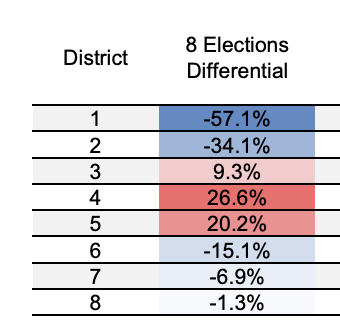
As much as I'd like to hope for a Democratic pickup of this open seat, it isn't happening. The 4th Congressional District is the safest GOP seat of all eight seats in Colorado.

Instead, the race will be a bellwether for the Colorado Republican party, to see how far right towards MAGA populism it has grown, and how much it remains a party of more traditional conservatives. 

06 July 2023

Good Government Colorado's State and Local Government Reforms

Alcohol Regulation

* It is absurd to regulate beer, wine, and liquor differently.

Construction Regulation

* The construction trades should be regulated at the state level rather than at the local level as they are now. This may have made sense when construction markets were local. Colorado currently has 273 active municipalities (comprising 198 towns, 73 cities, two consolidated city and county governments), and 62 unconsolidated counties, for a total of 335 different bodies licensing the construction trades. Most of these professionals should not exclude people with felony records unrelated to the construction trades.

* Each of these jurisdictions also has its own building code, based upon privately promulgated building codes that aren't even available for free which is unconscionable for binding laws. There should be a single state building code, that is a matter of public record. If localities want to deviate from it, they should have to seek permission from a state body to do so, and the local modifications ought to be a matter of public record on a state website. Aesthetic building code requirements should be tightly limited.

TABOR Elections And Taxes

* Elections over retaining growth in revenue not derived from new taxes should be abolished.

* Excess TABOR revenue should, by default, placed in a rainy day fund, rather than refunded. A supermajority would be required to touch a rainy day fund in excess of declines in revenue from the previous peak revenue year.

* The state 2.9% sales tax would be repealed and replaced with a revenue neutral income tax increase. Only local sales taxes would remain. But, all local sales taxes would be collected by the state and would be required to use the uniform state definition of taxable sales.

* School districts should be funded by state taxes and not by property taxes. As a result, there would no longer be elections for local property tax levies and bond issues for school districts.

* Higher educational institutions would have tax funding solely by state taxes, not local taxes.

Election Administration

* Elections should be administered by non-partisan civil servants, under the supervision of a partisan balanced board or boards. This task should be severed from the partisan elected offices of state secretary of state and county clerk, and from the non-partisan elected office of city clerk.

Elected Offices

* City clerks should not be elected.

* Statutory cities and towns have a city manager with the mayor elected by the city or town council as its chair, and do not have a have separately elected mayor or auditor.  Charter cities can do what they want.

* County coroners should not be elected and the institution should be replaced with a state medical examiner's office.

* County surveyors should not be elected.

* County treasurers should not be elected.

* County assessors should not be elected.

* County clerks should not be elected.

* County sheriff should be a non-partisan office. It is desirable not to give the local administration of criminal justice system a partisan tinge. This is less alienating between elections to the losing party members. Counties are often often politically homogeneous areas where intra-party competition is really more important the partisan competition anyway. This gives minority party members in a county more say in the outcome.

* County commissioner should be a non-partisan office. It handles local government issues like municipalities do. Counties are often politically homogeneous areas where intra-party competition is really more important the partisan competition anyway. This gives minority party members in a county more say in the outcome. In large counties there would be five seats elected from single member districts, all at once, for four year terms. In small counties, county commissioners would serve for six year terms with one elected every two years.

* District attorney should be a non-partisan office. It is desirable not to give the local administration of criminal justice system a partisan tinge. This is less alienating between elections to the losing party members.

* The state treasurer should not be elected.

* The state secretary of state should not be elected.

* The state attorney-general should not be elected.

* Uncontested elected offices should not appear on the ballot unless there is a declared write-in candidate before ballots are printed.

* School boards should be elected by the parents, except possibly by the students instead, in the case of high school students.

* The state school board should be appointed.

* The University of Colorado Board of Regent should not be elected by the general public. It would be better for these positions to be elected by alumni. The state still controls the purse strings, but this would strengthen academic freedom and ease the burden on the voters.

* Any other currently elected higher education district boards should be elected by alumni or appointed.

State And Local Judges And Courts

* Judges should be required to be lawyers with at least five years of experience. The four non-lawyer rural county court judges currently in office in Colorado should be grandfathered for their current terms, but not retained.

* The county courts should be consolidated to have a single limited jurisdiction division of the district court in each judicial district called the county court division of the district court, with a court house in each county and should be staffed with full time judges only.

* Judicial retention for judges not on the state supreme court should be decided by a vote of the judges at the next higher level, not the voters. So, county court division judicial retention should be decided by district court judges, district court judicial retention should be decided by court of appeals judges, and court of appeals judicial retention should be decided by state supreme court justices. These are the people best qualified to evaluate the performance of lower court judges.

* State supreme court justices should be limited to a single fourteen-year term of office, with one new justice appointed in the current process every two years in the absence of vacancies. 

* Vacancies in the state supreme court should be filled for the remainder of the term of the vacating justice (without prejudice to a further appointed term) by a court of appeals judge elected from the sitting judges of the court of appeals.

* The judicial discipline process should be more transparent.

* Court facilities and budgets, district attorneys offices, and public defender's offices should be financed at the state level, not the county level, to keep the judicial branch and district attorney's office independent from municipal and county government.

* Municipal courts should be abolished, with the ordinance violations previously in their jurisdiction prosecuted by city attorneys in the county court division of the district court before state appointed judges.

* County court appeals should be to a single judge of the court of appeals, not to a single district court judge otherwise on the same basis as under current law. There would be no municipal court appeals because there would no longer be any municipal courts.

* Colorado Appellate Rule 21 petitions (i.e. discretionary requests for extraordinary relief granted only when no other adequate remedy, including relief available by appeal or under C.R.C.P. 106, including petitions in the nature of mandamus, certiorari, habeas corpus, quo warranto, injunction, prohibition and other forms of writs cognizable under the common law) should be made to a designated panel of seven judges of the court of appeals (rotated annually) rather than to the state supreme court.

* The number of judges on the court of appeals should be doubled to allow it to process appeals more swiftly.

* Review of attorney regulation disciplinary hearings should be made to the court of appeals rather than to the state supreme court.

Remaining Elections

Candidate Elections

* There would be one election every November on election day, and a primary election (in parties and districts with contested races) in every even numbered year for state and federal offices. A partisan caucus would precede each primary election every even numbered year. Ballot issues would be restricted to November elections except for local recall elections and emergency local tax and bond measures.

* There would be one non-partisan local election in November in each odd numbered year. 

* In the year following the Governor's election there would be statutory municipal elections (with all municipal offices elected at once), and district attorney elections (and county commissioner elections in small counties) for a total of one or two offices plus city council races for each voter in statutory cities and towns. 

* In the odd numbered year two years after that there would be elections for county commissioner, sheriff and special district elections in the other (usually two or three races per voter). 

* Charter cities do what they want, but limited to odd numbered year elections except for recalls and for emergency ballot issues for referred tax matters or legally required referred charter amendments held when needed.

* There would be partisan caucuses and primaries (with unaffiliated voters allowed to participate in a primary of their choice, but not caucuses) in each even numbered year followed by a partisan general elections in November for state house, state senate, U.S. House, U.S. Senate, the Governor-Lieutenant Governor, and the President. The Governor-Lieutenant Governor election would be two years after the Presidential election. No election would have less than three or more than five offices to vote upon at a time, unless there was a U.S. Senate vacancy to be filled at the time, in which case there would be four to six offices. 

* Write-in candidates would not be allowed in primary elections and uncontested primary elections would not appear on the ballot. 

* All elected offices except the U.S. House and state house with two year terms, and the U.S. Senate with six year terms, would be for four year terms.

* All single member elected office races would require a majority to be elected, with a runoff of the top two candidates otherwise.

* City councils would fill municipal office vacancies. County commissions would fill county commissioner and sheriff vacancies. Special district boards would fill vacancies on their boards. State legislature vacancies would be filled by partisan vacancy committees. Governor vacancies would be filled by the Lieutenant Governor. Lieutenant Governor vacancies would be filled by the Governor (unilaterally). The law would provide for Governor's succession in other cases. The Governor would fill U.S. Senate vacancies until the next even numbered general election at which time a vacancy election for any remaining part of the vacant seat's term would be held.  U.S. House vacancies would be filled in special elections as under current law.

* Recall elections of particular local elected officials (city elected officials, county commissioners, sheriff, special district, district attorney), held promptly in the time frames allowed by law.  Vacancies created by recall elections would be filled like any other vacancy. Do not allow the recall of state legislators or the Governor, although the state legislature could impeach the Governor in a mirror of the federal process.

Ballot Issues

* Referred municipal or special district tax increase or bond issue ballot issues (during municipal or special district elections as the case may be, unless an emergency is declared by a supermajority of the city council or board, two-thirds unless there are just three members in which case it must be unanimous).

* Referred county tax increase or bond issue ballot issues (during county elections only, unless an emergency is declared by a supermajority of the county commission - unanimous if there are three members, four out of five if there are five members).

* Referred local charter amendment ballot issues (during municipal or special district elections). Legally required charter amendments would be adopted by the city council or special district board by majority vote.

* Local charter or legislation citizen initiatives (during municipal elections only for municipal measures, and during county elections only for county measures).

* State ballot tax increase ballot issues (referred only, during even numbered year elections in November only).

* State ballot issues on the state constitution or state legislation referred by the state legislature (during even numbered year elections in November only).

* Citizen initiated state constitution and legislative ballot issues (not impacting taxes, during even numbered year elections in November only).

* Newly passed state legislation would not be subject to referendums.
31 December 2022

Non-Lawyer Judges Are A Bad Idea

I usually agree with Jared Polis, the Governor of Colorado, but his decision to appoint a non-lawyer to a county court post this year, while legal, was a bad one that denies real justice to hundreds or thousands of litigants a year. If he hadn't appointed this non-lawyer judge, Colorado would have been down to three and could have slowly reduced the number to zero as incumbent judges retired.

County court judges in Colorado don’t need law degrees to sit on the bench in most parts of the state.

They don’t need college degrees, either. People with high school diplomas or GEDs and no legal training can become county court judges in 45 of the state’s 64 counties, presiding over lower-level criminal and civil cases with all the authority of any other county court judge.

Proponents of these so-called “lay judges” say the lower educational qualifications are key to filling judgeships in Colorado’s rural and remote counties where the positions might otherwise go unfilled because of a lack of local attorneys interested in the job. Critics suggest non-attorney judges aren’t qualified to interpret the law and mete out justice, even in low-level legal matters.

There are only four lay judges working in Colorado right now, a Denver Post review of the state judiciary found. The newest, Michael Halpin, was appointed by Gov. Jared Polis in October as a county court judge in Custer County.

Polis chose Halpin, a resident of Custer County and former sheriff’s deputy with a high school education, over an attorney candidate who lives in Loveland.

The other lay judges currently on the bench are: Kristei Jones, a rancher and veteran in Yuma County with a high school education, Truston Lee Fisher, a college-educated veteran whose been on the bench in Lincoln County since 1987, and Richard Medina, a college-educated former building inspector, in Crowley County.

The state’s four lay judges either declined interview requests or could not be reached.

Medina is the third consecutive lay judge to hold the role in Crowley County, Chief Judge Mark MacDonnell said, and being able to fill that job with non-attorneys has been critical over the years.

“For those three instances, there were not attorneys (who applied), so there would not have been a Crowley judge had there not been a lay judge willing to take it,” MacDonnell said. 
. . .  
Lay judges are nominated, appointed, evaluated and paid in the same way as judges with law degrees. The Judicial Performance Commission’s reviews of lay judges have been mixed in recent years. The evaluators in 2020 suggested Medina needed to improve his legal knowledge and consistency in following procedures.

“The Commission understands the challenges that a lay judge faces,” evaluators wrote. “As Judge Medina is not an attorney, he faces greater challenges than other judges. However, this does not excuse Judge Medina from being an ineffective judge.”

Another lay judge, Fisher, received a score that was higher than the average for all county court judges, both attorneys and not, the evaluations show.
Across the country, 27 states allow lay judges to work in some capacity, said Bill Raftery, senior analyst at the National Center for State Courts. . . . familiarity with the community has also become also a critique of lay judges, Raftery said, with critics suggesting the judges struggle to be impartial because of their close community ties and lack of legal training.

Colorado’s current lay judges include former law enforcement and prison officers, a former town mayor and a former school board member. McCallum said lay judges use their non-traditional backgrounds to their advantage when presiding over cases.

From the Denver Post

06 December 2022

Midterm Election Voter Turnout

Voter turnout in the U.S. midterm elections in 2022 as a percentage of eligible voters (of the 50 states and the District of Columbia) was as follows:

#1 Maine 61.5%
#2 Oregon 61.4%
#3 Minnesota 61.0%
#4 Wisconsin 60.1%
#5 Colorado 58.5%

. . .

#47 Oklahoma 40.1%
#48 Alabama 37.7%
#49 Mississippi 37.1%
#50 West Virginia 35.7%
#51 Tennessee 31.6% 
 
National average: 46.8%


Turnout was slightly lower nationwide than the record modern midterm election turnout of 2018.

About 88% of people who are eligible to vote are active registered voters in Colorado. In Colorado, about 5.8% of adults (i.e. people who are at least 18 years old) are ineligible to vote because they are not U.S. citizens and about 15,000 adults (0.3%) are ineligible to vote because they are currently in prison.

The adult population of Colorado in 2022 was 4,631,586, of whom 4,346,493 were eligible to vote.

Nationally 7.3% of the adult population is not eligible to vote, because they were not citizens (in most cases), or as collateral consequences of a criminal conviction 1.2% (or both). About 7.5% of people in the U.S. are not U.S. citizens, but some of those non-citizens are not adults or are also disqualified from voting due to criminal convictions in the state where they live. Disqualification from voting as a collateral consequence of a criminal conviction differs materially from state to state.

02 December 2022

The 2022 Midterm Election Turnout And Colorado State House Results Analyzed

Turnout

Turnout in the 2022 midterm elections in Colorado this year was 2,540,666 voters who voted ballots (not necessarily in every race), out of 3,833,468 active registered voters in the state, a 66.28% voter turnout rate. Turnout in the 2020 Presidential election in Colorado was 86.54% by the same measure.

Interpolating slightly from the state demographer's office's estimate, the voting age population of Colorado was 4,167,610 in 2019, and this probably increased by about 1.5% between 2019 and 2022. So, the voting aged population of Colorado at the time of the midterm election was about 4.23 million, so voter turnout was about 60.1% of the voting aged population in the midterm elections. Thus, about 90.6% of people who are part of the voting aged population in Colorado are registered to vote which, given disqualifications from voting for felons who are incarcerated and non-U.S. citizens, is exceptional. 

The turnout rate in Colorado was also well above the historical U.S. norm for midterm elections, almost double the long term national average turnout as a percentage of the voting age population. Voter turnout in Colorado has consistently been among the two or three highest of U.S. states in recent years, and the 2022 midterms were no exception to that rule.

The Colorado State House Race

There are sixty five seats in the Colorado state house, all of which are elected every two years. 

One of the seats won by Democrats (HD-7 in Denver) and three of the seats won by Republicans (HD-20 in suburban Colorado Springs, HD-51 in exurban Fort Collins, and HD-63 in the rural Front Range east of Fort Collins) were uncontested. The other 61 seats had at least a Democratic party candidate and a Republican party candidate. There was also a Libertarian candidate in 20 of those 61 seats, and in one of the 20 seats where there was a Libertarian candidate (HD-1 in Denver) there was also a fourth unaffiliated candidate in the race.

Democrats won 46 seats and Republicans won 19 seats in the Colorado state house in 2022, which is two more seats than the Democrats needed to have a two-thirds supermajority. Going into the election Democrats had held 41 house seats and Republicans held 24 for a net gain of five seats.

The map below from Ballotpedia is from before the election in what appear to be the newly drawn districts, but it does illustrate the geography of partisan politics in the State of Colorado.

In the Colorado state senate race, the results left Democrats with 23 seats to 12 Republican seats, a net gain of three seats and a single seat short of a two-thirds majority in that house of the Colorado General Assembly. Going into the election in which only half the seats were before the voters, Democrats had 20 seats and the Republicans had 15. That race is harder to analyze, however, because only half of the seats in the chamber were in play in this election.

Democrats also control all statewide elective offices in the state. 

The justices on the state supreme court are officially non-partisan and nominated by a blue ribbon commission in groups of three prospective candidates from which the Governor can choose. But, a majority of the current state supreme court justices (and state judges in Colorado more generally) were appointed by Democratic Governors.

Close Races

Few of the races were close, and the Republicans didn't win a single one of the six genuinely competitive races this year. Neither party won any of the other side's safe seats. If there is an overall theme is that the Democrats won in swing voting suburbs this year.

Each of the sixteen Republicans who were elected who won a contested House District race won by at least 13.6 percentage points, and the median margin of victory for a winning Republican in a contested race was 24.29 percentage points.

The Democratic Party's margin of victory in the median race in the state house, which it needed to win to secure its majority control of that house was 11.22 percentage points in HD-62 in eastern Pueblo and the San Luis Valley. 

Democrats won all 18 races where the margin of victory was less than the closest Republican win, all 11 races where the margin of victory was less than 8 percentage points (the next closest race had an 11.97 percentage point margin of victory), and all 6 races where the margin of victory for the winner was less than 5 percentage points (in which the Democratic margin of victory ranged from 0.9 percentage points to 3.37 percentage points).

The closest race was the 0.9 percentage point margin of victory in the two candidate HD-43 race in the Highlands Ranch suburb of Denver. The other two close house races that Democrats won which didn't involve potential third-party spoiler effects were HD-19, in suburban Colorado Springs, with a 3.37 percentage point margin of victory, and HD-61, which includes many mountain resort towns including Aspen and the surrounding area, with a 2.82 percentage point margin of victory.

Democrats secured an outright majority of the votes cast in 43 of the 46 house races that they won. They won three races (HD-16, HD-25, and HD-50) with pluralities that were smaller than the third-party Libertarian vote. Colorado does not have runoff elections at the state level if the plurality winner fails to receive a majority of the votes cast in the first round.

In HD-16, in suburban Colorado Springs, the Democratic candidate's margin of victory over the Republican was 2.17 percentage points and the Libertarian candidate received 2.66% of the vote. It is possible, although unlikely, that the Libertarian candidate was a spoiler in this race whose candidacy caused the Republican candidate's defeat.

In HD-25, in the mountainous portions of the Jefferson County western suburbs of Denver, the Democratic candidate's margin of victory over the Republican was 1.39 percentage points and the Libertarian candidate received 2.05% of the vote. It is plausible that the Libertarian candidate may have been a spoiler in this race whose candidacy caused the Republican candidate's defeat.

In HD-50, in Greeley, the Democratic candidate's margin of victory over the Republican was 1.89 percentage points and the Libertarian candidate received 3.51% of the vote. It is very possible that the Libertarian candidate may have been a spoiler in this race whose candidacy caused the Republican candidate's defeat.

The other 17 Libertarian candidates in house races and the 1 unaffiliated candidate in a house race, were irrelevant to the ultimate outcome of the 17 house races in which the other 18 third-party candidates contended. Likewise, third-party candidates were not potential spoilers in any of the statewide partisan races this year, all of which Democrats won with an outright majority of the votes cast.

The combined third-party candidate performance in HD-1 in Denver which had two third-party candidates was 4.53%; the Democrat won that seat by a 32.29 percentage point margin of victory. The best performance by a Libertarian candidate alone in a house was this year was in HD-15 in suburban Colorado Springs, where the Libertarian won 4.14% of the vote; the Republican won that seat by a 17.66 percentage point margin of victory.

The HD-50 race was also the marginal race that gave Democrats a two-thirds majority in the house. They could have secured a two-thirds supermajority in the house even if the Democrats had lost HD-43 which they won by 0.9 percentage points and HD-25, which they won by 1.39 percentage points. 

The Popular Vote Compared

The popular vote (including votes cast for candidates in the four uncontested races) was 53.32% for Democratic house candidates, 45.84% for Republican House candidates, 0.82% for Libertarian candidates, and 0.02% for a single unaffiliated candidate. 

If the 65 seats in the Colorado house had been allocated on that basis, as the would have been in a proportional representation list system, for example, the Democrats would have won 35 seats, the Republicans would have won 29 seats, and one Libertarian candidate would have won a seat.

Of course, this is distorted by the fact that turnout as measured by votes cast for house candidates by party omits Republican and Libertarian voters in the one uncontested house seat won by a Democrat, omits Democratic and Libertarian voters in the three uncontested house seats won by a Republican, and omits Libertarian voters in the 41 contested races that didn't have a Libertarian candidate running. It also doesn't fully account for reduced turnout by Democrats in safe districts given that there were no close partisan statewide office elections in 2022 in Colorado. Still, many statewide ballot measures gave every voters some incentive to vote, and turnout was overall quite high. 

The percentages for the aggregated house vote races aren't far outside the range of the performance of Democrats in statewide partisan races in 2022 in Colorado, although they rival the best performances that the Republicans had in any of the statewide partisan races (in part because there was a smaller third-party vote in the state house races since there were no third-party candidates in 41 of those races).

In the U.S. Senate race, incumbent Democrat Michael Bennet defeated Republican candidate Joe O'Dea by a 55.88% to 41.27% margin, with the Libertarian candidate securing 1.74% of the vote, the next most popular third-party candidate getting 0.66% of the vote, and one more third-party candidate getting 0.45% of the vote.

In the Governor's race, incumbent Democrat Jared Polis defeated Republican candidate Heidi Ganahl by a 58.53% to 39.18% margin, with the Libertarian candidate receiving 1.15%, and the other two third-party candidates receiving 0.86% and 0.27% of the vote respectively.

In the Secretary of State race, incumbent Democrat Jena Griswold defeated Republican Pam Anderson, 55.1% to 42.08% (in a race Griswold was administering by virtue of holding that office), with the Libertarian candidate receiving 1.47%, and the other two third-party candidates receiving 0.71% and 0.18% respectively.

In the State Treasurer's race, incumbent Democrat Dave Young defeated Republican candidate Lang Sias, 53.67% to 43.03%, with the Libertarian candidate receiving 3.30%. The other two statewide parties didn't field candidates for this race.

In the State Attorney General's race, incumbent Phil Weiser defeated Republican candidate John Kellner, 54.74% to 43.04%, with the Libertarian candidate receiving 2.21%. The other two statewide parties didn't field candidates for this race.

In the State Board of Education At Large race, Democrat Kathy Plomer defeated Republican candidate Dan Malloit, 53.43% to 43.04%, with the Libertarian candidate receiving 2.84% and another third-party candidate receiving 0.68% of the vote.

Of course, as I have noted previously, Democrats won five U.S. House seats (CO-1, CO-2, CO-6, CO-7 and CO-8) all of which are in Denver, Boulder, and the suburbs of Denver, of which, CO-8 was a highly competitive seat that they won by only a small margin. Republicans won what should have been three safe Republican seats (CO-3, mostly CO-4 in the rural Front Range, and CO-5 in Colorado Springs), but won CO-3 covering the the mountain towns, Western Colorado, and Southern Colorado which is a heavily Republican district by only 0.16 percentage points (the race is currently undergoing an automatic recount to be completed by December 16, 2022), which was the closest Congressional race in the entire United States (although it didn't make a difference for control of the U.S. House which Republicans secured in the midterms by a thin margin). This race was absurdly close for such a safe seat because Lauren Boebert, the Republican incumbent in the race seeking re-election, was such a deeply flawed candidate.

11 November 2022

Colorado Judicial Retention Elections In 2022

Background

In a pre-election post on judicial retention elections in Colorado, I noted that the "Colorado Gazette reports:
A total of 164 judges were eligible for retention in 2022, but only 140 received evaluations and 135 chose to remain on the ballot. Judges may opt to resign or retire prior to their retention for multiple reasons, including the expectation of a negative performance evaluation.

Thus 24 judges decided not to run again before receiving evaluations from citizen's commissions and another 5 withdrew from the ballot after receiving their evaluations. 

I also noted that the system was adopted in a 1966 amendment to the Colorado State Constitution and remains a great improvement over the system in place before then."

I also predicted that 99.5% of judges facing judicial retention elections this year in Denver would be retained. 

The 2022 Judicial Retention Election Results

[Note that I have rounded down to the nearest full percentage point in all retention percentages in this post as it is easier to scan the Secretary of State's election results tables that way.]

None of them received less than 65% of the vote. Every single judge in Denver facing a retention election was retained.

Statewide 99.24% of the 132 judges facing retention elections in Colorado (that I counted in the election results, I apparently  missed three) were retained, while one county court judge in LaPlata County was not retained. Basically, my prediction, once you account for rounding errors, amounted to a prediction that either no judges or one judge would not be retained and this was correct.

There were eight Colorado Court of Appeals judge facing retention elections. Five of them were women. All of them were retained and none of them received less than a 67% retain vote. 

There were sixty-six district court (i.e. general jurisdiction trial court) judges facing retention elections. Twenty-six of them were women. All of them were retained and none of them received less than a 56% retain vote. 

There were sixty-two county court (i.e. limited jurisdiction trial court) judges facing retention elections. Thirty of them were women.  One was not retained and none of the other county court judges received less than a 60% vote to retain.

The one judge who was not retained (at least so far in the unofficial count) was LaPlata County Court Judge Ann Catherine Woods received a 49% retain vote. None of the other county court judges received less than a 60% retain vote. She resigned immediately, rather than serving out the remainder of her term. According to Colorado Politics at the link above:

In her resignation email to Chief Justice Brian D. Boatright, Woods alluded to her own missteps, as well as inaccurate perceptions of her work within the community.

"It has been a very, very challenging journey for me (some of which has been my own doing, some of which has been misinformation from small town media/word of mouth and lack of support from the 6th judicial district)," Woods wrote. "Also, because the voters have spoken and do not want me representing the community, I would like to step down as soon as possible instead of serving out the remaining term of my appointment."

Woods was one of 135 judges who stood for retention across the state this year. Citizen-led performance commissions found all 135 had met the performance standards used to evaluate judges.

At the same time, Woods was the first judge since 2010 to be non-retained despite receiving a favorable evaluation, according to the Colorado Office of Judicial Performance Evaluation.

The Sixth Judicial District's performance commission found, by 6-3, Woods met performance standards. Its narrative to voters further indicated Woods, a former public defender, had improved during her time on the bench.

However, Woods' ratings from attorneys and non-attorneys were lower than for other county court judges. Her retention also received an unusual degree of interest — 90 responses — compared to county court judges in jurisdictions with populations similar to La Plata County.

"The public still may be partially anchored on the view that Judge Woods is a pro-defense judge," the performance commission wrote.

In an email to The Durango Herald on Wednesday, Woods believed voters were "fed cherry-picked facts about a few sensationalized cases," and suggested the newspaper was responsible for disseminating misinformation.

Woods was a 2020 appointee of Gov. Jared Polis. The Herald previously reported that she emphasized rehabilitation over punishment in her sentencing. At the same time, the chief judge of the judicial district, in November 2021, effectively precluded her from setting bail for criminal defendants, after reported concerns about Woods granting bail at low amounts.

Notably, the judges who received low retention election support were mostly women. Of the 132 judges facing retention elections of whom 61 were women and 71 were men. 

Nine of the 132 judges facing retention elections received less than 61% support. Seven of those nine judges were women (11% of female judges facing retention elections), including the only judge who was not retained and all four judges who received more than 56% but less than 59% support. 

Two female trial judges (a County Court judge in Arapahoe County and a District Court judge in Weld County) and two male trial judges (both District Court judges in Pueblo) received more than 59% support but less than 62% support.

The other 123 judges (89% of female judges and 97% of male judges) received at least 63% support.

The county could judge with the least retention support who was retained (60%) was Kelly LeFave in Arapahoe County. The other sixty county court judges who were retained had at least 63% support.

At the District Court level, all sixty-six judges were retained and seven of them had retention support of 60% or less (rounding down). All other District Court judges had at least 64% support.

Five of these seven judges were women: District Judge Marla Prudek in the 4th Judicial District (El Paso and Teller Counties) received 58% support. District Court Judge Stephanie M.G. Gagliano in the 13th Judicial District (Kit Carson, Logan, Morgan, Philips, Sedgwick, Washington and Yuma counties)  received 56% support. District Court Judge Rayna Gokli McIntyre in the 17th Judicial District (Adams and Broomfield County) received 57% support. District Court Judge Kimberly B. Shutt received 56% support in the 19th Judicial District (Weld County). District Court Meghan Patrice Saleebay in the 19th Judicial District received 61% support.   

Two District Court judges receiving comparative low levels of retention support were men, both in the 10th Judicial District (Pueblo County). District Judge Amiel J. Markenson received 59% support. District Judge Thomas Flesher received 60% support.

Colorado State Ballot Issue Results In 2022

There were 11 statewide ballot measures in Colorado in 2022. Seven passed, three failed, and one is leaning towards passing, but too close to call.

How does this compare to my endorsements? (Also note, that these were not predictions, just my opinion on what was and was not good policy).

Voters agreed with five of my endorsements, disagreed with five of my endorsements, and one is still too close to call but leaning toward concurring with my endorsement.

I endorsed passage of nine measures, five of which passed (split judicial district staffing, school lunches for all, impact tables for income tax measures, decriminalize magic mushrooms, and create an affordable housing fund), one of which is too close to call (selling wine in grocery stores), and three of which failed (charitable gambling regulation easing, allowing larger liquor store chains, and delivery of alcohol).

I strong opposed one (lowering state incomes taxes), and weakly opposed another (property tax breaks for Gold Star families), both of which passed. 

Obviously, I'm pleased by the five ballot issue results that went my way, and I am hoping for the one still in the balance (wine in grocery stores) to pass.

What Matters, What Doesn't?

Not all of the ballot measure results were equally important.

The worse result, by far, in significance was the reduction of the state income tax from 4.55% to 4.40% which will significantly squeeze the state budget with consequences that are more severe than many voters realized. But it does send a message that Colorado voters feel squeezed.

Amendment FF for school lunches for all, and Proposition 123 creating an affordable housing fund, both of which I supported and both of which passed, were medium sized wins, funding desirable modest sized programs in desirable ways that moderately strength the social safety net.

Amendment 122 which decriminalized magic mushrooms at the state level (they are still illegal at the federal level and can't be prescribed as medicines despite proven preliminary positive effects as fact acting anti-depressants), which I endorsed and which passed, was likewise a medium sized win in the ongoing effort to roll back the war on drugs and advance better mental health treatment. What did it do? The Denver Post explains:

The measure legalizes psilocybin and psilocin, two compounds found in “magic mushrooms,” for use in therapeutic settings and paves the way for the establishment of “healing centers” where adults 21 years old and up can use the substances under the supervision of licensed professionals.

Additionally, Proposition 122 decriminalizes the personal growing, use and sharing of psilocybin and psilocin, as well as ibogaine, mescaline and dimethyltryptamine, or DMT, for adults.

Colorado follows Oregon, which legalized psilocybin in 2020

The other two measures that I supported that passed were uncontroversial housekeeping measures (Amendment D re allowing judicial reassignments in a split district and Proposition GG re the information going out in ballot packages on future income tax measures). 

The defeat of relaxed charitable gambling rules (Amendment F), the defeat of a measure to allow larger liquor store chains (Proposition 124), and the passage of property tax breaks for Gold Star families (Amendment E), while they didn't go my way, aren't really that big of a deal in the larger picture. Amendments E and F had very tiny overall impacts. Proposition 124 was basically a fight between small liquor stores and big ones that doesn't affect the average person all that much.

Wine in grocery stores will be nice if it passes, but since almost every grocery store that I shop at already had wine or has a liquor store virtually next door to it, this isn't a huge deal either.

The defeat of liberalizing open container alcohol delivery (Proposition 126) is a bigger bummer in terms of long term convenience, access for the disabled, and reducing drunken driving, but again not that big of a deal. Restaurants and bars can still provide this service for two more years and the state legislature can act without voter approval in that time frame if it wants to do so. 

The narrow fail of Proposition 126 is somewhat of a surprise, however, as I had perceived the legalization of open container alcohol delivery during the pandemic as very popular. 

Realistically, all three of the alcohol measures struggled and were close to 50-50 due to a combination of concerns of left leaning vice liberalizing Colorado voters over protecting small businesses against big businesses together with concerns of conservatives with prohibitionist leanings who distrust anything that might increase access to alcohol.

The Results

Amendment D (staffing of split judicial district) 

My endorsement: Yes. Results: 67% yes (passes).

Amendment E (property tax break for survivors of certain vets). 

My endorsement: Weak no. Results: 88% yes (passes).

Amendment F (less regulation of charitable gambling)

My endorsement: Yes. Results: 60% no (fails)

Proposition FF (school lunches for all)

My endorsement: Yes. Result: 55% yes (passes).

Proposition GG (require impact table for income tax changes)

My endorsement: Yes. Result: 71% yes (passes).

Proposition 121 (cut income tax rate from 4.55% to 4.40%)

My endorsement: No. Result: 66% yes (passes).

Proposition 122 (decriminalize magic mushrooms)

My endorsement: Yes. Result: 52% yes (passes)

Proposition 123 (affordable housing fund)

My endorsement: Yes. Result: 51% yes (passes).

Proposition 124 (allow larger liquor store chains)

My endorsement: Yes. Result: 62% no (fails)

Proposition 125 (allow wine sales in grocery stores)

My endorsement: Yes. Result: 50.09% yes (pass if it holds, too close to call)

Leads by 4,016 votes out of 2,226,444 votes reported statewide to date.

Proposition 126 (non-package liquor delivery via non-bars)

My endorsement: Yes. Results: 52% no (fails)