04 March 2016

We Haven't Won The War On Cancer But We Are Making Progress

A drop of 23% in cancer death rates in twenty-five years may be painfully slow and incremental, but all the money and time spent trying to combat cancer is slowly but surely paying off.  And, even incremental progress is reducing one of the leading causes of death is a big deal.
The cancer death rate has dropped by 23 percent since 1991, with some even larger gains in types of cancer that used to be extremely lethal.
Via Vox.

The article goes on to note that the alternatives of cure or death have been replaced by a large number of people who have cancer that is controlled who can leave reasonably normal lives for many years while managing it (the experience of both my late father and of a colleague who recently died of cancer). The story of HIV/AIDS is similar.

One new approach to cancer therapies seeks to use DNA testing of the cancer cells to develop customized vaccines to kill them.

Better Textbooks Have Measurable Impact On Student Achievement

If all schools could be persuaded to use textbooks in the top 20% of quality as measured by educational outcomes, the average student would perform at the level of someone currently 3.6 percentiles better than they do now.

It is much easier to quickly transform the textbooks students use than a significant share of the teachers who use them.  And, while the gains may seem modest, they are impressive in an area where the dominant predictor of outcomes are student socio-economics, while teaching process impacts (e.g. percentage of certified teachers, teacher pay, student-teacher ratios) are rarely measurable except at the very top and bottom extremes.  Also, generally, better textbooks are not more expensive than inferior textbooks.

03 March 2016

Beware

Many of the quotes that you find on the Internet are misattributed or just plain fake.
Abraham Lincoln, 1862

A Platonic Nerd Love Story

One day in the spring of 2013, for instance, as he sat in the Queen’s Gallery at Buckingham Palace awaiting the annual Order of Merit luncheon with Elizabeth II, Sir Michael made a match for his lifelong friend and colleague, Sir Roger Penrose, the great mathematical physicist.

Penrose had been trying to develop his “twistor” theory, a path toward quantum gravity that’s been in the works for nearly 50 years. “I had a way of doing it which meant going out to infinity,” Penrose said, “and trying to solve a problem out there, and then coming back again.” He thought there must be a simpler way. And right then and there Atiyah put his finger on it, suggesting Penrose make use of a type of “noncommutative algebra.”

“I thought, ‘Oh, my God,’” Penrose said. “Because I knew there was this noncommutative algebra which had been sitting there all this time in twistor theory. But I hadn’t thought of using it in this particular way. Some people might have just said, ‘That won’t work.’ But Michael could immediately see that there was a way in which you could make it work, and exactly the right thing to do.” Given the venue where Atiyah made the suggestion, Penrose dubbed his improved idea “palatial twistor theory.”
Nerds are capable of feeling that rapture that others find in romance. The triggers are just a little different (from Quanta magazine via Not Even Wrong).

Murder and Suicide Rare In Islamic Countries

The current study assessed the relationship between national religious affiliation and lethal violence by simultaneously examining homicide and suicide rates. The information on homicide and suicide rates for 124 countries came from the World Health Organization (WHO). Regression results suggested no significant difference in lethal violence between predominantly Catholic and Protestant countries, although Islamic countries revealed significantly lower homicide, suicide, and overall lethal violence rates than non-Islamic countries. Countries with a high level of religious heterogeneity are subject to an increased suicide rate.
Don Soo Chon, "National Religious Affiliation and Integrated Model of Homicide and Suicide" (2016).

02 March 2016

U.S. News Says Denver Is Number One The Best Place To Live

Denver came in first place on the U.S. News and World Report list of best places to live for 2016 form a list of 100 U.S. cities. Of course, they are right, although honestly, the methodology used for these rankings if often dubious.

Record High Colorado Democratic Turnout

As of February 2016, there were 918,259 Democrats actively registered to vote in Colorado.  Of them, 122,000 turned out to participate in the Presidential caucus in Colorado yesterday, for a record high turnout (for a caucus) of 13.3%.

Primary elections almost always have higher turnout because it is much easier to participate (often only a mail in ballot is required).  But, the fact that so many Democrats were willing to take something like two to four hours out of their day to participate, depending upon their precinct, suggests that enthusiasm is high this year for Democrats in Colorado.

Ben Carson Out of GOP Presidential Race

Ben Carson has dropped out of the race for the GOP Presidential nomination that he hasn't had any shot of winning since at least the South Carolina primary.  I guess the donors finally stopped sending him checks.

This leaves Trump, Cruz, Rubio and Kaisch to split the single digit percentage of voters who supported Carson.

How Carson voters split, however, is anyone's guess.  He was relatively moderate in style, if not particularly so in substance, which would tend to favor Kaisch and Rubio.

His evangelical Christian credentials would seem to point voters towards Cruz. But, would supporters of a candidate whose rhetoric had some inkling of compassion really relate to someone know for being rigid and intolerant?

Carson's status as someone with no prior political experience would tend to point voters towards Trump.  But, are voters who were willing to support a black man for the Republican Presidential nomination really going to flock to a candidate who was slow to disavow a white supremacist leader and has cornered the racist demographic within the Republican party?

Kaisch, meanwhile, seems determined to hold on until the Republican primary in Ohio in two week on March 15, 2016, and may even have a chance of winning that contest where a February 2016 poll with a 3.6 percentage point margin of error found that likely Republican voters in Ohio were split:

Trump 31%
Kaisch 26%
Cruz 21%
Rubio 13%
Carson 5%

But, the fact that Kaisch has yet to finish better than a strong second place anywhere, and is struggling to be able to manage that feat in his home state, insures that there is really no conceivable way that Kaisch could win the Republican nomination.  If Kaisch dropped out too, Rubio might have a prayer of besting Trump in Ohio, but we'll probably never know, since that scenario is unlikely to unfold.

After Super Tuesday

The Democrats

Even though Bernie Sanders does much better against all of the leading Republican candidates in head to head polling match ups, and in particularly, is stronger than Clinton in many of the key swing states in the 2016 election, it is almost inevitable that Clinton will win the 2016 Presidential nomination.

He won four states on Super Tuesday, bringing his total to five including New Hampshire.

Clinton is dominating the Southern primaries and performing credibly in states like Massachusetts, where she narrowly defeated Sanders by winning the Boston metropolitan area while losing in the rest of the state.  Critically, she is winning shares of the African-American primary vote that equal or exceed that of Barack Obama and African-Americans are 25% of Democratic primary voters nationally and a far larger share of Democratic primary voters in the South.  She also has the backing of the overwhelming majority of the super delegates.

Colorado went 60-40 for Sanders whom I backed last night as I chaired the Precinct 223 caucus with 76 Democrats in attendance, about ten times as many as in a typical year without a contested Democratic party primary contest. (There are 755 active voters in this Precinct of all parties combined and in House District 2 as a whole of which Precinct 226 is a part, 46.4% of active registered voters are Democrats, so there are probably about 350 active registered Democrats in the precinct implying a turnout of about 21.7% which is better than the 13.3% that Democrats averaged statewide.) If I may brag, our caucus finished well before most of our peers, despite a larger turnout than most.  Our four Presidential race delegates were split evenly, because the Sanders edge was not quite large enough to translate into a 3-1 edge.

We also took a straw poll in the DA race in which Beth McCann took 3 of our delegates, while 1 was pledge to "uncommitted".

The Republicans

Cruz has now won Iowa, Texas, Oklahoma, and Alaska.  Rubio has won Minnesota.  Kaisch has made a few strong second place finishes.  I can't think of any state in which Carson has polled better than fourth place.

A straw poll held that the Republican caucus in Colorado, with no binding effect, suggests that Cruz would have won and that Trump would have placed third, if Colorado had held a caucus.  So the Republican establishment really spited itself by not doing so.  Then again, with higher turnout from less engaged Republicans, Trump might have done better than he did in a straw poll at an ill attended Republican caucus.

Trump has won all of the other state and has come in second place in every state that Cruz has won (Trump came in third in Minnesota). Trump is polling twenty points ahead of Rubio in Rubio's home state of Florida.  Trump hasn't broken 50% in any Republican primary yet, that I can recall, but the anti-Trump vote is divided.

The vain hope that the Republican establishment could rally around Rubio now looks like a pipe dream.  It had already been clear that Kaisch and Carson were spoilers in this race.  But, realistically, it now seems that the only shot that the Republicans have at nominating someone other than Trump is for Rubio, Kaisch and Carson to drop out immediately and throw their support behind Cruz.

Even that strategy is hardly a sure thing.  There are many states where Cruz isn't popular at all and would probably not pick up the votes of Republicans supporting other candidates.

A third of the states have already voted, and a flurry of races this weekend and Tuesday will bring that to almost half in less than a week, and a great many more will vote in the week after that.  There is very little time left to dramatically change the trend lines in the Republican nomination contest.

In any case, since none of the five GOP candidates show any sign of dropping out, Trump is almost surely going to be the Republican nominee for President, leaving us with a Clinton v. Trump race that current polling has Clinton winning by a nose.

This is a pretty thin thread for the nation's future to hang upon.  The Denver Post's editorial board nails it:
[N]ot a week goes by when Trump doesn't demonstrate he is unfit to be president because of his character, temperament and lack of knowledge — never mind his often lurid, simplistic policy positions.
Right now, it looks like the only way our nation can avoid having someone so unfit serve as our President is for Hillary Clinton to defeat Trump in the general election in November.

Fortunately, Sanders supporters are almost unanimous in their willingness to back Clinton in the general election, while many Republicans, rightfully, have qualms about supporting Trump if he wins their nomination.  We can only hope that independent voters won't be duped and throw our nation over the precipice.

01 March 2016

Another Day, Another School Shooting

This time, a fourteen year old shot four other kids in a school cafeteria, although fortunately none died. The Middletown school where it took place is just down the road from where I grew up in Butler County, Ohio.

As is almost universally true when the perpetrator doesn't die in the act, the perpetrator was apprehended promptly and will almost surely spend a long time incarcerated.  Because the perpetrator was a minor and because no one was killed, he won't face the death penalty or be sentenced to life in prison without possibility of parole.  But, there is still almost no doubt that he will be incarcerated for a long time.

Also close to my ancestral home, an African-American pastor was shot and killed by his brother while preaching last Sunday in Dayton, Ohio.

29 February 2016

The Poetry of Trump

Trump has apparently given rise to his own special form of poetry, the Twitter insult haiku.

In Emergencies, People Trust Robots

In emergency situations, psychology experiments have established that people trust robots even when there are signs that this trust isn't warranted.

Always Human - A Quirky Comic For A Quirky Day

The heartwarming girl meets girl science fiction romance webcomic, Always Human, that also has something to say about transhumanism is just the thing for a quirky day like leap day.

26 February 2016

The Weak Spot In Civil Litigation

Above the Law has a nice post on what the American civil litigation system handles poorly, which is middle sized disputes, although in Colorado, the real bottom end is more like $15,000 (the jurisdictional limit of county court civil cases), rather than $50,000:
Our system handles both very small and very high value disputes fairly well. However, it does an atrocious job of handling disputes in the middle. . . .
If the dry cleaner messes up your clothes (and you can’t otherwise work it out), if FedEx screws up the package (and you can’t otherwise work it out), or if your ex-roommate won’t return the $400 security deposit you gave him (and you can’t otherwise work it out), small-claims court provides fast and low cost justice.

You can get real justice or something close to it at the other end of the money value spectrum. At our firm we handle many multi-jurisdictional, complex commercial matters where the result in the case can make a difference in the millions, or tens of millions, or even more, or where the result determines whether or how someone does business. For such matters, it makes perfect sense to spend a great deal of money on lawyers . . . since the legal fees likely will pale in comparison to the value of the dispute or the result you hope to obtain (or avoid).

If your damages are too high to be in small claims court, but not over a million and “only” $50,000 or $300,000 or “only” about your lower-paying job, then litigation likely doesn’t make sense. That’s because it is very tough to find a good lawyer for a price where the legal fees and other expenses do not in the end swamp the possible recovery. . . . As much as you may hate to say it (and as much it may be against your business interests), sometimes you have to tell a plaintiff who has been screwed to just walk away; fighting isn’t worth it. Sometimes you have to tell a defendant wrongly sued just to pay something; fighting isn’t worth it.
The author doesn't address solutions in his short post, and I won't either in this one, but a lot of the more commonly proposed solutions sound nice but in my opinion also won't solve the problem.

Exceptions To The "Unsweet Spot" 

I'd also add that there are some kinds of cases in the middle range that are more tractable than others within the court system.  And, these kinds of tractable claims make up a pretty decent share of the total docket in general jurisdiction trial courts.

For example, simple automobile accident suits against careless or reckless drivers who cause damages in this range (or a few other simple negligence tort scenarios like slip and fall cases) can often be litigated cost effectively by mass production Plaintiff's trial lawyers working on contingency on one side and insurance defense lawyers on the other.

Similarly, simple collection lawsuits with one Plaintiff, one or two defendants, and a single simple cause of action, for example, to enforce promissory notes or credit card bills or taxes in arrears, or foreclose on a mortgage or repossesses mortgaged tangible personal property in this dollar range can also often be litigated cost effectively (and often give rise to default judgments).

But, anything that causes a case to transform a completely transparent plain vanilla case into a more complex one (such as construction defect cases, employment discrimination lawsuits, disputes related to ownership of real property, business to business contract disputes, breach of fiduciary duty claims, contested guardianship, conservatorship and probate cases, etc.) swiftly becomes excessively expensive to litigate in this dollar range.

It is almost impossible to litigate a middle range case that is not completely simple and plain vanilla, for less than $35,000-$50,000 of attorneys' fees and litigation costs, and it isn't hard at all for that figure to soar to several hundred thousand dollars if any minor or major complication comes up.  This is very manageable in a $500,000 or $1,000,000+ dispute, but is a real burden in medium sized civil litigation (which makes up a lot of the practice of the kind of law firms where I have worked all of my life).

A Breakdown Of "Unsweet Spot" Cases By Type

There are about 20,000 non-domestic relations cases a year in Colorado (which had a population of about 5,050,000 in 2010 when the caseload data was collected) that fall into that "unsweet spot" of complex cases involving medium amounts in controversy (excluding contested domestic relations cases which are another "unsweet spot").  Of course, that doesn't consider thousands of other cases in that dollar range where no suit was filed out of concerns for litigation costs.

This breaks down into about 3,000 complex tort cases, about 3,500 cases seeking to quiet title or seek possession of property, about 13,000 cases involving contract or real property disputes, about 1,000 cases involving appeals or administrative or municipal law, and about 3,000 complex cases within probate court jurisdiction (mostly, but not entirely, contested mental health, conservatorship and guardianship cases). But, some judicial mortgage foreclosures, personal property possession cases, contract disputes that amount to collection cases, and only minimally disputed probate cases within this total are probably actually fairly simple and perhaps 5%-10% are for very large amounts, so the actual estimate of truly problematic cases may be a bit less than 20,000.

There are also about 20,000 domestic relations cases a year (including both initial divorces or child custody and support orders, and subsequent motions to modify parenting time, child support or alimony), of which perhaps half (i.e. 10,000) are meaningfully contested by parties who don't have the resources to make this really cost effective.  So roughly a third of cases in the "unsweet spot" are contested domestic relations actions.

By comparison, there were about 150,000 collection cases and 43,000 eviction cases and about 13,000 restraining order cases tried in county court (which has jurisdiction limited to $15,000), and about 85,000 pro forma foreclosure and tax collection cases, and about 3,000 simple negligence tort cases in district court (which has general jurisdiction), about 8,000 pro forma uncontested probate cases, and about 10,000 uncontested domestic relations actions.

A Final Note On Solutions

The "unsweet spot" in civil litigation is a problem that calls for foxes and not hedgehogs.  Divide and conquer is the order of the day, and the best approach probably involves multiple independent tweaks, rather than just a single overarching solution to an overarching problem.  One of the reasons that these cases have to be resolved under very general and often inefficient rules is that they are diverse and each one presents different issues.

The answer also lie only partially in the rules of civil procedure themselves; another big issue is the business models that can be adopted to provide legal services and dispute resolution to these cases in a just, inexpensive and speedy manner.

But, I am confident that it is possible to come up with good solutions to be more cost effective in handling a large share of the "unsweet spot" docket, and I am confident that once one state comes up with these solutions that they can be widely replicated because pretty much every state in the United States has the same problem with this class of cases.  I will, however, defer specific ideas for solutions to a later post.

Blue America Has Recovered; Red America Has Not

Democrats are puzzled by why Republicans are so angry, while they so a country that has almost completely recovered from the financial crisis and Great Recession that followed over the course of President Obama's administration.

One of the reasons that members of the two main political parties think that their opponents have views disconnected from reality is that the realities that members of the respective political parties are experiencing are very different from each other.

An map from the New York Times showing which counties were and were not economically distressed from 2010 to 2014 sheds a great deal of light on that question.


Broadly speaking, the American South and much of the rural American West are awash in distressed counties (in darker blue), while the Northeast, the Midwest and most of the Democratic leaning parts of the American West have pretty much fully recovered (in pale blue).

Economics influence political outcomes.  In good times, people favor incumbents and the politics of hope with Democrats.  In bad times, people favor outsiders and the politics of fear in the Republican party are more attractive.  When the nation is a mish mash split on partisan lines, we can expect a general election in which each party thrives by appealing to its base, rather than one focused on winning over swing voters in purple states.

This also contributes to intra-party disconnects in the Democratic Party.  While much of blue America has recovered, some major Democratic leaning cities marked with red dots, have not.  All are highly distressed and heavily African-American which explains why white and black voters in the Democratic party can feel like they are living in different worlds.  Likewise, in the American South, the Democratic party is overwhelmingly a party whose backbone is made up of African American voters who like the core of the Republican base, mostly live in economically distressed parts of the country that have not yet recovered from the Great Recession.

As a result, white voters in the Democratic Party, who are feeling prosperous, have flocked to Bernie Sanders, who feel safe enough to embrace his hopeful agenda for positive change.  In contrast, black voters in the Democratic party, who have not enjoyed the recovery to a great extent and are more financially distressed, have favored Hillary Clinton, whose more cautious and fearful approach is a better fit to their reality.

The Mentally Ill Tend To Marry Each Other

A new study using the Swedish health records database which contains all of the medical information since 1973 on all people in Sweden (including, for example, 70,000 cases of schizophrenia), has revealed that people diagnosed with highly heritable mental health conditions such as attention-deficit/hyperactivity disorder (ADHD), autism spectrum disorder (ASD), schizophrenia, substance abuse are much more likely than random chance to marry (or have children with) someone else with the same conditions, and are much more likely than random chance to marry (or have children with) someone else with another serious mental health condition.

In some ways, this isn't surprising.  More and more studies are finding that, while we can have friendships and more serious relationships with people who are unlike us, generally speaking, we prefer to have friendships and marriages with people who are as similar to ourselves as possible in all of the most salient respects.  And, mental health conditions are frequently salient to who we would like to have a relationship with in life.  (In contrast, non-mental health conditions like diabetes mellitus and rheumatoid arthritis are apparently not salient as they do no show elevated levels of assortative mating.)

Individuals with other mental health conditions (e.g. "affective disorders") have much lower likelihoods of marrying someone else with the same or another mental health condition, and those conditions tend to be less hereditary.

The study also confirms that these conditions are influenced both by additive genetic variance, which is increased reliably by assortative mating (a kind of variance that is easily detected in genome wide association studies and effective caps the amount of heritability that those studies can identify) and non-additive genetic variance (involving factors like dominance, complex non-linear multiple gene effects, and gene x environment effects) which current genetic studies often miss.

This is clear from twin studies.  If only additive genetic effects were at work, risk would be proportionate to relatedness.
However, twin studies suggest that nonadditive genetic influence is greater for these same 3 disorders than for other disorders in that dizygotic twins are much less than half as similar as monozygotic twins. Most notably, concordance for ASD is approximately 60% for monozygotic twins and approximately 5% for dizygotic twins. Nonetheless, it is possible that these 3 disorders are so highly heritable because they include injections of both additive genetic variance from assortative mating and unusually high nonadditive genetic variance. Without assortative mating, these disorders might show little additive genetic variance.
Assortative mating could also be a major factor in explaining high rates of co-morbid mental health conditions. Many individuals may inherit one mental health condition from one or more ancestors, and another from another subset of ancestors.

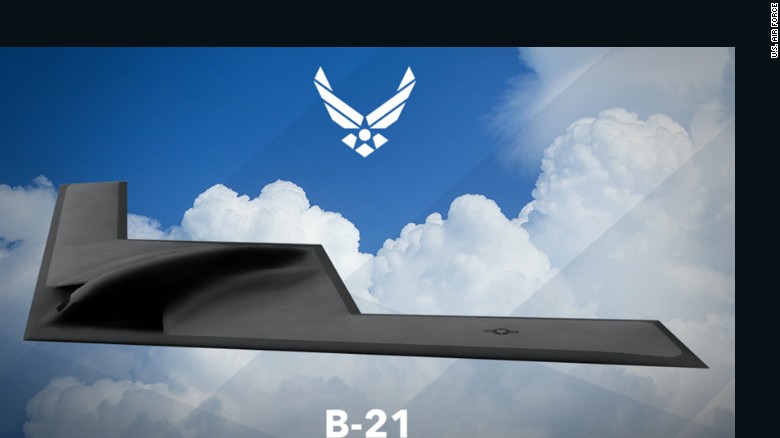
Air Force Unveils B-21 Bomber Design


The Air Force has unveiled the appearance of its new long range strike bomber, the B-21, which closely resembles and would have basically the same mission as the existing B-2 bomber (the most expensive warplane ever built, mostly because its run was cut short to 20 units due to cost overruns causing R&D costs to be allocated over far fewer units than planned).  It is slated to enter service in the mid-2020s, although at least some delays are almost inevitable in any major military procurement program.

The B-21 has been rumored to have stealth capability, to carry nuclear or conventional weapons, abd to be "pilot optional".  The Air Force is hoping to avoid cost overruns and delays by sticking mostly to "existing and mature technology."
When Northrop Grumman won the contract to build the B-21 last year, Defense Secretary Ashton Carter said it will allow the U.S. to "project power across the globe now and into the future," calling it a "strategic investment for the next 50 years." 
Long term, the idea is for these planes to replace Air Force B-52 bombers, which have been flying for more than half a century -- and eventually the B-1 bombers, when they retire sometime in the 2040s. 
Engineering and development costs are estimated at $21.4 billion (in 2010 dollars) over the entire life of the program.
If the projected run of 100 planes is built, the total cost is estimated at $511 million 2010 dollars each, about $300 million each to build, and the balance for R&D up front.

The previous two efforts to replace the B-52, first with the B-1B swing wing supersonic bomber, and then with the B-2, have not been great successes.  But, both of those projects don't really offer the basic "transport bomber" replacement for the B-52 to serve theaters where air superiority has already been achieved at a moderate costs.  The Navy's P-8 patrol aircraft is a closer fit to that role.

Do We Need 100 B-21s?

The 100 plane projection assumes almost 1-1 replacement of the existing long range bomber fleet. But, it isn't obvious that this is necessary.  The B-52 fleet size was built around assumptions from the days of "dumb bombs" when half of dozen to a score of bombing sorties might be necessary to hit one target on average.

Now, something like 98% of the guided munitions which are deployed by U.S. fighter planes, bombers, ships, missile submarines, helicopters, drones and artillery batteries hit their targets. The 5" main guns of U.S. Naval ships and the dumb ordinance used by U.S. Army Howitzers and mortars when smart munitions aren't used instead, and some 30mm cannons on the A-10 and A-130 and some ships are the only heavy "dumb" ordinance still in use and as prices for guidance systems fall (most of the $20,000+ cost of smart munitions and almost all recapture of R&D costs) the used of "dumb" rounds is expected to dwindle further.

The long range of the modern long range bombers also reduces the need to base bombers in every theater of action where they might be needed and they can be relocated from one theater to the other overnight, unlike ground based missile batteries, ships and submarines.

While the U.S. military's ground troop capacity has been strained for much of the time since the Iraq War, there has never been a time when the U.S. has had anything other than an extravagant excess of bombing assets, and the lion's share of bombing by U.S. forces and their allies since the Gulf War has taken place in half a dozen or so intense campaigns lasting just a few weeks or months.

This isn't to say that a future war couldn't be more demanding on U.S. bombing assets, but the kinds of campaigns that would call for those kind of resources, such as large scale conventional wars with China or Russia on their home territories, aren't wars that would make sense to fight with nuclear missile armed foes.

25 February 2016

Another Day, Another Suicidal Mass Shooter

This time, it was a worker in a Kansas factory who shot lots of people at the plant and other locations in the small Kansas town, killing some of them, before he was killed by a cop.  Four people, including the gunman were killed, and fourteen people were injured, ten critically.

UPDATE February 26, 2016: Shooter Cedric Ford, who grew up in Miami, Florida, launched his shooting spree about an hour and a half after he was served by sheriff's deputies with a protection order.  Ford had a criminal record including multiple arrests and at least one prior felony conviction over the course of the last decade and a half, so the handgun and assault rifle he used were almost surely in his possession in violation of federal laws barring felons from being in possession of firearms (usually with a ten year minimum sentence). END UPDATE.

In between this and the last mass shooting, in Kalamazoo, Michigan last Saturday, an anti-government activist previously associated with the Occupy Movement and the Green Party, shot three sheriff's deputies who were evicting him from his Bailey, Colorado home (which had been foreclosed upon long before then), killing one of them and injuring the other two (one critically) before being shot and killed by the officers.

Yes, Lots Of Trump Supporters Are Scary Racists

A YouGov/Economist poll in January asked respondents if they approved or disapproved of "the executive order that freed all slaves in the states that were in rebellion against the federal government." That executive order is better known as the Emancipation Proclamation. 
Thirteen percent of respondents — and "nearly 20 percent of Trump supporters," the [New York] Times reports, compared with 5 percent of Marco Rubio's — said they disapproved of it. . . . An additional 17 percent of respondents said they weren't sure.
Via Vox.

Federal Criminal Law Is Still Broken

Under the Hobbs Act, the federal government has the power to prosecute someone for robbery or extortion that affects interstate commerce.  And, it turns out, under the applicable law which has interpreted interstate commerce broadly, pretty much everything effects interstate commerce.

The definition is so broad that even though the government, in theory, has a duty to prove beyond a reasonable doubt that the crime affects interstate commerce, in practice, judges have held and it is the government's position, that there is no evidence that it is possible to offer that could ever show that interstate commerce is not affected by a robbery or extortion, so a defendant may not even try to offer evidence to rebut the government's claim.

So much for meaningful federalism.  A case on point where a defendant tried to argue that interstate commerce wasn't affected will probably lose.

Equally troubling, and not at issue in the U.S. Supreme Court case (because the law of cruel and unusual punishment under the 8th Amendment is absurdly toothless) is that the fellow in the Hobbs act case who stole a single marijuana joint, $40 and a cell phone on one occasion (from someone assumed to be a drug dealer for purposes of appeal) and stole a single cell phone on another occasion (again, from a drug dealer), was sentenced to 20 years in prison.

The government believes that this individual was part of a larger gang that specialized in home invasion burglaries aimed at suspected drug dealers called the Goonz.  But, all it had to prove beyond a reasonable doubt to the jury in order to secure the 20 year sentences was that the defendant participated in a robbery that took a single marijuana joint, $40 and a cell phone once, and a cell phone, a second time.

Maybe this was a pretty traumatic armed robbery, in which case the sentence is justified by the armed threat to persons, rather than the economic harm done.  But, it sure comes across as an excessively harsh sentence for a petty crime that didn't belong in federal court as a matter of policy, whether or not the United States Constitution allows this conviction to stand.