The United States has for some time been undergoing a process known in political science circles as "realignment." At first, the referred mostly to Republicans replacing conservative Democrats in the South in federal races. But, the flip side of the process involved Democrats replacing moderate Republicans in the North.
Democrats have a good shot at winning three of the four Senate seats in the Northeast which were won by Republicans in 2000. There is also a good chance that Joe Lieberman, who won election as a moderate Democrat in 2000, will be replaced by a more liberal Democrat is 2006. These states, together with neighboring Midwestern Ohio, which also has a Democratic party leaning U.S. Senate race, will bring Democrats half way towards securing Democratic party control of the U.S. Senate. Thus, while it is not the only story in this year's election, realignment in the Northeast is likely to be one of the most important ones.
Rhode Island
Realignment is catching up to the state of Rhode Island this year in its U.S. Senate race. Moderate Republican incumbent Lincoln Chafee faces much more conservative Republican Cranston Mayor Stephen Laffey in the U.S. Senate race primary to be held a week from Tuesday, on September 12, 2006.
Lincoln Chafee is rated by the American Conservative Union as the most liberal Republican in the Senate.
Sheldon Whitehouse, a former Rhode Island Attorney General, is almost certain to win the Democratic party primary in the race.
In April of this year, Chafee was leading in the primary by a 56-28 margin. The most recent poll, conducted August 28-30 showed Laffey with a 51-34 lead over Chafee. This is consistent with a trend that saw Chafee's lead slip in May, and drop to a single point in two different polls in June.
If Laffey wins, Sheldon Whitehouse has a cakewalk. The most recent general election poll, taken August 24, had Whitehouse leading Laffey by a 58-26 margin. Whitehouse has led every poll placing him head to head against Laffey since the race began by a safe margin, as would be expected in a strongly liberal leaning state which has held onto Chafee only because of his incumbency and moderation.
Even if Chafee wins, he has a tough fight. None of the seven Whitehouse-Chafee matchup polls taken in the period from May to the present, have given Chafee a lead of more than three percentage points, well within the margin of error. Those most recent Whitehouse-Chafee poll shows Chafee with a one percentage point lead in a 43-42 race. This is horrible for an incumbent, because few people are undecided about a long term incumbent, while many no opinion votes end up favoring a challenger once people get to know him. The rule of thumb is that an incumbent with under 50% support in a poll is in serious trouble.
As of June 30, Whitehouse had more cash on hand for the race, at $1.8 million, than either Chafee with $1.3 million, or Laffey, with $0.9 million. Of course, since Chafee has a much tougher primary than Whitehouse, whose opponent has Carl Sheeler had about a quarter of a million dollars on hand on June 30 (the most recent poll of that race, in June, showed Whitehouse leading 60-8), Chafee and Laffey have both likely been burning through their campaign funds much more quickly than Whitehouse. When the dust settles on September 13, 2006, Whitehouse will have a comfortable financial edge over whomever prevails.
Chafee isn't the only endangered moderate Republican in the U.S. Senate, and there aren't many of them to start with.
Vermont
Jim Jeffords, of liberal Vermont, kept his seat, but bolted from the Republican party where he had been viewed as a moderate, to become an independent in 2001. He is not running again. Bernie Sanders, a Democratic socialist leaning independent who currently represents Vermont is the House, is the runaway favorite in every poll matching him against possible general election opponents. None of the eleven polls in that race has shown him with less than a twenty percentage point lead against any opponent. In an August poll, he led the Republican front runner by 28 percentage points, almost a two to one margin.
Pennsylvania
Another incumbent in trouble in the Northeast in trouble is conservative Republican Rick Santorum of Pennsylvania. He faces moderate Democrat Bob Casey, Jr., the incubent state treasurer in Pennsylvania.
Casey has led all fifty-four polls matching him against Santorum since February of 2005. The most recent, on August 24, gave him a 44-39 lead. This indicates that the race is considerably tighter than earlier polling had indicated, and also shows the impact of a Green party run by rail industry consultant Carl Romanelli, who was placed in the ballot on August 1st, which is attracting 3-5% of voters who would otherwise probably have supported Casey. Santorum, with only 39% support as an incumbent Senator is certainly in trouble, but Pennsylvania's moderate trend in recent years to the point that it has become a Presidential election swing state, make it too early to call this race.
Casey needs the benefit of the general anti-Republican sentiment which is sweeping the nation this year in the wake of growing public dissatisfaction with the Bush Administration's handling of the Iraq War.
UPDATE: A USA Today poll released on September 1 has Casey leading Santorum by 18 percentage points among likely voters. This is a huge change from previous poll last week (by another firm). Now, fifty-five straight polls from about half a dozen polling firms have shown Casey in the lead in this race.
Maine
The only Northeastern Republican who is not seriously threatened in the 2006 election is two and a half decade incumbent moderate Republican Olympia Snowe of Maine who faces Democrat Jean Hay Bright, a progressive leaning reporter, in the general election. The most recent poll in the race, from August, shows Snowe with a 68-20 lead in the race.
Olympia Snowe is rated as the third most liberal Republican in the U.S. Senate by the American Conservative Union.
Other Northeastern Republicans and Republican moderates
The remaining Northeastern Republicans in the Senate, moderate Republican Arlen Specter of Pennsylvania, the moderate Republican Susan Collins of Maine, and the Republican incumbents from New Hampshire, Judd Gregg and John Sununu, do not face re-election this year.
Specter is rated by the American Conservative Union as the second most liberal Republican in the U.S. Senate, after Lincoln Chafee. They rate Susan Collins is the fourth more liberal Republican, coming right after third most liberal Olympia Snowe, also from Maine. Neither of New Hampshire's Republicans are particularly conservative, although Gregg is less prone to voting the party line than Sununu.
Maine, Pennsylvania, Connecticut, Vermont and Rhode Island all favored Gore and Kerry respectively, over President Bush, in the 2000 and 2004 elections. New Hampshire favored Kerry in 2004, and favored Bush over Gore in 2000. In both of these races for New Hampshire's electoral votes, the margin of victory was less than two percentage points.
Ted Stevens of Alaska, the fifth most liberal Republican in the U.S. Senate according to the ACU, faces the voters next in 2008. Given the fact that he will be a couple of weeks shy of his 85th birthday then (and 91 years old at the end of that term), and that he is already the longest serving Republican in the Senate, he is unlikely to run again. Alaska was a safe state for Bush in both the 2000 and 2004 Presidential elections.
All currently sitting Republicans according this and most other organizations that rate Senators from liberal to conservative are more conservative than all sitting Democrats on a lifetime voting record basis. But, Chafee, Snowe and Collins were all rated as more liberal than some Democrats by the ACU in 2005.
No Republicans are expected to pick up Senate seats in the Northeast this year.
Connecticut
Democrat Ned Lamont has roughly even odds to replace Joe Lieberman (a Democratic party incumbent who lost the Democratic party primary and is now running on the Astroturf Connecticut for Lieberman party) in Connecticut. The Republican party there has largely abandoned its own candidate in the race in favor of Lieberman, who while he was viewed as a moderate to conservative Democrat before the Democratic primary election this year, is far to the left of any Republican in the Senate and would vote for a Democratic leadership ticket if re-elected.
NOTE: All ACU ratings cited above refer to a lifetime ranking.
31 August 2006
30 August 2006
Math Ignorance and Beauprez's Abortion Comment
Bob Beauprez has made headlines and drawn immense protests for claiming the 70% of African-American women's pregancies end in abortion. Here's what he said on Colorado Public Radio:
It's obvious to me where that came from, and yes, it is quite incorrect.
Ratios v. Percentages
School children are taught about ratios v. percentages. Many forget when they grow up. Bob Beauprez is among them.
According to the Statistical Abstract of the United States (Table 93), in 2001, the most recent year for which data were available when it went to print, there were 229 abortions per 1,000 live births to white mothers, and there were 686 abortions per 1,000 lives births to mothers whose race was black or other.
The second number looks a lot like 70%, but, in fact, it isn't anywhere close to 70%.
Translated into more familiar ways of providing statistics, 18.6% of births that end in either a live birth or a medically induced abortion involving a white woman end in a medically induced abortion. In contrast 40.7% of births that end in either a live birth or a medically induced abortion where the woman is not white end in a medically induced abortion.
It also bears mention that the statistic cited above, which is probably the source of Beauprez's comment, doesn't break out African-American women separately at all.
Only Considering Two Possibilities Out Of Three
The reason that government health officials are reluctant to use a percentage approach, rather than a ratio, is because a percentage creates the false inference that every abortion would have, but for the abortion, have resulted in a live birth. Pregnancies end one of three ways, commonly known as live births, miscarriages/still births and abortions. The ratio omits one of the possibilities.
About 59% of abortions are done in the first two months of pregnancy. About 89% are done in the first trimester, and most that are not, are done very shortly thereafter. A significant percentage of abortions, had they not been done, would have ended in a miscarriage, the third option, rather than a live birth.
Virtually all abortions are conducted after a pregnancy is clinically recognized (i.e. the woman knows she is pregnant at the time). About 25% of pregnancies which are clinically recognized end in miscarriage, most between the time the pregnancy is recognized, and the end of the 8th week of pregnancy. Thus, about 15% of pregnancies (25% of 59%) terminated by abortion would probably have ended in miscarriage, rather than live births. Failing to make this adjustment leaves you talking about apples and oranges, rather than using comparable units. And a percentage based on quantities stated in two different units isn't meaningful.
Thus, the correct statement is that in white women, about 16% of pregnancies that would have ended in live births are terminated by an abortion, while in non-white women, about 37% of pregnancies that would have ended in live births are terminated by an abortion.
Why Care?
This leaves plenty of people who are appalled by the fact that any abortions happen at all lots to complain about. Abortion is a not uncommon event in a woman's life, particularly in light of the fact that most women have multiple pregnancies in life. It is not a rare exception. On a lifetime basis, a large minority of women have had an abortion at least once, and among some women in some ethnic groups, for a variety of reasons, almost a majority will have had an abortion at least once in a lifetime.
The 37% number is high enough, and enough people are uncomfortable with that number as well, that I didn't see any of the critics of his inaccurate statement provide the correct number. Nobody on any side of the abortion debate thinks that it is good that this number is as high as it is today.
If Beauprez had used the correct number, noted that legal abortion is the law of the land, and had phrased it more sympathetically, in terms of the difficult conditions that push some women to choose to have abortions, rather than implicitly demonizing African American women as immoral, as he did, he could have avoided criticism and made a valid point. This is the sort of thing that Democratic candidate for Governor Bill Ritter, who is himself very uncomfortable with the number of abortions that take place in the United States, might have said.
But, for Bob Beauprez to say that, he would have had have a kind of compassion for people unlike himself that he lacks (despite the fact that a disproportionate share of the African-Americans in Colorado live in the 7th Congressional District that he represents), and he would also have had to expressed a strong desire to prevent unwanted pregnancies, something that the policies he champions (like opposition to emergency contraception availability and teen pregnancy prevention programs) fail to do.
Beauprez's mistake from a math perspective was two-fold. First, he failed to understand the difference between a percentage and a ratio that doesn't include all possibilities. Secondly, and more importantly, he was too out of touch with what one would expect reasonable number to be to know to be skeptical enough of the absurdly high number he quoted, especially in a highly sensitive area. He should have known to double check it before citing it.
The way he discussed the reality that drives the racial discrepencies in abortion rates was equally problematic.
Taken as a whole, this incident suggests that he doesn't really understand the abortion issue or the race issue very well. And, while he apologized for the math error, he didn't apologize for the deep flaws in his views of African-Americans in Colorado at all.
In some of our ethnic communities, we're seeing very, very high percentages of babies, children, pregnancies end in abortion. I've seen numbers as high as 70 percent, maybe even more, in the African-American community that I think is just appalling.
It's obvious to me where that came from, and yes, it is quite incorrect.
Ratios v. Percentages
School children are taught about ratios v. percentages. Many forget when they grow up. Bob Beauprez is among them.
According to the Statistical Abstract of the United States (Table 93), in 2001, the most recent year for which data were available when it went to print, there were 229 abortions per 1,000 live births to white mothers, and there were 686 abortions per 1,000 lives births to mothers whose race was black or other.
The second number looks a lot like 70%, but, in fact, it isn't anywhere close to 70%.
Translated into more familiar ways of providing statistics, 18.6% of births that end in either a live birth or a medically induced abortion involving a white woman end in a medically induced abortion. In contrast 40.7% of births that end in either a live birth or a medically induced abortion where the woman is not white end in a medically induced abortion.
It also bears mention that the statistic cited above, which is probably the source of Beauprez's comment, doesn't break out African-American women separately at all.
Only Considering Two Possibilities Out Of Three
The reason that government health officials are reluctant to use a percentage approach, rather than a ratio, is because a percentage creates the false inference that every abortion would have, but for the abortion, have resulted in a live birth. Pregnancies end one of three ways, commonly known as live births, miscarriages/still births and abortions. The ratio omits one of the possibilities.
About 59% of abortions are done in the first two months of pregnancy. About 89% are done in the first trimester, and most that are not, are done very shortly thereafter. A significant percentage of abortions, had they not been done, would have ended in a miscarriage, the third option, rather than a live birth.
Virtually all abortions are conducted after a pregnancy is clinically recognized (i.e. the woman knows she is pregnant at the time). About 25% of pregnancies which are clinically recognized end in miscarriage, most between the time the pregnancy is recognized, and the end of the 8th week of pregnancy. Thus, about 15% of pregnancies (25% of 59%) terminated by abortion would probably have ended in miscarriage, rather than live births. Failing to make this adjustment leaves you talking about apples and oranges, rather than using comparable units. And a percentage based on quantities stated in two different units isn't meaningful.
Thus, the correct statement is that in white women, about 16% of pregnancies that would have ended in live births are terminated by an abortion, while in non-white women, about 37% of pregnancies that would have ended in live births are terminated by an abortion.
Why Care?
This leaves plenty of people who are appalled by the fact that any abortions happen at all lots to complain about. Abortion is a not uncommon event in a woman's life, particularly in light of the fact that most women have multiple pregnancies in life. It is not a rare exception. On a lifetime basis, a large minority of women have had an abortion at least once, and among some women in some ethnic groups, for a variety of reasons, almost a majority will have had an abortion at least once in a lifetime.
The 37% number is high enough, and enough people are uncomfortable with that number as well, that I didn't see any of the critics of his inaccurate statement provide the correct number. Nobody on any side of the abortion debate thinks that it is good that this number is as high as it is today.
If Beauprez had used the correct number, noted that legal abortion is the law of the land, and had phrased it more sympathetically, in terms of the difficult conditions that push some women to choose to have abortions, rather than implicitly demonizing African American women as immoral, as he did, he could have avoided criticism and made a valid point. This is the sort of thing that Democratic candidate for Governor Bill Ritter, who is himself very uncomfortable with the number of abortions that take place in the United States, might have said.
But, for Bob Beauprez to say that, he would have had have a kind of compassion for people unlike himself that he lacks (despite the fact that a disproportionate share of the African-Americans in Colorado live in the 7th Congressional District that he represents), and he would also have had to expressed a strong desire to prevent unwanted pregnancies, something that the policies he champions (like opposition to emergency contraception availability and teen pregnancy prevention programs) fail to do.
Beauprez's mistake from a math perspective was two-fold. First, he failed to understand the difference between a percentage and a ratio that doesn't include all possibilities. Secondly, and more importantly, he was too out of touch with what one would expect reasonable number to be to know to be skeptical enough of the absurdly high number he quoted, especially in a highly sensitive area. He should have known to double check it before citing it.
The way he discussed the reality that drives the racial discrepencies in abortion rates was equally problematic.
Taken as a whole, this incident suggests that he doesn't really understand the abortion issue or the race issue very well. And, while he apologized for the math error, he didn't apologize for the deep flaws in his views of African-Americans in Colorado at all.
Health News (Last August Edition)
Nerve Gas Treatment
An Alzheimer's drug, galantamine, is highly effective at preventing two well known nerve gases from causing fatalities in animal tests (at standard Alzheimer's doses) if taken up to three hours before, or within five minutes after exposure. ER doctors and terrorism response units -- although this is experimental, you need to bookmark this one and keep a vial handy, as the window of opportunity is so small and there is no other known effective response.
Making Babies Healthy
For Mom: Nursing women who nursing in the winter in places where sun exposure is reduced as people stay inside don't get enough vitamin D and neither do their infants. They need about 30 times the recommended daily allowance in the winter. In the summer, this is rarely a problem.
For Dad: The children of men who use saunas in the weeks prior to conception have a 3.6 times increased risk of brain cancer. Electric blankets increase the risk by a factor of 2.4 and other heat sources are also associated with a 2.5 fold increase in risk. It is hypothesized that this could be due to harm to sperm, which are temperature sensitive. The risk, even with exposure, is still very small, but the effect is statistically significant and people planning on becoming dads should avoid saunas and other measures that artificially warm the sperm production zone.
Infectious Disease
Air conditioning cooling towers turn out to be perfect petri dishes for bacteria dangerous to humans and mutated versions of these bacteria. They acts of parasites in amoebaes there.
A new form of cancer transmission has been discovered. A form of dog cancer is contagious. Rather than being transmitted via a virus, like the cervical cancer virus known as HPV, it is transmitted like a parasite, with the original cancer cells cloning themselves as they move from host to host. This is the first time cancer has been observed to spread in this manner.
Mental Health
Posttraumatic stress disorder (PTSD) is very real. About 28% of soldiers exposed to extreme stresses in war suffer from it, while it is found in only about 1% of soldiers in the same war who are not so exposed (corroborated against service records). About half of cases resolve within a decade.
Hat Tip to Science News (subscription only).
An Alzheimer's drug, galantamine, is highly effective at preventing two well known nerve gases from causing fatalities in animal tests (at standard Alzheimer's doses) if taken up to three hours before, or within five minutes after exposure. ER doctors and terrorism response units -- although this is experimental, you need to bookmark this one and keep a vial handy, as the window of opportunity is so small and there is no other known effective response.
Making Babies Healthy
For Mom: Nursing women who nursing in the winter in places where sun exposure is reduced as people stay inside don't get enough vitamin D and neither do their infants. They need about 30 times the recommended daily allowance in the winter. In the summer, this is rarely a problem.
For Dad: The children of men who use saunas in the weeks prior to conception have a 3.6 times increased risk of brain cancer. Electric blankets increase the risk by a factor of 2.4 and other heat sources are also associated with a 2.5 fold increase in risk. It is hypothesized that this could be due to harm to sperm, which are temperature sensitive. The risk, even with exposure, is still very small, but the effect is statistically significant and people planning on becoming dads should avoid saunas and other measures that artificially warm the sperm production zone.
Infectious Disease
Air conditioning cooling towers turn out to be perfect petri dishes for bacteria dangerous to humans and mutated versions of these bacteria. They acts of parasites in amoebaes there.
A new form of cancer transmission has been discovered. A form of dog cancer is contagious. Rather than being transmitted via a virus, like the cervical cancer virus known as HPV, it is transmitted like a parasite, with the original cancer cells cloning themselves as they move from host to host. This is the first time cancer has been observed to spread in this manner.
Mental Health
Posttraumatic stress disorder (PTSD) is very real. About 28% of soldiers exposed to extreme stresses in war suffer from it, while it is found in only about 1% of soldiers in the same war who are not so exposed (corroborated against service records). About half of cases resolve within a decade.
Hat Tip to Science News (subscription only).
Quote of the Day
The freethinking of one age is the common sense of the next.-- Matthew Arnold, Professor of Poetry at Oxford University, "God and the Bible: A Review of Objections to Literature And Dogma" (1875).
(An interesting discussion of the theological context in which Arnold's God and the Bible fits can be found here).
29 August 2006
Transformation Out At Pentagon
The Department of Defense is shutting down its Office
of Force Transformation effective September 30, 2006.
UPDATE: Armchair Generalist is reading my mind. I could have written the material quoted below almost word for word (and indeed just did, in similar terms at Daily Kos).
Hybrids Dead for Now At DOD
In related news:
Thus, like General Motors, European automakers, Korean automakers and Daimler-Chrysler (are they American or European?), they have no hybrid vehicles destined for the U.S. market.
A quote from Motortrend in the link above that "adapting it for larger vehicles isn't as easy", is just plain odd.
The two main uses of diesel-electric hybrid drives prior to the Honda Insight and Toyota Prius were in train locomotives and in submarines, both of which have far more horsepower than say, a Humvee or a tank.
Hybrid SUVs, which are somewhat smaller than Humvees, but still among the largest civilian passenger vehicles on the road, have four wheel drive, and are currently available in the U.S. market under Toyota (the Highlander), Lexus (the 400h) and Ford (the Escape) nameplates. A 2006 model year hybrid SUV gets better fuel efficiency in stop and go driving commonly called "city" driving than a conventional Honda Civic or Toyota Corolla, both of which are compact cars.
Every new vehicle design requires technological and engineering efforts, but a hybrid drive military vehicle is hardly revolutionary technology. Yet, by reducing the need to transport fuel in combat zones (about half of freight transported in the early days of the Iraq war was fuel), and providing greater vehicle range, it would confer real military advantages.
of Force Transformation effective September 30, 2006.
UPDATE: Armchair Generalist is reading my mind. I could have written the material quoted below almost word for word (and indeed just did, in similar terms at Daily Kos).
I don't like SecDef Rumsfeld. You know that. But I did appreciate the idea of transforming the Cold War military into a new and more efficient machine, using top-down direction in developing joint concepts instead of letting the services bicker about their "service-unique" needs and capabilities and continue to waste billions of dollars on gold-plated acquisition efforts. Unfortunately, Rumsfeld may be in the process of giving up on the one thing that might have redeemed his career.
Hybrids Dead for Now At DOD
In related news:
“Right now, we do not have a current hybrid program that targets fielding,” says Gus Khalil, team leader of hybrid-electric research at the Army’s Tank Automotive Research, Development and Engineering Center, or TARDEC.
Thus, like General Motors, European automakers, Korean automakers and Daimler-Chrysler (are they American or European?), they have no hybrid vehicles destined for the U.S. market.
A quote from Motortrend in the link above that "adapting it for larger vehicles isn't as easy", is just plain odd.
The two main uses of diesel-electric hybrid drives prior to the Honda Insight and Toyota Prius were in train locomotives and in submarines, both of which have far more horsepower than say, a Humvee or a tank.
Hybrid SUVs, which are somewhat smaller than Humvees, but still among the largest civilian passenger vehicles on the road, have four wheel drive, and are currently available in the U.S. market under Toyota (the Highlander), Lexus (the 400h) and Ford (the Escape) nameplates. A 2006 model year hybrid SUV gets better fuel efficiency in stop and go driving commonly called "city" driving than a conventional Honda Civic or Toyota Corolla, both of which are compact cars.
Every new vehicle design requires technological and engineering efforts, but a hybrid drive military vehicle is hardly revolutionary technology. Yet, by reducing the need to transport fuel in combat zones (about half of freight transported in the early days of the Iraq war was fuel), and providing greater vehicle range, it would confer real military advantages.
Who Do You Trust?
Bob Beauprez (left); Bill Ritter (right) (from the Ft. Collins Coloradoan).
The Durango Herald also got a fine shot of Beauprez aka "Both Way Bob."
28 August 2006
Americans Exiled Abroad
The United States government does have all sorts of immense powers. Excluding United States citizens from re-entering the United States is not one of them. Nobody told the Bush Administration that apparently.
Hat Tip to They Get Letters.
Federal authorities said Friday that the men, both Lodi residents, would not be allowed back into the country unless they agreed to FBI interrogations in Pakistan. . . . McGregor Scott, the U.S. attorney for California's eastern district, confirmed Friday that the men were on the no-fly list and were being kept out of the country until they agreed to talk to federal authorities. "They've been given the opportunity to meet with the FBI over there and answer a few questions, and they've declined to do that," Scott said. . . .Notable is the fact that these individual, who are U.S. citizens, are not only on a "no fly" list, but have been told that they will not be permitted to return to the United States, even if they come, for example, on a boat or private jet or via Mexico or Canada.
"They want to come home and have an absolute right to come home," said Mass [an ACLU attorney], who has filed a complaint with the Department of Homeland Security and a petition with the Transportation Security Administration.
"They can't be compelled to waive their constitutional rights under threat of banishment," Mass said. "The government is conditioning the return to their home on cooperation with law enforcement."
Aviation watch lists were created in 1990 to keep terrorists off planes and track drug smugglers and other fugitives. But since al Qaeda's attacks on Sept. 11, 2001, the government has expanded the lists significantly. Members of the public cannot find out if, or why, they are on a no-fly list.
Hat Tip to They Get Letters.
27 August 2006
Beyond Bake Sales
Figuring out how to finance physics experiements is an age old problem. The backers of one experiment have chosen the enterprising approach of trying to get the public to bet on the results.
26 August 2006
Lock Down
Not all children's fiction is kids stuff. It rarely has sex or immediate violence, but that doesn't mean that the adult themes that kids need to know about aren't very intense. Some parts of real life for elementary school aged kids these days are pretty intense too, like lock downs.
My first exposure to this subgenre with my own children was the Amber Brown series, by Paula Danziger about an elementary school aged girl dealing with the emotional intense reality of parents divorcing. (Judy Bloom can perhaps take credit for inventing the genre.) My daughter hasn't experienced divorce personally, but there is no child at her school who doesn't have at least one friend who has experienced it. They all need to know how to deal with this emotionally, and this kid's perspective view of parents who are honestly trying to do right by the children in the process is unflinchingly honest about the experience.
The first week of school this year, our bedtime story was I'm Still SCARED by Tomie DePaola. It too is told from the perspective of an elementary school aged kid, and like Amber Brown, incorporates diary entries. It begins on December 7, 1941 and ends on December 31, 1941. It is just as haunting and just as serious. For kids in the days after Pearl Harbor, one of the things that brought the new reality home was air raid drills. They never did those before, the teachers were circumspect about the nature of the threat, and harsh reality intruded into idylic childhood.
I didn't realize just how relevant this book would be until this evening, when parents from my daughter's second grade class gathered to meet each other socially at the beginning of the coming year and hear a little about what was in store.
The policy started before this year in the Denver Public Schools, but I didn't know about it until tonight. In addition to fire drills, the Denver Public Schools have "lock downs."
During a lock down, really a lock down drill, the doors are shut for half an hour. In the "red" drills, the children have to stay away from the windows and be still and quiet. In the less severe version of the drills, children can talk and mill around the classroom, but do have to stay there. It is largely a reaction to the Columbine Shooting and similar events.
Another part of the reaction to Columbine was also implemented at my children's elementary school last year. Every classroom was wired for and received a telephone and telephone number, so that teachers (or in a worst case scenario, students) can call for help, or receive calls warning them of impending danger. There are plenty of non-safety related reasons to have those phones, but the project was primarily a reaction to this fear.
The children find lock downs much more traumatic than fire drills. They are emotional and frightening. The children understand why they are held. But, it is hard to deride them for being hysterical. No American school was ever bombed in an air raid. The last time a nuclear bomb was launched in anger was in 1945 and a duck and cover routine wouldn't have made a nuclear any better. Violent acts in or near a school that makes a lock down the best knee jerk response happen someplace in the nation almost every year, sometimes multiple times. And, while Columbine shocked the nation, in part because no one thought that such a tragedy could happen in a suburban middle class school, the Denver Public Schools are, to be perfectly honest, the kind of place where everyone expects something like that to happen.
Who can blame them? One of the consequences of the fact that I read the newspaper every day, closely, is that my Denver is full of ghosts. This Wild Oats is the place where an estranged husband shot and killed his wife. This Korean grocery store parking lot is where a young man active in his church was killed trying to break up a fight. This K-mart is where a man who didn't get a job and went off his meds killed a woman and wounded another. This Safeway warehouse is where a young man who felt he was being discriminated against went amok. It could happen here, if not at my children's elementary school, at another one down the road.
I'm not convinced that practicing for these events will save any lives when an event like Columbine happens. The perpetrators will probably be aware of the anticipated response and use it to their own advantage. But, I can understood the instinct that drives lock downs, and it is generally a good one.
While no one can know when or where or precisely how one will happen next, maniacs who threaten public gatherings with weapons are a predictable tragedy. When you know that a threat exists, even if you are only fuzzy about the details, reasonsible community leaders take action to prepare as best they can for the threat. In this case, this means holding lock down drills. This is better than the response the system makes to a great many other predictable tragedies, like drop outs on a the jailhouse track, which is to do little or nothing.
Still, in this case, a lot of children have to endure a lot of system inflicted fear, which may do harm of its own, to be prepared for something that almost never happens in any individual school. This is a high price to pay for benefits which aren't very well established.
Cross Posted at Colorado Confidential.
My first exposure to this subgenre with my own children was the Amber Brown series, by Paula Danziger about an elementary school aged girl dealing with the emotional intense reality of parents divorcing. (Judy Bloom can perhaps take credit for inventing the genre.) My daughter hasn't experienced divorce personally, but there is no child at her school who doesn't have at least one friend who has experienced it. They all need to know how to deal with this emotionally, and this kid's perspective view of parents who are honestly trying to do right by the children in the process is unflinchingly honest about the experience.
The first week of school this year, our bedtime story was I'm Still SCARED by Tomie DePaola. It too is told from the perspective of an elementary school aged kid, and like Amber Brown, incorporates diary entries. It begins on December 7, 1941 and ends on December 31, 1941. It is just as haunting and just as serious. For kids in the days after Pearl Harbor, one of the things that brought the new reality home was air raid drills. They never did those before, the teachers were circumspect about the nature of the threat, and harsh reality intruded into idylic childhood.
I didn't realize just how relevant this book would be until this evening, when parents from my daughter's second grade class gathered to meet each other socially at the beginning of the coming year and hear a little about what was in store.
The policy started before this year in the Denver Public Schools, but I didn't know about it until tonight. In addition to fire drills, the Denver Public Schools have "lock downs."
During a lock down, really a lock down drill, the doors are shut for half an hour. In the "red" drills, the children have to stay away from the windows and be still and quiet. In the less severe version of the drills, children can talk and mill around the classroom, but do have to stay there. It is largely a reaction to the Columbine Shooting and similar events.
Another part of the reaction to Columbine was also implemented at my children's elementary school last year. Every classroom was wired for and received a telephone and telephone number, so that teachers (or in a worst case scenario, students) can call for help, or receive calls warning them of impending danger. There are plenty of non-safety related reasons to have those phones, but the project was primarily a reaction to this fear.
The children find lock downs much more traumatic than fire drills. They are emotional and frightening. The children understand why they are held. But, it is hard to deride them for being hysterical. No American school was ever bombed in an air raid. The last time a nuclear bomb was launched in anger was in 1945 and a duck and cover routine wouldn't have made a nuclear any better. Violent acts in or near a school that makes a lock down the best knee jerk response happen someplace in the nation almost every year, sometimes multiple times. And, while Columbine shocked the nation, in part because no one thought that such a tragedy could happen in a suburban middle class school, the Denver Public Schools are, to be perfectly honest, the kind of place where everyone expects something like that to happen.
Who can blame them? One of the consequences of the fact that I read the newspaper every day, closely, is that my Denver is full of ghosts. This Wild Oats is the place where an estranged husband shot and killed his wife. This Korean grocery store parking lot is where a young man active in his church was killed trying to break up a fight. This K-mart is where a man who didn't get a job and went off his meds killed a woman and wounded another. This Safeway warehouse is where a young man who felt he was being discriminated against went amok. It could happen here, if not at my children's elementary school, at another one down the road.
I'm not convinced that practicing for these events will save any lives when an event like Columbine happens. The perpetrators will probably be aware of the anticipated response and use it to their own advantage. But, I can understood the instinct that drives lock downs, and it is generally a good one.
While no one can know when or where or precisely how one will happen next, maniacs who threaten public gatherings with weapons are a predictable tragedy. When you know that a threat exists, even if you are only fuzzy about the details, reasonsible community leaders take action to prepare as best they can for the threat. In this case, this means holding lock down drills. This is better than the response the system makes to a great many other predictable tragedies, like drop outs on a the jailhouse track, which is to do little or nothing.
Still, in this case, a lot of children have to endure a lot of system inflicted fear, which may do harm of its own, to be prepared for something that almost never happens in any individual school. This is a high price to pay for benefits which aren't very well established.
Cross Posted at Colorado Confidential.
A Chip Off The Old Block
We found one of my daughter's goldfish, "Cutie," dead this morning in the tank. This was not unexpected. Cutie appears to have been suffering from swim bladder disease for a week or two, notwithstanding multiple remedies we applied based on internet fish care advice (peas, salt, food control, tank cleaning). Hey, at least the fish survived 65 days, much longer than the 72 hours or so the first time we tried to have fish. The other two goldfish in our tank seem to be healthy.
But, what was notable is how my daughter reacted.
Did she despair over the fate of Cutie's soul and insist on a proper burial? No. She asked if we could cut the dead fish open to see what a fish's organs looked like on the inside. That a girl!
We conducted the dissection later in the day observing the various fins, the gills, how the eyes were shaped and connected to the brain, the spine, the bones and the ruptured swim bladder. Afterwards, the remains were disposed of in the trash without objection.
But, what was notable is how my daughter reacted.
Did she despair over the fate of Cutie's soul and insist on a proper burial? No. She asked if we could cut the dead fish open to see what a fish's organs looked like on the inside. That a girl!
We conducted the dissection later in the day observing the various fins, the gills, how the eyes were shaped and connected to the brain, the spine, the bones and the ruptured swim bladder. Afterwards, the remains were disposed of in the trash without objection.
24 August 2006
Lochner Revisited
The Lochner decision, in which the U.S. Supreme Court invalided basic economic legislation on constitutional grounds like the "freedom of contract" is widely regarded as a low point of U.S. Supreme Court jurisprudence.
The U.S. Court of Appeals for the D.C. Circuit has made a similar decision in the Murphy case. It held that the subsection of the Internal Revenue Code that provides that fails to exclude from income non-physical personal injury damages (which not in lieu of lost wages) is unconstitutional as exceeding the power of Congress to tax income under the 16th Amendment because this is not income.
Almost everyone in the academic community and community of tax lawyers finds this notion absurd, the stuff of crackpot tax protestors, rather than an unanimous panel of judges on one of the most prestigious appellate courts in the land. Simply put, Congress has always been granted wide discretion to determine what is and is not income. There was not a consensus about it at the time the 16th Amendment was adopted. There is not a consensus about it now. And, even if it isn't an income tax, it might be some other kind of valid tax that Congress has the power to impose. The broad authority of Congress to define income was set forth by the U.S. Supreme Court in the Glenshaw Glass case in 1955 and has become settled law. As Professor Maule notes tax provisions have been declared unconstitutional excactly twice since the 16th Amendment was adopted. Once in 1920, and once in 1972. The 1972 ruling arose from the fact that the provision in question distinguished between unmarried men and unmarried women in violation of equal protection principals.
Professor Maule also correctly notes that if this kind of receipt of funds is not income, then it still isn't a constitutional question. Section 61 say "income" is subject to taxation, and Section 104 (the provision held unconstitutional) states that certain things that could be considered income still don't count. If something is not income under the 16th Amendment, then the correct holding is to interpret Section 61 of the Internal Revenue Code to hold that the money received is not part of gross income, not to declare Section 104 unconstitutional.
The D.C. Circuit Panel's argument is that these damage awards are neither a "gain" nor an "accession to wealth", and hence not income because it merely restores to her human capital that she has lost, based largely on dicta in the Glenshaw Glass case that noted a distinction made under the income tax laws at the time between compensatory damages in tort (then excluded from taxation), and punitive damages in tort (then taxable). But, the notion that this dicta imposed a constitutional boundary on what Congress could tax has never previously been established.
Part of their problem is that they misjudge the status quo. The status quo is not pre-injury. The tax law has, without constitutional objection, never allowed anyone to take a deduction strictly for suffering emotional distress, which the reasoning of the case suggests is a constitutional requirement on the tax code. Yet, to think that any bad day entitles you as a matter of constitutional law to a tax deduction is absurd.
The true status quo is where the litigant sits on the day before the damages award is awarded. On that day, if the litigant loses her case, she gets nothing, which is all she has received since the day of her injury, preserving the status quo. If she wins her case, she gets an award, making her better off. But, it is not the injury itself that causes her to gain wealth, it is the winning of a lawsuit as a result of the injury.
Either the U.S. Supreme Court, or the en banc D.C. Circuit, sitting en banc, could reverse, and this is a likely case for such treatment.
The U.S. Court of Appeals for the D.C. Circuit has made a similar decision in the Murphy case. It held that the subsection of the Internal Revenue Code that provides that fails to exclude from income non-physical personal injury damages (which not in lieu of lost wages) is unconstitutional as exceeding the power of Congress to tax income under the 16th Amendment because this is not income.
Almost everyone in the academic community and community of tax lawyers finds this notion absurd, the stuff of crackpot tax protestors, rather than an unanimous panel of judges on one of the most prestigious appellate courts in the land. Simply put, Congress has always been granted wide discretion to determine what is and is not income. There was not a consensus about it at the time the 16th Amendment was adopted. There is not a consensus about it now. And, even if it isn't an income tax, it might be some other kind of valid tax that Congress has the power to impose. The broad authority of Congress to define income was set forth by the U.S. Supreme Court in the Glenshaw Glass case in 1955 and has become settled law. As Professor Maule notes tax provisions have been declared unconstitutional excactly twice since the 16th Amendment was adopted. Once in 1920, and once in 1972. The 1972 ruling arose from the fact that the provision in question distinguished between unmarried men and unmarried women in violation of equal protection principals.
Professor Maule also correctly notes that if this kind of receipt of funds is not income, then it still isn't a constitutional question. Section 61 say "income" is subject to taxation, and Section 104 (the provision held unconstitutional) states that certain things that could be considered income still don't count. If something is not income under the 16th Amendment, then the correct holding is to interpret Section 61 of the Internal Revenue Code to hold that the money received is not part of gross income, not to declare Section 104 unconstitutional.
The D.C. Circuit Panel's argument is that these damage awards are neither a "gain" nor an "accession to wealth", and hence not income because it merely restores to her human capital that she has lost, based largely on dicta in the Glenshaw Glass case that noted a distinction made under the income tax laws at the time between compensatory damages in tort (then excluded from taxation), and punitive damages in tort (then taxable). But, the notion that this dicta imposed a constitutional boundary on what Congress could tax has never previously been established.
Part of their problem is that they misjudge the status quo. The status quo is not pre-injury. The tax law has, without constitutional objection, never allowed anyone to take a deduction strictly for suffering emotional distress, which the reasoning of the case suggests is a constitutional requirement on the tax code. Yet, to think that any bad day entitles you as a matter of constitutional law to a tax deduction is absurd.
The true status quo is where the litigant sits on the day before the damages award is awarded. On that day, if the litigant loses her case, she gets nothing, which is all she has received since the day of her injury, preserving the status quo. If she wins her case, she gets an award, making her better off. But, it is not the injury itself that causes her to gain wealth, it is the winning of a lawsuit as a result of the injury.
Either the U.S. Supreme Court, or the en banc D.C. Circuit, sitting en banc, could reverse, and this is a likely case for such treatment.
Where Is The Violence In Iraq?
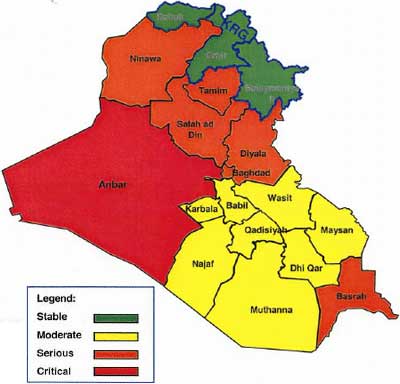
The image above is from the General Accountability Office via kos at Daily Kos and represents the situation as of March 2006. Basra is serious, rather than critical, although this is a little hard to make out in this illustration.
Bottom line: Kurdistan stable, predominantly Shi'ite provinces moderate (with Basra as the flash point which is the exception that proves the rule), diverse areas of Iraq in serious stife, and predominantly Sunni Anbar province in a critical state.
Recognizing the geographical and ethnic basis of violence in Iraq is key to identifying a workable political solution.
This data suggests that a predominantly Shi'ite Iraqi state of Sumer in the Southeast and an Iraqi Kurdistan state would be stable regimes which could manage without foreign assistance. Sumer would likely forge alliances with Shi'ite Iran. Kurdistan would likely continue on its relatively less religious, internationally independent course. As much as Turkey and Iran hate Kurdistan, they are the good citizens of post-war Iraq who have their house in order.
Given the connections between the Sunni leadership, the former Baathist regime of Iraq, and that currently in power Baathist regime in Syria, it also suggests that the best disposition of Anbar province may be to either cede it to Syria, or grant it independence, which would likely be followed by alliances with Syria. Such a move would probably rapidly transform Anbar province from being a territory in a state of critical unrest, to one that is peaceful because its people control their own destiny and would have to focus on their own economic development, rather than economic rent seeking behavior to try to get a bigger share of Iraq's oil wealth.
This still would leave a multi-ethnic, seriously strife torn rump Iraq that would probably not be capable of functioning on its own right away. It would be oil poor, but, would have water and would be brain power rich as it would include Baghdad, the urban center of Iraq. Think of this as the Bosnia-Croat federation part of the Bosnian Republic in former Yugoslavia.
Stablizing the rest of Iraq would narrow the military problems. In the areas where foreign troops leave, their departure would heighten the legitimacy of the regimes in place there because they would no longer be associated with an occupying foreign army. This would also make allocating Coalition military resources needed to get that part of Iraq on its feet more workable. There would be less territory to cover and troops could be more concentrated in trouble spots once freed to the need to provide some coverage to lower profile areas.
More importantly, insurrections are fundamentally political in origins and are a largely a function of the legitimacy of the regimes in place in the eyes of the insurgents. Just as no amount of law enforcement can completely shut down black markets in prostitution, or alcohol, or drugs, no amount of military force alone can shut down an insurgency. Unless it is in the interest of insurgents to participate in politics, they won't.
At the most crude level, democracy works because that people won't start a war to gain control when they can more easily achieve their ends at the ballot box. Insurrections with broad enough support to be a threat to a state usually also have broad enough support to win free and fair elections in a system that is not rigged against them.
But, if a state encompasses multiple politized political cultures in the same jurisdiction, they will struggle with each other. If the playing field is fairly even, as is the current situation in the United States where right wing and left wing forces with different cultural roots are fairly evenly balanced, this will happen politically. Alternately, the political situation will collapse into a dominant party system where one group always wins, and the other is forever disgruntled if they are not evenly balanced. Federalism is a partial solution to that, but there are only so many differences that can be accomodated in a single state with a meaningful central government.
Politics in a rump Iraq would probably be more successful at quelling the insurgency, than they have been within existing Iraqi boundaries.
As it stands, the Sunnis have no interest in using a political forum to air their grievances. They are at the mercy of the 80% of the country that has supported primarily Shi'ite or Kurdish affiliated political parties, so they can never win by virtue of their own political power. When you can't win a game, the logical reaction is not to play.
In contrast, in a rump Iraq, no ethnic group would have a decisive majority and Sunnis might have 30-40% of the representatives elected on a proportional representation basis. In this scenario, politics would be a viable alternative to violence. Also, because multi-ethnic parties would hold the swing votes in such a system, they might become the power brokers in a rump Iraq, which would encourage people to join them, rather than the marginal players that they are today in Iraq.
Furthermore, if a rump Iraq were highly federal in its design, with small highly autonomous cantons on the Swiss model, political buy in from potential insurgents could be even greater, because the chances that you will get at least some part of the political pie, either locally or nationally, would be enhanced.
And, if a rump Iraq had little oil, the biggest prize in the political system would no longer be there to fight over. In the absence of easy money, it would be easier for politicians in a rump Iraq to recognize the importance of using the resources they do have, which is the most educated workforce within the boundaries of pre-war Iraq.
Throwing People Away
What should society do with a mentally ill, multi-drug addicted, unemployable, homeless, 35 year old divorced mother of three children (who didn't live with her) with a long history of suicide attempts? Leave her to become a vagrant until she succeeds in killing herself, or help her with SSI payments and Medicaid care which she would qualify for if she is considered disabled?
The Social Security Administration insisted that she figure out how to free herself from alcohol and drugs, and doing so still fail dismally in efforts to obtain work because of her mental illness, before she could be treated as disabled as a result of her mental illness. The 10th Circuit,based in Denver, in its unpublished decision in the case of Julie Salazar, reversed that decision, ruling that compassion was a better choice.
Ms. Salazar ultimately prevailed largely because the evidence in her case showed that even after staying free of drugs and alcohol for 40 days in a substance abuse program she remained so deeply mentally ill that she had to be transferred directly to a hospital for inpatient mental health treatment.
(The Adminstrative Law Judge in the case misunderstood the medical records and thought that she had improved dramatically after those 40 days, failing to understand that she improved meaingfully only after five days of intensive inpatient psychiatric treatment following the 40 days of substance abuse treatment she had received.)
But, help for her was deferred for five years, which she was lucky to have survived at all.
Also, cases like this one cast into doubt the wisdom of "The Contract With America Advancement Act of 1996" (P.L. 104-121) which provides that:
Throwing people away has a price. Ms. Salazar, for example, broke her arm and it will be forever be a disability because she couldn't afford a doctor and didn't qualify for medical assistance.
Her experience with the system is also instructive. On numerous occasions, she missed meetings and other steps in the legal and bureaucratic process because she was mentally ill. At her final hearing on eligiblity for benefits, she was represented by a non-lawyer friend or family member, rather than by a lawyer. The administrative law judge interpreted some of the medical records to say the opposite of what they actually said, and ignored some of the proper procedures for handling claims like hers.
The quasi-adversary system in place now, that requires beneficiaries to make their own cases for eligiblity, doesn't make a lot of sense when the reason that the people need help is something that makes them inherently unqualified to meaningfully make their case to the government agencies involved.
It is one thing to routinely deny benefits to corporations that have their acts together because they can't meet deadlines and have trouble showing up for meetings. It is another to take the same approach to people who need benefits because they are so mentally ill that they can't hold down a job. In the case of the mentally ill person, an appplicant’s inability to process his or her own case tends to show exactly why that person needs help.
Ms. Salazar's longest period of employment in her life was one year as a pizza shop attendant, and her parenting was so bad that she did not receive any meaningful parenting time after her divorce.
Capitalism works very effectively to reward those who work, and deny help to those who aren't productive. But, it isn't perfect. Some people, like Ms. Salazar, are incapable of escaping their problems without a helping hand, no matter how great the incentives they have to do so.
Cross Posted at Colorado Confidential.
The Social Security Administration insisted that she figure out how to free herself from alcohol and drugs, and doing so still fail dismally in efforts to obtain work because of her mental illness, before she could be treated as disabled as a result of her mental illness. The 10th Circuit,based in Denver, in its unpublished decision in the case of Julie Salazar, reversed that decision, ruling that compassion was a better choice.
Ms. Salazar ultimately prevailed largely because the evidence in her case showed that even after staying free of drugs and alcohol for 40 days in a substance abuse program she remained so deeply mentally ill that she had to be transferred directly to a hospital for inpatient mental health treatment.
(The Adminstrative Law Judge in the case misunderstood the medical records and thought that she had improved dramatically after those 40 days, failing to understand that she improved meaingfully only after five days of intensive inpatient psychiatric treatment following the 40 days of substance abuse treatment she had received.)
But, help for her was deferred for five years, which she was lucky to have survived at all.
Also, cases like this one cast into doubt the wisdom of "The Contract With America Advancement Act of 1996" (P.L. 104-121) which provides that:
An individual shall not be considered to be disabled . . . if alcoholism or drug addition would . . . be a contributing factor material to the . . . determination that the individual is disabled.In other words, our national policy for the past decade has been to let alcoholics and drug addicts suffer without societal help, rather than to provide them the help they need to straighten their lives out.
Throwing people away has a price. Ms. Salazar, for example, broke her arm and it will be forever be a disability because she couldn't afford a doctor and didn't qualify for medical assistance.
Her experience with the system is also instructive. On numerous occasions, she missed meetings and other steps in the legal and bureaucratic process because she was mentally ill. At her final hearing on eligiblity for benefits, she was represented by a non-lawyer friend or family member, rather than by a lawyer. The administrative law judge interpreted some of the medical records to say the opposite of what they actually said, and ignored some of the proper procedures for handling claims like hers.
The quasi-adversary system in place now, that requires beneficiaries to make their own cases for eligiblity, doesn't make a lot of sense when the reason that the people need help is something that makes them inherently unqualified to meaningfully make their case to the government agencies involved.
It is one thing to routinely deny benefits to corporations that have their acts together because they can't meet deadlines and have trouble showing up for meetings. It is another to take the same approach to people who need benefits because they are so mentally ill that they can't hold down a job. In the case of the mentally ill person, an appplicant’s inability to process his or her own case tends to show exactly why that person needs help.
Ms. Salazar's longest period of employment in her life was one year as a pizza shop attendant, and her parenting was so bad that she did not receive any meaningful parenting time after her divorce.
Capitalism works very effectively to reward those who work, and deny help to those who aren't productive. But, it isn't perfect. Some people, like Ms. Salazar, are incapable of escaping their problems without a helping hand, no matter how great the incentives they have to do so.
Cross Posted at Colorado Confidential.
Denver Post No Daily Planet
The print edition of the Denver Post this morning utterly screwed up their story on the status of Pluto and various other minor planets, something that Daily Planet would never have done. It said Charon was discovered in 1800s (that was Ceres). It said all three new proposed planets were plutons (again, something that doesn't apply to Ceres). For background see my earlier post on the subject.
Their updated story this morning has no such obvious errors. Now, according to the Denver Post, the call is for Pluto, Ceres and Xena to get dwarf planet status, and for Charon to remain classified as a moon of Pluto (implicitly treating the biggest object in a system as the primary, and everything else as a satellite). This will leave eight full fledged planets.
Pluto, Ceres and Xena are ruled out from the new rule, under which an object is a planet if it is:
The final report direct from the IAU is found here. The official resolution states (formatting added):
When the dust settles in a few decades, there will be eight planets, several dozen dwarf planets, and lots of "small solar system bodies." Does that last name suck or what? Even the acronym, SSSBs sucks. Previous generations came up with names like asteroids and comets, and all we can come up with is SSSBs? Gah! The downsides of a lack of liberal arts education amongst astronmers is definitely making itself known.
UPDATE: What will be the political impact of this decision? Perhaps new ads like this one:
The floor is open for anyone who would like to propose a replacement name for dwarf planets further out than Neptune most of the time, other than the previously proposed "plutons," and a better name for SSSBs.
Their updated story this morning has no such obvious errors. Now, according to the Denver Post, the call is for Pluto, Ceres and Xena to get dwarf planet status, and for Charon to remain classified as a moon of Pluto (implicitly treating the biggest object in a system as the primary, and everything else as a satellite). This will leave eight full fledged planets.
Pluto, Ceres and Xena are ruled out from the new rule, under which an object is a planet if it is:
"a celestial body that is in orbit around the sun, has sufficient mass for its self-gravity to overcome rigid body forces so that it assumes a ... nearly round shape, and has cleared the neighborhood around its orbit." Pluto is automatically disqualified because its oblong orbit overlaps with Neptune's.Ceres doesn't qualify under that definition because there are other objects in the asteroid belt. Xena doesn't qualify under that definition because there are lots of objects in its vicinity in the Kuniper Belt.
The final report direct from the IAU is found here. The official resolution states (formatting added):
IAU Resolution: Definition of a Planet in the Solar SystemSo, Pluto gets knocked down a notch, Ceres and Xena get promotions, and Charon gets knocked down a little by association with Pluto from satellite of a planet to satellite of a dwarf planet. As a consolation prize, Pluto and Xena and its friends will get a new name, but the IAU decided that the name "plutons" was not worthy. This is probably due to objections from geologists who already had dibs on that word.
Contemporary observations are changing our understanding of planetary systems, and it is important that our nomenclature for objects reflect our current understanding. This applies, in particular, to the designation 'planets'. The word 'planet' originally described 'wanderers' that were known only as moving lights in the sky. Recent discoveries lead us to create a new definition, which we can make using currently available scientific information.
RESOLUTION 5A
The IAU therefore resolves that "planets" and other bodies in our Solar System be defined into three distinct categories in the following way:
(1) A "planet"1 is a celestial body that (a) is in orbit around the Sun, (b) has sufficient mass for its self-gravity to overcome rigid body forces so that it assumes a hydrostatic equilibrium (nearly round) shape, and (c) has cleared the neighbourhood around its orbit.
(2) A "dwarf planet" is a celestial body that (a) is in orbit around the Sun, (b) has sufficient mass for its self-gravity to overcome rigid body forces so that it assumes a hydrostatic equilibrium (nearly round) shape2 , (c) has not cleared the neighbourhood around its orbit, and (d) is not a satellite.
(3) All other objects3 except satellites orbiting the Sun shall be referred to collectively as "Small Solar-System Bodies".
1The eight planets are: Mercury, Venus, Earth, Mars, Jupiter, Saturn, Uranus, and Neptune.
2An IAU process will be established to assign borderline objects into either dwarf planet and other categories.
3These currently include most of the Solar System asteroids, most Trans-Neptunian Objects (TNOs), comets, and other small bodies.
IAU Resolution: Pluto
RESOLUTION 6A
The IAU further resolves:
Pluto is a "dwarf planet" by the above definition and is recognized as the prototype of a new category of trans-Neptunian objects.
When the dust settles in a few decades, there will be eight planets, several dozen dwarf planets, and lots of "small solar system bodies." Does that last name suck or what? Even the acronym, SSSBs sucks. Previous generations came up with names like asteroids and comets, and all we can come up with is SSSBs? Gah! The downsides of a lack of liberal arts education amongst astronmers is definitely making itself known.
UPDATE: What will be the political impact of this decision? Perhaps new ads like this one:
Bush loses City - NOLAThe term "dwarf planets" isn't that bad and while the prior term "minor planets" would have been better from the get go, it would cause confusion now since the same term would have two different definitions, a pre-2006 one and a post-2006 one.
Bush loses Country - Iraq
Bush loses whole Planet! - Pluto
The floor is open for anyone who would like to propose a replacement name for dwarf planets further out than Neptune most of the time, other than the previously proposed "plutons," and a better name for SSSBs.
23 August 2006
Posner on Our Quaint Constitution
William Roper: So, now you give the Devil the benefit of law!From here.
Sir Thomas More: Yes! What would you do? Cut a great road through the law to get after the Devil?
William Roper: Yes, I'd cut down every law in England to do that!
Sir Thomas More: Oh? And when the last law was down, and the Devil turned 'round on you, where would you hide, Roper, the laws all being flat? This country is planted thick with laws, from coast to coast, Man's laws, not God's! And if you cut them down, and you're just the man to do it, do you really think you could stand upright in the winds that would blow then? Yes, I'd give the Devil benefit of law, for my own safety's sake!
I can understand when someone with very little understanding of the law, or a populist politician, fails to understand the importance of following the law, including the United States Constitution. I have considerably less patience for senior U.S. Court of Appeals judges, such as Judge Posner, he fail to grasp this point and show contempt for the institution of the judiciary of which they are a part, when it is their job to enforce that Constitution, particularly in the context of a very public Wall Street Journal op-ed piece.
Indeed, as a sitting judge before whom these issues are likely to appear, it really isn't proper for him to be discussing these points at all. His opening disclaimer notwithstanding, he has gone far beyond what is appropraite for a judge. What did he say?
I can remark on the strangeness of confiding so momentous an issue of national security to a randomly selected member of the federal judiciary's corps of almost 700 district judges, subject to review by appellate and Supreme Court judges also not chosen for their knowledge of national security. . . . We are boxed in by our revered 18th-century Constitution as interpreted by the Supreme Court. The Hamdan decision suggests that a majority, albeit a bare majority, of the court is unsympathetic to arguments that our understanding of certain provisions of the Constitution needs to be revised to meet contemporary needs.With all due respect he is simply wrong when he states that:
Monitoring, even when it takes the form of wiretapping or other electronic interceptions, need not be conducted under a warrant.He implies that it might be a good idea for the Congress to strip the courts of jurisdiction over such matters. The full editorial is here.
Posner has outed himself. He is no originalist. Indeed, he doesn't really believe in the rule of law at all. No one is asking judges to formula battle plans, to decide with whom we ought to go to war, or decide which weapons we ought to buy. Cases like Hamdan and the NSA case just decided by a U.S. District Judge in Detroit, are enforcing recently enacted statutes placing specific limitations on the executive branch which the judicial branch is enforcing.
There is nothing new under the sun (Ecclesiastes 1:9). The tyranny of political leaders intent of ignoring the law was around in the 18th Century, and our Constitution's Bill of Rights and separation of powers were designed to address that issue. Call me quaint, but I'll keep our constitution, for my own safety's sake.
His Fraudulency II
After his narrow and disputed election in 1876, President Rutherford B. Hayes "his fraudulency" by the opposition in Congress.
Our sitting President Bush won both of his elections in similar circumstances. But, Bush deserves the title of "His Fraudulency II" for another reason -- his five years of lies about the connections between Iraq and the 9-11 attack which were an important factor in his re-election, and which he has finally disavowed in the last week.
The details are portrayed starkly by Bill in Portland Maine in his Cheers and Jeers Post at Daily Kos
Our sitting President Bush won both of his elections in similar circumstances. But, Bush deserves the title of "His Fraudulency II" for another reason -- his five years of lies about the connections between Iraq and the 9-11 attack which were an important factor in his re-election, and which he has finally disavowed in the last week.
The details are portrayed starkly by Bill in Portland Maine in his Cheers and Jeers Post at Daily Kos
Murkowski Third in Alaska Governor's Primary.
Corrupt Republican Governor of Alaska Frank H. Murkowski is the second least popular Governor in the United States, after Ohio Governor Bob Taft who was convicted of crimes related to his public office late last year, but hasn't resigned. The members of his party decided it was time to throw Murkowski under a bus yesterday.
Republican primary winner Sarah Palin, a former Wasilla mayor, will face the Democratic nominee, former Gov. Tony Knowles (1994-2002), in November.
By the way, there is a reason that you have never heard of Wasilla, Alaska: "As of the 2000 census, the population of the city was 5,470. 2004 estimates gives the city a population of 7,740[.]" It is 43 miles North of Anchorage, where 30% of its residents commute to work. The source of the name is disputed, although no one claims it was named after the ancient pagan god of the same name.
For comparison's sake, the West Washington Park neighborhood in Denver has twice as many people as the 2004 population of this fast growing bedroom community.
Murkowski had just 19 percent of the vote to Palin's 51 percent and Binkley's 30 percent. Longshot candidates Gerald L. Heikes and Merica Hlatcu split the remainder of the GOP voteMurkowski is now a lame duck, so is Taft.
Republican primary winner Sarah Palin, a former Wasilla mayor, will face the Democratic nominee, former Gov. Tony Knowles (1994-2002), in November.
By the way, there is a reason that you have never heard of Wasilla, Alaska: "As of the 2000 census, the population of the city was 5,470. 2004 estimates gives the city a population of 7,740[.]" It is 43 miles North of Anchorage, where 30% of its residents commute to work. The source of the name is disputed, although no one claims it was named after the ancient pagan god of the same name.
For comparison's sake, the West Washington Park neighborhood in Denver has twice as many people as the 2004 population of this fast growing bedroom community.
Heirloom Cafe In; Perk and Pub Out
The Wash Park Perk and Pub, at Ohio and S. Emerson Streets, has been replaced by the Heirloom Cafe, which involves both a new name and look, and new owners. It opened about a week ago. It had the usual free Wi-Fi, assortment of coffee drinks and sweets, but also features Belgian Sugar Waffles. The breakfast burritos and pizza are gone. It has also replaced the "family room" look and feel of its predecessor with the look of your parents' little used parlor, but with more people in it than your parents' parlor ever saw.
Stay at home moms and dads out about town should note that it is quite kid friendly (the proprietor's pre-schooler hangs out at the cafe), and dog walkers should note that it has retained dog friendly amenities like a big water bowl for dogs and a tie off bar right outside the door next to a window where you can keep an eye on your furry friends while you get a coffee.
The Wash Park Perk and Pub had gained press in small business against city hall strugle, for turning an old office space next to a laundrymat into a community gathering place, but facing hangups over a patio which the city approved, and then withdrew approval from in the face of pressure from the West Washington Park Neighborhood Association (it ultimately took no official stand on the matter IIRC). The struggle was colored by the fact that a neighborhood association officer lived basically next door.
Perk and Pub's neighborhood association relationship was also troubled by a deep seated neighborhood association aversion to liquor licenses (even of the nice cafe-vino variety at an early stage -- they argue that it could become something worse under a new owner once a license is in place), even though the "Pub" part of the concept that survived in the name was abandoned almost immediately at the Wash Park location. The concern about bars is perhaps a bit quaint. But, keep in mind that this neighborhood was first incorporated as part of the City of South Denver which was formed for the express purpose of shutting down the bars that were proliferating on South Broadway. South Denver faded into history a few years later when it merged with the City of Denver, but apparently, the sentiment still survives today.
When the Wash Park Perk and Pub opened, it had hoped to last until T-Rex was done, then catch the traffic down Emerson Street that normally guides a steady stream of traffic headed from I-25 to downtown past its door, but this didn't happen in time to save the Perk and Pub. Heirloom Cafe's owners, who benefit from this restored surge of traffic (the Emerson Street exit from I-25 opened yesterday) are optimistic about their prospects, despite competition from Roast Coffee about three blocks away across the street from Lincoln Elementary School, and a Starbucks at Downing and Alameda.
Renovations were brief enough that much of the existing traffic has continued.
Stay at home moms and dads out about town should note that it is quite kid friendly (the proprietor's pre-schooler hangs out at the cafe), and dog walkers should note that it has retained dog friendly amenities like a big water bowl for dogs and a tie off bar right outside the door next to a window where you can keep an eye on your furry friends while you get a coffee.
The Wash Park Perk and Pub had gained press in small business against city hall strugle, for turning an old office space next to a laundrymat into a community gathering place, but facing hangups over a patio which the city approved, and then withdrew approval from in the face of pressure from the West Washington Park Neighborhood Association (it ultimately took no official stand on the matter IIRC). The struggle was colored by the fact that a neighborhood association officer lived basically next door.
Perk and Pub's neighborhood association relationship was also troubled by a deep seated neighborhood association aversion to liquor licenses (even of the nice cafe-vino variety at an early stage -- they argue that it could become something worse under a new owner once a license is in place), even though the "Pub" part of the concept that survived in the name was abandoned almost immediately at the Wash Park location. The concern about bars is perhaps a bit quaint. But, keep in mind that this neighborhood was first incorporated as part of the City of South Denver which was formed for the express purpose of shutting down the bars that were proliferating on South Broadway. South Denver faded into history a few years later when it merged with the City of Denver, but apparently, the sentiment still survives today.
When the Wash Park Perk and Pub opened, it had hoped to last until T-Rex was done, then catch the traffic down Emerson Street that normally guides a steady stream of traffic headed from I-25 to downtown past its door, but this didn't happen in time to save the Perk and Pub. Heirloom Cafe's owners, who benefit from this restored surge of traffic (the Emerson Street exit from I-25 opened yesterday) are optimistic about their prospects, despite competition from Roast Coffee about three blocks away across the street from Lincoln Elementary School, and a Starbucks at Downing and Alameda.
Renovations were brief enough that much of the existing traffic has continued.
22 August 2006
GOP Govs At Nixonesque Approval Ratings

United States President Richard Nixon spent about ten months with approval ratings under 30% before he resigned with the prospect of impeachment awaiting him. He never fell below the low 20s in approval rating.
A Survey USA poll released today, reveals that three sitting Republican Governors have approval ratings in that territory, and one more is merely in President Bush approval ratings territory. All four states are states that voted for Bush in 2004. One, Murkowski from Alaska, is running again and has a primary today. The other two at the bottom are leaving office when their terms expire in early 2007. The fourth doesn't have an election until 2008.
Taft
At the very bottom is Republican Ohio Governor Bob Taft. He has 17% who approve of his performance and 79% who disapprove. He was even convicted of a crime during office and hasn't resigned. Taft's approval ratings have been in the high teens and low twenties, sub-Nixonesque levels, since, at least, May of last year. His low with Survey USA was 14% in February of this year.
According to Wikipedia:
In the wake of convictions for ethics violations (see "Criminal charges", below), Gov. Taft's approval rating bottomed out at 6.5%, according to a late November, 2005 poll by Zogby, giving him quite possibly the lowest polled approval rating ever by a United States politician.[2] A Survey USA poll that same month gave Taft a rating of 18%. . . . A late-2005 article in Time Magazine named him as one of the three worst governors in the country.
Taft is term limited, so the seat is an open seat in which the Democratic Party candidate is currently favored in the polls.
Murkowski
Then comes Republican Alaska Governor Frank Murkowski. Voters in the Republican primary today will decide if he should have another chance to run for Governor. If he wins, the seat will be very competitive for a Democratic candidate, and if he loses, it will be an effectively open seat, which gives a Democratic contender, at least, a realistic chance.
He has 19% who approve and 76% who disapprove. This is a new low for him, although he hasn't had even 35% approval ratings since, at least, May of 2005. He is also deep in Nixon's approval ratings territory. He was elected Governor in 2002, after many years in the U.S. Senate. I'm not familiar with Alaska politics, but according to Wikipedia:
Many residents are angry over a recently purchased jet using a state line of credit with Key Bank, which was legal but did not require legislative approval. Earlier disapproval was related to his elimination of the state longevity bonus paid annually to senior citizen residents of Alaska. However, it was eliminated at a time when the state was facing a budget deficit. Murkowski's use of the jet over cheaper commercial air travel has caused controversy among citizens as well as legislators and the matter of business that he attends to - and the possible use of the jet for personal business[1]. Senator Kim Elton publishes a newsletter detailing each time the jet is used, the cost, and the price of a first class commercial ticket the same day to the same destination.
Governor Murkowski is currently running for re-election. The unpopular governor faces stiff opposition from former Wasilla Mayor Sarah Palin and Fairbanks businessman John Binkley. Most polls have indicated that Murkowski will have a difficult time surviving the Republican primary election on August 22, 2006.
His daughter Lisa Murkowski, whom he appointed to the U.S. Senate in 2002, after which she won re-election in 2004, is surely hoping that the stink of her father's scandals will be forgotten when she faces re-election in 2010. She currently has a middling 55% approve, 39% disapprove rating.
Fletcher
Then comes Republican Kentucky Governor Ernie Fletcher. He has 24% who approve and 73% who disapprove, a new low. He pardoned many of his senior staff members after they were indicted in connection with corruption charges. The only reason he isn't facing charges himself is that a court held that a sitting Governor is immune from prosecution for the duration of his term of offie. He is not running again in 2006, so the race is an open seat.
Daniels
By comparison, the next worst approval rating, that of Republican Governor of Indiana Mitch Daniels of whom 34% approve and 54% disapprove (in the same ballpark as President Bush), looks positively wonderful, even if it does mark a return to negative net approval ratings. His next election is in 2008.
America's Third World Economy
Daily Kos diarist 7November amidst a larger argument about the estate tax throws in an interesting tidbit about where the United States ranks of the Gini index, a widely accepted measure of income inequality.
The U.S. has high income inequality as measured by the Gini index.
Out of 124 countries, the U.S. ranks 92nd most equal (meaning it has more income inequality than most countries) with a 46.6 Gini index. This has increased significantly since 1970:
Thus, on a comparable basis with prior years, the Gini coefficient for the U.S. in 2000 was about .442, rather than 0.462. In contrast, France, for example, has become a much more equal society in the same time period. The Gini index the U.S. had in 1970 would rank as #67 today, instead of the actually current ranking of #92.
Japan is second most equal. All of the other countries in the top 15 for equality are European (including the former Soviet Union), although there are a few exceptions in the top quarter (i.e. the top 31 countries). South Korea is #26, because, like Japan, it has a modern economy. Mongolia is #22, partially because of its former status as a Soviet satellite and partially due to likely oddities in the data that don't fully reflect the inequality in its society.
Rwanda (#16) (the tenth income percentile is around $7,500 per year), Ethiopia (#20) (the tenth income percentile is around $5,400 per year) and Bangladesh (#27) (the tenth income percentile is around $13,600 per year) make the list presumably because even the well to do are struggling in those countries.
Not all Western economies are in the top quarter, but almost all are in the top half (i.e. through #61). France is #34, Canada is #36, Switzerland in #37, Australia is #46, Greece is #48, Israel is #49, Ireland is #50, the U.K. is #51, Italy is #52, and New Zealand is #53.
The only reasonably developed countries outside the top half are Portugal at #65, Singapore is #77 (a particularly notable ranking in light of the fact that there is almost no privately owned residential real estate in Singapore -- everyone rents), and Hong Kong (ranked as a country despite being part of China for this purpose) at #83.
Who is in the American peer group, at the low end of the third quartile and in the bottom quartile?
82 Thailand 43.2
83 Hong Kong 43.4
84 Ecuador 43.7
85 Uruguay 44.6
86 Cameroon 44.6
87 Cote d'Ivoire 44.6
88 People's Republic of China (mainland only) 44.7
89 Bolivia 44.7
90 Philippines 46.1
91 Costa Rica 46.5
92 United States 46.6
93 Guinea-Bissau 47
94 Dominican Republic 47.4
95 Madagascar 47.5
96 The Gambia 47.5
97 Burkina Faso 48.2
98 Venezula 49.1
99 Malaysia 49.2
100 Peru 49.8
101 Malawi 50.3
102 Mali 50.5
. . .
109 Mexico 54.6
. . .
116 South Africa 57.8
117 Brazil 59.3
. . .
124 Namibia 70.7
Are the rankings hiding a lot of bunched together Gini index scores? Judge for yourself. The most equal, Denmark, has a Gini index of 24.7, Spain which is the last country in the top quartile is at 32.5, Armenia which rounds out the second quarter is at 37.9, Guinea-Bisseau which rounds out the third quarter is at 47. Namibia is worst at 70.7.
Limitations of Gini Index Data
The Gini index probably overrates income inequality in the United States relative to other countries as shown by two different measures discussed below where the U.S. ranks #79 and #77 respectively, as compared to #92 for the Gini index. Some likely factors (from the Wikipedia article for the Gini index) behind this disparity include:
The U.S. is more geographically large and diverse than many of the countries to which it is compared. For example, even if the South, the Northeast, the Midwest, and West were individually had high levels of income equality, the regional variation between incomes in the South and those in the Northeast, for example, would contribute to a higher Gini index for the United States.
The very top of the U.S. income distribution has a particularly large share of total U.S. income, even though the bottom 96% or so, have income distributions more equal than other countries with Gini indexes similar to the United States.
The U.S. also has very fine grained and accurate data available, something probably not true in the outlier countries identified below.
Also, most concern about income inequality is related to concerns about the poor (who may suffer needlessly for want of affordable social programs) and the rich (who may be exploiting the system for their own unjustified benefit), not to the extent of modest differences in the middle.
90-10 ratios
There are other ways than the Gini index to judge income inequality. One crude measure compares the ratio of the 90th percentile of income to the 10th percentile of income. In the United States this ratio is 15.9 to 1 which ranks #79 in the world out of 124 countries ranked by this measure.
A few countries with higher Gini indexes than the U.S. have higher income equality than the U.S. by this measure (with Gini index ranking in parenthesis). Mongolia (#22) has a ratio of 17.8 to 1. Burundi (#39) has a ratio of 19.3 to 1. Singapore (#77) has a 17.7 to 1 ratio. Iran (#79) has a 17.2 ratio.
All the countries ranked #83 to #124 by Gini index above, have a higher ratio than the United States, except Cameroon which has a 15.7 ratio. Still a ranking by this ratio leaves the United States in the middle of the third quartile in any case.
80-20 ratio
A similar measure compares the ratio of incomes for those at the 80th percentile of income to those at the 20th percentile of income. In the United States this ratio is 8.4 which ranks #77 by this measure.
This also shuffles results compared to the Gini index. Mongolia (#22) with a 9.1 ratio, Burundi (#39) with a 9.5 ratio, Singapore (#77) with 9.7 ratio, and Iran (#79) with a 9.7 ratio, are again outliers that fall below the United States by this measure. So does every country ranked #81 or lower by Gini index, except Thailand (#82)which has an 8.3 ratio.
Peer Comparison By Ratio Measures
By income ratio measures (90-10 and 80-20) on which the United States ranks 15.9 and 8.4 respectively, Japan has the least income inequality. Its 90-10 ratio is 4.5, and its 80-20 ratio is 3.4. Namibia remains worst in the world by these measures as well with a 90-10 ratio of 128.8 and and 80-20 ratio of 56.1.
Some of the other notable ratios are set forth below (after their Gini index ranks).
1 Denmark 8.1/4.3
2 Japan 4.5/3.4
3 Sweden 6.2/4
4 Belgium 7.8/4.5
5 Czech Republic 5.2/3.5
6 Norway 6.1/3.5
10 Finland 5.6/3.8
14 Germany 6.9/4.3
18 Ukraine 6.4/4.3
19 Austria 7.6/4.7
24 Netherlands 9.2/5.1
25 Russia 7.1/4.8
26 South Korea 7.8/4.7
31 Spain 9/5.4
32 India 7.3/4.9
34 France 9.1/5.6
36 Canada 10.1/5.8
37 Switerland 9.9/5.8
42 Poland 8.6/5.5
46 Australia 12.5/7
48 Greece 10/6.2
49 Israel 11.7/6.4
50 Ireland 9.7/6.1
51 U.K. 13.8/7.2
52 Italy 11.6/6.5
53 New Zealand 12.5/6.8
65 Portugal 15/8
70 Turkey 13.3/7.7
73 Cambodia 11.6/6.9
74 Turkmenistan
75 Ghana 14.1/8.4
76 Senegal 12.8/7.5
77 Singapore 17.7/9.7
78 Kenya 13.6/8.2
79 Iran 17.2/9.7
81 Nicaragua 15.5/8.8
82 Thailand 13.4/8.3
83 Hong Kong 17.8/9.7
88 China 18.4/10.7
90 Phillipines 16.5/9.7
92 United States 15.9/8.4
99 Malaysia 22.1/12.4
104 Nigeria 24.9/12.8
109 Mexico 45/19.3
112 Zimababwe 22/12
116 South Africa 33.1/17.9
117 Brazil 68/26.4
Conclusion
The bottom line is that the United States, by any measure, has level of income inequality associated with a developing country, not that of a mature industrialized economy.
Lassiez-faire economists who argue that income inequality is a necessary component of economic success for a nation as a whole are simply wrong in the face of the empirical facts. Highly productive societies tend to have low levels of income inequality, while most societies that struggle to provide for themselves either have high levels of income inequality, or near universal gross impoverishment.
The U.S. has high income inequality as measured by the Gini index.
Out of 124 countries, the U.S. ranks 92nd most equal (meaning it has more income inequality than most countries) with a 46.6 Gini index. This has increased significantly since 1970:
Gini coefficients for the United States at various times, according to the US Census Bureau:
1970: 0.394
1980: 0.403
1990: 0.428
2000: 0.462 [1]
[1] Note that the calculation of the index for the United States was changed in 1992, resulting in an upwards shift of about 0.02 in the coefficient.
Thus, on a comparable basis with prior years, the Gini coefficient for the U.S. in 2000 was about .442, rather than 0.462. In contrast, France, for example, has become a much more equal society in the same time period. The Gini index the U.S. had in 1970 would rank as #67 today, instead of the actually current ranking of #92.
Japan is second most equal. All of the other countries in the top 15 for equality are European (including the former Soviet Union), although there are a few exceptions in the top quarter (i.e. the top 31 countries). South Korea is #26, because, like Japan, it has a modern economy. Mongolia is #22, partially because of its former status as a Soviet satellite and partially due to likely oddities in the data that don't fully reflect the inequality in its society.
Rwanda (#16) (the tenth income percentile is around $7,500 per year), Ethiopia (#20) (the tenth income percentile is around $5,400 per year) and Bangladesh (#27) (the tenth income percentile is around $13,600 per year) make the list presumably because even the well to do are struggling in those countries.
Not all Western economies are in the top quarter, but almost all are in the top half (i.e. through #61). France is #34, Canada is #36, Switzerland in #37, Australia is #46, Greece is #48, Israel is #49, Ireland is #50, the U.K. is #51, Italy is #52, and New Zealand is #53.
The only reasonably developed countries outside the top half are Portugal at #65, Singapore is #77 (a particularly notable ranking in light of the fact that there is almost no privately owned residential real estate in Singapore -- everyone rents), and Hong Kong (ranked as a country despite being part of China for this purpose) at #83.
Who is in the American peer group, at the low end of the third quartile and in the bottom quartile?
82 Thailand 43.2
83 Hong Kong 43.4
84 Ecuador 43.7
85 Uruguay 44.6
86 Cameroon 44.6
87 Cote d'Ivoire 44.6
88 People's Republic of China (mainland only) 44.7
89 Bolivia 44.7
90 Philippines 46.1
91 Costa Rica 46.5
92 United States 46.6
93 Guinea-Bissau 47
94 Dominican Republic 47.4
95 Madagascar 47.5
96 The Gambia 47.5
97 Burkina Faso 48.2
98 Venezula 49.1
99 Malaysia 49.2
100 Peru 49.8
101 Malawi 50.3
102 Mali 50.5
. . .
109 Mexico 54.6
. . .
116 South Africa 57.8
117 Brazil 59.3
. . .
124 Namibia 70.7
Are the rankings hiding a lot of bunched together Gini index scores? Judge for yourself. The most equal, Denmark, has a Gini index of 24.7, Spain which is the last country in the top quartile is at 32.5, Armenia which rounds out the second quarter is at 37.9, Guinea-Bisseau which rounds out the third quarter is at 47. Namibia is worst at 70.7.
Limitations of Gini Index Data
The Gini index probably overrates income inequality in the United States relative to other countries as shown by two different measures discussed below where the U.S. ranks #79 and #77 respectively, as compared to #92 for the Gini index. Some likely factors (from the Wikipedia article for the Gini index) behind this disparity include:
The Gini coefficient measured for a large geographically diverse country will generally result in a much higher coefficient than each of its regions has individually. . . .
The meaning of the Gini coefficient decreases as the data become less accurate. . . .
Economies with similar incomes and Gini coefficients can still have very different income distributions. This is because the Lorenz curves can have different shapes and yet still yield the same Gini coefficient. As an extreme example, an economy where half the households have no income, and the other half share income equally has a Gini coefficient of ½; but an economy with complete income equality, except for one wealthy household that has half the total income, also has a Gini coefficient of ½.
It is claimed that the Gini coefficient is more sensitive to the income of the middle classes than to that of the extremes. . . .
[T]he Gini coefficient is influenced by the granularity of the measurements. For example, five 20% quantiles (low granularity) will yield a lower Gini coefficient than twenty 5% quantiles (high granularity) taken from the same distribution.
The U.S. is more geographically large and diverse than many of the countries to which it is compared. For example, even if the South, the Northeast, the Midwest, and West were individually had high levels of income equality, the regional variation between incomes in the South and those in the Northeast, for example, would contribute to a higher Gini index for the United States.
The very top of the U.S. income distribution has a particularly large share of total U.S. income, even though the bottom 96% or so, have income distributions more equal than other countries with Gini indexes similar to the United States.
The U.S. also has very fine grained and accurate data available, something probably not true in the outlier countries identified below.
Also, most concern about income inequality is related to concerns about the poor (who may suffer needlessly for want of affordable social programs) and the rich (who may be exploiting the system for their own unjustified benefit), not to the extent of modest differences in the middle.
90-10 ratios
There are other ways than the Gini index to judge income inequality. One crude measure compares the ratio of the 90th percentile of income to the 10th percentile of income. In the United States this ratio is 15.9 to 1 which ranks #79 in the world out of 124 countries ranked by this measure.
A few countries with higher Gini indexes than the U.S. have higher income equality than the U.S. by this measure (with Gini index ranking in parenthesis). Mongolia (#22) has a ratio of 17.8 to 1. Burundi (#39) has a ratio of 19.3 to 1. Singapore (#77) has a 17.7 to 1 ratio. Iran (#79) has a 17.2 ratio.
All the countries ranked #83 to #124 by Gini index above, have a higher ratio than the United States, except Cameroon which has a 15.7 ratio. Still a ranking by this ratio leaves the United States in the middle of the third quartile in any case.
80-20 ratio
A similar measure compares the ratio of incomes for those at the 80th percentile of income to those at the 20th percentile of income. In the United States this ratio is 8.4 which ranks #77 by this measure.
This also shuffles results compared to the Gini index. Mongolia (#22) with a 9.1 ratio, Burundi (#39) with a 9.5 ratio, Singapore (#77) with 9.7 ratio, and Iran (#79) with a 9.7 ratio, are again outliers that fall below the United States by this measure. So does every country ranked #81 or lower by Gini index, except Thailand (#82)which has an 8.3 ratio.
Peer Comparison By Ratio Measures
By income ratio measures (90-10 and 80-20) on which the United States ranks 15.9 and 8.4 respectively, Japan has the least income inequality. Its 90-10 ratio is 4.5, and its 80-20 ratio is 3.4. Namibia remains worst in the world by these measures as well with a 90-10 ratio of 128.8 and and 80-20 ratio of 56.1.
Some of the other notable ratios are set forth below (after their Gini index ranks).
1 Denmark 8.1/4.3
2 Japan 4.5/3.4
3 Sweden 6.2/4
4 Belgium 7.8/4.5
5 Czech Republic 5.2/3.5
6 Norway 6.1/3.5
10 Finland 5.6/3.8
14 Germany 6.9/4.3
18 Ukraine 6.4/4.3
19 Austria 7.6/4.7
24 Netherlands 9.2/5.1
25 Russia 7.1/4.8
26 South Korea 7.8/4.7
31 Spain 9/5.4
32 India 7.3/4.9
34 France 9.1/5.6
36 Canada 10.1/5.8
37 Switerland 9.9/5.8
42 Poland 8.6/5.5
46 Australia 12.5/7
48 Greece 10/6.2
49 Israel 11.7/6.4
50 Ireland 9.7/6.1
51 U.K. 13.8/7.2
52 Italy 11.6/6.5
53 New Zealand 12.5/6.8
65 Portugal 15/8
70 Turkey 13.3/7.7
73 Cambodia 11.6/6.9
74 Turkmenistan
75 Ghana 14.1/8.4
76 Senegal 12.8/7.5
77 Singapore 17.7/9.7
78 Kenya 13.6/8.2
79 Iran 17.2/9.7
81 Nicaragua 15.5/8.8
82 Thailand 13.4/8.3
83 Hong Kong 17.8/9.7
88 China 18.4/10.7
90 Phillipines 16.5/9.7
92 United States 15.9/8.4
99 Malaysia 22.1/12.4
104 Nigeria 24.9/12.8
109 Mexico 45/19.3
112 Zimababwe 22/12
116 South Africa 33.1/17.9
117 Brazil 68/26.4
Conclusion
The bottom line is that the United States, by any measure, has level of income inequality associated with a developing country, not that of a mature industrialized economy.
Lassiez-faire economists who argue that income inequality is a necessary component of economic success for a nation as a whole are simply wrong in the face of the empirical facts. Highly productive societies tend to have low levels of income inequality, while most societies that struggle to provide for themselves either have high levels of income inequality, or near universal gross impoverishment.
What Makes Us Human?
Scientists appear to have located one of the key genes that produces a greater human mental capacity than that of other primates. The gene involved in brain function known as HAR1 has changed nine times as much in the time period since humans and chimps had a common ancestor about 6 million years ago, than it has for the entire period of evolutionary advancement from fork in the tree of life between chickens to chimps, perhaps ten or more times as long ago.
It is one of 49 out of 35,000 genes where humans and chimpanzees are significantly different.
It is one of 49 out of 35,000 genes where humans and chimpanzees are significantly different.
GIs Screwed By Lenders
Predatory lending is a problem for U.S. soldiers, according to a 92 page report from the Department of Defense.
MOND Dead?
Recent observations of lensing effects in a collision of two galaxies, at least at first glance, seem to strongly favor dark matter, over a modified gravity theory (background from a 2006 article for lay science enthusiasts here). One of the key papers making this argument is this one.
The gist of the argument against a modified gravity theory is that in this system, unlike almost all other observed systems, the apparent center of the dark matter in the system determined by lensing effects, is separated in space from the center of the regular matter observed. The regular matter is particularly bright, because the collision of two galaxies is heating it up and illuminating it. But, the dark matter appears not to have interacted significantly with the regular matter, and hence the dark matter appears to have cruised through the collision which excited the regular matter. This is illustrated in an image on the second page of the paper.
This is a problem for a modified gravity theory, because in a modified gravity theory, the gravitational effect predicted by General Relativity and Newton's Theory of Gravity, and the modifications (usually as a non-lineral function of distance or some function of gravitational force magnitude) should be centered around the same point.
The directness of the evidence in this collision case, and the relative lack of model dependence involved make it more persausive an argument for dark matter over modified gravity than other recent arguments based on predictions of the cosmic microwave background radiation spectrum.
I'm not entirely satisfied that interference patterns in a modified gravity model couldn't product the observed result, because, while this possibility is briefly considered in the paper above, the analysis isn't very rigorous, creative or searching. Also, it has long been known that some aspect of galactic clusters have not been adequately modeled by MOND even in isolation. Even with a MOND assumption, they seem to have further significant dark matter. So, it isn't that surprising that the theory also doesn't do well with collisions of galactic clusters.
But, I suspect that we will see some papers from MOND supporters addressing the claims in papers like this one, either affirming them or questioning them, with a better analysis of the key issues, in the near future, in the path already established by this one. It also implies that there may be a problem with using straight general relativity theory to produce your lensing based matter distribution, and then checking for a fit to MOND gravity theories only later. But, so far, no one has shown that a MOND theory can produce the observed result either.
This doesn't mean, of coure, that we have a firm understanding of what dark matter is, or how it is distributed.
The gist of the argument against a modified gravity theory is that in this system, unlike almost all other observed systems, the apparent center of the dark matter in the system determined by lensing effects, is separated in space from the center of the regular matter observed. The regular matter is particularly bright, because the collision of two galaxies is heating it up and illuminating it. But, the dark matter appears not to have interacted significantly with the regular matter, and hence the dark matter appears to have cruised through the collision which excited the regular matter. This is illustrated in an image on the second page of the paper.
This is a problem for a modified gravity theory, because in a modified gravity theory, the gravitational effect predicted by General Relativity and Newton's Theory of Gravity, and the modifications (usually as a non-lineral function of distance or some function of gravitational force magnitude) should be centered around the same point.
The directness of the evidence in this collision case, and the relative lack of model dependence involved make it more persausive an argument for dark matter over modified gravity than other recent arguments based on predictions of the cosmic microwave background radiation spectrum.
I'm not entirely satisfied that interference patterns in a modified gravity model couldn't product the observed result, because, while this possibility is briefly considered in the paper above, the analysis isn't very rigorous, creative or searching. Also, it has long been known that some aspect of galactic clusters have not been adequately modeled by MOND even in isolation. Even with a MOND assumption, they seem to have further significant dark matter. So, it isn't that surprising that the theory also doesn't do well with collisions of galactic clusters.
But, I suspect that we will see some papers from MOND supporters addressing the claims in papers like this one, either affirming them or questioning them, with a better analysis of the key issues, in the near future, in the path already established by this one. It also implies that there may be a problem with using straight general relativity theory to produce your lensing based matter distribution, and then checking for a fit to MOND gravity theories only later. But, so far, no one has shown that a MOND theory can produce the observed result either.
This doesn't mean, of coure, that we have a firm understanding of what dark matter is, or how it is distributed.
21 August 2006
Israeli-Lebanon War Lessons Learned
Every war produces lesson's learned documents. This one, from the Center for Strategic and International Studies in Washington D.C. is worth reading, both because it is hot off the front pages current, and because it identifies important trends. Among them:
Don't expect too much.
Don't kill innocent bystanders without a damn good reason.
Understand your enemies and potential allies.
Non-state actors can employ high technology weapons and low tech stealth.
A non-state actor can have great military capabilities "when it achieves advanced arms, and it has strong outside support from state actors." These include medium and long range missiles (although destroying these weapons was one of Israel's main successes in the war), anti-ship missiles, high tech anti-tank weapons, and man portable surface to air missiles.
Technological surprise "is almost unavoidable when deliveries are high and many weapons are small and/or are delivered in trucks or containers and never seen used in practice."
Beware proxy forces.
Prepare for asymmetric warfare.
Train for the next war.
Missile defense has limitations.
Don't expect too much.
[L]imited wars tend to have far more limited results and uncertain consequences than their planners realize at the time they initiate and conduct them. . . . learn what cannot be done . . . avoid setting goals [for intelligence and technology] that are impossible, or simply too costly and uncertain to deploy. . . . pursue a decisive strategy within the limits of the war. . . . prepare for conflict escalation, alternative outcomes and "plan B" . . . prepare for conflict termination. . . . the advocates of airpower tend to sharply exaggerate its ability to influence or intimidate leaders and politicians, and act as weapons of political warfare. . . . such attacks provoke more hostility and counterescalation.
Don't kill innocent bystanders without a damn good reason.
The key issue for the U.S. are what can be done to . . . reduce civilian casualties and collateral damage. . . . The U.S. needs to approach these problems with ruthless realism at the political, tactical and technical level. It needs to change its whole set of priorities affecting tactics, technology, targeting and battle damage to give avoiding unnecessary civilian casualties the same priority as directly destroying the enemy. This means working with local allies and using HUMINT to reduce damage and political impacts. It also means developing real time capabilities to measure and communicate what damage has actually been done. . . . It must develop clear plans and doctrines regarding proportionality and be just as ready to explain and justify them as it is to show how it is acting to limit civilian casulties and collateral damage. Above all it must not fall into the trap of trying either to avoid the laws of war or of being so bound by a strict interpretation that it cannot fight.
Understand your enemies and potential allies.
Modern nations must learn to fight regional, cultural and global battles to shape the political, perceptual, ideological and media dimensions of war within the terms that other nations and cultures can understand, or they risk losing every advantage that their military victories gain.
Non-state actors can employ high technology weapons and low tech stealth.
A non-state actor can have great military capabilities "when it achieves advanced arms, and it has strong outside support from state actors." These include medium and long range missiles (although destroying these weapons was one of Israel's main successes in the war), anti-ship missiles, high tech anti-tank weapons, and man portable surface to air missiles.
Technological surprise "is almost unavoidable when deliveries are high and many weapons are small and/or are delivered in trucks or containers and never seen used in practice."
[All] systems that are not vehicle mounted are low signature weapons that [are] very difficult to characterize and target and easy to bury or conceal in civilian facilities. Stealth is normally thought of as high technology. It is not. Conventional forces still have sensors geared largely to major military platforms and operating in environments when any possible target becomes a real target.
Beware proxy forces.
Playing the spoiler role in arming non-state actors even with relatively advanced weapons is cheap by comparison with other military options. The U.S. must be prepared for a sharp increase in such efforts as its enemies realize just how cheap and easy this option can be.
Prepare for asymmetric warfare.
[There are] potential areas of vulnerability in U.S. forces and tactics non-state or asymmetric actors can exploit [which the] U.S. must anticipate and pre-empt when it can, and share countermeasure tactics and technologies with its allies.
Train for the next war.
Military forces must prepare for the wars they may have to fight, not for the wars they want to fight. They must also prepare knowning that nothing about the history of warfare indicates that peacetime planners can count on predicting when a war takes place or how it will unfold.
Missile defense has limitations.
There is nothing wrong with active missile defenses, provided they can be made cost-effective. This war, however, is another warning that they will never by themselves be an effective method of defense against the full spectrum of possible threats.
Six More Enemy Combatants At Gimo, Aren't.
Six men who have been held at Guantanamo Bay for years have been called innocent by the leader of their country, Bosnia, which has asked for their return in vain.
This is why holding people without charges or trials is unacceptable.
Today, more than four years later, the six remain locked up at Guantanamo, even though the original allegations about the embassy attack have been discredited and dropped, records show. . . . In 2004, Bosnian prosecutors and police formally exonerated the six men after a lengthy criminal investigation. Last year, the Bosnian prime minister asked the Bush administration to release them, calling the case a miscarriage of justice.
This is why holding people without charges or trials is unacceptable.
Is Rape A Form Of Legitimate Investigation?
Immigration judge injustice in asylum cases, a common place problem, has gotten so out of hand in a case involving a woman from Congo, ultimately reviewed by the 5th Circuit Court of Appeals, that the Justice Department is losing the stomach to make the argument it prevailed upon.
In the case, the 5th Circuit Court of Appeals held, at the urging of government immigration attorneys, that a woman who was repeated raped by jailers and investigators in a political witchhunt in Congo did not qualify for asylum because this was a "legitimate investigation." It did so even though it disagreed with the immigration judge's finding of fact that the woman was not credible, which were not supported by the record.
The immigration judge came up with multiple fanciful reasons for disbelieving the woman's testimony that had no basis whatsoever in the record of the proceeding before him, a common practice in asylum cases, which the 5th Circuit acknowledged. For example, he stated that she must be lying because she didn't visit her family before fleeing the country under cover of night with the help of a sympathetic person tied to the "investigation."
The Justice Department is now questioning whether it really wants to enshrine the legal principal established by the 5th Circuit that continual jail house rape by jailers can be a legitimate form of government investigation.
When the Justice Department has to back off its wins, instead, of being restrained in the first instance by administrative law judges, it becomes clear that the entire immigration asylum system is fouled up beyond all repair.
Hat Tip to How Appealing.
In the case, the 5th Circuit Court of Appeals held, at the urging of government immigration attorneys, that a woman who was repeated raped by jailers and investigators in a political witchhunt in Congo did not qualify for asylum because this was a "legitimate investigation." It did so even though it disagreed with the immigration judge's finding of fact that the woman was not credible, which were not supported by the record.
The immigration judge came up with multiple fanciful reasons for disbelieving the woman's testimony that had no basis whatsoever in the record of the proceeding before him, a common practice in asylum cases, which the 5th Circuit acknowledged. For example, he stated that she must be lying because she didn't visit her family before fleeing the country under cover of night with the help of a sympathetic person tied to the "investigation."
The Justice Department is now questioning whether it really wants to enshrine the legal principal established by the 5th Circuit that continual jail house rape by jailers can be a legitimate form of government investigation.
When the Justice Department has to back off its wins, instead, of being restrained in the first instance by administrative law judges, it becomes clear that the entire immigration asylum system is fouled up beyond all repair.
Hat Tip to How Appealing.
Conspiracy To Murder Charge v. Padilla Dismissed
One of three counts in an indictment against Jose Padilla, who was detained for years as an enemy combatant, has been dismissed on the grounds that the other counts already addressed the charges made. The "dismissed count charged conspiracy to murder, kidnap, and maim persons in a foreign county, in violation of 18 U.S.C. 956(a)(1)."
A local law blogger says (emphasis in quoted material and original source):
Thus, while initially facing four charges in three counts, Padilla now faces two. It isn't at all obvious to me why this is not one count. It also isn't at all obvious why the judge chose Count I, rather than Count II or Count III to throw out. One suspsects it is because the judge previously noted that the indictment is "very light on facts," and didn't actually allege an effort to murder, maim or kidnap specific foreign persons, just support for a terrorist group generally.
It looks from the order like the most serious charge carried a sentence of 15 years in prison, down from a possible life sentence under Count I.
While it won't likely come up until sentencing, the other issue looming over any sentence is how much credit Padilla gets for time served. Clearly, he gets credit for the period from the time he arrived in Florida to the time of trial. It is unclear if he should also get credit for the time he was detained as an enemy combatant. The fact that being an "enemy combatant" and being a part of a terrorist "conspiracy" sound very similar, make it a plausible argument which is unprecedented only because, to my knowledge, no one has ever been held as an enemy combatant and then charged in the civilian criminal justice system with a crime.
A local law blogger says (emphasis in quoted material and original source):
Judge Cooke explained that because "in Counts I, II, and III, the government alleged one and only one conspiracy, with one and only one purpose and object for each of the conspiracy counts," Count I is multiplicitous and must be dismissed. . . . Count I -- conspiracy to murder, kidnap, and maim persons in a foreign county, in violation of 18 U.S.C. 956(a)(1) -- is by far the most serious count, carrying a life maximum. Counts II and III carry far less serious maximum penalties . . . . An appeal will delay indefinitely the current trial setting in January, so Mr. Padilla will have to spend more time in solitary confinement. . . . In addition to dismissing Count I, Judge Cooke also found that Count II was duplicitious. A charge is duplicitous if it alleges two or more separate and distinct crimes in a single count. . . . Although the Court made this finding on Count II, it was not dismissed. Instead, the government has until Friday to decide which of the two crimes charged (either the general conspiracy statute under section 371 or the terrorism statute, section 2339) to pursue. Obviously, the government will elect the more serious terrorism section.The full text of the order is here.
Thus, while initially facing four charges in three counts, Padilla now faces two. It isn't at all obvious to me why this is not one count. It also isn't at all obvious why the judge chose Count I, rather than Count II or Count III to throw out. One suspsects it is because the judge previously noted that the indictment is "very light on facts," and didn't actually allege an effort to murder, maim or kidnap specific foreign persons, just support for a terrorist group generally.
It looks from the order like the most serious charge carried a sentence of 15 years in prison, down from a possible life sentence under Count I.
While it won't likely come up until sentencing, the other issue looming over any sentence is how much credit Padilla gets for time served. Clearly, he gets credit for the period from the time he arrived in Florida to the time of trial. It is unclear if he should also get credit for the time he was detained as an enemy combatant. The fact that being an "enemy combatant" and being a part of a terrorist "conspiracy" sound very similar, make it a plausible argument which is unprecedented only because, to my knowledge, no one has ever been held as an enemy combatant and then charged in the civilian criminal justice system with a crime.
New Military Blogging Policy
The U.S. military has a new policy on blogs by people affiliated with it:
Hey, capitalization may not be their thing, but, at least, they didn't feel the need to put "blogs" in scare quotes. They want to keep secrets, they are, at least, hip secret keepers. As a member of the general public, I assume that it doesn't apply directly to me.
PERSONAL BLOGS (I.E., THOSE NOT HAVING DOD SPONSORSHIP AND PURPOSE) MAY NOT BE CREATED/MAINTAINED DURING NORMAL DUTY HOURS AND MAY NOT CONTAIN INFORMATION ON MILITARY ACTIVITIES THAT IS NOT AVAILABLE TO THE GENERAL PUBLIC. SUCH INFORMATION INCLUDES COMMENTS ON DAILY MILITARY ACTIVITIES AND OPERATIONS, UNIT MORALE, RESULTS OF OPERATIONS, STATUS OF EQUIPMENT, AND OTHER INFORMATION THAT MAY BE BENEFICIAL TO ADVERSARIES.
Hey, capitalization may not be their thing, but, at least, they didn't feel the need to put "blogs" in scare quotes. They want to keep secrets, they are, at least, hip secret keepers. As a member of the general public, I assume that it doesn't apply directly to me.
Back To Cambodia?
The 10th Circuit Court of Appeals decided a case involving a parapalegic man (due to a 1990 car accident) with permanent residency in the United States who has been in the United States since he arrived in 1981 at age 7 as a Cambodian refugee on Friday.
The legal issue the case resolves, whether amendments to the immigration laws retroactively ended the authority of immigration judges to refuse to deport an immigrant convicted of an "aggravated felony," is one that only lawyers could love.
Two other aspects of the case, however, are interesting.
The Generation 1.5 Problem
People born in the U.S. are automatically U.S. citizens, which, when those people live their entire lives in the United States, as is usually the case, is a fair approach in the sense that people born in the United States almost always end up well assimiliated into U.S. culture and norms, and usually have fairly weak ties to the country in which their parents were born.
The trouble is that people who come into the United States as children and grow up here, known in immigration circles as generation 1.5 (adult immigrants are first generation, their children born in the United States are second generation), are often culturally very similar to their younger siblings born in the United States, but have an inferior legal status under immigration laws.
The individual facing deportation in this case, Mr. Hem, had been in the United States as a permanent residence since 1981 had failed to secure citizenship in 1999 when he faced criminal charges, eighteen years later. Generally, there is a five year residency requirement for citizenship. One has to pass an English language test and a civics test to qualify, but one imagines that someone who has lived in the United States since age 7, and was currently living in South Dakota when this case arose, probably wouldn't have had any difficulty on that count.
You can fault him for failing to have the bureacratic savy to be granted citizenship status. But, permanent residency status normally carries so few down sides compared to U.S. citizenship, that one can also understand how someone would let it slide, particularly if, like many Cambodian refuguees, his family was not affluent, making hiring an immigration attorney or taking preparation classes for citizenship exams a burden.
The reality is that almost all long time residents of the United States who came to the United States as children are so deeply assimilated into U.S. culture, and so little assimilated into the culture of the country that is their homeland, that deporting them is almost always harsh. Effectively it amounts to exiling him in shame to a country he can't remember, where he may not be able to speak the language fluently, and has only weak cultural ties. For many people in this situation this collateral consequence of a conviction is little different from throwing a dart at a map and sending them there.
While this is the law, it would make sense to automatically grant citizenship, for example, to anyone who is a permanent resident, entered the country at age twelve (or thirteen or sixteen or eighteen) or younger, and has resided in the United States without facing immigration proceedings for ten years or more. This would both reduce an administrative burden in a case where almost all applicants for citizenship would qualify, and would eliminate a great many injustices.
Alternately, one might create a status of "non-deportable lawful permanent resident" for people in this situation.
Aggravated Felonies
The other odd fact of this case is the conduct that caused the individual convicted to be convicted of an aggravated felony of aggravated assault punishable by up to fifteen years in prison in theory, and in this case, actually punished by a three year prison term.
The statute in question provides that knowingly causing any bodily injury to a police officer on duty, no matter who slight, a class 3 felony punishable by up to fifteen years in prison, even though a similar assault on a non-police officer would have been a misdemeanor, a not uncommon statutory provision that, as this case illustrates, can be grossly unfair by inflicting a draconian punishment on a minor infraction. Colorado has a similar statute punishable by up to sixteen years in prison, although it has a stiffer intent requirement in Colorado. Colorado Revised Statutes 18-3-203(1)(c).
Realistically this event would normally have been charged as disorderly conduct or resisting arrest, rather than even a mere bodily injury, that was grossly overcharged, quite possibily as a result of racial prejudice on the part of the South Dakota prosecutor, and produced a conviction, quite possibly, as a result of racial prejudice on the part of the jury. A torn shirt is not bodily injury, and steadying yourself as you fall is not knowingly attempting to cause bodily injury. In all likelihood, believing that he wouldn't be deported (and an immigration judge asked that deportation be waived in his case), and beliving that he wouldn't serve any time under a suspended sentence, he decided not to appeal.
But, the extremely long sentences permitted for even trivial injuries to police officers in the course of their duties offends the notions of equality under the law and justice, even though these statutes have been upheld against constitutional challenge. They are bad policy, and this case illustrates why they are bad policy.
The Result
Mr. Ham won his appeal on the retroactivity issue. There is a good chance, as a result, that he will not be deported. The result is a good one in a tough case, but the real problems are with the underlying laws, both immigration law and substantive criminal law. It also illustrates the value of having escape valves in the law for unusual situations.
The legal issue the case resolves, whether amendments to the immigration laws retroactively ended the authority of immigration judges to refuse to deport an immigrant convicted of an "aggravated felony," is one that only lawyers could love.
Two other aspects of the case, however, are interesting.
The Generation 1.5 Problem
People born in the U.S. are automatically U.S. citizens, which, when those people live their entire lives in the United States, as is usually the case, is a fair approach in the sense that people born in the United States almost always end up well assimiliated into U.S. culture and norms, and usually have fairly weak ties to the country in which their parents were born.
The trouble is that people who come into the United States as children and grow up here, known in immigration circles as generation 1.5 (adult immigrants are first generation, their children born in the United States are second generation), are often culturally very similar to their younger siblings born in the United States, but have an inferior legal status under immigration laws.
The individual facing deportation in this case, Mr. Hem, had been in the United States as a permanent residence since 1981 had failed to secure citizenship in 1999 when he faced criminal charges, eighteen years later. Generally, there is a five year residency requirement for citizenship. One has to pass an English language test and a civics test to qualify, but one imagines that someone who has lived in the United States since age 7, and was currently living in South Dakota when this case arose, probably wouldn't have had any difficulty on that count.
You can fault him for failing to have the bureacratic savy to be granted citizenship status. But, permanent residency status normally carries so few down sides compared to U.S. citizenship, that one can also understand how someone would let it slide, particularly if, like many Cambodian refuguees, his family was not affluent, making hiring an immigration attorney or taking preparation classes for citizenship exams a burden.
The reality is that almost all long time residents of the United States who came to the United States as children are so deeply assimilated into U.S. culture, and so little assimilated into the culture of the country that is their homeland, that deporting them is almost always harsh. Effectively it amounts to exiling him in shame to a country he can't remember, where he may not be able to speak the language fluently, and has only weak cultural ties. For many people in this situation this collateral consequence of a conviction is little different from throwing a dart at a map and sending them there.
While this is the law, it would make sense to automatically grant citizenship, for example, to anyone who is a permanent resident, entered the country at age twelve (or thirteen or sixteen or eighteen) or younger, and has resided in the United States without facing immigration proceedings for ten years or more. This would both reduce an administrative burden in a case where almost all applicants for citizenship would qualify, and would eliminate a great many injustices.
Alternately, one might create a status of "non-deportable lawful permanent resident" for people in this situation.
Aggravated Felonies
The other odd fact of this case is the conduct that caused the individual convicted to be convicted of an aggravated felony of aggravated assault punishable by up to fifteen years in prison in theory, and in this case, actually punished by a three year prison term.
[H]e was convicted of assaulting a police officer when he refused to let go of a traffic sign and grabbed the officer's shirt, tearing it as he fell from his wheelchair to the ground. . . . [At age twenty, when he was in a wheelchair and parapalegic] Hem was approached by a police officer as he was "horsing around" with a traffic sign. After being told he would be ticketed if he did not let go of the traffic sign, Hem wheeled away from the officer, but the officer chased Hem and pulled him from his wheel chair. While Hem was being pulled from his chair, he grabbed the officer's shirt, ripping his uniform in the process. He was thereafter indicated on two counts of aggravated assault in South Dakota. . . . He was convicted of one count of aggravated assault . . . He received a suspended sentence of three years, but violated the terms of his suspension, and served almost three years in prison. . . . Hem did not appeal his conviction.
The statute in question provides that knowingly causing any bodily injury to a police officer on duty, no matter who slight, a class 3 felony punishable by up to fifteen years in prison, even though a similar assault on a non-police officer would have been a misdemeanor, a not uncommon statutory provision that, as this case illustrates, can be grossly unfair by inflicting a draconian punishment on a minor infraction. Colorado has a similar statute punishable by up to sixteen years in prison, although it has a stiffer intent requirement in Colorado. Colorado Revised Statutes 18-3-203(1)(c).
Realistically this event would normally have been charged as disorderly conduct or resisting arrest, rather than even a mere bodily injury, that was grossly overcharged, quite possibily as a result of racial prejudice on the part of the South Dakota prosecutor, and produced a conviction, quite possibly, as a result of racial prejudice on the part of the jury. A torn shirt is not bodily injury, and steadying yourself as you fall is not knowingly attempting to cause bodily injury. In all likelihood, believing that he wouldn't be deported (and an immigration judge asked that deportation be waived in his case), and beliving that he wouldn't serve any time under a suspended sentence, he decided not to appeal.
But, the extremely long sentences permitted for even trivial injuries to police officers in the course of their duties offends the notions of equality under the law and justice, even though these statutes have been upheld against constitutional challenge. They are bad policy, and this case illustrates why they are bad policy.
The Result
Mr. Ham won his appeal on the retroactivity issue. There is a good chance, as a result, that he will not be deported. The result is a good one in a tough case, but the real problems are with the underlying laws, both immigration law and substantive criminal law. It also illustrates the value of having escape valves in the law for unusual situations.
Subscribe to:
Posts (Atom)