Showing posts with label bad reporters. Show all posts

29 August 2025

Dreaming About A Better Future: Beliefs, Culture, And Political Economy Edition

It doesn't hurt to image a better future, even if you have no way of getting all of the way there very quickly at the moment. Technologically driven change is more powerful, more inevitable, and more common, but beliefs, culture, and political economies can progress as well.

Wouldn't it be great to live in a world without the beliefs held by flat earthers, creationists, anti-vaxxers, evolution deniers, ancient astronaut believers, believers in lost high technology civilizations, faith healing believers, people who believe that demons are real, people who believe in possession by evil spirits, people who think that dinosaurs and humans co-existed, anti-fluoride activists, human caused climate change deniers, people who deny that men walked on the moon, and the pseudo-scientific beliefs of adherents to other forms of pseudo-science? Wouldn't it be great to live in a world where we didn't have elected officials and politically powerful individuals who took absurd conspiracy theories like government weather manipulation, Jewish space lasers, sex trafficking dens hidden by pizza parlors, 2020 U.S. Presidential election results denial, and Haitian immigrants in Ohio eating cats and dogs seriously? This isn't impossible. There are many parts of the world, and there are large subcultures in other parts of the world, where these beliefs are vanishingly rare and no one of consequence holds them.

Wouldn't it be great to live in a world where the vast majority of people saw the metaphysical worldviews of Judaism, Christianity, Islam, and Hinduism as myths akin to the predominant view held by modern people today about the pagan religions of the pre-Christian Phoenician, Greek, Roman, and Norse people This isn't impossible either. There are parts of the world where this is the predominant worldview, even if there are fairly small minorities of true believers and many people still acknowledge cultural identities with roots in religion.

Wouldn't it be great to have a world where there was no place where women were denied access to more than rudimentary education? This is already true in most of the world. But it is not true yet Afghanistan, in much of sub-Saharan Africa, in tribal societies in parts of Southeast Asia and the Amazon, and in some Islamic countries (or at least parts of them). Historically, women (and for that matter, almost everyone) was denied access to more than rudimentary education. But most of the world has moved beyond that situation and it isn't impossible to change that in the last remaining hold out societies.

Wouldn't it be great to live in a world free of misogyny and bigotry towards foreigners, non-white people, and LGBT people? This is possible too. There are, at a minimum, large subcultures in many places in the world where this is the overwhelming the case among members of that subculture.

Wouldn't it be great to live in a world that is profoundly less corrupt? This isn't impossible either. There are multiple countries, and there are more subcultures within other societies, where this has been accomplished at well.

The way that a world like this arose would matter, of course. I am imagining a path that would primarily involve gradually converting people to new worldviews, not a path with mass slaughter or one secured with fear or harsh repression, although it wouldn't necessary be completely voluntary either.

Once achieved, this cultural change could be stable. There isn't anything inherently wrong, for example, with the people in Red State America. They just have a culture and belief system the remains in place due to cultural inertia, that in the context of a modern, scientific informed, technological culture with a strong state, is dysfunctional and undermines their own well-being (in addition to making the world worse for everyone who shares the flawed democracy that is the United States with them, and everyone who is subjected to American power in its foreign and military affairs).

John Lennon's song "Imagine", however, wasn't right. We wouldn't live without war in peace and harmony even without religion, countries, and possessions. 

Life without religion can work, but isn't a panacea. Life without countries and possessions, where people just share everything and live as a brotherhood of man, doesn't work. Countries and reasonably regulated ownership of possessions are necessary conditions to peace and a decent life for ordinary people. 

Life without countries promptly leads to anarchic warfare, violence, and warlords. It looks like Somalia over the last few decades, not the garden of Eden. Indeed, well run countries, and systems of strong nation-states in the context of a well-organized international community with widely agreed upon borders, tend to suppress military conflicts, which are resolved by politicians, diplomats, and lawyers instead. 

The last time U.S. states were at war was one hundred and sixty years ago, in 1865. The last war in the U.S. with American Indians ended more than a century ago in 1924 and was followed by legislation that gave Native Americans who were parts of Indian tribes full U.S. citizenship. If the part of North America that is now occupied by the U.S. had been made up of many different independent countries, there would almost surely have been more international wars in this territory in this time period. 

We could also have a global system that somehow prevented psychopaths and authoritarian dictators from gaining control of, or holding onto control of, nations. Some of the worst wars and circumstances for people on Earth exist as a result of a handful of authoritarian leaders and their inner circles of advisors. 

We could have international institutions that could discourage wars. We could have global institutions that prevented the injustices, corruption, and incompetence of national leaders and oligarchs from persisting and triggering insurgencies, violent coups, and civil wars.

All past attempts at life without possessions in the Soviet Union, in communist regimes in Asia, and even in large-scale communes, failed. And, their disavowal of property, and of any meaningful level of inequality, was an important cause of their own collapse. It wasn't just that communism wasn't done right in these cases.

The transitions to Communism in Russia, China, and other places like Cambodia, were some of the worse catastrophes and epic scale tragedies of human history.

In the former Soviet Union and former Warsaw Pact, communism just died, producing a variety of successor regimes, none of which significantly disavowed large accumulations of possessions. Communist Asia has kept their Maoist style one party political systems, but they didn't keep its extreme prohibitions on private ownership of property to the point where it has the toxic concentration of extreme wealth associated with "late stage capitalism" despite being nominally communist. Communist regimes in Africa have had a similar fate. Communism is Cuba has been most of the most successful attempts at it, but has been seriously flawed and authoritarian nonetheless, and communism in Venezuela has been an unmitigated disaster. But we could significantly reduce poverty and other failures of capitalism without abolishing possessions and property and market based economic systems entirely.

It is possible to have a world that is peaceful, sane, rational, believes in science, with diverse populations, that is economically fair. The culture and worldview of Star Trek's society (although, of course, not all of its technologies), is not beyond the realm of possibility at a global level in the real world. Proof of the concept exists in multiple places. Expanding this set of beliefs and worldviews, and creating laws and institutions that support these kinds of societies is difficult but not impossible. 

Just because we failed to secure "the end of history" at the historical moment when it had seemed to pundits to be just around the corner, doesn't mean that this objective is fundamentally unattainable. Most great cultural and political revolutions have taken multiple attempts to finally gain hold.

France eventually secured a republic, despite the fact that it reverted to monarchy after the French Revolution and after some subsequent republics. The anti-monarchist uprisings of 1848 mostly failed, but a coupe of generations later, Europe was made up almost entirely of republics and constitutional monarchies in which the remaining monarchs were basically symbolic figureheads. Almost every newly independent country has coups and/or civil wars at some point fairly early on after gaining independence (the U.S. included). Some European countries have experienced coups and civil wars in the 20th century. A united India only lasted a few years before its Muslim territories were partitioned, the Muslim part was split by a civil war within a generation after that, and the Muslim successor states, between them have had multiple coups. A handful of monarchies transitioned peacefully into democratic countries, but these have been the uncommon exceptions and not the rule.

Why should securing the "end of history" be any easier? It isn't. But that doesn't mean that it can't be done.
22 February 2017

Quote of the Day


In an article called "The increasingly lonely hope of Barack Obama," The New Yorker showed that it belongs to the increasingly lonely class of educated people who still imagine that if they ever allowed an adjunct to separate infinitival to from the plain-form verb of the infinitival complement that it introduces, demons would break through the walls and floor and drag them down to hell.
- Geoffrey K. Pullum.

07 July 2016

9News Confused

A story from 9News about voter registration bylined to reporter Katie Wilcox, in the recent Colorado primary election stated:
[J]ust 20 percent of active registered voters actually voted in US Senate primary.

In Denver, turnout was higher. At least 30 percent of active Democratic voters participated in the race for the District Attorney. Beth McCann won by a margin of 9,000 votes and will now face off against Republican Mitch Morrissey.
In fact, Mitch Morrissey is the term limited incumbent DA who is a Democrat (although he sometimes acts like a Republican). Beth McCann with face his Chief Deputy DA, Helen Morgan, who is running as an independent candidate, in the fall.  No Republican candidate is running for this office.

Beth McCann is favored as 50% of registered voters in Denver are registered as Democrats.

18 September 2015

Law Journalists Aren't So Hot At Math Either

The saying goes that lawyers become lawyers because they are bad at math (obviously, not true in my case).  It turns out that the maxim holds true for law journalists as well.

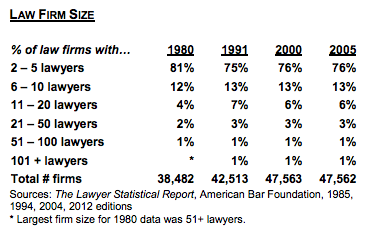
Law blog "Above the Law" is in my sidebar and often a good read.  But, a recent story of theirs, based upon this American Bar Association source, claiming that 95% of U.S. lawyers in private practice are in firms of 20 lawyers or less was not impressive.

The American Bar Association source that they relied upon was accurate, but the chart that Above The Law relied upon states that 95% of private U.S. law firms have 20 lawyers or less, said no such thing. The chart they reproduced in their story is this one:

law firm size

Based upon it, they said: "So 95% of attorneys in private practice work at firm with 20 lawyers or fewer."

The obvious tip off that they had it wrong, even if you were focusing on the numbers instead of the words in the chart, was the bottom line.  Yes, there really are more than 47,562 lawyers in private practice in the United States today (there are actually 1,300,705 lawyers licensed in the United States as of 2015 and there were more than 700,000-800,000 lawyers when I was in college and wrote a report for a class on the emergence of large law firms in the legal market).

Meanwhile, a chart immediately above it on the same page of the source states that only 74% of lawyers working in private U.S. law firms work in firms of 20 lawyers or less.  In fact, 49% of all lawyers in private practice are sole practitioners.

This is still a lot of lawyers in "Small Law", but not nearly as impressive as the inaccurate statement that they make in their story.

28 August 2013

97% of men in college and 80% of women in college have played video games often at some point

A study drawn from University of Texas-Austin students is making headlines, some based on misreporting of the story, about how often people play video games at the campus.
Potential participants were screened with a web-based questionnaire regarding their current and past video gaming habits. The principle items of the questionnaire were, "In the last year, how many hours per week do you tend to play video games?"' and "Prior to the last year, think back to the period in which you most frequently played video games. How many hours per week did you tend to play during that period?" Participants who reported 2 hours or less of video game play per week qualified for inclusion in the study. A sample of 816 prospective participants (463 female) were screened for inclusion in the present study. Only nine male respondents qualified based on their self-reported gaming habits, whereas 90 females qualified.
That’s right — the researchers had a hard time finding male participants who played computer games less than two hours per week, during the period in which they most frequently played video games, and not necessarily now.[1] 
[1] I’m pretty sure that the two-hours-per-week threshold was applied to the second question and not the first because only 90 of the 463 female respondents qualified, and “[f]or all female respondents, the median hours of current weekly game play was 1 (SD = 7.08) and 7 (SD = 12.6) at their most frequent.” If the two-hours-per-week threshold were applied based on current play, then well over half the women respondents would have qualified. Moreover, the study seems to discuss the eligible participants as “novice players,” which would likewise suggest that they were selected based on their never having played much.
The median male prospective participant played video games 8 hours per week (S.D. 9.2) in the last year, and 20 hours per week (SD 18.8) at a past time of peak play.  Given the other data it is fair to estimate that something like 10% to 20% of men at the University of Texas-Austin who inquired about the study had played less than two hours a week of video games in the last year.

The 90 female participants who qualified were a bit less than 20% of the prospective female participants.  The 9 male participants who qualified were a bit less than 3% of the prospective male participants.  This fits with a discussion of the literature in the study that states that: "In 2008, 72% of the general population and 97% of teenagers aged 12–17 reported playing video games."

Of course, one suspect that people who play video games very rarely may be disproportionately represented among people who don't answer web-based surveys about video game use with any eye towards being recruited as a subject in a psychology study.

Thus, most women and many men in college, however, currently don't play video games very often.

A number of blog reports inaccurately claimed that the cutoff was not two hours per week during the period in which you most frequently played video games, but two hours per day in the last year.  This is a far more extreme claim, although the number of male college students at the University of Texas-Austin who answered the survey and don't frequently play video games currently is still pretty modest.

The study's bottom line conclusion was that video game playing built valuable mental skills in novice players.


16 November 2012

Denver Post Misleading On Child Abuse Sentencing

A Denver Post story today on the sentences and prosecution practices found in child abuse and neglect cases notes that, on average, the sentences for these offenses and treatment of offenders in these cases is more lenient than it is for other felonies of the same grade (class 2 and class 3 felonies respectively).

The story fails to see the forest for the trees in this area of Colorado's criminal justice system, and gets the bottom line on this important issue in Colorado almost completely backward.

The Denver Post Is Not Making Apples To Apples Comparisons.

What the story completely neglects to mention, is that the sentences in child abuse and neglect cases in Colorado are more severe than they would have been if the same offense had been committed against anyone other than a dependent child.

* The class 2 felony "Child abuse resulting in death", CRS 18-6-401(7)(I), is the same crime as the class 4 felony of manslaughter, CRS 18-3-104, had it been committed against anyone other than a child (and generally speaking the offense is only applied to children who are in the care of the offender).

For example, if your reckless conduct causes the death of a child in your care, you are guilty of a class 2 child abuse felony (for which the average sentence is 29.9 years in Coloraod according to the Denver Post). If your reckless conduct caused the death of anyone else, you would be guilty of a class 4 manslaughter felony with an enhahnced sentence punishable by four to twelve years in prison.

The sentence actually imposed is about four times longer (about 22 years longer) than it would be for a case not involving a child.

* The class 3 felony "Child abuse negligently causing death", CRS 18-6-401(7)(a)(II), is the same crime as the class 5 felony of negligent homicide, CRS 18-3-105, had it been committed against anyone other than a child (and generally speaking the offense is only applied to children who are in the care of the offender).

For example, if you drive a car in a criminally negligent manner causing the death of your child who is a passenger, and also an adult stranger in another car, you are guilty of a class 3 child abuse felony (for which the average sentence is 13.6 years in Colorado according to the Denver Post), and you are also guilty of a class 5 negligent homicide felony with an enhanced sentence, which is punishable by eighteen months to six years years in prison.

The sentence actually imposed is about four times longer (about ten years longer) than it would be for a case not involving a child.

Even if you accept the legislature's judgment that a death from child abuse should be punished more severely than the homicide of a stranger involving comparable levels of intent, it does not follow that the additional punishment should be four times as long.

By way of comparison, in Colorado, a similar sentencing enhancement (three time the maximum sentence for the offense of conviction) is applied to offenders with two separate prior felony convictions within the last ten years. CRS 18-1.3-801(1.5). A four fold maximum sentence requires four prior felony convictions (but without within the last ten years limitation). CRS 18-1.3-801(2).

Is it really appropriate to enhance the sentence of a first time child abuse causing death offender by the same amount by which we enhance the sentence of someone with three or four prior felony convictions who has been convicted of a new felony?

The fact that judges and prosecutors exercise some very modest leniency in these cases, as demonstrated by the Denver Post's analysis, is entirely appropriate and reflects the widespread understanding of those who are involved in Colorado's criminal justice system, that Colorado's statutes punish child abuse much more severely than other crimes of comparable culpability in the state.

It is also important to recognize that a significant subset of child abuse causing death cases in the state involve prosecutions of seriously troubled young women who give birth alone, for example, in public bathroooms at a prom, who caused the death of their just born infant (often premature) while in the throes of having just given birth after having struggled with even acknowledging that they were pregnant.  Our society in not better off when these women are locked away in prison for fourteen to thirty years.  Leniency in cases like these alone is enough to reduce the average punishments metted out for child abuse offenses.

Losing A Child (And Other Children) Is A Punishment For Most Child Abuse Offenders

When you recklessly or negligently kill a stranger, the stranger's death, per se, usually isn't something that personally causes the offender to suffer (other than facing criminal punmishments and some generalized guilt).

Most child abuse causing death offenders are parents or guardians of a child who due to reckless or negligent conduct cause the death of their own child.

While there are some offenders who intentionally cause the death of their own child and don't regret having done so (who could have been punished for first or second degree murder in any case), the vast majority of child abuse offenders did care about and love their child, even though they did something seriously wrong that caused that child's death.

Losing a beloved child, even if it is a result of your own personal failings and is your fault, is a devistating loss to most child abuse causing death offenders. So, considering that point, some leniency relevant to someone who committed the same offense towards a stranger is justified.

Also, a conviction for child abuse causing death almost always results in the parent or guardian losing not only the child killed, but also having the parent-child relationship with any other children they have terminated.  This is another severe punishment for most child abuse offenders in addition to any criminal sentence imposed.

Reserving the harshest punishments for people who knowingly cause the deaths of their children (rather than merely recklessly do so), whom we may presume really haven't suffered as much from the death of their child, just as we do in the case of people who kill strangers (this is second degree murder, a class two felony) would be more appropriate.

Children Are Fragile

Many inexperienced, overwhelmed, low income parents (and this group of parents makes up a disproportionate share of child abuse causing death defendants), have not yet learned that children are more fragile than adults, and learn the hard way from the incident that caused the death.

While a child abuse causing death offender's conduct may have been reckless or negligent, it was also conduct that would often not have been fatal to an adult and that they didn't fully comprehend would be more harmful to a child. Thus, while it is often culpable and deserving of criminal punishment, on average, child abuse causing death cases often involve conduct that is less extreme and less culpable than manslaughter or negligent homicide cases.

Equally important, a far larger share of cases of child abuse causing death are cases where the question, "did the offenders conduct cause the death of the child?" is more seriously in doubt than it is in ordinary homicide cases. Given the inevitable reality that juries will sometimes make mistakes on the issue of causation, a less extreme sentence than one used in situations where the cause of death is not in the least in doubt in the typical case, is appropriate.  It is not uncommon for new medical analysis years later to determine that the death of a child for which a parent was sentenced to a long sentence of incarceration was not in fact caused by abuse as a jury concluded based on often sincere by inaccurate in hindsight expert testimony at trial.

Most Child Abuse Offenders Are Not A Great Threat To The General Public

The empirical research on criminal sentencing laws also demonstrate that even very harsh sentences for convicted offenders have minimal marginal impact in discouraging people from committing offenses in the first place. Almost all of the crime reduction benefits associated with long criminal sentences comes from immobilizing people who are at high risk of committing future crimes. Swift and reliable punishments of modest severity are far more effective at discouraging people from committing future crimes than delayed and uncertain punishments of much greater severity.

The main purpose of long sentences of imprisonment is not so much to punish the offender as it is to protect the general public from keeping the individual from horrifically reoffending and thus causing further harm.

Someone who recklessly causes the death of their own child is very often not nearly so great a threat to members of the general public as someone who knowingly kills a stranger, yet in Colorado, both offenses are class 2 felonies.

Likewise, someone who negligently causes the death of their own child is very often not nearly so great a threat to members of the general public as someone who knowningly causes seriously bodily injury to another or carries out an aggravated rape, which are also class 3 felonies.

These offenders may pose an extraordinary risk to other children in their care, if they are released.  But, there are far less costly ways of addressing this, such as a lifetime parole requirement barring child abuse causing death offenders from having children in their care that is regularly audited by state officials.

The Cost Of Incarceration Is Better Spent Elsewhere

An extra ten years in prison for a negligent child abuse causing death offender relative to a negligent homicide offender, costs the State of Colorado something on the order of $300,000. It also deprives that person and their family (quite possibly siblings or a parent of the child who died) of ten years of financial support from that person's earnings and deprives the government of ten years of taxes that the offender would have paid.

In the case of a child abuse causing death case where the offender is reckless rather than merely criminally negligent, the additional cost to the state is twice as great.

As other stories in the Denver Post series have made clear, many of the overlooked cases of child abuse that are reported and ultimately cause death in Colorado arise from a lack of funding for child protective services resources. Diverting money from longer sentences for convicted child abuse causing death offenders to child protective services funding would make a difference.

The amount of money saved by having sentencing in child abuse cases comparable to the sentences that would apply in the absence of Colorado's child abuse statute, could easily prevent at least one and often more than one additional child abuse death if spent on prevention rather than punishment. The incredible waste arising from Colorado's harsh statute makes children less safe, not more safe.

Bottom Line: Colorado's Child Abuse Sentences Are A Case Of Legislative Hysteria

In short, Colorado's legislators, seeking to look like they were taking tough action on an important and emotional social issue, child abuse, enacted laws that impose grossly disproportionate sentences for child abuse offenses relative to comparably culpable crimes committed against strangers.

The Denver Post article, by screaming out a headline that makes it look like Colorado is punishing these offenders leniently, when in fact, it is punishing them extremely harshly, irresponsibly undermines efforts to make rational reforms of these laws that currently wreck lives and fail to take the kind of constuctive actions that could really help address this serious social problem.

06 November 2012

Denver Post Getting Eager On Amendment 64

Have the Denver Post's political reporters been smoking weed in anticipation of marijuana legalization now that polls favor the passage of Amendment 64 in Colorado?

Otherwise, it is hard to explain the following statement on the front page of the paper's "Nation & World" section (Page 17A) today in a story attributed to David Lightman of the McClatchy Newspapers:

Conventional wisdom says Democrats tend to dominate early voting, while Republicans do better on Election Day, so a big turnout could mean a big day for Romney.


Hello! On what bizzaro world was this written? First of all, as Colorado returns have shown this year and every year, Republicans lead in early voting.

More importantly, a big turnout almost always favors Democrats whose voters are less reliable. This is why Republican operatives consistently work hard to suppress voter turnout, while Democrats consistently cry foul over these practices. The higher the voter turnout is today (which is election day), the more likely it is that Romney will do poorly.

How can anyone who regularly follows and reports on politics be so wrong?  And people say blogs are unreliable.

27 July 2006

Worthless Partisan Journalism

Not all partisan journalism is worthless. Indeed, there is an upsurge in stories with a political motivation that add to the debate. If I didn't believe that I wouldn't write for Colorado Confidential or ready Daily Kos. But, some partisan journalism, even at big name traditional media outlets that should have better quality control, is worthless.

Case in point: Yesterday's article by Ramesh Ponnuru in the National Review. If you say that a U.S. Supreme Court decision in the biggest case of the year is wrong on a key issue because of "simple factual mistakes," you had better get the story right. Ponnuru doesn't.

I would going to write a takedown of the story, but Emily Bazelon at Slate did an excellent job of doing just that, so I don't have to. One of the key points that Ponnuru just doesn't get is that:

They criticized the Hamdan lawyers for saying their colloquy wasn't live, asserting "the Congressional Record is presumed to reflect live debate except when the statements therein are followed by a bullet … or are underlined" [their italics]. As I wrote, this is entirely misleading. But Ponnuru omits Graham and Kyl's obfuscation. . . . Kyl and Graham . . . submitted a brief to the Supreme Court suggesting falsely that their testimony was live and implying that their views were public when they weren't.


It is one thing to insert written materials into the Congressional record, which everyone does routinely subject to full disclosures that it wasn't really live. It is quite another to doctor the record to make it appears live when it is not, and then claim in the U.S. Supreme Court brief that it was a live debate. That stance violates ethical standards for both Senators and for the attorneys who represented them in the U.S. Supreme Court.

Alas, the corruption of the Republican controlled Congress knows no bounds. It both doctors the Congressional record, as it did here, and also ignores even basic constitutional provisions like the one that says that a bill won't become law until both houses of Congress pass identical versions of it.

There are plenty of issues upon which politicians can have legitimate policy disagreements. Resolving those is why we have a Congress in the first place. But, accurately representing what transpired in a bill's legislative history, and getting bills passed in identical versions by both houses of Congress are not subjects upon which anyone who believes in democracy or rule of law can accept as legitimate.

Incidentally, this isn't the first time that Ramesh Ponnuru has been full of shit.