Showing posts with label water. Show all posts

22 April 2026

Oil And Water

Scarcity of oil and rising petroleum prices, and climate change driven drought, are a big deal. But there are fairly clear paths by which our society can adapt to both. Neither would be apocalyptic, even though it would drive significant, visible changes in our day to day material culture.

These matters are particularly worth thinking about on Earth Day, which is today.

Oil

A very large share of all petroleum consumption is for transportation, mostly cars, trucks, construction vehicles, boats, ships, and trains. Advances in battery technology, and EV manufacturing and infrastructure are making electric vehicle alternatives to all of those technologically viable. And, advances in renewable energy and nuclear power can replace almost all of the fossil fuels in the electrical power grid. Coal is well on its way to be phased out in the United States and much of the developed world. Alaska and Hawaii are the only U.S. states where a significant share of electricity is generated from petroleum. Heat pumps are paving the way as an alternative to heating buildings that were historically heated with heating oil in the U.S. (mostly in the Northeast). 

Heat pumps and evaporative coolers (together with better insulation) also dramatically more energy efficient than conventional air conditioning, and renewables like solar and wind combined with modern batteries are particularly well suited to meet the demand for electricity to provide cooling.

Lots of fertilizers that are petroleum based could also become unaffordable, as they have as global petroleum supplies have been interrupted by U.S. and Israeli attacks on Iran, and its counterattacks. But organic farming techniques are now well established enough that these methods pose an obvious alternative path for agriculture is petroleum based fertilizers cease to become economically viable. Dutch models of intensive hydroponic agriculture suggests another off ramp from what is now considered conventional agriculture.

There are some applications where there aren't good alternatives to petroleum, like plastics and jet fuel. But these are such a small share of total petroleum consumption that these uses could be sustained, even if they become more expensive, even if petroleum prices soar and the supplies contract greatly. 

Of course, plastics and petroleum based fabrics like nylon, have only been in wide use for about sixty years. If plastic becomes too expensive, we can revert to using metal, glass, wood, and plant and animal fiber alternatives for applications like kitchen ware and trash bins that aren't uniquely suited to plastic, as traditional alternatives becomes more affordable relative to plastic with rising petroleum prices.

The changes wouldn't be geographically neutral. A collapse in demand for petroleum driving by electric vehicles and organic farming would crush the economies of petrostates in the Middle East, in Brunei, in Nigeria, in Venezuela, and in select states within the United States. West Virginia has already seen its coal based economy collapse, as have many historically coal mining economy based regions in Europe. Wyoming will follow suit. 

On the other hand, rare earth rich areas who supply key components of modern batteries and electronics, may see mineral economy booms.

Water

In most of the arid west, marginal agricultural activity consumes 80%-90% of all fresh water, while landscaping and golf courses consume about half of the rest of the fresh water. If water becomes scarce, entire regions can eliminate their water hungry landscaping, golf courses can close or become much more expensive or use artificial grass, and marginal agricultural operations can close.

In places like the Arabian Peninsula, Greece, Utah, and California, desalination technology might become more prominent as a water source, at least for high value municipal waters uses like drinking, cooking, and bathing, and gray water systems would use non-potable water (such as salt water from the ocean or salt water lakes) in applications where drinkability wasn't important, like flushing toilets.

Climate change that produces global warming ultimately both gives and takes away arable land. It renders much of the arid West unsuitable for farming and ranching, but makes places that were too cold for farming in the past, more suitable for it. Even when climate change doesn't actually change the total amount of arable land somewhere, it may change the kind of agriculture that is appropriate in that place.

Places that used to support subtropical orange groves may freeze more often and get dryer and become more suitable for cotton and the soft wheat varieties currently grown in places north of Florida in the American South. Crops now grown in the South might start to be grown in the Midwest. The abundant corn and wheat fields of the Great Plains and Midwest might move north to Canada. The Great Plains might transition from grain farming to cattle grazing.

I'm not a climate scientist. I don't have exact models of exactly when and where climate zones that are suitable for particular crops and livestock will relocate. But that's the basic concept.

The ongoing wars across the Sahel of Africa illustrate how ugly the process of having herders ecologically forced into historically horticultural land can be without strong geographically large states to force the transition to be made with money instead of violence can look. But with strong states that remove violence as a viable option, the transition, while still massively disruptive, could be less tragic in places like North America and Western Europe.

Similarly, the skiing industry might relocate from places like Colorado and Vermont to places like the Yukon and Alaska, in North American, and from places like the Alps in Europe to the northern Urals and the Himalayas in Eurasia.

Many Sunbelt communities in places like Arizona and Texas and Florida may see the waves of migration to avoid the cold winters of the north replaced by migration north to avoid the months of hundred degree plus water in the Sunbelt which are already commonplace in cities like Phoenix and Las Vegas, while the rust belt, with its winters made milder due to global warming and abundant fresh water, may start to look more attractive, and may attract mass return migrations.

One of these days, people in the Sunbelt may return to the traditional solution of having midday siestas, inside cooler, shaded adobe insulated homes, and becoming more active once the sun goes down and the air cools late into the evening.

Coastal communities will have to build dikes or lose land area as sea levels rise, and many will have to remake their architectural landscape in the face of increasingly severe storms, something that will hit the U.S. states of Florida and Louisiana and some islands in Oceania particularly hard.

Species limited to narrow microenvironment ranges will go extinct en masse, as human encroachment upon their habitats, ecological disruption, and human predation have already done to many species already.

How fast will it happen?

We are, in 2026, at about the place on this path that we thought we'd be in the year 2006, back in 1986. Events like the transitions to EVs and heat pumps and renewables and industrial scale organic farming happened, but it took about twice as long as futurists at the time thought that it would.

Climate change, on the other hand, is happening faster than expected by a decade or three. The changes that were initially looking like they would take a century to run their course are now looking like they will occur in half of that time.

Certainly, these transitions are medium to long run trends. They will probably takes decades more to run their course. These transitions probably won't be complete in my lifetime, although they probably will run their course in the lives of my children, or at least, in the lives of my future grandchildren. Less poetically, this time frame is about 30-90 years.

But these trends are both massive and inexorable, like plate tectonics but much, much faster. Fast enough that it will be visible in future tree ring records.

Conclusion

These are huge, traumatic changes that will force mass migrations and fundamental changes in people's day to day culture. But they don't mean the end of modern life as we know it either. And falling birthrates will eventually lead to smaller global and regional populations that put less strain on scarce water and fossil fuel resources.

05 August 2025

The Proposed Mega Sports Complex For Douglas County


Artist's rendering from Douglas County via the Denver Post

The Project

The controversial Zebulon Regional Sports Complex in Douglas County is set to break ground this fallIt is a $1.3 billion project planned for a site near Chatfield Reservoir in a brownfield development with "an old dynamite-making plant that operated for decades at the proposed Zebulon site" although it purportedly has been fully remediated. The state signed off on that conclusion in 2022.

The plans for the Zebulon Regional Sports Complex are huge.

On the drawing board are four baseball fields, three ice rinks and a pair of soccer fields. Eight to 10 basketball courts — which can be converted into 20 volleyball courts or 30 pickleball courts — are also in the mix. Add in a 400,000-square-foot, domed indoor sports facility that will house more fields for year-round play. . . .

And that’s just the first phase, which could break ground as soon as this fall on a 50-acre parcel just southeast of the master-planned Sterling Ranch community. Later phases could bring as many as eight additional sports fields, along with restaurants, shops and a hotel[.]

Does It Pencil?

I've worked with clients to help vet a similar proposals on a smaller scale, so I have so familiarity with the economics of these deals. For the life of me, I can't see how this could pencil as a "for profit" private sector venture at this scale in this location.

Sure, there is unmet demand in the area, which has had and continues to have large subdivisions rolled out over the last few decades (like 12,000 homes in Sterling Ranch which will house 35,000 people when completed that is only 20% built out), without sufficient government investment or HOA in community amenities. So, a much smaller private non-profit or public sector recreation center run by Sterling Ranch's metro district might work.

But, the demand just isn't there for something of this scale, and a similar but smaller complex in Centennial isn't thriving.
[A] citizen survey conducted last year by Douglas County ... revealed [that] a “mega-sports complex” was identified by 33% of respondents as the “least appealing option” of a list of potential amenities. The survey also showed that just 22% of respondents were dissatisfied with the number of youth sports facilities in the county.
Another smaller recreation center is already on the drawing board for Highland's Ranch which would be between the South Suburban Recreation Center twenty minutes to the east and the Zebulon complex.

The county investment is about $800K in engineering planning for infrastructure (realistically, a drop in the bucket) and a portion of the about $22 million a year in revenues for the the next 15 years from the county's 0.17% sales tax for its Parks, Trails, Historic Resources and Open Space Fund established in 1994.

But even this investment is controversial, in part, because the county leadership whose home rule county proposal epically crashed and burned in June, and which has a history of infighting and political posturing, isn't popular and doesn't have much public trust.

Moreover, as a "for profit" it probably isn't eligible for municipal bond financing with private activity bonds. This project would probably have, at best, a BBB credit rating implying roughly a 6.1% corporate bond interest rate, while a comparable municipal bond would have roughly a 3.6% interest rate, which is a $32.5 million a year difference for an investment of this size. Municipal bond eligibility, that it could receive as a non-profit, would be worth more than all of the sales tax revenue that could be diverted to the project.

There are a few other sports complexes with a similar (but slightly smaller than the proposed full build out) scale in the metro area, the South Suburban complex further east in Douglas County, one in Arvada, and one in Jefferson County (IIRC). But those are strictly government owned and funded, and the most similar South Suburban Parks and Recreation District facility further east, in Centennial, doesn't seem to be thriving.

Bottom Line Analysis

Philosophically, the fact that it is a brownfield development is a good thing, the fact that it provides amenities in a rapidly growing community with unmet needs is a good thing, and the fact that the risk that it will be an unprofitable money pit will fall mostly on wealthy, private sector, for profit, investors with only modest public subsidies is a good thing. It is also estimated to create 1,800 temporary jobs to build it, which is a good thing in what is mostly a bedroom community, where construction work for its huge sprawling suburban subdivisions is winding down due to factors like a limited supply of water for new taps.

But the fact that the proposal appears to be vastly bigger than the realistic demand for recreational facilities, the fact that the public is subsidizing a for profit company (even if it isn't a professional sports team), and the fact that it doesn't have much public support when the public will be providing significant sales tax funding support to the project, aren't good things.

An independent non-profit project, or metro district, or South Suburban Parks and Recreation District (with annexation of additional territory, if needed) sponsored project, that is less ambitious, with more phases to allow experience to determine if demand justifies something larger, would make more sense, in my opinion.

15 May 2025

Residential HVAC Economics And Environmental Considerations

I live in a 100 years old house in central Denver with natural gas boiler driven steam heat radiators (the steam heat boiler was originally coal fired, which is not an option now, then converted to gas, and then replaced) and a swamp cooler. (I'm looking at this now because my 24 year old swamp cooler is replaced for the first time today.)

Is this the best choice from a cost perspective? 

Yes.

Is this the best choice for the environment?

Probably, although a heat pump is quite competitive from an environmental perspective and will grow more attractive as the power grid in Colorado becomes greener over the next decade or two.

Cooling

In Denver, swamp coolers (a.k.a. evaporative coolers) generally cost less to operate than heat pumps, especially during the cooling season, in part, because Denver's humidity in the summer is low. Swamp coolers use significantly less electricity than air conditioners, often saving 60-80% on energy costs. Heat pumps are about 50% more efficient than central air conditioners, but swamp coolers still draw 20% to 40% less electricity than heat pumps. See here and here. All three cooling costs are powered by electricity, so the relative energy costs are indifferent to the price of electricity.

Swamp coolers do use some water than heat pumps and central AC systems don't use. But this is pretty negligible in terms of the cost of well under a dollar a month (you pay for tap water at prices on the order of a few dollars per 10,000 gallons, and a swamp cooler uses less than 900 gallons a month and is only operating about five months a year, so the water costs are less than $3 per year). This is also pretty negligible in terms of the swamp cooler's share of total water consumption. In contrast, water for landscaping uses about half of our water consumption despite the fact that we have only a couple hundred square feet of lawn.

The maintenance costs of a swamp cooler are a little bit greater than for central air conditioning and heat pumps, however, because they have to be started up every spring, and shut down every autumn (filter replacement costs are comparable for central air condition and swamp coolers), but this can be a DIY maintenance job if you are up for it, and the costs is significantly smaller than the energy cost savings involved.

Also, a swamp cooler is much simpler and less expensive to repair than an air conditioner or heat pump because it is mechanically simpler. A swamp cooler has one simple electric motor that runs a fan, and the water flow is controlled by a float system similar to one in a residential flush toilet. A broken swamp cooler take much less time, much less skill, and much less expensive parts to fix than a broken air conditioner or heat pump. Higher end and newer swamp coolers are also more resistant to rust than older models.

And, the up front installation cost of a swamp cooler is lower than the installation cost of an air conditioner or heat pump, even without utility or government incentives, although rebates from Xcel Energy to encourage swamp cooler use improve this comparison.

A heat pump or central AC can reduce temperatures a bit more than a swamp cooler does. But this only matters at all for maybe the ten or twelve hottest days each year, and even then, with a good quality swamp cooler like the one we are having installed, the difference is tolerable and isn't huge. And, the humidifying effects of a swamp cooler also make a home more comfortable in the very dry, almost high desert conditions of Denver summers, relative to air conditioning or a heat pump, once you get used to it. Both a swamp cooler and central air conditioning do suck in the sometimes polluted outdoor air into the house on low air quality days which we get plenty of in Denver in the summer. But a swamp cooler does a better job of filtering that air than a typical central air conditioning filter does.

Environmentally, apart from energy costs, swamp coolers are also better, because they don't need the chemical fluids required for heat pumps or central AC to move heat outdoors (or to suck subsurface cool temperatures into your home).

Heating

In Denver, a gas boiler steam heat system is about 25% cheaper in fuel costs (at current natural gas and electrical prices from Xcel Energy which is about $1.26 per therm for natural gas and 20 centers per KwH for electricity) than a geothermal heat pump. See this calculator. In fact, this is the least expensive heating option of all of the possible alternatives, including gas forced air furnaces, wood stoves, pellet stoves, heat pumps, heating oil, kerosene, propane, or electric baseboard heating.

A couple of years ago, we replaced our old natural gas boiler (which had been converted from the original one hundred year old coal fired boiler), which is much smaller, is easier to operate and maintain, and is slightly more efficient, than our old one. It is much less expensive to replace a natural gas boiler for an existing steam heat system than it is to install a new heat pump system of any kind in a building that previously had a steam heat radiator system. I suspect that it would also be cheaper in new construction, but the installation cost advantage in new construction would be much less decisive.

Heat pump installation costs also have to be compared to the combined installation cost of both the cooling system and the heating system, because it does both jobs. And, in new construction for a new subdivision, using a heat pump and an electric water heater, instead of natural gas heat and other natural gas appliances and water heaters, avoids the substantial costs of building a subdivision with deeply buried natural gas pipelines serving each home. So, again, when building new construction homes in new subdivisions, the installation cost economics for heat pumps v. natural gas heating are much different than they are with existing construction in which every home is already served by natural gas pipelines.

The steam heat boiler does consume water that the heat pump or a gas forced air furnace would not (although many gas forced air furnaces have a humidifier built in that uses considerably more water than a steam heat boiler per year), but this too is negligible in both cost (less than a dollar per year) and the amount of tap water used (probably less than 90 gallons a year), since it is an almost closed system that recycles the water and only loses a little bit each cycle to evaporation at the boiler point. Our steam heat boiler has a water filter that needs to be replaced twice a year (because a lot of our pipes are old and made of galvanized steel and have some rust in them) at a price comparable to the cost of an air filter for a gas forced air furnace (which is not necessary in a heat pump) but this is also negligible compared to the differences in energy costs.

In terms of the in home results, radiator based steam heat is much nicer than gas forced air heat, because it doesn't dry out the air (an issue that a built in humidifier only partially addresses) and doesn't drag polluted outdoor air into the house on poor air quality days which Denver has plenty of, even in the winter.

Historically, heat pumps have been used primarily in the South in the U.S., where high humidity during long hot summers makes evaporative coolers useless in the summer so homes need either air conditioning or a heat pump to be comfortable in the summer, where it doesn't get that cold in the winter so the amount of heating needed is modest enough that infrastructure costs necessary for natural gas or heating oil based heating systems didn't make sense, and when heat pumps were less effective than they are today at heating homes in the winter. Since the infrastructure and installation costs of central air conditioning and a heat pump are similar (although geothermal heat pumps are a bit more expensive to install than central air conditioning), the marginal cost of a heat pump over the central air conditioning that you would otherwise need in the South was modest (technologically a heat pump is basically an air conditioner that you can run backwards), it made sense there to heat homes with a heat pump. Also, since the amount of heating degree days per year in the South is pretty modest, the greater summer cooling efficiency of a heat pump relative to central air conditioning pretty much pays for the energy costs of providing heat on infrequent and mild winter days in the South. And, since the amount of energy needed for fuel for the winter for a heat pump in the winter in the South is pretty modest, saving a little money with a cheaper fuel was relatively less important than saving money by reducing the installation costs and having more energy efficient summer cooling.

Modern heat pumps, especially geothermal heat pumps, that are well suited to colder climates and designed for them, are now widely available. But this wasn't the cost effective option when Northeastern homes overwhelmingly were heated with heating oil, and Midwestern homes and western homes in places with cooler climates were overwhelmingly heated with natural gas. And, as noted above, the economics of heat pumps are a lot more favorable in new build construction, especially in new subdivisions that dispense with creating natural gas pipelines to every home, than they are in homes where the old heating and cooling system needs to be torn out and replaced by a new heat pump (especially in homes with boiler based heat rather than forced air heating and cooling ducts).

Environmentally, at this point, it is a bit of a wash.

Natural gas in a home boiler burns almost as efficiently and cleanly as in a utility scale natural gas power plant (and is more efficient and less polluting at turning natural gas into heat because it doesn't lose energy by converting heat to electricity, losing electricity in transmission lines, and converting electricity back to heat again). And, natural gas creates much less air pollution than coal or firewood or pellets or propane or kerosene or heating oil in a home boiler, and creates less air pollution per unit of energy used than a utility scale coal fired electrical power plant.

But the air pollution caused by generating the electricity in the grid, in part from coal, and less efficient (for heat production) natural gas, is offset by the fact that about 45% of the electricity in the grid comes from hydroelectric, solar, and wind power in Colorado.

Natural gas also creates toxic pollution in the ground in the extraction process (a significant share of which comes from fracking), and that toxic extraction process is used to provide 100% of the fuel for a home natural gas boiler, but only less than half of the fuel for the power grid. But, the mining done to extract the coal that is the source of a still significant share of the electricity in the Colorado power grid, is much more toxic and creates far more harms to workers and the public from the extraction process alone (ignoring the air pollution) than natural gas extraction does (even considering the harms of fracking).

As more of Colorado's power grid comes from renewables, and less of it comes from natural gas, and coal is eventually virtually eliminated as a source of electricity for the Colorado power grid, electricity will eventually be greener than natural gas, but this will still be partially offset because a home boiler still generates heat with less energy than the power plant generating the energy needed for a heat pump does. So, even as the grid gets cleaner and tilts a little more in favor of heat pumps relative to a natural gas boiler, the environmental difference is still going to be pretty modest.

Home Based Solar Power Considered

Last year we got a detailed bid for the solar power system that our particular home could support in terms of power generation capacity and cost.

In terms of the cost of the electricity, it could have met almost 100% of our current electrical demand at a cost that would be about the same as buying electricity from Xcel Energy at the prices we are paying for electricity now, over the next twenty years (with substantial Xcel energy rebates and government tax credits). So, this wouldn't have changed the cost calculus discussed above, although having our own solar power with some sort of battery storage would have given us a hedge against rising electricity prices from Xcel over time.

But, given the rapid rate at which solar panel prices are falling, and the rapid improvements that are in the works in battery technology, it might be cheaper to get a solar power/battery system and the product might have better quality a decade or so from now, even without rebates and tax credits.

And, the fact that our house is a hundred years old and has roof framing that is almost surely not up to current building code standards was also a consideration. The rooftop solar power installation might have disturbed that by putting more of a burden on the roof or just damaging the existing roof framing in the process in a manner that in a worse case scenario might have required a major structural repair job to bring our roof framing up to current building code standards, in a half duplex where that kind of repair would also have to involve the owner of the other half of the duplex.

Solar power would have insulated us from temporary disruptions in our electrical service from Xcel (which typically range from a few minutes to a couple of hours and happen at most two or three times a year, with outages of more than a couple of minutes only once every few years).

It would have been environmentally cleaner, of course to get 100% of our electricity (on average) from solar power, although the environmental benefit of this would be reduced over the next couple of decades as the Colorado power grid gets greener.

If we were building this home new at this time, we would probably have opted for solar power, particularly if it was in a new subdivision that didn't have natural gas pipelines in place to every home. But as this stand, the benefit of getting rooftop solar power was not decisive enough for us to justify the time, trouble, and disruption to our lives in connection with the installation work and any possible follow roof repair work that might be needed, to justify making the change now.

12 August 2024

Converting To Residential Solar Power

So, lured by various trivial goodies (a nice steak dinner and a gift certificate), we got a solar power estimate for our little half-duplex.

A minimal build would provide 87% of our electrical needs, a maximal one would provide 131% (which would leave capacity for a future electric vehicle buy which is probably about six to ten years off when our current car, with only 54,000 miles on it after nine years is replaced and EV battery technology has improved), and the build we would most likely actually buy if we did it now would provide 107%.

It would require 8-10 panels on our roof and detached garage roof combined. The entire process would take about two months with one day of on site installation.

It would pay for itself in about 15 years if we paid for it up front (not including a battery backup for the house), but the economics are significantly less attractive if you finance it (they offered 8.49% APR financing). It would probably also modestly increase our homeowner's insurance due to the increased risk of hail damage claims (the better options are supposed to withstand 14 mm hail). This pricing is after a 30% federal tax credit that is not refundable, but can be carried forward. 

Of course, it is also a hedge against increased electricity service rates (much like a fixed rate mortgage but for electricity), and would mean that our home would be powered with 100% clean, renewable electricity.

A whole house backup power battery (that Xcel could also tap into in some circumstances), with about 24 hours of power stored, would cost another $15,000, but with a roughly 80% subsidy (with the State of Colorado and Xcel energy paying for about 50% in addition to the federal government's 30% credit).

Our experience over the last twenty-four years in Wash Park, however, has been that power outages are infrequent and short, and so a whole house battery probably doesn't justify the expense even with an 80% subsidy. Depending on the electric vehicle we purchased, we could probably even use that for backup power.

We will probably not bite yet, because we have other more urgent home improvements to make (our range-oven, and our evaporative cooler both need to be replaced in the near future, and we'd like to kill the remainder of our lawn). Also, solar panel prices have been plummeting and it isn't clear if we are at the bottom of that trend yet.

Still, if I was building a new house, I'd probably include solar panels and a battery backup for the house. A maximal solar power installation would also be more attractive if we had an electric car and/or if we had a heat pump instead of natural gas heating. 

In a new build, I'd seriously consider a heat pump (and better home insulation), an electric water heater, an indoor electric range, and an electric car charging station, to eliminate the need for a natural gas line entirely (although I'd have, at least, an outdoor gas grill and gas fire pit under a non-air tight gazebo fueled with small propane tanks). 

Honestly, it is impressive how much it is possible to free yourself from fossil fuels and to have zero or near zero net energy consumption at the grass roots level.

Other observations

In the course of gathering information about that, we also figured out our household's total energy consumption expense (electricity, natural gas, and gasoline for our car) which is about $200 a month, compared to a $340 per month average in Colorado and compared to a significantly higher average for the nation as a whole. 

About 14% of our electrical consumption is for seasonal cooling (an evaporative cooler and a ceiling fan). About 82% of our natural gas usage is for home heating in the winter (the balance is for a natural gas cooking range and natural gas water heating).

And, since the our household utility bill files were out, we also examined our water usage. The Colorado average is that about 50% of household water consumption used for landscaping (i.e. watering the lawn). In our case it is about 33%, since we have such a tiny lawn. Our water consumption is also well below average (as expected, now that we are empty nesters with a tiny lawn). Water for the lawn (at the higher summer water rate) costs us about $80 a year, which also has to be mowed, fertilized, weeded, etc.

14 April 2024

Sunday Musings

 * The United States is deeply politically and culturally divided, and it has had a few political dynasties. But, ultimately, the U.S. has at least largely resisted the hereditary principle and clan politics. We have oligarchies of big corporations, but those big successful corporations, while not entirely free of it, are not hotbeds of nepotism either. Father to son CEO succession happens, but it is rare, and tends to happen second tier businesses not in big national S&P 500 companies.

* We are approaching a point where it may make sense to declare war on both Iran and its proxies like Hezbollah, Hamas, the Houthis, and Iranian militias in Syria and Iraq. The Houthis have directed piracy and missiles at commercial ships in the Red Sea and their insurgency has led to one of the worst famines in the world in Southern Yemen which has historically been the bread belt of Arabia. (It is worth nothing that both sides of the civil war in Yemen are united in their hate for the United States.) Hamas carried out the October 7 attack and has continued a suicidal response by Gazans to Israeli retaliation. Hezbollah in Lebanon has been lobbing artillery and missiles as Israel for decades. Iranian missiles recently killed a detachment of U.S. troops in Jordan. Iran has fired several hundred missiles at Israel in the last few days, has been in multiple skirmishes with U.S. Navy forces in the Persian Gulf, and has terrorized commercial traffic in the Persian Gulf.

* The U.S., admittedly, plays an important part in Iran's ascendancy. U.S. support for the Shah in Iran played an important rule in the 1979 Islamic Revolution in Iran that put the current regime in place. Sanctions the U.S. pushed for caused Iran to develop its own domestic military production (something similar happened as a result of sanctions in Israel, in South Africa, and in Turkey), and also pushed Iran into Russia and North Korea's circle of allies. U.S. military intervention in Iraq and Afghanistan defanged Iran's neighbors who were among its greatest military adversaries. Dislodging the neo-Communist dictatorship in Iraq opened the door to Iranian backed Shiite party political gains there. Encouraging Arab Spring revolutions in Syria contributed to the Syrian Civil War that still isn't over and has created a vacuum for Iranian backed militias there.

* Golf courses are a waste of water in the arid west:


About 1% of total Colorado water consumption goes toward golf courses (this is about 5% of non-agricultural water use):

In its 2021 economic and environmental impact report, the Colorado Golf Coalition, a collection of state organizations, reported that the industry’s water consumption represents less than 1% of the state’s 2018 total — 41,213 acre-feet, compared with 4.7 million acre-feet for agriculture, the largest consumer.

It also touts the positive environmental impact of its more than 33,000 acres of greenspace statewide, of which a little more than 16,000 acres constitute irrigated turfgrass, species like bluegrass that can endure high traffic and low mowing heights ideal for golf. That’s more than 17% less irrigated acreage than in 2002.

By region, the courses in the Denver metropolitan area account for more than 43% of the irrigated acreage. Since the 2002 measurements, Colorado courses have increased use of reclaimed water and significantly reduced use of municipal sources.

Still, golf courses have joined lawns as targets for restrictions in places like Aurora, where Mayor Mike Coffman invoked the “new reality” of water scarcity in Colorado in support of a proposed ban on new courses — unless they employ the buffalo and blue grama long a staple on the Eastern Plains — as the city looks at limiting grass yards, medians and decorative office park areas.

In fairness, golf courses in the arid west have made very significant efforts to reduce their water consumption; far more significant efforts than agricultural users have.

* Agriculture and evaporation consume all but 18% of water in the Colorado River basin (and that 18% includes a significant portion for lawns and golf courses). About 70% of agricultural water is used for cattle feed, mostly alfalfa and to a lesser extent hay, according to a Denver Post analysis:


* Despite its immense water use, agriculture is almost economically irrelevant in Colorado.

* According to Denver Water, household water used breaks down as follows:

54% landscaping
13% toilets
11% laundry
10% showers and baths
6% faucets
5% leaks
1% dishwashers

* The Southwest is, however, a naturally ideal place for solar energy (and it doesn't hurt that a lot of the electricity demand there is for air conditioning which coincides with solar energy availability):

* This week I learned that there are both role playing games and video games in which the protagonist that you play is a bird.

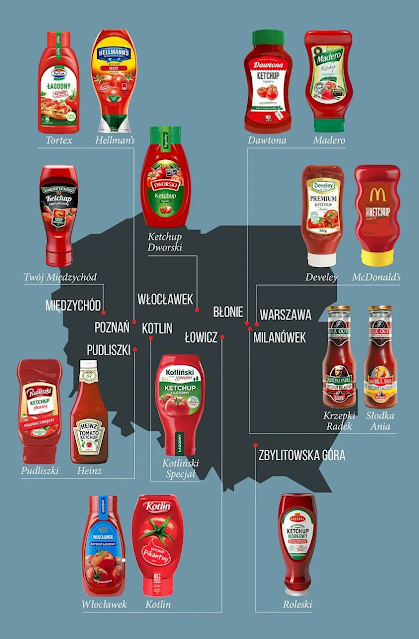
* It turns out that a certain part of Poland is the heartland of ketchup production (a widely used product there):


The Polish Ketchup Belt is a narrow lane between the 51.5N and 52.5N parallels where almost all ketchup production in Poland is concentrated. (Source)

* Ukraine has made strikes deep into Russian territory:

It is 755 kilometers from Ukraine to Moscow and there are numerous Russian refineries and oil storage sites to attack along the way. Ukraine has been attacking those oil facilities and . . . the damage to oil facilities and other targets has been so great that Russia has had to ration how much fuel civilian and military users can get. It is estimated that the Ukrainian attacks destroyed twelve percent of Russia’s oil refining capability.

* Bible reading has recently fallen dramatically in the U.S.:


 * Coal use is up globally, despite falling in the U.S., the U.K., and a number of European countries, due predominantly to new coal fired power plants in Asia:


Greece's failure to tap into its abundant wind power capacity and its near ideal geography for electric cars, baffles me. The same can be said for Hawaii.

* Turkish people drink a lot of tea.


* According to data cited the Economist magazine, South Korea has an intense "glass-ceiling" for women in the workplace, which surprises me. I had thought that the situation for South Korean women who didn't marry or had kids was pretty good.


* Early 19th century grave robbing was driven by incentives you wouldn't expect:

At the 1815 Battle of Waterloo, Napoleon Bonaparte’s final battle, more than 10,000 men and as many horses were killed in a single day. Yet today, archaeologists often struggle to find physical evidence of the dead from that bloody time period. Plowing and construction are usually the culprits behind missing historical remains, but they can’t explain the loss here. How did so many bones up and vanish?

In a new book, an international team of historians and archaeologists argues the bones were depleted by industrial-scale grave robbing. The introduction of phosphates for fertilizer and bone char as an ingredient in beet sugar processing at the beginning of the 19th century transformed bones into a hot commodity. Skyrocketing prices prompted raids on mass graves across Europe—and beyond.

* In the Netherlands, the interest rate on a particular mortgage fall over time to reflect the reduced risk of loss to lenders as the debt to equity ratio falls as principal is paid off and real estate appreciates in value. But, this also disincentivizes selling one home to move to another, or refinancing.

* Average hourly wages vary greatly across Europe:

* In Ray Bradbury's short story "All Summer In A Day": "The children let Margot out of the locked closet at the end of "All Summer in a Day." They had locked her inside while the teacher was elsewhere, making Margot miss the sun, which only comes out every seven years." It was a story the affected me greatly as a child and still does.

* Skunks are an American thing. The skunk family (Mephitidae) consists of 13 species, and almost all are restricted to the Western Hemisphere, reaching from Southern Canada to the Strait of Magellan in South America. The exception is the Stink Badger which can be found in Indonesia.

* Gasoline prices, adjusted for inflation, are similar or lower now than they were in 2006. U.S. mortgage interest rates are middling by historical standards and historically low rate until recently may have helped drive up real estate prices:


* High rise office buildings are plummeting in value.

* There were once more than 9,000 Blockbuster video stores. There is now one, in Bend, Oregon.

* What's better with Jalapeños?

1. Pizza.
2. Beer.
3. Lemonaide.

* Humans are basically fish in flesh suits and our blood is a decent approximation of sea water. An image gets across the concept:


*  There ought to be a law disqualifying judges from deciding cases involving the person who appointed them as a party (in the appointing person's personal, as opposed to their official, capacity).

* Trump does not have legitimate defenses in the classified documents criminal case against him, despite the fact that a judge he appointed seemed to be "confused" about this point.

19 May 2023

What Has Driven Urban Density Changes In The U.S. Over The Last 70 Years?

Living in the West, we've long known that mountains and water supplies impact density, sometimes discouraging sprawl.
Housing unit densities are examined in 56 large urban areas in the United States defined in a consistent manner from 1950 to 2020. 
The mean density declined slightly over this period but this masks tremendous variation across the urban areas. Some of the most dense urban areas at the start experienced large drops, but substantial numbers of areas had increases in density, some large. 
Densities across regions changed dramatically, with mean densities for urban areas in the West rising from only slightly above the South to the highest by 2020, well above the Northeast and the Midwest which were highest in 1950
Density and density change are related to the size of the urban area (number of housing units), and change is also related to change in size and (negatively) to density at the start. The effect of potential barriers to expansion on density is investigated, with strong, significant effects of water and mountains on urban area densities.

From the body text:
The list of the urban areas with the highest densities in 2020 is likely to be more of a surprise to many. 
New York remains on the list but in second place, edged out by Las Vegas, both with densities below 2,000 housing units per square mile, below all of the top 6 in 1950. 
San Francisco-Oakland-San Jose retains its position in third place but is followed by Los Angeles and Miami-Fort Lauderdale-West Palm Beach with nearly identical densities, all ranging from 1,834 to 1,859 units per square mile. 
San Diego is the sixth densest urban area with a density about 200 lower. 
New York and San Francisco-Oakland-San Jose were the only areas among the most dense in both years. New York accomplished this in spite of a huge decline by starting with by far the highest density in 1950. San Francisco-Oakland-San Jose experienced a modest drop in density over the period but maintained its position given the overall lower densities in 2020.

08 March 2023

If Hydrogen The Way To Go? Probably Not.

One possible path for our energy future would be to make wider use of hydrogen. Is hydrogen the way to go?

Probably not.

There is lots to like about about hydrogen based energy, which is one of the best options for chemical energy storage. Hydrogen fuel cells have the highest energy density of any chemical way to store energy: 2.6 times as much as natural gas and 3 times as much as gasoline. Fuel cells also emit nothing other than water vapor when used. 

But issues related to the supply and distribution of hydrogen fuel make it problematic.

Hydrogen Fuel Supply Issues

But the main way commercial hydrogen is produced now is to chemically strip it from fossil fuel hydrocarbons like natural gas, which is inefficient and shares a lot of the problems involved in using fossil fuels in the first place:
Synthesis gas—a mixture of hydrogen, carbon monoxide, and a small amount of carbon dioxide—is created by reacting natural gas with high-temperature steam. The carbon monoxide is reacted with water to produce additional hydrogen. This method is the cheapest, most efficient, and most common. Natural gas reforming using steam accounts for the majority of hydrogen produced in the United States annually.

A synthesis gas can also be created by reacting coal or biomass with high-temperature steam and oxygen in a pressurized gasifier. This converts the coal or biomass into gaseous components—a process called gasification. The resulting synthesis gas contains hydrogen and carbon monoxide, which is reacted with steam to separate the hydrogen. . . .  
Today, almost all the hydrogen produced in the United States is used for refining petroleum, treating metals, producing fertilizer, and processing foods. The primary challenge for hydrogen production is reducing the cost of production technologies to make the resulting hydrogen cost competitive with conventional transportation fuels.
Scientists are making progress in finding more efficient ways to produce hydrogen from the electrolysis of water with advanced catalysts to the reaction and other tricks, although adding a major new user to our limited fresh water supply has its own problems.  But we aren't there yet. 

Hydrogen Fuel Distribution Issues

Of course, even once we get good systems in place to produce usable hydrogen, we have to build a refueling network from scratch that competes in the alt-fuel market with electrical chargers (powered with existing national electrical grids) in a national electrical vehicle charging system, that is already well on its way to being built out.  According to an article from December 22, 2022 in Automotive World magazine:
This year marks an important anniversary in electric vehicle (EV) technology: the tenth anniversary of the first supercharger station opened by Tesla in Los Angeles in September 2012. Although, a decade has passed, the availability of quick and convenient charging is still cause for concern for many prospective customers. According to the US Department of Energy’s Alternative Fuels Data Center, there are currently 46,000 public EV charging stations in the US, with more than 13,000 of them in California. However, thousands more are needed to respond to the increase in EV demand and the industry’s shift away from internal combustion engine (ICE) cars. . . . 

The current charging infrastructure is not nearly in the state it needs to be to support the projections of 50% of all cars being EVs in the next ten years, but . . . charging station infrastructure is a work-in-progress across the globe. . . .

In Europe, there are currently about 400,000 fast charging stations compared to 47,000 in the US. The EU has committed to increasing that number to one million by 2025. In the US, the government has proposed federal minimum standards of at least four public charging ports every 50 miles along a highway with the goal of 500,000 charging stations across the country by 2030. . . . 

Despite the barriers of charging and range anxiety . . . EVs have gained massive momentum in recent years: “In 2019 EVs and hybrid vehicles were just 6% of vehicles produced (five million), but production in 2022 has tripled and is now at 18% of global passenger car production, forecasted to rise to 25% in 2023. We expect to see more than 20 million EVs produced in 2023.

Hydrogen vehicle production is stuck in a Catch-22. Hydrogen refueling networks respond to demand from customers who have hydrogen fueled vehicles, but a lack of a refueling network discourages people from buying hydrogen vehicles. Yet, almost all of the current alt-fuel vehicle momentum in R&D, charging station networks, and legislation to support it has been devoted to electric vehicles. It would be very difficult to turn this momentum around even if one can make a technological case that hydrogen fuel cell vehicles are better than electric vehicles.

One of the main reasons the internal combustion engine initially surged to market dominance over electric cars which were neck and neck with each other in the nineteen teens was that at the time only big cities had electrical power grids which gasoline powered cars didn't need. This made gasoline powered cars more attractive to consumers everywhere but big cities and people who needed to engage in intercity traffic. So gasoline powered cars had an almost 100% market share of the "horseless carriage" market, and as a result, these engines had received years of technological refinement, while electric vehicle battery technology was neglected, by the time that small towns finally had electrical grids which could have been used to refuel electric cars.

Even if hydrogen for hydrogen fuel cells can be produced at a competitive price and they are otherwise solid on the technological merits, overcoming the nation's lack of a hydrogen refueling network could be fatal to its widespread adoption as an energy source for vehicles. 

Nuclear Fusion Power Using Hydrogen

Of course, the other way to use hydrogen to produce energy is in nuclear fusion power plants. 

The heavy hydrogen (i.e. deuterium and tritium) fuel supply issues for nuclear fusion plants would be a trivial part of the cost of nuclear fusion power. This is so even though it costs much more to produce heavy hydrogen than ordinary hydrogen, because you first have to separate out heavy water from ordinary water and then you have to used electrolysis to extract the heavy hydrogen from the heavy water.

The heavy hydrogen fuel costs are trivial because you need about four million times less hydrogen to produce the same amount of energy from a kilogram of hydrogen in a hydrogen fuel cell, when you are using the hydrogen in nuclear fuel, despite the fact that no other chemical reaction based energy source has as much energy density as hydrogen fuel cells. 

Nuclear fusion generates 580,000,000 Mj of energy from a kilogram of hydrogen. In contrast, hydrogen fuel cell produces 142 Mj/kg. Natural gas (i.e. basically methane) produces 54 Mj/kg and gasoline produces 46 Mj/kg. 

Realistically, we are at least five or ten years out from being able to produce net energy at a commercial scale with sustained nuclear fusion plants. 

More importantly, nuclear fusion only makes sense to produce on a commercial scale if it is similar in price per Mj to the alternatives, even with significant subsidies to recognize the environmental benefits of nuclear fusion over anything but renewable energy 

We are probably at least twenty years out or more from being able to commercially produce nuclear fusion power at a price that is competitive with the alternatives like nuclear fission from uranium and plutonium, thorium decay, natural gas, syngas made from coal, and non-chemical fuel renewables like wind, solar, hydropower, tidal power, and geothermal. 

Previous posts at this blog supporting this conclusion and detailing the progress being made with nuclear fusion power technology can be found in posts from January 3, 2022 (China sets a new record in sustaining nuclear fusion reactions), October 26, 2021 (breakthroughs in turning heat into energy more efficient, which incidentally have continued to be made since then), and October 8, 2021 (reviewing the economic and technological barriers to commercial scale nuclear fusion power plants). 

The bottom line from those posts is that a nuclear fusion process needs to generate 18 times as much energy as is injected into it, not just net positive energy generation, to be viable commercially due to energy losses in getting the energy produced to the end user. But, improved efficiency in turning heat into electricity with new technologies could ease that requirement somewhat.

Also, you need to bring the cost of building a 1000 megawatt nuclear fusion power plant down to about $18.6 billion or less to make nuclear fusion a viable commercial power source. The current estimate of the likely cost of building a plant like that if it could be done, however, is about $3 billion, so this is less of a constraint than the technological barriers to nuclear fusion based power generation.

02 June 2022

Utility Ownership In Flordia

Public ownership of the means of production exists on a continuum, and often, it isn't a remarkable or bad thing.
[I]n Florida, 77% of utilities are owned by the private sector, while only 23% are owned by the public (including federal and local). That said, the 23% that are owned by the public sector service 92% of the population.

31 December 2021

The Marshall Fire


The Marshall Fire around Superior and Louisville in Boulder County, Colorado has destroyed more than 580 homes (UPDATE: closer to 1000) already, more than any other fire in Colorado history, despite its relatively moderate 1600 acre scope so far (UPDATE: 6000 acres). Probably 1500 or more people in the metro area are now newly homeless.

The seven worst by the measure of homes destroyed have happened since 2010, and all of the top ten have occurred since 2002. As the article linked above explains:

Officials say the Marshall fire, burning in Boulder County, has burned more than 500 homes, which would make it the most destructive fire in Colorado in terms of the number of homes destroyed.

1. Black Forest fire, Colorado Springs • 2013 — 489 homes
2. Waldo Canyon fire, Colorado Springs • 2012 — 347 homes
3. East Troublesome fire, Grand County • 2020 — 300+ homes
4. High Park fire, Larimer County • 2012 — 259 homes
5. Cameron Peak fire, Walden • 2020 — 224 homes
6. Fourmile Canyon fire, Boulder County • 2010 — 169 homes
7. Spring Creek fire, Costilla and Huerfano counties • 2018 — 141 homes
8. Hayman fire, Lake George • 2002 — 133 homes
9. Iron Mountain fire, Cañon City • 2002 — 106 homes
10. Missionary Ridge fire, Durango • 2002 — 56 homes

Looking at various accounts, so far only 6-9 injuries have resulted from the Marshall Fire, but more than 30,000 people have been forced to evacuate, including at least one or two hospitals. (The high winds caused a building to collapse elsewhere in the metro area injuring six more people.)

This hits close to home. It is about twenty miles away from my home and we are in no danger. But, for example, I have 130 Facebook friends in or near the affected area. At least one of them has lost her home entirely.

The Marshall Fire was still burning largely uncontrolled as of the last news reports of this evening. Snow is in the forecast starting at 11 a.m. today (December 31), and most of New Year's Day. Ebbing winds, snow, and bitter cold conditions forecast for New Year's Day should allow the mostly uncontrolled so far fire to be contained.

Usually, fire season is in hot mid-summer in Colorado. But this wild fire is burning bright on the last two days of December. Hurricane force winds started the originally grass based fire when power lines were brought down. The winds also prevented fire fighters from using aircraft to suppress the fires.

This year had significantly below normal rainfall (not quite 20% below normal), and last year was worse (close to 40% below normal). The last half of the year has been particularly dry. The National Weather Service notes in a tweet that:

One of the many factors that lead to the devastating wildfire today is the recent record dryness. For all periods from Jul 1st to Dec 29th (essentially the second half of the year), Denver has been the driest on record by over an inch. Snowfall is at record low levels, too.

Historical contemporaneously recorded weather records for Denver go back to 1872. We've had just 1.08 inches of precipitation from July 1, 2021 to December 29, 2021 (and no precipitation yesterday either).  

For the most part, rainfall at lower elevations isn't all that important. Most of our critical water supplies come from the mountain snowpack in the South Platte River watershed. 

But dry weather in the foothills and on the plains does create a tinder dry environment prone to extreme wildfires like this one.

More than twenty of Colorado's worst wildfires in the historical record (by any measure) have been recent. There is no reasonable doubt at this point that this record streak of extreme wildfires is mostly driven by global climate change. This is the worst it has been for more than a thousand years in this region, and maybe further back than that. Past bouts of aridity of this scale have destroyed whole civilizations in the historical and prehistoric record repeatedly.

21 April 2020

Golf

Golf courses will reopen in Denver tomorrow. As far as coronavirus risk goes, done in a responsible way, it can be pretty low risk. 

My inlaws are about as good as you get as amateur golfers. My daughter was captain of the golf team and even got a golf scholarship to college.

This said, I don't get the value of the sport. Personally, I would not be troubled in the least if every single golf course in the state were bulldozed and converted to open space, campgrounds, parks, and even housing. 

Golf courses are water hogs in the arid west.

Golf is also the physical personification of inequality. They take large tracts of land for the benefit of a few. It takes an immense amounts of leisure time to play eighteen holes, or even nine, which few people have to spare. And, it isn't a cheap sport in terms of money. The equipment isn't super cheap. The fee to play on a public course isn't trivial. And many people join country clubs with membership dues of upwards of $10,000 a year and selective admissions just to play.

As I understand it, the public golf courses in Denver pay for themselves, but that ignores the property tax free opportunity costs associated with the idle land. I don't know if country clubs, which are generally organized as non-profits, pay property taxes on their golf courses or not.

I suppose it is a "lifetime" sport that one can engage in for your whole life, not that there aren't other alternatives. I'm sure that my class biases and values are showing. But, in my humble opinion, a world without golf would be a better world. 

15 July 2019

Denver Is Usually Nearly A Desert; Grand Junction Is In A Desert

Most sources define a desert as a place with an average of 10 inches of precipitation (250 mm) per year, although I've seen 11 inches and 12 inches (in print) also used as definitions.

Denver get an average of 14.30 inches of precipitation per year (although some measurements suggest that the average is a little higher), which is 4.3 inches more than a desert. Grand Junction, where I lived from 1996 to 1999, is a bona fide desert with an average of just 9.4 inches of precipitation per year (probably an overstatement as this average does not appear to include some recent very dry years).

It is also useful, however, to think about the range of precipitation that an area experiences, as the high and the low over a long period of time (the low was 7.48 inches and the high was 20.95 inches since I've lived in Denver) is important for purposes like planning things like landscaping choices, construction specifications, and urban planning considerations like storm sewer capacities. The range is also quite relevant in valuing water rights.

This year in Denver, however, will not be a dry one. We are already at 10.59 inches of precipitation though July 14, 2019, about 2.25 inches above the year to date norm.

Denver has had three years that are below the desert threshold since I've moved here, and five more within under twelve inches of precipitation.

2018: 8.48 
2017: 11.69
2016: 11.59
2015: 18.22
2014: 18.77
2013: 16.60
2012: 10.11
2011: 17.27
2010: 12.86
2009: 18.12
2008: 10.23
2007: 14.00
2006: 8.64
2005: 12.80
2004: 14.67
2003: 13.92
2002: 7.48
2001: 16.55
2000: 14.55
1999: 20.95
1998: 15.93
1997: 19.59
1996: 10.25
1995: 18.27

To some extent, precipitation in Denver is really tri-modal with modes corresponding roughly to years marked by El Niño and La Niña events, and year with neither, respectively, although temperature tracks El Niño and La Niña events more closely than precipitation does.

Since the winter of 1995-1996, eight winters have been El Niño winters (when the central to easter tropical pacific is warmer): 2015-2016 and 1997-1998 (strong), 2009-2010 (moderate), 2002-2003, 2006-2007, 2004-2005, 2014-2015, 2018-2019 (weak).

Seven winters have been La Niña winters (when the central to eastern tropical pacific is cooler): 2007-2008 (strong), 2010-2011, 1995-1996 (moderate), 2005-2006, 2008-2009, 2011-2012, 2018-2019 (weak).

And nine winters have been neither El Niño nor La Niña winters (when temperatures in the central to eastern tropical pacific are normal): 1996-1997, 1998-1999, 1999-2000, 2001-2002, 2003-2004, 2009-2010, 2012-2013, 2013-2014, 2016-2017.