27 May 2024

Why Is Biden Doing So Poorly?

There are lots of theories about why Biden, a mediocre Democratic Presidential candidate who hasn't seriously screwed up anything in a strong economy, is doing so poorly against Trump, an absolute dumpster fire of a candidate. But lots of those theories are clearly wrong.

The most viable options seem to be for Biden to swing to the center and to do a better job of making his accomplishments better known. His campaign also needs to do a better job of getting the word out to ill-informed voters in swing states. Getting the word out from the inside of conservative networks about Trump would also help.

Ezra Klein at the New York Times in an Op-Ed column notes that:

Among likely voters, Biden is trailing Donald Trump by one percentage point in Wisconsin and three points in Pennsylvania. He’s ahead by a point in Michigan. Sweeping those three states is one route to re-election, and they’re within reach.

Still, Biden is losing to Trump. His path is narrowing. In 2020, Biden won not just Michigan, Pennsylvania and Wisconsin. He also won Arizona, Georgia and Nevada. Now he’s behind in those states by six points, nine points and 13 points in the latest Times/Siena/Philadelphia Inquirer poll. Have those states turned red? No. The same poll finds Democrats leading in the Arizona and Nevada Senate races. The Democrats are also leading in the Senate races in Pennsylvania and Wisconsin.

National polls find Democrats slightly ahead of Republicans for control of Congress. The “Never Biden” vote now looks larger than the “Never Trump” vote. The electorate hasn’t turned on Democrats; a crucial group of voters has turned on Biden.

. . .

He and the Democrats need a theory of why he’s trailing in the polls and what to do about it. Here are the most obvious:

The polls are wrong. This appears to be Biden’s view. “The polling data has been wrong all along,” he told CNN this month. Axios reports that polling denial is pervasive in Biden’s campaign.

There are two things to say about this. The first is that it’s false. Even as pundits predicted a red wave in 2022, the polls showed Republicans falling short, and they were right. “The polls were more accurate in 2022 than in any cycle since at least 1998,” FiveThirtyEight reported.

The second is that, to the extent polls have been wrong in recent presidential elections, they’ve been wrong because they’ve been biased toward Democrats. Trump ran stronger in 2016 and 2020 than polls predicted.

Sure, the polls could be wrong. But that could mean Trump is stronger, not weaker, than he looks.

It’s the media’s fault. As a member of the media, I’ve been hearing this one more often. Biden made the case himself at the White House Correspondents Dinner. “I’m sincerely not asking of you to take sides but asking you to rise up to the seriousness of the moment; move past the horse-race numbers and the gotcha moments and the distractions, the sideshows that have come to dominate and sensationalize our politics; and focus on what’s actually at stake,” Biden said.

It’s always the case that the media could be doing a better job. But as an explanation for Biden’s poll numbers, this doesn’t hold up. In April, NBC News released a national poll breaking the race down by where respondents got their news. Biden led by 49 points among voters who relied on newspapers. He led by 20 points among voters relying on national network news. In the slightly archaic-sounding category of “digital websites,” Biden led by 10 points. If the election were limited to voters relying on the kinds of outlets Biden was scolding, he would win in a landslide.

But Biden is behind, and here’s why: Among voters who rely on social media, Trump led by four points. Among voters who rely on cable news, Trump led by eight. Voters who get their news from YouTube and Google favor Trump by 16 points. And voters who don’t follow political news at all favor Trump by 26 points.

It’s a bad time to be an incumbent. As my colleague Paul Krugman notes, Biden is more popular than the leaders of peer countries like Canada and Britain. This may just be a bad time to be an incumbent.

But is that true in the United States? The midterm elections of 2022 were widely expected to be a disaster for the incumbent Democrats, and yet they survived just fine. Democrats are polling well in Senate elections. Morning Consult, a polling firm, tracks approval ratings for all 50 governors, and it found no evidence of a broad anti-incumbent mood.

. . .

Voters are angry about rising prices and high interest rates. In the Times/Siena poll, 21 percent of voters said the economy would drive their vote, while 7 percent said inflation was their top issue. By contrast, immigration was the top issue for 12 percent of voters, abortion was the top issue for 11 percent, the war between Israelis and Palestinians was the top issue for 2 percent, and crime was the top issue for fewer than 1 percent.

Prices are the most common explanation for Biden’s troubles. But Democrats performed — and polled — well in 2022, when the economy was in far worse shape than it is now. And Biden’s numbers aren’t following the pattern we’ve seen with other recent presidents.

Voters turned on Ronald Reagan during the 1981 recession but rewarded him for economic recovery in 1984. High unemployment decimated Democrats’ congressional majorities in 2010, but even a sluggish recovery was enough for Barack Obama to poll ahead of Mitt Romney in May 2012.

Biden’s recovery is stronger than what either Reagan or Obama saw. In 1984, inflation was higher than it is now, unemployment was higher than it is now, and the interest rate on a 30-year mortgage was above 13 percent — almost double what it is now. In May 2012, unemployment was over 8 percent; it’s 3.9 percent now. Yet Biden is polling worse than Reagan and Obama were at this point in their re-election bids.

Voters think Biden is too liberal. The Biden administration has worried about shoring up its left flank, particularly since the war in Gaza. But the Times/Siena poll found that while Biden is losing only 2 percent of his “very liberal” voters from 2020 to Trump, he is losing 16 percent of his supporters who described themselves as moderate and conservative.

Tacking to the center is an old move in politics, and it’s long been core to Biden’s identity as a politician. You can find video on C-SPAN of Biden, in 1995, coming out in support of a constitutional amendment to keep the federal budget balanced. That’s a horrible idea fiscally, but it reflects instincts Biden used to have about how to win over more conservative voters.

In 2020, Biden ran as the moderate alternative in a Democratic primary contest in which Bernie Sanders led many of the polls. Biden vocally opposed ideas like defunding the police. But after the primaries, Biden welcomed the left into his coalition and his government. On the substance, I prefer the Biden of 2024 to the Biden of 1995, but the shift might have cost him a political identity that was once central to his success.

I found myself last week watching Trump’s May 1 rally in Waukesha, Wis. Most of it features his constant stream of overstatement, false nostalgia, wild braggadocio and barely veiled threat. But the tenor changed when Trump turned to abortion. Here he swung suddenly to the left of his base. The goal, he said, was “to get abortion out of the federal government. Everybody wanted that. That was uniform. Then about 10 years ago, people lost their way. They started talking about — how many months?”

This is Trump’s pivot on abortion. Unlike other Republicans, he’s saying the goal wasn’t, and isn’t, a nationwide abortion ban. The goal was to let states decide for themselves, and now they can.

“There are some very conservative states that voted a very much more liberal policy than anybody would’ve thought,” Trump said. “Very liberal policy, a couple of states. I won’t mention, but a couple of states really surprise people. But basically, the states decide on abortion. And people are absolutely thrilled with the way that’s going on.”

Thrilled? The one time you can hear the crowd boo Trump is during his abortion spiel. But he doesn’t back down. I don’t know if Trump’s effort to run to the center on abortion will work, but he’s definitely going to try, even if it offends his base. Is there any issue on which Biden is doing the same?

Voters think Biden is too old. This is the one that worries me most. Polls routinely find that majorities of as much as 70 to 80 percent think Biden is too old to be president. Fears about his age crested after the special counsel’s report questioned his memory. I argued then that Democrats should consider nominating another candidate at an open convention. But Biden gave a zesty State of the Union in which he seemed livelier and, frankly, younger than he had in years. That quieted his doubters, at least for a time.

But Biden has good days and bad days in the campaign. His State of the Union was strong. His recent interview on CNN was weaker. A lot of voters see him only through the occasional clip, and particularly if they’re getting their news through social media or YouTube or TikTok, they’re seeing a lot of clips from his worst moments.

Biden’s age also shows up in the absence of great moments ricocheting across social media. If you compare his interviews and speeches with those of Obama or Bill Clinton before him — or especially with the Biden of the 2012 vice-presidential debate or the 2016 convention — his slippage as a campaigner is clear. Communication skills aren’t everything, but they aren’t nothing, either.

The optimistic take is that the bar for Biden is low and a strong debate performance or two will win him an unusual amount of support. The pessimistic take is that a lot of voters have concluded that Biden isn’t up to the job. Democrats have been telling them they’re wrong, but telling voters they’re wrong is a good way to lose an election.

Biden has some months yet to prove otherwise. The June debate will be his best opportunity. Doubts about age are really doubts about capability, and all Biden needs to do is persuade enough voters that he is more capable than the erratic criminal defendant across the stage, who turns 78 next month. But if the debate goes poorly or if Biden’s numbers deteriorate further, Democrats will need to decide between a Biden-Harris ticket that is very likely to lose and an open convention.

Democrats need to redefine Trump. “Biden is not running against God,” as Bernie Sanders put it. “He is running against Donald Trump.” A year ago, Democrats were pretty confident that as the possibility of a Trump presidency came closer, voters would realize what they were risking and come home to Biden. That looks less likely with each passing day.

The mistake Democrats keep making about Trump again and again is to assume that the rest of the country will see Trump as they see Trump. But Trump won in 2016, and he came scarily close in 2020; absent the pandemic, he might well have been re-elected.

What Democrats want to do in 2024 is run against the threat Trump poses to American democracy. “Whether democracy is still America’s sacred cause is the most urgent question of our time, and it’s what the 2024 election is all about,” Biden said on Jan. 5, in the speech that kicked off his re-election campaign. But it’s not working. Or at least it’s not working well enough.

There are other ways to run against Trump: He cut taxes for rich people and tried to cut Medicaid for poor people. He cut funding for the police before a crime wave and got rid of the National Security Council’s pandemic preparedness group before the coronavirus hit. He told the oil companies to give him a billion dollars because they’d get preferential treatment if he’s re-elected. His son-in-law, Jared Kushner, took $2 billion from Saudi Arabia to fund his private equity firm. Trump’s flagrant violations of democratic norms and basic decency often overshadow the banal ways in which he governed, or let others govern, in cruel, stupid and corrupt ways. Right now, the Biden campaign has much more money than the Trump campaign; it should be using it to redefine Trump in the ways that matter to the voters they need.

Biden is right about what he said on Jan. 5: Preserving democracy is the most urgent question of our time. But that means doing what’s necessary to beat Trump, even if it’s not what Democrats want to do to beat Trump.

What I fear Biden’s allies will do is deny the polls until Democrats wake up, as they did before, to the shocking news that Trump won. That would be a sin against the cause they claim as sacred. The first step toward winning is changing course when you’re losing.

What Voters Say Is Important Doesn’t Actually Affect Their Vote

Evidence of revealed preferences is much more accurate than stated preferences.
Over and over again this election season, you are going to see polls that try to assess which issues people think are important. Sometimes pollsters ask an open-ended question so respondents can state their priorities in their own words. Sometimes pollsters list issues and ask people how important each one is. Occasionally, pollsters will try to make respondents rank issues.

All of these exercises have their uses. But what are they not useful for? Identifying the factors that actually matter to voters at the ballot box.

That’s the conclusion of a 2020 paper, “More Important, but for What Exactly? The Insignificant Role of Subjective Issue Importance in Vote Decisions,” by political scientists Thomas Leeper and Joshua Robison. 
. . .
These findings fit with a long vein of research showing that people are not good at articulating the reasons for their choices. So they may say – and honestly feel! – that an issue is important. But when they say that, they are not revealing that this issue will affect how they vote. The same problem emerges even when pollsters directly ask people whether something would change their vote.
Via John Sides via Fully Myenlinated.

Moderate voters are particularly indifferent to the issues espoused by political candidates:
Models of voting behavior typically specify that all voters employ identical criteria to evaluate candidates. We argue that moderate voters weigh candidates’ policy/ideological positions far less than non-moderate voters, and we report analyses of survey data from the 2010 Cooperative Congressional Election Study that substantiate these arguments. Across a wide range of models and measurement strategies, we find consistent evidence that liberal and conservative voters are substantially more responsive to candidate ideology than more centrist voters. Simply put, moderate voters appear qualitatively different from liberals and conservatives, a finding that has important implications for candidate strategies and for political representation.
James Adams, et al., "Do Moderate Voters Weigh Candidates’ Ideologies? Voters’ Decision Rules in the 2010 Congressional Elections" 29 Political Behavior 205-117 (August 31, 2016, issue date March 2017). 

The study also sets the bar for "political sophistication" rather low:
Sophistication is measured using a battery of eight political knowledge questions relating to the party in control of state and federal institutions (U.S. Senate, U.S. House of Representatives, state senate, and state lower house) and name recognition of state and federal representatives (U.S. Senators, governor, and U.S. House Representative). Respondents who answered all eight questions correctly are classified as politically sophisticated.

Marijuana Legalization Has Produced Few Harms

Marijuana legalization has not led to increased youth marijuana use and has not served as a "gateway drug" to other psychoactive and addictive drugs. Its impact on traffic accidents has been modest at best and mixed.

Learning from the experiences of states that have legalized marijuana is essential. For one, they have not seen the much-feared explosion of youth use. An April 2024 study in JAMA Psychiatry analyzed survey data from 1993 to 2021 and found that teen cannabis use was no more common in the 24 states that legalized adult recreational use than elsewhere. According to a systematic review published in 2022, 10 earlier studies found increases in adolescent use, but 10 others showed no effect, and two showed reductions…

Other drug use didn’t increase, either. Use of the deadliest drugs — opioids — dropped significantly among youth as marijuana legalization spread. Prescription opioid misuse by 12th graders fell from 9.5 percent in 2004 to 1 percent in 2023; heroin use declined similarly. Most states showed little change or even a decline in opioid misuse and overdoses after passage of recreational or medical marijuana laws. And legalized cannabis products have not been linked to fatal poisonings or injuries. (Deaths linked to lung injuries from vape pens seem to have been caused by illegal products and tended to be less common in legal states.) . . .

Some studies show that it increases stoned driving, with one linking a 16 percent rise in fatalities with recreational legalization. Others, however, find no effects or even a reduction, due perhaps to people using cannabis instead of alcohol

From a New York Times op-ed piece. 

Big, Low Profile Issues

Today, some big, lurking low profile issues that deserve more attention:

* The public school system does a poor job of serving those who are not in the top quarter or so academically. Far too many students have a curriculum oriented towards preparing them for four years of a selective liberal arts college education that they will not pursue, which will not benefit them, and in which the routinely fail and struggle. Too many students are pushed into enrolling in AP classes which they aren't ready for and perform poorly in. Too many students are pushed into enrolling in college programs for which they are inadequately prepared and fail in at high rates. Regional vocational schools and good community college programs are among the most important exceptions to that rule but are under-enrolled.

* We have far too many people, especially men, without college educations who have skills and work habits that would have been valuable in the 1950s and 1960s, but are no longer needed in the quantities that are present in the work force. Our entrepreneurs have failed to find worthwhile ways to utilize what they have to offer. Public policy history is also filled with dozens of case studies of job training programs designed to address this problem that have failed. Our society needs a vision of a workable decent American dream for them, for people with minor criminal records, for people who had children at the wrong time, and so on.

* Our court system does a poor job handling medium sized civil lawsuits, those larger than small claims and small collection and residential eviction cases, but less than say, $100,000 in controversy. We need a better system for mid-sized litigation. There have been efforts to do this, but Colorado's simplified civil litigation rules under Colorado Rule of Civil Procedure 16.1 does a poor job of it.  It also needs to be a system that people without legal training and with poor bureaucracy navigating and writing and research skills can navigate without catastrophic results.

* We also need more affordable legal professionals to provide affordable representation in litigation where there isn't an ability to pay a lot, which a system that requires seven years of education plus a bar exam and some on the job training to be competent in doesn't provide. Specialist, independent licensed legal professionals in practice areas including child custody and child support, immigration law, criminal defense, consumer bankruptcy, and landlord-tenant law could fill this gap with mid-skill professionals.  These licensed legal professionals would have training levels similar to tax preparers, bookkeepers, police officers, real estate agents, customer service desk workers, title company closing officers, consumer loan bank officers, mortgage underwriters, and insurance adjusters.

* We need an eviction process that is connected to a homelessness mitigation response, because that is how a lot of homelessness starts, and an eviction process that does not result in undue collateral harm to the possessions of people who are evicted.

* We need to support foster children well after they turn age eighteen, until they can reach stable self-sufficiency, and need to improve the quality of life for them in the foster care system.

* Vast numbers of homeowners live in homes in that are in dysfunctional homeowner's associations. The way the needs that these HOAs serve are met must be reformed, because volunteer elected officers of small HOAs aren't competent to run them and democratic self-governance is not an ideal model for meeting most of these needs.

* We need our public systems for taxes, for welfare benefits, for health care, for routinely consumer legal problems, for business and labor regulation, for home ownership, and so on, to be less complex so that academically average and below average people can navigate them.

* We have a large unmet need for inpatient mental health and substance abuse care. The deinstitutionalization movement made some good points, but went too far and still hasn't recovered.

* There is not enough medical education capacity. We could be training twice as many doctors each year and still have extremely well qualified graduates.

* We need better models for how to handle the inevitable decline in population and tax bases of cities and towns in the Rust Belt and in rural America.

* Every place in American should have clean running water and functional sewage systems.

* Our jails and prisons are dangerous, do almost nothing to reform inmates in most cases, and are a major factor in the formation and strengthening of criminal gangs. They need to be run much differently.

21 May 2024

Things That Aren't True

One of the most serious problems with the current political climate is that large numbers of people believe things that aren't true. And, the absurdity of some of those beliefs is extreme.

Consider this example:
The outcome of the 2022 race for Governor in Colorado did not hinge on Republican Heidi Ganahl’s bizarre obsession with the ridiculous idea that public schools in Colorado were infested with children dressed up as animals (which she referred to as “furries“). . . . The final six weeks of that campaign were dominated mostly by Ganahl’s bizarre insistence on bringing up the widely-debunked conspiracy theory that public schools were catering to children who wore elaborate cat costumes in class. This is the same nonsense conspiracy theory that other Republican politicians have used to claim that schools were providing “litter boxes” for students; a Nebraska State Senator publicly apologized for the suggestion in March 2022. . . . 

Long after the 2022 gubernatorial race had ended, Ganahl was still talking about furries as she pushed to start up a “Moms for Liberty” chapter in Colorado — an idea that brought “Furry-Lago” full circle. Ganahl launched herself down this insane rabbit hole in 2022 at least in part at the suggestion of a Jefferson County woman named Lindsey Datko, who runs a Facebook page for like-minded idiots called “Jeffco Kids First.” Datko’s involvement was detailed in a story by Rylee Dunn of Colorado Community Media (publisher of the Arvada Press) that explained how “Jeffco Kids First” tried very hard to prove the existence of the invisible furry menace:
Over the summer, the members of a Facebook group called Jeffco Kids First began shifting their concern away from pandemic policies in schools to identities it deemed disruptive to learning. A leading voice in the group told parents to empower their children to find “furries,” kids who dress up in animal accessories, and to record them.
“If any of your kids would be willing to record anonymous audio of their experiences with furries hissing, barking, clawing, chasing, and how it affects their school day, please send to me or let me know ASAP!” Jeffco Kids First creator Lindsay Datko, a parent in Jefferson County Public Schools, posted.

Details like these have not been widely publicized because the Facebook group is private, meaning only members can see what is posted. After being denied entry to the group, Colorado Community Media gained access through a member who wanted the group’s content to be public.

School officials say the group’s activities can be disruptive and harmful to kids. But it has some strong backers, including Heidi Ganahl, the Republican Party’s nominee in this fall’s Colorado gubernatorial race. She’s also a member of the group.

There are other common falsities out there, some of which influence politics or are otherwise harmful:

* The false belief that election fraud is widespread and frequently impacts election results in the U.S. for the benefit of liberals. It is in fact, vanishingly rare, usually unintentional, is at least as common in benefiting conservatives as liberals, and almost never influences election outcomes before being caught. When election administration issues influence close elections voter suppression by conservatives, and unintentional bureaucratic and technological errors, are the main causes of outcome changing impacts.

* The false belief that almost everyone in the U.S. has a valid photo ID (about 11% of adults do not).

* The false belief that Donald Trump won the 2020 Presidential election.

* The false belief that the United States was established as a Christian nation.

* The false belief that many or most leading Democratic politicians are involved in child sex trafficking. 

* The false belief that ritual Satanic abuse is, or was ever, common.

* The false belief that transgender identity doesn't exist.

* The false belief that male to female transgender individuals present a high or elevated risk of sexual abuse of women or girls, for example, when using a women's restroom.

* The false belief that homosexuality is merely an immoral choice.

* The false belief that immigrants (or undocumented immigrants) commit more non-immigration crimes than native born persons.

* The false belief that illegal immigration across the Mexican border is a source of people who commit acts of terrorism in the United States. 

* The false belief that immigrants are a net economic burden on taxpayers.

* The false belief that vaccines are more harmful than beneficial.

* The false belief that Young Earth Creationism is accurate.

* The false belief that everything in the Bible is literally true. 

* The false belief that evolution isn't real, or that it isn't a conclusively scientifically established scientific reality.

* The false belief that the Earth is flat.

* The false belief that literal demons are real. Of course, the "demons" in the metaphorical sense of past traumas, addictions, and anti-social impulses do exist.

* The false belief that demon possession is an important cause of physical or mental illnesses.

* The false belief that IQ and almost all other human behavioral traits have no significant genetic component and are predominantly and even overwhelmingly a product of nurture. In fact, IQ is heavily genetic and more than a third to more than a half of a great many human behavioral traits are attributable to one's genetic inheritance, while the parental nurture impact on a great many human behavioral traits is widely overestimated.

* The false belief that substance abuse lacks of strong genetic component. In fact, it is one of the most strongly genetic human behavioral traits. 

* The false belief that atheists believe in and follow a literal Satan.

* The false belief in the reality of transubstantiation.

* The false belief that meteorologists control the weather.

* The false belief that U.S. Presidents have a significant ability to influence the inflation rate.

* The false belief that U.S. Presidents have a significant ability to influence gasoline prices.

* The false belief that owning a gun reduces your risk of being a victim of a violent crime.

* The false belief that successful, legal, self-defense from crime with a gun (including by brandishing it) is common.

* The false belief that crime rates are high and rising in the year 2024.

* The false belief that personal injury and malpractice lawsuits are usually frivolous.

* The false belief that climate change isn't real.

* The false belief that climate change isn't caused by human caused pollution.

* The false belief that nuclear power is more of a threat to public health and safety than fossil fuels. There are reasons to be concerned about nuclear power (e.g., the risk that nuclear fuel will be diverted to nuclear weapons), but that is not one of them.

* The false belief that someone who has not committed any crimes more than seven years after finishing a sentence for a previous crime is at highly elevated risk of committing a crime in the future compared to a comparable person with no prior criminal record.  

* The false belief that rape can't cause a pregnancy. 

* The false belief that abortion is more dangerous for abortion patients than giving birth.

* The false belief that miscarriage is rare (something on the order of 1/4 to 1/3 of known pregnancies end in miscarriage, and this is an underestimate of the total miscarriage rate because it excludes miscarriages before someone knows that they are pregnant).

* The inaccurate belief that income taxes cause people to earn less (a concept associated with the Laffer Curve) at income tax rates much lower than the rates at which this is actually true. The peak of the Laffer Curve is actually at tax rates of about 70%.

* The false belief that high tax rates are strongly correlated with low economic growth.

* The false belief that prayer itself (as distinguished from community support and knowledge of community support) influences anything.

* The false belief that astrology is valid.

* The false belief that literal ghosts are real. Of course, "ghosts" in the metaphorical sense of recollections of people who have died are real.

* The false belief that the United States has very nearly the best health care outcomes.

* The false belief that driving is safer than commercial air travel. 

20 May 2024

Improving Government

Government has a mix of problems. Sometimes it regulates too much, sometimes too little, sometimes it owns too much, sometimes too little, sometimes it is just operated in the wrong way. This post is a grab bag of ideas about improving it.

* Sidewalks should be publicly owned and maintained. Individual responsibility of property owners for this doesn't work because low rates of non-maintenance (including lack of prompt snow removal) makes the network of sidewalks much less valuable.

* Bicycles should usually not share roads with cars and trucks. They should use sidewalks or dedicated, protected bike paths and lanes.

* Amtrak has failed and should be shut down outside the Northeast Corridor.

* The U.S. Postal System worked well for a long time, but in the era of widespread parcel delivery services and e-mails and texts, it no longer does. Strong Veteran's preferences and higher pay than private sector equivalents don't justify it. Free mail for incumbents in Congress don't justify it. Delivering junk mail is not a good enough reason for a massive public enterprise. Fewer and fewer letters of significance are delivered that way. Money orders are no longer economically important and can be provided by private commercial banks and money services. Subsidizing rural living isn't a good reason for it.

* Occupational licensing is required when it shouldn't be. When it is required, requirements like a lack of a criminal record are often inappropriate for people who have been non-recidivist for a long enough time (about five to seven years) when the risk of future crime fades to the background level. Worse yet is construction trade licensing at the local level when it should be at the state level, fostering a high level of non-compliance. Independent legal para-professions should be allowed much more liberally, although licensing that might be appropriate. There should be a common database of licensing discipline since many disqualifying acts for one profession should also apply to others.

* Zoning and land use regulation should be dramatically paired back and places like Colorado finally realize that this is true and driving high housing prices. Deregulating is better than mandating affordable housing or rent control. Development fees to mitigate externalities of government costs caused by development, however, make sense. 

* Involuntary landmark designation is almost always a bad idea and an unfunded mandate. If it is important enough historically to preserve the government should buy it and rent it.

* Building codes are critical and non-compliance with permit requirements is far too high. But building codes are also too restrictive and the processing of building permits is much too slow. A system of private building code compliance auditors similar to the CPA system might be better.

* We should do a better job of discouraging people from building disaster prone housing in flood zones, fire zones and other "stupid zones".

* We should do a better job of encouraging off site manufacturing of buildings and large building modules.

* Property taxes are a decent way to finance local government (and shouldn't exempt non-profits and governments other than the one imposing them) but are a bad way to finance public K-12 education which is the main way that they are used now.

* Electing coroners, treasurers, clerks, surveyors, secretaries of state, engineers, and judges (even in routine judicial retention elections) is a horrible idea.

* Electing sheriffs and district attorneys and attorneys-general isn't as horrible an idea, but is still a worse idea than having elected officials appoint them, directly or indirectly.

* State and local school and college boards would be better not elected by the general public. Local school boards should be elected by student's parents. College boards could be elected by alumni or appointed by the elected official who make their funding decisions. State school boards should be appointed by the state officials who fund state K-12 education.

* Shorter ballots are better. In the England, there is one nation election in which you vote for a single legislator on a partisan ballot in a single district, irregularly, but not less than every five years absent a world war, for a government that does everything that the state and federal governments do in the U.S., with no primary elections since parties nominate their own candidates internally, and there is one set of partisan local council elections for one or two posts, and there are few referenda a lifetime, and they are democratic enough, despite having a monarchy and a house of lords. Very modest public electoral input is enough.

* I don't favor a system quite as simple as England's. But we should still have much shorter ballots.

* Rare recall elections make sense for officials who serve longer terms and perhaps for judges and other public officials who are now elected but shouldn't be.

* State constitutions and local charters should have less detail and so that changes to them should be things that require voter approval and not housekeeping measures.

* Some referenda on tax and debt issues is appropriate, but Colorado, with TABOR overdoes it. New taxes, and not new revenues from existing taxes, should get public votes. Maybe bond issues that commit a government to substantial tax obligations from general revenues but not renewals of them.

* Citizen initiatives have their place in overcoming systemic flaws in the legislative system and making elections interesting to voters. But it should be a bit harder and more structured and generally should avoid spending and taxing decisions that need to be made globally.

* Colorado mostly does the probate process right, although probate procedure could use more structure. Most states make the process too intrusive.

* When there is a single post in a candidate election, dispensing with primaries, having a majority to win requirement, and having runoff elections would be preferable to first past the post elections and to instant runoff elections.

* There would be merit to electing state legislatures and state congressional delegations by proportional representation.

* There would be merit to making state legislatures unicameral.

* The electoral college should be abolished in favor of a direct popular vote.

* The franchise should be expanded. The voting age should be reduced to sixteen. Non-citizens should be allowed to vote. Felons, even felons in prison, should be allowed to vote (in their pre-incarceration place of incarceration).

* HOAs are horrible but sometimes necessary institutions. They should be abolished or replaced where possible, and be restructured with fewer powers and less discretion where not possible. HOA covenants are routinely unreasonably restrictive.

* Municipal ordinances related to zoning and land use should have fines or other civil penalties, not criminal penalties.

* Arbitration on the U.S. model is usually a bad idea and should be banned in many circumstances.

* We should have a more pro-active way of intervening in cases where people are mentally ill or cognitively impaired, and the system for adjudicating these cases is too cumbersome.

* Single judges should not handle parenting time and parental responsibilities cases, and the best interests of the child standard should have more detailed substances to guide it. Alimony should also be less discretionary.

* There should be a right to counsel in all cases involving "persons" such as child custody cases, protective proceedings, and immigration cases.

* Forum shopping in the federal courts needs to be better restrained, and allowing a single forum shopped judge to issue national injunctions is problematic.

* After some rocky starts, regulation and technical private management of junk faxes, junk telephone calls, and even junk email has made some real progress. Social media junk is less well regulated.

* Privacy regulation often does more harm than good. Juvenile justice privacy does more harm than good in most cases, educational privacy goes too far, and Europe's GDPR goes too far. Secrecy around ownership of closely held companies is too great and the exception under the Corporate Transparency Act is far too complicated. There are places for privacy regulation but it needs to be cut way back. Secrets are often harmful in hard to quantify ways.

* Cryptocurrency serves few, if any, legitimate purposes, is an environmental disaster, and should be discouraged.

* Programs to help the poor need to have much less paperwork and red tape; means testing is rarely a good choice unless it is integrated into the tax system.

* Some tax credits for poor and middle income people, like the Earned Income Tax Credit and the Obamacare insurance premium subsidies, are far too complicated.

* State and local government funded free wi-fi for all would make lots of sense.

* There is a logic to allowing vouchers for religious private K-12 schools, but on balance it does too much to support religious institutions at public expense. Charter schools, i.e. public schools with autonomy from school boards, are a better approach. School choice of some kind does make sense among public ordinary and charter schools, ideally, statewide, rather than only within a school district.

* Boarding schools attached to high schools in more urban areas would be a better alternative to highly subsidized tiny rural high schools.

* We do a horrible job of managing the business of health care. The requirement that doctors be the sole owners of medical practices also forces them into being small business owners when they are ill suited to that part of their jobs and leads to bad systems and poor health care administration and bad financing arrangements. Almost every other country, in many varied models, does a better job. The current system results in overpaid health care providers (doctors, nurses, drug companies, medical equipment companies, private hospital system owners, etc.), for inferior results. Our drug prices and medical equipment prices and ambulance prices and ER prices are all vastly higher than in other countries and this isn't mostly driven by private pay medical education or medical malpractice lawsuits.

* We need to create more medical school slots. We have too few doctors and are compensating for that with too many senior paraprofessionals like nurse practitioners, physician's assistants, and midwives. We should also allow more non-M.D.'s to provide the care that psychiatrists do since the knowledge base for psychiatrists doesn't overlap heavily with that of M.D.'s and where it does overlap can be taught separately.

* The substance of pass-through taxation in taxing closely held business income once at roughly individual tax rates while allowing limited liability, is good, but the actual pass-through tax mechanism is not. Subchapter K of the Internal Revenue Code is not a good approach for taxing closely held limited liability entities, it complexity, it phantom income, and more don't work well. A double taxation reducing or limiting variation on the C-corporation model would be much better.

* We do a poor job of taxing hot assets in international taxation.

* We lack adequate guidance for remote worker labor and tax regulation, and haven't updated our laws adequately to reflect the era of independent contractors.

* We over regulate many prescription drugs and under regulate supplements and herbal remedies and the like. Homeopathic remedies and other supplements need to be regulated more like drugs. Prescription drug approval when approved elsewhere should be easier. Prescription approval for experimental drugs for the terminally ill, or in a pandemic, should be easier. More non-abuse prone prescription drugs should be available over the counter or with pharmacist approval.

* Prostitution should be decriminalized or legalized to a greater extent.

* We vastly under-regulate firearms and explosives and military equipment.

* We do a poor job of commercial air travel security, imposing too much of a burden and delay for too little benefit in a security theater way, at an excessive cost and a greatly excessive externality cost. We also do a crap job of managing luggage charges and checked luggage, and we are more inefficient than we need to be in how quickly commercial aircraft are loaded and unloaded.

* Uber, etc. revealed that we over-regulate taxis, but that we do need some regulation to assure riders are safe from dangerous or dangerous to them drivers.

* Buses and intracity rail won't thrive until we make them feel safer and comfortable.

* Public energy utilities do mostly a good job, except in Texas which opted out of the national energy grid.

* Clean water and good sewage treatment should be expanded urgently to places like Indian Reservations and Flint, Michigan.

* To better disentangle church and state, the charitable income tax deduction (but not the gift and estate tax deduction) for contributions to religious organizations (but not the tax exemption for churches) should end, the parsonage exemption should end, the property tax and sale tax exemptions for churches should end, the investment income of churches should be taxed as a corporation, and the ban on politics by churches should end.

* There should be more power to compel road maintenance below some standard.

* There should be a power to compel HOAs to do their jobs for all members, similar to landlord-tenant maintenance claims.

Modern Conservatism Is Morally Bankrupt

Glenn C. Loury’s new book, “Late Admissions,” is unlike any economist’s memoir I have ever read. Most don’t mention picking up streetwalkers. Or smoking crack in a faculty office at Harvard’s Kennedy School — or in an airplane at 30,000 feet. Or stealing a car. Or having sex on a beach in Israel with a mistress and attracting the attention of the Israel Defense Forces. Or later being arrested and charged with assaulting her. Or cuckolding a best friend.
From the New York Times.

A libertarian leaning academic economist nonetheless observes that "even given all this, Loury has a good career as an economist and as an public intellectual."

I remember a time when part of conservatism involved a commitment to the rule of law, and a strict traditional moral code. It was also an ideology that believed strongly that if you couldn't conform to the moral code, or just messed up, that you shouldn't brag about it, and instead should keep it a closely guarded secret to protect your reputation. But that doesn't seem to be the case anymore, and black conservative academics are no exception to this trend.

07 May 2024

Fast Food Prices Have Been Rising Faster Than Inflation For Ten Years


It isn't entirely clear what is behind rising fast food prices. Fast food workers are getting paid better in many major cities, but some of the increase could also be demand driven. 

Many fast food places didn't have price increases in excess of inflation until the pandemic, and it could be that this was driven by substitution of sit down restaurant food which wasn't available for while, with take out food, which continued to be available.  It could also be due to rising profits, but in a competitive market, you can't just increase prices because you want to make higher profits.

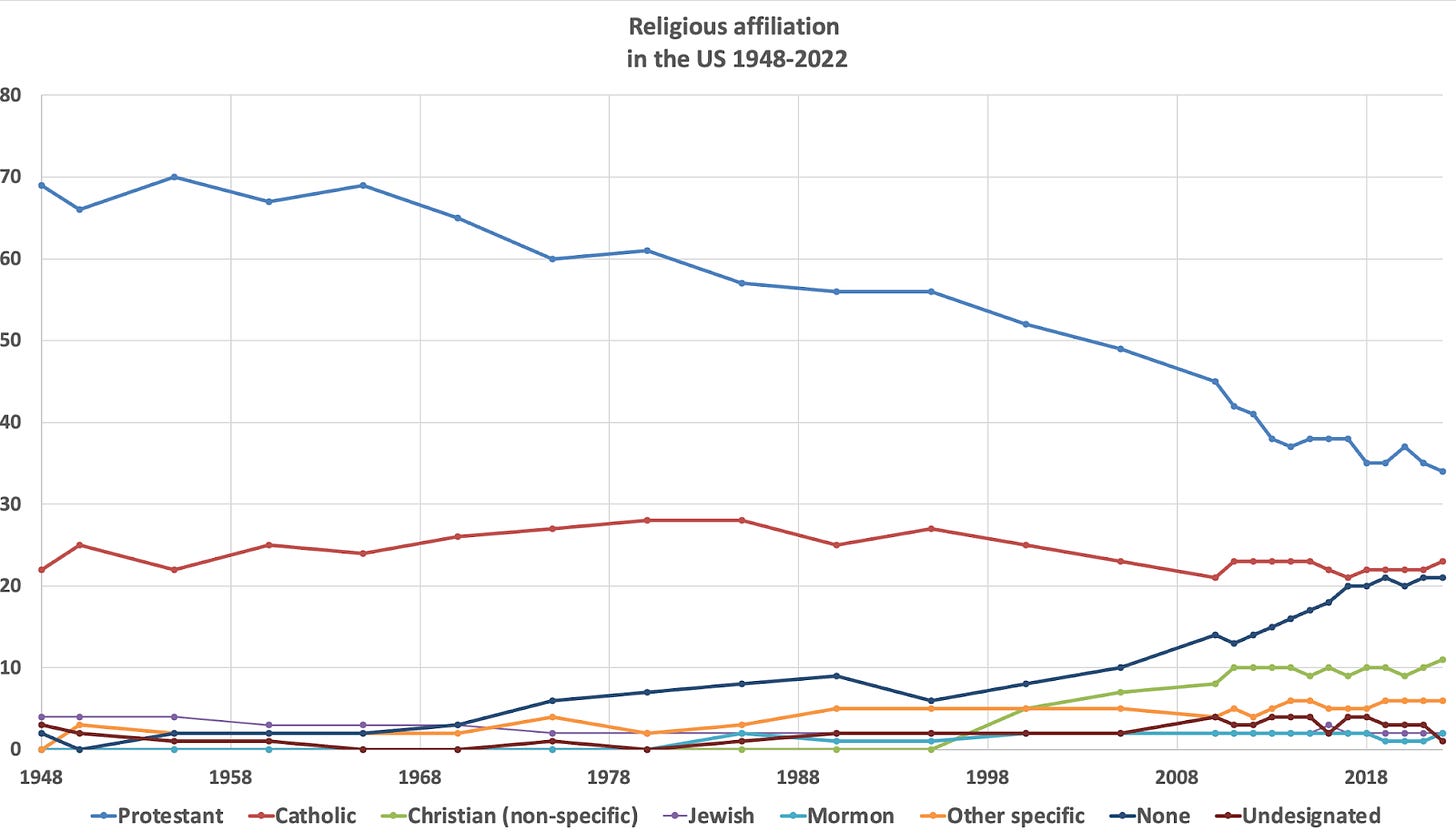
The Transition Away From Christianity

America is living through a religious transformation. The Baby Boomers grew up in a Christian America. More precisely, they grew up in a white Protestant America. A nation where over 60% of citizens were white and Protestant has now become one where only 30% are. More generally, in 1950 95% of Americans identified as Christian, while today 65% do. The future does not look promising for Christianity; most “Zoomers,” those born after 1995, do not believe it is necessary to raise children within a religion.
From Razib Khan (who then explores several historical treatments of the pagan to Christian transition in the Roman Empire and Europe).

The appearance that Catholicism has held steady in the United States in the chart, while Protestantism has not, is somewhat misleading. Native born white Catholics are becoming secular at rates that closely track the rates at which white Protestants are becoming secular. But the percentage of the U.S. population that is Catholic has held steady due to Hispanic Catholic immigration and higher birth rates among Hispanic Catholics relative to the general population.

Also, some of the decline in Protestant identification is due to Evangelical Protestant churches rebranding themselves as non-denominational Christians.

03 May 2024

The Marines Do It Right And Active Defenses

Technologically, we've turned a corner where active defenses are in, and armor is out.

A particularly stunning demonstration of the fact that active defenses are ready for prime time comes from Israel's defense of a massive Iranian missile and drone attack, nominally in retaliation for Israel's strike on Iran's embassy in Syria to kill an Iranian military leader there.

Iran’s attack against Israel on April 14 was historic—it marked the first time that Iran has directly struck Israeli territory from its own soil despite decades of tensions and shadow conflict. Iran utilized around 170 drones in the operation, making it one of the largest drone attacks in history—possibly the largest. As such, the attack epitomizes the increasing reliance on remote, uninhabited systems in modern warfare.

Aerial drones and other types of uninhabited vehicles are undoubtedly key to the future of conflict, but Iran’s attack demonstrates that the current generation of these systems have crucial weaknesses that limit their effectiveness on the battlefield against sophisticated adversaries. In particular, drones are highly susceptible to air defense and thus often do not reach their intended targets. However, Iran’s large-scale use of drones against Israel also illustrates how the military deficiencies of these systems can be leveraged to achieve two higher-order, strategic political goals—limiting escalation and maintaining a strong reputation for resolve.

Defense Is Stronger Than You Might Think

The only thing more striking than the large quantity of drones Iran used in its attack against Israel was the number of those drones that were shot down by Israel and other countries. According to Israeli estimates, over 99 percent of all Iranian weapons used in the attack were intercepted before reaching their targets—including all 170 drones. In part, this reflects the sophistication of Israel’s air defense capabilities and the abilities of the many other countries that helped Israel destroy these drones. But it also highlights something broader—the generally high susceptibility of drones to air defense compared to more traditional inhabited aircraft.

There are at least three reasons uninhabited aircraft are typically easier to shoot down than their inhabited counterparts. First, current-generation drones tend to fly much slower. For example, Iran’s Shahed-136 drones, which were used in the attack against Israel, can only fly a maximum speed of around 115 miles per hour. By contrast, Iran’s inventory of MiG-29 inhabited aircraft, which it acquired decades ago in the early 1990s, have maximum speeds closer to 1,500 miles per hour. The slow speed of uninhabited aircraft has helped enable Ukraine to shoot down Russian drones (many provided by Iran) with even unsophisticated air defense tools like machine guns.

Second, today’s drones tend to have only limited countermeasures they can deploy to protect themselves against air defense systems. For instance, they typically do not carry chaff or flares, which can be used to confuse air defense missiles. Compared to inhabited aircraft, military-grade drones (such as the Shahed or the Turkish-built Bayraktar TB-2 drone used by Ukraine) usually have quite limited maneuverability. This weakness, which does not apply to small quadcopters, makes it harder for drones to evade air defense missiles by executing sudden rolls and turns.

Third, the signals that enable communication between a pilot and a drone can be jammed. This is one crucial defense tool Russia and Ukraine have been using to down each other’s drones. It is also a tactic Israel deployed to disrupt the Iranian attack.

Of course, the cat-and-mouse game between drones and air defense will spur future innovations that could make uninhabited aerial vehicles less suspectable to being shot down. For example, drones can be designed to fly at faster speeds, carry more sophisticated countermeasures to air defense systems, and operate autonomously if communication links with pilots are severed. Furthermore, even existing systems do have at least one potential advantage over the defense: shooting down cheap drones that cost just tens of thousands of dollars with expensive air defense assets that can cost hundreds of thousands of dollars or more can bleed the financial resources of a country over time. Israel’s defense likely cost more than Iran’s offensive.

Nevertheless, the high vulnerability of most current-era drones to air defense can help explain why all of the Iranian drones were shot down and failed to reach their intended targets. It also explains why the attrition rates of Ukrainian and Russian drones are similarly high, with Ukraine losing as many as ten thousand drones per month. As one Ukrainian air force pilot said, relatively high-end and expensive Turkish TB-2 drones “were very useful and important in the very first days [of the war] . . . but now that [the Russians have] built up good air defenses, they’re almost useless.” 
. . . 
In any case, the most interesting aspect of the attack may be what it portends for the future of warfare. The alleged offensive advantage current-generation drones provide over the defense is overrated, but a new era where drones can operate autonomously in coordinated large-scale swarms is coming. To keep pace, defenders will need to continue to innovate cost-effective counter-drone technologies, including the possibility of using drones directly to destroy other drones. Sporadic drone-on-drone “dogfights” have already occurred in the Russia-Ukraine War and may offer a preview of the next generation of remote warfare.

Despite the military deficiencies of contemporary drones, their political utility will continue to be a defining element of modern warfare and statecraft well into the future. As Jacquelyn Schneider said, “These systems exist not because they are invincible, but instead because they decrease political risk for decision makers.” By reducing the financial and human costs of conflict, increasing public support for the use of force, and lessening the chances of escalation, drones are having a transformational effect on international politics.

Similar, but less sophisticated defenses in Ukraine have neutralized perhaps 95% of incoming large missile and suicide drone barrages from Russia.

Armor, in contrast, has been less effective. 

In the Ukraine War, single 40-100 pound anti-tank missiles and suicide drones have taken even the heaviest Russian and American made tanks, like the M1A Abrams tank, out of commission. So have barrages to cannon fire from an M2 Bradley, and single artillery shells and tank shells.

Likewise, one or two anti-ship missiles or torpedoes which are under half a ton each, are enough to remove from action warships that are many thousands of tons each, and probably even large amphibious ships, cruisers, and aircraft carriers up to a hundred thousand tons.

Armor can shield a target from small arms fire up to about a 0.50 caliber machine gun round, and heavy armor can even stop individual rocket propelled grenades and grenade sized cannon rounds that don't hit just right or with many successive hits. But they won't stop larger missiles and shells designed to be armor piercing, which are ubiquitous in near peer conventional warfare.

The response has largely been to look to active defenses. The navy, whose surface warships are so vulnerable to multiple threats, has taken this lead on this front, with systems like the Phalanx Close In Weapons System that shoots large numbers of cannon round at income missiles and shells, new laser and microwave directed energy weapons that can cause drones and missile fuel and warheads to ignite and explode, electronic warfare systems and flares designed to prevent guided weapon guidance systems from directing missiles to their targets, and small supersonic missiles designed to take down incoming aircraft, incoming anti-ship missiles, and incoming drones. These defenses were highly, but not perfectly, effective in warding off Houthi missile attacks on U.S. Navy ships and civilian merchant ships in the Red Sea.

The U.S. Marine Corp has been the U.S. military force that has best headed the lessons of recent military conflicts. It has shed tanks and howitzers from its forces entirely. And, it is more than tripling the size of its air defense forces by 2029:

The U.S. Marine Corps is in the process of a major expansion of its organic ground-based air and missile defense forces. The total number of air defense batteries within the service is set to increase by more than two-thirds by the end of the decade. Starting just next year, those units will be equipped with a mixture of new medium and short-range capabilities, including a version of Israel's Iron Dome, with a particular focus on added defenses against drones and cruise missiles.

Marine Col. Mike McCarthy, who runs the aviation enablers branch within the office of the Deputy Commandant for Aviation, provided an update on the service's air and missile defense plans earlier today at the annual Modern Day Marine exposition.

"Just give you some perspective about kind of where we're going in ground-based air defense, in 2019, when Force Design [2030] started, we had four air defense batteries the Marine Corps armed with Stinger missiles and machine guns. That was it," McCarthy said.

Force Design 2030 is the Marine Corps' current template for a complete restructuring of its forces, which is still ongoing and is centered on supporting new and evolving expeditionary and distributed concepts of operations. McCarthy was also referring here to the mix of Humvee-based Avenger air defense vehicles, armed with heat-seeking short-range Stinger surface-to-air missiles and .50 caliber M3P machine guns, as well as shoulder-fired Stingers, or man-portable air defense systems (MANPADS), that have formed the core of the service's air defense arsenal for decades now.

Marine Avenger short-range air defense systems. DOD

"As we approach 2029, we're going to have 15 batteries of air defense in the Marine Corps, to include the reserve component, and the weapon systems they're going to employ are night-and-day better than what we had three [to] four years ago," McCarthy continued.

Next year, we're going to field the Medium-Range Intercept Capability [MRIC]" which is "a cruise missile defense system based on the Israeli Iron Dome," the Marine Colonel added.

MRIC is by far the most substantial forthcoming addition to the Marine Corps' air defense arsenal. As McCarthy said, it is derived from the Israeli Iron Dome system and utilizes a trailer-based road-mobile launcher. It also fires the same Tamir interceptors as Iron Dome, which use active radar seekers to zero in on their targets and have a very high degree of maneuverability. The missiles also have a two-way data link and proximity-fuzed warhead to improve accuracy and the overall probability of scoring a hit. 

A Marine Corps MRIC Expeditionary Launcher. A total of 10 Tamir missile canisters are seen here loaded on the launcher, which can hold up to 20 at a time. USMC 
While the Marine Corps is acquiring MRIC with a focus on defending against incoming cruise missiles, as an Iron Dome derivative, the system inherently has the ability to engage a broader array of other incoming indirect threats. This includes artillery rockets and shells, as well as drones. Significant upgrades have been made to Iron Dome over the years to expand the breadth of targets it can be employed against, and MRIC could further evolve into an even broader medium-range air defense system.

"Next year, we'll also see the initial fielding of the Marine Air Defense Integrated System [MADIS]," Col. McCarthy also highlighted today.

A complete MADIS system in its current form consists of two 4x4 Joint Light Tactical Vehicles (JLTV) with similar, but different air defense configurations. One vehicle has a remote weapon station armed with a 30mm automatic cannon capable of firing proximity-fuzed rounds and Stinger missiles. The second vehicle has the same type of remote weapon station, but no Stingers, and has added electronic warfare, electronic support measures, and sensor capabilities, including active electronically-scanned radar arrays (AESAs). Small form factor AESA radars are an increasingly popular component of counter-drone systems, in general. 

A complete Marine Air Defense Integrated System (MADIS) system. USMC

There is also the "Light" version of MADIS, or L-MADIS, which consists of 4x4 Polaris MRZR all-terrain vehicles equipped with a mix of sensors and electronic warfare jammers. The L-MADIS vehicles can be carried inside the main cabin of an MV-22 Osprey and Col. McCarthy highlighted how this system is ideally suited for supporting smaller echelons, including forces embarked on amphibious warfare ships.

L-MADISs have already been in use for years now and there are now multiple configurations of the system. An L-MADIS buggy, lashed to the deck of the Wasp class amphibious assault ship USS Boxer, was actually used to knock down an Iranian drone that came within "threatening range" of the ship as it transited through the Strait of Hormuz in 2019.


A view of the forward end of the USS Boxer's flight deck from around the time of the knocking down of the Iranian drone in 2019, with an L-MADIS system seen highlighted inside the red circle. USN 
. . . 
MADIS and L-MADIS are both primarily geared toward the counter-drone role. MADIS, with its Stinger missiles, also has the ability to be used for more general short-range point air defense. 
The U.S. Army is also now in the process of developing a more capable replacement for the venerable Stinger that will still be able to use existing launchers, and that could be of interest to the Marines in the future. Newer versions of Stinger have already been developed that are better optimized against drones.

New radars are another important component of the Marine Corps' future air and missile defense plans, especially when it comes to MRIC. Currently, the service plans to pair MRIC with its existing AN/TPS-80 Ground/Air Task-Oriented Radar (G/ATOR), which is a modern road-mobile multi-purpose AESA radar that can be used for air defense and more general air traffic control purposes. You can read more about G/ATOR here.

Last year, the Marine Corps also awarded a contract to Leidos for the delivery of four prototypes of a new air defense radar called the Medium Range Air Defense Radar (MRADR; pronounced 'marauder'). Leidos subsidiary Dynetics is leading the development of the MRADR. The Marines have also been exploring Humvee-based mobile radar systems.

The Marine Corps' focus on cruise missile and drone threats in its new air defense push is hardly surprising.

Near-peer competitors like China and Russia are continuing to develop and field more advanced cruise missiles, including claimed hypersonic types. More and more capable cruise missiles are also proliferating among smaller countries and even non-state actors like Iranian-backed Houthi militants in Yemen.

The threat posed by uncrewed aerial systems has also now fully exploded into the mainstream consciousness, thanks in large part to the conflict in Ukraine. However, as The War Zone has long pointed out, the drone threat, including when it comes to weaponized commercial types, is not new, and is becoming an increasing given in conflicts large and small. The Marines and the rest of the U.S. military continue to very much play catch-up when it comes to addressing this threat through the fielding of systems like MADIS and L-MADIS. . . . it is also worth pointing out that MRIC will give the Marine Corps its first medium-range air defense capability of any kind since the service retired its HAWK surface-to-air missiles in the 1990s.

The Marine Corps is also developing palletized medium range missile systems to use, for example, in conjunction with with its new Light Amphibious Warships, which would be used for island hopping missiles carrying units of about 75 Marines, rather than concentrating larger Marine units on a single amphibious ships as the current force structure does.  

The Corps has established special “littoral” units for the specific purpose of refining an ability to conduct warfare operations in coastal and island areas throughout the Pacific such as the island chains in the South China Sea. As part of this, the Corps’ Marine Corps Force Design 2030 document calls for specific “stand-in” ready forces capable to conducting offensive operations in close proximity to enemy areas within the larger perimeter reach of longer-range weapons. . . . For instance, forward operating “stand-in” forces will, according to Force Design, operate with a much greater concentration of drones, unmanned systems and manned-unmanned teaming to ensure mobile ISR and targeting and sustain connectivity with stand-off forces and other command and control nodes. Stand-In forces will also need self-protective capabilities and offensive firepower typically less available to mobile, dismounted, island-hopping units. These kinds of mission challenges, threats and operational expectations form much of the inspirational rationale for the Marine Corps emerging Light Amphibious Warship.

The Operational Concept is to enable closer-in, faster, lighter and more expeditionary amphibious operations and quickly transit weapons and Marines from island to island or along littoral coastal areas without needing to risk a larger, more vulnerable footprint. Quick landings and close-in-ship-to-shore operations will be required to a much greater extent should the Corps find itself in need of protecting or taking over island chain, littoral and coastal areas. . . . 
Raytheon has been working with the Corps on a land-fired variant of the well-established ship-fired Naval Strike Missile.

Northrop Grumman, yet another massive weapons developer and US Navy industry partner, sought to anticipate the Corps' operational need and enterprise a mobile, multi-domain missile system engineered to sling-load beneath a helicopter and fire from both warships and land-locations. Northrop Grumman’s Modular Payload System is a 26,000-pound four-pack missile system designed for forward, highly-mobile fires from warships and land-locations as needed. Built to travel beneath a US Navy UH-60 Sea Hawk or CH-53 Super Stallion, the MPS can quickly transit from am amphibious warship to an island location for quick setup and attack.


Modular Payload System -- Northrop Grumman Image

Northrop Grumman innovators, who displayed renderings of the weapon at the 2024 Surface Navy Association, explained that the weapon is engineered for maximum modularity, meaning it can set up fire control and attack wherever there is a link to targeting data. This means the MPS is built to synch with both ship-based radar and fire control as well as land-operating systems. Precise ranges or details regarding the warheads and kinds of explosives are likely not available for security reasons, yet the weapon is designed for mobile, offensive attack in support of dismounted, fast-moving Marines. . . . Missiles of this kind could potentially offer counter-drone protection, anti-aircraft fire or even missile attacks against high-value land targets with a previously non-existent level of versatility and mobility. . . .
Corps weapons developers explain the LAW is intended to fill a critical maritime warfare capability gap between large, big-deck amphibs and smaller transport craft such as Landing Craft Utility vehicles or Ship-to-Shore Connectors. With this in mind, an MPS system capable of traveling beneath a helicopter from an amphibious assault ship or LAW could introduce unprecedented mobile lethality for “stand-in” forces needing close-in attack and rapid ship-to-shore kinds of combat transitions.

A couple of reasons suggest why the Marines are making the smarter choices. First, they are a smaller organization, which makes change less burdensome. Second, they are the only U.S. military service that integrates land, sea, and air resources under a single bureaucratic tent, which encourages cooperation and smart tradeoffs that other services including only one of these, can only make with intervention at the highest joint operations levels.

01 May 2024

The Road Christianity Could Have Taken


Christianity has steadily become a morally evil force in the United States. This was not an inevitable result, although, perhaps it was a likely one.

Mainline Protestants and Catholics could have tried to nip in the bud the current trend in the bud, denouncing the prosperity gospel, the resort to Old Testament thinking, and the general atmosphere of hate in Christianity. There were seeds of that. In Catholicism there was liberation theology and the social gospel, and as a global faith with a leader in Italy, it has always been a bit more cosmopolitan than American Protestantism, even if it has had no qualms about blending church and state. These trends also made real progress in elite seminary training for mainline Protestants, but the living faith of the people in the pews didn't transform in the same way.

These movements within American Christianity didn't bear fruit. Promising steps in the 1960s and 1970s in that direction fizzled out without fanfare. The path suggested by the Chicago Folk Service faded away, while the path imitating secular arena rock thrived.

One of the big barriers to this path is that Christianity is fundamentally at odds with the metaphysical naturalism that is the correct description of our world. In a scientific worldview, there is no room for miracles, for divine intervention, for prayers that make a difference, for faith healing, for demonic temptation and corruption.

The people who have left Christianity are not a random sampling of Christians. They are disproportionately people who share that scientific worldview, and it so happens that a scientific worldview and more humane moral instincts tend to coincide. This is why a more moral Christianity was always going to be a less likely outcome.

Of course, in the United States, where there is great freedom of religion, it is also the case that heresy can't have legal force. The First Amendment to the U.S. Constitution means that there is no such thing as a heretical sect in the United States. It is an open marketplace of ideas, and the sects that appeal to the darker sides of human nature thrived in that competition.