Showing posts with label Corporations. Show all posts

09 July 2026

Things To Research About CEOs

This information probably exists in the academic literature, but I don't know the answers, even though I've read a lot of the "power elite" literature in sociology and economics and political science

* How long does a typical CEO serve in that position?

* How often are CEOs previously CEOs elsewhere, and how often do CEOs leave a position for another CEO position?

* Does the tenure of a typical CEO vary between publicly held companies and large privately held companies?

* How does CEO tenure differ between company founders and successor CEOs?

* How often are CEOs removed by a board of directors, both eventually and at some point? This may be complicated to discern as many CEOs who are forced out try to frame the event as a voluntary retirement. Does this differ for company founders and successor CEOs?

* What are the circumstances that most frequently cause a board of directors to fire a CEO?

* What are the circumstances that most frequently cause a CEO to leave a position as CEO unilaterally?

* How do CEO and top level politician career patterns differ between the for profit sector and the non-profit and government sector?  Term limits and lots of study make this clear for U.S. Presidents and U.S. Governors. But what about members of Congress, Mayors, City Managers, County Managers, County elected officials, college presidents and chancellors, school superintendents and principals, football coaches, and other state and local elected officials and senior executives? What about non-profits and cooperatives?

* What are the statistics on the ages at which people become and cease to serve as CEOs and how does that differ by subtypes of CEOs?

* What characteristics of CEOs (age, education, experience, gender, etc.) differ between founders and successor CEOs, between publicly held and privately held company and non-profit CEOs, between elected officials and top appointed officials in government service, between private sector and elected top officials? 

08 December 2025

Private Equity v. Local Landlorrds

Private equity is playing a larger role in the housing market. Why?

Because rapid increases in interest rates, that have increased faster than the residential real estate market has time to compensate for them with lower inflation adjusted housing prices, has made buying homes unaffordable for home buyers who rely on significant mortgage debt to buy a home (especially, but not only, first time home buyers). This has created increased demand for rental housing which private equity is filling by buying single family homes (it has been a major player in the apartment market for a long time).

But, local government limitations on new housing are still more important to tenants and prospective home owners. Private equity isn't moral, but neither are smaller landlords. The main difference is that private equity concentrates the profits more than ownership by smaller landlords (and is less likely to spend its profits locally). The proportion of landlord owners housing and rental prices are predominantly governed by market forces that affect both equally and are heavily influenced by local zoning and building codes.

How did we get in this mess?

For a long time interest rates were exceedingly low in order to stimulate the economy. Housing prices soared to adapt, but low interest rates made those higher prices affordable. 

But, for a variety of reasons, nominal housing prices are sticky. 

In the short run, listing prices, home value appraisals, and conventional wisdom about fair market value selling prices are based on historical sales prices which are necessarily retrospective and often include comparable sales that pre-date the rise in interest rates, but mortgage rates reduce buyer's ability to pay almost instantly.

In the long run, there are two factors. 

One is that sellers can afford to sell heavily leveraged homes for less than their mortgages and also need enough left over after paying off their mortgage to have a down payment for their next home. And, mortgages are in nominal dollars, not a percentage of the home price. Leverage makes a small decrease in home values disproportionately erode the seller's equity, and most younger home owners have lots of mortgage debt. 

Secondly, sellers are human and psychologically anchor on the price that they bought their home for. Selling at a loss feels like losing, and nobody wants to voluntarily be a loser.

If interest rates had increased more gradually, the fall in affordability caused by higher interest rates would have been more modest giving the housing market time to adjust, and allowing nominal housing prices to hold steady, while allowing inflation adjusted housing prices to fall.

But the economic models that decision makers like the Fed use to set interest rate policies give little or no weight to how fast interest rates change when they estimate the effect that this will have on the economy, because economic models are heavily influenced by equilibrium models even though they acknowledge that the economy is dynamic to a limited, but insufficient, extent.

In short, the main reason that private equity is playing a bigger role in the housing market is that the Fed has flawed economic models and isn't sensitive to the needs of younger middle class people in the housing market. Interest rates were too low in an objective sense. But increasing them so quickly did as much harm as it did good.

If private equity hadn't done it, smaller individual landlords would have, albeit, somewhat less rapidly and in smaller chunks per neighborhood spread out over many landlords in more neighborhoods. Private equity isn't new. It's been around for several decades as an important economic force. It's been around in the apartment market for almost as long. But, the reason we've seen the shift from smaller landlords to private equity is that the Fed created a huge imbalance in the single family home market, and private equity was able to respond more quickly to this sudden change (that created a sudden demand for rental housing which occupants couldn't afford to buy due to higher interest rates) than smaller landlords were.

29 August 2024

Federal Court Reforms Worth Considering

1. Reduce The Scope Of Federal Court Jurisdiction

In terms of major top line categories, federal criminal cases break down as follows:

* Violent Crimes 2.4%
* Property Offenses 11.3%
* Drug Offenses 27.8%
* Firearms and Explosives Offenses 13.9%
* Sex Offenses 3.6%
* Justice System Offenses 0.9%
* Immigration Offenses 33.5%
* General Offenses 1.9%
* Regulatory Offenses 1.5%
* Traffic Offenses 2.2%

The single most commonly charged offense is illegal reentry by an alien which accounts for 27.5% of all federal criminal defendants. Like all immigration offenses, it has no state law equivalent, but there is no really compelling reason to make this offense a crime, rather than simply making it an administrative immigration matter that is a grounds for deportation and for denial of future immigration benefits. Improper entry by an alien accounts for just 0.6% of all federal criminal defendants but is another unnecessary federal immigration crime.
many federal crimes . . . are easily repealed and left to state and local authorities (with the estimated impact on the federal docket): Most federal homicides (0.1%), bank robbery (0.6%), kidnapping (0.2%), most racketeering offenses (0.6%), theft and embezzlement from banks and financial institutions (0.1%), many federal fraud offenses (0.7%), pornography offenses (1.7%), and all intrastate drug offenses (25.5%), for example, could be repealed.

Combined, repealing the crime of illegal re-entry by an aliens, and the other crimes suggested would reduce the federal criminal docket by 57.5% and probably a little more than that . . . This would also greatly shrink the federal prison system, although not proportionately, since the immigration offenses decriminalized typically involve short, often mere "time served" sentences.

Combined with a significant (roughly 51.9%) reduction in federal civil dockets by simply repealing 28 U.S.C. §§ 1331 (general federal question jurisdiction) which accounts for about 18.4% of cases that don't have an additional specific jurisdictional basis, and 1332 (diversity jurisdiction) which accounts for 32.9% of civil cases filed in federal court), these straight forward reforms could greatly reduce the importance of the federal courts . . . , thereby decreasing the stakes in federal judicial appointments below the U.S. Supreme Court level.

From here

2. Increase the Size Of The U.S. Supreme Court

Add 6 new justices to the U.S. Supreme Court, bringing the total number of justices to 15, initially 3 ultraconservatives, 3 conservatives, and 9 liberals.

The U.S. Supreme Court quorum should be reduced from six of nine justices now, to eight of fifteen justices, to prevent a boycott that undermines a majority decision.

The number of justices in an expanded Supreme Court needed to grant certiorari would be six or seven as determined by the court.

The U.S. Supreme Court should elect its own Chief Justice rather than having that post designated by the President and the U.S. Senate, in furtherance of the separation of powers.

A larger court might also have a greater capacity to handle more cases per term since there would be fewer lead opinions to write per justice.

3. Transfer Indian Country felonies from U.S. District Courts to a new court.

Tribal courts handle misdemeanors committed by Native Americans on Indian Reservations and civil cases. Generally, felonies committed on Indian Reservations, by both Native Americans and non-Native Americans, are tried in U.S. District Court by federal prosecutors. 

I would favor creating a new federal trial court system and corps of federal prosecutors and investigators who would handle felonies committed by Native Americans on Indian Reservations, which make up a large share of the "blue collar crime" docket in the federal courts, with appeals from these courts going to a new federal circuit court.

4. Discouraging Judge Shopping and National Injunctions

* Require cases in a U.S. District Court to be randomly allocated to the judges in the district.

* Require cases challenging the constitutionality or validity of a federal law or regulation to be heard by a three U.S. District Court judge panel. There would be a direct appeal of right to the U.S. Supreme Court in cases where the law or regulation is invalidated, except as provided below.

* Limit facial challenges of federal laws and federal regulations to a three U.S. District Court judge panel of the U.S. District Court for the District of Columbia (with appeals to the U.S. Court of Appeals for the District of Columbia Circuit). 

* Clarify that the statute of limitations for challenges to the process by which a regulation is adopted runs from the date that the regulation was adopted (overturning a recent U.S. Supreme Court precedent). 

* Limit the authority to enter a national injunction that binds the United States vis-a-vis anyone other than the parties to the case to a three U.S. District Court judge panel of the U.S. District Court for the District of Columbia (with appeals to the U.S. Court of Appeals for the District of Columbia Circuit).

5. Splitting The 9th Circuit, And A Merger


Form a new 12th Circuit consisting of California, Nevada, and Arizona, leaving the remaining courts in the 9th Circuit in Alaska, Guam, Hawaii, Idaho, the Northern Marina Islands, Montana, Oregon, and Washington.

As much as anything, this pre-empts less desirable splits. There would be no pressure based upon the number of judges or docket load to split up the rump 9th Circuit with its six states and two territories, and it would have a balanced red-blue mix. The new 12th Circuit with three states would still be very large in terms of its number of judges and docket size, and it would be even more dominated by California than the existing 9th Circuit, although it would also have a red-blue mix.

Splitting California up would lead to chaos, and moving Arizona from the 9th to 10th Circuits would also lead to complicated issues of which circuit's precedents applied to it. Circuits have also always had at least three states, which this plan would maintain. California, Nevada, and Arizona have strong economic ties and would benefit from having only a single circuit's precedents to govern them, which would not happen, for example, in a plan where California, Hawaii, Alaska, and the two territories were part of a new 12th Circuit.

The D.C. Circuit could be merged into the Federal Circuit.

A mentioned above, there would also be a new U.S. Court of Appeals For Indian Country.

The split would also leave 15 U.S. Courts of Appeal (twelve numbered circuits, the newly merged Federal Circuit, the Indian Country Circuit, and the U.S. Court of Appeals For the Armed Forces), one of which could be allocated to each justice in an expanded U.S. Supreme Court, as a circuit justice for that court.

6. Circuit splits.

One way to mitigate the harm caused by circuit splits, albeit at the cost of certainty in any particular circuit, would be to downgrade the effect of a precedent, even in the circuit in which it was decided, from binding precedent to persuasive authority, on any point of law with regard to which there is a live circuit split that has not been resolved by U.S. Supreme Court ruling, statutory change in the law, or a later en banc decision in the same case that the panel decided.

This would bring more judges into the process of considering the issue decided by the initial panel on the policy and precedent merits as a case of first impression, rather than pursuant to a precedent which has been seriously questioned.

If the panel decision downgraded to persuasive authority is well argued, it will still be followed. But, if it was poorly reasoned, other judges considering the issue will decline to follow it.

This rule would also put more pressure on the U.S. Supreme Court and Congress to resolve legal issues upon which circuit splits arise. This pressure should be present because many firms and organizations and even individuals need to take an action which will ultimately be subject to legal review in more than one circuit and a circuit split cements the inability of these people to predict the legal outcome of that issue since they don't know where it will arise.

 From here.

7. Habeas corpus and prisoner's litigation

In 2004, there were about 19,000 non-capital federal habeas corpus petitions filed and there were about 210 capital federal habeas corpus petitions filed in U.S. District Court. There are about 60 habeas corpus cases filed in the U.S. Supreme Court's original jurisdiction each year. The U.S. Courts of Appeal do not have original jurisdiction over habeas corpus petitions. . . . As of 2004, the percentage of federal habeas corpus petitions involving state death sentences was still about 1% of the total. . . . About 63% of issues raised in habeas corpus petitions by state court prisoners are dismissed on procedural grounds and about 35% of those issues are dismissed on the merits, while about 2% are either resolved favorable to the prisoner on the merits or remanded to a state court for further proceedings at the U.S. District Court level. . . . [A]study found that when habeas corpus petitions in death penalty cases were traced from conviction to completition of the case that there was "a 40 percent success rate in all capital cases from 1978 to 1995." . . . [Another study] puts the success rate in habeas corpus cases involving death row inmates even higher, finding that between "1976 and 1991, approximately 47% of the habeas petitions filed by death row inmates were granted." . . . about 20% of successful habeas corpus petitions involve death penalty cases. . . . As of 1991, the average number of federal habeas corpus petitions filed in the United States was 14 per 1,000 people in state prison, but this ranged greatly from state to state from a low a 4 per 1,000 in Rhode Island to a high of 37 per 1,000 in Missouri. 
The number of non-death penalty convictions reversed in federal habeas corpus proceedings is about 3 per 10,000.

From here.

These cases, and prisoner's litigation, are very numerous but often futile, in part due to harsh restrictions in the 1996 Prisoner Litigation Reform Act and the 1996 Anti-Terrorism and Effective Death Penalty Acts.

There were 9,690 prisoner's petitions, including habeas corpus petitions, out of 293,539 civil cases in U.S. District Court in the fiscal year ending September 30, 2023 (about half of the number filed twenty years ago in 2004), and about 3.3% of the civil docket. 

In the U.S. Courts of Appeal there are 9,089 prisoner's petitions out of 39,987 total appeals, in the same time period, and about 22.7% of all federal appeals.

Prisoner petitions constituted 69 percent of the civil pro se caseload. Civil rights actions accounted for 14 percent of the civil pro se caseload. The majority of prisoner petitions are filed pro se. . . . from 2000 to 2019, in 91 percent of prisoner petition filings, the plaintiffs were self-represented. In contrast, only 11 percent of non-prisoner civil case filings involved plaintiffs and/or defendants who were self-represented.

From here

A large share of filings in the U.S. Supreme Court are in forma pauperis (IFP) filings. In its 2022 annual report, the U.S. Supreme Court statistics were as follows:

The total number of cases filed in the Supreme Court decreased eight percent from 5,307 filings in the 2020 Term to 4,900 filings in the 2021 Term. 
The number of cases filed in the Court’s in forma pauperis docket decreased five percent from 3,477 filings in the 2020 Term to 3,288 filings in the 2021 Term. 
The number of cases filed in the Court’s paid docket decreased 12 percent from 1,830 filings in the 2020 Term to 1,612 filings in the 2021 Term. 
During the 2021 Term, 70 cases were argued and 63 were disposed of in 58 signed opinions, compared to 72 cases argued and 69 disposed of in 55 signed opinions in the 2020 Term. The Court also issued seven per curiam decisions in argued cases during the 2021 Term.

From here

About one in 470 IFP petitions are granted each term, while about one in 26 paid petitioners are granted each term. The IFP petitions are mostly, but not entirely, prisoner's petitions

This system isn't very functional either at providing relief for prisoners who have legitimate cases, or at managing cases without merit well. Access to the courts without counsel, particularly in the contexts of claims of wrongful convictions and prison conditions, is virtually meaningless. There are wrongs to be righted, amidst legions of bored prisoners with no downside in trying, but the current process does a poor job of sorting them.

At a minimum, this issue should be re-examined in good faith in search of a better solution.

8. Judicial ethics.

I would suggest two judicial ethics reforms:

* A rule that federal judges must recuse themselves from cases where the President or former President who appointed that judge is a party in a non-official capacity.

* A binding ethics code for the U.S. Supreme Court with the power to order a judge to recuse or impose other sanctions similar to those for other judges. Some violations would be criminal offenses.

9. Jurisdiction Over Corporations.

The recently overturned rule that a corporation may be sued, in general jurisdiction, any state in which it has an office for the conduct of business or an employee, should be reinstated by statute.

28 August 2024

Who Gained From Corporate Tax Cuts?

Trump's 2017 tax bill dramatically reduced corporate income taxes. Who gained? 

Hint. Contrary to the claims of apologist economists, wasn't workers.

22 August 2024

Some Excellent Non-Fiction Books

 * Henry Hansmann, "The Ownership of Enterprise" (2000). 

This is one of the best analyses of the economic and legal logic the causes some entities to be organized as "for profit" investor owned companies, others to be organized as worker cooperatives or producer cooperatives or consumer cooperatives, others to be organized as member controlled non-profits, and other considerations regarding entity ownership, backed by historical and empirical analysis of what worked, what didn't, and how this supports a larger theoretical framework of what forms of entity ownership make the most sense for particular purposes. Twenty-four years after it was written, all of its conclusions remain sound.

* Theodore Caplow, "How To Run Any Organization" (1976) (207 pages exclusive of end notes).

This short and practical guide lucidly sums up most of the academic consensus knowledge about the most important lessons about what works when it comes to being a manager in an organization. Forty-eight years after it was written, its guidance has aged very well. 

It also provides a carefully pruned and curated list of fourteen more classics of the management literature for further reading, although other solid books on the topic have been written since then.

This isn't necessarily the only book you need to read about management, but it is the best introduction to the subject out there.

* Sue Spencer, "Write On Target" (1976) (121 pages exclusive of end notes).

There are many books on writing that are basically grammar textbooks, are in the same genre as the Associated Press style guide, or focus on style preferences in sentence structure (such as E. B. White and William Strunk Jr., "The Elements of Style" (4th ed. 1999) (105 pages)). 

Bryan A. Garner is the leading authority on modern, plain English, legal writing styles at a similar level of specificity to "The Elements of Style."

But Spencer addresses writing style and rhetoric at a level more focused on the forest than the trees. Many writers and writing instructors have the technical copy editing level mastery of Strunk and Garner, but can't teach and often have not even internalized the kind of insights Spencer provides into telling a compelling story, whether it is fiction or non-fiction. Instead, they merely vaguely suggest putting together an outline to compose something that a Large Language Model AI could have written. 

The titles of her ten chapters are suggestive: "Know the score", "Bite off what you can chew", "Get off to a flying start", "Zero in", "Keep dropping those bread crumbs", "Stick to your guns", "Call a spade a shovel", "Squeeze, please", "Goof-proofing", and "End before your ending."

Once again, these lessons have aged well.

Another widely acclaimed book in the same vein, which I have not yet managed to read, is Blake Snyder, "Save the Cat!: The Last Book On Screenwriting That You'll Ever Need." (2005). It is also a "forest level" writing book, but is more focused on writing "formula" scripts for movies and television, rather than having a more general focus.

* W. Phillips Shively, "Power and Choice: An Introduction To Political Science" (1987).

This textbook, from an introductory political science class I took at Miami University of Ohio, decades later, taught me two main things.

First, the title rubric that breaks politics into the dimensions of "power" and "choice" has been a useful framework for thinking about politics for my entire adult life. My natural inclination is wonkish, focusing on the optimal policy choices I would make if I were king for a day. But it is important to recognize that perfect knowledge of the right choice to make is useless unless you can secure the power necessary to implement those choices, bringing majorities along with you. Other people are more focused on the "power" aspect, often in a Marxist or conspiratorial style analysis, but forget that political policy choices do matter and have consequences, which can't simply be made blindly on a value and results neutral basis.

Second, it eschewed early modern political philosophy in favor of illustrating every topic discussed with pertinent comparative politics examples from the 20th century from all across the globe, opening my eyes to a much broader perspective than high school civics did, and on topics like non-democratic government and the workings of government bureaucracies which I hadn't realized at the time were even a part of the discipline.

It is a little bit dated, because it doesn't have post-1987 developments like the fall of the Soviet Union and end of the Cold War, the market reforms of China, the evolution of the European Union to a more state-like entity,  

* Ronnie Eisenberg with Kate Kelly, "Organize Yourself!" (1986).

This book covers, at the nitty gritty detail level, issues like time management; organizing your personal files and financial records, and managing mail; keeping your closets, kitchen, laundry, grocery shopping, and household help organized; organizing major projects like melding households, moving, planning trips, planning for painters, planning parties and yard sales, and looking for jobs; shopping, organizing your purse and briefcase, organizing your spouse, not misplacing things, finding a doctor, and remembering dates; and the organizational challenges of pregnancy and children.

It doesn't reflect a life transformed by smart phones, personal computers, the cloud, and the Internet, so it is a bit dated. It doesn't contain any deep and profound insights. But, if your friends describe one of your parents' offices (as my friends did) as "it looks like a newspaper stand blew up in there", and you just don't have a foundation of routines and orderliness that is second nature to you, it is good for establishing a baseline foundation for a more organized personal life.

* Randall B. Ripley, "Congress: Process and Policy" (4th ed. 1988).

Some of this book, which I read as a textbook in college, is simply par for the course political science fare. Unlike the other three books mentioned above, this book is somewhat dated (there may be more recent editions, I haven't checked).

For example, it was written before the full running of political realignment between the Democratic and Republican parties, the emergence of the firm alignment between the Republican Party and Evangelical Christianity, the coalition shifts associated with the MAGA movement, innovations in election administration like ranked choice voting and various experiments with open primaries, or the nuclear option in the U.S. Senate.

But what sets this book apart, which was mind-blowing when I first read it, was its vivid description of the early U.S. Congress and how it, and the federal government more generally, was radically transformed into a very different institution, especially as a result of the U.S. Civil War, World War I, the Great Depression, and World War II. This historical context is vital to understanding not just the political history of the United States, but also its legal history which closely parallels the development of other federal government institutions.

10 July 2024

A Comprehensive Entity Taxation Reform Proposal

The Corporate Double Taxation Problem

The U.S. has about 1.4 million entities taxed as C-corporations, as of 2020 (the most recent year for which full tax statistics are available) of which only 644,000 had tax taxable income and only about 433,000 had any net tax liability. Thus, almost a million C-corporations are small, closely held entities that pay bonuses to management annually calculated to eliminate any corporate level tax liability after any available corporate tax credits. But C-corporations that pay significant corporate income taxes in at least some years are economically extremely important as they include all publicly held corporations and many large, privately held businesses in the U.S. For example, in 2020, corporations has $33,400 billion of gross revenues and owned $124,500 billion of assets.

One of the widely acknowledged issues with U.S. federal income taxation of corporate earnings is the double taxation of C-corporation income. U.S. C-corporations pay tax once when income is earned at the corporate level at a rate that is currently a flat 21%. Then, when dividends are distributed to shareholders, shareholders are taxed on their dividend income but C-corporations don't receive a deduction for this payment.

This double taxation issue has been an important driver of the preference for pass through entity taxation in the U.S., and it creates a strong tax incentive for U.S. corporations to retain rather than distribute their income. And, since U.S. corporate income tax rates have generally been lower the the maximum U.S. individual income tax rate, it creates a tax preference for C-corporations that retain their income due to deferral of income taxation at the shareholder level. 

It also creates a strong tax incentive for C-corporations to finance their operations with debt rather than equity, which from a macroeconomic perspective causes C-corporations, mostly publicly held companies, to have excessively high debt to equity ratios, which makes the U.S. economy more vulnerable to business failures, and less robust, in recessions.

The favorable tax rates for corporate income, capital gains income, and "qualified dividends" in U.S. tax are also rough justice attempts to mitigate the double taxation of corporate income.

Options To End Corporate Double Taxation In the U.S.

There are various ways to end the double taxation of C-corporation income.

1. One could exempt dividend income from taxation, but that would distort how progressive marginal income tax rates for individuals work and would create a perception of unfairness. This would also continue to preference for debt over equity in corporate finance with the macroeconomic costs that come with it. And, it would be unfair to people who would be taxed on capital gains income from stock but not on dividend income from stock.

2. One could exempt corporate income from taxation. But this would create a massive tax incentive for corporations to retain income indefinitely. This would also massively favor equity investment over debt investments and would lead to a surge in preferred stock replacing corporate bonds.

3. One could replace federal corporation income taxes as a withholding tax on ultimate dividend payments for which shareholders receive a tax credit when receiving dividends. This is the most common approach in developed country economies that works quite well there, even though it retains some of the bias for debt financing over equity financing. But in the U.S., in light of federalism considerations, where there is no coordination in corporate taxation between federal corporate income taxes and state corporate incomes taxes, with some states not having these taxes at all, and other states having significant ones, this is difficult to implement gracefully.

4. One could have some sort of simplified pass-through taxation regime similar to what is done now with mutual funds, real estate investment trusts, and publicly traded partnerships. This would be close to neutral at the macroeconomic level between debt and equity financing. Pass-through taxation is predominant for U.S. closely held entities, many millions of which are taxed this way, mostly through limited liability companies, limited liability partnerships, limited liability limited partnerships, limited partnerships, and S-corporations. As of 2020, there were 4.9 million corporations taxed on a pass-through basis (primarily S-corporations, REITs and RICs), another 4.3 million entities taxed as partnerships, and 2.8 million single person limited liability companies taxed as sole proprietorships, for a total of 12 million entities using pass-through taxation regimes (a figure that ignores trusts and estates which have another form of pass-through taxation). But this is administratively very complex and it causes tax audits of the pass-through entities to impact far more people. It is also less fair, as the amount of taxable income allocated in this system to shareholders may not exactly match the amount distributed to them creating "phantom income" in some cases, and windfalls in others. The phantom income problem is particularly problematic in entities where substantial corporate profits are retained for future operations, rather than being distributed.

5. One could continue the imperfect status quo of mitigating the harm caused by corporate double taxation by taxing some combination of corporate income, capital gains from the sale of corporation shares, and dividends from corporation at reduced income tax rates, doing rough justice in terms of equity between total tax rates on shareholder received income from corporations and income from other sources, but presenting the problems discussed above.

6. One could allow a deduction for corporate taxable income for dividends paid. This is already done, in full and in part, depending upon ownership percentages, for dividends paid by C-corporations to other C-corporations that own a significant part of their stock. It has the virtues of being simple, being easy to administer, being easy to integrate between varied state and federal corporate tax systems, almost perfectly eliminating double taxation of corporate income, and ending the preference at the corporate level for equity financing over debt financing. This is the model I explore below, considering its viability in terms of tax rates, which I conclude are very viable. With the appropriate corporate tax rates, it also basically eliminated an incentive to retain earnings in order to defer income tax liabilities.

The Federal Tax Revenue Impacts Of A Corporate Dividends Paid Deduction

U.S. C-corporations paid $374 billion of corporate income taxes in 2020 at a flat corporate income tax rate of 21% from $2,700 billion of corporate net income, reduced by $193 billion of corporate tax credits.

U.S. taxpayers received $328 billion of ordinary dividends and $248 billion of qualified dividends from C-corporations in 2020, for a total of $576 billion.

So, U.S. C-corporations paid 21.3% of their taxable income to shareholder as dividends in 2020 (this isn't quite right, because it excludes dividends from C-corporation to other C-corporations, many of which are partially or fully income tax free, and includes dividend income from foreign corporations that are subject to U.S. corporate income taxes, but neither of those amounts are material).

If dividends paid were deductible from the income of C-corporations, total C-corporation income in 2020 would have been $2,124 billion. So, a revenue neutral transition from non-deductible corporate dividends to deductible corporate dividend payments would require a flat 26.7% corporate tax rate.

If C-corporations were taxed at a flat 41% corporate tax rate (slightly more than the 40.8% of federal taxes due at the highest marginal income tax rate plus the Obamacare tax on investment income), but were allowed to deduct corporate dividend payments and take all existing corporate tax credits, corporations would have paid $678 billion in federal income taxes in 2020 (an increase of $304 billion per year). This would be equivalent to a 32.3% flat corporate income tax rate without a deduction for dividends paid by corporations but with all existing corporate tax credits. A 41% federal corporate tax rate with a dividend paid deduction would be an 81% in federal corporate income tax revenue from current record low corporate tax rates (although this is moderately overstated because corporate tax credits would grow significantly with higher corporate tax rates, although it would still be at least a 31% increase).

The increased federal corporate income tax revenues in this scenario would be partially offset by reduced state corporate income tax revenues due to the reduction in the state corporate income tax base, unless states decided to disallow the dividend paid deduction for state corporate income tax purposes.

This would also make a variety of anti-evasion and double taxation mitigation provisions of the tax code obsolete. These would include the accumulated earnings tax, the personal holding company tax, the separate dividend paid deduction for dividends paid by C-corporations to certain other C-corporations, the special tax rates applicable to qualified dividends, and the special tax rates applicable to capital gains in C-corporation stock. 

These changes (except the special rate applicable to capital gains and qualified dividends) would have a negligible federal tax revenue impact. The end of the tax treatment of capital gains would increase federal tax revenues by $162 billion, and the end of favorable taxation of qualified dividend would increase federal tax revenues by about $84 billion.

In all, these reforms would increase federal income tax revenues by about $550 billion a year, which would be a roughly 11% increase in federal tax revenues, more than two-thirds of which would be paid mostly by those in the top 1% and more than three-quarters of which would be paid by those in the top 10% of income earners. 

This would reduce the federal budget deficit by more than 46%, which would also tend to reduce interest rates in the U.S. economy, including interest rates of home mortgages.

Bottom line: 

An increase of the federal income tax rate on corporate income from 21% to 41%, accompanied by a deduction for dividends paid, the end of favorable tax treatment for capital gains and qualified dividends, and the elimination of other tax code provisions whose purposes are made obsolete by this change, is a good idea.

This would be a viable and sensible tax reform that would be more fair, would be less prone to loopholes and tax planning reductions, would raise modestly more federal revenue in line with historic norms for revenue from corporate income taxes, and would make the U.S. economy more robust from a macroeconomic perspective. It would also reduce tax complexity, be easier to administer, make audits simpler for entities currently taxed on a pass-through basis, and be transaction driven. It would achieve great benefits without radical changes to the overall income tax system in a politically palatable manner.

Other Desirable Reforms In Entity Taxation

* Dividends paid by U.S. corporations to people not otherwise subject to U.S. income taxation should be subject to a final 41% foreign dividend payment tax collected by the entity paying the dividends. This is lost federal tax revenue that could be easily curtailed under the existing tax regime, and is especially important in a corporate dividends paid deduction regime.

* Pass-through taxation should be greatly curtailed. Entities with limited liability should be taxed as C-corporations. Limited partnerships with some unlimited liability general partners and some limited liability limited partners, should be taxed as a general partnership of the general partnership and a C-corporation consisting of the limited partners. S-corporation taxation should be abolished. This would greatly reduce the administrative complexity of the tax system, and would make it much simpler for small businesses to craft their organizational documents, to prepare and file tax returns, and to deal with tax audits. It also removes a huge exception to limited liability for entity income related tax liabilities. State laws causing transferees of limited liability company membership interests to lose their voting rights and right to information about the company and arguably the right to bring derivative actions, which were adopted to gain partnership taxation tax treatment (now obsolete for that purpose) should also be repealed. A fringe benefit of curtailing pass-through entity taxation is that it would greatly increase the privacy of entity owners, particularly in entities that did not distribute dividends to their owners.

* Investments in publicly held, marketable securities and commodities should be taxed annually on a mark-to-market basis, on that the theory that gains that could easily be realized shall be deemed to be realized for tax purposes. 

* The proceeds of loans secured by unmarketable or liquid capital assets, such as closely held entity shares, would be taxable as ordinary income when received, and deductible as an ordinary expense when repayments of principal were made by the borrower, to prevent circumvention of capital gains taxations that are de facto realized.

* Equity investments in unmarketable closely held entities should be deemed to be sold at fair market value at death and taxed at that time, rather than receiving a tax free step up in basis, unless a carryover basis election is filed by the executor of the decedent's estate disclosing the carryover basis and representing that the asset is eligible for the election.

This package of additional reforms would raise something on the order of $50 billion of federal tax revenues each year, which combined with the primary package, would increase federal tax revenues by about $600 billion a year, and would reduce the federal budget deficit by 50%.

A Quick And Dirty Fix To Regressivity In Federal Income Taxation


A friend of mine observed with respect to the meme above that:

That's comparing net worth to income. (Not that there's anything wrong with a net worth tax on billionaires). His net worth increased $87b in 2021, so $11b comes to 13%. While low, it's not obscenely so. Presumably it's due to unrealized capital gains. Taxing unrealized capital gains would be a bad idea in general, except for in the case of billionaires.

I responded:

I did catch that and let it slide because the basic point the Musk is undertaxed is still true. 
Taxing unrealized capital gains honestly isn't such a bad idea in the case of publicly held securities that can be converted to cash in the blink of an eye. Taxing unrealized capital gains in assets that are less liquid is much more problematic.

As you say, the amount he is being taxed on his income is actually about 13%. 
The top federal income tax rate on ordinary income is about 37% plus 1.45% employer and 1.45% employee Medicare taxes (or the equivalent for self-employment tax) or 3.8% for Obamacare on investment income. The top rate on ordinary income in California for people making more than $1 million a year is 14.4%. 
So, if capital gains and dividends were taxed as ordinary income and unrealized gains in publicly traded securities were taxed, and assuming that his income is almost all investment, he could be paying 55.2% instead of 13% of his income in taxes without even increasing top tax rates on ordinary income for the rich. 
This would be about $36 billion more in taxes collected each year. 
By comparison, that is nine times as much as the total revenues of the U.S. federal government from oil and gas leasing each year, and is about twice as much as total federal gift and estate tax revenues each year. 
Yet it would come from increased tax collections due to a couple of minor tweaks in the taxation of capital gains and dividends in publicly held companies, from a single taxpayer alone. 
Across the board, these small changes would generate immense increased tax revenues and increase equity and reduce income inequality.

To recap: 

What are these simple proposals that would profoundly increase tax collections from the rich, make our income tax system much less regressive, and reduce income inequality, without creating serious economic problems due to flawed tax incentives and laws?

1. Tax capital gains and dividends at the same tax rates as ordinary income. The tax expenditures associated with these preferential tax rates for capital gains and dividends has been calculated by the U.S. Treasury Department. These preferential tax rates cost U.S. taxpayers about $162 billion a year. About 68% of capital gains income is earned by the top 1% of taxpayers and 74% of capital gains income is earned by the top 10% of taxpayers according to the Congressional Research Service.

2. Tax unrealized capital gains in publicly held securities on a mark-to-market basis (see also here). The associated tax revenues associated with this change are harder to estimate. The step up in basis of capital gains at death and carryover basis capital gains taxation of gifts during life, combined cost taxpayers about $55 billion a year, so that's an order of magnitude estimate, although probably an underestimate.

Increasing tax collections on the unearned income of the wealthy from publicly traded securities would raise more than $200 billion a year, out of $5,000 billion of total federal tax revenues. This would be a 4% increase in total tax revenues.

04 June 2024

The U.S. Needs Better Corporate Governance


We could secure CEOs just as competent as the current ones at a fraction of the price that they are paid in compensation. But due to week corporate governance structures in "race to the bottom" U.S. publicly held corporations, we don't. CEOs report to a board of directors, whom the CEO basically hand picks through a nominating committee that presents shareholders with a Soviet ballot that leaves them with no choices.

Excessive senior executive pay is also only the tip of the iceberg. The same poor governance structures that pay CEOs far more than they should also do a poor job of making sure that the executive team manages publicly held corporations well. This matters a lot, because those corporations make up a huge share of the total U.S. economy. Even a modest improvement in publicly held company performance due to better governance, say 5%, would be a huge boost to the U.S. economy.

24 April 2024

Major New Legal Developments

There have been several major new legal developments lately that either have happened or will take effect soon. 

In several cases, these developments reflect Biden administration officials working quietly behind the scene to change federal regulations in the face of Congressional gridlock. But, it has taken time for these efforts to bear fruit, because the regulatory process is quite slow. The other new developments are at the state level, which don't face the legislative gridlock seen in Congress.

* The federal FTC is banning non-competition agreements nationwide under a new regulation issued this week which will take effect in six months (October of 2024) unless a court rules otherwise. See, e.g., here. This is already the law in California.

* The federal National Labor Relations Board made a ruling in early 2023 that significantly limits the use of non-disparagement and confidentiality clauses in settlement agreements and severance packages with former employees under Section 8 of the National Labor Relations Act, which is one of the few provisions of that act that apply to employees who aren't in unions. The case is McLaren Macomb, 372 NLRB No. 58 (2023) (see more here). California has adopted legislation with a similar effect.

* Colorado enacted a new law, which will probably take effect on July 1, 2024, which prohibits residential landlords from not renewing periodic leases with no formal right to renew, without good cause. The full text of the act is here.

* The federal Corporate Transparency Act requires most closely held businesses to disclose their major and controlling owners to FINCEN, the federal anti-money laundering agency. Closely held businesses formed in 2024 must make the disclosure within 30 days of formation. Closely held businesses formed prior to 2024 must make the disclosure by the end of January 2025. The legislation is rather clunky, however, and the information disclosed will not be available to the general public.

* The federal regulatory process of reclassifying marijuana under the Controlled Substances Act, so that it is not a Schedule I drug, is underway and will be completed before the end of the current Presidential term. This means that marijuana can be prescribed as a drug without violating federal law (which the federal government has declined to enforce when state law authorizes it for man years). This makes it easier to do clinical studies of marijuana based drugs. This means that marijuana industry firms that are legal under state law can use the regular banking system. This means that marijuana use and businesses won't run afoul of contract and lease terms that require compliance with federal law. And, lastly, but hardly least, this means that 26 U.S.C. § 280E, which disallows tax deduction for marijuana dispensaries other than costs of goods sold, will no longer apply to marijuana businesses making them vastly more profitable after taxes (and probably significantly reducing the retail price of marijuana), but also reducing state tax revenues in states where state income taxes are based upon federal taxable income.

* Birth control pills are now available over-the-counter nationwide as a result of federal FDA regulations that were issued last July. This has been the case in Colorado for many years already.

* Via Boing Boing:

[T]he U.S. Department of Transportation announced a new rule requiring airlines to automatically provide full cash refunds when flights are canceled or drastically changed without haggling or jumping through hoops. "Passengers deserve to get their money back when an airline owes them – without headaches or haggling," declared Transportation Secretary Pete Buttigieg.

The refund mandate doesn't stop there. It also covers those maddening scenarios when you fork over extra cash for amenities like Wi-Fi or preferred seats, but the airline fails to deliver on its promises. No more getting stiffed – you'll get an automatic refund for any ancillary services not rendered. And finally, some justice for the lost luggage struggle: airlines will have to cough up that baggage fee if your checked bag is significantly delayed upon arrival.

14 April 2024

Sunday Musings

 * The United States is deeply politically and culturally divided, and it has had a few political dynasties. But, ultimately, the U.S. has at least largely resisted the hereditary principle and clan politics. We have oligarchies of big corporations, but those big successful corporations, while not entirely free of it, are not hotbeds of nepotism either. Father to son CEO succession happens, but it is rare, and tends to happen second tier businesses not in big national S&P 500 companies.

* We are approaching a point where it may make sense to declare war on both Iran and its proxies like Hezbollah, Hamas, the Houthis, and Iranian militias in Syria and Iraq. The Houthis have directed piracy and missiles at commercial ships in the Red Sea and their insurgency has led to one of the worst famines in the world in Southern Yemen which has historically been the bread belt of Arabia. (It is worth nothing that both sides of the civil war in Yemen are united in their hate for the United States.) Hamas carried out the October 7 attack and has continued a suicidal response by Gazans to Israeli retaliation. Hezbollah in Lebanon has been lobbing artillery and missiles as Israel for decades. Iranian missiles recently killed a detachment of U.S. troops in Jordan. Iran has fired several hundred missiles at Israel in the last few days, has been in multiple skirmishes with U.S. Navy forces in the Persian Gulf, and has terrorized commercial traffic in the Persian Gulf.

* The U.S., admittedly, plays an important part in Iran's ascendancy. U.S. support for the Shah in Iran played an important rule in the 1979 Islamic Revolution in Iran that put the current regime in place. Sanctions the U.S. pushed for caused Iran to develop its own domestic military production (something similar happened as a result of sanctions in Israel, in South Africa, and in Turkey), and also pushed Iran into Russia and North Korea's circle of allies. U.S. military intervention in Iraq and Afghanistan defanged Iran's neighbors who were among its greatest military adversaries. Dislodging the neo-Communist dictatorship in Iraq opened the door to Iranian backed Shiite party political gains there. Encouraging Arab Spring revolutions in Syria contributed to the Syrian Civil War that still isn't over and has created a vacuum for Iranian backed militias there.

* Golf courses are a waste of water in the arid west:


About 1% of total Colorado water consumption goes toward golf courses (this is about 5% of non-agricultural water use):

In its 2021 economic and environmental impact report, the Colorado Golf Coalition, a collection of state organizations, reported that the industry’s water consumption represents less than 1% of the state’s 2018 total — 41,213 acre-feet, compared with 4.7 million acre-feet for agriculture, the largest consumer.

It also touts the positive environmental impact of its more than 33,000 acres of greenspace statewide, of which a little more than 16,000 acres constitute irrigated turfgrass, species like bluegrass that can endure high traffic and low mowing heights ideal for golf. That’s more than 17% less irrigated acreage than in 2002.

By region, the courses in the Denver metropolitan area account for more than 43% of the irrigated acreage. Since the 2002 measurements, Colorado courses have increased use of reclaimed water and significantly reduced use of municipal sources.

Still, golf courses have joined lawns as targets for restrictions in places like Aurora, where Mayor Mike Coffman invoked the “new reality” of water scarcity in Colorado in support of a proposed ban on new courses — unless they employ the buffalo and blue grama long a staple on the Eastern Plains — as the city looks at limiting grass yards, medians and decorative office park areas.

In fairness, golf courses in the arid west have made very significant efforts to reduce their water consumption; far more significant efforts than agricultural users have.

* Agriculture and evaporation consume all but 18% of water in the Colorado River basin (and that 18% includes a significant portion for lawns and golf courses). About 70% of agricultural water is used for cattle feed, mostly alfalfa and to a lesser extent hay, according to a Denver Post analysis:


* Despite its immense water use, agriculture is almost economically irrelevant in Colorado.

* According to Denver Water, household water used breaks down as follows:

54% landscaping
13% toilets
11% laundry
10% showers and baths
6% faucets
5% leaks
1% dishwashers

* The Southwest is, however, a naturally ideal place for solar energy (and it doesn't hurt that a lot of the electricity demand there is for air conditioning which coincides with solar energy availability):

* This week I learned that there are both role playing games and video games in which the protagonist that you play is a bird.

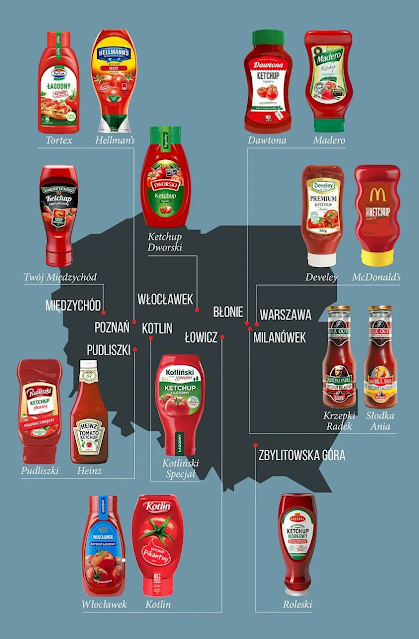
* It turns out that a certain part of Poland is the heartland of ketchup production (a widely used product there):


The Polish Ketchup Belt is a narrow lane between the 51.5N and 52.5N parallels where almost all ketchup production in Poland is concentrated. (Source)

* Ukraine has made strikes deep into Russian territory:

It is 755 kilometers from Ukraine to Moscow and there are numerous Russian refineries and oil storage sites to attack along the way. Ukraine has been attacking those oil facilities and . . . the damage to oil facilities and other targets has been so great that Russia has had to ration how much fuel civilian and military users can get. It is estimated that the Ukrainian attacks destroyed twelve percent of Russia’s oil refining capability.

* Bible reading has recently fallen dramatically in the U.S.:


 * Coal use is up globally, despite falling in the U.S., the U.K., and a number of European countries, due predominantly to new coal fired power plants in Asia:


Greece's failure to tap into its abundant wind power capacity and its near ideal geography for electric cars, baffles me. The same can be said for Hawaii.

* Turkish people drink a lot of tea.


* According to data cited the Economist magazine, South Korea has an intense "glass-ceiling" for women in the workplace, which surprises me. I had thought that the situation for South Korean women who didn't marry or had kids was pretty good.


* Early 19th century grave robbing was driven by incentives you wouldn't expect:

At the 1815 Battle of Waterloo, Napoleon Bonaparte’s final battle, more than 10,000 men and as many horses were killed in a single day. Yet today, archaeologists often struggle to find physical evidence of the dead from that bloody time period. Plowing and construction are usually the culprits behind missing historical remains, but they can’t explain the loss here. How did so many bones up and vanish?

In a new book, an international team of historians and archaeologists argues the bones were depleted by industrial-scale grave robbing. The introduction of phosphates for fertilizer and bone char as an ingredient in beet sugar processing at the beginning of the 19th century transformed bones into a hot commodity. Skyrocketing prices prompted raids on mass graves across Europe—and beyond.

* In the Netherlands, the interest rate on a particular mortgage fall over time to reflect the reduced risk of loss to lenders as the debt to equity ratio falls as principal is paid off and real estate appreciates in value. But, this also disincentivizes selling one home to move to another, or refinancing.

* Average hourly wages vary greatly across Europe:

* In Ray Bradbury's short story "All Summer In A Day": "The children let Margot out of the locked closet at the end of "All Summer in a Day." They had locked her inside while the teacher was elsewhere, making Margot miss the sun, which only comes out every seven years." It was a story the affected me greatly as a child and still does.

* Skunks are an American thing. The skunk family (Mephitidae) consists of 13 species, and almost all are restricted to the Western Hemisphere, reaching from Southern Canada to the Strait of Magellan in South America. The exception is the Stink Badger which can be found in Indonesia.

* Gasoline prices, adjusted for inflation, are similar or lower now than they were in 2006. U.S. mortgage interest rates are middling by historical standards and historically low rate until recently may have helped drive up real estate prices:


* High rise office buildings are plummeting in value.

* There were once more than 9,000 Blockbuster video stores. There is now one, in Bend, Oregon.

* What's better with Jalapeños?

1. Pizza.
2. Beer.
3. Lemonaide.

* Humans are basically fish in flesh suits and our blood is a decent approximation of sea water. An image gets across the concept:


*  There ought to be a law disqualifying judges from deciding cases involving the person who appointed them as a party (in the appointing person's personal, as opposed to their official, capacity).

* Trump does not have legitimate defenses in the classified documents criminal case against him, despite the fact that a judge he appointed seemed to be "confused" about this point.