19 August 2024

Public Opinion On Secession

If Texas, Oklahoma, and Alaska left the U.S. to become independent nations, the national politics of the United States would shift decisively to the left (and secession would likely be more popular in those states if it wasn't clearly illegal). 

The departure of those states, all of which are major U.S. petroleum producers, would also greatly weaken the power of oil and gas interests in Congress.


Per capita GDP by state (% fossil fuel revenue):

* Wyoming $67,326 - 80.0%
* North Dakota $74,005 - 65.9%
* Alaska $72,274 - 27.4%
* New Mexico $49,879 - 30.7%
* West Virginia $45,272 - 28.6%
* Oklahoma $49,745 - 20.4%
* Louisiana $52,079 - 13.9%
* Texas $66,646 - 9.2%
* Pennsylvania $60,910 - 8.6%
* Colorado $72,826 - 7.0%
* Montana $48,722 - 6.0%
* Ohio $59,242 - 3.9%
* Arkansas $45,892 - 3.8%
* Utah $64,130 - 2.6%
* Kansas $62,012 - 2.1%
* Kentucky $49,763 - 1.5%
* Mississippi $39,103 - 1.3%
* Alabama $47,324 - 0.9%
* California $82,975 - 0.4%
* Indiana $58,505 - 0.3%
* Illinois $67,768 - 0.3%
* Virginia $67,786 - 0.3%
* Michigan $54,574 - 0.2%
* South Dakota $61,251 - 0.2%
* Nebraska $72,879 - 0.1%
* Arizona $55,747 - Less than 0.005%
* Idaho $48,309 - Less than 0.005%
* Maryland $68,120 - Less than 0.005%
* Tennessee $59,694 - Less than 0.005%
* New York $90,731 - Less than 0.005%
* Florida $56,571 - Less than 0.005%
* Nevada $60,177 - Less than 0.005%
* Missouri $55,537 - Less than 0.005%

International comparisons (from here):

Oil Revenues as Percentage of GDP (per the World Bank):

Country
Most Recent Year
Most Recent Value
2019
43.9
2019
43.4
2019
42.1
2019
39.6
2019
25.1
2019
24.9
2019
24.2
2019
21.9
2019
18.8
2019
17.8
2019
16.9
2019
16.3
2019
14.4
2019
13.8
2019
7.4
2019
6.7
2019
5.6
2019
4.8
2019
4.7
2019
3.7
2019
3.6
In 2022, about 594,155 thousand (or 594 million) short tons of coal were produced in 21 states. Five states produced a total of about 433,894 thousand (or 434 million) short tons, equal to about 73% of total U.S. coal production. The five largest coal-producing states with production in thousand short tons, and their percentage shares of total U.S. coal production in 2022, were:

* Wyoming—244,730—41.2%
* West Virginia—83,448—14.0%
* Pennsylvania—39,701—6.7%
* Illinois—37,488—6.3%
* Kentucky—28,527—4.8%
60% of Texans surveyed opposed becoming an independent nation. However, 48% of Texas Republicans surveyed supported it.
From Wikipedia citing Post. Archived from the original on May 31, 2012. Retrieved May 25, 2010; "Daily Kos/Research 2000 Texas Poll". Daily Kos. Archived from the original on April 26, 2009. Retrieved November 16, 2012. Also from Wikipedia:
Secession is most popular in Alaska (36%), Texas (31%), and California (29%).
From here, as of February 2-5, 2024 (a partisan breakdown for Alaska isn't available due to the lack of both 100 Democrats and 100 Republicans in the sample, but given the experience in other states, secession is almost certainly more popular among Alaska Republicans than among Alaska Democrats).


For reference, here is a map of states that pay more in taxes than they receive in federal spending, and vice versa:

16 August 2024

A Bullshit Bomb Drone

So, suppose you want to stop high speed chases (often involving stolen cars).

Start with a drone that can fly faster than a car in a high speed chase. Give it a payload of about 120 pounds of cow manure. Drop it on the front windshield of the fleeing car (which is also where its cabin air intakes are located). The driver, who can no longer see has to stop, or is, at least, distracted by the reduced front vision and smell. After the chase is over, the manure can be washed away. You could also enhance this by putting a few air tags to track the vehicle in the manure.

There would also be other applications.

The same approach as with a vehicle in a high speed chase, but for military vehicles that you'd prefer to capture than to destroy.

A suspect is fleeing on foot. Dump manure on him.

You want to discourage someone from crossing a foot bridge or path that is dangerous during a flood. Dump manure at an entry point.

You want to quickly discourage people from entering a crime scene. Dump manure near entry points.

You want to fertilize a garden on a jutting rock midway up a cliff, or the top of an inaccessible to vehicles mountain top, or a roof top garden, or a median on a busy roadway. Dump manure near it for someone in the difficult to access place to spread.

14 August 2024

The Current State Of Territorial Control In The Ukraine War

This is just a brief update, with a single map of which side controls what territory in the Ukraine War, and two more maps and one chart for context. 

About 40% of the territory currently controlled by Russia has been controlled by it since 2014. Russia has made few territorial gains since the early days of its February 2022 invasion when it seized and held about 10% of Ukraine's territory, mostly in four eastern provinces.


From December 2022.
This can be compared to the map below (from here) which shows the percentage of people for whom Russian was their primary language in 2001:

13 August 2024

Four Alternative History Memes


Imagine if the ancient Egyptians had developed steam power!  
Instead of relying solely on manpower and simple machines to build their iconic monuments, they could have harnessed the power of steam engines thousands of years before the industrial revolution. Pharaohs might have used steam-powered boats to travel up and down the Nile, transforming trade and transportation. Massive stone blocks for pyramids and temples could have been moved with ease using steam-driven cranes and pulleys. 
This technological leap could have altered the course of history, potentially leading to an ancient industrial age in the heart of Egypt. Would the Great Library of Alexandria have become a hub for early engineering and scientific advancement? 
Would the Mediterranean world have seen an unprecedented explosion of innovation? 
What do you think the world would look like today if ancient Egyptians had tapped into the power of steam?

Observation: The steam part wasn't the real key point of the steam age. The steam age is just a pretty name for the coal age. I'm not sure that Egypt had good access to coal resources.


Imagine a world where Carthage defeated Rome in the Punic Wars. Instead of the Roman Empire shaping the Western world, the Carthaginian Empire would have dominated the Mediterranean. Latin might have been a minor dialect, while Punic became the lingua franca of Europe and North Africa. The famous Roman roads could have been Carthaginian trade routes, bustling with merchants from across the known world. Christianity might never have taken root, as Carthage was a stronghold of polytheistic beliefs. Instead of Roman architecture, we could see Carthaginian designs influencing our cities, with grand temples dedicated to Baal and Tanit. 
How different would our history be if the victors of the Punic Wars were not the Romans? 
What other cultural and technological advancements might have emerged under Carthaginian rule?

Observation: It isn't at all obvious that the Carthaginians had the same engineering, organizational, and conquest proclivities as the Romans. 

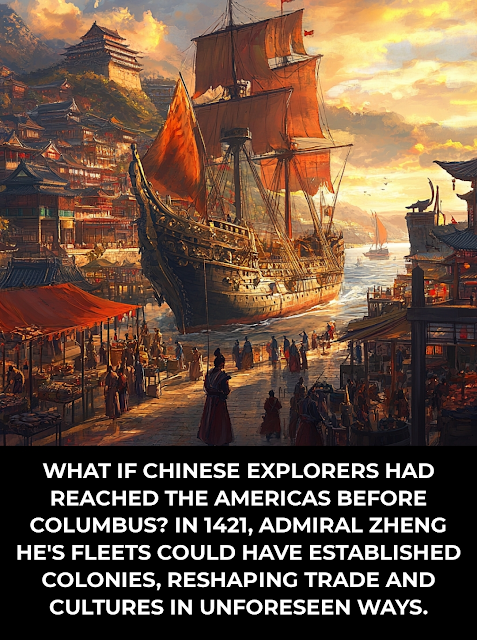
Imagine a world where ancient Chinese explorers reached the Americas before Columbus. Around 1421, fleets of massive Chinese junks, led by Admiral Zheng He, could have set sail across the Pacific, landing on the West Coast of what is now the United States. What if these early Chinese settlers established thriving colonies along the Californian coast? 
Cities like San Francisco and Los Angeles might have been founded centuries earlier, rich with Chinese architecture, culture, and technology. Trade routes could have emerged, connecting Asia directly with the Americas. The exchange of goods, ideas, and innovations would have reshaped both continents. Imagine Chinese influence on indigenous cultures and the blending of traditions that might have occurred. Would the European Age of Exploration have taken a different path? 
The Spanish, Portuguese, and later British explorers might have encountered powerful Chinese settlements, altering their strategies and alliances in the New World. Consider the global power dynamics. With a strong Chinese presence in the Americas, the geopolitical landscape of the 16th and 17th centuries would look drastically different. The balance of power between East and West might have shifted in unexpected ways. 
What other changes do you think could have happened if China had colonized the Americas?

Observation: The indigenous peoples of the Americas would probably still have suffered mass death killing 90%+ of them from Old World diseases. 

Imagine a world where the Ottoman Empire embraced the Industrial Revolution in the 19th century. Factories would have sprung up in Istanbul, with steam engines transforming the landscape. The Bosporus Strait might have been lined with bustling ports, filled with ships transporting goods across Europe and Asia. With an industrial base, the Ottomans could have developed a powerful railway network, connecting distant provinces from the Balkans to the Arabian Peninsula. This might have led to quicker movement of troops and resources, potentially altering the outcomes of conflicts in the region. Urban centers like Cairo, Baghdad, and Damascus might have transformed into major industrial hubs, attracting workers and fostering innovations. The cultural and scientific advancements could have been significant, possibly influencing global technology and trade. Think about how different the Middle East and Europe could have been if the Ottomans had harnessed the power of industry. 
What do you think would have been the biggest changes?

Observation: The early Islamic empire was a center of advanced medicine, science, and business technologies (like checking accounts). The Ottoman Empire had been in a state of deep decay and decline for many centuries before it actually fell in the early 1900s.

Automobile Manufacturing Moves From The Rust Belt To The Sun Belt

The prototypical Rust Belt job, in motor vehicle manufacturing industry, left Rust Belt centers in places like Michigan and Ohio. But, lots of those jobs moved to places like California and Alabama, rather than off shore.


Selected Wishes

They aren't prayers, because there is no one to pray to and prayers don't work.

They are just select, somewhat realistic, wishes or dreams, and I have little ability to do much to make them happen or not.  

U.S. Politics

* Harris wins the Presidential election.

* Democrats win the U.S. House and the U.S. Senate.

* Democrats hold CO-8 and win CO-3 and maybe even CO-5.

* The filibuster is abolished in the U.S. Senate.

* The U.S. Supreme Court is expanded to 13-15 seats, allowing Harris to appoint 5-7 new liberal justices.

* D.C. gains statehood status.

* Trump is sentenced to and serves several years in prison on his current charges of conviction, is not released pending appeal, and is ultimately convicted of at least some charges in the three other criminal cases that were brought against him with the classified documents case dismissal reversed on appeal.

* Justice Thomas is punished for corruption.

* Abortion bans fall one by one, state by state.

* The MAGA movement collapses.

U.S. Culture And Daily Life

* Christianity continues to decline in the U.S. in favor of secular worldviews.

* The percentage of people who own guns falls.

* Crime rates continue to fall.

* Police become less likely to use excessive force and less likely to act inappropriate when accountability measures and training are improved.

* Life expectancies and general health improves with new medical advances and better public health measures.

* Southern and country culture, and cultures of honor ebb and wane.

U.S. Economics

* Electric vehicles increase their market share.

* Coal consumption continues to plummet.

* Petroleum consumption plummets.

* Fossil fuel dependent economies like Wyoming, Alaska, and Texas see huge, long term stagnation similar to what was seen in the Rust Belt.

* The U.S. becomes more urbanized.

* Anti-fraud enforcement becomes more successful.

* Lawns and grass landscaping become more rare in the arid West.

* Land use regulations are relaxed.

* Unnecessary occupational regulation is relaxed.

* Immigration remains substantial and undocumented immigrants are largely legalized.

* Copyright laws and other intellectual property laws are weakened.

International Affairs

* Ukraine wins its war with Russia.

* Putin dies or is removed from office.

* The Houthis are defeated in Yemen.

* Hezbollah is defeated in Lebanon.

* Iran's efforts to make war with Israel prove futile.

* North Korea and Russia cease to be able to support their large military forces and greatly reduce them.

* Countries with fossil fuel economies like Russia, Venezuela, and Saudi Arabia see long term stagnation as fossil fuels become less important in their economies, and this undermines their authoritarian leaning regimes.

12 August 2024

Fried Chicken

The kind of fried chicken served at KFC had its roots in Scotland, before it appeared in Kentucky.

Our Diets Are Not Getting More Toxic


More children died of starvation in the United States 90 years ago, in 1934, than in any other year in the last century plus.

So, don't believe the utter bullshit implication of the following meme which is has a bogus and misleading implication, and is basically a bald faced lie fueled by ignorance and hysteria.


The idea that "new" food is making us sick couldn't be further from the truth. Little things like iodized salt and enriched flour have made us vastly healthier today. 

Not "eating local" has prevented myriad deaths from famine and has greatly reduced malnutrition too. 

Our very civilization's existence hinges on the fact that almost none of us grow our own food as our primary source of sustenance.

The fact that we understand what ails us, and can give it a name, rather than merely chalking most deaths up to "natural causes" is not a bad thing. You can't cure a disease you don't know that you have.

Converting To Residential Solar Power

So, lured by various trivial goodies (a nice steak dinner and a gift certificate), we got a solar power estimate for our little half-duplex.

A minimal build would provide 87% of our electrical needs, a maximal one would provide 131% (which would leave capacity for a future electric vehicle buy which is probably about six to ten years off when our current car, with only 54,000 miles on it after nine years is replaced and EV battery technology has improved), and the build we would most likely actually buy if we did it now would provide 107%.

It would require 8-10 panels on our roof and detached garage roof combined. The entire process would take about two months with one day of on site installation.

It would pay for itself in about 15 years if we paid for it up front (not including a battery backup for the house), but the economics are significantly less attractive if you finance it (they offered 8.49% APR financing). It would probably also modestly increase our homeowner's insurance due to the increased risk of hail damage claims (the better options are supposed to withstand 14 mm hail). This pricing is after a 30% federal tax credit that is not refundable, but can be carried forward. 

Of course, it is also a hedge against increased electricity service rates (much like a fixed rate mortgage but for electricity), and would mean that our home would be powered with 100% clean, renewable electricity.

A whole house backup power battery (that Xcel could also tap into in some circumstances), with about 24 hours of power stored, would cost another $15,000, but with a roughly 80% subsidy (with the State of Colorado and Xcel energy paying for about 50% in addition to the federal government's 30% credit).

Our experience over the last twenty-four years in Wash Park, however, has been that power outages are infrequent and short, and so a whole house battery probably doesn't justify the expense even with an 80% subsidy. Depending on the electric vehicle we purchased, we could probably even use that for backup power.

We will probably not bite yet, because we have other more urgent home improvements to make (our range-oven, and our evaporative cooler both need to be replaced in the near future, and we'd like to kill the remainder of our lawn). Also, solar panel prices have been plummeting and it isn't clear if we are at the bottom of that trend yet.

Still, if I was building a new house, I'd probably include solar panels and a battery backup for the house. A maximal solar power installation would also be more attractive if we had an electric car and/or if we had a heat pump instead of natural gas heating. 

In a new build, I'd seriously consider a heat pump (and better home insulation), an electric water heater, an indoor electric range, and an electric car charging station, to eliminate the need for a natural gas line entirely (although I'd have, at least, an outdoor gas grill and gas fire pit under a non-air tight gazebo fueled with small propane tanks). 

Honestly, it is impressive how much it is possible to free yourself from fossil fuels and to have zero or near zero net energy consumption at the grass roots level.

Other observations

In the course of gathering information about that, we also figured out our household's total energy consumption expense (electricity, natural gas, and gasoline for our car) which is about $200 a month, compared to a $340 per month average in Colorado and compared to a significantly higher average for the nation as a whole. 

About 14% of our electrical consumption is for seasonal cooling (an evaporative cooler and a ceiling fan). About 82% of our natural gas usage is for home heating in the winter (the balance is for a natural gas cooking range and natural gas water heating).

And, since the our household utility bill files were out, we also examined our water usage. The Colorado average is that about 50% of household water consumption used for landscaping (i.e. watering the lawn). In our case it is about 33%, since we have such a tiny lawn. Our water consumption is also well below average (as expected, now that we are empty nesters with a tiny lawn). Water for the lawn (at the higher summer water rate) costs us about $80 a year, which also has to be mowed, fertilized, weeded, etc.

07 August 2024

Quote Of The Day

I can't say if I'm in love with him or not, but I won't let you have him. 
He's mine! 

From "Alya Sometimes Hides Her Feelings In Russian" (Episode 6) (as translated from Japanese in the official subtitles).

06 August 2024

What Will Ending Affirmative Action Change?

Hispanic women appear likely to bear the brunt of bans on affirmative action. 

This paper estimates the long-run impacts of banning affirmative action on men and women from under-represented minority (URM) racial and ethnic groups in the United States. 

Using data from the US Census and American Community Survey, we use a difference-in-differences framework to compare the college degree completion, graduate degree completion, earnings, and employment of URM individuals to non-URM individuals before and after affirmative action bans went into effect across several US states. We also employ event study analyses and alternative estimators to confirm the validity of our approach and discuss the generalizability of the findings. 

Results suggest that banning affirmative action results in a decline in URM women’s college degree completion, earnings, and employment relative to non-Hispanic White women, driven largely by impacts on Hispanic women. Thus, affirmative action bans resulted in an increase in racial/ethnic disparities in both college degree completion and earnings among women. Effects on URM men are more ambiguous and indicate significant heterogeneity across states, with some estimates pointing to a possible positive impact on labor market outcomes of Black men. These results suggest that the relative magnitude of college quality versus mismatch effects vary for URM men and women and highlight the importance of disaggregating results by gender, race, and ethnicity. We conclude by discussing how our results compare with others in the literature and directions for future research.

05 August 2024

Ongoing Armed Conflicts

Wikipedia has a list of ongoing armed conflicts, ranked by number of deaths per year (with the 2023 combined military and civilian deaths on all sides shown). The two largest (Ukraine and Israel) have international components, while the rest are basically civil wars and insurgencies.

A few observations: 

* most are insurgencies or civil wars, only a few are international wars between organized national military forces;

* lots of conflicts have an ethnic/religious dimension (especially Islamist movements), with the collection of conflicts in multiple countries that I call the Sahel War most notable among them, the several Kurdish insurgencies are also notable, and several related to the fall of the Soviet Union;

* lots of conflicts have a drug war dimension (especially in Latin America and the Caribbean);

* many of the smaller conflicts are the tail end of formerly more intense conflicts.


It lists five major wars:

#1 Ukraine War. 71,235–95,088+

#2 Arab-Israel conflict in Gaza and Lebanon. 23,424–32,519

#3 Sahel War. 14,728

#4 Sudanese Civil War (two rival factions of the military government of Sudan, the Sudanese Armed Forces (SAF) under Abdel Fattah al-Burhan, and the paramilitary Rapid Support Forces (RSF) under the Janjaweed leader Hemedti). 7,757–13,225

#5 Myanmar Conflict. 3,065–15,773

Followed by 16 "wars":

#6 Mexican Drug War. 7,168–13,877

#7 Boko Haram insurgency (which I would tend to lump in as part of the Sahel War). 5,182

#8 Kivu conflict, a highly fractured insurgency at its root mostly a Tutsi-Hutu conflict in the wake of the Second Congo War (now involving the Democratic Republic of the Congo, Rwanda, Burundi, and Uganda). 4,617

#9 Civil war in Somalia. 4,420–9,343

#10 Muslim/non-Muslim-herder/farmer violence in Nigeria (which I would also lump in as part of the Sahel War). 3,300–3,900

#11 Insurgencies/civil war in Ethiopia. 2,225–3,830

#12 Sudanese nomadic conflict (ethnic violence in South Sudan). 1,249.

#13 Insurgency in Khyber Pakhtunkhwa, Pakistan. 1,164–1,300

#14 Yemeni civil war. 926–3,381

#15 Conflict with ISIS in Iraq. 480–1,338

#16 Pemon conflict centered around mining disputes between the Maduro government, the Pemon nation (indigenous people that live in the Gran Sabana region in southeastern Venezuela) and armed irregular groups in Venezuela. 472–2,558

#17 Gang war in Haiti. 435–4,451

#18 Afghan conflict. 342–1,041

#19 Cameroon Civil War. 338-1,042

#20 Syrian Civil War. 56–6,211

#21 Conflict for control of favelas in Rio, Brazil. 41–2,288.

Minor conflicts

    #22 Kashmir insurgency in India and Pakistan. 706

    #23 Sistan and Baluchestan insurgency in Pakistan and Iran. 600

    #24 Central African Republic Civil War also related to the Sahel War. 546.

    #25 Insurgency in NE India. 540

    #26 Jamaican political conflict. 397

    #27 Naxalite-Maoist insurgency in India. 360

    #28 Philippine drug war. 269

    #29 Kurdish insurgency in Iran. 198

    #30 Papua conflict (independence from Indonesia movement). 179

    #31 Delta conflict in SE Nigeria (Biafra nationalist). 150

    #32 Kurdish insurgency in Turkey. 136

    #33 Honduran gang crackdown. 112-647

    #34 Islamic state insurgency in North Caucasus. 10

    #35 Armenia-Azerbaijan border crisis. 462-594

    #36 Islamist insurgency in Cabo Delgado (Mozambique) 275-321

    #37 New People's Army Rebellion in the Philippines (Maoist). 259-580

    #38 Internal conflicts in Bangladesh. 12-328

    #39 Ethnic violence in Papua New Guinea. 1-337

Skirmishes and clashes

    #40 Libyan crisis. 89

    #41Peruvian conflict. 75

    #42 Cabinda War in Angola. 66

    #43 Ecuadorian drug war. 60

    #44 South Thailand insurgency. 57

    #45 Salvadoran gang crackdown. 56

    #46 Casamanse conflict in Senegal. 48

    #47 Western DR Congo clashes. 43+

    #48 Western Saharan clashes. 38

    #49 Insurgency in Northern Chad (arguably part of Sahel War). 37

    #50 Kurdish insurgency in Iraq. 21-25+ 

    #51 Insurgency in Egypt. 21

    #52 Korean War. 12

    #53 Insurgency in Paraguay. 10

    #54 Lord's Resistance Army insurgency (Africa). 3

    #55 Katanga insurgency in DR Congo. 2

    #56 Georgian-Ossetian conflict. 2

Broken out by region

Europe:
#1 Ukraine War 
#34 Islamic state insurgency in North Caucasus. 
#35 Armenia-Azerbaijan border crisis. 
#56 Georgian-Ossetian conflict. 
 
Middle East, North Africa, and West Asia:
#2 Arab-Israel conflict in Gaza and Lebanon.
#14 Yemeni civil war.
#15 Conflict with ISIS in Iraq.
#20 Syrian Civil War. 
#29 Kurdish insurgency in Iran.  
#32 Kurdish insurgency in Turkey.  
#40 Libyan crisis. 
#48 Western Saharan clashes. 
#50 Kurdish insurgency in Iraq. 
#51 Insurgency in Egypt.

Sub-Saharan Africa:
#3 Sahel War.
#4 Sudanese Civil War.
#7 Boko Haram insurgency (really part of the Sahel War).
#8 Kivu conflict, a highly fractured insurgency at its root mostly a Tutsi-Hutu conflict in the wake of the Second Congo War (now involving the Democratic Republic of the Congo, Rwanda, Burundi, and Uganda).
#9 Civil war in Somalia.
#10 Muslim/non-Muslim-herder/farmer violence in Nigeria (which I would also lump in as part of the Sahel War).
#11 Insurgencies/civil war in Ethiopia.
#12 Sudanese nomadic conflict (ethnic violence in South Sudan).
#19 Cameroon Civil War (English v. French colonial legacies). 
#24 Central African Republic Civil War (also related to the Sahel War).  
#31 Delta conflict in SE Nigeria (Biafra nationalists)  
#36 Islamist insurgency in Cabo Delgado (Mozambique) 
#42 Cabinda War in Angola (former Portugese enclave of related tribes).  
#46 Casamanse conflict in Senegal (non-Wolof, non-Muslim minority seeking autonomy). 
#47 Western DR Congo clashes. 
#49 Insurgency in Northern Chad (arguably part of Sahel War). 
#54 Lord's Resistance Army insurgency (Africa).  
#55 Katanga insurgency in DR Congo. 
 
Central and South Asia:
#5 Myanmar Conflict (anti-coup and Muslim minorities).
#13 Islamist insurgency in Khyber Pakhtunkhwa, Pakistan.
#18 Afghan conflict. 
#22 Kashmir insurgency in India and Pakistan. 
#23 Sistan and Baluchestan insurgency in Pakistan and Iran.  
#25 Insurgency in NE India. 
#27 Naxalite-Maoist insurgency in India. 
#38 Internal conflicts in Bangladesh. 

Southeast Asia:
#28 Philippine drug war.
#30 Papua conflict (independence from Indonesia movement).
#37 New People's Army Rebellion in the Philippines (Maoist).
#39 Ethnic violence in Papua New Guinea.
#44 South Thailand insurgency.
  
Latin America and the Caribbean:
#6 Mexican Drug War.
#16 Pemon conflict centered around mining disputes between the Maduro government, the Pemon nation (indigenous people that live in the Gran Sabana region in southeastern Venezuela) and armed irregular groups in Venezuela.
#17 Gang war in Haiti.
#21 Conflict for control of favelas in Rio, Brazil. 
#26 Jamaican political conflict. 
#33 Honduran gang crackdown. 
#41 Peruvian conflict (Maoist insurgency). 
#43 Ecuadorian drug war.  
#45 Salvadoran gang crackdown. 
#53 Insurgency in Paraguay (Marxist/drug war). 

East Asia:

#52 Korean War.

English Crime Rates

 
From here.

The peak is right around the same time as the U.S. peak, which casts doubt on U.S. specific explanations for the trend.

Fraud and computer misuse account for a majority of crime incidents in England and Wales.

04 August 2024

Summer

100º Heat. Fires. Smoke. Hurricanes. 

Time for swamp coolers, ceiling fans, dim rooms with blinds closed. Drinks. Stillness.

02 August 2024

Splitting The United States Three Or Six Ways

One way to resolve the deadlock and malaise of the U.S. political system would be to divide the United States into three countries, for example, roughly along the lines of the map below. Another option, with a six way split appears below it.

Mostly states end up in one of the new countries or another. But Washington State, Oregon, Illinois, Indiana, Ohio, and Georgia would be split. Washington State and Oregon would cede territory to Idaho. Northern Illinois would be ceded to Wisconsin. Northern Indiana and Ohio would be ceded to Michigan. Georgia would just be split into two states: Atlanta (with the Northern portion) and Georgia.

This would leave the notional country of Pacifica with 9 states. It would have borders with Canada (in 2 states), Jesus Land (in 7 states), and Mexico (in 3 states). It would have a Pacific Coast, but no Great Lake Coast, Gulf Coast or Atlantic Coast. Pacifica would also get American Samoa, Guam, the Northern Mariana Islands, and all other U.S. possessions in the Pacific. Alaska wouldn't be thrilled with this, but would need Pacifica's Navy and Air Force to defend itself from Russia, which is something that Jesus Land couldn't do adequately. This would be a quite liberal country.

The notional country of Jesus Land would have 25 states. It would have borders with Canada (in 3 states), Pacifica (in 7 states), Atlantia (in 12 states), and Mexico (in 1 state). It would have a Gulf Coast and an Atlantic Coast, but no Great Lake or Pacific Coast. It would also get the U.S. Virgin Islands (which could be annexed to Florida). If they wished, however, Great Idaho and Utah could form Mormon Land rather than joining Jesus Land, leaving Jesus Land with 23 states. Either way Jesus Land and Mormon Land if there was one, would be very conservative countries politically. Alternately, Greater Idaho, Utah, Montana, and Wyoming could form the Mountain Republic, leaving Jesus Land with 21 states. Similarly, either Texas (with or without Oklahoma) or Florida, or both, could be independent countries of their own, separate from Jesus Land, potentially leaving Jesus Land with as few as 18 states. This could lead to up to six notional countries where the U.S. used to be.

The notional country of Atlantia would have 18 states (including the District of Columbia which would be made a state). It would have borders with Canada (in 6 states) and Jesus Land (in 8 states). It would have an Atlantic Coast (and Great Lake coasts), but not a Gulf Coast or a Pacific Coast. This would be a quite liberal country.

Puerto Rico would be granted independence, whether it wanted it or not.

Atlantia and Jesus Land would be geographically contiguous. Pacifica would be mostly geographically contiguous but would also include Alaska and Hawaii.

Each country would have a large enough population and land area to be formidable in its own right and would have access to international maritime trade. 

Each would draw up a new national constitution. 

Treaties between the resulting countries would also have to be put in place, and existing foreign treaties would have to be moderately reworked.

Some national assets and liabilities would have to be divided: the military, the Postal Service, the national debt, the Social Security and Medicare trust funds, etc.