18 April 2013
Zoologicals?
The notion of "botanicals", i.e. herbal medicines, is now widespread. Are "zoologicals", with intentionally transplanted symbiotic bacteria and fauna, far away? We already have maggot therapy, "gut bacteria transplants" and leech therapy in isolated circumstances. What could we see next?
17 April 2013
Corporate Tax Expenditures Are Huge
Estimated corporate revenue losses in 2011, which totaled $181.4 billion, were approximately the same size as the amount of corporate income tax revenue the federal government collected that year.The GAO via the Tax Profs Blog.
Accelerated depreciation accounts for 42% of corporate tax expenditures.
Another 26% comes from the deferral of income from controlled foreign corporations and financial firms with overseas income. The 5% of corporate tax expenditure due to the U.S. production deduction which is a deduction on U.S. production activities meant to discourage off shoring, is a further loss of U.S. tax revenues that to a great extent exists simply to counterbalance the other tax expenditure incentives in the other direction.
Three other big tax expenditures for corporations are the R&D tax credit (5%), the low income housing tax credit (3%), and the exclusion of interest on state and local public purpose bonds from income taxation (4%).
Other smaller corporate tax expenditures account for 20% of the total.
On the flip side, it is worth recalling that one of the most important biases against earned income in the individual income tax code (which also applies to pass through entities) is preferrential treatment for capital gains income.
This is telling. The main reason to favor capital gains is to encourage productive business investment, but the entities that make the vast majority of productive business investment in the United States don't get this tax break.
Awesome South Asian Economic Data Presentations
The blog Data Stories does a stunning job of visually presenting data about the economy of India. I've added it to the blog roll. For example, it is one thing to see per capita GDP data, and quite another to see statistics like this:
Admittedly, I don't own a television set myself. But, that is something of a first world fluke that reflects abundance in other domains. It isn't uncommon for there to be in my apartment that houses my two children and I at any given time four laptop computers, two iPods, two cell phones, a Kindle, and five radios (including the one in my SUV) as well as a networked printer, a wireless router with a high speed internet connection, and a bicycle with a flat tire. Very few people in the top 4.6% of the U.S. wealth distribution would like any of these items which I suspect around half of Americans who are in poverty own. Anyway, here's the interactive map:
Another great graphic (also interactive) is this one:
Also, as my Sociology 101 professor made clear to me early on, it is important to keep in mind that with many technologies, like televisions and phones, the difference between having only a handful in a village and having none can be huge in their cultural impact.
Around 18% of households in India don’t own any of the assets listed on the census form – that means no phone, no TV or radio, and no bicycles or other vehicles of any kind. [In many county sized districts in India the percentage is 48% or more.] . . . Take a look at the map below. It maps the proportion of households in each district, who told census-takers that they own all of the following – a TV set, a phone, a computer and a vehicle (scooter/motorcycle or car). That number, for the country as a whole, is 4.6% (roughly 11 million households). I leave you to draw your own conclusions about what it means to be ‘privileged’ in this country.
Admittedly, I don't own a television set myself. But, that is something of a first world fluke that reflects abundance in other domains. It isn't uncommon for there to be in my apartment that houses my two children and I at any given time four laptop computers, two iPods, two cell phones, a Kindle, and five radios (including the one in my SUV) as well as a networked printer, a wireless router with a high speed internet connection, and a bicycle with a flat tire. Very few people in the top 4.6% of the U.S. wealth distribution would like any of these items which I suspect around half of Americans who are in poverty own. Anyway, here's the interactive map:
Also, as my Sociology 101 professor made clear to me early on, it is important to keep in mind that with many technologies, like televisions and phones, the difference between having only a handful in a village and having none can be huge in their cultural impact.
Seemingly Stupid Ideas Often Succeed
Tyler Cowen delightfully recaps eighteen stupid sounding business concepts that have turned out to be phenomenally successful. He could easily add an older one: FedEx, the produced billions in revenues despite a mediocre grade for the proposal from a Harvard Business School professor. I personally use eight of the eighteen in addition to FedEx.
Predicting what will work and what will not work is not elementary.
Predicting what will work and what will not work is not elementary.
16 April 2013
Who?
We know the "what", the "when", the "where" and the "how" rather precisely.
As evidence filters in about the Boston Marathon bombing, the big question is "who?" (The "why" inside the head of the sick fuck who did it hardly matters.)
Was this a 9-11 like international terrorist attack intended to punish the United States? Was it an act of domestic terrorism probably with some far right cause? Was it the act of some derranged individual with no greater agenda than to achieve infamy (not unlike the Aurora theater shooting)?
No one has claimed responsibility. The Pakistani Taliban issued a statement denying a connection. The bombs themselves were not packed with sharpnel to produce any more damage than they did. Statements that there were more than two bombs in the vicinity or that a fire at the JFK library were related have proved to be unfounded. In short, this incident was of a scale that could have been orchestrated by a single individual acting alone.
The twenty-year old Saudi Arabian ESL student detained at the scene whose shared rental condo is being searched by authorities appears at first glance to have been nothing but an innocent bystander.
It is hard to see why any terrorist with a political agenda would let the incident come without a claim of responsibility (unless the terrorist was killed accidentally by the blast denying him or her the opportunity to spout an agenda later). One could also imagine a terrorist, or perhaps a mere prankster who underestimated the consequences, seeing the carnage and having a change of heart about whether carrying out this act should be used to advance a cause.
The marathon route was swept by police for bombs that morning and there were countless photographs and videos taken by people interested in capturing the race that morning and there are tens of thousands of potential witnesses. But, in the critical first twenty hours after the bombing there appear to be no solid leads yet. Solving this case may involve a long, tedious slog of reconstructing from videos and photographs and tens of thousands of witnesses and bomb remnants how the bombs were put where they exploded, how they were detonated, and who put them there in a narrow window of time after a morning sweep of the route and before the explosion.
We know an eight year old boy and two unidentified people died and that at least seventeen others had critical injuries (including two relatives of the boy who was killed) with numerous people having legs amputated as a result of the blast (including two brothers who each lost part of a leg). At least 176 people were injured. It is possible that additional people may yet die from their injuries although the fact that the critically injured all seem to have lived though the day is encouraging.
Cell phone service was immediately shut down near the blast area to prevent phone activated detonations (a lesson learned, although apparently unnecessary in this case, from Iraq). A no fly zone was imposed in Boston and public transit was temporarily halted in the city. Searches on transit and passenger rail and heightened security citywide persist today.
Investigators are rumored to be slightly favoring the possibility of domestic terrorism, in part, because the bombing took place on Patriot's Day and the national deadline for filing tax returns, and in part, perhaps because of the theme of this year's race "26 for 26", a reference to the Newtown Connecticut Massacre at Sandy Hook Elementary School that has spurred gun control efforts nationwide. Thus, anti-tax and anti-gun control motives would have spurred an act of a domestic terrorist.
The fact that the name of the two other dead have not been released yet could be for a pedestrian reasons - a difficulty in identifying a victim or an inability to locate next of kin, or could suggest that authorities suspect that one or both of the individuals could have been perpetrators.
As evidence filters in about the Boston Marathon bombing, the big question is "who?" (The "why" inside the head of the sick fuck who did it hardly matters.)
Was this a 9-11 like international terrorist attack intended to punish the United States? Was it an act of domestic terrorism probably with some far right cause? Was it the act of some derranged individual with no greater agenda than to achieve infamy (not unlike the Aurora theater shooting)?
No one has claimed responsibility. The Pakistani Taliban issued a statement denying a connection. The bombs themselves were not packed with sharpnel to produce any more damage than they did. Statements that there were more than two bombs in the vicinity or that a fire at the JFK library were related have proved to be unfounded. In short, this incident was of a scale that could have been orchestrated by a single individual acting alone.
The twenty-year old Saudi Arabian ESL student detained at the scene whose shared rental condo is being searched by authorities appears at first glance to have been nothing but an innocent bystander.
It is hard to see why any terrorist with a political agenda would let the incident come without a claim of responsibility (unless the terrorist was killed accidentally by the blast denying him or her the opportunity to spout an agenda later). One could also imagine a terrorist, or perhaps a mere prankster who underestimated the consequences, seeing the carnage and having a change of heart about whether carrying out this act should be used to advance a cause.
The marathon route was swept by police for bombs that morning and there were countless photographs and videos taken by people interested in capturing the race that morning and there are tens of thousands of potential witnesses. But, in the critical first twenty hours after the bombing there appear to be no solid leads yet. Solving this case may involve a long, tedious slog of reconstructing from videos and photographs and tens of thousands of witnesses and bomb remnants how the bombs were put where they exploded, how they were detonated, and who put them there in a narrow window of time after a morning sweep of the route and before the explosion.
We know an eight year old boy and two unidentified people died and that at least seventeen others had critical injuries (including two relatives of the boy who was killed) with numerous people having legs amputated as a result of the blast (including two brothers who each lost part of a leg). At least 176 people were injured. It is possible that additional people may yet die from their injuries although the fact that the critically injured all seem to have lived though the day is encouraging.
Cell phone service was immediately shut down near the blast area to prevent phone activated detonations (a lesson learned, although apparently unnecessary in this case, from Iraq). A no fly zone was imposed in Boston and public transit was temporarily halted in the city. Searches on transit and passenger rail and heightened security citywide persist today.
Investigators are rumored to be slightly favoring the possibility of domestic terrorism, in part, because the bombing took place on Patriot's Day and the national deadline for filing tax returns, and in part, perhaps because of the theme of this year's race "26 for 26", a reference to the Newtown Connecticut Massacre at Sandy Hook Elementary School that has spurred gun control efforts nationwide. Thus, anti-tax and anti-gun control motives would have spurred an act of a domestic terrorist.
The fact that the name of the two other dead have not been released yet could be for a pedestrian reasons - a difficulty in identifying a victim or an inability to locate next of kin, or could suggest that authorities suspect that one or both of the individuals could have been perpetrators.
15 April 2013
The North Korean Crisis and DOD Budget Politics
Kim Jong Un is manna from heaven for every U.S. Department of Defense Star Wars program manager's budget requests. There is nothing like a rogue nation on the verge of having medium to long range nuclear weapon delivery capabilities that existing technology might actually be able to do something to stop to help fund those anti-missile capabilities.
The only reason that North Korea hasn't been squashed like by bug by Western allied military forces is that this would risk retaliation from either the Soviet Union (now Russia) or China.
It isn't clear, however, that North Korea can rely on those ties to protect it much longer in the face of its aggressive rhetoric and small scale actual provocative acts of hostile military action directed at South Korea. Even a botched missile launch that was more than a test would probably force the hand of the U.S. and cause it to bomb North Korea's potential nuclear and missile facilities into rubble and possibly push it to take military action to unseat its regime as well.
China is a much more market based economy than North Korea and needs trade with the U.S. for its economy far more than it needs anything from North Korea. Indeed, China's political ruling class is to a much greater extent than in the U.S. made up of business chiefs who personally profit from the U.S. business relationship, China's sovereign interests be damned.
The Russians also gets very little from their relationship, such as it is, with North Korea.
From the perspectives of both Russia and China the main objective is not to get anything themselves from North Korea, but simply to keep the United States and its allies from getting any further into their back yards militarily. Also, the defense technology development that U.S. responses to North Korea motivate undermine the effectiveness of Chinese and Russian military programs driving up their military budgets.
The sensible resolution of the current North Korean nuclear weapon threat crisis would be for Russia and China to shut it down without Western involvement. This would allow them to continue to claim that North Korea was within their "area of influence" to keep Western powers out, while defusing the threat to nations whose relationships are much more important to them than the North Korean relationship. Alternately, hidden assurances from Russia and China that they would not come to North Korea's military aid in the face of a U.S. and/or Japanese and South Korean attack if North Korea takes such provacative action would give the U.S. the green light to take military action.
Whether Secretary of State Kerry can connect these dots and work behind the scenes to make this happen is another matter.
The only reason that North Korea hasn't been squashed like by bug by Western allied military forces is that this would risk retaliation from either the Soviet Union (now Russia) or China.
It isn't clear, however, that North Korea can rely on those ties to protect it much longer in the face of its aggressive rhetoric and small scale actual provocative acts of hostile military action directed at South Korea. Even a botched missile launch that was more than a test would probably force the hand of the U.S. and cause it to bomb North Korea's potential nuclear and missile facilities into rubble and possibly push it to take military action to unseat its regime as well.
China is a much more market based economy than North Korea and needs trade with the U.S. for its economy far more than it needs anything from North Korea. Indeed, China's political ruling class is to a much greater extent than in the U.S. made up of business chiefs who personally profit from the U.S. business relationship, China's sovereign interests be damned.
The Russians also gets very little from their relationship, such as it is, with North Korea.
From the perspectives of both Russia and China the main objective is not to get anything themselves from North Korea, but simply to keep the United States and its allies from getting any further into their back yards militarily. Also, the defense technology development that U.S. responses to North Korea motivate undermine the effectiveness of Chinese and Russian military programs driving up their military budgets.
The sensible resolution of the current North Korean nuclear weapon threat crisis would be for Russia and China to shut it down without Western involvement. This would allow them to continue to claim that North Korea was within their "area of influence" to keep Western powers out, while defusing the threat to nations whose relationships are much more important to them than the North Korean relationship. Alternately, hidden assurances from Russia and China that they would not come to North Korea's military aid in the face of a U.S. and/or Japanese and South Korean attack if North Korea takes such provacative action would give the U.S. the green light to take military action.
Whether Secretary of State Kerry can connect these dots and work behind the scenes to make this happen is another matter.
12 April 2013
The U.S. Still Pays Too Much For Too Little When It Comes To Healthcare
As the infographic below (used with permission at the request of its author) illustrates accurately, the United States based more for its health care in both absolute terms and relative to its GDP than any other developed country in the world.
In absolute dollar terms, the U.S. paid 54% more dollars than the runner up in Norway, a sum of $2,845 per man, woman and child in the entire United States which works out to about $893 billion a year for the nation as a whole - about 25% of the federal government's annual budget. It is 47% more as a percentage of its GDP than the Dutch who spend a very high percentage of GDP on health care pay.
This would be justified if the quality of care in the United States in materially better than any place else in the developed world, but as the infographic suggests (and other measures also bear this out), the quality of care in the United States isn't materially better than the care provided in peer countries that pay far less for health care. Yet, it secures mediocre health outcomes with its spending.
Key Factors In The Cost Discrepency
The infographic doesn't explain in detail which factors make U.S. health care spending so high and like any big number related to something complicated there are all sorts of factors that contribute to this result, although it does do a decent job at explaining the medicore outcomes that are obtained.
Overpaid Providers
The number one factor in the high price of health care in the United States is that Americans have much higher rates of compensation for health care professionals and pay higher prices for drugs, medical devices, and other health care industry goods and services than peer countries do, pretty much across the board. Basically, the collective mix of multiple government programs, many health insurance companies, and private individuals who negotiate these prices (and government and insurance company negotiators swamp the impact of all other negotiators in the marketplace), are in a system where they are unable to effectively negotiate the prices that are secured by every other country in the world. Also, health care providers in the U.S. have to deal with far more business management, debt collection and administrative issues than health care providers in most of the world and charge more for being managers of complex businesses rather than purely being medical professionals.
In short, the amount of personal compensation that U.S. health care professionals like doctors and nurses receive is far in excess of their developed world peers doing exactly the same jobs by any measure, and the companies that provide drugs and medical devices and the like are far more profitable in the U.S. than elsewhere in the world. Medical professionals make a decent living in every country in the developed world and drug companies and medical device companies make profits everywhere in the developed world. But, U.S. compensation levels are extreme by international standards.
To resolve this discrepency all at once would mean pay cuts on the order of 25% to 50% for physicians and a wide swath of other health care professionals and that isn't politically feasible. But, a remedied system of negotiating provider costs would "bend the curve" of health care inflation over a couple of decades to bring the U.S. more in line with other developed economies.
Excess Administrative Costs
Americans also pay much more than other countries for costs related to establishing eligibility for payment (e.g. getting people to buy health insurance or enroll in government health care programs) and pay more than its peers to processes claims for payment from provides (on both the provider and payor side).
Most countries have eligibility establishment and claim processing costs closer to (or less than) the most efficient U.S. health care financing system in the U.S. with regarding to those costs, which is Medicare. Government is not the most efficient institution for doing lots of things. But, it is highly efficient at processing huge masses of bureaucratic paperwork.
These higher administrative costs while proportionately higher relative to other countries than almost any other component of the total health care expendiitures of the United States, are only a second or third largest source of the cost discrepency than the basic issue of the rates paid to providers for their services, because it is a small part of the total.
Wasteful Health Care Provision Practices
Wasteful health care provision practices also drive up costs at a similar level of magnitude. The U.S. provides quite a bit of low value, high cost health care, particularly in geriatric practice (although the share of this attributable to "defensive medicine" as opposed to mere lack of awareness of costs and benefits is surprisingly modest). And, the U.S. health care system strikes a poor balance between inexpensive prevention and condition management, and expensive medical cures, particularly for low income patients.
Not Our Medical Malpractice Regime
One factor that has been repeatedly been shown to have a negligible economic impact on U.S. health care costs is our medical malpractice regime and the cost of medical malpracitice insurance.
Will Obamacare Fix The Problem?
The Affordable Care Act (a.k.a. Obamacare) whose main provisions take effect next year, address some of the important issues that drive up costs, and some of the important issues that impair U.S. health care outcomes (most importantly, the large number of people without health coverage and poor incentives for providers in contracts between payors and providers).
Neither Obamacare, nor any of the Republican alternatives, however, effectively address the single biggest factor, which is the inability of U.S. government to effectively negotiate lower rates from health care providers.

Image source: www.bestmasterofscienceinnursing.com
In absolute dollar terms, the U.S. paid 54% more dollars than the runner up in Norway, a sum of $2,845 per man, woman and child in the entire United States which works out to about $893 billion a year for the nation as a whole - about 25% of the federal government's annual budget. It is 47% more as a percentage of its GDP than the Dutch who spend a very high percentage of GDP on health care pay.
This would be justified if the quality of care in the United States in materially better than any place else in the developed world, but as the infographic suggests (and other measures also bear this out), the quality of care in the United States isn't materially better than the care provided in peer countries that pay far less for health care. Yet, it secures mediocre health outcomes with its spending.
Key Factors In The Cost Discrepency
The infographic doesn't explain in detail which factors make U.S. health care spending so high and like any big number related to something complicated there are all sorts of factors that contribute to this result, although it does do a decent job at explaining the medicore outcomes that are obtained.
Overpaid Providers
The number one factor in the high price of health care in the United States is that Americans have much higher rates of compensation for health care professionals and pay higher prices for drugs, medical devices, and other health care industry goods and services than peer countries do, pretty much across the board. Basically, the collective mix of multiple government programs, many health insurance companies, and private individuals who negotiate these prices (and government and insurance company negotiators swamp the impact of all other negotiators in the marketplace), are in a system where they are unable to effectively negotiate the prices that are secured by every other country in the world. Also, health care providers in the U.S. have to deal with far more business management, debt collection and administrative issues than health care providers in most of the world and charge more for being managers of complex businesses rather than purely being medical professionals.
In short, the amount of personal compensation that U.S. health care professionals like doctors and nurses receive is far in excess of their developed world peers doing exactly the same jobs by any measure, and the companies that provide drugs and medical devices and the like are far more profitable in the U.S. than elsewhere in the world. Medical professionals make a decent living in every country in the developed world and drug companies and medical device companies make profits everywhere in the developed world. But, U.S. compensation levels are extreme by international standards.
To resolve this discrepency all at once would mean pay cuts on the order of 25% to 50% for physicians and a wide swath of other health care professionals and that isn't politically feasible. But, a remedied system of negotiating provider costs would "bend the curve" of health care inflation over a couple of decades to bring the U.S. more in line with other developed economies.
Excess Administrative Costs
Americans also pay much more than other countries for costs related to establishing eligibility for payment (e.g. getting people to buy health insurance or enroll in government health care programs) and pay more than its peers to processes claims for payment from provides (on both the provider and payor side).
Most countries have eligibility establishment and claim processing costs closer to (or less than) the most efficient U.S. health care financing system in the U.S. with regarding to those costs, which is Medicare. Government is not the most efficient institution for doing lots of things. But, it is highly efficient at processing huge masses of bureaucratic paperwork.
These higher administrative costs while proportionately higher relative to other countries than almost any other component of the total health care expendiitures of the United States, are only a second or third largest source of the cost discrepency than the basic issue of the rates paid to providers for their services, because it is a small part of the total.
Wasteful Health Care Provision Practices
Wasteful health care provision practices also drive up costs at a similar level of magnitude. The U.S. provides quite a bit of low value, high cost health care, particularly in geriatric practice (although the share of this attributable to "defensive medicine" as opposed to mere lack of awareness of costs and benefits is surprisingly modest). And, the U.S. health care system strikes a poor balance between inexpensive prevention and condition management, and expensive medical cures, particularly for low income patients.
Not Our Medical Malpractice Regime
One factor that has been repeatedly been shown to have a negligible economic impact on U.S. health care costs is our medical malpractice regime and the cost of medical malpracitice insurance.
Will Obamacare Fix The Problem?
The Affordable Care Act (a.k.a. Obamacare) whose main provisions take effect next year, address some of the important issues that drive up costs, and some of the important issues that impair U.S. health care outcomes (most importantly, the large number of people without health coverage and poor incentives for providers in contracts between payors and providers).
Neither Obamacare, nor any of the Republican alternatives, however, effectively address the single biggest factor, which is the inability of U.S. government to effectively negotiate lower rates from health care providers.
Image source: www.bestmasterofscienceinnursing.com
09 April 2013
Congo Still Has Witchcraft Courts
One woman now lives with her daughter in a densely populated neighborhood of the city of Bukavu, in eastern Congo. Six months ago, she had been sentenced to permanent exile from her native village of Lemera, in the South Kivu province, after a tribal court tried and convicted her of using witchcraft to kill her neighbor’s three children.
Another woman from the same village was also convicted of using witchcraft to kill her husband’s concubine, exiled as well by this tribal court, called a Kihango.
In the Uvira highlands, the Bafuliru tribe holds Kihango court three or four times a month. Men and women who are accused of practicing witchcraft are brought before the court to be tried. When a person is found guilty of being a witch, the typical sentence is forced exile, and at least three weeks doing forced labor for the Mwami – the tribal chief.
“The person must leave the community immediately. This saves them from being lynched,” explains tribal elder Edmond Simba.
In this remote Congolese region, many people still believe that sickness, death or accidents do not “just happen” – they are caused by individuals, that must be identified and neutralized. This is done through a tribal justice system based on traditional customs and superstition.
To detect signs of witchcraft, the “judge” uses a nylon thread that is “extraordinary and resistant,” explained the tribal elders that we spoke to. The thread is put on a metal plate, which is heated with fire. If the thread breaks, the person on trial is a witch.
Out of the three tribes living in the Uvira highlands, only the Bafuliru people still use Kihango trials, which have been denounced by human rights activists.
The trials were banned in 1994 by the Bafuliru's Mwami, only to be resurrected in 2009, after the Mwami declared that it was a tradition that should be upheld. Going against tradition, he said, would be a serious offense. Even though many elders were against it, they approved the chief’s decision, for fear of losing their position in the tribe.
The neighboring tribe, the Bavira people, banned the practice in 2008. The Kihango trials were replaced by a new judicial process, which their Mwami trusted to deal with local disputes.From here.
Theoretical Flaws In The Don't Tax Capital Assets Dogma
There are multiple deep theoretical flaws and empirically inaccurate assumptions in the economic models (such as the Chamley-Judd model and the Ramsey model) that are used to argue that zero taxation of capital income is a desirable economic policy.
1. The Preference For Capital In The Model Flows Mostly From The Notion That Investment Produces Long Term Benefits While Labor Does Not
Another point is that the argument for zero taxation of gains from capital falls apart when there are diminishing returns from new capital investments.
6. Government Spending Has Productivity Enhancing Value And Taxing Poor People Is An Inefficient Way To Generate Government Revenue
None of these critiques address the fact that government spending has economic value, and that we primarily tax people to generate revenues, rather than primarily to tweak economic incentives. A material share of government spending constitutes investments that increase the nation's productive capacity: roads, medical research, the Internet, dispute resolution mechanism for businesses, and schools, for example, are all basically the product direct government investments.
Optimally, the marginal dollar of public sector spending and the marginal dollar of private sector spending have the same marginal utility. Undertaxation produces suboptimal results. But, the only way for taxes to generate revenue is for them to tax people who have an ability to pay, which generally means people who have physical or human or institutional capital. Taxing poor people is not a good strategy for generating adequate government revenue.
7. The Assumption That Higher Productivity Means Workers Are Rewarded Is Flawed
The model argues that worker pay is tied to how productive they are.
1. The Preference For Capital In The Model Flows Mostly From The Notion That Investment Produces Long Term Benefits While Labor Does Not
What distinguishes these factors and leaves one optimally taxed, the other optimally untaxed? Fundamentally, the difference is that capital accumulates, while labor does not. Judd assumes completely inelastic labor provision, Chamley allows for a labor/leisure trade-off bounded by a fixed number of hours. Each period labor is born anew, while capital stands on the shoulders of its ancestors. This difference is what drives the asymmetry and then the result. Labor is a factor in strictly limited supply, capital is a factor whose quantity can grow indefinitely and which augments labor in production. Under these circumstances, the way to get a big, rich economy — and to maximize the marginal product of labor! — is to encourage the accumulation of capital. Encouraging labor provision directly can’t take you very far, because there is a ceiling. But the sky’s the limit with capital. Further, in Chamley and Judd, nonconsumption automatically implies useful deployment of capital into production.
If these were adequate characterizations of capital and labor, the Chamley-Judd result would be much more plausible than it is. But these are very poor descriptions of the real world phenomena we ordinarily label “capital” and “labor” when we decide how much to tax them.2. Empirically Human And Institutional Capital Matter More Than Physical Capital
[L]abor is not in fact measurable in terms of homogenous hours. What a brain surgeon can do with an hour is very different from what a child laborer can accomplish. Macroeconomically, our collective capacity to produce improves. You might, as Jones does, refer to this incorporeal je ne sais quoi that enhances labor over time as “human capital”, or as labor-augmenting technology. Like physical capital, it seems to accumulate. In empirical fact, “human capital” and its more sociable, incorporeal twin “institutional capital” seem to be much more important predictors of the growth path of an economy than physical capital. Europe and Japan bounce back quickly after war devastates their infrastructure. But imagine that a Rapture clears the Earth and pre-agrarian nomads take possession of perfect gleaming factories. I think you will agree that production does not recover so fast. Human and institutional capital dominate physical capital. [3]
[3] It was Garret Jones himself who offered the single most insightful economics tweet of all time, on precisely this topic:
Workers mostly build organizational capital, not final output. This explains high productivity per ‘worker’ during recessions.
Like physical capital, and unlike hours of the day, the collective stock of human capital grows over time, without obvious bound. Yet, at least under existing arrangements, we have no means of distinguishing between “returns to human capital” and “wages”. “Capital taxation”, in conventional use, refers to levies on capital gains, dividends, and interest. As a political matter, results like Chamley-Judd are often used to support setting these to zero. But eliminating conventional capital taxes shifts the cost of government to wages, which include returns to human capital. If human capital accumulation is as or more important than other forms of capital accumulation, and if the quality of effort that people devote to building human capital is wage-sensitive, then taxing wages in preference to financial capital may be quite perverse. . . . Fundamentally, Chamley-Judd logic suggests that we should tax least the factor most capable of expanding to engender economic growth. You don’t have to be a new-age nut to believe that human and institutional development, which yield return in the form of wages, may well be that factor. It is perfectly possible, under this logic, that the roles of capital and labor are reversed, that the optimal tax on labor should be zero or even negative, because returns to physical and financial capital are so enhanced by human talent that even capitalists are better off paying a tax to cajole it. . . .3. Financial Savings And What The Model Calls Investment Are Not The Same Things
Empirically, the relationship between the outstanding stock of financial claims and anything recognizable as productive capital is very weak. [4]
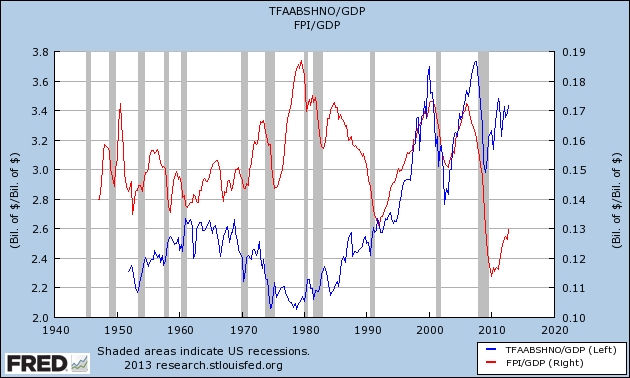
[4] Within the sphere of financial claims, the relationship is sometimes stronger: there may be a relationship between, say, the aggregate balance sheet size of the telecoms industry and fixed investment in telecoms. But the aggregate quantity of financial claims as a whole (restricted to those held by households to avoid double-counting of “pass-through” holdings) has no stable relationship to the quantity of measurable investment in the economy:
TFAABSHNO → “Total Financial Assets – Assets – Balance Sheet of Households and Nonprofit Organizations”, “FPI” → Fixed Private Investment; I should probably have included gross foreign holdings in the financial assets measure, but the series I’d need, though available in the flow of funds, seems not to be published on FRED. (It’d be Table L.106, “Rest of the World”, “Total financial assets”, Line 1 if anyone is more motivated than I am to find the full series and add it to household financial assets.) [End Footnote]
In the models, foregone consumption and productive investment are inseparable. In the real world, purchasing a financial asset (or holding money!) does imply that some agent forgoes consumption. But it does not imply that the foregone consumption will be invested. The consumption an agent forgoes may be consumed by others. It may be wasted. . . . In real life, there are a lot of those revaluations, and no measure of observable capital corresponds with a cumulation of financial savings. So, if we want to take Chamley-Judd reasoning seriously, we oughtn’t set tax rates capital gains, dividends, or interest to zero. Instead, we should ensure that real investment activity by firms is tax advantaged. There is no Chamley-Judd case for not taxing the interest on consumer loans or government bonds that finance transfers. There may be a case for policies like accelerated depreciation of fixed capital or even tax credits for education expenses. [5] But given the weak relationship between financial assets and real investment, eliminating conventional “capital taxes” just subsidizes the products of the financial sector. It offers a windfall to financiers and their best customers, but creates no foreseeable “piece of a bigger-pie” benefit for the people to whom the tax burden is shifted.
[5] Interestingly, Andrew Abel points out that, under conventional Chamley-Judd assumptions, not worrying at all about human capital or the imperfections of finance, optimal tax policy may be to tax only capital, but to permit the ultimate in accelerated depreciation, immediate expensing of capital goods.4. Aggregate Saving Rates Are Empiricallly Insensitive To Returns
The force that drives the Chamley-Judd conclusion is the long-term elasticity of capital provision to interest rates. The intuition is that capitalists make a decision about whether to forego consumption and contribute to growth or whether to consume today based on a comparison between available returns and their time preference. Lower capital taxes keep returns higher and make contributing capital “worth the wait” over a longer arc of the production function, leading to a higher steady state.
Unfortunately, this sort of calculation does not seem to describe economy-wide savings behavior very well. Aggregate purchases of financial assets seem to be insensitive to returns. In the US, yields on debt, risk-free, corporate, and individual, have been falling since the 1980s, while the stock of financial assets held by households (as a share of GDP) has grown inexorably. (Total equity returns were high only in the 1990s; financial holdings grew about as fast during the low-debt-yield, low-return pre-crisis 2000s as they did in the 1990s, see the graph below.) Unless you posit a peculiarly declining time preference, the core implication about aggregate savings behavior in any Ramsey model seems quite false. We need other stories. I have some! Perhaps consumption is approximately satiable, and the fraction of income saved is just a residual, the difference between income and the satiation level. Perhaps wealthier households save, not to endow future consumption, but because they are in a competitive race with other households for insurance or status that derive from financial holdings. Perhaps for the US, aggregate saving is largely a residual of other countries’ return-insensitive economic policy (Asian mercantilism, petrodollar recycling, etc.). In any of these cases, we’d expect gross financial saving not to be especially sensitive to investment returns. Now human capital formation may be less wage-sensitive than we’d guess too. Maybe we become brilliant more because of expectations and support provided by the people and institutions that surround us than because of the extra money we anticipate. But all these uncertainties undermine the Ramsey/Chamley/Judd edifice, rather than suggesting a zero capital tax.5. There Are Diminishing Returns To Most Kinds Of Investment
Another point is that the argument for zero taxation of gains from capital falls apart when there are diminishing returns from new capital investments.
With modestly decreasing returns to scale, the optimal tax rate is positive; with constant returns to scale the optimal tax rate is zero; with modestly increasing returns to scale, the optimal tax rate is negative.The notion that investments can have diminishing returns flows naturally from the assumption that investors rationally invest in the investments with the greatest returns first, and only consider less beneficial investments when the better ones have been made already.
6. Government Spending Has Productivity Enhancing Value And Taxing Poor People Is An Inefficient Way To Generate Government Revenue
None of these critiques address the fact that government spending has economic value, and that we primarily tax people to generate revenues, rather than primarily to tweak economic incentives. A material share of government spending constitutes investments that increase the nation's productive capacity: roads, medical research, the Internet, dispute resolution mechanism for businesses, and schools, for example, are all basically the product direct government investments.
Optimally, the marginal dollar of public sector spending and the marginal dollar of private sector spending have the same marginal utility. Undertaxation produces suboptimal results. But, the only way for taxes to generate revenue is for them to tax people who have an ability to pay, which generally means people who have physical or human or institutional capital. Taxing poor people is not a good strategy for generating adequate government revenue.
7. The Assumption That Higher Productivity Means Workers Are Rewarded Is Flawed
The model argues that worker pay is tied to how productive they are.
It is wonderful for Jones to remind his students that, especially in a context of full employment, “capital helps workers”. Stories of what a worker can accomplish with a bulldozer versus a shovel are important and on-point. Students should inquire into the process by which in some times and places construction workers get bulldozers and live well, while in other times and places they work much harder with shovels yet barely subsist.The evidence of the last few decades, however, is that the lion's share of GDP growth has been captured by capitalists without providing a benefit to workers. The historic trend of shared benefits from GDP growth seen in the highly unioned 1950s and 1960s is gone. It is not in the interest of workers to tax themselves in order to allow someone else to get rich.
Gut Bacteria Based Obesity Treatment Works In Mice
Obesity has significant links to how one's gut bacteria work in a person's digestive tract. New research tested in mice shows that "a natural gut enzyme — called intestinal alkaline phosphatase (IAP) — that helps keep endotoxin in check." The endotoxin in the gut produced by gut bacteria are the mechanism by which many of the downsides of obesity work their way into our bodies.
[M]ice lacking IAP have leaky guts, as well as excess endotoxin and inflammatory molecules in their blood. The knockout animals are also obese and have insulin resistance, a sign of diabetes.
The team then looked at the effects feeding mice IAP as a supplement to a high-fat diet. A daily dose of IAP (it’s a powder that dissolves in the animals’ drinking water) for 11 weeks prevented all of the problems that develop in mice eating the high-fat diet alone — insulin resistance, leaky gut, blood endotoxin, inflammation, and weight gain.
In yet another set of experiments, the researchers fed mice a high-fat diet and allowed them to fully develop metabolic syndrome and obesity. Then they gave them the IAP supplement for six weeks. In these animals, IAP reduced endotoxin levels, inflammation and glucose intolerance. If the fat mice had taken the supplement for a longer period of time, their condition may have reversed even more[.]Essentially, IAP supplements hold the promise of a diet pill that works not by curbing hunger, but by changing the way the body processes what it eats.

08 April 2013
Snow Day
The Denver Public Schools will be closed on Tuesday, April 9, 2013, due to a severe spring snowstorm headed into the area. Jefferson County Schools are also closed and given that DPS is generally the most reluctant to close of any of the metro area schools, I expect that other districts will swiftly follow suit.
Today's high was 71 degrees, with a forecast low of 19 degrees and a forecast low tomorrow of 15 degrees.
Today's high was 71 degrees, with a forecast low of 19 degrees and a forecast low tomorrow of 15 degrees.
05 April 2013
North Carolina Still Thinks It Can Have An Official State Religion
North Carolina is considering a bill that says the following:
The North Carolina General Assembly asserts that the Constitution of the United States of America does not prohibit states or their subsidiaries from making laws respecting an establishment of religion.
The North Carolina General Assembly does not recognize federal court rulings which prohibit and otherwise regulate the State of North Carolina, its public schools, or any political subdivisions of the State from making laws respecting an establishment of religion.From here.
04 April 2013
Delegitimatizing Dangerous People
Proposed state and federal bans on large magazines for civilian firearms probably won't make a difference for more than one or two mass shootings in the next decade or two (bad guys can always just buy more small, easily replaceable magazines) and won't prevent entirely any mass shootings. As a barrier to larger mass homicide counts, it is an epic fail.
But, ultimately, these laws are as much about changing social norms about guns as they are about the utilitarian objective of reducing the number of people who die in already extremely rare mass shooting events.
These laws add moral authority to a proposition that is very widely felt:
Most gun control in the United States is social and not legal. Something on the order of 80% of adults in Colorado have the legal right, with only minimal bureaucratic hassle to get a concealed carry permit and bring a handgun with them to work, while out about town running errands, into stores, in movie theaters, and so on. In a typical urban setting in Colorado, the percentage of non-security professionals who actually do so is under 0.5%, even though roughly half of adults have a gun in their homes, and probably more than 40% of households have a handgun in their homes.
Passing a law like a state ban on large capacity magazines is a way to develop the social norm that paranoid or diabolical gun nuts are a tiny, illegitimate and dangerous outlier subset of our nation's population, despite the fact that they are very politically vocal. By doing so, their influence in the gun control debate down the line can be reduced. Indeed, delegitimatizing these group of people, all by itself, may have the helpful effect of encouraging ordinary citizens to make law enforcement aware of these people, which may very well prevent gun violence by them.
But, ultimately, these laws are as much about changing social norms about guns as they are about the utilitarian objective of reducing the number of people who die in already extremely rare mass shooting events.
These laws add moral authority to a proposition that is very widely felt:
Civilians who feel the need to buy large capacity magazines for their firearms are paranoid or diabolical, dangerous people with a highly elevated chance of committing horrible atrocities (no matter how low the chance of this happening is on an absolute percentage basis). Buying a large magazine is something that only someone who has illegitimate uses for a gun finds valuable and we as a society should delegitimatize you and the uses you contemplate for your firearms when you buy one.Similarly, a law like this legitimatizes the sentiments of ordinary non-gun nut individuals, even gun owners, who feel that someone who feels the need to spend money to buy a large capacity magazine for their firearm is a dangerous individual whom we are right to fear, despise and ostracize. If you have a scary neighbor who also happens to own a large capacity magazine for his firearms, he is probably someone in the community that local law enforcement needs to be as worried about as your average local felon on parole.
Most gun control in the United States is social and not legal. Something on the order of 80% of adults in Colorado have the legal right, with only minimal bureaucratic hassle to get a concealed carry permit and bring a handgun with them to work, while out about town running errands, into stores, in movie theaters, and so on. In a typical urban setting in Colorado, the percentage of non-security professionals who actually do so is under 0.5%, even though roughly half of adults have a gun in their homes, and probably more than 40% of households have a handgun in their homes.
Passing a law like a state ban on large capacity magazines is a way to develop the social norm that paranoid or diabolical gun nuts are a tiny, illegitimate and dangerous outlier subset of our nation's population, despite the fact that they are very politically vocal. By doing so, their influence in the gun control debate down the line can be reduced. Indeed, delegitimatizing these group of people, all by itself, may have the helpful effect of encouraging ordinary citizens to make law enforcement aware of these people, which may very well prevent gun violence by them.
02 April 2013
Gender Preferences v. Economics in Marriage and Parenting
A Real Life Case In Point
The following is from the current online dating profile of a never married, childless woman in her late thirties who is a medical doctor who has completed her residency and is well established in her career describing what she wants in a prospective husband (emphasis mine):
The following is from the current online dating profile of a never married, childless woman in her late thirties who is a medical doctor who has completed her residency and is well established in her career describing what she wants in a prospective husband (emphasis mine):
You want kids/a family. . . . I am not willing to compromise on having my own complete family one day. . . . You know how to save. You make a good living. Yes, I'm a physician, and this means I'm financially independent. . . . But I'd like to work part time once I have kids. I don't want to be the primary bread winner.*
Electric Car Battery Technology Improving But Only Incrementally
The main barrier to a world full of electric cars that replace those with internal combustion engines (ICEs) is battery technology. Electric cars perform every bit as well or better than conventional cars and we know how to make them. But, their batteries have limited range (a third to half of the range of a conventional automobile with a full tank of gas) because they have low energy density relative to gasoline and diesel fuel (i.e. they are heavy for the amount of energy they carry), can take a long time to recharge (often overnight without special equipment that is only available in select locations), they are expensive ($12,000 to $15,000 per vehicle, about a third of the total cost) and they are often environmentally harmful to manufacture.
There has been progress. The cost of an electric car battery per unit of energy stored has fallen by a factor of eight from 1991 to 2005, although almost all of that improvement took place from 1991 to 1998. The energy density of batteries in 2005 was 2.35 times what it was in 1991 and that improvement has not leveled off so starkly.
If these gains repeated themselves over another fifteen years, the internal combustion engine vehicle would cease to exist as anything other than a museum piece and in niche conditions. But, existing electric car battery technologies are mature enough, and the relevant fundamentals of chemistry and physics are well enough understood, that additional huge breakthoughs of that magnitude seem like a long shot, particularly on the question of energy density (there may be more room to find cheaper anode and diodes with comparable performance than they is to find them with dramatically better performance at any plausible price).
Right now, we are close to economic boundary conditions between a variety of automobile fuel and engine technologies that leaves us poised beween hybrid vehicles and conventional vehicles, with the most sensitive factor being the cost of gasoline. An oil production boom in the United States made possible with fracking has keep gasoline prices relatively low.
But, in all likelihood, gas prices will rise to the $5.00 to $6.00 a gallon where plug in electric hybrids make sense more rapidly than battery prices will fall by the 50% or so it would take to make anything other than a hybrid vehicle much more attractive. Battery prices are moving down much more slowly than gasoline prices are moving up, in medium term time frames.
Indeed somewhere in the $8.00 to $16.00 a gallon real dollars gasoline price range, it starts to make sense to reengineer our urban landscapes and commercial logistics systems to shift more long haul freight and passenger service to electric rail, to concentrate housing more centrally, to develop systems to switch out batteries rather than recharging them in place, and so on - electric cars would be used for short run local transportation where they excel, rather than long haul highway trips where their lack of range is a problem. We would return to street car cities with electric vehicles on existing city streets instead of trollies.
There are probably some unrealized price gains left to be made in a transition from low volume retail mass market production to high volume retail mass market production, but much of the gains made so far already look like economy of scale gains, so additional scale may not produce much more than a 10%-20% price reduction.
Of course, an entirely new kind of battery could easily be game changing. But, that advance hasn't been made so far and would probably require a switch to some radically different technology like moving from conventional chemical batteries to supercapacitors or flywheels.

There has been progress. The cost of an electric car battery per unit of energy stored has fallen by a factor of eight from 1991 to 2005, although almost all of that improvement took place from 1991 to 1998. The energy density of batteries in 2005 was 2.35 times what it was in 1991 and that improvement has not leveled off so starkly.
If these gains repeated themselves over another fifteen years, the internal combustion engine vehicle would cease to exist as anything other than a museum piece and in niche conditions. But, existing electric car battery technologies are mature enough, and the relevant fundamentals of chemistry and physics are well enough understood, that additional huge breakthoughs of that magnitude seem like a long shot, particularly on the question of energy density (there may be more room to find cheaper anode and diodes with comparable performance than they is to find them with dramatically better performance at any plausible price).
Right now, we are close to economic boundary conditions between a variety of automobile fuel and engine technologies that leaves us poised beween hybrid vehicles and conventional vehicles, with the most sensitive factor being the cost of gasoline. An oil production boom in the United States made possible with fracking has keep gasoline prices relatively low.
But, in all likelihood, gas prices will rise to the $5.00 to $6.00 a gallon where plug in electric hybrids make sense more rapidly than battery prices will fall by the 50% or so it would take to make anything other than a hybrid vehicle much more attractive. Battery prices are moving down much more slowly than gasoline prices are moving up, in medium term time frames.
Indeed somewhere in the $8.00 to $16.00 a gallon real dollars gasoline price range, it starts to make sense to reengineer our urban landscapes and commercial logistics systems to shift more long haul freight and passenger service to electric rail, to concentrate housing more centrally, to develop systems to switch out batteries rather than recharging them in place, and so on - electric cars would be used for short run local transportation where they excel, rather than long haul highway trips where their lack of range is a problem. We would return to street car cities with electric vehicles on existing city streets instead of trollies.
There are probably some unrealized price gains left to be made in a transition from low volume retail mass market production to high volume retail mass market production, but much of the gains made so far already look like economy of scale gains, so additional scale may not produce much more than a 10%-20% price reduction.
Of course, an entirely new kind of battery could easily be game changing. But, that advance hasn't been made so far and would probably require a switch to some radically different technology like moving from conventional chemical batteries to supercapacitors or flywheels.
Combined Tax Burdens In U.S. Slightly Progressive
The combined tax burdens at the federal, state and local level in the United States are slightly progressive (on average). The pain of the fiscal cliff tax increases after the deal struck in Congress a few months ago, is shared quite evenly by all income groups.
State and local taxes in the United States are mildly regressive, on average, but the federal tax code's progressivity largely counterbalances that effect.
It is also important to recall that these are national averages of state and local tax burdens. In general, state and local taxes in the South are more regressive and in the Northeast are more progressive. The combined tax impact in the South is probably either flat or slightly regressive. The combined tax impact in the Northeast is more meaningfully progressive.
Also, of course, these numbers are only averages. Some people pay more than average for their income class, while others pay less.
In general, the federal tax code favors people with unearned income significantly over those with earned income. State and local tax codes largely amplify this effect, garnering much of their revenue from sales taxes on personal consumption (effectively taxing the income earned to make those purchases through a back door while excluding most services and in many cases excluding grocery store food), and property taxes on real estate - while taxing income from investments not spent on real estate or goods for personal consumption quite lightly.
Tax Burdens By Social Class
The famed "one percenters" pay only about ten percent more in taxes than they would if the overall tax burden were perfectly flat. Those in the next four percent of income pay about 7% more than they would under an overall flat tax system. These families pay an average of 32% to 33% of their incomes in taxes. The "rich" one percenters pay only slightly larger share of their income in taxes than the upper middle class in the next nineteen percent of families, despite earning four or five times as much on average as those at the upper end of the upper middle class range.
Households in the 60th to the 95th percentiles of income pay roughly the same share of their income in taxes as they would if the overall tax burden were flat. These families pay an average of 30%-32% of their income in taxes.
The bottom 60% gets some relief in the federal tax code which more than makes up for them paying more than a flat tax share of state and local taxes, but still pay less than a third less than the flat tax amount. These families pay 19% to 27% of their incomes in taxes on average.
Overall, Americans pay 30% of their incomes in combined federal, state and local taxes, with only poor and working class families in the bottom 40% of the income distribution paying more than +/- about 10% from that value. The combined tax burden in the U.S. as a percentage of personal income is quite low compared to most of its first world peers.

Income Distribution By Social Class
Poor and working class families in the bottom 40% of the income distribution earn 11.2% of personal income, middle class families in the next 40% of the income distribution earn 29.6% of personal income, upper middle class families in the next 19% of the income distribution earn 38.4% of personal income, and the rich in the top 1% earn 21.9% of personal income.
Those in the top 1% earn 21.9 times the average income. Those in the upper middle class (the next 19%) are earning 1.4 to 5.5 times the average income. Those in the middle class (the next 40%) earn 0.6 to 0.9 times the average income. The poor and working class (the bottom 40%) earn 0.2 to 0.3 times the average income.
The Realm Of Posssibility
It wouldn't be hard to provide significant tax relief to the poor and working class with only modest tweaks to the tax burdens of the affluent. But, the problem of increasingly widening pre-tax income distributions is far more intractable. And, major middle class tax relief is not so easily accomplished because they contribute far more to public revenues.
State and local taxes in the United States are mildly regressive, on average, but the federal tax code's progressivity largely counterbalances that effect.
It is also important to recall that these are national averages of state and local tax burdens. In general, state and local taxes in the South are more regressive and in the Northeast are more progressive. The combined tax impact in the South is probably either flat or slightly regressive. The combined tax impact in the Northeast is more meaningfully progressive.
Also, of course, these numbers are only averages. Some people pay more than average for their income class, while others pay less.
In general, the federal tax code favors people with unearned income significantly over those with earned income. State and local tax codes largely amplify this effect, garnering much of their revenue from sales taxes on personal consumption (effectively taxing the income earned to make those purchases through a back door while excluding most services and in many cases excluding grocery store food), and property taxes on real estate - while taxing income from investments not spent on real estate or goods for personal consumption quite lightly.
Tax Burdens By Social Class
The famed "one percenters" pay only about ten percent more in taxes than they would if the overall tax burden were perfectly flat. Those in the next four percent of income pay about 7% more than they would under an overall flat tax system. These families pay an average of 32% to 33% of their incomes in taxes. The "rich" one percenters pay only slightly larger share of their income in taxes than the upper middle class in the next nineteen percent of families, despite earning four or five times as much on average as those at the upper end of the upper middle class range.
Households in the 60th to the 95th percentiles of income pay roughly the same share of their income in taxes as they would if the overall tax burden were flat. These families pay an average of 30%-32% of their income in taxes.
The bottom 60% gets some relief in the federal tax code which more than makes up for them paying more than a flat tax share of state and local taxes, but still pay less than a third less than the flat tax amount. These families pay 19% to 27% of their incomes in taxes on average.
Overall, Americans pay 30% of their incomes in combined federal, state and local taxes, with only poor and working class families in the bottom 40% of the income distribution paying more than +/- about 10% from that value. The combined tax burden in the U.S. as a percentage of personal income is quite low compared to most of its first world peers.
Income Distribution By Social Class
Poor and working class families in the bottom 40% of the income distribution earn 11.2% of personal income, middle class families in the next 40% of the income distribution earn 29.6% of personal income, upper middle class families in the next 19% of the income distribution earn 38.4% of personal income, and the rich in the top 1% earn 21.9% of personal income.
Those in the top 1% earn 21.9 times the average income. Those in the upper middle class (the next 19%) are earning 1.4 to 5.5 times the average income. Those in the middle class (the next 40%) earn 0.6 to 0.9 times the average income. The poor and working class (the bottom 40%) earn 0.2 to 0.3 times the average income.
The Realm Of Posssibility
It wouldn't be hard to provide significant tax relief to the poor and working class with only modest tweaks to the tax burdens of the affluent. But, the problem of increasingly widening pre-tax income distributions is far more intractable. And, major middle class tax relief is not so easily accomplished because they contribute far more to public revenues.
Structural Change In The U.S. Job Market
The US has gained 387,000 managers and lost almost 2m clerical jobs since 2007, as new technologies replace office workers and plunge the American middle class deeper into crisis.
Data from the Bureau of Labour Statistics divide the US workforce into 821 jobs from dishwasher to librarian. They show rapid structural shifts – on top of a cyclical unemployment rate of 7.7 per cent – that may increase income inequality.
One probable cause of rising inequality is new computing technologies that destroy some middle-class occupations even as they create jobs for highly skilled workers who can exploit them.
The number of clerical workers such as book-keepers, tellers, data entry keyers, file clerks and typists has been falling, pointing to a structural decline. The number of retail cashiers has also dropped – indicating that internet shopping and self-checkout systems may be eroding another occupation.
Employment growth came from healthcare, management, computing and food service jobs. The number of personal care aides is up 390,000 since 2007. Demand for people who figure out how to replace clerical workers – such as operations managers, management analysts and logisticians – grew substantially.From the Financial Times via Marginal Revolution.
Perhaps a better way to describe the trend than an erosion of the middle class (for many of these jobs have ceased to be middle class jobs) is as an erosion of the white collar working class job. And, I don't doubt that it is real. Entire tasks like copying and mailing legal pleadings, or taking dictation, have virtually disappeared. When was the last time someone filled your gas tank for you? Robots don't just work in factories anymore.
Unskilled labor is really cheap. You see that on the streets of Denver every day where it has become cost effective to have people drive other people around town in rickshaws and twirl signs.
High school students are far less likely to be employed, something that used to be a right of passage and the norm for middle class families, as adults chase the jobs they used to fill because nobody else wanted them.
Hell, skilled labor is abundant and not all that expensive. I've never had trouble filling the ten hour a week position as my assistant with highly intelligent and capable college graduates who have prior work experience (one of three a graduate student and another with some graduate school experience) at hourly rates that while they are far above minimum wage, would not support a family breadwinner even at forty hours a week.
My decision to hire highly educated applicants isn't just a matter of simplying the job search either. The level of computer expertise and brain work that is involved in the job is far greater than it was in similar jobs when I started practicing law in the 1990s.
What will they do?
The big question is whether our economy can find something else worthwhile for all those displaced low end retail, administrative, and clerical workers to do that they are capable of doing. Can we find jobs that have economic value that need to be done doing something else?
The free market virtually guarantees that at some price, we can. The real question is how much value the replacement jobs can create.
Nobody bemoans the fact that we no longer need to employ 80%+ of the population to be farmers to meet our collective needs as we did around the time of the American revolution. To the extent that manufacturing employment is down due to greater efficiency rather than offshoring (in fact, both are involved) this too is not inherently a bad thing. Services that no one was available to provide once upon a time can now be provided with the abundance that more efficient exploitation of resources and production of goods and certain kinds of services has made possible.
But, increasingly, the problem of finding means of support or work for people in a society where fewer people can provide all of the goods and services we used to consume is a problem on our doorstep and not a conceptual issue to struggle with in the future.
Degree inflation and the dangers of long term statistical comparisons
I would note, however, that long run comparisons of the well being of high school graduates without college, or college graduates, for example, are not necessarily comparing apples to apples.
If we imagine a domain, "education level" which is first roughly sorted by degree earned and then internally sorted by GPA when earning a degree, or credits earned for people with "some college", the education level percentile for the median person at each level of education has fallen dramatically since 1950 and 1970 respectively, two common dates from which people make comparisons. The shift has been much more pronounced for women than it has been for men.
Even accounting for the Flynn effect, people have grown more educated much more rapidly than they have gotten smarter in this time period. While additional educational degrees can add value from the process of being educated, a significant (and hotly contested) portion of the value of an educational degree has always been symbolic of sorting effects that take place mostly in the admissions process and to a lesser extent by sorting people who are together enough to graduate from those who are not.
In other words, today's median college graduate is much dumber than a typical college graduate in 1950 or 1970, today's median high school graduate with no further education is much dumber than in 1950 or 1970, and today's high school dropout is much dumber than in 1950 or 1970. Today's graduate or professional degree holder still lags a little in educational percentile relative to the average college graduate in 1950.
Part of the reason that job prospects were so good for high school graduates back in the day is that they were the intellectual equivalents of today's liberal arts graduates with four year college degrees. And, the jobs that were available to high school graduates reflected their intellectual abilities. High school graduates with no further education were routinely places in middle management, insurance sales, real estate sales, worked as journalists and editors for top newpapers, taught in elementary schools, worked as nurses, and even secured patents as inventors. College professors often lacked graduate degrees.
For example:
* In 1960 the high school dropout rate was 27.2%.
* In 1970, it was 15.0% - 13.2% for whites and 27.9% for blacks.
* In 1980, it was 14.1% - 11.4% for whites, 19.1% for blacks, and 35.2% for Hispanics.
* In 1990, it was 12.1% - 9.0% for whites, 13.2% for blacks, and 32.4% for Hispanics.
* In 2000, it was 10.9% - 6.9% for whites, 13.1% for blacks, and 27.8% for Hispanics.
* In 2010, it was 7.4% - 5.1% for whites, 8.0% for blacks, and 15.1% for Hispanics.
The median high school dropout in 1960 was in the 13.6th percentile educationally.
In 1970, the 7.5th percentile, in 1980, the 7.05th percentile, in 1990 the 6.5th percentile, in 2000 the 5.45th percentile and in 2010 the 3.7th percentile.
A median high school dropout in 2010 was almost four times closer to the bottom of the heap than in 1960, half a century earlier. It is little wonder that high school dropouts who are much closer to the bottom of the barrel intellectually than they were forty or fifty years ago are a lot less socioeconomically successful. Today's high school dropout is at the same level of education as the junior high school dropout of the 1960s, percentile-wise.
Has degree inflation gotten out of hand?
Nobody doubts that in the case of some degrees, for example, engineering or medicine, that the learning that takes place during the college experience is adding value that is not just due to sorting effects. But, in the case of a great many degrees in business, education, journalism, the fine arts, culinary schools, or the liberal arts, sorting effects predominate from an economic perspective, if not from a cultural one. For example, the many countries where one can become a lawyer after earning an undergraduate degree in that profession are no worse off than those that insist that would be lawyers earn a four year degree in absolutely anything they want before attending three more years of law school.
Some credible form of ability sorting, like more widely accepted measures of merit from exceptional high school performances could (mechanically at least) easily be substituted for college attendance on career tracks where the actual educational content of the higher education process isn't adding value. Indeed, the same can be said of high school in many cases. Millions of medicore high school students are not mistaken when they despair at the uselessness of the curriculum they have been assigned which is calculated prepare them to go to a college that they will never attend, or which they will attend and fail miserably at anyway after incurring student loans.
Yet, it is undeniable that earning a college degree is a key divider between the haves and the have nots in our society and it is one of the few assets that cannot be taken away from you when a severe recession depletes all other forms of wealth for huge swaths of the middle class. For those who can successfully complete a college degree, it is almost socioeconomic suicide not to earn one.
The perks we gain as a society from increased credentialism and degree inflation have not been weighed sufficiently against the cost of providing these degrees in terms of tuition and fees, the cost of earning these degrees in terms of opportunity costs both in earnings and on the job experiences, and the cost of expecting these degrees in terms of the delay it imposes on young people before they can become established in careers, start families, or otherwise get on the with business of being full fledged adults.
Education is an area where the individual incentives to earn them are strong, but the collective benefits of encouraging everyone to earn them are dubious. Yet, as much as anything, over education is our natural economic response to an economy where we don't need as large a workforce because those who work are so productive.
Funding Science Vegas Style
One of the great things about quantum mechanics is that it is the most pure form of randomness known to man. This has prompted physicist Tommaso Dorigo to propose (not on April 1st) that perhaps the Large Hadron Collider should be integrated into a lottery system that would provide both quantum physical integrity and increase public interest in science. Indeed, particle physics would then be funded entirely by the mathematically stupid, bringing the irony of the stupidity tax that is the lottery to new heights.
Subscribe to:
Posts (Atom)