A recent Fox News story demonstrates the fact that in Colorado, genetic relatedness is not perfectly equivalent to paternity for custody and child support purposes (even in the absence of a legal adoption).
Paternity can be established in multiple ways in Colorado in addition to genetic relatedness, including through presumptions arising from marriage or birth certificates that sometimes become conclusive after a sufficient period of time, even if later found to be inconsistent with DNA evidence. There is also not perfect consistency between definitions of paternity under the law for different purposes (e.g. child support v. custody v. tax purposes v. Social Security v. immigration and nationality status v. inheritance).
Also, in Colorado, in addition to parents (and in some circumstances non-custodial grandparents), even completely unrelated persons who have lived with a child for at least six months in the six months before the proceeding, or with whom the child was present at the time that the proceeding was commenced, have standing to seek parenting time and parental responsibilities for the child on a equal footing with parents determined under one omnibus (and hopelessly vague) "best interests of the child" standard.
Apart from presumptions of paternity related to marriage of the mother of a child and some provisions related to inheritance, the law of child support and custody in Colorado is largely independent of the rest of divorce law. In other words, the rights of unmarried couples and married couples in child support and custody cases are basically the same.
It is also worth observing that merely having children together, or merely cohabiting (or both) even for decades, does not give rise to a common law marriage in Colorado (contrary to descriptions of common law spouses frequently made by law enforcement officers and journalists). Common law marriage in Colorado requires an agreement between two adults that they are married, that the couple hold itself out to the public as married, and (arguably) cohabitation or consummation. A common law marriage doesn't require years of cohabitation and once a couple is common law married, the bond cannot be broken except by divorce or death. There is no such thing as a common law divorce.
The main difference between married and unmarried couples that break up, legally, is that spouses may have claims to maintenance (a.k.a. alimony), responsibility for debts arising during the marriage on which a spouse may not otherwise be fully legally responsible, and a right to equitable division of property acquired during the marriage even if titled in the other spouse's name.
In contrast, a partner in an unmarried couple with children is typically entitled to child support and custody of the children, but not to any additional maintenance, to assistance from the other partner with debts in the unmarried partner's name, or to property that is titled or legally owned by the other partner.
(There are also marital rights related, for example, to wrongful death lawsuits, inheritance, Social Security benefits, taxes, and decision making related to a partner who can not make decisions for him or herself.)
28 July 2016
Life Imitates Art Again
Ilkwon Ha's 2015 webcomic "Duty After School" features Korean high schoolers drafted into the military to respond to killer spherical purple blobs with red nuclei that have invaded the world.
Meanwhile, marine biologists this week discovered a strikingly similar looking organism whose exact taxonomy remains unknown.
Meanwhile, marine biologists this week discovered a strikingly similar looking organism whose exact taxonomy remains unknown.
Not The Best Defense
McConnell appeared in court for an advisement hearing on Thursday morning. He faces charges for first-degree kidnapping and felony menacing, as well as second-degree misdemeanors for false imprisonment and prohibited use of a firearm.
During the hearing, records say McConnell said he “didn’t kidnap anyone. I just held him hostage.”From 9News.
ADHD Meds Work
Children who are diagnosed with ADHD are significantly less likely to get sexually transmitted diseases, to have substance abuse problems, and to experience accidental injuries if they are taking ADHD medicines than they are if they do not do so.
Eleven percent of children in the United States ages 4-17 have been diagnosed with ADHD and almost 70 percent of them are treated with medications. . . . Compared with children who were diagnosed with ADHD but did not receive medication, those who took medication were 3.6 percentage points less likely to contract a sexually transmitted disease, 7.3 percentage points less likely to have a substance-abuse disorder and 2.3 percentage points less likely to be injured.Needless to say, these results are not direct, but flow instead from behavioral changes that occur when ADHD symptoms are controlled.
Misdemeanor Defendants Unable To Post Bond Pay Dearly For Their Poverty
In misdemeanor cases, pretrial detention poses a particular problem because it may induce otherwise innocent defendants to plead guilty in order to exit jail, potentially creating widespread error in case adjudication. . . . This Article uses detailed data on hundreds of thousands of misdemeanor cases resolved in Harris County, Texas — the third largest county in the U.S. — to measure the effects of pretrial detention on case outcomes and future crime.
From here.We find that detained defendants are 25% more likely than similarly situated releases to plead guilty, 43% more likely to be sentenced to jail, and receive jail sentences that are more than twice as long on average.
Controls in the study establish that these effects are probably caused by pre-trial detention rather than simply correlated with it.
This is particularly troubling in misdemeanor cases, because the de facto punishment arising from pre-trial detention in misdemeanor cases is often great relative to the likely sentence upon conviction, and because the likely harm from pre-trial release of misdemeanor defendants is generally much smaller than the likely harm from pre-trial release of felony defendants.
Another troubling fact is that the bond amounts, while insurmountable to those too poor to raise those funds, are quite modest for middle class defendants in most misdemeanor cases. Yet, misdemeanor bonds are rarely imposed, in practice, on a sliding scale. This also means that bond forfeiture may be a poor deterrent to flight for those inclined to do so in these cases, and that the economic gain to the detaining court from bond forfeitures is often modest.
Finally, studies have definitively and repeatedly shown that alternatives to bail are equally or more effective at causing defendants to show up for hearings if they are not detained prior to trial despite allowing far more people to be released prior to trial.
This casts the whole system of bail as more of an unfair litigation tactic used by prosecutors and less as a legitimate protection for the public.
More discussion of these issues if found in this post from 13 months ago, and also in this 11 month old post.
15% of U.S. Tech Patent Litigation Due To Patent Troll Enforcement Of Three Dubious Patents
Last month I noted that 60% of U.S. copyright suits are brought against anonymous downloaders, with 40% of the total brought by a single porn company.
Also notable is the fact that a court has determined that the song "Happy Birthday" which has been the subject of nearly a century of copyright enforcement action, has actually been in the public domain all along.
Similarly dubious is the use of copyright law to charge people for access to sources that constitute legal authority that ignorance is no excuse for not knowing.
A similar situation exists in U.S. patent litigation:
Shipping & Transit's patent on bus-tracking (the basis of 500+ lawsuits, most against cities' transit authorities); Uniloc's patent on DRM; and Sportbrain Holdings' patent on wearable health monitors. Collectively, these patents account for 15% of all of America's tech patent litigation.
In suits to enforce patents that go to trial, about half of the patents are found to be invalid, notwithstanding the fact that the patents are presumptively valid and have undergone expert review of the validity on the merits in the ex parte Patent and Trademark Office patent prosecution process which rejects significant share of all patent applications, particularly for patents related to business services.
This empirical data about how intellectual property laws are actually used in practice in the U.S. casts real doubt on the largely theoretical and ideologically driven arguments that our intellectual property law regime is good for the economy.
26 July 2016
Nobody Controls Syria
Syria's fate in its five year old civil war is still very uncertain. As the open source map curated by the Carter Center demonstrates, the government, opposition forces, ISIS and Kurdish dominated YPG groups all control comparable amounts of habitable Syrian territory.
The YPG controls most of the territory along the northern border, opposition forces and the government control a roughly equal patchwork of territory along the coast (although the opposition forces are themselves divided among multiple factions) including a few small areas where there are ceasefires in place, and ISIS controls most of the habitable areas of the southeastern part of the country.
About half of Syria is basically uninhabitable mountain and desert territory not really controlled by anyone.
The Syrian government appears to be gaining ground with Russian backing, but still controls only perhaps 1/8th of the nation's territory and does not even have firm control over its leading city, Damascus. It is largely restricting its efforts to defeating opposition forces in the coastal areas that are not controlled by the YPG and has made only modest inroads against ISIS (in part by design with the hope that ISIS will harm rebels and will be defeated by others). Given the government force's relative unity and far superior weapons compared to opposition forces, its failure to be more effective is remarkable.
ISIS, of course, which spans both Syria and Iraq, faces concerted coordinated attacks from the U.S., its allies, Kurds, the Iraqi government, Russian forces and Syrian forces. These attacks have destroyed a large share of their conventional heavy weapons like tanks, armored personnel carriers, artillery, and aircraft. These attacks have also destroyed many ISIS bases and ISIS has lost thousands of fighters in the war that has been ongoing since its inception.
ISIS probably has no more than four operable warplanes which have proven difficult to deploy without being shot down, has limited numbers of anti-aircraft missiles, 100 or fewer tanks, a couple dozen self-propelled artillery pieces, and perhaps one or two hundred other armored vehicles, and hundreds or thousands of pickup trucks with mounted heavy guns. A concerted attack on a convoy after ISIS lost Fallujah destroyed a substantial proportion of its heavy conventional weapons.
But, the people who are being "liberated" by Iraqi and Kurdish forces are mostly Sunni Arabs who have little interest in being a part of Shiite dominated Iraq or Kurdish autonomous areas within Iraq or Syria. So, gaining control of more territory is a non-trivial matter despite numerous military defeats in Iraq and Syria for ISIS.
Which U.S. City Has Weather Most Similar To London?
I've seen the question of which U.S. city has weather most similar to London (which is relevant because a lot of U.S. fashion, particularly formal business clothing, is derived from London norms) discussed often, but rarely with empirical evidence.
The short answer is Seattle, Washington.
In London, the average high temperature in July is 72 degrees Fahrenheit and 45 degrees Fahrenheit in January. It has 164 days of precipitation per year (45%), and 29.68 inches of precipitation per year.
The U.S. Data (from the National Climtatic Data Center, DESDIS, NOAA, U.S. Department of Commerce via the 2016 World Almanac mostly based upon 1981-2010 data).
* U.S. cities that are similarly cool in July (+/- 7 degrees) include:
Anchorage, Alaska (65), Los Angeles, California (74), San Francisco, California (72), Caribou, Maine (76), Portland, Maine (79), Sault Saint Marie, Michigan (76), Duluth, Minnesota (76), and Seattle, Washington (76).
* U.S. cities that are similarly warm in January (+/- 7 degrees) include:
North Little Rock, Arkansas (50), Denver, Colorado (44), Wilmington, Delaware (40), Washington D.C. (43), Atlanta, Georgia (52), Boise, Idaho (38), Dodge City, Kansas (44), Louisville, Kentucky (43), Baltimore, Maryland (41), Kansas City, Missouri (38), St. Louis, Missouri (40), Reno, Nevada (46), Atlantic City, New Jersey (42), Albuquerque, New Mexico (47), New York City, New York (38), Raleigh, North Carolina (51), Oklahoma City, Oklahoma (50), Portland, Oregon (47), Philadelphia, Pennsylvania (40), Memphis, Tennessee (50), Nashville, Tennessee (47), Norfolk Virginia (48), Richmond, Virginia (47), Seattle, Washington (47), and Charleston, West Virginia (43).
* U.S. cities with similar amounts of precipitation per year (+/- 8 inches a year) include:
Chicago, Illinois (36.89), Des Moines, Iowa (36.01), Detroit, Michigan (33.47), Sault Saint Marie, Michigan (32.95), Duluth, Michigan (30.96), Minneapolis, Minnesota (30.61), Omaha, Nebraska (30.62), Oklahoma City, Oklahoma (36.52), Portland, Oregon (36.03), Dallas, Texas (36.14), Burlington, Vermont (36.82), Seattle, Washington (37.49), and Milwaukee, Wisconsin (34.76).
* U.S. cities with similar numbers of days of precipitation per year (+/- 16 days a year) include:
Buffalo, New York (173), Burlington, Vermont (155), Caribou, Maine (165), Cleveland, Ohio (178), Grand Rapids, Michigan (168), Pittsburg, Pennsylvania (148), Portland, Oregon (158), and Seattle, Washington (150).
Analysis
There is exactly one city which is on all four lists: Seattle, Washington which is four degrees warmer in the summer and two degrees warmer in the winter. It gets a 7.81 inches more precipitation per year than London but on 14 fewer days. No other city is on both the January and the July temperature lists. The slightly warmer January temperatures in Seattle, however, mean that Seattle gets much less snow than London whose average low temperature in January is 32 degrees Fahrenheit.
Elsewhere in North America, Vancouver, British Columbia is a very close match to London in temperature with average January high (44), average July high (72), and in number of days of precipitation per year (165), but has about 50% more total precipitation per year (45.4 inches) (per Wikipedia).
All other American cities have hotter summers, colder winters or both.
Burlington, Vermont and Portland, Oregon have similar precipitation to London, and Portland, Oregon also has mild winters, but Portland's July high temperature averages 81, quite a bit warmer than London in the summer. Burlington is as warm as Portland, Oregon in the summer, and has much cooler average highs (27) in the winter.
Sault Saint Marie has mild summers, similar amounts of precipitation, more days of precipitation (181), but much colder January average highs (23). Duluth has fewer days of precipitation (137) and much, much colder January average highs (19). Portland, Maine has cooler January average highs (31), more precipitation per year (47.25 inches), and fewer days of precipitation (136).
San Francisco (20.65 inches from 54 days of precipitation a year) is considerably drier than London and has somewhat warmer January average highs (56) but earns honorable mention for the seasonal morning fogs that it, like Seattle, shares with London.
21 July 2016
Denver Christian Guidance Counselor Sexually Assaulted Student For Years
The Denver Post story doesn't identify the school where the following incident happened:
While this might slightly impact the privacy of the victim, it is a matter of public concern that this particular private school, as opposed to another one, failed to learn of and prevent this multi-year course of conduct. And, it is also a matter of public concern that this incident took place at a conservative Christian school, rather than a secular one or Roman Catholic one, for example.
Channel 7 news reports this detail and also notes that the course of conduct continued from November 2010 to March 2015. (Incidentally, Denver's Channel 7 has been on a streak of quality reporting relative to its competition for at least a year or two now.)
Somebody at the school must have known, or at least suspected, that something was going on long before this was reported to law enforcement authorities. And, dimes to dollars, this is probably one case of inappropriate conduct by the guidance counselor involved among many, over many students over many years.
Denver’s district attorney has filed charges against a former counselor being accused of sexually assaulting a teenage client for years.
The man, Troy Vandenbroeke, 49, is facing charges of aggravated sexual assault on a client by a psychotherapist and sexual assault on a client by a psychotherapist.
The charges allege that Vandenbroeke sexually assaulted an 18-year old student at a private high school in Denver while he was her guidance counselor, and that the assaults continued for four years, according to a news release from the district attorney’s office.
Vandenbroeke is currently out on a $50,000 bond and scheduled back in court on Aug. 12.But, it was trivial to determine that the school was Denver Christian.
While this might slightly impact the privacy of the victim, it is a matter of public concern that this particular private school, as opposed to another one, failed to learn of and prevent this multi-year course of conduct. And, it is also a matter of public concern that this incident took place at a conservative Christian school, rather than a secular one or Roman Catholic one, for example.
Channel 7 news reports this detail and also notes that the course of conduct continued from November 2010 to March 2015. (Incidentally, Denver's Channel 7 has been on a streak of quality reporting relative to its competition for at least a year or two now.)
Somebody at the school must have known, or at least suspected, that something was going on long before this was reported to law enforcement authorities. And, dimes to dollars, this is probably one case of inappropriate conduct by the guidance counselor involved among many, over many students over many years.
11 July 2016
Crisis Living Rooms
The default destination for someone in a mental health crisis that requires police intervention is a hospital emergency room. But, as an article in the High Country News focusing on an effort to find alternatives notes, an ER isn't very well suited to addressing mental health crisis events in a proportionate, deescalating way. The alternative model of a "Crisis Living Room" removes the aspects of an ER that can be counterproductive while having a staff well trained in dealing with a mental health crisis.
The Bigger Picture
While I understand the funding parity interest in equating mental health care and physical health care, ultimately, I don't think that a physical trauma and disease oriented model is a good one for mental health care.
The kind of professionals and institutions that provide mental health care best barely overlap at all with those well suited to physical health care. And, good psychiatric care rarely requires a skill set that can be acquired only by someone with a full fledged M.D. with 95% of the curriculum devoted to physical health conditions that have little or no relationship to mental health conditions, with the very high hourly rate for professional services that comes with it.
A disease model of mental health care for conditions that predominantly are unchangeable aspects of who patients are which need to be managed, rather than something that is "cured" or "fixed" in short order, doesn't make sense either.
And, piggybacking on a health care system that has at its foundation employer provided health insurance which takes a high level of bureaucratic conformity and emotional persistence to manage successfully is ill suited to a population that often has episodic absence from the work force and intrinsic difficult navigating the system is also ill founded. Proof is in the pudding - the number of in patient psychiatric beds has fallen to ridiculously low levels relative to the need because funding has not been there.
Mental health, more so than physical health apart from contagious diseases, is something we provide not just for the benefit of the patient, but for the benefit of the community, because untreated mental health conditions are externalities that can do great harm.
There is nothing inconsistent or problematic about designing a health care system in which mental health care might be designed on a single payer universal system with a pro-active approach to bringing people into the system, much like the public schools, while physical health care might be handled mostly on a much more patient driven basis under something like the current Obamacare mix of employer provided insurance for people who work for big business, insurance exchanges with incentives for the self-employed and small businesses, Medicaid for the poor, and a single payer system for the elderly.
Even the physical care system already has an institutionally quite different set of arrangements for trauma and acute illness care (for which insurance company preferred network providers are dispensed with) and non-trauma care.
Likewise, the case for establishing universal free or low cost access to reproductive health care in a manner that is largely independent of the employer based health insurance regime and the vagaries of politics, for example, funding it through a long term endowment, might make a lot of sense.
Neither mental health care, nor reproductive health care, make up a particularly large share of the U.S. health care budget. Mental health care and substance abuse treatment makes up about 7% of the total health care budget.
Comprehensive reproductive health care including birth control, abortion, STD treatment, prenatal and obstetric care, and fertility treatments is considerable less expensive - and the politically most sensitive aspects of it - birth control, abortion and STD treatment - are all quite inexpensive per capita indeed, but if funding for these were "solved" the political barriers to other kinds of government health care mandates and funding could be greatly reduced.
Even in the case of much less controversial reproductive health care services, evaluating reproductive health care needs based upon on per lifetime perspective, rather than a per year perspective, makes much more sense from an insurance underwriting and total health care perspective. Your prenatal and delivery health care quality should not be a function of the particular economic circumstances you have in the year that a baby is born for an event that happens a relatively small number of times in a lifetime. This can lead to mischief and inappropriate incentives on the part of both insurance companies and health insurance beneficiaries (who might, for example, have children inappropriately early for themselves in their relationship due to the availability of health care at the moment, or might postpone childbearing due to its lack when it would otherwise be a good time to have children).
08 July 2016
Dallas Leaves More Questions Than Answers
A coordinated shooting by at least two gunmen in Dallas yesterday killed at least five law enforcement officers, and left six seven more officers and two civilians a civilian shot, in a coordinated attack at a Black Lives Matters protest march. The march was protesting the deaths at police hands of a black man in Minnesota and another in Louisiana, each documented on video that went viral which make any justification for those killings seem dubious. There is no indications that the shooters had any connections to the protest organizers who were holding one of many peaceful rallies in cities across the nation including Denver.
Perhaps the most remarkable thing about the Dallas shooting is that something like this hadn't happened sooner. The means, opportunity and motive have been around for a very long time. No plan to stop something like this could have thwarted determined perpetrators. But, something nearly universal in our social fabric prevented it. But, yesterday it did happen. More law enforcement officers died in the incident than any other since 9-11 in 2001, and that wasn't specifically targeted at law enforcement in particular.
Mass shootings are exceedingly rare. Mass shootings involving coordinated perpetrators outside the context of gang crime are even more rare (although the ISIS inspired mass shooting by a married couple in San Bernadino of local government agency co-workers was another one in recent memory.) Mass shootings directed at law enforcement in particular are virtually unprecedented in the U.S., although they are common in Mexico, Columbia, Afghanistan, Iraq, and pretty much every other country with an active counterinsurgency or drug war in progress. This looks more like domestic terrorism in furtherance of a political agenda than the usual random or employment or domestic relationship related mass shooting.
One suspect was arrested following a shootout with police. Anotherkilled himself was killed by a bomb squad robot carrying a bomb placed there by police that police detonated after being wounded in a 45 minute or longer shootout with police. Multiple suspicious packages that may have been bombs were dealt with by the bomb squad, apparently without incident, and one or both of the shooter suspects said that there were bombs. A woman near the shooters was also arrested and has apparently not been released. A third suspect is apparently also in custody, but it isn't clear under what circumstances that arrest took place. No one knows if there are other conspirators still at large. No public information has been released about any of them. The suspect who was killed said that he was acting alone, that there were bombs placed, and that he wanted to kill white people and in particular police officers because of the wrongs done by police officers.
A man legally carrying a rifle in downtown Dallas who was wearing camouflage in the area who was not involved was named as a person of interest, surrendered himself and his gun and was released. Two other suspects who left the scene in a car at high speed after tossing a purportedly suspicious package into the car were stopped, interrogated and released.
The two or three arrested suspects who were not released are reportedly not cooperating with police, and nothing has been released about their identities or the identity of the suspect who killed himself. The Santa Monica Observer has made unsubstantiated claims about their identities and motives found nowhere else, but those claims from a news outlet far from the scene don't even bear repeating until they are substantiated by a more reliable source.
So we wait with questions.
Who was involved in carrying out the shooting and preparing bombs and what motivated them? How long had they been formulating their plans? Is this a larger conspiracy? Will this incident provoke copycat shootings?
Could anything be done to prevent this? Why did this happen now, rather than years or decades ago?
Some answers will come soon. We may never have good answers to some of the other questions.
UPDATED as indicated at 7:40 a.m. MT on July 8, 2016.
SECOND UPDATE at 9:50 a.m. MT on July 8, 2016.
No information was released about the other suspects.
Perhaps the most remarkable thing about the Dallas shooting is that something like this hadn't happened sooner. The means, opportunity and motive have been around for a very long time. No plan to stop something like this could have thwarted determined perpetrators. But, something nearly universal in our social fabric prevented it. But, yesterday it did happen. More law enforcement officers died in the incident than any other since 9-11 in 2001, and that wasn't specifically targeted at law enforcement in particular.
Mass shootings are exceedingly rare. Mass shootings involving coordinated perpetrators outside the context of gang crime are even more rare (although the ISIS inspired mass shooting by a married couple in San Bernadino of local government agency co-workers was another one in recent memory.) Mass shootings directed at law enforcement in particular are virtually unprecedented in the U.S., although they are common in Mexico, Columbia, Afghanistan, Iraq, and pretty much every other country with an active counterinsurgency or drug war in progress. This looks more like domestic terrorism in furtherance of a political agenda than the usual random or employment or domestic relationship related mass shooting.
One suspect was arrested following a shootout with police. Another
A man legally carrying a rifle in downtown Dallas who was wearing camouflage in the area who was not involved was named as a person of interest, surrendered himself and his gun and was released. Two other suspects who left the scene in a car at high speed after tossing a purportedly suspicious package into the car were stopped, interrogated and released.
The two or three arrested suspects who were not released are reportedly not cooperating with police, and nothing has been released about their identities or the identity of the suspect who killed himself. The Santa Monica Observer has made unsubstantiated claims about their identities and motives found nowhere else, but those claims from a news outlet far from the scene don't even bear repeating until they are substantiated by a more reliable source.
So we wait with questions.
Who was involved in carrying out the shooting and preparing bombs and what motivated them? How long had they been formulating their plans? Is this a larger conspiracy? Will this incident provoke copycat shootings?
Could anything be done to prevent this? Why did this happen now, rather than years or decades ago?
Some answers will come soon. We may never have good answers to some of the other questions.
UPDATED as indicated at 7:40 a.m. MT on July 8, 2016.
SECOND UPDATE at 9:50 a.m. MT on July 8, 2016.
The dead gunman in the Dallas ambush that left five officers dead has been identified as 25-year-old Micah Xavier Johnson of Mesquite, Texas, law enforcement sources familiar with the investigation told CNN. Johnson had no criminal record or known terror ties, a law enforcement official said. Johnson had served in the U.S. Army Reserve, two U.S. officials said. A neighbor said there are police cars outside Johnson's home. Wayne Bynoe, the neighbor, told CNN that Johnson lived with his mother and "keeps to himself."From CNN.
No information was released about the other suspects.
07 July 2016
9News Confused
A story from 9News about voter registration bylined to reporter Katie Wilcox, in the recent Colorado primary election stated:
Beth McCann is favored as 50% of registered voters in Denver are registered as Democrats.
[J]ust 20 percent of active registered voters actually voted in US Senate primary.In fact, Mitch Morrissey is the term limited incumbent DA who is a Democrat (although he sometimes acts like a Republican). Beth McCann with face his Chief Deputy DA, Helen Morgan, who is running as an independent candidate, in the fall. No Republican candidate is running for this office.
In Denver, turnout was higher. At least 30 percent of active Democratic voters participated in the race for the District Attorney. Beth McCann won by a margin of 9,000 votes and will now face off against Republican Mitch Morrissey.
Beth McCann is favored as 50% of registered voters in Denver are registered as Democrats.
30 June 2016
Fewer Households Own Guns, But Those Who Do Own More Guns
The percent of American households owning guns is at a near-40 year low in the latest CBS News poll released this month.Via the Washington Post's Wonkblog.
According to the survey, which was conducted among 1,001 Americans in the aftermath of the Orlando nightclub shooting, 36 percent of U.S. adults either own a firearm personally, or live with someone who does. That's the lowest rate of gun ownership in the CBS poll going back to 1978. It's down 17 points from the highest recorded rate in 1994, and nearly 10 percentage points from 2012.
Different national polls tend to show slightly different rates of gun ownership. The latest household gun ownership rate in the General Social Survey, in 2014, was 32 percent. The October 2015 Gallup survey showed a higher rate of 43 percent, including guns kept on property outside the home.
But the downward trend in gun ownership remains consistent across the national polls. According to Gallup, gun ownership has fallen by about 10 percentage points since its peak in 1993. The General Social Survey shows a 20-point drop since the mid-1970s.
But gun purchases, as measured by FBI firearm background checks, are at historic highs. And data from the Bureau of Alcohol, Tobacco and Firearms shows that gun manufacturers are churning out record numbers of guns. Many gun rights advocates argue that these figures mean that the overall number of gun owners is growing: If more guns are being sold, more people must be owning guns.
But the declining rates of gun ownership across three major national surveys suggest a different explanation: that most of the rise in gun purchases is driven by existing gun owners stocking up, rather than by people buying their first gun. A Washington Post analysis last year found that the average American gun owner now owns approximately eight firearms, double the number in the 1990s.
Other research bears this out as well. A 2004 survey found that the average gun owner owned 6.6 firearms, and that the top 3 percent of gun owners owned about 25 guns each. More recently, a CBS News poll taken in March of this year found that roughly 1 in 5 gun owners owned 10 guns or more.
In accord, see this New York Times story from March 9, 2013 noting a four decade decline in gun ownership rates and this Pew Study.
Another trend which the story above doesn't mention but which has been reported elsewhere, is that a lot of the decline in the percentage of households that own guns involves the decline in the popularity of hunting (also here) and a not unrelated migration of rural populations to suburbs and urban areas. See, e.g. this Pew study:
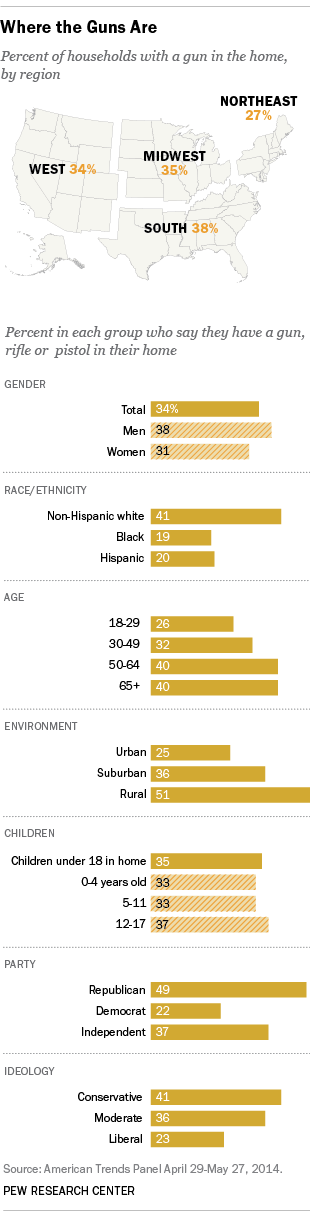
Thus, the decline in gun ownership is likely concentrated among households that once owned a hunting rifle or a shotgun, but moved from a rural area to the suburbs or city and no longer hunt anymore. Hence, the decline in gun ownership is probably much more marked in the case of long arms than in the case of handguns.
But, at least some of the decline may also be due to changing sentiment among urban and suburban dwellers about the merits of owning a handgun for self-protection, particularly has plummeting crime rates in urban areas have reduced the daily exposure to a risk of violence that many poor urban people face.
29 June 2016
A Couple Of Musing On Uncertainty Civil Litigation
* One of the primary sources of expense in civil litigation is disclosure and discovery practice in which, prior to a trial, litigants are required to produce documents to each other, to answer each other's questions, and to present sworn recorded testimony outside the presence of a judge in what is called a deposition.
A major driver of this cost is uncertainty over what factual issues are in dispute and are relevant to the claims and defenses asserted in the action. As a result, in practice, discovery is permitted on almost all factual issues related in any way to the case.
Much of this uncertainty could be resolved if a judge intervened early in the case to adjudicate which factual issues are really relevant under a correct interpretation of the law (which in practice tends to be profoundly uncertain in all but the simplest of cases) and to force parties to be reasonable in their claims that relevant factual issues really are disputed in ways that are material to the outcome of the case.
And, of course, it discovery were actually limited to issues that have been authoritatively determined to be legally relevant and to be genuinely disputed, there would be vastly less discovery and civil litigation would be profoundly less expensive.
And, of course, it discovery were actually limited to issues that have been authoritatively determined to be legally relevant and to be genuinely disputed, there would be vastly less discovery and civil litigation would be profoundly less expensive.
One of the main virtues of the European civil law system over the American common law system of civil litigation is that the European system does a much better job of this task. The American system with its often illusory promise of a jury trial or jury-trial equivalent bench trial at the conclusion of a case, in contrast, is very adverse doctrinally to addressing any issues of this kind before dealing with all of them.
* The "black letter law" as enunciated by statutes, regulations, court rules and appellate case law is highly relevant and can often be applied to particular facts by judges in a manner that would be almost unanimous despite the fact that the judges differ greatly in their judicial philosophies and political inclinations.
But, it is also not at all uncommon for judges to make rulings that depart from that black letter law, either by clearly misapplying it to the facts or by accepting clearly erroneous interpretations of it. This happens perhaps 40%-45% or more of the time in any case that isn't totally straight forward (at least on the civil side, I have no practical experience as a criminal law attorney), and perhaps 10%-20% of the time, these errors are outcome determinative.
(Juries also make mistakes in applying the law with which they are instructed that creates uncertainty, but the kinds of mistakes that juries make have causes and solutions that differ profoundly from those made by judges. The best available evidence suggests that error rates in criminal cases that go to trial on the issue of guilt or innocent are about 10%, but the decision facing juries in criminal cases are usually much less complex than in civil cases, so the error rate in civil cases is probably higher.)
(Juries also make mistakes in applying the law with which they are instructed that creates uncertainty, but the kinds of mistakes that juries make have causes and solutions that differ profoundly from those made by judges. The best available evidence suggests that error rates in criminal cases that go to trial on the issue of guilt or innocent are about 10%, but the decision facing juries in criminal cases are usually much less complex than in civil cases, so the error rate in civil cases is probably higher.)
Certainly, this not uncommon disconnect between the black letter law as applied to the facts and actual outcomes is the reason that going to trial is routinely described as "rolling the dice."
Yet, the practical reality is that it is profoundly more expensive and time consuming to win on appeal (which itself has a similar level of error) and often it is simply impossible to obtain redress from an erroneous trial court decision.
For example. it is very rare that a tenant who loses an eviction action, or a debtor who loses a collection action, will be able to obtain any meaningful redress by appealing a decision, not least because staying a trial court decision requires that the tenant or debtor post a bond equal to the amount of the judgment entered (generally including the other side's attorneys fees).
The body of legal theory that examines systematic patterns in the way that judges deviate from the black letter law is called "legal realism." And, while legal realism was vibrant in its heyday in an era when empty legal formalism had gotten out of control, this kind of legal scholarship, particularly when informed by empirical data, both receives too little attention among legal scholars and receives too little attention in the law school curriculum.
This is a shame, because truly effective real world lawyers need to not only know the "black letter law" but also know when and why and in what manner judges are likely to disregard or twist the black letter law when it is applied to particular facts.
Too often, legal realist scholarship gets so hung up on establishing at all that judges do in fact frequently fail to honor the black letter law, that they never manage to take the next step of synthesizing that reality into theories that explain when, why and how this is likely to happen, so that lawyers can incorporate this deeper empirical understanding of the relationship between the black letter law and the law as it is actually applied, into their practice.
27 June 2016
TODAY Is The Deadline To Cast Colorado Primary Ballots
Tuesday, June 28, 2016 is the final day to deliver you mail-in primary ballots to polling places in Colorado. It is too late to mail these ballots. But, there are many drop off locations near you. Primary ballots are distributed only to voters who are registered to vote and affiliated with a political party.
These ballots do not include a Presidential primary vote as Colorado's Democrats had a Presidential caucus and Colorado's Republicans denied its rank and file a say in the Presidential nomination process.
UPDATED with new title on June 28, 2016.
These ballots do not include a Presidential primary vote as Colorado's Democrats had a Presidential caucus and Colorado's Republicans denied its rank and file a say in the Presidential nomination process.
UPDATED with new title on June 28, 2016.
Plausibility Pleading Reaches Colorado
The Colorado Supreme Court today adopted the plausibility pleading standard of the U.S. Supreme Court cases Twombly and Iqbal in the case of Warne v. Hall by a closely split 4-3 margin.
It did so out of a desire to have harmony between the Federal Rules of Civil Procedure as currently interpreted, and the Colorado Rules of Civil Procedure which are modeled on the federal rules, despite the fact that Twomblyand Iqbal have been widely condemned and almost universally condemned as bad decisions that hurt legitimate plaintiffs in academic circles.
Justice Gabriel's dissent sums up the case against taking this step:
¶31 Today, the majority jettisons a rule that has stood the test of time for over fifty years, based largely on an asserted preference for maintaining uniformity with federal court interpretations of analogous federal rules of procedure. In reaching this result, the majority misperceives the existing state of the law in Colorado and grafts onto C.R.C.P. 8 a “plausibility” requirement that the rule does not contain and that other courts have correctly recognized results in a loss of clarity, stability, and predictability. Even more concerning, the majority’s preferred standard allows a single district judge, at the incipient stages of a case, to weigh what the judge speculates the plaintiff will plausibly be able to prove, based on the individual judge’s subjective experience and common sense, and then to decide whether the plaintiff’s action is viable.
¶32 I cannot subscribe to such a standard, which I believe will deny access to justice for innumerable plaintiffs with legitimate complaints. Indeed, the majority’s application of its newly adopted standard in this case demonstrates the overreaching nature and ultimate unfairness of that standard.But, the odious federal standard is now Colorado law as well.
23 June 2016
Waiting For Brexit Results
Polls close in England's Brexit vote at 3 p.m. Denver time. Polling favors a "remain" vote, but by a narrow majority less than the polling margin of error. A "leave" vote could have catastrophic consequences for Europe's economy and as a result, for the world economy.
UPDATE 10:00 p.m. Mountain Time: With 85% of the votes counted, 51.5% of voters have decided to leave the E.U., so the U.K. is almost certain to leave the E.U. Now, all that remains are the ugly details and catastrophic global economic consequences of this decision. The British pound has already fallen 11% on the early news and financial markets around the world are falling on the news.
UPDATE June 24, 2016: Charlie Stross has an excellent rant at his blog:
Remote Causes
There is a credible case to be made that Brexit, and quite likely Scottish independence and a renegotiation of the status of Northern Ireland and Gibraltar in its wake, all started in Tripoli.
Tunisia is where the Arab Spring started. Arab Spring in Tunisia triggered a revolution in Libya that brought about regime change with assistant from the military of the U.S. and select allies in the form of missiles and air support and intelligence. This and some anti-Assad statements gave rise to the Syrian Civil War. The Syrian Civil War turned a modest flow of refugees into Europe into a historic flood.
The flood of refugees into Europe put pressure on the E.U. in its capacity as immigration union to share an immigration burden that would otherwise have fallen primarily on Greece and Italy alone, and that combined with terrorist incidents in Paris and elsewhere in Europe triggered anti-immigrant sentiment, fear, and dissatisfaction with the E.U.
Without a doubt, there was already a strong base of euro-skepticism in the U.K. that had developed over decades for myriad reasons. But, when the ultimate "leave" vote margin was less than 2 percentage points, it is very likely that the change of events that started in Tripoli may have tipped the balance from "Remain" to "Leave" in yesterday's vote.
UPDATE 10:00 p.m. Mountain Time: With 85% of the votes counted, 51.5% of voters have decided to leave the E.U., so the U.K. is almost certain to leave the E.U. Now, all that remains are the ugly details and catastrophic global economic consequences of this decision. The British pound has already fallen 11% on the early news and financial markets around the world are falling on the news.
UPDATE June 24, 2016: Charlie Stross has an excellent rant at his blog:
What happens to England and Wales now?
Short version: economic turmoil caused by the uncertainty. An upswing in right-wing xenophobia as the utterly odious crypto-fascist Nigel Farage makes hay while the Sun shines on his project.
Divorce negotiations ...the Brexiters have been selling a lie; that they'd get a no-fault divorce and keep the house. Reality is somewhat less convenient and Brussels has no alternative but to play hardball if it is to deter other loosely-bound members from following England's example. Most likely England will end up losing the house, the CD collection, and the cat and having to sleep in the car.There is much more worthwhile analysis in the rest of his post.
Remote Causes
There is a credible case to be made that Brexit, and quite likely Scottish independence and a renegotiation of the status of Northern Ireland and Gibraltar in its wake, all started in Tripoli.
Tunisia is where the Arab Spring started. Arab Spring in Tunisia triggered a revolution in Libya that brought about regime change with assistant from the military of the U.S. and select allies in the form of missiles and air support and intelligence. This and some anti-Assad statements gave rise to the Syrian Civil War. The Syrian Civil War turned a modest flow of refugees into Europe into a historic flood.
The flood of refugees into Europe put pressure on the E.U. in its capacity as immigration union to share an immigration burden that would otherwise have fallen primarily on Greece and Italy alone, and that combined with terrorist incidents in Paris and elsewhere in Europe triggered anti-immigrant sentiment, fear, and dissatisfaction with the E.U.
Without a doubt, there was already a strong base of euro-skepticism in the U.K. that had developed over decades for myriad reasons. But, when the ultimate "leave" vote margin was less than 2 percentage points, it is very likely that the change of events that started in Tripoli may have tipped the balance from "Remain" to "Leave" in yesterday's vote.
21 June 2016
Higher Taxes Don't Kill Economic Growth
It is well known that the U.S. economy and the federal government's fiscal health has been better under Democratic Presidents than under Republican ones. At least at the extremes of Colorado and California vis-a-vis Wisconsin and Kansas, this is true of Democratic v. Republican Governors of states as well in recent history.
UPDATE June 24, 2016:
Additional GPD data from Kansas and other states nearby confirm the story about the economic health of Kansas relative to its peers. GDP in Kansas flatlined in the state relative to the U.S., to neighboring states and to the GDP growth trend lines it had been on, following the policy changes it made under Governor Brownback. Colorado, meanwhile, under the stewardship of Democratic Governor Hickenlooper, has thrived.
Wisconsin's economy has similarly faltered following its implementation of a slate of conservative economic policies under Governor Walker.
In 2012, voters in California approved a measure to raise taxes on millionaires, bringing their top state income tax rate to 13.3 percent, the highest in the nation. Conservative economists predicted calamity, or at least a big slowdown in growth. Also that year, the governor of Kansas signed a series of changes to the state's tax code, including reducing income and sales tax rates. Conservative economists predicted a boom.
Neither of those predictions came true. Not right away -- California grew just fine in the year the tax hikes took effect -- and especially not in the medium term, as new economic data showed this week.From here.
Now, correlation does not, as they say, equal causation, and two examples are but a small sample. But the divergent experiences of California and Kansas run counter to a popular view, particularly among conservative economists, that tax cuts tend to supercharge growth and tax increases chill it.
California's economy grew by 4.1 percent in 2015, according to new numbers from the Bureau of Economic Analysis, tying it with Oregon for the fastest state growth of the year. That was up from 3.1 percent growth for the Golden State in 2014, which was near the top of the national pack.
The Kansas economy, on the other hand, grew 0.2 percent in 2015. That's down from 1.2 percent in 2014, and below neighboring states such as Nebraska (2.1 percent) and Missouri (1.2 percent). Kansas ended the year with two consecutive quarters of negative growth -- a shrinking economy. By a common definition of the term, the state entered 2016 in recession. ...
Few, if any, economists would say today that the recovery has been sufficient for all Californians. But almost no one can say that raising taxes on the rich killed that recovery. Or that given a choice of the two states' economic performances over the past few years, you'd rather be Kansas.
UPDATE June 24, 2016:
Additional GPD data from Kansas and other states nearby confirm the story about the economic health of Kansas relative to its peers. GDP in Kansas flatlined in the state relative to the U.S., to neighboring states and to the GDP growth trend lines it had been on, following the policy changes it made under Governor Brownback. Colorado, meanwhile, under the stewardship of Democratic Governor Hickenlooper, has thrived.
Wisconsin's economy has similarly faltered following its implementation of a slate of conservative economic policies under Governor Walker.
14 June 2016
Federal Courts Swamped With Porn Pirate Suits
[T]he adult website Malibu Media is a prodigious enforcer of its copyrights. According to law professor Matthew Sag of Loyola University in Chicago, Malibu alone was responsible for nearly 40 percent of all copyright filings in federal court in 2015. Litigation against anonymous downloaders, by Malibu and other copyright enforcers, made up nearly 60 percent of the federal copyright docket last yearFrom a Reuters article discussing the similar failed business model of the law firm Prenda Law, which died in a hail of court sanctions for unethical conduct.
Since porn websites routinely give away vast amounts of product for free, it isn't unreasonable to guess that these sites make more money suing infringers than they do from paying customers.
I have long advocated conceptualizing copyright suits as a form of unjust enrichment lawsuit, rather than one involving copyrights, and limiting damages to actual damages as measured by an unjust enrichment principle.
13 June 2016
Qatar Is Still A Barbaric Place Where Women Are Prosecuted For Reporting Rapes
It happens routinely, most recently to a Dutch woman and before that to a Norwegian woman, because Qatar is a backward country with oil wealth and a medieval way of life that would collapse without oil dollars from the West.
Of course, all of this is done in the name of Islam, which, as practiced in Qatar and many countries nearby, is a cruel and dangerous cult that stands in the way of an semblance of progress, decency or justice. In short, it is a lot like fundamentalist Christianity in the United States.
Of course, all of this is done in the name of Islam, which, as practiced in Qatar and many countries nearby, is a cruel and dangerous cult that stands in the way of an semblance of progress, decency or justice. In short, it is a lot like fundamentalist Christianity in the United States.
Subscribe to:
Posts (Atom)