Showing posts with label Europe. Show all posts

01 September 2025

Labor Day Musings

* The state of labor in one chart:

The failure of businesses to share productivity increases with their workers starting in the early 1970s is the root cause of a lot of the current political reality in the United States. In my view, the decline of private sector union membership is more a product of declining worker economic power than a cause of this shift, but that's an open question in economics.

* The number of immigrants in the U.S. labor force has fallen by 1.2 million since Trump started his second term. According to the Wall Street Journal: "With zero net immigration, Apollo Chief Economist Torsten Slok estimates, the U.S. economy would be able to sustainably add only about 24,000 nonfarm jobs a month, compared with an average 155,000 from 2015 through 2024."

Agriculture (overwhelmingly in "red America") in the U.S. is particularly suffering both due to tariffs and due to the immigration crackdown that is cutting into the agricultural labor workforce. Nebraska and Iowa saw their state GDPs fall at an annualized rate of 6.1% in the first quarter of 2025.  Those tariffs were found to be mostly illegal by the U.S. Court of International Trade in a ruling affirmed by the U.S. Court of Appeals for the Federal Circuit in a 7-4 ruling. The effect of the ruling is on hold until mid-October pending a petition for certiorari to the U.S. Supreme Court which has consistently ruled in favor of Trump despite his weak legal arguments.

The anti-immigrant fervor is driven by two main factors: (1) the economic stagnation of working age men without any college education who native born white men attribute to immigrants, international trade, and civil rights for women and minorities, and (2) the fear of white protestants in places with few immigrants that their culture will cease to be dominant.

* Courts in India are very slow.

[I]n one recent example a Delhi court concluded a property dispute after 66 years. Both the original litigants were dead. Still, the lawyer for one of the warring parties cautioned that the conclusion was in fact not the end, as the ruling would be appealed.

Three years ago, after pondering a dispute for 16 years, the supreme court sent back a 60-year-old land case for fresh adjudication to a lower court, which had already taken over 30 years to give its judgment in 2006.

A 2021 study of Mumbai real estate found that more than a quarter of the projects under planning or construction and 43 per cent of all “built-up spaces” in the city were under some litigation. My apartment block was one of them.

…One of the reasons for this accumulation is human resources. India has around 16 judges per million people, compared to over 150 for the US. In 2016, the issue brought the country’s chief justice, TS Thakur, to tears during a speech as he requested that the government hire more judges to wade through the “avalanche” of backlog.

For what it is worth, there are far fewer judges per capita in the U.S. than in Europe, even though the total number of legally trained professionals in the U.S. and in Europe per capita are similar.

The lack of state capacity in the area of courts means that property and contract rights and other forms of private law are weaker, which is bad for the economy.

* Adults in the U.S. are having sex less often (the decline is at least as great among high school students). It is basically a coincidence, but my children were conceived right around "peak sex" in the recent history of the United states.


* Wildfires are at record high in Europe due to climate change.


* The U.S. housing market is starting to favor smaller single family homes again after a peak in roughly 2014. Single family houses in the U.S. are still, on average, much larger than they were 30 years ago.


* A mere 6.0 magnitude earthquake in Afghanistan, shortly before midnight on August 31, 2025, was enough to cause at least 800 deaths and 2500 injuries.

* "Flukewarm": That feeling when you're reluctant to make a recipe, because the last time you made it, it came out perfectly. But it was a fluke, you're not sure what you did right, and you're worried you won't be able to repeat your past success.

* Last Saturday, I went to a store to buy a blind spot warning system for my car. They weren't available in 2015 when I bought it. But, I couldn't. Tariffs have delays shipments of cars parts like that one by more than a month and have greatly increased the price of those parts.

* As our country devolves into a civil war, ICE agents in unmarked cars wearing masks and not displaying their badges are unlawful combatants, and are thus they are not entitled to the protections of the Geneva Conventions. Instead, they are terrorists who are not entitled to the protections of legitimate combatants under the laws of war. They also aren't entitled to the peacetime protections and privileges of law enforcement officers.

* Rhode Island has the lowest state murder rate in the United States. Louisiana has the highest (or very nearly so) and has about ten times as many murders per capita.

* The lion's share of the counties in the U.S. with life expectancies lower than North Korea are (1) in the South and majority black or nearly so, (2) include Indian Reservations (or the Alaskan equivalent), or (3) are in Appalachia. The outliers are still in the South.


* Non-U.S. central banks are substituting gold for U.S. Treasury Bonds.


* The U.K. electrical wall plug design is safer than the U.S. design.

* People are dying on overloaded boats trying to emigrate from Gambia (in West Africa) to Europe. "More Than 130 People Are Feared Dead in West Africa Boat Tragedy: Around 150 people boarded a boat in Gambia that was thought to have been headed for Europe. The boat capsized after traveling about 380 miles."

* A judge ordered Alligator Alcatraz in Florida closed on the petition of an Indian tribe with an interest in the land, because an environmental impact statement wasn't done. The debacle cost $250 million. All detainees at the location which was inhuman and defective have been moved to other detention centers in Florida.

* Finland (which is the source of about half of my genetic ancestry) is a genetic outlier in Europe (for reasons that are well understood and closely related to the fact that it is also a linguistic outlier). 23andme was able to correctly pinpoint the place of origin of my Finnish ancestors to a region about the size of a U.S. county. The other half of my ancestry (which I know to some detail due to genealogy) is basically a European mutt that can't be localized from genetics much at all.


Other places with significant Uralic populations, Basque country, historically Celtic areas (despite the putative cultural origin of the Celts in the vicinity of Czechia which is being used as a baseline in the chart above), and places with significant Islamic migration since the 700s CE, also stand out in  this map. Sardinia is the closest modern match to the genetics of Europe prior to the arrival of the Indo-Europeans.

* It doesn't take a history genius to understand why South America, in general, and Argentina, in particular, has so much Italian ancestry (to a significant extent, because a lot of Italian Nazis fled there after World War II).

* The Holocaust has an immense effect:


* New Mexico is, by a variety of measures like education and poverty, much more like red states than blue states. But it has stayed blue because the GOP has historically made its Hispanic and Native American residents feel unwelcome and tried to persecute them. 

Utah is, by a variety of measures like education and poverty, much more like blue states than red states. But, its predominantly Mormon religion's conservative tenets have kept it out of the Democratic party fold.

* The cost of living is about 30% greater in the highest cost of living states in the U.S. than in the lowest cost of living state (Arkansas). Most of the difference is due to real estate prices.

* A plausible observation:


* Louisiana still hasn't recovered from Hurricane Katrina twenty years ago. It permanently reduced the population of the state, and of New Orleans, in particular (predominantly due to migration away from it, not due to the fatalities themselves).


* Almost every country in Western Europe has supplied Ukraine with military equipment. So have quite a few other countries (mostly in what could be called the Western European diaspora).

* Most of North America was once home to Buffalo, although the size of the herds may have been exceptionally large because the Native American populations that hunted them were decimated by European diseases not long before European migrants first documented them.


* Almost all of the land on Earth was connected about 200 million years ago.


* Republicans in Congress have grown less likely to have attended elite universities (while Democrats have grown more likely to have done so), mirroring the shift in college educated people towards the Democratic party.

* Data centers v. office building construction.


* Soil quality in Europe.


* Firefighting employment in Europe.


The U.S. figure is 0.2% (there are about 1.019 million firefighters out of 163.3 million employees, but two-thirds of them, who are not included in the 0.2%, are volunteers). This is similar to the European average.

* The twenty years from 1807 to 1827 did a lot to shape the political map of the Americas.


* Squirrels v. people.


* Women didn't start wearing underwear (i.e. panties and bras) in Europe until the 19th century, for the most part.

* Modern musical notation was invented by a Benedictine monk, Guido of Arezzo in 1025 CE and he also invented the Do-Re-Me system. Recognizable modern musical notation is older than Middle English.

* Billionaires have lower effective tax rates than the upper middle class and even less than for the average person.
We estimate income and taxes for the wealthiest group of US households by matching Forbes 400 data to the individual, business, estate, and gift tax returns of the corresponding group in 2010–2020. In our benchmark estimate, the total effective tax rate—all taxes paid relative to economic income—of the top 0.0002% (approximately the “top 400”) averaged 24% in 2018–2020 compared with 30% for the full population and 45% for top labor income earners. 
This lower total effective tax rate on the wealthiest is substantially driven by low taxable individual income relative to economic income. First, the C-corporations owned by the wealthiest distributed relatively little in dividends, limiting their individual income tax unless they sell their stocks. Second, top-owned passthrough businesses reported negative taxable income on average in spite of positive book income, further limiting their individual income tax. The top-400 effective tax rate fell from 30% in 2010–2017 to 24% in 2018–2020, explained both by a smaller share of business income being taxed and by that income being subject to lower tax rates. 
Estate and gift taxes contributed relatively little to their effective tax rate. Top-400 decedents paid 0.8% of their wealth in estate tax when married and 7% when single. Annual charitable contributions equalled 0.6% of wealth and 11% of economic income in 2018–20.

* Japan has the lowest housing prices in its major metropolitan areas of any comparable cities in the world. It isn't clear to me how much of this is due to lax land use laws arising from handling that function at a regional level rather than locally, and how much of this is due to its low birthrates and modest immigration rates.

28 April 2025

Christianity's Prospects

Globally, Christianity faces different issues in different places. In Europe (including heavily colonized formerly British Australia, New Zealand and Canada), in the U.S., and in South Korea and much of Asia, trends away from religion entirely are the biggest issue. In Latin America, the Catholic-Protestant divide is more prominent as Protestantism eats away at Catholicism although secularism is an issue too.

In the Middle East, North Africa, and much of the rest of Asia, the conflict between Christianity and Islam is center stage (except in Israel with its Jewish-Muslim conflict taking center stage and Christianity taking something of a bystander role).

As an aside, Iran despite being formally a theocratic Shi'ite Islamic state, is actually quite religiously divided and has surging levels of irreligion. This is atypical in predominantly Islamic countries which tend to be dominantly Sunni Islamic and more religious on average, by far, than predominantly Christian or Jewish countries. I have less of a finger on the pulse of the Sunni Islamic world and its prospects, however, than the religious tendencies of other parts of the world (despite having considerably more factual knowledge about Sunni Islam and these regions than the vast majority of Americans, even those with college educations). Secular, communist trends in predominantly Islamic places like Turkey, Egypt, Syria, and Iraq seem to have reversed.

Christianity in the U.S.

The continued decline "market share" of Christianity in the United States in the coming decades seems highly likely. It may drop to less than 50%, if not by the end of my life, during my children's lifetime.

This is almost certain to persist because young people are much less likely to be Christianity adherents than older people, so as older people die, the share of Christians falls, even in the absence of deconversion. 

This fall seems to be somewhat stalled in the last few years. But, there is a much lower tendency to convert to Christianity after leaving it than there is to deconvert from being a Christian. And, shifts in the percentage of people who follow a religion tend to follow a logistic curve, with the highest rate of change when the relative percentages of each category are most equal. 

We also have the precedent of Europe which is much less religious than it was shortly after World War II. So, this is almost sure to continue.

Of course, some new religious movement, more adaptive to current conditions, could change the picture dramatically.

Further, in accordance with the maxim that religions that protect threatened cultures thrive. Part of why Christianity declined in Europe is that most of those countries had state established religions which were particularly aligned with the secure, establishment culture, with exceptions like Ireland, where Catholicism was protecting Irish culture from English Protestantism, and Poland, where Catholicism was protecting Polish culture from secularizing communism.

White Catholics are on a trajectory close to that of White Protestant with steady decline associated with age, while Hispanic Catholics are on a different, more religious track, mirroring the predominantly Catholic but emerging Pentecostal trend of Latin America, as the establishment Catholicism with no culture to protect in Latin America loses it's shine but does better in the U.S. where it is protected Latin American immigrant culture.

In another illustration of this tendency, in the U.S. (and in Europe) religion thrives among recent immigrants whose homeland culture is threatened by the very different culture of their new homes, but fades as waves of immigrants assimilate.

The U.S. is more religious than Europe, in part, because it has never had an established religion, which left religious denominations from becoming as establishment, and in part, because it has such high levels of foreign born people who have non-U.S. cultures that are threatened in the new homeland that religion can protect.
 
The stall in deconversion is also related to the extent to which the large coalition of subcultures at odds with the establishment which is the Southern/Appalachian/rural subculture that is associated with the Republican party has members who find themselves in deep distress as their members are two to four times less economically productive than the members of the American establishment that is currently associated with the Democratic party, which is distinguished by its embrace of science, its acceptance of racial and ethnic diversity, its feminism, its acceptance of LGBTQ people, its acceptance of alcohol and recreational drugs, its globalism, and its lack of a culture of honor. 

Members of the Southern/Appalachian/rural coalition of cultures make up a third to half of the people in the United States. Its members are older than the rest of the U.S., whiter, less connected to the global economy, and more distrustful of science and education. One large share of them live in places that have very little racial, ethnic, religious, or immigrant sourced diversity. Another large share of them live in South and are deeply divided between conservative whites who identify as "American" and blacks who are the descendants of slaves and have not migrated to big cities who make up a large minority of the population.

Christianity in Asia

South Korea is one of most Christian nation in East Asia and Southeast, with about 23-31% who are Christian and about 60% who espouse no religion (historically classified by geographers and demographers as "Confucian" although younger generations may be less strictly Confucian than older generations).

Those only other countries in the region (and arguably these are Oceanian countries) with such a high percentage of Christians are East Timor which is 97% Roman Catholic (and 1% other Christian for a total of 98% Christian), the Philippines which is 79% Roman Catholic and 13% other Christian (for total of 92% Christian) with a notable Muslim minority.

Countries in East, Southeast and South Asia with smaller but significant Christian populations include Singapore which is 19% Christian (and about 31% Buddhist), the former territory of Hong Kong within China which is about 12% Christian, Indonesia which is about 11% Christian - about 8% Protestant and 3% Catholic (and 83% Sunni Islam), Brunei which is about 10% Christian (and 81% Sunni Islam), Malaysia which is about 9% Christian (and 63% Sunni Islam), the former territory of Macau within China which is about 9% Christian, Vietnam which is 8% Christian and 70% irreligious, Sri Lanka which is about 8% Christian and 70% Buddhist, Myanmar is 6% Christian and 89% Buddhist, Taiwan which is about 5% Christian and 35% Buddhist, China which is about 4% Christian and 65% irreligious, India which is about 2% Christian and 80% Hindu (with most of the rest split between irreligious people, Muslims, and a variety of other beliefs like Buddhism and Sikhism which originated there), Mongolia is about 2% Christian and 53% Tibetan Buddhist, Japan is about 2% Christian and about 77% a syncretic mix of folk Shinto and Buddhism. The rest of the region is less than 2% Christian.

Indonesia is a huge country with great regional variation, with Christianity being most common in Northern Borneo, West Papuan areas, and its smaller eastern islands, as well as regional pockets in its larger, eastern, predominantly Muslim islands (and with a notable Hindu enclave in Bali and a small Buddhist enclave in central Borneo).


Map from here.

In central Asia, Kazakhstan is 25% Christian and 70% Sunni Muslim, Turkmenistan is 9% Christian and 89% Sunni Muslim, Kyrgyzstan is 7% Christian and 86% Sunni Muslim, and Uzbekistan is 3% Christian and 90% Sunni Muslim.

Christianity in Africa

Islam is common in Africa in the Sahel, the Sahara, North Africa, and along much of its eastern coast. 
Map from here.

But Christianity is flourishing and growing in sub-Saharan Africa, which was historically animist. Twenty-seven Sub-Sarahan African countries (including Ethiopia and Eritrea) are majority Christian and many more have large Christian minorities or pluralities. It isn't unthinkable that Africa could be home to a plurality of Christians within the lives of my children.

31 March 2025

Life After Death


Belief in life after death is an interesting choice to compare religiosity. 

It is a belief shared by all of the widely adhered to religions in the region without being strictly tied to any one of them, and also captures residual metaphysical beliefs in contrast to metaphysical naturalism among people who are nominally non-religious and may have a problem with particular denominational or institutional religious structures but not with a somewhat religious worldview at a broad level.

The percentage of people believe in life after death considerably exceeds the percentage of people who regularly attend religious services or pray regularly. But it is below 50% in most of the historically predominantly Christian countries  of Europe, and just barely above 50% in several of the remaining ones in the face of a long term trend towards declining belief in an afterlife. Most of Europe is majority secular, or very nearly so. In the homelands of most of my ancestors, belief in an afterlife is less than 40%.

Related from a May 12, 2016 post:
* For the first time in Norwegian history, there are more atheists and agnostics than believers in God. 
* For the first time in British history, there are now more atheists and agnostics than believers in God. And church attendance rates in the UK are at an all-time low, with less than 2% of British men and women attending church on any given Sunday. 
* A recent survey found that 0% of Icelanders believe that God created the Earth. That’s correct: 0%. And whereas 20 years ago, 90% of Icelanders claimed to be religious, today less than 50% claim to be.
* Nearly 70% of the Dutch are not affiliated with any religion, and approximately 700 Protestant churches and over 1,000 Catholic churches are expected to close within the next few years throughout the Netherlands, due to low attendance.
* According to a recent Eurobarometer Poll, 19% of Spaniards, 24% of Danes, 26% of Slovenians, 27% of Germans and Belgians, 34% of Swedes, and 40% of the French, claim to not believe in “any sort of spirit, God, or life-force.” 
The Data

Belgium, Moldova, Ireland and Kosovo are omitted, presumably for a lack of statistically significant amounts of data. Vatican City is almost omitted but one presumes that this belief is near 100% among its couple thousand permanent residents.

Poland, Bosnia, and Turkey are the only countries on the map over 60%. 

The lowest rates are in Bulgaria (25%) and Albania (22.7%), presumably as legacies of communism in places where religious institutions didn't play a large role in their emergence as non-communist states, and where the juxtaposition of these states against their Muslim neighbors, made an emphasis on state imposed atheism more salient.

In Turkey this is due to an overwhelmingly Muslim population. In Bosnia, the 51% of the population that is Muslim brings up the average. Predominantly Muslim Kosovo is probably higher than the 65.9% of Bosnia, but due to its long membership of nominally secular communist Yugoslavia and a somewhat larger non-Muslim minority, is probably less than teh 91.8% of Turkey. 

Poland is predominantly Catholic and the only predominantly Christian country on the map over 60%. This makes sense as Catholicism played an important and recent role in its departure from its former Communist regime, less than half a century ago.

Below Poland, but above 50% are Iceland, Lithuania, Romania, Croatia, Switzerland, Austria, and Macedonia, with a mix of Protestants, Catholics, and Eastern Orthodox adherents and a range of economic development and historical ties to the Western and Eastern economic blocks of the Cold War. And, more generally, there doesn't seem to be a strong Protestant, Catholic, or Eastern Orthodox skew to the likelihood of believing in life after death among Europeans in predominantly Christian countries. 

Belgium probably splits the difference between France (41.2%) and the Netherlands (34%) and is probably under 40%. 

Moldova probably splits the difference between Romania and Ukraine, which are also former Eastern block countries that were historically Eastern Orthodox, and is probably close to Romania than Ukraine and may be a bit over 50%.

I don't have a great intuition regarding where Ireland falls. It is probably under 60%, but probably higher than the U.K. (41.7%), as it is one of the more religious observant Christian countries in Europe, and Catholicism played a major role in sustaining Irish culture in the face of centuries of English rule in 1921 (now more than a century ago). It is probably in the high 40s or low 50s, percentage-wise.

Muslim v. Christian Approaches To Heresy

The very high rates in belief in life after death among Muslims is notable in light of a big difference in how Christianity and Islam have historically approached heresy at the individual level.

Christianity conceptualized heresy as an internal and subjective matter - not believing in the doctrinal truths of the established church.

Islam, in contrast, has focused on insisting that people outwardly comply with religious edicts concerning prayer, fasting, etc., without trying to punish or even really condemn people who are outwardly compliant with its demands even though subjectively, deep down, they have doubts or even outright don't believe in Islamic doctrines.

Yet, modern Islam has much higher rates of belief in the afterlife than modern European Christianity does, where the median rate of belief in the afterlife is probably half what it is among Muslims, if not a little lower.

Paces On The Path To Secular Humanism

Another possibility is that predominantly Islamic countries are simply on the same path towards secular humanism induced by modern scientific thinking and modern societal conditions as predominantly Christian countries, but are just less far along that path.

Many of the Islam driven doctrines and practices that are striking to us today in historically Christian countries, were once present in Christianity.

Witchcraft

Saudi Arabia is executing people for witchcraft now. Christians in Europe and North America were doing this into the 18th century. 

The last known execution for witchcraft in Europe was that of Anna Göldi in 1782 in Glarus, Switzerland, while in the British Isles, Janet Horne was the last person executed for witchcraft in 1727. The last known witchcraft trial in North America was held in Virginia in 1730, where a woman named Mary was convicted of using witchcraft to find lost items and sentenced to be whipped 39 times. There are still witchcraft persecutions (and lots of focus on fighting demons and exorcisms) among African Christians and animists.

Witchcraft prosecutions died, in part, because nobody believed that witchcraft was real any more.

Charging Interest

Islam prohibits the charging of interest now (although work around doctrines exist in Islamic finance to allow the equivalent of simple interest but not compound interest).

Interest was condemned not only in the Hebrew Bible, but also in the New Testament, in writings of the fathers of the Roman Catholic church during the Roman Empire, and by Luther and Calvin at least as late as the 16th century, although usury came to be redefined in Western Christianity as a bar only unfairly high interest rates and not charging interest at all, and became a minor issue for Christian clergy, with the established or formerly established Christian churches now relying on interest on their endowments to operate.

The gap in the focus on barring the charging of interest in the period between the Roman era and the Reformation, moreover, was as much due to the lack of banking activity entirely during the Middle Ages in Christendom, where feudalism prevailed, as it was due to a change in Christian religious doctrine in that time period, per se. 

Modesty

The Islamic world is known today for its greater expectations of modesty in how women dress, and its less equal treatment of women than in the modern Western world. But this too was recently a part of the Christian world, often with religious justification.

Certainly, there is a range of how this manifests within the Islamic world. Saudi Arabia and Afghanistan under the Taliban impose absurdly strict modestly standards. American Muslims and Muslims in Southeast Asia, in contrast, are still more strict than modern Americans and Western Europeans, but are far less extreme than Saudi Arabians.

European and American styles of dress for women were common in Afghanistan and Iran in the 1970s, but this shift was rolled back in Islamic revolutions.

Still, Victorian England, and most predominantly Christian countries in that era, were similar in standards of female modesty to many Islamic countries today. In the early 19th century, women were still wearing swim wear that looked suspiciously similar to "burkinis" in Europe and the U.S. Women were still getting arrested and held in contempt of court for wearing pants in the United States, in the early 1900s. 

Not wearing a skirt or dress to school, even at the collegiate level, was something that women got in trouble for doing up to the early 1960s in the U.S., and skirts are still part of mandatory school uniforms for girls in Japan, much of Asia, and some places in the British Commonwealth.

Marriage

Polygamy and cousin marriage ended much sooner in countries that became Christian than it did in the Islamic world where it is still common in much of the Middle East, West Asia, South Asia, and Africa, although polygamy is banned in both Turkey and Tunisia as a matter of secular law and is quite rare in most Islamic countries. And, cousin marriage is not common in much of the Islamic world.

Polygamy has been very rare, outside the early Mormons in the 19th century and some small splinter Mormon sects after that, in places that have been predominantly Christian at the time, although tolerance for mistresses and concubines who are not Christian wives, instead of, or in addition to, Christian wives, has varied in European and Latin American history, and to a lesser extent until the early 19th century especially in places where slavery was permitted in North America and the Caribbean. Polygamy was at least as common as it is in modern polygamist countries in the Mediterranean world and Europe in the pagan era, and remains common today among animists in Africa.

In one exception to the trend, divorce has been allowed in Islam from the outset, while it was banned entirely until the 16th century, and was virtually non-existent in most Christian countries until the 19th century (with divorces generally only available from the legislature). Complete divorce bans for Christians existed in Ireland and Italy until a quite late date, and this is still the case in the Philippines.

Women's Rights

Mary Wollstonecraft was famously battling for women's rights in the U.K. and Europe in the 18th century. The Married Women's Property Acts that formally gave married women many private law rights and ended coverture law that absorbed women's private law personalities into their husbands were mostly passed in the 19th and early 20th centuries.

This is close to where women's rights in private law are today in many Islamic countries. Shi'ite Islamic communities have tended to be afford women greater rights than Sunni Islamic countries, although this may be more a matter of coincidence and local cultures and conditions than it is a matter of the doctrines of the religious sects, both of which vastly predate widespread democratic government.

Political Rights

The United States, at its independence in 1776, was one of the earliest and largest Republics since the fall of the Roman Republic to the Roman Empire (although the Swiss, Iceland, and some city states had it earlier). 

Constitutional monarchies afforded considerable democratic rights to a fairly narrow franchise of middle aged property owning white men in the U.K., but the British monarch had real power into the 19th century as the franchise was expanded by fits and starts there.

The French Revolution in 1789 was another early experiment in democratic government without a monarch, but this revolution was not stable with some form on monarchy persisting intermittently until 1870.

Most European and Latin American constitutional monarchies and republics arose in the late 19th century. The modal year at which European colonies with mostly non-European residents gained their independence in Africa and Asia was 1960, in most cases with Western style Republican government followed not many years after by military coups and dictatorships and multiple false starts before stable democratic government was established.

Much of the Islamic world was subject to European colonial rule for a long time. But outright strong monarchies now persist predominantly in the oil rich states of the Islamic world, mostly in the Middle East and North Africa. Morocco and Jordan are fairly close to where the British constitutional monarchy was at the time of the American Revolution. Pakistan, Bangladesh, Egypt, Turkey, and Indonesia have shed their monarchs for a while, but still struggle to make those republics stable multi-party democracies. The Middle East, generally, is still playing out the final acts of the fall of the Ottoman Empire which was formally dissolved with country lines redrawn after World War I, at a time when most of Europe and Latin America has republics. But World War II hit the reset button on democratic government in almost all of continental Europe, leading to the organization of new democratic regimes with the demise of most of them under fascism during World War II.

Eastern Europe and much of Africa and some of Latin America has Soviet style communist regimes until the fall end of the Cold War around 1989, and in some cases beyond, with holdouts like Cuba and Venezuela, and the post-communist era in these countries have only sometimes yielded multi-party democratic republics, and those that did persist still often have a political culture marked by authoritarian tendencies.

Women's Right To Vote

In the U.S. women's right to vote came late. The 19th Amendment, guaranteeing women's right to vote at the national level was adopted only in 1920. Unmarried women who owned property in New Jersey could and did cast ballots between 1776 and 1807. Beginning in 1869, women in Western territories won the right to vote. And in the decade leading up to the 19th Amendment’s passage, 23 states granted women full or partial voting rights through a series of successful campaigns.

The U.S. was neither first nor last in the women's right to vote. New Zealand was the first country to allow a wide cross-section of women to vote in national elections in 1893, followed by Australia in 1902, Finland in 1906, Norway in 1913, and Denmark (including Iceland) in 1915. Many European countries followed in 1917 and 1918. But women in Switzerland obtained the right to vote at federal level in 1971, and at local cantonal level between 1959 and 1972, except for Appenzell in 1989/1990.

Women has the right to vote in national elections in Afghanistan's constitutional monarchy, a predominantly Islamic country then and now, from 1919 to 1929.

Relative to the time that Islamic countries have become democratic republics, in the places where they have, women have gained the right to vote, if anything, sooner than they did in predominantly Christian countries, often from the outset.

27 December 2024

TFR In The EU

The replacement "total fertility rate" which is what is being described below, is 2.1 children per woman per lifetime. So far, the demographic transition towards fewer children that comes with economic development, knows no bounds.
Official statistics show Germany’s birth rate fell to 1.35 children per woman in 2023, below the UN’s “ultra-low” threshold of 1.4 — characterising a scenario where falling birth rates become tough to reverse.

Estonia and Austria also passed under the 1.4 threshold, joining the nine EU countries — including Spain, Greece and Italy — that in 2022 had fertility rates below 1.4 children per woman.

With young people reaching milestones, such as buying a house, later in life, the average age of EU women at childbirth rose to 31.1 years in 2023, a year later than a decade ago.

…Austria reported a fall to 1.32 children per woman in 2023, down from 1.41 in the previous year. In Estonia, the rate hit 1.31 in 2023, down from 1.41 in the previous year.

Birth rates have fallen across Europe — even in countries such as Finland, Sweden and France, where family-friendly policies and greater gender equality had previously helped boost the number of babies. In Finland, the birth rate was above the EU average until 2010, but it dropped to 1.26 in 2023, the lowest since the record began in 1776, according to official data.

France had the highest birth rate at 1.79 children per woman in 2022, but the national figures showed it dropped to 1.67 last year, the lowest on record.
From the Financial Times.

25 July 2024

Historic Comparisons To Russian Casualties And Prospective Casualties In The Ukraine War

Russia has annexed four regions, or oblasts, of eastern Ukraine, although it does not control all of Donetsk, Luhansk, Kherson and Zaporizhzhia. Moscow also controls Crimea, the peninsula to the south of mainland Ukraine which it annexed in 2014. Russia's control over the regions is not internationally recognized, and Kyiv has vowed to reclaim the annexed territories.

From Newsweek.

The same link recounts that the top British General and Admiral say that to control the four regions in Eastern Ukraine (in addition to Crimea), that Russia claims to have annexed, would require a total of 1.5 to 1.8 million casualties and five years. This is double the size of the entire Russian military in early 2022 which had about 900,000 active duty service members at the time.

The British military estimates that Russia has suffered 550,000 casualties since early 2022 (only modestly less than Ukraine's estimate of 570,000), and the BBC estimates that this includes at least 60,000 deaths, so far. According to Ukraine, Russia adds about 30,000 new soldiers a month, and has slightly more casualties each month.

There were about 7,000 deaths in the 2014-2015 Donbas phase of the Ukraine war for Russia and Russian allied militias, and about 16,000 wounded. The Russian annexation of Crimea was almost bloodless.

This is in addition, of course, to the immense losses of military equipment Russia has suffered which continue to accrue daily. For example, Russia has already lost tanks equal to 125% of the number initially assigned to the mission in February of 2022, and has lost daunting amounts of almost every other conventional military resource.

The British military estimates that it will take Russia at least five years after the conflict ends to restore itself to something approaching its 2022 situation.

Ukraine is suffering epic casualties, both civilian and military, as well, in addition to losing control of a significant part of its territory, since the war is being fought mostly on its territory.

But the Ukraine War has strengthened the military position of NATO.

NATO has expanded, has seen its members strengthen their militaries in reaction to the Ukraine War, and is seeing Russia, the primary adversary it exists to protect members from, incredibly weakened in its capacity to engage in conventional warfare from casualties and loss of military equipment. The Ukraine war has also revealed Russia's military tactics and weaknesses, and its actual state of readiness free of propaganda claims of a larger military, which was hollow, which helps NATO prepare for any future conflicts with Russia.

Of course, that doesn't change the fact that Russia has one of the largest nuclear arsenal's on Earth if it gets desperate enough to use it.

Comparisons To U.S. Wars

By comparison, in the Vietnam War, the U.S., which had a population one-third larger than the current population of Russia, suffered about 48,100 deaths and 153,300 non-deadly casualties over nine years. In the three years of the Korean War, the U.S., which had a population 5% larger than the current population of Russia, suffered about 35,600 deaths and 103,300 non-deadly casualties over three years. The current Ukraine War has cost Russia more than either of these wars cost the U.S., but are on the same order of magnitude.

Despite suffering lower casualties in those wars, the U.S. had more troops involved in the Korean War (5.7 million) and Vietnam War (8.7 million) than Russia does, either in absolute terms or proportionately, in the current Ukraine War.

The current Ukraine conflict is on track to be more costly to Russia than World War I was for the U.S. with 106,500 deaths and 204,000 non-deadly casualties over a year and a half, when its population was 70% of Russia's current population. Relative to the U.S. population at the time, the total U.S. casualties in World War I are already comparable to those of Russia in the Ukraine War, and the number of Russian deaths is so far about half of the U.S. deaths in World War I adjusted for population (but has no end in sight).

Russia's war in Ukraine is so far, not so costly to it as either World War II or the U.S. Civil War were to the U.S., however. Both World War II and the U.S. Civil War also involved far more U.S. soldiers relative to its population than the Russia has deployed in the current Ukraine War.

The ratio of deaths to total casualties in the current Ukraine war is likewise lower than in any of these five major historic U.S. wars (probably, to a significant extent, due to better medical care).

Other U.S. Wars Compared

Russian casualties in the current Ukraine War far exceed those of the U.S. in the Revolutionary War, War of 1812, Mexican War of 1846-1848, Spanish-American War, Persian Gulf War, Iraq War, the war in Afghanistan, and other lesser U.S. military engagements (like the "Indian Wars" with tribes in U.S. territory, and the most recent invasion of Panama) in both absolute terms and relative to the U.S. population at the pertinent times.

The number of U.S. troops in the Persian Gulf War (2.2 million) was roughly comparable, relative to the U.S. population in 1991, which was about 75% larger than Russia's current population (the U.S. force then was equivalent to about 1.3 million soldiers on a population adjusted basis) to the number of Russian troops involved in the Ukraine War. But, the Persian Gulf War was a rout that resulted in few U.S. casualties.

Comparison To Historic Soviet And Russian Wars

Russia and the Soviet Union have been involved in many military conflicts over the course of history.

How does the current Ukraine War compare to some of the bigger conflicts it has been a part of since the mid-19th century?

The Crimean War of 1853-1856, resulted in about 450,000 Russian deaths, including 73,100 in combat, in a war it lost, in an area that overlaps with the site of the current Ukraine War, when Russia's population was about a third of what it is now. This was clearly worse than the current Ukraine War so far.

The Russo-Japanese War of 1904-1905 resulted in 43,300 to 71,500 Russian deaths, 146,000 non-deadly casualties, and 74,400 Russian soldiers captured. There were also 18,600 combatants killed on both sides combined, at least 20,000 wounded, and at least 38,000 captured in the failed Russian Revolution of 1905. These two wars took place when Russia's population was about 60% to two-thirds of its current population. These conflicts combined are of the same order of magnitude of losses as the current Ukraine War so far.

The Ukraine conflict has been much more costly for Russia than the war in Afghanistan was for the Soviet Union (although a vastly greater number of its Afghan allies and civilians died in that war than have died in the Ukraine War so far). The Soviet Union fought a counterinsurgency action in Afghanistan for nine years from December of 1979 to February of 1989, a war that ended pretty much as badly as the U.S. war in Vietnam and the U.S. war in Afghanistan, in terms of benefits achieved. At the time that war started, the Soviet Union had a population 80% larger than the current population of Russia. The Soviet Union suffered about 14,500 deaths and 53,800 non-deadly casualties in that war.

It was also more costly than the Russia's First Chechen War of 1994-1996 that left 14,000 Soviet soldiers dead, or Russian's Second Chechen War of 1999 to 2009, which left 6,000 Soviet soldiers dead.

The Russo-Georgian War in August of 2008, meanwhile, only caused about 200 deaths.

There were about 7,000 deaths in the 2014-2015 Donbas phase of the Ukraine war for Russia and Russian allied militias, and about 16,000 wounded. The Russian annexation of Crimea in 2014 was almost bloodless.

Indeed, the Ukraine War has in two and a half years been more costly to Russia than all five of these conflicts (counting Donbas and Crimea in 2014-2015 as one conflict) from 1979 to 2015 combined.

The Soviet Union's casualties in World War I (and including the overlapping Russian Civil War from 1917-1923, and Polish-Soviet War of 1918-1919 which itself caused 60,000 deaths which is comparable to current Ukraine War casualties), however, were far greater than Russia has suffered so far, with about 2 million deaths at a time when the population of the USSR was about 2% smaller than the current population of Russia (of 144.2 million) and would have been almost exactly the same but for 1-2 million people emigrating from Russia at that time.

World War II (including the Soviet invasion of Poland in 1939, and the Soviet-Japanese War in 1945) was likewise much worse, causing about 27 million Soviet deaths, including 8.7 million military deaths, at a time when the Soviet Union had a population about 26% larger than the current population of Russia.

08 May 2023

European Referendums


From here.

Some countries in Europe make much heavier use of referendums than others. The analysis is also complicated by the fact that some of these countries are much older than others.

The United States has never had a federal referendum, but many U.S. states use them routinely. 

01 February 2023

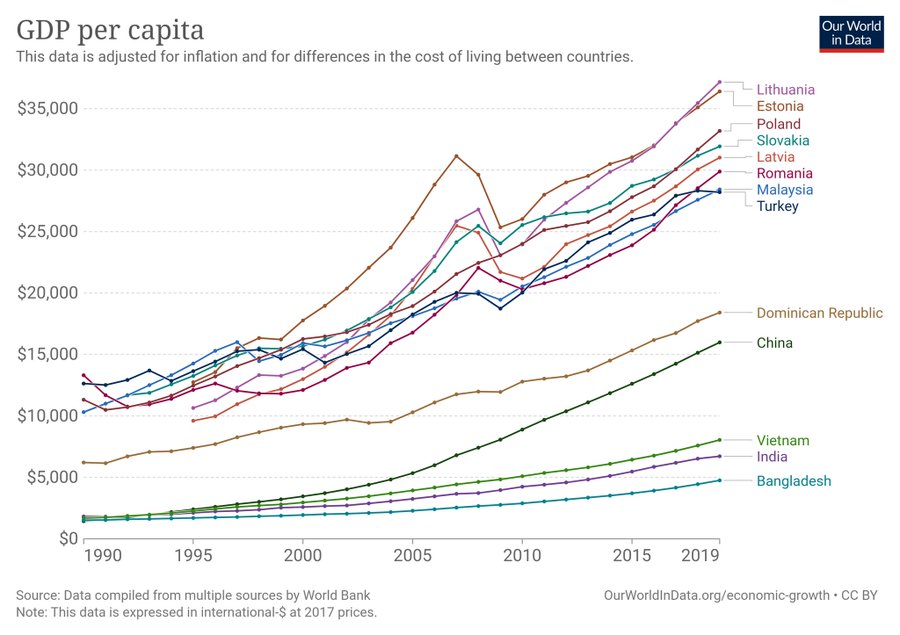
Rapid Recent Economic Development In Select Countries

Eastern Europe, Malaysia, and Turkey have seen rapid economic growth since the end of the Cold War. 

In all of these cases, except Malaysia, greater openness to and increased trade with Western Europe is the likely reason for the economic growth these countries experienced.


04 January 2023

Good Timing For A Warm European Winter

Europeans, cut off from Russian natural gas supplies, were expecting a bitter winter, and energy prices are high there. 

But, in a stroke of good fortune, this year's winter is setting records as one of the warmest European winters in recent history, easing the burden on natural gas supplies to supply heat.

04 October 2022

Immigration and Political Identity In Europe

The conclusion that second generation European immigration are more liberal than native born Europeans is unsurprising, but it is always better to rely of established data than default assumptions.
We analyze whether second-generation immigrants have different political preferences relative to observationally identical children of citizens in the host countries. Using data on individual voting behavior in 22 European countries between 2001 and 2017, we characterize each vote on a left-right scale based on the ideological and policy positions of the party receiving the vote. 
In the first part of the paper, we characterize the size of the “left-wing bias” in the vote of second-generation immigrants after controlling for a large set of individual characteristics and origin and destination country fixed effects. We find a significant left-wing bias of second-generation immigrants, comparable in magnitude to the left-wing bias associated with living in urban (rather than rural) areas. 
We then show that this left-wing bias is associated with stronger preferences for inequality-reducing government intervention, internationalism and multiculturalism. We do not find that second-generation immigrants are biased towards or away from populist political agendas.
Simone Moriconi, Giovanni Peri, and Riccardo Turati, "Are Immigrants more Left leaning than Natives?" NBRE Working Paper 30523 (September 2022).