Showing posts with label Russia. Show all posts

29 June 2026

U.K. Navy Makes Smarter Decision Than U.S. Navy

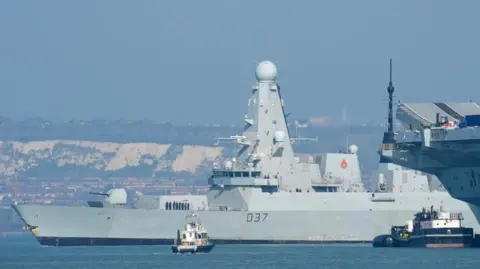
The U.K.'s Navy, unlike the U.S. Navy, understands that building more 1980s era concept destroyers no longer makes sense. They've been paying attention to the Ukraine War in the Black Sea in which traditional surface combatants are being felled by drones. 

The U.S. hasn't been and instead is working on a "Trump-class Battleship" which is precisely the wrong direction, and more Arleigh Burke class destroyers.

Navy to build drone-equipped warships instead of replacing ageing destroyers

PA Media


Plans to replace ageing warships will be scrapped in favour of building at least six new modern "hybrid" vessels equipped to deploy drones as part of the UK's upcoming defence strategy.

The Ministry of Defence (MoD) said the new vessels would be more suited to the "pace and nature of modern warfare", and a better investment than a "small number of large expensive ships".

Defence Secretary Dan Jarvis said the new equipment would be "designed and built for the increasing threats we face".

Outgoing Prime Minister Sir Keir Starmer has committed to publishing the long-delayed defence investment plan (DIP) before the Nato summit in Turkey on 7 July after months of talks over how to fund it.

The MoD had been exploring options to replace the Type 45, the Navy's fleet of destroyers, with the Type 83, a concept vessel which was at an early design phase.

Instead, investment will now go towards six new Common Combat Vessels, which the department said would be capable of "coordinating uncrewed systems in the air, on the surface and under the sea to deliver more resilient air defence".

It said the change in approach would extend "the Navy's reach, resilience and firepower without a proportional increase in crew or cost".

From the BBC. 

02 May 2026

Russia Has Lost 30% Of Its Black Sea Fleet

Ukraine has done a remarkable job to degrading Russia's Black Sea naval fleet for a country without a navy of its own.

Russia’s Black Sea Fleet was once a dominant regional naval force. But the fleet has been severely weakened, resulting in a shift from an offensive force to a defensive “fleet-in-being.” What’s notable about the fleet’s degradation is that Ukraine didn’t need a traditional navy to inflict it; rather, it used drones, missiles, and targeting to strip the Black Sea Fleet of its ability to operate, offering another example of asymmetric, cheap measures crippling traditional, expensive military platforms.

Russia is believed to have lost 30 percent of its Black Sea Fleet, either to damage or outright destruction. That’s 24–29 vessels lost. Key losses include the flagship vessel, the Moskva cruiser, and multiple landing ships.

The remaining strike force consists of seven offensive warships, including two frigates, three corvettes, and two submarines. So the fleet still exists, but its offensive capabilities have collapsed. . . .
The primary weapon in the fleet’s arsenal is the Kalibr cruise missile. Before the Russo-Ukrainian War, the fleet had the capability to launch large missile salvos. But now the Kalibr can be launched from just five surface ships and two submarines, limiting the fleet’s ability to launch its pre-war missile salvos. . . .

Loss of Bases 

Ukraine has also targeted Russian naval bases. Sevastopol, the primary naval hub, has been repeatedly struck, forcing the fleet to relocate. But the new base, Novorossiysk, has also been under attack.
The result has been that Russia no longer has a secure naval base in the Black Sea, which has obviously degraded its ability to maintain a meaningful presence there. And now, with the fleet concentrated in Novorossiysk, Ukraine has a base under constant drone threat, limiting the fleet’s ability to maneuver.

As a defensive measure, the ships rarely leave port, and the submarines hide near the bases. So the existing fleet is effectively contained—still present but operationally inactive.
Missile Capability Degradation
Maintenance Collapse

The fleet has suffered from a maintenance collapse. The core issue is that there is no dry dock, and the Bosporus Strait has been closed. The result is that no major repairs have been made, and overall readiness has been severely degraded.

Damaged ships have been forced to simply remain damaged, meaning that even ships that survive are slowly losing their effectiveness. . . .

Strategic Implications

The destruction of Russia’s Black Sea Fleet suggests that large ships are now vulnerable to cheap and effective drones that adversaries can deploy in swarms.

Sea control has been redefined; Ukraine does not have a traditional navy, yet it still managed to deny Russia’s ability to use a traditional navy to control the seas.

The global lesson here is that fleets can be neutralized without a fleet-on-fleet battle. The Black Sea may offer a glimpse into the future of naval warfare, where distributed, low-cost systems are effective counters to legacy systems.

From National Security Journal.

08 March 2026

Indirect And Non-Obvious Effects Of The Iran War

The U.S.-Israeli attack on Iran (the NYT recaps the first week here) will have some indirect and non-obvious impacts, some of which mirror those from the Ukraine War.

* Iran is the sole significant outside military supplier for Russia in the Ukraine War (supplying drones) apart from North Korea which has supplied artillery rounds and some old school military equipment (and even about 10,000 troops) all of which have been subpar in quality and not very useful. The attacks on Iran are likely to divert existing supplies of drones to domestic military use from exports to Russia for use in counterstrikes, and are likely to somewhat degrade Iran's military production capabilities.

* Iran's counterattacks and continued war-like footing have driven up global oil prices dramatically, have had direct supply effects on most of Asia, and have damaged the oil production infrastructure in many Middle Eastern oil producing nations (including Saudi Arabia) which will reduce the capacity of these countries to produce oil in the short to medium term.

* This oil price shock, like many more before it, makes electric vehicles and public transportation more attractive to policy-makers and consumers alike, all over the world, potentially resulting in long-term systemic reduction in demand for oil.

* This mirrors the indirect effect of the Ukraine War in causing Europe to rush to find long term alternatives to oil and natural gas, resulting in wider adoption of EV vehicles, renewable energy sources for their power grids, and energy conservation measures. Again, this results in long-term systemic reductions in demand for oil and natural gas in one of the largest economically developed regions in the world.

* The Ukraine War also strengthened NATO, strengthened European cooperation, and caused re-militarization of European countries, especially those most at risk of attacks from Russia.

* Trump's inexplicable decision to temporarily ease sanctions on Russian oil sales to India, helps Russia in the Ukraine War despite the fact that Russia has used its intelligence resources to help target the U.S. and its allies for Iranian counterstrikes.

* Generally, an international war strengthens the regime attacks vis-a-vis external dissent (something that partially explains Russia's persistence in the Ukraine because the ongoing war there makes Putin more able to crush dissent against him at home). The protests of the Iranian people against its regime may suffer because of this effect. While the U.S. assassinated the Ayatollah, Iran's supreme leader, and many of the likely successors, the successor chosen for this reason is probably more likely to be a hardliner than the person who might have been chosen if the Ayatollah (who was 86 years old and close to 87 when he was killed by a U.S. strike) had died of natural causes as was likely in the near future.

* It seems unlikely that Iran will experience regime change, either in favor of a more democratic regime (Iran's democracy was actually more robust than a lot of regimes in the Middle East), or a monarchist restoration of the Shah. Pre-attack, this had been conceivable because of huge protests against the too conservative Shiite religious regime's social policies, despite the fact that Iran is actually quite religiously and ethnically diverse. Air strikes and missiles are rarely sufficient to secure regime change.

* The war probably delays steps that could be positive for the residents of Gaza.

* The war probably depletes military equipment supplies of Iran, and to a lesser extent, the U.S. and Israel, weakening the affected countries' capacity to fight further wars.

* In much the same way, the Ukraine War has dramatically depleted Russia's military resources (despite half the national budget in Russia being spent on the military and interest on loans to support it).

* The strikes in Iran are very likely to weaken the Republican Party's MAGA coalition, since MAGA campaigned on ending foreign wars of choice and then has repeatedly sought out those wars in Trump's second term, striking Venezuela, embargoing Cuba, striking Iran, and renewing a "drug war" in Mexico, Ecuador, the Caribbean, and the Pacific, which doesn't seem very calculated to actually do anything about drug abuse and drug related crime in the U.S. (as well as threatening Canada and Greenland). This coalition has already been beaten up in special elections and survey results and has a very thin majority (especially in the U.S. House).

* The inflation caused by rising oil prices, weakens support for Trump and the Republicans and strengthens Democrats chances in the 2026 midterm elections, which are just seven months away.

* The Iran War hasn't been particularly effective at diverting attention from the Epstein files which graphically reveal a coalition of child trafficking, corrupt, and Russian influenced officials in senior levels of politics, business, and academia, with Trump at the center of all of it as a highly culpable serial child rapist.

* The Venezuela invasion, by the way, seems inconclusive and certainly doesn't seem to be having much of an oil supply impact.

04 March 2026

Trump's Many Wars

Trump has declared wars on small boats in international waters in the Caribbean and the Pacific, claiming that they are drug boats, without proof, claiming a right to kill the people on them, contrary to international law.

Trump invaded Venezuela and seized its leader.

Trump has involved U.S. military forces in striking a Mexican cartel chief, leading to a bloodbath there.

Trump has unilaterally made strikes on Iran.

Trump has now deployed the U.S. military in Ecuador.

Trump is trying to impose an oil embargo on Cuba.

Trump deployed the National Guard to peaceful American cities.

Trump has deployed ICE as his private secret police to lawlessly terrorize American cities with scant regard to what they are actually legally authorized to do.

Trump has deployed U.S. forces to interdict Russia's shadow fleet of oil tankers trying to evade sanctions arising out of the Ukraine War. The Ukraine war itself is ongoing and Trump and blown hot and cold on it, prolonging the war by giving Putin hope.

Trump has threatened, but not yet struck, Greenland, Canada, and Panama.

And, while only metaphorical, Trump has declared trade wars on the entire world.

In most of these cases, Trump hasn't had even a whisper of Congressional authorization or legal authorization to act. The uses of force (and the tariffs) have violated domestic and international law. 

22 February 2026

Four Years Of War

Tuesday is the fourth anniversary of the latest Russian invasion of Ukraine, that started on February 24, 2022, after an eight year respite following the Russian seizure of Crimea and Russian allied sympathizers trying to join Russia in parts of a couple of the far western provinces of Ukraine that were most ethnically and linguistically Russian.

Russia thought it would have a quick and easy triumph, just as it had had in Crimea in 2014. It didn't. 

* It has had 1.2 million casualties (including wounds not mortal, captured soldiers, and desertions), which is more than the size of the entire Russian Army it started with, and the losses have extended to officers and even the highest ranking generals. About 325,000 of them were killed.

* It is losing soldiers as fast as it can draft them, at a rate of about a thousand soldiers a day. It is replacing a large share of its seasoned soldiers with green conscripts that are ill-trained, ill-equipped, and ill-treated.

* The vast majority of it tanks, infantry fighting vehicles, artillery, and the like gone. It's soldiers are resorting to using museum pieces and horses. Ukraine's estimates (below) may be slightly high, but they've largely been born out by third-party assessments. Here is there assessment as of yesterday:


Russia's losses in this war have been greater than all but a handful of entire military forces in the world, and greater than the entire amount of its ground forces and ground force equipment that was in active service four years ago.

* It's military tactics sometimes seem similar to the inability of World War I generals to recognize the futility of their approaches, trying the same things over and over to abject failures.

* Its Black Sea fleet suffered heavy casualties and neutered.

* Its air forces have suffered not insignificant losses.

* Its supplies of advanced drones and guided missiles has thinned.

* After the early part of the first year of the invasion, its territorial gains have been minuscule, and have come at immense cost in troops lives and equipment. The most recent assessment I could easily find was as of February 11, 2026:

Since Feb. 24, 2022: Russia: +29,210 square miles. 13% of Ukraine. (Area roughly equivalent to half the U.S. state of Illinois).

Total area of all Ukrainian territory Russia presently controls, including Crimea and parts of Donbas, Russia had seized prior to the full-scale invasion on Feb. 24, 2022: Russia: +45,835 square miles. About 20% of Ukraine. (Area roughly equivalent to the U.S. state of Pennsylvania.) . . .
In 2025, the average monthly rate of Russian gains was 171 square miles. . . . 
According to RM’s measurements, using ISW data, Russia captured 2,171 square miles—about 0.93% of Ukraine including Crimea—in 2025.

Russia still controls less Ukrainian territory than it did in August of 2022, six months into the war.

Russia has gained 5,200 square miles of territorial control since November 2022, its low point in this four year long war. This is an average gain of 133 square miles a month in a war where it is currently experiencing 30,000 casualties or so per month.

* The territory taken, which was home to the strongest political opposition to Ukraine's government, has strengthened the political backing of Ukraine's government in the territory it still controls. And, Russia has alienated former pro-Russian Ukrainians in territory it does not control.

* Crimea was mostly as a summer resort for Russians and had been a key Black Sea fleet military base for Russia. It is neither of those things now.

* Its oil and gas infrastructure has been seriously ravaged. Its ability to sell its oil and gas abroad is also increasingly restricted.

* Its transportation infrastructure, especially en route to the front and to Crimea, has been seriously damaged.

* It has been isolated internationally and the restrictions have tightened, while the world, and especially Europe has embraced it. It has failed to win military support from any countries except North Korea and Iran. China and India have remained lukewarm towards it.

* It's oligarchs have been pinched and looted as sanctions.

* It's domestic economy has again been squeezed out for military demand.

* An estimated 7,254 Russian civilians have been killed.

* It's best and brightest young men have fled abroad to avoid conscription and likely death or disability in the process. 1,000,000 (0.7% of Russia’s 2022 population) left Russia for economic or political reasons in the first year of the full-scale war. Between 15% and 45% of those who had left have returned since then, so, between 550,000 and 850,000 people have not returned to Russia.

* It has withdrawn from other international military commitments, for example, in Syria (whose regime fell), and in a strip of land in Moldova.

* NATO has expanded and grown stronger.

* It's European neighbors have built up their own military might and military solidarity, at the same time that Russia's military might is a shadow of what it was four years ago.

* It has relied heavily on more or less random attacks with long range drones, glide bombs, and missiles on civilian targets of little tactical value that violate intentional laws of war. Ukraine's air defenses have been about 89% effective, which means that strikes do get through regularly and cause damage, but the air defenses make it about 9 times more expensive for Russia to do so than it would be without them.
Russia fired: 
* 4,838 drones
* 14 ballistic missiles
* 61 cruise missiles 
Ukraine intercepted: 
* 4,120 drones (718 not intercepted)
* 1 ballistic missile (13 not intercepted)
* 38 cruise missiles (23 not intercepted)
* Ukraine has proven to have more military industrial capacity, more allies, more competent troops, and more of a capacity to learn and change their tactics and technologies.

* Ukraine has managed to strike both military and economic targets deep in Russia, but has done so without indiscriminately harming civilians.

* Russia has found that its immense nuclear arsenal has been challenging to turn into practical military gains.

This isn't to say that Ukraine has won. It has had about 600,000 military casualties (including wounds not mortal, captured soldiers, and desertions), of whom about 120,000 have been killed, and lost lots of military equipment too (although Ukraine has faired better at replenishing its equipment losses). An estimated 15,954 Ukrainian civilians have been killed (from the same source).

The vast majority of harm to civilians and the civilian property has been on its territory. 

It has lost significant amounts of territory. Millions of Ukrainians have been internally displaced or have become refugees. As the New York Times explains:
At the start of the full-scale invasion, excluding regions that were already occupied by Russia, it had a population of perhaps 36 million people, according to Tymofii Brik, a sociologist and the rector of the Kyiv School of Economics. (Other estimates tend to be higher.) Since then, Brik says, six million have been displaced inside the country and some four million — mostly women and children — have left Ukraine. More than 100,000 Ukrainians, troops and civilians, are estimated to have been killed. Millions of people live under occupation in areas Russia controls.
Ukraine's whole existence has become an existential fight for survival every day, with intense uncertainty.

But, at best, the Russo-Ukrainian war has been a stalemate for the last three and a half years, and Russia's military capacity to challenge anyone is profoundly depleted.

Russia's leaders have seized on the war to exert greater control on its people in an authoritarian style, but the cracks are showing.

The feckless "leadership", or lack thereof, by Trump and the Republicans in Congress has helped encourage Putin and extended the war, given Putin hope that his unilateral adventure unknown outside his inner circle until it happened, can prevail, at least into a treaty that leaves Russia better off. They have also cratered NATO.

03 February 2026

Military Updates

Initially without links:

* 70%-80% of the casualties in the Ukraine War have been from drones. Heavy armored units en masse have almost vanished as a tactic and a very large share of all artillery batteries have been destroyed. Russia has had 1.2 million military casualties, Ukraine has had 0.6 million military casualties. The fourth anniversary of the start of the latest phase of the war is coming up later this month. Russia's rate of territorial advance has been the slowest in the last century. Europe is stepping up support for Ukraine and considering deploying troops as U.S. support under Trump continues to be fickle. Ukraine's campaign against oil and gas infrastructure in Russia seems to have subsided somewhat although it has hit some relatively low value targets near Moscow. Russia has stepped up strikes against civilian targets in Ukraine (more or less indiscriminately). Russia is nearing a breaking point economically, although it has finally started to ramp up its military-industrial capacity someewhat. U.S. and European forces are being more pro-active in interrupting "ghost fleet" trade in sanctioned Russian oil.

* Germany has invented anti-torpedo torpedos.

* Japan has invented a 40mm railgun for one of its ship classes. It overcame the hurdles faced by the U.S. program with a 40mm round instead of a 155mm round, different materials in the barrel that have different electrical properties, and gallium capacitors that reduce the power supply footprint. It can fire 120 rounds in shot succession and doesn't suffer the barrel burn out problem of the U.S. attempt. It can fit in a shipping contain plus a small turret. This would be mostly useful in anti-small craft, anti-drone, anti-helicopter, and missile interception roles. It is quite accurate although range and accuracy details are not publicly available. The same ship would have lasers, something that China is also investing it. But lasers are only effective for 3-5 km, and can be disrupted by heavy sea spray, fog, low lying clouds, storms, and fog, so the lasers would be mostly for close in missile and drone defense together with something like a Phalanx Close In Weapons System. Railgun rounds are basically immune to lasers.

* The U.S. has developed a large area anti-drone system that uses microwaves to generate an electromagnetic pulse that can take down hundreds of drones at once, deployed on military truck.

* The U.S. is stepping up B-21 Raider production, a stealth bomber similar to the B-2 but a bit smaller and more modern.

* A prototype of a next generation Abrams tank was shown off at the Detroit auto show.

* China claims to have ready for prime time sensors that can see U.S. stealth aircraft.

* Progress is being made in ground drones, generally, either on a small unmanned ATV scale or a robot dog with a rifle sized weapon approach.

* Progress is being made on surface and submarine drones.

* Progress is being made on optical gun sight attachments that make it much easier to identify sniper sights that would otherwise be almost invisible at ranges up to a mile.

* China continues to be active in deploying its navy, coast guard, are paramilitary maritime forces around the Philippines and the South China sea.

03 October 2025

The Tide Is Turning In Ukraine's Favor

The Ukraine War seems to have reached a turning point. Ukrainian attacks on the Russian oil and gas infrastructure, and on coal and natural gas fired electrical power plants, often deep inside Russia, are having an impact that ordinary Russian citizens can no longer ignore. And, when Russia can not longer supply oil and gas to Western Europe, European resolve to take a firm stand against Russia strengthens.

In a few cases, strikes deep in Russia have been carried out by Ukrainian special forces acting in concert with domestic minority nationalist groups, raising the specter of a Russian civil war, or at least a renewed insurgency at a time when it's military is stretched thin to beyond a breaking point.

Russia is almost completely out of heavy armored vehicles and has dramatically reduced artillery resources. Russia is still suffering about 30,000 casualties a month, a rate at which it can just barely replace the soldiers it's losing with green conscripts.

Russia's provocation of NATO countries from Poland to Hungary to Denmark is driving these countries in Europe to vigorously prepare for war and take more aggressive measures against it.

Russia is deploying huge numbers of drones, missiles, and glide bombs to Ukraine at unsustainable levels, but many of these are intercepted before they can do harm, and those that done usually result in modest Ukrainian civilian casualties that incited outrage, but have little military effect and have not broken Ukraine's spirit. And, those attacks are unsustainable because Russia's capacity to procure new drones and missiles, and the replace its military equipment losses is far lower than that of Ukraine and its Western allies.

And, while Trump's America has been a feckless ally to Ukraine, it also hasn't turned out to be the solid supporter of Russia that Putin had hoped to receive.

It isn't over, but the tide has turned definitively in favor of Ukraine.

26 August 2025

A Best Case Scenario Future For Russia

This post isn't a prediction. It isn't even a likely possibility. It is just barely within the realm of possibility. But it doesn't hurt to dream big now and then, because progress towards even part of this goal would be great.

What would be a best case scenario for the future of Russia?

Ukrainian Territory Surrendered

* Crimea is returned to Ukraine, demilitarized and granted a high degree autonomy within Ukraine. 

* The historically ethnically Russian eastern provinces which Russia controls or partially controls would receive similar treatment.

* Ukrainians relocated to Russia would be repatriated.

* International peace keeping forces would provide security guarantees for a limited time period in formerly Russian controlled territory.

Demilitarization

* Russia surrenders its nuclear weapons (which are destroyed with the radioactive elements repurposed for nuclear power). It's nuclear power plants are operated under the close supervision of a beefed up International Atomic Energy Agency.

* Russia's long range missiles and military drones are destroyed.

* Russia's long range bomber aircraft are destroyed.

* Russia's remaining air force is scaled back and its most advanced fighters are destroyed.

* Russia's navy is profoundly scaled back to little more than a coast guard.

* Russia's military industry is basically shuttered, closing its tank factories, it artillery shell factories, its naval ship yards, its military aircraft factories, and so on.

* Russian military spending and military forces would be limited in a manner similar to post-WWII Germany and Japan.

International Relations

* Russia is replaced on the U.N. Security Council by India and Pakistan.

* Any Russian foreign military bases are closed and ceded to the county where they are located.

* Any treaties between Russia and former Soviet Republics are dissolved and open to renegotiation on a clean slate.

* The autocrats ruling Belarus are replaced with a democratically elected regime in elections conducted under foreign monitoring.

Balkanization

* Part of the strategy is that reform and democratization is easier for smaller unitary countries than it is for large federal countries. It is also harder to concentrate military might and economic power in many small countries than it is in one big country. Rump Russia would still be the largest successor state but would still be significantly smaller and more decentralized.

* All of Russia's autonomous regions (everything but the red and pink and blue areas on the map below, i.e. all territories in orange, yellow or green) are granted independence and a right of free passage across all territory that was formerly part of Russia. About 25 million people (out of a total of about 144 million people) live in republics and autonomous regions that would gain independence, which also make up a huge share of Russia's territory.

Via Reddit.

* The Asian and Arctic Russian Oblasts and Krai would be allowed to vote (collectively) on whether to become a separate country of "Western Russia" or not.

* Kaliningrad Oblast, with an area of 5,840 square miles (a little bigger than Connecticut or Puerto Rico or Prince Edward Island in Canada), is demilitarized and its one million people (mostly Russian speaking and ethnically Russian) are granted independence. It is offered membership in the European Free Trade Association (but not the European Union) and encouraged to convert military industries to civilian ones. 

* The loss of Kaliningrad together with the independent republics and autonomous regions, this would leave about 118 million people in rump Russia, and even less if Western and Arctic Russia voted to form their own country.

Regime Change

* Putin is deposed and the current political regime is dissolved and its political officials are removed from office with many disqualified from holding public office.

* A new Russian constitution is adopted reflecting its loss of territory and forbidding any future annexation of territory. It has a very weak Presidency and shifts most power over domestic policy, and almost all lower level courts, to oblast and krai and independent city governments from the national government.

Democratization, accountability, and reconciliation:

* A campaign of democratic education for a decade or so would counter propaganda from the authoritarian era, and firmly reestablish democratic freedoms. 

* Russia and all of its successor states become signatories of the European Declaration of Human Rights (administered by the Council of Europe) and the International Criminal Court treaty. 

* War crimes committed by Russians since the fall of the Soviet Union are prosecuted.

* A commission investigates and discloses the true story of abuses during its authoritarian regime with inside information and the behind the scenes stories of its post-Soviet Wars are told (including all abuses and casualties).

Economic Reforms and Reparations

* Heavy taxes are imposed on Russia's oligarchs and strengthened antitrust laws would break up their economic power.

* Russia's oil and gas industry is transferred to an international corporation in which Ukraine and other victims of its aggression receive a 1/3rd share of the profits (further broken out by an international arbitrator) in lieu of other reparations.

25 August 2025

Drones And Dirt Bikes > Tanks And Armored Personnel Carriers

On August 7, 2025 at about 6 a.m. local time (the link is to an eleven minute video summary of the attack from the Ukrainian military), a Russian column of one hundred and twenty vehicles, including heavily armored 48 ton modern T-90 Russian main battle tanks, and infantry fighting vehicles with heavy 20-30 mm cannons carrying six hundred troops, together with support and supply vehicles with ten days of supplies, advanced along a road from a portion of occupied Ukraine near the Black Sea coast between the Russian border and Crimea advanced north with an objective of establishing a forward operating base further inland which was 120 km away from their base (about a four hour trip for an uninterrupted convoy).

The 3.4 kilometer long Russian convoy was advancing at the slow speed of tracked vehicles (about 28 km per hour), easily visible, noisy, and smelly with 65,000 horsepower of diesel engines running at once. The major advance was promptly identified by Ukrainian surveillance and reconnaissance resources. Ukrainian officers gathered in minutes to devise a counterattack plan.

Within minutes, Ukraine dispatched twenty long range, fixed wing reconnaissance drones with six foot wing spans and high quality visual and thermals sensors transmitted in real time to Ukrainian command centers (which cost about $4,000 each), flying low at about sixteen feet above the ground at 140 km per hour until almost reaching the convoy, to avoid Russian radar, to gain detailed information about the Russian convey, characterizing each vehicle. The Russians failed to notice them.

Within a half an hour, a plan had been formulated and the counterattack force was deployed. 

By air, eighty shorter range quad copter drones, each carrying the 12 kg shaped charge warhead of an anti-armor shell or missile, or an anti-tank mine, flying low to avoid detection. 

By land, two hundred military grade dirt bikes with two riders each - a driver and a gunner, some with assault rifles, and others with a mix of not very sophisticated anti-armor weapons from rocket propelled grenades to a Soviet anti-tank missile similar to the U.S. TOW missile, broken up into three groups targeting the beginning, middle, and rear of the armored column. The dirt bikes advanced off paved roads through forests and hills through narrow tracks, parallel to the paved road upon which the Russian convoy of armored vehicles was advancing. 


Allegedly, the counterattack was devised and directed from a deep heavily fortified Ukrainian bunker not all that far from the front lines. Each drone was monitored and controlled from a computer screens and VR goggles, by a remote operator. The image quality on the FPV drones, which cost about $500 reach, is far inferior to that of the reconnaissance drones.

The Russians tried to strike the incoming drones with cannon fire from the infantry fighting vehicles and machine guns, but didn't have electronic warfare jamming resources that worked against the incoming drones, or dedicated anti-drone weapons, and only took out a few of the incoming drones.

The Ukrainian drones struck carefully chosen targets in the convoys: tanks and armored vehicles at the front and rear of the convoy to bring it to a halt and deny it an opportunity to retreat, the most heavily armored tanks, a lightly armored supply truck carrying a large load of mortar rounds that produced secondary explosions. 

Moments after the simultaneous attacks from the drone swarm hit, the Ukrainian soldiers on dirt bikes, who had been undetected, fired anti-tank weapons at the remaining vehicles and killed the Russian soldiers who abandoned their vehicles.

The main strike takes place half an hour after the Russian advance is detected and lasts less than fifteen minutes, followed by clean up fire by the soldiers on dirt bikes.

There may have been a few Ukrainian casualties, but all of the one hundred and twenty vehicles in the Russian convoy were neutralized, and almost all of the close to a thousand Russian soldiers, between the vehicle operators and the six hundred troops carried in armored vehicles, were killed or grievously wounded.

Ukraine's tactics aren't new. Ukraine has used infantry on dirt bikes with anti-tank weapons to strike Russian armored vehicles traveling in convoys along civilian roads since February 24, 2022 when the latest phase of the Ukraine War began. Warhead carrying quadcopter drones have been the mainstay of the war on both sides for at least a couple of years now. But apparently, the Russian are slow learners sticking to obsolete Russian army tactics that have been discredited for years now.

The Russian convoy had radar, either integrated into its unit or at nearby bases, but the radar couldn't detect small, low flying drones, advancing at more than 140 km per hour from not many kilometers away. And, any air defense systems in the convoy were among the first targets.

The Russian convoy didn't have reconnaissance drones of its own flying overwatch to detect the incoming drone swarm and dirt bikes in time to give them more time to prepare to respond to the attack. Even if it had had those resources, only a few minutes passed from the launch of the Ukrainian drone swarm to its arrival at the convoy. The dirt bikes, likewise, were hidden under tree cover and behind hills until shortly before the drone swarm struck and diverted attention from them.

The Russian convoy didn't appear to have effective electronic warfare resources to jam the remote control signals for the incoming drones, even though other Russian units have been known to use them. The Russian convoy didn't appear to have purpose built anti-drone weapons sufficient to take down the incoming quad copters at a moment's notice and instead relied on infantry fighting vehicle cannons and machine guns for their largely ineffective effort to take down incoming drones before they were hit. Russian "turtle tank" and anti-drone nets, for the vehicles that had them, weren't very effective. If a first strike from a Ukrainian drone failed to neutralize a Russian armored vehicle, a second or third drone strike would.

The Ukrainian response, and its outcome, should have been entirely predictable at this point to Russian army officers. It isn't as if Ukraine's tactics are a closely guarded state secret. Ukrainian forces regularly upload video of its attack on Russian positions to the Internet for all to see. The Russians had plenty of time to plan an attack that would be less vulnerable to this kind of attack.

There may have been some innovations that weren't disclosed. 

For example, maybe the Russian convoy did have electronic jamming in place, but the Ukrainians were using new innovations to keep its radio signals from being effective or used fiber optic cables that can't be jammed to direct its drone swarm. Maybe the Russians thought there was strength in numbers because it didn't believe that Ukraine could mobilize so many drones and dirk bikes on short notice, so that it least some of its forces would survive and decimate the Ukrainian soldiers sent in to finish the job. 

Maybe the Russians just didn't think it through and defaulted to tactics that they were taught in the pre-drone era. Like a large share of American military strategists and planners, they still don't seem to have come to terms with what they are up against, and have failed to make the dramatic changes necessary to respond to the tactics like Ukraine has pioneered. 

Russia's tactics in the Ukraine War resemble the way that military officers on both sides of World War I resorted to huge human wave attacks (and even horse cavalry charges) long after it had become clear that machine guns and artillery had mad it clear that those tactics were obsolete and futile. Indeed, in many places on the front of the Ukraine War, it appears that Russia is still resorting to World War I style human wave attacks with similar results: gaining control of tiny amounts of territory at a staggering cost in the lives of their own soldiers.

Whatever the reason, three and a half years into the war, on very short notice, Ukrainians with a hundred cheap and crude drones loaded with anti-tank warheads, two hundred dirt bikes, and several hundreds soldiers with a decent supply of anti-tank weapons, managed to defeat a large, heavily armored two battalion sized Russian convoy and neutralize it.

Admittedly, this is being recounted in a propaganda video. There are no doubt operations by the Ukrainian forces that aren't nearly so successful that aren't publicized, where Russians inflict heavy casualties on Ukrainian forces and aren't obliterated.

But the big picture statistics in terms of casualties, equipment destroyed, territory gained, and the proportion of the damage done by drones, bear out that while not all Ukrainian strikes are as large scale and flawless, on balance, cheap drones and light infantry with heavy weapons are superior to heavily armored, large, more conventional military forces.

24 August 2025

Damage Inflicted By Ukraine According To Ukraine


This may be exaggerated. But, Ukraine has consistently been much closer to the truth than Russia. Third-party verified damage assessments admit that they are underestimates and are order of magnitude similar.

Ukraine has also inflicted considerable damage on Russia's oil and gas industry, its defense industry, its railroads, and its bridges.

These numbers, which are three weeks old, are themselves underestimates.

Estimates of how many of these systems Russia has left are harder to come by, however, and are ultimately more important. But still, Russia has had bigger losses than the entire military of many countries. 

The U.S. Should Divest Its Tanks

The best use of the M1 Abrams tanks currently in the U.S. military arsenal would be to give them away to Taiwan, South Korea, and Ukraine. We would not be able to get additional tanks to Taiwan in the event of an invasion by the People's Republic of China, or South Korea in the event of a North Korean invasion, in time to make a difference. Ukraine would welcome anything we can provide it.

Note that Australia is sending its M1 Abrams tanks to Ukraine.

The M1 Abrams tank is also ill-suited for the conflicts we could conceivably fight, as the U.S. Marine Corps has already realized. The U.S. military is an expeditionary one. All of the near peer conflicts it would fight are overseas and it is very challenging to get its 70 ton plus mass to the front. They are too heavy to cross bridges, or to be carried on trains over rail bridges, in much of the world. They destroy roads and leave a clear trail of where they have been. They are noisy. They are the opposite of stealthy. They have poor situational awareness outside of a flat plain or desert.

The Ukraine War has shown how vulnerable they are to FPV drones and other modern anti-tank weapons despite their extremely heavy armor. Thousands upon thousands of tanks and heavy armored vehicles on each side have been defeated. 

Tanks very rarely destroy other tanks in modern warfare, greatly reducing the utility of their main guns. Their main guns have a shorter range than the anti-tank missiles and artillery rounds that can be used against them. 

They are slow at a peak speed on roads of 45 mph or so, and are slower off road (even though they are much more competitive in speed off road), and the experience of other modern wars have shown that off road warfare is very much the exception rather than the rule. They require an immense amount of fuel and mechanical support to keep running, and those support units generally can't go off road and lack the heavy armor of the tanks. 

They are too wide for urban warfare on narrow streets or in mountain passes or dense forests. Their limited angle of fire makes them ineffective against opponents on top of buildings. Drive a heavy tank into a building with a basement and it will fall into it.

It isn't that armored military vehicles are obsolete entirely. 

An armored vehicles is a formidable adversary to a force without anti-tank weapons that has only small arms. It can ignore the small arms with impunity, and if it has appropriate weapons to engage infantry and more lightly armored vehicles than other tanks (which doesn't require a heavy main tank gun), it can very effectively take on these adversaries. But armored vehicles only make sense in an environment where the force using them has air superiority, has taken out all enemy artillery within range, where the enemy doesn't have modern anti-tank weapons and is unable to place effective anti-tank mines or IEDs. 

There is a niche for armored military vehicles in those conditions, but a huge main gun with a couple of light machine guns added as after thoughts doesn't fill that niche. If one needs the power of a tank round now and then, it can be supplied with a missile or large recoilless rifle round, at a fraction of the weight.

If an adversary has anti-tank weapons or the adversary can attack with ground attack fighters or attack helicopters, the solution is not more armor beyond what is necessary to stop small arms, it is to use active defenses instead. This is a lesson which the U.S. Navy has already learned, but which the U.S. Army continues to ignore.

22 August 2025

Time Is On Ukraine's Side

An article in the New Yorker entitled "What It Would Actually Take to End the War in Ukraine" gets it exactly backward with in subheading that says:
With Ukraine drained by more than three years of fighting, time is on the side of Vladimir Putin.
Ukraine has held out as long as it had because it has Western allies resupplying with good quality (although not state of the art) military equipment. So, Ukrainian military equipment losses can be replaced. And, in general, a defender can inflict many times as much damage on an invader as an invader can on a defender (as reflected in the two country's respective military losses to date). As long as Western Europe sees Ukraine's survival as something that is in their interest (and it is hard to imagine circumstances when they wouldn't), Ukraine will not run out of modern military weapons.

Ukraine also can't just voluntarily stop the war without losing their country, so their commitment to keep fighting is higher. 

Russia has much less capacity to resupply itself from its own factories, with only North Korea (whose arms and munitions are of substandard quality) and Iran (who has only supplied some narrow types of drones and is distracted by war with Israel) willing to sell it arms. Russia is in grave peril in a time frame of six to twelve months or so, of basically completely running out of almost all of its tanks (even museum relics from the 1950s and 1960s), artillery batteries, other armored ground vehicles, guided missiles, and advanced drones over the next year. And, Russia is already is using artillery shells and less advanced drones as quickly as it can make or import them, because it has no inventories of them left. Russia is also, slowly but surely, seeing its supply of warplanes eroded, and has suffered some modest losses to its navy as well with its Black Sea fleet basically emasculated and forced to retreat to safety.

For Russia, this war is a luxury that it can stop at any time with no consequences except sunk costs and shame (and with the benefits that would come from relaxed sanctions and an end to military strikes on its roads, bridges, railroads, and oil and gas infrastructure). Furthermore, since Russia's war is driven almost entirely by the personal ambitions of Vladimir Putin, if he dies or is incapacitated or loses power, Russia's impetus for the war would end promptly, while Ukraine would continue its fight without missing a beat, even if President Zelensky was killed.

In a war of attrition, Russia not only loses, but ceases to become a threat to any other country in the short to medium term.

15 August 2025

Soft Kill


One of the tactics used by Ukraine in its current war with Russia has been to secure the "soft kill" of enemy armored vehicles by defeating their view ports and sensors, leaving them blind and then vulnerable to being dispatched by opponents that can get close enough to do real damage. This has allowed, for example, a Bradley infantry fighting vehicle, whose cannon rounds aren't strong enough to pierce a main battle tank's armor, to nonetheless defeat it.

Concern about the risk of this kind of sensory deprivation soft kill has also been part of the debate about procuring unmanned ground vehicles for military use. 

The comic illustrates this tactic, in addition to containing an inside joke pun for Dungeons and Dragons fans.

Our Dismal Moment

The left is fighting for all it is worth to keep democracy alive in America, to create a world where justice prevails, where villains aren't rewarded, where decency and empathy guide policy, where science and reason are heard, and where people doing good are empowered through cooperative effort.

The right has less noble goal and tries to achieve them with lies, cheating, and violence. There was a time when there were intellectually defensible conservative policy arguments that the right tried to advance. But that has died with MAGA. Trump is a post-policy politician who is doing is best to run the federal government, and the United States of America into the ground without regard to any legitimate arguments for doing so.

Why the political right in the United States, which is suffering and will suffer further from Trump's agenda, doesn't wake up and turn on Trump is hard to understand.

Trump, a life long con man, rapist, and pedophile, and more recently, a felon, an insurrectionist and hard core fascist (like his father), is unraveling further into his most basic psychopathic tendencies as, at age 79, his dementia, probably the same Lewy body dementia that afflicted his father Fred in his 70s, gets steadily worse. The average 79 year old man in the U.S. has a life expectancy of 9-10 years and Trump is in below average health. The average person with Lewy body dementia dies 7-8 years after symptoms start, and they started a while ago in Trump. He may or may not manage to stay alive for the next three and a half years. He is the most unpopular President in U.S. history (rivaled only by himself in his previous term).

He's already done irreparable harm. A defeat in the 2026 midterm elections could mitigate the amount of further harm he can do, and would make it harder for him to carry out a coup ending democracy for good.

Once in place, dictatorial regimes can persist for generations. Look at North Korea.

Democrats really, really want to resolve the crisis facing the United States while coloring within the lines, rather than slicing the Gordian knot. MAGA has no such scruples.

Today, Vladimir Putin and Donald Trump will be having a summit meeting in Alaska, mostly about ongoing Ukraine War. In a better world, treachery would leave both men, each one of the greatest forces for evil in the entire world in their generation, dead. This is highly unlikely to happen, however. We'll see what does.

The night is pretty dark, although there is plenty of room for it to get darker. I'd like to think that hope can survive it, but I'm not sure.

04 August 2025

Russia Fears Further Breakups

Contrary to Russian fears, Western governments aren't secretly plotting to dismember it, even though they would welcome this outcome if it happened. But, the fact that it is repeatedly talking about this possibility, in what seems to be a case of projection, suggests that the bonds that hold Russia together are much more fragile than they seem. This concern is in addition to the economic crisis in Russia which is starting to take hold due to sanctions and which Western governments are trying to create. 

On the other hand, rather than projection, this may simply be a boogie man that the Russian leadership is trying to create to unify the country against a common enemy so it can secure greater control over its people who are dissatisfied with the economy and poor results in the war with Ukraine.
Messaging from the Kremlin over the last year reveals deep concerns about Russia’s internal unity and stability.

Russian officials are sounding increasingly alarmed and even paranoid in their public statements about the future of their country. Most notably, Foreign Minister Sergey Lavrov claimed in September of last year that Western governments have assembled a coalition of at least fifty countries in order to dismember Russia.

What may appear to be political paranoia or an attempt to mobilize citizens behind the regime is not necessarily based on imagined enemies. It reveals the official realization that numerous negative trends are converging on Russia and that the current regime, and even the state itself, may be running out of time.

Three overarching fears preoccupy Russian officialdom: losing the war, economic collapse, and state fracture. The prospect of all three occurring soon looms on the horizon. Regarding war losses, in June, Russia’s Ambassador to the UK, Andrey Kelin, inadvertently confirmed the hundreds of thousands of casualties sustained by Russian forces during its full-scale invasion of Ukraine. The coming injection of US and NATO weapons and more onerous US sanctions on Russian oil exports have led to the usual desperate threats of nuclear retaliation, including a direct warning from former President Dmitry Medvedev to President Trump that Moscow possessed Soviet-era nuclear strike capabilities.

The fear of defeat and international isolation is palpable at the highest levels of government. As if preparing Russia for defeat, Foreign Minister Sergey Lavrov has acknowledged that Russia is fighting the war against Ukraine without any Western allies, a situation the country has never faced before in its history. He warned that Russia must rely on itself and cannot afford weakness or laxity.

Defeat in war or a prolonged conflict that drains the economy will increase pressure on the regime and can turn large sectors of society against the Kremlin. Russia has historical experiences of lost wars or disruptive economic conditions leading to state fracture, most notably during the collapse of the empire during World War I and the demise of the Soviet Union at the end of the Cold War.

Margarita Simonyan, editor-in-chief of the Kremlin-controlled Russia Today network, admitted that Russian authorities are increasingly concerned that the war in Ukraine could turn ordinary, apolitical citizens against the government—not only through battlefield losses, but through disruptions to their everyday lives and economic living standards. Officials are also fearful that returning veterans will turn to gangsterism and organized crime.

The First Deputy Chief of Staff of the Presidential Administration, Sergei Kiriyenko, told local administrators in July that the Kremlin considers returning veterans to be “the main factor of political and social risks.” . . . .

Regime collapse and state fracture are undoubtedly the Kremlin’s biggest fears. Officials have tried to perform a difficult balancing act—on the one hand, claiming that Russia is indestructible while simultaneously warning that it faces a serious danger of fragmentation. The alarm signals are intended to mobilize and unite society behind the government. Still, they also reveal a fear that Russian history may repeat itself, and the authorities may be powerless to prevent it.

A major target of Moscow’s attacks is the specter of state-wide separatism. Since April 2024, the Putin regime has intensified its campaign against allegedly expanding separatist movements. The Ministry of Justice demanded that an “international social movement for the destruction of the multinational unity and territorial integrity of Russia”—defined as the “Anti-Russian Separatist Movement” and all of its structural divisions—be recognized as an extremist organization, even though such an organization did not exist.

The proposal has enabled the authorities to persecute national and regionalist movements more aggressively and to target any citizen it considers a threat. The repression of regionalists, including those simply calling for political and economic decentralization, indicates how fearful the Kremlin has become of any potential dissent, even among ethnic Russians.

In January 2025, the FSB designated 172 ethnic and religious groups associated with the international Free Nations of Post-Russia as “terrorist organizations” because the Forum called for Russia’s decolonization and the independence of captive nations. They included movements such as Asians of Russia, Free Buryatia, Free Yakutiya, New Tyva, the League of Free Nations, the Association of Indigenous Peoples of the Russian Federation, Free Idel-Ural, Free Bashkortostan, the Congress of Peoples of the North Caucasus, the All-Tatar Social Center, and the Karelian National Movement.

To reinforce its repression of any independent anti-regime activities, Moscow also prepared to fine people searching for banned content online, evidently fearful that news about the separatist groups would attract a wider public. Paradoxically, the Kremlin’s attacks have backfired, as leaders of various groups often based abroad or online now consider themselves part of a major movement that Moscow views as a direct threat to the country’s integrity and existence.

The rising fear in the Kremlin over Russia’s decolonization was reflected in the draft of its new nationality policy strategy released in July 2025. It devoted significant attention to preserving and developing the culture of ethnic Russians as the sole “state-forming” nation and countering foreign threats to Russia’s stability, including the impact of outside efforts to reach various ethnic groups inside Russia.

From The National Interest. 

Military Technology Musings

Nuclear Weapons

Most of the nuclear weapons in the world are H-bombs (which create a nuclear fusion explosion from heavy hydrogen) and ICBMs (Intercontinental Ballistic Missiles that carry H-bombs) with multiple warheads that spread out over a large area, and a much greater explosive power than the Hiroshima and Nagasaki A-bombs (that created a nuclear fission explosion from uranium) that were the first and only time that nuclear weapons were used in combat in 80 years ago.

The problem with one of these typical weapons in nuclear arsenals worldwide is that blowing up everyone and everything in a major metropolitan area, irradiating that area for many years, doing significant harm to the global environmental, and risking a counterattack in kind from other nuclear powers under the Mutual Assured Destruction (MAD) doctrine, is almost never a militarily useful thing to do. We justify them primarily under the MAD doctrine as a way to discouraging anyone from ever using nuclear weapons.

Even for extreme military missions like "bomb Mecca", or destroying the headquarters of an enemy government in a capital where its top leaders are located, or destroying a large military base isolated from civilian populations, or penetrating deep bunkers (such as a North Korean or Iranian nuclear facility or an ICBM missile base or an underground submarine base in China), a single warhead much less potent than a typical U.S. ICBM or SLBM (submarine launched ballistic missile) and closer in explosive power to the Hiroshima and Nagasaki A-bombs, are more than adequate in terms of explosive power.

Really, the only mission for which such powerful weapons make any military sense is planetary defense, to break up a large incoming meteor or comet into small enough pieces to burn up in the atmosphere before doing serious damage, or to divert an incoming meteor or comet from a collision course with Earth, in the basically oxygen free environment of deep space.

Indeed, one of the main reasons that nuclear weapons haven't been used again for 80 years, despite the fact that quite a few countries now have them, is precisely because they aren't a good fit to any military objectives, and not because the countries that have them been particularly ethical.

Tactical nuclear weapons, such as the backpack sized "Davy Crocket" bomb from Cold War era, are another matter. These can be as potent as, or perhaps ten times as potent as the largest conventional missiles and bombs, but can be five hundred times less massive. This makes them the right size to bust deep bunkers, sink aircraft carriers and other large warships, or destroy a large dam, bridge, or military base, or a dictator's palace while the dictator and his top lieutenants are in residence, with a single blow. This could be delivered using a small hypersonic missile, or small fast supercavitating torpedo, or small stealthy drone, or a guided bomb delivered with a stealth warplane, or by special forces soldiers disguised in a civilian boat or car or ATV, that can more easily evade air defenses that could more easily intercept a conventional sized missile or conventional bomber aircraft. If one could make a tactical nuclear weapon with a much smaller yield than even the 10-20 kiloton Davy Crocket bomb, one would even use it to make much smaller anti-armor/anti-ship/anti-fortifications weapons - with a four to ten pound mini-missile doing the damage of the two thousand pound bombs that are the largest typically used by fighter aircraft and as conventional ship and submarine launched missiles.

But, the much smaller size of the bomb is less likely to provoke a civilization ending counterattack, and, particularly if it is an H-bomb that doesn't spread uranium or plutonium all over the place, leaves a much smaller area irradiated for a shorter time period and doesn't do nearly as much damage to the global environment.

What this means for policy is another matter. 

On one hand, it suggests that investing in large numbers of multiple kinds of large modernized nuclear missiles and bombs doesn't really make sense. Optimally, one wants no more of them than is necessary to present a credible MAD deterrent. Why, for example, should you have land based ICBMs at all, when they turn those bases into first priority targets in World War III and are easier to use missile defenses against than SLBMs and nuclear bombs delivered by stealth aircraft or shorter range hypersonic missiles launched from aircraft.

On the other hand, if you create a significant arsenal of tactical nuclear weapons, particularly if other nations and insurgent groups follow your example, it is much more likely that they will actually be used in war. And, honestly, existing conventional bombs are more than adequate to destroy or disable that most heavily armored vehicles and all but the deepest and most secure bunkers, without crossing the line of normalizing the use of nuclear weapons in war.

Nuclear Batteries

Nuclear power for military applications has only been used for military submarines and large ships like aircraft carriers and mega-cruisers, in part, because they have been hard to scale down in size, and in part, because the nuclear materials in them could be used by an enemy, if captured, to make nuclear weapons.

But nuclear batteries, using lighter radioactive isotopes than uranium and plutonium (like thorium), that are not nearly as suitable for use in nuclear weapons, share the immense energy density of existing nuclear power plants on submarines (which use only 10 kg of fuel for decades), and large warships, and can be scaled down to arbitrarily small sizes (e.g. a pacemaker or watch or single automobile). Nuclear waste from nuclear batteries using lighter isotopes is also reputedly easier to dispose of than uranium. This has tremendous (I hesitate to use this overused phrase but it's appropriate here) game changing potential to reduce the logistics burden of military units. 

In fiction, this is basically the innovation that makes Iron Man's suit possible. 

Nuclear batteries facilitate quieter, lower maintenance, all electric military systems that don't need to be refueled for years, and that can also use that spare power to recharge electric devices in the unit and military lasers and directed energy weapons, and they allow fuel supplies to be decentralized to individual vehicles, systems, and equipment items. It generates no smoke or emissions smells. Combined with night vision, IR sensors, and LIDAR these vehicles could operate without lights at night. If a ship with a nuclear battery were sunk, it wouldn't create an oil slick that would endanger sailors who abandoned ship. 

The logistics burden involved in providing water to troops could be reduced as well. In coastal areas and at sea, it could power a desalinator, at least for showers and cleaning use, even if it wasn't good enough to make tasty water for drinking. In deserts, it could power a device to extract clean water from the air. In jungles and forests, it could power a water purifier that would allow local water supplies to be used. It could also power heat pumps in places that were too hot or too cold.

No more tanker ships. Propeller and rotor driven aircraft could dispense with aerial refueling tankers. No more vulnerable, unarmored convoys carrying diesel fuel. No more vulnerable fuel depots. No more reliance of distant fuel supplies whose prices are influenced by foreign powers who may become adverse to you.

And, because nuclear batteries can be much more compact than conventional fossil fuel tanks or chemical batteries, without sacrificing range, there is one less thing in the military system which can be easily struck causing the vehicle or military system to explode from its own fuel, because nuclear batteries are a much smaller target and, if properly designed with this risk in mind, aren't necessarily explosive if hit with a high explosive round.

Things That Are Hard To Predict

The mix of drones (armed and unarmed), guided bomb and missiles, active defenses including but not limited to directed energy weapons and jammers, new materials that could make armor lighter and stronger, hypersonic missiles, prototype "invisibility" cloaks, claimed (but not demonstrated) sensors that can penetrate radar stealth, and the use of artificial intelligence to organize information in the fog of war, identify incoming targets and respond before a human could react, and guide drones and guided munitions without active direction from a human controller and guide sniper weapons more accurate, all combine to make the future of warfare hard to predict.

Active defenses, particularly as used by Ukraine and Israel in recent conflicts, and by U.S. naval ships, have made securing air superiority much more challenging, intercept something like 85-90% of incoming missiles and drones reversing the one shot, one kill trend established by the first guided weapons, and could be the only thing that rescues tanks and fixed forward operating bases from obsolescence (while allowing the use of less armor since threats only countered by heavier armor can be actively intercepted). 

And, these are only in the early days. There is plenty of room to make interceptor munitions less expensive (particularly with directed energy weapons), to make them and their associated sensors smaller, lighter, and more secure, to increase the percentage of incoming munitions that are intercepted, and to increase their range.

On the other hand, countermeasures to active defenses, like AI guided and wire guided suicide drones that make jamming ineffective, are being developed rapidly too, out of necessity. So far, suicide drones have been mostly crude modification of commercial, off the shelf quadcopters, but there is also plenty of room to make them quieter, harder to see, and to make them harder to discern with radar and electronic signals.

Part of what makes the future course of these technologies so hard to predict is the constant, rapid Red Queen hypothesis evolution of measures and countermeasures. 

For example, recent efforts to develop rail guns with unguided rounds that rely purely on kinetic energy without resort to explosives or guidance systems, which were set aside because they were too difficult technologically, may receive renewed attention for their immunity to active defenses based upon jamming, lasers, or other directed energy weapons (like microwaves), and may be possible to scale down in size as heavier armor is abandoned in favor of active defenses.

Armed drones are much smaller and cheaper than comparable manned warplanes, warships, submarines, and military ground vehicles, and can be used to take much greater risks since the smaller ones are expendable. They have become the dominant weapons in the Ukraine War and in military encounters directly between Israel and Iran, and have been one of the primary weapons used in the war on terrorism carried out by the U.S. in the wake of 9/11. They can strike targets well beyond the range of slug throwing artillery, and can be effective in precisely striking the most vulnerable parts of moving targets whose exact location isn't known when they are launched, while reducing the risk of friendly fire.

So far, simple, remote controlled, flying drones have been predominant in military applications. But, we have seen glimpses of other possibilities. Large sophisticated drone fighter aircraft are smaller, cheaper, and capable of higher-G maneuvers and faster reaction times than manned fighter aircraft. Flying drones have been used to resupply troops in war zones in environments where there is too much enemy fire or the terrain is too difficult for conventional logistics convoys. Drone jet skis and speed boats filled with explosives have destroyed large warships in the Black Sea. Small, comparatively inexpensive, drone ships carrying anti-ship missiles in shipping containers have been successfully tested against target test ships. Small anti-personnel aerial drones carrying small arms or grenade sized munitions have been prototyped but not yet widely used, but could facilitate sniper-like tactics in conditions where these tactics were previously not viable.

Reconnaissance drones can identify enemy forces in ways that previously took much larger and more expensive helicopters, fixed wing reconnaissance aircraft, and satellites, at a cost and size that make them cost effective for even platoon or squad sized army units to use organically for themselves in real time. Coast guard cutters can use them to patrol far more of the sea at once, and more quickly and in more places at once, than any ship or boat could. Smaller battery powered reconnaissance drones can be similar in size, speed, and noise level to birds, making them harder to detect. The smallest insect-sized reconnaissance drones can enter buildings or clear anti-drone netting, undetected, aren't that expensive, are harder to shoot down if detected, and can be deployed in swarms. There have also been successful efforts to put cameras on actual roaches and other insects for tasks like locating survivors in the rubble of collapsed buildings. Small remotely monitored sensors can constantly monitor roads, bridges, fields, buildings, and ports with a much reduced risk of detection. And, unlike a human scout or forward observer, who is also easier to detect, they can't reveal many secrets, or create a POW hostage situation or casualty if they are captured.

Submarine drones can be on constant patrol for days or weeks for enemy armed submarines, sea mines, and enemy ships, or could follow enemy submarines to their hidden bases, while appearing to sensors like sea life. Submarine drones or mostly submerged drone ships can be used to smuggle supplies in interdicted waters, in the way that drug dealers have used them. Submarine suicide drones (or armed submarine drones) can be used to destroy enemy ships without being detected until it is too late, at distances far exceeding what is possible with a conventional torpedo.

Nuclear batteries could be used to create drones or remote sensors that can operate autonomously for years without human contact or maintenance.

It is hard to know what kind of balance and mix of technologies will emerge as experience and economics guide the choices that make sense as these technologies become more mature. 

For example, lots of drone and missile guidance systems (and military aircraft) are expensive to a significant extent, not because they are expensive to manufacture, but because a large premium is being paid for the intellectual property rights arising from the development process. So, a significant part of the cost barrier to their use is economic and could be addressed without any technological advancement (perhaps the military would be better off paying for R&D itself on a work for hire basis and retaining all of the intellectual property).

Things We Can Predict

This said, there are some predictions and conclusions that can be reached with some comfort:

* Tanks and conventional warships without active defenses are as obsolete against a near peer opponent as horse cavalry, warships with sails and cannons, swords, and bayonets. Howitzers and mortars throwing unguided slugs will follow soon.

* Large, mostly unarmored and undefended forward operating bases near "front lines" (such as they are), massed formations of ground troops and armored vehicles, and small pillbox type fortifications are obsolete tactics against near peer opponents.

* No armor, unaccompanied by active defenses, is effective against anti-armor weapons, which are increasingly inexpensive, light, and effective, making large, heavy military systems that rely on armor ineffective against near peer opponents. Armor pretty much only makes sense against enemy forces or insurgents or civilians with only small arms.

* The cost and availability of the weapons necessary to be effective, in a cost-effective way, against a big budget sovereign nation military force has greatly declined.

* National borders, national waters, and military tactics organized around front lines have limited relevance when long range strikes are widely available.

* Large nuclear weapons will continue to not be used because they don't serve useful military objectives.

* Biological weapons are unlikely to be widely used until they can be better controlled, because the risk of blow back to the user is great.

* Despite being lumped in with nuclear and biological weapons, chemical weapons, at least historically, have not been significantly more effective than conventional weapons, and have been amenable to effective countermeasures when they have been used like air sealed vehicles with positive air pressure, filters, protective clothing, and gas masks.

* Advances in modern military weapons have made great strides in destroying distant and armored targets, but drones, missiles, and guided bombs can't hold or control populated territory, which is one of the most common military objectives, without boots on the ground.