Showing posts with label North Korea. Show all posts

08 March 2026

Indirect And Non-Obvious Effects Of The Iran War

The U.S.-Israeli attack on Iran (the NYT recaps the first week here) will have some indirect and non-obvious impacts, some of which mirror those from the Ukraine War.

* Iran is the sole significant outside military supplier for Russia in the Ukraine War (supplying drones) apart from North Korea which has supplied artillery rounds and some old school military equipment (and even about 10,000 troops) all of which have been subpar in quality and not very useful. The attacks on Iran are likely to divert existing supplies of drones to domestic military use from exports to Russia for use in counterstrikes, and are likely to somewhat degrade Iran's military production capabilities.

* Iran's counterattacks and continued war-like footing have driven up global oil prices dramatically, have had direct supply effects on most of Asia, and have damaged the oil production infrastructure in many Middle Eastern oil producing nations (including Saudi Arabia) which will reduce the capacity of these countries to produce oil in the short to medium term.

* This oil price shock, like many more before it, makes electric vehicles and public transportation more attractive to policy-makers and consumers alike, all over the world, potentially resulting in long-term systemic reduction in demand for oil.

* This mirrors the indirect effect of the Ukraine War in causing Europe to rush to find long term alternatives to oil and natural gas, resulting in wider adoption of EV vehicles, renewable energy sources for their power grids, and energy conservation measures. Again, this results in long-term systemic reductions in demand for oil and natural gas in one of the largest economically developed regions in the world.

* The Ukraine War also strengthened NATO, strengthened European cooperation, and caused re-militarization of European countries, especially those most at risk of attacks from Russia.

* Trump's inexplicable decision to temporarily ease sanctions on Russian oil sales to India, helps Russia in the Ukraine War despite the fact that Russia has used its intelligence resources to help target the U.S. and its allies for Iranian counterstrikes.

* Generally, an international war strengthens the regime attacks vis-a-vis external dissent (something that partially explains Russia's persistence in the Ukraine because the ongoing war there makes Putin more able to crush dissent against him at home). The protests of the Iranian people against its regime may suffer because of this effect. While the U.S. assassinated the Ayatollah, Iran's supreme leader, and many of the likely successors, the successor chosen for this reason is probably more likely to be a hardliner than the person who might have been chosen if the Ayatollah (who was 86 years old and close to 87 when he was killed by a U.S. strike) had died of natural causes as was likely in the near future.

* It seems unlikely that Iran will experience regime change, either in favor of a more democratic regime (Iran's democracy was actually more robust than a lot of regimes in the Middle East), or a monarchist restoration of the Shah. Pre-attack, this had been conceivable because of huge protests against the too conservative Shiite religious regime's social policies, despite the fact that Iran is actually quite religiously and ethnically diverse. Air strikes and missiles are rarely sufficient to secure regime change.

* The war probably delays steps that could be positive for the residents of Gaza.

* The war probably depletes military equipment supplies of Iran, and to a lesser extent, the U.S. and Israel, weakening the affected countries' capacity to fight further wars.

* In much the same way, the Ukraine War has dramatically depleted Russia's military resources (despite half the national budget in Russia being spent on the military and interest on loans to support it).

* The strikes in Iran are very likely to weaken the Republican Party's MAGA coalition, since MAGA campaigned on ending foreign wars of choice and then has repeatedly sought out those wars in Trump's second term, striking Venezuela, embargoing Cuba, striking Iran, and renewing a "drug war" in Mexico, Ecuador, the Caribbean, and the Pacific, which doesn't seem very calculated to actually do anything about drug abuse and drug related crime in the U.S. (as well as threatening Canada and Greenland). This coalition has already been beaten up in special elections and survey results and has a very thin majority (especially in the U.S. House).

* The inflation caused by rising oil prices, weakens support for Trump and the Republicans and strengthens Democrats chances in the 2026 midterm elections, which are just seven months away.

* The Iran War hasn't been particularly effective at diverting attention from the Epstein files which graphically reveal a coalition of child trafficking, corrupt, and Russian influenced officials in senior levels of politics, business, and academia, with Trump at the center of all of it as a highly culpable serial child rapist.

* The Venezuela invasion, by the way, seems inconclusive and certainly doesn't seem to be having much of an oil supply impact.

24 August 2025

The U.S. Should Divest Its Tanks

The best use of the M1 Abrams tanks currently in the U.S. military arsenal would be to give them away to Taiwan, South Korea, and Ukraine. We would not be able to get additional tanks to Taiwan in the event of an invasion by the People's Republic of China, or South Korea in the event of a North Korean invasion, in time to make a difference. Ukraine would welcome anything we can provide it.

Note that Australia is sending its M1 Abrams tanks to Ukraine.

The M1 Abrams tank is also ill-suited for the conflicts we could conceivably fight, as the U.S. Marine Corps has already realized. The U.S. military is an expeditionary one. All of the near peer conflicts it would fight are overseas and it is very challenging to get its 70 ton plus mass to the front. They are too heavy to cross bridges, or to be carried on trains over rail bridges, in much of the world. They destroy roads and leave a clear trail of where they have been. They are noisy. They are the opposite of stealthy. They have poor situational awareness outside of a flat plain or desert.

The Ukraine War has shown how vulnerable they are to FPV drones and other modern anti-tank weapons despite their extremely heavy armor. Thousands upon thousands of tanks and heavy armored vehicles on each side have been defeated. 

Tanks very rarely destroy other tanks in modern warfare, greatly reducing the utility of their main guns. Their main guns have a shorter range than the anti-tank missiles and artillery rounds that can be used against them. 

They are slow at a peak speed on roads of 45 mph or so, and are slower off road (even though they are much more competitive in speed off road), and the experience of other modern wars have shown that off road warfare is very much the exception rather than the rule. They require an immense amount of fuel and mechanical support to keep running, and those support units generally can't go off road and lack the heavy armor of the tanks. 

They are too wide for urban warfare on narrow streets or in mountain passes or dense forests. Their limited angle of fire makes them ineffective against opponents on top of buildings. Drive a heavy tank into a building with a basement and it will fall into it.

It isn't that armored military vehicles are obsolete entirely. 

An armored vehicles is a formidable adversary to a force without anti-tank weapons that has only small arms. It can ignore the small arms with impunity, and if it has appropriate weapons to engage infantry and more lightly armored vehicles than other tanks (which doesn't require a heavy main tank gun), it can very effectively take on these adversaries. But armored vehicles only make sense in an environment where the force using them has air superiority, has taken out all enemy artillery within range, where the enemy doesn't have modern anti-tank weapons and is unable to place effective anti-tank mines or IEDs. 

There is a niche for armored military vehicles in those conditions, but a huge main gun with a couple of light machine guns added as after thoughts doesn't fill that niche. If one needs the power of a tank round now and then, it can be supplied with a missile or large recoilless rifle round, at a fraction of the weight.

If an adversary has anti-tank weapons or the adversary can attack with ground attack fighters or attack helicopters, the solution is not more armor beyond what is necessary to stop small arms, it is to use active defenses instead. This is a lesson which the U.S. Navy has already learned, but which the U.S. Army continues to ignore.

22 August 2025

Time Is On Ukraine's Side

An article in the New Yorker entitled "What It Would Actually Take to End the War in Ukraine" gets it exactly backward with in subheading that says:
With Ukraine drained by more than three years of fighting, time is on the side of Vladimir Putin.
Ukraine has held out as long as it had because it has Western allies resupplying with good quality (although not state of the art) military equipment. So, Ukrainian military equipment losses can be replaced. And, in general, a defender can inflict many times as much damage on an invader as an invader can on a defender (as reflected in the two country's respective military losses to date). As long as Western Europe sees Ukraine's survival as something that is in their interest (and it is hard to imagine circumstances when they wouldn't), Ukraine will not run out of modern military weapons.

Ukraine also can't just voluntarily stop the war without losing their country, so their commitment to keep fighting is higher. 

Russia has much less capacity to resupply itself from its own factories, with only North Korea (whose arms and munitions are of substandard quality) and Iran (who has only supplied some narrow types of drones and is distracted by war with Israel) willing to sell it arms. Russia is in grave peril in a time frame of six to twelve months or so, of basically completely running out of almost all of its tanks (even museum relics from the 1950s and 1960s), artillery batteries, other armored ground vehicles, guided missiles, and advanced drones over the next year. And, Russia is already is using artillery shells and less advanced drones as quickly as it can make or import them, because it has no inventories of them left. Russia is also, slowly but surely, seeing its supply of warplanes eroded, and has suffered some modest losses to its navy as well with its Black Sea fleet basically emasculated and forced to retreat to safety.

For Russia, this war is a luxury that it can stop at any time with no consequences except sunk costs and shame (and with the benefits that would come from relaxed sanctions and an end to military strikes on its roads, bridges, railroads, and oil and gas infrastructure). Furthermore, since Russia's war is driven almost entirely by the personal ambitions of Vladimir Putin, if he dies or is incapacitated or loses power, Russia's impetus for the war would end promptly, while Ukraine would continue its fight without missing a beat, even if President Zelensky was killed.

In a war of attrition, Russia not only loses, but ceases to become a threat to any other country in the short to medium term.

27 March 2025

The March 2025 Threat Assessment

The U.S. intelligence community has come out with its Trump 2.0 threat assessment:

The 2025 Annual Threat Assessment (ATA) is the Intelligence Community’s (IC) official, coordinated evaluation of an array of threats to U.S. citizens, the Homeland, and U.S. interests in the world. A diverse set of foreign actors are targeting U.S. health and safety, critical infrastructure, industries, wealth, and government. State adversaries and their proxies are also trying to weaken and displace U.S. economic and military power in their regions and across the globe.

Both state and nonstate actors pose multiple immediate threats to the Homeland and U.S. national interests. Terrorist and transnational criminal organizations are directly threatening our citizens. Cartels are largely responsible for the more than 52,000 U.S. deaths from synthetic opioids in the 12 months ending in October 2024 and helped facilitate the nearly three million illegal migrant arrivals in 2024, straining resources and putting U.S. communities at risk. A range of cyber and intelligence actors are targeting our wealth, critical infrastructure, telecom, and media. 
Nonstate groups are often enabled, both directly and indirectly, by state actors, such as China and India as sources of precursors and equipment for drug traffickers. State adversaries have weapons that can strike U.S. territory, or disable vital U.S. systems in space, for coercive aims or actual war. These threats reinforce each other, creating a vastly more complex and dangerous security environment.

Russia, China, Iran and North Korea—individually and collectively—are challenging U.S. interests in the world by attacking or threatening others in their regions, with both asymmetric and conventional hard power tactics, and promoting alternative systems to compete with the United States, primarily in trade, finance, and security. They seek to challenge the United States and other countries through deliberate campaigns to gain an advantage, while also trying to avoid direct war. Growing cooperation between and among these adversaries is increasing their fortitude against the United States, the potential for hostilities with any one of them to draw in another, and pressure on other global actors to choose sides.

Naturally, it omits the biggest threat of all, which is the threat posed by the Trump Administration from within. Surprisingly, it manages to still keep Russia and North Korea on the threat list, despite Trump's inclination to join their side. The mention of cyber is notable given that the administration has tried to stand down U.S. defenses on that front. The inclusion of India on the threat list is concerning and probably unwarranted.

19 February 2025

The Ukraine War After Almost Three Years

An Overview Three Years Later

In three years of war, Ukraine and Russia have both had immense casualties (as have the North Korean soldiers deployed with Russian forces), and have lost immense amounts of military equipment.

Ukraine is able to obtain replacements for its military equipment losses from the U.S. and Europe. Russia has a very limited capacity to replace its military equipment and is able to buy additional military equipment primarily only from North Korea (whose equipment is of poor quality) and Iran (which has primarily supplied it with military drones).

Estimates of what military equipment resources Russia and Ukraine, respectively, have to use right now are hard to come by (previous posts at this blog have tried to estimate this for Russia). Russia has so far been able to largely replace its casualties with new recruits and conscripts, but the expertise of the huge swath of its officer corps and experienced career soldier veterans which it has lost are much harder to replace than warm bodies with minimal military training.

But it is fair to say that Russia's resources to fight conventional ground warfare have been greatly reduced by the Ukraine War, while NATO countries have simultaneously increased their capacity to wage war with Russia in response to the Ukraine War (and NATO has also expanded to add new members as a result). And, this ignores the extent to which Russian military secrets about its tactics and readiness have made it easier for its opponents to figure out how best to counter its military and has allowed them to more realistically assess how its forces on paper translate into actual military capabilities.

Russia has lost more troops and military equipment than many countries in the world have at all. Russia inherited the Soviet Navy, but at a fraction of the USSR's population, struggles to maintain and operate it.

Russia's economy more generally is also starting to struggle, as 57% of its sovereign wealth fund has been used up, its fiscal deficit has increased thirteen-fold, its cutting pay for soldiers, its inflation rate has leapt to 24% (with key food items like butter and potatoes surging 30% and 56%, year to year, respectively), consumer loans are almost impossible to get (95% of applications are rejected) and business loans are much harder to get because interest rates are being artificially capped at 21%, 700,000 to 900,000 economically mobile Russians have moved abroad since the war started, this and diversion of people from the work force to the military, and mass deportations of foreigners in response to terrorist attacks, have created shortages of workers, and sanctions have slowly but effectively taken a toll on it. Russia's fossil fuel sales have taken a hit as well.

For the most part, the Trump Administration has been intent upon pulling the rug out from under Ukraine and doing what Russia wants, but in one surprising deviation from that policy, it has floated the idea of providing Ukraine with nuclear weapons.

Russia continues to make some territorial gains, but is going so slowly and at an immense cost in soldiers, equipment, and money.

So far, Russia has used the excuse of the war to crack down on internal dissent and shut off foreign influences. It has been largely successful in doing so, apart from one mutiny by Russia's mercenaries which was quickly abandoned.

Military Casualties in the Ukraine War

"In a rare public estimate, President Volodymyr Zelensky told US news outlet NBC over the weekend that more than 46,000 Ukrainian soldiers have been killed and some 380,000 wounded. But independent Ukrainian war correspondent Yuri Butusov said in December 2024 that his army sources estimated some 70,000 dead and 35,000 missing. Several Western media, citing European and US sources, have reported numbers that hugely vary -- with estimates ranging from 50,000 to 100,000 Ukrainians killed in combat."

From France24. 

"The Russian army has lost almost 250,000 soldiers in the war against Ukraine, President Volodymyr Zelensky said on Feb. 15 during his speech at the Munich Security Conference. . . . In addition, a total of over 610,000 Russian troops have been wounded since Feb. 24, 2022, according to the president. . . . 
Up to 12,000 North Korean troops were deployed to Kursk Oblast last fall to support Russian forces in countering a Ukrainian incursion launched in early August 2024. Zelensky previously said that North Korean troops fighting for Russia against Ukraine have suffered 4,000 casualties, two-thirds of whom have been killed. The heavy losses of the North Korean army may be related to its lack of combat experience and the tactic of human waves attacks with a limited amount of equipment[.]"

From the Kyiv Independent.  

Russian Military Equipment Losses

Ukrainian Commander-in-Chief General Oleksandr Syrskyi reported in early February 2025 that Russia has lost (presumably damaged or destroyed) almost 10,000 tanks since the start of the full-scale invasion in February 2022. Data from the Ukrainian General Staff indicates that Ukrainian forces destroyed or damaged 3,689 tanks, 8,956 infantry fighting vehicles (IFVs), 13,050 artillery systems, and 407 air defense systems in 2024 alone. The British International Institute for Strategic Studies (IISS) recently estimated that Ukrainian forces destroyed 1,400 Russian main battle tanks and over 3,700 Russian IFVs and armored personnel carriers (APCs) in 2024. (IISS's numbers likely differ from those from the Ukrainian General Staff as IISS data likely only accounts for destroyed vehicles.) Dutch open-source project Oryx, which uses photo or video evidence to verify Russian equipment losses, confirmed that Russia has lost at least 3,740 tanks, 5,459 IFVs, 615 APCs, 446 towed artillery systems, and 880 self-propelled artillery systems since February 2022 as of the time of this writing.

From an Institute for the Study of War report, dated February 19, 2025.  

Replacing Russian casualties and resupplying Russian military equipment

Russia is replacing its military casualties at a roughly one to one rate with new green recruits, and North Korean forces have barely made a dent in that issue. 

Russia's efforts to replenish its military equipment are in even worse shape, and are forcing it to dig deep into Soviet boneyards for inferior older models that are hard to refurbish and will be exhausted in a year or two. Russia is burning through artillery and tank shells as fast as it can make them. 

North Korea is supplying Russia with military equipment, but its products are inferior. Iran is mostly limiting itself to selling Russia drones. China is refusing to sell Russia military equipment.

Russia's current reported monthly recruitment rate is either just equal to or just below the quantity needed to replace Russia's monthly casualty rate one-to-one. Former US Defense Secretary Lloyd Austin reported in October 2024 that Russian forces were suffering roughly 1,200 casualties per day. UK Defense Secretary John Healey stated in November 2024 that Russian forces suffered an average daily casualty rate of 1,345 troops per day in October 2024. Russia's casualty rate increased in late 2024 as Russian forces made gradual, creeping advances in eastern Ukraine. The Ukrainian Ministry of Defense (MoD) reported that December 2024 saw a record-high Russian loss rate with 48,670 casualties, even though Russian advances slowed in December 2024 compared to September through November 2024. Syrskyi reported in January 2025 that Russian forces suffered more than 434,000 casualties in 2024. Similarly high casualty rates have continued into 2025, with Russia reportedly suffering 48,240 casualties in January 2025. Russian Security Council Deputy Chairperson Dmitry Medvedev claimed in late December 2024 that 440,000 recruits signed military service contracts with the Russian MoD in 2024 — about 36,600 new recruits per month. . . . The roughly 12,000 North Korean troops in Kursk Oblast would offset nine to 12 days of theater-wide Russian losses at current rates.
        . . . 

Russia's defense industrial base (DIB) cannot produce new armored vehicles and artillery systems at rates that can offset Russia's current tempo of losses in the medium- to long-term. Russia is reportedly able to produce about 200 IFVs per year — far below even the more conservative figures for Russia's IFV losses in 2024. Russia is reportedly able to produce about 50 artillery gun barrels per year but is unable to quickly scale up this production as Russia currently only has two factories that are equipped with the specialized machines used to produce gun barrels. Russia has one factory producing new tanks — Uralvagonzavod in Nizhny Tagil. Estimates vary widely for the factory's production rates, ranging from about 20 tanks per month to just 60 to 90 per year. Uralvagonzavod can also reportedly refurbish about eight tanks per month, while three other repair plants can reportedly refurbish about 17 tanks per month each. Đ•ven Uralvagonzavod's higher new production estimates plus Russia's reported refurbishment rates leave the Russian DIB unable to replace Russia's continued high tank losses.

Russia has maintained its offensives by tapping its Soviet-era stocks of armored vehicles and artillery systems to compensate for these high loss rates, but this resource is finite and approaching a point of diminishing availability. IISS assessed that Russia refurbished and built over 1,500 tanks and 2,800 IFVs and APCs in 2024 — suggesting that Russia produced enough vehicles to replace all of IISS's estimated tank losses and three quarters of IISS's assessed Russian armored vehicle losses in 2024. Other open-source assessments of Russian military depots using satellite imagery find that Russia retains 47 percent of its pre-war tank reserves, 52 percent of its pre-war IFV reserves, and 45 percent of its pre-war APC reserves in storage as of December 2, 2024. Some analysts forecast that Russia will run out of its Soviet-era equipment stockpiles by the end of 2025 or in 2026. IISS also notably assessed that Russia may be suffering from a shortage of spare parts to refurbish tanks and armored vehicles. Significant portions of Russia’s Soviet-era tanks and armored vehicles remaining in long-term stores are likely the remains of cannibalized or unsalvageable hulls in deteriorated condition that cannot be used to offset the high equipment losses Russian could face in 2025 and beyond.

Russian forces have reportedly been using fewer armored vehicles in assaults in the most active areas of the frontline in recent months, likely in part due to heavy losses and the need to conserve these vehicles as Soviet stocks dwindle. ISW began observing indications in November and December 2024 that Russian forces were using fewer armored vehicles in Donetsk Oblast, particularly in areas where Russian forces had previously relied heavily on mechanized assaults to make significant tactical advances. Ukrainian military officials have reported in recent months that Russian forces are fielding fewer armored vehicles in the Pokrovsk and Kurakhove directions — the two operational directions with the highest intensity of fighting and where Russia has the densest concentrations of its forces — in favor of highly attritional, infantry-led assaults. IISS noted in February 2025 that Russia has adapted some of its tactics to address ongoing equipment shortages and is increasingly relying on infantry-led assaults to advance along the frontline.

Russia's DIB may not be able to produce or procure enough artillery ammunition to support the current rate of Russian offensive operations in the medium- to long-term. Russia cannot produce sufficient shells to meet its current operational needs despite the fact that Russia has increased its artillery production since the start of its full-scale invasion. CNN reported in March 2024 that NATO intelligence estimated that the Russian DIB was producing about 250,000 artillery shells per month. The Royal United Services Institute's (RUSI) and Open Source Center reported in October 2024 that Russian forces' rate of fire since June 2022 has been "fairly consistent" between 7,000 and 16,000 rounds per day, with an average of about 10,000 per day or about 300,000 per month — just over Russia's average production rate. Russia’s previous 5:1 artillery advantage ratio over Ukraine has been reduced to 1.5:1 as of December 2024 and will likely continue to decrease provided current trends continue.

Russia has had to lean on allies and partners to satisfy Russia’s materiel requirements. Up to 60 percent of the artillery and mortar shells that Russian forces have been firing as of December 2024 have reportedly come from North Korea, which reportedly sent Russia as many as nine million shells — indicating that the Russian DIB was unable to sustain the required level of supplies on its own. It remains unclear if North Korean and other foreign provisions will be able to compensate for the Russian DIB's inadequacies indefinitely. North Korea reportedly increased its domestic production of 152mm shells in 2024, but the North Korean shells that Russian forces are currently firing are reportedly of a low quality, with about half of them proving to be duds.

Iran has supplied Russia with weapons, particularly Shahed drones, as Russian-Iranian relations have intensified since Russia's full-scale invasion. However, it is unclear if Iran would be willing or able to significantly increase its materiel supplies to Russia. The January 2025 Russia-Iran Comprehensive Strategic Partnership Agreement lacked a mutual defense clause, and Iranian officials noted at the time that the agreement is "not a military alliance" and differs from Russia's agreements with North Korea and Belarus — suggesting that Iran is unwilling to participate in Russia's war in Ukraine at a higher level on par with North Korea or Belarus. Iran also lacks the stockpiles or defense industrial capacity to provide Russia with much needed tanks, IFVs, APCs, artillery systems, or ammunition.

The People's Republic of China (PRC) has larger materiel stocks and could provide Russia with vehicles, artillery systems, and ammunition, but has so far refused to engage in such direct support. The PRC will likely continue to refuse to do so out of fear of triggering economic sanctions or decoupling from the West.

From an Institute for the Study of War report, dated February 19, 2025. 

13 February 2025

Turning Civilian Ships Into Warships (And New Chinese Long Range Bombers)

In the modern era, where conventional warfare is expected to be conducted mostly at long range with missiles and drones, the aircraft and ships that deliver those missiles and drones to the theater of conflict aren't themselves terribly important. And, some of them that are purpose built military vehicles, such as the B-52 bomber, and the littoral combat ship, are only marginally more capable than commercial transport aircraft and ships respectively.

In the case of ships, the missile launchers, radar systems, drone launcher and support systems, and even guns that distinguish a warship from a merchant ship, can all be put in shipping containers and are pretty much ready to go. And, increasingly, since many advocates for a stronger navy are fixated on quantity rather than quality, putting these militarizing shipping containers on large numbers of merchant ships can quickly increase the quantity of missiles that the navy can deliver.

Surface combatant warships are inherently vulnerable, but at least securing most of their offensive capabilities at low cost with small crews mitigates the cost in money, and in crews placed in harm's way, of existing destroyers and frigates in the U.S. Navy.

Certainly, these ships would have some limitations. They don't have integrated advanced air defenses. They aren't well suited to littoral warfare where small missile boats and short range naval drones and ground based anti-ship missiles can easily place them in harm's way. They don't have torpedoes or naval guns or anti-submarine warfare or mine countermeasures. But, they do perform the most critical mission for "near peer conflicts" of providing platforms for the delivery of anti-ship and land attack long range missiles (and even anti-ballistic missile air defenses) and long range reconnaissance drones, from stations deep in the blue seas of international waters.

On the other hand, given their narrow mission, it isn't at all obvious why it doesn't make more sense to hand the task of delivering long range anti-ship and land attack missiles over to long range aircraft that can spend a bare minimum of time "in theater" exposed to enemy missiles and aircraft, with a minimum number of crew in harm's way, and remove low and vulnerable naval ships from this mission all together. Long range aircraft can also be rapidly shifted from one theater of action to another across the globe, in a matter of days, in the event of simultaneous regional wars, while ships take weeks to make that transition. This is essentially the U.S. Air Force's argument for a large B-21 fleet.

Really the only blue sea navy mission that can't be dealt with this way is the task of locating opposition submarines, which can be delegated to small drones with a purely reconnaissance mission directed from a small number of motherships, with the actual strike mission being something that could be carried out, for example, by P-8 maritime patrol aircraft (or a wide variety of other air platforms). 

The days when noisy diesel submarines just below the surface have to be attacked with torpedos from destroyers should be left back in the days of World War II. And, there simply aren't all that many military submarines in the world, fewer still are in the fleets of potential adversary nations (predominantly North Korea, China, Russia, and Iran), and only China and Russia have significant military submarine capabilities that extend far from their coasts. Russia's navy, moreover, is in a low state of readiness as Russia's military diverts available resources to fight the Ukraine War. So, rather than thinking in the abstract, it is essential to realize that the number of blue sea military submarines deployed at any one time, which come from just two military forces and are split between multiple theaters of potential conflict, is small. And, while they are hard to find, they are comparatively easy to destroy once located, as they have far fewer active defenses than surface warships against anti-submarine missiles.

In the past half decade, innovators have heeded calls to increase the Navy’s ship count by putting containerized missiles on merchant ships. They have improved the weapons, drones, and sensors to the point the Navy is experimenting with mounting them on container ships. Even so, U.S. politicians, military leaders, and analysts continue to overemphasize the number of destroyers, cruisers, frigates, etc., the Navy needs. But the Navy has acknowledged it cannot meet its goal of 380-plus ships any time soon: In October 2024, Deputy Chief of Naval Operations for Warfighting Requirements and Capabilities Vice Admiral James Pitts noted that, if the budget is kept at the projected level, that number would be unobtainable.

Even were the Navy to get the desired 380-ship fleet, there would not be sufficient forward-deployed ships to win a missile fight within range of the antiship missiles of the People’s Liberation Army (PLA). Yet staying out of range of Chinese missiles would render the surface fleet largely irrelevant and leave allies to fight without U.S. naval support. If war comes, China will almost certainly fire first, leaving U.S. forces to absorb the opening volley and hoping to remain effective enough to reply. As has been well documented elsewhere, carrier-based aviation’s limited range and land-based aircraft’s vulnerabilities mean strike fighters probably would not be much help. Finally, the Navy has too few missiles to fill the magazines of the ships it has. There are many reasons for this, but a significant factor is that the Navy’s budget and expenditures continue to emphasize expensive platforms and missiles rather than affordable ones.

In short, the need for and potential capability of the missile merchant concept and new weapons have each increased dramatically in the past six years. The clear solution is to put more ships to sea with better missiles and drones. It is time to get on with it. 
Different (Better) Weapons

The number of ships is the wrong metric. Far more important is how many weapons the Navy can bring to bear in a great power confrontation. Retired Navy Captain Wayne Hughes highlighted a fundamental truth about modern naval combat: “Navies are in a new tactical era characterized by missile warfare.” Recent events suggest attack drones should be added to the calculations.

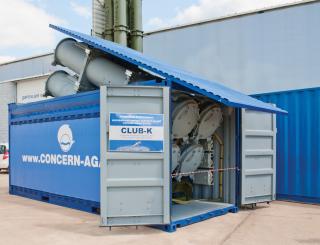
Multiple nations and even private companies are exploring the potential of this idea and have developed complete packages of containerized systems that include a variety of missiles, drones, guns, radars, towed-array sonars, and command-and-control suites. Russia has been selling the Club-K antiship missile in 20-foot equivalent (TEU) containers for more than a decade. Since then Israel, Iran, China, the United States, the Netherlands, Denmark, and numerous other nations have developed containerized missile systems. This year, the Royal Netherlands Navy began arming its auxiliaries with containerized missiles. Israel’s tests of containerized weapons in 2020 is instructive:
No modifications to the ship would be required once the weapon system is on board. In addition to offensive missiles, cargo ships could be equipped with canisterized and/or concealed anti-ship missiles and guns, as well as air- and missile-defense interceptors and sensors—making them asymmetric, concealable warships.
Containerized weapons and support equipment are multi-modal. They can be used from container ships or the decks of warships or even moved ashore. Containers can be handled by commercial equipment present in any major port, including those throughout the first and second island chains. Marine littoral regiments and Army multidomain task forces are already exercising with land-based antiship cruise missiles (ASCMs) in the Pacific. The next logical step would be to move from the specialized launchers and vehicles those services are using now to standard shipping containers and commercial trucks to make the systems interchangeable and multimodal.

Unfortunately, China’s large merchant marine fleet and tens of thousands of fishing vessels could provide the PLA Navy (PLAN) with effectively unlimited launch platforms. This makes it all the more important that the United States and regional partners cooperate. Japan, Taiwan, South Korea, Singapore, and Australia are already fielding land-based ASCMs that could easily be adapted for containerized systems. Such efforts would reinforce U.S. efforts to protect friends and partners in the East and South China Seas and beyond. 
Improved Attack and Surveillance Systems
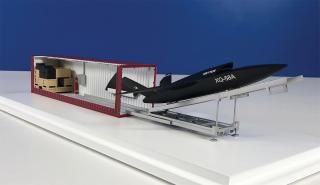
A model of a containerized Kratos XQ-58 unmanned aerial vehicle. Kratos

The range and capability of air and sea drones have increased massively in recent years. For example, conservationists have been using autonomous drones with visual and infrared sensors and very long range—up to 1,100 miles for the Flexrotor—to monitor illegal, unreported, and unregulated fishing as well as wildlife poaching.

Israel has been operating the Harpy unmanned aerial vehicle (UAV) for more than a decade. The vertical-takeoff-and-landing Harpy can autonomously navigate up to 600 miles to hunt in the visual, infrared, and electromagnetic spectrums. 
The U.S. Air Force, Navy, and Marine Corps are experimenting with the Kratos Valkyrie UAV. It has a range of 3,000 miles, a payload of 600 pounds, and a cruise speed of .72 Mach, and it is designed to be “runway independent.” Kratos has developed a version with a launcher that can fit in a standard shipping container.

Numerous countries are developing long-range autonomous surface attack boats. Ukraine’s Magura V has demonstrated lethal capability and essentially driven the Russian Navy from the Black Sea. Saronic Technologies, a U.S. firm, is building autonomous, swarming boats with a 1,000-mile range and a 1,000-pound payload. These craft are small enough that several can be loaded in a TEU container. They can be launched from a ship at sea, aircraft, and the beach. 
Inexpensive Platforms

By combining such new weapons and delivery systems with widely available and relatively inexpensive commercial ships, the Navy could create a class of “missile merchants” that would possess deep magazines, long range, and onboard intelligence, surveillance, and reconnaissance (ISR), thus addressing the number and range issues. Further, it would be easy to upgrade the capabilities of these ships. As the Navy develops newer, longer-range missiles, drones, and sensors, it could swap out the containers.

Ship costs could vary from a low of $10 million for a small container ship to $40 million for a 40,000 deadweight-ton (DWT) container ship. With missile, drone, command-and-control, life-support, and maintenance containers, such a ship could be converted into a warship with long-range precision weapons faster than designing and building a new warship. A package with 40 missiles would cost around $100 million—about $2 million for each Naval Strike Missile and $20 million for command, maintenance, and living modules and any minor ship modifications required. Most modern container ships are double hulled, making them capable of absorbing more damage than Navy surface ships such as littoral combat ships. In addition, empty containers could be filled with foam, dirt, or other energy-absorbing materials as inexpensive armor. As an added benefit, container ships generally require less maintenance than surface warships and are at sea much more frequently.

For a net acquisition cost of $130 to $145 million each, the Navy could purchase 40 or so missile merchants for about one-quarter the combined cost of a Gerald R. Ford–class aircraft carrier and its air wing—while adding 1,600 high-end missiles to the fleet.

Better still, this concept could reinforce the significant progress the Pentagon is making in seeking nontraditional defense firms to produce low-cost cruise missiles. In mid-2024, just 11 weeks after its founding, startup defense company Ares began flight testing a cheap cruise missile. It “is targeting a $300,000 unit cost for its missiles,” compared with the $3 million Long-Range Antiship Missile.

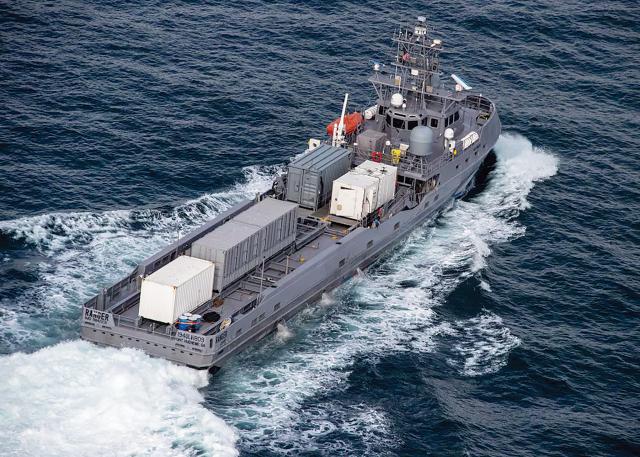
The Navy has test fired containerized SM-6 Standard Missiles from the large unmanned surface vessel Ranger. U.S. Navy (Tyler Fraser)

Smaller, cheaper ASCMs like these would mean the Navy could greatly increase the fleet’s magazine depth, fill the vertical launch systems cells of its current fleet, and potentially put hundreds of missiles on board missile merchants.

Beyond reduced up-front costs, real savings also would occur in manpower. Based on peacetime manning plus additional personnel for combat systems operation, missile merchants would require about 45 sailors. In other words: Four could be manned for the expected crew size of the future Constellation (FFG-62). Containerized launch-control modules could be assigned to Navy Reserve units that could routinely train on them during drill weekends. Those units’ annual training then could consist of operating the modules on board proof-of-concept ships—or even leased ships, if necessary. Such training could help identify the optimal mix of regulars, reservists, and merchant mariners. Wargaming and simulation also would help determine the optimal missile, attack drone, and ISR drone loadout per ship.

It would be essential that the Navy resist any bureaucratic impulse to require these ships to be retrofitted to meet Naval Sea Systems Command general specifications. Doing so would dramatically increase the cost and complexity.

A positive second-order effect of acquiring missile merchants could be to provide command opportunities for younger officers, restoring the long and successful Navy tradition of putting young officers in command. A missile merchant would be an ideal first command for a lieutenant commander. 
Getting Under Way
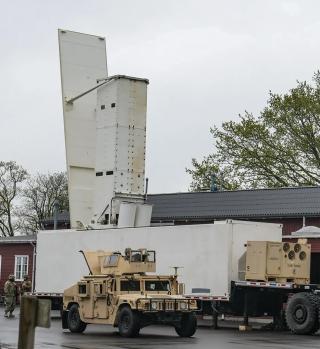
A Navy containerized missile launcher during an exercise in Bornholm, Denmark, in May 2024. U.S. Navy photo (James S. Hong)

The Navy could begin the developmental process by purchasing existing containerized weapon systems and buying or leasing two container ships—a large ship of 30,000 to 40,000 DWTs with a 2,500-container capacity and a smaller ship of perhaps 6,000 DWTs with a 150–250 container capacity. This would allow initial experiments with different operating concepts.

Some questions the Navy might consider include: Can these platforms provide deep magazines for destroyers operating outside the range of most Chinese weapons? Can commercially available, long-range drones establish ISR and communication networks to allow the ships to provide their own targeting information? Can larger drones such as the XQ-58A operate from these platforms and recover ashore at a Marine Corps expeditionary base for reuse?

Communication systems would be an integral part of the containerized weapon packages on board missile ships. The recent adoption of Starlink/Starshield by various navies and commercial fleets is demonstrating that any ship can have high bandwidth, gaining rapid access to national assets and intensive commercial satellite surveillance of the planet. With sustained communications, the embarked weapons’ long ranges would allow massed fires from dispersed platforms—supporting the Navy’s distributed maritime operations concept. But degraded or even denied communications would not render the missiles useless. Inexpensive vertical-launch-and-recovery drones such as the Flexrotor or V-Bat would give the ships organic surveillance assets, allowing them to locate and engage targets even when communication links to higher headquarters are severely degraded. With clear commander’s intent and containerized sensors, the ships would stay in the fight, increasing the uncertainty China would face if it were to initiate a conflict.

The Navy should work with innovative companies to develop rapid mobilization and production processes. It should even consider something like the Civil Reserve Aircraft Fleet, which subsidizes commercial aircraft purchases on the condition that, in times of war, those aircraft could be mobilized by the Department of Defense. A Civil Reserve Industrial Base to subsidize advanced manufacturing could provide surge capacity in a future crisis while investing in innovation immediately.

As concepts are refined, the Navy could buy as many as eight merchant ships for the price of one frigate to develop tactics and integrate these missile merchants into fleet fires. As a bonus, in peacetime, these ships could supplement Military Sealift Command, moving matĂ©riel into and around operational theaters. 
Ready and Waiting
Russia has been selling the Club-K container missile system for more than a decade. Shutterstock

One certain effect of any war between the United States and China would be a rapid and dramatic reduction in maritime trade for the duration. With proper testing and development ahead of time, the Navy could be well positioned to replace significant combat losses with idle container ships and arm them with containerized weapons and sensors. They would be able to provide rapid reinforcements—but only if the Navy starts working with manufacturers now while training Naval Reserve crews to man the mobilized ships.

Advanced Chinese antiaccess systems will limit how far forward the fleet can deploy until China’s fleet and missile arsenal are degraded. Pushing carrier strike groups too far forward could place too much blood and treasure in harm’s way without contributing to the fight. Carriers would play a vital role in winning the midocean fight for dominance but are too valuable to risk in the opening stages.

In contrast, missile merchants would be low-value platforms of the type historically put at risk in great power conflict—consider the picket ships that screened the U.S. fleet during the Battle of Okinawa. In any naval fight some ships will have to be risked but, unlike those picket ships, missile merchants would pack a considerable offensive punch while being much tougher and needing smaller crews. And, given that electromagnetic sensors could have a hard time distinguishing them from what commercial ship traffic remains at sea, they might be more likely to persist forward.

Converted merchant ships could be durable and inexpensive weapon “trucks.” Given modern containers’ interchangeability, this type of missile ship could become the most easily replaced and upgraded system in a fight.

From here.

In other, not entirely unrelated news, China has finally put into service long range, nuclear armed capable strategic bombers that can refuel in the air:

China’s military has begun deploying significant numbers of upgraded strategic nuclear bombers that are bolstering Beijing’s triad of weapons, including land-based missiles and nuclear missile submarines, according to U.S. defense officials.

The new strategic bomber is an H-6N that was recently converted to a nuclear delivery system from less-capable bombers. . . .

What sets the H-6N apart from earlier variants is that it’s the first bomber in the Chinese warplane inventory that can be refueled while in flight. “This is important because if you want to have a strategic strike capability, you have to have strategic range associated with that, and [the H-6N] is designed specifically to deliver a nuclear payload,” the official said.

The Chinese nuclear bomber force is being built along lines similar to those used by the Soviet and now Russian nuclear bomber force, the official said. The number of deployed H-6Ns is unknown as the Chinese government does not disclose the size of its nuclear forces. The Arms Control Association estimates there are about 20 H-6Ns. Other assessments from 2023 state that the total number of H-6 bombers of all variants is around 150, with a projected expansion to around 250 bombers by 2035.

The H-6N has a range of 3,728 miles and can be armed with an air-launched ballistic missile with a range of 1,864 miles for a combined nuclear strike range of 5,592 miles.

China did not use the new H-6N variant during a provocative aerial incursion near Alaska last summer. Two H-6K maritime bombers along with two Russian Tu-95 Bear nuclear-capable bombers conducted an operation in international airspace July 24, penetrating the Alaska air defense identification zone and prompting the deployment of U.S. F-35 and F-16 jets and Canadian CF-18 fighters to intercept them. It was the first time Chinese and Russian bombers operated together and highlights the potential for nuclear war fighting cooperation under the 2022 “no limits” agreement. “Both the Chinese and Russian bombers involved in the patrol were nuclear-capable, a signal that corresponds with the rapid expansion of China’s nuclear forces and persistent Russian nuclear saber-rattling,” the Center for Strategic and International Studies said in a report on the joint bomber patrol.

Both H-6 variants are based on the Soviet Tu-16 heavy bomber, dubbed the “Badger” by NATO and first flown in 1952. Analysts say the Chinese probably flew H-6Ks rather than the newer H-6N near Alaska to avoid showing off the strategic bomber to U.S. intelligence assets. . . .

The Pentagon’s annual report on the Chinese military, published in December, said the PLA enhanced the effectiveness of the H-6 despite its age. Both variants can fire long range cruise precision missiles capable of hitting ships near Chinese coasts from airfields in China, while the H-6K can carry six supersonic long-range YJ-12 anti-ship cruise missiles.

“The H-6N features a modified fuselage, enabling it to carry an air-launched ballistic missile externally that may be nuclear-capable,” the report said. . . .  A new H-20 stealth strategic bomber is on the drawing board, the report said.

22 January 2025

Some Ukraine War Updates

The images below (in part, from here) recounts the situation on the ground in Ukraine as of January 20, 2025. 


The Percentage Of Russian Casualties That Are Deaths Has Surged

The most notable information is regarding the proportion of Russian casualties which involve deaths rather than injuries from the leading third-party think tank monitoring the war. The Institute for the Study of War believes that at least 150,000 Russian soldiers have been killed in 2024 alone, which is about 35% of all estimated Russian casualties in 2024 (although its primary source for this is the Ukrainian government).

This is far in excess of my previous estimates that the percentage of Russian casualties representing soldiers killed in action is up to 10%. Prior to 2024, Ukraine has probably inflicted about 300,000 casualties upon Russia, of which perhaps 30,000-60,000 involved Russian soldiers who were actually killed, suggesting that 180,000-220,000 Russian soldiers have been killed in the Ukraine War so far (which is close to the BBC estimate), and another 500,000 or so Russian soldiers have been wounded since 2022. This is relative to about 600,000 active duty Russian ground troops (who have born the brunt of the casualties in this war) and about 300,000 active duty naval and air force troops in the entire Russian military at the start of the war in 2022, which has been expanded with mercenaries, conscripts, and ethnically Russian Ukrainian separatist rebels. 

About 300 North Korean soldiers out of about 12,000 provided by North Korea to Russia, were killed and about 2700 were wounded fighting for Russia from December 14, 2024 to January 13, 2024, a number which has no doubt grown significantly in the last 9 days.

About 64,000 Ukrainian soldiers have been killed and about 450,000 more are missing or have been wounded or captured as well, which implies that about 13% of Ukrainian military casualties are deaths, in addition to about 13,000 civilians killed and about 30,000 civilians wounded and immense property damages since the war has mostly been fought on its territory. About 10.2 million Ukrainians are refugees or have been internally displaced. In contrast, only about 400 Russian civilians have been killed in the conflict since 2022.

The total number of deaths, military and civilian, on all sides combined, in the Ukraine War since 2022 has been about 255,000 to 295,000. More people were killed, mostly in ethnically Russian insurgency in the Donbas region, in the decade or so before the Russian invasion in 2022.

This clearly cements the Ukraine War as the third most deadly deadly war in which Russia has been involved since at least the year 1900, with second place held by World War I which killed 1-2 million Russians, and first place held by World War II which killed 27 million Russians (including 8.7 million Russian soldiers). 

The number of Russian soldiers killed in the Ukraine War also exceeds the number of U.S. soldiers killed in any of its wars since it came into existence during the Revolutionary War, other than World War II (407,316 deaths and 671,278 wounds not mortal) and the U.S. Civil War (about 698,000 deaths and about 800,000 wounds not mortal).

This higher death rate for Russian soldiers may, in part, represent the more severe and numerous Russian infantry casualties produced by Ukraine's heavier use of cluster bombs. 

This may also be a product of more casualty tolerant human wave infantry advance tactics of the Russian military in the fall of 2024, which are more similar to those of World War I and the Russo-Japanese War than of more recent conflicts. These tactics have produced some territorial gains on the Eastern Ukraine front for Russia. But those gains have still been modest, incremental, and secured at a very high cost in Russian casualties. See here and here and here.

Most of Russia's territorial gains were in the first two months of the war, which was followed by a slower, but significant roll back of those gains by Ukrainian forces, then stagnation, followed by modest Russian territorial gains this fall and winter.
Russia now controls about 18% of Ukraine's territory, a gain of about one percentage point since January of 2023, two years earlier, and a small amount of Russian territory is now controlled by Ukraine.

Russia have favored these human wave dismounted infantry tactics because drone delivered bombs, anti-armor missiles, and artillery are less effective against somewhat dispersed dismounted infantry than they are again major military systems on the front lines like tanks, infantry fighting vehicles, armored personnel carriers. Drone delivered bombs and artillery aren't as effective on the front lines in Russian operations to expand territory under its control. But dismounted infantry are easier to kill with small arms. at relative close range.

Russia's territorial gains also continue to be largely confined to parts of Ukraine that were mostly or significantly ethnically and linguistically Russian before Russia's 2014 and 2022 invasions (and hasn't even captured all of that). Very little Ukrainian territory that is less than 20% ethnically Russian has been held by Russian forces, and almost of of the 7% of Ukrainian territory Russia had gained control over by 2014 was majority ethnically Russian in the year 2001.


This ethnic mismatch in Ukraine's borders wasn't a big deal when Ukraine and Russia were both under the umbrella of the Soviet Union prior to 1989 when they were drawn, but became more meaningful when the U.S.S.R. collapsed and Ukraine became an independent country that in turn developed along a more Western European leaning trajectory than Russia did.

Cannon Artillery In Ukraine

Also, while other reports have noted that drone attacks have accounted for something like 80% of the damage that Ukraine is inflicting upon Russia in this war, Ukraine has also been making heavy use of its howitzers, which account for a significant share of the remaining major Russian military systems and bases destroyed.

Ukraine is reportedly firing up to 3000 155mm artillery shells a day from NATO model howitzers and needs to replace more than 30 towed howitzer barrels per month (which are produced entirely at a single U.S. based plant than is struggling to produce that many). These barrels (a.k.a. M776 cannons) suffer more wear and tear when used at longer ranges, because more propellant is used, and when they are used more frequently. Worn barrels have reduced range and accuracy even before they fail completely.

Ukraine has received more than 200 towed M777 155mm howitzers from the U.S., and another 4 from Australia and 6 from Canada. At least 100 of these howitzers have been damages or destroyed in combat, although some of them may have been repaired and returned to service, or salvaged for parts.

Ukraine also has some Russian designed 152mm self-propelled howitzers with a maximum range of about 21 miles, and some domestically made 152mm self-propelled howitzers that are somewhat more accurate with a maximum range of about 24 miles. But these systems are apparently inferior to the 155mm howitzers used by NATO "in terms of range, precision, and rate of fire." 

Belarus

Outside the headlines, Russia has been quietly working towards total annexation of Belarus, even though it has contributed very little to Russia's military effort, after providing a staging ground for Russia in the very early days of the Ukraine War's re-ignition starting in February 24, 2024.

16 January 2025

Anti-Tank Warfare And Attrition In Ukraine

Tanks really only make sense against adversaries who don't have anti-tank weapons, and they aren't very useful as anti-tank weapons themselves. 

Heavy armored formations and mechanized units engineered for dispersed, yet “linear” attacks to penetrate and hold enemy territory are not likely disappearing anytime soon as a critical element of modern Combined Army Maneuver, yet there is little question that the warfare in Ukraine is re-defining certain key ground-war tactics in favor of lightweight, de-centralized, agile and ground-fired anti-tank weapons used by dispersed, dismounted forces and fast, light tactical vehicles. When combined with precise overhead surveillance, unmanned systems and some measure of effective networking, Ukrainians armed with shoulder-fired anti-armor weapons continue to exact a devastating toll upon Russian assault platforms.

A significant Army Intelligence Report called the “The Operational Environment 2024-2034 Large-Scale Combat Operations.” (US Army Training and Doctrine Command, G2) says that Russia’s entire active duty tank force has been destroyed in its war with Ukraine.

“Ukrainian Armed Forces have used vast quantities of man-portable air-defense systems (MANPADS), antitank guided missiles, and FPV UAS—combined with fires—to great effect. As of July 2024, Russia has lost 3,197 main battle tanks—more than its entire active-duty inventory at the outset of conflict—and 6,160 armored fighting vehicles, forcing them to pull increasingly obsolescent systems from storage,” the text of the report from 2024 states.

From Warrior Maven.

As I noted in a previous post, Russia has lost more than 2/3 of its major military systems and is on track to have lost about 3/4 of them by the third anniversary of the war on February 24, 2025. 

Ukraine has the clear advantage when it comes to replacing major military systems. The U.S. and other NATO countries are giving Ukraine large amounts of modern major military systems. Russia has only feeble domestic industrial capacity to build such systems in quantity, in contrast, and is pretty much limited to what it can buy from Iran and what North Korea will give it. China hasn't shut out Russia entirely but isn't arming it either. Ukraine's domestic war production has also been impressive. For example, it has built and used at least 1.2 million armed drones.

As many of 750,000 Russian troops (including their North Korean allies) may have died, been injured, or captured by that time, a number which already exceeds 600,000. Russia's active duty military personnel at the start of the war numbered 900,000, of which 300,000 to 500,000 were navy and air force personnel. Russian casualties equal or exceed the total number of ground forces that it had at the outset of the war.

The best estimates are that 11,000-12,000 North Korean troops have joined the fight. But multiple thousands of them are already casualties in their first few weeks in action. Apparently, North Korean troops are being used as cannon fodder in mass human wave attacks reminiscent of World War I and the Russo-Japanese War - tactics that were discredited a century ago.

Russia has the advantage when it comes to replacing casualties with new conscripts and forces like mercenaries and North Korean soldiers, because it has a much larger population than Ukraine and Ukraine's allies are not yet lending it troops. But neither combatant has any significant capacity to replace seasoned military officers who are lost in the conflict in the short term.

19 September 2024

The U.S. Approach To A Hypothetical Invasion Of Taiwan

Size comparison

The United States military is acutely aware of the possibility that the People's Republic of China on the mainland (the PRC), might try to invade and conquer Taiwan, something that the PRC has repeated threatened to do, although a military conflict with between the Philippines and the PRC in which the U.S. might become embroiled seems more likely in the short term and has resulted in more incidents of low intensity warfare in the last two or three years. I've also explained, elsewhere, why the PRC's reliance on international trade in a wide variety of goods and services to support its economy makes an invasion of Taiwan a much more costly option for it, than a globally unpopular war would be for Russia, whose international exports are dominated by oil and gas, or North Korea, which is very isolated economically from the rest of the world. Further background is available below.

Indeed, the threat of a Chinese invasion of Taiwan is the single largest rhetorical justification used by the U.S. Navy, and to a lesser but still great extent by the U.S. Marine Corps and U.S. Air Force, for U.S. military expenditures.

The U.S. Strategy

The U.S. doesn't have any major military bases in Taiwan, unlike its military bases in Japan, South Korea, Hawaii, Alaska, three U.S. territories in the Pacific, and a smaller U.S. military base in the Philippines (which was once a much larger presence), presumably, in order to formally honor its "One China" policy.

But the U.S. has sold a lot of sophisticated U.S. military equipment to Taiwan, and together with its allies, can marshal considerable naval and air forces in the region.

Basically, the plan is for the U.S., Taiwan, and its allies to direct large numbers of anti-ship missiles and when the opponents are very close, Taiwanese artillery and allied naval gun shells at invading Chinese ships and boats, deployed from land, from surface ships at sea, from every manner of aircraft from long range stealth and conventional bombers, to carrier and land based fighter aircraft (some making the trip with the help of aerial refueling), to maritime patrol aircraft, to C-130 and C-17 military transport planes carrying missile launching cargo, to long range drones, to nuclear attack submarines, with the nuclear attack submarines also launching torpedoes. It would use U.S. satellites, high altitude spy planes, surveillance drones, and U.S. signals intelligence resources to identify targets (as well as any human intelligence resources within China available to the U.S. or its allies). Containerized anti-ship missile batteries will soon make it possible for cargo ships, amphibious transport ships, and merchant ships to also carry and deliver anti-ship missiles with ranges in the hundreds of miles.

Long range bombers, maritime patrol aircraft, C-17s, and fighter aircraft that use aerial refueling tankers, can travel thousands of miles and make the trip in about 12-13 hours from Hawaii. The trip from based in Japan or South Korea or Guam or American Samoa or the Northern Marina Islands would be shorter. Surface ships and submarines not already in the area can take several weeks to arrive, rendering them almost irrelevant in a fast developing naval battle, without a great deal of advance warning from satellites and other intelligence that she China mobilizing.

The aircraft and ships and ground batteries firing anti-ship missiles don't have to get particularly close. The aircraft can stay at high altitudes. Even the shortest range fighter and helicopter carried anti-ship missiles have a range of 18-20 miles. Most have ranges from 100 to 600 miles, and the aircraft can get just within range and turn around if the risk of air defenses is great. Modern torpedoes have a range of about 24 miles, although a longer range provides a target a greater opportunity to evade it.

The U.S. and its allies could deposit of small force of mostly light ground troops in the lead up to an invasion and during an invasion, but for the most part, Taiwan would have to rely on its own troops and reserves, and pre-placed equipment for its ground forces, to repel any Chinese troops that managed to cross the Taiwan strait by sea or by air.

The mission of Taiwan and its allies is easier. It need only destroy or mitigate the harm from incoming ships, aircraft, drones, missiles, and naval gun shells (the Taiwan strait is too wide for cannon artillery or all but the longest range artillery missiles on the mainland to cross) with a mix of anti-ship and anti-aircraft weapons. They don't need to board ships of the People's Liberation Army Navy (PLAN), and don't have to deliver troops or their equipment in an amphibious invasion. PLAN submarines are effective ways to deny access to the ships of Taiwan and its allies and merchant ships bound to Taiwan, but most are fairly short range coastal submarines that have almost no effectiveness against the aircraft of Taiwan and its allies, and pose only a manageable threat to surface warships of Taiwan and its allies that are not in the Taiwan strait or too close to the island of Formosa.

A carrier with F-35C fighter aircraft, for example, need only be close enough for its fighters to fly to the edge of their 700 (non-nautical) mile combat radius which in turn must be within 150 to 700 (non-nautical) miles of the target of their anti-ship missiles. So, the carrier can strike a ship in the Taiwan strait that is 850-1400 miles away from its, for example, from the vicinity of the Northern Marina Islands, or Tokyo, or South Korea, or the southern most islands of the Philippines. 

A carrier group at that distance would also have a decent chance of intercepting long range missiles bound towards it from mainland China, and the range of these anti-ship missiles is greater than all but the most potent anti-aircraft missiles in China's arsenal and would have to be timed to strike the aircraft delivering the missiles only just as the aircraft is about to launch its air to ground missiles or is just returning from doing so. And, of course, if an F-35 is hit by a Chinese anti-air missile, only one pilots life, at most, is lost, and there is a decent chance that the pilot could eject and be recovered by a search and rescue team. The number of Chinese ground troops killed every time a Chinese warship or worse yet, a Chinese troop carrying ship, is sunk, would be profoundly greater.

Certainly, Chinese troops that do manage to reach the Taiwanese shore by sea, or by helicopter or transport plane or as paratroops, as elite soldiers in an massive all volunteer military of professional Chinese soldiers are, on average, going to be better trained and more skilled soldiers, than Taiwanese ground troops at the vanguard of a massive but not terribly ready or elite reserve force. But the Taiwanese troops know their territory, have the support of the locals, have been training for this mission and this mission only, are fighting to protect their homes, and will locally outnumber the modest number of Chinese troops that manage to cross the strait at least at first, if the efforts to Taiwan and its allies to destroy incoming troop carrying ships and transport aircraft is reasonably successful.

Also, in an era of Chinese demographics where one child families are the norm, even in this nation of 1.4 billion people, the lives of young men serving as soldiers in the PRC's military are no longer cheap and expendable. And, China has not fought any actual hot conflict in which its any significant number of its soldiers and sailors have lost their lives in the living memory of the vast share of the Chinese people. They haven't had much of a chance to come to see these losses as a necessary price to meet its geopolitical objectives, which it has mostly achieved with trade, aid, and diplomacy.

For all of China's bluster, one can seriously doubt whether China really has the stomach to lose the lives of hundreds of thousands of young men, most of its navy, a substantial share of its air force, and many of its coastal military resources, when it can already extract much of what it wants Taiwan for economically as opposed to culturally or politically, through trade. 

China has nuclear weapons, but those too are less potent of a threat in a Taiwan invasion. Using on nuclear weapon on the island of Formosa pretty much defeats the purpose of conquering it and would make it an international pariah. But missile defenses are effective enough that ICBMs aimed to the U.S. or its allies might be completely or almost completely thwarted, with any successes threatening massive nuclear retaliation against it.

The Historical And Geopolitical Context And Background

The island of Formosa is about 100 miles from mainland China across the Taiwan Strait. 

A typical naval warship can make the trip in about four hours, a very fast one might make it in two or three hours. A helicopter or slower drone could make it in forty-five minutes or less. A subsonic missile or fighter jet or military transport plane can make the trip in ten to fifteen minutes. A supersonic jet fighter can make the trip in five minutes. A hypersonic missile can make the trip in less than two minutes.

The PRC claims the island of Formosa upon which Taiwan is situated is a rebel province which is part of its territory, along with the strait between Formosa and the mainland, despite the fact that the regime has never had any control or authority on the island, and the fact that no mainland Chinese regime has had any control or authority on the island since 1895. The modern Chinese state dates only to the revolution in China in 1911.

Meanwhile, Taiwan, even more laughably, claims to be the legitimate government in exile of mainland China, a territory it lost any remnant of authority or control over from its inception when its regime retreated there after losing the civil war in China that persisted from the end of World War II in 1945 which left a power vacuum there, until the victory of the Maoists and defeat of the Nationalists in 1949, 75 years ago. The Kuomintang party abandoned its claim to be the sole government of mainland China in 1991 in the same year that it ended "emergency rule".

Imperial China ruled the island of Formosa from 1662 when it ousted the Dutch and large numbers of people from mainland China migrated there, until 1895 when the island was conquered by the Japanese Empire. The Japanese ruled it for half a century until the end of World War II in 1945. 


After World War II, there was a civil war in China between the Maoist Communists and the Chinese Nationalist Party led by Chiang Kai-shek. The non-communist Chinese Nationalist Party eventually lost that civil war and relocated to the island of Formosa in a mass migration of its remaining loyalist in 1949 (the same year that the Maoist PRC regimes was declared by Chairman Mao), filling the post-World War II power vacuum caused by the collapse of Imperial Japan's rule there. The following year, in 1950, now 74 years ago, the PRC conquered Tibet.

Chiang Kai-shek ruled Taiwan as a de facto dictator for twenty-six years until 1975, with U.S. backing against expansion of the Communist PRC as part of the Cold War, running the economy on a capitalist model.

The PRC claimed the island as its territory, even though no mainland Chinese government had ruled there since early 1895, and in 1971, after three-quarters of a century in mainland China had no control or authority there, and despite the fact that the PRC regime had never had control or authority there, in 1971, the U.N. recognized the PRC's claim to the island and expelled Taiwan from the U.N. The PRC terminated its diplomatic relationship with Taiwan in 1978. Today, following the U.N.'s lead, only 13 countries, including the U.S., have formal diplomatic ties with Taiwan. The PRC and Taiwan had their first formal talks with each other again in 2014, thirty-six years after breaking off diplomatic relations but have not reestablished diplomatic ties. Per the BBC link below:

Today, only 12 countries (plus the Vatican) officially recognise Taiwan. The US decision to switch diplomatic recognition from Taipei to Beijing in 1979 was the turning point. And a richer, more powerful China exerts pressure so more countries do not recognise Taiwan or lend it support. But America remains the island's strongest ally, sells arms to it and has vowed to help in case of a Chinese attack.

The U.S., however, continued to be a strong ally to Taiwan and its military guaranteed its independence from the PRC, and under its influence, Taiwan eventually reformed itself, carrying out land reform to address the feudal era inequalities that led to the Maoist revolution on the mainland, instituting universal public education, modernizing its agricultural and industrial economies, and finally, step by step becoming a democracy. Martial law was lifted in 1987 after 38 years. Four years later in 1991, four decades of "emergency rule" was ended. And, five years after that in 1996, Taiwan had its first direct Presidential election, which the Kuomintang party, the successor to the original Chinese Nationalist Party that had controlled Taiwan for forty-seven years since 1949, won. 

The uncontested rule of Chiang Kai-shek's dominant Kuomintang party finally ended in the year 2000, when the leader of the pro-independence Democratic Progressive Party won the Presidential election, only for the Kuomintang party to regain the Presidency from 2006 to 2016, when the Democratic Progressive Party regained the Presidency, in part, over concerns that the Kuomintang party was to friendly with China and might jeopardize Taiwan's independence. The Democratic Progressive Party still holds the Presidency today. China has gradually stepped up its saber rattling towards Taiwan since the Kuomintang Party lost the Presidency in 2016.

Taiwan is now a first world country with a high standard of living in an advanced stage of demographic transition of 23.6 million people (compared to about 1,400 million people in the PRC which is about 59 times a large). Taiwan's economy is best known for its advance computer chip manufacturing which is the global state of the art. Indeed, according to the BBC, "By one measure, a single Taiwanese company - the Taiwan Semiconductor Manufacturing Company or TSMC - has over half of the world's market."

Despite a lack of formal diplomatic relations, 21% of Taiwan's imports are from the PRC and 26% of its exports are to the PRC.

About 70% of the Taiwanese people are Han Chinese, another 25% or so are from another Southern mainland Chinese ethnicity, about 2-3% of the Taiwanese people are indigenous Formosans who speak sixteen different languages once of which is the ancestral language of the Austronesian family of languages spoken from Easter Island and Oceania, to Southeast Asia, to Madagascar, with a small percentage of people of other ancestries. Mandarin Chinese, and two other Chinese topolects (one of which has several dialects) are the predominant languages of Taiwan. But even Chinese languages like Mandarin which are present in both Taiwan and the mainland have developed distinct Taiwanese accents that are perhaps as distinct from their mainland counterparts as American and Canadian English dialects, in their spoken versions, in the non-logographic written versions of them, and in subtleties of meaning and pronunciation of their shared Chinese characters. 

Over the last thirty years or so, however, the people of Taiwan have increasingly come to identify themselves as Taiwanese, or as both Taiwanese and Chinese. About two-thirds identify as Taiwanese only. Almost a third identify as both, and only one or two percent now identify only as Chinese.


Taiwan's religious makeup reflects the pre-Maoist religious mix of China, with 42% adhering to Chinese folk religion (a close cousin of Japanese Shinto practice), 27% identifying primarily as Buddhist, 13% identifying as Daoist, 7% identifying with East Asian "new religions", 6% as Christian, and the remainder as non-religious agnostics, although these religious movements are not nearly so mutually exclusive as Western religious denominations and sects.

Taiwan controls a territory of about 13,900 square miles, while the PRC controls about 3.7 million square miles, which is about 2660 times as large.

Critically, the PRC of today is not the PRC of 1949. While the PRC doesn't adhere fully to the extreme version of capitalism found in the United States and has high levels of state involvement in the economy, its record economic growth for many decades has been made possible only through market based economic reforms, soft recognition of property and contract rights, and sufficient openness towards ideas from the world outside of China to allow it to gain the scientific and technological knowledge necessary for it to rapidly catch up to the developed world. 

The assimilation of Hong Kong into China has meant even more growing pains for both sides. 

China is still astoundingly authoritarian, but it is also not the raw, unpredictable cauldron of violence that it experienced in the 1970s during the Cultural Revolution. 

Despite being nominally communist, China has its fair share of billionaires and there is a great deal of overlap between its political elites and its economic elites. In other words, China's rules are also among the very wealthiest people in the entire country, which makes a return to an extremely leveling brand of communism that eats the rich unlike to recur there, even if it is quite a dangerous thing to be a billionaire or centi-millionaire in China that can lead to your untimely demise in a usually not officially acknowledged manner if the cross the wrong people or offend the sensibilities of leaders in the Chinese Communist Party.

So far, China has liberalized economically in a gradual manner, rather than all at once as the Soviet Union did in what turned out to be a chaotic and sudden mess that transformed the country from Soviet style communism or crony capitalism run by oligarchs in less than a quarter of a century, with intense societal and governmental pain along the way. This lesson schools Chinese Communist Party leaders to be cautious in their reforms, and had discouraged a relaxation of its authoritarian political model. 

But the expectations of continuous fast economic growth that they have developed for themselves puts pressure on them to adopt policies that work to continue that as much as possible and at some point, China's authoritarian rule will have to be relaxed to sustain that, particularly as China starts to have to rely on new innovations of its own, rather than copying proven global economic and technological models to achieve new economic growth. Also, non-economic freedom is, to some extent, one of the luxuries that people in economically prosperous societies crave and desire. The more affluent the Chinese people become, the more they are going to be willing to face significant personal risk and sacrifice and economic resources to escape authoritarian rule. And, there are enough wealthy Chinese people who have traveled abroad to less authoritarian counties, or who have access to less censored international media, that they can know that it is possible to leave in a freer and more democratic world (and the people of Hong Kong have demonstrated that this can work even for ethnically and culturally Chinese people), that it is an enjoyable and desirable intangible luxury to have, and that there are ways of achieving and sustaining it that they can learn and copy as they did less political foreign technologies. It isn't clear how smooth or rocky the path to that end will be, and in the near term, transitioning from China level authoritarianism to Singapore level authoritarianism, or something like it, may be an intermediate step. But it is hard to see a trajectory in which China becomes more insular and authoritarian, rather than less so, in over the next several decades.

This is all to say, then, that it an invasion of Taiwan can be discouraged for a sufficiently long period of time, that eventually mainland China may eventually catch up with Taiwan (which has only enjoyed more or less full democracy and social freedoms for thirty years or so itself), at which point a merger of the PRC and Taiwan might not be so problematic anymore.

Military Capabilities

Taiwan is quite militarized, with 169 thousand active duty military personnel, 1,657 thousand reserve troops, and a defense budget of $16.2 billion. But this is dwarfed by the PRC's 2,035 thousand active duty military personnel, 650 thousand reserve troops, and $242.4 billion USD defense budget. Taiwan has 26 surface warships of frigate class or larger and 4 military submarines and many smaller naval and coast guard vessels. China has 92 surface warships of frigate class or larger and 59 military submarines and many smaller naval and coast guard vessels and is expanding its fleet rapidly. Taiwan's air force has 405 jet fighters. China has more than 1,628 jet fighters. Taiwan has 650 tanks. China has 4,800 tanks.


Most of the information above is drawn from a BBC background piece and the 2024 World Almanac (hard copy).

Unlike the United States and Russia, which have large "blue sea Navies", China's ships rarely venture more than 400 miles from its Pacific Coast (although China has deployed as many as a dozen naval ships to suppress pirates in the Indian Ocean right up to the Persian Gulf and Red Sea, and has an ample merchant and fishing fleet that is sometimes pressed into paramilitary service), and Taiwan's navy stays even closer to home.