Showing posts with label attorneys. Show all posts

22 March 2026

Reflections On Six Months As A City Attorney

Six months and a week ago, I started a new job as a senior assistant city attorney at the City ad County of Denver in the civil litigation section. We handle lawsuits brought against the City and County of Denver, and against City employees where the lawsuit arises from the employee's official duties.

The job

Most people who work in my section have backgrounds either in criminal case litigation, or in private sector insurance defense of personal injury cases. I was one of the fairly uncommon applicants who had significant prior experience in civil litigation with government entities. One of my main responsibilities at my first job in Colorado, in Grand Junction, was defending county governments all over Western Colorado from lawsuits, which is more or less exactly what I do now defending the City and County of Denver. In my subsequent private private of law, I had a low volume, but steady trickle of cases where I represented private parties in lawsuits against the government, in addition to having broad civil litigation experience making up about half of my practice in a variety of other areas in both state courts and federal courts. This has allowed me to hit the ground running, compared to many of my peers.

Fortunately, our office operates with a very high level of professionalism, and my co-workers are good to work for.

My current case load (which varies from lawyer to lawyer in my section based upon the lawyer's experience and aptitudes) is about 60% civil rights litigation (mostly, but not entirely, involving actions of the police and jail guards), about 20% plain vanilla personal injury litigation like motor vehicle accidents that is similar to what private insurance defense lawyers do but with a governmental liability twist, and about 20% litigating subpoenas and public record requests where there are disputes that go beyond what can be resolved by records custodians out of court.

Different sections of the City attorney's office handle employee discipline and employment related litigation, enforcement of ordinance violations, child protective proceedings in cases where there are allegations of abuse and neglect, and transactional/corporate counsel type work for matters like negotiating and monitoring compliance with contracts between the City and its vendors, drafting ordinances, lobbying the state and federal governments, and managing conflicts that arise between different city agencies and officials.

There are also some governmental agencies which many people think are part of the City and County of Denver, but which are not: the Denver Public Schools, the Denver District Attorney, Denver Health (the county's public hospital), the Denver Housing Authority, the Regional Transportation District (RTD), the Downtown Development Authority, the Denver District Court, the Denver Probate Court, the Denver Juvenile Court, and probably a few others that I've failed to mention. 

The Denver County Court is a unique hybrid court that combined the roles of the limited jurisdiction state government's county court found in other Colorado counties, and the role of a municipal court for the City and County of Denver where municipal ordinance violations are prosecuted.

The biggest change for me has been transitioning from being self-employed for two decades to being a salaried W-2 employee. 

Mostly, this is for the better and was an important reason to take this job. Instead of having to invoice clients and pester them to pay their bills, or to wait until contingent fee cases are converted into money at the end of a case, money just magically appears in by bank account without me even asking for every two weeks. I get paid vacations and sick days! I get my health insurance through an employer plan, a switch I made shortly before big cuts to Affordable Care Act subsidies for self-employed people seeking health insurance took effect. If I continue to work for the City for five years, I get a defined benefit pension. I have a public sector defined contribution plan to which I can contribute about 20% of my income. I can pay for my parking expenses with pre-tax dollars. I don't have to pay anything out of pocket to get IT support. My tax returns will get a lot less complicated starting in 2027 (I had some residual self-employment work and income wrapping up my private practice in early 2026). I don't have to deal with fixing broken copying machines, building maintenance, hiring employees, tax withholding for employees, office security, arranging telephone and internet service, balancing an attorney's trust account, and so on. I don't have to spend large chunks of time marketing and deciding which clients to sign up. My work is mostly (not 100%) confined to 9-5 on business days.

I also get to work in a place with good systems in place, with adequate administrative support, with competent fellow attorneys who can cover for you while you are sick or on vacation, and top quality legal research and office related software packages.

We still have to pay close attention to potential conflicts of interest in new cases (and conflicts of interest that can emerge during cases), so we can send conflicted cases to outside counsel. But, unlike my fairly brief stint in a multi-state law firm with about a thousand lawyers, I don't have to spend half an hour to forty-five minutes every day (like every single other lawyer in that entire law firm) screening new cases brought into the firm for conflicts of interest.

Best of all, except for particular phases of the small share of cases where there is a prospect of receiving an attorneys' fee award, I don't have to track every tenth of an hour of every single working day, since all of the work we do is for the same client and is very unlikely to be the subject of attorneys' fee litigation.

Insights into law and policy and legal practice

Most people, most of the time, are outsiders to government, sometimes spinning conspiratorial narratives about what they think happens behind the scenes in the criminal justice system, and in government more generally. In my subpoena and records request practice, and in civil rights cases, I'm on the opposite side of the fence, with more or less complete access to the full "behind the scenes" story.

I almost always know more about what actually happened, sometimes legally relevant and sometimes not, than the other lawyers in the case and that the judge. It is a rare case where I don't know more or less exactly what happened in all legally relevant ways within a month or two of receiving it, and often within a couple of weeks.

I have nearly full access to all relevant records and a full ability to interview the government employees involved in a context where they are more quickly forthcoming about what I want to know, than in the formal discovery process.

The truth isn't nearly as nefarious as conspiracy theorists and a plurality of civil rights lawyers would have you believe.

This isn't to say that law enforcement officers or jail guards never make mistakes that hurt someone, sometimes in ways that give rise to legal liability, and sometimes in ways that don't.

A significant portion of my job is facilitating the payment of reasonable settlements to people who have been legitimately wronged by the government or government officials. Sometimes a city employee is clearly at fault in a motor vehicle accident. Sometimes a law enforcement officer does cross the line and is in the wrong. The City pays out millions of dollars a year in settlements and judgments as a result.

Most settlement payments err on the side of being generous, in order to avoid the risk that a jury won't correctly evaluate liability and damages in a case and will award an excessive amount. 

A significant minority of jury awards reach the wrong result on liability or damages (sometimes for the government and sometimes against it), often (as post-verdict juror interviews reveal) for reasons that shouldn't be legally relevant or reflect misunderstandings that neither side's lawyers even contemplated were possible. Most of the time, juries reach verdicts that are close to being right, but not all of the time by any means (even when the lawyers and judges are doing their jobs correctly).

My rule of thumb (based upon the available academic literature on the topic, and confirmed by my personal experience) is that in a best case scenario where the lawyers and judges in a case are doing their jobs right and the law dictates a clear answer, is that the likelihood that a jury will reach the wrong conclusion is about 10%. 

The odds that the jury will reach the wrong conclusion rockets up, of course, when one or the other side's lawyers engaged in misconduct, or the judge makes a significant mistake (not always appealable), or there is litigation misconduct by a party in the case such as destroying or fabricating evidence or lying under oath (often not known to the lawyers). The most common problems, however, are lawyer incompetence or a bad ruling from a trial judge or sincere but incorrect witness memories about what happened, and not outright litigation misconduct.

Some kinds of suspicions about what is happening behind the scenes are more often correct than others. For example, I know (from having access to what is in them in cases where I move to quash subpoenas) that the vast majority of internal affairs files sought by defense attorneys in criminal cases that are withheld from them, truly aren't material to the outcome of those cases, even at the margins on credibility issues. The kind of conduct that law enforcement agencies, and governments more generally, care about for purposes of internal employee discipline, are only vaguely similar to the kinds of conduct that give rise to legal liability, or would be relevant in a criminal case in which an officer was involved in some way and is a potential witness.

Timelines

Different kinds of cases have different timelines. Records request cases and subpoenas are typically litigated over a period a week to a few months. Ordinary personal injury cases in which a defendant just happens to be a governmental entity, tend to be fairly simple cases that are resolved in a year or two once a case if filed, and are often settled sooner than that. 

Civil rights cases, and personal injury cases which are really civil rights cases in disguise, take one of two typical courses. Many of them are resolved very early on in initial dispositive motion practice and are often dismissed within a few months to a year with complete dismissals on the merits (or for failure to prosecute by a pro se party, i.e. a Plaintiff bringing suit without a lawyer). The civil rights cases that aren't resolved that way can take much longer, in part because they are often prosecuted in federal court which is much slower than state court, in part because interlocutory appeals (i.e. appeals brought prior to a final trial and verdict) are common in civil rights cases, and in part because these cases are sometimes more complex and require lengthy pre-trial discovery and motion practice. I have one case that will probably go to trial soon about eight years after the underlying incident (that involved a handful of people over the course of less than two hours in one place)  took place.

If everyone knew what I know as a governmental defense attorney know within two or three months of a case being filed, these cases could be resolved in six months and would be resolved more accurately than they are in jury trials. But, of course, part of the reason that I can secure this information so quickly is because the people from whom I receive the information know that what they share with me won't be used against them in court. Still, this observation does suggest that there is plenty of room for improvement in the process.

Also, a lot of the delay in civil litigation is a function of simply not having enough judges to keep their case loads small enough to allow them to make prompt rulings, and an overall litigation system that has adapted to that reality.

The quality of plaintiff's litigation

Another thing that my job gives me is a broad overview of the quality of the legal work done by the people who sue the City.

About half the lawsuits brought against the City are brought by pro se parties, or by lawyers whose legal work falls below the standard of care that should be expected from a reasonable competent lawyer. 

Indeed, the best pro se parties (maybe the top 5-10% of them) are doing a better job of litigating their cases than the worst lawyers that we see (although no pro se parties do an excellent job). There are a few lawyers in the Plaintiff's bar who are so incompetent that I am amazed that they passed the bar exam, although even they have basic literacy and some understanding of the process. But there are plenty of pro se parties whose literacy and understanding of the process is below that of an average high school student, who would benefit from representation by even an only marginally competent lawyer.

One of the better arguments for a "civil Gideon" system in which indigent people would routinely be provided access to lawyers by the state, the way that indigent criminal defends are, is that it would make the delays and confusions caused by incompetent pro se litigants largely go away making the whole legal system work much more efficiently.

Cases brought by incompetent litigants overwhelming get dismissed early on, or settled for amounts far less than a competent lawyer could secure.

Incompetent litigants tend to be particularly weak at investigating a case and gathering facts to support it, and in understanding at a more than superficial level the relevant substantive and procedural legal requirements for proving a case of governmental liability. Now and then, they do the right thing despite themselves, however.

Of course, part of the failure rate among these litigants is an inability to accurately judge if they have a legally meritorious case. I have definitely seen cases that were winnable or could have secured a larger settlement, that don't because they are brought by incompetent litigants. But probably 80%-90% of the cases brought by incompetent litigants wouldn't have been brought at all by competent lawyers, who could have identified the weakness in those cases at the outset and not filed suit. 

When I was in private practice, I probably turned away two or three potential clients a week, often potential clients who had heart wrenching stories of misfortune. But those potential clients either didn't have cases for which the legal system had a remedy, or had cases where the likely outcome of  their cases with competent legal representation would provide them with less economic benefit than the cost of competent legal representation, and would have greatly disrupted their personal lives and eaten up huge amounts of their personal time.

And, by the way, incompetence by lawyers isn't restricted to sole practitioners with little experience. I've seen multiple cases of grossly incompetent litigation from medium to large plaintiff's law firms (some of which are household names due to their advertising or due to prominent cases that they have litigated) by lawyers with significant experience.

This isn't to say that all litigants against the City are incompetent. About half of lawsuits against the City are brought by lawyers whose work is at least up to the standard of a reasonable competent lawyer, and a minority but good share of litigants against the city are represented by lawyers whose work represents the best practices in this work, are highly competent, and have screened potential clients in such a manner that they have chosen to represent plaintiffs with meritorious cases.

At least one case that I have handled so far involved a plaintiff who was represented by two successive incompetent lawyers, only to have the case pass to a third, highly competent lawyer that salvaged the case with some smart litigation decisions and was able to secure a settlement much higher than what the previous incompetent lawyers came close to reaching.

Sadly, there is very little that a person thinking about bringing a lawsuit can do to determine if their lawyer is litigating competently or not. That's why we have a bar exam in an attempt to impose at least some minimum standards, but this gatekeeping isn't perfect.

Admission to the bar allows you as a lawyer to handle almost any kind of case (patent law is an exception, and some states set a higher standard to determine if a lawyer is allowed to represent defendants in death penalty cases), subject only to their own self-determination about their competence.

But while being admitted to the bar usually means that a lawyer meets basic standards of literacy and can find their way to the courthouse, with a vague understanding of how the process works, the vast majority of lawyers (I'm an extreme outlier in this regard), have a far more specialized legal practice and predominantly handle a fairly narrow kind of legal work.

Probably a majority of lawyers don't litigate any civil or criminal cases on a regular basis, and instead do transactional work, legal compliance work, or provide counsel to senior corporate officials in their day to day activities.

It is rare for a lawyer to represent both plaintiffs and defendants in personal injury work. It is rare for divorce lawyers or real estate lawyers to handle personal injury or civil rights cases. It is rare for commercial litigators to litigate personal injury cases. It is rare for probate lawyers to do personal injury or civil rights litigation. It happens. I'm an example of that. But it is rare.

Unlike physicians, whose regulators have imposed both a general threshold professional qualification to become an M.D., and an additional professional qualification to practice in a particular medical specialty, the legal profession has almost no secondary level of professional qualification to practice in a particular legal specialty, like personal injury litigation, or civil rights litigation.

Most specialist legal practitioners do develop special expertise in the area where they practice, from working as a junior lawyer in a firm that has that kind of practice, from taking continuing legal education classes in that field, from researching the law and procedure in their own cases, and from the school of hard knocks. But it isn't systemic or uniform among specialist legal practitioners who often have significant gaps in their knowledge of the best practices for handling cases in their specialty.

This can be a particular problem in civil rights litigation where the law is more complicated than in many other areas of law, and where firm sizes tend to be small, so that many practitioners have never worked as junior lawyers under seasoned senior civil rights lawyers to learn the ropes. A fair number of lawyers with this kind of practice went to law school because of, and are driven by, a strong commitment to social justice, but couldn't find an employer in a field relevant to their objectives out of law school. So, they never received the kind of mentorship that they needed to become competent in their field as a result and are prone to making big picture conceptual mistakes and to bad legal judgment that hasn't been honed by more seasoned practitioners.

16 May 2025

Team Death

In the "they didn't teach us this in law school" department:

One of the things my job requires on a regular basis is talking with clients about death and grievous disabilities and injuries. This is something that makes most people uncomfortable and is very unfamiliar for people who aren't "Team Death" professionals (a group that includes estate planning and probate lawyers, funeral home directors, cemetery officials, clergy, grief counselors, hospice nurses, corners, bank trust department officers, life insurance sales people, financial planners, actuaries, Social Security bureaucrats, many florists, many kinds of doctors, and many CPAs).

It takes many years to find ways to do that which communicates to people what they need to hear and understand, without being too socially uncomfortable. Ordinary etiquette discourages discussing these possibilities at all. It can be depressing and many of us superstitiously just don't want to "tempt fate."

It is almost a whole philosophy and way of thinking, starting with recognizing that death will eventually happen to everyone, that most people experience serious disabilities and injuries at some point in their lives, and that life frequently presents people with surprising tragedies and unexpected triumphs of survival. Someone who seems fine and healthy today can die tomorrow, while someone who seemed to have only a few months to live can sometimes hold on for another decade or more.

24 July 2024

IQ, College, Engineering, Law, And National Merit Scholarships

College

Students who are below a 22 on the ACT composite, a 1073 on the new SAT composite, a 1610 on the older SAT composite, are not in the top 35% of his high school class (in a high school that is representative of the general population), or have below a B+ GPA, have a significantly impaired, low chance of graduating with a four year degree. 

This cutoff is not very sensitive to the selectivity or to the type of institution attended.

The threshold for any ordinary college program corresponds to an IQ of about 110 on a 15-point standard deviation scale or 111 on a 16-point standard deviation scale which is about the 75th percentile of the general population (a higher percentage because the general population includes high school dropouts who aren't included in SAT and ACT percentiles).

But a strong work ethic and grit can make it possible for you to graduate despite a lower IQ in many majors.  

Certain programs (e.g. some STEM programs such as math, physics and engineering), however, have a higher effective minimum threshold for a student to have a reasonable chance of graduating. Basically 0% of people who earn such a degree have an IQ of under 111 (and the threshold to have a better than 50-50 likelihood of graduating is an IQ of 119). Unlike some undergrad majors, engineering has a strong threshold effect.

Under 15-point standard deviation WAIS IQ scaling standard, an IQ of 100 is average for the population as a whole, an IQ of 105 is average for a high school graduate, and an IQ of 115 is average for a college graduate. So, an effective cutoff IQ of about 110 for a reasonable likelihood of graduating from college, fits with the concept that one must be discernibly better than average high school student to be likely to graduate from a college or university with a four year degree.

The Bar Exam

Maximal test prep can increase an LSAT score by about 3 point in the 120-180 range of the test. The maximum impact on other standardized tests scores is similar (but there is more room to improve in math than verbal on the SAT).

An IQ of 100 is roughly an LSAT score of 133, and almost no one who gets below 145 on the LSAT has any realistic chance of passing the bar exam. The bar exam is highly correlated with IQ test results. It takes an IQ of about 117 to pass the bar exam eventually after multiple tries, and the average IQ of a lawyer who passes the bar exam is about 133. (Medical school is much more selective.)

The patent bar is even harder to pass with a low IQ because to be a lawyer admitted to the bar and be a patent lawyer at the same time, you need an engineering BA (there are exceptions but similarly rigorous ones). 

National Merit Scholarships

About 2300 National Merit Scholarships were awarded in the year 2010. It turns out that just 10 elite universities accounted for well over half of these awardees. 

Number of NMS in entering class / size of entering class.

Caltech 42 / 200
Harvard 266 / 1600
Yale 234 / 1300
Princeton 196 / 1300
Stanford 110 / 1600
MIT 110 / 1000
Brown 91 / 1500
Duke 105 / 1600
Penn 125 / 2000
Berkeley 91 / 6000

Total 1270

31 May 2023

ChatGPT Confabulates

It's citations form is perfect. It's sentences are grammatical and support your argument. But, often ChatGPT just makes stuff up, as it did in a recent case where a lawyer was caught using a ChatGPT generated brief that had six made up cases.

15 May 2023

What Do Colorado Attorneys Do?

It is helpful now and then to examine the relative importance of different kinds of practices that lawyers in Colorado engage in to understand the "typical" kinds of legal practices out there. 


From the 2022 Annual Report of Colorado's Office of Attorney Regulation Counsel.

A very large share of all criminal litigation in the state, which makes up a large share of all court business, is conducted by lawyers who work in a DA's office (15% of government lawyers) or a public defender's office (13% of government lawyers), of whom there are about 1,355 combined out of about 29,000 active lawyers in the state (about 5%).

A few criminal cases are handled by the state attorney-general's office (with 430 attorneys), and some ordinance violation cases are handled by city attorneys (357 attorneys, mostly part-time), and county attorneys (242 attorneys, many part-time in smaller counties), but the lion's share of the criminal case work is done by the DA's office and the public defender's office. There are some criminal defendants who are represented by private criminal defense attorneys, but these defendants are definitely a minority of all criminal defendants.

A very large share of all jury trials in the state are in criminal cases, which are mostly handled by a tiny percentage of all lawyers in the state. As noted here:
For example, in 2006 in Colorado, in state courts there were 1,776 criminal or quasi-criminal jury trials (plus about 35 quasi-criminal parental rights termination jury trials). . . . In federal court, there were 22 criminal jury trials. . . . 

As of 2006, there were 337 civil jury trials, about 240 of which were in tort cases (the vast majority of which involve personal injuries in accidents), and about 97 of which were in other matters: 

There were just 17 limited jurisdiction civil trials in state court. . . . About 54% of civil trials in federal court (43 jury trials and 36 bench trials) and 50% civil trials in general jurisdiction state courts were to juries (277 jury trials and 280 bench trials), with about 75% [of civil jury trials] in tort cases)[.]

Of course, the vast majority of litigated case of all types are resolved without trials, either by a default judgment, in motion practice, by settlement, or by a guilty plea.

21 April 2023

Crime And City Living

A thirty-four year old man was killed yesterday a couple of blocks from my daughter's home in a recently designated historic neighborhood that is walking distance from Denver's downtown Auraria campus. 

This is the second murder within a stone's throw of her home since she moved in. Like the last one, it was swiftly solved, but a quick arrest doesn't bring the dead back, or erase the unease the murders leave behind.

This burglar and murderer who was already wanted on outstanding warrants was caught with the latest technology - a traffic camera feed and iPhone tracking, as well as more old school gumshoe work, and the weapon used, a metal bar, was also old school. He was caught to the victim's house keys in hand.

The previous murder in the neighborhood involved two girls, probably with gang connections, who were fighting downtown and reconvened to the park. A bystander who tried to intervene was shot and killed by one of the girl's boyfriends.

Crime, serious and petty, is a reality of daily life in a major city.

There have been three shootings near East High School, which is almost exactly half a mile from my office.

A couple of years ago, a man went on a murder spree that started about four blocks from my office, killed a passing acquaintance of my wife on South Broadway in the middle, shortly before its end resulted in the death of a clerk at a hotel where I'd met a friend from out of town a few months earlier.

A few months before that, some drunks drove their car into a light pole in the alley behind my office and took out power to the entire block for a day. They were arrested on the spot barely conscious in the car.

I was having breakfast at a fairly nice restaurant a couple blocks from my office, maybe a year ago, when a schizophrenic homeless man barged in and started trying to wreck havoc, knocking things to the floor, before a couple employees and a patron in an elegantly executed maneuver managed to remove him from the premises and send him on his way.

It barely even counts as crime, but I routine drive by one to three homeless encampments going to or from work, or on errands elsewhere around town.

The most serious incident my family has personally experienced was a few years ago when I was robbed by two men at gunpoint in front of my home who then fled in a beat up late model car. I stayed cool and cooperated with them, and it honestly wasn't even a lasting PSTD class trauma.  I called the police ands they came, but no one was caught and there wasn't much of an investigation.

They took my laptop, my cell phone, and my wallet. In the end, it was inconvenient, but not life altering. Almost all of the files on my laptop were backed up in the cloud and a quick call from my wife's phone to my assistant made it possible for him to adopt new passwords that made it impossible for any of the data to be accessed even if someone could breach the password to the laptop itself. He also quickly alerted my credit card companies to the theft and no unauthorized charges were made. It took a couple of weeks to replace my ID and credit cards which was particularly inconvenient because I had to be on a trip for which I needed not just an ID for airport security, for which I could use my passport at home, but a driver's license to rent a car. I'd also had about $100 in cash and an unfilled pharmacy prescription in my wallet. The cash was a total loss, but I managed to find the prescription, wrapped around a couple of discarded meth prescriptions in a public trash can a couple of blocks away, the next day. The monetary loss was sufficiently marginal that I didn't make an insurance claim. While they weren't caught for this mid-level felony, I'm sure that within a few years that the perpetrators ended up in prison for something, OD'd, or killed.

Other incidents of crime were far more mild. A locked bicycle was stolen off of our front porch. A stroller we were no longer using was stolen from our garage when the garage door was left open once. My car parked on the street has been broken into several times with a handful of items of trivial value like spare change, a pocket knife, a disposable lighter, and a bottle of ibuprofen were stolen although my musical tastes were sufficiently unfashionable that they didn't steal my CDs.

I've had a couple of instances of authorized credit card charges. One was a set of recurring false charges probably at a gas station I used to frequent when I worked in Wheat Ridge that I didn't even notice until I started working in the Denver Tech Center on the other side of town but kept seeing charges from a gas station I no longer used. The other was a string of expensive appliances purchased from big box home supply stores in Houston, Texas while I was several states away and knew no one there. Both were reversed without much trouble when I called attention to them and the problem didn't recur.

Beyond that it's been nothing more serious than littering and dogs pooping on my lawn without the owner picking it up, and near misses with cars violating traffic laws from cutting me off on the highway or a roundabout when they were supposed to yield, to nearly being hit by someone running a red light, to honking my horn at someone driving the wrong way on a one way street towards me.

My partner in my law firm, who also lived just a few blocks away from me, experienced a couple of home burglaries.

Still, it's survivable.

In the practice of law itself, it isn't usually quite so personal. 

Mostly, I routinely dealt with cases of major fraud and embezzlement. Economically, these cases, often involving hundreds of thousands to many millions of dollars of losses, have been the most serious. But white collar crime simply isn't as traumatic of violent and physical blue collar crime.

I have, however, worked on a couple of wrongful death cases involving homicides (which honestly are easier on the stomach than negligence based personal injury cases because you don't have to delve into the gory medical details of the horrific injuries). There have also been several cases involving the multiple legal facets that can flow from sexual assaults involving people who know each other, domestic violence, and child abuse, from restraining orders to custody to claims for money damages.

There have also been a number of cases of more mundane thefts from probate estates, the most notable of which involved a widow whose late husband had rented heavy construction equipment that his employees misappropriated a dozen of after his death. 

Finally, there have been a few cases of on the job potential threats of violence from people connected to cases we are involved in, the most notable of which happened in Grand Junction, Colorado, where I had to deal with a stalker ex-husband who had followed his wife and our of our attorneys back to our offices after a hearing, while the client, the attorney, and rest of the employees of the office fled out the back door to hide until the police arrived. The attorney involved, a former domestic relations magistrate, took the risk very seriously because she and her law clerk had been shot outside the Mesa County Courthouse by a disgruntled husband in a divorce case after a hearing.

30 March 2023

Common Misconceptions About Law

This is a list of common misconceptions people have about the law (to be clear, every statement below is false):

Sources of Law

* The law is mostly the same everywhere.

* The law is the mostly the same everywhere in the U.S.

* Legal terms almost always mean exactly one thing no matter where they are used.

* The law mostly fits a criminal law paradigm of statutes that prohibit you from doing something and impose a punishment if you do that.

* The constitution tells you everything you need to know about the law.

* Only the U.S. Supreme Court has jurisdiction to decide the constitutionality of something.

* Usually, a determination that something is unconstitutional involves finding that a treaty, statute, ordinance, or regulation is unconstitutional.

* The law is mostly contained in statutes.

* It is rarely necessary to look at case law or regulations to determine the meaning of a statute.

* The "common law" is the same in every state.

* Only one state or country's law applies to a business operating on the Internet. In a variant of this, the most important way to determine which law applies to a business on the Internet is where its servers are physically located.

* The law is static and has changed only a little over time.

* Modern U.S. law is very similar to modern English law.

* The Declaration of Independence creates enforceable U.S. law.

* The U.N. Universal Declaration of Human Rights creates enforceable U.S. law.

* International law consists mostly of legal rules that can be litigated in international courts producing judgments that matter.

Judges

* Judges are heavily influenced by their personal feelings about litigants and their personal relationships to litigants and are strongly biased against particular people.

* Judges can do whatever they want and the person who wins is mostly determined not by what the law says but by which side has the best lawyers which is mostly a function of much each side spends on their lawyers.

* Family court judges are intentionally or ideologically biased against men.

* Judges are basically umpires with no independent ability to interpret the law in different ways.

* A judge's political philosophy and judicial ideology have no impact on how a judge rules in a case.

* Judicial decisions are purely a matter of legislating from the bench.

* Judge are being dishonest when they utilize "legal fictions."

Dishonesty

* Criminal defense lawyers are bad people who unethically try to make it possible for people guilty of serious crimes to avoid responsibility for their actions by being acquitted at trial of all of the charges against them.

* It is unethical to represent someone you as a lawyer know is guilty or liable for wrongdoing.

* Pleading not guilty in a criminal case when you are guilty is perjury.

* Lawyers are allowed to lie.

* Prosecutors are routinely punished when a court determines that they withheld exculpatory evidence from a criminal defendant in a case.

* Negotiated compromises are dishonest.

* Cops are legally required to tell the truth to criminal suspects.

* Cops almost always tell the truth in court.

* Cops are routinely punished by their employers or a court when a court finds that they violated a criminal suspect's constitutional rights.

* Perjury in court is frequently prosecuted criminally.

* People are more likely to tell the truth when they are under oath or are making a statement under penalty of perjury.

* You can make an evidentiary objection to testimony presented in court on the grounds that the person giving the testimony is lying.

Certainty

* The law mostly involves general principles that can be stated at a high level of generality and logically applied to any new situation.

* If you know the facts of a case with perfect certainty you can know the legal consequences of those facts with certainty. Conceiving of the law as rules rather than standards.

* The law has a clear answer to every hypothetical situation one can imagine.

* Legal questions that don't have clear answers are rare.

* Traffic laws clearly establish that one person is at fault and another person is not at fault in a car accident most of the time.

* Jury trials are highly accurate at reaching outcomes consistent with the true facts and the law.

Arbitration

* Arbitrators have to follow the law based upon the facts presented to them the way that judges do.

* Arbitration awards can be reviewed on the merits in an appeal.

* Arbitration is usually less expensive than going to court.

* Arbitration is usually much faster than going to court.

* Arbitrators are not more biased in favor of one side over the other than judges are.

* You can only be compelled to arbitrate a dispute if you sign a contract agreeing to arbitrate the dispute.

* Only contract disputes are subject to arbitration.

Criminal Justice

* Criminal cases can be filed only if the victim files a complaint with a law enforcement officer.

* People who are released from prison after having their convictions overturned are automatically entitled to substantial compensation.

* People who are acquitted in criminal cases usually receive compensation for their legal fees and the disruption that their lives experienced.

* The police and prosecutors have an enforceable legal obligation to prevent, investigate, and prosecute crimes committed against you, if they can.

* People who commit crimes other than murder are usually caught and punished for their crimes.

* When a criminal law is repealed, people incarcerated for violating that law are routinely released from prison.

* The fact that a witness recants testimony provided in a criminal trial that gave rise to a criminal conviction makes it highly likely that the person convicted will have their conviction vacated and be released from prison.

* Prosecutors routinely cooperate in having wrongful convictions which they secured overturned.

Finality

* Mistaken findings of fact made in a trial can usually be corrected in an appeal.

* Mistakes made in hearings and trials can usually be corrected later, and information provided in hearings and trials can usually be supplemented after the fact. 

The Value Of Legal Training

* Lawyers are mostly charging people for the written documents that they produce.

* Any reasonably literate person can quickly learn what they need to know to effectively act as their own lawyer with a modest amount of self-study on the Internet.

* Doing legal work yourself saves money while also giving rise to few risks.

* Non-lawyers can learn to be competent judges with tens of hours to a couple hundred hours of training.

* When you have a dispute with someone, you can have a lawyer write the person you have a dispute with a letter for a minimal fee or no legal fee and the other person is likely to concede that you are right and cooperate.

* People who win legal disputes usually have their attorney fees awarded to them in the United States.

* A large share of losing lawsuits fit the law's description of a legally frivolous, groundless, or vexatious lawsuit.

The Effectiveness Of The Law And Justice

* The law is self-executing.

* People rarely get away with breaking the law.

* People almost always conform the behavior they would have taken otherwise to what the law requires. The law powerfully influences everyday behavior.

* The law almost always produces fair outcomes, unless someone incompetently makes a mistake in applying it.

* Every wrong has a legal remedy.

* All violations of constitutional rights and obligations have a legal remedy.

* There is always someone who is legally liable for the harm caused by an accident.

Contracts

* Economic pressure is enough to make a contract involuntary and invalidate it.

* Statements made by someone involved in a circumstance that gives rise to a legal case that aren't corroborated in writing aren't "proof."

* Contracts are never binding unless they are in writing.

* Contracts are only binding if you have read them and understood their terms.

Miscellaneous Other Specific Legal Issues

* Obligations to a child depend on the nature of the events that led to the child's conception and the relationship between the parents.

* Children must always take the surname of their father.

* In the United States, illegitimate children can't inherit from their fathers.

* You can't be an intellectual property infringer if you don't make a profit and give credit to the source of the work.

* Bank deposits are basically currency in a safe waiting for you to need to use it.

* Debts for fraud and other willful misconduct are automatically non-dischargeable in bankruptcy without any need for the creditor to take legal action to establish the nature of the debt in the bankruptcy case.

* Non-citizens don't have legal rights.

* The doctrine of "corporate personhood" usually hurts the average person in a legal dispute with a big business.

* People who engage in criminal conduct or civil wrongs in the course of their employment by a corporation are immune from liability for their actions.

* The U.S. Constitution, the Second Amendment to the U.S. Constitution, and the Declaration of Independence create a legal right to overthrow an unjust government.

* Texas has a right to secede from the United States.

04 August 2022

Don't Solve For The Equilibrium

One of the classic catch phrases of both economics and physics is "solve for the equilibrium". It is easier, mathematically and simpler, in  principle, to solve a problem with formulas in which everything has to balance out, than it is to solve a problem and predict a result where everything is out of equilibrium.

But, in the 21st century, we are in a context in which most questions worth asking in the social sciences involves circumstances that are further from an equilibrium state than at almost any other time in human history.

Technology, the fundamentals and system self-interactions that drive economics, the climate, the ecological balance of nature, parenting, dating, marriage, gender, racial identities, the way the political system works, military realities, and more are in intense flux.

Only a handful of political regimes anywhere in the world are more than five generations old. The first powered fixed wing aircraft flew four generations ago in 1903, commercial aircraft entered wide use about a generation later, and two generations later a man had walked on the Moon. Internal combustion engine vehicles fueled with refined petroleum became predominant by 1908 and will probably be a minority of vehicles on the road by 130 years later - the vast majority of non-transportation uses of petroleum have already largely been phased out (except heavy heating oil in a few regions, electricity generation in Hawaii and Alaska, lubricants, plastics, and fertilizers). General Relativity and quantum mechanics are less than four generations old, and when they were invented, Armies still had horse cavalry. Most of the national boundaries in the Middle East were drawn shortly after World War II. 

Jews started to return to Israel in the 1920s, after by tradition, about 1850 years in the diaspora, and the State of Israel came into being in 1948. Hebrew was an exclusively a liturgical language and a language used by religious scholars from about 200 CE to 1880 CE, was spoken by a community of about 34,000 people during World War I, and did not start to become a widespread living first language until the 1920s in the British Mandate in Palestine and first became a national language in 1948, about two generations after it started to be revived, when Israel became an independent state (at which point about 80% of Jews spoke it as a first language, and 15% spoke it as a second language).

The home that I live in was built less than a hundred years ago, in 1925 with coal fired steam heat boiler made popular by then recent global Spanish flu pandemic, had a door in the kitchen wall to receive ice deliveries, had a garage sized for a Model T, had galvanized steel pipes, didn't have electricity until it was added in later renovations, and was in a neighborhood that got its start as a streetcar suburb of Denver called "South Denver" before it was annexed by the City of Denver. Coal is now used predominantly to generate electricity in large power plants, in which it has a rapidly decreasing market share, and for "coke" in the steel production process.

Soviet style communism lasted less than 75 years in Europe, where it no longer exists. Many countries in East Asia and Southeast Asia still have nominally communist political systems (none of which are yet 75 years old), but their economies have adopted so many market economy reforms that their economies aren't really communist anymore. These nominally communist regimes are still authoritarian one-party states, but collective ownership of the means of production, and distribution of the fruits of production according to need, is a Marxist pipe dream that Asian regimes that are nominally communist have largely abandoned.

Around the time that my parents were born, the Great Depression wasn't over yet, the airship industry was collapsing, most of Africa and Asia was governed by European colonial powers, the Communists were just an upstart political party in China, and the Soviet Union was alive and well. My in-laws were born during World War II and experienced the Korean War in ways that put their lives at risk. The farm my father grew up on used a horse for farm labor when he was a child. The entire nuclear dimension of military affairs came into being at a time when my parents could read about it in the newspaper, as did the political regimes in Europe, Asia, and Africa. 

When my parents started high school, Latin was a mandatory subject for every college bound high school student and public schools in the South were still segregated by race as a matter of law. All Roman Catholics in the world conducted their church services in Latin at a time when my parents had both finished their undergraduate educations. My parents were first generation college students who earned PhDs. Co-ed dorms didn't exist when my parents were in college. At the time my father served in the Army, it was just in the process of desegregating. 

Long term mortgages and employment based health insurance were first widely used in my parent's lifetimes. My father-in-law was one of the first doctors to use radiology machines more sophisticated than X-Rays and his parents were first generation Christians. 

Over the course of my parents lives, the Republican party went from being a liberal leaning Northern party to a conservative party of the South and rural America. At my father's first job as a professor in Atlanta, Georgia, many of his students had spent at least some of their school years in segregated schools, and some of their African-American friends had first been able to vote in a Presidential election just four years before they arrived in Georgia as a consequence of the Voting Rights Act of 1965. 

My father was on the committee that organized the first Earth Day. My parents were peers of Elvis Presley and disliked the Beatles and pretty much all other kinds of rock musics, well into their 30s, when rock music started to become predominant. Big band music, more than one sub-genres of jazz music, rock music, and the music of "crooners", like Frank Sinatra featured on the Lawrence Welk show on TV, all came into being during their lifetimes before I was born.

Most of the hydroelectric, geothermal, and nuclear power plants in the world were built during my parents lifetimes before I was born, or when I was a child. The vast majority of the wind, solar, tidal power and natural gas fueled power plants powering the electrical grid in the world has come online in my lifetime, and a majority of the wind, solar and tidal power powering the electrical grid in the world has been added during my children's lifetimes.

Polio afflicted tens of thousands of people a year in the United States until after my parents were finished with college; there were ten cases of polio that originated in the United States in the first decade of my life, and there has only been one case of polio from any source in the United States in the last twenty-nine years, which was this year. The concept of autoimmune diseases as a coherently class of ailments was developed after my parents had graduated from college (and after my aunt was first diagnosed with M.S. an autoimmune disease whose true cause has only been ascertained in the last few years).

When I was born, most cars ran on leaded gasoline, most physics and engineering calculations were still done with slide rules, computers took up whole rooms, the primary method of putting information into a computer was a punchcard, formulas in physics journal articles were written by hand, and many rural areas were still served by "party line" telephone service. Early computers (in my lifetime) with the power of my cell phone would have taken the same amount of electricity to operate as a skyscraper. Computer processor power and memory has increased exponentially, and has seen power consumption decrease exponentially, for my entire life. The core components of the Standard Model of Particle Physics were invented in my lifetime. "No fault" divorce, legal recognition for LGBT rights, females making up more than low single digit percentages of lawyers and doctors and professors, the modern concept of attention deficit disorder, the generalized concept of post-traumatic stress disorder, widespread use of statins to control cholesterol, widespread use of student loans for higher education, and the modern environmental movement all came into existence, for all practical purposes, in my lifetime. Obesity rates for both children and adults in the U.S. have roughly tripled from their long term historical norms to current levels during my lifetime. 

The first time I met someone who was openly gay was in college, which is also the first time that I used the Internet, and the first time I'd encountered Muslims face to face, and the first time I'd eaten tofu. The Soviet Union ceased to exist when I was in college. Crime rates hit all time highs around the time that I was in college and have since declined to half century lows. Divorce rates which were once low across the board soared to record highs during my lifetime, then experienced a class divide with divorce rates for college educated couples plummeting and divorce rates for couples without any college educations reaching levels never before seen that continue to rise checked only by couples not bothering to get married when living together and having children at all.

MTV came and went in my lifetime, as did disco, New Wave, eight track tapes, cassette tapes, videodisks, compact disks (CDs), DVDs, and analog broadcast television. Broadcast satellite TV and radio came into wide commercial use in my lifetime and I doubt that either will still be in wide commercial use when I die. Rap and Hip hop were invented in my lifetime and remain vibrant. The proportion of Americans who identify as non-religious has increased by a factor of ten in my lifetime. 

Commercial supersonic aircraft came into being and then ceased to exist in my lifetime, and will renter the market again in a few years.

"Smart bombs", guided missiles, stealth aircraft, and unmanned military drones all entered regular military use in my lifetime.  Amphibious assaults, air to air combat between fighter aircraft in "dog fights", ship to ship battles, submarine to ship battles, ship to submarine battles, and the use of nuclear weapons in war, have become vanishingly rare or non-existent in my lifetime.

The death penalty in the United States was abolished nationally, and then reinstated on a much more restricted basis, in my lifetime. Abortion was first constitutionally protected after my brother and I were born, and has now been denied constitutional protection in my lifetime. Marital rape was criminalized, and domestic violence  and acquaintance rape first began to be taken very seriously by the criminal law in my lifetime, and gay sex between consenting adults was legalized by becoming constitutionally protected in the United States in my lifetime. Serious drunk driving penalties and major reductions in tobacco use both arose in my lifetime.

At my first job as a summer law clerk with a law firm, lawyers were not allowed to use computers or typewriters, we had to dictate everything that we didn't write longhand, leaving typing for a large and almost entirely female corps of secretaries who knew how to use typewriters and early word processors (even though the youngest lawyer in the firm and the law clerks knew how to do so themselves). Legal research, including checking cases to make sure that they had not been overruled or narrowed by subsequent cases, was done almost entirely with dead tree books, because computerized legal research while it existed, was very expensive per minute or per search. At the end of each day, a recent high school graduate would rush to hand deliver all of the firm's court filings to the local court clerk before the office closed at five p.m., and to mail copies of those documents before five p.m. at the local post office that this courier had spent all afternoon photocopying to every party of record in the case and the court with an extra copy to be pinned down with metal clamps in a hard copy paper pleadings file. Lawyers needed to finish their dictations and final handwritten revisions to court documents by three or four o'clock in the afternoon, to allow time for them to be typed by the secretaries, photocopied, delivered to the court clerk, and mailed, before the hard five o'clock deadlines for doing so. All court hearings were held in person.

Now those jobs are gone. All lawyers except men in their sixties or older type their own first drafts of court documents subject to only light editing and proofreading by staff (younger lawyers do their own advanced typesetting as well, while older ones rely on secretaries or paralegals for these formatting tasks), after personally researching cases and statutes online, and then they either personally, or with one paralegal serving several lawyers, e-file the documents to the court and to all other parties in the case by midnight deadlines, often without the final draft ever being printed or manually signed or filed. The client gets an email copy and often there is no paper pleadings file in a case at all. Many non-evidentiary court hearings like status conferences and pre-trial conferences are conducted remotely, as are many mediation sessions (something that also was rare back then, but now is required in almost every case).

Back in the day, many court documents needed to be notarized, in person, with a red ink stamp with a raised embossed seal. Now, the documents that used to be notarized are just signed by the client or witness in pen under penalty of perjury, scanned, and emailed to the lawyer for filing. 

As a result, modern law firms are profoundly more top heavy than they used to be in most kinds of law practices, and lawyers no longer work "banker's hours."

Mass produced electric cars were reinvented in my children's lifetime. I have never owned a car that wasn't made by a Japanese or Korean car company since my children were born. We haven't had broadcast television service at any time in my children's lives. We ended our cable TV service before they started middle school. We discontinued our landline telephone service before my children were in high school. My wife was pregnant with my oldest child when the Euro came into being and about a dozen European national currencies ceased to exist. My children were alive when cryptocurrencies came into being and when same sex marriages were legalized. The Department of Homeland Security, the TSA, the "no fly list", security checkpoints with shoe removal, and limits on carrying liquids arose after my oldest child was born. The U.S. has been a party to low intensity "small" wars for essentially all of my children's lifetimes. The privately enforceable constitutional right to bear arms was first recognized in my children's lifetimes. Lockdown drills at school, in response to numerous mass school shootings, have replaced in my children's generation the duck and cover drills of the Cold War era.

My children don't really remember ever living without the Internet or cell phones. Some of my children's high school textbooks were delivered on electronic tablets and they had homework assignments in high school that included typing mathematical formulas using LaTex computer typesetting. COVID, of course, arose during my children's lifetime. We are still a couple of years away from the U.S. getting its first truly high speed rail line, long after they have become common in Europe and China.

This recitation of historical events reminiscent of Billy Joel's song, "We Didn't Start The Fire" and a few subsequent imitations of its structure, may be a bit excessive and familiar. But, in this post, my real point is that everyone alive today, and our parents, and our grandparents, and even a generation or two beyond them, have never known a time when science, technology, economics, international affairs, culture, and law weren't in periods of breakneck change. 

Austrian-born economist Joseph Schumpeter, who is most famous for his Marxist inspired characterization of dynamic capitalist economies in the long run as a process of "creative destruction", particularly in his 1942 book Capitalism, Socialism and Democracy, was one of my favorite economists in college. This was because he had a realistic description and astute understanding of the essential features of the big picture of the workings of modern capitalism, when other economists so frequently seemed to lose sight of the forest for the trees attempting to devise simple, theory driven mathematical models of the economy.

It is easy to fall into the trap of thinking about the present as if this is the way that the world has always been and always will be, and one of the most important lessons I learned as a history minor in college was just how untrue that assumption was over far shorter time frames than I ever would have guessed otherwise.

But, solving for an equilibrium in the social sciences that can't be reached in the very short term of a fewer minutes to a few decades, at most, is irrelevant and often counterproductive. 

Change, and not equilibrium, has been the long standing norm for all of living history and all of the oral history and recollections of the vast majority of living people alive today. 

Forcing yourself to almost always consider dynamic models in the social sciences and in predicting the future of technology, is far harder and far less certain than trying to solve for an equilibrium predicted by your theories based upon the present. But, at least doing so avoids the near certainty that any attempt to solve for the equilibrium for any significant period of time will be wrong.

18 July 2022

Colorado Moves Forward On Independent Domestic Relations Paralegals

The Colorado Supreme Court in a newsletter today states that: 

Licensed Legal Paraprofessional Proposal Open for Public Comment 
The Colorado Supreme Court has published for public comment the implementation plan to license legal paraprofessionals (“LLPs”) for a limited practice of law in the area of domestic relations. The 26-page plan outlines how interested paraprofessionals who meet educational and experiential requirements could become licensed for this limited practice of law by taking and passing designated family law and ethics exams and clearing character and fitness requirements.

The scope of practice would include marital dissolution and allocation of parental responsibility cases when the client meets certain income or asset criteria associated with less complicated matters. Under the current proposal, LLPs would be allowed to accompany their clients to court, and could respond to factual questions if requested by the court, but would not be allowed to orally advocate for their clients or to conduct hearings or trials.

The Court is inviting public comment on the entire proposal, and specifically the issues of what asset or income criteria are appropriate limits for LLP representation of clients. A working group has proposed that the LLPs would be allowed to serve only clients in marital dissolution cases with a net marital estate of $200,000 or less. The same working group proposed that an income cap be set for representing a client in an allocation of parental responsibility matter, which could be a dollar threshold or a percentage of federal poverty guidelines. Cases involving more assets or income tend to correlate with more complex issues for which a lawyer’s education and expertise may be needed.

Utah, Washington, and Arizona now have licensed legal paralegal or legal technician programs covering certain types of family law matters, among other matters. These jurisdictions have reported that many if not most of these licensed non-lawyers practice in firms with lawyers, but may be more affordable to modest-means clients. A number of other states are either considering or piloting similar programs.

To review the implementation plan and the various proposed rule and statutory changes, and for instructions on how to provide public comments, go to the Court’s proposed rule change website and review the information under “PALS implementation report and plan.” The deadline for public comments is September 14, 2022 at 4 p.m.

The Colorado Bar Association is hosting a virtual “town hall” where speakers from the working group will provide more information and answer questions about the implementation plan. That event is August 9, 2022, from 12-1 p.m. The CBA will post the link to participate at its website. The event is open to both members and non-members of the CBA, and is open to non-lawyers.

Additional information and updates about the LLP program can be found here.

I was on the Colorado Bar Association committee that started work on the proposal many years ago, but left when the CBA came down strongly against the development. In a rare move, however, the Colorado Supreme Court pushed to move forward despite CBA opposition.

25 March 2022

Learning To "Don't Bargain Against Yourself" And Some Long Run Reflections

Well Prepared For Academia, Less Well For Law

Until I graduated from law school (a year and a half early, because I finished college in three years and law school in two and a half years), I lived my entire life ensconced in academia, and continued to have close ties to it for another five years or so after finish law school.

This was great preparation for being a professor, and I was an associate professor in the graduate degree program at the "for profit" College for Financial Planning (a sister college of the University of Phoenix), for fifteen months and would have happily continued doing so indefinitely, before I was laid off on a last hired, first fired basis, because the College wasn't meeting its profit targets (I did have a low volume moonlighting solo practice of law in that time period as well). 

I've published three subject matter articles in state bar magazines and presented two papers at academic conferences for law professors.

I taught thirty-three continuing education course for lawyers and paralegals in the last twenty years on a variety of subjects. Some of those classes have been as short as an hour, but many have been all day affairs including one recent class where I prepared materials to support five hours straight of lectures which I delivered, in part, because one of my two co-presenters had to drop out of teaching the all day class. 

I read perhaps a dozen or two academic journal articles a week (although, to be honest, I only carefully read one to three of them cover to cover in detail and really analyze them) 

I discuss what I read and answer questions from people at my two blogs, and sometimes more summarily, in a Facebook post, or in online discussion forums like Stack Exchange, Physics Forums, or other people's blogs. 

I have the third highest reputation out of more than thirty-three thousand contributors at Law Stack Exchange (which is probably the leading and most authoritative English language legal discussion forum open to the general public in the world) and the ninth highest reputation out of more than thirty-four thousand contributors at Politics Stack Exchange. I am in the top 6% by reputation at Physics Stack Exchange (something usually reserved for physics graduate students, high school physics teachers, and physics professors), and I am a well regarded "Gold" contributor to the Physics Forums. 

I have also shared my studies by making about fifteen hundred edits to dozens of Wikipedia articles, mostly about law, physics, and historical linguistics, but also about a variety of other subjects. I am a principal or original author of several Wikipedia articles, including, for example, an article in the area of angelology, some popular culture entries, some biographical entries, a few legal terms and concepts, and a few physics concepts. I have also written many articles at the left leaning dKosopedia including most of their coverage of military, water, and agricultural issues. 

My academic training and hands on college experiences were also good preparation for the work that I did for a year and a half as a part-time professional journalist covering a law and politics beat, writing a couple of articles or so every week for an online magazine. I had been a radio news reporter in college, and after moving to Denver, I had been a regular guest contributor to a call-in talk radio show about business and finance for a couple of years.

My writings have been cited in a variety of published academic journal articles on subject including taxation, law, politics, and linguistics, and are included in the Lexus-Nexus database. One of my articles on military affairs was made part of the course materials at a class at the British military's war college. I've even won a Westword "Best of Denver" award for my blog writing, where I have made more than ten thousand posts since 2005.

But this background and these experiences provided me with none of social capital or context I would have to develop for the work I've in a mixed transactional and civil litigation law practice, working mostly with closely held businesses and affluent individuals clients, that I've had for what will be, as of this summer, the past twenty-seven years. This, I had to learn as I went, and most of my peers were ahead of me in this regard when I was in law school.

How I Got Here

My father was a professor. I grew up in a small college town (Oxford, Ohio). My mother, when she returned to the workforce after my brother and I were old enough, was a university administrator and earned a PhD while working in that capacity (she earned a master's degree before I was born). While I was in junior high school, I read many of my mother's graduate school textbooks in educational leadership. I read articles in the Chronicle of Higher Education from the time I was in junior high school until I left for college and also when I was home from college on breaks. I took half my classes in my senior year at the local university rather than my high school. A large share of my peers growing up were likewise the children of university employees.

After I left the college town where I grew up, I spent my undergraduate years in another small college town (Oberlin, Ohio), and then went to law school (I started classes less than twenty-four hours after I graduated from Oberlin) in a big college town (Ann Arbor, Michigan).

Growing up, my family had a small law firm lawyer who lived just down the street, who assisted my parents in estate planning, probate, and real estate matters, and represented my brother in a personal injury case after he was hit by a car while crossing the street about a hundred feet away from our lawyer's home. But I had never interacted with him professionally, and really had no idea what the daily life of a real lawyer was like.

At my first summer job in law school, I was a research assistant for a government commission that one of my law professors served upon. At my next summer job, I was a summer law clerk in a medium sized law firm, but that peon level attorney job mostly involved writing legal research memorandums. 

After graduating from my top ten law school (cum laude in the top quarter of my class with several awards and experience as a senior editor on one of the secondary law reviews at our law school), I did document review as a law clerk while I was studying for the bar exam for an attorney in downtown Buffalo, New York, mostly on the Love Canal superfund site insurance coverage litigation. Litigation related to Love Canal started in earnest in 1978 and was still going strong seventeen years later in 1995 when I was working on it, trying to get useful information from discovery materials kept in 1980s era litigation support databases. 

After passing the bar exam (using only about half the allocated time to complete it and then leaving early after each testing session, with a multi-state bar exam score in the top 1% of law school graduates and a perfect professional ethics exam score), I worked two more weeks for that attorney as an actual lawyer doing essentially the same week and got myself admitted to the federal court bar as well as the New York State bar to which I'd already been admitted, but then was laid off when he lost what had been his dominant client for the past decade (85% of his billings) in a corporate merger of his client with another whose existing legal team won the work.

At that point, I spent about nine months in solo practice in Buffalo, New York, It wasn't terribly profitable because I didn't have a big volume of work, but the work that I did do was quite sophisticated. I handled the sale of a small business and its related real estate. I did the transactional legal work for a multi-million dollar floor plan financing for a car dealership for a private investor. I handled a couple of copyright matters. I dealt with an international custody dispute. I wrote some wills and trusts. I absolutely learned many things about both substantive law and the practice of law in the process, but I didn't have any mentors or attorney peers, and I had no context for the world of law and business from my life experience. Instead, I relied more or less entirely on my law school and bar exam studies and self-study. I also looked for jobs as a lawyer working for others. 

But even then, I was still closely connected to academia, because my wife was in graduate school at SUNY-Buffalo studying for her master's degree. We discussed the classes she was taking and her experiences teaching sections of women's studies classes. I provided administrative support (like transcribing interviews, since I was a good typist, and proofreading) in connection with her master's thesis (which incidentally has now been cited by published academic journal articles numerous times).

Eventually, now twenty-five years old and married, I ended up in a medium sized law firm (eleven or twelve lawyers) in Grand Junction, Colorado that was more than a hundred years old and was one of the two largest law firms in Western Colorado. 

Even then, I was close to academia. My wife moved to join me as soon as she finished her master's degree, spent a year as an English composition instructor at Mesa State College (it has subsequently changed its name), and the balance of our time there as a college administrator in their admissions office, also handling issues for foreign exchange students studying there from abroad.

I would end up working at this Grand Junction law for three years, before moving to new job where I was hired laterally by a small law firm in Denver. We moved because we were about to have children (our actual move took place about two months before our first child was born), and some racist incidents at the time there made it clear that Grand Junction, Colorado was not a safe or nurturing place to raise a multi-racial family. 

But I learned valuable lessons there. It was the most well established and most well run law firm I have ever worked for as a lawyer, before or after that job. It had good systems in place, appropriate staffing levels filled with employees who were more competent than average and had been working as a team for a long time, and a savvy and seasoned group of attorneys who worked well together.

The mentoring that I received there from the partners in the law firm is where I first really learned about the aspects of law that aren't taught in law school and aren't easily learned from books, like conducting negotiations, taking depositions, preparing for trials, conducting client meetings, coordinating with other lawyers and staff, and preparing adequate time entries. I also learned about the way business and financial and estate planning deals are customarily done, and the larger business and financial and social context involved in being a lawyer.

About Negotiations

One of the first, nearly iron-clad laws of negotiations that all other lawyers seemed to already know and understand, was "don't negotiate against yourself."

In other words, in a negotiation, once you have made an offer, you don't make another less favorable offer while you are waiting for the other party or parties in the negotiation to accept your offer or make a counteroffer. If they reject your offer without making a counteroffer, then a deal doesn't happen at all, in a transactional matter, and you try to win the case with motion practice or by going to trial, in litigation.

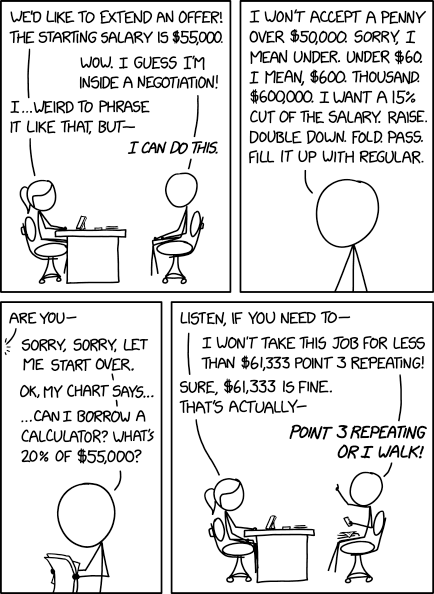
The most recent comic from xkcd, entitled "Salary Negotiation" illustrates nicely, although to the point of absurdity, why this is a good idea:

Mouseover text: "We can do 0.33 or 0.34 but our payroll software doesn't allow us to--" "NO DEAL."

Salary negotiation itself, is quite a salient issue right now in our family. 

My son recently negotiated his summer job employment terms, my daughter just negotiated the terms of her second full time, permanent "real job" (with a 40% pay increase from her current position), her significant other just secured a raise at his first post-college "real job" and support for a professional development program that will put him on track for further advancement in his career, and I negotiated an 80% increase in the rate I am paid when working in an "Of Counsel" capacity two or three years ago after it had been stagnant for seven or eight years. 

My wife left the work force when the pandemic hit because her industry of doing promotional modeling and serving as a brand ambassador basically ceased to exist overnight, and our household suddenly doubled in size, with the extra stresses of having everyone working and studying from home and basic grocery supplies becoming challenging to get for a while. But prior to that, working as an independent contractor, she would engage in a dozen or so new job negotiations every year.