Showing posts with label Colorado. Show all posts

02 September 2025

Moving Space Force HQ From Colorado To Alabama Is Stupid

Trump is about to renew his efforts to move the headquarters of the Space Force, a fifth military service that he created, from Colorado (where the headquarters of the part of the Air Force bureaucracy that was transferred to the separate Space Force service was located before he created the Space Force), to Alabama. He tried to do so during his first term, but the moved got bogged down in Department of Defense red tape, and the Department of Defense reversed that decision during the Biden Administration. 

UPDATE:

President Trump said one of the main considerations for moving Space Command out of Colorado Springs is because Colorado voters largely vote by mail. 
“I will say I want to thank Colorado,” Trump said. “The problem I have with Colorado… they do mail-in voting, they went to all mail-in voting, so they have automatically crooked elections." 
Trump has long criticized voting by mail, and has cited the practice as a major reason he lost the 2020 election to Biden though he has not provided evidence of fraud emanating from mail-in ballots." . . . 
The Denver Metro Chamber of Commerce estimates that Space Command supports nearly 1,400 jobs and has a $1 billion impact on the Colorado Springs economy. Colorado has a significant Space Force presence, hosting half the bases with its major operations, including Peterson as well as Schriever Space Force Base in the Colorado Springs area and Buckley Space Force Base in Aurora. Nationally, the branch has more than 14,000 military and civilian members, who are called Guardians. 

Colorado Attorney General Phil Weiser on Tuesday said his office was prepared to challenge in court Trump’s decision to move the command, though he did not elaborate the legal rationale for a lawsuit. . . . 
Huntsville, nicknamed Rocket City, has long been home to Redstone and NASA’s Marshall Space Flight Center. The Army’s Space and Missile Defense Command is also located in Huntsville, which drew its nickname because of its role in building the first rockets for the U.S. space program.

This is almost certainly not a legitimate reason for executive branch action under the Administrative Procedure Act. It is also an outrageously false claim.

Colorado Pols has more details.

END UPDATE

This is very on brand for Trump. He is making a call that places partisan politics above what is best for national security and wastes federal dollars.

Alabama is less attractive than Colorado to the civilian employees and contractors (who have a choice unlike active duty service members), so it won't attract the same quality work force. And, if one was going to move it away from Colorado one could have justified an HQ in Florida or Texas, which are also GOP strongholds, but like Colorado and Washington State, actually have a space industry (but see the material in the update above about Huntsville). Charitably, the best that can be said for it is that it provides economic development assistance to an underdeveloped part of the U.S.A. that supports him politically. Less charitably, it can be seen as a political payoff to Senator Tommy Tuberville who was getting in the way of Trump's Defense Department agenda. Less charitably still, it is a way for Trump to try to take action solely attributable to him that will become part of a military service's legacy once the bad decisions that went into that choice are long forgotten.

Tearing down old infrastructure to move it somewhere else is also just wasteful, while providing no benefits to national security. It is will probably require a billion or so dollars of unnecessary defense spending.

Of course, creating the "Space Force" was a bone headed idea in the first place. It undermines interservice cooperation, and honestly, it would have been better to be truly conservative and roll the Air Force back into the Army, rather than further dividing the Air Force. There might be a time when a Space Force makes sense, but that time is far in future.

Space Force's military role remains ill-defined and it remains a work in progress that is currently creating more confusion rather than a stronger U.S. military. Do we really need a new Space Force academy? Do we really need Space Force reserves? How is it doing anything that the Air Force did better? How many people are even in the Space Force? According to Google AI it apparently has 9,400 active duty "guardians" and about 4,600 civilians, making it far smaller than even the Coast Guard.

Trump's other wasteful symbolic military acts

Trump's other symbolic military initiatives are similarly dubious. His military birthday parade in the District of Columbia on June 14, that the Army aptly converted to a boring historical display from the third-world dictatorship show of force that he wanted in an act of malicious compliance, it was a wasteful and expensive flop.

The idea he has floated to change the name of the Department of Defense to the Department of War (as it was called during and before World War II), were also wastes of money, but at least are basically harmless. Indeed, the calling it the Department of War is also more honest.

Trump's intent to reassign Confederate names to U.S. military bases is fundamentally endorsing treason and insurrection and is patently un-American.

Trump's inappropriate domestic uses of the military

Trump's deployment of military force, mostly but not entirely, national guard troops, on the other hand, in addition to being a waste of money, are grossly improper, manufactured crises that threaten democracy, undermine federalism, are inappropriate for immigration enforcement, and are illegal.

The Courts rejected his efforts to criminalize illegal immigration by calling a large swath of the border a military base, and have rejected his characterization of illegal immigration as an "invasion" of the United States for constitutional purposes. Courts have also held that deportation flights he had the military make in violation of court orders were illegal.

Courts have shut down his military deployments to Los Angeles. As the New York Times explains:
A federal judge in California said President Trump broke the law by deploying roughly 5,000 Marines and National Guard troops to Los Angeles in June in response to immigration protests. The judge said on Tuesday that Mr. Trump, Defense Secretary Pete Hegseth and the Defense Department had violated the Posse Comitatus Act, which generally prohibits using the military to enforce domestic law. The judge barred them from using the troops for any law-enforcement purpose, but put the order on hold for 10 days. The administration is expected to appeal. . . . 
The ruling was the latest in a series of judicial battles over claims of expansive unilateral powers by the administration. Mr. Trump and administration officials have deported people without due process, imposed widespread and unpopular tariffs and rolled back energy regulations, citing wartime and emergency powers that have been disputed in federal court. 
The president also declared crime in Washington, D.C., to be an emergency in order to send federal troops there in August, although crime rates in the nation’s capital have actually been falling and local officials said the deployment was not needed. Since then, Mr. Trump has publicly mused about sending the National Guard into other Democratic-led cities. Federal law gives the White House more latitude to conduct local law enforcement in the District of Columbia than in the states. . . .
The ruling places strict limits on the what the troops can do and applies only in California, although the judge noted that Mr. Trump and Mr. Hegseth “have stated their intention” to use Guard troops as a “national police force with the president as its chief.” Gov. Gavin Newsom of California praised the decision, saying Mr. Trump’s efforts were “illegal, authoritarian, and must be stopped in every courtroom across this country.”

Other bad defense department decisions.

These aren't the only bad defense department decisions he's made. He's banned books at the military academies (eventually rescinding all but a few of those bans). 

He wiped all mention of women and minorities who contributed to the U.S. military on government websites (another decision he has mostly backed down from in the face of court action and bad P.R.). 

He's systemically fired or removed from command women and minorities whom he has called "DEI hires" while putting in place less qualified individuals chosen for political loyalty. 

He's baselessly fired transgender troops contrary to their civil rights and denied them their legitimate benefits for being laid off and having served with distinction.

He's purged the ranks of generals and admirals and national intelligence officials to replace them with political loyalists. Trump's major appointments in the defense and national intelligence sectors have involved woefully unqualified people who have made major public blunders.

His openly revenge oriented revocations of security clearances and security details for various officials has been disgraceful.

The mixed bag of Trump's military deployments and threats abroad.

Trump's deployment of U.S. forces have been a mixed bag at best.

Trump wasn't wrong to continue Biden's policy of militarily engaging the Iranian backed Houthi rebels in Yemen who have been using advanced anti-ship missiles from Iran to interrupt maritime commerce in acts of piracy that they claim are in support of Gaza but really have nothing to do with it. But then, he just lost interest and ended U.S. involvement.

Trump wasn't wrong to provide some extra military support to Israel's raids on Iran to thwart its nuclear capabilities, although the B-2 bomber strikes he made were less effective than might have been hoped. And, of course, this is a problem of his own making created when he pulled the U.S. out of President Obama's deal with Iran to end its nuclear weapons program.

Trump, in his first term, set up Biden for failure, and the Afghan government installed by the U.S. and its allies for collapse, by negotiating with the Taliban for a U.S. withdrawal that left the Afghan government out of the loop and left Biden holding the bag when he took office, just a month or so before the scheduled pull out date. And, in his second term, Trump has broken faith with Afghan citizens who served U.S. forces in Afghanistan at great risk to their own lives by trying to revoke the immigration protections that the Biden Administration and his own administration in his first term provided to them.

Trump has been indecisive, has wrecked our alliances, has taken absurd and counterfactual positions, and has played into Russia's hand with respect to the Ukraine War, even though with immense bipartisan political pressure from Congress and from the Defense Department, he hasn't entirely abandoned it.

Trump's utter abandonment of Africa, ending U.S. Aid in a way that has killed hundreds of thousands of people and will kill millions, planning to close all U.S. embassies there, and imposing tariffs upon it, has basically ceded the entire continent to China.

Trump has been less firm than he might have been in the Philippines-China clashes in the South China Sea caused by Chinese Coast Guard harassment of Filipino military and civilian shipping in places that international law has declared to be international waters.

Trump's response to the situation in Israel with Gaza has ranged from rudderless to absurd with his call to vacate Gaza and turn it into a Trump owned beach resort. By floating the proposal without even consulting his advisors, he has undermined U.S. credibility on the issue.

Trump's deployment of naval forces towards Venezuela seems to be an attempt to manufacture a war. His early threats to invade Greenland and Panama and Mexico, contrary to the sovereignty of a NATO member, to treaty obligations, and to international law, and to annex Canada, have likewise been toddler level moves that have undermined U.S. credibility in foreign affairs and turned us into a global menace.

The mixed bag of Trump's procurement decisions

Trump's military procurement decisions have also been a mixed bag.

The cancelation of the M10 Booker light tank (that the Army refused to call a tank) was a good move. Cancelling the Joint Light Tactical Vehicle for the Army (one of the best procurement decisions that the Army and Marine Corps have made for ages), while keeping the Army's buy of the obviously bad Infantry Squad Vehicle that ignores all of the lessons the Army learned in Iraq and Afghanistan was a very bad move.

Cancelling the Army's successor to the M113 was mostly a good move, but leaves the Army without a next generation medical transport and field hospital vehicle, even though other parts of that buy were unwise. Progress on an Osprey-like tilt wing successor to the Blackhawk helicopter in the Army is positive. Upgrading Army small arms makes sense.

The decision to boost purchases of the B-21 Raider and the F-47 Air Force fighter (to replace the F-35A) aren't horrible decisions, nor is the decision to continue the Collaborative Combat Aircraft (a.k.a. Loyal Wingman drone) program. Looking at ways to use cargo aircraft as bombers or missile launching platforms also makes sense. This administration's continued failure to recognize the need to have a close air support aircraft (shared with past administrations), however, even if the A-10 is just too old, wasn't wise. Trump's absurd attempt to play aerospace engineer and claim that the F-47 really needs twin engines, however, is more toddler level governance.

A focus on improving U.S. air defenses in a program known as the Golden Dome (playing on Israel's Iron Dome), on ramping up U.S. drone production, and on rushing to get drone defense resources fielded aren't wrong. Developing hypersonic missiles also makes sense. 

Developing new anti-ship tactical nuclear missiles, however, is a bad call and doesn't meet a real military need since existing anti-ship missiles are more than adequate to sink any ship in existence.

The decision to fund development of Elon Musk's SpaceX Rocket Cargo program which is technologically challenging, doesn't have a proven track record of quality control, and doesn't meet an urgent need, is less wise. This contract is just political payback.

It is honestly still hard to tell, more than seven months into the administration, what it's naval policy is. The Navy is appropriately looking at a major increase in unmanned ships and submarines, and at containerized anti-ship missiles for ships that wouldn't ordinarily have any missiles. Is the successor to the F-35C on or off? Is the Constellation class frigate on or off? Where is the Littoral Combat Ship program? Do we really need more old model Arleigh Burke destroyers? Does spending big bucks on maintaining a large scale amphibious attack capability really make sense?

Trump has talked big about using the U.S. military against cartels in Latin America, but the Department of Defense has apparently done nothing to prepare for this historically law enforcement and Coast Guard mission.

15 July 2024

Recycling In Colorado

Almost no one is opposed to recycling in principle. But Colorado has a quite low 15.8% percent rate of trash being diverted to recycling or composting. The Colorado Sun explores what can be done to address the issue.

07 December 2023

Colorado Passenger Rail: Cool But Unnecessarily Expensive

The federal government will provide $500,000 in seed money to help kick-start construction of Colorado’s Front Range Passenger Rail project between Fort Collins and Pueblo — a decision that brings the prospect of millions more in future funding. 
The U.S. Department of Transportation and the Federal Railroad Administration are set to announce that the rail project will be included in the Corridor Identification and Development Program, according to a news release issued Wednesday by U.S. Rep. Joe Neguse, a Democrat from Lafayette. The program is a major component of the 2021 Bipartisan Infrastructure Law that aims to facilitate the development of intercity passenger rail corridors across the nation. Front Range rail’s inclusion could mean significant money from the federal government over the coming years as the project moves closer to reality. 
Among its chief boosters is Gov. Jared Polis. “This corridor stretches across more than 160 miles, connecting 13 of the most populous counties across the state and acting as a transportation ‘spine’ for the Front Range,” Neguse said in a statement. “I am excited to see this project become a reality for our growing communities.” . . .
Early estimates have put the cost for a starter system — likely to be operated by Amtrak in a partnership — at $1.7 billion to $2.8 billion, with as many as six trains a day running mostly on shared freight tracks connecting cities including Pueblo, Colorado Springs, Denver and Fort Collins.

The first passenger trains between Fort Collins and Pueblo could be rolling within the next decade, Karsian said. Later upgrades to speed up service and add more frequent trains would add billions of dollars to the cost.

From the Denver Post. 

The Front Range railway plan is in flux but calls for passenger service that potentially would start as far north as Cheyenne, Wyoming, and go as far south as Pueblo or Trinidad, eventually linking with Amtrak’s Southwest Chief.

Last week, Amtrak officials expressed strong support for the regional line and said they would work to help pay for it. Costs for an initial route have been estimated at $2 billion or more, making use of existing freight rail corridors, with a full buildout costing as much as $14 billion. State legislators are considering a bill that would create a Front Range Passenger Rail District in all or parts of 13 counties to oversee the effort.
From the Denver Post.

Front range passenger rail is cool, but it doesn't makes much economic sense.

Front range passenger rail would be much cheaper than passenger rail in the I-70 corridor from DIA to the mountains (by a factor of ten or more) where the need is arguably much greater (I-70 is routinely locked in stop and go traffic in the mountains), because building both road and rail in the mountains is expensive as a result of the difficult terrain.

The Limited Benefits In Speed

I-25, making maximum use of HOV lanes as a luxury bus would, is quite fast for much of the route from Fort Collins to Pueblo route: 75 mph for much of the trip and 55 mph or more for the rest.

Traditional Amtrak service on rails shared with freight trains averages 45-60 mph. Enhanced shared freight line service would be hard pressed to exceed average speeds of 75-100 mph. 

True dedicated high speed rail with average speeds of 125-200 mph is possible and would be a meaningful improvement in speed, but would be much more expensive than what is proposed for $2 billion or so, and wouldn't serve all that many people even considering increased traffic made possible by higher speeds.

Time spent going to and from airports, security, and boarding time destroys the time advantage for airplane travel between Colorado's front range cities (even though commercial aircraft on short flights are going 350-550 miles per hour when actually flying), and those flights are pretty expense compared to the current alternatives as well.

The Intercity Bus Service Alternative

Luxury bus service would be at least 10 times less expensive to implement the front range passenger rail sharing freight rail lines, even with some added stretches of HOV lanes, new electric powered luxury buses to be environmentally comparable to electrically powered passenger rail engines (if used), and nice new dedicated intercity bus stations (or upgrades to existing bus stations) to make it more attractive to would be passengers.

We already have a state subsidized luxury bus service filling this need from Fort Collins to Colorado Springs, called Bustang, which gets modest but steady use, and makes one or two round trip runs a day. Current adult one way, one time Bustang fares are $10 from Fort Collins to Denver and $12 from Denver to Colorado Springs.

The drive from Colorado Springs to Pueblo, in particular, is very fast, in part, because there isn't much traffic on the route. The cost-benefit ratio of adding existing freight line passenger rail to Pueblo, compared to expanded Bustang service, is particularly low because of the reduced speed benefits and low levels of traffic.

12 October 2023

The Impact Of Legalizing Marijuana

Colorado received a particularly large economic boost because it was an early adopter of recreational marijuana legalization. 

One important social benefit that isn't quantified is the social benefit arising from people not being incarcerated for and receiving criminal records for marijuana violations. 

Another factor not considered is the social benefit arising from people who use marijuana without having substance abuse difficulties (and sometimes with medical benefits). Likewise, beneficial substitution of marijuana for alcohol is not analyzed.

There are lots of other methodological issues, and while a 35% increase in chronic homelessness seems high and could have confounding factors, the paper says that it is "just outside of statistical significance."
We analyze the effects of legalizing recreational marijuana on state economic and social outcomes (2000–20) using difference-in-differences estimation robust to staggered timing and heterogeneity of treatment. 
We find moderate economic gains and accompanied by some social costs. Post-legalization, average state income grew by 3 percent, house prices by 6 percent, and population by 2 percent. However, substance use disorders, chronic homelessness, and arrests increased by 17, 35, and 13 percent, respectively. 
Although some of our estimates are noisy, our findings suggest that the economic benefits of legalization are broadly distributed, while the social costs may be more concentrated among individuals who use marijuana heavily. States that legalized early experienced similar social costs but larger economic gains, implying a potential first-mover advantage.

12 August 2022

How Large A Part Does Agriculture Play In Colorado's Economy?

Colorado, a major beef and wheat producer, has an agricultural economy worth about $47 billion. The Colorado Fruit and Vegetable Growers Association said produce, grown on more than 90,000 acres statewide, contributes nearly $485 million to the economy, which doesn’t include the benefits as the products move through the distribution system. 

From the Denver Post. 


As of 2021, the Gross Domestic Product of Colorado is $421 billion (with a labor force of 2,819,800 workers), so the agricultural economy's share of Colorado's overall economic production is about 11% (using about 15% of Colorado's labor force).

Wheat, corn, sorghum, and proso millet were the largest agricultural products by acres farmed. Hay ($1 billon), corn ($850 million), and wheat ($460 million) were the largest farmed products by value sold. Colorado is also a significant beef producer with 659,000 cows in 2021. Colorado was the fourth largest marijuana producer in 2021 by sales at $460 million. . . . 
Colorado's agriculture supports a $47 billion dollar economy with more than 426,000 employees and $1.7 billion in exports.  
Farming and ranching takes 32 million acres of Colorado land. Colorado's agriculture consumes 88% of the state's water or 4.7 million acre feet. The northeast of the state has the most agricultural business.

The total number of jobs and economic contribution in this count, however, includes "food industry" workers such as grocery store employees and workers in factories that process food. 

The statistics on water use don't break it out between cattle operations, other livestock operations, and horticulture. I know that cattle operations use a disproportionately large share of Colorado's agricultural land. I suspect that cattle operations make up a big share of the dollar contributions and of the water use relative to the dollar contributions as well, but I don't know that for fact.

There are 38,900 farms and ranches in Colorado.

Fruits and vegetables make up a little more than 1% of the total agricultural economy in Colorado, and about 0.12% of the total Colorado economy. Fruits and vegetables are grown on about 0.3% of Colorado's agricultural land. 

Fruit and vegetable growers contribute about the same amount to Colorado's economy as marijuana growing does. About half of the marijuana grown in Colorado is produced in the City and County of Denver in about 100 acres of indoor marijuana grows.

See also the following sources relied upon by Wikipedia and quoted here:

29 April 2022

Not Every College Program Is Worth It, And College Isn't Right For Every Student

Defaults on student loans, which are an empirical measure of inability to pay these loans which are almost impossible to discharge in bankruptcy, are highly concentrated among students who have dropped out, who weren't able to secure professional certification in their chosen fields, who attended "for profit" institutions of higher education, or attended other low quality (often private and religious) institutions of higher education. 

Also, some programs of study produce greater economic returns on investment than others.

Graduates of reputable higher educational institutions, especially those with a track record of having economic value, who manage to secure the relevant professional certifications, in contrast, have very low default rates even when the student loan debts that they owe are substantial.

An op-ed column lays out some of the relevant facts:

Before the federal government forgives student loan debt, it would be good to understand what makes the debt so onerous. The problem isn’t overwhelming debt — it’s underpowered education.

Postgraduate borrowers aren’t earning enough money to repay their loans because whatever they studied didn’t give them the skills to get a sufficiently well-paying job.

Think about it: Even a big debt is manageable if you incur it to get, say, a medical degree. Conversely, even a small debt is unaffordable if you major in a field with limited career prospects or low pay or, worse, you drop out with nothing to show for your efforts. The high price of tuition simply compounds the problem. . . .

According to the latest data from the Department of Education’s National Center for Education Statistics, only 26 percent of students who enrolled in private, for-profit institutions in 2013 managed to graduate within six years. Other schools’ six-year graduation rates weren’t great, either: 62 percent for public institutions and 68 percent for private nonprofits.

A report last year by Third Way, a center-left think tank, found more than 500 schools where the average low-income student who enrolls earns less than an average high school graduate, even 10 years after enrolling. “It’s unlikely that low-income students who attend these institutions will ever be able to recoup their educational investment,” the study said.

The Third Way report linked above used the following metric that is then broken down in the charts below, which tend to show that a 15 or 20 years to recoup net cost threshold would be quite reasonable.

There is a piece missing from this analysis, however, which is that many of the institutions with high default rates irresponsibly admit and accept tuition from large numbers of students who lack sufficient academic preparation and aptitude as demonstrated by secondary school curriculum, grades, test scores, and references, for example, to have a reasonable chance of graduating from the program and succeeding the the careers that these students are entering those programs to pursue.

While there is a positive credential effect associated with many degrees and majors, it is also the case that detailed measures of learning and value added are consistently lowest, on average, for the students admitted with marginal academic readiness for college.

Most often, these ill-prepared students incur substantial tuition, fees and sometimes room and board costs, to attend for a while, during which they are also forgoing opportunities to pursue work or apprenticeships that make more sense for them, much of it financed with student loan debt that can't be discharged in bankruptcy, and then they predictably fail and drop out. The students who do drop out in these circumstances often gain little or no educational benefit from the experience during which they were in over their heads. And, their failure does not build character, at least relative to successes that they could have had in a more suitable post-high school path.

One can argue that everyone ought to be able to have their chance, but one problem with that argument is that students who are ill-equipped to succeed in a particular high educational or post-high school program are often also in a poor position to accurate gauge their chances of success in doing so.

Many post-high school educational programs eligible for student loan financing so consistently admit students who are ill-prepared and fail, and offer such poor quality instruction, that the institutions should not continue to receive any public support or recognition and are basically fraudulent schemes.

Other programs provide outcomes comparable to public community colleges, but not significantly better, and with a much higher price tag for students, for the federal government that makes good on defaulted student loans, and at a much higher cost per successful graduating student.

Schools that are providing poor economic returns to their students are overwhelmingly admitting large numbers of low income students eligible for Pell grants who aren't academically prepared. More affluent students have social networks and resources sufficient to let them know that the problem institutions and/or programs are basically scams.

At other times, the problem is not an entire post-high school education program (I continue to use the term because many of these programs are not traditional academic degree programs), but just a few programs within that institution.

Advocates of the value of a generalize liberal education can argue that higher education is about more than money. But that ignores the fact that the most egregious offenders are predominantly offering pre-professional programs like the Marinello Schools of Beauty, used as a poster child for this problem in the article quoted above. Student loan defaults aren't coming mostly from liberal arts college program graduates who majored in classics or English literature.

This isn't to say that the non-profit and public higher education sectors are blameless. For the most part, they offer reasonably legitimate educational experiences and charge tuition that is less unreasonable relative to the quality of the programs that they offer. 

But, they too are frequently guilty of admitting academically unprepared students whom they set up to fail and don't provide the extra academic support to that students on the margin need to have a fighting chance, nor do they adequately warn marginal students that they are at heightened risk for failure.

Admittedly, predicting academic success is not an exact science. There are plenty of admitted students who have a very reasonable chance of success who nonetheless don't have the 90%+ odds of graduating and receiving any necessary professional certifications associated with their degrees that selective institutions of higher education do.

But it is also true, particularly at "open admissions" institutions and non-flagship public colleges and universities with lower retention rates, that the fact that often, probably a majority of the time, the fact that a particular student dropped out without graduating was eminently predictable before the first day of class. And, when that happens, the public that helped finance that predictably failed effort to pursue higher education is burned and the failed students, often burdened with student loans that are onerous for them, are frequently not better off compared to their other alternatives either.

More often than not, it is correlation and not causation, it is also true that students who aren't academically ready are also socio-economically less well off, and their predictable failures also burden their families much more severely than an upper middle class student who washes out in college.

This isn't to say that we shouldn't invest as a society in the betterment of young adults who aren't academically ready for college at the age of eighteen. But the funds our society invests in these young people could be spent on investments that put these young adults on paths to success rather than failure, and there are also plenty of people who, while they aren't ready for further education at age eighteen, have matured and are ready for further education and training five or ten or twenty years later.

We can also give those young people a boost by refusing to require educational credentials for employment that aren't actually necessary or beneficial for the job.

There are schools at providing great value to lower income students. The City University of New York, and the California State University System are standouts when it comes to four year degrees. So are a variety of public two year degree programs. No private or "for profit" colleges make the top ten cut in either four year degree or two year degree programs, and no private non-profits make the cut in certificate programs, although three "for profit" programs do:

* Teterboro School of Aeronautics in New Jersey, 
* Marian Health Careers Center in Los Angeles, and
* Alliant International University in San Diego.

Forty-six programs in Colorado were evaluated. The key portions of those evaluations and related analysis are below the fold. 

25 March 2022

Learning To "Don't Bargain Against Yourself" And Some Long Run Reflections

Well Prepared For Academia, Less Well For Law

Until I graduated from law school (a year and a half early, because I finished college in three years and law school in two and a half years), I lived my entire life ensconced in academia, and continued to have close ties to it for another five years or so after finish law school.

This was great preparation for being a professor, and I was an associate professor in the graduate degree program at the "for profit" College for Financial Planning (a sister college of the University of Phoenix), for fifteen months and would have happily continued doing so indefinitely, before I was laid off on a last hired, first fired basis, because the College wasn't meeting its profit targets (I did have a low volume moonlighting solo practice of law in that time period as well). 

I've published three subject matter articles in state bar magazines and presented two papers at academic conferences for law professors.

I taught thirty-three continuing education course for lawyers and paralegals in the last twenty years on a variety of subjects. Some of those classes have been as short as an hour, but many have been all day affairs including one recent class where I prepared materials to support five hours straight of lectures which I delivered, in part, because one of my two co-presenters had to drop out of teaching the all day class. 

I read perhaps a dozen or two academic journal articles a week (although, to be honest, I only carefully read one to three of them cover to cover in detail and really analyze them) 

I discuss what I read and answer questions from people at my two blogs, and sometimes more summarily, in a Facebook post, or in online discussion forums like Stack Exchange, Physics Forums, or other people's blogs. 

I have the third highest reputation out of more than thirty-three thousand contributors at Law Stack Exchange (which is probably the leading and most authoritative English language legal discussion forum open to the general public in the world) and the ninth highest reputation out of more than thirty-four thousand contributors at Politics Stack Exchange. I am in the top 6% by reputation at Physics Stack Exchange (something usually reserved for physics graduate students, high school physics teachers, and physics professors), and I am a well regarded "Gold" contributor to the Physics Forums. 

I have also shared my studies by making about fifteen hundred edits to dozens of Wikipedia articles, mostly about law, physics, and historical linguistics, but also about a variety of other subjects. I am a principal or original author of several Wikipedia articles, including, for example, an article in the area of angelology, some popular culture entries, some biographical entries, a few legal terms and concepts, and a few physics concepts. I have also written many articles at the left leaning dKosopedia including most of their coverage of military, water, and agricultural issues. 

My academic training and hands on college experiences were also good preparation for the work that I did for a year and a half as a part-time professional journalist covering a law and politics beat, writing a couple of articles or so every week for an online magazine. I had been a radio news reporter in college, and after moving to Denver, I had been a regular guest contributor to a call-in talk radio show about business and finance for a couple of years.

My writings have been cited in a variety of published academic journal articles on subject including taxation, law, politics, and linguistics, and are included in the Lexus-Nexus database. One of my articles on military affairs was made part of the course materials at a class at the British military's war college. I've even won a Westword "Best of Denver" award for my blog writing, where I have made more than ten thousand posts since 2005.

But this background and these experiences provided me with none of social capital or context I would have to develop for the work I've in a mixed transactional and civil litigation law practice, working mostly with closely held businesses and affluent individuals clients, that I've had for what will be, as of this summer, the past twenty-seven years. This, I had to learn as I went, and most of my peers were ahead of me in this regard when I was in law school.

How I Got Here

My father was a professor. I grew up in a small college town (Oxford, Ohio). My mother, when she returned to the workforce after my brother and I were old enough, was a university administrator and earned a PhD while working in that capacity (she earned a master's degree before I was born). While I was in junior high school, I read many of my mother's graduate school textbooks in educational leadership. I read articles in the Chronicle of Higher Education from the time I was in junior high school until I left for college and also when I was home from college on breaks. I took half my classes in my senior year at the local university rather than my high school. A large share of my peers growing up were likewise the children of university employees.

After I left the college town where I grew up, I spent my undergraduate years in another small college town (Oberlin, Ohio), and then went to law school (I started classes less than twenty-four hours after I graduated from Oberlin) in a big college town (Ann Arbor, Michigan).

Growing up, my family had a small law firm lawyer who lived just down the street, who assisted my parents in estate planning, probate, and real estate matters, and represented my brother in a personal injury case after he was hit by a car while crossing the street about a hundred feet away from our lawyer's home. But I had never interacted with him professionally, and really had no idea what the daily life of a real lawyer was like.

At my first summer job in law school, I was a research assistant for a government commission that one of my law professors served upon. At my next summer job, I was a summer law clerk in a medium sized law firm, but that peon level attorney job mostly involved writing legal research memorandums. 

After graduating from my top ten law school (cum laude in the top quarter of my class with several awards and experience as a senior editor on one of the secondary law reviews at our law school), I did document review as a law clerk while I was studying for the bar exam for an attorney in downtown Buffalo, New York, mostly on the Love Canal superfund site insurance coverage litigation. Litigation related to Love Canal started in earnest in 1978 and was still going strong seventeen years later in 1995 when I was working on it, trying to get useful information from discovery materials kept in 1980s era litigation support databases. 

After passing the bar exam (using only about half the allocated time to complete it and then leaving early after each testing session, with a multi-state bar exam score in the top 1% of law school graduates and a perfect professional ethics exam score), I worked two more weeks for that attorney as an actual lawyer doing essentially the same week and got myself admitted to the federal court bar as well as the New York State bar to which I'd already been admitted, but then was laid off when he lost what had been his dominant client for the past decade (85% of his billings) in a corporate merger of his client with another whose existing legal team won the work.

At that point, I spent about nine months in solo practice in Buffalo, New York, It wasn't terribly profitable because I didn't have a big volume of work, but the work that I did do was quite sophisticated. I handled the sale of a small business and its related real estate. I did the transactional legal work for a multi-million dollar floor plan financing for a car dealership for a private investor. I handled a couple of copyright matters. I dealt with an international custody dispute. I wrote some wills and trusts. I absolutely learned many things about both substantive law and the practice of law in the process, but I didn't have any mentors or attorney peers, and I had no context for the world of law and business from my life experience. Instead, I relied more or less entirely on my law school and bar exam studies and self-study. I also looked for jobs as a lawyer working for others. 

But even then, I was still closely connected to academia, because my wife was in graduate school at SUNY-Buffalo studying for her master's degree. We discussed the classes she was taking and her experiences teaching sections of women's studies classes. I provided administrative support (like transcribing interviews, since I was a good typist, and proofreading) in connection with her master's thesis (which incidentally has now been cited by published academic journal articles numerous times).

Eventually, now twenty-five years old and married, I ended up in a medium sized law firm (eleven or twelve lawyers) in Grand Junction, Colorado that was more than a hundred years old and was one of the two largest law firms in Western Colorado. 

Even then, I was close to academia. My wife moved to join me as soon as she finished her master's degree, spent a year as an English composition instructor at Mesa State College (it has subsequently changed its name), and the balance of our time there as a college administrator in their admissions office, also handling issues for foreign exchange students studying there from abroad.

I would end up working at this Grand Junction law for three years, before moving to new job where I was hired laterally by a small law firm in Denver. We moved because we were about to have children (our actual move took place about two months before our first child was born), and some racist incidents at the time there made it clear that Grand Junction, Colorado was not a safe or nurturing place to raise a multi-racial family. 

But I learned valuable lessons there. It was the most well established and most well run law firm I have ever worked for as a lawyer, before or after that job. It had good systems in place, appropriate staffing levels filled with employees who were more competent than average and had been working as a team for a long time, and a savvy and seasoned group of attorneys who worked well together.

The mentoring that I received there from the partners in the law firm is where I first really learned about the aspects of law that aren't taught in law school and aren't easily learned from books, like conducting negotiations, taking depositions, preparing for trials, conducting client meetings, coordinating with other lawyers and staff, and preparing adequate time entries. I also learned about the way business and financial and estate planning deals are customarily done, and the larger business and financial and social context involved in being a lawyer.

About Negotiations

One of the first, nearly iron-clad laws of negotiations that all other lawyers seemed to already know and understand, was "don't negotiate against yourself."

In other words, in a negotiation, once you have made an offer, you don't make another less favorable offer while you are waiting for the other party or parties in the negotiation to accept your offer or make a counteroffer. If they reject your offer without making a counteroffer, then a deal doesn't happen at all, in a transactional matter, and you try to win the case with motion practice or by going to trial, in litigation.

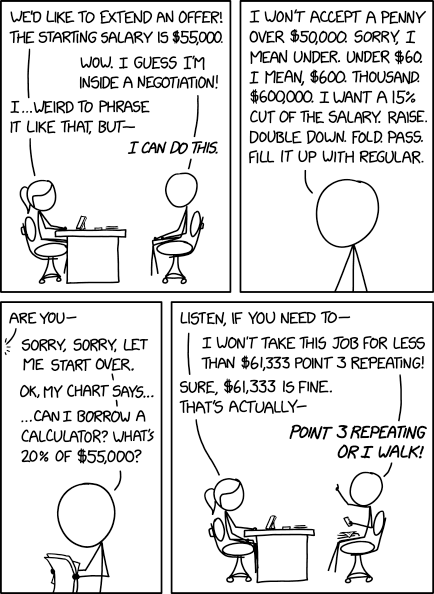
The most recent comic from xkcd, entitled "Salary Negotiation" illustrates nicely, although to the point of absurdity, why this is a good idea:

Mouseover text: "We can do 0.33 or 0.34 but our payroll software doesn't allow us to--" "NO DEAL."

Salary negotiation itself, is quite a salient issue right now in our family. 

My son recently negotiated his summer job employment terms, my daughter just negotiated the terms of her second full time, permanent "real job" (with a 40% pay increase from her current position), her significant other just secured a raise at his first post-college "real job" and support for a professional development program that will put him on track for further advancement in his career, and I negotiated an 80% increase in the rate I am paid when working in an "Of Counsel" capacity two or three years ago after it had been stagnant for seven or eight years. 

My wife left the work force when the pandemic hit because her industry of doing promotional modeling and serving as a brand ambassador basically ceased to exist overnight, and our household suddenly doubled in size, with the extra stresses of having everyone working and studying from home and basic grocery supplies becoming challenging to get for a while. But prior to that, working as an independent contractor, she would engage in a dozen or so new job negotiations every year.

17 March 2022

Why Does Oklahoma Have A Panhandle?

This meme isn't true. But the real story is interesting.


The Oklahoma Panhandle derives from one of those "how sausages are made" stories of the legislative process and the sustained fights in Congress over slavery prior to the Civil War. It started with the Missouri Compromise (requiring new northern states over a certain line of latitude to be "free states"). 

This affected the efforts of Texas to be admitted to the United States as a slave state, which gave rise to the Compromise of 1850 that had Texas cede the portions of its territory that violated the Missouri Compromise and tweaked eastern boundary of what would become New Mexico.

Also, the drafting of the Kansas-Nebraska Act of 1854 was sloppy. It really should have extended the Kansas border further South to the Missouri Compromise line at the 36°30' parallel north. A bill that passed by both houses of Congress, that was vetoed for some reason that isn't obvious by President Garfield in 1886, would have moved the boundary of the Kansas territory south to the Missouri Compromise line.

If this had been done, then what is now the Oklahoma Panhandle would very likely have become part of Colorado and not Oklahoma.


Wikipedia tells the story of how the Oklahoma Panhandle came to be:
The Oklahoma Panhandle (formerly called No Man's Land, the Public Land Strip, the Neutral Strip, or Cimarron Territory) is the extreme northwestern region of the U.S. state of Oklahoma, consisting of Cimarron County, Texas County and Beaver County, from west to east. 
. . .

The Western history of the Panhandle traces its origins as being part of New Spain. 
The Adams–Onís Treaty of 1819 between Spain and the United States set the western boundary of this portion of the Louisiana Purchase at the 100th meridian. With Mexican independence in 1821, these lands became part of Mexico. With the formation of the Texas Republic, they became part of Texas. When Texas joined the U.S. in 1846, the strip became part of the United States.

. . .

When Texas sought to enter the Union in 1845 as a slave state, federal law in the United States, based on the Missouri Compromise [of 1820], prohibited slavery north of 36°30' parallel north. Under the Compromise of 1850, Texas surrendered its lands north of 36°30' latitude. The 170-mile strip of land, a "neutral strip", was left with no state or territorial ownership from 1850 until 1890. It was officially called the "Public Land Strip" and was commonly referred to as "No Man's Land." The Compromise of 1850 also established the eastern boundary of New Mexico Territory at the 103rd meridian, thus setting the western boundary of the strip. The Kansas–Nebraska Act of 1854 set the southern border of Kansas Territory as the 37th parallel. This became the northern boundary of "No Man's Land." 
When Kansas joined the Union in 1861, the western part of Kansas Territory was assigned to the Colorado Territory but did not change the boundary of "No Man's Land."

After the Civil War, cattlemen moved into the area. Gradually they organized themselves into ranches and established their own rules for arranging their land and adjudicating their disputes. There was still confusion over the status of the strip, and some attempts were made to arrange rent with the Cherokees, despite the fact that the Cherokee Outlet ended at the 100th meridian. In 1885, the U. S. Supreme Court ruled that the strip was not part of the Cherokee Outlet. In 1886, Interior Secretary L. Q. C. Lamar declared the area to be public domain and subject to "squatter's rights". The strip was not yet surveyed, and as that was one of the requirements of the Homestead Act of 1862, the land could not be officially settled. Settlers by the thousands flooded in to assert their "squatter's rights" anyway. They surveyed their own land and by September 1886 had organized a self-governing and self-policing jurisdiction, which they named the Cimarron Territory. Senator Daniel W. Voorhees of Indiana introduced a bill in Congress to attach the so-called territory to Kansas. It passed both the Senate and the House of Representatives but was not signed by President Grover Cleveland. The organization of Cimarron Territory began soon after Secretary Lamar declared the area open to settlement by squatters. The settlers formed their own vigilance committees, which organized a board charged with forming a territorial government. The board enacted a preliminary code of law and divided the strip into three districts. They also called for a general election to choose three members from each district to form a government. The elected council met as planned, elected Owen G. Chase as president, and named a full cabinet. They also enacted further laws and divided the strip into five counties (Benton, Beaver, Palo Duro, Optima, and Sunset), three senatorial districts (with three members from each district), and seven delegate districts (with two members from each district). The members from these districts were to be the legislative body for the proposed territory. Elections were held November 8, 1887, and the legislature met for the first time on December 5, 1887. Chase went to Washington, D.C., to lobby for admission to Congress as the delegate from the new territory. He was not recognized by Congress. A group disputing the Chase organization met and elected and sent its own delegate to Washington. A bill was introduced to accept Chase but was never brought to a vote. Neither delegation was able to persuade Congress to accept the new territory. Another delegation went in 1888 but was also unsuccessful. In 1889, the Unassigned Lands to the east of the territory were opened for settlement, and many of the residents went there. The remaining population was generously estimated by Chase at 10,000 after the opening. Ten years later, an actual count revealed a population of 2,548.

The passage of the Organic Act in 1890 assigned Public Land Strip to the new Oklahoma Territory, and ended the short-lived Cimarron Territory aspirations.

Beaver County encompassed the whole Panhandle from 1890 until statehood. . . . "No Man's Land" became Seventh County under the newly organized Oklahoma Territory and was soon renamed Beaver County. Beaver City became the county seat. When Oklahoma Territory and Indian Territory were combined in 1907 as the state of Oklahoma, Beaver County was divided into Beaver, Texas, and Cimarron counties. 
The Oklahoma Panhandle had the highest population at its first census in 1910, 32,433 residents, compared to 28,729 in the 2020 census.

31 December 2021

The Marshall Fire


The Marshall Fire around Superior and Louisville in Boulder County, Colorado has destroyed more than 580 homes (UPDATE: closer to 1000) already, more than any other fire in Colorado history, despite its relatively moderate 1600 acre scope so far (UPDATE: 6000 acres). Probably 1500 or more people in the metro area are now newly homeless.

The seven worst by the measure of homes destroyed have happened since 2010, and all of the top ten have occurred since 2002. As the article linked above explains:

Officials say the Marshall fire, burning in Boulder County, has burned more than 500 homes, which would make it the most destructive fire in Colorado in terms of the number of homes destroyed.

1. Black Forest fire, Colorado Springs • 2013 — 489 homes
2. Waldo Canyon fire, Colorado Springs • 2012 — 347 homes
3. East Troublesome fire, Grand County • 2020 — 300+ homes
4. High Park fire, Larimer County • 2012 — 259 homes
5. Cameron Peak fire, Walden • 2020 — 224 homes
6. Fourmile Canyon fire, Boulder County • 2010 — 169 homes
7. Spring Creek fire, Costilla and Huerfano counties • 2018 — 141 homes
8. Hayman fire, Lake George • 2002 — 133 homes
9. Iron Mountain fire, Cañon City • 2002 — 106 homes
10. Missionary Ridge fire, Durango • 2002 — 56 homes

Looking at various accounts, so far only 6-9 injuries have resulted from the Marshall Fire, but more than 30,000 people have been forced to evacuate, including at least one or two hospitals. (The high winds caused a building to collapse elsewhere in the metro area injuring six more people.)

This hits close to home. It is about twenty miles away from my home and we are in no danger. But, for example, I have 130 Facebook friends in or near the affected area. At least one of them has lost her home entirely.

The Marshall Fire was still burning largely uncontrolled as of the last news reports of this evening. Snow is in the forecast starting at 11 a.m. today (December 31), and most of New Year's Day. Ebbing winds, snow, and bitter cold conditions forecast for New Year's Day should allow the mostly uncontrolled so far fire to be contained.

Usually, fire season is in hot mid-summer in Colorado. But this wild fire is burning bright on the last two days of December. Hurricane force winds started the originally grass based fire when power lines were brought down. The winds also prevented fire fighters from using aircraft to suppress the fires.

This year had significantly below normal rainfall (not quite 20% below normal), and last year was worse (close to 40% below normal). The last half of the year has been particularly dry. The National Weather Service notes in a tweet that:

One of the many factors that lead to the devastating wildfire today is the recent record dryness. For all periods from Jul 1st to Dec 29th (essentially the second half of the year), Denver has been the driest on record by over an inch. Snowfall is at record low levels, too.

Historical contemporaneously recorded weather records for Denver go back to 1872. We've had just 1.08 inches of precipitation from July 1, 2021 to December 29, 2021 (and no precipitation yesterday either).  

For the most part, rainfall at lower elevations isn't all that important. Most of our critical water supplies come from the mountain snowpack in the South Platte River watershed. 

But dry weather in the foothills and on the plains does create a tinder dry environment prone to extreme wildfires like this one.

More than twenty of Colorado's worst wildfires in the historical record (by any measure) have been recent. There is no reasonable doubt at this point that this record streak of extreme wildfires is mostly driven by global climate change. This is the worst it has been for more than a thousand years in this region, and maybe further back than that. Past bouts of aridity of this scale have destroyed whole civilizations in the historical and prehistoric record repeatedly.

29 October 2021

How To Restructure PK-12 Education In Colorado

The preschool to high school (PK-12) education system in Colorado would benefit from a major restructuring of its governance and finance. I've provide my proposal first, and then review the status quo for those not already familiar with it.

My Proposal

1. Finance PK-12 education entirely from state revenue with the increased state revenue demand financed with an income tax increase. This would require an increase from a 4.5% state income tax to a 6.53% state income tax.

2. Eliminate all property tax and car tax funding of schools. This would reduce real property taxes, business personal property taxes, and motor vehicle property taxes by an average of approximately 60% across the board statewide, although the reduction would vary by school district and by locality within school districts. Districts will low property tax rates due to large property tax bases per student would receive the least benefit.

3. The State of Colorado would guaranty all school district municipal bonds to which property tax revenues had previously been pledged.

4. Replace the elected state school board with a school board appointed by the Governor with approval from the state senate, with staggered terms. (While we are at it we should do the same thing in the case of the CU-Regents, which are also elected statewide on a partisan basis.) This would reduce the number of statewide elected officers per voter by four.

5. Replace existing school board elections for the general public, with internal elections conducted on a one enrolled student, one vote basis, in which parents or guardians vote as proxies on behalf of their children of less than high school age (the vote for a student with two parents would be split in half, one for each parent), and high school students would vote for themselves. A single transferrable vote system would be used (and would be more feasible given the smaller number of voters involved). In Denver this would reduce the number of school board posts per voter to vote upon per election cycle by three. A set of rules and processes related to school district campaigns would be developed to fit this new kind of election.

6. Future bond issues would have to have the support of the same people who vote for school board (so that major capital projects get parent-student approval), but could only be made if the Colorado Department of Revenue certifies that the school district will have enough revenue to service the bonds for their term and agrees to guaranty those bonds. 

7. End all state and local elections in odd numbered years, outside home rule cities or cities and counties that can make their own rules.

Why?

* It resolves inter-district school funding level and tax burden disparities in a fair way.

* It provides a stable funding base for education that is appropriate to what it funds.

* It makes Colorado's state and local tax system less regressive.

* This is a boon to lower income property owners and vehicle owners, and tends to make housing more affordable.

* It eliminates conflicts between state government and local government in school finance.

* It is basically neutral in terms of tax administration costs since the process of collecting property taxes and the process of collecting income taxes would remain largely unchanged with only the amounts due changing.

* School boards make decisions on how to spend school funds (they don't have the power to raise funds with taxes without state legislature or voter approval), which are only salient to students and people not related to students shouldn't have a say in that matter. But, it gives a say to non-citizen parents and parents of students from outside the district who make school choice decisions to attend there.

* Frequently, the combination of the different voter base for school boards, and the use of a single transferrable vote system, would provide a voter base that would appropriately reflect the greater diversity of children enrolled in schools in an area than the local community as a whole.

* Giving high school students a vote in real school board elections is an excellent way to build habits of good civic participation, and high school students are old and wise enough to participate in making these decisions.

* It substantially reduces the burden imposed on voters by eliminating elections for the general public in odd numbered years.

* It substantially reduces the burden imposed on voters by ending general public elections for local school boards, the state school board, and local bond and mill levy issues that impose a significant burden on voters to investigate and vote upon. It would reduce the number of candidate races per four year election cycle per voter by seven and would also reduce the number of ballot issues each voter would have to evaluate.

* Elections for Governor, the State House, the State Senate, and state TABOR voters would provide an adequate protection to taxpayers in the general public and adequate general public supervision of the educational process, in a manner with a similar political lean.

* While this is a substantial overhaul, it wouldn't require federal legislation or changes in federal appropriations. This is a major improvement in public policy that could be achieved despite gridlock on most policy issues at the federal level. 

* It isn't likely to result in meaningful positive or negative externalities outside of Colorado, something that is a major consideration for high education financing reforms where interstate travel by students is common.

Background: The Complex Status Quo In Colorado

PK-12 Governance

Currently, the state is divided into school districts that provide PK-12 education that are governed by school boards elected in odd numbered years by all registered voters in the district. These voters also vote on requests from school boards for property tax funding and in order to authorize significant debt financing of capital expenditures with municipal bonds to which property tax revenues and other revenues of the district are financed. 

Neighboring school districts may established Boards of Cooperative Education, which are joint ventures of two or more neighboring school districts to cooperate to provide services such as vocational schools or special education services that smaller school districts could provide more efficiently with the economies of scale provided by a joint venture. These BOCES, as they are called, are governed by officials selected by representatives of the member school districts and are financed with funds from the member school districts' funds.

Some PK-12 education policy issues, other than school finance, are handled by an elected state school board. For example, the state school board sets statewide curricular standards, approves certain charter or voucher school applications, and can intervene to place school districts that are in crisis in a receivership type status.

School Choice

The default rule is that students in a public school district are assigned to attend the school appropriate to their grade in the system in their neighborhood with each elementary school, middle school, and high school having its own territory within the district. Many schools have multiple programs that have distinct student bodies for most classes and different curricula and teachers, while sharing things like sports teams, school dances, and cafeterias, and students in those schools, on a space available or applicable basis, can be placed in one of these programs at a neighborhood school. 

But, students can attend a school outside their assigned territory within the school district is there is more than one school at their grade level using a school choice system, and a system of statewide school choice exists to allow students who reside in one school district to attend a school in another school district. To utilize the school choice system, one applies to attend a neighborhood school outside your own neighborhood to the extent that there is space available there. Sometimes one can apply more specifically a special program in a school of choice. 

Also, the school system has authorized "charter schools" and "voucher schools" which are public schools with almost no district level supervision that don't have an assigned neighbor and admit students who choose them based upon applications and the choice system rules. 

PK-12 Finance

School boards are financed through a combination of local property tax collections and from state funds appropriate from the state general fund budget that is raised predominantly from state income and state sales taxes. 

State PK-12 funds are distributed to school districts based upon a formula established by the state legislature which begins with a per enrolled student dollar amounts, with adjustments for certain higher need enrolled students, and is further adjusted at the aggregate level based upon the property tax revenues that the district raises. The mix of PK-12 funding in the Denver Public Schools (from here) is fairly typical:

In fiscal year 2017-2018, in the Denver Public Schools, total expenditures per K-12 student were $11,476.

Property taxes to finance the operations (mill levies) and municipal bond payments (redemption mills) for the local school district typically make up a majority of the property tax burden. There is a certain baseline mill levy rate that a school district can impose without voter approval. There is also a maximum amount of property taxes that the state allows a school district to impose. Voter approved property taxes above the minimum amount are called mill levy overrides and the extent to which local taxpayers approve them varies considerably.

Because some school districts have a larger property tax based per student than others, the amount of money raised by a given mill levy varies. Some school districts can generate more tax revenue than they need from a low mill levy, while others generate very little tax revenue even from a maximum level mill levy. Schools with less property tax revenue generating capacity (generally rural farming based areas, areas heavily impacted by tax exempt government property, and low income urban areas) receive more state funding than schools with more capacity to fund themselves with property taxes (such as ski resort towns). For this reason the state funding component of PK-12 funding to school districts in Colorado is called a "state equalization payment."

Specifically, as a March 3, 2020 article from the Colorado Sun explains:

Currently, Colorado sends about $453 million in state funds to districts where school property tax rates are below the level needed to fully fund themselves, or below 27 mills. . . .
Colorado’s history of inequitable school funding was set in motion in 1988, when property tax rates were all over the place, similar to how they are today. . . .

The legislature aimed to establish a consistent level of investment in schools through a uniform tax rate, mandating all districts levy the number of mills at which they would be fully funded, or at most 40 mills. That would have resulted in local communities covering half of the funding needed for K-12 education with the other half contributed by the state. . . .

By 1991, all districts had reached 40 mills or the number that would enable them to be fully funded with local property tax revenues. But in 1992, Colorado voters passed the Taxpayer’s Bill of Rights, which capped the amount of revenue the state government and local governments could generate and spend. In K-12 education, that cap was dictated by growth in inflation and student enrollment. . . .
That posed a problem for school districts in communities where the assessed value of properties was rising rapidly, causing them to generate revenue amounts above their constitutional limit.

The solution: decrease property tax rates.

In some communities, particularly those experiencing an oil and gas boom, property values soared, causing property tax rates to plummet, [for example in] Primero RE-2 School District in rural Las Animas County. That district’s property tax rate dropped from 40 mills in 1993 to 1.68 mills in 2006.

Some districts in Weld County also cut their property taxes and mill levies and are fully funded because of oil and gas values. Those districts include Pawnee School District Re-12, Prairie School District and Platte Valley School District RE7.

In 2007, after property tax rates had continued to fall, the legislature stepped in and froze the rates to keep them from ratcheting down. At that point, some districts were approaching 0 mills. . . .

That legislative decision, she said, also froze inequities in place with no way for districts to resolve them and no incentive to change because they can count on the state to backfill budget gaps.

The resulting system has been an unbalanced one in which wealthier school districts are in many cases receiving state funding at the expense of districts in lower-income communities, and the state’s role in funding public education has become increasingly outsized.

The scales have tipped so far that the state is now providing 61% of education funding while local communities cover the remaining 39%, according to figures provided by the Colorado Children’s Campaign.

State funding per student varies greatly in across Colorado's 178 school districts: 

Rural districts receive large upward adjustments in per pupil funding, despite their low cost of living due to the diseconomies of scale associated with having small schools with low enrollments, and because their property tax base is anemic.

School districts typically own the buildings and facilities used to provide education in their district which are funded with municipal bonds that are repaid with voter approved bond redemption millage. Sometimes, school districts made their buildings available to charter schools or voucher schools in their district which rent the spaces from their budgets.

A lot has changed since October 24, 2005 (including the state income tax rate) when I summarized state and local finance in Colorado, but some of the broad outlines remain the same:

A single comprehensive solution can solve the problems above to a great extent.

Colorado currently collects the following amounts of taxes:

State Income Tax-------$3,972M at a 4.63% flat rate.
State Sales Tax--------$1,849M at a 2.9% rate.
Local Sales Taxes------$1,862M at an average 2.95% rate.
School Property Taxes--$2,048M
Other Property Taxes---$1,366M

About 25% of Colorado's aggregate property valuation is business property now assigned to bear 55% of the total property tax burden. About 75% of Colorado's aggregate property valuation is reisdential property assigned to bear 45% of the total property tax burden.

The gas tax currently brings in about $900 million a year, with no funds currently being contributed for transporation spending from general revenues, but the Department of Transportation needs $1.4 billion a year to maintain state roads in a way that will match growing expenses and traffic.

As of 2019-2020, state K-12 education spending was $4,405.2 million of general fund money and $1,780.7 million of other state funds. The total state general fund revenues are $12,641.4 million, of which $8,387.6 million comes from state income taxes (net of diversions to the state education fund which funds K-12 education outside the general fund).