Showing posts with label anthropology. Show all posts

28 May 2026

How We Got Here, And Where We Might Go Next

Proximately, the U.S. is in a bad way because Trump and MAGA secured a federal trifecta and also control the U.S. Supreme Court, as well as the governmental apparatus of many states, because our laws do too little to discourage the concentration of economic power.

Political theory seeks to explain what factors in the complex political economy we live in led to this situation.

This post surveys some of the possible answers.

An institutionalist approach

An institutionalist approach is a social engineering outlook on why political systems work or do not work. It takes as an axiom the belief that the right rules and systems and organizations more or less directly produce good political economy outcomes, so reforming existing institutions is the path to a better political economy. 

This is closely aligned with a notion that the rule of law is the key to a good society, something that is an article of faith in "Western culture" (with its roots in Western Europe) and is widely rejected in "Eastern culture" (with its roots in China).

Fundamentally Broken Institutions

The U.S. Constitution, other key laws, and important institutions of political and civic society (like political parties and the media) are broken. There are deep design flaws with the status quo that can't right itself without decisive, and indeed, perhaps revolutionary change in our institutions.

Common reform proposals in this approach are campaign finance reform, gun control, abolition of the electoral college, expansion of the franchise, proportional representation electoral systems or ranked choice voting, better procedural rules within legislative institutions, improved methods of selecting judges and other key public officials, tweaked checks and balances (like a unicameral legislature, a conversion from a Presidential to a parliamentary system, laws prohibiting corrupt practices enforced by effective enforcement agencies, and so on.

Imperfect, But Fundamentally Sound Institutions

The U.S. Constitution, related key laws, and important institutions of political and civic society (like political parties and the media) are flawed but are not fundamentally broken. These institutions are robust enough to eventually right the ship of our political economy, even though they aren't as fool proof and rapid as we'd like.

Really bad Presidents produce electoral backlash and encourage more competent people who otherwise would pursue careers other than politics to resist bad political leaders, which puts us back on track. But this feedback mechanism can't react much sooner than every couple of years, can't prevent serious abuses and failings, and often takes decades. Lessons learned in the last crisis are forgotten until we pay the price for forgetting those lessons again. In worst case scenarios, it can take long insurgencies or wars or full on Great Depressions to trigger support for the necessary reforms.

Bad high court judges need to be threatened with court packing to overcome their biases. Legal scholars seeing legal doctrines producing bad results propose new legal theories. New political parties need to replace old ones much like the GOP replaced the Whigs. People come to realize that voting for openly corrupt liars and criminals is maybe not such a good idea.

Culture

The main counterpart to an institutionalist approach to the success of a political economy (which has strong parallels in the economic development literature), observation that laws and institutions that are identical in all material respects can produce wildly different results, when people who are culturally different utilize these institutions.

This approach concludes that the character, morals, norms, and values of the people who use the institutions profoundly influence the quality of the political economy outcomes that a society produces, while the particulars of the institutional arrangements put in place to facilitate management of the political economy aren't particularly important within a fairly finite set of combinations of big choices in institutions.

Differences between the success of parliamentary systems and Presidential systems, in this view, have more to do with the political culture of the people utilizing those systems than with the inherent, universal virtues of different reasonable sets of institutions and rules. 

There may be some sets of institutions and rules that usually led to bad outcomes, but people with a good political culture can make any remotely reasonable set of institutions produce good outcomes, while people with a political culture ill-suited to their demands of their current circumstances will find a way to break any set of institutions and rules, no matter how expertly crafted.

The optimal political culture is also not universal. In times of economic hardship and scarce resources which give rise to weak states, cultures of honor, clan based societies, cousin marriage, and systems that reward might over right may be more functional. In times of economic abundance that facilitate the rise of strong states, more atomized social structure, meritocracy, forgiveness, out marriage, and systems that reward truth over power may be more functional.

For example, one way to explain the rise of Christianity in the Greco-Roman classical era is that Christianity was a tool of cultural change that helped a society that was becoming more abundant, more urban, and more mercantile transition managed by a strong state, and away from a Greco-Roman pagan culture more suited to rural living, herding, and tradition based allocations of resources, in small and weak states. The expansion of the Islamic empire likewise involved a massive cultural change from a decadent and disorganized society without strong state management in the post-Roman era to a society with more firm and decisive, yet decentralized leadership that functioned well in the absence of Western Roman Empire type institutions.

This cultural-first approach to political theory is closely aligned with a notion that rule by good and moral leaders is the key to a good society, something that is an article of faith in "Eastern culture" (with its roots in Chinese Confucianism) and is widely rejected in "Western culture" (with its roots in Western Europe), where the "rule of man" is synonymous with authoritarianism, corruption, and arbitrary treatment of people.

Malleable culture

One version of a cultural approach to political economy sees a society's political culture as harder to change in many respects than institutional rules, but feasible with measures like widespread public education, religious conversion or deconversion, and grass roots activism through "movement politics" over decades. And, while this takes longer to accomplish than institutional rule changes, it is almost more robust and enduring.

A malleable culture theory concludes that while the relative political leanings of groups and geographic regions with different cultures are persistent over time periods measured in centuries, that societal progress is attainable over time. Yesterday's segregationists become today's advocates of a color blind society without affirmative action. Yesterday's corporal punishment advocates become today's advocates of large fines and long sentences of incarceration. 

In absolute terms, society gradually abandons specific practices and norms that are conservative or backward at the time, while the descendants of people who held those specific practices and norms come to adopt views that were liberal in the times of their ancestors and are conservative now. But the descendants of the liberal leaning ancestors in turn, become even more progressive.

Even proponents of malleable culture approaches to political economy acknowledge that the process can be two steps forward and one step back. But ultimately, technology and the accumulation of knowledge and fundamental, universal human impulses that are masked by different immediate material conditions point humanity in the same general direction in the long terms (although there are shorter and longer routes to progress), so we progress more often than we regress.

Static culture

In contrast, a view that culture at an ethnic group or geographic area scale is predominantly static, even if isolated and exceptional individuals can change their cultures, see mass movements and programs to change a society's culture intentionally as largely futile.

It isn't that this view believes that the culture of a particular geographic area can't change. But, it sees the main mechanism for a change in the culture of a particular geographic area to be replacement of people of one ethnicity or mix of ethnicities with people of another ethnicity or group of ethnicities.

In this view, some of the main mechanisms of cultural change are colonization by people of a different ethnicity, genocide (through forcible abandonment of culture, actually murder, restrictions on fertility, or economic marginalization), immigration, and differential rates of births and deaths between ethnicities, with these mechanisms being particularly strong among men, while women more easily assimilate into new cultures in which they find themselves. This is also a more zero sum worldview. Flavored with ideas about ethnic or religious or cultural superiority, this can morph into righteous missionary zeal, ethnic nationalism and/or religious nationalism.

Along the same lines, languages associated with dominant cultures tend to increase their market share of language speakers in a society, while languages associated with economically marginal ethnicities tend to decrease their market share of language speakers in a society, in both cases at a pace measured primarily in generations, rather than within the lives of individual speakers of a language.

This outlook was heavily disfavored in the 1960s and 1970s in the Western world (under the motto that pots are not people), but has enjoyed a resurgence as research into ancient DNA, historical linguistics, and physical archaeology have been synthesized in a manner that has reviewed that over time frames of centuries and millennia, that these mechanism of demic change have been far more common than culture change through intercultural contact and elite dominance. Admittedly, there have been notable exceptions to this general trend (e.g. the linguistic transition of the country now known as Hungary, or the Brahui people, or the expansion of the Islamic empire, or the rise of Christianity). But cultural transition without demic change has been the exception rather than the norm.

This outlook on political economy, for example, perceives Zionism and the formation of new West Bank settlements in Israel, or ethnically and religiously motivated raids by Sahel Muslims from traditionally herding societies in Africa on Christian/animist communities to their immediate South, from a very different worldview framework than a worldview in which institutional approaches or malleable cultural views are the norm.

More generally, a political theory bent rooted in the worldview that culture is predominantly static, particularly when fused with the concepts of economic and environmentally driven cultural change discussed below, tends to see political tactics that "civilized society" condemns most intensely, as largely inevitable and natural, even if it is not morally desirable at an individual level.

Political worldviews and theories that emphasis the static nature of culture at the group and regional level are more sanguine about the inevitability of progress than those which see culture as malleable. These worldviews tend to see cultural progress as exceptions to the general rule that require specific and rarely recurring conditions, rather than as a universal law or inevitability.

Environmentally determined culture

A premise which is widely accepted in anthropology, but less widely accepted in political theory, is that people's material conditions determine which cultures are optimal for those conditions.

While no culture is inherently better than any other in a vacuum, in any given set of circumstances, some cultures are more functional than others.

Plough based agriculture tends to favor patriarchy and patrilocal clan systems. Hoe based agriculture and hunter-gatherer societies can tend to favor matriarchal social structures, with households often led by brother-sister couples rather than households led by monogamous co-parent households. 

Affluent, urban societies, without low rates of childhood morality that rely on skilled labor that takes many years of investment in human capital tend to favor small family households; poor, rural societies, with high rates of childhood mortality that rely on unskilled labor tend to favor large family households. 

Weak states tend to favor cultures of honor, and clan based social organization. Strong states tend to favor a focus on individual autonomy, meritocracy, rule based justice, and weaker extended family ties. 

Perceptions of economic scarcity and uncertainty favor conservatism and societies where religion and/or superstition are important. Perceptions of economic abundance and security favor secular, liberal societies that rely on science rather than superstition.

Perceptions of economic decline or stagnation of an ethnicity or geographic group or social class, and societies where the economy is heavily reliant upon economic rents like land ownership or fossil fuel resources, can further fascism, far-right movements, ethnic and religious nationalist movements, and support for authoritarianism. Shared prosperity in a society where the economy depends heavily on a diffuse class of merchants, professionals, and skilled labor rather than natural resources, in contrast, tend to further democracy, an absence of corruption, respect for individual rights, and tolerance for diversity.

Cultures ill-suited to their conditions decline, due to both conversion to better suited cultures and economic and demographic decline. Cultures well-suited to their conditions thrive. Conversely, religious institutions that support threatened cultures tend to thrive, while religious institutions associated with establishment, secure, dominant cultures tend to wither despite the fact that the communities that they serve tend to have more economic resources.

The notion that culture is economically or environmentally determined is relatively agnostic about whether culture is malleable or static, with their very different mechanisms and tactics that give rise to cultural change.

Synthesis

Of course, none of these political theories is 100% true. 

Even a strong culture oriented political theorists who takes a hard look at all the data will acknowledge that institutions and rules can matter, and can shape culture. You can see this particularly clearly when looking at the divergent paths taken by North Korea and South Korea, by Taiwan and mainland China, by East Germany and West Germany prior to unification and persisting in regional culture differences in the thirty-seven years that have elapsed since unification, even though the highly distinct institutions in these places that once shared a common culture including a political culture arose only about eighty years ago or less, in these cases.

On the other hand, scholarly works like Albion's Seed, and studies of persistent regional cultural differences in Germany (that predate the formation of a unified Germany state about 150 years ago), also establish that once regional or ethnic cultures are established, they are remarkably resilient in the face of institutional change and political unification, and can persist for centuries.

If you were to guess how politicians in the late 1700s and early 1800s in newly formed U.S. states leaned politically relative to each other on major groups of political issues like being pro-war or anti-war, or on economic or social issues, based upon the current political leanings of those states, you would overwhelming be correct 250 years plus or minus a few decades later.

The Catholic-Protestant divisions of Europe have been mostly static for the entire early modern period that started with the Protestant Reformation in the 1500s that were decided based upon the decisions of late stage feudal lords to choose one side or the other of this divide in European Christianity. And, those religious divisions, as famously noted by Max Weber in the 19th century, are associated with a whole suite of larger cultural divides epitomized by what he called the "Protestant work ethic."

Persistent culture divisions whose effects predominate in places where different cultures function within the same formal political institutions, like divisions in economic prosperity and political economy between regions dominated by different ethnic groups in Nigeria, whose characteristic cultures and cultural identities pre-date the relatively recent conversion of southern Nigeria to Christianity across a wide variety of diverse ethnicities starting in the 19th century or so, are still very real (even though many formal statistics on African immigrants to the U.S. aren't so fine grained and don't make these distinctions in their record keeping mask these differences).

In India, genetic testing has confirmed the anthropologically well-documented phenomena of caste endogamy and inequalities, pin pointing the time frame, centuries ago, when endogamous caste divisions at the jati level started to harden upon which historical accounts from those time periods were inconclusive and scarce, and eighty years of Indian independence with egalitarian institutions and ideals have only modestly dented the resilient cultural juggernaut of caste divides. Genetic studies also establish the time frame of the much older origins of varna level caste/ethnic divisions within India and help establish more clearly the magnitude, timing, and nature of introgression of people from one varna into another one.

Particularly in my own personal world and my own country, I am well aware that I instinctually lean towards institutional explanations and solutions, and that I also tend to favor malleable culture worldviews over static culture worldviews, to a greater degree than that evidence available to me supports.

How We Got Here

Each of these political theories naturally lends itself to a different narrative about how we go here, and the deeper driving factors behind the proximate causes of our woes.

Environmental determinism points to technological changes and human driven climate changes as the source of structural economic changes and changes to the U.S. social structure and social class system that has shunted the benefits of economic growth to an educated upper middle class serving a thin veneer of old money and new money billionaires and big businesses, and while reducing the less educated whom the modern economy has little use for, from a broad unifying middle class that has a stake in our society to a working class and underclass. The upper middle class has small stable prosperous families, while the working class is seeing their families fall apart despite having as many or more children, and their prospects for social mobility or comfort without generational wealth and social capital fading. The upper middle class has become far more secular, while comparatively the working class has remained more religious despite its long term trend away from religion as well.

The neo-fascist MAGA movement is, in this analysis, a natural consequence of two generations of economic stagnation for the non-college educated working class.

Static cultural worldviews emphasize the fact that there is a straight line from antebellum Southern whites to the KKK and Jim Crow and segregation supporters and American Nazis prior to WWII to opponents of the civil rights movement to MAGA.

Malleable cultural worldviews emphasize the fact that far right political viewholders skew heavily towards older white men while younger generations are much more liberal on a wide variety of issues. They note that the divorce between the MAGA worldview and reality is the product of intentional propaganda by billionaire class funded conservative media outlets like Fox News, conservative think tanks, talk radio, and fundamentalist Christians and Christian clergy who are wary of reality based inquiry because it undermines their religious doctrines, and can be reversed with carefully crafted interventions to deprogram MAGA adherents.

Institutionalists who see the system as fundamentally broken see the proximate causes of our woes as more directly caused by particular flaws in our Microsoft of political systems which was state of the art in the late 1700s, but had rules that didn't benefit from the next couple of centuries of experience with democratic political institutions which addressed the inherent flaws in our own system which the Founders, not being omniscient, and with their own narrow franchise and biases could not have foreseen. The trouble is, that if indeed, our Institutions are fundamentally and deeply broken, there is no clear path to fixing them.

Institutionalists who see the system as flaws but fundamentally sound, in contrast, acknowledge that the flaws in our system have prevented our political system from preventing or more swiftly ending the MAGA scourge. But they are more optimistic and stoic. In an analog to the idea that suppressing all wildfires can make a forest more vulnerable to more devastating big wildfires, or to the hygienic hypothesis that an environment that is too sterile and devoid of threats can lead to autoimmune diseases and allergies because the immune system didn't have a chance to do its job non-pathologically, they argue that as unpleasant as it is at the time, healthy political economies need periodic threats to its values so that the people served by them remain vigilant in developing a combination of institutions and political cultures that can defeat even strong threats to their health.

People never exposed to fraud become too trusting and become easy marks (something that is a big problem in the overall high trust society of Mormon Utah). Politicians who grow too used to playing nice with their political opponents forget the tactics that their predecessors used to win when their political opponents didn't play fair. 

A near miss constitutional crisis of our political economy with fascism and authoritarianism, with an scary dose of corruption and lies, may be what it takes to build broad enough support to fix the most important institutional flaws in the status quo, much like the U.S. did in the New Deal, and again in the 1960s and 1970s.

Institutionalists who see the "bones" of U.S. political institutions as fundamentally sound will note that the U.S. system has been good enough to last 250 years including multiple comparably bad or worse political crises, like those leading up to, during, and following the U.S. Civil War. And, they see the gridlock and shifting political coalitions that have predominated in the time frame from the 1980s to the present, as a feature rather than a bug, by preventing thin majorities from making big and bold political changes in the absence of widespread, bipartisan, cross-ethnic, cross-regional support. Our federal system funnels paths to innovations to the states and refrains from making big changes until with the passage of time, some approaches are widely understood to be desirable, and other approaches are seen as failures. And, like the seventy year plus era of doctrinaire communism in Eastern Europe, China, and Southeast Asia, on one side, and mixed capitalism in the "West" and some Western leaning East Asian nations, this deadlock can seem completely intractable and static, until sudden it collapses, with Eastern European communism collapsing in just a few years, and Asian communism more resiliently adopting market-style reforms to the point where it has become communism in name only with billionaire capitalists holding all positions of power in these one party states.

We saw something similar leading up to the abolition of slavery in the United States. This issue divided the new republic for eight-five years from its inception right up until 1861, only for slavery to be formally abolished four years later all at once, in turn followed after a brief reconstruction interlude, with another eight-five years of so of Jim Crow, only for that institution to in turn collapse over the course of about a decade when it had seemed in 1950 that Jim Crown might persist eternally. Sixty years after the Civil Rights movement had achieved most of its major objectives, MAGA is trying its best to undo the reforms of the civil rights era in a last dying eruption of a movement that know that democracy will mean its death as socially and economically regressive Baby Boomers, some of whom were born in the era of segregated water fountains, bathrooms, and schools, die and reduce their share of the electorate only to be replaced by liberal Generations Z and Alpha in the electorate for whom racial diversity is second nature and is their generation's reality.

Trump has been a racist all of his life, just like his Nazi father. Joe Biden came around later in his political career, but got started in Congress on a platform of opposition to school desegregation in Delaware. Many of the leaders in Congress, and especially in the U.S. Senate, are from that same generation and still wear ideological and worldview boots of clay developed in their politically formative years.

Eventually, however, cancer, cardiovascular diseases, dementia, COVID, geriatric falls, and the like will do the job of replacing them with the next generation of politicians, that Baby Boomers have prevented from happening in the ordinary course as it should have a couple of decades ago.

The midterms in 2026 could end the GOP's trifecta control of the federal government and reducing the bleeding that our national institutions and esteem on the global stage have been suffering. Ideally, its defeat could be crippling enough to lead to the GOP's replacement with some new center-right opposition party that starts over after MAGA has burned all of the GOP's bridges and poisoned the well with several younger generations. Democrats could take the Presidency in 2028 with majorities not seen in recent memory and a commitment to play hardball after the horrors of Trump 2.0, and make enough major reforms to put the U.S.A. on track again with wide consensus backing, even though it may take decades to undo the damage done by Trump already that is not irreparable. And, if that happens, the Institutionalists who believe that flawed as it is, that the U.S. political system is not broken beyond all repair, will be vindicated. The fact that the U.S. has weathered past crises makes this a far from unlikely scenario, and the optimist in my wants to hope that they are right. Polling leading up to the midterms that are barely more than five months away, suggest that they might be right. 

While MAGA stayed loyal during Trump 1.0, his more radical Trump 2.0 term has finally seen Trump's steadfast support start to erode and has seen some prominent GOP/MAGA leaders, like Marjorie Taylor Green, break ranks with him.

What Happens If We Don't Escape And End Up In A Deeper Circle of Hell?

I want to believe that they are right, because the alternatives are very dark indeed. If Democrats can't do this over the next three years or so, because its institutions are too badly broken to return the nation to a positive path, all of the paths before us are nightmares.

One need look no further than North Korea, Cuba, Albania until the fall of communism, Saudi Arabia, Kuwait, Iraq, Afghanistan, East Germany, the Soviet Union, post-Soviet Russia, the Ottoman Empire, and the slave states of the U.S. prior to the U.S. Civil War, to observe that the fact that a regime is authoritarian, undemocratic, and performs dismally economically in its non-natural resource sector, and faces significant sustained pressure from  the international community to reform, does not mean that these regimes are fragile or vulnerable to prompt collapse. Eventually, many of these regimes did collapse. But it took an entire lifetime or so to do fall, and more often than not it took an international military intervention (or at least a costly cold war interspersed with periodic hot proxy wars) to make it happen.

The U.S. is to big and militarily powerful for a turn for the worse to be cured with a foreign military invasion of the U.S. to liberate us any time soon. 

If one of the darker scenarios has developed in the U.S. by 2028 or 2030, it is entirely possible that the U.S. will degenerate into a full fledged malevolent dictatorship and remain in that state until sometime in the early twenty-second century. 

This dark era for the U.S. could possibly punctuated by an ugly and deadly military insurgency, and waves of assassinations, asymmetric warfare, sabotage, and non-violent resistance that persists as long as Afghanistan has been in a state of near continual war since the 1970s, that may only end or at least subside when it is put down with brutal ruthless efficiency that scars our nation with horrors we have yet to imagine like the annihilation of every soul in a whole liberal leaning rebellious metropolitan area like Minneapolis, rather than a mere attempted ICE and National Guard driven show of force. The Handmaid's Tale was meant to be a warning and not a prophecy, but there is no certainty that it won't turn out to be one.

There are happier paths that one could imagine, like a bloodless coup that is followed by a new covenant that replaces our existing political and economic institutions, if the existing ones don't solve the problem in the next three year or so, that reboot our nation in some manner or another, or a wave of blue state successions, that leaves unsubsidized red state America in a state of total economic collapse, and followed by reform or reunification.

One could also imagine something like the experience of the Romans, who first transformed from a genuine Republic, to a more flawed Republic, to a truly non-democratic empire, stuttering from crisis to crisis, with bandaid temporary political fixes that don't last, punctuated with emperors like Nero and Caligula, who are still remembered about two thousand years later for their perfidy and insanity. Trump could end up being a model for future corrupt, authoritarian, delusional demagogues who are equally bad, but even less restrained by the democratic actions of the electorate or the courts or federalism or military independence, than Trump 2.0 which is actually exploring every avenue to end these constraints upon it.

Some of these nightmares seem almost unthinkable now, after the imperfect and slow mechanisms and institutions for slowing down Trump and MAGA's destruction of the federal government and everything good in the United States of America finally started to kick in. But the United States doesn't get three strikes. If the midterms to provide a decisive and effective check on Trump 2.0 in what has so far been a Congress that has ceded its responsibilities, we'll be lucky to get a federal election at all in 2028, and if there is one then, it will probably be less free and less fair (despite the fact that Republicans are pulling out all stops to undermine the regularity of the 2026 elections and to persecute Trump's enemies with no regard to the law or any notion of anything greater than Trump's momentary whims).

If Americans, collectively, fail to decisively interrupt its current course in either 2026 or 2028, we're pretty much done. Democracy and democratic values and the rule of law and civil liberties will be no more, and there will be no way back within the confined of legal political action or even civil disobedience. The U.S. is too big, and too culturally divided to secure the final turnabout that ousted a far right authoritarian regime in Hungary earlier this year.

Those who can will become political refugees, much like the scientists who fled Germany when the Nazis came to power, and fled the Soviet Union as it grew ever more oppressive. Those who can't will suffer, or sell their souls for petty subordinate power at the whim of some unsteady dictator (probably not Trump for long, given his ill-health and age, but possibly some successor who is equally evil but more competent).

20 February 2025

Thirty-One Flavors Of Fiction That Could Be Attempted

1. The usual medical drama features a brilliant but somehow personally flawed or anti-social physician. It would be interesting to imagine one that is, instead, about an admittedly mediocre or dull physician, just barely qualified medically to do their job, and perhaps a little corrupt as well, so not truly righteous, who nonetheless basically moral and makes a positive difference by falling back on the medical basics and by recognizing and addressing the non-medical concerns of this physician's patients.

2. If one wanted to do a "hard science" story about aliens, how could one do it without faster-than-light travel? Suppose that somehow someone in our solar system with an advanced space based radio telescope intercepted transmissions from another advanced civilization without faster-than-light travel many light years away. Suppose further that these transmissions were sufficiently rich to figure out their language(s) and to follow the story playing out amongst the aliens. This would leave the author free reign to develop a very different (and yet in some essentials, similar) culture and world. The aliens' stories, in turn would impact the solar system based observers despite the fact that it doesn't directly impact them and they can't really meaningfully interact with the aliens. Perhaps, for example, our solar system observers might witness transmissions from the fall of their civilization and gain insights from it that would guide them in trying to prevent humans from making the same mistakes. The solar system observers might also glean technological advances that could be utilized by us.

3. There are several places in the solar system: the atmosphere of Venus, and the gas clouds of Jupiter and Saturn, for example, where the most habitable regions would be for life that was perpetually aloft rather than on the surface of some rocky or icy planet. A hard science fiction story of first contact with an intelligent species that is part of a larger aeolian ecosystem in one or more of these places could be promising.

4. There have been a number of science fiction stories about human scientists deliberately nudging other species along to become sentient species on a par with our own. One of the most promising, but least explored, of these possibilities, is the possibility of sentient octopi, who are already quite intelligent and have the physical traits necessary to be tool users but whose intelligence is as different from our own as almost any other on Earth. The main problem that prevents them from realizing this potential is that they have a great many young who receive no parental care once they are born and are eaten in large quantities by all manner of other creatures in the sea. A story taking place near the end of this process as we begin to share the world with another fully sentient species that we helped to create could be fascinating.

5. A hard science fiction story exploring the consequences in the not so distant future, of widespread biohacking and genetic engineering for longevity and other traits.

6. A hard scientific Jurassic Park style de-extinction drama, but involving mostly Pleistocene mammal species (which are much more feasible), rather than dinosaurs, and a less tragic ending.

7. A story exploring the co-existing of various archaic hominins and modern humans that we know happened several times in human history, perhaps a "Clan of the Cave Bear" type story, but with Denisovans and hobbits making first contact with modern humans.

8. A century or two in the future, climate change driven by fossil fuels will have run its course, fossil fuels themselves will have ceased to play a significant economic role even if it persists in some niches, Africa will have undergone economic development and experienced the demographic transition seen everyplace else that has experienced economic development, the global population will have fallen significantly from a peak of perhaps 9-10 billion people, Islam will have transformed from a current state that is a bit like Victorian Christian civilization to something more like modern Christianity, Christianity will have become a minority religion in most places outside of Africa in the face of secularization, and science will have advanced to the point where we know the laws of physics at the most fundamental levels without the various unsolved problems and open questions we have today. All this plausibly prophecy for the future needs is the right kind of story to unveil this world, and to identify the new central conflicts that have emerged in it, perhaps a heroes journey, or a journey of exploration, or a flight from some peril.

9. What would the world look like in the future if the so called "Axis of Evil" ends up winning, perhaps with the complicity of a MAGA America? What would the regression of global civilization look like in that new dark age? I would expect a future in that scenario that is dystopian but not apocalyptic, in which some small resistance or movement tries to get return humanity to a path of progress, and our hero joins that movement. 

10. We know that there was once a farming civilization, thousands of years ago at a suitable moment in climate history, in what is now the Amazon jungle. At some point, the climate changes, the civilization collapsed, and the jungle came to be in its current state. Imagine a story, or perhaps a series of stories or short stories, all set in this civilization trying to imagine it as fully and accurately as possible.

11. The Younger Dryas climate event profoundly impacted much of the world about three thousand years before farming and herding was invented, at a moment when the Clovis culture was thriving in North America, and when proto-farming and megalithic ritual centers were starting to develop in Anatolia. In North America, this climate event tipped the balance provided by the ecological pressure of human hunters, to result in a mass megafauna extinction. In Anatolia, this climate event delayed the development of agriculture by about three thousand years. There would be plenty of room for the stories of people who lived just before, during, and after the Younger Dryas event.

12. The modern collection of military conflicts that I call the Sahel War in Africa is a climate driven conflict that is epic and primal, giving rise to genocidal wars between Muslims in the north, whose ancestors were traditionally herders, and Christians and animists in the south, whose ancestors were traditionally farmers, as the slowly expanding Sahara desert creeps southward, pushing herders into the farmers' territory as their own land become uninhabitable. There are many stories that could be written in the context of this ongoing conflict from both sides, or perhaps in the context of a young couple with a herder and farmer from opposite sides of the conflict.

13. The ancestors of the Chadic people of Africa made an epic journey from the place we now call Moldova to Lake Chad at the peak of the Green Sahara period. A story, perhaps a multi-generational one, of their journey and of the society they build upon arriving at Lake Chad, would be a worthy one.

14. Another epic, possibly multi-generational journey worth describing in fiction based upon pre-history would be that of the Austronesian mariners who settled Madagascar via East Africa, and also brought the banana to Africa.

15. Swahili civilization arose when Arabic speaking maritime traders entered into marriages with high status local women along their trade routes along the eastern coast of Africa. The ethnogenesis of this civilization could provide a great backdrop for all manner of stories.

16. It would be interesting to read stories set in the early days of the Islamic empire, concretely filling in the blanks with best available hunches, on what fueled its explosive expansion in a matter of decades and the experience of the first wave of people converting to Islam that made this attractive to them. 

17. It would also be interesting to set a story in the medieval period at urban centers in the Islamic empire where an Islamic renaissance of intellectual progress and cultural flowering was underway. The story of how the lives of women who got divorced in this time period, which was something that happened and was not uncommon at the time (long before divorce was possible in Christendom), in a historically authentic way, could provide at least one important unifying thread to the overall narrative.

18. Some horrible regional war in the medium term future forces a large group of refugees into exile, and they settle in some near Arctic or Antarctic region that global warming has made marginally habitable, or in someplace like Texas that has become increasingly uninhabitable causing most people to move away, in a story of pioneering colonization on a last frontier on Earth.

19. A murder mystery, a few decades in the future, some sprawling megacity in the developing world or third-world city, perhaps in a more backward part of India developing on the late side, or Southeast Asia, or Africa.

20. Some political faction in a gridlocked political system, resorts to assassinations to achieve its political goals, authorities try to thwart them with mixed success.

21. A story recounting the rise of a new religion, along the lines of the 2010 series "Caprica" (a Battlestar galactic prequel), or the 2024 series "Dune Prophecy", that is a better fit in its metaphysics and in the social issues that it addresses, than the Abrahamic faiths that are predominant today.

22. A city killing sized asteroid is headed towards Earth and scientists have greatly narrowed down where it will strike, but political leaders and the rich have declined to mobilize a planetary defense effort. So, instead, the race is on to relocate as many people as possible from the predicted impact area far enough away that they can survive, before it strikes at the appointed time.

23. A retelling of the Bible narrative and some of its extra-canonical books from the perspective of Satan, an angel cast out of heaven because he bucked YHWH's tyrannical rule.

24. A very personal story of the author of some piece of a major work of legendary history and what drives this author to mix elements of historical fact with mythical fiction, perhaps the Iliad, perhaps the Bible, perhaps some other Bronze Age mythology.

25. The Second Amendment is repealed and slowly but surely the population of the United States is disarmed in a series of conflicts with reluctant gun nuts that ultimately end decisively against them. Tyranny does not follow.

26. Vice has been legalized, but only in designated areas that were formerly industrial or in the middle of nowhere. Our protagonist is a public official charged with helping people who have started to drown in this and need treatment, and identifying abuses that need to be ended.

27. A woman from a strict and wealthy Muslim family de-converts while she is a foreign student in the U.S. where she is chased by extended family members and the Islamic government of her home country, in an effort to subject her to a honor killing. With the help of allies she meets along the way, she tries to stay alive and make a life for herself.

28. A short story of a woman who is charged with sorcery in Saudi Arabia and ultimately executed for it, ideally based as much as possible on one or more true stories.

29. All of the women and a couple of the men in the senior class of a high school, with varied well developed individual characters, in an isolated rural hot springs resort town, inspired by a science fiction story that a few of them read, form a polyamorous pod and have and raise children in it.

30. Oil runs out or becomes worthless, in much the way that coal is starting to, or already has, in North America of Europe. The economies of oil states start to collapse. Our protagonist is a member of the Saudi Arabian royal family as the monarchy must choose a path to either constitutional monarchy or being replaced entirely in the face of dramatically declining economic prospects, particularly when it is discovered that the sovereign wealth fund of the country has been embezzled on a massive scale and invested in failed nepotism and politics driven investments.

31. A relict colony of archaic hominins are discovered deep in an Indonesian jungle and scientists make contact with them and study them. They find that they are more human than they expected them to be, while still clearly not being modern humans.

Note also that science fiction, and really all speculative fiction, really involves all other genres of fiction, but in disguise.

27 September 2023

Cousin Marriage In The U.S. Ties People To Depressed Rural Areas

Cousin marriage bans in the U.S. push young people into cities where they are less tightly bound to close family and find better economic prospects.
Close-kin marriage, by sustaining tightly knit family structures, may impede development. 
We find support for this hypothesis using U.S. state bans on cousin marriage. Our measure of cousin marriage comes from the excess frequency of same-surname marriages, a method borrowed from population genetics that we apply to millions of marriage records from the eighteenth to the twentieth century. Using census data, we first show that married cousins are more rural and have lower-paying occupations. 
We then turn to an event study analysis to understand how cousin marriage bans affected outcomes for treated birth cohorts. We find that these bans led individuals from families with high rates of cousin marriage to migrate off farms and into urban areas. They also gradually shift to higher-paying occupations. We observe increased dispersion, with individuals from these families living in a wider range of locations and adopting more diverse occupations. 
Our findings suggest that these changes were driven by the social and cultural effects of dispersed family ties rather than genetics. Notably, the bans also caused more people to live in institutional settings for the elderly, infirm, or destitute, suggesting weaker support from kin.
Arkadev Ghosh, Sam Il Myoung Hwang, Munir Squires, "Economic Consequences of Kinship: Evidence From U.S. Bans on Cousin Marriage" 138(4) The Quarterly Journal of Economics 2559–2606 (published online May 23, 2023 in advance of November 2023 journal issue). https://doi.org/10.1093/qje/qjad018 

21 February 2023

Why Do Women Accuse Other Women Of Witchcraft?

Witchcraft accusations are alive and well today in Africa, often in the context of polygynous marriages which are very common in some parts of Africa.

There is significant cross-cultural variation in the sex of individuals most likely to be accused of practising witchcraft. Allegations of witchcraft might be a mechanism for nullifying competitors so resources they would have used become available to others. In this case, who is targeted may result from patterns of competition and conflict (same-sex or male–female) within specific relationships, which are determined by broader socio-ecological factors. 
Here we examine patterns of sex-specific accusations in historic cases from sub-Saharan Africa (N = 423 accusations). 
Male ‘witches’ formed the greater part of our sample, and were mostly accused by male blood-relatives and nonrelatives, often in connection to disputes over wealth and status. 
Accusations of women were mainly from kin by marriage, and particularly from husbands and co-wives. The most common outcomes were that the accused was forced to move, or suffered reputational damage. 
Our results suggest that competition underlies accusations and relationship patterns may determine who is liable to be accused.
Sarah Peacey, Olympia L. K. Campbell and Ruth Mace, Same-sex competition and sexual conflict expressed through witchcraft accusations, 12 Scientific Reports volume 6655 (April 22, 2022) (open access) via Tyler Cohen.

24 March 2022

Random Observations About Alaska

The U.S. bought that land that is now Alaska from Russia on March 30, 1867 for $7.2 million. This is equivalent to $138 million in 2022 dollars. 

Almost ninety-two years later, Alaska became the 49th state on January 3, 1959, just 63 years ago. It is represented by two U.S. Senators and one member of the U.S. House of Representatives (it has never had more than one representative in the U.S. House of Representatives). 

Alaska is, unhappily to hear its politicians tell the tale, part of the territory of the liberal leaning U.S. Court of Appeals for the 9th Circuit.

Geography 

Alaska is only about 2.5 miles over water in the Bering Strait (between an Alaskan island and a Russian island) from Russia at its closest point. There are regular diplomatic conflicts between the U.S. and Russia arising from Russian military aircraft intruding into U.S. airspace in Alaska.

Alaska is not contiguous with any of the other 49 U.S. states, or any other U.S. territory outside of a U.S. state. Alaska's only land border is with Canada. 

All of Alaska is further north than any other U.S. state and a substantial part of it is within the Arctic circle, but the vast majority of the Alaskan population, even in rural areas, lives close to a coast. It has always been thinly populated because of the long frigid winters most of the state experiences as a result of its high latitude. This said, global warming is causing temperatures to rise in much of Alaska. Temperatures in Alaska are less harsh on the coasts where ocean currents moderate its natural tendency to be cold due to its high latitude.

Alaska provides the U.S. with an Arctic Ocean coast, in addition to its Atlantic Ocean, Pacific Ocean, Gulf of Mexico, and Great Lakes coasts. Alaska has more coastline than any other U.S. state or territory.

Mountains

Denali (f.k.a. Mount McKinley) at 20,310 feet, is the highest altitude point in North America and the only mountain more than 20,000 feet high in North America. All eleven mountains in the United States more than 15,000 feet are in Alaska, as are all fifteen of the tallest mountains in the United States.

The tallest mountain in the United States outside of Alaska is Mount Whitney in California, which is 14,505 feet. The runner up is Mount Elbert in Colorado at 14,400 feet. There are 53 mountains that are more than 14,000 feet, but less than 15,000 feet in the United States. Thirty-six are in Colorado, seven are in Alaska, seven are in California, and three are in Washington State.

Canada has nine mountains taller than 14,000 feet that do not straddle the Alaska-Canada border, all of which are in Canada's Yukon territory. 

Mexico has five mountains taller than 14,000 feet.

Land

Alaska is geographically the largest U.S. state or territory, and has immense land area (about one-fifth of the land area of the lower 48 states) as the "to scale" comparison maps below show:


There are about 375 million acres of land (excluding area covered by water) in Alaska.

About 59% of the land in Alaska (222 million acres) in owned by the U.S. federal government. This includes national parks, wildlife refuges, national forests, military reservations and the North Slope National Petroleum Reserve managed by more than a dozen federal agencies.

This includes 48.3 million acres of National Park Service land, 71 million acres of Fish and Wildlife Service land, 19.8 million acres of Forest Service land, 77.9 million acres of Bureau of Land Management land, 23.6 million acres of National Petroleum Reserve land, military base land, U.S. Postal Service land, and smaller amounts of land managed by about half a dozen other federal agencies.


The National Petroleum Reserve-Alaska and the Arctic National Wildlife Reserve via Wikipedia.

The state government originally received about 28% of the land in Alaska (105 million acres), a small portion of which has been transferred to local governments. 

About 8% of the state's land (44 million acres), together with $963 million dollars (equivalent to about $6,442 million dollars adjusted to 2021 for inflation at a time when there were 50,605 Native Alaskans as of the 1970 census), was transferred to native Alaskans in 1971. The cash portion of the settlement was equivalent to about $509,200 per family of four at the time in inflation adjusted 2021 dollars.

Rather than being organized into Indian tribes, Alaska Natives are organized politically into thirteen Alaska Native corporations, twelve of which are regional and own 16 million acres of land, and one of which (based in Seattle, Washington) manages the cash settlement received. Another 26 million acres of native land in Alaska is owned by 224 village corporations with 25 or more residents (an average of 181 square miles each). The remaining 2 million acres of native land consists of historical sites, land already titled in native Alaskans in 1971, and villages with 24 or fewer residents. Alaska Native owned land has a population density of about 1.1 people per square mile.

Less than 1% of the land in Alaska (less than 3.75 million acres) is in private, non-native ownership, which is where about 90% of Alaskan residents reside.

Until October 21, 1986, you could homestead land in Alaska (i.e. reside on federal land and claim it as your own after fairly short period of occupancy).

People

As of 1880, the first census taken in the territory determined that the population of Alaska was 33,426 and this fell to 31,795 in the 1890 census. 

In the 1960 census, shortly after becoming a state, Alaska's population was 226,167. 

The population of Alaska, as of 2022, is estimated to be 720,763 (slightly less than the population of the City and County of Denver proper, which is 732,909 in 2022). About 84% of Alaska's population in urban.

Alaska has a population density of about 1.2 people per square mile, although this is far lower (about 0.2 people per square mile) outside a few cities. Only seven cities or census designated urbanized areas in Alaska have more than 10,000 people; only three (Anchorage, Juneau, and Fairbanks) have more than 20,000 people.


Alaska perceives people living in remote areas as so central to its identity that Alaska has a state constitutional right to participate in most kinds of public meetings remotely.

The population of Alaska grew by 3.3% from 2010 to 2020, compared to population growth for the U.S. as a whole of 17.8%, and its two largest cities in 2010 (Anchorage, and Fairbanks which dropped to third in population in 2020) fell slightly in population from 2010 to 2020. Despite this fact, overall, Alaska's rural population has been growing much more slowly than its urban population.

About 83% of Alaskans live in coastal areas. Many Alaskans live on islands.

Alaska Native People

As of 2020, 22% of Alaskan's are Alaska Natives (with 15% who are Alaska Native only even if from more than one Alaska Native ethnicity, and roughly 7% who are Alaska Native and some other race). Almost of the Native American or Alaska Native people in Alaska are Alaska Natives.

About 44% of Alaska Natives live in urban areas and 56% live in rural areas. More than half of Alaska's rural population, and about 10% of Alaska's urban population is Alaska Native.

Alaska has never been heavily populated, and its pre-European contact population collapse came much later than it did further south in North America (from about 1750 CE in the Aleutian islands to about 1850 CE in the Arctic far north):
University of Alaska at Anchorage anthropology professor Steve Langdon estimates that approximately 80,000 people lived in Alaska by the time of contact with Europeans, which began in the mid-1700s. This population on number was not reached again until World War II. 

The total population loss of Alaska Natives from all causes during the Russian America period is unknown. Estimates are 80 percent of the Aleut and Koniag (Kodiak) populations and 50 percent of the Chugach (Prince William Sound), Tlingit, Haida, and Dena’ina populations.  
Alaska Native Languages And Related Languages

About 2.2% of Alaskans (15,994 speakers, almost all of whom are bilingual and also speak English fluently), i.e., about 10% of Alaskan Natives,  speak an Alaska Native language.

There are currently 22 officially recognized Alaska Native languages in use in Alaska: 7 in the Eskimo-Aleutian language family (15,050 speakers in Alaska, 41,165 speakers in Canada, and 54,000 speakers in Greenland), 13 in the Na-Dene language family (this family has three subfamilies spoken in Alaska with a combined 850 fluent U.S. speakers of these languages: 60 fluent speakers of Tlingit languages in Alaska and 120 in Canada, 789 fluent speakers of Alaskan Athabaskan languages, and 1 non-native but fluent speaker of the Eyak languages in Alaska), the Haida language (with 24 native speakers, all in Alaska), and the Coast Tsimshian language (with 50 native speakers in Alaska and 2,170 in Canada divided between four languages in this language family).

The Na-Dene language family and the Eskimo-Aleutian language family are associated with successive migrations to North America from Northeast Asia at least eight or nine thousand years after the main wave of the original founding population of the Americas arrived via the Bering Straight in the case of the Na-Dene language family, and more recently than that in the chase of the Eskimo-Aleutian family with the archaeological culture known as the Thule. 

The Haida and Tsimshian languages are the only Alaska Native languages associated with the founding population of the Americas, and these two languages combined have only 74 speakers left. While the later population waves both admixed significantly with early Native American populations in Alaska, culturally, they had largely replaced their predecessors already in the period prior to European contact.

In all these 22 languages in these three language families are spoken by 15,974 people in Alaska. Two more Athabaskan languages with 20 speakers are also spoken in Alaska. 

Another 19 Athabaskan languages in the Northern Athabaskan languages, are spoken by a combined 25,137 people in Canada. 


There are also about 179,641 U.S. speakers of seven non-extinct, non-Alaskan languages in the Athabaskan subfamily of the Na-Dene languages in the Southwestern United States (Navajo with 170,000 or more speakers, and four distinct Apache languages with a combined 9,510 speakers) and on the Pacific Coast of the U.S. (one spoken in Oregon with at least one but probably less than 100 revival effort speakers, and one, Hupa with 31 speakers, in California). These languages all have their origins in the Alaskan Na-Dene languages. The Navajo and the Apache languages migrated to what is now the American Southwest from what is now Canada around 1000 CE.

Alaska Native Religion

The pre-European contact Alaskan Native religions have fallen into desuetude with almost no one primarily identifying as an adherent of these traditional belief systems. About one in eight Alaskans are adherents of the Orthodox Church in America (a geographically neutral merger of U.S. denominations in the Orthodox Christian tradition), which in Alaska is a heavily Alaskan Native religious affiliation that has its origins in conversions to the Russian Orthodox Church during the period of Russian claims to Alaska.

European Impacts On Alaska Natives And Reparations

Thus, while some Alaska Native peoples were hard hit by European contact, those in the Alaskan interior were far less impacted, and the extent of European colonial impacts on them were less severe than in much of the Americas. Most Alaska Native tribes were never exiled from their pre-contact homelands and retained very significant good quality landholding as a result of the 1971 settlement reached with them by the U.S. government. Also, the significant monetary reparations settlements paid to them in 1971, are among the most significant of those received by any indigenous populations of the United States.

European Ancestry People In Alaska

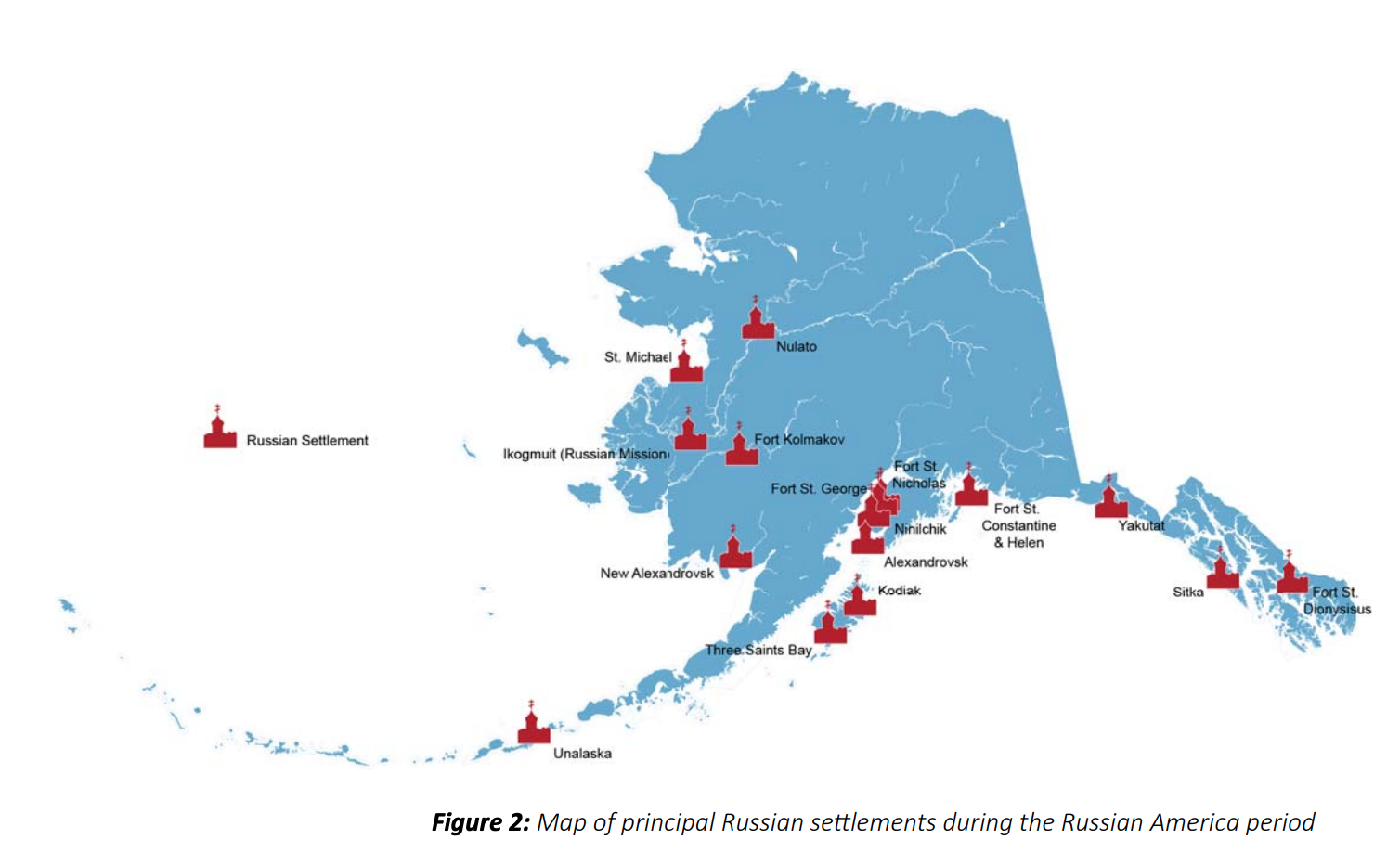
Russia made the first attested European contact with Alaska in 1741 and claimed the territory as its own in 1799. But, this claim didn't really correspond to the facts on the ground:
On maps of that time period, Russia was in control of the entire landmass that became Alaska, but in truth their direct control varied from heavy-handed to nonexistent. In the Aleutians, the Unangans were subjugated by force and made to hunt sea otters for the Russian fur trade. Other areas, including the Arctic region and inland rivers areas, saw little if any Russian presence. . . . 
During the entire period of Russian colonization . . . the Russian footprint remained minimal to nonexistent in several areas of Alaska, including much of the arctic and upriver areas of the Yukon Basin.

The first large scale enumeration ordered in 1819 counted 14,019 people in Russian America, 391 of whom were Russian. This count did not include anyone in interior, arctic, or western Alaska north of the Alaska Peninsula. . . . 

Father Ioann Veniaminov, a Russian Orthodox missionary and scholar who later became Bishop Innocent, produced an estimate of 39,813 people for Russian America in 1839. Noticeably higher than other Russian counts and estimates, Veniaminov surmised that beyond those areas known, 17,000 people had not been contacted yet. He estimated 7,000 people lived along the Kuskokwim River and 5,000 Tlingit lived in Southeast, the most populated areas in Alaska. He put the total number of Russians at 706, with 1,295 “Creoles,” or those born of Russian and Native parents. Before the sale of Alaska, Russian-American Company population numbers compiled from 1830 to 1863 show Alaska’s population ranged between 11,022 and 7,224. Though the estimates of Alaska Natives were low, the report also listed the peak Russian population in the territory at 823 in 1839. 
In the 1880 census, only 1.3% of people residing in Alaska (430) were white, of whom 68% (293) lived in Southeast Alaska, mostly in the capital of Sitka (157) and the old fortress town of Wrangell (105). 

In the 1890 census, 13.5% of people residing in Alaska were white, 53% of whom were only living in Alaska temporarily, mostly as canning workers in Southeast Alaska.

There wasn't a really significant population with European ancestry in what is now Alaska until well into the 1890s. This first large scale surge in Alaska's European ancestry population was a direct result of the 1896 gold strike in the Klondike region of the Yukon Territory.

From the 1900 census to the 1940 census, the percentage of the Alaska population that was white hovered just above and just below 50% (breaking 50% for the first time in 1910, dipping below 50% in 1930, and exceeding 50% in all subsequent years).

Alaska is currently about 60% non-Hispanic white, but only about 50% of children born in Alaska are non-Hispanic white. 

Non-Hispanic whites in Alaska are a plurality in the Southeastern part of the state from a little west of Anchorage to the east and a bit to the north up to the Canadian border and along the Pacific coast to the South (i.e. basically in places with higher population densities).

Other Races and Ethnicities In Alaska

About 18% of Alaskans are currently neither non-Hispanic white nor Alaska Native (solely or in connection with other ancestry). 

About 7% are Hispanic (5% of Alaskans are Hispanics who whom identify racially as white, and less than 2% of whom identify as something else racially including Asian or black), about 8% are Asian or Pacific Islander,  about 4% are black, and less than 0.5% have two or more races that are not Alaska Native. 

The subtotals add up to more than 18% due to rounding issues, due to the fact that some Alaska Natives are people with two more more races who are black, Asian, or Pacific Islanders (mostly Filipinos), and because some black, Asian, and Pacific Islander Alaskans are also Hispanic.

In 2010, two-thirds of Asians, Native Hawaiians, and Pacific Islanders in Alaska were Filipino, and as of 2020 at least half are Filipino. 30%-50% of the population (varying by region) of the Aleutian Island region of Alaska. are Asians, Native Hawaiians, and Pacific Islanders.

Fossil Fuel Economics

Alaska has the third highest revenues from fossil fuel production per capita in the United States at about twenty-thousand dollars per capita, behind only number one Wyoming and number two North Dakota. Alaska is heavily dependent upon the oil and gas industry for tax revenues.

Alaska pays every man, woman, and child who resides there full-time $1,114 per year, no strings attached, from the "Alaska Permanent Fund" of banked proceeds from its oil and gas revenues. It also has no personal income tax.

Alaska and Hawaii are the only U.S. states that generate a significant share of their electricity with petroleum.

More of Alaska is roadless than any other U.S. state.