02 July 2006

Superman Returns Metablogging (Spoilers Alert)

Most of the blogosphere wasn't nearly as impressed with Superman Returns as I was, and some of the criticisms are well taken.

The American Way Quote

Conservatives were outraged over the fact that "Truth, Justice and the American Way" of television, becomes "Truth, Justice and 'all that stuff'" in the words of Perry White, the editor of the Daily Planet (see, for example, here and here and here and here).

Unless you are a rabid conservative it isn't a big deal, however, doesn't hurt the plot seriously, and a conservative Christian Superman apologist, saves the day, however, with a witty observation:

Some may be of the mistaken opinion that Superman, himself, uttered the imponderable unAmerican quote, but he didn't. True to form, it was the editor (Frank Langella) of the MSM Daily Planet who sluffed off the aforementioned comment. Think of him as the editor of the NYTimes or any other big time MSM newspaper and why would anyone be surprised that he would say such a thing. He's the editor of an MSM newspaper afterall!

Here's the other thing. I keep hearing that Superman is "gay." Huh? Who's suggesting this? The "gay lobby?" Are they suggesting that everyone who wears tights is gay? Isn't that a bit prejudicial? Have they forgotten that Superman has the hots for Lois Lane regardless of his attire?

Well if the Gay lobby can wishfully suggest that Superman is gay and others can suggest that he is unAmerican, I'm going to suggest that he is a conservative Christian convert from another planet who saw firsthand that liberalism and the leftist U.N. have been an abysmal failure and he has had to intervene domestically and internationally in order to save mankind. In fact, he altruistically sacrificed his very life for all mankind, not knowing whether or not he would be resuscitated.

Yes, there's no doubt about it, Superman is a devout heterosexual conservative Christian. You go, Supe!


(Another intra-conservative snipe at this take can be found here, chiding fellow free marketers for being anti-globalist.)

While I can nevertheless understand conservative ire over this, and the easy way out would have been to have the less sophisticated and utterly enthusiastic Jimmy utter the phrase, I also have to agree with those bloggers who note that President Bush has tarnished the "American Way" to mean xenophobia, torture and disregard for the rule of law. What director wants to associate Superman with that? Also, the screen writers themselves note that their dropping of the American Way thing, is largely in service of their focus on Superman as a Christ figure who stands for more than just Americans, but is a savior for the entire world. How can conservatives complaint about that?

Although despite the Christ figure references, although, in the movie, almost no one is visibly influenced by this story. A lengthy account at Belief.net spells out the Christ figure elements in excruciating detail after detail. High school English teachers are prone to making unintended symbolic mountains out of molehills, but in this case the symbols are there (and indeed, we have corroboration from the script writers themselves that it was intended).

A comment at the same site is also notable and I'm reprinting it here before it disappears:

TripleCaff
7/2/2006 9:31:06 PM
What's kinda funny about this whole "Christian symbolism' that's being projected into this film is that Superman's original creators were both Jewish, and plenty of Moses parallels can be found in the original story. There's an interesting article on aish.com about it.


The referenced article is here, and probably entirely justified in the Jewish lore that worked its way into the Superman story, although it appropriately doesn't go so far as to claim that Superman Returns lacks a detailed Christian Passion story, instead, merely not discussing that part. (And, of course, Jesus is, in the tradition, a Jewish man, and not a Christian himself.)

Sincere Plot Hole Critics

No two ways about this one. The comic book fans have it right. There are some serious holes in the script.

The supporting cast (hell, even Superman in his Clark Kent persona) was not given an opportunity to shine.

The movie earned some well deserved snark:

Why would ANYONE want to live in Metroplis? Jesus. A day doesn’t go by when there’s not at least one disaster. That town would break FEMA in a month. And the citizens must now be used to them because no one ever heads for cover, no one ever panics, people continue dining at sidewalk cafes even though a car or airplane is hurtling right for them. . . . .

Why doesn’t anyone ever call the Child Protection Agency and blow the whistle on Joan Crawford-worthy mom, Lois Lane? She puts her kid in harm’s way every fifteen minutes. . . .

For a flashback segment (which wasn’t needed at all) they spent untold millions to build a whole farm and cornfield in Australia when they just as easily could have used any fifteen minutes from SMALLVILLE. . . .

If Superman were really wheeled into a hospital he’d be stopped at the door and asked to provide proof of health insurance.

Lois Lane gets into the hospital to see Superman but his mother has to stand outside with the crowd?

In the hospital, they can’t hang up Superman’s suit. They just have to drape it over a chair? Was Superman in a Kaiser hospital? . . . .

You’d think Superman would be smart enough to put a lock on his Fortress of Solitude. If not Lex Luther, there has to at least be Jehovah’s Witnesses stopping by. . . .

With those crystals I thought initially that Lex Luthor’s insidious plan to achieve world domination involved opening a New Age store.


Also high up in the snarkosphere is the "Superman in Prada" poster.

Yes, they totally screwed up the whole kryptonite thing:

I also object to the use of Kryptonite in this movie. By all rights, Superman should not have been able to fly anywhere near New Hawaii (as Nick christened it). Certainly not over it, and then walk around on it without noticing the power drain. I thought this was the plan to begin with - that Lex could set up his new island-o-fun without having to worry about Superman even showing his cute little face. The small effect Kryptonite has on Supe is really, really annoying. If he had a shard of it in him, she should not have been able to fly. Yellow sun or no. (In the comics, Lex kept him at bay with less in his pinky ring) He should not have been able to sustain his upward thrusting when the kryptonite laced crystals burst through the bottom of the land mass he was lifting into space. (I also really wanted to see a shot of the shuttle astronauts going "WTF where did that huge rock come from!? Mayday, mayday! Hard to port!" Alas.) Weakened as he was, he should have been dead when he hit the ground.


In the same vein:

Speaking of boneheaded moves, how is it that Superman lands on an island made of Kryptonite, and he doesn't even realize it's weakening him until he's close enough to be punched by Lex Luthor? You'd have to be awfully unobservant to not notice a GIANT CONTINENT MADE OF THE STUFF THAT KILLS YOU until you are standing on it.


Many movie goers likewise took umbrage at the lax security at the Fortress of Solitude (see, for example, here). As one disappointed fan put it:

Why does Superman leave the Fortress of Solitude totally open and unguarded? It wouldn't have surprised me if Superman came in there and found, not just the crystals missing, but the whole place covered in graphitti and empty beer cans from teenaged Eskimo partiers. I guess he wasn't smart enough to realize that in five years, global warming would make it possible for someone to pilot a yacht to the Arctic and stroll right in.


The leads are too young. Many bloggers noted that the Superman and Lois Lane characters were too young. The actor and actress who play them certainly are:

Kate Bosworth's Lois Lane is problematic. The actress is 23, way too young for the role, and too young to have a five year old kid (spoiler) to Superman unless he bonked her when she was in high school. She does okay, but maybe a more mature actress would have worked better, though Routh is 27 which doesn't make them a bad match age-wise.


Other Points

The references to the 1978 "Superman: The Movie" were overdone. Although some people enjoyed this, as one blogger put it: "The director was not in love with Superman. The director was in love with Superman : The Movie." Riffing on this idea with some really deep analysis and examination of roads not taken, another blogger writes:

And in this film, I spotted at least two plotbunnies that I've seen all over the place in fan efforts, to wit: pregnancy and huge medical emergencies. I've seen both of these in particular all over the Lois and Clark fanfic archive site where I was amusing myself earlier this year. It's full of plots involving Superman getting Lois pregnant without his knowing about it, and later sequel stories where the kid grows up (or kids grow up!) to inherit Daddy's Kryptonian powers. There are also quite a few stories involving Supes in a medical emergency, and I very clearly remember at least one where he was in a coma and thought to be in danger of dying.

Now, to this film's credit, they handled both of these things fairly decently. This film is a sequel to the first two Christopher Reeve flicks, and he and Lois do sleep together in Superman II. That she therefore got pregnant as a result of that is not a stupid idea in the slightest. Neither did I have any real issue with Superman falling into a coma. I mean, he had suffered a huge dose of exposure to Kryptonite, thanks to Lex's little island being laced with the stuff and because of Lex stabbing him with the Kryptonite shard. That the titanic effort of yoinking that island out of the ocean and shoving it into space almost killed him is totally reasonable. Furthermore, I appreciated that the scriptwriters very specifically avoided a couple of the schmaltzy things that they could have done with Superman in a coma--i.e., having him wake up when Lois was whispering to him, or having the kid somehow be able to magically wake him up. I really liked that they had him hear her even while unconscious, that the heart monitor blipped to show this, and that Lois gave it a "you have got to be KIDDING ME" look--and that he did not actually wake up. The boy coming over to give him a smooch on the forehead was also a very sweet little touch, which was exactly how much you needed of the kid in that scene, and not a whit more.

But that I have seen similar plotbunnies in fanfic a lot detracted from the film for me. So did the constant hammering of the concept of Superman as Christ figure, and the too-heavy stealing from the first movie. I caught all the noticeable large chunks of dialogue that were lifted right out of the movie, while spazzkat and solarbird remarked upon how big chunks of the cinematography were also swiped from it, not to mention the entire sequence where Supes zips all over Metropolis doing his string of Superdeeds. It was all too heavily reminiscent of Supes' first night out in the first flick. Lex's female sidekick this time around was also way, way too reminiscent of Miss Teschmacher--flighty, really kind of a decent person deep down, crushing hardcore on Supes, and doing something behind Lex's back to help him out. With her, too, we had rehashes of some of the best Lex lines out of the original movie: "When I was six, my father said to me--" "Get out!" "Heh, no, before that!"

I was really kind of torn, musically speaking, by hearing John Williams' theme playing over the opening credits. Don't get me wrong--I really, really love that theme. It's one of the most iconic movie themes ever, and it never fails to fill my little heart with joy. But to hear it here overall just played for me as another example of this movie swiping way, way too many things from the original Reeve one.


Read the whole thing, as it really does point out the thematic failures of the film.

One blogger noted: "And Superman is kind of a stalker in this movie. That's a little weird." (Other aren't so hard on this behavior.)

I also have to join in noting the shout out to citizen journalism in the movie.

A woman of considerable insight notes:

I've always disliked the depiction of Clark Kent as over-the-top "bumbling" or "mild-manned." It's hard to believe that Clark could succeed as a front-page, investigative reporter on "a great metropolitan newspaper" like The Daily Planet.

I much preferred Dean Cain as Clark in "Lois & Clark: The New Adventures of Superman." He was charming in the role, indicating that it was Superman, not Clark who was the disguise (which made sense) and also made it far more plausible that Lois, if she's a woman of substance, would fall for the real man rather than the icon. This is the route that the comics ultimately took.


"Superman is not gay. He is Jesus, however. I'm sure his creators would love that. . . . In many, many ways, this movie should have been called 'Lois Lane, Superman's Ex-Girlfriend.'"

3-D Imax apparently helps. (Although, "Lois Lane's kid totally needed a haircut and some grooming.")

And, for a truly different consideration, you can get Superman's horoscope (He's a Saturn in Leo).

Lessons Learned

In a low budget B movie things like plot holes, roads not taken, inconsistencies, and pissing off lots of your potential audience with a single line of dialog aren't such a big concern. But, this was a $200 million, give or take, enterprise, with another $150 million or so squandered on aborted efforts that preceeded the version that opened this weekend. Wikipedia's take on the movie calls it an example of "development hell."

Once you commit to a plotline and script in a movie of this magnitude you are really committed. You can't just edit out a $20 million special effects sequence, or add a $10 million addition, at that last minute without really pissing some people off, not least amongst them, the producers who paid to make it happen.

Is it any wonder that adapted sceenplays from proven, well crafted, best sellers are more popular than original screenplays? Indeed, part of the whole idea of doing a comic book movie is that the basic concept can be tested with a small number of illustrators, writers and inkers, for a minimal investment, before you throw the boatloads of money necessary to make a science fiction/fantasy movie at it.

The technical execution of Superman Returns was exceptional. Very few people are complaining about the quality of the special effects, the realization of the visual elements from the first two Superman movies, or quality of the cinematography, although the editing does come in for some considerable criticism (few people think that this needed to be a two and half hour film). But, the underlying screen play was flabby, and the many of the main problems with it should have been clear not later than the story board stage of the production process. Particularly if you are writing a movie that is going to have, by virtue of its lineage and developed fan base, such an intense level of audience scrutiny, it pays to vet your screen plays better with the right kind of people (like the fan community). Clearly, this wasn't done in this case, even though there was a lot of "movie community" input as evidenced by the slavish attention to the details of the prior films and virtually invisible fine touches like the many cameos cast from people with prior involvement in the Superman saga.
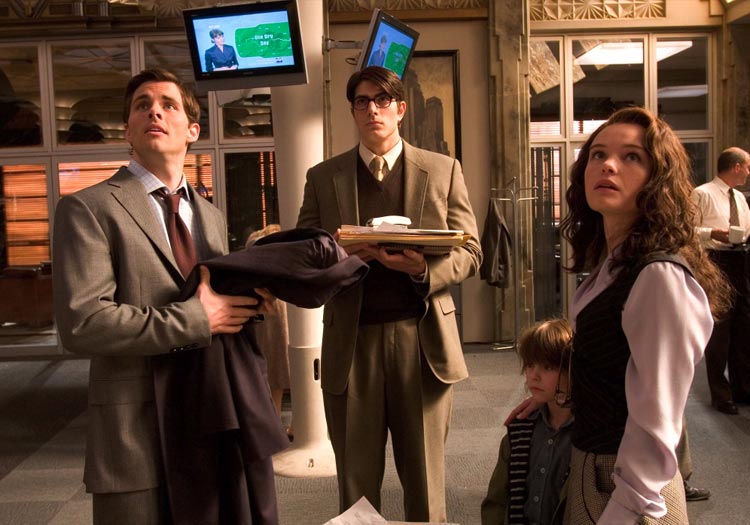
Superman Gets Real (Spoiler Alert)


There are spoilers in the post below. Don't read it if you don't want to know.

The movie Superman Returns hit theaters this weekend. (There is, by the way, no better deal in Denver for first run movies than the $5 early matinee prices offered by Harkins Theaters Northfield 18, which is Northeast of the intersection of I-70 and Quebec in a still under construction shopping area.)

This Superman movie is a cultural landmark. The Superman movies have always been family movies, but this one is actually about family. In its previous renditions on television and in the movies, the Superman saga stuck fast to the paradigm of unattainable courtly love for a woman who plays hard to get. Courtly love remains the dynamic that moves the story forward, but the story has moved closer to that genre's origins in medieval Southern France, where the object of our heroes love is already taken, instead merely being chaste.

Lois Lane has gone from being an unattainable virgin, or at least, a close modern day facsimile thereof, to an unmarried mother of a five year old boy with special needs who lives with her rich fiance, Richard. Richard, incidentally, also happens to be a colleague, her boss's nephew, and despite both of those facts, a man every bit as creditable as we could expect from a woman with standards as high as those of Lois Lane. Superman finds himself in the unfamiliar territory of being the cad, instead of his more accustomed role as a paragon of virtue who simply isn't permitted to reveal he good deeds when in the guise of his alter ego, the ever unreliable Clark Kent. Life goes on, and the ancient genre of courtly love, by hewing closer to its ancient roots, has become a thoroughly modern story.

Mr. Kent has not only left Kansas for Metropolis, but, he has also found himself with no choice but to abandon the straight laced Protestant values he developed there, for the more complex realities of 21st century family life.

It shouldn't really be too much of a surprise that Superman can offer us relevant insights on the family. He was an adopted boy at a time when most states were just starting to pass their adoption laws, and adoption was becoming a preferred option in lieu of a brief stint in an orphanage followed by a youth put out as a family servant.

The picture at the top of this post captures the dilemma nicely. In Superman Returns, we are confronted with three well meaning, genuinely moral adults trying to deal in a civil manner with a love triangle that arose through unmalicious miscommunication, in a way that ruins neither their lives, nor that of a child. Lois genuinely loves both the men to whom she is so intimately tied. All three adult genuinely love her son. Both men genuinely love her. And, the two men both take the high road by giving each other respect and by helping each other in times of need, despite Superman's full knowledge of the situation, and Richard's strong suspicions. (Hell, even Lex Luthor is rehabilitated considerably in this film as a man with his own vision of himself as a sort of hero and some biting commentary on the flaws in Superman's persona.)

In short, the story has gotten real. Family courts every day deal with the issues of psychological parents versus genetic parents that are staring us in the face in this movie. Water cooler talk across America struggles with how to deal with love between co-workers and our romantic choices and obligations. Bars and coffee shops across the nation are full of friends counseling each other on balancing their own emotional needs with those of their children. These issues are obviously too involved to wrap up nicely in two and a half hours. Few movies scream "sequel coming soon" more loudly. But, like most family courts would in a temporary orders hearing, we are left with the unstable status quo more or less in tact.

Notably, this is all accomplished without overt sexuality. Yes, there is subtle implication for the adults. It is not Ozzie and Harriet. Richard and Lois had a bedroom at his luxurious place with a single queen sized bed, and share the routines of their lives together. Even those of us who didn't see the first Superman movie (and the opening John Williams leitmotifs firmly places us in the same continuity as the 1978 film), know from an allusion in the dialog between Richard and Lois, what went on between Lois and Superman, even if she isn't willing to admit it. We know how babies are made.

But, even more notably, it is accomplished without shame, leaving the 1950s, and for that matter, Dan Quayle's 1992 Murphy Brown speech, in the dust. Lois is a Pulitzer Prize winning journalist not about to acknowledge that she has ever done anything wrong, with a child and a fiance she loves to back it up. Superman may be a cad who knows he has to say he's sorry, but that is as far as his guilt extends. Richard never does anything wrong to anyone and is a model stepfather who is acknowledged as a genuine dad. Superman has, like everyone else, learned that there aren't easy answers or clear scripts when it comes to today's complicated families and that you simply have to take it day by day, little by little, and see how it evolves.

Superman Returns

(Link included in exchange for permission to include the photo at the top of this post.)

01 July 2006

Why High School Teachers Shouldn't Date.

If your high school math teacher dated your high school English teacher, you might get abominations like this:

Long separated by cruel fate, the star-crossed lovers raced across the grassy field toward each other like two freight trains, one having left Cleveland at 6:36 p.m. traveling at 55 mph, the other from Topeka at 4:19 p.m. at a speed of 35 mph.

"Good Girl" Chick Lit

First there was Chick Lit. Lizzie Skurnick, writing for the Baltimore City Paper described it as follows:

The trouble began, as it always does, with a Helen. I'm referring, of course, to Helen Fielding, author of 1997's Bridget Jones's Diary. Perhaps you've heard of it? It was only 271 pages long, but the publishing boom it created grossed $71 million dollars in the last year alone, according to a recent report by ABC News, and launched a flurry of manuscripts that could bury a small nation in typescript. And this summer it seems like they all made it to your local bookstore.

We're talking about Chick Lit--a trend variously described as "breezy novels written by and about young women" (Fort Worth Star-Telegram); "stories of fallible, single professional women" (The Sydney Morning Herald); and "tales dominated by a plucky heroine who searches for her place in the big city" (Hollywood Reporter). (Chick Lit has arguably started its own cottage industry: articles about Chick Lit.) It's the Bildungsroman of the spike-heeled, single girl--and she's downing some Chardonnay at a multilevel bookstore display near you.

Chick Lit is often confused with romance literature, but it has little to do with bodice-rippers and frothy historical pas de deux. Its roots are in books like Mary McCarthy's The Group, Helen Gurley Brown's Sex and the Single Girl, Rona Jaffe's Best of Everything, and Nora Ephron's Heartburn: works that linked the touchstones of their eras--white-gloved marriages, career girls, the Pill, divorce--to the women.


I read Rona Jaffe growing up (she drew me in with a little tale called Mazes and Monsters that was made into a TV movie about role playing game players, and I read more from there). And, the Bridget Jones movie wasn't half bad. But, like all newly emerging genres, it has mutated.

"It's the good girls who keep diaries," said Tallulah Bankhead. And, while the bad girls have been busy writing sex blogs instead, the good girls have turned their diaries into literary ventures.

The result? "Good girl" Chick Lit. What is it?

Let’s face it. Life is messy. And trying to live by faith only makes it harder. Good Girl Lit features contemporary characters dealing with modern life. It’s about facing real issues with faith. It’s about trying to live as God wants, and failing. It’s also about the redeeming power of grace. It’s Christian fiction for the real world.


Here's a blurb about one of the latest offerings in the genre, Consider Lily:

A tale of love, trials, and faith set against a wonderfully drawn portrait of San Francisco, Consider Lily is chick lit with a heart.

Lily Traywick thinks she must have been adopted. It’s easier than believing she’s actually related to Jane and Roland Traywick, her power-couple parents who own Traywick’s of San Francisco, the most chichi department store on the West Coast. While her parents party with Muccia in Milan and Gabbana in Paris, Lily hangs out at home in ratty jeans and an old T-shirt. She loves softball, guys, and Jesus, and she’s eager to make her own way in the world. Feeling that her life is on hold, she turns to her best friend Reagan Axness. Reagan, a fashionista who has it all, offers just the solution: a major life makeover.

Lily is soon dressing in the latest must-have fashions and pursuing a writing career. She’s even dating the “perfect” guy. But does he love her for who she really is? And will he be able to resist the tempting seductress who has her eye on him? As Lily’s old friends question her new way of life, and public scandal, family drama, and technological disasters add to her confusion, Lily is forced to consider whether her quest to have it all will cause her to lose everything that matters.

Hot off their debut success, Emily Ever After, “good-girl” chick-lit trailblazers Dayton and Vanderbilt return with a witty, refreshingly real story of a young woman’s adventures in the high-powered world of San Francisco high fashion.


Decadence and teenage rebellion are alive and well, it seems, but these days, apparently, it is the parents who are being decadent, and the teens who are rebeling against it. This anti-Paris Hilton protagonist is on K-Mart book section shelves everywhere.

Indeed, my comments above notwithstanding, they even have charming little blog, with stories like:

There IS a God

Saturday, July 1, 2006
Coffee and alcohol work together!


and

little observations like:

I saw someone reading Consider Lily on the subway today. I giggled like a child. It caught my eye because, well, because it is florescent.

Newsflash: Dating is good for you, spiritually.


Honestly, while my first thought upon discovering it is a gag reflex, it is probably one of the most healthy developments on the American Christian scene in decades. Somebody has to rescue Christianity from the cultural deficiencies of the land of peaches and magnolias, and who better to do it than a couple of spiritual women who are still in tune with the soul of New York City.

The 65% Solution Ballot Measure

Colorado voters will be considering a proposal called the "65% solution" devised by an Ohio politician, which limits how much money schools can spend on "non-instructional activities". A conservative pundit has called it one of worst ideas in education.

This is an issue that liberals and conservatives can agree should be defeated in November.

Voter ID Requirements

Governor Owens in his special session call has demanded that the legislature impose ID requirements to vote. To see why this is a bad idea, we need look no further than the examples of Arizona and Georgia.

Here's what happened in the 2005 election in Arizona:

In Maricopa County, home to Phoenix, more than 10,000 people trying to register have been rejected for being unable to prove their citizenship. Yvonne Reed, a spokeswoman for the recorder's office, said Friday that most probably are U.S. citizens whose married names differ from their birth certificates or who have lost documentation.


It takes two to three years to get a marriage license from California, if you have lost your copy, so you can prove your citizenship.

Georgia's effort to introduce this requirement was held unconstitutional as a poll tax, because it required voters to pay for an ID in order to vote. It has since salvaged its rule, but only by making a voter ID free. The requirement will still likely deprive many in Georgia of the right to vote because it was imposed at the last minute.

Here's what Senator Obama from Illinois has to say about these requirements:

There are two problems with the argument: number one, there's been no showing that there's any significant problem with voter fraud in the 50 states. There certainly is no showing that non-citizens are rushing to try to vote: this is a solution in search of a problem.
The second problem is that historically disenfranchised groups - minorities, the poor, the elderly and the disabled - are most affected by photo ID laws. Let me give you a few statistics, overall 12% of voting age American do not have a driver's license, most of whom are minority, new U.S. citizens, the indigent, the elderly or the disabled. AARP reports that 3.6 million disabled Americans have no driver's license. A recent study in Wisconsin this year found that white adults were twice as likely to have driver's licenses as African Americans over 18. In Louisiana, African Americans are four to five times less likely to have photo IDs than white residents.

Now, why won't poor people be able to get photo IDs or Real IDs? It's simple. Because they cost money. You need a birth certificate, passport or proof naturalization and that can cost up to $85. Then you need to go to the state office to apply for a card. That requires time off work, possibly a long trip on public transportation assuming there's an office near you. Imagine if you only vote once ever two or four years, it's not very likely you'll take time off work, take a bus to pay $85 just so you can vote. That is not something that most folks are going to be able to do. . . .

The Carter-Baker commission in 2002-2004 said fraudulent votes make up .000003% of the votes cast. That's a lot of zeros. Let me say it a different way. Out of almost 200 million votes that were cast during these elections, 52 were fraudulent. To put that into some context, you are statistically more likely to get killed by lightning than to find a fraudulent vote in a federal election.


Even the Carter-Baker Commission which proposed voter ID requirements, has stated that any such requirements should wait until 2010, to allow adequate time to prepare voters and election officials for the change, and should include free access to voter IDs for the 12% of Americans of voting age who don't have driver's licenses.

Waiting in line at one of the few remaining driver's license bureaus in the state to get a state ID is a relatively minor inconvenience if you are an able bodied person. It is a serious barrier if you are bed ridden in a nursing home, for example. Colorado does not currently have any provision for having state ID officials make house calls for the disabled.

Improper voting was examined closely in one recent Wisconsin race. What did the study find:

Apparently dead people 12.

[I]nterviews revealed honest mistakes occurred in most cases. One woman was upset to learn that the federal government had erroneously marked her as being dead; two men had been unwittingly voting under their dead fathers' registrations.


Felons on Parole 361

Like Colorado, in Wisconsin you can't vote if you are in prison or on parole, but aren't disqualified from voting entirely simply for having a felony conviction. Those who voted were still on parole.

and

Legal Immigrants Awaiting Naturalization 4.

There were no double votes.

The review looked at 370,000 voting records. Thus, roughly one in a thousand was a felon on parole, and one in 100,000 was a non-citizen, in each case apparently just shy of being a citizen.

In the 2004 election in Colorado, our experience was similar:

122 people voted twice statewide, casting absentee ballots through the mail, then showing up in person to vote on Election Day;

120 felons cast illegal ballots statewide;

In Denver, 81 residents voted twice and 52 felons cast ballots;

In Jefferson County, elections officials requested that prosecutors investigate 30 cases of people attempting to vote twice and 256 cases of suspicious signatures on absentee ballots;

In El Paso County, officials reported 23 cases or prisoners or parolees who voted. (145)

Less than one month before Election Day, The Denver Post reported that Colorado’s voter rolls contained as many as 6,000 felons ineligible to vote[.]


I don't agree with the rule that keeps felons on parole from voting, since integrating people into the community through civic involvement like voting makes a symbolic step towards rehabilitation of criminals and the social benefit involved in keeping paroled felons off the voter rolls is ought weighed by the considerable cost of enforcing the law. But, there is little doubt that this is the main source of unauthorized voters in Colorado, far overshadowing the issue of illegal immigrants voting, a non-existence problem in the state.

As the office of Donnetta Davidson, former Republican Secretary of State for Colorado noted around the time of the 2004 election:

Mrs. Davidson said she would hold a meeting with county clerks and district attorneys on Saturday to grapple with voter-fraud issues. The problem lies not with would-be voters, but with disorganized voter-registration organizations, said Davidson spokeswoman Dana Williams.


And, as a voter regisration group representative noted:

Registration fraud is different than voter fraud. Just because you register someone 35 times doesn't mean they get to vote 35 times. They can only vote once.


Similarly, Betty Ann Habig, a Centennial council member who has been volunteering in the busy Arapahoe County Clerk and Recorder's office, said:

Is there a concerted effort to perpetuate fraud? No, but you have to remember, these folks are getting paid by the piece.


State ID requirements do nothing to address the largest cause of unauthorized voting, which is felons on parole voting, or address the problem of double voting, while this requirement does pose a proven risk of disenfranchising many legitimate voters by creating bureacratic hoops for them to jump through.

As Spencer Overton, a member of the Carter-Baker Commission noted in his dissenting opinion from that study, which is a main movitator for voter ID requirements:

The existing evidence suggests that the type of fraud addressed by photo ID requirements is extraordinarily small and that the number of eligible citizens who would be denied their right to vote as a result of the Commission's ID proposal is exceedingly large. According to the 2001 Carter-Ford Commission, an estimated 6% to 10% of voting-age Americans (approximately 11 million to 19 million potential voters) do not possess a driver's license or a state-issued non-driver's photo ID, and these numbers are likely to rise as the "Real ID Act" increases the documentary requirements for citizens to obtain acceptable identification. The 2005 Carter-Baker Commission does not and cannot establish that its "Real ID" requirement would exclude even one fraudulent vote for every 1000 eligible voters excluded.

The Commission's ID proposal would exclude Americans of all backgrounds, but the poor, the disabled, the elderly, students, and people of color would bear the greatest burden. According to the Georgia chapter of AARP, 36% of Georgians over age 75 do not have a drivers' license. In the United States, more than 3 million people with disabilities do not have identification issued by the government. A June 2005 study in Wisconsin found that the rate of driver's license possession among African Americans was half that for whites, and that only 22% of black males age 18 to 24 had a driver's license. The lack of government-issued photo ID is particularly acute among Native Americans, some of whom have religious objections to photo ID.

The exclusionary effects of the Commission's ID proposal are best illustrated by some of the people it is most likely to disenfranchise-the victims of Hurricane Katrina. Many who were left behind in hurricane-torn New Orleans were poor, did not own a car, and were less likely to have a driver's license. These forgotten Americans-and many like them across our nation-are the ones the Commission's ID proposal will most likely leave out of our democracy.


Overton noted in his testimony before Congress that:

[I]n states such as Wisconsin 78 percent of African-American men ages 18-24 lack a driver’s license. By comparison, a study of 2.8 million ballots cast in 2004 in Washington State showed only 0.0009 percent of the ballots involved double voting or voting in the name of deceased individuals. If further study confirms that photo identification requirements would deter over 6,700 legitimate votes for every single fraudulent vote prevented, a photo identification requirement would increase the likelihood of erroneous election outcomes. . . .

[A] statewide survey of each of Ohio’s 88 county boards of elections found only four instances of ineligible persons attempting to vote out of a total of 9,078,728 votes cast in the state’s 2002 and 2004 general elections. This is a fraud rate of 0.00000045 percent. The Carter-Baker Commission’s Report noted that since October 2002, federal officials had charged 89 individuals with casting multiple votes, providing false information about their felon status, buying votes, submitting false voter registration information, and voting improperly as a non-citizen. Examined in the context of the 196,139,871 ballots cast between October 2002 and August 2005, this represents a fraud rate of 0.0000005 percent (note also that not all of the activities charged would have been prevented by a photo identification requirement).


Given the extremely low rates of voter fraud, any procedure that disqualifies even a small percentage of legitimate voters is likely to do more harm than it prevents.

A proponent of voter ID requirements testifying before Congress described in detail about a 2005 Utah study, but his data was not very convincing:

In 2005, Utah’s legislative audit bureau attempted to undertake a systematic study of illegal immigrants who had obtained state identification cards – either driver’s license or state identification cards. Utah determined that some 383 possibly illegal immigrants were registered to vote. Utah asked ICE to review these registered voters to determine if, in fact, they were U.S. citizens. ICE examined a sample consisting of 135 of these individuals and determined that 5 were naturalized citizens, 20 were “deportable,” one was a permanent legal resident and the other 109 had no record and were likely in the United States illegally. Fourteen of these 383 individuals voted in a recent election in Utah, but ICE did not provide enough information to the state to allow it to determine whether these 14 individuals were in fact citizens.


Got that? In all of Utah, there were, at most 378 illegal aliens registered to vote, possibly far fewer, and that only 14 member of a group of 383 yellow flagged voters, 5 of whom were definitely U.S. citizens and 109 of whose status was undetermined, actually voted. If 14 or fewer illegal votes in all of Utah is the magnitude of the problem, it is hardly a major public emergency.

Hawaii had 543 people in Oahu, home to the vast majority of its population, in 2000, who might not be citizens on its voter roles. There is no evidence that a meaningful precentage of them actually voted.

Similar data comes from Harris County, Texas, which has a population of 3.7 million people, almost as large as the entire state of Colorado, and is estimated to have in that county alone, roughly twice as many illegal immigrants as the State of Colorado, about 500,000. How many foreign nationals applied to vote in 2005? About 35.

An overwhelming majority in the House of Representatives, a Republican controlled committee of the House that examined the issue, and California election officials, all found that allegations of widespread fraudulent voting by illegal aliens in the 1996 election in the 46th Congressional District between Robert Dornan and Loretta Sanchez was not substantiated.

Interestingly, most people don't know it, but the constitution does not even require non-citizens to be excluded from voting. Texas permitted it prior to 1921.

There are non-citizens on voter rolls in the United States (most probably through flaws in the motor-voter registration system) and a very small percentage of them, perhaps 3-4%, actually vote.

Non-citizen voting is hardly a pressing problem that needs to be dealt with at the last minute in a special session, as Governor Owens has insisted. Indeed, it is interesting that Republicans think that people voting is an emergency, but people not voting isn't a problem.

30 June 2006

Aquitted Conduct As Evidence.

In a recent Colorado case, a Colorado trial court allowed a jury to here testimony from two woman who said that they had been sexually assaulted by the defendant in a case involving a third woman, even though the two prior cases had gone to trial and resulted in acquittals. The judge found by a preponderance of the evidence that the sexual assaults had taken place despite the acquittals, and offered the women's testimony as modus operandi evidence (Colorado Rule of Evidence 404(b)). This decision was affirmed in a 2-1 decision, on appeal.

Given that their testimony, which provides trials within trials, in effect, could not be a complete as the actual trials that produced the acquittals, and the fact that the jury wanted that additional evidence and asked for it in deliberation, excluding the fact of the acquittals seems particularly prejudicial. Yes, acquittal does not mean a finding of innocence, and the jury should be instructed of this fact, but given the general distrust the legal systems has of propensity evidence, it should come with footnotes when appropriate to impeach the implication left, which was that the individual was a serial rapist with two prior convictions, something that wasn't the case.

Death Penalty Overkill?

Douglas Berman, of the Sentencing Law and Policy Blog, explains why he thinks that courts, and particularly the U.S. Supreme Court, devote to much attention to death penalty cases. The main points:

1. The death penalty is a regional issue with little or no impact in most of the country.
2. Death is so different that it often can skew the development of the law.
3. Innocence issues aside, the very worst defendants get (very limited) benefits from all the time and attention give to capital cases.
4. Our massive criminal justice systems implicate many issues that get little attention.

The strongest counterpoint is not the one he is responding to in that post. Instead, the best reason to focus on capital punishment is a canary in the mine theory. High capital punishment rates in places like Texas are a symptom of particularly sick criminal justice systems. It is a regional issue because the South it far behind the rest of the county in the fairness of their criminal justice systems, particularly at the state level. After the South, the federal system's draconian sentencing is ailing most seriously.

This isn't to say that other states are paragons of virtue. California's three strikes law, for example, is a nightmare, and the grittier day to day operations of California's system are nothing to write home about. But, most state court criminal justice systems outside the South are far less out of whack.

Big Changes For Wash Park Prophet Blog

I'm keeping my day job. But, starting in July, I'll be taking on a major new project. I'll be going semi-pro as an independent blogger-journalist focused on Colorado.

I've always had a Colorado focus, not just at this blog, but at my previous gigs as a contributor to Political State Report, and before then, in diaries at Daily Kos. This will be a group effort. Some of my blogger-journalist colleagues will be familiar to the progressive Colorado blogosphere. Some may be new faces. The details are under wraps for a few more days. Some of the details have yet to be worked out.

The bottom line is that a large share of my blogging output will be devoted to this project. The Wash Park Prophet blog will continue to exist, partially with cross-posts, and partially with material exclusive to this site that doesn't fit with my new focus. My "Steal All You Want" copyright policy will also probably change soon, at least in connection with my cross-posts. Stay tuned for more details as they become available.

The History and Future of Kosovo

Daily Kos diarist Sirocco offers the fullest history of Kosovo that I have ever read. Near the conclusion of his thorough, illustrated and hyperlinked account, Sirocco sums up the current situation in the wake of a concluded U.S. lead NATO military campaign that had just been resolved in 1999:
Upon the end of hostilities in June, Kosovo Albanian refugees started to return; but at the same time, Serbs fled or were chased out by Albanians in equally large numbers. By July 20, the UN High Commissioner for Refugees estimated that 150,000 Serbs were flooding into Serbia, which already harbored half a million refugees from the other ex-Yugoslavian wars. The total number of refugees from Kosovo rose to some 230,000, most of them Serbs. Of these, over 200,000 remain Internally Displaced Persons in what is Europe's biggest refugee problem. A hundred thousand Serbs stayed put among approximately 1.8 million ethnic Albanians, among whom little love was lost on Serbs.

This minority now dwell in KFOR-guarded enclaves, with limited freedom of movement and high unemployment even by the standards of a dysfunctional UN protectorate where only the black economy flowers. The Serbian apartheid state has effectively been inverted. More than 4,000 Serbs worked at the public electricity service in 1999; today around 30 do so, out of 8,000 employees. Meanwhile, barbed wire and armed KFOR troops protect those medieval monasteries that remain recognizably intact.

Independence is, however, finally in the offing, mostly because the Western powers acknowledge once again that the majority would never settle for less. Serbia, impoverished and demoralized, is unable to do more than strut and fret at the impending loss of its "historical heartland."
I recently discussed more recent events related to Kosovo. U.N. sponsored talks in Vienna aimed at mapping out Kosovo's future are ongoing. As I summed up then, the U.N. and by extension NATO which has committed to following its lead:

will be pushing hard for Kosovo's independence, if ratified in a referendum whose outcome is largely a foregone conclusion. But, the U.N. will also likely push to have independence for Kosovo limited by provisions of Kosovo's own constitution and/or international treaties with Serbia, which would provide the human rights protections and protections for cultural and religious heritage which Serbia has sought to retain jurisdiction over in an autonomous state (the flexibility referred to by the U.N. representative), but not foreign policy, currency or border control for Serbia.


The international community would very much like Serbia to consent to Kosovo's independence, however, because it fears "opening up the can of worms associated with the notion of unilateral declarations of independence by a portion of an existing sovereign state."

Serbia is trying to leverage that fear into an agreement to broad autonomy short of sovereignty, that would permit it to salvage its national pride and would leave open an opportunity to restore greater control some time in the future when it is not in a world spotlight. This is the approach that it took in 1989 when it attempted to roll back autonomy status granted to the region in 1974 by Yugoslavian leader Tito, precipitating the crisis in Kosovo that lead to international military intervention.

The assessment of the situation on the ground provided by Sirocco, where the current population is almost 95% Albanian Kosovar, and the Serbian minority lives in segregated, economically depressed compounds at the sufferance and protection of international forces (and more would probably leave, if international forces ceased to protect them), suggests that the Serbian bid to retain sovereignty is unlikely to succeed.

29 June 2006

Enforcing Hamdan

I won't be the first observer to note that one of the most important aspects of the U.S. Supreme Court's Hamdan decision today is its holding that al Queda members are still entitled to the benefit of Common Article 3 of the Geneva Convention. This case focused on the right of those individuals to due process prior to punititive sanctions. But, another part of the same article bans torture and near torture.

The question that immediately follows is, how does this get enforced?

Hamdan does not, itself, authorize private lawsuits to prevent the government from torturing detainees. It applies the Geneva Convention only as part of the law of war which is referenced in the Uniform Code of Military Justice. The Detainee Treatment Act of 2005, on its face, at least, expressly forbids Guantanamo Bay detainees from bringing new lawsuits to remedy the harms they have suffered as a result of violations of the Geneva Convention by the Bush Administration. It would appear unlikely that a taxpayer or individual legislator would have standing to bring such a lawsuit.

There is some chance that the issue may be raised in a lawsuit already pending when the Detainee Treatment Act of 2005 was enacted, whose jurisdictional validity is affirmed in Hamdan. In that case, a court could enforce compliance by holding responsible officials, such as Secretary of Defense Rumsfield in contempt of court, either detaining him at the hands of a U.S. Marshall, or fining him, in order to secure compliance, or perhaps even empowering another individual to issue such binding military orders as are necessary to ensure compliance with the Geneva Conventions.

But, suppose that this legal strategy doesn't come together. Is Hamdan's pronouncement about the meaning of the Geneva Conventions necessarily without effect? I don't think that it is meaningless. Admittedly, the President has discretion to direct the attorney-general not to commence war crimes prosecutions based on the United States Code that prohibits violations of the Geneva Conventions in exercise of prosecutorial discretion. And, admittedly, the President can shut down courts-martial directed to punish misbehaving soldiers. But, the federal governments is fundamentally comprised of relatively intelligent individuals, selected on the basis of merit except at the very highest levels, who are in the business of following rules. This is what bureaucrats do.

It is one thing for a lone bureaucrat or soldier to go out on a limb to quash what political leaders want on the grounds that the order is unlawful when the law is a subject of debate. It is quite another to do so when the U.S. Supreme Court has spoken clearly on the issue. Indeed, even many politically appointed officials in the Office of Legal Counsel would have qualms about outright defying the U.S. Supreme Court's recent, clear determination of an issue of constitutional law. To do so would be to welcome legal anarchy, when they themselves need to have a system for giving themselves legal authority to maintain their own power.

In confidential areas of national security and intelligence, legality has always rested on the commitment of government officials to adhere to the law, because no one else is in a position to know of the violations that take place. Ambiguity in the law engineered by people like Judge Yoo and Alberto Gonzales, created a cover which permitted things like the torture memos and illegal NSA surveilance to go forward despite discomfort from career government employees used to operating on a more restrained basis. But, the Hamdan case, along with the McCain Amendment limiting torture, blows away much of that legal cover, and the Hamdan case also decisively wipes out the authority of the President to follow "signing statements" purporting to take the position that the President does not have to follow duly enacted laws regarding national security.

This has the potential to inspire mass resolve within the career staff of the Central Intelligence Agency and Department of Defense. They are now both on notice that they could be subject to prosecution for continuing to carry out illegal Bush Administration torture policies (perhaps under a successor administration), and empowered to be insubordinate when given a dubious order. By making clear what is legal and illegal, even if there is no formal enforcement mechanism, many career civil servants will do what comes naturally, which is to do what is legal. As comfortable as they may be playing in gray areas of the law, your typical law abiding bureacrat is not comfortable flauting the law, even if the President and his inner circle are perfectly happy to do so.

Of course, bureaucrats are creative people. They don't march in the streets. Most will not even go so far as to leak the fact that the administration is breaking or trying to break the law, which has questionable legality itself, although the brave might send a letter to the inspector general of their agency. But, there are many ways that bureacrats can thwart projects short of outright defiance. They can work to rule. They can slow down and deprioritize questionable projects. The can make "mistakes" in classifying material that informs the media and elected officials of what is going on. They can require more clearances than would normally be insisted upon to cover themselves, before proceeding. Enough delay in implementing administration policies can cause implementation to outlast the administration itself. Most political appointee managers eventually discover the power of the bureacracy and learn to seek peace with it.

Those who do not, like our recently department leadership group in the CIA, often pay for the inability to seek peace with their jobs.

Indeed, this phenomena also comes with a conclusion for good jurisprudence. In private law cases, there is a strong judicial imperative to decide no more in a given case than is absolutely necessary to resolve the case. The norm against making rulings that are dicta, or simply issues raised but not necessarily decided by a case, depending upon the order of decision, makes all sorts of sense in the private law context, which inherently disenfranchses other similarly situated people from participating in the process of making precedent. Indeed, the same norm applies for similar reasons, in the public law context (i.e. suits against government) when it concerns, for example, the rights of police officers employed by our fractures local governments.

But, when the courts address the rights on similarly situated individuals vis-a-vis the solitary federal government, particularly when the case is such that it is hard to posture for court review, the opposite philosophy makes sense. The Courts should push to clarify as many issues legitimately raised by the case as possible, because the guidance that the case provides will bring clarity that will encourage compliance with the law, and the lack of participation by impacted parties is at a minimum.

The Marines' New Ride

The U.S. Navy's newest ship designed to deliver Marines to war, the San Antonio class LPD-17, which entered service in January of this year, is summed up in depth by Defense Industry Daily. Eight more are planned.

Basically, the San Antonio, which, at 25,000 tons, is larger than the Austin class ships it is intended to replace, carries 800 Marines and their vehicles, supplies and gear. Like other ships designed to deliver Marines to amphibious assaults, it is diesel powered.

They will have deck spots for operating and supporting up to 2 $100+ million MV-22 Osprey tilt-rotor aircraft, or 4 CH-46 Sea knights or comparable helicopters, or 6 AH-1 Super Cobra/ Viper attack helicopters, or 2 CH-53 Super Stallion heavy transport helicopters. Hangar space will accommodate only one V-22 Osprey tilt-rotor or CH-53 heavy-lift helicopter, or it could be used for up to 3 AH-1 attack helicopters, or 2 CH-46 or comparable-size helicopters, or any appropriate combination thereof.

These ships will also carry 2 LCAC hovercraft for ship-shore transport, plus 14 of the Marines' forthcoming Expeditionary Fighting Vehicles with swim-out capability up to 20 miles offshore.


It also has amenities like a 24 bed hospital, a water desalinization plant, and advanced sensor and communications gear, and better than average creature comforts, with an eye towards it serving as a flagship for a larger Marine force. It has only defensively oriented weapons: anti-aircraft missiles, a close in weapons system (largely designed for fending off small craft and cruise missiles) and .50 caliber machine guns (for small craft and individuals on docks). It is not equipped to actively fight submarines and warships, a task left to any Navy ships escorting it.

The only U.S. military combatant ships which are larger are aircraft carriers (i.e. supercarriers) which are about 97,000 tons, and amphibious assault ships (i.e. Harrier carriers), such as the Wasp and Tarawa class ships which are about 40,000 tons.

The San Antonio primarily replaces the Austin class of ships, although the Navy has pitched the San Antonio as also replacing a couple dozen other ships that have already been retired from service.

Navy sources note that the 9 scheduled ships of this class (reduced from 12) are slated to assume the functional duties of up to 41 previous ships. These include the USA's older LSD-36 USS Anchorage Class dock landing ships (all decommissioned as of 2004, LSD-36 and LSD-38 transferred to Taiwan) and its LPD-4 USS Austin Class ships (12 ships of class built and serving). The San Antonio Class ships may also replace two classes of ships currently mothballed and held in reserve status under the Amphibious Lift Enhancement Program (ALEP): the LST-1179 Newport Class tank landing ships, and LKA-113 Charleston Class amphibious cargo ships.


Like many defense projects, it was far over budget, was behind schedule, and was built in a manner characterized by "shoddy construction and basic workmanship problems." The San Antonio itself will end up costing $1.7 billion and was projected to cost a little under $1 billion. The next ship of its class, the New Orleans, will cost $1 billion, compared to a projected $0.76 billion. Stealth features are also not living up to promised standards.

The San Antonio does not represent any major conceptual shift from the prior regime, except perhaps, for replacing several smaller Marine transports with one larger one, intended to operate from over the horizon. The big open question is whether this still meets the needs of the Marines in this quantity, or whether bolder innovation was necessary.

1600 Posts

Today is the 11th anniversary of my admission to the practice of law, in New York State, my first bar admission.

Four days from today is the 1st anniversary of this blog, so I've been posting between four and five posts a day, on average. Technorati reports that 75 other blogs link here, although it turns out that many of them are trackback spam. Traffic has steadily increased, with more than 200 unique visitors a day at this point most work days. About half of the traffic comes from search engines (overwhelmingly Google) and most of the rest from website referrrals.

The blogroll needs some updating and is on the "to do" list. I'm thinking about some new directions for the year to come, but haven't come to any definitive conclusions yet.

Government Loses Hamdan Case

The Hamdan case addressed the rights of people detained as enemy combatants at Guantanamo Bay when tried for crimes beyond merely being detained, a detention which was itself upheld. The U.S. Supreme Court ruled against many key parts of the Bush Adminisration's enemy combatant doctrine. The main ruling was 5-3 with Justice Roberts who ruled in favor of the government in the U.S. Court of Appeals before he was appointed, not participating. Justice Kennedy, part of the majority, concurred in only part of the primary opinion by Justice Stevens. SCOTUS Blog has a syllabus of the decision. The full opinion is here.
The Court expressly declared that it was not questioning the government's power to hold Salim Ahmed Hamdan "for the duration of active hostilities" to prevent harm to innocent civilians. But, it said, "in undertaking to try Hamdan and subject him to criminal punishment, the Executive is bound to comply with the Rule of Law that prevails in this jurisdiction."
Basically, the Court's main opinion held that:

1. The government can try Hamdan, but must comply with rules essentially identical to courts-martial for U.S. soliders, not the reduced legal protections of the military commissions established by the administration.

2. The Detainee Treatment Act of 2005, which divests the courts of jurisdiction over most Guantanamo detainee appeals did not apply to pending cases. And, it ruled out refraining from addressing the case out of a generalized deferrence to the President in military affairs, or because the commission had not reached a final verdict.

3. Neither the Detainee Treatmen Act of 2005, nor the Authorization for Use of Military Force following 9-11, which was used as the basis for the war in Afghanistan authorized the creation of military commissions which were contrary to the Uniform Code of Military Justice and the Geneva Conventions. But, the commissions created by the President violated both the UCMJ and Geneva.

4. Military commissions and courts-martial must comply with the Geneva Conventions, at the very least, because they are part of the laws of war, which the UCMJ provides must be considered.

5. Common Article 3 of the Geneva Conventions, at least, applies to the war with al Qaeda, which is not a Convention signatory.

6. Common Article 3 includes: "a prohibition on 'the passing of sentences … without previous judgment … by a regularly constituted court affording all the judicial guarantees … recognized as indispensable by civilized peoples.'"

7. As an aside, Common Article 3 also "provides that detained persons 'shall in all circumstances be treated humanely,' and that '[t]o this end,' certain specified acts 'are and shall remain prohibited at any time and in any place whatsoever'—including 'cruel treatment and torture,' and 'outrages upon personal dignity, in particular humiliating and degrading treatment.' This standard, not limited to the restrictions of the due process clause, is much more restrictive than even the McCain Amendment." This means that the President's treatment of many terrorism suspects was illegal. But, it does not clarify how detainees may go about enforcing this right. For example, do they have a private right of action to enforce it? The other part of Common Article 3, in contrast, is enforceable through the UCMJ courts-martial process through additional Congressional action in the form of express adoption of the "laws of war" as part of the rules of courts-martial.

8. Specific problems with the military commissions include: (a) the use of evidence kept secret for the defense, (b) a lack of real limits on evidence that the commission may consider, (c) the UCMJ requires its proceedures to be applied, if practicable, to trials of detainees in commissions, but the administration has failed to show good cause for deviating from those procedures, and (d) in the sense of the Geneva Conventions it is not a "regularly constituted court affording judicial guarantees."

In a part of the opinion not joined by Justice Kennedy, Justice Stevens stated:

1. The conspiracy crime with which Hamdan has been charged cannot be brought because it is not part of the law of war.

2. "[A]n accused must, absent disruptive conduct or consent, be present for his trial and must be privy to the evidence against him." If he is not, the commission violates the Geneva Conventions.

Meanwhile:
Justice Kennedy, agreeing that Hamdan’s military commission is unauthorized under the Uniform Code of Military Justice, 10 U. S. C. §§836 and 821, and the Geneva Conventions, concluded that there is therefore no need to decide whether Common Article 3 of the Conventions requires that the accused have the right to be present at all stages of a criminal trial or to address the validity of the conspiracy charge against Hamdan.


The exact status of this part of the ruling is not exactly clear. While Kennedy didn't join it, he didn't dissent. So, is this a 4-4 ruling, or a 4-3 ruling? This will only come up when new charges using a court-martial procedure are used, and only if the Bush Administration goes this route. The secret evidence holding probably is moot if a court-martial procedure is used. The conspiracy holding, in contrast, is central to any result, since this is a charge against all of the military commission defendants, and the only charge against many of them. To the extent that the issue is not decided in this case, there are at least four votes to say that conspiracy charges are not permitted, and probably four votes to say that they are permitted, leaving Kennedy as the swing vote if the issue returns to the U.S. Supreme Court.

Bottom line: The Bush Administration's military commissions in Guantanamo Bay are kangaroo courts. But, Gitmo can stay, if it stops engaging in torture and near torture.

28 June 2006

Ken Salazar Disses First Amendment

Ken Salazar and Wayne Allard, Colorado's U.S. Senators care more about the flag than the political freedoms it represents. This is predictable in the case of Wayne Allard, who has a long record of standing up for torture and all things un-American. We could have hoped for better from Democrat Ken Salazar, whose Democrat party was able to prevent a constitutional amendment to ban flag burning from passing in the Senate by one vote, with the help of three Republicans with some sort of conscience, and one former Republican who is now an independent.

Base appeals to knee jerk reactions from faux patriots are apparently more important to Ken Salazar than the principal of protecting the freedoms established in the Bill of Rights. Ironically, under prior flag care laws, most of those punished were people who were trying to be patriotic and were ignorant of the established rules for doing so, the same sort of people who want this amendment now. Senators should lead, not just cave to our baser impulses. But, Ken Salazar has again failed that test.

The Cost Of Ignoring Mentally Ill Felons

When you ignore predicable problems, you pay a price. Sometimes, the price comes like clockwork every month, like the interest on the national debt or on the balance you are carrying on your credit card. Sometimes, the problem resurfaces suddenly, like deferred maintenance on your car or a bridge that collapses because warnings that it was crumbling were ignored. When you ignore a mentally ill person with a history of violence, often the price paid is that an innocent person ends up dead. This is what happened at the Englewood, Colorado K-Mart store on Sunday.

Anthony Law, 39, is in an Arapahoe County jail right now, charged with shooting Kathy DeBell, 43 and Claudia Nunez, 30, outside the Kmart at 200 W. Belleview Ave. He hasn't been convicted at this point in time, but I'm not too worried that the police have the wrong man. K-mart has surveilance videotape. Witnesses observed the direction the killer walked away immediately after the early evening shooting. He was a regular at that K-mart store, where he bought lottery tickets, so K-mart employees who saw him can be expected to be reliable witnesses. I suspect that physical evidence will surface before the case is over. The press has not stated whether a gun was recovered. When his case goes to trial, it will be an insanity defense case with a decent chance of success because the mental illness was well documented long before the murder took place. Even if Law is convicted of the first degree murder with which he has been charged, a death penalty is probably unlikely, given mitigating evidence of his mental illness, although statistically, his fate is made perilous because he is a black man who killed a white woman.

Law didn't know either of the victims and there does not appear to have been a heated argument that led up to the shooting. It could have been entirely random, or it could have been a case where Law felt that DeBell got a job that he applied for and should have received. Whatever the motive, DeBell is dead now. Nunez is in critical condition at Swedish Medical Center. If this Level One Trauma Center weren't so close to the scene of the crime, she'd probably be dead now as well. Many researchers believe that one of the main causes of the declining murder rate in the United States is improved trauma treatment at hospitals.

The Denver Post revealed today that Law has a long history of schizophrenia including being "paranoid with hallucinations." He was hospitalized for it at age 18 in about 1985. He had a run in with the law in 1991. He attacked a co-worker and arresting officer in 1995, in an incident that left him with a felony record, and was on medication through 2000 when his correctional supervision ended. Is it really a surprise that six years later, apparently without any supervision from anyone, that he slips up and acts violent under the influence of his mental illness again?

We don't know, but the fact that he had recently applied for a job at K-mart suggests that Law was unemployed. The fact that his rap sheet isn't longer and that he completed correctional supervision while taking psychiatric medicine without reoffending suggests that he was not a threat when he was on meds, even though he was when he was off them. He may have skipped appointments with psychiatrists or failed to buy mediciations he needed to control his schizophrenia because he didn't have the money to pay for them. Incidents like this one are a common result of a disruption in taking psychiatric medication.

While there is no cure for schizophrenia, it is a highly treatable and manageable illness. However, people may stop treatment because of medication side effects, disorganized thinking, or because they feel the medication is no longer working. People with schizophrenia who stop taking prescribed medication are at a high risk of relapse into an acute psychotic episode.
In America, prescription drugs that necessary to provide life or sanity are just one more luxury, available only to those who have the money to pay for them. Never mind that drugs to treat schizophrenia not only heal the person who is mentally ill, but also protect the rest of us from random violence. The fact that he lived in an apartment in a working class neighborhood and shopped at bargain basement K-mart on a regular basis is also suggestive of the notion that he may not have been able to afford the medicines he needed. Medicaid is hard to qualify for if you are single man with no dependents Even if Law qualified, he may have lacked the bureaucratic acumen to apply and prove that he was an eligible disabled person by virtue of his mental illness and income. Colorado enrollment in the relevant program is also capped at 2,040 people at a time, and there are often waiting lists, even for men like Law, who, we learned, was a ticking time bomb that the system was informed of, but ignored. Certainly, nothing in existing law gave anyone the right to be told that he had slipped out of treatment, or the authority and duty to urge him to get back on his meds, at state expensive, if necessary.

This is despite the fact that clear evidence shows that Medicaid coverage reduces recidivism rates for mentally ill convicted felons. A Washington State program targeting dangerous mentally ill offenders for special follow up after release significantly reduced recidivism according to a 2005 study of the program.

We have a system of lifetime supervision for every convicted rapist (class four felony or more see pdf page 50) in Colorado, since 1998. This is true despite the fact that many studies have shown that violent offenders, including sex offenders, are much less likely to reoffend than felons who commit economic crimes (including drug offenses) for which crime is a profession, not just an acting out of improper impulses that tend to fade with age after long sentences.

While mentally ill felons do not necessarily commit future crimes at lower rates than other felons, it is possible to predict those with the highest risk of doing so to some degree, and knowing that an offender was mentally ill provides a clear and effective approach to preventing recidivism, not necessarily available for other felons. We also know that mental illnesses like schizophrenia are lifetime conditions, which makes lifetime supervision of people with such conditions who have proven to be threats to themselves or others in the past more rational than existing lifetime supervision provisions for sex offenders (although the fact that the vast majority of sex offenders under lifetime supervision in Colorado who are in prison are child molestors is suggestive of the possibility that they too may suffer from their own form of mental illness.)

Law was typical of the small class of mentally ill persons who are a threat to themselves or others, in that he spent more time in prison than receiving mental health treatment in facilities designed for that purpose. Law isn't atypical in this regard. About 42% of inmates in Colorado prisons have mental health problems (pdf page 53) according to the the Department of Corrections. The same source reports that 0.2% of inmates have a severe mental health problem, another 3.7% have a moderately severe mental health problem, and another 16% have a moderate mental health problem (even larger percentages have severe or moderately severe substance abuse problems). Even Republicans in Congress like Senator Mike DeWine from Ohio and Representative Chris Cannon of Utah, recognize that this is bad policy.

Of course, another important question is how he got a gun. Both convicted felons and people have have been committed to a hospital for a mental illness are prohibited from buying guns under Section 922 of Title 18 of the United States Code. In reality, the mental illness part has never been effectively enforced, because mental health information is kept private and few states have effective registries of mental health commitments. This is a problem that needs to be fixed, although it was not a factor in this case. As a convicted felon, and this is probably one reason that the D.A. pushed for the 1995 conviction of this clearly mentally ill man, background checks should have prevented him from buying a gun from any legitimate dealer.

More than a hundred improper gun purchases are prevented every year by the system in Colorado, and hundreds of people who try to purchase guns when they aren't eligible to do so are arrested in Colorado every year. In the wake of the Columbine shooting, Colorado voters in 2000 closed the "gun show loophole" in its background check requirements (a response considerably more meaningful than the establishment of "Respect Life" license plates which have ended up being largely a bumper sticker alternative for anti-abortion advocates that generated nothing to help Columbine victims.)

It is possible, indeed, likely, that the only one criminally punished from this incident will be the person who provided Law with a gun. He probably obtained the gun through a straw man purchase, or a private sale outside a gun show, or by theft. But, this is probably too little too late. Also, in all likelihood, the person who did it has too few assets to make a civil suit for damages for the wrongful death and injuries arising from the shootings made possible by the illegal gun sale meaningful. Straw man purchasers such as those recounted in a 1999 Denver Post article don't tend to be well heeled.

Paranoid delusional people are uniquely not impacted by a fear of criminal laws on the books. Prevention is the only way to stop incidents like the one that took place at K-Mart last Sunday from happening. And, there are warning signs. In this case, there were two decades of warning signs, some of which came through loud and clear. But, our system wasn't designed to listen. Not everyone in our society needs an elaborate and intrusive safety net. But, some of us, based on a history of prior actions and personal conditions are accidents waiting to happen. For them, an intrusive safety net, not the default rule of live and let live applied to the population at large, can prevent tragedies for everyone later on.

27 June 2006

Colorado Supreme Court Justice Ideology

The judicial philosophies of the sitting members of the U.S. Supreme Court are widely known. On the right are Chief Justice Roberts, and Associate Justices Scalia, Thomas and Alito. On the left are Associate Justices Beyer, Souter, Ginsberg and Stevens. The swing vote is Associate Justice Kennedy.

You can make exceptions and qualifications to the characterizations I've made above, on an issue by issue basis, in terms of personal style, and in terms of degree. But, the left-right divide in this "political model" turns out, on its own, to have a great deal of predictive power in explaining what the U.S. Supreme Court does. Ethnographic accounts of the way the U.S. Supreme Court operates confirm that not much deliberation actually occurs when the justices meet to discuss cases.

Colorado's Supreme Court's justices also follow predictable patterns that to a significant extent fit the left-right divide, but these Justices, unlike their U.S. Supreme Court counterparts, are not household names. Indeed, many members of the practicing bar in Colorado, while they might recognize the justice's name as familiar, would be hard pressed to describe their judicial philosophies. This post provides readers with this bare bones outline.

There are seven members of the Colorado Supreme Court. They are, with their respective dates of appointment:

Appointees of Roy Romer (a Democrat)
Chief Justice Mary Mullarkey (June 29, 1987)
Justice Gregory J. Hobbs, Jr. (April 18, 1996)
Justice Alex J. Martinez (September 12, 1996)
Justice Michael L. Bender (January 2, 1997)
Justice Nancy E. Rice (August 5, 1998)

Appointees of Governor Owens (a Republican)
Justice Nathan B. Coats (April 24, 2000)
Justice Allison Eid (February 15, 2006)

A comprehensive review of every single case decided by the Colorado Supreme Court since Justice Eid was sworn in (March 13, 2006, shortly after her appointment) leaves room for some tenantive conclusions.

Justice Eid frequently recuses herself at the moment, because of her involvement in many of the cases before the Court while she was solicitor general in the attorney general's office. In other words, she was in charge of arguments on behalf of Colorado to the Colorado Supreme Court. But, this will be temporary.

Predictably, one of the most common alignments of justices in non-unanimous cases (and many cases are decided unanimously) is for Justices Coats and Eid to dissent from, or write an opinion concurring in result but differing in reasoning, from the other five justices. To oversimplify the matter, Coats and Eid are the right wing of the Colorado Supreme Court.

Of the five justices appointed by Governor Romer, Justice Rice most often differs with the other four, although given the makeup of the Court she can't be properly called a "swing vote" on the Colorado Supreme Court. For example, Justice Rice joined Justice Coats in dissent in the recent high profile case in which the Colorado Supreme Court found that Initiative #55, regarding services for illegal immigrants, contained more than a single subject. (Justice Eid recused herself in the case, but was on the title board whose decision was reversed by the Colorado Supreme Court in the case.)

The other four justices, however, do not invariably vote as a block. For example, in a recent series of contentious rulings made on June 26, 2006 on the power of a trial court to disqualify the district attorney for a district from prosecuting a case, Justice Hobbs and Rice joined with Coats and Eid, securing a rare win for the Court's usual dissenters. When Justices Martinez, Bender or Mullarkey dissent, it is frequently a dissent "to the left" of the majority to the extent that this is discernable. Of course, it is also true that not every issues has a discernable partisan element and hinge merely on details that only a lawyer could love.

Garbage Statistics and Affordable Housing

Garbage Statistics

The world is full of meaningless statistics. Sometimes, even the more respected traditional media outlets produce them. The latest example, The Economist magazine, which published a cost of living survey that excludes housing from the cost of living.

It turns out that housing accounts for 29% of the most common cost of living index (Table 709), making it the single largest factor in an individual's cost of living. But, the even more important thing about the exclusion is that housing accounts for a much larger share of the variation in cost of living from place to place, particularly at the extremes.

Housing costs vary from 69% of the national average in Albany, Georgia, to 387% of the national average in Manhattan, and there is considerable variation from metropolitan area to metropolitan area.

Miscellaneous goods and services, in contrast, make up 33% of the normal cost of living index, but the variation is much smaller. Manhattan is still the most expensive by that measure, but miscellaneous goods and services cost only 139% of the national average there, while the cheaptest miscellaneous goods and services are found in Youngstown, Ohio, where they cost 91% of the national average.

This is not surprising. Goods can typically be shipped anywhere for only the cost of transportation, which are in the continental United States, at least, even with high gasoline prices, only a small part of the retail cost of most goods. The primary drivers of area specific good prices are retail store rental costs and the prevailing local retail employee wages, which are themselves, to some extent, housing cost driven. Lawyers in New York City make more money than lawyers in Cleveland, primarily because the New York City cost of living is higher, which is primarily because real estate in New York City is so expensive. This trend is true right down the line to the baristas on the first floor of those lawyer's office buildings, and the janitors who sweep the building's floors after hours.

Indeed, housing prices alone are a good proxy for cost of living generally, even though cost of living minus housing prices is almost meaningless.

Overall Denver's cost of living is about 3% above the national average, and if you really want to measure the "cost of living" the composite figure is really the only thing that matters. Knowing category specific prices may matter to anti-trust regulators wondering if a metropolitan area's gas stations are engaged in price fixing, or for people interested in identifying ways to reduce health care costs, for instance, so the outliers can be identified and studied.

But. a composite index that excludes housing is rubbish. Metropolitan Denver's own fairly high ranking on non-housing elements of the survey (it comes in 8th according to the Economist) may have as much to do with the Gallagher Amendment (which disproportionately allocates property taxes to businesses, who in turn pass that cost on, rather than residential property), as anything.

Affordable Housing

The revelation that housing prices are the main drivers of a locality's cost of living, and that these prices decidely local, does cast some important light on the issue of affordable housing.

The United States does not have a shortage of affordable housing. There are small towns on the Great Plains that will actually give away land to newcomers who agree to settle there. And, the abundance of cheap housing isn't limited to prairie ghost towns. Some friends of the family in Rochester, New York recently bought a large single family house for their growing family for less than the cost of a one bedroom condominium in Denver. What the United States has, instead, is a lot of localized affordable housing shortgages.

Cost of living statistics don't capture it, but in fact, housing prices tend to march in lock step. In San Francisco, everything from mansions to cottages have eye popping prices. In Pueblo, Colorado housing prices tend to be reasonable regardless of whether you are looking for four thousand square feet or four hundred.

Basically, housing prices shoot up because jobs in an area grow faster than the housing supply. Housing prices tend to lag in places where job growth has been stagnant relatively to the housing supply.

It happens very fast. In Grand Junction, Colorado, when the oil shale bust occured in 1983, real estate prices dropped virtually overnight. The jobs disappeared and the housing prices responded. In the same vein, right now on the Western Slope, the revival of interest in the areas high cost oil resources, as oil prices have increased, has made the area one of the most quickly appreciating real estate markets in the state.

There is some flexibility for people to get homes other than where they work, but the vast majority of people will live within a reasonable commute of where they work, with reasonable itself a function of just how expensive in terms of housing costs a few more minutes each day of commuting turns out to be for an employee. Where a long commute can save an employee a lot of money, say in Vail or San Francisco or Manhattan, people will do it. Where it won't, people try to live close to work.

This, in turn, points to one of the problems with addressing high housing prices directly. There are two ways you can do it. Stymie job growth or build housing, and the first one is a choice almost no community would willingly make. But, building lots of housing takes lots of time and money.

It also points to an important aspect of a likely solution. It isn't terribly important to make designated "low income housing" to reduce the demand for housing, which will impact the real estate market generally. Those who can afford to pay less are going to end up with the bottom of the barrel in the housing market, in any case. But, if you build lots of higher end homes, then existing housing residents will move into them leaving their existing homes for those who couldn't afford housing before, while if you build lots of low end homes, the more affluent will stay where they are and the less affluent will move into new properties. This has limits, but the basic solution to affordable housing problems, when affordable housing really is the problem, is to build more houses.

Sometimes, of course, the problem isn't really affordable housing at all. The problem is frequently underpaid workers. If employers are thinking about building housing for the purpose of letting employees pay a submarket rent or purchase price for the housing, then the employer is basically providing an off the books paycheck increase, and one has to wonder whether it wouldn't make more sense to keep employers in the pay check writing business and putting someone else in the landlord business. If teachers, firefighters and baristas can afford to live close enough to their jobs to afford to live there, maybe you just need to pay the more.

26 June 2006

Protocols Save Lives

While individual acts of negligence can be linked to particular deaths, most medical mistakes are attributable to bad systems. Colorado hospitals are part of a national effort to institute some of the simplest and most important protocols that make the difference between good care and bad, or even life or death. The results, predictably, are good.

3,100 hospitals (out of more than 5,000) are participating in an unprecedented national campaign led by Harvard professor Dr. Donald Berwick to reduce fatal hospital errors. After 18 months, some 122,300 lives had been saved as a direct result of improved care and reduced errors . . . . Berwick launched the program after a startling 1999 study found that as many as 98,000 Americans die each year from preventable hospital errors
. . . . Sixty-two of Colorado's 71 acute care hospitals took part in implementing some of the changes proposed . . .
How many lives saved again? About two per hospital per month.

Key practices include:

(1) Rapid response times for patients outside ERs whose vital signs deteriorate.
(2) Encouraging less experienced staff to call for help.
(3) Double checking patient medications.
(4) Using pre-operative antibiotics.
(5) Washing hands and a patient's skin prior to IV insertions.
(6) Giving asprin and beta-blockers to potential heart attack patients.
(7) Raising the heads of people on ventilators.

The real pioneer in a systems approach to preventing medical mistakes was the professional association of anesthesiologists, which has worked to identify key systems and improve them with impressive results:
One medical specialty, anesthesiology, has already made significant improvements in its safety record. Mortality resulting from errors in anesthesia has been reduced by 95 percent over the past 15 years.
In the same time frame, a focus on protocols has dramatically improved the quality of care at Veterans Administration hospitals.
[H]ere's a curious fact that few conservatives or liberals know. Who do you think receives higher-quality health care. Medicare patients who are free to pick their own doctors and specialists? Or aging veterans stuck in those presumably filthy VA hospitals with their antiquated equipment, uncaring administrators, and incompetent staff? An answer came in 2003, when the prestigious New England Journal of Medicine published a study that compared veterans health facilities on 11 measures of quality with fee-for-service Medicare. On all 11 measures, the quality of care in veterans facilities proved to be “significantly better.”

Here's another curious fact. The Annals of Internal Medicine recently published a study that compared veterans health facilities with commercial managed-care systems in their treatment of diabetes patients. In seven out of seven measures of quality, the VA provided better care. It gets stranger. Pushed by large employers who are eager to know what they are buying when they purchase health care for their employees, an outfit called the National Committee for Quality Assurance today ranks health-care plans on 17 different performance measures. These include how well the plans manage high blood pressure or how precisely they adhere to standard protocols of evidence-based medicine such as prescribing beta blockers for patients recovering from a heart attack. Winning NCQA's seal of approval is the gold standard in the health-care industry. And who do you suppose this year's winner is: Johns Hopkins? Mayo Clinic? Massachusetts General? Nope. In every single category, the VHA system outperforms the highest rated non-VHA hospitals.
Veteran's Administration hospitals do this with some of the lowest paid doctors in the profession.

Another major breakthrough along the same systems oriented lines has been the development of the "trauma center", a specialized hospital unit with systems tailored to maximizing trauma patient survival, an idea largely attributable to R. Adams Cowley, M.D. of Maryland, which has produced great improvements in patient care. In metropolitan Denver, the most visible effect of this reform can be found at Denver Health our level one trauma center. Swedish Medical Center and St. Anthony's Hospital in Denver are also level one trauma centers.

Studies in Boston and Scandinavia have shown similarly promising results in having specialty centers with the proper systems in place to treat heart attacks and strokes.

Call Central Casting: Ignorant Sheriff Candidate

Routt County, Colorado Sheriff John Warner seems intent on fitting into the stereotypical ignorant rural sheriff role we see so often in the media.
Rainbows customarily go by whimsical names they have chosen for themselves, but Warner said U.S. Magistrate Judge David West, who had traveled over from his usual base in Gunnison, was having none of it.

"He is addressing them by their God-given names, and the tickets are written out that way, too," Warner said.
One wonders if, in addition to the divinely inspired theory of child naming, he also believes in the "stork theory" of childbirth, widely discredited in the medical community but still widely propogated in children's literature. Or, perhaps he thinks that all parents are gods, but I suspect he is more inclined to monotheism than Shinto in his religious orientation.

Neither the judge nor the sheriff appear to be right on the law when it comes to names. Colorado law follows the common law, which provides that a person can adopt another name at will, and that the statutory method for changing one's name, provided at Sections 13-15-101 and 13-15-102 of the Colorado Revised Statues, merely provides an additional method beyond the common law for making a name change. In re Knight, 36 Colo. App. 187, 537 P.2d 1085 (1975). Incidentally, in Christian scripture, divine naming is restricted to exceptional cases, see e.g., Luke 1:31, Mark 3:16-17, and arguably Luke 1:59-63, compared to the general rule of Genesis 2:19, where humans get the job.

The Rainbow Family of Living Light has an unofficial home page here and is running into trouble for not obtaining a permit for their 20,000 person gathering in the rural area on federal land near Steamboat Springs. Probation and orders to leave the area, were the order of the day in the special session of the federal court (one not unlike an effort of Justice Souther when he was a state attorney general, that was instrumental to bringing him to the U.S. Supreme Court).

I imagine that a little creativity and tolerance could have produced a more productive interaction here from mainstream society in Routt County, but apparently, those involved are incapable of the feat.

24 June 2006

Secret Societies

The whole world is fascinated with secret societies.

Many of our Presidents, including our current one, have been members of them. Indeed, one of those secret societies, the Free Masons, was central to the formation of the United States. My own alma mater was profoundly influenced by opposition to that same organization. Public enemy number one in the United States today, Al-Queda, is something of a secret society, as are, more generally, most elements of the Iraqi insurgency. Others are more social in nature, like the many secret societies of New Orleans. In politics, we focus on secret cabels of private contributors funding shadowy 527 political groups. We are governed by one of the most secretive administrations in U.S. history.

Even organizations that are not themselves secret, often operate in secret. Petite jury deliberations, grand jury proceedings, the college of cardinals, and almost every board of every governmental organization conducts secret deliberations. Even Congress has secret conference committee proceedings, and sometimes entire secret sessions. Even ordinary offices frequently have "Secret Santas."

The best selling Da Vinci Code, now a movie, tells the tale of dualing secret societies. Many of the classics of science fiction and fantasy, like Frank Herbert's Dune series, Asimov's Foundation series, and J.K. Rowling's Harry Potter series, give central roles to secret societies. There is an entire genre of fiction devoted to a secret society known as the mafia. Other genres are built around secret governmental agencies that no one knows exists, from the Mission Impossible series to Men In Black. Denver Post columnist Ed Quillen frequently discusses his fictional committee that really runs America. Almost every Superhero has a secret identity.

We fear them, but also look to secret societies for salvation. We are loathe to underestimate their power, yet recognize that many conspiracy theories are overblown. They often seem diminished once they are in public view.

Secretive banks from Switzerland to the Cayman Islands use the mystique of secrecy as a sales pitch. Many professions, from attorneys, to doctors, to accountants, to teachers, to psychologists, to journalists, to salespeople, to clergy are bound by law and honor to keep secrets. Encryption software is available at your local office supply superstore, along with shredders, firewalls, safes and lockable file cabinets. Blogs are frequently published anonymously.

It would be nice to have a powerful, secret, force for good afoot in the world. It would be nice if its members were well connected in politics and business. It would be nice if this society were out there countering all the conservative plots and dubious government actions that seem to surface again and again.

The left has journalists and attorneys working in the public eye to save the world, but do we have anyone behind the scenes working towards the same ends? If we don't, do we need one?

I'm not exactly sure what such an organization would actually do, but it does make for a nice pipe dream.