04 February 2022

Plastics

Materials science doesn't have quite the intellectual cache of fundamental physics, but it can still do some pretty cool things.

Using a novel polymerization process, MIT chemical engineers have created a new material that is stronger than steel and as light as plastic, and can be easily manufactured in large quantities.

The new material is a two-dimensional polymer that self-assembles into sheets, unlike all other polymers, which form one-dimensional, spaghetti-like chains. Until now, scientists had believed it was impossible to induce polymers to form 2D sheets.

Such a material could be used as a lightweight, durable coating for car parts or cell phones, or as a building material for bridges or other structures, says Michael Strano, the Carbon P. Dubbs Professor of Chemical Engineering at MIT and the senior author of the new study.

“We don’t usually think of plastics as being something that you could use to support a building, but with this material, you can enable new things,” he says. “It has very unusual properties and we’re very excited about that.”

The researchers have filed for two patents on the process they used to generate the material, which they describe in a paper published in Nature on February 2, 2022. MIT postdoc Yuwen Zeng is the lead author of the study.

From here.

Quote Of The Day

Our hero talks with the ghost who haunts his rental house: 

From Wilde Life (Episode 1021).

03 February 2022

Modern Pirates

Piracy has been an issue in several places in the 21st century, there have been hot spots in the vicinity of Somalia, in island Southeast Asia, and most recently and predominantly, in the Gulf of Guinea.

Worryingly, the security threats in west Africa now include piracy in the Gulf of Guinea. In 2020, all but one of the world’s 28 kidnappings recorded at sea occurred in these waters. Similarly, in 2018, all six hijackings at sea, and 13 of the 18 incidents of ships fired upon occurred in the Gulf of Guinea. Of the 141 hostages held at sea that year, 130 were captured by pirates here.
From the Financial Times.

In the Americas, in contrast, it appears that drug and arms smuggling, and human trafficking, have become bigger concerns than out and out piracy.

02 February 2022

Partnership Taxation Is The Brain Surgery Of Tax Law But Shouldn't Have To Be

Partnership taxation is the most intellectually challenging part of federal tax law. Done right, it usually comes to the intuitively correct solution, but the way it gets there is rarely intuitive. This is a problem of increasing importance. Since the vast majority of limited liability companies (LLCs) with more than one member are governed by partnership accounting rules, that were previously used much less widely and are often micro-businesses run by amateurs, this issue has become far more pressing that it used to be.

There are a couple of things that make it particularly difficult. One is that allocation of entity level items of revenue and expense and credits are not necessarily linked directly to actual cash transactions with partners. The other is that there is a parallel set of accounts for inside and outside basis whose reconciliation is tricky.

The Tax Profs blog notes:
Andrea Monroe’s article, Making Tax Law Work: Improvisation and Forgotten Taxpayers in Partnership Tax, boldly calls on partnership tax experts to understand their role in normalizing dysfunction within partnership tax law and to support reform that is mindful of all partnerships.

Although millions of business entities are taxed as partnerships, assets and income are concentrated in a small number of them. As Monroe notes, drawing on IRS data from 2018, “less than 1 percent of partnerships held greater than 76 percent of partnership assets, and approximately 73 percent of partnerships held roughly 1 percent of partnership assets.” This suggests great differences among tax partnerships, yet, as partnership income and deductions are taxed to the partners and not the partnership, all tax partnerships must allocate their income and deductions to their owners. ...

Andrea Monroe’s article is a critical and timely reminder that the tax system, including the highly difficult portion applicable to tax partnerships, “only works if the vast majority of [taxpayers]—whether rich or poor, forgotten or elite—can participate.”
The paper and its abstract are as follows:
There is a growing awareness that federal tax law caters to a small number of wealthy and well-advised taxpayers without regard for the rest of the taxpaying public, and partnership tax is a prime example. This article explains how complexity and indeterminacy have transformed partnership tax, harming millions of forgotten taxpayers who struggle to comply with their annual filing obligations. A root cause of this phenomenon is the professional culture of elite practitioners, policymakers, and scholars at the heart of the partnership tax system.

The most troublesome provisions of partnership tax are also its most fundamental, namely the allocation rules that regulate how partners share a partnership’s taxable items. Complexity is a universal problem faced by partnerships at all levels of wealth, status and sophistication, and the vast majority of taxpayers respond with improvisational tax compliance. In remarkably diverse contexts, improvisation has replaced technical compliance as the norm in partnership allocations. Wealthy partnerships make a strategic choice to improvise, using “target allocations,” while poorer partnerships improvise because they have no other choice, routinely following “intuitive” tax law and hoping for the best.

Reframing this complexity problem as a shared experience of all partnerships exposes the technical and cultural fractures of partnership tax in a new and different light. First, the technical rules governing partnership allocations do not work as designed for any category of partnership. A second, less explored problem is the professional culture of partnership tax, which takes for granted the technical sophistication of substantive tax law without appreciating the distributional consequences of sustained complexity and improvisation.

Partnership allocations require more than technical solutions. One necessary step is addressing the professional culture of partnership tax to rethink what it means for tax law to work. This article proposes that partnership reforms developed by experts and directed at wealthy and well-advised partnerships should be accompanied by reforms addressing parallel problems faced by forgotten partnerships. The solutions will necessarily differ, but a bilateral focus on the universal problems of all partnerships would represent meaningful progress, signaling a commitment to a fair, principled, and representative system of partnership tax.
Monroe, Andrea, Making Tax Law Work: Improvisation and Forgotten Taxpayers in Partnership Tax (May 1, 2021). University of Michigan Journal of Law Reform, Forthcoming, Temple University Legal Studies Research Paper No. 2021-23, Available at SSRN: https://ssrn.com/abstract=3838058

U.S. Support For The Ukraine Is Lukewarm

Russia is massing 100,000 troops on Ukraine's border in a transparent attempt to annex much of the eastern part of the Ukraine which has been controlled by pro-Russian rebels backed not quite officially, but not quite covertly either, by the Russian government. Russia seeks to add this territory to the Ukrainian territory that it acquired in its swift military imposed annexation of Crimea in 2014, which is still not widely recognized in the international community, before Ukraine or any other country could put up a fight.

The U.S. reaction to this conflict has been sympathetic to the Ukraine's plight, but it hasn't committed itself to decisive action to defend its former Soviet ally either.
Several thousand troops will be sent to NATO member nations in Eastern Europe to reassure allies anxious over tensions surrounding Ukraine. The U.S. has said it will not deploy troops to Ukraine in the event of conflict there.
President Biden has approved the deployment of about 3,000 additional American troops to Eastern Europe, administration officials said on Wednesday.

The troops, including 1,000 already in Germany, will head to Poland and Romania, the Pentagon spokesman, John F. Kirby, said. Their purpose will be to reassure NATO allies that while the United States has no intention of sending troops into Ukraine, where President Vladimir V. Putin of Russia has been threatening an invasion, Mr. Biden would protect America’s NATO allies from any Russian aggression.

“Its important that we send a strong signal to Mr. Putin and the world that NATO matters,” Mr. Kirby told reporters at a news conference. “We are making it clear that we are going to be prepared to defend out NATO allies if it comes to that.”

At the moment, Russia is threatening Ukraine, not Romania or Poland. But Mr. Putin has made clear his distaste for both NATO and the post-Cold War redrawing of the map of Europe, which put former Soviet republics and satellite countries in the West’s foremost military alliance at his doorstep.

The president’s decision comes days after Pentagon leaders said that Mr. Putin had deployed the necessary troops and military hardware to conduct an invasion of Ukraine. 
From the New York Times.

Germany, which depends upon Russia for natural gas supplies, has also been unwilling to that a firm stand against Russia's aggression, while the United Kingdom, which is less economically dependent upon Russia, has supplied arms including anti-tank missiles to the Ukraine.

Rebel controlled Eastern Ukraine and Crimea are the most ethnically and linguistically Russian parts of Ukraine that were included in it at a time when Ukraine was just one more top level regional government in the Russian majority Soviet Union until it became an independent country with the collapse of the Soviet Union in 1991, and Crimea was something of an afterthought, added to the Soviet Republic of the Ukraine after the rest of its territory.

Politically, the Ukraine is divided, more or less, on an East-West continuum, with the east being more conservative, pro-Russian, and anti-Western, and the West being more similar politically to the Eastern European countries that have joined NATO.

If these transfers had been accomplished through a diplomatic agreement, the West would have supported this as a way of affording these regions self-determination. But as it happened, Russian involvement in Ukraine violated a sovereign nation's boundaries and territory by means of unilateral military force, signaled an unwillingness of Russia to abide by international law and norms, and marked an effort by Russia to rebuild as much of the Soviet empire as it can manage through aggressive military actions contrary to the rule of law.

Russia is no longer a communist country. Instead, it is a partially democratic Republic with a corrupt kleptocratic capitalism run by newly emerged oligarchs, that supports a militaristic nationalism, has reestablished its historic alliance with the Russian Orthodox church that had been suppressed during the Soviet era. The end of communism produced intense economic malaise and triggered a wave of deaths of despair that seriously lowered the life expectancy of Russian men. But thirty years later, Russia's economy and state capacity have consolidated and recovered somewhat, although still probably to a point below that of its Soviet peak compared to other world powers.

Russia, with only about half of the population of the former Warsaw Pact of the Soviet Union and its tributary Eastern European states, simply couldn't support the Soviet Union's former military might, and wasn't helped by having key parts of its defense industry based in the Ukraine disassociate itself with Russia's military-industrial complex which now had it in its cross-hairs. 

Russia's national political leader, Vladimir Putin, is a demagogue and an autocrat, who hasn't quite fully achieved the totalitarian dominance of some of his Soviet and pre-Soviet predecessors. But he has shown now qualms about riding herd on the democratic process domestically, and breaking international law to achieve his ends. 

One of his greatest achievements to date has been to win a war against insurgents in Chechnya, previously an autonomous region within Russian rather than at the Soviet level, who were not granted to independence despite having perhaps the most legitimate grounds to deserving it of any former Soviet polity. He did so by convincing rebel leaders to become his personal allies in exchange for special treatment as his personal enforcers in disordered Russia.

For most of the last thirty years, Russia has had a hollow military of ill maintained major weapons systems and ships, and sailors and soldiers at a low level of readiness. But one of Putin's signature policies has been to rebuild Russian military might on a more sound footing, and he has had significant successes on that front, which he is now seeking to utilize for his political advantage in foreign affairs.

Russia has been active ruthlessly asserting itself, often militarily, overtly or covertly, in what it sees as its sphere of influence in numerous former Soviet countries.

In this context, the U.S. response to Russian aggression, not just by Biden, but by his predecessors, Presidents Trump and Obama, has reeked of appeasement. It looks like Biden is inclined to continue on that path.

This approach also begs the question of why the U.S. spends so much on its own military. If it actually had the resolve to engage in near peer military conflict with Russia, some of its massive expenditures might make sense. But if the U.S. isn't actually going to use the military might it has spend so much of its treasure to acquire when a real conflict that calls for those kinds of resources finally arises, it is hard to know why the silent sacrifices that our nation made to buy those military resources was worth it.

If States Were Countries, How Many Of Us Would Be Immigrants?

We can get focused on immigration to the U.S. from outside the U.S., and lose track of the massive amount of internal migration that the United States has as well. 

Also, since every state has people both leaving it and moving there, the net population changes attributable to migration understate the extent to which the U.S. population churns between states. 

This also suggests that "voting with one's feet" is a significant force in the incentives facing individual states in our federal system, not just in the highly publicized area of competitions between states to win new federal government and business jobs, but at the level of individuals.

Generally speaking, a high percentage of people who were born outside the state is a positive economic indicator, that suggests something is attractive about the state that is bringing people there, while a low percentage of people who were born outside the state is a negative economic indicator. The linked story called the places where the most people didn't move "the stuck belt." 

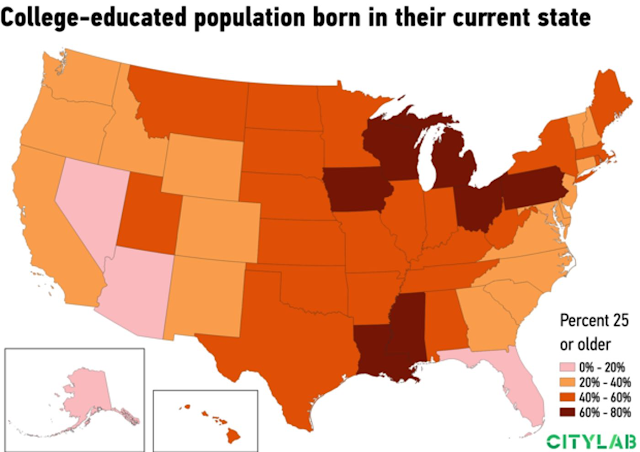
Percentage of people age 25 years or older in each state who were born in that state via Bloomberg in a March 5, 2019 story by demographer and regional development economist Richard Florida who in turn is relying on data from the 2017 American Community Survey (which the Census Bureau in the U.S. Department of Commerce conducts between decennial censuses). 

The linked story notes that: 

Nearly six in ten Americans (58.5 percent) currently reside in the state where they were born. There is a minuscule difference between men and women: A slightly higher percentage of men (58.8 percent) lived in their birth state compared to women (58.2 percent).

The 12 States With The Most Mobile Populations

In one state, Nevada, only 10% of residents over age 25 were born there. 

In three more states, more than 20% but less than 30% of residents over age 25 were born there. Those state are Florida (22%), Arizona (23%), and Alaska (27%). 

In eight more states, more 30% but less than 40% of residents over age 25 were born there. Those states are Washington State, Oregon, Idaho, Wyoming, Colorado,  Maryland, Delaware, and New Hampshire. 

All but four of the states with the lowest percentage of people over age 25 who were born there are in the West, and those four states are all on or near the East Coast.

Age And Migration

Anecdotally, three of the states with the lowest percentage of residents over age 25 who were born there: Nevada, Florida and Arizona, are known for their large communities of migrating retirees. It is plausible that migration patterns may be quite different for retirees and for people of working age. The data don't unequivocally confirm this intuition, however.

A map showing a breakdown of states by the percentage of the population age 65+ sheds some light on this, although it doesn't distinguish between migrants and people born in the state:

From here, also noting that:
Across the total U.S. population, 16.0 percent of Americans are over the age of 65, while 6.7 percent are over the age of 75. The median age in the United States is 38.2.

This source notes which states have the fewest seniors:

The three states with the most youthful populations are Utah, Alaska, and Texas. These three states are home to residents over age 65 who make up 11.1, 11.9, and 12.5 percent of the total population, respectively.

In Utah, this is due to the high birth rates of the Mormon majority. In Alaska and Texas, this is probably driven mostly by migration of younger people to these states, particularly in connection with the oil and gas industry, although a large Hispanic Catholic population and lots of immigration from Mexico may be another factor in Texas. This may also be driven by seniors moving away from the tough climate of Alaska to warmer destinations further south. 

The U.S. states with the largest percentage of the population over age 65 (from the same source) are:

1. Maine 20.6%
2. Florida 20.5%
3. West Virginia 20%
4. Vermont 19.8%
5. Montana 18.8%
6. Delaware 18.7%
7. Hawaii 18.4%
8. Pennsylvania 18.2%
9. New Hampshire 18.1%
10. South Carolina 17.7%

Some of these states are predominantly migrant populations, some are states in the "struck belt", and some are in between.

The 14 States In The Stuck Belt

In eleven states, more than 60%, but not more than 70% of residents over age 25 were born there. Those states are North Dakota, Minnesota, Wisconsin, Iowa, Missouri, Indiana, Pennsylvania, West Virginia, Kentucky, Mississippi, and Alabama. 

In three states, more than 70% of the residents over age 25 were born there. Those states are Ohio (71%), Michigan (72%), and Louisiana (74%).

Illinois (at about 55%) is the only state in the Midwest where less than 60% of residents over age 25 were born there, and that is without a doubt, predominantly due to the Chicago metropolitan area.

These states have been affected by interstate migration as well, but more by emigration than immigration.

Every state, however, has at least 26% of residents over age 25 who were not born there.

The 24 In Between States

In the remaining twenty-four states, more than 40% but less than 60% of residents over age 25 were born there. 

[The] larger coastal states like California and New Jersey have rates in the low 40 percent range. New York and Illinois have significantly higher shares of people, roughly 55 percent, who were born in those states.

Foreign Born Migrations v. Interstate Migrants. 

The percentages of the population not born in each state includes both foreign born people who were born outside the U.S. and interstate migrants. The percentage of the total population born outside the state in some select states is as follows:

California 26.7%
New Jersey 23.4%
New York 22.4%
Florida 21.1%
Nevada 19.8%
Massachusetts 17.3%
Texas 17.1%
Maryland 15.4%
Washington 14.9%
Illinois 13.9%
Arizona 13.4%
Virginia 12.7%
Georgia 10.3%
North Carolina 8.4%
Pennsylvania 7.0%

In many states in the Northeast, a very large share of all people in each state who weren't born there are foreign born.

The percentage of people in Nevada who are foreign born is less remarkable when one considers that only 10% of residents over age 25 in Nevada were born in the state.

Education and Mobility

The link between education and mobility isn't particular consistent. The story also parses out the data by education level: 

Louisiana again tops the list with nearly two-thirds of its adults who hold a bachelor’s degree or more remaining in the state, followed by Michigan (64 percent), Ohio (63 percent), and Mississippi and Iowa (62 percent).

The most significant way in which U.S. states discriminate based upon state residency is by charging significantly less for tuition a state colleges and universities to students who are state residents than to students who reside outside the state (although some states are more strict about this than others, and there are a few states, mostly smaller states with less complete higher educational offerings, with interstate compacts allowing residents of states that are part of the compact to receive in state tuition at a sister state, and there are some state colleges and universities that offer instate status or special scholarships to members of certain Indian tribes outside the state, such as Miami University of Ohio for members of the Miami Indian tribe).

Presumably, because economics teaches us that incentives matter, this means that new high school graduates are more likely to attend college in their own state than they are in another state. The high percentages of in state students at most state colleges and universities, especially the less academically selective ones, supports this conclusion. Thus, this distinction provides a return on taxes paid to parents have lived in the state and mostly paid significant taxes, since parents of students attending state colleges and universities, especially the more selective ones that have the highest subsidies per student, are much more affluent than average parents in those states. 

Statistics about the likelihood of state college and university students living in a state after graduation (which is when the general public in a state receives the benefit of this state subsidy) are harder to come by. But it is safe to guess, from mere inertia, that graduates of state colleges and universities in a state are more likely to live in that state after graduating than graduates of colleges and universities outside the state (and probably also, are more likely to do so than students of the more selective of the private colleges and universities within the state). 

As a matter of economic development policy, a state would typically like to lure smart students from outside the state to go to college there, with the hope that those students will later contribute to that state's economy, although no state binds graduates of its colleges and universities to do so. This may happen behind the scenes to some extent through scholarships awarded to out of state students at more selective state colleges and universities. But the tuition tax breaks given to in state students at almost every state college and university without regard to merit or financial need, suggest that this reason for funding state colleges and universities is not a primary motive for state legislators funding state colleges and universities in state budgets. 

In contrast, many European countries extend the full economic subsidies they provide to domestic college students to college students from abroad enrolling in their regular college and university programs.


Louisiana again tops the list with roughly three-quarters of its adults who did not complete high school native to the state as does West Virginia (75.6 percent), followed by Mississippi (72.9 percent), and Kentucky (72.6 percent).

There is only one state, New York, where college graduates are much more likely to stay in their birth state than high school dropouts, while there are six states (Alaska, Georgia, South Carolina, Virginia, Vermont, and Maine) where high school dropouts are much more likely to stay in their birth state than college graduates. 

The remaining 33 states are fairly evenly split between states where college graduates are a little more likely to stay and states where high school dropouts are a little more likely to stay. This shows some regional trends but it isn't entirely obvious what is driving those trends.

31 January 2022

When Is Military AI O.K.?

Setting up active defense systems that respond to incoming ordinance and missiles and snipers faster than a human being could for the military isn't very troubling.

Letting Artificial Intelligence systems select targets outside these exigent kinds of situation, as some tech companies are proposing, is potentially more troublesome, at least unless there is reliable and responsible human involvement in the loop. But, on the other hand, having AI second guess and flag for review potentially problematic targets selected by humans, could be a good idea.

The Regions That Can Grow Particular Crops Is Shifting

One of the most trivial and obvious, but nonetheless important, implications of global warming is that the places where agricultural crops grow will shift. A new study breaks down the details of that with respect to four representative warm climate crops.

A new analysis predicts that, as climate change progresses, the most suitable regions for growing coffee arabica, cashews, and avocados will decline in some of the main countries that produce these crops.

Replacement growing locations may emerge, but that isn't guaranteed, because the appropriate growing conditions for a crop include not just mean temperature, but also rainfall patterns, soils, and other parts of the ecosystem that are symbiotic with the crops in cryptic ways.

For example, even at the same mean temperatures, crops that grow well in a Mediterranean weather pattern may not grow well in a South Asian monsoonal weather pattern.

Why Was Religious Indoctrination So Successful?

Once up a time, not so long ago, in the early to mid-20th century, organized religion (mostly Christianity and Judaism in the U.S.) were extraordinarily successful at getting almost everyone to describe themselves as an adherent of it, to claim belief in God, and to hold onto those childhood beliefs into adulthood and old age.

Pretty much everyone in my parents generation and older was a believer. A huge swath of people in my generation are not, and the nation is become less religious almost every year.

Europe underwent a similar transformation about a generation earlier.

What was organized religion doing back then that made it so successful and why did this collapse in a just a generation or two?

The question often gets asked from the other perspective. Why are people these days so non-religious. But, from our perspective, the real question is not that, but why it used to be so successful. It is something that people in my generation, which is when the transition really took off ought to be uniquely qualified to answer.

I won't answer the question in this post, but wanted to ask it while I am thinking about it.

27 January 2022

The Case For A UN Earth Defense Force

Protecting Earth from extraterrestrial impacts is a "Space Force" mission that makes sense, and one that clearly justifies the use of nuclear weapons. But, it really ought to be a global effort, since it protects everyone on Earth. 

The preprint below discusses the threat from a quite practical perspective. It highlights the fact that early detection of a threat, preparation to respond to it as quickly as possible if one is detected, and decisive action to commit us to responding to the threat as early as possible are critical to the continued survival of the human species if a threat like this manifests itself. 

All of this is because, for the first time in the history of life on Earth, we are advanced enough technologically to overcome this threat is we act swiftly. Previously, it would have been futile to try to take action to prevent a devastating impact, even if we knew well in advance that a dangerous impactor was on a collision course with Earth.  

The title of the paper is a reference to the recently released film, "Don't Look Up" by a Denver based team, that while fictional, appeals to the documentary crowd and is heavy on social commentary. The introduction reminds readers why they should care:

Asteroid and comet impacts pose a continual threat to life on Earth. For example, on February 15, 2013, a 20 m diameter asteroid airburst over Chelyabinsk, Russia with a total energy of about 0.5 Mt, or roughly that of a modern ICBM thermonuclear warhead. About 50% of its energy went into the atmospheric blast wave that injured approximately 1,600 people. The same day, a 50 m diameter asteroid (2012 DA14) passed within the geosynchronous satellite belt. Had it impacted, it would have had a yield of about 10 Mt. Such an impact over a major city could have killed and injured millions. Asteroids the size of 2012 DA14 (∼ 50 m diameter) are expected to strike Earth approximately every 650 years, while objects at least the size of the Chelyabinsk asteroid (∼ 20 m diameter) are expected to strike Earth approximately every 50–100 years. Another recent example is the Tunguska 1908 event that could have caused large scale loss of life, but did not due to the remote area in Russia it airburst over. This event is estimated to have been a roughly 65 m diameter asteroid (or possibly an atmospheric grazing comet) and resulted in an air blast with total energy yield of between 3 and 30 Mt. The resulting blast wave flattened more than 2000 km^2 of forest, as seen from the 1927 Soviet Academy of Sciences expedition. Larger objects pose an even more severe threat. For example, the total kinetic energy associated with an impact of a 100 m asteroid is equivalent to approximately 100 Mt, and that of the well-known ∼ 350 m threat, Apophis, would have an impact yield of approximately 3–4 Gt, or about 1/2 of the Earth’s total nuclear arsenal, while Bennu at 490 m could have a yield greater than the entire Earth’s nuclear arsenal. This is summarized in Figure 1, wherein we show the bolide kinetic energy as a function of its diameter. For reference, Apophis will next visit Earth on Friday April 13, 2029 and come within the geosynchronous belt.

The paper and its abstract are as follows: 

We discuss a hypothetical existential threat from a 10 km diameter comet discovered 6 months prior to impact. 
We show that an extension of our work on bolide fragmentation using an array of penetrators, but modified with small nuclear explosive devices (NED) in the penetrators, combined with soon-to-be-realized heavy lift launch assets with positive C3 such as NASA SLS or SpaceX Starship (with in-orbit refueling) is sufficient to mitigate this existential threat. 
A threat of this magnitude hitting the Earth at a closing speed of 40 km/s would have an impact energy of roughly 300 Teratons TNT, or about 40 thousand times larger than the current combined nuclear arsenal of the entire world. This is similar in energy to the KT extinction event that killed the dinosaurs some 66 million years ago. Such an event, if not mitigated, would be an existential threat to humanity. 
We show that mitigation is conceivable using existing technology, even with the short time scale of 6 months warning, but that the efficient coupling of the NED energy is critical.
Philip Lubin, Alexander N. Cohen, "Don't Forget To Look Up, arXiv:2201.10663 (January 25, 2022).

Epstein-Barr Virus and Type 2 Diabetes Are Risk Factors For Long COVID

Another reason to develop an Epstein-Barr virus vaccine, in addition to the fact that it causes M.S. and mono.

One of the four factors researchers identified is the level of coronavirus RNA in the blood early in the infection, an indicator of viral load. Another is the presence of certain autoantibodies — antibodies that mistakenly attack tissues in the body as they do in conditions like lupus and rheumatoid arthritis. A third factor is the reactivation of Epstein-Barr virus, a virus that infects most people, often when they are young, and then usually becomes dormant. The final factor is having Type 2 diabetes, although the researchers and other experts said that in studies involving larger numbers of patients, it might turn out that diabetes is only one of several medical conditions that increase the risk of long Covid.
From the New York Times.

25 January 2022

Military Quick Hits

* The next major conventional war between near peers with a significant maritime component will give rise to a catastrophic defeat of surface warships to one or more of a variety of threats including missiles delivered by aircraft and drone aircraft, medium to long range hypersonic missiles, ballistic missiles, tactical nuclear weapons, submarines and drone submarines, coastal missile boats, and sea mines. 

The soonest this could happen would be a catastrophic defeat of the Russian Black Sea fleet in an imminent conflict between Russian-proxy fighters and the Ukraine, although that conflict might never end up going in that direction. 


A conflict in the Taiwan Strait or the East China Sea would be the second most likely place this paradigm changing battle or series of battles could play out, where sword rattling has crescendoed in recent weeks (see also here).

For example, on Sunday (two days ago), the People’s Liberation Army Air Force flew 39 fighter aircraft into Taiwan’s airspace.


* The Army's Mobile Protected Firepower program which is basically a light tank program aiming for a 25-35 ton sized tank (less than half the weight of an M1 Abrams main battle tank) will probable feature "a lightweight 120mm gun called the XM360 – built for the now-cancelled Future Combat Systems Mounted Combat System" and made possible with advanced technologies. 

As impressive a technological achievement as this may be, however, it is akin to the invention of a carbon fiber or composite longbow: it is military irrelevant. 

Why? 

Any 120mm gun will still be heavier, less accurate, and have a shorter range than highly effective anti-tank missiles that are much less expensive than a state of the art modern light tank. Admittedly, 120mm shells are less expensive per round than a guided missile that delivered a comparable punch, but in real life, few shots are fired in anger, especially in the case of highly accurate guided missiles.

These 120mm tank rounds may also be vulnerable in conflicts with near peers to active defense laser weapons the cause incoming rounds to explode prematurely, or other active defense systems such as a land based version of the U.S. Navy's "Close In Weapons System" that fire a barrage of big bullets at incoming ordinance. 

These laser weapons have been successfully tested against mortar rounds and drones, but could also be effective against artillery rounds, missiles, and tank shells. Tank shells may have some edge because they are probably faster moving than the other laser weapon targets, and aren't vulnerable to "soft" active defense that defeat guidance and communications systems in drones and missiles.

Tanks and other armored vehicles can be formidable opponents against civilians and light infantry will only small arms like assault rifles and machine guns (although many are still vulnerable to infantry approaching out of an armored vehicle's line of sight to deliver heavy ordinance at short range to "Achilles heel" points on many of these armored vehicles). But they are highly vulnerable to moderately expensive but highly effective anti-tank rockets and missiles that can be delivered by dismounted infantry, carried by light ground vehicles (manned or unmanned), or delivered by helicopters, fixed wing aircraft, or drone aircraft. They are also reasonable vulnerable to modern landmines such as Improved Explosive Devices (IEDs), despite efforts to improve the designs to address this threat. Armor is effective against bullets, shrapnel, and smaller shells, but it no match for purpose built anti-tank weapons.

Global Abortion Laws In One Map


Juvenile Life Without Parole

The use of life in prison without possibility of parole sentences for juvenile offenders has declined dramatically as a result of to key U.S. Supreme Court decisions and some legislative reforms that they triggered. But it also remains far more common in the U.S. than anywhere else in the world and some states are particularly at fault on this score including 210 cases in the three states singled out below.

Six years ago today, the U.S. Supreme Court issued its decision in Montgomery v. Louisiana, making Miller v. Alabama’s requirement that judges consider the mitigating attributes of youth retroactive . . .

At the time Miller and Montgomery were decided, Pennsylvania, Michigan, and Louisiana each had more children sentenced to life without parole than any other state in the country

While 76% of the pre-Miller JLWOP population in Louisiana was Black, Black children received 93% of JLWOP sentences since 2012. Today, the sentence is reserved almost exclusively for Black boys. . . . Despite six years passing since the Supreme Court ordered resentencings in Montgomery, almost 100 people still serving unconstitutional JLWOP sentences in Michigan have not yet had their day in court. This is especially concerning in light of the COVID-19 pandemic, which tragically claimed the life of William Garrison a few months shy of freedom.. . . . JLWOP population at time of Miller: 297 Completed resentencings: 251 Currently Serving JLWOP: 63 Released: 99

Once second to Pennsylvania in JLWOP cases, Michigan now has the most children serving life without parole in the country. Racial disparities for this population in Michigan are starker than they are nationally—71% of those eligible for resentencing in Michigan after Miller were Black (compared to 61% nationally), and 74% of those still awaiting resentencing are Black. . . . JLWOP population at time of Miller: 356 Completed resentencings: 273 Currently Serving JLWOP: 97 Released: 154

At the time Miller was decided, Pennsylvania mandated JLWOP for first and second degree murder and had the highest number of children sentenced to life without parole in the country. Subsequent reforms have abolished JLWOP for second degree murder, a significant step forward. Since Montgomery, approximately 90% of these cases have been resentenced with only 1% resentenced to JLWOP. This progress was bolstered by the Pennsylvania Supreme Court, which acted to ensure resentencing hearings had constitutionally sufficient procedure. The Pennsylvania Parole Board has also recognized the importance of meaningful consideration of these cases, granting parole in approximately 70% of the former JLWOP cases. . . . JLWOP population at time of Miller: 526 Completed resentencings: 463 Currently Serving JLWOP: 50 Released: 268

At the time of the decision, 2,800 individuals in the U.S. were serving life without parole for crimes committed as children. In the six years since, 835 individuals formerly serving this sentence have been released from prison. 
Today, 25 states and the District of Columbia ban life-without-parole sentences for children, and in six additional states, no one is serving life without parole for a crime committed as a child. . . . 
The uneven implementation of Miller disproportionately impacts Black individuals, who represent 61% of the total JLWOP population.... 
Within that population [serving JLWOP when Montgomery was decided], 29% have been released, over 50% have had their sentences reduced from JLWOP, about 17% have not yet been afforded relief, and approximately 3% have been resentenced to JLWOP.

From this report

21 January 2022

Old School Coding Was Tight

It is amazing how much used to be done with so little processing power.

The AGC was designed with the sole purpose of providing navigational guidance and spacecraft control during the Apollo program throughout the 1960s and early 1970s. The AGC sported 72kb of ROM, 4kb of RAM, and a whopping 14,245 FLOPS, roughly 30 million times fewer than the computer this report is being written on. These limitations are what make the AGC so interesting, as its programmers had to ration each individual word of memory due to the bulk of memory technology of the time. Despite these limitations (or perhaps due to them), the AGC was highly optimized, and arguably the most advanced computer of its time, as its computational power was only matched in the late 1970s by computers like the Apple II. It is safe to say that the AGC had no intended market, and was explicitly designed to enhance control of the Apollo Command Module and Apollo Lunar Module. The AGC was not entirely internal to NASA, however, and was designed in MIT's Instrumentation Laboratory, and manufactured by Raytheon, a weapons and defense contractor.
Charles Averill "A Brief Analysis of the Apollo Guidance Computer" arXiv:2201.08230 (January 6, 2022).

20 January 2022

Some Facts About Immigration To the U.S.

As of 2018, 13.7% of people in the U.S. are foreign born (this grew to 14.1% as of 2019, which would be a modern peak of 14.1%), of whom 6% are under the age of eighteen. 

The percentage of people in the U.S. who are foreign born has probably declined since this 2019 peak due to COVID driven legal immigration restrictions, and due to economic factors reducing undocumented immigration and causing foreign born persons residing in the U.S., whether or not documented, to return to their home countries.

Near the 20th century low point in 1970, 4.7% of people in the U.S. were foreign born. The percentage of the U.S. population that is foreign born population is now three times that low point half a century later. This low point was reached after declining from a peak of 14.7% in 1910. The percentage then increased steadily from 1970 to 2019.

As of 2018, 50.7% of foreign born persons in the U.S. were citizens. This percentage has been slowly but steadily increasing in recent years and is probably somewhat higher in 2022 than it was in 2018.

As of 2017, there were 10,500,000 undocumented foreign born people in the United States (3.2% of the U.S. population). This is down 13.9% from 2007, and it has probably declined further, as of 2022, despite a recent surge in refugees and undocumented immigration from Central America and Venezuela due mostly to gang activity in Central America and economic collapse in Venezuela.

There are about 26.0 million adults in the U.S. who cannot vote because they are not U.S. citizens (about 16.2 million legal immigrants and about 9.8 million undocumented immigrants).

Overall, 39% of foreign born people in the U.S. are U.S. citizens, 38% are documented immigrants, and 23% are undocumented immigrants. Of undocumented immigrants, 6% of in the DACA program (about 1.4% of all foreign born people in the U.S.).

These percentages differ considerably from state to state, however. For the 15 states with the largest absolute number of undocumented immigrants, the percentages  of foreign born people in the state who are undocumented is as follows:

State - % Pop. FB - % Pop. Undoc. - % FB Undoc. (% 10 yr. Change in Undoc.)

NC 8.4% * 3.1% * 36.8% (0.0%)
TX 17.1% * 5.9% * 34.5% (+3.2%)
NV 19.8% * 6.8% * 34.3% (-12.5%)
GA 10.3% * 3.5% * 34.0% (-11.8%)
AZ 13.4% * 3.8% * 28.4% (-45.0%)
MD 15.4% * 4.0% * 26.0% (+13.6%)
VA 12.7% * 3.2% * 25.2% (+10.0%)
IL 13.9% * 3.3% * 23.7% (-22.7%)
MA 17.3% * 3.9% * 22.5% (+25%)
WA 14.9% * 3.2% * 21.5% (0.0%)
PA 7.0% * 1.5% * 21.4% (+26.7%)
NJ 23.4% * 4.8% * 20.5% (-18.2%)
CA 26.7% - 5.1% - 19.1% (-28.6%)
FL 21.1% - 3.8% - 18.0% (-21.4%)
NY 22.4% - 3.2% - 14.3% (-35.0%)

These 15 states have a total population of 206,300,000 as of 2020.

The total of number of people in the District of Columbia and the 35 remaining states is 125,100,000 as of 2020. The number of foreign born people in the District of Columbia and the 35 remaining states is 7,992,000 which is 6.4%. The total number of undocumented foreign born people in the U.S. outside of these 15 states is 2,125,000 which is 1.7%. Thus, 26.6% of foreign born people in the District of Columbia and the 35 remaining states are undocumented.

Another way to look at immigration is to look at it by country of origin.

Country - Number of Foreign Born People - % Undoc (% 10 yr. Change in Undoc.)

Mexico 10,932 * 45.3% (-26.8%)
China and Taiwan 2,854 * 13.1% (+15.4%)
India 2,688 * 19.5% (+61.5%)
Philippines 2,045 * 7.8% (-15.8%)
El Salvador 1,412 * 53.1% (+25.0%)
Vietnam 1,384 * NA
Cuba 1,360 * NA
Dominican Republic 1,169 (+20.5%)
Guatemala 1,111 * 54.0% (+50.0%)
Korea 1,039 * NA

The number of undocumented immigrants in the U.S. from Honduras and Venezuela were increasing as of 2017. The number of undocumented immigrants in the U.S. from Columbia, Ecuador, Haiti and Peru were decreasing as of 2017. 

By region, foreign born people in the U.S. have the following origins:

Latin America 52% (5.2% children)
Asia 30% (5.7% children)
Europe 10% (4.8% children)
Other 8% (13.4% children)

Black Immigrants In The U.S.

The share of African, Afro-Caribbean, and black Latin American legal immigration to the U.S. is modest, many of those immigrants are naturalized citizens, and those immigrants overwhelmingly have passports. About 6-7% of undocumented immigrants in the United States are black (see here and here) and those undocumented immigrants are overwhelming recent immigrants. As the Pew Research Center explains in a 2015 report:
A record 3.8 million black immigrants live in the United States today, more than four times the number in 1980, according to a Pew Research Center analysis of U.S. Census Bureau data. Black immigrants now account for 8.7% of the nation’s black population, nearly triple their share in 1980.

Rapid growth in the black immigrant population is expected to continue. The Census Bureau projects that by 2060, 16.5% of U.S. blacks will be immigrants. In certain metropolitan areas, foreign-born blacks make up a significant share of the overall black population. For example, among the metropolitan areas with the largest black populations, roughly a third of blacks (34%) living in the Miami metro area are immigrants. In the New York metro area, that share is 28%. And in the Washington, D.C., area, it is 15%.

Black immigrants are from many parts of the world, but half are from the Caribbean alone. Jamaica is the largest source country with about 682,000 black immigrants born there, accounting for 18% of the national total. Haiti follows with 586,000 black immigrants, making up 15% of the U.S. black immigrant population.

However, much of the recent growth in the size of the black immigrant population has been fueled by African immigration. Between 2000 and 2013, the number of black African immigrants living in the U.S. rose 137%, from 574,000 to 1.4 million. Africans now make up 36% of the total foreign-born black population, up from 24% in 2000 and just 7% in 1980.

Among black immigrants from Africa, virtually all are from sub-Saharan African countries, with only 1% of all black immigrants from North Africa. Nigeria, with 226,000 immigrants, and Ethiopia, with 191,000, are the two largest birth countries for black African immigrants to the U.S.

Black immigrants have roots in other parts of the world as well. Some 5% of all black immigrants are from South America and 4% are from Central America; those from Europe make up 2% of the population and those from South and East Asia make up 1%.

Many black immigrants are from Spanish-speaking countries. Among these, the Dominican Republic is the largest country of birth, accounting for 161,000 black immigrants. Mexico is also a source of black immigration with roughly 70,000 black immigrants. Some 41,000 are from Cuba, and 32,000 are Panamanian. Moreover, 11% of the foreign-born black population identifies as Hispanic. . . .

The modern wave of black immigration to the U.S. began when U.S. immigration policy changed in the 1960s, becoming more open to a wider variety of migrants. Just like other immigrants, foreign-born blacks benefited from the Immigration and Nationality Act of 1965 that emphasized family reunification and skilled immigrant labor. In addition, the Refugee Act of 1980 loosened immigration restrictions by allowing more immigrants from conflict areas such as Ethiopia and Somalia to seek asylum in the U.S. Finally, the U.S. Immigration Act of 1990 sought to increase the number of immigrants from underrepresented nations, and although the act was initially intended to increase the flow of European immigrants, Africans have benefited from the program, as well.

This act, also known as the diversity visa program, has been an important way for African immigrants to gain entry into the U.S. About one-in-five sub-Saharan African immigrants (19%) who gained legal permanent residence between 2000 and 2013 entered through this program.

During the same period, about three-in-ten (28%) sub-Saharan African immigrants arrived in the U.S. as refugees or asylees. That share was only 5% for Caribbean immigrants and 13% for the overall immigrant population. Caribbean immigrants are much more likely to enter the U.S. through family-sponsored

Caribbean and sub-Saharan African immigrants are less likely to have been granted admittance via employment-based visa programs than immigrants overall.
Languages Spoken At Home

For the U.S. as a whole, 78% of the U.S. population speaks only English at home, 14% speak a language other than English at home but speak English "very well", and 8% speak a language other than English at home and do not speak English "very well."

The most common language spoken at home other than English is Spanish. This is spoken at home by 13.5% of people in the U.S. out of the 22% of people in the U.S. who speak a language other than English at home (about 61% of non-native English speakers), and 5.2% of people in the U.S. who do not speak English "very well" speak Spanish at home out of 8% of people in the US. who do not speak English "vey well" (about 65% of non-fluent English speakers and 38.6% of non-native English speakers who speak Spanish). 

A language other than English or Spanish is spoken at home by 8.5% of people in the U.S. About 2.8% of people in the U.S. do not speak either English or Spanish "very well," while 5.7% of people in the U.S. are not native speakers of English or Spanish but speak English "very well."

The runner up is Chinese which is spoken at home by 1.13% of people in the U.S. (about 5% of non-native English speakers). The percentage of people in the U.S. who are native Chinese language speakers who do not speak English "very well" is 0.59% (about 21% of people who do not speak either English or Spanish "very well"). 

This number conceals the fact, however, that there are many Chinese topolects which are not mutually intelligible in spoken form despite sharing a common set of historical Chinese characters (although not all Chinese speakers, particularly in the U.S. can read Chinese characters, and even among those who are literate in Chinese characters many people can not read both the simplified character system promoted by the People's Republic of China and also traditional Chinese characters). A similar situation exists with respect to languages collectively characterized as Arabic.

The percentage of people who speak a language other than English at home who do not speak English "very well" varies widely by native language (and there are some native speakers of almost every non-moribund language in the world who live in the U.S.). It is highest for Vietnamese (56.9%), Chinese (52.0%), Korean (51.0%), and speakers of Thai, Lao, or other Tai-Kadai (51.0%). 

It is lowest for Hebrew (11.7%), Native American languages other the Navajo (12.3%), German (15.0%), Tamil (15.7%), Hindi (17.7%), Telugu (19.0%), other Dravidian languages (19.8%), French including Cajun (20.2%), West African languages (20.9%), and Greek (22.8%). 

The high level of English language fluency among South Asian language speakers reflect the fact that English bilingualism is common in India where it is a linga franca dating to the centuries that it spent (prior to the separation of what is now Pakistan and Bangladesh from India) as an English colony, and the fact that South Asian migration is heavily weighted towards highly educated professionals (especially in information technology, engineering and medicine). 

A significant number of West African immigrants are likewise from countries such as Nigeria, a former English colony, and Liberia (a country founded by former U.S. slaves), where English is a lingua franca.

Non-Native English speaking does not coincide perfectly with being foreign born. Essentially all non-native English speakers in the U.S. who speak native American languages and Cajun, are U.S. born, as are many U.S. born children of foreign born immigrants (sometimes called "second generation immigrants).

Sources

My source is The World Almanac and Book Of Facts 2022 when not otherwise noted. It is relying on the Pew Research Center for undocumented immigration numbers. It is relying on the American Community Survey (conducted by the U.S. Census Bureau) for language information.

19 January 2022

What Does Federalism Make Possible?

The Federal Government Is Gridlocked

A successful use of the filibuster to block voting rights legislation in the Senate today is a reminder of a long standing, and intractable problem. The legislative process in the United States is deeply gridlocked. 

It hasn't bee possible to pass legislation in the United States without bipartisan support since sometime in the 1970s when I was in elementary school learning cursive writing, even when, as now, a single political party controls the U.S. House of Representatives, the U.S. Senate, and the Presidency.

As the partisan divide between Democrats and Republicans in our two party system has deepened, and as the Republican party has shown a willingness to block the legislative process simply to deny Democrats a legislative achievement even when many Republicans don't substantively oppose Democratic policy proposals in many cases, this gridlock prevents most kinds of policy reforms worth caring about.

The party that controls Congress and the Presidency isn't entirely without options. Congress has already abolished the filibuster with respect to Presidential nominations in almost all cases, and with respect to a small number of must pass budget bills. 

The President can use existing legislative authority to issue regulations, but as a 6-3 U.S. Supreme Court ruling in the past week invalidating an OSHA regulation mandating COVID vaccination for employees of large employers (with legal reasoning that even conservative legal pundits seriously criticized for both inaccuracy and disregard of basic principles for equitable relief) illustrates, the holdover of ideological judges in our system of political judicial appointments limits that option significantly.

Similarly, while the President, in theory, has wide discretion regarding how to direct federal government employees to enforce laws, rogue federal court judges, including one in Texas, have, for example, prevented the President from exercising that authority to reverse Trump administration practices for immigration enforcement and to allow soldiers to disregard direct orders from their superiors regarding COVID vaccination, on legal rationales that are dubious at best but which the 6-3 ultraconservative majority on the U.S. Supreme Court has allowed to persist.

Indeed, the U.S. Supreme Court hasn't even upheld settled binding precedents that have stood for more than four decades on abortion to enjoin clearly unconstitutional Texas legislation on the subject (specifically designed to evade SCOTUS review from a conservative controlled court). Instead, it has allowed that unconstitutional law to remain enforceable and on the books for many months (contrary to all prior practice) and has strongly signaled (contrary to express representations made in confirmation hearings to the contrary) that Roe v. Wade will be overruled this summer in some matter or another.

Congress could expand the size of the U.S. Supreme Court to appoint more friendly justices who aren't grossly outside of the legal mainstream, if the unwillingness of two of the Democratic caucuses own Senators weren't dedicated to preserving Republican power by retaining the filibuster, an issue that will probably cost of them their seat in a primary challenge in the next election. But, the bottom line is that President Biden and his democratic majorities in both houses of Congress still have remarkably little power in the status quo. 

Midterm elections in 2024, moreover, look much more likely to cost Democrats even formal control of Congress, than to strengthen their hand.

All of this prelude, however, just goes to show that for the foreseeable future, most policy changes will have to emerge at the state and local level, especially if they are perceived as partisan or provide any colorable basis for courts to block the new policies, however far fetched that basis may be been when the U.S. Supreme Court was more balanced.

What Does Federalism Make Possible?

There are many U.S. states that are controlled by Democrats without archaic limitations like those imposed by the power that the U.S. Senate affords to minorities, especially rural ones. And, many U.S. states are similarly controlled by Republicans without strong political barriers to majoritarian policy-making. Likewise, many local governments are under the firm partisan control of one party or the other.

But even though, in constitutional theory, states have basically plenary power to adopt legislation on almost any subject, in practice, state policy makers operate in a highly constrained environment.

The preemptive effects of federal laws, treaties and regulations, the federal constitution, state constitutions, and the irresistible incentives created by federally funded state government programs, all profoundly limit state and local legislative discretion. State and local governments also generally have much less freedom to tax and spend than the federal government.

State policy-makers also face constraints unique to subordinate lawmakers in a federal system. 

One is the "race to the bottom" issue that, for example, causes the law governing the internal affairs of corporations to be governed by the law of the state where a firm is incorporated, even though it is allowed to operate in any U.S. state. So, states compete to offer the people who choose which state to incorporate firms laws that they favor.

The other is that it is difficult for state and local governments to be generous with the public in an economic sense if this happens in a context where non-residents of the state can take advantage of the state offered boon without undue difficulty.

For example, if Colorado were to allow anyone to attend its public college and universities tuition-free, which is a widely adopted policy that can make sense in a unitary state, parents from other states may flood Colorado with college students despite making no contribution to the Colorado tax base that would finance tuition-free higher education.

This doesn't mean that state and local policy-makers are powerless.

"Laboratory of democracy" type innovations are far more rare that political theorists would have us believe. But often it takes just one innovative state that is on the right track, to demonstrate that often invoked parades of horribles associated with a policy don't actually happen, to open the flood gates of imitators in many other like minded states. 

For example, Colorado's success in legalizing medical and then recreational marijuana under state law has causes many other states, and even whole countries, to follow its example. Now, a majority of states, by population at least, have legalized marijuana at the state level and full legalization seems inevitable in the not too distant future.

Even within Colorado, innovation in decriminalizing marijuana at the level of the City and County of Denver was pivotal in getting the rest of the state to follow suit, and for the industry to later launch itself with local government support.

And, once something does work at the state and local level and a new policy really catches on, it is routinely copied by a large supermajority of states. 

This doesn't happen every time: the procedural provisions related to probate administration of the Uniform Probate Code, for example, hasn't been widely adopted or imitated, even though it has been a smashing success in practice.

But, it happens often enough, that this back door and gradual state by state alternative to federal legislations in a policy area that isn't subject to exclusive federal government control, is frequently an attractive alternative to federal legislation that also conveniently keeps most litigation of these state adopted policies in state courts subject only to U.S. Supreme Court review from final decisions of state supreme courts.

Even though it is partially a historical accident, there are many areas of law where federal legislation and/or federal constitution court rulings preclude state and local policy-making.

As much as they would like to, state and local governments have little or no power to regulate immigration or arbitration or bankruptcy law. They have very little say in military policy-making and foreign affairs. They are economically locked into the Medicaid program (including its nursing home program and childhood health insurance program CHIP), and to federal mandates that are part of welfare aid to how child support must be handled in the state. They can't establish their own currencies with independent monetary policies and interest rates. They are economically locked into the federal highway system, and to policies on how higher educational institutions are administered governed by federal law. Federal constitutional law largely mandates gender neutrality in policy-making. Local governments have to conform to state mandates as well, which leaves them even more constrained.

So, while state and local government is indeed one of the main places where policies favored by one major political party and opposed by the other can be enacted, that authority is highly constrained in practice, most of time. Finding opportunities that aren't otherwise blocked to adopt state and local level policies is a highly challenging endeavor, despite being the best game in town for idealists favoring policy reforms at this point in history.