14 April 2022

Who Is In Prison?

The experiences that put you on a path to prison are quite extreme. This doesn't mean that what they did as a result of those experiences is O.K. but it does demonstrate that the root causes of crime are frequently in place in childhood and need to be prevented there.
The report analyzes data from the Bureau of Justice Statistics’ “Survey of Prison Inmates,” collected in 2016 and released in late 2020. The data show what many in the criminal justice reform movement already know: that the U.S. criminal justice system today locks up the least powerful people in society. Key takeaways include:
* Many, if not most, people in prison grew up struggling financially. 42% of survey respondents said their family received public assistance before they were 18. Respondents also reported uncommonly high levels of homelessness, foster care, and living in public housing before the age of 18.

* Most individuals in state prisons report that their first arrest happened when they were children. 38 percent of the people BJS surveyed reported a first arrest before age 16, and 68% reported a first arrest before age 19. The average survey respondent had been arrested over 9 times in their life.

* The typical person in state prison is 39 years old and has a 10th grade education, a fact that is most likely linked to youth confinement, which disrupts a young person’s life and schooling.

* Half (49%) of people in state prisons meet the criteria for substance use disorder (SUD), and 65% were using an illicit substance in the immediate lead-up to their incarceration, suggesting that many people who are not locked up for drug offenses are still victims of our country’s choice to criminalize substance use rather than treat it as a health issue.

From the Sentencing Law and Policy Blog.

As a reference point: "In 2021, the highest level of education of the population age 25 and older in the United States was distributed as follows:

8.9% had less than a high school diploma or equivalent.
27.9% had high school graduate as their highest level of school completed.
14.9% had completed some college but not a degree.
10.5% had an associate degree as their highest level of school completed.
23.5% had a bachelor’s degree as their highest degree.
14.4% had completed an advanced degree such as a master’s degree, professional degree or doctoral degree."

Thus, the 8.9% of adults who don't finish high school (12% of those age 18 plus, some of whom earn a high school diploma by age 25) account for 62% of prison inmates. 


Furthermore, most of the remaining 38% of prison inmates earned high school diplomas but did not have any college education. Even "some college" greatly reduces one's likelihood of going to prison.

12 April 2022

Women Are More Unhappy Always And Everywhere

I didn't expect the data to be so overwhelming and robust. The introduction of the paper begins as follows (italics in the original; bold emphasis mine):
The female well-being paradox is that women are happier than men in happiness equations but also more unhappy than men in unhappiness equations. Unhappiness and happiness are often treated as the flip side of the same concept and, when one considers many of their correlates, this appears to be the case. For instance, correlates of happiness such as unemployment, income, age, being married, and having a degree are the mirror images of each other in a happiness and unhappiness equations and simply flip signs (Blanchflower, 2020, 2021). But this is not the case with regards to sex. There is also evidence that at least in relation to happiness in the United States, the gap closed over time in the years before the Great Recession as women became relatively less happy (Blanchflower and Oswald, 2004; Stevenson and Wolfers, 2009). It seems this trend has been exacerbated by the COVID pandemic which differentially impacted the wellbeing of women. However, women appear to be resilient to wellbeing shocks during the pandemic since their happiness recovers faster than men (Fancourt et al., 2020). 

In this paper we show that gender differences in wellbeing – at a point in time and across time – are sensitive to the measures of wellbeing one uses, the timing of the data collection, the conditioning covariates, and the location of the individuals providing the information. 

We find that one part of the female happiness paradox is very robust: when answering questions about negative affect, women are always and everywhere more unhappy than men. This is true across time, country, and across different metrics of negative affect. This is perhaps best illustrated by anxiety: women are consistently more anxious than men, both pre- and post-COVID, and across months of the year and across years. But it is also true with respect to other measures on negative affect such as being depressed, downhearted, tense, lonely, frustrated, stressed, sad, and having restless sleep and other measures. 

Another set of results are also consistent. It is men (not women) who tend to have higher wellbeing when it is measured in terms of momentary positive affect (enjoyment, feeling fresh and rested, active and vigorous, cheerful and in good spirits), and in terms of domain-specific satisfaction with aspects of their life such as marriage financial status along with wider political and economic issues as captured by satisfaction with national government, democracy, the economy, the education system, health services and the standard of living. 

Confusion arises, however, only when analysts focus on the two most popular ‘global’ metrics of wellbeing, namely life satisfaction and happiness. Here the evidence on gender differences is far less clear cut. It is true that women’s happiness has declined relative to men’s since the 1970s in the United States, but this trend is not apparent, for example, in the UK where, over the same period, women tend to be a little happier than men. Furthermore, whether women are happier or more satisfied with life than men, varies tremendously across countries and over time, and across states within the United States.
The paper and its abstract are as follows:
Using data across countries and over time we show that women are unhappier than men in unhappiness and negative affect equations, irrespective of the measure used – anxiety, depression, fearfulness, sadness, loneliness, anger – and they have more days with bad mental health and more restless sleep
Women are also less satisfied with many aspects of their lives such as democracy, the economy, the state of education and health services. They are also less happy in the moment in terms of peace and calm, cheerfulness, feeling active, vigorous, fresh and rested. 
However, prior evidence on gender differences in global wellbeing metrics – happiness and life satisfaction – is less clear cut. Differences vary over time, location, and with model specification and the inclusion of controls especially marital status. 
We also show that there are significant variations by month in happiness data regarding whether males are happier than females but find little variation by month in unhappiness data. It matters which months are sampled when measuring positive affect but not with negative affect. 
These monthly data reveal that women’s happiness was more adversely affected by the COVID shock than men’s, but also that women’s happiness rebounded more quickly suggesting resilience. 
As a result, we now find strong evidence that males have higher levels of both happiness and life satisfaction in recent years even before the onset of pandemic. As in the past they continue to have lower levels of unhappiness. A detailed analysis of several data files, with various metrics, for the UK confirms that men now are happier than women.
David Blanchflower & Alex Bryson, "The Female Happiness Paradox" NBER Working Paper, March 2022 via this site, hat tip to Fully Myelinated.

The Colorado GOP's Nomination Meltdown

Tina Peters, the top line GOP Secretary of State (i.e. top elections administrator) candidate is the Mesa County Clerk and Recorder and received more than 60% support at the Republican state assembly this weekend. She has been indicted along with her deputy by the Republican DA in Mesa County for election administration felonies and also faces contempt of charges there, and was barred in a civil proceeding from carrying out her election administration duties in the most recent election.

Colorado Pols recaps other aspects of the Republican Party of Colorado's state assembly that put people in the GOP primary ballot for statewide offices this year. I'll quote some of the high points:

The Denver Post: “Colorado GOP embraces election conspiracy theories in nominations for Secretary of State, Senate”

Axios Denver: “Colorado GOP nominates election deniers to 2022 primary ballot”

Colorado Public Radio: “False claims about 2020 election front and center as Tina Peters clinches spot in GOP secretary of state race”

9News: “Far-right challengers gaining ground ahead of GOP primary”

Colorado Newsline: “Far-right conspiracy theorists triumphant at Republican state assembly” . . .

Colorado Republican Party Chair Kristi Burton Brown (KBB) was elected to her current post early last year after basically running on the “Big Lie.” 
. . .

Presumptive GOP gubernatorial frontrunner Heidi Ganahl has been flailing since her 2021 campaign kickoff about her persistent refusal to acknowledge that the 2020 election was legitimate. . . .

two different people were then nominated from the floor for Attorney General. We wrote earlier about Stanley Thorne, but there was a second woman nominated for AG who admitted soon thereafter THAT SHE WASN’T EVEN AN ATTORNEY. Thorne, by the way, is a licensed attorney, but not in Colorado (he’s also apparently not a registered Republican). In the end, District Attorney John Kellner escaped Colorado Springs without a Primary opponent, but he can’t be feeling too pleased with himself. As we wrote on Sunday:
Apparently 42% of Colorado Republicans said they would prefer “any random asshole” for Attorney General rather than John Kellner…EVEN if that person is not even a registered Republican in Colorado. 
. . .

Republicans do have a primary fight for Governor, U.S. Senate, and Secretary of State. All three Republican incumbents in Congress will have a Primary in June, and both open seats (CO-07 and CO-08) have multiple-candidate Primary battles. Republicans also have NO candidates in CO-01, CO-02, or CO-06. . . . 

Greg Lopez won top line at the assembly BECAUSE he promised to pardon Peters of any crimes committed during her tenure as Mesa County Clerk and Recorder. Stanley Thorne got 42% of the vote in the race for AG because he and others claimed that John Kellner failed to support Peters with sufficient vigor. . . . Tina Peters spent a night in jail literally one month ago. She might yet be jailed on a contempt of court charge, and we don’t even know about the federal crimes she could get dinged for in the coming months.

Mike O’Donnell made the June Primary ballot, giving Republicans a three-way Primary for SOS. O’Donnell is a long shot to win, but he could be helpful to the GOP if he is able to siphon votes away from Tina Peters to the benefit of Pam Anderson (who skipped the assembly after getting on the ballot via the petition route). . . .

Republican operatives have insisted for months that Ron Hanks is not a real candidate for U.S. Senate and would have no chance in a GOP Primary. We’ve long believed that reality was exactly the opposite of this position. On Saturday Hanks SHUT OUT every other Republican Senate candidate, emerging from the State Assembly as the only person to make the Primary ballot via this process . . . Hanks will face Joe O’Dea in June after O’Dea was the only Republican Senate candidate with the sense to collect petition signatures instead of relying on the GOP’s lunatic base. Hanks has raised very little money for his U.S. Senate campaign and is about as far away from the average Colorado voter on policy issues as a candidate could get. But he might well win the Republican Primary in June. . . .

We knew things were going to be (extra) weird on Saturday after incumbent Congressman Ken Buck (R-Greeley) almost failed to get his name on the June Primary ballot during Friday’s CO-04 assembly. Buck finished in second place behind somebody named Bob Lewis. Buck will likely still win the GOP Primary, but getting just 38% of the vote from your own base is pretty sad for an incumbent Congressman.

Ken Buck's primary challenger in his rural Eastern Colorado District (CO-4) is from the right, because he was too supportive of House Minority Leader Cheney (WY) who did not toe the line regarding the 2020 election results and unconditional support for President Trump.

If I recall correctly, incumbent Republican Congressman Doug Lamborn had to Petition onto the ballot in CO-5 (Colorado Springs) because he didn't get enough support in his Republican Congressional Assembly this year. Lamborn has faced persistent challenges almost every election cycle since he was elected for his general incompetence and laziness.

Lauren Boebert, the Republican incumbent in CO-3 (Western Slope and rural Southern Colorado) is facing a primary challenge from moderate Republicans because she's an ineffectual notorious far right gadfly.

The Democrats Compared

Democrats have no primary battles for any statewide race. Their candidates for statewide office are incumbents running for re-election, except for the newly created State School Board at larger seat.

There may be one primary race in a Congressional race with a Democratic Party incumbent, with Diana DeGette potentially facing Neal Walia who has submitted a petition to be placed on the ballot which has not yet been approved. But, even if Walia makes it onto the ballot, his odds of winning a primary against a secure long time incumbent in CO-1 which is predominantly in Denver is basically nil. No Republicans are running in that race.

There is a Democratic primary in the Republican held CO-3 (Western Slope and Southern Colorado), between Sol Sandoval, Alex Walker and Adam French. There is a Democratic primary in the Republican held CO-5 between David Torres and Michael Columbe.

Democrats will be represented by Ike McCorkle in Republican held CO-4 (who has no primary opponent). 

There will not be Democratic primaries in the two open Congressional races. State Senator Brittany Pettersen will be the Democratic nominee in CO-7 (greater Jefferson County), and State Representative Yadira Caraveo will be the Democratic nominee in the newly created CO-8 (Northern Denver metro areaish). 

The Democratic Party incumbents Joe Neguse in CO-2 (Boulder) and Jason Crow in CO-6 (greater Aurora) will face only write in opponents, if any, in November.

There will also be a primary race for CU-Regent in CO-1 between Johnnie Nguyen and Wanda James. This could go either way. Both candidates are talented young Democrats in their first race for public office. The winner will be a shoe-in in the general election since CO-1 is a safe Democratic party stronghold.

08 April 2022

State Action, State Inaction, Standing, And Individual Rights

The Legal and Political Theory Of Constitutional Rights

Protections From Government Misconduct

U.S constitutional rights, almost without exception, only provide protection against individualized personal harms caused by "state action", i.e. from wrongs fairly attributable to the government.

These protections are imperfect. See, e.g., the City of Greenwood Village case, qualified immunity, the lack of vicarious liability on the part of government employees for constitutional rights they violate in the course of their official duties, the availability of money damages only for intentional violations of constitutional rights (with remedies that are far more limited for rights not articulated in the constitution), undue deference to the testimony and legal stances of government officials, etc.

But, this does not mean that these protections are worthless. Governments pay billions of dollars a year in damages for violations of constitutional rights, and not infrequently change their unconstitutional policies and practices, either under a consent decree in litigation or by court order. Criminal charges are dismissed or reduced for violations of the constitutional rights by law enforcement officials every day that the courts are open, and convictions are reversed for violations of constitutional rights in the criminal justice process on a regular basis even if they don't make up a huge percentage of all convictions. 

While not all wrongs by government actors are remedied, the share of the most serious wrongful government actions that significantly harm particular individuals that are remedied is not negligible. Many people wrongfully convicted of crimes and sentenced to long prison terms or to death are eventually (often painfully slowly) exonerated.

The due process rights afforded to the people routinely prevent or remedy unfair or arbitrary government actions and regulations. Many instances of big dollar harm caused by wrongful government conduct produce economically significant monetary settlements paid by, or judgments against the government, and the government almost always eventually pays all of its legally determined obligations (and vast numbers of legal obligations that are never legally adjudicated as well). In some areas of law, like immigration, the quality of justice provided is lower. In other areas of law, like condemnation of private property for public use, the quality of justice provided (while rarely perfect) is comparatively consistent and adequate.

Protections From Private Misconduct

The theory is that Congress and state governments protect people from wrongs to their individual rights committed by non-state actors and that we rely on the political process to assure that elected officials make this happen, by having legislators pass laws necessary to do so, by having executive branch and judicial branch officials carry out those ordinary laws.

The constitution does not provide protections for you life, liberty, or property from non-governmental actors. It is an international outliner because it does not compel law enforcement to take action to enforce the criminal laws that are on the books for the benefit of any particular individual. See Castle Rock v. Gonzales. It does not guarantee due process when a private party wants to employ self-help to interfere with your property rights or your freedom of speech. 

In many cases, even when the authority of the state is invoked in litigation to enforce a right against a private individual in court, this is not considered "state action" for purposes of determining whether it abridges your constitutional rights in a manner that you have a legal right to enforce.

Most of the time, the system works. The circumstances under which non-constitutional law authorizes self-help without due process or interference with other private person's lives without your consent are few. Most of the time, law enforcement and prosecutors enforce the criminal law to the extent that they are able to do so. Most of the time, when the criminal justice system fails to act. 

When there is a fairly broad consensus on what private conduct should be regulated by law and what due process and other limitations should limit private law and criminal law regulation of that conduct, this isn't a problem and elected officials do the right thing. But as the United States is seeing its normative consensus break down before our eyes, and a willingness to use tactics that earlier generations would have disavowed has emerged, simply relying on the political process to protect private law rights has become increasingly problematic.

The Problem Of Unrestrained Abuses That Government Is Supposed To Prevent

But, the legal and political theory behind the U.S. constitution and the American political economy provides little backstop, apart from the Second Amendment right to bear arms, against individualized harms caused by means other than state action, or by the state's failure to enforce laws that it has a near monopoly right to enforce.

Under U.S. law, the state may, even with ill intention, deny a person the full protections that they are supposed to be afforded to protect their life, liberty and property from harm at the hands of non-state actors. 

The government may decline to provide private causes of action for private violations of an individual's rights that would be actionable deprivations of constitutional rights if the government were the party that deprived an individual of their rights. The government may, without violating the constitution, authorize or prohibit individual acts of self-help that the government could not take itself. 

The government may even, in many cases, allow its courts and the remedies available to enforce court judgments to be used to take actions violating individual constitutional rights that the government could not violate itself, without providing the individual whose rights are violated with a constitutional law remedy, or even, any remedy at all.

Increasingly, government actors are intentionally conspiring with private actors to use these methods to undermine their political opponents, and to carry out policies, in ways that they could not do alone as a result of the U.S. Constitution.

The Unavailability Of Redress For Illegal Governmental Operations 

Individual Constitutional Rights

The most of the litigation involving the United States Constitution involves individual rights that it establishes and regulates, primarily involving the First, Second, Fourth, Fifth, Sixth, Seventh, Eight, Eleventh, Thirteenth, and Fourteenth Amendments to the United States Constitution. The first ten amendments were added in 1791, with the 11th Amendment adopted not long afterwards and the 13th and 14th Amendment adopted not long after the U.S. Civil War.

A few provisions of the pre-amendment United States Constitution of 1789 also establish or regulate individual rights that give rise their utilization in litigation: the powers of Congress in Section 8, the powers denied to Congress in Section 9, and the powers denied to the states in Section 10 of Article I, he jurisdiction of the federal courts, the jury trial and venue requirements for federal crimes, and the definition of treason in Article III, the full faith and credit clause, the privileges and immunities clause, and the extradition process in Article IV, and the Supremacy Clause of Article VI.

There are a variety of ways that someone harmed by a violation of their individual constitutional rights can seek remedies, the most common of which are (1) a suit under 42 U.S.C. § 1983 for damages caused by an intentional violation of a constitutional right under color of state law, (2) a direct appeal of a criminal conviction on the grounds that it was obtained in violation in a constitutional right after that right was invoked by a convicted defendant in a trial court proceeding in a criminal case, (3) a writ of habeas corpus asserting that someone is detained under color of state law under a manner that is unconstitutional, and (4) an action for a writ of mandamus, an injunction, or declaratory judgment that clarifies that some sort of state action in unconstitutional and insisting the the government act properly. This list isn't exhaustive, but it covers the main remedies.

Other Aspects Of The Constitution

The remainder of the United States Constitution of 1789, and the remaining seventeenth amendments to the United States Constitution, relate to the political and electoral process, has been repealed, clarifies default principles of interpretation that are rarely expressly invoked (the Ninth and Tenth Amendments), or provide for situations (domestic quartering of soldiers in private property under the 3rd Amendment, and the Republican government clause) that almost never arise and are to some extent redundant. 

In most cases, however, the doctrine of "standing to sue" limits the extent to which these parts of the Constitution can be litigated in court because an ordinary citizen with no particularized harm from violations of these parts of the constitution other than as a citizen, a voter, or a taxpayer, similarly situated with everyone else, is prohibited from enforcing these legal requirements in court. 

The main enforceable protected individual right under this part of the constitution is the individual right to vote. But, because everyone is often equally harmed, for example, by improper government spending or misapplications of the political process, the end result is often that violations of these aspects of the law can be carried out with impunity.

Also, even when someone has standing to seek to redress misconduct in government operations, the violations are often considered to be non-justiciable, for example, because they are "political questions" or because the person engaging in misconduct has some sort of absolute or qualified immunity from liability for the conduct in question. 

05 April 2022

COVID Stalls Denver's Population Growth

Denver, despite being landlocked, has added 158,173 people in the last fifteen years. Residential rents and home prices have gone up dramatically, as new housing supply has lagged behind demand, although a disproportionate share of metropolitan Denver's new housing starts in the past fifteen years have been in Denver proper, year after year.

The combined efforts of a pandemic and these rising housing prices finally hit a breaking point, however between July 2020 and early 2021, when many people nationwide left high cost of living cities to live with family and work and study remotely during the pandemic. 

But even this only rolled back growth by one year in Denver (thankfully, after the 2020 census data that was used for redistricting was complete by then), and the metro area as a whole was merely flat, growing by 0.02%. Housing construction has continued full tilt, heavily favoring luxury rentals, so while the "for sale" inventory in the Denver real estate market remains extremely tight, we may be due for a brief plateau in housing prices.

Denver had quite the run, experiencing a full 15 years of uninterrupted population growth. The pandemic has reversed the trend — or at least paused it.

The latest census estimates show that the city was among many nationally that saw more people move out than move in between mid-2020 and mid-2021. That happened — especially in higher-cost cities — while the pandemic was scrambling many aspects of work and life, raising the possibility that the new dynamics will be temporary, experts say. 
. . .

Denver’s population ended up at an estimated 711,463 as of July 1, according to new county population estimates released late last month by the U.S. Census Bureau. That was down 6,167, or 0.9%, from mid-2020. The decline reversed most of Denver’s entire prior-year population gain.
. . .

In just a couple of years, Denver, which is both a city and county, went from adding more people by number than any other Colorado county to losing the most of any county in the state last year. It wasn’t alone, with some metro suburban counties also showing declines during the year ending July 1.

All of it added up to a stagnating of metro Denver’s longstanding rapid population growth. The seven-county metro area’s population stood at an estimated 3.2 million, an increase of just 683 people, according to a Denver Post analysis.

But . . . demographers say there are many reasons to think the declines experienced by Denver and some of the nation’s largest urban areas — including New York City, Los Angeles, Chicago and San Francisco — will be short lived. . . . 
Denver’s last population decline occurred in mid-2005. Then, from 2005 through 2020, the city’s population grew from 559,459 to 717,632 — an increase of 28.3%[.] . . .

Colorado as a whole saw an increase in residents in the new estimates, adding an estimated 27,761 to eclipse 5.8 million.

El Paso County, home to Colorado Springs, grew by 0.8% to an estimated 737,867 as of July 1. It remains the state’s most populous county, ahead of Denver.

In the Denver area, other metro counties were a mixed bag. Jefferson, Boulder and Arapahoe counties lost population slightly — all by less than Denver, percentage-wise — during the year ending July 1. Adams and Broomfield counties grew slightly, while Douglas County grew by 2.5%, or nearly 9,000 people — the largest numerical increase in the state last year. . . . Denver proper’s loss mostly was due to residents moving to other places in Colorado or out of state, with nearly 9,000 more people leaving than arriving. Some of that was offset by a net natural increase, with births outpacing deaths by about 2,700.

Nationally, most counties had the opposite of Denver’s experience. Most saw net increases from migration, but when it came to natural population changes, more than 73% recorded more deaths than births due to COVID-19 and other factors.

From the Denver Post

04 April 2022

The Right Decision At SCOTUS

In what should be an easy case, SCOTUS decided in a 6-3 decision that not being convicted in the face of a malicious prosecution is good enough to prevail in a civil action for malicious prosecution, without having to show that a criminal prosecution ends with an affirmative finding of innocence, something that almost never happens in a criminal case. 

Thomas, Alito, and Gorsuch dissent join Alito's dissenting opinion. They argue that a Section 1983 lawsuit should involve wrongful search and seizure claims, but not something akin to a common law malicious prosecution claim. But common law malicious prosecution claims are often barred by state law governmental immunity, so the practical effect of such a ruling would be to deny relief when someone is prosecuted for a crime without probable cause.

02 April 2022

Migration Impacts If Sea Level Rises 1.8 Meters

This doesn't reflect the falling Colorado River levels that are likely to accompany rising sea levels, or the climate shifts that will make the Southern U.S. less habitable and bring milder weather to the Northern U.S. and Canada. I'm also skeptical of the predicted population surge in central Florida.


From PLOS One.

29 March 2022

Disappointed

The Republican party is the most mendacious and stupid political movement the United States has seen in many decades, if not its entire history. Yet, all indications are that the 2022 midterm elections will be neck and neck.

I am deeply disappointed that so many of the American people are so stupid and evil. This election, and indeed, any national election of the Trump era, shouldn't have even been remotely close. Democrats should have a supermajority against such obviously bad opponents. Yet, this is where we are now.

28 March 2022

Excess Deaths Tell A Different COVID-19 Story Than More Direct Measurements

A lot of COVID-19 death statistics are plagued with bad data. But excess death statistics are robust and tell are more true story, especially once you adjust for the age pyramids of the respective populations. 

By that metric, Eastern Europe has responded worst to the pandemic, while countries with better data reporting have not done as bad as it seems.

A year ago, it seemed easy enough to divide pandemic outcomes into three groups — with Europe and the Americas performing far worse than East Asia, which appeared to have outmaneuvered the virus through public-health measures, and much of the Global South, especially sub-Saharan Africa, which looked to have been spared mostly by its relatively young population. Today, a crude count of official deaths, not excess mortality, suggests the same grouping: North America and Europe have almost identical death counts with official per capita totals eight times as high as Asia, as a whole, and 12 times as high as Africa. South America’s death toll is higher still — ten times as high as Asia and 15 times as high as Africa.

The excess-mortality data tells a different story. There is still a clear continent-by-continent pattern, but the gaps between them are much smaller, making the experiences of different parts of the world much less distinct and telling a more universal story about the devastation wrought by this once-in-a-century contagion. According to The Economist, Europe, Latin America, and North America have all registered excess deaths ranging from 270 to 370 per 100,000 inhabitants; excess mortality in Asia is estimated between 130 to 330; in Africa, the range is 79 to 220. These numbers are not identical, but, all things considered, they are remarkably close together. The highest of the low-end estimates is barely three times the lowest; the highest of the high-end estimates is not even twice as high as the lowest.

If you adjust for age, as the Economist database does separately, the differences among continents grow more dramatic — suggesting a reversal of outcomes, rather than a convergence. 
Outside of Oceania, Europe and North America were among the best in the world at preventing deaths among the old, and they were several times better at protecting their elderly, of whom they had many more, than Africa and South Asia. 
East Asia performed better, but only slightly: Canada is in line with China, Germany just marginally worse than South Korea, Iceland in the range of Japan. 
By almost any metric, Oceania remains an outlier: The Economist estimates zero excess deaths among the elderly in New Zealand, for instance, and gives the whole region an excess-mortality range of negative 31 to positive 37 per 100,000 residents, meaning it’s possible fewer people died there than would’ve had we never even heard of SARS-CoV-2.

In the country-by-country data, the divergences grow even bigger. Perhaps most striking, given both self-flagellating American narratives about the pandemic and current events elsewhere on the globe, is that the worst-hit large country in the world was not the U.S., which registered the most official deaths of any country but ranks 47th in per capita excess mortality, or Britain, which ranks 85th, or even India, which ranks 36th. It is Russia, which has lost, The Economist estimates, between 1.2 million and 1.3 million citizens over the course of the pandemic, a mortality rate more than twice as high as the American one.

Russia is not an outlier. While we have heard again and again in the U.S. about the experience of the pandemic in western Europe — sometimes in admiration, sometimes to mock — it has been eastern Europe that, of any region in the world, has the ugliest excess-mortality data. This, then, is where the pandemic hit hardest — in the countries of the old Warsaw Pact and formerly of the Soviet bloc. In fact, of the ten worst-performing countries, only one is outside eastern Europe.

From the New York Intelligencer. 

U.S. Troops In Iraq And Afghanistan Over Time

 My sources aren't entirely consistent.


From here (a Congressional Research Service report).


Afghanistan (from chart above)

2001 (October)  2,500
. . . 
2005 (January) 19,500
2006 (January) 21,500
2007 (January) 25,240
2008 (January) 30,051
2009 (January) 60,065
2010 (January) 101,205
2011 (January) 102,077
2012 (January) 81,174
2013 (January) 63,673
2014 (January) 33,186
2015 (January) 12,802
2016 (January) 12,489
2017 (January) 16,500
2018 (January) 14,000
2019 (January) 14,000
2020 (January) 8,000
2021 (January) 2,500
2021 (August) 7,500
2021 (September) 0

From USAFacts.org.

Note that the total number of active duty personnel in the U.S. military has fallen from the peak of the Iraq War/Afghan War era, to close to the 1940 levels (not replicated in absolute levels since of a little under 600,000 active duty soldiers and sailors) on a personnel per capita basis when the U.S. had 40% of its current population.

Also, it is worth noting that the peak number of personnel deployed in these wars was facilitated with stop-loss orders for existing personnel (i.e. by prohibiting them from leaving the military at the end of the term that they signed up for), heavy deployment of reserve and national guard forces, and even limited reassignments from one service (e.g. the U.S. Navy) to work on missions primarily being handled by another service (e.g. the U.S. Army). 

Thus, peak deployments in these conflicts is a good rough estimate of the maximum number of ground troops that can be deployed to a foreign war at any one time, without abandoning other foreign bases or wholesale transfers of personnel from one service to the other. Indeed, the peak deployment capacity of the U.S. military now is probably less than it was then, due to the reduced number of active duty personnel serving today.

Roughly speaking, the U.S. can deploy about 1/7th of its total number of active duty personnel on the ground in a foreign war while tapping reserve and national guard forces to the greatest extent possible in a time period after air superiority is achieved.

About half of that amount is due to U.S. Navy and U.S. Air Force troops not being available and/or useful in conflicts where air superiority is achieved and there are no naval battles to fight. 

Some of the rest comes from ongoing commitments to man foreign bases in places like South Korea and Japan and Germany. 

Some of the rest comes from having some personnel who aren't suitable for that particular conflict in a forward base due to the nature of their specialized training or the fact that they are still, for example, in basic training. 

The balance of the limitation is due to the need to rotate troops periodically, rather than keeping them indefinitely in the field in war zones.

The bottom line is that while the U.S. military has by far the most expensive military in the world, with the most high end military systems, and is reasonably well trained, it does not have particular great numbers of deployable ground troops.

25 March 2022

Getting Rich By Being Wrong: How Do We Prevent Stupid Patients From Unfairly Enriching Stupid Doctors?

This post sets forth the bare outlines of an economic paradox. I don't know if it is novel or has a name. I may research this and explore it further later.

Suppose that there are two ways to respond to a health condition and health care consumers are free to choose between them. Let's call one the "conventional approach" and the other the "novel approach."

Without being rigorous, we'll illustrate a set of facts where this paradox is present with an example, not the exact conditions when this paradox is present.

Suppose that 99% of the relevant healthcare practitioners favor the conventional approach because their greater experience and knowledge causes them to favor this conclusion, while only 95% of patients, who are less certain and less well informed favor the conventional approach. 

Thus, 1% of the relevant healthcare practitioners favor the novel approach, while 5% of patients favor the novel approach.

Further suppose that healthcare practitioners are ethical and do not offer an approach to their patients which they believe is not in the best interests of their patients. And, suppose that for every 100 relevant health care professionals there are 100,000 patients.

Now, run the numbers. There are 99 health care professionals using the conventional approach serving 95,000 patients (960 patients per professional). There is 1 health care professional using the novel approach serving 5,000 patients (5,000 patients per professional).

A health care professional with more than five times as many patients each can probably charge more and thus will make more profits by favoring the novel approach than by favoring the conventional approach, even if, as the facts suggest, the conventional approach is much more likely to be in the best interests of the patients, objectively, than the novel approach.

Certainly, in some rare cases, the health care professional using the novel approach is a genius with unique insight who is the one acting in the best interests of the patient. Indeed, given how new ideas are adopted, it will usually be the case that the economics will be similar at first whether or not the new idea is a good one, although later on, as the evidence becomes more clear, more practitioners will adopt the novel approach causing the economics to change.

We don't have a problem with early adopters of a good novel approach making an extraordinary profit. This is similar to what we already do mechanically with patent rights.

But we don't want early adopters of a bad novel approach to receive undue profit, particularly because there is some irreducible level of stupidity and distrust of valid evidence in the general population of patients, and so, the economic upside to continuing to provide a bad novel approach is likely to be very sustained and extreme especially as some early adopters of the novel approach abandon it as unwise.

There are two very familiar ways to discourage this possibility.

A Pre-Approval Policy

One is to require the novel approach to be approved by an agency like the Food and Drug Administration in advance to be safe and effective relative to the status quo, in ethically conducted clinical trials in advance before the novel approach can be used. 

The pre-approval policy imposes costs of obtaining approval that counterbalance the excess profits associated with being an early adopter of the novel approach if it is approved, and is a total loss not compensated by subsequent early adopter profits, if the novel approach is not approved. 

The pre-approval policy assures that the risk of a bad novel approach being permitted and causing harm is pretty much as low as it is humanly possible to be. But while it properly discourages bad novel approaches, it may provide too weak of an incentive to adopt a good novel approach, since the costs of approval are still significant, and the early adopter reward after the novel approach is permitted may be very modest if the successful clinical trial wins over the practitioners using the conventional approach greatly reducing the excess profits for being an early adopter in the absence of a patent.

Also, the pre-approval process denies the benefit of the good novel approach both to patients waiting during the pre-approval process, and if excess profits are boosted with a patent but the early adopters don't have the capacity to provide the patented profit widely enough, to post-approval patients who would benefit from the approved good novel approach who aren't able to access the novel approach either due to high cost or due to limited capacity to provide it due to intellectual property rights.

A Tort Liability Policy

The other option would be to simply impose malpractice liability on practitioners who take a bad novel approach to their patients that causes harm to the patients when the threshold determination is made that doing so constitutes malpractice.

Tort liability also serves to create a powerful incentive for practitioners using the conventional approach to transition to a good novel approach so that they don't face malpractice liability when the threshold determination is made that the good novel approach is better in the amount harm suffered by the patients.

So far, so good, but how does one determine what the threshold is in that circumstance, and under what circumstances should a patient be free to waive that liability with informed consent about the risks that the approach chosen is the wrong one.

A hybrid approach might be to have the government do clinical trials at its own expense of novel approaches. Once a clinical trial is completed, it becomes malpractice to use a bad novel approach, and it also becomes malpractice to fail to use a good novel approach.

This doesn't fully resolve the original problem in the time period from when the novel approach is discovered to when the clinical trial is completed. But it does lower the malpractice stakes greatly for informed practitioners, powerfully shuts down bad novel approaches, and powerfully encourages the rapid adoption of good novel approaches.

Dual Track Waivers and Clinical Trials

A waiver with informed consent while a clinical trial is pending isn't the same as a regular clinical trial. 

In a clinical trial, patients enroll hoping that they will get a good novel treatment (which prescreening non-human clinical trials make more likely), but knowing that they might end up in a control group. They are taking the risk that the novel approach, if they get it is a bad one, balanced against the possible good fortune that the novel approach is a bad one but they are assigned to the control group and don't suffer as a result. But, they are also taking the risk that the novel approach is good but they don't get it because they are in the control group, balanced against the hope driving people to volunteer that the novel approach is good and they receive the novel approach. When novel approaches are more likely to be good than bad, the clinical trial participants are at a disadvantage.

But, in a waiver with informed consent, the patient knows for a certainty that they are getting the novel treatment. The patient is taking the risk that the novel approach is a bad one, but not the risk that they aren't actually getting the novel approach. When the novel approaches are more likely to be good than bad, the non-participants in the trial benefit and no one will sign up for the trial absent non-intrinsic incentives.

Then we have to consider the patient stupidity factor. In this dual regime of clinical trial participants and waiver patients, when there is evidence that the novel treatment is likely to be bad, smart people won't do waivers and will not sign up for clinical trials, while stupid people will do waivers and the clinical trials may not have enough enrollees to proceed.

But when the novel treatment is likely to be good, smart people will want to do a waiver, smart people will not want to do the clinical trial, and stupid people, disproportionately will not want to do either a clinical trial or a waiver because they are more likely to wrongly think that the novel treatment will be bad.

In conclusion, allowing patient waivers when it is clearly more likely that a novel treatment will be good, or is clearly more likely that a novel treatment will be bad, due to some sort of prescreening procedure, doesn't really work.

Clinical Trials With Free Choice While The Trials Are Pending Without Waivers

Another option would be to not allow waivers of malpractice liability and instead impose strict liability on the practitioners for harm caused to patients by using a bad novel treatment that has not yet been clinically approved. Thus, instead of having patients who aren't in a good position to evaluate the risk assume that risk, the better informed and knowledgable practitioner bears the risk that the novel treatment will be a bad one.

This would discourage lots of practitioners from using unapproved novel approaches and would probably make the patient charges to administer unapproved novel approaches high, but will leave the patients who could afford to take that risk the ability to do so, knowing that if it doesn't work out that they will be compensated by the practitioner making them pay the high treatment fees. This could work out to be a back door waiver, in effect, but it would prevent clinical trials from going empty, and it would allow a bold genius practitioner and their patient to benefit from a good novel approach sooner. 

A Multi-Stage Rule Regarding Waivers With Special Clinical Trial Group Treatment

An even more intermediate position would prohibit waivers when there isn't enough preliminary clinical trial data available for a patient to make a decision with informed consent and instead impose strict liability on the practitioner at that stage. But, perhaps waivers could be allowed once the late stage clinical trial was fully enrolled, perhaps with a premium price, strict liability as to the clinical trial participants (who are also taking the control group risk) and no cost of participation for clinical trial participants, and a shift of the risk from practitioner to patient for people who waive with informed consent at that stage outside a clinical trial group. This sounds close to the correct rule.

Things I Don't Know

I have quite in depth knowledge about a variety of subjects. But I definitely have blind spots as well. 

This post lists some of the things that I know that I don't have any particular expertise regarding, which is not to say that I know absolutely nothing about these subjects. I'm open to learning many (although not quite all) of these things at some point, but I'm not there yet.

* Human anatomy and physiology (especially outside gross anatomy).

* Exercise

* Physical therapy.

* Participating in any of the following sports: Skiing, snow boarding, water skiing, surfing, skateboarding, football, rugby, cricket, pole vaulting, long distance running, basketball, squash, tennis, badminton, jai alai, hockey, lacrosse, polo, water polo, and golf (other than miniature golf).

* Dancing.

* The current or historical state of major sports teams and athletes.

* Hunting and fishing (although I know how to safely operate a hunting rifle, have moderate familiarity with features, operations and functions of a variety of non-hunting firearms, and can do some very basic fishing pole fishing).

* Plant identification.

* Interacting with dogs and dog care.

* Accurately naming animal breeds (dogs, cats, horses, etc.)

* Accurately naming living fish in a tank or other body of water.

* Intuitively knowing the meaning of metric units of human range temperatures, human weight, human height, and area.

* Remembering peoples names.

* Listening to or discussing the vivid details of physical injuries or the effects of drugs in a real time setting (I passed out every single year in health class in school, and I get woozy now and then at doctor's visits and in discussions related to personal injury cases. I look away when I'm poked with a needle to give blood or get a shot  or have an IV inserted). If I really read to know, I can read about it at my leisure, taking breaks when it gets too intense.

* Sight reading music (although I am good at recalling music if I hear it even once).

* Playing musical instruments (I was a vocalist, and dabbled in piano, bass violin, and the trombone, but didn't reach a particularly high level).

* Whiskey, bourbon, Scotch, gin and cocktails made with them.

* Cooking pastries, doughnuts, and pastry pie crusts.

* How to use an Instant pot, air fryer, deep fryer, or smoker.

* Arts and crafts, sculpting, ceramics, free hand drawing, and artistic painting (as opposed to, for example, painting walls a single solid color).

* Woodworking and carpentry.

* Poetry.

* Advanced grammar and phonetic terminology (even though I can correctly determine what is and isn't correct grammatically intuitively quite well) and understanding the international phonetic alphabet.

* Classic English literature, especially more "highbrow" works like James Joyce, Virginia Wolff, and many contemporary "serious novels" that receive high praise from critics.

* Country western music. 

* Ethiopian food (I enjoy eating it, but I don't know how to make it or even how to order it at a restaurant and know what I'm getting).

* Operating heavy machinery.

* Operating commercial or military vehicles.

* Operating motorcycles.

* Operating aircraft.

* Riding a unicycle.

* Juggling.

* The European Union's General Data Protection Regulation.

* The finer details of Islamic law.

* The main narrative outline of the Quran and the theological significance of most of its key passages.

* The main narrative outline of the Book of Mormon and the theological significance of its key passages.

* The main narrative outline of the Rig Vedas and the theological significance of its key passages.

* Computer programming with programming languages that are currently in wide use (e.g. C, C+, and Python)

* Advanced typesetting.

* Operating local area networks.

* Advanced business telephone features.

* Fashion and clothing design.

* Selecting and applying cosmetics.

* Popular culture and entertainers outside a few select genres. I have a strong aversion to sitcoms and to pro-wrestling.

* Memorizing lyrics and scripted dialog.

* Gardening.

* Advanced organic chemistry.

* Condensed matter physics.

* An ability to do original calculations with General Relativity, as opposed to having a conceptual understanding of it.

* An ability to do original calculations using quantum mechanical path integrals.

* Academic philosophy.

* The details of the workings of macroeconomic general equilibrium models.

* I am not fluent in any language other than  English, although I have formally studied French and Latin, and I have some familiarity with a smattering of words and grammatical structures in languages  including Maori, Japanese, Korean, Swedish, and Spanish through daily life and media consumption. The only writing scripts I can read other than Roman letters and numbers, and Arabic numbers, are Greek  letters. 

* Mimicking accents and dialects in English (although I am fairly good at understanding them).

* Estimating how long it will take me to do something.

* Proofreading my own written work product.

* Shifting fluidly from one activity to another on demand, as opposed to spontaneously.

*  My sense of smell isn't very discerning.

* I have trouble hearing high pitched noises, especially in the presence of background noise. If it got worse I would need hearing aids.

* Distinguishing or naming subtle differences in colors.

* Writing neatly and readably by hand, in either print or cursive.

Learning To "Don't Bargain Against Yourself" And Some Long Run Reflections

Well Prepared For Academia, Less Well For Law

Until I graduated from law school (a year and a half early, because I finished college in three years and law school in two and a half years), I lived my entire life ensconced in academia, and continued to have close ties to it for another five years or so after finish law school.

This was great preparation for being a professor, and I was an associate professor in the graduate degree program at the "for profit" College for Financial Planning (a sister college of the University of Phoenix), for fifteen months and would have happily continued doing so indefinitely, before I was laid off on a last hired, first fired basis, because the College wasn't meeting its profit targets (I did have a low volume moonlighting solo practice of law in that time period as well). 

I've published three subject matter articles in state bar magazines and presented two papers at academic conferences for law professors.

I taught thirty-three continuing education course for lawyers and paralegals in the last twenty years on a variety of subjects. Some of those classes have been as short as an hour, but many have been all day affairs including one recent class where I prepared materials to support five hours straight of lectures which I delivered, in part, because one of my two co-presenters had to drop out of teaching the all day class. 

I read perhaps a dozen or two academic journal articles a week (although, to be honest, I only carefully read one to three of them cover to cover in detail and really analyze them) 

I discuss what I read and answer questions from people at my two blogs, and sometimes more summarily, in a Facebook post, or in online discussion forums like Stack Exchange, Physics Forums, or other people's blogs. 

I have the third highest reputation out of more than thirty-three thousand contributors at Law Stack Exchange (which is probably the leading and most authoritative English language legal discussion forum open to the general public in the world) and the ninth highest reputation out of more than thirty-four thousand contributors at Politics Stack Exchange. I am in the top 6% by reputation at Physics Stack Exchange (something usually reserved for physics graduate students, high school physics teachers, and physics professors), and I am a well regarded "Gold" contributor to the Physics Forums. 

I have also shared my studies by making about fifteen hundred edits to dozens of Wikipedia articles, mostly about law, physics, and historical linguistics, but also about a variety of other subjects. I am a principal or original author of several Wikipedia articles, including, for example, an article in the area of angelology, some popular culture entries, some biographical entries, a few legal terms and concepts, and a few physics concepts. I have also written many articles at the left leaning dKosopedia including most of their coverage of military, water, and agricultural issues. 

My academic training and hands on college experiences were also good preparation for the work that I did for a year and a half as a part-time professional journalist covering a law and politics beat, writing a couple of articles or so every week for an online magazine. I had been a radio news reporter in college, and after moving to Denver, I had been a regular guest contributor to a call-in talk radio show about business and finance for a couple of years.

My writings have been cited in a variety of published academic journal articles on subject including taxation, law, politics, and linguistics, and are included in the Lexus-Nexus database. One of my articles on military affairs was made part of the course materials at a class at the British military's war college. I've even won a Westword "Best of Denver" award for my blog writing, where I have made more than ten thousand posts since 2005.

But this background and these experiences provided me with none of social capital or context I would have to develop for the work I've in a mixed transactional and civil litigation law practice, working mostly with closely held businesses and affluent individuals clients, that I've had for what will be, as of this summer, the past twenty-seven years. This, I had to learn as I went, and most of my peers were ahead of me in this regard when I was in law school.

How I Got Here

My father was a professor. I grew up in a small college town (Oxford, Ohio). My mother, when she returned to the workforce after my brother and I were old enough, was a university administrator and earned a PhD while working in that capacity (she earned a master's degree before I was born). While I was in junior high school, I read many of my mother's graduate school textbooks in educational leadership. I read articles in the Chronicle of Higher Education from the time I was in junior high school until I left for college and also when I was home from college on breaks. I took half my classes in my senior year at the local university rather than my high school. A large share of my peers growing up were likewise the children of university employees.

After I left the college town where I grew up, I spent my undergraduate years in another small college town (Oberlin, Ohio), and then went to law school (I started classes less than twenty-four hours after I graduated from Oberlin) in a big college town (Ann Arbor, Michigan).

Growing up, my family had a small law firm lawyer who lived just down the street, who assisted my parents in estate planning, probate, and real estate matters, and represented my brother in a personal injury case after he was hit by a car while crossing the street about a hundred feet away from our lawyer's home. But I had never interacted with him professionally, and really had no idea what the daily life of a real lawyer was like.

At my first summer job in law school, I was a research assistant for a government commission that one of my law professors served upon. At my next summer job, I was a summer law clerk in a medium sized law firm, but that peon level attorney job mostly involved writing legal research memorandums. 

After graduating from my top ten law school (cum laude in the top quarter of my class with several awards and experience as a senior editor on one of the secondary law reviews at our law school), I did document review as a law clerk while I was studying for the bar exam for an attorney in downtown Buffalo, New York, mostly on the Love Canal superfund site insurance coverage litigation. Litigation related to Love Canal started in earnest in 1978 and was still going strong seventeen years later in 1995 when I was working on it, trying to get useful information from discovery materials kept in 1980s era litigation support databases. 

After passing the bar exam (using only about half the allocated time to complete it and then leaving early after each testing session, with a multi-state bar exam score in the top 1% of law school graduates and a perfect professional ethics exam score), I worked two more weeks for that attorney as an actual lawyer doing essentially the same week and got myself admitted to the federal court bar as well as the New York State bar to which I'd already been admitted, but then was laid off when he lost what had been his dominant client for the past decade (85% of his billings) in a corporate merger of his client with another whose existing legal team won the work.

At that point, I spent about nine months in solo practice in Buffalo, New York, It wasn't terribly profitable because I didn't have a big volume of work, but the work that I did do was quite sophisticated. I handled the sale of a small business and its related real estate. I did the transactional legal work for a multi-million dollar floor plan financing for a car dealership for a private investor. I handled a couple of copyright matters. I dealt with an international custody dispute. I wrote some wills and trusts. I absolutely learned many things about both substantive law and the practice of law in the process, but I didn't have any mentors or attorney peers, and I had no context for the world of law and business from my life experience. Instead, I relied more or less entirely on my law school and bar exam studies and self-study. I also looked for jobs as a lawyer working for others. 

But even then, I was still closely connected to academia, because my wife was in graduate school at SUNY-Buffalo studying for her master's degree. We discussed the classes she was taking and her experiences teaching sections of women's studies classes. I provided administrative support (like transcribing interviews, since I was a good typist, and proofreading) in connection with her master's thesis (which incidentally has now been cited by published academic journal articles numerous times).

Eventually, now twenty-five years old and married, I ended up in a medium sized law firm (eleven or twelve lawyers) in Grand Junction, Colorado that was more than a hundred years old and was one of the two largest law firms in Western Colorado. 

Even then, I was close to academia. My wife moved to join me as soon as she finished her master's degree, spent a year as an English composition instructor at Mesa State College (it has subsequently changed its name), and the balance of our time there as a college administrator in their admissions office, also handling issues for foreign exchange students studying there from abroad.

I would end up working at this Grand Junction law for three years, before moving to new job where I was hired laterally by a small law firm in Denver. We moved because we were about to have children (our actual move took place about two months before our first child was born), and some racist incidents at the time there made it clear that Grand Junction, Colorado was not a safe or nurturing place to raise a multi-racial family. 

But I learned valuable lessons there. It was the most well established and most well run law firm I have ever worked for as a lawyer, before or after that job. It had good systems in place, appropriate staffing levels filled with employees who were more competent than average and had been working as a team for a long time, and a savvy and seasoned group of attorneys who worked well together.

The mentoring that I received there from the partners in the law firm is where I first really learned about the aspects of law that aren't taught in law school and aren't easily learned from books, like conducting negotiations, taking depositions, preparing for trials, conducting client meetings, coordinating with other lawyers and staff, and preparing adequate time entries. I also learned about the way business and financial and estate planning deals are customarily done, and the larger business and financial and social context involved in being a lawyer.

About Negotiations

One of the first, nearly iron-clad laws of negotiations that all other lawyers seemed to already know and understand, was "don't negotiate against yourself."

In other words, in a negotiation, once you have made an offer, you don't make another less favorable offer while you are waiting for the other party or parties in the negotiation to accept your offer or make a counteroffer. If they reject your offer without making a counteroffer, then a deal doesn't happen at all, in a transactional matter, and you try to win the case with motion practice or by going to trial, in litigation.

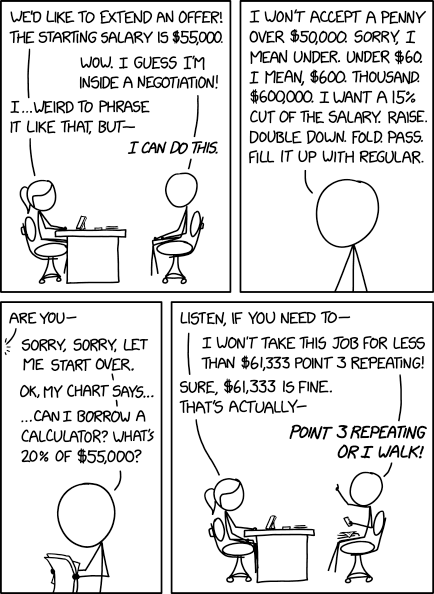
The most recent comic from xkcd, entitled "Salary Negotiation" illustrates nicely, although to the point of absurdity, why this is a good idea:

Mouseover text: "We can do 0.33 or 0.34 but our payroll software doesn't allow us to--" "NO DEAL."

Salary negotiation itself, is quite a salient issue right now in our family. 

My son recently negotiated his summer job employment terms, my daughter just negotiated the terms of her second full time, permanent "real job" (with a 40% pay increase from her current position), her significant other just secured a raise at his first post-college "real job" and support for a professional development program that will put him on track for further advancement in his career, and I negotiated an 80% increase in the rate I am paid when working in an "Of Counsel" capacity two or three years ago after it had been stagnant for seven or eight years. 

My wife left the work force when the pandemic hit because her industry of doing promotional modeling and serving as a brand ambassador basically ceased to exist overnight, and our household suddenly doubled in size, with the extra stresses of having everyone working and studying from home and basic grocery supplies becoming challenging to get for a while. But prior to that, working as an independent contractor, she would engage in a dozen or so new job negotiations every year.