Showing posts with label Iraq. Show all posts

11 June 2025

The Imperfect Case That The Army Is Too Light

An argument that the Army is too light gets some points right, but others deeply wrong. 

How can we have forgotten the terrible lessons of the early 2000s, when losses in Iraq and Afghanistan prompted a scramble to deploy up-armored HMMWVs and Mine Resistant Armor Protected Vehicles? Today’s Army, far lighter than the one that took such damage in so-called “low-intensity combat,” is ill-equipped to deter or contend with the likes of China or Russia.

Let’s take roll of the Army’s 31 active maneuver brigades. Eleven are heavy brigades equipped with tanks and infantry fighting vehicles—well-protected platforms suited to modern war.

Another six brigades are Stryker formations equipped with their eponymous lightly armored, wheeled infantry carriers. Originally called the “interim armored vehicle,” the Stryker was intended to serve only until the arrival of the Future Combat Systems, which imploded instead. From conception, Stryker units have suffered from doctrinal and conceptual confusion. Stryker units carry more dismounted troops than Bradley units, which are intended to fight primarily mounted. But they are infantry carriers, not infantry fighting vehicles. With poor off-road mobility, they are vulnerable to hand-held anti-armor systems, and their units have towed rather than self-propelled artillery. Repeated National Training Center rotations show they cannot survive when employed against armor.

The remaining 14 active maneuver brigades are light infantry formations, cheaper and easier to deploy but, realistically, unable to compete with today’s threat. Under current guidance, they go to war in “infantry squad vehicles”—essentially, unarmored dune buggies without heavy weapons.

Compounding the problem, the commanders of these light brigades have dramatically less firepower than they used to. The recent decision to eliminate the air cavalry squadron from the aviation brigade in Army divisions removes half of each division’s 48 AH-64E attack helicopters, a massive reduction in combat power. Only slightly less dangerous was the Army’s recent decision to deactivate the cavalry squadron in Stryker and light infantry brigades, with their many wheeled vehicles and heavy weapons. The same directive stripped light infantry battalions of their antiarmor/heavy weapons companies: mounted formations armed with automatic grenade launchers, heavy machine guns and heavy antitank systems. These actions removed much of the brigade’s available firepower.

Meanwhile, light artillery battalions still use the venerable M119 105mm towed howitzer, which has a lower rate of fire, shorter range, and weaker weapons effects than the 122mm and 152mm systems used by Russian and Chinese brigades. They are also slower to displace than self-propelled systems, making them far more vulnerable to counter-battery fire and drone attacks.

Promises to offset all these reductions with “Unmanned Systems and Ground/Air launched effects” raise serious questions, given the lack of specifics provided and DoD’s poor acquisition track record.

A quick look at adversary force structure illuminates the challenge. Russian maneuver brigades (tank, motor rifle, airborne/air assault, naval infantry) are remarkably similar. All include four maneuver battalions; three artillery battalions (both tubed and rocket); anti-tank, air defense and reconnaissance battalions; and an electronic warfare company. Chinese brigades have four maneuver battalions supported by strong artillery, air defense and EW units. U.S. brigades have three maneuver battalions, a single artillery battalion, and no dedicated anti-tank, air defense, or EW units. At higher echelons, adversary artillery, air defense and EW continues to outmatch U.S. capabilities, and both the Russian and Chinese militaries have evinced strong commitments to advance their drones and unmanned systems. Overall, their forces are clearly stronger, a dilemma only exacerbated by repeated moves to lighten or weaken U.S. ground forces.

What should the U.S. Army do? Several things: re-equip light brigades with protected, wheeled transport mounting heavy weapons, as before; restore their antiarmor companies; increase the density of Javelin anti-tank and Stinger air defense systems across light formations; replace towed light artillery with wheeled, 155mm systems like the French Caesar or German RCH-155; reverse the deactivation of divisional air cavalry squadrons; and arm divisional UH-60 assault helos with the Hellfire antitank missile system.

Stryker brigades should be converted into true heavy brigades, perhaps with reconditioned M1 Abrams tanks and M2 Bradley fighting vehicles that are now in storage. Hundreds of earlier variants of the M1, M2, and M109 self-propelled howitzer are stored at Sierra Army Depot in Nevada. Should Stryker brigades be retained, they should include an armor battalion, similar to Russian motor rifle brigades. Heavy brigades should be upgraded with the M1A3 Main Battle Tank and M2A4 Infantry Fighting Vehicle as soon as possible.

Army divisions should field a general support 155mm artillery battalion in addition to the artillery battalions providing direct support to the maneuver brigades. All brigades and divisions should include air defense and electronic warfare units, as well as dedicated drone formations with trained operators at every echelon from company to division.

America has not fought a high-intensity war against heavy forces since the Gulf War, when it enjoyed crushing superiority in all domains. Today that superiority now longer exists.

Touted as a move away from a GWOT-focused Army to one more focused on “lethality” and better suited to the Indo-Pacific region, current changes in fact cut deeply into the Army’s ability to hit hard and mass combat power. An America optimized to fight in only one theater is an America content to be a regional but not a global power—a recipe for decline. In the real world, challenges erupt suddenly and unexpectedly (think December 1941, June 1950, October 1963, August 1990 and September 2001). True national security requires a flexible and adaptive Army trained and equipped for sustained, intense combat at the high end of the spectrum of conflict. This means mobility, protection and firepower in all Army formations.

In a word, light is not lethal. It’s time for a rethink.

From Defense One.

What does this analysis get right?

Sufficient armor to protect troops against small arms fire and IEDs does make sense. The “infantry squad vehicles”—essentially, unarmored dune buggies without heavy weapons, indeed don't make sense. They utterly unprotected against even rain or hail or dust or snow or children throwing rocks. They have no weapons of their own and don't have storage capacity to carry squad scale heavy weapons or medical supplies. And, they concentrate a whole squad in a tiny space where a single grenade or volley of automatic weapons fire or IED can kill all of them in one blow. It isn't particularly capable off-road (unlike, for example, the Humvee). The only thing that recommends an infantry squad vehicle at all is that it is faster than walking. Using that as the core model for 14 of 31 Army Brigades is indeed nuts. Maybe one or two brigades of them for paratrooper type deployments into very lightly armed theaters might make sense, but these are, indeed, far too light for almost any conceivable conflict. 

These units aren't even really heavy enough to take on civilian drug cartels (as President Trump has urged the Army to make a priority). U.S. police SWAT teams routinely use more armor and heavier weapons to take on tiny domestic drug dealing gangs in U.S. cities, and protesters without firearms, or a single violent boyfriend and husband or mass shooter with a handful of small arms none of which is more than 0.45 caliber.

Cutting close air support from helicopters with missiles doesn't make much sense either.

But, how can you think that the future of near peer ground warfare lies with heavy tracked tanks and infantry fighting vehicles after having seen how the Ukraine War has played out. The author of this piece forgets that the U.S. Army deliberate fielded few main battle tanks in Kosovo due to its mountains, and that it took many critical weeks to ship them by boat and train to the front in all of the conflicts in which the U.S. has been involved since the Gulf War, despite the fact that the pace of modern warfare has not gotten slower.

Strykers and MRAPs were adequate in the main U.S. wars since the 2000s, the firepower of the main M1 Abrams tank has not been very useful, tank v. tank warfare is basically no longer a thing, and guided missiles like anti-tank Javelin missiles, Hellfire missiles, and TOW missiles have all delivered much more firepower per pound, with greater precision, at equivalent or longer ranges than the main guns of tanks. Traditional tanks like the existing Abrams and traditional infantry fighting vehicles like the Bradley, have no air defenses and no anti-drone weapons, are challenging to operate in tight urban warfare and mountain warfare settings, and aren't particularly mine resistant.

Another lesson of the wars that the U.S. has fought in the last 25 years is that off-road capabilities, where tracked vehicles are a bit faster than off-road capable wheeled vehicles, are rarely used in practice. But the tracks vehicles slow down their entire units, and because they are profoundly less fuel efficient, require more, completely vulnerable fuel tanker trucks to be sent to supply them (and those tanker trucks can't go to the off-road places that the tracked vehicles can). In wars where the front lines are often ill-defined, this is a huge problem.

As for howitzers, either towed or self-propelled, tracked or wheeled, there are also problems. Their range is only 12-24 miles. They are very heavy relative to their firepower. And, they aren't very accurate, so its takes multiple rounds to destroy a target. Mortar systems are even worse in basically every respect. Guided missile systems like HIMARs, or like or Hellfire and Javelin and TOW missiles, produce equal or greater results, with much more accuracy, at longer ranges which enemy artillery can't reach.

We need a middle ground. Yes, Army units should have heavy and lethal weapons like grenade launchers/canons, heavy machine guns, anti-tank missiles, and anti-aircraft missiles. But, for just about anything more than 50mm rounds, guided missiles or handheld recoilless rifles (e.g. for breaching bunkers or fortifications) are superior to tank shells and artillery shells.

Also, yes, they should mostly have sufficient armor to protect against shrapnel and small arms fire, and provide force protection to resist land mines and IEDs. But trying to use heavy armor to protect military vehicles against dedicated anti-armor weapons is generally futile. In Ukraine, every single type of armored tank or infantry fighting vehicle, former Soviet and Western alike, has taken extremely heavy losses no matter how strong their armor was. Against these threats, the options are to either run and hide so as not to get hit, or to employ active defenses like Israel's Trophy system, or lasers, or ground based versions of the Navy's Phalanx close in weapons system, or electronic warfare tools that disrupt the guidance systems of cruise missiles and drones.

And, finally, except in extremely niche roles in very small numbers, wheeled vehicles are superior to tracked vehicles. They are lighter. They can still handle many off-road condition. They are much faster. And, they are much more fuel efficient.

A new off the shelf JTLV, which weighs about half of the original M2 Bradley (which means that you can deploy them in twice the numbers in the same time and with C-130 aircraft that can't transport a Bradley), has about the same fire power as the Bradley, and is similarly or more protective against forces without anti-armor weapons. Both are equally vulnerable to forces with anti-armor weapons. And, the JTLV is 50% faster and has a much lighter logistics trail (it needs much less fuel per mile than a tank or a tracked infantry fighting vehicle) and is cheaper. Yes, it carries fewer infantry to dismount, but this is made up for by allowing units to field twice as many of them.

Looking at how Strykers perform against armor is a straw man argument. Strykers aren't meant to primarily be tank destroyers, any more than it makes sense to send masses of dismounted infantry up against a machine gun nest for no cover. Their carried soldiers need anti-armor weapons (like the Javelin missile, or TOW missiles) that have a range longer than the range of a tank, or other systems to support them, like helicopters or drones armed with anti-tank weapons need to be deployed as tank destroyers.

Current U.S. military doctrine is based upon the assumption that U.S. forces will quickly gain air superiority, and will then use that air superiority to destroy enemy armor and artillery, before U.S. ground forces move in. Strykers aren't supposed to enter the field of battle until the armor, that they indeed don't fare well against head to head, are dispatched, and especially not a close range without at least anti-tank weapons for their dismounted infantry.

The Ukraine War, Houthi attacks on shipping, and recent clashes between Israel and Iran, however, have demonstrated that gaining air superiority and dominance may not be possible in every case, particularly against longer range guided missiles and one way armed drones. Traditional anti-aircraft weapons, meanwhile, are optimized against manned helicopters and fixed wing attack aircraft, not numerous cheap, deadline guided munitions that blur the line between armed drones and guided missiles. Against a "near peer" force, slow and heavy main battle tanks and infantry fighting vehicles, with big, vulnerable logistics trains are targets and not assets.

The U.S. Army does need to increase air defenses and drone defenses across the force. And, the U.S. military should seriously consider switching out more vulnerable and slower attack helicopters as close air support providers, for more robust and faster dedicated close air support aircraft to replace the A-10, and drones, in addition to traditional fighter aircraft designed primarily for air to air combat, and bomber aircraft, at high altitudes, dropping "smart" bombs.

The U.S. Marine Corps has learned these lessons. It has ditched its tanks and howitzers, but kept integrated fixed wing fighter aircraft and armed helicopters to support them. 

The U.S. Army hasn't yet fully woken up to these realities and is still trying to fight World War II and the Korean War.

The Foreseeable Conflicts

It also bears noting that wars against China and Russia, which the author identified as the threats against which the U.S. Army needs to be prepared, are two very different things. 

Plausible Russian Scenarios

The Ukraine War has given us a sneak preview of what a war in Europe with Russia would look like. The Ukraine War also means that Russia's resources to fight a large scale conventional war will have been profoundly reduced. And, any plausible conflict with Russia would be fought not by the U.S. alone, but with all of its European NATO allies. 

Tanks have been destroyed at high rates by both sides in that conflict and their main guns have been very unimportant in that fight. 

Conventional howitzers received heavy use early on, because that is what was available to Russia and Ukraine at first. But now, 70%-80% of the damage is done with armed drones, missiles, snipers, and machine guns do a fair amount of the rest of the damage, and while artillery does still play a significant role in that conflict (because the supply of drones and guided missiles is more limited) it is steadily decreasing as artillery batteries are destroyed (the Russian's have lost more than two-thirds of their's so far and lose more almost every day), while supplies of drones are being replenished (since replacing lost howitzers is much more difficult). Further, artillery resources have not given either side enough of an edge to budget the current territorial front lines for years. 

And, if the U.S. and NATO, unlike Ukraine, were able to overwhelm and defeat Russian air defenses (which their guided munitions, satellite intelligence, stealth aircraft, and medium range artillery missiles would all help facilitate), Russia would be in a much worse position in terms of conventional warfare. Still, one might try to argue despite this for heavier U.S. Army forces.

Plausible Chinese Scenarios Don't Heavily Implicate The Army

In contrast, there is no sensible scenario in which U.S. forces invade any significant part of mainland China with a plan to hold it and rule it for any significant length of time.

The U.S. missions in the Indo-Pacific theater, vis-a-vis China, are to (1) protect Taiwan from being invaded, (2) protect the Philippines from maritime harassment or subjection by China, (3) to protect Hawaii, Alaska, and the U.S. territories in the Pacific (e.g. Guam and the Northern Mariana Islands) from invasion or embargoes, and (4) to protect Japan and South Korea and other allies in the region from Chinese attacks or intimidation.

A threatened invasion of Taiwan is the dominant concern among those possibilities. And, mostly, the U.S. role would to be employ the U.S. Air Force, the U.S. naval aviation, U.S. surface combatants with anti-ship missiles, U.S. attack submarines, and naval and air force resources from Japan, South Korea, and Australia, and possibly other U.S. and Taiwanese allies, to sink as many invading Chinese ships and destroy as many Chinese aircraft as possible, in support of Taiwanese forces on the ground, and to destroy the facilities on the coast of China from which those forces are deployed without occupying them on a medium or long term basis. 

The U.S. Marine Corps, based in places like Okinawa and Guam would play the leading role in reinforcing Taiwanese ground troops on the island of Formosa and nearby islands. In part, this is because the U.S. Army with the help of U.S. Air Force  and allied transport planes going into a contested airspace, and painfully slow U.S. Navy transport ships going into a contested maritime space, wouldn't be able to arrive in meaningful numbers in sufficient time to make a difference (especially their heavier forces which would have to come from South Korea, Hawaii, Alaska, and the West Coast of the mainland U.S.). 

And, invading Chinese forces that did manage to make it to Taiwan, would most likely be light infantry, because all or almost all of the ferries carrying heavy Chinese armor would likely be sunk by a barrage of air, sea, and land sources missiles, torpedos, and sea mines while crossing the 100 mile straight to Formosa from the Chinese mainland. U.S. special forces or Marines might briefly set foot on the Chinese mainland to destroy an airport or a port or a military base or to disrupt the supply chain of the Chinese forces, but they would most likely bug out as soon as their narrow and destructive mission was accomplished.

Taiwanese forces would be doing the heavy lifting to fight any Chinese forces that managed to cross the straight and in dealing with inbound Chinese missiles and armed drone with whatever anti-drone and anti-missile defenses they could muster. In any conflict where U.S. Army ground troops were doing more than just tipping the balance slightly in an evenly matched fight between invading PLA troops and Taiwanese defenders, their role would be a lost cause, and would need to happen in a matter of days, before PLA victory became a fait accompli. Artillery or tank duels between the U.S. Army and the PLA are highly unlikely.

All of which is to say that the Army's case that its forces need to be heavy armored forces to engage in a ground war with China doesn't stand up to close scrutiny. Even if the Army is able to secure the long range fires with a 1,000 mile range that it is seeking in defense procurement fights, that wouldn't matter. Hawaii is about 5,250 miles away from Taiwan. Alaska and the U.S. mainland are farther away. 

South Korea is about 830 miles away from Taiwan (about 28 hours or more by U.S. Navy transport ships once at sea through highly contested waters) and this distance would put it barely within striking distance with missiles with ranges almost three times as great as its current longest range option (which is in short supply). This is also too far for the Army to deliver its troops by helicopter without midair refueling in the face of very vigorous Chinese air defenses.

Okinawa, which has mostly Marines and Air Force and Navy personnel, is 400 miles away from Taiwan (which is still 13 hours away on an amphibious assault ship through hotly contested waters). Guam is about 2,750 miles from mainland China and has naval and air bases, but no meaningful Army or Marine Corps presence.

There are no U.S. military based on Taiwan itself, so it has almost no prepositioned troops or heavy military equipment there, and it doesn't have the depth of a relationship with local military forces that it does in Japan and South Korea either.

Plausible Scenarios Against North Korea

Really, the only plausible scenario in which U.S. Army forces would be engaged in ground combat with heavy opposing forces in Asia would be in North Korea, defending South Korea together with its own forces and with support from Japan and from other branches of the U.S. military. This would be a profoundly different kind of conflict than the conflicts against China or Russia that the author references.

North Korea may be armed to the hilt, but it is still a small country and its forces are hollow. And, it would be facing adversaries who had been planning for this moment for decades.

The Second Division of the U.S. Army, which is the main U.S. combat force stationed in South Korea (in addition to about 8,000 airmen), is divided between an artillery brigade with armored, tracked M270 multiple rocket launchers, and a combat aviation brigade with a mix of Apache AH-64 gunships, an assault regiment of troops deployed in UH-60 Blackhawk helicopters, and a regiment of general support transport helicopters, as well as some larger reconnaissance and armed drones.

The Seventh Air Force stationed in South Korea consists of two fighter wings with three squadrons of F-16 fighter aircraft and one squadron of A-10 attack aircraft.


There are about 300 sailors at a U.S. naval base in Busan, which is about 4,860 miles from Hawaii (about 162 hours by naval transport ship, in addition to time to travel from Busan to the DMZ over land). So, it would take more than a week to get more U.S. Army soldiers and equipment to South Korea that could not be air lifted (although the Marines in Okinawa would be much closer, about 25 hours by ship to Busan plus addition time to the front over land).


There are about 100 Marines and about 100 special operations forces and 20 Space Force "guardians" at the Army base there (Camp Humphreys) that also houses the 20,000 U.S. Army soldiers who are not special forces, and the U.S. Air Force base with 8,000 airmen.
Camp Humphreys is 40 miles (64 km) south of the former base in Seoul and about 60 miles (97 km) from the Demilitarized Zone that divides North and South Korea. That puts the base about twice as far from North Korea as its predecessor, one of the main reasons for the move. While the new location moves the bulk of U.S. troops out of the range of North Korean artillery, the North Korean military has developed large caliber rockets and ballistic missiles, as well as a nuclear capability, capable of reaching Camp Humphreys.

Camp Humphreys is 143 miles from Busan Naval Base, which is less than three hours away for wheeled vehicles (or by train) and less than four hours away for tracked vehicles by road. It would take another hour to the DMZ for wheeled vehicles and another hour and twenty minutes for tracked vehicles by road. So, it would be a full seven days of travel from Hawaii to the front by sea, assuming that no detours were necessary to avoid attacks in contested maritime waters, and however long it took to load and unload the forces onto their sealift, to make sealift arrangements, and to decide to deploy them. 

The Marines from Okinawa make take a couple of day to arrive by sea with heavy equipment and reach the front.

19 November 2024

The Next Generation Hellfire Missile And Better Explosives

A Much Improved Successor To The Hellfire Missile

A Hellfire missile has a similar size (a little over 100 pounds), explosive capacity (20-24 pounds), and range to a 155mm Howitzer round. The guided missile is more accurate, hitting targets within a 10 foot radius about 50% of time, but has a 7 mile range, while the unguided artillery round has a 12 mile range but is much less accurate, hitting targets within a 180-900 foot radius about 50% of the time (which is about 324-8100 times more area than the Hellfire strike zone). 

Both pack more punch than the 70 pound shell launched from a 5" naval gun (the largest naval gun in service on any U.S. warship), a 120mm tank shell, a 120mm mortar round, a 105mm tank shell, a 105mm artillery round, a GUB-44/B Viper Strike guided bomb, or any kind of anti-tank missile, rocket, or recoilless rifle round in wide use.

But it is less powerful than a torpedo, a U.S. Army Standard MLRS artillery missile, a Naval Strike missile, and ATACMS missile, a missile launch from a naval vertical launch system (VLS), or any fixed wing aircraft dropped bombs bigger than a Viper Strike.

The Hellfire missile needs only minimal launching apparatus (which allows it to be used from helicopters, light aircraft, drones, and even a slightly modified Humvee), while a howitzer requires a heavy and slow artillery system, about four tons towed, or almost 28 tons for an armored tracked Paladin mobile artillery system (with a peak speed of only about 35 mph, slowing down the force, whose poor fuel efficiency adds to the logistics trail of the force). 

The Hellfire missile is much more expensive (around $150,000) than an artillery round (around $2000 with inflation), however. But, the missile's greater accuracy means that far fewer rounds are necessary to reliably destroy the same target, and that it produces far less collateral damage. 

As noted in a previous post (emphasis added):

155mm M795 U.S. high explosive howitzer shell (103 pounds) The 155mm (about 6") M777 howitzer, used by the U.S. Marines, has a 90 pound shell, weighs four tons, and has a range of 12 miles with conventional shells and 24 miles with guided shells (Excalibur) which are more accurate as well. Existing Paladin M109 mobile howitzers used by the U.S. Army has a range of about 30 kilometers (18 miles); the design requirement for the existing systems was a target zone of 180 feet radius to about 900 feet depending upon range and other factor; it weighs 27.5 tons (and thus can't be carried in a C-130) and has a maximum speed of 35 mph. The Crusader mobile howitzer, which was cancelled, was going to cost on the order of $24 million or more per one howitzer vehicle. A standard 155mm howitzer shell costs about $1,500 per round.

A proposed next generation successor to the Hellfire missile is similar in size and weight to the existing Hellfire missile, but has twice the amount of explosives (40 pounds) and an 138 mile range with undiminished accuracy, which would hit a tank sized target in Cheyenne, Wyoming (101 miles), Vail (97 miles), or Pueblo (113 miles) from Civic Center Park in Denver. 

The main difference between the successor and the existing Hellfire missile is that instead of using a solid fuel rocket, it uses a disposable jet engine. It may actually end up being cheaper than the Hellfire missile when produced in quantity.

California-based Anduril Industries has been scooping up defense contracts left and right in recent years. And now the firm, which is primarily known for its advanced and highly autonomous drone systems, is looking to apply that expertise to precision-guided munitions in a new line of air-breathing cruise missiles they call the Barracuda M.

The Barracuda M line is made up of three different weapons: the M-100, M-250, and M-500 cruise missiles. . . . the M-100 significantly outclasses the weapons it could feasibly replace. The M-100 was designed to be carried by rotorcraft like the AH-64 Apache gunship or the AH-1 Cobra, in very much the same way these platforms carry Hellfire missiles today. (Although it could feasibly be launched by any of the long list of other platforms that carry Hellfires.)

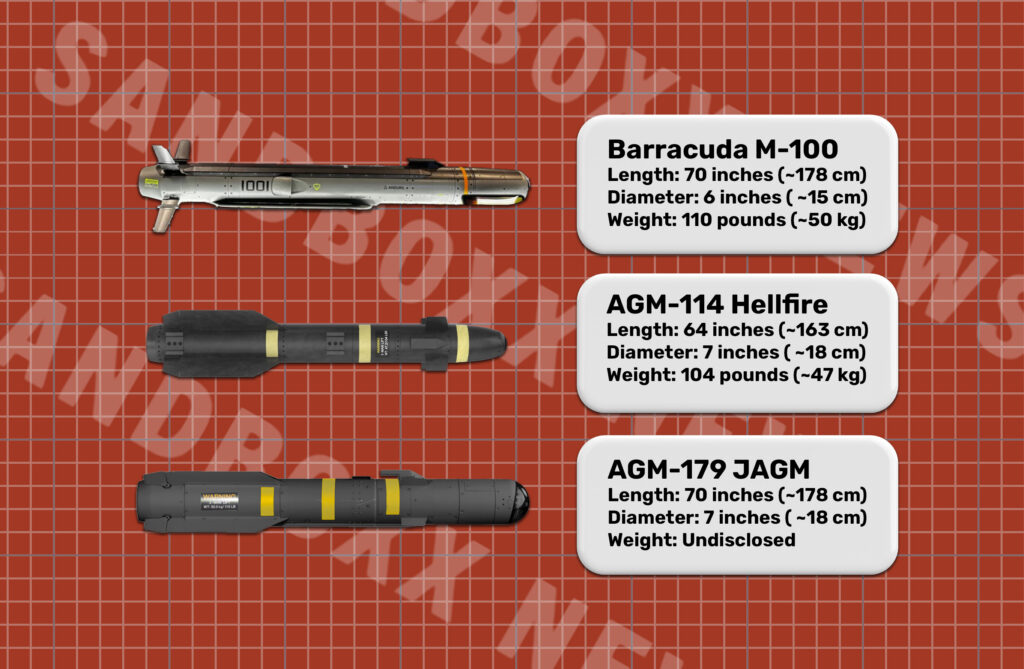
Indeed, the M-100 is very close in size to the long-serving AGM-114 Hellfire, and even closer in size to the AGM-179 Joint Air to Ground Missile (JAGM) that’s meant to replace the Hellfire.

The M-100 is about 70 inches long with a six-inch diameter and weighs roughly 110 pounds. In comparison, the AGM-114 is 64 inches long, with a seven-inch diameter and a total weight of around 104 to 108 pounds; and the new AGM-179, which is 70 inches long with a seven-inch diameter and an undisclosed total weight. 
 
(Graphic by Alex Hollings)

But while the M-100 is about the same size as the Hellfire or the JAGM, it packs a much bigger punch.

The Hellfire missile carries a roughly 20-pound high explosive warhead and the JAGM is expected to carry about the same. In our original story, Anduril initially told Sandboxx News that their M-100 would carry a 35-pound warhead, but that has since been increased to 40 pounds – twice the size of the Hellfire’s and JAGM’s warhead.

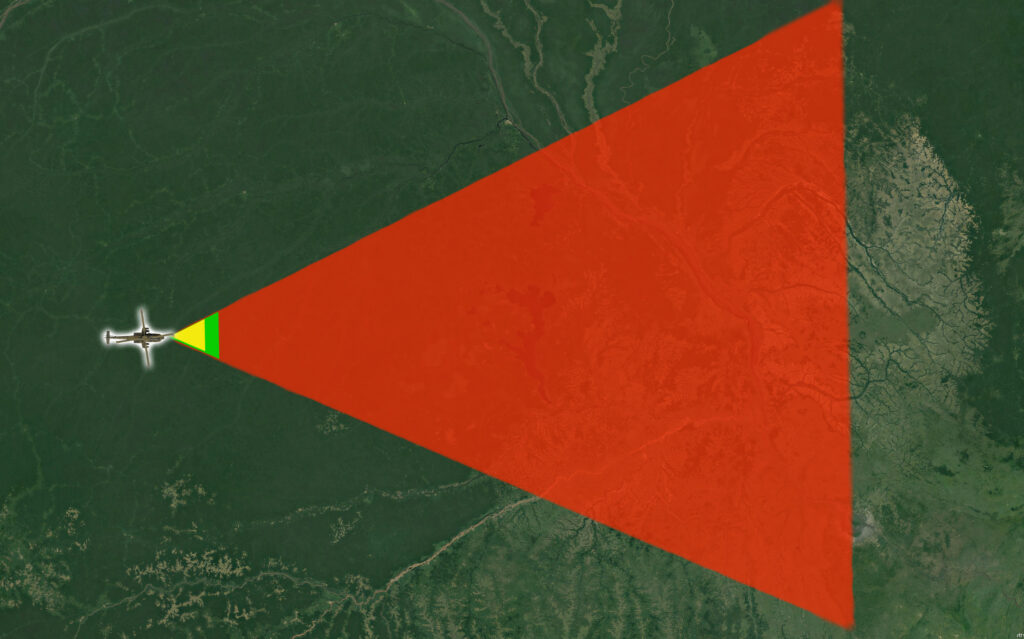
The Hellfire missile usually has a maximum range of between four and 6.8 miles, depending on launch conditions – though some variants, like the AGM-114R-4 long-range Hellfire missile that saw testing in 2022, can reach as far as 21 miles. The AGM-179 JAGM, meanwhile, started its journey to service with a stated range of roughly five miles, but has since doubled that figure to 10. 
 
Comparing the maximum ranges of the AGM-114 Hellfire (yellow), the AGM-179 JAGM (green), and the Barracuda M-100 (red). (Graphic by Alex Hollings)

The M-100, on the other hand, can carry its 40-pound warhead to targets 138 miles away – or 20 times the Hellfire’s range. This is possible because the weapon carries a completely different type of propulsion system than you’ll find in weapons like the Hellfire which are powered by a solid propellant rocket motor. The M-100 is powered by a very small, air-breathing turbojet engine, the same sort of propulsion system you’d find powering a tactical aircraft or other long-range cruise missiles.

The only place the M-100 would fall short of the Hellfire is in maximum speed, as the Hellfire is known to top out at around Mach 1.3, while the M-100 is limited to high subsonic speeds, according to Anduril.

Depending on the iteration, Hellfire missiles have a per-unit price of around $150,000, while the newer JAGM costs about $320,000. Although we don’t know how much the M100 will ultimately cost, Anduril focuses on streamlined and simple production. The company says that the entire weapon can be assembled using fewer than 10 simple hand tools, which will make it very easy to train personnel in assembling it. Because of that simplicity, the company claims it can double its production capacity anytime the U.S. needs a surge of precision-guided munitions.

This weapon . . . has already seen testing in-house at Anduril and now the company is shopping these weapons to the Department of Defense in hopes of securing a production contract.

In a war like the currently pending Ukraine War, where Russian troops feel secure stationing weapons systems and bases outside artillery range from Ukraine's front lines, widespread availability of these missiles could push back the front lines by 130 miles into Russian territory. 

Similarly, this makes it possible to strike at another country (e.g. Israel), or into international waters, from deep inside sovereign territory of the person making the shot.

The larger version of this new missile (the M-250 and M-500) are more comparable to full sized HIMARs, M270, and navy cruise missiles, and to other intermediate range, larger missiles which the Marines, Army, and Air Force are all actively developing.

The greater range also makes real time forward reconnaissance much more important. 

A forward observer with a device about the size of a satellite phone, a small reconnaissance drone (ideally with a long range), spy planes, high altitude airships or balloons, or spy satellites, could all provide real time imagery that could direct missiles from distant launch sites to a target.

The Case For A Canon Artillery Substitute Missile

Another possibility would be to develop a missile similar in concept to the M-100, but smaller, with a warhead size similar to a Hellfire missile or 155mm artillery round (20-24 pounds), and perhaps only a fifth as much fuel for a 28 mile range, that is significantly lighter (perhaps 60-75 pounds) than the 90-103 pounds of a 155mm artillery round or the 104-110 pounds of a Hellfire missile or an M-100, as a canon artillery substitute missile. 

This canon artillery substitute missile could be fired from a variety of platforms, e.g., a pickup truck mount, a JTLV, a Stryker, an ATV sized ground based drone, an air based drone, a helicopter, a light plane, an AC-130, an A-10, an F-35, a patrol boat, a corvette, or a frigate. Faster, lighter platforms, operating at a greater distance from opposition forces, would be better suited to the modern scoot and shoot tactics of modern artillery forces. Its lighter weight would allow more to be carried on any given platform.

Advanced Energetic Materials

Another way to reduce the weight, without sacrificing explosive power, would be to introduce a new generation (paywalled WSJ article) of "advanced energetic materials - chemicals that propel or explode" which have advanced little since the RDX and Torpex used as TNT replacements which were about 50% more powerful per weight than TNT towards the end of WWII.

For example, an explosive material called CL-20, first identified in 1993 which is currently the subject of research by China and Russia's defense scientists, has been basically stalled in the R&D phase for the last thirty-years, during which it wasn't a priority because counterinsurgency operations in Iraq and Afghanistan were the priority. It is supposed to be 10 times more powerful than TNT (video) making it the most powerful non-nuclear explosive known to man.

17 October 2024

The B-2 Is Rarely Used

Despite the small size of the U.S. B-2 bomber fleet, it isn't a heavily used resource despite its immense cost.

The U.S. bombing yesterday of five bunkers where Houthi rebels in Yemen stored weapons (which killed no civilians) was carried out by a B-2 bomber.

The last time that this class of bomber was used in combat before this week was seven years ago in 2017 in a January 18 strike on an ISIS training camp by two B-2s. 

Before that it was used to strike targets in Libya in March of 2011. 

They were used 49 times in the wars in Afghanistan and Iraq in 2003. 

It was first used in combat in the Kosovo War in 1999 (where it was used heavily), two years after it entered military service in 1997. The first B-2 bomber flew thirty-five years ago on July 17, 1989, eight years before it entered military service.

The B-2's global range (6,900 miles, which can be greatly extended with aerial refueling), stealth capabilities, and heavy bomb payload (20-25 tons) is a combination unmatched in the world. It has a crew of two. 

Just 21 were built (driving up the per unit cost immensely) and 17 remain in service, while four had accidents or crashes that removed them from service. This is quite unimpressive for such a small number of aircraft when the number of combat missions it has flown in the 27 years it has been in military service is so small. 

The U.S. is in the process of fielding a replacement B-21 bomber which is quite similar in design and capabilities to the B-2. 

04 June 2024

360 x 360

In the Iraq War and the war in Afghanistan, two of the biggest vulnerabilities of occupying U.S. and allied forces that the local resistance in Iraq and Taliban in Afghanistan used were to shoot exposed gunners with snipers, and to use improvised explosive devices (IEDs), as land mines (sometimes controlled visually by cell phones), to exploit the flat bottoms of Humvees, tanks, and other armored vehicles.

Humvees weren't designed to be on the front lines, but ended up there in wars that had no front lines.

Armored vehicles, including tanks and infantry fighting vehicles, were designed to have side armor protecting them from direct fire in a two dimensional battlefield, and had the heaviest armor on the front where their opponents were supposed to be.

In the moment, the U.S. bought mine-resistant ambush protected (MRAP) vehicles to respond to those threats. These featured curved rear surfaces to deflect blast energy from mines and make IEDs less effective, and either protected or remote controlled gunner positions to protect gunners from ambushes.

But neither the M1 Abrams tank, nor the M2 Bradley Infantry fighting vehicle, which are the mainstay of U.S. Army armored forces, were redesigned to provide mine and IED resistance, although some upgrades to protect gunners from ambushes and sniper fire were adopted.

The Joint Light Tactical Vehicle (JLTV) that has replaced the Humvee has the features of the MRAP, but more thoughtfully put together without the time pressure of a war being conducted.

The Ukraine war has cast attention on another of the problems with almost all armored vehicles in protection. They almost all have lighter armor on top, because the threats that their armor was designed to stop were expected to come from opponents, like other tanks, in front of them, or at most, on the sides in a two-dimensional plane. So, almost all existing armored vehicles are especially vulnerable to anti-tank missiles and artillery rounds that strike from above, and to bombs dropped from drones and loitering munitions from above, relative to strikes from the front where their armor is strongest. Tens of thousands of armored vehicles in Ukraine on both sides of the conflict, modern and dated alike, have fallen to top side attacks.

A new generation of front line military vehicles and systems need to be defended not only from the 360 degrees surrounding the vehicle from all sides in a two dimensional plane, but also from threat below, like land mines and IEDs, from above, and from all angles from low to high in between, including fire from the side from ditches, and fire from above from tall buildings or mountains.

The Limits Of Armor

Of course that's not the only design issue facing armor in an era of new threats.

Offense has surpassed passive defenses for the foreseeable future. The maximum feasible amount of armor protection comes with immense weight, makes it hard to deploy to the conflict quickly, slows the vehicle down, makes it vulnerable to mud or pits and trenches, and makes it less fuel efficient with a longer and vulnerable logistics supply chain. But even maximal armor can be overcome by much smaller, lighter anti-armor missiles. And, lesser strikes to tracks on the vehicle, for example, can produce soft kills that force troops to abandon it.

While armor is invincible against small arms fire and shrapnel, and provides some meaningful protection against lighter anti-tank weapons like 20mm to 50mm canons and RPGs, no amount of armor is going to prevent a direct hit from an anti-armor tank round, an artillery shell, an anti-tank missile, and a guided bomb dropped by fighter aircraft or a bomber. For those threats, the only defenses are to be out of range, to be undetected, or to have active defenses.

When it comes to deployments, airlift and transportation of armored vehicles by rail and road bridges built to civilian standards in most places where the U.S. might go to war is greatly impeded for vehicles with more than 38 tons or so, while vehicles of 19 tons or less are much more easily deployed by air (including a C-130) and across civilian road and rail bridges.

The Problems With Tracked Vehicles

The same considerations that disfavor heavy armor also disfavor tracked vehicles. Tracked vehicles top out at about 45 miles per hour and that simply isn't fast by any measure. At that speed, even trying to get out of range of incoming opposition forces is basically futile. And, any military unit with even a single tracked vehicle is limited to the speed of its slowest vehicle. The last sixty years of experience have shown that the off road capabilities of tracked vehicles are utilized much less than planners anticipated (and again, a whole unit can't travel off road unless every vehicle in the unit has that capability), and the comparative disadvantage of wheeled vehicles designed to be used off road against tracked vehicles has greatly declined. Also, slow, heavy, tracked vehicles are hard to hide and not being seen by opponents who can destroy you until it is too late is critical in modern ground warfare. A drone can easily see where a tracked vehicle has been and trace that to its target. Tracked vehicles use at least twice as much fuel per mile as comparable wheeled vehicles.

Tracker artillery vehicles and missile launchers are ill suited to modern "shoot and scoot" tactics.

Active Defenses

Active defenses, in contrast, have made immense leaps and bounds. Electronic warfare devices can disrupt the controls of remote controlled or GPS guided weapons. Automated active response systems can shoot and defeat incoming drones, missiles, and shells before they hit an armored vehicle, leaving its armor to merely deflect shrapnel. Long range anti-air and anti-tank missiles can defeat incoming ground attack aircraft, attack helicopters, drones, and enemy armored vehicles before they are within the range of direct fire weapons like the main gun of a tank, cannons, rocket propelled grenades, recoilless rifles (a.k.a. bazookas), or other enemy weapon ranges.

Vulnerable Logistics Supply Lines

Logistics also takes on a new relevance in an era of war without true front lines. No military unit can get far without supplies of fuel, ammunition, food, and water. The heavier and less fuel efficient military vehicles are, the more fuel they need. The more "dumb" their weapons are, the more ammunition they need. But in a world without front lines, logistics supply trucks are vulnerable because they are softer targets than armored vehicles. Increasingly, however, logistics vehicles need to be as protected against hostile fire as the vehicles which were traditionally the tip of the spear. So, we need to minimize the size of the logistics supply line and to make the vehicles that are a part of it more survivable, to at least the point of armored personnel carriers.

25 April 2024

More Thoughts On The Conflict In Israel

* Palestine hasn't been a sovereign state for more than 75 years and the international community has done great harm by supporting this expectation. Palestinian claims for a right of return have no validity. Claims that people who have never lived in Israel proper (which is the case for most Palestinians in Gaza) are refugees aren't valid either. Conquest is a legitimate basis for sovereignty.

* In the same way, the international community has done great harm by refusing to recognize the People's Republic of China's claim to Taiwan and by not pressuring Taiwan to drop its claims to the mainland. 

* The current conflict is fundamentally the fault of the Hamas leadership in Gaza supported by Iran.

* The military actions of Hezbollah, Hamas, the Houthis, Iranian backed militias in Iraq and Syria, and Iran, purported directed at Israel are all completely unjustified. The U.S. and Israel should formally declare war on all of them, exterminating completely all of the soldiers and political leaders behind all of Iran's proxies and destroying Iran's military capabilities and nuclear efforts of all kinds completely.

* Gaza claims that 32,000 lives of its 2.3 million people have been lost, it should count itself lucky that the number is so small. Everything that it has suffered, it has brought on itself, with broad popular support. It should have unconditionally surrendered. Instead, even now, most Gazans support the decision to launch the October 7 attack, and still is pushing for Palestinian sovereignty, and still wants to exterminate Israel. They tried, over and over again. They lost. It's over. The Middle East will be at war forever until the world acknowledges once and for all that the Palestinians lost.

* Gaza cannot support 2.3 million people anymore in any sustainable way due to destroyed homes and infrastructure. Something like half of the population needs to be relocated somewhere. And, about the same proportion of Gazans would like to leave. The international community should stop questioning the fact that most Gazans need to be relocated, i.e. exiled, basically permanently, and should start recruiting countries to receive exiled Gazans. Exile is really the only solution that is humane and viable. If the Islamic world really cares about the people suffering in Gaza, it should offer to take them in with open arms.

* Cease fires, efforts to reinstate local home rule, and so on, are only aggravating the suffering.

* The Palestinians of the West Bank should be given a choice: be ceded to Jordan or be exiled with the people of Gaza. They chose Hamas to lead their home rule too, and as such, they should not be eligible for further local home rule.

14 April 2024

Sunday Musings

 * The United States is deeply politically and culturally divided, and it has had a few political dynasties. But, ultimately, the U.S. has at least largely resisted the hereditary principle and clan politics. We have oligarchies of big corporations, but those big successful corporations, while not entirely free of it, are not hotbeds of nepotism either. Father to son CEO succession happens, but it is rare, and tends to happen second tier businesses not in big national S&P 500 companies.

* We are approaching a point where it may make sense to declare war on both Iran and its proxies like Hezbollah, Hamas, the Houthis, and Iranian militias in Syria and Iraq. The Houthis have directed piracy and missiles at commercial ships in the Red Sea and their insurgency has led to one of the worst famines in the world in Southern Yemen which has historically been the bread belt of Arabia. (It is worth nothing that both sides of the civil war in Yemen are united in their hate for the United States.) Hamas carried out the October 7 attack and has continued a suicidal response by Gazans to Israeli retaliation. Hezbollah in Lebanon has been lobbing artillery and missiles as Israel for decades. Iranian missiles recently killed a detachment of U.S. troops in Jordan. Iran has fired several hundred missiles at Israel in the last few days, has been in multiple skirmishes with U.S. Navy forces in the Persian Gulf, and has terrorized commercial traffic in the Persian Gulf.

* The U.S., admittedly, plays an important part in Iran's ascendancy. U.S. support for the Shah in Iran played an important rule in the 1979 Islamic Revolution in Iran that put the current regime in place. Sanctions the U.S. pushed for caused Iran to develop its own domestic military production (something similar happened as a result of sanctions in Israel, in South Africa, and in Turkey), and also pushed Iran into Russia and North Korea's circle of allies. U.S. military intervention in Iraq and Afghanistan defanged Iran's neighbors who were among its greatest military adversaries. Dislodging the neo-Communist dictatorship in Iraq opened the door to Iranian backed Shiite party political gains there. Encouraging Arab Spring revolutions in Syria contributed to the Syrian Civil War that still isn't over and has created a vacuum for Iranian backed militias there.

* Golf courses are a waste of water in the arid west:


About 1% of total Colorado water consumption goes toward golf courses (this is about 5% of non-agricultural water use):

In its 2021 economic and environmental impact report, the Colorado Golf Coalition, a collection of state organizations, reported that the industry’s water consumption represents less than 1% of the state’s 2018 total — 41,213 acre-feet, compared with 4.7 million acre-feet for agriculture, the largest consumer.

It also touts the positive environmental impact of its more than 33,000 acres of greenspace statewide, of which a little more than 16,000 acres constitute irrigated turfgrass, species like bluegrass that can endure high traffic and low mowing heights ideal for golf. That’s more than 17% less irrigated acreage than in 2002.

By region, the courses in the Denver metropolitan area account for more than 43% of the irrigated acreage. Since the 2002 measurements, Colorado courses have increased use of reclaimed water and significantly reduced use of municipal sources.

Still, golf courses have joined lawns as targets for restrictions in places like Aurora, where Mayor Mike Coffman invoked the “new reality” of water scarcity in Colorado in support of a proposed ban on new courses — unless they employ the buffalo and blue grama long a staple on the Eastern Plains — as the city looks at limiting grass yards, medians and decorative office park areas.

In fairness, golf courses in the arid west have made very significant efforts to reduce their water consumption; far more significant efforts than agricultural users have.

* Agriculture and evaporation consume all but 18% of water in the Colorado River basin (and that 18% includes a significant portion for lawns and golf courses). About 70% of agricultural water is used for cattle feed, mostly alfalfa and to a lesser extent hay, according to a Denver Post analysis:


* Despite its immense water use, agriculture is almost economically irrelevant in Colorado.

* According to Denver Water, household water used breaks down as follows:

54% landscaping
13% toilets
11% laundry
10% showers and baths
6% faucets
5% leaks
1% dishwashers

* The Southwest is, however, a naturally ideal place for solar energy (and it doesn't hurt that a lot of the electricity demand there is for air conditioning which coincides with solar energy availability):

* This week I learned that there are both role playing games and video games in which the protagonist that you play is a bird.

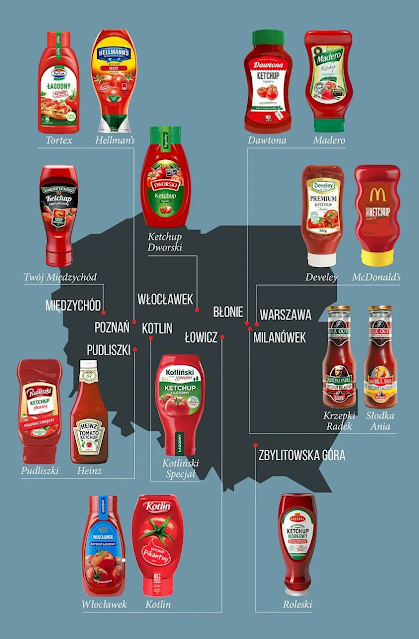
* It turns out that a certain part of Poland is the heartland of ketchup production (a widely used product there):


The Polish Ketchup Belt is a narrow lane between the 51.5N and 52.5N parallels where almost all ketchup production in Poland is concentrated. (Source)

* Ukraine has made strikes deep into Russian territory:

It is 755 kilometers from Ukraine to Moscow and there are numerous Russian refineries and oil storage sites to attack along the way. Ukraine has been attacking those oil facilities and . . . the damage to oil facilities and other targets has been so great that Russia has had to ration how much fuel civilian and military users can get. It is estimated that the Ukrainian attacks destroyed twelve percent of Russia’s oil refining capability.

* Bible reading has recently fallen dramatically in the U.S.:


 * Coal use is up globally, despite falling in the U.S., the U.K., and a number of European countries, due predominantly to new coal fired power plants in Asia:


Greece's failure to tap into its abundant wind power capacity and its near ideal geography for electric cars, baffles me. The same can be said for Hawaii.

* Turkish people drink a lot of tea.


* According to data cited the Economist magazine, South Korea has an intense "glass-ceiling" for women in the workplace, which surprises me. I had thought that the situation for South Korean women who didn't marry or had kids was pretty good.


* Early 19th century grave robbing was driven by incentives you wouldn't expect:

At the 1815 Battle of Waterloo, Napoleon Bonaparte’s final battle, more than 10,000 men and as many horses were killed in a single day. Yet today, archaeologists often struggle to find physical evidence of the dead from that bloody time period. Plowing and construction are usually the culprits behind missing historical remains, but they can’t explain the loss here. How did so many bones up and vanish?

In a new book, an international team of historians and archaeologists argues the bones were depleted by industrial-scale grave robbing. The introduction of phosphates for fertilizer and bone char as an ingredient in beet sugar processing at the beginning of the 19th century transformed bones into a hot commodity. Skyrocketing prices prompted raids on mass graves across Europe—and beyond.

* In the Netherlands, the interest rate on a particular mortgage fall over time to reflect the reduced risk of loss to lenders as the debt to equity ratio falls as principal is paid off and real estate appreciates in value. But, this also disincentivizes selling one home to move to another, or refinancing.

* Average hourly wages vary greatly across Europe:

* In Ray Bradbury's short story "All Summer In A Day": "The children let Margot out of the locked closet at the end of "All Summer in a Day." They had locked her inside while the teacher was elsewhere, making Margot miss the sun, which only comes out every seven years." It was a story the affected me greatly as a child and still does.

* Skunks are an American thing. The skunk family (Mephitidae) consists of 13 species, and almost all are restricted to the Western Hemisphere, reaching from Southern Canada to the Strait of Magellan in South America. The exception is the Stink Badger which can be found in Indonesia.

* Gasoline prices, adjusted for inflation, are similar or lower now than they were in 2006. U.S. mortgage interest rates are middling by historical standards and historically low rate until recently may have helped drive up real estate prices:


* High rise office buildings are plummeting in value.

* There were once more than 9,000 Blockbuster video stores. There is now one, in Bend, Oregon.

* What's better with Jalapeños?

1. Pizza.
2. Beer.
3. Lemonaide.

* Humans are basically fish in flesh suits and our blood is a decent approximation of sea water. An image gets across the concept:


*  There ought to be a law disqualifying judges from deciding cases involving the person who appointed them as a party (in the appointing person's personal, as opposed to their official, capacity).

* Trump does not have legitimate defenses in the classified documents criminal case against him, despite the fact that a judge he appointed seemed to be "confused" about this point.

07 February 2024

More Discussion Of Tanks


The first new armored vehicle in the U.S. Army in 40 years, the M10 Booker Mobile Protected Firepower a.k.a. Light Tank is about to enter service. The Army wants to buy 504 of them. 

This is still basically a bad idea. The number of units of the M10 should be greatly reduced as it provides a brief interim respite until a better alternative that is better suited to the realities of modern warfare can be fielded.

* The Ukraine war has demonstrated that tanks with a large main direct fire gun firing a dumb shell, tracks, and only minor secondary weapons, no matter how advanced, are generically sitting ducks in modern conventional warfare that provides little offensive capabilities that other military systems can't provide equally well or better. Other recent conflicts involving tanks tend to reaffirm this conclusion.

* The M1 Abrams was ill-suited for the Iraq War, was ill-suited for Kosovo, was ill-suited for Afghanistan, is ill-suited for the Ukraine War, and is ill-suited for any kind of war in the Pacific with China or North Korea. It isn't fit to fight in cities with narrow streets, in mountains with narrow passes, in jungles or other muddy terrain, and in countries with rivers crossed by bridges that can't hold 73 tons, although it performs adequately on plains and in deserts outside major cities that aren't broken up by canyons or rivers. It is also generically ill-suited to any kind of rapid response expeditionary mission where they cannot be prepositioned, because so few of them can be delivered by air and delivering tanks by sea is far slower than the pace at which modern warfare proceeds. 

* But the M10 Booker solves too few of the M1 Abrams' flaws. It doesn't solve the limited ability of crews to see their surroundings, and limited angular range of fire issues that make the M1 vulnerable to mines, IEDs and infantry with short range anti-tank weapons when it lacks dismounted infantry support. It doesn't solve the M1s vulnerability to drone and missile attacks. It doesn't solve the weak top armor problem. It doesn't solve the problem that its direct fire main gun has a shorter range than artillery rounds and anti-tank missiles. It doesn't solve the M1s slow speed that denies it a capacity to flee attackers moving at even modest speeds and slows down units that could otherwise move faster. It doesn't reduce the number of soldiers in harm's way in the tank. It is basically just an M1 Abrams with a smaller tank shell and somewhat less strong armor, that is more fuel efficient and 32 tons lighter, which is a pretty unimpressive improvement after 45 years on a tank that has consistently proven how ill-suited it is for most of the missions where its use might potentially be considered.

* The speed and lower fuel consumption and maintenance costs of wheeled armored vehicles make them superior to slower and more expensive tracked vehicles, in exchange for only minor reductions (if any) in their off road capabilities. Attacks on supply conveys were major military issues in the Ukraine, in Afghanistan, and in Iraq, as modern warfare no longer has clearly defined front lines, so any vehicle located anywhere in the theater of conflict, including lightly armored and unarmed diesel fuel tankers, can be attacked.

* Anti-tank missiles deliver the same punch, with greater accuracy and range, with vastly less weight than a main gun on a tank. Tank shells are less expensive,  but the less expensive delivery devices for anti-tank missiles make up for that, unless the number of shells fired in anger is far greater than post-WWII combat history suggests are usually needed. And, the prices of anti-tank missiles can plummet as their tech goes out of patent.

* The M10's fairly heavy armor which is second only to the M1 main battle tank is virtually irrelevant, because it doesn't appear to have a V-shaped hull to deal with mines and IEDs, it lacks active defenses against drones and anti-tank weapons, and it appears to share the flaw of having thin top armor relative to front and side armor of most tanks that have increased their vulnerability to drones and anti-tank missiles. It also doesn't have its own drones to provide situational awareness and/or sniper capabilities at greater ranges that it can without drones.

* Unlike the Russian "Terminator", it doesn't have a versatile and numerous enough set of weapons to take on large numbers of infantry effectively in all directions and at all angles in an urban setting, where many future wars with a need for protected firepower are likely to be fought.

"The Russian army’s three-person, 53-ton BMPT Terminator tank support vehicle combines the thickly-armored hull of a T-72 tank with an unmanned turret packing twin 30-millimeter autocannons and launchers for four anti-tank missiles.", via Forbes magazine.
* There is no reason that a light tank entering service in the year 2024 should have the same sized four person crew as the M1 Abrams tank that entered service in 1979, 45 years earlier. It should have been possible with modern automation technologies to reduce the M10s crew to two, if not to make it optionally unmanned. The M2 Bradley which entered service in 1981, and has proven the equal of the M1 Abrams in actual combat, has a crew of three (commander, driver, and gunner) and could function with two.

* The M10 is still too heavy for an expeditionary armored vehicle meant to deploy rapidly with infantry by air. It is similar in weight at 41 tons to many other countries' main battle tanks. If the weight could be brought down by 14 tons to 27 tons, three of them could be deployed per C-17 sortie, instead of two, which would be huge in terms of its ability to get more systems in the field quickly, even if it didn't get down to the 19 tons of the Stryker that can be deployed four to a C-17 and one per C-130 sortie. More than tripling deployment rates is much better than more than doubling deployment rates.

* Getting to 27 tons for a light, wheeled missile tank is very technically feasible. The M2 Bradley's initial version was 27 tons and it had to carry six infantry and three crew while a new armored vehicle should only need a driver and a gunner. The other suggested changes, like wheels and losing the main gun in favor of anti-tank missiles (with the same punch and more range and accuracy), would also help achieve that weight goal. It would also be feasible to trade some of its passive armor capabilities for active protection systems and a drone of its own that weigh less.

Key observations about the M10 Booker:

Mobility, Deployment, and Training

* The 41 ton M10 is too heavy to be transported on a C-130. But a C-17 can carry two of them on a roll on, roll off basis, while a C-17 can carry only one 73+ ton M1 Abrams main battle tank and some assembly is required with heavy equipment (such as an M-88 tank recovery vehicle) after a C-17 drops off an M1 resulting in considerable delay in it being battle ready. It is comparable in size to the most fully extra-armored and kitted out M2 Bradley, a design that started in its base model at 27 tons, and is heavier than many M2s.

* An M10 can travel far more miles per gallon of diesel fuel than an M1, so they are less of a logistics burden. Every diesel fueled vehicle implies a caravan of tanker trucks that must follow not too far in their wake. 

* The M10, M1 and M2 Bradley are all tracked vehicles that travel at similar speeds (about 40 miles per hour). They are all considerably slower than wheeled vehicles on roads (where most tanks end up operating most of the time) like the Stryker and JLTV, and the cost of maintaining the tracks is more expensive per mile and harder to maintain than the wheels of wheeled armored vehicles. The M1, in particular, has proven expensive to maintain.

* An M10 can operate on narrower roads and cross weaker bridges than an M1. The M1 has had problems dealing with narrow urban streets, narrow mountain roads, weak non-U.S. road and train bridges, and mud, due to its great weight and great width.

* Operating an M10 is very similar to operating an M1. Minimal retraining is necessary for crews trains on an M1. Both have a crew of four.

Weapons and Defenses

* The M10 has a 105mm main gun, while the M1 has a 120mm main gun.

* A 105mm tank shell, a 120mm tank shell, and a 105mm howitzer shell (with a 7 mile range), are all in the 33-48 pound range and an order of magnitude cheaper per round than guided weapons systems (ca. $800-$2,500 each) This is comparable in size to the Chinese HJ-12 anti-tank missile (37 pounds), the BGM-71 TOW missile (42 pounds), the FGM-148 Javelin missile (49 pounds), and the AGM-176 Griffin missile (45 pounds), and Viper Strike guided bombs. An M2 Bradley with weight and deployability comparable to the M10, typically has a 7.62mm machine gun, a 25mm canon, and TOW missiles, giving it comparable or superior firepower (but fewer rounds of anti-tank class ammunition) to a tank, in addition to carrying six infantry passengers.

The 105mm and 120mm tanks rounds are significantly larger than rocket propelled grenades, bazookas (a.k.a. recoilless rifles), mortar shells (up to 120mm), 2-3" naval gun shells hydra rockets, and Bofors RB56 anti-tank missiles. 

But these tank rounds are smaller than 5" naval gun shells (70 pounds), 155mm howitzer shells (90-103 pounds), and heavier anti-tank missiles such as Israeli Spike missile (75 pounds), Chinese HJ-10 missile (94-95 pounds), U.S. AGM-114 Hellfire missile (108 pounds), and British Brimstone anti-tank missile (110 pounds). 

Airplane launched bombs other than the Viper Strike bombs, Army MLRS missiles, and naval ship missiles and torpedos (250 pounds to 3,900 pounds for everything but bunker buster bombs and ICBMs) are all much larger than tank shells.

Stinger and French Mistral man carried surface to air weapons are in the same overall weight range as tank shells, but pack much less punch (6-6.5 pound warheads) because their weight is devoted to achieving guided supersonic speeds to take on jet fighters. 

* The M10 has a secondary 7.62mm machine gun and a secondary 0.50 caliber machine gun, which is similar to an M1.

* The M10 has lighter armor than the M1, although its armor is still heavier than an M2 Bradley Infantry Fighting Vehicle, a Joint Light Tactical Light Vehicle (JLTV) or a Stryker armored personnel carrier. The need to fill this gap has not been demonstrated:
During the two decades of largely counter-insurgency operations in Afghanistan and Iraq, there was little need for a vehicle that could bridge the gap between the Abrams and armored vehicles like the Bradley Fighting Vehicle or the Stryker Armored Vehicle. A mobile gun system Stryker variant had a 105mm gun, but the Army divested that in 2021 because of problems with its dated cannon and autoloader. That platform was also far less protected than the Booker and its wheels meant it could not get to the same places as easily as the M10 can.

At present, Infantry Brigade Combat Teams (IBCTs) just have light tactical vehicles – Humvees that are now in the process of being replaced by Joint Light Tactical Vehicles (JLTV) – armed with .50 caliber M2 machine guns, 40mm Mk 19 automatic grenade launchers, and TOW anti-tank missiles, for organic mobile fire support.
* The M10 does not initially have an explosive reactive armor add on, although it is designed to be able to receive one, or a "skirt" designed to protect against fire from the side at its tracks.

* The M10 does not have active defenses against anti-tank missiles or drones or a current plan to add these active defenses, while the Army's goal is to upgrade M1s with this capability. As noted here:
Initially . . . Bookers will not have a Modular Active Protection System (MAPS). . . . That system, designed to be adaptable to future threats, helps guard against anti-tank guided missiles and infantry anti-tank rockets by combining radar with launchers that shoot out blasts of metal pellets, intercepting the incoming round.

“The initial M10 Booker design is complete and vehicles are in low-rate initial production now,” Norman told us. “The M10 does not include an integrated Active Protection System. The Army is consistently evaluating best-of-breed APS from domestic and foreign sources and may elect to equip M10’s with one of those systems in the future but that is not currently programmed.” . . . In addition to not having APS, the M10 will not have anti-tank guided missiles or drone capabilities, at least at first.
Anticipated Use

* The M10 will be deployed in Army infantry brigades, which deploy more quickly and are more expeditionary, while the M1 is deployed in Army armor brigades. The Army also has Stryker brigades that will have neither M10s nor M1s. 

* The M10 is being pitched as providing a way to allow infantry to take on medium strength fortifications and armored vehicles that don't have weapons effective against tanks at beyond its direct fire range. Cheaper ammunition seems like a weak reason to use tank shells rather than missiles for this purpose.

* This means that M10s and M2 Bradleys (if any) in infantry brigades, plodding along at 40 miles per hour on their tracks along the roads that they actually travel on the vast majority of the time, will slow down the advancement of the wheeled vehicles in the brigade that could otherwise advance at least 50% faster, thus degrading the mobility of the unit as a whole, which can move no faster than its slowest member. Nothing else in an infantry combat brigade is tracked and limited to 40  miles per hour. Yet time is of the essence in war, and  this undermines scoot and shoot tactics.

* The M10 still doesn't have the range to take out artillery positions or anti-tank missile units with its main gun before it is within range of these threats, and doesn't have the speed to outrun these threats even if they are mounted on slow tracked vehicles themselves. In the vicinity of enemies with anti-tank missiles or artillery that has a range of at least three miles and can move at 40 miles per hour or more, the members of an M10 crew are dead men walking if they don't abandon their tank.

* Tanks v. tank engagements have always been uncommon and remain rare (under 5% of destroyed tanks). Artillery shells, armed drones, helicopters, loitering munitions (i.e. one way drones), ground attack fighters, anti-tank land mines and IEDs, anti-tank missiles, rocket propelled grenades, and 20-40mm cannons all destroy more tanks than the main guns of other tanks. As explained here:
Hundreds of expensive tanks of both sides are being destroyed on the battlegrounds of Ukraine by cheap UPV drones. These include the Russian T-90MS Tank (worth about $4.2million) and the German Leopard 2A6 Tank (about $6.3 million). They are being destroyed by ubiquitous Chinese UPV drones, and their local variants, that sell for about $3000. The U.S. has also supplied Ukraine with 155mm howitzer rounds known as Remote Anti-Armour Munitions (RAAM). Each shell scatters nine 2.3kg magnetically activated mines. Tanks with limited vision, especially Russian tanks, often hit these mines, damaging their tracks, and making them sitting targets. They are all then finished off by precision artillery and antitank guided missiles.
It also notes the massive losses of tanks in the Russian-Ukraine war (very few of which come from other tanks). More than 60% of tanks fielded by Russia and the Ukraine have been destroyed in the first year and a half of the war, with tanks every kind from the most advanced to the most out dated destroyed.

The same article also has interesting discussion of future tanks:
In the short term:

Tanks that are lighter in order to ease the logistic, with V-shaped floors, crewless turret, with minor heat signature, APS systems against drones (like Trophy or light Droneguns), more equal armor thickness all around since now top hitting kamikaze drones and missiles are the main enemy, not other tanks anymore.

They would all be armed high-trajectory indirect-fire weapons like rockets, missiles, or mortars. Many tank models would also have additional secondary weapons like rotary multi-barrelled autocannons, machine guns, anti-infantry explosive strips on the sides, side-firing ports for internally carried soldiers or crew, etc. They would also have various types of advanced computer brains, communications, systems, and sensors.

Increasingly they sound like the relatively inexpensive M3 Bradley and the variants America are about to produce.

In the long term:

Tanks will be AI controlled and/or remotely controlled, crewless vehicles, with light armor and focus on mass production and low maintenance.