Can a medical practitioner legally charge health insurances a different amount from what it would charge a non-insured patient?
10 November 2020
A Short Introduction To Medical Billing In America
Vote Share, Population Density, Religion, and Regional Culture
The good baseline for predicting the Democratic-Republican vote shares of states in Presidential elections involves two main factors: urbanization based upon population density measured at the census tract level, and religiosity. Democrats do better in more urban, more secular places, while Republicans do better in more rural, more religious places.
Throw in education as a factor (with more educated states favoring Democrats and less educated states favoring Republicans), and you'd probable do even better.
Looking at urbanization alone, Vermont, Maine, and to a lesser extent New Mexico, New Hampshire and Wisconsin are vulnerable to GOP pickups, while Florida, Texas, Utah and Ohio are vulnerable to Democratic pickups.
Vermont, Maine and New Hampshire show a New England regional shift to the left. New Mexico's lean is influenced by significant Hispanic and Native American populations. Utah's lean right is a product of it being predominantly Mormon.
Still Maine, New Hampshire, Wisconsin, Florida, Ohio and Texas which are out of step between their urbanization and their party leaning are among the closest to even in terms of partisan lean in Presidential elections.
While Wyoming and Montana are both safely Republican and the two least urbanized state in the United States, Montana is much less Republican leaning than Wyoming, despite the fact that Wyoming is significantly less religious than Montana. This may be due to the stronger influence of the coal industry in Wyoming. It could also be that urbanization is underestimated in some of the mountain states because it isn't sufficiently fine grained an analysis and fails to capture the extent to which people actually live in densely populated small towns rather than spread out as in most rural areas.
From Politics.StackExchange.
The urbanization index used in this chart and the one below is calculated as follows (which rules out some conjectures I'd had about problems with methodology):
As a somewhat random aside, the best metric I've been able to find for how urban or rural a given state/community is—i.e. what tends to best correlate with political outcomes where urbanization is a factor—is this: How many people live within 5 miles of you?
If you calculate this number for each person (well, each Census Tract) in the state, take the natural logarithm, then average them together (weighed based on the Census Tract's population), you can come up with a nifty "urbanization index" that looks like this.
This has a formal name. It's the . . KLD of the population and land distribution plus the log population density of the state.
The correlation coefficient between Presidential election two-party vote share and urbanization is about r= 0.66.
As the illustration demonstrates, regional differences account for almost all of the reset of the difference. "Northern" states are usually more Democratic than their urbanization index would indicate. "Southern" states are usually more Republican than their urbanization index would indicate.
Without the New England outliers of Maine and Vermont, the correlation would be significantly stronger and more tightly correlated. The Southern and Appalachian states, in contrast, are below the line.
The correlation was r= 0.68 in 2016 as shown below:
06 November 2020
Red States, Blue States, And Education
The correlations in these two maps explains a lot (although not everything).
The 2020 Presidential election results:
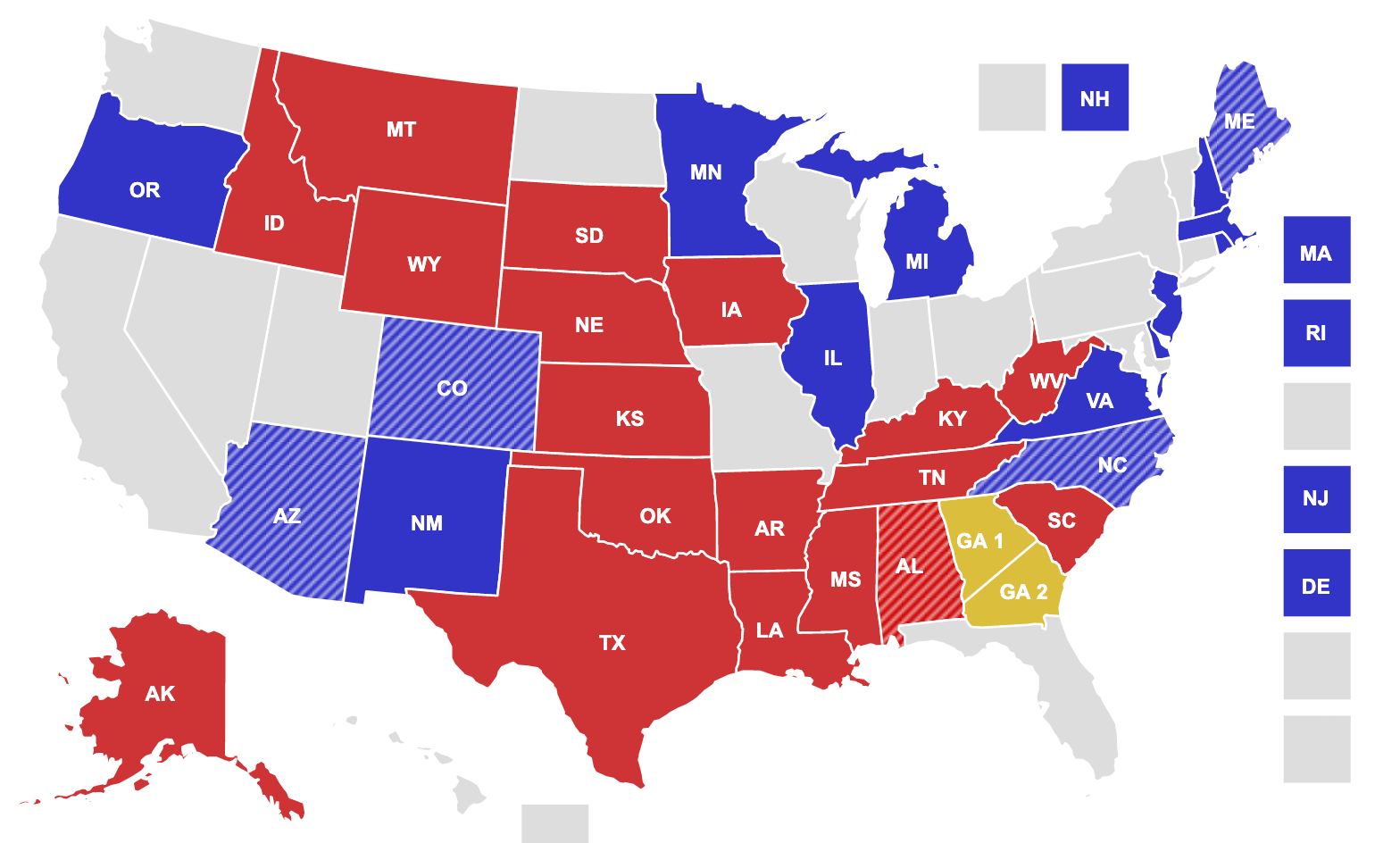
Utah (Trump + 21) and Kansas (Trump + 15.6) are more educated than their fellow red states. Nevada (Biden + 1.6) and Wisconsin (Biden + 0.6) are less educated than their fellow blue states. The Presidential election outcomes in the other 46 U.S. states can be explained entirely by the extent to which their citizens are highly educated.
Education isn't a perfect predictor of the strength of GOP or Democratic support among red and blue states respectively, but it does a pretty decent job on that front as well.
Puerto Rico Votes For Statehood
The outcome of Puerto Rico's statehood referendum on Tuesday is sufficient for Congress to feel comfortable granting it statehood without a further referendum. The U.S. House would support this step. It would take a majority of the U.S. Senate to back the measure, which would be a stretch with Democrats currently having just 48 U.S. Senate seats and possibly picking up two more in Georgia runoff elections, with a couple of Republicans and perhaps one Democrat who may not be reliable Democratic votes on this issue. Granting Puerto Rico statehood is clearly the right thing to do.
With 95 percent of precincts reporting in the nonbinding referendum, 52 percent of voters in Puerto Rico endorsed statehood, compared to nearly 48 percent who voted against it. The victory for the statehood movement marked a significant departure from the past, when the political parties that oppose statehood banded together for a nearly evenly split result.Tuesday’s race was the sixth plebiscite on the matter. The statehood movement overwhelmingly won the last referendum, held in 2017, but turnout was just 23 percent.
The question voters were asked was considered so loaded to favor statehood that critics who support the status quo or independence for Puerto Rico boycotted.This time, there was no official boycott, but voter apathy still prevailed, said Carlos Vargas-Ramos, director of public policy at the Center for Puerto Rican Studies at Hunter College. Data from the territory’s Electoral Commission shows that 51 percent of eligible voters cast ballots in Tuesday’s election, in which the election of the island’s next governor was also on the ballot.That is a steep decline compared to past gubernatorial elections, when voter turnout rates often exceeded 70 percent. In fact, the turnout on Tuesday was the lowest in the 72 years that Puerto Rico has been electing governors, Mr. Vargas-Ramos said. Still, he said, proponents of statehood can take these latest results and boast of a “clear majority.”
From the New York Times.
Meanwhile, the same story reports that:
In the governor’s race, Pedro Pierluisi of the pro-statehood New Progressive Party held a lead of about 1 percentage point over Carlos Delgado of the Popular Democratic Party, which supports the island’s current status. But with six candidates on the ballot, Mr. Pierluisi had less than one-third of the vote.
So, Pierluisi and Delgado will probably face off in a runoff election.
The U.S. 2020 Presidential Election Outcome
From the Washington Post at 1:16 p.m. Mountain Time (Friday, November 6, 2020).
This is how the Presidential race stands. Not every last vote has been counted, some litigation is pending and there will be one or two recounts.
But the likelihood that the additional votes, litigation outcomes, or recounts will change the result from the one shown above in which Biden has 306 electoral votes and Trump has 238 is low. Additional votes are likely to favor Biden at this point considering where votes are not yet counted. None of the lawsuits has any real factual or legal basis and many have already been dismissed. Recounts only change outcomes about one time in ten and then, almost always when the gap is in the low single digit thousands or less.
The likelihood that additional votes, litigation outcomes, or recounts will shift Biden's electoral vote count to below 270 is even lower. The results in at least three of these states would have to flip from the status quo shown above.
It was a close election. A shift of just 0.6 percentage points nationwide would have been enough for Trump to win re-election, while leaving Trump lagging by 2.2 percentage points in the popular vote (or more).
Trump fell short in the marginal states he needed to win the electoral college by about 80,000 votes out of about 143.9 million counted so far (there are about 16 million votes not yet counted, but the vast majority of those uncounted votes for in states that have been safely won by Biden or Trump by large margins).
The popular vote in the Presidential election is Biden with 74,001,605 votes (50.5%) to Trump 69,899,090 votes (47.7%), a margin of 4,102,515 votes (2.8 percentage points) in favor of Biden. Biden's margin will increase a bit as more votes are counted.
There are relatively few states that were close.
Twelve states and DC had a more than 15 percentage point margin for Biden. Nineteen states had a more than 15 percentage point margin for Trump. Nineteen states had a margin between Biden and Trump of less than 15 percentage points (Biden won 13, Trump won 6).
Just nine states had a margin of less than 7 percentage points (Biden won 6, Trump won 3). Just seven states had a margin of less than 3 percentage points that would appropriately have been considered toss up states (Biden won 6, Trump won 1).
Lean Blue Outcomes (7)
Colorado (Biden + 13.0)
Illinois (Biden + 12.3)
New Mexico (Biden + 10.6)
Maine (Biden + 10.5)
Virginia (Biden + 9.5)
Minnesota (Biden + 7.1)
New Hampshire (Biden + 7.1)
Toss Up Race Outcomes (7)
Michigan (Biden + 2.8)
Arizona (Biden + 2.4)
Nevada (Biden + 1.6)
Wisconsin (Biden + 0.6)
------------- 270 electoral votes above this line
Pennsylvania (Biden + 0.2)
Georgia (Biden + less than 0.1)
------------- 238 electoral votes below this line
North Carolina (Trump + 1.4)
Lean Trump Outcomes (2)
Florida (Trump + 3.4)
Texas (Trump +5.9)
Likely Trump Outcomes (5)
Ohio (Trump + 8.1)
Iowa (Trump + 8.2)
South Carolina (Trump + 12.0)
Analysis
Almost all of the states that are even remotely competitive are:
in the Midwestern Rust Belt (Minnesota, Illinois, Michigan, Wisconsin, Pennsylvania, Ohio, and Iowa),
in the Atlantic Coastal "New South" (Virginia, North Carolina, Georgia, South Carolina, Florida),
in the Southwest (Colorado, New Mexico, Arizona, Nevada, and Texas), or
in rural New England (New Hampshire and Maine).
05 November 2020
2020 Election Polling Had A Democratic Bias
UPDATED November 6, 2020.
Overview
The polling in the 2020 election was badly biased against Republicans and Trump, and in favor of Democrats and Biden, in particular.
The pro-Democrat bias in the U.S. Senate polling was even worse (an average of 6.99 percentage points) than in the Presidential race (an average of 4.42 percentage points).
Of 51 state polls in the Presidential race, the national Presidential rate polling and polling in 35 U.S. Senate races, a total of 87 polling averages, 79 (91%) erred in favor of Democrats.
Of the 87 polling averages, 54 (63%) were off by more than 4 percentage points (easily more than one standard deviation), with 98% of these large errors in favor of Democrats and the one large error in favor of a Republican coming in a race without a Democrat running.
If the polls were not biased, you would expect a mean error of close to zero for 87 polling averages, about equal numbers of polls biased in favor of Democrats and of Republicans both in terms of any errors, and in terms of large errors (about 43-44 errors for each party), and 28 or fewer large errors (about 14 errors for each party).
It isn't obvious why this bias occurred in both 2016 and 2020 polling.
The most plausible theory is that Trump supporters and Republicans disproportionately refuse to answer political polls, thereby omitting their support even after adjustments for demographic balance. This would imply a reduced response rate of about ten to twenty percent by Republicans relative to non-Republicans in the same demographic categories.
The Presidential Race
The final 538 blog 2020 election forecast was primarily a weighted average of lots and lots of good quality polls. These predictions were way off.
In the 50 U.S. state and District of Columbia predicting the outcome of the Presidential race, there was an average bias in favor of Biden relative to the actual results of the election was 4.42 percentage points. There were 45 errors in favor of Biden and 6 in favor of Trump.
Twenty-seven of the fifty-one polls were off by 4 or more percentage points, outside the one standard deviation margin of error. Of those outliers, all twenty-seven were in Biden's direction.
The popular vote prediction was an 8.0 percentage point lead for Biden. The actual outcome was a 2.8 percentage point lead for Biden. This may improve from a 5.2 percentage point error to as little as a 3 percentage point error as more votes are added to tallies from slow counting safe states like California.
All of the errors in favor of Trump were in states that were either as safely Republican as Utah, or as safely Democratic as Colorado. Every single battleground state had an error in favor of Biden. There were swing state errors in favor of Biden of 4 percent or more in Illinois (5.6), Michigan (5.2), Nevada (4.5), Wisconsin (7.7), Pennsylvania (4.5), Florida (4.5), Texas (4.4), Ohio (7.5), Iowa (6.7) and South Carolina (4.5). Pennsylvania may improve somewhat as vote counting continues there, but it will almost surely be off by more than 4 percentage points in favor of Biden when all of the votes are counted. The pro-Biden polling error was smaller in Arizona (0.2), Georgia (0.9), and North Carolina (3.1).
The U.S. Senate race
The 538 blog also made 35 polling average driven predictions for the 35 U.S. Senate races. The average Democratic bias in the polling was 6.99 percentage points. There were 33 errors in favor of Democrats and 2 in favor of Republicans.
Twenty-seven of the thirty-five polls were off by 4 or more percentage points, outside the one standard deviation margin of error. Of those outliers, one was in a Republican's favor (in a safe race with no Democrat against a third party candidate), and twenty-six were in the Democratic candidate's direction.
There were less than safe state polling errors in favor of Democrats of 4 percent or more in U.S. Senate races in the Georgia Special Election (6.0), New Mexico (7.0), Minnesota (7.0), Michigan (5.4), North Carolina (5.0), Iowa (5.2), Maine (9.5), Montana (6.8), Kansas (5.6) and South Carolina (8.3).
The only U.S. Senate races reasonably in play which the polling got close to right on were Colorado (1.0 bias in favor of GOP), Arizona (1.0 bias in favor of the Democrat), Georgia regular election (1.7 bias in favor of the Democrat), Texas (2.5 bias in favor of the Democrat),
Analysis
This is surprising. The factors usually associated with major polling errors weren't present in this case.
The poll numbers were robust to errors limited to particular polling operations. They were weighted by methodology quality past partisan bias, by sample size, and by recency. In many cases there were eight or more recent, high quality polls that went into the averages.
There was not a strong third-party candidate or a lot of undecided voters except for one U.S. Senate race (Arkansas) which was off by a larger margin than any other Presidential or U.S. Senate race this cycle except the U.S. Senate races in Alaska and West Virginia. None of those races were remotely close.
Polling was stable leading up to the election, not volatile as it had been in 2016, and there were trend lines in favor of Democrats and Biden in particular leading up to the election (except for Cunningham, the Democratic Senate candidate in North Carolina whose affair was revealed in an October surprise).
Turnout was higher than predicted (the highest since the year 1900 in any national general election), which should have favored a pro-Democratic adjustment in polling models.
Pollsters adjusted their methodologies after the major errors of 2016 in an effort to remedy the problems then, but those problems returned this year in many of the same places.
The explanation in bold below seems to be the most likely one.
The 2020 polling error “matches the pattern of the 2016 error really well, so there really does seem to be something wrong here,” explained G. Elliott Morris, a data journalist who runs the Economist’s election forecast, during a Wednesday postmortem on the “Science of Politics” podcast. “It’s not just two random polling errors.” . . .Researchers have largely ruled out the idea of “shy Trump voters” who lie to pollsters and say they’re undecided or that they favor someone else when they really favor Trump. But it’s possible, Grossman and Morris speculated, that pro-Trump, non-college-educated whites are simply less inclined to pick up the phone or participate in polls than pro-Biden, non-college-educated whites.Why?
Because the pro-Trump cohort also tends to have less “social trust” — i.e., less “trust in other people or institutions,” as Morris put it. Spurred by Trump’s “fake news” mantra, participating in polls may have itself become politicized. When overall response rates are as low as 4 percent, this could skew the results against Trump in places like the Rust Belt or Texas.A similar dynamic may have also made it seem like more Republicans were flipping from Trump to Biden than ultimately did — again, because pro-Trump Republicans may be less inclined than pro-Biden Republicans to answer a pollster’s call or participate in an online survey.Other potential reasons for 2020’s big miss may have been beyond anyone’s control. It’s unlikely that late-breaking voters who decided within the last week made the difference, even though they told exit pollsters they favored Trump over Biden by 14 percentage points. There simply weren’t enough of them this year — just 4 to 5 percent of the overall electorate vs. about 14 percent in 2016 — to explain Trump’s overperformance on Election Day.A more plausible scenario, Morris said, is that a significant number of pandemic-induced mail ballots are either arriving late, or being rejected, or not being returned at all. If tons of people tell pollsters they’ve voted by mail and then, for whatever reason, some those “likely votes” don’t actually count on Election Day, it could widen the gap between the polls and the results.Political scientists and pollsters will debate these problems for years to come, and they’ll probably devise new approaches to deal with them. But after being told that Joe Biden could win in a landslide — and then watching as Trump beat his polls by even more than 2016 in state after state — the broader public might be more inclined to dismiss political surveys in the future.There are “systematic problems that they haven’t solved since 2016, and in fact seem to be worse this time,” Morris said. “That’s pretty troubling if you’re a pollster — especially if you’ve spent the last four years trying to reckon with the fact that polls were missing Trump supporters. So they have a big reckoning ahead of them.”
From Yahoo News.
It may well be days, if not weeks, before the winner of the 2020 presidential race is decided, but one clear lesson from Tuesday night’s election results is that pollsters were wrong again. It’s a “giant mystery” why, says Nick Beauchamp, assistant professor of political science at Northeastern.There are a number of possible explanations, Beauchamp says. One is that specific polls undercounted the extent to which certain demographics—such as Hispanic voters in specific states—shifted toward President Trump.Another is that, just as in 2016, polls undercounted hard-to-reach voters who tend to be less educated and more conservative. Beauchamp is less convinced that “shy” Trump voters deliberately misrepresented their intentions to pollsters.“Whatever the cause, it has huge implications not just for polling, but for the outcome of the presidential and Senate elections,” Beauchamp says. “If the polls have been this wrong for months, since they have been fairly stable for months, that means that campaign resources may have also been misallocated.” . . .This year’s polling errors, Beauchamp said, were “enormous” even compared to 2016, when polls failed to predict Trump’s defeat of Democratic nominee Hillary Clinton.Indeed, just days before the presidential contest, FiveThirtyEight founder Nate Silver predicted that Biden was slightly favored to win Florida and its 29 Electoral College votes. The race was called on election night with Trump comfortably ahead. . . .“I think Nate Silver and the other pollsters are saying ‘Well that’s just within the bounds of systematic polling,’ but it seems awfully large to me for just that,” Beauchamp says.Now, election watchers and media leaders are questioning the value of polling overall. Washington Post media columnist Margaret Sullivan wrote that “we should never again put as much stock in public opinion polls, and those who interpret them, as we’ve grown accustomed to doing.”“Polling,” she wrote, “seems to be irrevocably broken, or at least our understanding of how seriously to take it is.”Polling misses aren’t unique to the United States, Beauchamp points out. Polls also failed to predict the 2015 elections in the United Kingdom, as well as the UK’s 2016 “Brexit” vote to exit the European Union.In those cases, as with the 2016 US election, Beauchamp said, pollsters “made these mistakes, which are relatively small, but in the same direction and with fairly significant effects.”To avoid a repeat of 2016 and 2020 in the United States, Beauchamp says, pollsters should shift their tactics—and perhaps attach different weights to factors they’re trying to measure, such as social distrust or propensity to be a non-voter.“Hopefully they’re going to start modeling all of that information as a way to better capture these issues in voters,” Beauchamp says.
04 November 2020
The Post-Election Results
The 2020 election was about as bad an outcome as was possible without it being a loss.
The Presidency
Joe Biden, when the paperwork is finished, will be the President-Elect, and Kamala Harris will be his Vice President on January 20, 2021, despite President Trump's protests to the contrary.
It is possible that his total number of electoral votes will be the bare minimum 270 with the marginal state won by the narrowest of margins. It could be as much as 306, depending upon the outcome of final counts in Pennsylvania and Georgia. His popular vote margin is currently about 3 million out of 136 million. Total turnout was 160 million and Biden's popular vote margin will improve as more votes are counted.
Joe Biden's DW-Nominate score when he left the U.S. Senate during the 2009-2011 session of Congress (the 111th) was -0.314, which was to the right of Warren and Sanders, and to the left of Gabbard and Klobuchar.
Kamala Harris is more progressive than at least 85-90% of the Senate. But, of course, a Vice President has little formal power and usually exercises that power at the direction of the President.
Congress
The Republican Controlled Senate
Democrats will start the 117th Congressional session on January 3, 2021 with 48 Senators (including independents who caucus with them) while Republicans will have 52.
A runoff in a Georgia Special Election to fill a vacancy currently filled by a Governor appointed Republican will be held on January 5, 2021 and could shift the balance from 48-52 to 49-51.
Either way, the Republicans will be in control unless a moderate Republican like recently re-elected Senator Susan Collins (R-ME) can be convinced to change parties and Democrats win the runoff election (or can win over another party switcher). She is the most moderate Republican in the U.S. Senate; Lisa Murkowski (R-AK) is the second most moderate member of the GOP caucus in the Senate.
Of course, even if the Democrats could somehow achieve a 50-50 split, which together with the Vice President would give the Democrats control of the Senate, this majority would still be subject to defections from the turncoats and from conservative Democrats in the U.S. Senate such as Joe Manchin III (D-WV), the most conservative member of the Democratic caucus in the U.S. Senate.
The Democratic Party Controlled House
Democrats will have a slightly reduced majority in the U.S. House which they still control. It isn't clear if Nancy Pelosi will retain her leadership position as Speaker of the House, or will be replaced with new leadership.
SCOTUS
The U.S. Supreme Court will have a 6-3 conservative majority. Four far right conservatives (Thomas, Alito, Barrett and Kavanaugh), two plain old conservatives (Gorsuch and Roberts) who will hold the swing votes, and three liberals (Breyer, Sotomayor and Kagan).
The possibility of the U.S. Supreme Court invalidating administration regulations and proposals, or striking down or misinterpreting legislation that the Biden Administration can cure with new legislation is great. But, some pro-Trump precedents it has recently adopted regarding executive authority, may inure to a President Biden's favor.
Consequences
This state of affairs greatly limits Biden's ability to advance a progressive or liberal agenda during his first two years of office.
He can't realistically increase the size of the U.S. Supreme Court, grant statehood to the District of Columbia or Puerto Rico, pass a voting rights act restoration bill with teeth, or pass any other major legislation with any partisan bent.
He can use his allies in the House to leverage budget and appropriations legislation and can bargain with built in expiration dates of the provisions of Trump's signature 2017 tax law.
He can adopt new regulations and conduct foreign and military affairs with a fair amount of freedom. He also has considerable discretion in setting priorities for his executive branch departments.
He can make judicial and non-judicial appointments, although the Senate will likely try to block or delay his lifetime judicial appointments.
The Senate will have no incentive to abolish the legislative filibuster, because any legislation it passes can be vetoed by President Biden, or not agreed to by the Democratic Party controlled House anyway.
Biden's long service in Congress makes him well suited to try to negotiate bipartisan compromises and less partisan legislation.
Effectively, the situation puts Biden into a caretaker role.
03 November 2020
Predictions and Probabilities
538 predicts that Pennsylvania is most likely to be the marginal state with a forecast vote share of 52.0% for Biden and 47.3% for Trump (a 4.7 percentage point margin of victory).
Montana still shows a strong polling lead for Trump (6.3 percentage points) that even high turnout probably won't flip. So do South Carolina (7.5), Alaska (8.5), Missouri (9.5), Indiana (10.8), and Nebraska's First Congressional District (12.2).
Three states are leaning in favor of Trump but by very thin margins that insufficiently optimistic turnout models, trend lines, and just random error could easily flip to Biden: Texas (1.5), Iowa (1.5) and Ohio (0.6).
Four more states and two Congressional Districts that aren't the marginal states lean towards Biden: Georgia (0.9), Maine's Second District (1.6), North Carolina (1.7), Florida (2.5), Arizona (2.6), and Nebraska's Second Congressional District (3.2).
These seven states and two districts before one gets to the marginal state, leaves a lot of hurdles for Trump to overcome to win the electoral college, and as I explained above, I think that Texas, Georgia, North Carolina, Florida and Arizona are probably slightly erring in favor of Trump due to higher turnout than the turnout models in some of the polls have predicted.
The hurdles involved in Trump taking states with less favorable polling than Pennsylvania are quite dim in Nevada (4.1), Michigan (8.0), Wisconsin (8.3), Minnesota (8.9), New Hampshire (10.6), Colorado (11.7), Maine (11.8) and Virginia (12.5), and the polls probably lean inaccurately towards Trump due to turnout models predicting lower voter turnout in Nevada.
States beyond those are pretty much safe without question.
The odds of Trump winning the popular vote according to 538 are about 3%. So, 70% of the odds of Trump winning are with a loss in the popular vote and a win in the Electoral College.
The odds of no one getting 270 electoral votes, sending the election to the House of Representatives is less than 1%.
The odds that the race comes down to less than half of a percent in a decisive state, likely triggering a recount, is about 4%.
Pennsylvania worries me the most, since pre-election turnout there is only 38% of the 2106 vote, but the polling is very consistent in showing a lead for Biden of at least five percentage points, and there are lots of high quality polls to support that.
The Real Clear Politics site (which leans slightly conservative) has a "no toss up" map based upon state polling averages with 319 electoral votes for Biden and 219 electoral votes for Trump. This leaves Biden with a 49 electoral vote margin of error.
With toss ups, it puts 216 electoral votes in the Biden column, 125 in the Trump column, and 197 electoral votes as toss ups, with Biden needing 54 electoral votes from "toss up" states to win.
But the polling puts Michigan, Wisconsin and Minnesota, which have a combined 36 electoral votes, all as safely in the Biden column as it puts South Carolina in Trump column and RCP puts South Carolina in the Trump column. This would put 252 electoral votes in the Biden column and 125 in the Trump column with 161 electoral votes as toss ups, with Biden needing only 18 toss up electoral votes to win. Pennsylvania or Florida or Texas would cinch the 270 electoral votes on their own. Trump, in contrast, needs 145 of the 161 toss up electoral votes.
Without Pennsylvania or Florida or Texas, there are still los of combinations of states that could win it for Biden. For example, North Carolina and Georgia, North Carolina and Iowa, Georgia and Iowa, Nevada, Arizona and Iowa, North Carolina and Nevada, North Carolina and Arizona, North Carolina and Ohio, Georgia and Nevada, Georgia and Arizona, Georgia and Ohio, Arizona and Ohio,
For now though, Biden is leading in the national polls by about 10 points. That’s 8 points better than Hillary Clinton won the national popular vote by in 2016.
And remember, Biden’s lead is also significantly wider than where the final national polls put Clinton’s lead in 2016. Those national polls had Clinton up 3 to 4 points in the national popular vote, which turned out to be quite accurate.Now take a look at the current average of polls in the states Trump won by 10 points or less in 2016. At the same time (in parentheses), we’ll examine what we’d expect those averages to be by applying an 8 point uniform swing from the 2016 results. A uniform swing is simply shifting all the results a certain amount (e.g. 8 points in Biden’s direction). We’re shifting these states 8 points because Biden’s winning nationally by 10 points, and Clinton won nationally by 2 points.* Michigan: Biden +8 points (Biden +8 points)* Wisconsin: Biden +8 points (Biden +7 points)* Pennsylvania: Biden +7 points (Biden +7 points)* Arizona: Biden +4 points (Biden +5 points)* Florida: Biden +4 points (Biden +7 points)* North Carolina: Biden +3 points (Biden +4 points)* Georgia: Biden +2 points (Biden +3 points)* Iowa: Biden +1 point (Trump up 1 point)* Ohio: Tied (Tied)* Texas: Trump +2 points (Trump +1 point)
What should be quite apparent is the state polls look almost identical to what you’d expect given a uniform shift of 8 points across states. The average difference is just a point. Moreover, there is no bias with Biden doing 8 points better than Clinton did in the average of state polls, as you’d expect with the national polls where they are.
Control of the U.S. Senate
Democrats currently hold 47 seats in the U.S. Senate.
538 puts the odds of Democrats retaking the U.S. Senate at 75% in its final forecast. The most probable outcome is 51 Democrat U.S. Senate seats, the mean is 51.5 U.S. Senate seats. There is a 10.6% chance that Democrats come up one short with 49 U.S. Senate seats, a 7.0% chance of coming up two short with 48 U.S. Senate seats, and a 6.3% chance of doing worse.
Real Clear Politics in its "no toss up" analysis predicts a 50-50 split in the U.S. Senate, which is Democratic control if Biden wins the Presidency (although not until January 20, 2021, before then, Vice President Pence casts the tie vote).
This implies Democratic pickups in Arizona, Colorado, Maine and North Carolina, and a Democratic loss in Arkansas.
The RCP list shows more states as toss ups, but again, some of the toss ups lean strongly Democratic.
Control of the U.S. House of Representatives
The final U.S. House forecast from 538 is that Democrats have a 97% chance of retaining control, with an average of 239.3 seats. A majority is 218 seats.
Currently there are 232 Democrats, 197 Republicans, 1 Libertarian and 5 vacancies.
The current mix of House seats was set in the 2018 midterm elections with similarly high turnout for a midterm election and with a similar political climate, so less of a shift is expected in these races. The odds of the Democrats losing 18 seats that they hold and all five 5 vacant seats, and not picking up a single Republican held seat, is low.
Colorado
Colorado is a safe state for both Biden-Harris and its Democratic U.S. Senate candidate, John Hickenlooper, our former two term Governor and former Mayor of Denver.
The only federal race that is close in Colorado is the Third Congressional District consisting of Western and Southern Colorado, in which several polls have shown Diane Mitsch Bush, the Democrat, leading by 1 percentage point, over primary upset winner, Lauren Boebert, a far right conspiracy theory adherent with a checkered past and no prior political experience.
Democrats are strongly favored to retain control of the Colorado State House, and favored, although less strongly to retain control of the Colorado State Senate. High voter turnout in the state and longer term trends to the left for Colorado due to demographics, migration into the state, increased urbanization and changing attitudes, also favors this outcome.
There are some important ballot issues at the state level in Colorado that have been the subject of only a little polling.
The repeal of the Gallagher Amendment is favored to win, but with large numbers of undecided voters who tend to vote against tax increases.
The National Popular Vote ballot issue 113 which would add Colorado to a National Popular Vote interstate compact, is favored to win but only by a thin margin.
Issue 115 to ban late term abortion is favored to lose, but only by a thin margin.
Issue 118 to create a government financed paid medical and family leave system paid for with a 0.9% payroll tax (half employer and half employee) is favored to win by a safe margin.
I have seen no polling on the many other measures facing Colorado voters and have only win intuitions myself about how they will come out.
Other States
While coverage of no federal elections is scarce, the likelihood is, going into redistricting following the 2020 Census, that Democrats will shift more states to total control and more states from total Republican control to mixed control. This should reduce gerrymandering against Democrats as will the shift of many states towards more neutral redistricting commissions.
Virginia is voting on moving to a neutral redistricting commission today (potentially weakening pro-Democratic gerrymandering).
Many states are leaning towards legalizing marijuana, in some cases only medical marijuana by ballot measures today, and in some cases recreational use as well. These measures could help tip the balance towards national legalization in a Biden administration.
What it would do: Allow adults 21 years and older to possess, consume or transfer up to one ounce of cannabis and create a regulatory system for the products' cultivation and sale.
What it would do: Allow physicians to recommend medical cannabis for patients with any of 22 qualifying conditions such as cancer, multiple sclerosis and post-traumatic stress disorder.
What it would do: Limit the smoking of medical cannabis to people who are terminally ill, and would leave the future regulatory framework up to the legislature.
What it would do: Amend the state's constitution to establish 21 as the legal age to purchase, possess and consume cannabis.
What it would do: Allow adults in the state to possess, buy and use cannabis for recreational use and defined a 20% tax on recreational cannabis. It would also allow people serving a sentence for certain cannabis-related acts to apply for resentencing or records expungement.
What it would do: Amend the state constitution to legalize cannabis for personal, non-medical use by adults 21 and older.
What it would do: Establish a medical cannabis program and registration system for people with qualifying conditions.
What it would do: Legalize cannabis for all adults and require state legislators to adopt medical cannabis and hemp laws.
Puerto Rico has a clean up or down vote on statehood today that is likely to pass. If it passes, it could speed up its admission as a U.S. state if Biden wins and Democrats win control of the U.S. Senate.
Mississippi voters will vote on a new flag that is not longer based on the Confederate Battle Flag. It's old flag has been retired but the new one has not yet been adopted (the new one still has the "In God We Trust" dig).
There is an anti-abortion measure in Louisiana (that would end all state level protections for abortion rights limiting those protections to the U.S. Constitutional minimum), a measure about the employment status of gig workers like Uber drivers in California, measures to adopt ranked choice voting in Alaska and Massachusetts, a measure to drop "and Providence Plantations" from Rhode Island's official name, a measure to prohibit local government concealed carry gun control laws in Montana, a measure to restore affirmative action in California (banned in 1996), a measure to allow 17 year olds to vote in California, a measure to end cash bail (under a 2018 law), and in Mississippi:
Mississippi's Ballot Measure 2 asks voters whether to remove a Jim Crow era voting provision that requires a candidate to secure a majority in the state's popular vote and to win a majority of Mississippi's 122 state house districts.