Showing posts with label Global Warming. Show all posts

11 September 2017

A Short 9-11 Observation

Sixteen years ago, in the wake of the 9-11 attacks, I was convinced as were most people, that the lives of my infant and two year old would be defined by a world wracked by terrorism.

This isn't what happened. In the subsequent sixteen years, there has been more domestic terrorism in the U.S. than there has been Islamic terrorism, and phenomena like gun violence, police brutality, the gay rights movement, and global warming have all had more of an impact on my children's lives than the kind of terrorism that gave rise to 9-11.

Yes, the U.S. is still fighting the war in Afghanistan that begun with 9-11 and our involvement in Syria and Iraq at this point is justified by the same legal authority that provides a basis for the ongoing war in Afghanistan. But, those conflicts have remained "small wars" that have managed to remain at the periphery of American life.

21 January 2011

Twenty Obvious International Trends

Lots of economic, environmental and political predictions are hardly better than horoscopes. Others are reliable enough to be thought of a "fundamentals." I'm more interested in the latter. Here are a few:

1. China's economic growth rate will be greater for medium term time periods (e.g. three years or more) than that of the United States for the foreseeable future, because it is engaged in "catch up growth," while the United States is not.

2. China will experience a notable economic crash in the next decade or so, because it hasn't had one for a long time and periods of even strong sustained growth are almost always interrupted periodically by economic crashes.

3. India's economic growth rate will be greater for medium term time periods than that of the United States for the foreseeable future, because it is engaged in "catch up growth," while the United States is not.

4. India's economic growth rate will exceed that of China sometime in the next ten to fifteen years, because China's per capita GDP is significantly greater than that of India, leaving India with more "catch up growth" potential than China.

5. Oil dependent nations in the Middle East will each experience serious economic contractions not long as oil production in the nation in question starts to fall due to exhaustion of the nation's oil supply. These nations are heavily reliant on oil revenues to sustain their standard of living with imported goods and temporary immigrant workers, both of which will be harder to come by when there are not new oil revenues available.

6. Countries in Africa that experience war and authoritarian governments will experience less economic growth than those with sustained periods of peace and democratic government.

7. In the developing world, it will be a long time before environmental and climate change concerns have enough political clout to cause air pollution to be reduced more rapidly than the increasing scope of economic activity increases air pollution. As a result, emissions will not be reduced rapidly enough to stop continued global warming.

8. Nuclear power will spread to more countries.

9. Oil more be more expensive in real terms in 2020 and more expensive again in real terms in 2030 than it is today. Rising oil prices will make technologies that are powered by energy sources other than oil more attractive. This trend will be a global one, because oil trades in a global marketplace.

10. Oil rich countries that are not close to exhausting their reserves will receive an economic boost from rising oil prices.

11. North Korea's political and economic system will collapse, probably within a couple of decades, if it fails to open itself up to the rest of the world. If it does collapse, it will probably be reabsorbed by South Korea.

12. Public health measures will improve in most of the developing and undeveloped world that are not war torn as patents on new effective drugs expire and make those drugs more affordable.

13. Global fertility rates will fall as more countries become more economically developed.

14. Developing countries will become less religious as they become more economically developed in fairly close synch with falling fertility rates.

15. The need to impose taxes as oil revenues decline will force Middle Eastern monarchs who have not already been deposed in revolutions and democratized of their own free will to make genuine democratic reforms.

16. The proportion of the world population engaged in farming will fall steadily for decades to come.

17. Some small island nations will be swallowed up by the sea and forced to relocate all or most of their populations as sea levels rise with global warming sometime in the next century.

18. A large share of the world's languages, probably half or more, will die in the next few decades.

19. A significant number of plant and animal species will go extinct in the next few decades.

20. The proportion of Africans who are Christians will increase significantly over the next decade.

26 February 2010

My Grandchildren's World Part I: Climate Change

What will the world be like in the lives of my children and grandchildren? In other words, what will the world be like in the time frame of 2010 to 2140, more or less. These are long term predictions. Some of that future can't be predicted. But, we know enough to make some reasonable guesses.

Climate

Global Warming Will Happen

We are in the midst of a human caused period of rapid global warming. It appears completely unrealistic politically for there to be effective global political action sufficient to stop or reverse this trend in the time frame that scientists say is available.

China's economy is too wed to coal and too fast growing to wean itself to cleaner fuels in the several decades time frame we have for really effective action.

China, India and many other places in the developing world are going to find the urge to dramatically increase their consumption of motor vehicles to be irresistible. More cars will mean more global warming inducing air pollution, even if developing world cars are more fuel efficient, more intensely used, less polluting and less numerous per capita than those of the United States, Australia, New Zealand and Europe. Japan's level of car use is a more plausible model. But that still means far more cars being used in the world and with them more air pollution.

Deforestation is another trend that is unlikely to reverse itself in the next few decades sufficiently to crimp global warming. In the places where it is happening, the need of burgeoning local populations for agricultural income and mineral resources will not be held back indefinitely by any altruistic motives.

The developed world will make a concerted effort to reduce their emissions. Deforestation will be slowed. The developing world will have an industrial revolution that is more environmentally sound than the original. Most importantly, "peak oil" will produce dramatic changes in how our finite supply of fossil fuel resources are used which will lead to widespread adoption of new technologies and the reorganization of the economic sectors most at fault. There will be steps taken that actively counter the global warming trend. And, the ecology of the world will react to buffer the changes we are creating as natural global cooling factors in the biosphere kick in.

So, the problem will ultimately be addressed. Earth is not on track to become the next Venus. We simple won't be able to change soon enough avoid irreversible significant further change and probably not soon enough to avoid crossing a global climate tipping point of some kind. It will be too little, too late to arrest further human contributions to global warming in the next thirty to forty years. My optimistic predictions are that humanity will cease contributing to global warming, with a big boost from peak oil effects and advanced transportation and non-fossil fuel energy technology, sometime after my grandchildren reach adulthood, in the range of 2050 to 2080.

Selective Impacts From Global Warming

What will global warming mean to my children and grandchildren in their lives?

1. The sea level will rise significantly. In real life terms some of the implications of this sea level rise will include the following:

Much of coastal Louisiana will fall below sea level. The most historic parts of New Orleans will be preserved, at great expense, as a Venice or Netherlands on the Gulf of Mexico, with epic engineering efforts. Its connection to the continental United States will be as tenuous as that of Key West to Florida today.

Much of the Everglades and Southern Florida will fall below sea level. Miami and other major coastal cities will be preserved only with major engineering efforts that preserve a thin peninsula on the Florida's East coast from Miami to Cape Canaveral.

Many low lying islands in Oceania and the Caribbean will be flooded, forcing their residents to relocate. Most will move either to higher ground in Oceania, or to places in the developed world with which they have ties as a result of former colonial links, religious missionaries, or past tourism ties. The populations involved will be small enough, and the diaspora far flung enough, that this will have only a modest impact on the rest of the world.

Prime real estate resorts and homes near sea level right at the coast worldwide will be irreplaceably destroyed as the beach retreats inland.

Warmer sea surfaces will also fuel more and more powerful hurricanes, typhoons and cyclones, hitting particularly hard the coastal American South, the Caribbean, the Gulf Coast of Mexico and Central America, Japan, Coastal China, the Philippines, Bangladesh and coastal India.

2. Skiing Will Move North and Up; Glaciers will vanish.

Global warming will leave the winter ski seasons in existing ski resorts looking more like their fall ski seasons. The ski season will start later in the fall, and end earlier in the spring. In North America, Colorado and Utah will start to lose ground to Wyoming and Canada. In Europe, the Alps will become less attractive for skiers. In Japan, skiing opportunities will degrade. Skiing resorts may prosper in the Alaska Range, the Yukon, the Himalayas, Central Asian mountains and the Kolyma mountains of Siberia.

Glaciers are retreating rapidly everywhere in the world that they are found from Scandinavia to New Zealand, from Mount Kilimanjaro to the Alps, from the Rockies to the Himalayas.

Arctic species like polar bears have a dim future.

3. Canada's populated belt will expand.

The vast majority of the people who live in Canada live quite close to the U.S. border. As the global climate warms, the Northern parts of British Columbia, Alberta, Saskatchewan, Manitoba, Ontario and Quebec will all become more attractive for both agriculture and urban settlement.

4. Diseases, plants and fauna will migrate North and up.

Malaria, yellow fever, killer bees, termites, tropical parasites, hot weather plants, subtropical animals and tropical animals will all migrate significantly north and south from the equator, and to higher elevations than those at which they were previously known.

Kudzu will make a slow but sure migration North. Cotton will be grown further north in the American South that it used to, while Egyptian cotton will be pressured by hotter, drier conditions with that crop possibly migrating to the Levant or Northern Mediterranean.

Similarly, temperate crops will migrate north, with the line between deciduous and evergreen forests moving northward, for example.

Areas of the United States that are already marginal for agriculture, like areas used by dryland farmers in the arid West will tend to revert to open space as farming becomes hopeless outside irrigated areas. In the American South, tropical and subtropical plant varieties will increasingly become more viable.

5. The Sahara will expand.

The Sahara desert in Africa will expand, most notably to the South into the Sahel, where many people who speak Nilo-Saharan or Afro-Asiatic languages, most often Muslims, live now. Climate change will put strong pressure on these peoples to migrate South into territory previously controlled by Christan and animist peoples who do not speak Arabic and are seeing their traditional farming methods fail in the face of an increasingly drier, hotter climate.

We are already starting to see military conflicts, increased ethnic clashes, and famines breaking out in these regions. Somalia is a failed state divided politically along a North-South axis. This climate trend is a major driving force behind the genocidal warfare in Sudan which is likely to cede a new nation called South Sudan in the next few years. Southern Chad, Northern Nigeria, Niger and Mali are also all under these pressures.

Broad based fronts in clash of civilizations conflicts like the one that is developing as the Sahara expands are historically an important motivator for the unification of previously independent states into empires. I expect to see strengthening political and military alliances between Northern Sudan, Chad, Niger, the Islamic controlled Northern states of Nigeria, Niger, Mali and Mauritania, which would also fund insurgent forces of Islamic minorities in the Southern neighbors in West and Central Africa, Uganda and Kenya. Likewise, I expect to see strengthening military and political ties among the coastal nations of West Africa, the Central African Republic, Southern Sudan, Uganda and Kenya. Burkina Faso, which evenly divided between the two civilizations, is at a particularly grave risk of civil war. Minority populations on both sides of the divide are a grave risk of being expelled as refugees to neighboring countries where their side of the clash is in the majority, in brutal campaigns of ethnic cleansing on a much larger scale than seen from the Bosnia Serbs or the Algerian Islamist efforts to expel foreigners. The genocidal campaign seen in Darfur is likely to be a more relevant model for these conflicts.

These wars are likely to be particularly brutal and are likely to remain a military hot spot for most of the lives of my children and grandchildren. I would be surprised if Nigeria sustains this era of Sahel conflict in one piece. It seems more likely that the Islamic states of Nigeria in the North will unite and secede from Nigeria, particularly as the volume of Nigeria's oil production begins to decline. Nigeria will cease to be able to maintain an oil based economy as oil decreases in economic importance in the years running up to roughly 2055-2075. The prospect of sharing oil revenues is an important part of the glue holding many currently oil rich nations like Iraq and Nigeria together today.

One winner in Africa may be Khoisan speaking people who may face less threat from expanding urbanization as the Kalahari Desert grows less and less suitable for settled occupation. But, declines in arable land to the North will increase deforestation pressures in the greater Congo area further threatening Africa's Pygmy populations.

6. Inland seas will dry up.

Expect the Caspian Sea, the Aral Sea, the Dead Sea, Lake Chad, Lake Tana in Ethiopia, Lake Turkana in Kenya, Lake Vitoria, the Great Salt Lake in Utah, and the North American Great Lakes to dry up and get smaller as global temperatures rise. These changes will greatly impact local communities, but will rarely have major geopolitical impact.
28 August 2009

Our Kids Will Be Hot

Our kids will be hot, and not just because they have such good looking parents.

Because if our emissions aren't reined in quick, and I mean darned quick, this is what the U.S. could be facing by 2050. Yes, Kansas and Oklahoma could fare worse than Colorado. But I'm telling you, I don't think many Coloradans will think too highly of 7.5°F higher (or more!) temperatures in the summer.


We now endure long weeks of 95 degree Fahrenheit weather most summers. When my children are my age, in Colorado, those weeks may have heats in the low triple digits.

Places like Florida and Louisiana will fare much better in terms of raw temperature changes, but will have to face another threat: land lost as sea levels rise, particular in coastal wetlands and in cities like Miami and New Orleans. Dutch style dikes and Venetian style flood management may become the next trend of necessity there. The Great Plains could see another dust bowl. Glaciers will recede further and tourism driving snow in Colorado's mountains is also a likely casualty.

Those engaged in long term landscape planning should look to what they do in places like Phoenix and Las Vegas. Cycads in, maple trees and willows out?

It isn't to late to make a difference that will mitigate these predictions. But, we don't have a great track record of making responses to slow moving disasters any sooner than we must, and some of the damage is already irreversible.

29 April 2009

What Does It Take To Stop Global Warming?

If you want to limit the risk of exceeding 2 degrees C global warming to one in four, or 25 percent, then total CO2 emissions over the first half of the 21st century have be kept below 1,000 billion tons,” said Malte Meinshausen, a climatologist at the Potsdam Institute for Climate Impact Research in Germany . . . . Between 2000 and 2006, human activities emitted about 236 billion tons of carbon dioxide, the researchers estimate. “Only a fast switch away from fossil fuels will give us a reasonable chance to avoid considerable warming,” Meinshausen says. . . . The researchers also estimate that limiting cumulative carbon dioxide emissions between now and 2050 to no more than 1 trillion tons would actually leave three-fourths of the world’s known reserves of oil, gas and coal in the ground unburned — unless techniques for capturing and sequestering carbon dioxide underground rather than dumping it into the atmosphere become commonplace in the future.


From here.

We have 764 billion tons left to emit over the next 41 years, which implies a rate of a 18.6 billion tons per year. We have been emitting at a rate of about 34 billion tons per year. So, we need to reduce emissions by more than 50% to ward off catastrophic global warming by 2050 with a reasonable probability. If the developing world and third world are to make any development progress over the next four decades, moreover, that means that the fossil fuel use per unit of economic productivity, must decline by much more than 50%.

A switch away from fossil fuels means producing electric power with a far larger share of nuclear power and renewables, and means a wholesale shift from gasoline and diesel fueled cars and trucks, through a combination of reduced travel, more fuel efficient vehicles, public transportation, rail rather than road travel, and alternative fuel vehicles.

26 February 2009

Global Warming: How Much? How Soon?


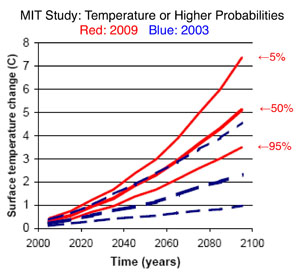
So, what does this graph say? It says that in a business-as-usual ("no policy") scenario, there is a 50% chance that the temperature will 5C (9F) or more warmer in 2095 and there is a 95% chance that it will be 3.5C (6.3F) or more warmer in 2095!

Scientists tell us that going past 2C (3.6F) warmer will be disaster. As I said in my previous post, 2C (3.6F) warming will be really bad, 3C (5.4F) will be biblical, and at 4C (7.2F) and above, we face the possible collapse of agriculture, the economy, and perhaps civilization itself. It may be "Game Over" at 6C (10.8F) and above.

We can see from the graph that there is a 50% chance we will cross the 2C (3.6F) "danger line" between 2040 and 2050, and there is a 95% chance will will cross it by 2060 or before.


From here, citing this report.

The red lines are the current predictions. The blue lines are the predictions made in 2003 by the authors of the current study.

Who would have guessed that air pollution is more likely to do us in than nuclear war or a comet?

28 July 2008

Another Hot and Dry Summer In Denver

So far in 2008, Denver has had 3.28 inches of precipitation. The normal amount of precipitation for the year to date is 9.97 inches. July has been particularly dry with just 0.24 inches to date, compared to a normal of 1.88 inches this far into the month.

The average yearly precipitation in Denver is 15.81 inches (40.2 cm). A desert is often defined as an area receiving less than ten inches of rain per year, and this year's dry first seven months could easily push Denver from merely being semi-arid, into being a true desert. Unless the spring brings above average precipitation, Denver will be a desert this year.

A good snowpack last winter is preventing us from suffering severe water shortages, but this isn't the first time Denver has set heat and drought records in the past few years. Colorado's ski resorts fear that global warming could cut their competitiveness vis-a-vis Canadian ski resorts soon, however, which is why they are some of the most ardent proponents of controlling greenhouse gases in the state.

We are also chasing the record for the longest number of ninety degree plus days in a row, eighteen, last seen in 1901 and tied a quarter decade earlier. With fourteen straight ninety degree days in a row (as of Sunday), we are already in fourth place for heat waves, and the forecast has us breaking the record on Thursday, and the forecast is for the heat to stay at least another several days. Wednesday is also forecast to be just short of a record high for that day; a slight shift in the weather cut set a new one.

The heat wave will surely break in August, at some point. With luck, the Democratic National Convention will have somewhat cooler weather in late August.

Global warming has gone far enough, and is irreversible enough at this point that summers like this one are what we have to look forward to in the decades to come. Moreover, one of the main big picture take away messages from a recently completed national drought atlas is that drought phenomena operate over very large geographical areas. A fair small number of areas capture a very large share of all dought phenomena in the United States.

In English, that means that dry summers in Denver mean bad news for wide swaths of the Front Range. Dare I say Dust Bowl II?

12 February 2008

Denver Post Offers Junk Headline

Normally, I am not a big one to pursue media bias. But, I'm ready to agree when the Denver Post runs a headline that reads "Ritter's climate plan dubbed 'junk science'" parrotting Rep. Kevin Lundberg, R-Berthoud, who himself is taking the junk science position that (in the Post's description of his position) "it has not been settled scientifically that manmade carbon-dioxide emissions contribute to global warming."

Hello Denver Post and other Associated Press clones. In public debates various parties have their publicly expressed opinions, but there is also something out there called the factual truth, and your are betraying our trust when you fail to call out, and indeed, when you fail to mock, science deniers like Lundberg. Giving their statements the credibility of a headline is irresponsible reporting.

19 February 2007

We're Number Two. . . In Stale Snow

Today, Denver enjoyed (survived?!) its 61st continuous day with measurable snow on the ground. This makes this winter second only to the winter of 1983-1984, when Denver had 63 continuous days of measurable snow on the ground. They measure it at 6 a.m. in Stapleton. Today broke the second place record from 1913-1914.

More snow is due this afternoon and evening, so despite warm temperatures today, we are likely to make it, at least, to day 62 on Tuesday morning. Wednesday would tie the record, and Thursday would surpass it. Warm temperatures expected during the day all this week makes this is a close call.

We know that we can never get enough moisture in Denver, and with the evidence for global warming growing ever more conclusive, we may be looking at long eras of drought that will leave us nostalgic for winters like this one. Still, it does get old.