05 February 2023

IQ v. Income In Sweden

Are the best-paying jobs with the highest prestige done by individuals of great intelligence? 
Past studies find job success to increase with cognitive ability, but do not examine how, conversely, ability varies with job success. Stratification theories suggest that social background and cumulative advantage dominate cognitive ability as determinants of high occupational success. This leads us to hypothesize that among the relatively successful, average ability is concave in income and prestige. 
We draw on Swedish register data containing measures of cognitive ability and labour-market success for 59,000 men who took a compulsory military conscription test. 
Strikingly, we find that the relationship between ability and wage is strong overall, yet above €60,000 per year ability plateaus at a modest level of +1 standard deviation. The top 1 per cent even score slightly worse on cognitive ability than those in the income strata right below them. We observe a similar but less pronounced plateauing of ability at high occupational prestige.
Marc Keuschnigg, Arnout van de Rijt, and Thijs Bol, "The plateauing of cognitive ability among top earners" European Sociological Review, jcac076 (January 28, 2023) (open access). Hat tip to Marginal Revolution.

The introduction also notes that:
[I]ncome distributions have strong right skew. In all Western countries, top income shares have been steadily rising since the 1980s, with the 1 per cent highest earners receiving 9 per cent of national income in Sweden and even 20 per cent in the United States—excluding capital gains[.]

Note the subtlety that while very high levels of IQ translate on average to continued improvement in economic and non-economic outcomes, that lots of people who achieve high levels of economic and non-economic outcomes are people of lesser IQ who are at the top of the bell curve for outcomes for a given IQ. 

Within the bottom 50% of economic outcomes the correlation of IQ and economic results, rather than being monotonic, hits minimum IQ at the 20th percentile of income and starts rising below that point.

The range between the 50th and 90th percentiles of economic outcomes seems to be the most meritocratic.

Then, there is a leveling off in the top 10%.

You might reasonably have guessed in the absence of data, that the top 10% of economic outcomes would be extremely meritocratic because lots of jobs paying in the top 10% are highly skilled in a way that imposes a de facto minimum IQ, while "faking it" might be easier in middle class jobs that are less skilled. But that doesn't seem to be the case until you get to jobs in the bottom half of the wage distribution.

On the other hand, as someone who regularly deals with lots of people in the top 1% of income as a lawyer, I am well aware that they are not predominantly at or close to the top 1% of IQ, although they are rarely entirely stupid either. The epithet used to be that: "A students work for B students in companies owned by C students", although grade inflation has distorted that a bit over time. 

A plateau at €60,000 per year is lower than I would expect, although given the relatively egalitarian economy and small scale of the Swedish economy, it is somewhat harder to put a finger on what is going on as it differs in lots of material ways from the U.S. economy with which I am much more familiar. 

There is also no doubt that non-IQ personality factors like "work ethic", conscientiousness, and extraversion, play a part in economic outcomes as well. But, I'd would be surprised if those factors eclipsed IQ at the 10th percentile of income and would be less surprised if the administrative and professional sector of Sweden was less meritocratic than lower level employment.

For example, I have only a dim idea of how important family wealth is to adult income in Sweden, even though I'm much more familiar with this in the U.S.

It is also possible that somewhere in the top 10% that wage data ceases to be an accurate measure of economic returns to ability, with profits from businesses that you own and royalty income, for example, becoming more relevant than mere wages for this group of workers. In the U.S. this tendency is driven, in part, by tax law in addition to the fundamental economics, in ways that I understand fairly well, but again, I don't know how this plays out in Sweden and don't trust my intuition about a situation that in the U.S. that is heavily driven by U.S. tax laws to generalize to Sweden which has very different tax laws.

The paper's own theoretical prediction suggests that the actual data best correspond to a situation in which there is an extremely "noisy" relationship between IQ and income:

The sample size is 59,000 people, which is decent, but the top 1% is still only about 590 men (the study is based upon military entrance exams so it doesn't address income to IQ relationships for women). Also, top income may partially be suppressed by the fact that the cohort of men involved have not yet reached their peak earnings years. The sample is as follows:

Our analysis includes men who joined the labour force between 1991 and 2003 (median 1993). In total, 670,203 men, aged 18–60, entered the labour market in this period to be fully employed for at least 1 year. Cognitive-ability scores are available only for Swedish men who had the obligation to undergo military conscription. We subset on men who took a compulsory conscription test at age 18–19 during 1971–1977 or 1980–1999, years in which ≥90 per cent of each cohort enlisted (94 per cent on average). Enlistment became less comprehensive after 1999 and dropped substantially until its abolition in 2010. We focus on multi-year career success for those men for which we observe 11 years of labour market participation centred around the age of 40 (see below). This leaves us with a full census of 59,387 Swedish-born men for whom we observe a balanced 11-year panel of annual labour-market success.

Cognitive ability is on a scale of 1-9 with a median of 5, a mean of 5.45, and a standard deviation of 1.98. About 30% of the sample had scores of 7 and above, and about 15% has scores of 8 and above. So the plateau in the top 10% of income earners embraces around the top 25% by IQ.

The distribution of wages has a long tail at the high end.

The distribution of the underlying quantities compared is as follows:

The comments to the Marginal Revolution post from a person identified only as "M" discusses the related issue of higher incomes in urban areas notes some sources for further reading:

https://www.eurekalert.org/news-releases/977543 
- "Benefits of big city life – only for the elite - Urban scaling laws arise from within-city inequalities"

and previously 
https://www.eurekalert.org/news-releases/629397 
- "Big cities feed on their hinterlands to sustain growth" - "Their research, published in Science Advances, shows that big cities feed on their hinterlands to sustain growth, thereby escalating the urban-rural divide in economic prosperity and individual life chances. Individuals who leave small areas for large cities are better educated and have higher cognitive abilities than those who stay. These findings provide a more nuanced account for the reasons behind the increasingly uneven economic geography observed in many countries, with growing levels of inequality between urban and rural areas."

Urban superlinear scaling in large cities mostly caused by, and benefits to, high talented individuals. Not a lossless phenomenon for the rest of the country, so extending largest cities, although not zero-sum, generates fewer positive sum gains than thought (contra "Extending the most productive cities would be the way to most strongly boost national living standards").

03 February 2023

Excess Deaths During The Pandemic

A careful analysis set forth in the New York Times makes a good case that the lion's share of the 20% of excess deaths not due to COVID during the pandemic mostly involve people who died at home of COVID without being tested for COVID, which as a result weren't classified as their cause of death on their death certificates. 

The timing of these excess deaths, the fact that COVID deaths diagnosed as such disproportionately took place in hospitals, and the demographics of the excess deaths, all support this conclusion.

Russian Casualties And Tank Warfare In Ukraine

Russian Casualties

We are three weeks short of a year after Russian's unprovoked invasion of Ukraine. 

The number of Russian troops killed and wounded in Ukraine is approaching 200,000, a stark symbol of just how badly President Vladimir V. Putin’s invasion has gone, according to American and other Western officials.
From the New York Times.

Maybe a quarter to a third (i.e. 50,000-65,000) of the Russian casualties are troops killed in action.

The Ukraine War is already one of the ten most deadly wars in all of world history since 1812, according to a comprehensive database of historical military data.

The entire active duty Russian military prior to the Ukraine war was about 900,000, some of which is in the navy and air force which have had minimal casualties, some of which are deployed in places like Syria and Moldova, and some of which have to be stationed near other parts of Russia's sprawling international borders and to reinforce its major cities and military bases. 

Russia is trying to fill the gap by activating reserve forces and conscripting new troops, but these forces will not be as well trained as its regular soldiers which bodes poorly for Russia's military given the poor performance of its ill-trained soldiers in a bottom heavy force so far, and it still takes months to activate these new ill-trained troops. 

Seasoned and well-trained veteran enlisted soldiers and military officers killed in the Ukraine war will take years for Russia to replace.

Tank Warfare In Ukraine

Most of the tanks of both Russia and Ukraine have been taken out of action in the last year of fighting. But tanks have played a decidedly minor part in advancing either party's military objectives and are not being used heavily by either side. Only a small percentage of the tanks that have been destroyed, moreover, have been destroyed by other tanks. Artillery has played a much larger role in the Ukraine war than tanks.

Key observations about tank warfare in Ukraine:

*  Russians are using mostly high explosive (HE) tank shells as anti-personnel weapons, against unarmored vehicles, and against structures. Using a 125mm tank shell for this purpose is overkill that can also be accomplished as well or better with 25-40mm cannons and smaller and lighter recoilless rifles (i.e. bazookas) like the U.S. 84mm M3A1 MAAWS. 

* "Ukrainian troops have seen few or no Russian tanks in the last few months."

* A "125mm HE shell fired at a maximum range [which is about 5000 meters] will land up to sixty meters from where it was aimed." So, if a Russian tank aims its shell at a target on the fifty yard line of an American football field from 5 km away, the shell will end up somewhere on the field or the end zones on each side of the field. 

* Wear and tear on the tank's main gun barrel from regularly using large numbers of HE shells, even before it needs to be replaced, causes the accuracy of a Russian tank's main gun to grow even worse. The bottom line is that like howitzers, Russian tanks are very inaccurate at long ranges (from which, and beyond which, anti-tank weapons and artillery can still be fired at the tanks).

* Unlike most Western tanks, newer Russian tanks (such as its T-80s) can also fire an anti-tank missile through its main gun, but this capability doesn't appear to have been used widely in Ukraine.

* Russians have lost about 1,600 out of 2,600 tanks that they started with in engagements with Ukraine, and have replaced about 1,000 tanks from their stockpiles (mostly out of date models). In theory, this means Russia should have about 2,000 operational tanks in Ukraine, albeit, many of which are outdated. 

* But, wear and tear on hard to replace tank main gun barrels and sporadic shortages of other replacements parts mean that not all of those 2,000 tanks, especially among the more modern 1,000 tanks that Russia was using at the start of its invasion. A Russian tank can fire about 1,000 shells before its main gun barrel needs to be refurbished - which requires moving the tank from the theater of battle to a distant factory in a lengthy process, effectively reducing the number of tanks at its disposal. A tank without its main gun isn't very useful. There have also been shortages of replacement parts for Russian tanks that make more of them that are not destroyed in battle temporarily inoperative.

* So, even with 1,000 replacement tanks from storage, Russia probably has fewer than half of the tanks it started with that are actually operational, many of which are nearing the end of their useful lives before they have to be refurbished, most of which are outdated, and most of which have ill-trained tank crews.

* Russia's supply of tank shells is also not unlimited. It has used about 100,000 tanks shells so far and the production line of new HE tank shells that its tanks are mostly using was shut down many years ago.

* In fairness, Ukraine has also had many hundreds of its tanks destroyed, rendered inoperable, abandoned, or captured in this war (473 of them according to Oryx, which is an undercount since it includes only photographically confirmed losses, out of about 900 tanks, mostly older T-64 models, that it had a year ago), and also has difficulty finding the parts it news to keep its remaining tanks working.

* The Russian military seems to be aware at some level of the shortcomings of Russia's armored forces and as a result hasn't been using its tanks very much in recent months.
Russia reported that they had 2,600 tanks available at the time of February 2022 invasion of Ukraine. There was visible evidence that nearly 1,600 were lost during the first few months of the invasion. While 924 were destroyed, another 664 were damaged and abandoned. Most of these tanks were undamaged and captured intact after their crews abandoned them. These were repainted to identify them as Ukrainian and used against the Russians. Many of these tanks eventually became unusable because Ukraine did not have replacement parts for them. Ukraine used similar tanks but not all of the replacement parts for Ukrainian tanks were suitable for the captured Russian ones.

Russia had a similar problem with the thousand tanks that survived the invasion and over a thousand more that were brought in as replacements. The replacement parts problem was even more acute for the Russians because they changed their tank tactics in the face of the numerous Western top-attack ATGMs (Anti-Tank Guided Missiles) that quickly destroy Russian tanks because of the way these tanks use their autoloaders, which puts many exposed shells and their propellant charges in the turret. If the turret is hit by a top attack ATGM, all those propellant charges explode, killing the three-man crew and often blowing the turret off the tank.

Russia responded to this by using their remaining tanks only for direct-fire artillery support for Russian troops. This meant using HE (high-explosive) shells that explode when they hit something, usually the ground, and create many high-speed metal fragments that will wound or kill troops and damage structures and unarmored vehicles. These shells are effective if they hit something but they are not accurate and often just hit the ground, where most of the fragments go into the ground or fly harmlessly into the air. In Ukraine Russian tanks have used more HE shells than ever before. 
Russia used them occasionally in Afghanistan, and during the Chechen wars of the 1990s. In both these wars Russia had air superiority and could use helicopters and ground attack aircraft as well as conventional artillery. 
In Ukraine Russia has lost the tank war as well as the artillery war. Using 125mm HE shells fired by tanks seemed to be a practical solution. It was, but there were unwanted side-effects.

Firing HE is less accurate the farther away the target is. That means a 125mm HE shell fired at a maximum range will land up to sixty meters from where it was aimed. The 125mm accuracy problem was confirmed in 2018. That was when the Russian army conducted tests to measure the effectiveness of HE shells fired from the smooth bore 125mm guns tanks are equipped with. The test results recommend against tanks using HE shells. The ones on hand were not discarded but no new ones were manufactured.

Russian tanks in Ukraine appear to have used about 100,000 of these shells and in doing so discovered another problem. These shells caused barrel wear on the 125mm tank gun liners. These liners are common in tank guns and tube artillery. It’s cheaper to replace a worn-out liner than to replace the entire barrel and attached loading mechanism. Tube artillery barrel liners are good for 5,000 to 6,000 shells fired. On Russian tanks the liner wears out after about a thousand shells are fired. Most of the Russian tanks in Ukraine used for firing HE shells found that their barrels already had a lot of wear on them and heavy use of HE increased liner wear to the point where all shells (anti-tank or HE) were much less accurate.

Russian tanks can have their liners replaced but it happens so infrequently that the process is not simple. It involves removing the turret from the tank to replace the liner. This can only be done in one special facility and that means putting the entire tank on a train flat car and shipping it to the facility and then shipping it back. This meant that most of the Russian tanks with worn barrel liners were useless except as machine gun-armed vehicles. That’s hardly worth the fuel and other spare parts (like the tracks) required. This is apparently why Ukrainian troops have seen few or no Russian tanks in the last few months. This means less shell fire at Ukrainian troops and Ukrainian artillery can concentrate on other targets, like Russian infantry and supply stockpiles.

The Ukrainians want Western tanks, particularly American M1s and German Leopard 2’s because they are both considered the best designed and effective tanks available. The M1 has extensive combat experience against Russian tanks and has never, so to speak, been defeated by Russian T-90, T-72 or T-55 tanks. Like the Leopard, the M1 has multiple layers of armor protections including an APS (Active Protection System) and safer storage of tank shells and propellant inside the turret. An effective fire extinguishing system can quickly deal with any type of fire. The fire control system is one of the best available, allowing the M1 to accurately fire on the move and hit an enemy tank several thousand meters distant. The United States and Germany can supply all the spare parts needed to Ukrainian users. Worn barrels on the Western tanks are easier to replace.
[World War II] German generals noted that “…the Russian armored force was not as good as the Russian artillery,” citing a lack of flexibility and inability of commanders to exploit success. They also observed that “The training of the individual tank driver was inadequate…” and that “The Russian avoided driving his tank through hollows and along reverse slopes, preferring to choose a route along crests which would give fewer driving difficulties.” These observations seem consistent with Russian armor operations in Ukraine. Many armor troops in the initial Russian invasion force were conscripts with minimal training. Despite the flat terrain and frozen ground, most Russian armor appeared to be road-bound as commanders sought to avoid maneuver in open areas.

To date, Russian commanders have been unable to create any major breakthroughs as the initial failed assaults demonstrate. Most Russian tank advances were made only after massive artillery barrages rather than large, armored sweeps across open terrain. The Russian armor’s main contribution is its sheer mass and numbers, just as it was in WWII. However Russian armor forces remain largely road-bound and an easy target for Ukrainian drones, artillery and anti-tank weapons.
From a February 2, 2023 report assessing the performance of Russian forces so far in the Ukraine War.

02 February 2023

Russia's Military Still Sucks

A report released today summarizes, with supporting references, the myriad reasons that the Russian military is far less effective in practice than it seemed on paper. It concludes:

At the core of the problem are endemic issues within the Russian armed forces that have endured since WWII. Now, as then, risk adverse leaders allow junior leaders no initiative at the lower echelons. Poorly trained conscripts are unable to operate and maintain modern military equipment or conduct required complex maneuvers on the ground. Artillery and air support are used as mass terror weapons rather than as coordinated supporting arms for ground maneuver forces.

One key element it misses, however, is that Russia's decision to make an unprovoked invasion of Ukraine contrary to its prior treaty obligations and affirmations left it with few allies and little ability to promptly resupply itself, while providing Ukraine with allies across Europe and the globe who have provided it with arms, intelligence support, diplomatic support, and more. Wars are frequently won or lost based upon which allies the parties in the conflict have.

01 February 2023

Travel To The U.S. Is Down

Travel to the United States still hasn't fully recovered from the pandemic.


A Radical Rollback Of Zoning Laws In California

The main disagreement I have with the summary below is that a law from the 1990s is not a "very old law," a term that should be reserved for laws such as the 1792 law establishing which state owns the Ohio River (it is Kentucky).

On the merits, rolling back zoning regulation is a great idea, especially in California where restrictive zoning laws are one of the main reasons it has most of the most expensive housing markets in the nation.

An old law may eliminate the housing-related zoning ordinances of the vast majority of cities throughout the Bay Area. Yes, seriously. It’ll occur this Wednesday, too. Developers will be allowed to propose housing (and only housing) at any height and any density in a city, so long as at least 20% of the homes in the proposed building are deed-restricted to low income residents who make at or less than 80% the area median income. Alternatively, 100% affordable to moderate income residents where rents don’t exceed 120% area median income.

The first city to have the builder’s remedy thrust upon them was Santa Monica who failed to adopt a valid housing element. What happened next shocked California: the residential zoning for the city was suspended by law.

The whole residential zoning.

A town which in the last eight years approved 1,600 new homes and within a week, saw a dozen development proposals filed that put 4,000 new homes in the pipeline with over 800 of them deed-restricted for low income households. They couldn’t reject a single home, either. It didn’t even go through a long city council process, the project approvals were merely administrative by the planning department who verified if the project is sound in non-density or height regulations. The city councils and zoning boards had zero authority to deny the projects. Zero.

This shocked California political pundits, news media and neighborhood organizations. This had never happened before. Were more cities next? Yes, the rest of the state of California. But it was brought about by a combinations of new and old laws that got us here. So a brief history:

The “builder’s remedy” is a very old law from the 1990s known as the Housing Accountability Act (HAA). Cities since the 1970s have been required to design housing elements (formerly known as municipal master plans) that essentially sketch out the residential zoning of a city. During the ‘70s, cities were all about an anti-population growth and downzoned the capacity for future housing by the millions in housing units, which pretty quickly led to a housing shortage.

From here. 

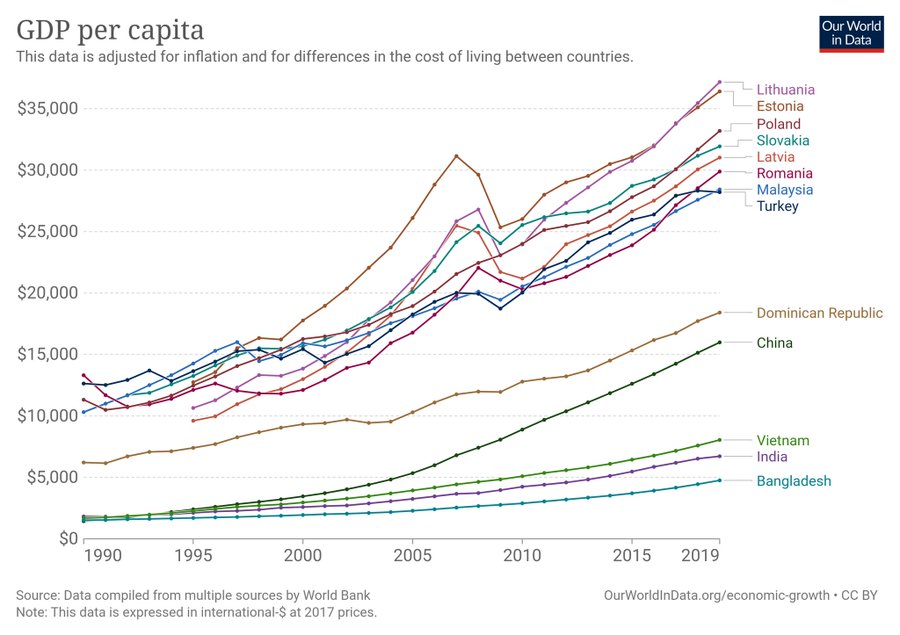
Rapid Recent Economic Development In Select Countries

Eastern Europe, Malaysia, and Turkey have seen rapid economic growth since the end of the Cold War. 

In all of these cases, except Malaysia, greater openness to and increased trade with Western Europe is the likely reason for the economic growth these countries experienced.


Bipartisan Suggestions For Constitutional Change

[W]e convened three teams of well-known law professors — conservative, libertarian and progressive — to draft new constitutions from scratch. All three teams converged around basic reforms, including the need to strengthen congressional oversight of the president and to increase Congress’s control over federal spending and regulations. Encouraged by this consensus, the three teams gathered together for a Zoom convention in August to see if they could agree on specific amendments to the existing Constitution. And after a week of dialogue, deliberation and compromise, the ideologically diverse delegates agreed on proposals for five pathbreaking amendments: 
  • The 28th Amendment would eliminate the natural-born citizenship requirement for the presidency. If the amendment passed, Henry Kissinger and Arnold Schwarzenegger could run for president. 
  • The 29th Amendment would allow for legislative vetoes of executive and regulatory actions. All three teams shared concerns about an imperial presidency and a runaway administrative state, typically a conservative and libertarian bugaboo. And they all found a solution in resurrecting the legislative veto, which allows Congress to negate executive actions by majority vote. Congress exercised this power from 1932 until the Supreme Court struck it down in 1983, a decision that the delegates’ amendment would overrule. 
  • The 30th Amendment would seek to avoid partisan impeachments while making it easier to remove dangerous presidents. It would reform the presidential impeachment process by replacing “Treason, Bribery, or other high Crimes and Misdemeanors” as cause for impeachment with “serious criminal acts, or for serious abuse of the public trust.” In other words, not all crimes would be impeachable and not all impeachable conduct would be criminal. And while the current Constitution requires a majority of the House to impeach and two-thirds of the Senate to convict, the amendment would change both thresholds to three-fifths, making it harder to impeach but easier to convict. 
  • The 31st Amendment would set 18-year term limits for Supreme Court justices, with staggered terms allowing for a vacancy every two years. Thus each president would get to appoint two Supreme Court justices per four-year term, regularizing and de-politicizing the Supreme Court confirmation process. It would also require the Senate to vote on all nominees. (In other words, no ignoring Merrick Garland.) If a sitting justice died or left the court, the president would nominate a successor to fill out the end of that term. 
  • The 32nd Amendment would make proposing and ratifying future amendments a little easier. Congress could propose amendments by a three-fifths vote of both Houses (down from two-thirds), and amendments would become law when ratified by two-thirds of the states (down from three-fourths). The delegates also added an alternative, population-based amendment track, so that small states couldn’t block overwhelming majorities from changing the Constitution. On this other track, states representing two-thirds of the national population could force Congress to propose amendments, and states representing three-fourths of the population could call a Constitutional Convention themselves. And all proposed amendments would go into effect if ratified by states representing three-fourths of the population.

The language of the proposed 29th Amendment is as follows:
AMENDMENT XXIX: LEGISLATIVE VETO 
Congress may by law provide for a veto, by majority votes in each of the Houses of Congress, of actions taken by the executive department, except actions adjudicating the applicability of a statute or regulation to a person. 
A failure by Congress to act pursuant to such a law shall not affect any judicial determination as to whether any law, or any actions of the executive department, are valid or enforceable. 
This article shall be inoperative unless it shall have been ratified as an amendment to the Constitution by the legislatures of the several States, as provided in the Constitution, within seven years from the date of the submission hereof to the States by the Congress.
The proposed 28th Amendment is a no brainer. 

The 29th Amendment would be fine, but wouldn't make much of a difference and would basically only be invoked when the President was of a different political party than a majority of both houses of Congress. 

The 30th Amendment is an improvement, and so is the 32nd Amendment that is suggested. The 32nd Amendment would probably, indirectly, lead to the adoption of a popular vote for President in lieu of the Electoral College.

I'm not convinced that the 31st Amendment is the right solution although it isn't the worst possible approach. The status quo option of allowing Congress to increase the size of the U.S. Supreme Court is better given how far out of kilter the U.S. Supreme Court has gotten. 

Reviewing the proposed language of the amendment which would also make other appointments more difficult reaffirms my sense that this proposal is a bad idea. The full text of the proposal is as follows, and I have put in bold the portions that I agree with and in strikeout the portions that I disagree with:
AMENDMENT XXXI: APPOINTMENTS

This amendment shall supersede Article II, § 2, para. 2 and Article III, § 1 of the present Constitution: 
§ 1. The President shall have power, by and with the advice and consent of the Senate, to make treaties, provided that three fifths of the Senators present concur; and shall nominate, and by and with the advice and consent of the Senate shall appoint, ambassadors, other public ministers and consuls, judges of the supreme and inferior courts, and all other officers of the United States, whose appointments are not herein otherwise provided for, and which shall be established by law: but the Congress may by law vest the appointment of such inferior officers, as they think proper, in the President alone, in the courts of law, or in the heads of departments. 
Nominations shall be deemed to have received the advice and consent of the Senate unless disapproved by majority vote within three months of the nomination; but any Senator shall have the right to bring any nomination to the floor for debate and vote prior to that time. Any nomination made within the last three months of the President’s term shall lapse at the end of that term, unless sooner approved by the Senate. 
§ 2. The judicial power of the United States, shall be vested in one supreme court, and in such inferior courts as the Congress may from time to time ordain and establish. The judges of the inferior courts shall hold their offices during good behavior. Congress may by law provide for a process within the judicial department for the suspension from duty of inferior court judges on grounds of disability. Both the judges of the supreme and inferior courts shall, at stated times, receive for their services a compensation, the real value of which shall not be diminished during their continuance in office. 
There shall be nine judges of the supreme court, who shall hold their offices for staggered terms of eighteen years, such that every two years there shall be a vacancy. In the event of a vacancy resulting from death, resignation, impeachment, or other inability to perform the duties of the office, a new judge shall be appointed for the duration of the term only. After a term of office has expired, the judge whose term has expired may elect to sit on an inferior court during good behavior, which court is to be determined by the Chief Justice or as Congress shall direct.

After this article is ratified, the senior-most judge currently serving on the supreme court, calculated by time served on the court, shall retire by the next presidential inauguration. The President after said inauguration shall nominate a successor. Every two years thereafter for sixteen years, the most senior remaining judge shall retire by January 20, whose successor shall be nominated by the sitting President after that date. In the event of a vacancy resulting from the death, resignation, or impeachment of a judge of the supreme court sitting as of the time this article is adopted, a new judge shall be appointed for the duration of the term that would have otherwise elapsed according to this section.

This article shall be inoperative unless it shall have been ratified as an amendment to the Constitution by the legislatures of the several States, as provided in the Constitution, within seven years from the date of the submission hereof to the States by the Congress.

The Cost Of Buying A Home

The Zillow Home Value Index sets the cost of buying a home in various metro areas (and for the United States as a whole). Here are selected results for December 2022:

United States: $356,819
  1. San Jose, CA: $1,521,049
  2. San Francisco, CA: $1,348,952
  3. Santa Cruz, CA: $1,224,439
  4. Santa Barbara, CA: $951,803
  5. Urban Honolulu, HI: $917,978
  6. Los Angeles, CA: $893,468
  7. San Luis Obispo, CA: $871,600
  8. San Diego, CA: $865,499
  9. Ventura, CA: $832,740
  10. Santa Rosa, CA: $810,550
  11. Boulder, CO: $753,182
  12. Seattle, WA: $725,882
  13. Boston, MA: $642,106
  14. New York City, NY: $619,155
  15. Denver, CO: $614,979
  16. Vallejo, CA: $585,242
  17. Sacramento, CA: $582,243
  18. Provo, UT: $574,397
  19. Riverside, CA: $570,580
  20. Salt Lake City, UT: $569,969
  21. Stamford, CT: $562,857
  22. Portland, OR: $556,622
  23. Fort Collins, CO: $564,926
  24. Washington, DC: $551,067
  25. Bremerton, WA: $546,876
  26. Stockton, CA: $537,973
  27. Reno, NV: $535,479
  28. Austin, TX: $531,197
  29. Greeley, CO: $526,316
  30. Olympic, WA: $526,169
  31. Ogden, UT: $505,937
  32. Portland, ME: $483,531
  33. Miami, FL: $476,860
  34. Boise City, ID: $476,570
  35. Colorado Springs, CO: $471,376
  36. Eugene, OR: $458,638
  37. Manchester, NH: $458,256
  38. Modesto, CA: $452,819
  39. Salem, OR: $449,549
  40. Providence, RI: $446,479
  41. Nashville, TN: $446,141
  42. Phoenix, AZ: $437,703
  43. Raleigh, NC: $433,424
  44. Charleston, SC: $421,868
  45. Worcester, MA: $419,855
  46. Durham, NC: $418,091
  47. Las Vegas, NV: $418,083
  48. Spokane, WA: $418,056
  49. Asheville, NC: $414,093
  50. Chico, CA: $410,228
  51. Orlando, FL: $398,331
  52. Merced, CA: $397,901
  53. Tampa, FL: $387,110
  54. Dallas, TX: $382,179
  55. Madison, WI: $381,738
  56. Ann Arbor, MI: $380,927
  57. Fresno, CA: $380,919
  58. Atlanta, GA: $380,619
  59. Anchorage, AK: $378,533
  60. Baltimore, MD: $378,283
  61. Minneapolis, MN: $370,054
  62. Daytona Beach, FL: $363,586
  63. New London, CT: $347,825
  64. Richmond, VA: $347,267
  65. Philadelphia, PA: $344,532
  66. Tuscon, AZ: $339,332
  67. Bakersfield, CA: $337,309
  68. San Antonio, TX: $336,791
  69. Yakima, WA: $336,628
  70. New Haven, CT: $332,630
  71. Atlantic City, NJ; $326,909
  72. Sioux Falls, SD: $326,759
  73. Hartford, CT: $326,038
  74. Knoxville, TN: $324,587
  75. Albuquerque, NM: $321,300 
  76. Greenville, SC: $315,192
  77. Houston, TX: $311,338
  78. Allentown, PA: $310,877
  79. Huntsville, AL: $309,522
  80. Chicago, IL: $307,349
  81. Grand Rapids, MI: $306,416
  82. Savannah, GA: $305,938
  83. Columbus, OH: $304,421
  84. Kansas City, MO: $293,088
  85. Hagerstown, WV: $288,253
  86. Chattanooga, TN: $284,847
  87. Appleton, WI: $279,527
  88. Lincoln, NE: $278,111
  89. Milwaukee, WI: $275,271
  90. Indianapolis, IN: $273,939
  91. Des Moines, IA: $271,256
  92. Cincinnati, OH: $267,706
  93. New Orleans, LA: $266,726
  94. Birmingham, AL: $252,018
  95. Buffalo, NY: $247,248
  96. St. Louis, MO: $245,958
  97. Louisville, KY: $245,203
  98. Springfield, MO: $244,146
  99. Baton Rouge, LA: $239,241
  100. Detroit, MI: $238,838
  101. Memphis, TN: $237,529
  102. Duluth, MN: $236,994
  103. Augusta, GA: $235,476
  104. Oklahoma City, OK: $226,242
  105. Cleveland, OH: $219,740
  106. Fort Wayne, IN: $217,183
  107. Pittsburg, PA: $209,325
  108. Lubbock, TX: $209,113
  109. Little Rock, AR: $201,705
  110. Wichita, KS: $199,936
  111. Gulfport, MS: $199,519
  112. Evansville, IN: $196,194
  113. Montgomery, AL: $188,943
  114. Jackson, MS: $187,587
  115. Erie, PA: $187,346
  116. Campaign-Urbana, IL: $187,013
  117. Brownsville, TX: $182,018
  118. Flint, MI: $175,653
  119. Macon, GA: $172,893
  120. Rockford, IL: $171,786
  121. Toledo, OH: $170,917
  122. Youngstown, OH: $150,699
  123. Peoria, IL: $144,941
  124. Huntington, WV: $136,528
  125. Charleston, WV: $132,072
Some observations:

* The most expensive metro area in the index is 11.5 times as expensive as the least expensive one. 

* The immense divide in housing costs reflects the immense economic divide between different regions in the U.S. which is a major drive of the political division in the U.S., with the more expensive metro areas tending to lean Democratic, and the less expensive metro areas tending to lean Republican.

* Eleven of the top twelve are on the Pacific Coast. Nine, including the top four, are in California, one is in Hawaii (#5), and one in Washington State. Boulder is the only metro area in the top twelve that is not on the Pacific Coast.

* The most expensive metro areas not on the Pacific Coast are: Boulder, Boston, New York City, and Denver, in that order.

* The West has most of the 40 most expensive metro areas in the United States (30), followed by the Northeast (8). Two are in the South: Miami and Austin.

* Madison, WI at #55 is the most expensive metro area in the Midwest. Chicago at #80 is very inexpensive considering that it is the third largest metro area in the United States.

* Metro areas with home values of under about $300,000 are fairly described as having "depressed economies" for the most part. Metro areas with home values of under $200,000 are fairly described as being in "economic collapse" for the most part. There are 62 metro areas on the list above that are above the U.S. average.

* The bottom of the list is dominated by post-industrial towns, mostly in the Rust Belt, but also with a smattering of places with fossil fuel extraction economies and some rural area hubs.

31 January 2023

What Is Driving Religious Radicalism In The United States?

The U.S. is radicalizing because it is failing to deliver broad based prosperity. 

A hotter and more reactionary style of religion is surging in America and mainstreaming certain radical frameworks. It cuts across traditional denominational divides. It tracks some global shifts in religion, shifts in which America is a follower as well as a leader. And it represents a significant threat to the future of American democracy. 
The most fruitful line of investigation and response has to focus on the root causes of the religious transformation. Religion in America is starting to look more like religion in Brazil and Guatemala because America, in some aspects, is starting to resemble Brazil and Guatemala: increasingly unequal, bitterly divided, corrupt, rife with disinformation, and unstable. If we want people to choose different gods, we might think about tackling the conditions that lead them to prefer one kind over another.

From Katherine Stewart, "The Rise of Spirit Warriors on the Christian Right," at the New Republic via BoingBoing.

27 January 2023

Krugman On Rural Resentment

I've known this and discussed it for a long time, but a reminder now and then is appropriate. Without government subsidies, the rural population of the United States would be significantly smaller.

The truth is that ever since the New Deal rural America has received special treatment from policymakers. It’s not just farm subsidies, which ballooned under Donald Trump to the point where they accounted for around 40 percent of total farm income. Rural America also benefits from special programs that support housing, utilities and business in general.

In terms of resources, major federal programs disproportionately benefit rural areas, in part because such areas have a disproportionate number of seniors receiving Social Security and Medicare. But even means-tested programs — programs that Republicans often disparage as “welfare” — tilt rural. Notably, at this point rural Americans are more likely than urban Americans to be on Medicaid and receive food stamps.

And because rural America is poorer than urban America, it pays much less per person in federal taxes, so in practice major metropolitan areas hugely subsidize the countryside. These subsidies don’t just support incomes, they support economies: Government and the so-called health care and social assistance sector each employ more people in rural America than agriculture, and what do you think pays for those jobs?

From a New York Times Op-Ed by Paul Krugman. 

24 January 2023

Guns, Homicides, Suicides, and Drugs

The Big Picture

Gun control and drug policy are two areas where overwhelming empirical evidence shows that liberal policies on these issues would profoundly increase public welfare, and that conservative policies on these issues are deeply misguided and do profound harm without providing meaningful benefits to society. 

The misguided status quo policies in the United States on these issues are also among the most important reasons that U.S. life expectancies are lower than in other developed countries. While the raw numbers of deaths caused by these policies is not extremely high relative to diseases that cause deaths, because they results in deaths of much younger people on average than other leading causes of death, their impact on U.S. life expectancies is outsized.

Weak gun control laws are a root cause of about 75-80% of the homicides and more than half of all suicides in the United States. 

Insufficiently strong gun control laws cause about 30,000 more deaths per year in the United States than it would have if strong gun control laws were in place. 

These preventable deaths take a particularly strong toll on people who are more than one year old and are not yet elderly, who otherwise tend not to die of "natural causes" and are the leading cause of death for children in the United States. These deaths disproportionately kill men and racial and ethnic minorities in the United States, especially black adolescent boys, and young black men. Deaths due to weak gun control laws also disproportionately kill young white men in the South and in rural America.

This is also the reason that the United States leads the world in its number of mass shootings. And, the evidence is overwhelming that widespread gun ownership does not meaningfully mitigate mass shootings that do occur, and does not prevent mass shootings. Instead, it makes them more common.

The criminal justice system does not deter mass shootings. They continue to occur, even though it is widely known that almost every mass shooter (98% of whom are men): (1) commits suicide, (2) dies in the act as law enforcement tries to shop him or arrest him, (3) is convicted of multiple murders and remains in prison for life (or in very rare cases is executed a decade or more later), or (4) is declared insane or incompetent and is involuntarily committed and never walks free again. Almost no mass shooters escape death shortly after or maximal criminal justice system punishments. The clearance rates for these cases is almost perfect. Because of this fact, the only way to reduce the number of mass shootings is to prevent them, and stricter gun control laws are well proven to greatly reduce mass shootings.

Consideration of homicides and suicides alone fails to consider the way that the pervasive threat of armed crime triggers excessive uses of force by law enforcement and the militarization of law enforcement, sometimes resulting in unjustified law enforcement killings, in legally unjustified killings by civilians claiming to be acting in self-defense, in justified law enforcement and self-defense killings that could have been prevented if guns were less widely available, and in riots causing mass property damage, injuries, and sometimes deaths. These circumstances claim hundreds of lives each year and also lead to hundreds of law enforcement deaths of each year.

Of course, this doesn't even begin to consider the harms associated with gun involved crimes such as non-fatal shootings, extortion, robberies, burglaries, and rapes that are committed with firearms. The rates at which these aggravated crimes would be committed would be significantly reduced if strict gun control were in place, although comparative crime rate studies suggest that the reductions would not be nearly as great as the reductions in the rates of homicides.

The evidence is also overwhelming that the widespread availability of armed self-defense does not significantly prevent crimes from taking place, or mitigate the harm associated with crimes. Instead, gun ownership increases the rate at which gun owners and non-gun owners alike are victims of crimes and commit suicide. Armed self-defense and armed defense of others does succeed, at least partially, in a tiny number of cases, but the benefits of armed self-defense in the rare cases where it is used are profoundly overwhelmed by the harms that widespread gun availability facilitates, even to people who are generally law abiding when they buy firearms who purchase them in good faith solely for the purpose of defending themselves, their homes, and their families.

Widely available firearms, by making crimes more serious, also drives mass incarceration in the United States, by turning people who otherwise would have committed less serious crimes into people who commit serious violent crimes. People serving long sentences for violent crimes make up a large share of all prison inmates and would make up a significantly smaller share of prison inmates in a world with strict gun control.

Weak gun control laws in the United States and the prohibition rather than regulation of controlled substances in the United States are also a leading cause of homicides and other gun crimes in Canada, the Caribbean, and Latin America. Strong gun control laws in the United States would save tens of thousands of lives each year elsewhere in the Americas.

The facts that countries with strict gun control laws like the U.K. and Japan have healthy democratic systems, that guns and threats of violence are increasingly being used to thwart the democratic process, and the results of comparative and historical studies of the impact of armed populations on tyranny and the democratic process, all soundly demonstrate that the political theory underlying the Second Amendment is profoundly incorrect as an empirical matter.

Unequivocal evidence clearly shows that the United States, and the Western Hemisphere more generally, would be profoundly better off if the Second Amendment to the United States Constitution were repealed, and the United States then adopted strict national gun control laws along the lines of those current in place in the United Kingdom and Japan.

In short, the Second Amendment is a suicide pact.

A policy towards illegal drugs and unauthorized use of prescription drugs that deals with drugs as a public health problem, rather than treating this as primarily a criminal justice problem would also greatly reduce ever rising number of drug overdose deaths in the United States. It would also profoundly reduce organized crime and gang activity and greatly reduce property crimes committed to fund illegal drug purchases. In the year 2021, 106,699 people in the United States died of drug overdoes (mostly of opiates), and this would be profoundly reduced if the United States instead took a public health approach to the problem. Perhaps 90% of these deaths could be prevented with better drug policies. This has been convincingly demonstrated in places that have shifted fully or partially from a war on drugs criminal justice approach to a public health approach to the problem of substance abuse such as France, Switzerland, and Portugal, and in places that have legalized recreational marijuana. The illegal drug trade that U.S. controlled substance laws facilitate also fuels organized crime worldwide, often making it a powerful rival to the civilian governments of the countries where it is present.

This post addresses many, but not all of the claims above, others of which have been addressed in previous posts at this blog.

Gun Control Laws Compared

The U.S. has the most lax gun control law in the world other than Ethiopia and Yemen (Switzerland is lax, but not as lax as the U.S., Yemen and Ethiopia are also more lax than they seems as Yemen is in the middle of a civil war and Ethiopia is the midst of a lower grade military insurgency).

The U.K. and Japan have the most strict gun control laws in the world, with Japan's regulation of guns being more strict and more effectively enforced, in part because the borders of the U.K. are more open to countries with less strict gun control laws. Japan also might tightly regulates bladed weapons than the U.K. does.

Homicide Rates Compared

How does this affect homicide rates in the respective countries?

The lion's share of the difference in homicide rates between the U.S., U.K., and Japan can be attributed to gun control.

Total Homicide Rates Per 100,000 people:

* U.S.    4.7 (74% involving guns)

* U.K.    1.17 (5% involving guns, i.e. 35 gun homicides per year).

* Japan   1.02 (less than 1% involving guns, i.e. 9 gun deaths including suicides and accidents per year).

Gun Homicide Rate Per 100,000 people:

* U.S.    3.48 (about 58 times as great as the U.K.)

* U.K.:  0.06 (more than 6 times more than Japan)

* Japan: less than 0.01 (more than 348 times less than the U.S.)

The U.S. would have about 11,300 fewer gun homicides per year if it had the U.K. gun homicide rate instead of its own.

More generally (involving slightly different rates due to age adjustments and data from different years):

Non-Gun Homicide Rates Per 100,000 people:

* U.S. 1.22 (21% more than Japan and 10% more than the U.K.)

* U.K. 1.11 (10% more than Japan)

* Japan 1.01

The U.S. would have about 363 fewer non-gun homicides per year (about one less homicide per day, nationwide) if it had the U.K. non-gun homicide rate rather than its own non-gun homicide rate.

Some of the difference in the non-gun homicide rate between the U.S. and the U.K. and Japan (but probably less than 10%), may reflect the inferior health care system of the U.S., which unlike the U.K. and Japan is not universal causing people who need emergency medical care to avoid hospitals.

Some of the difference in the non-gun homicide rate between the U.K. and Japan (but probably not more than 10%) may reflect stricter controls on bladed weapons in Japan than in the U.K.

The fact that the population of Japan is older than the populations of the U.K. and the U.S. may account for some of the difference.

Another factor may  be greater economic inequality and higher poverty rates in the U.K. Economic inequality and poverty are higher in the U.S. than either the U.K. or Japan.

But, all other factors explaining the differences in homicide rates between these countries pale in comparison to gun control.

Mass Shootings Compared

Unsurprisingly, the U.S. also (almost) leads the world in mass shootings:

Mass shootings are a fairly modest share of all murders committed with guns in the United States (about 2.6%):
The Gun Violence Archive, an online database of gun violence incidents in the U.S., defines mass shootings as incidents in which four or more people are shot, even if no one was killed (again excluding the shooters). Using this definition, 513 people died in these incidents in 2020.

But mass shootings have a disproportionate impact on our public sense of security, because they are comparatively random and unpredictable.

There are no mass shooting in Japan, which has a population of about 125 million people.

The U.S. has:

about twenty-five times as many mass shootings per capita as the U.K., 

about twelve times as many as Italy, 

about eight times as many as Australia, 

about five times as many as Germany, 

about three times as many as Canada, 

about two and three-quarters times as many as Austria, 

about two and two-thirds times as many as the Netherlands, 

about two and a half times as many as France, 

one and three-quarters times as many as Belgium, 

about one point six times as many as the Czech Republic, and 

33% more the Switzerland. 

Finland actually has 80% more mass shootings per capita than the U.S., in part due to random variation in a very small number over a twenty-one year period in a country with a small population (and probably involves fewer victims per capita than the U.S.).

Per capita rates are also problematic and not as statistically significant in countries with only one mass shooting during a twenty-one year period when the country has a small population, where random chance at a given rate and "rounding error" type issues come into play.

Gun Suicides

Stricter gun control would also greatly reduce firearm suicides without corresponding increases in suicides from other causes. 

According to the Pew Center:

In 2020, 54% of all gun-related deaths in the U.S. were suicides (24,292), while 43% were murders (19,384), according to the CDC. The remaining gun deaths that year were unintentional (535), involved law enforcement (611) or had undetermined circumstances (400). . . .
Nearly eight-in-ten (79%) U.S. murders in 2020 – 19,384 out of 24,576 – involved a firearm. That marked the highest percentage since at least 1968, the earliest year for which the CDC has online records. A little over half (53%) of all suicides in 2020 – 24,292 out of 45,979 – involved a gun, a percentage that has generally remained stable in recent years. 

As noted by the Kaiser Family Foundation:

Variation in state-level suicide rates is largely driven by rates of suicide by firearm.  
Suicides involving firearms vary from the lowest rate of 1.8 per 100,000 in New Jersey and Massachusetts to a high of 20.9 per 100,000 in Wyoming, representing an absolute difference of 19.1. 
In contrast, the rate of suicide by other means is more stable across states, ranging from a low of 4.6 in Mississippi to a high of 11.4 in South Dakota, representing an absolute difference of 6.8. . . .
More than twice as many suicides by firearm occur in states with the fewest gun laws, relative to states with the most laws. . . .
Taking a look at suicide deaths starting from the date of a handgun purchase and comparing them to people who did not purchase handguns, another study found that people who purchased handguns were more likely to die from suicide by firearm than those who did not–with men 8 times more likely and women 35 times more likely compared to non-owners.

Non-firearm suicides rates are relatively stable across states suggesting that other types of suicides are not more likely in areas where guns are harder to access.

Similarly:

A study by the Harvard School of Public Health of all 50 U.S. states reveals a powerful link between rates of firearm ownership and suicides. Based on a survey of American households conducted in 2002, HSPH Assistant Professor of Health Policy and Management Matthew Miller, Research Associate Deborah Azrael, and colleagues at the School’s Injury Control Research Center (ICRC), found that in states where guns were prevalent—as in Wyoming, where 63 percent of households reported owning guns—rates of suicide were higher. The inverse was also true: where gun ownership was less common, suicide rates were also lower. 

Spillover Effects

Stricter gun control laws in the U.S. would also significantly reduce homicide rates in Canada, the Caribbean, and Latin America, where a very significant share of all gun homicides are committed with guns smuggled into those countries illegally from the United States, where guns are easy to obtain. 

For example, according to a July 2022 article, in "Ontario, Canada's most populous province . . . when handguns involved in crimes were traced in 2021, they were overwhelmingly - 85% of the time - found to have come from the United States. . . . 70% of all traced guns used in crimes in Ontario came from the United States, while so far this year the U.S. share has risen to 73%, according to the data from the Ontario police's Firearms Analysis and Tracing Enforcement (FATE) program."

A significant share of homicides in Latin America are also attributable to the trade in illegal drugs involving drug cartels and other forms of organized crime from Latin American to meet U.S. demand, which would be greatly reduced if those drugs were legalized but regulated in the United States.

Taking a global view, the six countries with the highest age-adjusted rates of firearm homicides are:
  1. El Salvador
  2. Venezuela
  3. Guatemala
  4. Colombia
  5. Honduras
  6. Brazil
Research has found high levels of homicides in these countries are associated with drug cartels, the illegal trade in firearms from the US, and firearms flowing to civilians after conflicts end, as summarized in the Global Burden of Disease study.

From here.

Thus, stricter gun control in the United States and more enlightened controlled substances laws in the United States would greatly reduce homicides almost everywhere in the Americas.

As an aside, the linked Global Burden of Disease study concludes that the drug trade and smuggled firearms from the U.S. have a much smaller impact on suicide rates in Latin America than these factors do on homicide rates there. 

There is good reason to think that this is also true in Canada.

22 January 2023

We Need A Takings Jurisprudence For All Constitutional Rights

In the extremely conservative 11th Circuit, neither the individual law enforcement officers involved nor the government has any liability in this fact pattern:

Sosa has lived in Martin County, Florida, since 2014. Things did not start well for him there. In November of that year, a Martin County Sheriff’s deputy pulled Sosa over for a routine traffic stop. During the encounter, the deputy ran Sosa’s name through the Office’s computer system. 
The computer told the deputy of an outstanding 1992 warrant issued out of Harris County, Texas, for a “David Sosa” in connection with the wanted Sosa’s conviction for selling crack cocaine. The warrant described the wanted Sosa, including his date of birth, height, weight, tattoo information (he had at least one), and other details. When the deputy went to arrest Sosa on the warrant, Sosa pointed out that his own date of birth, height, and weight did not match the information for the wanted Sosa and that, unlike the wanted Sosa, he had no tattoos. The deputies arrested Sosa, anyway, and took him to the station. 
While detained at the station, Sosa told two Martin County jailers that he was not the wanted Sosa. And he explained that the wanted Sosa’s identifiers differed from his own. Then a deputy fingerprinted Sosa and determined that he was not the wanted Sosa. So roughly three hours after Sosa was initially detained, he was released. 
Three-and-a-half years passed. Then, the same thing happened again—only this time, Sosa was not lucky enough to be released within three hours. On April 20, 2018, a different deputy of the Martin County Sheriff’s Department, Deputy Killough, pulled Sosa over for a traffic stop. When Deputy Killough ran Sosa’s name, he discovered the same 1992 open warrant. Sosa explained that he was not the wanted Sosa and told Deputy Killough he had previously been incorrectly arrested on that warrant and released when deputies realized the error. Sosa again noted that he and the wanted Sosa did not share the same birthdate, Social Security number, tattooed status, or other identifying information. But once again, his explanation did not work; Deputy Killough arrested Sosa and impounded his truck anyway. 
When Deputy Killough took Sosa to the Martin County jail, Sosa “repeatedly explained to many Martin County employees . . . that his date of birth and other identifying information [were] different than the information on the warrant for the wanted . . . Sosa.” Among those Martin County employees were Deputy Sanchez and the other Martin County deputies in the booking area. They wrote down Sosa’s information and told him they would follow up on the matter. 
But Sosa spent the remainder of April 20 in jail. 
The next day, Sosa appeared by video before a magistrate judge. Though Sosa tried to explain the mistaken identity, “several Martin County jailers threatened him and told him not to talk to the judge during his hearing.” As a result, Sosa “thought it was a crime to talk to the judge.” 
Sosa spent the rest of that day in jail. 
And then he spent the next day in jail as well. 
Finally, after detaining Sosa for three nights, deputies fingerprinted him on April 23 and released him in the late afternoon. In the meantime, Sosa missed work and had to pay to retrieve his truck from impoundment.

In a system based on the jurisprudence of 5th Amendment takings, the government whose law enforcement officers arrested Sosa would have liability to Sosa because he was deprived of his liberty and incurred funds to retrieve his truck from impoundment when he was an innocent man and gave the authorities every opportunity to confirm that fact immediately.

But, the law instead imposes liability not on the entity in most cases, but only on its employees, and only in cases where they intentionally violate a well-established constitutional right. So, if the system is broken that that means that someone is deprived of liberty without deserving it, they have no remedy. 

Even if their constitutional rights are intentionally violated, as a result of the court created doctrine of qualified immunity, the victim of this conduct has no remedy unless previous controlling case law had held in a factually similar case that the constitution doesn't permit this conduct. And, since qualified immunity can be invoked before the question of whether a constitutional right have been violated or not comes up, the system intrinsically prevents the scope of constitutional rights of developing naturally in the case law.

This rule of law is unjust and fails to adequately protect the people who most deserve the constitution's protections. It is very doubtful that the Founders would have approved of this approach had they foreseen it.

The dissent argues that even under existing law, Sosa is entitled to relief, stating (emphasis mine, citations omitted):

[T]he factual allegations in Sosa’s complaint must establish two things: (1) the deputies violated his constitutional rights by detaining him for three nights and days on a warrant for a different David Sosa when the deputies knew or should have known that he was not the wanted Sosa; and (2) those rights were “clearly established,” in that “every reasonable official would have understood that what he [wa]s doing violate[d] that right.”

As I explain below, Sosa’s complaint does both.

But, the hurdle was too high in the first place. It should be sufficient to show that Sosa was not the individual wanted in the warrant and that he was detained and forced to incur monetary charges. This ought to entitle him to full compensatory damages and an apology.

This strict liability standard might be high to impose personal liability upon law enforcement officers, but it shouldn't be to high to impose upon the government directing those officers and establishing the systems that led to his wrongful detention.