09 April 2013

Congo Still Has Witchcraft Courts

One woman now lives with her daughter in a densely populated neighborhood of the city of Bukavu, in eastern Congo. Six months ago, she had been sentenced to permanent exile from her native village of Lemera, in the South Kivu province, after a tribal court tried and convicted her of using witchcraft to kill her neighbor’s three children.
Another woman from the same village was also convicted of using witchcraft to kill her husband’s concubine, exiled as well by this tribal court, called a Kihango.
In the Uvira highlands, the Bafuliru tribe holds Kihango court three or four times a month. Men and women who are accused of practicing witchcraft are brought before the court to be tried. When a person is found guilty of being a witch, the typical sentence is forced exile, and at least three weeks doing forced labor for the Mwami – the tribal chief.
“The person must leave the community immediately. This saves them from being lynched,” explains tribal elder Edmond Simba.
In this remote Congolese region, many people still believe that sickness, death or accidents do not “just happen” – they are caused by individuals, that must be identified and neutralized. This is done through a tribal justice system based on traditional customs and superstition.
To detect signs of witchcraft, the “judge” uses a nylon thread that is “extraordinary and resistant,” explained the tribal elders that we spoke to. The thread is put on a metal plate, which is heated with fire. If the thread breaks, the person on trial is a witch.
Out of the three tribes living in the Uvira highlands, only the Bafuliru people still use Kihango trials, which have been denounced by human rights activists.
The trials were banned in 1994 by the Bafuliru's Mwami, only to be resurrected in 2009, after the Mwami declared that it was a tradition that should be upheld. Going against tradition, he said, would be a serious offense. Even though many elders were against it, they approved the chief’s decision, for fear of losing their position in the tribe.
The neighboring tribe, the Bavira people, banned the practice in 2008. The Kihango trials were replaced by a new judicial process, which their Mwami trusted to deal with local disputes.
From here.

Theoretical Flaws In The Don't Tax Capital Assets Dogma

There are multiple deep theoretical flaws and empirically inaccurate assumptions in the economic models (such as the Chamley-Judd model and the Ramsey model) that are used to argue that zero taxation of capital income is a desirable economic policy.

1. The Preference For Capital In The Model Flows Mostly From The Notion That Investment Produces Long Term Benefits While Labor Does Not
What distinguishes these factors and leaves one optimally taxed, the other optimally untaxed? Fundamentally, the difference is that capital accumulates, while labor does not. Judd assumes completely inelastic labor provision, Chamley allows for a labor/leisure trade-off bounded by a fixed number of hours. Each period labor is born anew, while capital stands on the shoulders of its ancestors. This difference is what drives the asymmetry and then the result. Labor is a factor in strictly limited supply, capital is a factor whose quantity can grow indefinitely and which augments labor in production. Under these circumstances, the way to get a big, rich economy — and to maximize the marginal product of labor! — is to encourage the accumulation of capital. Encouraging labor provision directly can’t take you very far, because there is a ceiling. But the sky’s the limit with capital. Further, in Chamley and Judd, nonconsumption automatically implies useful deployment of capital into production.
If these were adequate characterizations of capital and labor, the Chamley-Judd result would be much more plausible than it is. But these are very poor descriptions of the real world phenomena we ordinarily label “capital” and “labor” when we decide how much to tax them.
2. Empirically Human And Institutional Capital Matter More Than Physical Capital
[L]abor is not in fact measurable in terms of homogenous hours. What a brain surgeon can do with an hour is very different from what a child laborer can accomplish. Macroeconomically, our collective capacity to produce improves. You might, as Jones does, refer to this incorporeal je ne sais quoi that enhances labor over time as “human capital”, or as labor-augmenting technology. Like physical capital, it seems to accumulate. In empirical fact, “human capital” and its more sociable, incorporeal twin “institutional capital” seem to be much more important predictors of the growth path of an economy than physical capital. Europe and Japan bounce back quickly after war devastates their infrastructure. But imagine that a Rapture clears the Earth and pre-agrarian nomads take possession of perfect gleaming factories. I think you will agree that production does not recover so fast. Human and institutional capital dominate physical capital. [3]
[3] It was Garret Jones himself who offered the single most insightful economics tweet of all time, on precisely this topic:
Workers mostly build organizational capital, not final output. This explains high productivity per ‘worker’ during recessions. 
Like physical capital, and unlike hours of the day, the collective stock of human capital grows over time, without obvious bound. Yet, at least under existing arrangements, we have no means of distinguishing between “returns to human capital” and “wages”. “Capital taxation”, in conventional use, refers to levies on capital gains, dividends, and interest. As a political matter, results like Chamley-Judd are often used to support setting these to zero. But eliminating conventional capital taxes shifts the cost of government to wages, which include returns to human capital. If human capital accumulation is as or more important than other forms of capital accumulation, and if the quality of effort that people devote to building human capital is wage-sensitive, then taxing wages in preference to financial capital may be quite perverse.  . . . Fundamentally, Chamley-Judd logic suggests that we should tax least the factor most capable of expanding to engender economic growth. You don’t have to be a new-age nut to believe that human and institutional development, which yield return in the form of wages, may well be that factor. It is perfectly possible, under this logic, that the roles of capital and labor are reversed, that the optimal tax on labor should be zero or even negative, because returns to physical and financial capital are so enhanced by human talent that even capitalists are better off paying a tax to cajole it. . . .
3.  Financial Savings And What The Model Calls Investment Are Not The Same Things
Empirically, the relationship between the outstanding stock of financial claims and anything recognizable as productive capital is very weak. [4]
[4] Within the sphere of financial claims, the relationship is sometimes stronger: there may be a relationship between, say, the aggregate balance sheet size of the telecoms industry and fixed investment in telecoms. But the aggregate quantity of financial claims as a whole (restricted to those held by households to avoid double-counting of “pass-through” holdings) has no stable relationship to the quantity of measurable investment in the economy:
TFAABSHNO → “Total Financial Assets – Assets – Balance Sheet of Households and Nonprofit Organizations”, “FPI” → Fixed Private Investment; I should probably have included gross foreign holdings in the financial assets measure, but the series I’d need, though available in the flow of funds, seems not to be published on FRED. (It’d be Table L.106, “Rest of the World”, “Total financial assets”, Line 1 if anyone is more motivated than I am to find the full series and add it to household financial assets.) [End Footnote]
In the models, foregone consumption and productive investment are inseparable. In the real world, purchasing a financial asset (or holding money!) does imply that some agent forgoes consumption. But it does not imply that the foregone consumption will be invested. The consumption an agent forgoes may be consumed by others. It may be wasted. . . . In real life, there are a lot of those revaluations, and no measure of observable capital corresponds with a cumulation of financial savings. So, if we want to take Chamley-Judd reasoning seriously, we oughtn’t set tax rates capital gains, dividends, or interest to zero. Instead, we should ensure that real investment activity by firms is tax advantaged. There is no Chamley-Judd case for not taxing the interest on consumer loans or government bonds that finance transfers. There may be a case for policies like accelerated depreciation of fixed capital or even tax credits for education expenses. [5] But given the weak relationship between financial assets and real investment, eliminating conventional “capital taxes” just subsidizes the products of the financial sector. It offers a windfall to financiers and their best customers, but creates no foreseeable “piece of a bigger-pie” benefit for the people to whom the tax burden is shifted. 
[5] Interestingly, Andrew Abel points out that, under conventional Chamley-Judd assumptions, not worrying at all about human capital or the imperfections of finance, optimal tax policy may be to tax only capital, but to permit the ultimate in accelerated depreciation, immediate expensing of capital goods.
4. Aggregate Saving Rates Are Empiricallly Insensitive To Returns
The force that drives the Chamley-Judd conclusion is the long-term elasticity of capital provision to interest rates. The intuition is that capitalists make a decision about whether to forego consumption and contribute to growth or whether to consume today based on a comparison between available returns and their time preference. Lower capital taxes keep returns higher and make contributing capital “worth the wait” over a longer arc of the production function, leading to a higher steady state.
Unfortunately, this sort of calculation does not seem to describe economy-wide savings behavior very well. Aggregate purchases of financial assets seem to be insensitive to returns. In the US, yields on debt, risk-free, corporate, and individual, have been falling since the 1980s, while the stock of financial assets held by households (as a share of GDP) has grown inexorably. (Total equity returns were high only in the 1990s; financial holdings grew about as fast during the low-debt-yield, low-return pre-crisis 2000s as they did in the 1990s, see the graph below.) Unless you posit a peculiarly declining time preference, the core implication about aggregate savings behavior in any Ramsey model seems quite false. We need other stories. I have some! Perhaps consumption is approximately satiable, and the fraction of income saved is just a residual, the difference between income and the satiation level. Perhaps wealthier households save, not to endow future consumption, but because they are in a competitive race with other households for insurance or status that derive from financial holdings. Perhaps for the US, aggregate saving is largely a residual of other countries’ return-insensitive economic policy (Asian mercantilism, petrodollar recycling, etc.). In any of these cases, we’d expect gross financial saving not to be especially sensitive to investment returns. Now human capital formation may be less wage-sensitive than we’d guess too. Maybe we become brilliant more because of expectations and support provided by the people and institutions that surround us than because of the extra money we anticipate. But all these uncertainties undermine the Ramsey/Chamley/Judd edifice, rather than suggesting a zero capital tax.
5.  There Are Diminishing Returns To Most Kinds Of Investment

Another point is that the argument for zero taxation of gains from capital falls apart when there are diminishing returns from new capital investments.
With modestly decreasing returns to scale, the optimal tax rate is positive; with constant returns to scale the optimal tax rate is zero; with modestly increasing returns to scale, the optimal tax rate is negative.
The notion that investments can have diminishing returns flows naturally from the assumption that investors rationally invest in the investments with the greatest returns first, and only consider less beneficial investments when the better ones have been made already.

6.  Government Spending Has Productivity Enhancing Value And Taxing Poor People Is An Inefficient Way To Generate Government Revenue

None of these critiques address the fact that government spending has economic value, and that we primarily tax people to generate revenues, rather than primarily to tweak economic incentives.  A material share of government spending constitutes investments that increase the nation's productive capacity: roads, medical research, the Internet, dispute resolution mechanism for businesses, and schools, for example, are all basically the product direct government investments.

Optimally, the marginal dollar of public sector spending and the marginal dollar of private sector spending have the same marginal utility.  Undertaxation produces suboptimal results.  But, the only way for taxes to generate revenue is for them to tax people who have an ability to pay, which generally means people who have physical or human or institutional capital.  Taxing poor people is not a good strategy for generating adequate government revenue.

7.  The Assumption That Higher Productivity Means Workers Are Rewarded Is Flawed

The model argues that worker pay is tied to how productive they are. 
It is wonderful for Jones to remind his students that, especially in a context of full employment, “capital helps workers”. Stories of what a worker can accomplish with a bulldozer versus a shovel are important and on-point. Students should inquire into the process by which in some times and places construction workers get bulldozers and live well, while in other times and places they work much harder with shovels yet barely subsist.
The evidence of the last few decades, however, is that the lion's share of  GDP growth has been captured by capitalists without providing a benefit to workers.  The historic trend of shared benefits from GDP growth seen in the highly unioned 1950s and 1960s is gone.  It is not in the interest of workers to tax themselves in order to allow someone else to get rich.

Gut Bacteria Based Obesity Treatment Works In Mice

Obesity has significant links to how one's gut bacteria work in a person's digestive tract.  New research tested in mice shows that "a natural gut enzyme — called intestinal alkaline phosphatase (IAP) — that helps keep endotoxin in check." The endotoxin in the gut produced by gut bacteria are the mechanism by which many of the downsides of obesity work their way into our bodies.
[M]ice lacking IAP have leaky guts, as well as excess endotoxin and inflammatory molecules in their blood. The knockout animals are also obese and have insulin resistance, a sign of diabetes. 
The team then looked at the effects feeding mice IAP as a supplement to a high-fat diet. A daily dose of IAP (it’s a powder that dissolves in the animals’ drinking water) for 11 weeks prevented all of the problems that develop in mice eating the high-fat diet alone — insulin resistance, leaky gut, blood endotoxin, inflammation, and weight gain.
In yet another set of experiments, the researchers fed mice a high-fat diet and allowed them to fully develop metabolic syndrome and obesity. Then they gave them the IAP supplement for six weeks. In these animals, IAP reduced endotoxin levels, inflammation and glucose intolerance. If the fat mice had taken the supplement for a longer period of time, their condition may have reversed even more[.]
Essentially, IAP supplements hold the promise of a diet pill that works not by curbing hunger, but by changing the way the body processes what it eats.

The Twenty-First Century's Answer To Family Circle

Put a GPS on a cat and see where it goes.

19_map3_revise2.jpeg

08 April 2013

Snow Day

The Denver Public Schools will be closed on Tuesday, April 9, 2013, due to a severe spring snowstorm headed into the area.  Jefferson County Schools are also closed and given that DPS is generally the most reluctant to close of any of the metro area schools, I expect that other districts will swiftly follow suit.

Today's high was 71 degrees, with a forecast low of 19 degrees and a forecast low tomorrow of 15 degrees.

05 April 2013

North Carolina Still Thinks It Can Have An Official State Religion

North Carolina is considering a bill that says the following:
The North Carolina General Assembly asserts that the Constitution of the United States of America does not prohibit states or their subsidiaries from making laws respecting an establishment of religion.
The North Carolina General Assembly does not recognize federal court rulings which prohibit and otherwise regulate the State of North Carolina, its public schools, or any political subdivisions of the State from making laws respecting an establishment of religion.
From here.


04 April 2013

Delegitimatizing Dangerous People

Proposed state and federal bans on large magazines for civilian firearms probably won't make a difference for more than one or two mass shootings in the next decade or two (bad guys can always just buy more small, easily replaceable magazines) and won't prevent entirely any mass shootings. As a barrier to larger mass homicide counts, it is an epic fail.

But, ultimately, these laws are as much about changing social norms about guns as they are about the utilitarian objective of reducing the number of people who die in already extremely rare mass shooting events.

These laws add moral authority to a proposition that is very widely felt:
Civilians who feel the need to buy large capacity magazines for their firearms are paranoid or diabolical, dangerous people with a highly elevated chance of committing horrible atrocities (no matter how low the chance of this happening is on an absolute percentage basis). Buying a large magazine is something that only someone who has illegitimate uses for a gun finds valuable and we as a society should delegitimatize you and the uses you contemplate for your firearms when you buy one.
Similarly, a law like this legitimatizes the sentiments of ordinary non-gun nut individuals, even gun owners, who feel that someone who feels the need to spend money to buy a large capacity magazine for their firearm is a dangerous individual whom we are right to fear, despise and ostracize. If you have a scary neighbor who also happens to own a large capacity magazine for his firearms, he is probably someone in the community that local law enforcement needs to be as worried about as your average local felon on parole.

Most gun control in the United States is social and not legal. Something on the order of 80% of adults in Colorado have the legal right, with only minimal bureaucratic hassle to get a concealed carry permit and bring a handgun with them to work, while out about town running errands, into stores, in movie theaters, and so on. In a typical urban setting in Colorado, the percentage of non-security professionals who actually do so is under 0.5%, even though roughly half of adults have a gun in their homes, and probably more than 40% of households have a handgun in their homes.

Passing a law like a state ban on large capacity magazines is a way to develop the social norm that paranoid or diabolical gun nuts are a tiny, illegitimate and dangerous outlier subset of our nation's population, despite the fact that they are very politically vocal. By doing so, their influence in the gun control debate down the line can be reduced. Indeed, delegitimatizing these group of people, all by itself, may have the helpful effect of encouraging ordinary citizens to make law enforcement aware of these people, which may very well prevent gun violence by them.

02 April 2013

Gender Preferences v. Economics in Marriage and Parenting

A Real Life Case In Point

The following is from the current online dating profile of a never married, childless woman in her late thirties who is a medical doctor who has completed her residency and is well established in her career describing what she wants in a prospective husband (emphasis mine):
You want kids/a family.  . . . I am not willing to compromise on having my own complete family one day. . . . You know how to save. You make a good living. Yes, I'm a physician, and this means I'm financially independent. . . . But I'd like to work part time once I have kids. I don't want to be the primary bread winner.*

Electric Car Battery Technology Improving But Only Incrementally

The main barrier to a world full of electric cars that replace those with internal combustion engines (ICEs) is battery technology.  Electric cars perform every bit as well or better than conventional cars and we know how to make them.  But, their batteries have limited range (a third to half of the range of a conventional automobile with a full tank of gas) because they have low energy density relative to gasoline and diesel fuel (i.e. they are heavy for the amount of energy they carry), can take a long time to recharge (often overnight without special equipment that is only available in select locations), they are expensive ($12,000 to $15,000 per vehicle, about a third of the total cost) and they are often environmentally harmful to manufacture.

There has been progress.  The cost of an electric car battery per unit of energy stored has fallen by a factor of eight from 1991 to 2005, although almost all of that improvement took place from 1991 to 1998.  The energy density of batteries in 2005 was 2.35 times what it was in 1991 and that improvement has not leveled off so starkly.

If these gains repeated themselves over another fifteen years, the internal combustion engine vehicle would cease to exist as anything other than a museum piece and in niche conditions.  But, existing electric car battery technologies are mature enough, and the relevant fundamentals of chemistry and physics are well enough understood, that additional huge breakthoughs of that magnitude seem like a long shot, particularly on the question of energy density (there may be more room to find cheaper anode and diodes with comparable performance than they is to find them with dramatically better performance at any plausible price).

Right now, we are close to economic boundary conditions between a variety of automobile fuel and engine technologies that leaves us poised beween hybrid vehicles and conventional vehicles, with the most sensitive factor being the cost of gasoline.  An oil production boom in the United States made possible with fracking has keep gasoline prices relatively low.  

But, in all likelihood, gas prices will rise to the $5.00 to $6.00 a gallon where plug in electric hybrids make sense more rapidly than battery prices will fall by the 50% or so it would take to make anything other than a hybrid vehicle much more attractive.  Battery prices are moving down much more slowly than gasoline prices are moving up, in medium term time frames.

Indeed somewhere in the $8.00 to $16.00 a gallon real dollars gasoline price range, it starts to make sense to reengineer our urban landscapes and commercial logistics systems to shift more long haul freight and passenger service to electric rail, to concentrate housing more centrally, to develop systems to switch out batteries rather than recharging them in place, and so on - electric cars would be used for short run local transportation where they excel, rather than long haul highway trips where their lack of range is a problem.  We would return to street car cities with electric vehicles on existing city streets instead of trollies.

There are probably some unrealized price gains left to be made in a transition from low volume retail mass market production to high volume retail mass market production, but much of the gains made so far already look like economy of scale gains, so additional scale may not produce much more than a 10%-20% price reduction.

Of course, an entirely new kind of battery could easily be game changing.  But, that advance hasn't been made so far and would probably require a switch to some radically different technology like moving from conventional chemical batteries to supercapacitors or flywheels.


Combined Tax Burdens In U.S. Slightly Progressive

The combined tax burdens at the federal, state and local level in the United States are slightly progressive (on average).  The pain of the fiscal cliff tax increases after the deal struck in Congress a few months ago, is shared quite evenly by all income groups.

State and local taxes in the United States are mildly regressive, on average, but the federal tax code's progressivity largely counterbalances that effect.

It is also important to recall that these are national averages of state and local tax burdens. In general, state and local taxes in the South are more regressive and in the Northeast are more progressive.  The combined tax impact in the South is probably either flat or slightly regressive.  The combined tax impact in the Northeast is more meaningfully progressive.

Also, of course, these numbers are only averages.  Some people pay more than average for their income class, while others pay less. 

In general, the federal tax code favors people with unearned income significantly over those with earned income.  State and local tax codes largely amplify this effect, garnering much of their revenue from sales taxes on personal consumption (effectively taxing the income earned to make those purchases through a back door while excluding most services and in many cases excluding grocery store food), and property taxes on real estate - while taxing income from investments not spent on real estate or goods for personal consumption quite lightly.

Tax Burdens By Social Class

The famed "one percenters" pay only about ten percent more in taxes than they would if the overall tax burden were perfectly flat.  Those in the next four percent of income pay about 7% more than they would under an overall flat tax system.  These families pay an average of 32% to 33% of their incomes in taxes.  The "rich" one percenters pay only slightly larger share of their income in taxes than the upper middle class in the next nineteen percent of families, despite earning four or five times as much on average as those at the upper end of the upper middle class range.

Households in the 60th to the 95th percentiles of income pay roughly the same share of their income in taxes as they would if the overall tax burden were flat.  These families pay an average of 30%-32% of their income in taxes.

The bottom 60% gets some relief in the federal tax code which more than makes up for them paying more than a flat tax share of state and local taxes, but still pay less than a third less than the flat tax amount.  These families pay 19% to 27% of their incomes in taxes on average.

Overall, Americans pay 30% of their incomes in combined federal, state and local taxes, with only poor and working class families in the bottom 40% of the income distribution paying more than +/- about 10% from that value.  The combined tax burden in the U.S. as a percentage of personal income is quite low compared to most of its first world peers.

CTJ Chart

Income Distribution By Social Class

Poor and working class families in the bottom 40% of the income distribution earn 11.2% of personal income, middle class families in the next 40% of the income distribution earn 29.6% of personal income, upper middle class families in the next 19% of the income distribution earn 38.4% of personal income, and the rich in the top 1% earn 21.9% of personal income.

Those in the top 1% earn 21.9 times the average income. Those in the upper middle class (the next 19%) are earning 1.4 to 5.5 times the average income.  Those in the middle class (the next 40%) earn 0.6 to 0.9 times the average income.  The poor and working class (the bottom 40%) earn 0.2 to 0.3 times the average income.

The Realm Of Posssibility

It wouldn't be hard to provide significant tax relief to the poor and working class with only modest tweaks to the tax burdens of the affluent.  But, the problem of increasingly widening pre-tax income distributions is far more intractable.  And, major middle class tax relief is not so easily accomplished because they contribute far more to public revenues.

Structural Change In The U.S. Job Market

The US has gained 387,000 managers and lost almost 2m clerical jobs since 2007, as new technologies replace office workers and plunge the American middle class deeper into crisis.
Data from the Bureau of Labour Statistics divide the US workforce into 821 jobs from dishwasher to librarian. They show rapid structural shifts – on top of a cyclical unemployment rate of 7.7 per cent – that may increase income inequality.
One probable cause of rising inequality is new computing technologies that destroy some middle-class occupations even as they create jobs for highly skilled workers who can exploit them.
The number of clerical workers such as book-keepers, tellers, data entry keyers, file clerks and typists has been falling, pointing to a structural decline. The number of retail cashiers has also dropped – indicating that internet shopping and self-checkout systems may be eroding another occupation.
Employment growth came from healthcare, management, computing and food service jobs. The number of personal care aides is up 390,000 since 2007. Demand for people who figure out how to replace clerical workers – such as operations managers, management analysts and logisticians – grew substantially.
From the Financial Times via Marginal Revolution.

Perhaps a better way to describe the trend  than an erosion of the middle class (for many of these jobs have ceased to be middle class jobs) is as an erosion of the white collar working class job.  And, I don't doubt that it is real.  Entire tasks like copying and mailing legal pleadings, or taking dictation, have virtually disappeared.  When was the last time someone filled your gas tank for you?  Robots don't just work in factories anymore.

Unskilled labor is really cheap.  You see that on the streets of Denver every day where it has become cost effective to have people drive other people around town in rickshaws and twirl signs. 

High school students are far less likely to be employed, something that used to be a right of passage and the norm for middle class families, as adults chase the jobs they used to fill because nobody else wanted them.

Hell, skilled labor is abundant and not all that expensive.  I've never had trouble filling the ten hour a week position as my assistant with highly intelligent and capable college graduates who have prior work experience (one of three a graduate student and another with some graduate school experience) at hourly rates that while they are far above minimum wage, would not support a family breadwinner even at forty hours a week.

My decision to hire highly educated applicants isn't just a matter of simplying the job search either.  The level of computer expertise and brain work that is involved in the job is far greater than it was in similar jobs when I started practicing law in the 1990s.

What will they do?

The big question is whether our economy can find something else worthwhile for all those displaced low end retail, administrative, and clerical workers to do that they are capable of doing.  Can we find jobs that have economic value that need to be done doing something else?

The free market virtually guarantees that at some price, we can.  The real question is how much value the replacement jobs can create.

Nobody bemoans the fact that we no longer need to employ 80%+ of the population to be farmers to meet our collective needs as we did around the time of the American revolution.  To the extent that manufacturing employment is down due to greater efficiency rather than offshoring (in fact, both are involved) this too is not inherently a bad thing.  Services that no one was available to provide once upon a time can now be provided with the abundance that more efficient exploitation of resources and production of goods and certain kinds of services has made possible.

But, increasingly, the problem of finding means of support or work for people in a society where fewer people can provide all of the goods and services we used to consume is a problem on our doorstep and not a conceptual issue to struggle with in the future.

Degree inflation and the dangers of long term statistical comparisons

I would note, however, that long run comparisons of the well being of high school graduates without college, or college graduates, for example, are not necessarily comparing apples to apples.

If we imagine a domain, "education level" which is first roughly sorted by degree earned and then internally sorted by GPA when earning a degree, or credits earned for people with "some college", the education level percentile for the median person at each level of education has fallen dramatically since 1950 and 1970 respectively, two common dates from which people make comparisons.  The shift has been much more pronounced for women than it has been for men.

Even accounting for the Flynn effect, people have grown more educated much more rapidly than they have gotten smarter in this time period.  While additional educational degrees can add value from the process of being educated, a significant (and hotly contested) portion of the value of an educational degree has always been symbolic of sorting effects that take place mostly in the admissions process and to a lesser extent by sorting people who are together enough to graduate from those who are not. 

In other words, today's median college graduate is much dumber than a typical college graduate in 1950 or 1970, today's median high school graduate with no further education is much dumber than in 1950 or 1970, and today's high school dropout is much dumber than in 1950 or 1970.  Today's graduate or professional degree holder still lags a little in educational percentile relative to the average college graduate in 1950.

Part of the reason that job prospects were so good for high school graduates back in the day is that they were the intellectual equivalents of today's liberal arts graduates with four year college degrees.  And, the jobs that were available to high school graduates reflected their intellectual abilities.  High school graduates with no further education were routinely places in middle management, insurance sales, real estate sales, worked as journalists and editors for top newpapers, taught in elementary schools, worked as nurses, and even secured patents as inventors.  College professors often lacked graduate degrees.

For example:

* In 1960 the high school dropout rate was 27.2%. 
* In 1970, it was 15.0% - 13.2% for whites and 27.9% for blacks. 
* In 1980, it was 14.1% - 11.4% for whites, 19.1% for blacks, and 35.2% for Hispanics. 
* In 1990, it was 12.1% - 9.0% for whites, 13.2% for blacks, and 32.4% for Hispanics. 
* In 2000, it was 10.9% - 6.9% for whites, 13.1% for blacks, and 27.8% for Hispanics.
* In 2010, it was 7.4% - 5.1% for whites, 8.0% for blacks, and 15.1% for Hispanics.

The median high school dropout in 1960 was in the 13.6th percentile educationally.
In 1970, the 7.5th percentile, in 1980, the 7.05th percentile, in 1990 the 6.5th percentile, in 2000 the 5.45th percentile and in 2010 the 3.7th percentile.

A median high school dropout in 2010 was almost four times closer to the bottom of the heap than in 1960, half a century earlier.  It is little wonder that high school dropouts who are much closer to the bottom of the barrel intellectually than they were forty or fifty years ago are a lot less socioeconomically successful.  Today's high school dropout is at the same level of education as the junior high school dropout of the 1960s, percentile-wise.

Has degree inflation gotten out of hand?

Nobody doubts that in the case of some degrees, for example, engineering or medicine, that the learning that takes place during the college experience is adding value that is not just due to sorting effects.  But, in the case of a great many degrees in business, education, journalism, the fine arts, culinary schools, or the liberal arts, sorting effects predominate from an economic perspective, if not from a cultural one.  For example, the many countries where one can become a lawyer after earning an undergraduate degree in that profession are no worse off than those that insist that would be lawyers earn a four year degree in absolutely anything they want before attending three more years of law school.

Some credible form of ability sorting, like more widely accepted measures of merit from exceptional high school performances could (mechanically at least) easily be substituted for college attendance on career tracks where the actual educational content of the higher education process isn't adding value.  Indeed, the same can be said of high school in many cases.  Millions of medicore high school students are not mistaken when they despair at the uselessness of the curriculum they have been assigned which is calculated prepare them to go to a college that they will never attend, or which they will attend and fail miserably at anyway after incurring student loans.

Yet, it is undeniable that earning a college degree is a key divider between the haves and the have nots in our society and it is one of the few assets that cannot be taken away from you when a severe recession depletes all other forms of wealth for huge swaths of the middle class.  For those who can successfully complete a college degree, it is almost socioeconomic suicide not to earn one.

The perks we gain as a society from increased credentialism and degree inflation have not been weighed sufficiently against the cost of providing these degrees in terms of tuition and fees, the cost of earning these degrees in terms of opportunity costs both in earnings and on the job experiences, and the cost of expecting these degrees in terms of the delay it imposes on young people before they can become established in careers, start families, or otherwise get on the with business of being full fledged adults.

Education is an area where the individual incentives to earn them are strong, but the collective benefits of encouraging everyone to earn them are dubious.  Yet, as much as anything, over education is our natural economic response to an economy where we don't need as large a workforce because those who work are so productive.


Funding Science Vegas Style

One of the great things about quantum mechanics is that it is the most pure form of randomness known to man.  This has prompted physicist Tommaso Dorigo to propose (not on April 1st) that perhaps the Large Hadron Collider should be integrated into a lottery system that would provide both quantum physical integrity and increase public interest in science.  Indeed, particle physics would then be funded entirely by the mathematically stupid, bringing the irony of the stupidity tax that is the lottery to new heights.

Financial Crisis Wiped Out Middle Class

Charts

From here.

In the wake of the financial crisis, the percentage of Americans with zero or negative net worth (22.5%) has reached the highest level, by a large margin, since records have been kept in 1962.

The median net worth in real dollars has fallen below that of 1969, to $57,000, a 47% decline that wided out more than forty years of progress.  Mean net worth, which is heavily weighted towards the more affluent took a much more modest 18% hit and the percentage hit of the more affluent, ignoring the deep net worth reductions experience by the middle class, is a bit more modest still.  The affluent have been set back only a decade. 

Hispanics and young households led by people under the age of forty-five years were particular hard hit.

The decline in wealth is despite a twenty-five percent decline in average middle class debt.  Many members of the middle class are no longer home owners or have had home equity wiped out and downsized into new homes worth much less with little equity.

01 April 2013

Computerized Matchmaking ca. 1965

My alma mater, Oberlin College, was the first co-educational college in the nation and also one of the first to have co-ed dorms.  When I was there, our dorm had co-ed bathrooms and showers (not unlikely the fictional college in the movie "Pitch Perfect"). 

So, perhaps it is not surprising that it was also a pioneer in computerized match making with freshman Paul Lewis operating a computer dating systems  off the college's mainframe computer back in April of 1965 (47 years ago) when the data input method of choice was still punch cards. 

The service didn't last, but Oberlin still has a very high percentage of graduates who end up marrying each other (now in both opposite sex and same sex unions), although I couldn't find a precise figure easily at hand.

The People Skills of Social Scientists

Economists are pretty good with numbers but when it comes to human relations, they . . . don't do so well.

- Meg Cabot, "All-American Girl" (2002).

Alas, this is almost as true of academic researchers in psychology and psychiatry as it is of economists.

Transit and infrastructure in Denver and Colorado

Since any statements of fact made today are inherently unreliable, here are a few little squibs of opinion about transit and public infrastructure in Denver.

A slightly thoughtless light rail stop design.  One of the first stops out of Denver on the light rail's West Line that opens later this month is the Decatur-Federal stop.  It is pretty, but it only takes a moment seeing it to observe a slight bit of thoughtlessness that went into its design.  It is right across the gulch from Rude Recreation Center, one of the newer and more deluxe rec centers in the city which anchors a hive full of new social service agency buildings.  But, existing bridges over either Federal or Decatur Streets (which are the only authorized pedestrian paths across the gulch) require significant detours to either side of the stop.

It would have been very easy to have a direct pedestrian route from the RTD light rail stop to the rec center immediately opposite it.  A slight bit of grading to integrate into the existing bike path and a redesign of one rec center door to be more of a main entrance instead of a side entrance is all it would have taken.  Alternately, the stop could have been placed a bit further away from Federal, and a bit closer to the side street bridge that is one of two ways over the gulch to Rude Recreation Center and the social services agencies, which would also be closer to Sports Authority Stadium at Mile High where the Broncos play, both of which will be high volume pedestrian destinations at the stop for the next twenty or thirty years at least.

But, the rec center, bike path and social services office complex are owned by the City and County of Denver and managed by non-transportation departments, while the light rail stop is a Regional Transportation District is a special district that isn't part of the City and County of Denver, and the stadium is part of its own stadium district, so integrating the biggest destinations on that side of the stop for pedestrians apparently took second place to having a stop a bit closer to the bus routes on Federal Boulevard and not having to coordinate too much with other governmental agencies.  Yet another agency, the Denver Regional Council of Governments, exists to encourage cooperation between these agencies, but this bandaid doesn't assure total cooperation and integration of governmental services.

While it is hardly the end of the world and the stop is very nice and a welcome addition to the metropolitan area's public transportation capacities, it does mean that everyone who goes to Rude Rec Center, the social service agencies or the stadium, which covers just about all of the pedestrian traffic in this non-residential area that isn't just transferring to a bus line, will have to walk a couple hundred yards farther.  It also means that people will be making a not very safe jump off the light rail embankment as a short cut for the next twenty or thirty years on a regular basis en route to Rude Rec Center.  And, it means that pedestrians will have to take a less visible route not intended to be a major pedestrian path to the Rec Center and social service agencies, which may increase the amount of crime that takes place at the stop and tarnishes some of the elegant designs of the Rec Center and social service offices which are oriented towards the longer and busier Federal Boulevard route that used to be the main public transit access to these locations.

Public sector urban planning, unlikely zoning, is good.  As an aside, I'd like to note that while I have a very low opinion of land use regulations like zoning and aethestic building code provisions in urban planning, I have a very high opinion of the value of urban planning in thinking through public improvements (such as roads and bridges), facilities (such as libraries and rec centers) and public spaces (like parks and trails and pedestrian malls).

Denver's rec center and library systems.  As another aside, the cost of an adult pass to a city recreation center for a year is about $30 a month for access to all of them, including the niceest ones.  A rec center pass that provides access only to second rate rec centers is about $20 a month, and a rec center pass that provides access only to the most mimimal rec centers in the City is about $10 a month.  Youths, seniors, and people with disabilities, etc. pay less, there are shorter time periods with higher average rates available (day passes, for example), and non-residents pay more.  Honestly, the rates are quite fair and comparable to those in the private sector for non-residents and adults in no special category, while providing a modest but appropriate subsidy to others.  Denver's libraries and rec centers are generally well managed and maintained and provide good affordable safe spaces for struggling and middle class families to leave more comfortable lives without unduly burdening city budgets. 

Rec centers and libraries as support for the invisible homeless and working poor.  The libraries and rec centers also provide showers, exercise, heated spaces, quite space and clean bathrooms for a lot of the City's invisible homeless population that isn't vagrant and sleeping under bridges but may live out of an RV, in a car, bouncing from friend to friend or between shelters, or crammed into overcrowded rooms with insufficient bathrooms for the number of residences and no quiet places to think, that buffer the harshness of not having a proper home for a while.

The new West line is a good thing.  The opening of the West Rail line also brings a new level of mobility and freedom to large numbers of metro area tweens and teens who can't drive or don't have cars.  Bus routes, particularly low frequency bus routes, are hard to figure out and use.  Light rail and high frequency bus routes are easy to understand and use, and light rail tends to have less sketchy passengers so you feel safe putting tweens and teens on these routes unaccompanied. 

The West line dramatically expands the territory within which it is possible to live with a viable car free commute to downtown (although not necessarily a car free life), something that a number of new apartment and condominium complexes going up right now near light rail stops already in place is also enhancing.  The new line also continues to make downtown Denver the center of everything and to make it less important to have parking available downtown for everyone who works or shops there.

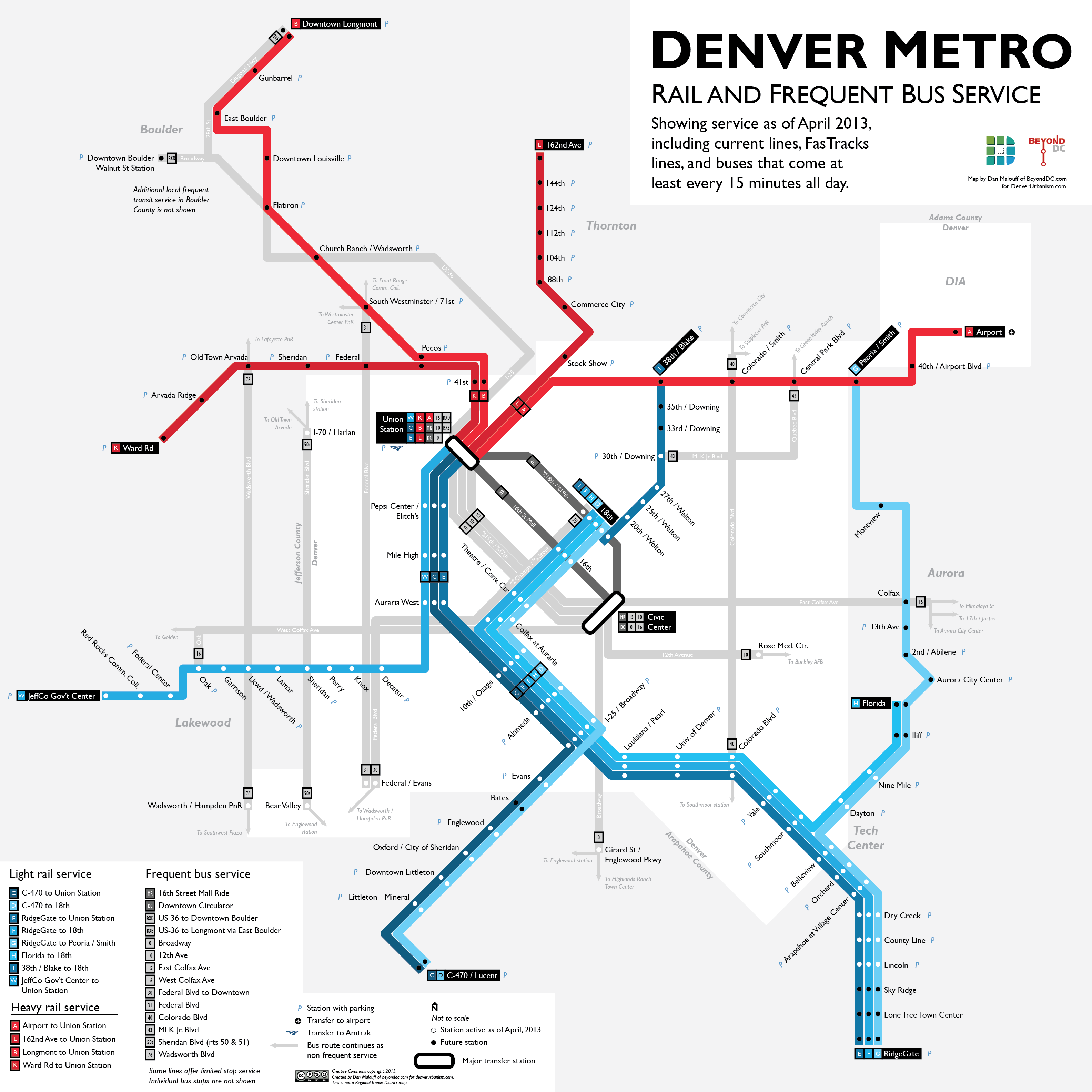
About frequent bus service.  The Denver Urbanism blog had a nice map (not an official RTD map) and post discussing the near equivalency of frequent bus service (in light gray) and light rail (the red lines are planned future heavy rail and the black dots are planned future intracity rail stops).  Frequent bus service, because of high ridership, also tends to have the lowest public subsidy per passenger-trip and per passenger-mile of any form of bus service.  Indeed, the least subsidized service in the RTD system per passenger-trip and passenger-mile is actually the free 16th Street Mall shuttle downtown because it has such high ridership and a fairly modest operational cost on the route that is only two or three miles long.

Basically, there is downtown frequenty bus service (within the City and County of Denver), East-West frequent bus service on Colfax Avenue (Lakewood-Denver-Aurora), frequent North-South bus service on five major city streets in the metro area (all but one of which are mostly in the City and County of Denver or on a City and County of Denver boundary), and frequent bus service to and from Boulder.  (The map omits some additional frequent bus routes within Boulder).

Thus, light rail is the only frequent transit service for most of Denver's suburbs, but Denver proper and Boulder have significant and helpful supplementing bus service.

Denver FasTracks and frequent bus map


A transit system that is increasingly one of the best in North America

FasTracks is still building out and lots of other public transit systems are stagnant. In addition to the West line, there are one to three new stops each planned on the Sante Fe, North Denver (connecting to I-70), and I-25 spurs, a continuation of the 9-Mile spur along I-225 to I-70, a heavy rail line to DIA, and heavy rail to Arvada, Boulder and Northern suburbs of Denver planned and construction on some of these is actively underway.

Denver has about 4.5% of its commutes by transit with will leap up when the West line opens and probably increase again with future rail line openings.  Denver may never have the public transit of New York (30%), Boston, Philadelphia, or Washington D.C. in the high density Northeast Corridor (the rest are in the 10%-15% range) which also have operationally profitable high speed Amtrak rail and but close to rivaling the weakest of these systems like Baltimore (about 6.5%) and Pittsburg (about 5.9%).  It also lags behind San Francisco (about 15%).   But is close to rivaling that of Pacific coast cities like Los Angeles (about 6%), Seattle (about 7%), and Portland (about 6.5%).  Denver already surpasses every Midwestern and Southern transit system in the U.S. except Chicago (about 12%), such as Minneapolis, Miami, Altanta, San Diego, Houston, Cinncinnati, Saint Louis, and pretty much every other major American city not mentioned already.  Of course, many Canadian cities, even the smaller ones, have quite high levels of transit use.

In other words, Denver is on track to be second only to Chicago as the U.S. city with the most heavily used transit system in the United States, as a percentage of commutes, outside the Northeast Corridor and the Pacific Coast.

Also, the ski resorts of Colorado have very good bus shuttle systems (its transit commutes are probably in excess of 10%), and there is some meaningful bus service in many of Colorado's medium sized cities.

High speed rail prospects.  There is serious talk about both DIA to Vail (more or less along I-70), and I-25 corridor high speed rail that may someday go somewhere (although the inability of the Colorado Springs-Denver corridor to continue to support even the FREX intercity bus line doesn't bode well for that effort, and Amtrak is in a perpetual state of near collapse outside the Northeast Corridor including its routes in Colorado).  

The I-25 Corridor has more population density and lower population costs, but these stretches of I-25 are quite fast to drive on and not terribly congested for the most part, so rail would have to be quite fast to generate much comparative advantage and not all of the destinations are friendly for carless visitors.  Fort Collins and Greeley are very flat, making them nice to bicycle in, but you wouldn't want to do that in a business suit and it has a fair amount of sprawl for college towns and little in the way of cab service.  Pueblo likewise has considerable sprawl.  Central Colorado Springs is a bit better in terms of density for urban business traveler destinations and tourists, but its chronically underfunded public services detract from the quality of its transit services.

High speed rail in the mountains that is sensitive to the construction costs associated with the terrain could mitgate the need for costly interestate highway expansions there making it more affordable in terms of opportunity costs.  And, the existing good shuttle bus services in these areas and very high urban densities also make them attractive destinations for carless travelers.

One nice aspect of high speed rail development in Colorado is that it doesn't really require any meaningful interstate cooperation until it is almost completely built out. In the I-25 corridor, the Fort Collins to Pueblo stretch would make sense to develop first before extending it to New Mexico or Wyoming.  And, the DIA to Vail stretch is entirely in Colorado and doesn't make sense to extend to the empty desert on the Utah border or the thinly populated plains of the Kansas and Nebraska borders anytime soon. 

The basic fact of high speed rail is that the economics are very dependent upon high population densities in the service area for cost efficiency relative to intercity buses and commercial airlines.  So, it will be a very long time before the U.S., which has far lower population densities in most of its territory than Europe or Japan or Eastern China or India, for example, will be well served by a national high speed rail service.  A patchwork of different high speed rail systems in the highest population density corridors looks like the most sensible course for at least the next half century or so in the United States.

Commercial flights are artificially slow relative to light rail.  It is also worth recognizing that much of the competitiveness that high speed rail has in point to point speed against commercial aircraft on medium sized trips has far more to do with a more relaxed security environment for high speed rail than it does from actual slower vehicle speed.  No commercial aircraft flies slower than even the fastest high speed rails system.

It would be possible to almost double the point to point speed of commercial flights on medium distant trips without changing any aircraft equipment or flight speeds, simply by devoting more staffing to security checks (or reducing standards or imposing greater baggage limitations), using more of the already available doors on commercial aircraft to board passangers and deplane them, running tighter schedules on short run routes, and dedicating traffic lanes or intracity rail lines to travel to and from city centers to airports.

28 March 2013

Secular trends in Ireland

Although Catholicism is declining in both the north and the south, the situation is different in each country. The south is 84 percent Catholic, while the north is 48 percent. In both places, however, the number of those practicing their faith is significantly lower than those who just check the census box. According to Archbishop Diarmuid Martin of Dublin, in 1984, nearly 90 percent of Irish Catholics went to weekly Mass. In 2011, only 18 percent did. Numbers in the north are harder to come by. Rev. Edward McGee, spokesman for the Diocese of Down and Connor, where Belfast is located, said his jurisdiction has no longitudinal surveys on membership or attendance.
 
From here.

27 March 2013

Law is not just politics

The big concern about "judicial activism" and the legitimacy of judicial review is that judicial rulings are just politics, unbound by precedents.  This concern is particularly true in the U.S. Supreme Court where the Court frequently divides on liberal v. conservative lines in high profile cases.  But, the facts are not so simple. 

The U.S. Supreme Court is at the extreme pinnacle of the judicial system which is widely acknowledged to have the most political docket of any U.S. court because it is subject to no higher authority whose precedents it must follow on issues of constitutional law.  And, it does decide many of the highest profile partisan political legal issues in the land on an almost purely partisan basis.  But, these cases make up a surprising modest share of the cases it decides (less than ten percent) and many cases that could conceivably be viewed as having liberal or conservative sides to them are decided on a non-partisan and often on a near consensus basis.  What the U.S. Supreme Court does is more like ordinary judging than it is like legislating, even though it sometimes does effectively make law.

There is still a broad baseline of consensus of the substantive meaning of the law (even on issues that divide the more than five dozen lower state and federal appellate courts from which it receives appeals).  And, when there is disagreement, the dividing lines after often not partisan political ones.

Early Hints On Prop 8 and Section 3 of DOMA

Section 3 of DOMA

The U.S. Supreme Court heard arguments today on Section 3 of the Defense of Marriage Act (DOMA) in the case of United States v. Windsor. 

Procedural History

Section 3 of DOMA, adopted in 1996, prohibits the federal government from recognizing the validity of same sex marriages that are valid under state law for federal law purposes such as immigration, federal income taxation, and Social Security benefits. 

This case and many others in the pipeline challenging its constitutionality, do not attack the constitutionality of the other key provision of DOMA which provides that states do not have to give full faith and credit to gay marriages from other states under federal law.

The federal government initially defended the constitutionality of the law, then withdrew its opposition to it during the course of the case.  Attorneys representing the leadership of the House of Representatives are defending its constitutionality.  The trial court and appeals court both held that Secton 3 of DOMA is unconstitutional.

The government's switch of position on the issue is closely related to its decision to end the ban on gays in military service.  Section 3 of DOMA would deny their partners the spousal benefits of active duty soldiers and veteran's benefits available to other soldiers.

This is not a one-off case.  Federal courts in multiple jurisdictions have made similar holdings that are working their way through the appellate pipeline, aided by the federal government's refusal to defend the law in court.  However, the federal government is enforcing Section 3 of DOMA until a final federal court order tells it otherwise.

Today's Argument

Five justices (Kennedy and the four liberal justices) seemed to indicate in oral arguments that Section 3 of DOMA was probably unconstitutional.
Justice Kennedy told Clement that there was “a real risk” that DOMA would interfere with the traditional authority of states to regulate marriage. Kennedy also seemed troubled about the sweeping breadth of DOMA’s Section 3, noting that its ban on benefits to already married same-sex couples under 1,100 laws and programs would mean that the federal government was “intertwined with citizens’ daily lives.” He questioned Congress’s very authority to pass such a broad law.
Moreover, Kennedy questioned Clement’s most basic argument — that Congress was only reaching for uniformity, so that federal agencies would not have to sort out who was or was not married legally in deciding who could qualify for federal marital benefits, because some states were on the verge of recognizing same-sex marriage.
Along with sharply negative comments about DOMA by the Court’s four more liberal members, Kennedy’s stance could put the law on the edge of constitutional extinction. But, if the Court were to do that based on states’ rights premises, the final ruling might not say much at all about whether same-sex couples were any closer to gaining an equal right to marry under the Constitution.
There did not appear to be a majority of Justices willing to strike down the 1996 law based on the argument that the Obama administration and gay rights advocates have been pressing: that is, the law violates the Fifth Amendment guarantee of legal equality in general.
The merits of Section 3 of DOMA can only be reached nationally, however, if the House of Representatives leadership which brought the appeal has standing to do so, which was also at issue.  If they did not have standing, the U.S. Court of Appeals circuit ruling would stand and would be persausive precedent, even more so in light of oral arguments in the U.S. Supreme Court on the issue today, but would not be binding precedent in other circuits.  The standing issue would also be pertinent to a great many other constitutional issues.  A finding that the House lacked standing would enhance Presidential authority to not defend the constitutionality of laws in a wide variety of areas in the future.
In order to rule on DOMA’s validity, the Court has to be persuaded that it has a genuine controversy before it — that is a real legal dispute between opposing parties, each of whom has a direct interest in the outcome. Whether it has that was the issue, with Professor Jackson arguing that the administration wants the same thing as Ms. Windsor — the nullification of DOMA Section 3 — so the Court has no jurisdiction over the government’s appeal, and arguing that the House GOP leaders have no direct harm they can claim even if DOMA is nullified.
The Justices seemed somewhat at odds over whether they do have the authority to go ahead with this case, so the possibility remained that the Court in the end could choose not to decide the merits of the law’s validity. That portion of the argument focused on just who in Congress, if anyone, could be in court to defend a federal law when the executive branch chose not to do so.
Justice Kennedy seemed to be leaning toward finding that there did exist a live controversy — between the government and Mrs. Windsor, over whether she is entitled to a refund of an estate tax she paid on her late spouse’s estate. But Chief Justice John G. Roberts, Jr., commented that the Court had never ruled on a case in which all of the parties involved agreed — as he suggested would be the case with the government and Ms. Windsor sharing their opposition to DOMA.
It did not appear, however, that Clement had succeeded in contending that the House GOP leaders (BLAG) had a full right to be in court to defend DOMA in the absence of a defense by the government.
Thus, Section 3 of DOMA is almost sure to be ruled unconstitutional, either in the 2nd Circuit in a precedent which federal government officials and other circuits are very likely to follow nationally, or nationally as a result of a ruling in this case. 

It is also possible that the power of Congress to defend a law in Court, at least in the absence of a joint resolution from both houses of Congress as opposed to a decision of the leadership of just one house of Congress, could be narrowed or eliminated in general.

A ruling that Section 3 of DOMA is unconstitutional and that state law on the validity of a marriage should govern would greatly increase the pressure on states to go beyond civil unions legislation like that recently passed by Colorado which does not confer federal law benefits, to full gay marriage which would confer federal law benefits, even without the mandate that the Proposition 8 case decided yesterday could impose depending upon how it is decided.

The next wave of DOMA issues: choice of law.

A ruling that Section 3 of DOMA is unconstitutional also opens up significant choice of law issues regarding whose law determines if a couple is married.  The case before the court presented the easy and most common case where a couple was marriaged in a state that had gay marriage and continued to live in that state.  The case where a couple was married in a state that had gay marriage and lived in a state that gave full recognition to that status (perhaps because it has gay marriage itself, or perhaps as a back door solution to a state constitutional ban on gay marriage), is another easy case.

But, if a couple marries in a state that recognizes gay marriage and then moves to a state that does not recognize gay marriage with the blessing of a different section of DOMA that has not been held unconstitutional, the question is not so easy to resolve. 

Does the law of the state where the marriage was entered into govern for federal law benefit purposes (an easy to apply rule, even though it undermines the ability of states to prevent any sort of gay marriage from having legal effect in its state), or does the state where the couple resides matter? 

I suspect, that when the issue eventually comes up, the answer will be that the law of the place where the marriage was entered into will govern for federal law purposes.

This, in turn, suggests that many couples in civil unions only states may solve their inability to marry under their own state's laws by forming a civil union in their state of residence and then getting married in a state that recognizes gay marriage before returning home.  This way, they would have full state benefits under a civil unions law, and full federal benefits under their marriage in another state.  It would effectively provide a back door way to obtain the full benefits of same sex marriage in civil union only states, thereby circumventing state constitutional prohibitions on gay marriage without legislative action or a court declaring that state constitutional provision to be unconstitutional.

This choice of law analysis would not, however, afford state law benefits to same sex couples married in other states and recognized under federal but not state law.  For example, states would not have to allow same sex couples married in other states to divorce in their state (although Maryland courts, which was on the verge of adopting gay marriage, did just that before its gay marriage laws took effect).

Eventually, this situation in states without gay marriaage would probably become untenable and give rise to equal protection challenges striking the state law gay marriage bans, or to a later ruling holding that the full faith and credit provisions of DOMA are unconstitutional would have essentially the same effect, but in all states.  But, those rulings would happen years from now when public opinion on gay marriage was greatly changed.

California's Proposition 8

Yesterday, the U.S. Supreme Court heard arguments in the cas (Hollingsworth v. Perry) concerning the constitutionality of California's Proposition 8.

Procedural History

Prior to Proposition 8, California courts held that gay marriage was allowed in the state on state constitutional grounds.  A citizen's referrendum overturned that ruling by amending the state constitution. 

California officials refused to defend the measure in a federal court challenge to Proposition 8's constitutionality because they agreed that it was unconstitutional, but the proponents of the measure were allowed to defend its constituionality at trial with the consent of the state officials.  The federal court held that Proposition 8 was unconstitutional under a rational basis standard of review. 

The proponents appealed to the 9th Circuit Court of Appeals without the consent of the state officials.  The 9th Circuit sought a certification from the California Supreme Court to determine if the proponents had standing to appeal under California law and the California Supreme Court held that they did.  The 9th Circuit, relying on the certified question answer held that the proponents also had standing to appeal under federal law and proceeding to affirm the federal district court judge's ruling that Proposition 8 was unconstitutional.

Yesterday's Argument

The proponents appealed that ruling to the U.S. Supreme Court which granted certiorari and held oral arguments yesterday. 

The three conservative justices who spoke at oral arguments left the impression that they were ready to reverse the 9th Circuit and hold that Proposition 8 was valid under the federal constitution and it would be fair to assume that Justice Thomas, who did not speak as is his custom, would side with them.  This would have ended federal law based efforts to secure gay marriage.

The four liberal justices appeared inclined to affirm the 9th Circuit, although the grounds upon which they would do so were not entirely clear:
* they could hold that a lack of federal standing which would apply only to this California case and conceivably could allow a later challenge by someone with standing,
* they could hold that gay marriage couldn't be abolished once a state had gay marriage, which would apply only to California,
* they could hold that a repeal of gay marriage once you had civil unions was unconstitutional limiting the ruling to the eight states with civil unions (Colorado as of May 1, 2013 would be the ninth), or
* they could hold broadly that there was a constitutional right to gay marriage which would apply nationally.

Justice Kennedy, the swing justice, who was part of the majority in the Lawrence opinion which held that same sex sodomy between consenting adults could not be criminalized under federal constitutional privacy protections, didn't like any of the coonservative or liberal options and was leaning towards denying certioriari entirely, suggesting that the decision to take up the case was improvident.

The impact of a possible withdrawal of certiorari

Justice Kennedy's option of punting on the issue would leave in place the 9th Circuit opinion holding that California's Proposition 8 was unconstitutional in circumstances where a state that once had gay marriage and still had civil unions breached equal protection guarantees without a rational basis for doing so by denying gay's marriage.  This ruling could probably be extended to other states in the 9th Circuit which have civil unions but not gay marriage.

This would have no impact in Washington State which already had gay marriage, would provide a strong precedent for turning civil unions into gay marriage in Hawaii, Oregon and Nevada which arre in the 9th Circuit and have civil unions, would leave unchanged Alaksa, Idaho, Montana and Arizona that have never had civil unions or gay marriage. 

The 9th Circuit case would be a non-binding persuasive authority in Rhode Island (2nd Circuit), New Jersey (3rd Circuit), Wisconsin (7th Circuit), Illinois (7th Circuit), and Colorado (10th Circuit).  This would in effect, a "1+3 state solution."

All of the states in the 1st Circuit, and all of the state except Rhode Island in the 2nd Circuit (which has civil unions), already have gay marriage.  In the 3rd Circuit, New Jersey has civil unions and Pennsylvania and Delaware have neither civil unions nor gay marriage.  In the 4th Circuit, Maryland has gay marriage and none of the other states have gay marriage or civil unions.  In the 8th Circuit, Iowa has gay marriage and none of the other states have civil unions.  No states in the 5th, 6th, or 11th Circuits have gay marriage or civil unions.

Thus, in the near future, the SCOTUS decision in this case would be irrelevant in the 1st, 4th, 5th, 6th, 8th or 11th Circuits (or the Federal Circuit which lacks jurisdiction over these kinds of cases).  The U.S. Supreme Court would have time to determine if the 9th Circuit precedent was distinguished in later 9th Circuit cases or followed by the 2nd, 7th, or 10th Circuits.

Justice Kennedy worries that U.S. Supreme Court precedent establishing a ratchet effect may discourage states from adopting civil unions or gay marriage, a concern that is particular apt as a new holding on the constitutionality of the Defense of Marriage Act and rapidly shifting political opinion on the gay marriage issue may lead many states that have civil unions now to adopt gay marriage in the near future.  When Section 3 of DOMA is constitutional, there is no difference between a civil union and gay marriage except a name, since federal law may not recognize gay marriage pursuant to it.  If Section 3 of DOMA is unconstitutional, then gay marriage would confer federal marriage rights, while civil unions would not.

Justice Kennedy, rightly, assumes that all other things being equal, it would be healthier for the long term acceptance of gay marriage and for U.S. Supreme Court legitimacy, if any final decision on the constitutional right to gay marriage or the equal protection issues of civil unions v. gay marriage, were resolved nationally only after the issue had an opportunity to play out in the states via legislative, intitiative, and court action in light of new rulings on Section 3 of DOMA, federal recognition of gay couples in many contexts including military benefits, and litigation of the issue in multiple United States Courts of Appeal circuits giving rise to a circuit conflict, before being mandated nationally with the highly fluid issue not yet well developed.  Gains outside the U.S. Supreme Court probably would lead to greater acceptance of gay marriage than gains from this unelected group of nine justices appointed for life from on high.

For example, it is likely that Colorado will adopt a state constitutional amendment mandating gay marriage in the next few years, particularly if Section 3 of DOMA is held unconstitutional.  And, quite a few other states are likely to do so in the near future given trends in public opinion and strong federal recognition of same sex marriages where states allow them in the executive and judicial branches.

It may be that the nation will soon neatly be divided into gay marriage states and states with no gay marriage or civil unions.  Or, it may be that the dam will finally break and gay marriage will spread into states that no constitutionally ban gay marriage or anything like it.  The Supreme Court would make a wiser judgment if it was informed by several years of developments on this front.

26 March 2013

Objective Impulsivity Test Predicts Rearrest Rate

[R]esearchers studied a group of 96 male prisoners in New Mexico just before their release. Using functional magnetic resonance imaging (fMRI), the team scanned the prisoners’ brains while they completed a computer task measuring impulsivity: They had to quickly and accurately respond when the letter X flashed onscreen, but if it was a letter K, they had to restrain themselves from responding.  
Researchers were particularly interested in a region of the brain called the anterior cingulate cortex (ACC), which is known to be linked to behavioral regulation and self-control.  
Four years after these prisoners’ release, the researchers checked their arrest records. Over half had been rearrested—and their earlier brain scans were telling. Men who had shown lower ACC activity were significantly more likely to be rearrested, and they were rearrested sooner. A man in the lower half in terms of ACC activity had a 60 percent likelihood of rearrest, while those with above-average ACC activity had only a 46 percent likelihood. And the men with low ACC activity were rearrested seven months earlier on average. These numbers held true even after the researchers accounted for other risk factors such as age, drug and alcohol abuse, and psychopathic traits, they report in the Proceedings of the National Academy of Sciences.
From here.

The study used fMRI as its objective test of impulsivity, but this aspect of the study isn't really all that critical, just flashy. There are many less expensive objective tests of impulsivity out there that would serve essentially the same purpose or might even been more definitive, as fMRI intepretation is as much as art as a science and have had less time to have the kinks worked out of them. The "authors themselves stress that much more work is needed to prove that the technique is reliable and consistent, and that it is likely to flag only the truly high-risk felons and leave the low-risk ones alone. “This isn't ready for prime time,” says Kiehl."

The brief news report also doesn't report how material factors like age, drug and alcohol abuse, and psychopathic traits were as risk factors. Ultimately, what really matters is how predictive the entire risk prediction instrument using all of the factors it studies is relative to not using it or making purely subjective determinations. If nothing else in the instrument is measuring impulsivity, yet impulsivity accounts for a quarter of the entire risk and an even greater proportion of the predictable risk, then an objective measure of this trait belongs in the overall risk prediction instrument.

Of course, saying that objectively determined impulsivity really accounts for a quarter of the risk of rearrest, when the measured difference involved twenty-two or so rearrests in the lower half of impulsivity and twenty-nine or so rearrests in the higher half of impulsivity, overstates the findings.  The findings may have been large enough to be statistically significant, particularly given the confirming data on rearrest timing.  But, the study is too small to quantify the magnitude of the effect observed with any great precision.  The odds are good that a meaningful share of the difference could be attributed to random chance.

The end product one is looking for is a set of psychological tests and a set rule for combining their results that can be used when judges and prosecutors make decisions on eligiblity for or recommendations relating to probation, deferred judgment or community corrections program eligiblity, for judges determining sentence length in data included in a presentencing report, and when probation and parole supervision programs and state correction departments make decisions on how intensely a convicted criminal should be supervised in and outside of prison. Individuals at high risks of reoffending should be more intensely supervised and/or incarcerated longer, while those at low risk of reoffending can be lightly supervised, thereby maximizing protections for the public and other inmates with their department's limited budget.

Instruments like these can also be used to demonstrate in an empirically based way as part of a larger presentation to demonstrate how changes in funding for probation and parole programs are likely to impact reoffense outcomes. An ability to identify higher risk individuals with some degree of accuracy demonstrates that available monies are being well spent and that the programs would allocate them to needs that would have a real impact if they had the funds to do so.

Simple point systems that add or subtract points based on predetermined factors in amounts devised to fit a recidivism model of the kind that an impulsivity test like the one used would be incorporated into, consistently outperform in accuracy expert assessments of likelihood of recidivism performed in a more individualized and less structured manner.

Mostly, this is because experts routinely consider facts that empirical studies have determined are not very important, and because expert opinions are frequently fuzzy on the relative importance of the factors that they do consider. Simple point systems devised based upon regression models derived from empirical data address the mistakes of considering too much irrelevant information and giving the wrong weight to the facts that are important better than highly trained experts who use more subjective methods.

While the findings of these studies are commonly described as ways to identify high risk offenders, the real benefit to budgets and otherwise, is to give senior corrections and court system administrators empirical cover for recommendations that individuals whom the point systems show to be "mostly harmless" be lightly supervised. In the absence of such cover, these officials might need to greatly increase the average level of supervision at great cost, while still inadequately supervising high risk individuals and engaging in overkill for a large share of the supervised population.

The study is Aharoni, Eyal; Kiehl, Kent, et al. Proc. Natl Acad. Sci. (2013). Some of the lead author's prior publications in the field include:
* Aharoni, E., Antonenko, O., & Kiehl, K. A., "Disparities in the moral intuitions of criminal offenders: The role of psychopathy." Journal of Research in Personality, 45, 322–327 (2011);
* Aharoni, E., Funk, C., Sinnott-Armstrong, W., & Gazzaniga, M.m "Can neurological evidence help courts assess criminal responsibility? Lessons from law and neuroscience.", Annals of the New York Academy of Sciences, 1124, 145–160 (2008).
* Aharoni, E., Sinnott-Armstrong, W., & Kiehl, K. A., "Can psychopathic offenders discern moral wrongs? A new look at the moral/conventional distinction.", Journal of Abnormal Psychology (2012).

Another of his papers published online before print earlier this year correlated scores on a commonly used psychopathy evaluation instrument, the Hare Psychopathy Checklist–Revised, against confidential reports by offenders in prison of prior unsolved violent crimes committed, and determines that psychopaths are far more likely to have committed previously violent crimes for which they were not caught and that some parts of the checklist were correlated with more undetected prior crimes (antisocial lifestyle and behavioral psychopathic traits) while others (affective psychopathic traits) were associated with fewer undetected prior crimes relative to others with the same psycopathy score.

Indeed, this result, taken together with the rearrest data, suggests that part of the reason that the rearrest rate shows a fairly strong relationship to impulsivity, is that impulsive people not only reoffend, but get caught doing so, while less impulsive but pyschopathic parolees might be reoffending just as often but not getting caught as often.

The frequency of psychopathic traits in the general population is similar to the incidence of bipolar disorder or schizophrenia, for example, but these traits seem to be somewhat more of a matter of degree than those forms of psychosis.

Another Example Of Insane Drug Sentencing Laws

On March 20, 2013, University of Colorado police arrested a twenty-three year old student with selling a single tablet of Vyvanase (an amphetamine based ADHD drug) to a twenty-one year old student who was also arrested at CU-Boulder based upon a campus employee's report.  The student selling the pill was arrested on suspicion of "unlawful sale of a controlled substance, a Class 3 felony."  The student buying the pill was arrested on suspicion of "possession of a controlled substance", a Class 6 felony.

As explained at length below, the sale charge is stunningly serious given the nature of the act.  Other class 3 felonies (subject to somewhat stiffer sentences due to special aggregavating provisions in the case of violent crimes and sex offenses) are:
* armed robbery,
* forcible rape,
* attempted second degree murder,
* aggravated assault causing serious bodily injury,
* kidnapping of an adult for ransom or with a deadly weapon that does not involve rape or robbery,
* arson involving a building or occupied structure,
* residential burglary while armed or involving an assault on a resident,
* theft of more than twenty-thousand dollars,
* incest involving one's own child or an incestuously related relative under the age of ten years,
*child neglect causing death, or
* pimping a child.

In all likelihood, if these young men don't have criminal records, and white male CU-Boulder student of those ages probably don't, they will receive the most or almost most lenient treatment available under Colorado law if they don't grossly bumble the process or get struck with a real hard ass in the prosecutors office or on the bench (neither of which is likely in Boulder County).  Deferred prosecutions, probation, fines, or sentences actually served of less than three years are far more likely in this particular case.

But, the fact that a prosecutor's unfettered decision to press charges rather than accept a plea bargain to a lesser charge or permit a deferred prosecution, and a judge's decision upon receiving a guilty plea or upon a conviction of these charges for up to sixteen years in prison, followed by five years mandatory parole and a fine of up to $750,000 is authorized by Colorado law for this offense shows how deeply broken Colorado law is on this score. 

The Controlled Substances Act in Colorado and under federal law does not accurately link sanctions to culpability.  A better rule would treat selling drugs as a purely economic offense comparable to theft in sanctions for particular dollar amounts involved (at least where no harm arising from tainted drugs or harms to minors from using illegal drugs arises), and would treat any level of personal illegal drug use or possession as a mere misdemeanor.

25 March 2013

Microsoft Continues The Tradition

The tradition of making dreadful software with extremely broad distribution, that is.  I recently purchased a Windows 8 laptop (my current one is periodically providing warning signs that it is on death's door).

Windows 8 may not quite reach the utter low of Windows Vista, but it is decidely an inferior product to Windows 7 or Windows XP (albeit with the admirable goal of standardizing user interfaces across different kinds of devices).

It doesn't help that factory install prominently features the Bing search engine, the most vile piece of malware ever to touted as legitimate software.  Bing is what Google might have been but for the company's "don't be evil" motto.  (And, when Bing isn't actually functioning as malware itself, it seeks out its cousins: "Nearly two-thirds of search results on Bing were found to have links that spread malware or spam, compared to 30 percent for Google[.]") 

My middle school aged son asked me in the car today if there is anyone out there who sincerely thinks Bing is better than Google, a possiblity that seemed as impossible to him as a military without guns.

Everything Microsoft touches seems to instantly turn to shit.  It should quit while it is still ahead and just stop already.