Showing posts with label public finance. Show all posts

20 March 2026

Some Quick, Ill Developed, Political Ideas

In defense of the deep state

The "deep state" is valuable and good, not a conspiratorial anti-democratic force. It is the bureaucratic manifestation of the rule of law.

We say we live in a "democracy" but that's an oversimplification. Obeying the law is not a matter up for popular vote. When we say we are a democracy what we really mean is that changes in the law must be made democratically. Not even the President is allowed to deviate from the law, which the President is sworn to faithfully execute. The President, wearing a different hat, can participate in the legislative process. But the bureaucratic organization that is the state can and normatively should push back against a President who tries to deviate from the way that the law mandates that the organization should behave.

Fiscal federalism

Trump 2.0 has illustrated the perils of relying too heavily on the federal budgetary process to spend funds for public purposes. So have many past government shutdowns.

Of course, dysfunction in the federal budgetary process leaves undisturbed public functions funded and operated at the state and local level with state and local funding. Most law enforcement comes from state and local law enforcement, most court cases (criminal and civil) are handled in the state courts, most K-12 and higher education funding is state and local, most roads and bridges are maintained at the state and local level, state and local law and funding keeps the water running, the sewers flowing, clears away trash from homes and businesses, and regulates the construction industry and real estate development for the most part.

We've seen what happens when this falls apart now. Because Medicaid and VA Health Care are federally funded and don't even had dedicated federal tax funding, they can be undermined quickly when the federal budgetary process goes astray and also equalize services between poor states and rich states. A simple federal tax law change can undermine ACA individual health insurance marketplace subsidies. K-12 education relies heavily on federal funding for special education (i.e. educating the disabled) and for schools in low income areas (which also equalizes situations between poor states and rich states). Higher education relies upon federal funding for grants for low income students, higher educational institutions for military officers and the deaf, student loan financing, and research grants. Disaster relief is heavily federally funded and leaves havoc unchecked when that is suspended. Disease control and weather prediction and monitoring are also heavily federally funded and are screwed up when this changes.

While we couldn't fund the military or the national debt at the state and local level, we could have a system where more health care and education spending is state and local. This would reduce federal influence on how those industries run and remove those industries from the whims of the federal budget process to a great extent, but would also lead to weaker subsidies of poor states and disproportionately worse services in poor states and would subject those services to greater state and local political influence.

After 9-11 we federalized airport security creating the TSA. Today, we see the political price of that as a federal budgetary process fight unrelated to the TSA itself disrupts airport service. Early in Trump 2.0 we saw what happened to FAA air traffic control as a result of exposure to the Trump 2.0 administration and the federal budgetary process.

So far, Social Security is only suffering deficiencies in administrative processing of disability claims for the most part, because it has its own dedicated funding source that insulates it from the federal budgetary process as an entitlement.

But national parks and major transportation ad energy infrastructure programs have seen a twirl.

Could we build a more robust system without facing too many costs?

05 August 2025

The Proposed Mega Sports Complex For Douglas County


Artist's rendering from Douglas County via the Denver Post

The Project

The controversial Zebulon Regional Sports Complex in Douglas County is set to break ground this fall. It is a $1.3 billion project planned for a site near Chatfield Reservoir in a brownfield development with "an old dynamite-making plant that operated for decades at the proposed Zebulon site" although it purportedly has been fully remediated. The state signed off on that conclusion in 2022.

The plans for the Zebulon Regional Sports Complex are huge.

On the drawing board are four baseball fields, three ice rinks and a pair of soccer fields. Eight to 10 basketball courts — which can be converted into 20 volleyball courts or 30 pickleball courts — are also in the mix. Add in a 400,000-square-foot, domed indoor sports facility that will house more fields for year-round play. . . .

And that’s just the first phase, which could break ground as soon as this fall on a 50-acre parcel just southeast of the master-planned Sterling Ranch community. Later phases could bring as many as eight additional sports fields, along with restaurants, shops and a hotel[.]

Does It Pencil?

I've worked with clients to help vet a similar proposals on a smaller scale, so I have so familiarity with the economics of these deals. For the life of me, I can't see how this could pencil as a "for profit" private sector venture at this scale in this location.

Sure, there is unmet demand in the area, which has had and continues to have large subdivisions rolled out over the last few decades (like 12,000 homes in Sterling Ranch which will house 35,000 people when completed that is only 20% built out), without sufficient government investment or HOA in community amenities. So, a much smaller private non-profit or public sector recreation center run by Sterling Ranch's metro district might work.

But, the demand just isn't there for something of this scale, and a similar but smaller complex in Centennial isn't thriving.
[A] citizen survey conducted last year by Douglas County ... revealed [that] a “mega-sports complex” was identified by 33% of respondents as the “least appealing option” of a list of potential amenities. The survey also showed that just 22% of respondents were dissatisfied with the number of youth sports facilities in the county.
Another smaller recreation center is already on the drawing board for Highland's Ranch which would be between the South Suburban Recreation Center twenty minutes to the east and the Zebulon complex.

The county investment is about $800K in engineering planning for infrastructure (realistically, a drop in the bucket) and a portion of the about $22 million a year in revenues for the the next 15 years from the county's 0.17% sales tax for its Parks, Trails, Historic Resources and Open Space Fund established in 1994.

But even this investment is controversial, in part, because the county leadership whose home rule county proposal epically crashed and burned in June, and which has a history of infighting and political posturing, isn't popular and doesn't have much public trust.

Moreover, as a "for profit" it probably isn't eligible for municipal bond financing with private activity bonds. This project would probably have, at best, a BBB credit rating implying roughly a 6.1% corporate bond interest rate, while a comparable municipal bond would have roughly a 3.6% interest rate, which is a $32.5 million a year difference for an investment of this size. Municipal bond eligibility, that it could receive as a non-profit, would be worth more than all of the sales tax revenue that could be diverted to the project.

There are a few other sports complexes with a similar (but slightly smaller than the proposed full build out) scale in the metro area, the South Suburban complex further east in Douglas County, one in Arvada, and one in Jefferson County (IIRC). But those are strictly government owned and funded, and the most similar South Suburban Parks and Recreation District facility further east, in Centennial, doesn't seem to be thriving.

Bottom Line Analysis

Philosophically, the fact that it is a brownfield development is a good thing, the fact that it provides amenities in a rapidly growing community with unmet needs is a good thing, and the fact that the risk that it will be an unprofitable money pit will fall mostly on wealthy, private sector, for profit, investors with only modest public subsidies is a good thing. It is also estimated to create 1,800 temporary jobs to build it, which is a good thing in what is mostly a bedroom community, where construction work for its huge sprawling suburban subdivisions is winding down due to factors like a limited supply of water for new taps.

But the fact that the proposal appears to be vastly bigger than the realistic demand for recreational facilities, the fact that the public is subsidizing a for profit company (even if it isn't a professional sports team), and the fact that it doesn't have much public support when the public will be providing significant sales tax funding support to the project, aren't good things.

An independent non-profit project, or metro district, or South Suburban Parks and Recreation District (with annexation of additional territory, if needed) sponsored project, that is less ambitious, with more phases to allow experience to determine if demand justifies something larger, would make more sense, in my opinion.

03 July 2025

The GOP Budget In Charts

The Republican budget passed today passed the House initially by 215-214, passed the Senate in a 51-50 VP tie breaking vote, and passed the House the second time around by 218-214 with no amendments from the Senate version (which was slightly better than the original House version, mostly because bad non-budgetary riders were stripped from the bill). These razor thin majorities, however, have made immense changes to U.S. tax laws and federal spending that are unrivaled since the War on Poverty during LBJ's administration.

This will do irreparable harm in the next couple of years, at least, disproportionately suffered by Republican controlled areas and Republican voters, and the bill's provisions are wildly unpopular with the American public.

The big question is whether this bill, along with Trump's other horrible steps in governing, will lead to a catastrophic defeat for Republicans in the 2026 midterm elections as backlash, or whether the usual partisan tendencies will remain unchanged. Have Republicans committed political suicide? Or will the MAGA cult remain strong after encountering the "find out" part of the FAFO adventure.

I can't imagine how any decent person could sleep at night backing this proposal, and struggle to discern any values other than massively transferring wealth from the poor to benefit the rich, are served by it. But Republicans never cease to surprise me.

The big messages about the budget are that: 

(1) the tax cuts in Trump's budget are driving up the national debt immensely (more than any other bill in the Biden or Trump Administrations by a lot) and will drive up interest payments as a drain on tax revenues, 

(2) the number of people without health insurance will grow from about 25 million (out of a U.S. population of about 340 million) to more than 35 million due mostly to Medicaid changes and there will be a massive disinvestment in health care, 

(3) student loan payments for new college graduates will soar, 

(4) the clean energy investments that are eliminated will mostly hurt people in Republican Congressional districts, 

(5) the bottom 20% are much worse off, the next 20% break even very rich are much better off, while the poor are much worse off, the next 59% are modestly better off, and the top 1% and big businesses are vastly better off, and

(6) any improvements to economic growth are exceedingly small.

One key impact that the charts don't note is that many hundreds of rural hospitals (maybe more than a thousand), almost all in Republican dominated areas, will close. 

It also doesn't really capture how deep cuts to federal spending programs will be, except for defense and funds to carry out mass deportations which get big budget boosts.

The charts via the New York Times:

14 May 2025

Sanctioning And Preventing Federal Government Corruption

Emoluments And Other Standing Problems
The law is very clear. And, it is the highest possible law - a part of the United States Constitution. But, enforcing it, particularly in the case of a President who violates it, by any means short of an impeachment, which can be circumvented by 34 Senators of the President's political party, is another thing.

The U.S. Supreme Court's rules on standing to sue takes the position that you can't have standing to sue as a taxpayer, as a U.S. citizen, or as a voter, on a wrong that affects everyone in the same way.

The U.S. Supreme Court recently held that the President is immune from criminal liability for his official acts, no matter how egregious (in a stark deviation from the widespread understanding at the time it ruled this way), in addition to being immune from lawsuits seeking money damages for his official acts.

Justice Department policy, and the structure of the Executive Branch also prevent federal prosecutors from prosecuting a sitting President, and the President's authority over the Justice Department, together with his pardon power, allows the President to shield anyone he favors from federal criminal prosecutions.

The U.S. Supreme Court hasn't directly ruled on the issue, but at least one lower court (in the criminal case against Trump involving his refusal to turn over documents with government nuclear secrets which he kept in his residence after he left office and refused to return upon demand) has held that special prosecutor statutes are unconstitutional, in an extension of the (until recently fringe) "unitary executive theory."

The same problem does not arise to nearly the same extent in state government. Almost every U.S. state has an independently elected state attorney general who can prosecute misconduct in other parts of the state government, and the federal government can also step in to prosecute state and local government corruption and violations of civil rights as a federal offense. The subject-matter jurisdiction of state courts is also not subject to the same level of strict limitations as the federal courts are by Article III of the U.S. Constitution.

This problem isn't unique to the Emoluments clause either. It comes up frequently in Establishment clause violations of the First Amendment. It can come up when one part of the federal government illegally shares confidential information with another part of the federal government. It comes up when the executive branch spends federal government money without a Congressional appropriation to support it. It comes up when a President orders a violation of the Posse Comitatus Act and then pardons anyone who was involved in it. And, there are many other contexts where serious violations of the law within the executive branch have no viable remedy.

In some cases, an entire house of Congress can, by majority vote, authorize a lawsuit against the Executive Branch in federal court, but this is cumbersome and rendered frequently ineffectual by partisan politics. In some cases, a federal government chartered corporation, like the Public Broadcasting Corporation, can have independent standing to sue and by sued under a statutory grant of federal authority.

But, there is no systemic solution to this problem in existing federal law. Mostly, we just have to trust the President to do the right thing, but not all Presidents have earned this trust, and certainly, our current President has not. This is a glaring flaw in American Public Law.

Solutions

There are plausible solutions which could be imagined that would set aside the usual rules of standing on the grounds of necessity. We could grant the federal courts the authority to deputize a special prosecutor to pursue these issues. We could grant standing to pursue these issues to state attorneys-general. We could allow Congress to create an independent agency (perhaps one located in the judicial or the legislative branch with no Presidentially appointed directors or board members from an organizational chart and constitutional perspective) to pursue these claims. We could vest this authority in former U.S. Presidents who are still living, or the candidate that was the runner up in the last Presidential election.

Possible Constitutional Amendments

Perhaps we need an "anti-corruption" constitutional amendment, although conceptually, maybe this could be broken into several components. Consider this package to six constitutional amendments (and to be clear, some of those could also be accomplished without constitutional amendments):

Anti-Corruption And Standing Amendment

* Create an agency that has standing to take criminal, and civil legal action with national effect), to enforce federal law, to render advisory ethics opinions, and to protect the rule of law within the federal government (perhaps with a director appointed by a governing board made up of federal judges chosen at random),
* Prohibit federal elected officials from having a role in, or knowledge of, the management of private businesses or investments while in office,
* Prohibit self-dealing and conflicts of interest by federal officials including the President,
* Prohibit felons from serving as President unless that disability is removed by the same means as an insurrection disability is removed,
* Prohibit members of Congress from serving while serving a sentence for a felony,
* Authorize removal of members of Congress without being formally expelled from office by the House where someone is a member by the courts for various grounds established by law constituting good cause,
* Expressly authorize the appointment of special prosecutors by a three U.S. District Court judge panel, where the Justice Department is conflicted, or where the federal government fails to prosecute a crime when a preponderance of evidence, beyond mere probable cause, shows that it was committed by the proposed defendant,
* Authorize facial challenges to the constitutionality of legislation and regulations by the anti-corruption agency and by state attorneys-general, even in the absence of a case or controversy or other proof of standing,
* Create standing to enforce the establishment clause by any person who resides in, or is detained by, the territory of a government that is alleged to have violated it,
* Expand the scope of grounds for impeachment to include a willful and persistent failure to faithfully execute the laws in violation of one's oath of office, or a willful defiance of a court order.
* Try impeachments before a panel of judges rather than by the U.S. Senate,
* Prohibit judges appointed by a President from serving as a judge in any court proceeding in which the appointing President is a party in a non-official capacity (including any criminal prosecution),
* Mandate that Congress pass appropriate legislation to thwart judge shopping,
* Create binding ethics rules for the U.S. Supreme Court and lower courts that can be enforced without utilizing the impeachment power by state attorneys-general, but some minority percentage of Senators, or by an anti-corruption agency, and
* Provide additional remedies for courts when federal government officials disobey court orders (including the permanent removal of an official from office, and the appointment of a special master to carry out the duties of the defiant official).

Immunity Amendment

* Overrule the U.S. Supreme Court's recent Presidential immunity ruling creating blanket immunity from criminal prosecution for a President's official acts,
* Forfeit immunity from civil lawsuits for money damages for acts that an official has been legally adjudicated to have committed in a criminal case or civil proceeding,
* Allow immunity from civil or criminal liability for federal government officials exclusively when Congress authorizes it by law, including, but not limited to Presidential immunity and qualified immunity for law enforcement,
* Prohibit stripping all courts of the authority to consider any matter,
* Narrow the political questions doctrine, and
* Make clear that there is no immunity from contempt of court liability.

Anti-Tyranny Amendment

* Impose limitations on the prosecution of state and local government officials by federal officials while they are performing their official duties (perhaps limiting such prosecutions to the anti-corruption agency),
* Make the Posse Comitatus Act a matter of self-executing constitutional law and to allow its enforcement in civil actions as well as by criminal prosecutions,
* Provide a self-executing, federal, private cause of action for compensatory, economic and non-economic damages including litigation costs and attorneys fees and/or injunctive relief, for any deprivation of federal rights constitutional or statutory, under color of state or federal law, against the government under whose authority or actions or inactions the deprivation was made, on a strict liability basis without regard to the intent of the government or governmental agents or employees doing so, and with no form of immunity (in a matter akin to the takings clause),
* Provide an absolute right to have criminal convictions vacated upon a showing of actual innocence by a preponderance of the evidence,
* Create a right to counsel in deportation actions and to bring habeas corpus petitions,
* Remove the "subject to the jurisdiction thereof" (which applies only to a handful of children of diplomats anyway) and "Indians not taxed" provision (which was legislatively mooted in 1924) from the grant of birthright citizenship in the 14th Amendment,
* Prohibit criminal defamation laws,
* Prohibit laws barring travel from one state to another in order for the person doing so to avail themselves of another state's law,
* Prohibit laws barring interstate communications about a matter that is legal to communicate about in either state,
* Prohibit revocation of immigration status based upon speech which would be protected by the First Amendment for a U.S. citizen,
* Prohibit involuntary denaturalization under any circumstances (even in the naturalization was secured by fraud which could be prosecuted but could not result in loss of U.S. citizenship), and
* Expressly include the limitation on the suspension of habeas corpus to places where the federal courts are not open established by Ex Parte Milligan and to clarify that the writ of habeas corpus is available to person detained outside the territory of the United States by the federal government or its agents or contractors.

Election Law Amendment

* Make Section 3 of the 14th Amendment (the insurrection clause) self-executing in any local, state, or federal tribunal with jurisdiction over qualifications to hold public offices or elections for those offices,
* Create eligible voter standing to enforce election laws including campaign finance laws, and constitutional provisions related to elections in jurisdictions where the voter has a right to vote,
* Remove the authority of Congress to resolve disputes over the election or qualifications of their members or the validity of duly certified state elections for federal offices, vesting that authority, instead, in the courts,
* Invalidate all statutory confidentiality rights other than attorney-client privilege and religious confession privilege for anyone running for, or holding, a federal elective office,
* Remove the authority of state legislatures to appoint electors for the President by any means other than a vote of the people,
* Require federal elections be administered at the state and local level by officials who are not partisan elected officials or appointees of partisan elected officials,
* Authorize non-criminal remedies for false statements of presently existing facts, or false statements related to voting, made with actual malice, in connection with political speech, and
* Constitutionally overrule Citizens United which constitutionally prohibits any rigorous campaign finance regulation.

Pardon Power Amendment

* Expressly prohibit the President from pardoning himself, or members of his family, or a President who appointed the current President to the office that put him in the line of succession to be President,
* Prohibit pardons from contempt of court sanctions whether civil or criminal, 
* Invalidate pardons for criminal conduct taken in reliance on a promise from the President that it would be pardoned, or issued in exchange for any consideration,
* Require notice of all pardons and commutation (other than a stay of execution) to be transmitted to Congress to be effective, and to subject them to a legislative veto in the same way as a veto override that must be acted upon with a certain period of time (perhaps 35 days) after it is transmitted to Congress.

Congressional Supremacy Amendment

* Clarify that Congress has plenary authority over the operations and organization of the Executive branch, and over how the President exercises his discretion in any matter whatsoever of which the constitution or statutes grants him authority, which the President has no authority to contradict,
* Require all Executive Orders purporting to impact anyone outside of the Executive branch of the federal government to be transmitted to Congress and paused until ratified by both houses of Congress, or until three weeks have elapsed, before taking effect, and to allow either house of Congress alone, by majority vote, to repeal any Executive Order,
* Legalize legislative veto legislation (retroactively),
* Confirm the authority of Congress to pass anti-impoundment legislation,
* Confirm the validity of civil service protections for public servants,
* Confirm the validity of government contracting rules established by Congress,
* Constitutionally disavow the "unitary executive" theory by expressly allowing Congress to create independent agencies whose directors, boards, and staff cannot be dismissed or directed by the President,
* Validate the constitutionality of laws such as the Administrative Procedures Act which governs how executive branch discretion may be exercised,
* Provide that Congress has the authority to waive any claim of executive privilege made by the President, and
* Constitutionally ratify the authority of Congress to pass legislation like the War Powers Act.

06 May 2025

The Trump 2.0 Defense Budget

One of Trump's signature military programs that he has pushed is the "Golden Dome", a missile system for U.S. territory. The Congressional Budget Office says that this system, which would also be space based, would cost $542 billion. North Korea, Russia, and China are all potentially hostile nations that might launch nuclear weapons at the United States, making this kind of defense necessary.

This is not cheap, but it is also less than the roughly $950 billion it is expected to cost over the next ten year to update the U.S. strategic nuclear arsenal, a weapons system in the same arena that is much less likely to be used. This is because even on smallish nuclear weapon does more indiscriminate harm than there is any legitimate reason to use to achieve a military objective.

Indeed, the Golden Dome is one of the very few parts of the Trump Agenda that is within the realm of "normal" politics and which, with proper Congressional appropriations and approval, could be a worthwhile addition to the capabilities of the U.S. military, which might actually reduce the need for U.S. nuclear missile deterrents to ever be used. 

It is also the highest level of the emerging concept of active defense, as passive defenses like armor and bunkers have increasingly become less effective in the face of more potent offensive weapons. 

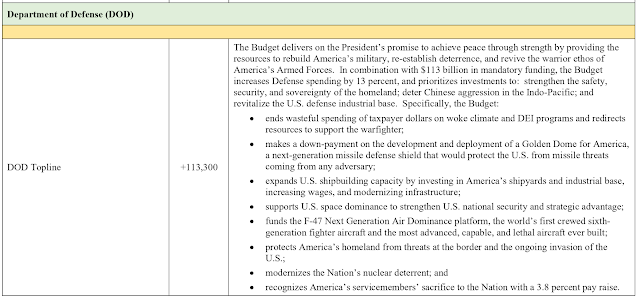
Other aspects of Trump 2.0's first defense budget are discussed here. Some highlights (my comments follow in italics):


The ending DEI component is doing serious harm to the U.S. military's effectiveness, rolls back the military's many civil rights movement accomplishments, and threatens the rule of law.

The focus on shipbuilding is misguided. The U.S. has the largest blue sea navy in the world which far outnumbers its likely adversaries, but its surface fleet is far too vulnerable. We should be shifting away from large surface combatants and focusing on building a ghost fleet, and on shifting anti-ship warfare to submarines, drones, aircraft, and long range missiles.

Also, Trump 2.0 in the foreign policy arena is all about leaving the role of world policeman, at least outside the Western Hemisphere which has far less militarily capable military forces. Trump wants so little to do with Africa that he's even proposing to close U.S. embassies there. He wants to reduce or make more conditional U.S. support for Ukraine, is trying to reduce the size of our foreign military bases, and has viewed our NATO alliance with such disdain that he seems to be considering leaving it in favor of a far more pro-Russian foreign policy. He's at most ambivalent about defending U.S. allies in the Indo-Pacific region although his trade war is making a conflict there more likely since China has less to lose from invading Taiwan or harassing the Philippines, to the horror of U.S. military and defense contractor lobbyists who are using that threat as almost the exclusive justification for the U.S. Navy and Marine Corps.

The F-47 might be significant, but it might not. Too little is known about it to be sure. It is very likely that its steal features may be undermined by Chinese technological developments before it leaves service.

Characterizing illegal immigration and drug smuggling as an "ongoing invasion of the U.S." is just factually wrong and profoundly misguided. Border control should be predominantly a civilian homeland defense department and Coast Guard function, supplemented by the Air National Guard, not a U.S. military function. U.S. military action in a drug war in Mexico or elsewhere in almost all of Latin America is not welcome and would constitute an illegal invasion of Mexico which is the international war crime of "aggression." If the U.S. wants to hurt cartels, it should legalize but regulate drugs to destroy the U.S. black market that funds the cartels and crack down on illegal exports of U.S. firearms.

Modernizing the nation's nuclear deterrent, as a technological matter, has its place when our nuclear missiles were recently run by 5.25" floppy disks and 1970s CRT screen computers running DOS. But it is being done thoughtlessly. A capability to destroy the entire world in a mutual assured destruction scenario with the Soviet Union, which is was designed for, isn't very valuable, and the strategy of packing large numbers of H-bomb submunitions into a single "dumb" non-stealth ICBM undermines that deterrent effect in an age when missile defense can, or soon will, be able to intercept a large percentage of incoming missiles, especially when there aren't all that many incoming missiles. Indeed, it isn't at all obvious that ground based ICBMs add much value when we have SLBMs and aircraft delivered nuclear weapons. This lazy, autopilot thinking in a trillion dollar nuclear force upgrade is the epitome of wastefulness. The current U.S. nuclear arsenal is overkill for a mission that doesn't make sense. 

A program to develop a tactical nuclear anti-ship cruise missile, which in practice would be predominantly used against countries with nuclear arsenals (like China and Russia and North Korea), risks escalating conventional military conflicts into nuclear wars for very marginal improvements in anti-ship missile capabilities which are already more than adequate with conventional armaments including submarine launched torpedos, and soon to enter service hypersonic missiles. In theory, a nuclear armed anti-ship cruise missile could be smaller than a comparable conventional explosive based anti-ship cruise missile, although not faster, and the case that it is necessary to overcome the armor or size of enemy warships has not been made. There is no surface warship in the Russian navy that can't be destroyed with existing anti-ship missiles and torpedos, and longer range and hypersonic missiles, and improved stealth fighters and bombers will only accentuate that reality. There might be a handful of Chinese aircraft carriers that make take more than a single anti-ship missile or torpedo to sink, but simply using more conventional missiles for that very narrow task makes more sense that risking escalation of a conflict with China into a nuclear war and the many, many billions of dollars needed to develop and deploy a tactical nuclear armed anti-ship cruise missile.

A cost of living pay raise for active duty service members is fine enough, but it can't make up for major cuts in veteran's benefits, for nickel and dime savings from cutting (and undermining with anti-DEI agendas) U.S. military academies, failing to retain seasoned combat veterans (especially in the Army and Marines), not having enough ground troops that can be deployed abroad at any one time for one or two major conflicts, and closing and shrinking foreign military bases that make deployment of U.S. forces in a conflict much more rapid especially with heavier equipment.

With respect to the U.S. Army (the indented language in ordinary type are quotations, with my comments interlineated in italics):

We will introduce long-range missiles and modernized UAS into formations, field the M1E3 tank, develop the Future Long-Range Assault Aircraft, and close the C-sUAS capability gap. 
The M1E3 tank is a bad decision as I have discussed previously. 

Long range missiles and modernized unmanned aerial systems make sense. 

Counter-Small Unmanned Aircraft System capabilities (i.e. anti-drone weapons) are indeed critical as recent wars in Israel and Ukraine have illustrated. 

The Future Long Range Assault Aircraft (basically a next generation MV-22 Osprey for the Army) previously discussed here as a successor to existing transport helicopters also has its place because it would be faster and have longer range that a true helicopter (although the fact that the military has a second program in an earlier stage of development in the Air Force to do almost exactly the same thing is wasteful).
We are eliminating 1,000 staff positions at HQDA. To further optimize force structure, Army Futures Command and Training and Doctrine Command will merge into a single command that aligns force generation, force design, and force development under a single headquarters. Forces Command will transform into Western Hemisphere Command through the consolidation of Army North and Army South. Multi-Domain Task Forces will align with theater headquarters to operate under relevant authorities. 
A little bureaucratic reorganization isn't necessarily bad, and may need trimming, but this isn't being done very thoughtfully. 

The U.S. military is really bad at procuring major new military systems, however, and a little reshuffling of top level headquarters organization with a few layoffs won't fundamentally address the problem of programs that are chronically far behind schedule, far over budget, technologically infeasible, or ill-suited for what the U.S. military really needs, resulting in many programs that are canceled, cut short, or deeply flawed.
We will trim general officer positions to streamline command structures and revise civilian talent management policies to prioritize performance.
Again, a little bureaucratic reorganization isn't necessarily bad, and may need trimming, but this isn't being done very thoughtfully. The increasing focus in this process on personal loyalty to Donald Trump, and on replacing qualified officers who happen to be women or minorities with unqualified ideological arch-conservatives (in an already overwhelmingly conservative officer corps) is deeply concerning. Arch-conservatives are not the people with the IQ or emotional intelligence necessary to be effective on a complex foreign battlefield or war zone, or to consider out of the box possibilities.
…reducing one Aerial Cavalry Squadron per Combat Aviation Brigade (CAB) in the Active Component... We will convert all Infantry Brigade Combat Teams to Mobile Brigade Combat Teams to improve mobility and lethality in a leaner formation. We are trading weight for speed, and mass for decisive force. 
Lighter weight and greater speed are generally good concepts. But this is a lot of labels without much detail for the uninitiated.

The MBCT's heavy reliance on the M1301 Infantry Squad Vehicle (image below) introduced in 2020, which doesn't even have an enclosed space for troops or significant equipment storage space and built in weapons, let alone providing any cover in a hostile environment, after the lessons we learned about the need to replace unarmored Humvees (which were at least enclosed) with Mine Resistant Ambush Protected (MRAPs) in multiple conflicts leading to the development of the JLTV is very problematic and suggests bad force design. Ill-suited to cold weather, rain, hail, dust storms, smoke, ambush friendly terrain, land mines, proximity to shrapnel that could be created by artillery and missile near misses or active defenses, and more. It doesn't even protect the crew from adversaries with civilian handguns and rifles, let alone military grade weapons. It is light, it can seat nine soldiers, it beats walking, and it can de-active its running lights and brake lights, but that's a pretty weak set of capabilities to recommend it. These reduced capabilities are particularly troubling when viewed together with the elimination of close air support resources from the force. And, if it really is being used in a reconnaissance role, nine soldiers in a dune buggy without reconnaissance drones or anti-tank missiles or anti-air missiles seems very non-optimal.

The fact that this is being advocated by the very same people who think that we need tracked vehicles to have off road capabilities and need heavy tanks to provide mobile protection to infantry forces and more drones also makes little sense.

The U.S. Army is doing a far inferior job of thoughtful force design than the U.S. Marine Corps. By all means, the Army needs to rethink its force design make it lighter so that it can deploy faster, and abandon the idea of troops whose primary means of travel is on foot (or slow, heavy, tracked vehicles like the cancelled M10 Booker or the M1 Abrams tank or the under gunned M2 Bradley based replacements for the M113).

But military vehicles for front line combat and reconnaissance units still ought to be afford some force protection in an environment like is even somewhat non-permissive like an urban riot with armed civilians (especially if it can't blend in to the existing civilian vehicles in the area), and ought to be suited to environments less friendly than Southern California beaches or country roads in Florida in good weather when there are no wildfires burning. The ISV also doesn't appear to have the off road capabilities of the Humvee or JTLV, as it is just a glorified civilian Chevy Colorado pickup truck with less occupant protection from attacks or weather than the civilian version.

We will cancel procurement of outdated crewed attack aircraft such as the AH-64D, excess ground vehicles like the HMMWV and JLTV, and obsolete UAVs like the Gray Eagle. We will also continue to cancel programs that deliver dated, late-to-need, overpriced, or difficult-to-maintain capabilities. 
The JLTV is not an excess ground vehicle and much better suited to modern warfare than either a next generation M1 Abrams tank or the ISV dune buggy (which is worse than a Humvee). 

If you cut the AH-64, the Future Attack Reconnaissance Aircraft (FARA) successor to the AH-64, and allow the Air Force to finally dispose of the A-10 with only the F-35A to replace it and the light OA-1K in permissive environments, what will the military use to provide close air support to troops during the daytime in less permissive environments when the AC-130 can't be used. Incidentally, naval fire support for ground troops located near coasts has also been largely eliminated. But mortars and canon artillery aren't accurate enough to fill that role.

Close air support is also a role where keeping a human being in the kill loop is particularly essential, and where reliance on remote controls for drones in an environment where electronic warfare and jamming may disrupt that, is particularly problematic.

Republicans on the House and Senate armed services committees unveiled a $150 billion boost to the defence budget, most going to existing and near-future programs: $3.15 billion for more Boeing F-15EX fighters, $4.5 billion to accelerate the Northrop Grumman B-21 bomber, and even $1.5 billion for the ailing ICBM replacement, Sentinel. There was also money to slow retirements of F-15s and F-22s. The new Boeing F-47 and the Navy’s F/A-XX got $400m and $500m respectively. The Lockheed Martin F-35 was not mentioned at all, nor were aircraft carriers.

The navy gets an extra Virginia-class submarine and money for shipbuilding infrastructure—everything from wire and steel to drydocks and workforce development. The consistent ‘more ships’ message has been heard, after a decade of repetition. But there was no cash for the messed-up Constellation-class frigate, which could yet be thrown to the DOGEs. . . .

Like industry, Congress strongly favors protecting established programs. In its plus-up proposal, among new and radical things, the Collaborative Combat Aircraft program (for fighter-like drones) and missile defense did best. . . .

Not mentioning the carriers is not significant. The idea of not having carriers is off the table; the last major design change in the carrier program was traumatic; and its unique facilities and skills make it almost impossible to adjust its building rate.

The omission of the F-35 may mean rather more. The new fighter designs and the F-15EX have greater range; even the F-47 will arrive before the USAF’s planned production of the F-35 will be completed, not before 2051. The F-35’s supporters seem anxious, and Lockheed Martin wasted no time in promoting a Super F-35 after the F-47 announcement.

The navy converted most of its future F-35Bs, capable of short take-off and vertical landing, into F-35Cs early this year, under a new Marine aviation plan. Navy Secretary John Phelan was asked in his confirmation process whether the service planned to upgrade the B models to the new Block 4 standard; he answered noncommittally. That’s significant because it has long been held that U.S. forces would keep all their F-35s in a common configuration. . . .

New cruise missiles and anti-ship missiles present an opening for new ideas and new competitors. There is little daylight between the views of the people running Anduril’s Barracuda cruise-missile project and those who did Lockheed Martin’s Common Multi-Mission Truck (CMMT, or Comet). Both teams believe new technology—one-shot injected structures, additive manufacturing in engines, and cheap and powerful data processing—can drop the cost of a cruise missile by an order of magnitude.

They also think new electronic payloads can allow the same vehicle to perform multiple kinetic and non-kinetic missions. The difference is that Anduril is pushing the idea hard but Lockheed Martin—maker of the million-dollar AGM-158 cruise missile—is not.

And, while not directly on point, a recent argument that missiles and drones can't replace cannon artillery isn't very convincing. It argues that:

A careful and historically informed examination of the conflict in Ukraine, coupled with an understanding of the fundamental principles of warfare, reveals a fundamental truth: unmanned aerial vehicles (UAVs) can enhance fire support, improve situational awareness, and provide tactical advantages, but they are not, and won’t be in the foreseeable future, a replacement for the range, volume, destructive power, and all-weather operability of traditional artillery. The focus should be on integrating drones into a comprehensive fires network, not on attempting to substitute them for a proven and essential capability.

Both Ukrainian and Russian forces have demonstrated remarkable adaptability, rapidly fielding large numbers of drones, both short and long-range, commercial and military-grade, to address resource constraints, a largely static front, and the evolving demands of the conflict. However, this isn’t a strategic shift based on superior capability or a harbinger of a new era of warfare, but rather a pragmatic response to circumstance. As many reports open-source intelligence (OSINT) analysts, and other respected military analysts indicate, the proliferation of FPV drones largely compensates for critical shortages of artillery shells, particularly on the Ukrainian side, filling a gap rather than offering a fundamentally better solution. While FPV drones have proven effective against armored vehicles and in close-quarters combat, at best, they deliver tactical-level precision comparable to battalion mortars, a far cry from the comprehensive impact of artillery fire. They are a tactical tool, not a strategic game-changer. Furthermore, the reliance on drones has created new vulnerabilities, as both sides have developed increasingly sophisticated electronic warfare capabilities to counter them.
The Limits of Drones in Modern Warfare: A Multifaceted Analysis

Drones excel in specific roles, and their utility is undeniable. They provide invaluable real-time intelligence, surveillance, and reconnaissance (ISR) capabilities, significantly enhancing situational awareness for commanders and troops on the ground. They can strike isolated targets with precision, reducing collateral damage and minimizing the risk to friendly forces. They are effective at harassing enemy units, disrupting logistics, and conducting psychological warfare. Yet, as the Institute for Security and Development Policy and other think tanks have pointed out, UAVs are inherently limited by a number of factors. UAVs are significantly hampered by adverse weather conditions; rain degrades sensor performance and can cause electrical malfunctions, while strong winds can destabilize the aircraft, impacting its ability to maintain flight or accurately deliver payloads. These limitations mean UAV effectiveness is often dramatically reduced, or even negated, during inclement weather, making them unreliable.

UAVs’ payloads also restrict their destructive potential, limiting their ability to inflict significant damage on hardened targets or to suppress enemy fire effectively. Their reliance on radio frequency links makes them vulnerable to jamming, spoofing, cyberattacks, and other forms of electronic warfare—a weakness artillery, particularly when combined with robust communications security measures, doesn’t share.

Moreover, the logistical demands of drone operations—battery charging, spare parts, specialized operator training, and the constant need for counter-electronic warfare measures—create new sustainment challenges that would become overwhelmingly complex and costly in a prolonged, high-intensity conflict. Add in the manning requirements for drone units, observers, and support teams, and that heavy draw off of an already stretched force creates a self-inflicted dilemma on force structure.

Artillery, in contrast, delivers massed fires in all weather conditions, over extended ranges, and with significantly greater explosive effect. Even the most advanced FPV drones, as Euromaidan Press and other sources have highlighted, cannot replicate the broad-area suppression, neutralization, and destruction that a battery of 155mm howitzers can achieve in a matter of minutes. Nor can drones match the psychological impact of sustained artillery bombardment, a long-recognized element of attritional warfare. The notion that swarms of small drones could simply replace guns and rocket systems also ignores the economic realities of scaling up drone warfare, especially when considering enemy countermeasures and layered defenses, as David Hambling of Forbes and other defense analysts have argued. The cost of replacing drones lost in combat, coupled with the expense of maintaining a robust logistical tail, and manning requirements quickly erodes any perceived cost advantage. Furthermore, the vulnerability of drones to electronic warfare and physical destruction creates a significant risk of losing critical ISR assets and disrupting fire support operations. 
Ukraine and Russia: A Unique Case Study — Circumstance, Not Revolution

The reliance on drones by Ukraine and Russia doesn’t necessarily predict the future of warfare for well-equipped, industrialized militaries. It’s a reflection of their specific circumstances; adaptation born of necessity, resource constraints, and the unique characteristics of the conflict. Drone strikes address tactical needs, achieving limited effects when traditional artillery is unavailable or when precise targeting is required. They enhance reconnaissance and target acquisition, allowing for more efficient use of dwindling artillery resources. However, neither side has abandoned conventional indirect fire. In fact, both are actively working to rebuild their artillery capabilities even as they deploy drones extensively. The Ukrainian plea for more artillery shells from Western allies underscores the continued importance of conventional fires. Drones are a temporary fix, a stopgap measure, not a replacement. Recognizing this distinction is crucial for American military planners. The conflict has also highlighted the importance of counter-drone technology, with both sides investing heavily in electronic warfare systems and physical defenses to mitigate the threat posed by UAVs.

The trouble with this analysis is that many existing drones and missiles have longer ranges than artillery (their limited range is one of their biggest drawbacks), canon artillery is profoundly less accurate than drones and guided missiles, and that it is easy to scale up the payload of a drone or guided missile to equal or exceed the explosive power of the largest artillery shells currently in use (the 155mm howitzer round).

One of the latest guided missiles, the "Red Wolf" long range precision fire missile carried by a light AH-1Z Marine Corps helicopter, for example, has a range of 170 miles or more, and "the munition was a six-foot-long design powered by an unspecified German-made turbojet and capable of being launched by an MQ-1C Gray Eagle drone."

TWZ added that the Corps previously has expressed a need to be able to reach ranges of 170 miles (278 kilometers), and the Red Wolf appears to be capable of reaching that distance. Extended range variants of the Hellfire, like the AGM-114R-4, or the JAGM’s ‘MR’ version have maximum ranges of 21 miles and 10 miles respectively, which are drastically shorter than what the Corps desires.

Heavy howitzers, in contrast, has a range on the order of 24 miles, with extended range versions relying on guidance systems that have the same issues as drones and guided missiles and bombs. 

The notion that mortars or howitzers are more precise than drones is absurd, and arguing that drones are not a strategic game changer is putting your head in the sand contrary to all available evidence from recent real world conflicts, like those in Ukraine and Middle East.

Canon artillery shells, like most drones and slower missiles, are also vulnerable to active defenses.

While some of the more feeble FPV drones suffer in bad weather, most ground, air and sea launched guided missiles don't (relative to artillery shells).

And, when you are making the beyond the line of sight long range strikes that canon artillery are designed for, you need to have forward reconnaissance to provide eyes on the target that will often be a drone with the same issues. Firing artillery blindly is not a good practice. It may inflict terror with the vast collateral damage it inflicts, but it's not particularly effective. And, any barrier to communicating with drones also applies to communications with forward observers. It is true that dumb weapons can't be jammed. But remote control is not the only way to operate a drone. And great progress has been made in fire and forget technologies for drone and missile guidance that don't rely on GPS signals or radio controls. This is also an area where advanced AI technologies can be deployed for the purposes of final approach target identification. If you have human forward observers, they can use laser designators (in colors not visible to the human eye) to substitute for GPS, radar sensors, heat sensors, or more elaborate AI systems in guiding a munition in its final approach to the target.

The biggest problem with guided missiles and drones is their cost relative to artillery shells. But as another article quoted above notes, we are on the brink of being able to reduce that by an order of magnitude. And, much of that cost comes from intellectual property royalties, not unit assembly costs. Maybe the U.S. military just needs to buy some patents from defense contractors who hold them (it can seize them for fair compensation using the power of eminent domain if they don't do so willingly).

Why use drones or missiles instead of canon artillery?

1. Their greater cost is offset by their greater accuracy so that fewer of them are necessary to destroy a single target than the number of artillery shells that would be required. This was one of the biggest lesson that the U.S. Air Force learned in the 1990s which has held true in every conflict since then. The greater accuracy also reduces collateral damage and allows forces to strike closer to friendly forces. Aside from a few extremely heavy bunker buster bombs, almost all U.S. Air Force bombs and missiles are guided for this reason. The A-10 and AC-130 retain canons and in the case of the AC-130 what amounts to a howitzer for direct fire purposes, but not for indirect fire. Other fighter jets also have direct fire canons (which are very rarely used), but none of them use slug throwers for long range or beyond line of sight engagements.

2. The delivery systems for artillery are vastly heavier and are often tracked, making these systems harder to deploy swiftly and less agile. A 100 pound missile and missile launcher can deliver the same results as a multi-tons howitzer or mortar carrier vehicle. This is why military helicopters, fighter jets, and the Bradley M2 Infantry Fighting Vehicle have been using missiles rather than guns of more than 40mm diameter for decades.

3. The delivery systems for canon artillery are much more expensive than missile launchers. The missile launcher for an artillery substitute missile can be so cheap relative to the cost of the missile that it is basically disposable. A self-propelled howitzer costs tens of millions of dollars.

The main reason that canon artillery was used in the Ukraine War at all, was because the combatants didn't have enough drones at first. Now, 70%-80% of casualties are inflicted with drones that often cost $500, but with heavier drones and missiles for more robust or distant targets. And, don't forget that the reasons that the Ukraine War is being fought predominantly with drones, missiles, and artillery, is because in the Ukraine War, the tank proved so obsolete that the lion's share of them have been destroyed and tanks have provided only a very small share of the offensive kills of either side in the conflict.

Basically, this pro-artillery argument is taking down a straw man, limiting its comparison to very cheap, short range, small, and feeble FPV drones, rather than to the full range of guided missile and drone alternatives that the U.S. military is capable of procuring to fill the role of canon artillery in a way that outperforms it in almost all respects.

10 April 2025

Bingo Cards

What unusual or exceptional events could happen in this administration (i.e. "what's on my Bingo Card")?

1. The Trump Administration could decide to deliberately default on the federal debt (perhaps only if owed to selective perceived enemies).

2. The U.S. Supreme Court could adopt the President's fringe unitary executive theory.

3. The U.S. Supreme Court could affirm the validity of the President's Alien Enemy Act declaration, perhaps by holding that it is non-justiciable.

4. The U.S. Supreme Court could affirm a contemplated Insurrection Act declaration, perhaps by holding that it is non-justiciable.

5. The U.S. Supreme Court could hold that the impoundment act in unconstitutional.

6. Congress could repeal Trump's authority to impose tariffs.

7. Trump could die of natural causes.

8. Trump could be assassinated.

9. Other leading Trump administration officials could be assassinated.

10. The U.S. Supreme Court could declare Trump's tariffs to be illegal or invalid under a variety of legal theories.

11. The Republican Party could suffer a crushing defeat in the 2026 elections.

12. The 2026 elections could be cancelled or postponed.

13. Elon Musk could lose his billionaire status after having been the richest man in the world this year.

14. China could invade Taiwan.

15. China could start providing arms to Russia (it already seems to have provided 150 mercenaries).

16. Volcanos and earthquakes could enter a sustained period of high activity.

17. Martial law could be declared.

18. There could be a military coup attempt in the U.S.

19. There could be an unprecedented wave of farm bankruptcies.

20. A trade war with China and/or an invasion of Taiwan could bankrupt Apple.

21. A serious Ebola-class foreign pathogen could lead to a U.S. outbreak.

22. There is a Kent State-like incident of anti-Trump protesters being killed.

23. The U.S. Supreme Court upholds state laws making it illegal to be transgender.

24. Southern Florida experiences Hurricane Katrina-class flooding that leads to permanent large population reductions in some areas.

25. The U.S. invades Mexico militarily over Mexican objections leading to military clashes with Mexico.

26. The U.S. invades Greenland triggering a NATO response.

27. There is a terrorist attack on Trump's proposed military parade in D.C.

28. Marsupial tigers are revived.

29. Insider trading in Trump's inner circle is definitively established and not prosecuted.

30. Trump gets divorced again.

31. Trump declares (falsely) on national TV that aliens are real and that the U.S. government has been in contact with them.

32. The Smithsonian Museum is mostly shut down and its collections are destroyed.

33. Trump sponsors new Confederate monuments in Washington D.C.

34. The U.S. leaves NATO.

35. The 2028 election is cancelled.