18 April 2024

Musings On Markets and Monopolies

There are some economic choices where not having "freedom to choose" works out reasonably well.

Untroubling monopolies

For example, I have no choice over:

* who I buy water and sewer services from;
* who collects my trash and recycling;
* who responds to fires;
* who builds and maintains the roads, bridge, and tunnels that I drive on and through (apart from one toll road in the Denver metro area); and
* who I buy natural gas and electricity from.

The first three are provided by local government. The fourth is provided by a combination of local and state governments with some state funding. The fifth is provided by a state regulated utility company.

Sometimes there are quality of service issues and customer service issues with each of these four services. But I don't believe that competition between firms to provide them would be significantly better, and I don't perceive the prices charged for any of them to be excessive.

Toll roads, where they exist, are generally regulated monopolies used to finance road construction and maintenance. They are generally underused relative to freeways and are modestly expensive but not all that hugely profitable. There are also public sector toll lanes on free roads which seem to work better (and are free for high occupancy vehicles and buses and motorcycles).

Leaky monopolies and near monopolies

Postal service

Postal service is a federal government monopoly, in theory, but in practice, there is considerable competition in parcel delivery, there is some competition in junk flier delivery, and email and other online communication tools have provided a lot of competition in delivering the messages and payments which were historically sent by mail. 

For reasons that are a mix of technology issues and governance issues, the quality what is done by the U.S. Postal Service is falling, and the price of that service keeps going up. The U.S. Postal Service did its job quietly, efficiently, and well when I was younger, but has slipped steadily over the last thirty years, and has plummeted since U.S. Postmaster De Joy was appointed.

Telecommunications

There is a de jure monopoly on cable television, although streaming and satellite TV make this a leaky monopoly, and there are only about two significant providers of high speed Internet service: the cable company, a regulated utility, and a DSL provider affiliated with the legacy local landline phone service company which is also a leaky monopoly due to cell phone service. The cable company is too expensive, has miserable customer service, and really displays none of the reasonable cost, reliability, and stability of government owned and regulated private utilities that have worked well. Competition in the cell phone and long distance telephone service industries, in contrast, has worked reasonably well.

Intercity passenger transportation.

Amtrak has a de jure monopoly on intercity passenger rail in the U.S., although private high speed rail ventures, all from the same parent company if I understand it correctly, have been authorized with operations in Florida, Texas, Nevada, and California, although only Florida's medium speed passenger rail is up and running. There is also some separate scenic or limited service rail service.

This is a leaky monopoly, because it has competition from private intercity bus services, at least one publicly owned intercity bus service in Colorado (Bustang), and commercial air traffic.

Basically everywhere outside the Northeast Corridor, Amtrak is a dismal failure. It is slower than passenger rail was in its heyday in the 1950s. It is unreliable and plagued with long delays. It has infrequent service. It runs huge operating losses per passenger mail. Bus service between cities is comparably fast, varies greatly from more comfortable to less comfortable, is cheaper, and operates without subsidized operating costs. Commercial airlines are much faster, are often less expensive than Amtrak's operating costs, and are sometimes cheaper.

Intracity Transit

In theory, the Regional Transportation District (RTD) is a regional local government that has a monopoly on intracity bus and passenger rail service in the Denver metro area. In practice, this monopoly is also not all that strict. There are private cabs, Uber and Lyft, hotel shuttle services, a school bus system, apartment and church shuttle services, and more that compete with it in particular niches.

De facto monopolies

On the other hand, there are some services that are not formally monopolies, but are monopolies in substance. 

Commercial airports

Denver International Airport, which is owned by the city and county, is the only commercial airport in the metro area, even though there are several general aviation airports in the area that could offer commercial airport service. And, it works reasonably well.

Pro-sports

We have pro-football, soccer, baseball, basketball, hockey, and lacrosse teams that are not formal monopolies, but are part of dominant national pro-sports leagues that allow only one team in our metropolitan area and region. The teams are privately owned although their stadiums are publicly financed. On the other hand, these pro sports teams do compete with myriad high school and college sports teams for spectator interest.

Software

Microsoft Word, Microsoft Excel, and Adobe Acrobat are all de facto monopolies with dominant market share because compatibility between users in different firms and households is so crucial to their usefulness. In the case of Microsoft Word, this is unfortunate, because the product quality is poor. Microsoft Excel and Adobe Acrobat are better quality products, so this is less troubling in those cases.

Unnecessary competition

There are some areas where we have competition we don't really need. 

Oil Companies

There are several very profitable and heavily polluting large oil companies that extract, refine, and distribute petroleum for use as gasoline, diesel fuel, airplane fuel, boat fuel, heating oil, plastics, and fertilizers. But while there is arguably value in having competition between local gas station/convenience stores that dispense gasoline and diesel fuel, these are standardized products. It isn't at all obvious that we are better off having competing oil companies rather than nationalizing this industry as a great many countries do. 

Hospitals, ambulances, and their competitors

All but one of the hospitals in the metropolitan area are non-governmentally owned, either on a for profit or non-profit basis. Denver Health and the VA hospital system is the only governmentally owned hospitals in the metro area. And, there are many privately owned ambulatory surgery centers, free standing emergency rooms, and urgent care centers that perform services that compete with hospitals.

But, as a practical matter, emergency room patients have virtually no choice over whose emergency room they seek treatment in. Often they aren't even conscious, and in major disasters, ER availability trumps patient choice. Patients are also typically ill-equipped to meaningfully evaluate the available hospital choices which are typically constrained by what their insurance will cover anyway.

Similarly, patients have essentially no choice over which ambulance service providers choose them and don't really benefit from having multiple competing providers of that service.

Two year college and trade school programs

Publicly owned school district trade schools and community colleges are the dominant provider of higher education and professional training short of a bachelors or gradate degree. These schools and community colleges are inexpensive, available close to home, and generally speaking provide a good value to students who earn degrees, and are available to almost any student interested in attending, although the community college drop out rate is extremely high.

There is very little competition in this sector from private non-profits who make up a large share of colleges and universities that offer four year and graduate degrees.

There are for profit educational institutions that compete with the public sector in this market. But they are expensive, are mostly financed with federal government grants and loans, and with just a handful of exceptions in the entire United States are offer educational services that are greatly inferior to those of publicly owned trade schools and community colleges.

Choice without much private sector competition

Everyplace in the United States has public K-12 schools which are the dominant providers are education in those grades. Most places in the United States also have some private K-12 schools for at least some grades owned by either religious affiliated non-profits, or secular non-profits (the market share of "for profit" private K-12 schools is negligible although there is a private tutoring industry that supplements other schools).

In Denver, the public school system offers many school choice options, some between programs at ordinary public schools, and some set up as "charter schools" which are public schools that are governed by private non-profits that are autonomous from the school board that runs ordinary private schools. There are also some places that offer school vouchers that allow parents to use public money to send their children to truly private schools including private religious schools, typically in amounts a little less than the average per child funding level of the public schools.

Studies of school choice systems reveal two things. First, the main benefit of school choice systems is that they force poorly performing schools that parents don't choose, to shut down and allow parents to not send their children to those schools. Second, adjusting for the socioeconomic status of the students attending them, private voucher funded schools and charter schools don't consistently outperform ordinary public schools.

The economic importance of choice

In general, choice matters primarily because monopoly government owned good and service providers allow poorly performing and poor quality parts of their operations to continue at losses without being shut down or reformed.

When a private non-profit or for profit venture can't secure enough customers and patrons to cover its expenses, it promptly goes out of business. And, this happens organically, location by location, transit route by transit route, and not necessarily all at once, although mass downsizing via a Chapter 11 bankruptcy is fairly common. 

Sometimes, this happens dramatically. Essentially the entire subprime mortgage lending industry and the entire investor owned investment bank industry collapsed in the financial crisis. Blockbuster, which used to be the biggest video rental store in the country, went from 9,000 stores in an early 1990s peak, to just one store in the nation thirty years later. Chains like Radio Shack, Sears, Kmart, JC Penny, Big Boy, and Bed, Bath and Beyond are gone or nearly so. Thousands of dollar stores are closing. Dozens of airlines have gone out of business over the years. 

At other times, it happens gradually. There are significantly fewer bank branches in the United States than there were at the peak perhaps a decade ago. Diner style restaurants have shut down one by one. There has been some consolidation and closing of locations in the legal marijuana industry in Colorado. A few marginal private liberal arts colleges have shuttered each year in recent years as demand for them as declined, in part, due to demographics and, in part, because the subjects they specialize in aren't as popular anymore.

This doesn't happen in the government owned sector until the situation is grossly out of hand. The vast majority of Amtrak routes outside the Northeast Corridor provide poor service at a high cost, but keep running. Suburban bus lines that carry few passengers at a high cost keep running. Public schools in school districts without school choice continue to operate even when they are very poorly run and have poor outcomes for their students, and even when they see marked declines in the numbers of students they serve due to demographic shifts in their area. Shutting down a local post office that doesn't have enough business to make sense any more rarely happens.

The number one reason that the Soviet Union was less economically vibrant than the West was that it failed to shut down poorly performing factories and businesses and operations within businesses quickly enough.

In the case of monopoly businesses that everyone needs for the foreseeable future, this isn't a problem. The people of Denver will continue to need water and sewer and trash collection services indefinitely, so shutting these services down entirely isn't something that will ever need to be done. And, these are mature enough fields that their basic business model isn't likely to be upended any time soon.

The government owned monopolies that are more problematic are leaking monopolies in industries where technological change has made their historic business model no longer viable, like the Post Office and AMTRAK.

Musings About Language and Religion In Japan

Language Log discuses an interesting evolving issue in the Japanese language, which has four parallel systems of writing that are mixed together, that is somewhat obvious, but I've never really drilled down the frame this way:

Most Language Log readers are aware that the Japanese writing system consists of three major components — kanji (sinoglyhs), hiragana (cursive syllabary), and katakana (block syllabary). I would argue that rōmaji (roman letters) are a fourth component, as they are in the Chinese writing system.

How do people decide when to switch among the different components of the Japanese writing system? Of course, custom and usage determine when to use one and when to use another. (It's a bit like masculine, feminine, and neuter in gender based languages [a frequent and recent topic on Language Log] — you don't ask why, you just do it].) In most cases, convention has fixed which of the three main components of the writing system is used for a particular purpose. On the other hand, since I began learning Japanese half a century ago, I noticed a fairly conspicuous slippage regarding what I had been led to believe were predetermined practices. . . . there is a lot of variability in the way people mix and match hiragana, katakana, and kanji.

Not infrequently, multiple different writing systems will be incorporated in the same sentence, although each word will generally be written in a single writing system.

In the case of Japanese proper names, it is common for someone to say their name orally and then to say that it is written with a certain set of kanji, because there is more than one set of kanji that can sound essentially the same, but have very different meanings. 

Indeed, Japanese is full of pun wordplay because its many homonyms and words that sound very similar but are not identical sounding, are common, in large part, because Japanese has a quite small set of phonemes (i.e. distinct vowel and consonant sounds). 

The small phoneme set in Japanese is a big part of why English speakers who learn Japanese often have quite good accents (since almost all Japanese phonemes are present in English), while Japanese  speakers who learn English tend to have a much more difficult time overcoming thick accents (since many common English phonemes are absent in Japanese and English has less strict rules about how phonemes can be combined).

Another nuance in addition to these four writing systems is that there are certain words, like the words for numbers, that are written in a special way in legal documents in order to make them resistant to being forged or modified, with a few strokes of a pen. It is a custom somewhat similar to writing numbers in both words and numerals on a check or in a legal contract.

Scripts aren't the only context in which the Japanese mix and match. 

Japan is also famous for its religious mixing and matching, with the average Japanese person invoking a mix of Confucian philosophy (which is pervasive), Shinto religious practices (with shrine observances especially on certain holidays and in home shrines for deceased family members), Buddhist religious practices (especially with respect to funerals), and even some Western Christian religious/cultural practices (mostly Christmas celebrations heavy on Santa and light on Jesus, and aspects of Christian wedding practices). In Japanese popular fiction, it is almost cliche for supernatural threats to be challenged by mixed religion teams of priests from Shinto, Buddhist, and Christian perspectives, much like a party of warriors who are each trained in a different martial art.

15 April 2024

NDAs

It should be a crime and violation of professional ethics rules, in and of itself, and should also make one a civil and criminal co-conspirator to use a non-disclosure agreement to conceal criminal conduct, tortious activity, breaches of contract, violations of government regulations, government mistakes, adultery, affairs, or to protect a person's reputation. Any such non-disclosure agreements should also be void ab initio. An NDA should be permissible solely to protect trade secrets. And, any valid NDA should disclose this limitation on its face.

Likewise, data protection and privacy rules and laws should never be used for these purposes.

Privacy protections for juvenile delinquency and educational records should also be abolished.

All of this legal protection for secrets does more harm than good.

14 April 2024

Sunday Musings

 * The United States is deeply politically and culturally divided, and it has had a few political dynasties. But, ultimately, the U.S. has at least largely resisted the hereditary principle and clan politics. We have oligarchies of big corporations, but those big successful corporations, while not entirely free of it, are not hotbeds of nepotism either. Father to son CEO succession happens, but it is rare, and tends to happen second tier businesses not in big national S&P 500 companies.

* We are approaching a point where it may make sense to declare war on both Iran and its proxies like Hezbollah, Hamas, the Houthis, and Iranian militias in Syria and Iraq. The Houthis have directed piracy and missiles at commercial ships in the Red Sea and their insurgency has led to one of the worst famines in the world in Southern Yemen which has historically been the bread belt of Arabia. (It is worth nothing that both sides of the civil war in Yemen are united in their hate for the United States.) Hamas carried out the October 7 attack and has continued a suicidal response by Gazans to Israeli retaliation. Hezbollah in Lebanon has been lobbing artillery and missiles as Israel for decades. Iranian missiles recently killed a detachment of U.S. troops in Jordan. Iran has fired several hundred missiles at Israel in the last few days, has been in multiple skirmishes with U.S. Navy forces in the Persian Gulf, and has terrorized commercial traffic in the Persian Gulf.

* The U.S., admittedly, plays an important part in Iran's ascendancy. U.S. support for the Shah in Iran played an important rule in the 1979 Islamic Revolution in Iran that put the current regime in place. Sanctions the U.S. pushed for caused Iran to develop its own domestic military production (something similar happened as a result of sanctions in Israel, in South Africa, and in Turkey), and also pushed Iran into Russia and North Korea's circle of allies. U.S. military intervention in Iraq and Afghanistan defanged Iran's neighbors who were among its greatest military adversaries. Dislodging the neo-Communist dictatorship in Iraq opened the door to Iranian backed Shiite party political gains there. Encouraging Arab Spring revolutions in Syria contributed to the Syrian Civil War that still isn't over and has created a vacuum for Iranian backed militias there.

* Golf courses are a waste of water in the arid west:


About 1% of total Colorado water consumption goes toward golf courses (this is about 5% of non-agricultural water use):

In its 2021 economic and environmental impact report, the Colorado Golf Coalition, a collection of state organizations, reported that the industry’s water consumption represents less than 1% of the state’s 2018 total — 41,213 acre-feet, compared with 4.7 million acre-feet for agriculture, the largest consumer.

It also touts the positive environmental impact of its more than 33,000 acres of greenspace statewide, of which a little more than 16,000 acres constitute irrigated turfgrass, species like bluegrass that can endure high traffic and low mowing heights ideal for golf. That’s more than 17% less irrigated acreage than in 2002.

By region, the courses in the Denver metropolitan area account for more than 43% of the irrigated acreage. Since the 2002 measurements, Colorado courses have increased use of reclaimed water and significantly reduced use of municipal sources.

Still, golf courses have joined lawns as targets for restrictions in places like Aurora, where Mayor Mike Coffman invoked the “new reality” of water scarcity in Colorado in support of a proposed ban on new courses — unless they employ the buffalo and blue grama long a staple on the Eastern Plains — as the city looks at limiting grass yards, medians and decorative office park areas.

In fairness, golf courses in the arid west have made very significant efforts to reduce their water consumption; far more significant efforts than agricultural users have.

* Agriculture and evaporation consume all but 18% of water in the Colorado River basin (and that 18% includes a significant portion for lawns and golf courses). About 70% of agricultural water is used for cattle feed, mostly alfalfa and to a lesser extent hay, according to a Denver Post analysis:


* Despite its immense water use, agriculture is almost economically irrelevant in Colorado.

* According to Denver Water, household water used breaks down as follows:

54% landscaping
13% toilets
11% laundry
10% showers and baths
6% faucets
5% leaks
1% dishwashers

* The Southwest is, however, a naturally ideal place for solar energy (and it doesn't hurt that a lot of the electricity demand there is for air conditioning which coincides with solar energy availability):

* This week I learned that there are both role playing games and video games in which the protagonist that you play is a bird.

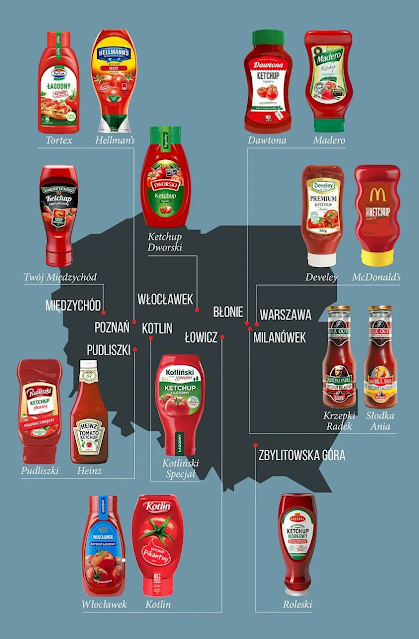
* It turns out that a certain part of Poland is the heartland of ketchup production (a widely used product there):


The Polish Ketchup Belt is a narrow lane between the 51.5N and 52.5N parallels where almost all ketchup production in Poland is concentrated. (Source)

* Ukraine has made strikes deep into Russian territory:

It is 755 kilometers from Ukraine to Moscow and there are numerous Russian refineries and oil storage sites to attack along the way. Ukraine has been attacking those oil facilities and . . . the damage to oil facilities and other targets has been so great that Russia has had to ration how much fuel civilian and military users can get. It is estimated that the Ukrainian attacks destroyed twelve percent of Russia’s oil refining capability.

* Bible reading has recently fallen dramatically in the U.S.:


 * Coal use is up globally, despite falling in the U.S., the U.K., and a number of European countries, due predominantly to new coal fired power plants in Asia:


Greece's failure to tap into its abundant wind power capacity and its near ideal geography for electric cars, baffles me. The same can be said for Hawaii.

* Turkish people drink a lot of tea.


* According to data cited the Economist magazine, South Korea has an intense "glass-ceiling" for women in the workplace, which surprises me. I had thought that the situation for South Korean women who didn't marry or had kids was pretty good.


* Early 19th century grave robbing was driven by incentives you wouldn't expect:

At the 1815 Battle of Waterloo, Napoleon Bonaparte’s final battle, more than 10,000 men and as many horses were killed in a single day. Yet today, archaeologists often struggle to find physical evidence of the dead from that bloody time period. Plowing and construction are usually the culprits behind missing historical remains, but they can’t explain the loss here. How did so many bones up and vanish?

In a new book, an international team of historians and archaeologists argues the bones were depleted by industrial-scale grave robbing. The introduction of phosphates for fertilizer and bone char as an ingredient in beet sugar processing at the beginning of the 19th century transformed bones into a hot commodity. Skyrocketing prices prompted raids on mass graves across Europe—and beyond.

* In the Netherlands, the interest rate on a particular mortgage fall over time to reflect the reduced risk of loss to lenders as the debt to equity ratio falls as principal is paid off and real estate appreciates in value. But, this also disincentivizes selling one home to move to another, or refinancing.

* Average hourly wages vary greatly across Europe:

* In Ray Bradbury's short story "All Summer In A Day": "The children let Margot out of the locked closet at the end of "All Summer in a Day." They had locked her inside while the teacher was elsewhere, making Margot miss the sun, which only comes out every seven years." It was a story the affected me greatly as a child and still does.

* Skunks are an American thing. The skunk family (Mephitidae) consists of 13 species, and almost all are restricted to the Western Hemisphere, reaching from Southern Canada to the Strait of Magellan in South America. The exception is the Stink Badger which can be found in Indonesia.

* Gasoline prices, adjusted for inflation, are similar or lower now than they were in 2006. U.S. mortgage interest rates are middling by historical standards and historically low rate until recently may have helped drive up real estate prices:


* High rise office buildings are plummeting in value.

* There were once more than 9,000 Blockbuster video stores. There is now one, in Bend, Oregon.

* What's better with Jalapeños?

1. Pizza.
2. Beer.
3. Lemonaide.

* Humans are basically fish in flesh suits and our blood is a decent approximation of sea water. An image gets across the concept:


*  There ought to be a law disqualifying judges from deciding cases involving the person who appointed them as a party (in the appointing person's personal, as opposed to their official, capacity).

* Trump does not have legitimate defenses in the classified documents criminal case against him, despite the fact that a judge he appointed seemed to be "confused" about this point.

12 April 2024

Arguments For And Against Submarine Launched Nuclear Cruise Missiles

Nuclear armed cruise missiles are primarily designed to destroy aircraft carrier and other very large surface warships, and to destroy fortified bunkers, with a relatively small and agile weapon that is less vulnerable to missile defense systems than a ballistic missile that isn't very maneuverable. 

The U.S. military recently cancelled plans to develop a nuclear armed sea-launched cruise missile,  mostly because small nuclear warhead submarine launched ballistic missiles and aircraft launched nuclear cruise missiles are already available. A senior U.S. Navy reserve officer, meanwhile, argues that this was a bad call, because he doesn't trust aircraft to be reliable and because it would allow attack submarines to carry nuclear weapons, rather than leaving this is a much smaller fleet of ballistic missile submarines.

Lurking behind this debate is one that I have pressed for a long time, the argument that aircraft are usually better suited to destroying or disabling enemy warships than other warships. Aircraft have numerous advantages over surface warships which is comparable to going into a battlefield on ground in an RV.

Arguments that the Navy should deploy a nuclear-armed sea-launched cruise missile (SLCM-N)—particularly arguments centered on low-yield characteristics—contribute important points to ongoing discourse about U.S. nuclear modernization. But there is more to consider than yield. Senior policy-makers need to understand SLCM-N in the context of a broader question: How should the United States bolster theater deterrence distinct from but reinforced by strategic deterrence?

While yield matters, focusing on it diminishes other considerations and plays into established opposition. Recall that the 2022 Nuclear Posture Review (NPR) canceled SLCM-N in part because “the W76-2 low yield submarine-launched ballistic missile warhead, globally deployable bombers, dual-capable fighter aircraft, and air-launched cruise missiles” were considered sufficient for theater deterrence.

There are three stronger arguments for SLCM-N than firepower per se. First, it improves theater deterrence options by decreasing reliance on aircraft-delivered weapons. Second, it could complement or replace the W76-2, distributing some of the theater deterrence role to attack submarines (SSNs) while reserving ballistic-missile submarines (SSBNs) for higher levels of conflict. Third, SLCM-N contributes to U.S. arms control, assurance, and nonproliferation objectives as complementary facets of U.S. nuclear strategy.

From here. 

11 April 2024

A Nation Divided By Disinformation, Stupidity, And Hate

Great insights. Two key factors are developing this week. The Arizona Supreme Court's restoration of an abortion law passed before Arizona was a state and before women had the right to vote, which Republicans are running away from as fast as they can despite their rhetoric, and Trump's first felony trial in New York starting on Monday.

The looming showdown between President Biden and former President Donald J. Trump, assuming Nikki Haley cannot pull off a hail-mary surprise, goes beyond the binary liberal-conservative split of two political parties familiar to generations of Americans. It is at least partly about ideology, yes, but also fundamentally about race and religion and culture and economics and democracy and retribution and most of all, perhaps, about identity. . . . Mr. Biden leads an America that, as he sees it, embraces diversity, democratic institutions and traditional norms, that considers government at its best to be a force for good in society. Mr. Trump leads an America where, in his view, the system has been corrupted by dark conspiracies and the undeserving are favored over hard-working everyday people.

Deep divisions in the United States . . . have rarely reached the levels seen today, when Red and Blue Americas are moving farther and farther apart geographically, philosophically, financially, educationally and informationally.

Americans do not just disagree with each other, they live in different realities, each with its own self-reinforcing Internet-and-media ecosphere. The Jan. 6, 2021, attack on the Capitol was either an outrageous insurrection in service of an unconstitutional power grab by a proto-fascist or a legitimate protest that may have gotten out of hand but has been exploited by the other side and turned patriots into hostages.

The two lands have radically different laws on access to abortion and guns. The partisan breakdown is so cemented in 44 states that they effectively already sit in one America or the other when it comes to the fall election. That means they will barely see one of the candidates, who will focus mainly on six battleground states that will decide the presidency.

In an increasingly tribal society, Americans describe their differences more personally. Since Mr. Trump’s election in 2016, according to the Pew Research Center, the share of Democrats who see Republicans as immoral has grown from 35 percent to 63 percent while 72 percent of Republicans say the same about Democrats, up from 47 percent. In 1960, about 4 percent of Americans said they would be displeased if their child married someone from the other party. By 2020, that had grown to nearly four in 10. Indeed, only about 4 percent of all marriages today are between a Republican and a Democrat. . . . Michael Podhorzer, a former political director of the AFL-CIO, wrote in an essay last month. “But America has never been one nation. We are a federated republic of two nations: Red Nation and Blue Nation. This is not a metaphor; it is a geographic and historical reality.”

The current divide reflects the most significant political realignment since Republicans captured the South and Democrats the North following the civil rights legislation of the 1960s. Mr. Trump has transformed the G.O.P. into the party of the white working class, rooted strongly in rural communities and resentful of globalization, while Mr. Biden’s Democrats have increasingly become the party of the more highly educated and economically better off, who have thrived in the information age. . . . 
When historians search for parallels, they often point to the period before the Civil War, when an industrializing North and an agrarian South were divided over slavery. While secession today is far-fetched, the fact that it nonetheless comes up in conversation among Democrats in California and Republicans in Texas from time to time indicates how divorced many Americans feel from each other.
“Whenever I mention the 1850s, everyone thinks we are going to have a civil war,” said Sean Wilentz, a Princeton historian who was among a group of scholars who met recently with Mr. Biden. “I’m not saying that. It’s not predictive. But when institutions are weakened or changed or transformed the way they have, you can get perspective from history. I think people have yet to understand just how abnormal the situation is.”

Mr. Biden and Mr. Trump are both historically unpopular presidents. Mr. Biden opens his re-election year with an approval rating of just 39 percent in Gallup polling, the lowest of any elected president at this point going back to Dwight D. Eisenhower. The two are essentially equal in favorability, a slightly different question, with 41 percent expressing positive feelings about Mr. Biden compared with 42 percent about Mr. Trump.

But they represent different electorates. Mr. Biden is viewed favorably by 82 percent of Democrats but only 4 percent of Republicans. Mr. Trump is viewed favorably by 79 percent of Republicans but only 6 percent of Democrats.

In Mr. Sosnik’s latest analysis, Mr. Biden starts the general election with 226 likely votes in the Electoral College and Mr. Trump with 235. To get to the 270 needed for victory, one of them will have to harvest some of the 77 votes up for grab in half a dozen states: Arizona, Georgia, Michigan, Nevada, Pennsylvania and Wisconsin. . . .

[T]he wild cards this year remain unique nonetheless — an 81-year-old incumbent who is already the oldest president in American history against a 77-year-old predecessor who is facing 91 felony counts in four separate criminal indictments. 

 From the New York Times.

Military Technology Ideas

Small Missiles

* Mini-Javelin Missiles. Similar to U.S. anti-tank javelin missiles, but lighter, with shorter range and smaller warhead, for use against vehicles that are less heavily armored than tanks which lack long range weapons, like armored personnel carriers. Autoloading recoilless rifles (a.k.a. bazookas) mounted on military vehicles could also be used for this purpose.

* Mini-Stinger Missiles. Similar to U.S. infantry carried Stinger anti-aircraft missiles, but lighter with shorter range and smaller warhead, for use against airborne drones, helicopters, and very light fixed wing aircraft, but not against fighter aircraft or larger fixed wing aircraft.

* Anti-Personnel Missiles. This small guided missile would have a warhead that would be only the size of a grenade (a pound or less in weight), but it would be a guided weapon with a range of significantly greater than 3 km (perhaps 5-10 km), which is too far for sniper rifles or other direct fire weapons. An infantry soldier could carry several of them and a reusable launcher and would use it in roles similar to those of a long range sniper.

These smaller missiles would allow a soldier or military vehicle to carry more of them, would reduce collateral damage, and might reduce the cost per missile somewhat, in situations where the full capabilities of a larger missile that could be used for a similar purpose was not needed. This would advance of goal of having more units with air defenses and effective weapons against lightly armored vehicles.

* Bunker Breaching Missiles. This would have a warhead comparable in size to a tank shell or artillery shell, and a range similar to or less than a tank shell (perhaps 1 km), but would not require the heavy launching system of a tank with a large main barrel and turret, and very primitive guidance systems (perhaps even a wire guided system like the original TOW anti-tank missile). Again, autoloading recoilless rifles (a.k.a. bazookas) mounted on military vehicles could also be used for this purpose. It would be used for breaching fortifications in much the same way that a tank shell or artillery shell would be used for the same purpose. This would be similar in size to a Javelin missile but less sophisticated and expensive.

Tagging

This would be a two step attack process. 

Step one would be to affix an "air tag" sized tracking beacon to the target, which could be a submarine, an artillery battery, a helicopter, a jet fighter, a cruise missile, a train car, a truck, or a building. The tag could be radio silent or transmit a brief GPS location in a burst at unpredictable times only every few hours or days, until activated. Step one could be performed by a single soldier or spy, or with a very light military vehicle or drone, since each tag (possible with some sort of adhesive or camouflaging) would weigh only a few ounces, freed of the burden of carrying the large amounts of high explosive needed to destroy the target. 

Step two would be to blow up the tagged target with a missile, smart bomb, or torpedo.

This would be especially useful for hard to locate targets like submarines or stealthy aircraft, where the hard part is locating the target, not destroying it once you know where it is located.

Electric Expeditionary Sea Bases

The Expeditionary Sea Base (ESB) is a new class of Marine support ship, in all current cases adapted from a civilian oil tanker or freighter. But what if it were nuclear powered instead?

The benefits of a nuclear powered ESB such as having a much smaller logistics supply line could be enhanced if:

* All of its organically carried helicopters, Osprey-like VTOL fixed wing aircraft, boats, and military ground vehicles were completely electric. The ESB would have a modest supply of fuel for visiting helicopters, Ospreys, F-35Bs, and sea planes, but that would be the only chemical transportation fuel on the ship.

* It has its own desalinization plant, so that it didn't need to resupply water.

* It would have a couple of electric fishing boats which could add some fresh food to the supplies for the crew, act as decoys in anti-piracy missions, and do reconnaissance from a mundane looking and non-threatening platform.

* It would have eight 5 MW lasers for point defense of the ESB against drones, incoming missiles and shells, helicopters, and small watercraft. Existing 50 kW military lasers need about ten seconds on target to do their job at a cost of about $13 of electricity per shot, while a 5 MW laser could do the same in less than a second, at a cost of about $1,300 of electricity per shot (supplied by the nuclear power plant, perhaps bolstered with batteries or super capacitors). Each military laser would also have a large fan lined up with its line of fire, to clear away as much smoke, sea spray, drizzle, or other particle that could interfere with the laser's effectiveness to the extent possible.

* It would have a full suite of defensive weapons similar to other amphibious ships and/or navy destroyers, but without the vertical rocket launcher system. Some of its helicopters would be outfitted for attack helicopter/close air support, and for anti-submarine warfare missions. It might have palletized anti-ship missiles.

This could be useful, for example, for sustained anti-piracy missions off the African coast or in Indonesia, as a base for protecting Filipino fishing boats from Chinese attacks, or in a war with almost any plausible adversary other than Russia or China (but including Iran or North Korea).

Maritime Search and Rescue

* Lifeboat canisters that could be dropped near people in distress at sea, a bit like a bomb. These could be delivered by search and rescue aircraft (fixed wing or helicopter), airborne drones, surface boat drones, submarine drones, or search and rescue airships. Any military aircraft that drops bombs, such a bomber aircraft, fighter aircraft, or sea patrol aircraft like the P-8, could be used for this purpose. You could even have a "lifeboat canon" that would shoot lifeboat canisters towards people in need of them.

* Unarmed or minimally armed submersible or semi-submersible watercraft (manned or unmanned) that could retrieve sailors whose ships have sunk either from open water or lifeboats, in naval battle zones.

* "Escape pods" for sunked submarines, in lieu of lifeboats.

* Drones that would deliver vital life jackets, medical supplies, food and water, clothing, tents, or other urgently necessary things to people awaiting rescue (on land or sea) before they can be rescued and extracted from their positions.

Resupply and Troop Transfer Seaplanes

A seaplane about the size of a Boeing 737 or a C-5 military transport could resupply ships at sea, including expeditionary sea bases, but also other existing naval and coast guard ships. It could also be used to facilitate "just-in-time" delivery of Marines to ships mean to carry them, so that they wouldn't have to spend months at sea moving at less than 25 mph to a destination and in harms way while on a troop transport for the duration.

Just-in-time delivery of Marines would also greatly reduce the logistical burden for Marine transport and base ships by eliminating the need for supplies to feed and care for them over the weeks it often takes to get the ship carrying them to its final destination.

A seaplane like this could also be used to trade out crews on naval vessels with fresh crews, while leaving the ships at sea without having to return to a U.S. naval base to do so.

A "ground effect vehicle" could be used in lieu of a genuine sea plane in these roles.

Other Ideas For Ground Troops

* A wheeled or tracked drone that would dig foxholes and trenches.

* An armored personnel carrier that could move around on autopilot while the crew is asleep or resting, to make it a harder target to hit.

* A wand-like user interface that would allow a forward observer or gunner to simply point at an intended target and press a button on it to direct fire, perhaps from artillery batteries or guided missiles or smart bombs or one's own direct fire weapons to a target. It could be either wired or wireless.

* Assault rifle sized ammunition in guns mounted in the hub of the wheels of armored vehicles together with cameras and some adjustability, to detect infantry approaching in low visibility spots to attach bombs to or to disable tracks or wheels, when dismounted infantry to defend against this vulnerability is not available. These weapons might have range restricted bullet that automatically self-destruct after a certain distance to reduce the risk of collateral damage to unintended targets.

* A front mounted gun on a military vehicle with sensors designed to detect mines and IEDs and then to blow them up before the military vehicle is so close that it is at risk of harm from the mine or IED.

* Military vehicles with "low rider" type extreme suspensions that would assist if the vehicle went over a mine or IED, would assist in easing drops off small cliffs or rough parachuted airdrop landings, and would allow the vehicle to make small "hops' over obstacles a bit over its available clearance.

* A canon similar to the 25mm canon on a Bradley M2 Infantry Fighting Vehicle, but rather than being designed for a high rate of fire, it would be designed to be used selectively with smart grenades that could be programmed immediate prior to being fired, for example, to explode at a set distance over a target or to explode a short distance after its initial impact with a window or wall or something similar so that it would explode inside a building.

* A small wheeled all electric military vehicle designed to be able to travel in narrow "Old World" streets, narrow mountain passes, and narrow dirt roads in wooded areas, with a crew of just two (one facing forward and one backward), that could travel at speeds similar to a street legal car or truck, and would be as heavily armored and armed as technically feasible. Basically, it would be a ground based counterpart to a fighter jet or attack helicopter, providing a rapid response akin to the role of pre-modern calvary, with heavy firepower. It would also be equipped to effortlessly act as a forward observer for artillery, guided missiles, aircraft, and naval weapons providing fire support for ground troops. Tanks and infantry fighting vehicles are too large and heavy and slow to fulfill this role in many environments.

* Small airborne drones that would provide reconnaissance to ground troops and would have a gun comparable to a pistol or carbine that could be used, for example, to strike snipers shielded behind cover from the vehicle or location of the ground troops themselves. Almost every military vehicle could have one or two of them, which would make them much harder to ambush.

09 April 2024

Where To Worry About China?

China's military is probably more of a threat to Filipino fishermen and merchant ships in the East China Sea than to Taiwan, which it would face far more severe consequences for invading than it would in an insidious, low intensity campaign to gain de facto control of waters that belong to other countries or are international waters.

China has the military might to launch a land invasion of North Korea, for which the world would thank it (even, eventually, the liberated North Koreans). Russia or Mongolia or Kazakhstan would be very angry but not very weakened by losing a lot of land with few people on it, and would receive little international support to defend themselves. An attempted land invasion of India would yield mostly uninhabited frigid mountains that have never been exploited for their mineral resources, at a high cost.

China has no need to invade Laos or Vietnam, which are already in its sphere of influence. It has no reason to invade the other "stans" on or near its border or Burma, which would be more trouble than they would be worth.

Invasions of South Korea or Japan would be too costly for it to attempt, not just militarily, but in the collapse of the international trade based economy upon which it relies for its prosperity.

07 April 2024

Naval Warfare Is Rare


Not entirely true. But most of the enemy vessels sunk in combat have been pirate ships and Iranian missile boats.

02 April 2024

Hamas, The Houthis, Hezbollah, Iran, And ISIS-K

Hamas and the Houthis have provoked the responses that they predictably received with wide popular support for their actions.

The decision of Hamas to conduct the October 7, 2023 attack on Israel still had strong majority support among Gazans months after the attack when the devastating consequences of that decision were clear. 

Likewise, the Houthi attacks on shipping and U.S. warships in the Red Sea are a boost to Houthi political support and legitimacy in the parts of Southern Yemen which it controls that is home to 70% of the population of Yemen, despite the fact that the insurgency it has waged there has led to a catastrophic humanitarian disaster there.

Every bit of Israeli and Western military response in Gaza and against the Houthis was deliberately provoked and had broad popular support. In both places, large majorities actively wanted to inflict harm on the U.S. and to obliterate Israel entirely. And, Gaza also continues to keep 100 or so Israeli hostages and has done nothing to surrender.

So, in both cases, while there is clearly significant suffering and plenty of people in each place, like children did nothing to deserve it, neither population is very sympathetic. Each of them brought what they are experiencing upon themselves through deliberate provocation and evil conduct. 

Iran's Role

Of course, Iran is to blame too, for giving them firepower and intelligence that they otherwise would have lacked, and for egging them on behind the scenes. Iran has played a similar role in providing capabilities for and egging on Hezbollah which has waged war on Israel for Lebanon for decades, and Shiite Islamic militias in Iraq and Syria.

Iran's role in world affairs is complicated. 

The war in Yemen is a proxy war between Iran and Saudi Arabia to a great extent, yet the two countries recently reached a Chinese brokered peace accord. China is also looking to strengthen its ties to the Houthis as a way to exempt its own merchants from Houthi piracy. China has previously joined naval coalitions against Somalian pirates in the same region. On the other hand, China is lukewarm toward Russia since it can't alienate its Western trading partners too badly, and has pulled back a majority of of expatriates and economic investments in Africa in the last five years or so, after having spent years trying to build economic and political influence in Africa and across the second and third worlds.

Iran is a key military supplier and source of military technology for both Russia and North Korea as a result of the military industrial capabilities it was forced to develop for itself after decades of Western sanctions. It probably has a few nuclear weapons, has proven it has long range missile capabilities, and its naval might in the Persian Gulf is rivaled upon plausible U.S. naval adversaries only by Russia, China, and North Korea. Iran has also not refrained from using its military capabilities on occasion and has designs on making Shiite majority Iraq into one of its client states.

Yet, Iran reached a treaty, from which Trump promptly withdrew, with the U.S. during President Obama's administration. Its democracy, while flawed and subject to a theoretic veto, is more of a real democracy than most of the Middle East and West Asia. While Iran presented itself to the world as a Shiite theocracy, it actually have considerable religious diversity and is almost as far along the path towards secularism as places like the U.S. and Ireland in terms of grass roots belief, even though the waning religious conservatives have the upper hand in terms of political power. Iran would be a natural place for an Islamic analog to the modernizing Protestant Reformation in Europe to emerge under the right circumstances. Iran has oil wealth, but unlike many other reasonably developed Islamic countries, also has a substantial commercial and manufacturing sector, leaving it in circumstances that have more in common with Turkey and Egypt, than with Saudi Arabia and UAE and Brunei which are dominated by oil wealth, or Yemen and Afghanistan which have little more than subsistence farming interrupted by long periods of civil war.

Israel's Overkill

Israel's response in Gaza has probably been overkill although it is also completely understandable. Hamas and kindred Islamist movements in Gaza, the West Bank, and across the Middle East have been trying to exterminate Israel and to wipe Jews from the face of the Earth almost since its inception in 1948. When Israel gave Gaza more autonomy and withdrew from direct supervision of the region, the Palestinians put Hamas in charge and Israel got terrorist bombings, endless rocket attacks, and the October 7 massacre in return.

President Biden treads the difficult path of not adding aid and comfort to those who would destroy Israel, while simultaneously trying to mitigate humanitarian suffering in Gaza. And, contrary to the views of many on the left, Israel is not just an American puppet that is compelled to do the bidding of an American President in response to an existential threat to it and its people.

About ISIS-K

As an aside, the terrorist attacked recently carried out at a concert in Moscow that killed about 144 people and seriously injured at least 100 more was the work of four Tajik terrorists affiliated with ISIS-K. ISIS-K is one of the main opponents of the Taliban in Afghanistan, although they obviously have no problem with the idea of an Islamist theocracy. 

ISIS-K stands for Islamic State - Khorasan, a reference to the 7th and 8th century CE kingdom in what is now Islamic Central Asia that included "western Afghanistan, northeastern Iran, the eastern halves of Turkmenistan and Uzbekistan, western Tajikistan, and portions of Kyrgyzstan and Kazakhstan." The region was first united under the pre-Islamic Sasanian Persian empire, and then became part of the first two Sunni Islamic Caliphates:

First established in the 6th century as one of four administrative (military) divisions by the Sasanian Empire, the scope of the region has varied considerably during its nearly 1,500-year history. Initially, the Khorasan division of the Sasanian Empire covered the northeastern military gains of the empire. . . .With the rise of the Umayyad Caliphate, the designation was inherited and likewise stretched as far as their military gains in the east, starting off with the military installations at Nishapur and Merv, slowly expanding eastwards into Tokharistan and Sogdia. Under the Caliphs, Khorasan was the name of one of the three political zones under their dominion (the other two being Eraq-e Arab "Arabic Iraq" and Eraq-e Ajam "Non-Arabic Iraq or Persian Iraq"). Under the Umayyad and Abbasid caliphates, Khorasan was divided into four major sections or quarters (rub′), each section based on a single major city: Nishapur, Merv, Herat and Balkh.

The Abbasid Caliphate gots its start in Khorasan around 750 CE, was a high water mark of the Islamic empire in a golden age which lasted more than five centuries until 1258 CE, and persisted in some form for more than two and a half centuries after that, until the 1517 CE when the Ottoman Empire replaced them. The Ottomans, in turn, were the most powerful Islamic country in the world and expanded well into the Balkans, for centuries, but then faded in a long, slow decline, until it fell, roughly the end of World War I, when the current politics of the Middle East began when the colonial powers that won in World War I drew the boundaries of the modern Middle Eastern states and picked the rulers for those countries.

The Abbasid Caliphate or Abbasid Empire (/əˈbÊsɪd/ or /ˈÊbəsɪd/; Arabic: الْØ®ِلَافَØ© الْعَØšَّاسِيَّØ©, romanized: al-Khilāfa al-Ê¿Abbāsiyya) was the third caliphate to succeed the Islamic prophet Muhammad. It was founded by a dynasty descended from Muhammad's uncle, Abbas ibn Abd al-Muttalib (566–653 CE), from whom the dynasty takes its name. They ruled as caliphs for most of the caliphate from their capital in Baghdad in modern-day Iraq, after having overthrown the Umayyad Caliphate in the Abbasid Revolution of 750 CE (132 AH). The Abbasid Revolution had its origins and first successes in the easterly region of Khorasan, far from the bases of Umayyad power in Syria and Iraq. The Abbasid Caliphate first centered its government in Kufa, modern-day Iraq, but in 762 the caliph Al-Mansur founded the city of Baghdad, near the ancient Babylonian capital city of Babylon and Persian city of Ctesiphon. Baghdad became the center of science, culture, and invention in what became known as the Golden Age of Islam. This, in addition to housing several key academic institutions, including the House of Wisdom, as well as a multiethnic and multi-religious environment, garnered it an international reputation as the "Centre of Learning".

The Abbasid period was marked by dependence on Persian bureaucrats (such as the Barmakid family) for governing the territories as well as an increasing inclusion of non-Arab Muslims in the ummah (Muslim community). Persian customs were broadly adopted by the ruling elite, and they began patronage of artists and scholars. Since much support for the Abbasids came from Persian converts, it was natural for the Abbasids to take over much of the Persian tradition of government. Despite this initial cooperation, the Abbasids of the late 8th century had alienated both non-Arab mawali (clients) and Persian bureaucrats.

The political power of the caliphs was limited with the rise of the Iranian Buyids and the Seljuq Turks, who captured Baghdad in 945 and 1055, respectively. Although Abbasid leadership over the vast Islamic empire was gradually reduced to a ceremonial religious function in much of the caliphate, the dynasty retained control of its Mesopotamian domain during the rule of Caliph al-Muqtafi and extended into Iran during the reign of Caliph al-Nasir. The Abbasids' age of cultural revival and fruition ended in 1258 with the sack of Baghdad by the Mongols under Hulagu Khan and the execution of al-Musta'sim. The Abbasid line of rulers, and Muslim culture in general, re-centred themselves in the Mamluk capital of Cairo in 1261. Though lacking in political power (with the brief exception of Caliph al-Musta'in of Cairo), the dynasty continued to claim religious authority until a few years after the Ottoman conquest of Egypt in 1517, with the last Abbasid caliph being Al-Mutawakkil III.

And, as an aside, who were the Sasanians? 

The Sasanian Empire or Sassanid Empire, also known as the Second Persian Empire or Neo-Persian Empire, was the last Iranian empire before the early Muslim conquests of the 7th to 8th centuries. Named after the House of Sasan, it endured for over four centuries, from 224 to 651, making it the second longest-lived Persian imperial dynasty after the Arsacids of the Parthian Empire.

01 April 2024

The Big Ideas In Defense Personnel and Procurement Policy

What are the big overarching ideas that should be front and center in the U.S. military's future procurement and personnel policies?

1.  There are only quite limited circumstances where heavy tracked armored vehicles like the M1 Abrams tank and the M10 Booker mobile protected firepower vehicle make sense. They almost never make sense anywhere in the United States or its territories. They don't make sense in places with narrow mountain passes. They don't make sense in jungles and swamps and muddy plains. They don't make sense in cities with narrow streets. They don't make sense if they have to cross low weight capacity bridges or cross rivers. They are better suited to deserts, non-muddy plains, frigid tundras, and places with wide roads, strong bridges, and few rivers to cross. They are ill suited to rapid advances. They only make sense in circumstances where they can be safely resupplied with ammunition, fuel, and tracks. They don't make sense where the enemy has advanced anti-tank missiles that have longer ranges than the tanks do, or have air superiority. It is fairly easy to fortify a position against tanks with physical barriers and anti-tank mines. Tanks mostly makes sense, instead, to use against civilians and lightly armed infantry without access to anti-tank weapons. In those niche applications where tanks may make sense, essentially all of those tanks need to be pre-positioned close to the anticipated field of battle before the fighting starts, since so few can be airlifted per sortie, and they are slow and rail transport for them can be easily sabotaged. Selling tanks to allies whose borders we might want to defend, or whom we might want to help defend from an amphibious attacks, makes even more sense than pre-positioning tanks. Also, the demand for extreme off road capabilities is almost always overestimated, while the vulnerability of logistics support for heavy tracked vehicles and the need for all other vehicles in armored units to travel on any terrain that armored vehicles penetrate very far is usually underestimated.  

2. Tanks are rarely useful as anti-tank weapons. Anti-tank missiles, guided bombs, mines, and other obstacles are almost always a better way to destroy tanks than other tanks.

3. We underestimate the value of having well-trained ground troops under the leadership of battle tested commanders in service. Volunteers with little training and conscripts aren't nearly as useful as they used to be in modern warfare, and modern warfare unfolds rapidly leaving little time to bolster forces with new recruits. Reserve forces can provide a middle ground but still won't be as effective as active duty full-time soldiers in terms of readiness.

4. The only virtues of mortars and howitzers are that they are cheap per round, although the vehicles used to deliver them are not always cheap. Both are inaccurate, often requiring many rounds to destroy each target. Mortars have very limited range, but have cheap delivery systems and are fairly small. Howitzers have ranges less than that of medium range guided missiles and have delivery systems that can be quite expensive. A commitment to ditch these systems in lieu of guided missiles to replace their capabilities would make sense.

5.  Aircraft are usually better tools for destroying enemy warships than our own warships, because they put fewer personnel in harm's way, because they are harder to destroy since they are faster, stealthier, and smaller, because they have longer range, because they are easier to reload with new anti-ship missiles, and because they can more rapidly be redeployed to the theater where they are needed.

6. Submarines are better tools for destroying enemy warships than our own surface combatants, because they are stealthier and harder to destroy.

7. The hard part of anti-submarine warfare is figuring out where the enemy submarines are located. Once that is known, submarine killing weapons can be deployed by airplane, by helicopter, by ships and submarines with vertical launch rockets or torpedos. The military systems the locate submarines and the military systems that destroy them don't have to be the same ones, so long as they can communicate. Drones in the air, on the surface, and underwater, are well suited to locating enemy submarines.

8. Land based anti-ship missiles are increasingly valuable tools for destroying enemy warships because these missiles have longer ranges than they used to have.

9. Active defenses must increasingly replace armor on both ground vehicles and ships, because relatively light and inexpensive missiles and torpedos and mines can almost always defeat even heavily armored targets.

10. We are underinvested in air defense systems against jet fighters, helicopters, cruise missiles, ballistic missiles, incoming shells, and drones. Both naval and ground forces need these.

11. Surface ships are slow, big, non-stealthy, put large crews in harm's way, can't be quickly relocated from one military theater to another, and have lots of down time with only about 1/3 of them available to fight at any one time. They are vulnerable to anti-ships missiles including hypersonic missiles launched from aircraft, other large ships, small missile boats which can come in swarms, suicide drones, submarines and ground launch sites. They are vulnerable to enemy submarines. They are vulnerable to naval mines. They are vulnerable to bombing from aircraft including smart bombs. Also, the U.S. Navy already has vastly more surface warships and blue sea submarines than almost all likely adversaries and would be working in combination with allies in almost any foreseeable major naval war.

12. Large naval main guns (typically 3" or 5" guns in the U.S. Navy) are not very effective against many of the threats to surface combatants and have ranges much shorter than anti-ship missiles, and their limited range and less than stellar accuracy make them of limited use in providing fire support to coastal ground troops - their main usefulness is against surface ships that lack anti-ship missiles and also lack armed aircraft, but even then an armed military helicopter is better at dealing with these threats.

13. Guided missiles are almost always superior to unguided shells from tank main guns, naval guns and howitzers and to unguided bombs from aircraft, for pretty much any shell over 50mm. Their greater range, greater accuracy, and minimal launcher size and cost make up for their greater cost per round, much of which consists of royalties for guidance system intellectual property.

14. The weapons and capabilities that are needed for homeland defense of the continental United States are very different from the weapons and capabilities needed for expeditionary warfare abroad against near peer opponents.

15. Many key military functions are best performed by air, ground, surface combatant, and submarine drones, ranging in scale from hand held to tens or even hundred of tons. Even when fully automated drones aren't viable, greater automation to reduce the number of military personnel in harm's way is important. Ground drones with missiles are smaller and better than tanks. Jet fighter substitute drones can outperform manned air to air fighters in air to air combat. Drones are almost always superior to manned aircraft in reconnaissance roles. Armed air drones can be very effective as anti-artillery weapons, particularly if they can overcome jamming devices with their own non-GPS guidance systems. Drones with small arms can rival snipers and special forces.

16. Snipers remain relevant in modern warfare and modern sensors and AI can make them as effective for less skilled users as they are in the hands of experts.

17. Airlift is almost always going to be superior in expeditionary warfare to sealift, at least in the critical early days of a conflict, and there are very few circumstances where a large scale D-Day type amphibious assault make sense. Airlift can get troops and military gear to the fight in hours, while sealift can take weeks. The main reason to deploy soldiers from ships these days is to provide a reasonably secure base for them in a conflict with an opponent that has no meaningful naval or air or ground based anti-ship missile resources, or where we are conducting evacuation of civilians missions and aren't a primary target of parties to a conflict.

18. An important way to limit the procurement costs for a large military like that of the U.S. is to tailor systems to different kinds of conflicts to avoid expensive overkill. For example, anti-piracy and anti-smuggling is an important mission, but it doesn't require $2 billion all purpose destroyers. Similarly, pricey stealth fighters make no sense against an opponent with no radar or advanced air defense systems. To be effective in low intensity conflicts we need cost effective systems so we don't lose a war of attrition.

19. The U.S. has devoted too few resources to evacuations and to embargo busting.

20.   Too many U.S. military ships and ground vehicles are basically defenseless which doesn't work in modern warfare, in which everyone is on the front lines.

Today's Safety Fact (No Joke!).


From the New York Times.