24 March 2022

Random Observations About Alaska

The U.S. bought that land that is now Alaska from Russia on March 30, 1867 for $7.2 million. This is equivalent to $138 million in 2022 dollars. 

Almost ninety-two years later, Alaska became the 49th state on January 3, 1959, just 63 years ago. It is represented by two U.S. Senators and one member of the U.S. House of Representatives (it has never had more than one representative in the U.S. House of Representatives). 

Alaska is, unhappily to hear its politicians tell the tale, part of the territory of the liberal leaning U.S. Court of Appeals for the 9th Circuit.

Geography 

Alaska is only about 2.5 miles over water in the Bering Strait (between an Alaskan island and a Russian island) from Russia at its closest point. There are regular diplomatic conflicts between the U.S. and Russia arising from Russian military aircraft intruding into U.S. airspace in Alaska.

Alaska is not contiguous with any of the other 49 U.S. states, or any other U.S. territory outside of a U.S. state. Alaska's only land border is with Canada. 

All of Alaska is further north than any other U.S. state and a substantial part of it is within the Arctic circle, but the vast majority of the Alaskan population, even in rural areas, lives close to a coast. It has always been thinly populated because of the long frigid winters most of the state experiences as a result of its high latitude. This said, global warming is causing temperatures to rise in much of Alaska. Temperatures in Alaska are less harsh on the coasts where ocean currents moderate its natural tendency to be cold due to its high latitude.

Alaska provides the U.S. with an Arctic Ocean coast, in addition to its Atlantic Ocean, Pacific Ocean, Gulf of Mexico, and Great Lakes coasts. Alaska has more coastline than any other U.S. state or territory.

Mountains

Denali (f.k.a. Mount McKinley) at 20,310 feet, is the highest altitude point in North America and the only mountain more than 20,000 feet high in North America. All eleven mountains in the United States more than 15,000 feet are in Alaska, as are all fifteen of the tallest mountains in the United States.

The tallest mountain in the United States outside of Alaska is Mount Whitney in California, which is 14,505 feet. The runner up is Mount Elbert in Colorado at 14,400 feet. There are 53 mountains that are more than 14,000 feet, but less than 15,000 feet in the United States. Thirty-six are in Colorado, seven are in Alaska, seven are in California, and three are in Washington State.

Canada has nine mountains taller than 14,000 feet that do not straddle the Alaska-Canada border, all of which are in Canada's Yukon territory. 

Mexico has five mountains taller than 14,000 feet.

Land

Alaska is geographically the largest U.S. state or territory, and has immense land area (about one-fifth of the land area of the lower 48 states) as the "to scale" comparison maps below show:


There are about 375 million acres of land (excluding area covered by water) in Alaska.

About 59% of the land in Alaska (222 million acres) in owned by the U.S. federal government. This includes national parks, wildlife refuges, national forests, military reservations and the North Slope National Petroleum Reserve managed by more than a dozen federal agencies.

This includes 48.3 million acres of National Park Service land, 71 million acres of Fish and Wildlife Service land, 19.8 million acres of Forest Service land, 77.9 million acres of Bureau of Land Management land, 23.6 million acres of National Petroleum Reserve land, military base land, U.S. Postal Service land, and smaller amounts of land managed by about half a dozen other federal agencies.


The National Petroleum Reserve-Alaska and the Arctic National Wildlife Reserve via Wikipedia.

The state government originally received about 28% of the land in Alaska (105 million acres), a small portion of which has been transferred to local governments. 

About 8% of the state's land (44 million acres), together with $963 million dollars (equivalent to about $6,442 million dollars adjusted to 2021 for inflation at a time when there were 50,605 Native Alaskans as of the 1970 census), was transferred to native Alaskans in 1971. The cash portion of the settlement was equivalent to about $509,200 per family of four at the time in inflation adjusted 2021 dollars.

Rather than being organized into Indian tribes, Alaska Natives are organized politically into thirteen Alaska Native corporations, twelve of which are regional and own 16 million acres of land, and one of which (based in Seattle, Washington) manages the cash settlement received. Another 26 million acres of native land in Alaska is owned by 224 village corporations with 25 or more residents (an average of 181 square miles each). The remaining 2 million acres of native land consists of historical sites, land already titled in native Alaskans in 1971, and villages with 24 or fewer residents. Alaska Native owned land has a population density of about 1.1 people per square mile.

Less than 1% of the land in Alaska (less than 3.75 million acres) is in private, non-native ownership, which is where about 90% of Alaskan residents reside.

Until October 21, 1986, you could homestead land in Alaska (i.e. reside on federal land and claim it as your own after fairly short period of occupancy).

People

As of 1880, the first census taken in the territory determined that the population of Alaska was 33,426 and this fell to 31,795 in the 1890 census. 

In the 1960 census, shortly after becoming a state, Alaska's population was 226,167. 

The population of Alaska, as of 2022, is estimated to be 720,763 (slightly less than the population of the City and County of Denver proper, which is 732,909 in 2022). About 84% of Alaska's population in urban.

Alaska has a population density of about 1.2 people per square mile, although this is far lower (about 0.2 people per square mile) outside a few cities. Only seven cities or census designated urbanized areas in Alaska have more than 10,000 people; only three (Anchorage, Juneau, and Fairbanks) have more than 20,000 people.


Alaska perceives people living in remote areas as so central to its identity that Alaska has a state constitutional right to participate in most kinds of public meetings remotely.

The population of Alaska grew by 3.3% from 2010 to 2020, compared to population growth for the U.S. as a whole of 17.8%, and its two largest cities in 2010 (Anchorage, and Fairbanks which dropped to third in population in 2020) fell slightly in population from 2010 to 2020. Despite this fact, overall, Alaska's rural population has been growing much more slowly than its urban population.

About 83% of Alaskans live in coastal areas. Many Alaskans live on islands.

Alaska Native People

As of 2020, 22% of Alaskan's are Alaska Natives (with 15% who are Alaska Native only even if from more than one Alaska Native ethnicity, and roughly 7% who are Alaska Native and some other race). Almost of the Native American or Alaska Native people in Alaska are Alaska Natives.

About 44% of Alaska Natives live in urban areas and 56% live in rural areas. More than half of Alaska's rural population, and about 10% of Alaska's urban population is Alaska Native.

Alaska has never been heavily populated, and its pre-European contact population collapse came much later than it did further south in North America (from about 1750 CE in the Aleutian islands to about 1850 CE in the Arctic far north):
University of Alaska at Anchorage anthropology professor Steve Langdon estimates that approximately 80,000 people lived in Alaska by the time of contact with Europeans, which began in the mid-1700s. This population on number was not reached again until World War II. 

The total population loss of Alaska Natives from all causes during the Russian America period is unknown. Estimates are 80 percent of the Aleut and Koniag (Kodiak) populations and 50 percent of the Chugach (Prince William Sound), Tlingit, Haida, and Dena’ina populations.  
Alaska Native Languages And Related Languages

About 2.2% of Alaskans (15,994 speakers, almost all of whom are bilingual and also speak English fluently), i.e., about 10% of Alaskan Natives,  speak an Alaska Native language.

There are currently 22 officially recognized Alaska Native languages in use in Alaska: 7 in the Eskimo-Aleutian language family (15,050 speakers in Alaska, 41,165 speakers in Canada, and 54,000 speakers in Greenland), 13 in the Na-Dene language family (this family has three subfamilies spoken in Alaska with a combined 850 fluent U.S. speakers of these languages: 60 fluent speakers of Tlingit languages in Alaska and 120 in Canada, 789 fluent speakers of Alaskan Athabaskan languages, and 1 non-native but fluent speaker of the Eyak languages in Alaska), the Haida language (with 24 native speakers, all in Alaska), and the Coast Tsimshian language (with 50 native speakers in Alaska and 2,170 in Canada divided between four languages in this language family).

The Na-Dene language family and the Eskimo-Aleutian language family are associated with successive migrations to North America from Northeast Asia at least eight or nine thousand years after the main wave of the original founding population of the Americas arrived via the Bering Straight in the case of the Na-Dene language family, and more recently than that in the chase of the Eskimo-Aleutian family with the archaeological culture known as the Thule. 

The Haida and Tsimshian languages are the only Alaska Native languages associated with the founding population of the Americas, and these two languages combined have only 74 speakers left. While the later population waves both admixed significantly with early Native American populations in Alaska, culturally, they had largely replaced their predecessors already in the period prior to European contact.

In all these 22 languages in these three language families are spoken by 15,974 people in Alaska. Two more Athabaskan languages with 20 speakers are also spoken in Alaska. 

Another 19 Athabaskan languages in the Northern Athabaskan languages, are spoken by a combined 25,137 people in Canada. 


There are also about 179,641 U.S. speakers of seven non-extinct, non-Alaskan languages in the Athabaskan subfamily of the Na-Dene languages in the Southwestern United States (Navajo with 170,000 or more speakers, and four distinct Apache languages with a combined 9,510 speakers) and on the Pacific Coast of the U.S. (one spoken in Oregon with at least one but probably less than 100 revival effort speakers, and one, Hupa with 31 speakers, in California). These languages all have their origins in the Alaskan Na-Dene languages. The Navajo and the Apache languages migrated to what is now the American Southwest from what is now Canada around 1000 CE.

Alaska Native Religion

The pre-European contact Alaskan Native religions have fallen into desuetude with almost no one primarily identifying as an adherent of these traditional belief systems. About one in eight Alaskans are adherents of the Orthodox Church in America (a geographically neutral merger of U.S. denominations in the Orthodox Christian tradition), which in Alaska is a heavily Alaskan Native religious affiliation that has its origins in conversions to the Russian Orthodox Church during the period of Russian claims to Alaska.

European Impacts On Alaska Natives And Reparations

Thus, while some Alaska Native peoples were hard hit by European contact, those in the Alaskan interior were far less impacted, and the extent of European colonial impacts on them were less severe than in much of the Americas. Most Alaska Native tribes were never exiled from their pre-contact homelands and retained very significant good quality landholding as a result of the 1971 settlement reached with them by the U.S. government. Also, the significant monetary reparations settlements paid to them in 1971, are among the most significant of those received by any indigenous populations of the United States.

European Ancestry People In Alaska

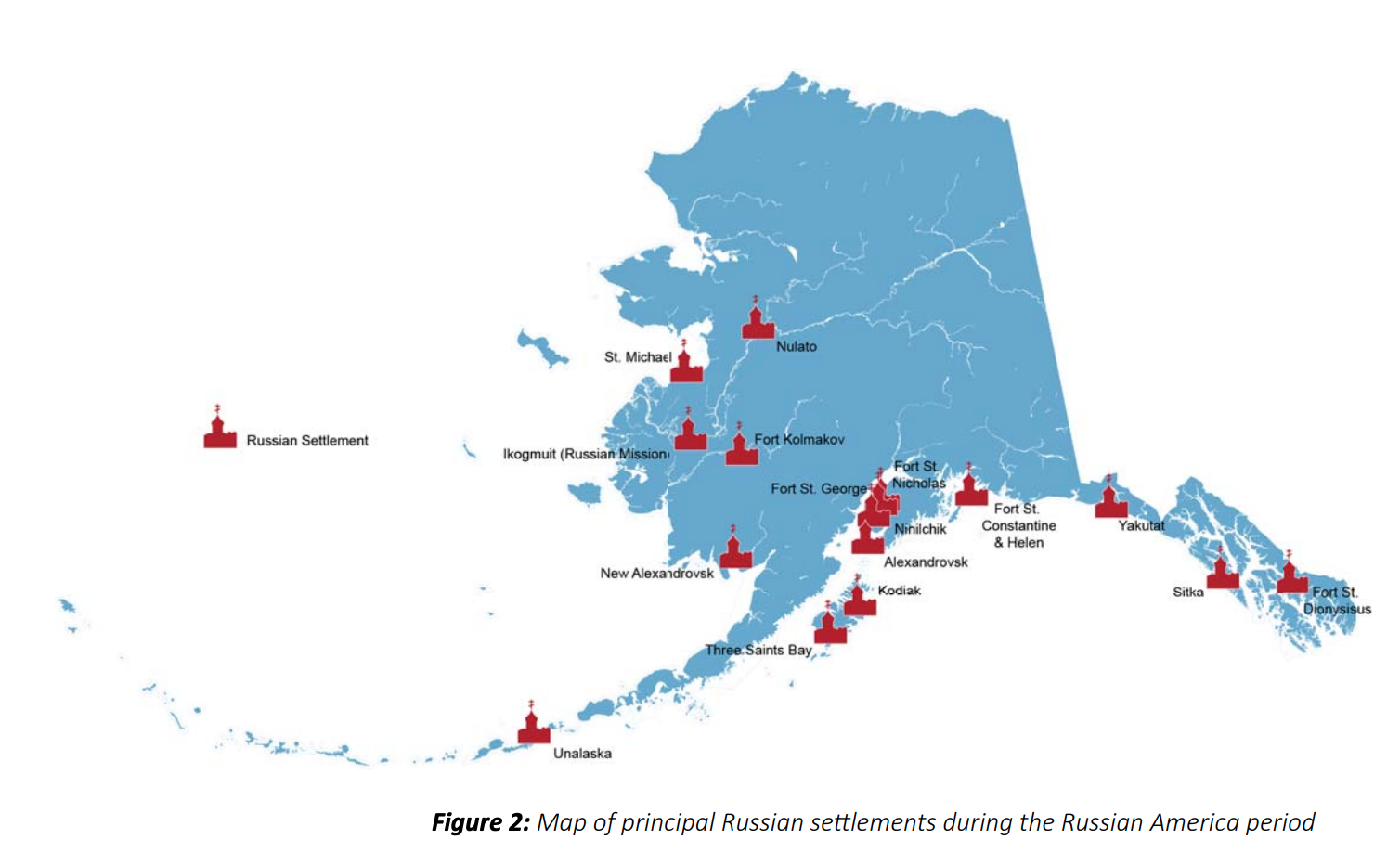
Russia made the first attested European contact with Alaska in 1741 and claimed the territory as its own in 1799. But, this claim didn't really correspond to the facts on the ground:
On maps of that time period, Russia was in control of the entire landmass that became Alaska, but in truth their direct control varied from heavy-handed to nonexistent. In the Aleutians, the Unangans were subjugated by force and made to hunt sea otters for the Russian fur trade. Other areas, including the Arctic region and inland rivers areas, saw little if any Russian presence. . . . 
During the entire period of Russian colonization . . . the Russian footprint remained minimal to nonexistent in several areas of Alaska, including much of the arctic and upriver areas of the Yukon Basin.

The first large scale enumeration ordered in 1819 counted 14,019 people in Russian America, 391 of whom were Russian. This count did not include anyone in interior, arctic, or western Alaska north of the Alaska Peninsula. . . . 

Father Ioann Veniaminov, a Russian Orthodox missionary and scholar who later became Bishop Innocent, produced an estimate of 39,813 people for Russian America in 1839. Noticeably higher than other Russian counts and estimates, Veniaminov surmised that beyond those areas known, 17,000 people had not been contacted yet. He estimated 7,000 people lived along the Kuskokwim River and 5,000 Tlingit lived in Southeast, the most populated areas in Alaska. He put the total number of Russians at 706, with 1,295 “Creoles,” or those born of Russian and Native parents. Before the sale of Alaska, Russian-American Company population numbers compiled from 1830 to 1863 show Alaska’s population ranged between 11,022 and 7,224. Though the estimates of Alaska Natives were low, the report also listed the peak Russian population in the territory at 823 in 1839. 
In the 1880 census, only 1.3% of people residing in Alaska (430) were white, of whom 68% (293) lived in Southeast Alaska, mostly in the capital of Sitka (157) and the old fortress town of Wrangell (105). 

In the 1890 census, 13.5% of people residing in Alaska were white, 53% of whom were only living in Alaska temporarily, mostly as canning workers in Southeast Alaska.

There wasn't a really significant population with European ancestry in what is now Alaska until well into the 1890s. This first large scale surge in Alaska's European ancestry population was a direct result of the 1896 gold strike in the Klondike region of the Yukon Territory.

From the 1900 census to the 1940 census, the percentage of the Alaska population that was white hovered just above and just below 50% (breaking 50% for the first time in 1910, dipping below 50% in 1930, and exceeding 50% in all subsequent years).

Alaska is currently about 60% non-Hispanic white, but only about 50% of children born in Alaska are non-Hispanic white. 

Non-Hispanic whites in Alaska are a plurality in the Southeastern part of the state from a little west of Anchorage to the east and a bit to the north up to the Canadian border and along the Pacific coast to the South (i.e. basically in places with higher population densities).

Other Races and Ethnicities In Alaska

About 18% of Alaskans are currently neither non-Hispanic white nor Alaska Native (solely or in connection with other ancestry). 

About 7% are Hispanic (5% of Alaskans are Hispanics who whom identify racially as white, and less than 2% of whom identify as something else racially including Asian or black), about 8% are Asian or Pacific Islander,  about 4% are black, and less than 0.5% have two or more races that are not Alaska Native. 

The subtotals add up to more than 18% due to rounding issues, due to the fact that some Alaska Natives are people with two more more races who are black, Asian, or Pacific Islanders (mostly Filipinos), and because some black, Asian, and Pacific Islander Alaskans are also Hispanic.

In 2010, two-thirds of Asians, Native Hawaiians, and Pacific Islanders in Alaska were Filipino, and as of 2020 at least half are Filipino. 30%-50% of the population (varying by region) of the Aleutian Island region of Alaska. are Asians, Native Hawaiians, and Pacific Islanders.

Fossil Fuel Economics

Alaska has the third highest revenues from fossil fuel production per capita in the United States at about twenty-thousand dollars per capita, behind only number one Wyoming and number two North Dakota. Alaska is heavily dependent upon the oil and gas industry for tax revenues.

Alaska pays every man, woman, and child who resides there full-time $1,114 per year, no strings attached, from the "Alaska Permanent Fund" of banked proceeds from its oil and gas revenues. It also has no personal income tax.

Alaska and Hawaii are the only U.S. states that generate a significant share of their electricity with petroleum.

More of Alaska is roadless than any other U.S. state.

23 March 2022

Mariupol

Some of the worst fighting in Ukraine has taken place in Mariupol, a port city on the Aral Sea costs between Crimea and the parts of Eastern Ukraine that Russian allied insurgents have held since 2014. 

Here's the latest news on that part of the conflict:

In the last update from Mariupol officials, they said March 15 that at least 2,300 people had died in the siege. Accounts from the city suggest the true toll is much higher, with bodies lying uncollected. Airstrikes over the past week destroyed a theater and an art school where many civilians were taking shelter.

Zelenskyy, in his address, said more than 7,000 people were evacuated from Mariupol on Tuesday. But about 100,000 remain in the city “in inhuman conditions, under a full blockade, without food, without water, without medicine and under constant shelling, under constant bombardment,” he said.

Before the war, 430,000 people lived in Mariupol.

Like Zelenskyy, the Red Cross said a humanitarian aid convoy trying to reach the city with desperately needed supplies had not been able to enter.

Perched on the Sea of Azov, Mariupol is a crucial port for Ukraine and lies along a stretch of territory between Russia and Crimea. The siege has cut the city off from the sea and allowed Russia to establish a land corridor to Crimea.

But it’s not clear how much of the city Russia holds, with fleeing residents saying fighting continues street by street.

A senior U.S. defense official, speaking on condition of anonymity to give the Pentagon’s assessment, said Russian ships in the Sea of Azov have now joined in the shelling of Mariupol. The official said there were about seven Russian ships in that area, including a minesweeper and a couple of landing vessels.

Ukraine’s Defense Ministry said that troops defending the city had destroyed a Russian patrol boat and electronic warfare complex.

Those who have made it out of Mariupol told of a devastated city.

“They bombed us for the past 20 days,” said 39-year-old Viktoria Totsen, who fled into Poland. “During the last five days the planes were flying over us every five seconds and dropped bombs everywhere — on residential buildings, kindergartens, art schools, everywhere.”

22 March 2022

Geopolitical Musings

The U.S. urgently needs to restore some of its soft power. It has fallen off the wagon of being a country the rest of the world looks up to, and has instead become a cautionary tale.

One doesn't have to be terribly altruistic or idealistic to think so. The single biggest determinant of who wins wars is the allies that each side has in the fight.

Although, the way that you fight when you are the powerful party and the way you fight in an asymmetric battle as the weaker party is very different.

One of the major lessons of the Ukraine war is that the Russian military's conventional warfare capabilities are far inferior to what had been widely believed. While Russia has some advanced weapons, it has proportionately far fewer, its troops are much less well trained, and its leaders are less competent.

The good news that flows from this fact is that everyone can be much more comfortable that the Western European powers, a coalition that has grown larger in the post-Soviet era, together with the U.S. and Canada, would soundly defeat Russia and its handful of allies in a conventional war.

The bad news that flows from this fact is that Russia will be inclined in future conflicts as it has in this one, to maximize the leverage that it has available to it from its possession of nuclear weapons by threatening to use them and possibly by actually using them.

The temptation for Russia to use them will grow even greater because its global economic and diplomatic clout have been greatly undermined by sanctions and boycotts in response to its invasion of Ukraine, and because the rest of the world has been forcefully encouraged to become energy independent of Russia, since energy is the main thing that the rest of the world relies upon it for.

A major development this week has been an act of sabotage by Belorussian railway workers, shutting down rail based logistics support from Belorussia to Russian forces in Ukraine. As sanctions have impaired the quality of life in Russia, and the intelligentsia, as well as many of the powerful and the rich in Russian who aren't in Putin's inner circle, have found themselves out of the loop, dragged into a war that isn't in their own interests, and at grave peril of persecution both from within Russian for dissent, and outside Russia for loyalty, the stream of Russia's best and brightest out of their country is giving rise to brain drain.

The voluntary exile of dissenters and opponents from Russia, together with crackdowns on those who dissent without leaving, will no doubt help Putin to consolidate power at home, as will the fact that the world seems united against Russia providing a bond to those facing this outside action. But it also means the Russia's economy and society will be much weaker for it, and that untold Russian secrets are escaping to the outside world.

Ten million Ukrainians, roughly a quarter of its population, are now refugees too. It appears that those refugees are disproportionately women and children, with far more than a quarter of them departed. According to a news report from today:

Russian forces appeared unprepared and have often performed badly against Ukrainian resistance. The U.S. estimates Russia has lost a bit more than 10 percent of the overall combat capability it had at the start of the fight, including troops and tanks and other materiel. Western officials say Russian forces are facing serious shortages of food, fuel and cold weather gear, leaving some soldiers suffering from frostbite. . . .

Thousands of civilians are believed to have died. Estimates of Russian military casualties vary widely, but even conservative figures by Western officials are in the low thousands.
On Monday, Russia’s pro-Kremlin Komsomolskaya Pravda newspaper, citing the Defense Ministry, reported that almost 10,000 Russian soldiers had been killed. The report was quickly removed, and the newspaper blamed hackers. The Kremlin refused to comment. The Western official said the figure is “a reasonable estimate.”

Russian forces aren't gaining much ground, basically having been stalled out for weeks, but also aren't ceding much ground to Ukraine's offensives. The air space over Ukraine remains contested with daily dog fights between fighter aircraft on both sides and Ukrainian forces harrying Russian aircraft with anti-aircraft missiles.

Russia's poor military performance in Ukraine doesn't just undermine its credibility in future conflicts either. It also depletes Russia's finite resources of military equipment like tanks, warplanes, military helicopters, missiles, and soldiers, especially in the European theater, leaving it less ready for any sequel European conflict to the war in Ukraine. With a weak economy and isolation from international trade, Russia won't be able to easily replace that lost equipment, and it appears to be short of qualified troops to fill the gap as well.

A Russia isolated from the outside world by sanctions and boycotts will still never be as insular as North Korea or Soviet era Albania. But economic isolation and brain drain will dampen its economy and impair its technological capacity. 

True to type, Russia will probably try to shift a larger share of its economy to military spending while dealing with a shrinking economy with reduced consumer spending, as unpleasant as that will be for ordinary Russians. But even so, its resources for military spending will be limited and the military goods it can produce will be degraded.

All of this will leave Russia with few options to exercise power other than its nuclear arsenal, much like North Korea, but far more potent, and apparently with a leader who seems to be going mad and disconnecting  his entire country from reality, as his grand vision for Russia has turned to ash.

It looks as if even Russian-Chinese relations are falling apart. China's society is healthier and the rest of the world's trade means much more to it than Russia's does. Talk of a Chinese pivot towards the West and away from Russia is growing. China is increasingly surpassing Russia as the number one non-Western power in the world.

China's society may be awash in reality challenged propaganda from top to bottom as well. But its leaders, unlike Putin, do not appear to be crazy.

it seems that there is no foreseeable hope of revolution from within to bring about regime change in North Korea. It is less clear if this is a possibility in Russia, despite the current dominance of the United Russia party and Putin. In particular, in areas where Russia thought it had put down insurgencies for good in the past may, in the face of a perception that Russia's military is overtaxed and the regime is weak, some of those insurgencies could reignite, leading Putin to be more embattled and more prone to take ruthless action.

Also, despite the fact that the leadership in Belorussia has kowtowed to Russia to the point of practically rejoining it in a union again, and despite the fact that the Belorussian leadership has been drifting in a totalitarian direction, it seems from some things I've read that its leadership is much less secure, even if it can swiftly be replaced with the normal democratic process. And, Belorussia is facing many of the same economic sanctions and boycotts that Russia is from its collaboration with Russian in its invasion of Ukraine.

Of course, whatever upside Russia had hoped to gain from its invasion of Ukraine seems to have largely evaporated. International recognition of a bit more Ukrainian territory in areas that are heavily ethnically Russian, a withdrawal of its forces from the remainder of Ukraine, and a partial relaxation of sanctions and boycotts, is probably the best outcome it could hope for at this point, and that is far from a sure thing. Russia has already irrevocably lost more than it can reasonably hope to gain.

In an ideal world, all countries of the world would learn from Russia's debacle in Ukraine that unprovoked invasions of other countries don't pay.

And, let's be honest. While not quite as brazen, U.S. invasions of Iraq and Afghanistan weren't terribly honorable or well justified either (and who knows what the U.S. was thinking in the Gulf War when it sought to protect a slave holding monarchy in Kuwait from an Iraqi invasion). But, it isn't as if the U.S. benefitted all that much from those wars either.

When the U.S. finally withdrew from Afghanistan last year, the Taliban regime that had been on the verge of ruling the country promptly replaced the regime the U.S. and its allies had put in place in a matter of days and now rules the entire country. I'm hard pressed to explain how the U.S. benefited from the Iraq War, or the Gulf War, either.

Both wars provided a sandbox for the U.S. and its allies to sharpen their military acumen. But these wars were extremely expensive. The Iraq War gave rise to the Islamic State as a major global adversary. Afghanistan and the Iraq War combined have defanged for Iraq, its most threatening neighbors in both directions.

The U.S. has also gains little or nothing from providing military aid to Saudi Arabia, which is not its friend and is using those military resources to fight a proxy war with Iran in Yemen with horrific humanitarian consequences.

The cost of these foreign wars to the U.S. in lives lost has been relatively modest for two decades of war, although it hasn't been nothing. But the money the U.S. has spent to fight these wars and prepare to fight more wars has been immense. One doesn't have to be a pacifist to recognize that we could spend less and yet use U.S. military might in a way that provides us with greater security benefits.

So, returning to the core questions:

1. How can the U.S. restore its soft power and become a global model again?

2. What is the best way to deal with a nuclear armed and unpredictable and aggressive Russia that is starting to collapse and become dangerous out of desperation?

3. How can the U.S. reduce the immense expense it continues to incur for the military and stop fighting wars it does not benefit from, while remaining capable of military operations that make sense for it?

4. Can the U.S. lure China more into the fold of the developed world? How?

Selected Republicans And Republican Candidates For Office

* This is a sitting Republican U.S. Senator from Indiana:
U.S. Sen. Mike Braun: SCOTUS should leave abortion, interracial marriage to states.
(Source NPR affiliate WFYI of Indianapolis). Note also that U.S. Supreme Court Justice Clarence Thomas is in an interracial marriage.

* At least four notable GOP candidates this election cycle have horrific histories of domestic violence.
Missouri's US Senate hopeful Eric Greitens . . . had to resign as governor after a woman accused him of tying her up and taking her photograph as potential blackmail material if she told anyone about their affair. But the AP got its hands on an affidavit filed by Greitens's ex-wife Sheena Greitens in the custody dispute over their two children, and it is really, really ugly.

Prof. Greitens, a China expert who relocated to Austin where she teaches at the University of Texas, did manage to extricate herself and her children from the marriage. But now her ex-husband is seeking custody of the children, and she's alleging a shocking pattern of abuse at the end of their relationship.

“Prior to our divorce, during an argument in late April 2018, Eric knocked me down and confiscated my cell phone, wallet and keys so that I was unable to call for help or extricate myself and our children from our home,” she wrote. “I became afraid for my safety and that of our children at our home.”

She went on to describe “behavior [that] included physical violence toward our children, such as cuffing our then-3-year-old son across the face at the dinner table in front of me and yanking him around by his hair.”

For the record, Greitens denies the allegations.

“His ex-wife is engaged in a last-ditch attempt to vindictively destroy her ex-husband,” the candidate's spokesman Dylan Johnson told the AP. “Eric has always been a great Dad, who loves his boys and has always put them first, and that is why he is filing for full custody of his children.”

Prof. Greitens describes the ex-governor as becoming mentally unstable as his political fortunes unraveled, threatening to harm himself if she didn't publicly support him and implying that he might hurt the children if she didn't do what he asked. 
At one point, Eric Greitens made a reference to the fact that he had the children — and she didn’t — while trying to persuade Sheena Greitens to delete emails she had sent to the family therapist seeking help, according to the affidavit.

“Eric threatened to accuse me of child abuse if I did not delete the emails and convince the therapist to delete them,” she wrote.
The professor also describes her ex-husband hiding a gun in the house, so that “multiple people other than myself were worried enough to intervene to limit Eric’s access to firearms.”
Senate candidate Sean Parnell dropped out of the race in Pennsylvania in November after similar allegations of spousal and child abuse by his ex-wife. Not to be confused with Herschel Walker in Georgia, whose ex-wife alleged pervasive abuse during their marriage, including having him hold a gun to her head and threatening to "blow her fucking brains out." Or Max Miller, a congressional candidate in Ohio, who White House comms flack Stephanie Grisham alleges abused her during their relationship.

From Wonkette (if you don't trust it, click through to the sources linked).

* Trump's former chief of staff appears to have engaged in voter registration fraud. "North Carolina state investigators have launched an investigation into Mark Meadows’ voter registration after reports raised questions about the former White House chief of staff’s status." He appears to have engaged in voter registration fraud.

* Mesa County, Colorado Clerk Tina Peters, who is a Republican candidate for Secretary of State (the chief elections officer in Colorado), and her Deputy County Clerk Belinda Knisley, have been indicted (in charges brought by Mesa County's Republican District Attorney) of multiple counts of election administration related crimes. Peters also faces contempt of court charges for violating a court order and then  lying to a judge about it, in a related proceeding. She has a decent chance of becoming the GOP nominee for Secretary of State in Colorado (More details here). The same source notes that:
Another Colorado clerk — Dallas Schroeder of Elbert County — has also admitted to making two copies of his county’s voting system hard drive. Schroeder said he gave one copy to his own attorney and another to an unidentified “private attorney.” 
Griswold filed a lawsuit in February to force Schroeder to name the private attorney, retrieve the copies of the hard drives and provide copies of communications with non-county employees who assisted Schroeder in making the copies. She argued that Schroeder’s behavior had created “an ongoing risk that the copies of the voting system ... are being exploited by unknown actors to uncover system vulnerabilities that might be used to undermine voters’ confidence in Colorado’s secure elections.” 
In court documents, Schroeder’s lawyer has said that he believes his actions were “authorized by law and appropriate under the circumstances to preserve election records of the November 2020 election.”

* A conservative and Republican led school board majority in Douglas County, Colorado, an affluent and conservative exurb of Denver, has been placed under a preliminary injunction for conduct violating the state's open meetings law

* Then there is this guy: "Michigan GOP candidate says he tells daughters to ‘lie back and enjoy it’ if rape is inevitable. Robert Regan, a Republican favored to win a seat in the Michigan House, made the comments while trying to make an analogy about abandoning efforts to decertify the 2020 election."

* Colorado's representative in Congress from the 3rd Congressional District (mostly representing Colorado's Western Slope) "Lauren Boebert says, like Ukraine, Canada and U.S. ‘need freedom and need to be liberated’" She didn't get a high school diploma and earned her GED a month before the 2020 primary. She and her husband both have minor criminal records. She disgraced Colorado with disorderly conduct during the State of the Union speech this year. She has been fined for violating U.S. House rules like a ban on carrying firearms on the floor of the U.S. House and not wearing masks on the U.S. House floor. The list of her infamous acts could continue for a long time and include some probably collusive acts with the January 6 capitol rioters (more than 700 of whom are now facing criminal charges). She makes up fake military ranks (note that she votes on the U.S. Defense Budget).

* A former Presidential candidate for the Republican Party despairs that: "'I've got morons on my team': Romney blasts fellow GOP members for attending White nationalist event and supporting Putin":
Republican Sen. Mitt Romney of Utah on Sunday blasted his fellow GOP members who attended a White nationalist event and those who support Russia President Vladimir Putin as the country invades Ukraine
"Look, there is no place in either political party for this White nationalism or racism. It's simply wrong ... it's evil as well," Romney told CNN's Dana Bash on "State of the Union." "(Rep.) Marjorie Taylor Greene and (Rep.) Paul Gosar, I don't know them, but I'm reminded of that old line from the 'Butch Cassidy and the Sundance Kid' movie where - where one character says, 'Morons, I've got morons on my team.' And I have to think anybody that would sit down with White nationalists and speak at their conference was certainly missing a few IQ points." 
The comment from Romney follows criticism from Wyoming Rep. Liz Cheney, a Republican, of Reps. Marjorie Taylor Greene of Georgia and Paul Gosar of Arizona for speaking at the America First Political Action Conference that took place in Orlando, Florida and was organized by White nationalist Nick Fuentes. Illinois Rep. Adam Kinzinger, also a Republican, criticized Greene and Gosar. Greene spoke at the event in person and Gosar, who attended the same conference last year, appeared through pre-recorded remarks.

"As Rep Marjorie Taylor Greene and Rep Paul Gosar speak at this white supremacist, anti-Semitic, pro-Putin event, silence by Republican Party leaders is deafening and enabling," Cheney tweeted Saturday. "All Americans should renounce this garbage and reject the Putin wing of the GOP now."

Marjorie Taylor Greene was in concert with Lauren Boebert in their State of the Union mischief and has, if I recall correctly, been censured by the U.S. House for violent threats directed at other U.S. House members.

* In El Paso County, Colorado, first-term incumbent GOP Rep. Mary Bradfield representing southeastern Colorado Springs"narrowly missed making this year’s Republican primary ballot, losing at the GOP assembly on Saturday to an intra party challenger [Karl Dent] who was convicted in August of felony trespassing and who currently faces misdemeanor charges including allegedly violating a protection order. . . . In addition to the less than a year old felony conviction for trespassing, Dent is also reportedly facing misdemeanor animal cruelty charges, and yet another charge for violating a protection order granted to an ex-girlfriend."

* And to close today's selective recount, here's a reminder that criminal activity by politicians is not a bipartisan matter, in which both major parties are equivalent:

21 March 2022

U.S. Sentencing Commission Facts

This U.S. Sentencing Commission summary also says a lot about the federal criminal justice system more generally, even though it is out of commission due to vacancies.
The Sourcebook presents information on the 57,287 federal offenders sentenced in FY21 (October 1, 2020 through September 30, 2021)—a sentencing caseload that decreased by more than 7,000 from the previous fiscal year.

* Drug trafficking, immigration, firearms, and fraud crimes together comprised 83% of the federal sentencing caseload in FY21.

* Drug trafficking was the most common federal crime type sentenced, accounting for 31% of the caseload.

* Immigration cases accounted for the next largest group (30%) but decreased by more than one-third from the number of those cases in FY20.

* Methamphetamine continued to be the most common drug type in the federal system, and a steadily growing portion of the drug caseload (up from 31% of drug cases in FY16 to 48% in FY21).

* In FY21, Fentanyl moved into the top five drug types in the federal caseload. The Commission has added it to the Drug Offenses section of the Sourcebook. Methamphetamine trafficking continued to be the most severely punished federal drug crime (90 months).

* Two-thirds (67%) of drug offenders were convicted of an offense carrying a mandatory minimum penalty, holding steady from the previous year.

* 69% of federal offenders were sentenced under the Guidelines Manual (either within range or outside the range for departure reasons in the manual).

* The Annual Report presents an overview of the Commission's work in FY21.
Beginning in FY21 and continuing into FY22, the Commission has operated with only one voting commissioner, lacking the quorum required to promulgate guideline amendments. The Commission’s other statutory duties are unaffected by the lack of four voting commissioners.

Maybe Lower BAC Standards Don't Really Work That Well

Utah's decision to lower the blood alcohol content necessary to constitute a drunk driving offense greatly reduced reported accidents. But a closer look at the data suggests that the main reason is that people are less likely to report minor accidents in urban areas on weekdays, not an actual reduction in accidents.
In March of 2017 Utah became the first state in the United States to lower the legal blood alcohol content (BAC) for driving from 0.08 to 0.05 g/dL. We take advantage of the fact that enforcement was delayed until 2019 to test whether this policy change significantly affected the number of traffic accidents or the severity of those accidents. We employ a difference-in-differences strategy on Utah counties using neighboring states as controls. Results show the policy appears to decrease the total number of accidents in urban counties, limited primarily to property damage only accidents. Surprisingly, the strongest effects are found during weekday days. We confirm our findings using a synthetic control and a doubly robust difference-in-differences estimator. We believe these results may be partially explained by drivers who, after the policy is enacted, avoid reporting property damage only accidents if possible.
Javier E. Portillo, et al., "Drink...then Drive Away: The Effects of Lowering the BAC in Utah" (March 15, 2022).

Pretrial Juvenile Detention Is Common But Clearly Counterproductive

Empirical evidence shows that pre-trial juvenile detention is common and is strongly counterproductive.
Roughly one in four juveniles arrested in the U.S. spend time in a detention center prior to their court date. To study the consequences of this practice for youth, we link the universe of individual public school records in Michigan to juvenile and adult criminal justice records. Using a combination of exact matching and inverse probability weighting, we estimate that juvenile detention leads to a 31% decline in the likelihood of graduating high school and a 25% increase in the likelihood of being arrested as an adult. Falsification tests suggest the results are not driven by unobserved heterogeneity.
E. Jason Baron, Brian Jacob & Joseph P. Ryan, "Pretrial Juvenile Detention" NBER WORKING PAPER 29861 (March 2022) DOI 10.3386/w29861

Colorado Supreme Court Favors Weaker Interpretation Of Governmental Immunity

In the case of Cisneros v. Elder, 2022CO13, the Colorado Supreme Court today chose an interpretation of the state's governmental immunity statutes that is less protective of jail guards. The official syllabus states:
In this case, the supreme court considers whether section 24-10-106(1.5)(b), C.R.S. (2021), of the Colorado Governmental Immunity Act ("CGIA") waives sovereign immunity for intentional torts that result from the operation of a jail for claimants who are incarcerated but not convicted.

The court now concludes that section 24-10-106(1.5)(b) waives immunity both for intentional torts and for acts of negligence resulting from the operation of a jail for claimants who are incarcerated but not convicted. In reaching this determination, the court concludes that the statutory language waiving immunity for claimants who "are incarcerated but not yet convicted" and who "can show injury due to negligence" sets a floor, not a ceiling.

In contrast, in many circumstances, governmental immunity is waived for negligent acts of governments and government officials that cause injury, but not for intentional acts.  

The Colorado Supreme Court also rejected the argument that governments themselves should not be responsible for the intentional wrongs of their employees, basically on that theory the intentional wrongs are beyond the scope of the authority of these officials and that suing particular government employees for "willful and wanton" acts is expressly permitted in Colorado under CGIA. In this case, the court reasoned, the government was not being held vicariously liable for the willful and wanton misconduct of its employees, but for its own intentional wrongs as a matter of policy.

The underlying case involved the El Paso County Sheriff refusing to release an inmate who had posted bail, without authorization to do so, in connection with an alleged immigration hold that was held to be improper in separate litigation  resulting in the inmate's release four months later. 

The inmate was represented by the Colorado ACLU and Holland & Hart, LLP, one of the largest law firms in the state (presumably pro bono).

The decision of the Colorado Supreme Court was unanimous and followed a 2-1 decision against the inmate in the Colorado Court of Appeals which was reversed.

The damages in this individual case aren't huge, perhaps a few hundred thousand dollars at most, and possibly much less. But, the principal will probably significantly influence how sheriffs manage jails in Colorado going forward.

18 March 2022

The War In Ukraine After Three Weeks

The Russian invasions of Ukraine is three weeks old. Enough time has passed to make some preliminary assessments.

The Russian military is "hollow". 

Russia has far fewer guided missiles and "smart bombs" than the U.S. or other developed nations, and apparently used up much of its supply in the first day or two of this conflict.

Russia's pilots are only minimally trained, Russian forces weren't patient enough to wait until they had air superiority, and the widespread availability of MANPADS among Ukrainian forces (infantry carried anti-aircraft missiles) have all worked together prevent Russia from gaining air superiority and control in Ukraine. This deprived Russia of an edge in the conflict could have had a decisive advantage for their forces if it had been secured.

Russia's logistics planning is horrible. Its forces were literally running out of gas, running out of food, and getting lost in the first few days. Ukrainian forces have targeted the "tow trucks" used for heavy military vehicles that are disabled and fuel and supply trucks, that are more vulnerable, for strikes to prevent their advance, and have been quite effective at doing so.

Despite their treads, tanks overwhelmingly stay on main roads, leaving their column exposed to attack.

An expectedly large share of Russian tanks and artillery are very dated models.

The best available data suggests that something on the order of half of Russian tanks deployed in this mission have been destroyed, as well as many armored personnel carriers and some mobile artillery vehicles. The large number of small, anti-tank missiles available to Ukrainian forces have been an important factor on this front.

Russian forces have lost significant numbers of fixed wing warplanes and military helicopters, maybe two dozen, all told.

About one in seven Russian soldiers have been killed or seriously injured in this conflict so far. About one in twenty-five of its generals have been killed.

It does not appear that either side has been able to use their tanks to secure decisive victories.

About a quarter of Russian soldiers are minimally trained and marginally competent conscripts. They are not properly trained to defend themselves against reasonably competent attacks or otherwise.

Inaccurate and indiscriminate unguided howitzer shell attacks that hurt civilian and military targets alike instilling terror in the general population, and indiscriminate bombing by fighter aircraft with "dumb bombs" are shaping up to be some of the characteristic tactics of the Russian invasions. But this has not been cost free. It has painted Russian troops from Putin to the rank and file Russian soldiers in Ukraine as war criminals. These tactics have unified the Ukrainian people against the Russia. These tactics have helped cement global public opinion against Russia.

Russia's substantial Black Sea naval forces have done very little after the first day or two when they were part of a campaign to launch missiles all over Ukraine. They have not been used for fire support for ground troops and do not appear to have been important in making amphibious assaults. There has been essentially no naval warfare so far.

Russia already controlled Crimea and the Donbas region in Eastern Ukraine, immediately prior to its invasion. As shown on the map below, Russia has crept a few miles past the Russian-Belorussian border in the north, has gained control of a narrow strip of Ukraine's Aral Sea coast,  and has gained control of some territory immediately adjacent to Crimea. But they have been stalled in the suburbs of the capital city Kyiv for three weeks. 

Overall Russia's territorial gains over the last three weeks have been very modest and have been largely confined to areas with substantial Russian minorities, despite the very heavy toll that Russian forces have suffered in both casualties to their troops and destroyed major military systems. 

Even if Russia manages to eventually take Kyiv, that would be a pyrrhic victory, as it seems highly unlikely that this would result in regime change in Ukraine or in giving Russia control over the vast majority of Russian territory. It is hard to imagine a scenario at this point in which Russia could secure regime change in Ukraine or could control anything close to the majority of the territory or population of Ukraine.

This is a map of the territory Russia controlled on March 17, 2022 (yellow dots indicate recent battles):


This is a map of territory that Russia controlled on March 7, 2022, ten days earlier, with the shaded and striped areas being territory that Russia controlled immediately prior to the invasion.


It is quite clear that Russia has gains only a little ground in the last ten days, and only a modest share of Russian territory at all since the invasion began.

The credibility of Russia's conventional military forces as a tool in diplomatic negotiations has been dramatically undermined. Unless Russia can make quick and remarkable gains relative to what it has achieved in the last three weeks, the credibility will only be diminished further as time passes.

The losses of equipment and personnel that Russia has suffered in its invasion has significantly degraded the capabilities of Russia's military as a whole, at least in the short term. The longer Russia continues to try to fight in Ukraine, the weaker it military capacity to fight other conventional wars in the near future will be.

Unprecedented international sanctions and boycotts are seriously harming Russia's economy and daily life for ordinary Russians. 

International trade in anything other the natural gas exports, air travel in and out of Russia, foreign investment, and international financial transactions have basically ground to a halt. The ruble has plunged in value. Interest rates have surged to 20%. Russian's can't trade stocks domestically and have only limited access to their bank accounts. Russia narrowly avoided a default on its sovereign debt this week. Foreign Russian assets of Russia, its political leaders, and its oligarchs have been frozen. China is preparing to cooperate with international sanctions against Russia because it needs trade with the rest of the world more than it needs Russia. Russia has been closed out of international sporting and cultural exchanges. Access to foreign media and entertainment has been shut down.

Even if sanctions and boycotts are formally lifted, the developed world and global big business has collectively concluded that the political risk associated with doing business in and with Russia is prohibitively high. As a result, it may take a decade or more for Russia to recover economically from the side effects of its invasion of Ukraine, even if the war ends swiftly, unless Russia experiences regime change.

Russia's "liberal intelligentsia" is fleeing Russia in droves, resulting in a massive brain drain from Russia. They are leaving mostly by car and train to neighboring countries,  some of which were formerly Soviet Republics, before the borders are sealed or these individuals who rarely supported the invasion in the first place and didn't think that Putin would go as far as he did, are persecuted themselves. This may help Putin continue to consolidate power as dissenters self-deport themselves, but it will do grievous harm to the Russia's medium to long term future as a country.

Europe has been given a powerful nudge to reduce its reliance on Russian oil and Russian natural gas in the long run. This will do serious long term, irreversible harm to Russia's predominantly export industry.

Europe and the rest of the world have mostly united around strong opposition to Russia's invasion.

How Russia will use its nuclear arsenal, as it has threatened to do, is the elephant in the room. This is the main reason (together with the dependency of countries like Germany and Italy on Russian natural gas) that other countries haven't directly intervened militarily.

Ukraine is more united as a single country than it ever has been in the past, and pro-Russian political forces in the country pre-invasion, have been completely undermined.

Ukraine is suffering immense property damage, significant although not nation changing loss of life, significant loss of military equipment (although foreign aid is making up for some of that), and an indefinite major refugee crisis that is sending more than 10% of the country's population fleeing abroad.

Global food prices will soar from now until a year or two after the war is over, because Ukraine is a major exporter of food that can't pay attention to farming right now.

Other countries bordering Russia are fortifying collective European defense measures and are studying the tactics hat have been effective against Russia in this war so that they can better repel those tactics in future conflicts.

17 March 2022

Why Does Oklahoma Have A Panhandle?

This meme isn't true. But the real story is interesting.


The Oklahoma Panhandle derives from one of those "how sausages are made" stories of the legislative process and the sustained fights in Congress over slavery prior to the Civil War. It started with the Missouri Compromise (requiring new northern states over a certain line of latitude to be "free states"). 

This affected the efforts of Texas to be admitted to the United States as a slave state, which gave rise to the Compromise of 1850 that had Texas cede the portions of its territory that violated the Missouri Compromise and tweaked eastern boundary of what would become New Mexico.

Also, the drafting of the Kansas-Nebraska Act of 1854 was sloppy. It really should have extended the Kansas border further South to the Missouri Compromise line at the 36°30' parallel north. A bill that passed by both houses of Congress, that was vetoed for some reason that isn't obvious by President Garfield in 1886, would have moved the boundary of the Kansas territory south to the Missouri Compromise line.

If this had been done, then what is now the Oklahoma Panhandle would very likely have become part of Colorado and not Oklahoma.


Wikipedia tells the story of how the Oklahoma Panhandle came to be:
The Oklahoma Panhandle (formerly called No Man's Land, the Public Land Strip, the Neutral Strip, or Cimarron Territory) is the extreme northwestern region of the U.S. state of Oklahoma, consisting of Cimarron County, Texas County and Beaver County, from west to east. 
. . .

The Western history of the Panhandle traces its origins as being part of New Spain. 
The Adams–Onís Treaty of 1819 between Spain and the United States set the western boundary of this portion of the Louisiana Purchase at the 100th meridian. With Mexican independence in 1821, these lands became part of Mexico. With the formation of the Texas Republic, they became part of Texas. When Texas joined the U.S. in 1846, the strip became part of the United States.

. . .

When Texas sought to enter the Union in 1845 as a slave state, federal law in the United States, based on the Missouri Compromise [of 1820], prohibited slavery north of 36°30' parallel north. Under the Compromise of 1850, Texas surrendered its lands north of 36°30' latitude. The 170-mile strip of land, a "neutral strip", was left with no state or territorial ownership from 1850 until 1890. It was officially called the "Public Land Strip" and was commonly referred to as "No Man's Land." The Compromise of 1850 also established the eastern boundary of New Mexico Territory at the 103rd meridian, thus setting the western boundary of the strip. The Kansas–Nebraska Act of 1854 set the southern border of Kansas Territory as the 37th parallel. This became the northern boundary of "No Man's Land." 
When Kansas joined the Union in 1861, the western part of Kansas Territory was assigned to the Colorado Territory but did not change the boundary of "No Man's Land."

After the Civil War, cattlemen moved into the area. Gradually they organized themselves into ranches and established their own rules for arranging their land and adjudicating their disputes. There was still confusion over the status of the strip, and some attempts were made to arrange rent with the Cherokees, despite the fact that the Cherokee Outlet ended at the 100th meridian. In 1885, the U. S. Supreme Court ruled that the strip was not part of the Cherokee Outlet. In 1886, Interior Secretary L. Q. C. Lamar declared the area to be public domain and subject to "squatter's rights". The strip was not yet surveyed, and as that was one of the requirements of the Homestead Act of 1862, the land could not be officially settled. Settlers by the thousands flooded in to assert their "squatter's rights" anyway. They surveyed their own land and by September 1886 had organized a self-governing and self-policing jurisdiction, which they named the Cimarron Territory. Senator Daniel W. Voorhees of Indiana introduced a bill in Congress to attach the so-called territory to Kansas. It passed both the Senate and the House of Representatives but was not signed by President Grover Cleveland. The organization of Cimarron Territory began soon after Secretary Lamar declared the area open to settlement by squatters. The settlers formed their own vigilance committees, which organized a board charged with forming a territorial government. The board enacted a preliminary code of law and divided the strip into three districts. They also called for a general election to choose three members from each district to form a government. The elected council met as planned, elected Owen G. Chase as president, and named a full cabinet. They also enacted further laws and divided the strip into five counties (Benton, Beaver, Palo Duro, Optima, and Sunset), three senatorial districts (with three members from each district), and seven delegate districts (with two members from each district). The members from these districts were to be the legislative body for the proposed territory. Elections were held November 8, 1887, and the legislature met for the first time on December 5, 1887. Chase went to Washington, D.C., to lobby for admission to Congress as the delegate from the new territory. He was not recognized by Congress. A group disputing the Chase organization met and elected and sent its own delegate to Washington. A bill was introduced to accept Chase but was never brought to a vote. Neither delegation was able to persuade Congress to accept the new territory. Another delegation went in 1888 but was also unsuccessful. In 1889, the Unassigned Lands to the east of the territory were opened for settlement, and many of the residents went there. The remaining population was generously estimated by Chase at 10,000 after the opening. Ten years later, an actual count revealed a population of 2,548.

The passage of the Organic Act in 1890 assigned Public Land Strip to the new Oklahoma Territory, and ended the short-lived Cimarron Territory aspirations.

Beaver County encompassed the whole Panhandle from 1890 until statehood. . . . "No Man's Land" became Seventh County under the newly organized Oklahoma Territory and was soon renamed Beaver County. Beaver City became the county seat. When Oklahoma Territory and Indian Territory were combined in 1907 as the state of Oklahoma, Beaver County was divided into Beaver, Texas, and Cimarron counties. 
The Oklahoma Panhandle had the highest population at its first census in 1910, 32,433 residents, compared to 28,729 in the 2020 census.

16 March 2022

Somebody's Not Going To Have Any Difficulty Getting Into College

Glenn Bruda is truly brilliant young man whom I can relate to. I've known a few other math prodigies in his league, although his accomplishments are particularly impressive. 

If I were him, I'd be applying to schools like Cal Tech,  M.I.T., and Princeton, all of which would be thrilled to admit him, rather than the University of Florida. But that's his prerogative, I guess.
Glenn Bruda . . . a [17-year-old] senior at Buchholz High School in Gainesville. He . . .  concocted [what] turned out to be an entirely new calculus technique to solve integral equations. He cross checked it with mathematics professors at Santa Fe College and the University of Florida, who later encouraged him to submit his discovery for publication. On Jan. 30, 2022, it was published to Cornell University’s “arXiv”, an open-access archive for scholarly scientific articles. . . . Bruda titled his integration technique the “Maclaurin Integration” because it is derived from a formula named after Colin Maclaurin, a famous 18th century Scottish mathematician. He is now in the process of writing a second mathematical paper that will propose another original integration technique.

The Maclaurin Integration technique Bruda developed is designed to be “one of the most versatile integration techniques” because, with it, “there is essentially zero human labor involved in calculating integrals.”
Bruda keeps the notebook where he wrote his first original integral calculus technique as a source of motivation. There are visible water stains on the page from when he spilled his glass in excitement. (Photo courtesy of Jennifer Bruda)
Where most integration techniques can only be applied to around 10% to 40% of integral problems, Bruda’s technique applies to approximately 73% of integrals. That means it is almost two times more effective than most mainstream techniques.

Integration techniques are most common in Calculus II courses, which – despite not having graduated high school – Bruda claims as his favorite mathematics course to date. Bruda is a dual-enrolled student at Santa Fe College, where he is currently enrolled in courses like Differential Equations and Physics I with Calculus.. . . He’s now applying for the Davidson Fellows Scholarship, a prestigious scholarship for gifted high school students with rewards of $10,000, $25,000 and $50,000. The scholarship is awarded to students who create a “significant piece of work” at the graduate level. The Davidson Institute defines significant work as work “that experts in the field recognize as meaningful and has the potential to make a positive contribution to society.” . . . He is a Gainesville native who hopes to study mathematics at the University of Florida.

Bruda poses with his dog Leggo while wearing a graduation cap and gown. He graduates from Buchholz soon, and hopes to study mathematics at the University of Florida. (Photo courtesy of Jennifer Bruda)